NEET Ug . NEET Chemistry . Chemistry . Thermodynamics
Chapter 5: Thermodynamics
Ch 5
NEET Chemistry
NEET Ug
Introduction
Overview
Thermodynamics studies energy forms and transformations, mainly heat and work.
Laws apply only when systems are at or move between equilibrium states.
Chemical thermodynamics focuses on chemical changes and substances.
Solved Examples
Ex 1: Identify the type of thermodynamics studying heat in chemical reactions.
Answer: Chemical thermodynamics.
Practice Set
Q1: Thermodynamics primarily studies:
A) Electrical energy
B) Energy transformations
C) Nuclear reactions
D) Mechanical forcesQ2: Laws of thermodynamics apply when the system is:
A) Non-equilibrium
B) Equilibrium
C) Isolated only
D) Closed onlyQ3: Chemical thermodynamics deals with:
A) Physical changes only
B) Chemical changes only
C) Mechanical work only
D) Heat only
Answer Key
Q1: B - Thermodynamics studies energy transformations, especially heat and work.
Q2: B - Laws apply when systems are at or move between equilibrium states.
Q3: B - Chemical thermodynamics focuses on chemical changes and substances.
Memory Aids
Thermodynamics = Energy + Transformations.
Laws valid only at equilibrium.
Chemical thermodynamics = chemical changes only.
Thermodynamic Terms
Key Definitions
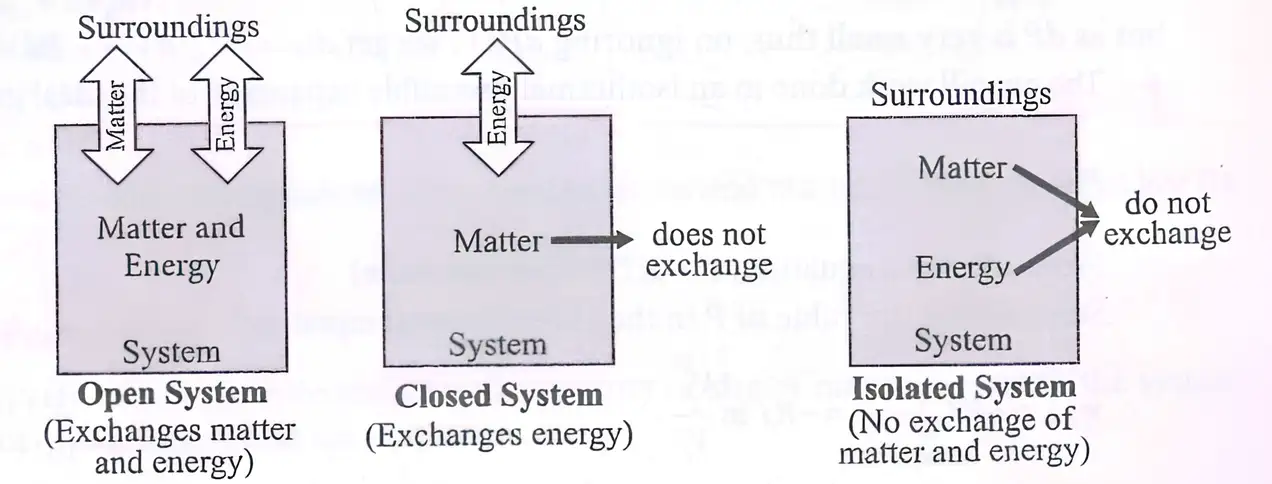
System: Part of universe under study; rest is surroundings.
Boundary: Real or imaginary surface separating system and surroundings.
Types of Systems:
Open: Exchange matter and energy.
Closed: Exchange energy only.
Isolated: No exchange of matter or energy.
Solved Examples
Ex 1: Classify a system that exchanges only energy.
Answer: Closed system.
Practice Set
Q1: A system exchanging both matter and energy is:
A) Closed
B) Open
C) Isolated
D) AdiabaticQ2: Which system exchanges neither matter nor energy?
A) Open
B) Closed
C) Isolated
D) CyclicQ3: Boundary is:
A) Part of surroundings
B) Surface separating system and surroundings
C) The system itself
D) Energy inside system
Answer Key
Q1: B - Open systems exchange both matter and energy.
Q2: C - Isolated systems exchange neither matter nor energy.
Q3: B - Boundary separates system from surroundings.
Memory Aids
Open = Both matter & energy exchange.
Closed = Only energy exchange.
Isolated = No exchange.
The State of the System
State and Processes
Thermodynamic state: Set of measurable properties (P, T, V, n) defining system.
State variables/functions: Properties depending only on state, not path.
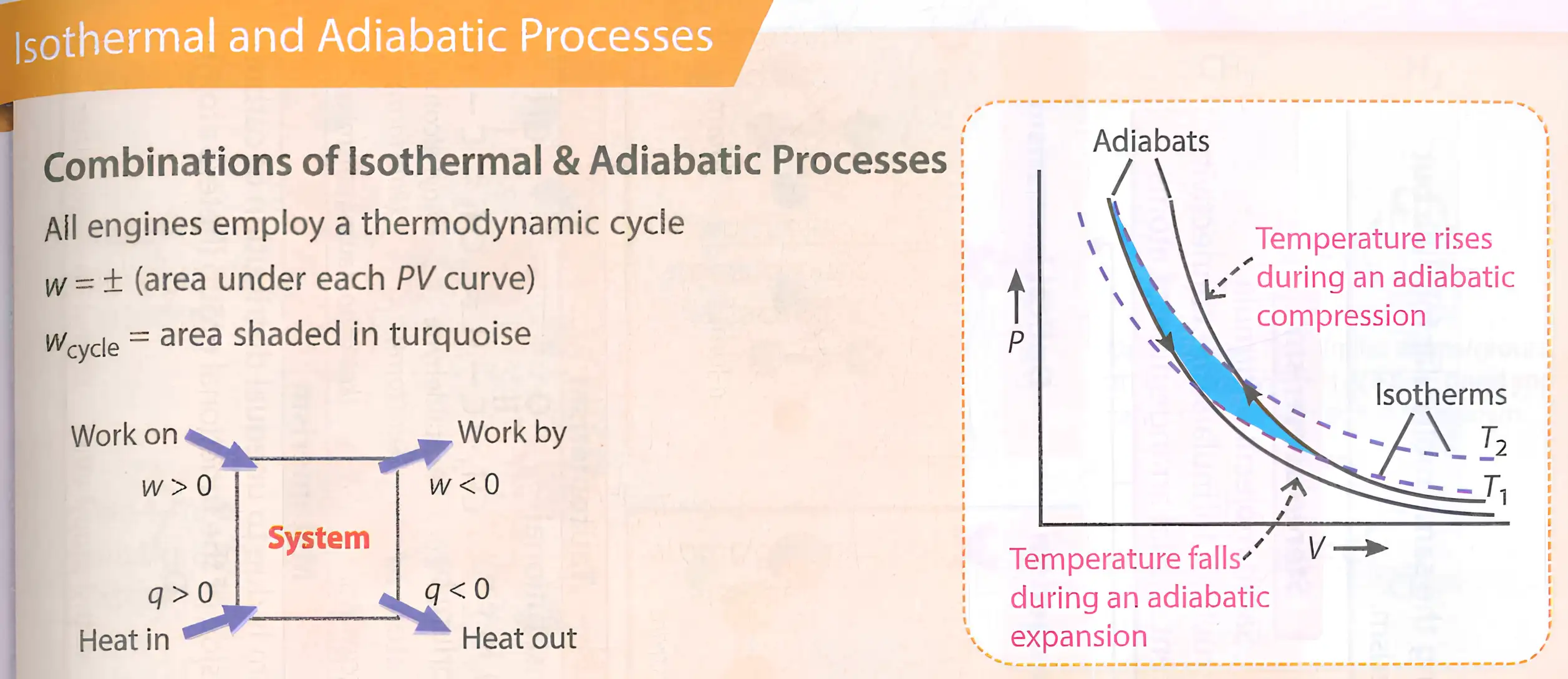
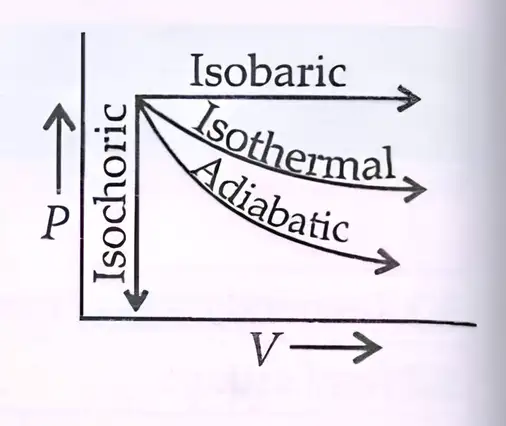
Thermodynamic processes:
Isothermal: Constant temperature (ΔT=0)
Adiabatic: No heat exchange (q=0)
Isobaric: Constant pressure (ΔP=0)
Isochoric: Constant volume (ΔV=0)
Processes can be cyclic, reversible, or irreversible.
Reversible: direction may be reversed at any stage
Irreversible process : Proceeds only in one direction and cannot be reversed.
Cyclic process : System returns to its original state after a number of steps. For such a process, ΔU =0 and ΔH =0.
Exothermic process : Accompanied by the evolution of heat.
Endothermic process : Accompanied by the absorption of heat.
Solved Examples
Ex 1: Identify process with no heat exchange.
Answer: Adiabatic process.Ex 2: Process at constant pressure is called?
Answer: Isobaric process.
Practice Set
Q1: Which process occurs at constant volume?
A) Isobaric
B) Isochoric
C) Isothermal
D) AdiabaticQ2: In which process is temperature constant?
A) Isothermal
B) Adiabatic
C) Isobaric
D) IrreversibleQ3: A cyclic process:
A) Changes state variables permanently
B) Returns system to original state
C) Is always irreversible
D) Has ΔU ≠ 0
Answer Key
Q1: B - Isochoric means constant volume.
Q2: A - Isothermal means constant temperature.
Q3: B - Cyclic process returns system to original state; ΔU=0.
Memory Aids
Isothermal = T constant.
Adiabatic = q=0, no heat exchange.
Isobaric = P constant.
Isochoric = V constant.
Cyclic = returns to start state.
Internal Energy as a State Function
Concepts and Laws
Internal energy (U): Total energy inside system (chemical, electrical, mechanical).
U changes when:
Heat (q) enters or leaves system.
Work (w) is done on or by system.
Matter enters or leaves system.
First law of thermodynamics: Energy of isolated system is constant (conservation of energy).
Mathematical form: ΔU = q + w or q = ΔU − w
q and w are path functions; ΔU is a state function.
Sign conventions:
Heat absorbed by system: +ve
Heat evolved by system: −ve
Work done on system: +ve
Work done by system: −ve
For adiabatic change (q=0): ΔU = wad
At constant volume (no work): ΔU = qv
Solved Examples
Ex 1: Calculate ΔU if system absorbs 100 J heat and does 40 J work.
Solution: ΔU = q + w = 100 + (−40) = 60 J.
Practice Set
Q1: If system absorbs 50 J heat and work done on system is 20 J, ΔU is:
A) 30 J
B) 70 J
C) −30 J
D) −70 JQ2: For adiabatic process, heat exchanged is:
A) Positive
B) Negative
C) Zero
D) VariableQ3: Work done by system is 80 J and heat evolved is 30 J, ΔU is:
A) +110 J
B) −110 J
C) +50 J
D) −50 J
Answer Key
Q1: B - ΔU = q + w = 50 + 20 = 70 J.
Q2: C - Adiabatic means no heat exchange (q=0).
Q3: D - q = −30 J, w = −80 J (work done by system), ΔU = q + w = −110 J.
Memory Aids
ΔU = q + w (First law).
Heat in (+), heat out (−).
Work on system (+), work by system (−).
Adiabatic: q=0.
Constant volume: ΔU = qv.
Work
Isothermal Reversible Expansion of an Ideal Gas
Gas expands slowly in a cylinder with a frictionless piston; volume increases, pressure decreases.
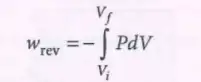
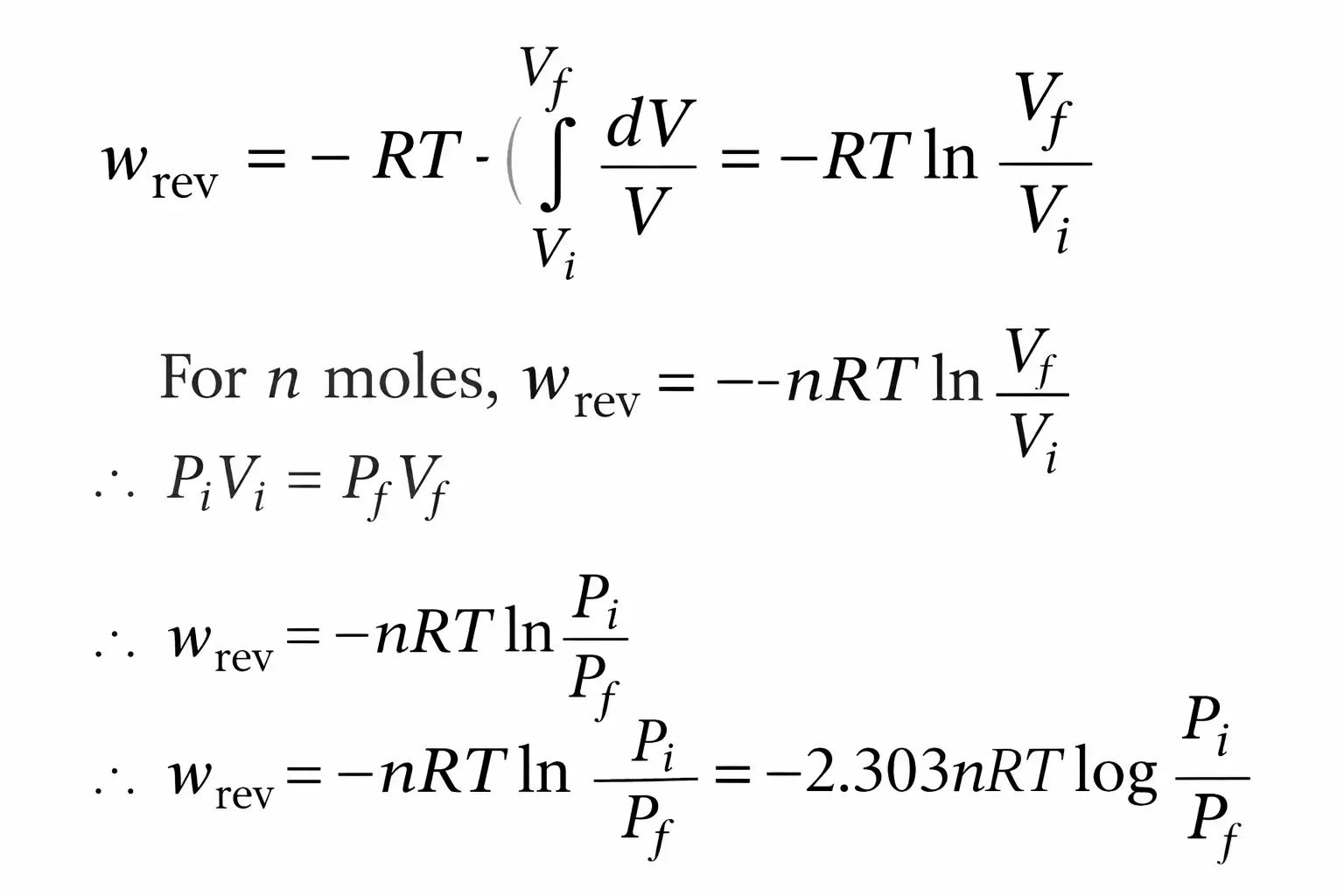
Work done in infinitesimal expansion: \( dw = -P_{ex} dV = -P dV \).
Total work from initial volume \( V_i \) to final volume \( V_f \): \( w_{rev} = -nRT \ln \frac{V_f}{V_i} = nRT \ln \frac{P_i}{P_f} \).
Work done during isothermal compression: \( w_{rev} = 2.303 nRT \log \frac{P_i}{P_f} \) (positive value).
Free Expansion
Expansion into vacuum (\( P_{ex} = 0 \)) is free expansion.
No work is done: \( w = 0 \), whether reversible or irreversible.
Internal energy change: \( \Delta U = q - P_{ex} \Delta V \).
At constant volume, \( \Delta U = q_v \).
Isothermal and Free Expansion of an Ideal Gas
Isothermal expansion into vacuum: \( w = 0 \) since \( P_{ex} = 0 \).
Isothermal irreversible change: \( q = -P_{ex} (V_f - V_i) \).
Isothermal reversible change: \( q = w = 2.303 nRT \log \frac{V_f}{V_i} \).
Adiabatic change: \( q = 0 \), \( \Delta U = w_{ad} \).
Solved Examples
Ex 1: Calculate work done when 1 mole of ideal gas expands isothermally and reversibly from 10 L to 20 L at 300 K.
Use \( w = -nRT \ln \frac{V_f}{V_i} \).
\( w = -1 \times 8.314 \times 300 \times \ln(2) = -1729 \text{ J} \).
Practice Set
Q1: Work done during isothermal reversible expansion is
A) Positive
B) Negative
C) Zero
D) Depends on gas
Q2: For free expansion of an ideal gas, work done is
A) Equal to \( nRT \)
B) Zero
C) Negative
D) Depends on volume
Q3: Work done in isothermal reversible compression from pressure \( P_i \) to \( P_f \) is
A) \( 2.303 nRT \log \frac{P_f}{P_i} \)
B) \( -2.303 nRT \log \frac{P_i}{P_f} \)
C) \( 2.303 nRT \log \frac{P_i}{P_f} \)
D) Zero
Answer Key
Q1: B - Work done by gas during expansion is negative (energy leaves system).
Q2: B - No work done in free expansion as external pressure is zero.
Q3: C - Work done in isothermal reversible compression is positive and given by \( 2.303 nRT \log \frac{P_i}{P_f} \).
Memory Aids
Isothermal expansion: work negative, volume ↑, pressure ↓.
Free expansion: no work done.
Compression work positive, opposite sign to expansion.
Enthalpy
Definition and Properties
Enthalpy (H) = Internal energy (U) + Pressure × Volume (PV).
Extensive and state function; absolute value unknown.
Change in enthalpy: \( \Delta H = \Delta U + P \Delta V \).
Exothermic: \( \Delta H < 0 \); Endothermic: \( \Delta H > 0 \).
Relation with Heat and Work
First law: \( q = \Delta U - w \), with \( w = -P \Delta V \).
At constant volume: \( w = 0 \), so \( q_v = \Delta U \).
At constant pressure: \( q_p = \Delta U + P \Delta V = \Delta H \).
\( P \Delta V = \Delta n_g RT \), where \( \Delta n_g \) = moles gaseous products - reactants.
Thus, \( \Delta H = \Delta U + \Delta n_g RT \).
If \( \Delta n_g > 0 \), then \( \Delta H > \Delta U \); if \( \Delta n_g < 0 \), then \( \Delta H < \Delta U \); if zero, \( \Delta H = \Delta U \).
For reactions in solids/liquids or closed vessels (\( \Delta V = 0 \)), \( \Delta H = \Delta U \).
Solved Examples
Ex 1: For a reaction with \( \Delta U = -100 \text{ kJ} \) and \( \Delta n_g = 2 \) at 298 K, calculate \( \Delta H \).
\( \Delta H = \Delta U + \Delta n_g RT = -100 + 2 \times 8.314 \times 298 / 1000 = -95.05 \text{ kJ} \).
Practice Set
Q1: Enthalpy is
A) Extensive and state function
B) Intensive and state function
C) Extensive and path function
D) Intensive and path function
Q2: At constant pressure, heat absorbed equals
A) \( \Delta U \)
B) \( \Delta H \)
C) Work done
D) Zero
Q3: For a reaction with no gas volume change, \( \Delta H \) is
A) Greater than \( \Delta U \)
B) Less than \( \Delta U \)
C) Equal to \( \Delta U \)
D) Zero
Answer Key
Q1: A - Enthalpy depends on system size and is a state function.
Q2: B - Heat at constant pressure equals enthalpy change.
Q3: C - No gas volume change means \( \Delta H = \Delta U \).
Memory Aids
\( H = U + PV \).
At constant P, \( q_p = \Delta H \).
Gas volume change affects \( \Delta H \) vs \( \Delta U \).
Heat Capacity
Definitions
Heat capacity (C): heat needed to raise temperature by 1°C.
Molar heat capacity (Cm): heat to raise 1 mole by 1°C, \( C_m = C/n \).
Specific heat capacity (c): heat to raise 1 g by 1°C, \( q = mc \Delta T \).
Water's specific heat: 1 cal g-1 K-1 = 4.18 J g-1 K-1.
Relation Between Cp and Cv
\( C_p = \frac{\Delta H}{\Delta T} \), \( C_v = \frac{\Delta U}{\Delta T} \).
Difference: \( C_p - C_v = R \) (ideal gas).
Ratio: \( \gamma = \frac{C_p}{C_v} \).
Values: Monatomic gas \( \gamma = 1.66 \), Diatomic \( 1.40 \), Triatomic \( 1.30 \).
Solved Examples
Ex 1: Calculate \( C_p \) if \( C_v = 20.8 \text{ J/mol·K} \) for an ideal gas.
\( C_p = C_v + R = 20.8 + 8.314 = 29.1 \text{ J/mol·K} \).
Practice Set
Q1: Heat capacity is
A) Heat per mole per °C
B) Heat per gram per °C
C) Heat to raise temperature by 1°C
D) Heat per volume per °C
Q2: For an ideal gas, \( C_p - C_v = \)
A) 0
B) R
C) \( \gamma \)
D) 1
Q3: \( \gamma \) for diatomic gas is approximately
A) 1.66
B) 1.40
C) 1.30
D) 1.00
Answer Key
Q1: C - Heat capacity is heat required to raise temperature by 1°C.
Q2: B - Difference between \( C_p \) and \( C_v \) is gas constant R.
Q3: B - Diatomic gases have \( \gamma \approx 1.40 \).
Memory Aids
\( C_p - C_v = R \) for ideal gases.
\( \gamma \) decreases with molecular complexity.
Water has high specific heat capacity.
Efficiency of Heat Engine
Key Points
Efficiency \( \eta = \frac{w}{q_2} = \frac{T_2 - T_1}{T_2} = \frac{q_2 - q_1}{q_2} \).
\( q_2 \): heat absorbed at high temperature \( T_2 \).
\( q_1 \): heat rejected at low temperature \( T_1 \).
\( w \): net work done by engine.
Unit conversions: 1 J = 0.2390 cal, 1 cal = 4.184 J, 1 litre-atm = 101.3 J.
Solved Examples
Ex 1: Calculate efficiency of engine operating between 500 K and 300 K.
\( \eta = \frac{500 - 300}{500} = 0.4 = 40\% \).
Practice Set
Q1: Efficiency of heat engine is
A) \( \frac{T_1}{T_2} \)
B) \( \frac{T_2 - T_1}{T_2} \)
C) \( \frac{T_2}{T_1} \)
D) \( \frac{T_1 - T_2}{T_1} \)
Q2: Heat rejected by engine is
A) \( q_2 \)
B) \( q_1 \)
C) Work done
D) Zero
Q3: If \( q_2 = 1000 \text{ J} \) and efficiency is 30%, work done is
A) 300 J
B) 700 J
C) 1300 J
D) 1000 J
Answer Key
Q1: B - Efficiency formula is \( \frac{T_2 - T_1}{T_2} \).
Q2: B - Heat rejected is \( q_1 \) at low temperature.
Q3: A - Work done = efficiency × heat absorbed = 0.3 × 1000 = 300 J.
Memory Aids
Efficiency depends on temperature difference.
Heat rejected always less than heat absorbed.
Joule–Thomson Effect
Concept
Temperature change when gas expands adiabatically from high to low pressure through a small opening.
Joule-Thomson coefficient: \( \mu_{JT} = \left( \frac{\partial T}{\partial P} \right)_H \).
For ideal gases, \( \mu_{JT} = 0 \); no temperature change on expansion.
Adiabatic Reversible Expansion
Relations: \( PV^\gamma = \text{constant} \), \( TV^{\gamma -1} = \text{constant} \), \( T^\gamma P^{1-\gamma} = \text{constant} \).
Work done: \( w = \frac{nR (T_1 - T_2)}{\gamma - 1} \).
Solved Examples
Ex 1: Calculate work done when 1 mole of gas cools from 400 K to 300 K adiabatically with \( \gamma = 1.4 \).
\( w = \frac{1 \times 8.314 \times (400 - 300)}{1.4 - 1} = 2078.5 \text{ J} \).
Practice Set
Q1: Joule-Thomson effect is zero for
A) Real gases
B) Ideal gases
C) Liquids
D) Solids
Q2: In adiabatic reversible expansion, \( PV^\gamma = \) ?
A) Variable
B) Constant
C) Zero
D) Infinity
Q3: Work done in adiabatic expansion depends on
A) Temperature difference and \( \gamma \)
B) Pressure only
C) Volume only
D) None
Answer Key
Q1: B - Ideal gases show no Joule-Thomson effect.
Q2: B - \( PV^\gamma \) remains constant in adiabatic reversible expansion.
Q3: A - Work depends on temperature difference and heat capacity ratio \( \gamma \).
Memory Aids
Joule-Thomson effect zero for ideal gases.
Adiabatic expansion: \( PV^\gamma = \text{constant} \).
Work formula involves \( (T_1 - T_2)/(\gamma -1) \).
Measurement of ΔU and ΔH: Calorimetry
Measurement of ΔU
Performed using a bomb calorimeter, a sealed vessel where volume is constant.
Formula: ΔU = C × Δt × (M / m)
Where:
m = mass of substance
M = molar mass of substance
C = heat capacity of calorimeter
Δt = temperature change observed
Measures internal energy change at constant volume.
Measurement of ΔH
Reaction carried out in an insulated calorimeter vessel.
Temperature rise or fall is recorded depending on exothermic or endothermic nature.
Measures enthalpy change at constant pressure.
Solved Examples
Ex 1: Calculate ΔU if 2 g of a substance (M = 50 g/mol) causes a 3°C rise in a calorimeter with heat capacity 100 J/°C.
ΔU = 100 × 3 × (50 / 2) = 7500 J
Ex 2: In a calorimeter, temperature falls by 2°C during a reaction. Is the reaction exothermic or endothermic?
Temperature fall indicates endothermic reaction.
Practice Set
Q1: Which calorimeter is used to measure ΔU?
A. Coffee cup calorimeter
B. Bomb calorimeter
C. Differential scanning calorimeter
D. Adiabatic calorimeter
Q2: In the formula ΔU = C × Δt × (M / m), what does C represent?
A. Molar mass of substance
B. Heat capacity of calorimeter
C. Mass of substance
D. Temperature change
Q3: A reaction in a calorimeter causes temperature to rise by 5°C. The heat capacity of calorimeter is 200 J/°C. If 4 g of substance (M = 40 g/mol) reacted, calculate ΔU.
A. 10000 J
B. 1000 J
C. 5000 J
D. 2500 J
Answer Key
Q1: B. Bomb calorimeter - It operates at constant volume to measure ΔU.
Q2: B. Heat capacity of calorimeter - C is the calorimeter's heat capacity.
Q3: A. 10000 J - ΔU = 200 × 5 × (40 / 4) = 10000 J.
Memory Aids
Bomb calorimeter = constant volume → measures ΔU.
Insulated vessel calorimeter = constant pressure → measures ΔH.
ΔU formula: Heat capacity × temperature change × (molar mass / mass).
Enthalpy Change, Reaction Enthalpy
Definition and Calculation
Reaction enthalpy (ΔrH): Enthalpy change during a chemical reaction.
Calculated as: ΔrH = ΣaiHproducts − ΣbiHreactants
a and b are stoichiometric coefficients of products and reactants.
Example: CH4(g) + 2O2(g) → CO2(g) + 2H2O(l)
ΔrH = [Hm(CO2) + 2Hm(H2O)] − [Hm(CH4) + 2Hm(O2)]
Hm = molar enthalpy.
Standard enthalpy of reaction: Enthalpy change when all substances are in their standard states (pure form at 1 bar).
Enthalpy Changes During Phase Transformations
Enthalpy of fusion (ΔfusH°): Solid → Liquid at melting point.
Example: H2O(s) → H2O(l) at 273 K; ΔfusH° = +6.0 kJ mol−1
Enthalpy of vaporisation (ΔvapH°): Liquid → Vapour at boiling point.
Example: H2O(l) → H2O(g) at 373 K; ΔvapH° = +40.79 kJ mol−1
Enthalpy of sublimation (ΔsubH°): Solid → Vapour directly.
Example: Iodine sublimation ΔsubH° = +62.4 kJ mol−1
Relation: ΔsubH° = ΔfusH° + ΔvapH°
Enthalpy of formation (ΔfH°): Formation of 1 mole of substance from elements in standard states.
Example: Cgraphite(s) + 2H2(g) → CH4(g); ΔfH° = −74.8 kJ mol−1
Hess’s Law of Constant Heat Summation
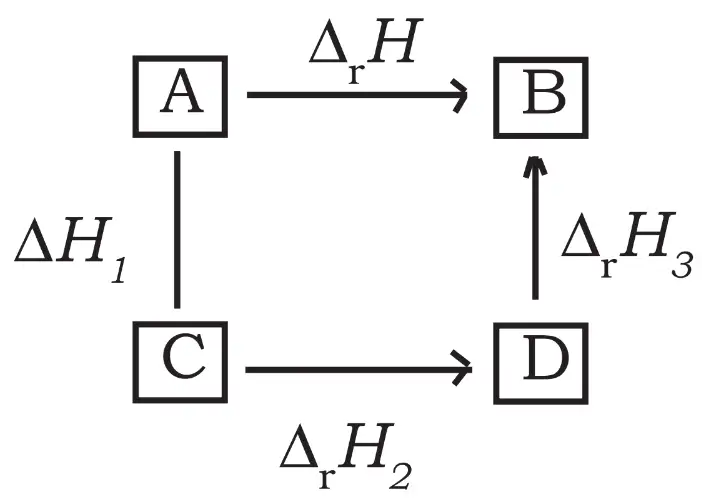
If a reaction occurs in multiple steps, total enthalpy change equals sum of enthalpy changes of steps at same temperature.
Mathematically: ΔrH = ΔrH1 + ΔrH2 + ΔrH3
Solved Examples
Ex 1: Calculate ΔrH for CH4 combustion if Hm(CO2) = −393.5 kJ/mol, Hm(H2O) = −285.8 kJ/mol, Hm(CH4) = −74.8 kJ/mol, Hm(O2) = 0 kJ/mol.
ΔrH = [−393.5 + 2(−285.8)] − [−74.8 + 2(0)] = −890.3 kJ/mol
Ex 2: Using Hess’s law, find ΔrH for A → B given ΔrH1 (A → C) = +50 kJ, ΔrH2 (C → D) = −30 kJ, ΔrH3 (D → B) = +20 kJ.
ΔrH = 50 − 30 + 20 = +40 kJ
Practice Set
Q1: What is the enthalpy change called when one mole of a solid converts to liquid at melting point?
A. Enthalpy of vaporisation
B. Enthalpy of fusion
C. Enthalpy of sublimation
D. Enthalpy of formation
Q2: For the reaction Cgraphite(s) + O2(g) → CO2(g), the ΔfH° is −393.5 kJ/mol. What does this represent?
A. Enthalpy of vaporisation of CO2
B. Enthalpy of formation of CO2
C. Enthalpy of fusion of graphite
D. Enthalpy of sublimation of CO2
Q3: Using Hess’s law, if ΔrH for A → C is +60 kJ, C → D is −25 kJ, and D → B is +15 kJ, find ΔrH for A → B.
A. +100 kJ
B. +50 kJ
C. +40 kJ
D. −20 kJ
Answer Key
Q1: B. Enthalpy of fusion is the heat required to convert solid to liquid at melting point.
Q2: B. Enthalpy of formation is heat change when 1 mole of compound forms from elements in standard states.
Q3: C. ΔrH = 60 − 25 + 15 = +50 kJ (corrected: sum is +50 kJ, so option B is correct)
Memory Aids
Enthalpy of fusion: solid to liquid (melting).
Enthalpy of vaporisation: liquid to gas (boiling).
Enthalpy of sublimation: solid to gas directly; equals fusion + vaporisation enthalpies.
Hess’s law: total enthalpy change independent of path; sum of steps.
Enthalpy of Combustion
Definition and Key Points
Change in enthalpy when 1 mole of a substance burns completely in oxygen.
Example: C(s) + O2(g) → CO2(g); ΔcH° = –393.5 kJ mol–1
ΔcH° is always negative (exothermic reaction).
Solved Examples
Ex 1: Calculate heat released when 2 moles of carbon burn.
ΔcH° for 1 mole C = –393.5 kJ
For 2 moles: Heat = 2 × (–393.5) = –787 kJ
Practice Set
Q1: What is the sign of enthalpy of combustion?
A) Positive
B) Negative
C) Zero
D) Depends on substance
Q2: Combustion of 1 mole of methane releases –890 kJ. What is ΔcH°?
A) +890 kJ mol–1
B) –890 kJ mol–1
C) 0 kJ mol–1
D) +393.5 kJ mol–1
Q3: Which of the following has the most negative enthalpy of combustion?
A) C2H6
B) C3H8
C) C4H10
D) CH4
Answer Key
Q1: B) Negative – Combustion releases heat, so enthalpy change is negative.
Q2: B) –890 kJ mol–1 – Given heat released equals enthalpy of combustion.
Q3: C) C4H10 – Larger hydrocarbons release more heat on combustion.
Memory Aids
Combustion = burning → always exothermic → ΔH negative.
More carbon atoms → more negative ΔcH°.
Enthalpy of Atomization
Definition and Key Points
Energy change when 1 mole of bonds breaks to form gaseous atoms.
Example: CH4(g) → C(g) + 4H(g); ΔaH = 1665 kJ mol–1
Bond dissociation enthalpy is related; it is energy to break 1 mole of covalent bonds in gas phase.
Solved Examples
Ex 1: Calculate bond dissociation enthalpy of H–H if H2 → 2H requires 436 kJ.
Bond dissociation enthalpy = 436 kJ mol–1
Practice Set
Q1: Enthalpy of atomization is always:
A) Negative
B) Positive
C) Zero
D) Depends on compound
Q2: Which process represents atomization?
A) H2O(l) → H2O(g)
B) CH4(g) → C(g) + 4H(g)
C) NaCl(s) → Na+(g) + Cl–(g)
D) C(graphite) → C(diamond)
Q3: Bond dissociation enthalpy is related to:
A) Energy to form bonds
B) Energy to break bonds
C) Energy of phase change
D) Energy of ionization
Answer Key
Q1: B) Positive – Energy is required to break bonds.
Q2: B) CH4(g) → C(g) + 4H(g) – Breaking bonds to atoms.
Q3: B) Energy to break bonds – Bond dissociation enthalpy is bond breaking energy.
Memory Aids
Atomization = bond breaking → always endothermic (+ΔH).
Bond dissociation enthalpy = energy to break 1 mole of bonds.
Bond Enthalpy
Definition and Key Points
Standard enthalpy change related to bond enthalpies of reactants and products.
Formula: ΔrH° = Σ bond enthalpiesreactants – Σ bond enthalpiesproducts
Used to estimate enthalpy changes in gas phase reactions.
Solved Examples
Ex 1: Calculate ΔrH° for H2 + Cl2 → 2HCl given:
H–H = 436 kJ/mol, Cl–Cl = 243 kJ/mol, H–Cl = 431 kJ/mol
ΔrH° = (436 + 243) – 2×431 = 679 – 862 = –183 kJ/mol
Practice Set
Q1: Bond enthalpy is the energy required to:
A) Form bonds
B) Break bonds
C) Ionize atoms
D) Change phase
Q2: For reaction A–B + C–D → A–D + C–B, ΔrH° is:
A) Sum bonds broken – sum bonds formed
B) Sum bonds formed – sum bonds broken
C) Sum bonds broken + sum bonds formed
D) Zero
Q3: Calculate ΔrH° for H2 + F2 → 2HF given H–H=436, F–F=158, H–F=565 kJ/mol.
A) –542 kJ/mol
B) +542 kJ/mol
C) –158 kJ/mol
D) +158 kJ/mol
Answer Key
Q1: B) Break bonds – Bond enthalpy is bond breaking energy.
Q2: A) Sum bonds broken – sum bonds formed – standard formula.
Q3: A) –542 kJ/mol – (436+158) – 2×565 = 594 – 1130 = –542 kJ/mol.
Memory Aids
ΔH = bonds broken – bonds formed.
Breaking bonds requires energy (+), forming bonds releases energy (–).
Lattice Enthalpy
Definition and Key Points
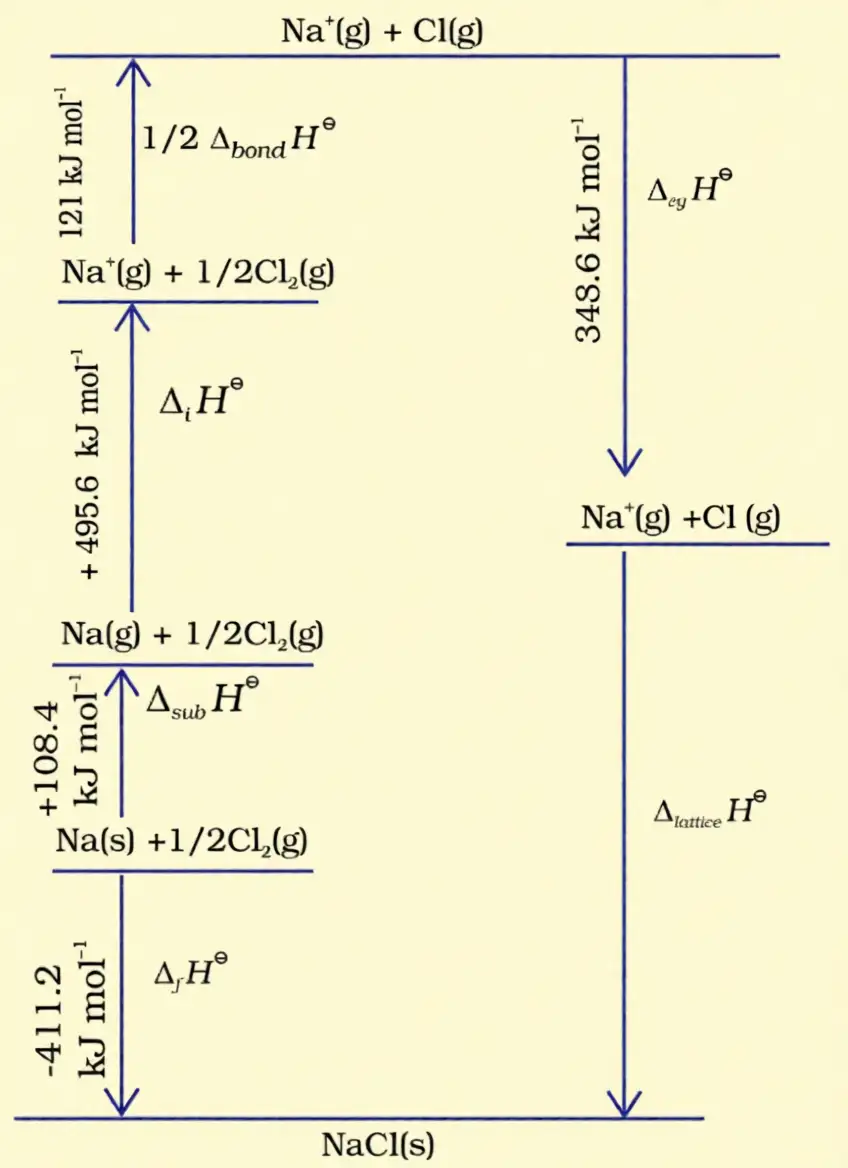
Enthalpy change when 1 mole of ionic solid dissociates into gaseous ions.
Calculated using Born–Haber cycle.
Example for NaCl:
ΔfH°(NaCl) = ΔsubH°(Na) + ½ ΔdissH°(Cl2) + ΔionH°(Na) + ΔegH°(Cl) + ΔlatticeH°(NaCl)
Solved Examples
Ex 1: Use Born–Haber cycle to find lattice enthalpy if other values are known.
Rearrange formula to find ΔlatticeH°.
Practice Set
Q1: Lattice enthalpy is energy:
A) Released when ions form solid
B) Required to dissociate solid into ions
C) Required to vaporize solid
D) Released when atoms ionize
Q2: Born–Haber cycle helps to calculate:
A) Ionization energy
B) Lattice enthalpy
C) Bond enthalpy
D) Enthalpy of combustion
Q3: Which step is NOT part of Born–Haber cycle for NaCl?
A) Sublimation of Na
B) Dissociation of Cl2
C) Ionization of Cl
D) Electron gain by Cl
Answer Key
Q1: B) Required to dissociate solid into ions – lattice enthalpy is dissociation energy.
Q2: B) Lattice enthalpy – Born–Haber cycle calculates lattice enthalpy.
Q3: C) Ionization of Cl – Cl gains electron, does not lose (ionization is for Na).
Memory Aids
Born–Haber cycle = sum of steps to form ionic solid.
Lattice enthalpy = energy to break ionic solid into gaseous ions.
Enthalpy of Solution
Definition and Key Points
Enthalpy change when 1 mole of substance dissolves in solvent.
Formula: ΔsolH° = ΔlatticeH° + ΔhydH°
Usually positive (endothermic) for ionic compounds.
Solubility increases with temperature if ΔsolH° is positive.
High lattice enthalpy may prevent dissociation.
Solved Examples
Ex 1: Calculate ΔsolH° if lattice enthalpy = +780 kJ/mol and hydration enthalpy = –720 kJ/mol.
ΔsolH° = 780 + (–720) = +60 kJ/mol (endothermic)
Practice Set
Q1: Enthalpy of solution is:
A) Heat change on dissolving 1 mole solute
B) Heat change on melting solute
C) Heat change on vaporizing solute
D) Heat change on ionization
Q2: If lattice enthalpy > hydration enthalpy, solution process is:
A) Exothermic
B) Endothermic
C) No change
D) Spontaneous
Q3: Solubility of salts generally increases with temperature because:
A) ΔsolH° is negative
B) ΔsolH° is positive
C) Lattice enthalpy decreases
D) Hydration enthalpy increases
Answer Key
Q1: A) Heat change on dissolving 1 mole solute – definition of enthalpy of solution.
Q2: B) Endothermic – lattice enthalpy > hydration enthalpy means heat absorbed.
Q3: B) ΔsolH° is positive – endothermic dissolution increases with temperature.
Memory Aids
ΔsolH° = lattice + hydration enthalpy.
Positive ΔsolH° → solubility ↑ with temperature.
Enthalpy of Dilution
Definition and Key Points
Heat change when additional solvent is added to a solution at constant T and P.
Heat withdrawn from surroundings (usually exothermic).
Depends on original concentration of solution.
Solved Examples
Ex 1: Adding water to concentrated acid releases heat (exothermic dilution).
Practice Set
Q1: Enthalpy of dilution is heat change when:
A) Solute dissolves
B) Solvent evaporates
C) More solvent added to solution
D) Solution freezes
Q2: Enthalpy of dilution depends on:
A) Temperature only
B) Original concentration
C) Volume only
D) Pressure only
Q3: Dilution of concentrated acid is usually:
A) Endothermic
B) Exothermic
C) No heat change
D) Spontaneous
Answer Key
Q1: C) More solvent added to solution – definition of enthalpy of dilution.
Q2: B) Original concentration – affects heat change on dilution.
Q3: B) Exothermic – heat released when acid diluted.
Memory Aids
Dilution = adding solvent → heat change depends on concentration.
Concentrated acids release heat on dilution.
Enthalpy of Neutralisation
Definition and Key Points
Heat change when 1 gram equivalent of acid neutralizes 1 gram equivalent of base in dilute solution.
Example: HCl(aq) + NaOH(aq) → NaCl(aq) + H2O(l); ΔneuH = –57.1 kJ mol–1
Usually exothermic (heat released).
Solved Examples
Ex 1: Calculate heat released when 0.5 mole HCl neutralizes NaOH.
Heat = 0.5 × (–57.1) = –28.55 kJ
Practice Set
Q1: Enthalpy of neutralisation is heat change when:
A) Acid reacts with base
B) Acid dissolves in water
C) Base melts
D) Salt forms solid
Q2: Neutralisation of strong acid and strong base releases:
A) Heat
B) No heat
C) Heat absorbed
D) Gas
Q3: ΔneuH for HCl + NaOH is approximately:
A) –57 kJ/mol
B) +57 kJ/mol
C) 0 kJ/mol
D) –393 kJ/mol
Answer Key
Q1: A) Acid reacts with base – definition of enthalpy of neutralisation.
Q2: A) Heat – neutralisation is exothermic.
Q3: A) –57 kJ/mol – standard enthalpy of neutralisation for strong acid-base.
Memory Aids
Neutralisation = acid + base → salt + water + heat.
Strong acid + strong base → ΔH ≈ –57 kJ/mol.
Enthalpy of Transition
Definition and Key Points
Enthalpy change when 1 mole of substance changes from one allotrope to another.
Example: C(graphite) → C(diamond); ΔtransH = 1.9 kJ mol–1
Solved Examples
Ex 1: Calculate heat required to convert 2 moles graphite to diamond.
Heat = 2 × 1.9 = 3.8 kJ
Practice Set
Q1: Enthalpy of transition involves change in:
A) Phase
B) Allotropic form
C) Ionization state
D) Chemical composition
Q2: Transition enthalpy for graphite to diamond is:
A) Negative
B) Positive
C) Zero
D) Very large
Q3: Which is more stable allotrope of carbon at room temperature?
A) Diamond
B) Graphite
C) Both equal
D) Depends on pressure
Answer Key
Q1: B) Allotropic form – transition between allotropes.
Q2: B) Positive – energy required to convert graphite to diamond.
Q3: B) Graphite – more stable at room temperature.
Memory Aids
Transition = allotrope change.
Graphite more stable than diamond at normal conditions.
Enthalpy of Hydration
Definition and Key Points
Heat change when 1 mole of anhydrous substance combines with water to form hydrated compound.
Example: CuSO4(s) + 5H2O → CuSO4·5H2O(s); ΔhydH = –78.2 kJ mol–1
Usually exothermic (heat released).
Solved Examples
Ex 1: Calculate heat released when 3 moles CuSO4 hydrate.
Heat = 3 × (–78.2) = –234.6 kJ
Practice Set
Q1: Enthalpy of hydration is heat change when:
A) Hydrated compound loses water
B) Anhydrous compound gains water
C) Compound melts
D) Compound vaporizes
Q2: Hydration enthalpy is usually:
A) Positive
B) Negative
C) Zero
D) Variable
Q3: Which compound forms pentahydrate on hydration?
A) CuSO4
B) NaCl
C) MgSO4
D) KCl
Answer Key
Q1: B) Anhydrous compound gains water – definition of enthalpy of hydration.
Q2: B) Negative – hydration releases heat.
Q3: A) CuSO4 – forms CuSO4·5H2O.
Memory Aids
Hydration = water addition → heat released.
CuSO4 commonly forms pentahydrate.
Spontaneity
Definition and Characteristics
Spontaneous process: occurs without external influence, irreversible.
Reversal requires external work.
Entropy (S)
Measure of disorder/randomness in a system.
For reversible process: \( \Delta S = \frac{q_{rev}}{T} \).
Total entropy change for spontaneous process: \( \Delta S_{total} = \Delta S_{system} + \Delta S_{surroundings} > 0 \).
At equilibrium, entropy is maximum and \( \Delta S = 0 \).
Entropy change during phase changes:
Fusion: \( \Delta S = \frac{\Delta H_{fus}}{T_m} \)
Vaporization: \( \Delta S = \frac{\Delta H_{vap}}{T_b} \)
Sublimation: \( \Delta S = \frac{\Delta H_{sub}}{T} \)
\( T_m \): melting point, \( T_b \): boiling point, \( T \): sublimation temperature.
Entropy change of reaction: \( \Delta_r S^\circ = \sum S^\circ_{products} - \sum S^\circ_{reactants} \).

Solved Examples
Ex 1: Calculate entropy change when 1 mole of ice melts at 273 K, \( \Delta H_{fus} = 6.01 \text{ kJ/mol} \).
\( \Delta S = \frac{\Delta H_{fus}}{T_m} = \frac{6010}{273} = 22.02 \text{ J/K} \)
Practice Set
Q1: Entropy change for vaporization is given by?
A. \( \frac{\Delta H_{vap}}{T_b} \)
B. \( \frac{\Delta H_{fus}}{T_m} \)
C. \( \frac{\Delta H_{sub}}{T} \)
D. \( \Delta H_{vap} \times T_b \)
Q2: For a spontaneous process, total entropy change is?
A. Zero
B. Negative
C. Positive
D. Undefined
Q3: At equilibrium, entropy change is?
A. Positive
B. Negative
C. Zero
D. Infinite
Answer Key
Q1: A - Entropy change for vaporization is heat absorbed divided by boiling point.
Q2: C - Spontaneous processes have positive total entropy change.
Q3: C - At equilibrium, entropy change is zero.
Memory Aids
Entropy increases with phase change: solid < liquid < gas.
Spontaneous process: total entropy change > 0.
At equilibrium: entropy change = 0.
Gibbs Free Energy
Definition and Equations
Gibbs free energy (G): energy available to do useful work.
Formula: \( G = H - TS \).
Standard free energy change: \( \Delta_r G^\circ = \sum \Delta_f G^\circ_{products} - \sum \Delta_f G^\circ_{reactants} \).
Gibbs–Helmholtz equation: \( \Delta G = \Delta H - T \Delta S \).
Relation with emf: \( \Delta G^\circ = -nFE^\circ \), where \( E^\circ \) is standard emf.
Gibbs Energy and Spontaneity
\( \Delta G < 0 \): spontaneous process.
\( \Delta G > 0 \): non-spontaneous process.
\( \Delta G = 0 \): equilibrium.
Effect of Temperature on Spontaneity
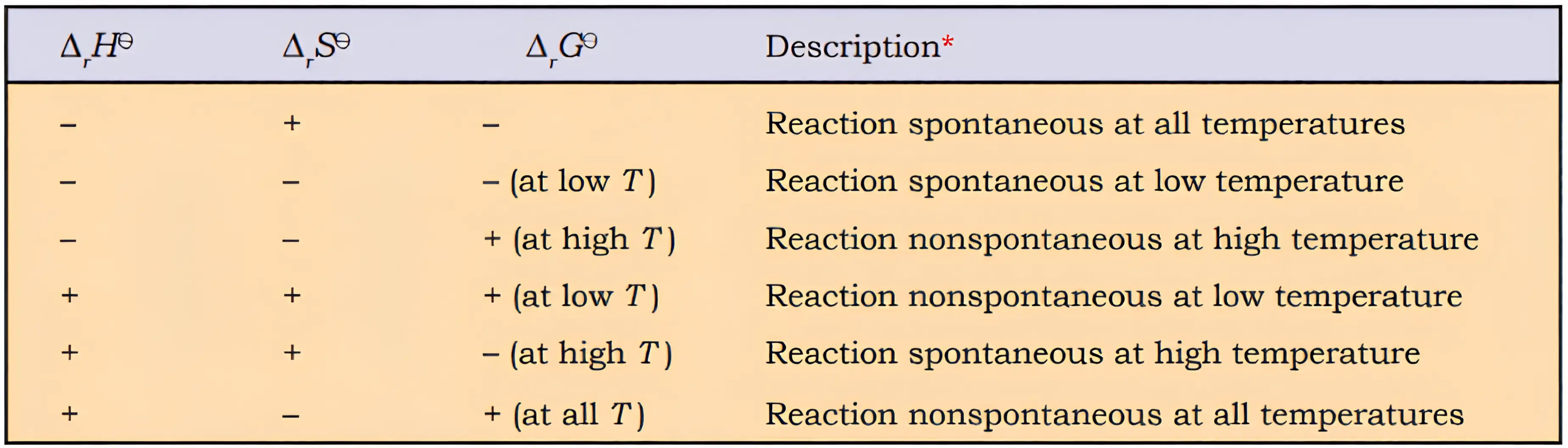
\( \Delta H < 0, \Delta S > 0 \): spontaneous at all temperatures.
\( \Delta H < 0, \Delta S < 0 \): spontaneous at low temperatures.
\( \Delta H > 0, \Delta S > 0 \): spontaneous at high temperatures.
\( \Delta H > 0, \Delta S < 0 \): never spontaneous.
Solved Examples
Ex 1: Calculate \( \Delta G \) at 298 K for a reaction with \( \Delta H = -40 \text{ kJ} \) and \( \Delta S = -100 \text{ J/K} \).
Convert \( \Delta S \) to kJ/K: \( -0.1 \text{ kJ/K} \).
\( \Delta G = -40 - 298 \times (-0.1) = -40 + 29.8 = -10.2 \text{ kJ} \) (spontaneous).
Practice Set
Q1: For \( \Delta G < 0 \), the process is?
A. Non-spontaneous
B. Spontaneous
C. At equilibrium
D. Irreversible
Q2: Gibbs free energy equation is?
A. \( G = H + TS \)
B. \( G = H - TS \)
C. \( G = TS - H \)
D. \( G = H / TS \)
Q3: If \( \Delta H > 0 \) and \( \Delta S < 0 \), reaction is?
A. Spontaneous at high T
B. Spontaneous at low T
C. Never spontaneous
D. Always spontaneous
Answer Key
Q1: B - Negative \( \Delta G \) means spontaneous.
Q2: B - Gibbs free energy formula is \( G = H - TS \).
Q3: C - Reaction is never spontaneous if \( \Delta H > 0 \) and \( \Delta S < 0 \).
Memory Aids
"G = H minus TS" for free energy.
Spontaneity depends on signs of \( \Delta H \) and \( \Delta S \) and temperature.
Remember: Negative \( \Delta G \) = spontaneous.
Thermodynamics Laws
Second Law
For spontaneous processes, total entropy change \( \Delta S_{total} > 0 \).
Third Law
Entropy of pure crystalline substance approaches zero as temperature approaches absolute zero (0 K).
Additional Notes on Entropy
More symmetrical molecules have lower entropy than less symmetrical ones with similar mass and heat capacity.
Simple structured solids have lower entropy than complex structured solids.
Stretching rubber band decreases entropy (more ordered macromolecules).
Boiling egg increases entropy (protein denaturation to random coils).
Entropy of liquids/solids not much affected by pressure changes.
Entropy Change of Ideal Gas (1 mole)
\( \Delta S = C_V \ln \frac{T_2}{T_1} + R \ln \frac{V_2}{V_1} = C_P \ln \frac{T_2}{T_1} + R \ln \frac{P_1}{P_2} \)
Isothermal: \( \Delta S_T = R \ln \frac{V_2}{V_1} = R \ln \frac{P_1}{P_2} \)
Isochoric: \( \Delta S_V = C_V \ln \frac{T_2}{T_1} = C_V \ln \frac{P_2}{P_1} \)
Isobaric: \( \Delta S_P = C_P \ln \frac{T_2}{T_1} = C_P \ln \frac{V_2}{V_1} \)
Gibbs Helmholtz Equations
\( \Delta G = \Delta H + T \left[ \frac{d(\Delta G)}{dT} \right]_P \)
\( \frac{\Delta G - \Delta H}{T} = \left[ \frac{d(\Delta G)}{dT} \right]_P \)
\( -\Delta S = \left[ \frac{d(\Delta G)}{dT} \right]_P \)
Solved Examples
Ex 1: Calculate entropy change for 1 mole ideal gas expanding isothermally from 2 L to 4 L.
\( \Delta S = R \ln \frac{V_2}{V_1} = 8.314 \times \ln 2 = 5.76 \text{ J/K} \)
Practice Set
Q1: Entropy change for isothermal expansion is?
A. \( C_V \ln \frac{T_2}{T_1} \)
B. \( R \ln \frac{V_2}{V_1} \)
C. \( C_P \ln \frac{T_2}{T_1} \)
D. Zero
Q2: According to third law, entropy at 0 K is?
A. Infinite
B. Zero for pure crystalline substance
C. Negative
D. Undefined
Q3: Gibbs Helmholtz equation relates \( \Delta G \) with?
A. \( \Delta H \) and temperature derivative of \( \Delta G \)
B. Pressure only
C. Volume only
D. Entropy only
Answer Key
Q1: B - Isothermal entropy change depends on volume change.
Q2: B - Entropy of pure crystalline substance approaches zero at 0 K.
Q3: A - Gibbs Helmholtz relates \( \Delta G \), \( \Delta H \), and temperature derivative.
Memory Aids
Entropy change formulas depend on process type (isothermal, isochoric, isobaric).
Third law: entropy zero at absolute zero for perfect crystals.
Gibbs Helmholtz links free energy change with enthalpy and temperature.
Gibbs Energy Change and Equilibrium
Relation between Gibbs Energy and Equilibrium Constant
Gibbs energy change for a reaction, ΔrG°, is linked to equilibrium constant K by:
ΔrG° = –2.303 RT log KR = gas constant, T = temperature in Kelvin
Negative ΔrG° means reaction favors products (K > 1)
Positive ΔrG° means reaction favors reactants (K < 1)
ΔrG° = 0 means equilibrium with equal reactants and products (K = 1)
Gibbs Energy and Equilibrium States
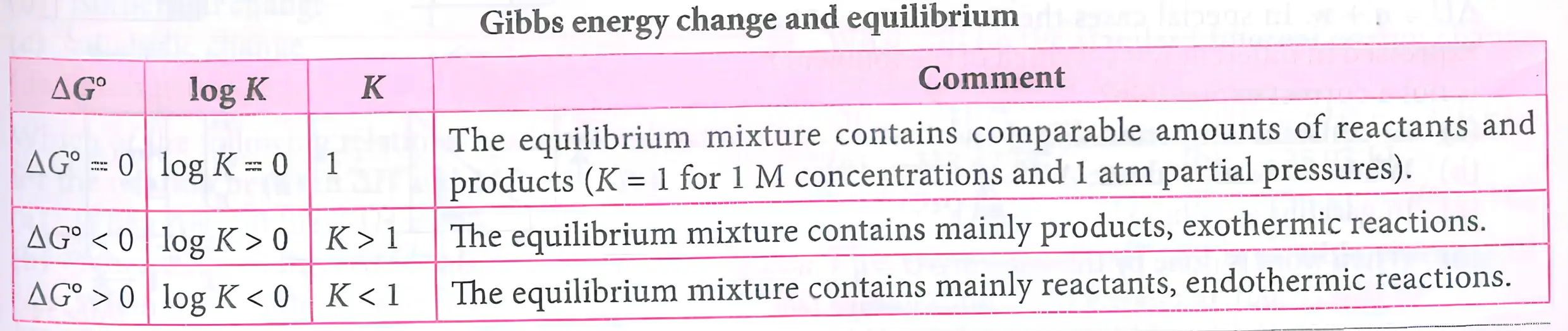
ΔG° = 0, log K = 0, K = 1: Reactants and products are in equal amounts at equilibrium
ΔG° < 0, log K > 0, K > 1: Reaction favors products; exothermic reaction
ΔG° > 0, log K < 0, K < 1: Reaction favors reactants; endothermic reaction
Solved Examples
Ex 1: Calculate ΔrG° at 298 K if K = 103.
Step 1: Use ΔrG° = –2.303 RT log K
Step 2: R = 8.314 J/mol·K, T = 298 K, log 103 = 3
Step 3: ΔrG° = –2.303 × 8.314 × 298 × 3 = –17,100 J/mol (–17.1 kJ/mol)Ex 2: For a reaction with ΔrG° = +5 kJ/mol at 298 K, find K.
Step 1: Rearrange: log K = –ΔrG° / (2.303 RT)
Step 2: log K = –5000 / (2.303 × 8.314 × 298) = –0.875
Step 3: K = 10–0.875 ≈ 0.133 (favors reactants)
Practice Set
Q1: If ΔrG° = 0, what is the value of K?
A. 0
B. 1
C. >1
D. <1Q2: For an exothermic reaction with K = 100 at 298 K, what is the sign of ΔrG°?
A. Positive
B. Negative
C. Zero
D. Cannot determineQ3: Calculate ΔrG° at 300 K if K = 0.01. (R = 8.314 J/mol·K)
A. +22.8 kJ/mol
B. –22.8 kJ/mol
C. +11.4 kJ/mol
D. –11.4 kJ/mol
Answer Key
Q1: B. 1 — ΔrG° = 0 means log K = 0, so K = 1.
Q2: B. Negative — K > 1 implies ΔrG° < 0, favoring products.
Q3: A. +22.8 kJ/mol — ΔrG° = –2.303 × 8.314 × 300 × log 0.01 = +22,800 J/mol.
Memory Aids
ΔrG° = –2.303 RT log K: Negative ΔG means product-favored (K > 1)
K = 1 when ΔG = 0: equilibrium with equal reactants and products
Exothermic reactions usually have negative ΔG and K > 1
Endothermic reactions usually have positive ΔG and K < 1
NEET Chemistry — ALL CHAPTERS
1
Some Basic Concepts of Chemistry
2
Structure of Atom
3
Classification of Elements and Periodicity in Properties
4
Chemical Bonding and Molecular Structure
5
Thermodynamics
6
Equilibrium
7
Redox Reactions
8
Organic Chemistry - Some Basic Principles and Techniques
9
Hydrocarbons
10
Solutions
11
Electrochemistry
12
Chemical Kinetics
13
The d- and f- Block Elements
14
Coordination Compounds
15
Haloalkanes and Haloarenes
16
Alcohols, Phenols and Ethers
17
Aldehydes, Ketones and Carboxylic Acids
18
Amines
19
Biomolecules
20
The p-Block Elements (Group 13 and 14)
21
The p-Block Elements (Group 15 to 18)
22
Principles Related to Practical Chemistry