NEET Ug . NEET Chemistry . Chemistry . Amines
Chapter 18: Amines
Ch 18
NEET Chemistry
NEET Ug
Amines
Definition and Occurrence
Amines are ammonia (NH3) derivatives where 1, 2, or 3 hydrogen atoms are replaced by alkyl or aryl groups.
Found naturally in proteins, vitamins, alkaloids, and hormones.
Classification
Primary (1°) amines: one alkyl/aryl group attached to nitrogen.
Secondary (2°) amines: two alkyl/aryl groups attached.
Tertiary (3°) amines: three alkyl/aryl groups attached.
Basicity
Amines are basic due to lone pair on nitrogen.
Basic strength depends on alkyl/aryl groups and solvation effects.
Solved Examples
Ex 1: Identify the type of amine in CH3NH2.
CH3NH2 has one alkyl group attached to N → Primary amine.
Practice Set
Q1: Which of the following is a tertiary amine?
A. CH3NH2
B. (CH3)2NH
C. (CH3)3N
D. NH3
Q2: Amines are derivatives of:
A. Water
B. Ammonia
C. Methane
D. Benzene
Q3: Which natural compound does NOT contain amine group?
A. Proteins
B. Vitamins
C. Alkaloids
D. Carbohydrates
Answer Key
Q1: C - (CH3)3N has three alkyl groups attached to nitrogen, making it tertiary.
Q2: B - Amines are derivatives of ammonia (NH3).
Q3: D - Carbohydrates do not contain amine groups.
Memory Aids
Amines = Ammonia + Alkyl/Aryl substitution.
Primary = 1 group, Secondary = 2 groups, Tertiary = 3 groups on N.
Natural amines found in proteins, vitamins, alkaloids, hormones.
Diazonium Salts
Definition and General Formula
Arenediazonium salts have formula ArN2+X−, where Ar = aryl group (e.g., C6H5), X− = Cl−, Br−, NO3−, HSO4−, BF4−, etc.
Named by adding "diazonium" suffix to parent hydrocarbon + anion name (e.g., benzenediazonium chloride).
Stability
Primary aliphatic amines form unstable alkyldiazonium salts.
Primary aromatic amines form arenediazonium salts stable at low temperatures (273-278 K).
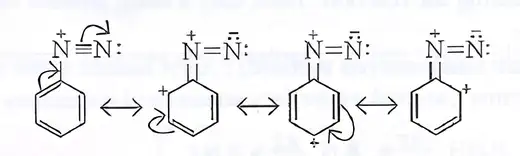
Stability due to resonance delocalization of positive charge over benzene ring.
Resonance
Positive charge on N2+ is delocalized into aromatic ring via resonance.
Resonance structures stabilize arenediazonium salts.
Solved Examples
Ex 1: Name C6H5N2+Cl−.
Parent hydrocarbon: benzene (C6H6).
Name: benzenediazonium chloride.
Practice Set
Q1: General formula of arenediazonium salts is:
A. RNH2
B. ArN2+X−
C. RNH3+
D. ArNH2
Q2: Which diazonium salt is more stable?
A. Alkyldiazonium salt
B. Arenediazonium salt
C. Both equally stable
D. None
Q3: Benzenediazonium hydrogensulphate formula is:
A. C6H5N2+HSO4−
B. C6H5NH2
C. C6H5N2+Cl−
D. C6H5NO2
Answer Key
Q1: B - Arenediazonium salts have formula ArN2+X−.
Q2: B - Arenediazonium salts are more stable due to resonance.
Q3: A - Benzenediazonium hydrogensulphate is C6H5N2+HSO4−.
Memory Aids
Diazonium salts = ArN2+X−, stable only for aromatic amines.
Stability order: Arenediazonium > Alkyldiazonium (unstable).
Named by parent hydrocarbon + "diazonium" + anion.
Structure of Amines
Hybridization and Geometry
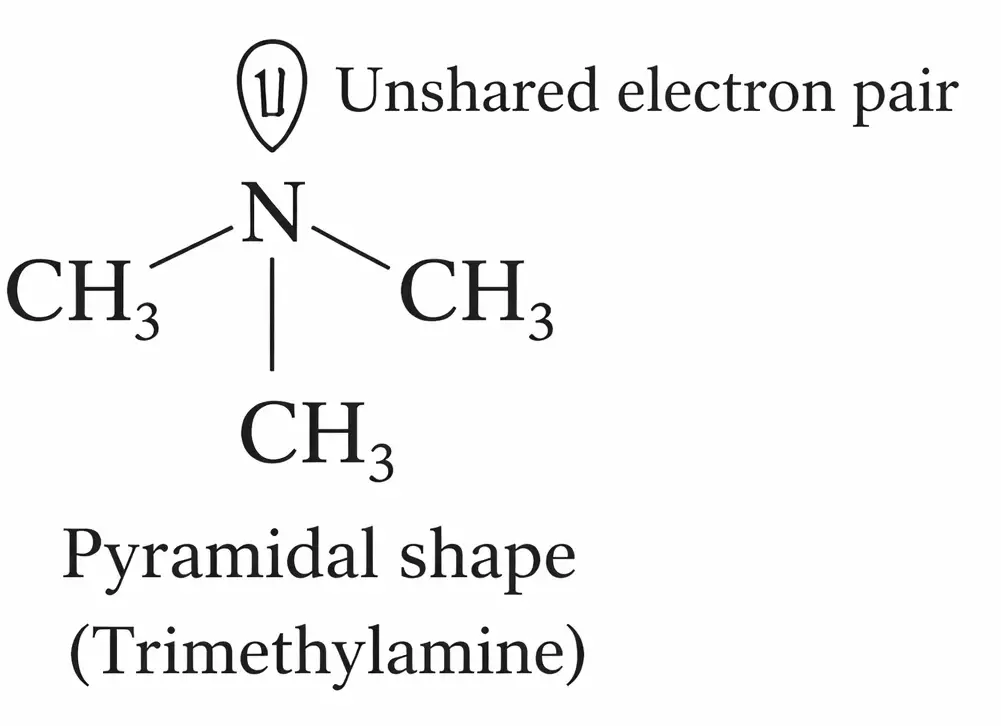
Nitrogen in amines is sp3 hybridized.
Geometry is pyramidal due to lone pair on nitrogen.
Bond angle C–N–E (E = C or H) < 109.5°, e.g., 108° in trimethylamine.
Effect of Lone Pair
Lone pair repels bonding pairs, reducing bond angles.
Shape affects reactivity and properties of amines.
Solved Examples
Ex 1: Describe the shape of trimethylamine.
Trimethylamine has N bonded to 3 CH3 groups and 1 lone pair.
Shape is pyramidal due to lone pair repulsion.
Practice Set
Q1: Hybridization of nitrogen in amines is:
A. sp
B. sp2
C. sp3
D. dsp2
Q2: Bond angle in amines is generally:
A. 120°
B. 109.5°
C. Less than 109.5°
D. 90°
Q3: The shape of trimethylamine molecule is:
A. Tetrahedral
B. Pyramidal
C. Planar
D. Linear
Answer Key
Q1: C - Nitrogen in amines is sp3 hybridized.
Q2: C - Bond angle is less than 109.5° due to lone pair repulsion.
Q3: B - Trimethylamine has pyramidal shape.
Memory Aids
Amines: sp3 N, pyramidal shape.
Lone pair reduces bond angle below 109.5°.
Trimethylamine angle ~108° due to lone pair.
Classification
Types of Amines
Amines are derivatives of ammonia (NH3) where one or more hydrogen atoms are replaced by alkyl or aryl groups.
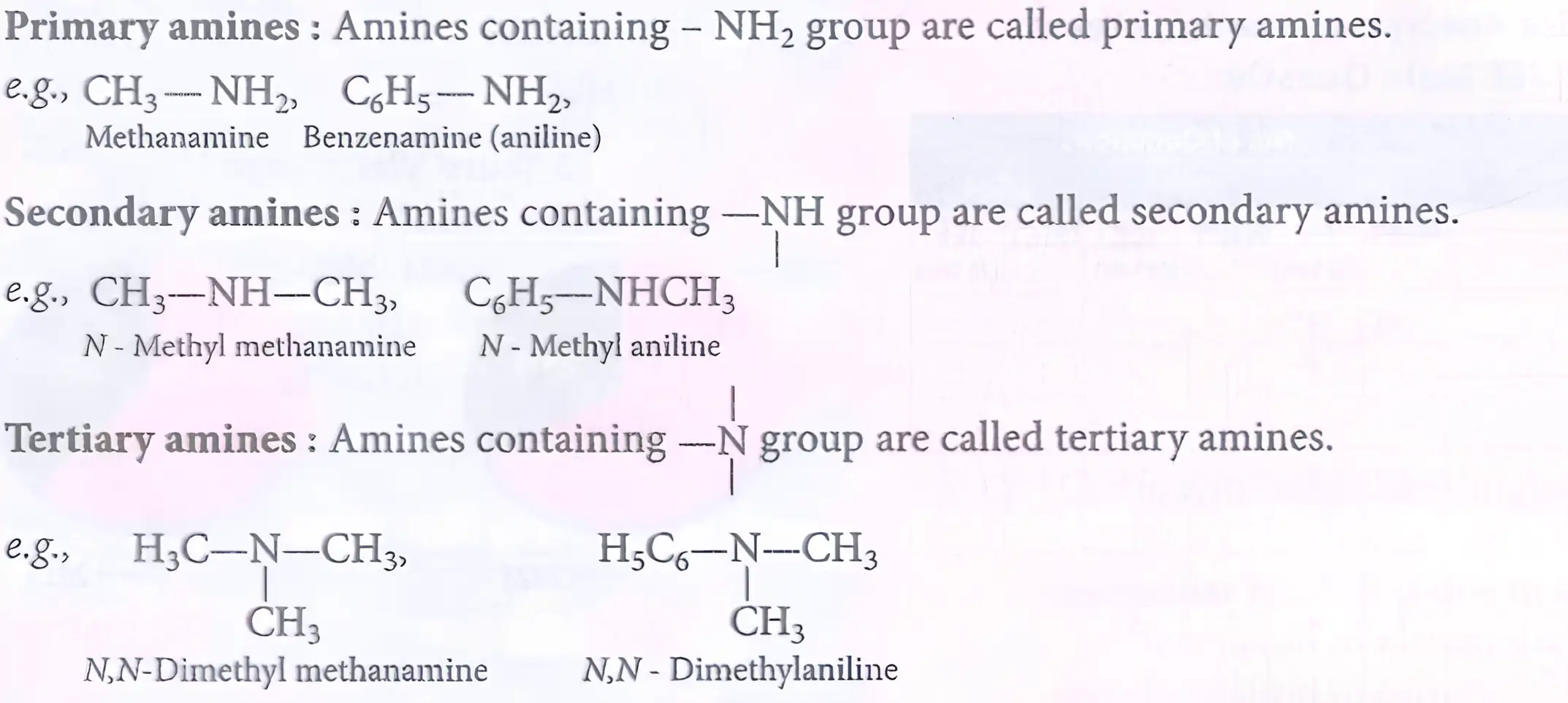
Based on the number of alkyl/aryl groups attached to nitrogen, amines are classified as:
Primary (1°) amines: One alkyl/aryl group attached; general formula RNH2.
Secondary (2°) amines: Two alkyl/aryl groups attached; general formula R2NH.
Tertiary (3°) amines: Three alkyl/aryl groups attached; general formula R3N.
Naming depends on the number and type of groups attached to nitrogen.
Solved Examples
Ex 1: Identify the type of amine: CH3NH2.
One alkyl group (CH3) attached to NH2 → Primary amine.
Ex 2: Identify the type of amine: CH3NHCH3.
Nitrogen attached to two alkyl groups (CH3) and one hydrogen → Secondary amine.
Ex 3: Identify the type of amine: N(CH3)3.
Nitrogen attached to three alkyl groups, no hydrogen → Tertiary amine.
Practice Set
Q1: Which of the following is a primary amine?
A. CH3NH2
B. (CH3)2NH
C. (CH3)3N
D. NH3
Q2: The general formula of a secondary amine is:
A. RNH2
B. R2NH
C. R3N
D. NH3
Q3: Which amine has no hydrogen attached to nitrogen?
A. Primary amine
B. Secondary amine
C. Tertiary amine
D. Ammonia
Answer Key
Q1: A. CH3NH2 is a primary amine with one alkyl group attached.
Q2: B. R2NH is the general formula for secondary amines.
Q3: C. Tertiary amines have no hydrogen attached to nitrogen.
Memory Aids
Primary amine = 1 alkyl group + 2 hydrogens on N.
Secondary amine = 2 alkyl groups + 1 hydrogen on N.
Tertiary amine = 3 alkyl groups, no hydrogen on N.
Remember: "Primary has one, Secondary has two, Tertiary has three alkyls on nitrogen."
Nomenclature
Common System Naming
Aliphatic amines named by prefixing alkyl group to "amine" (e.g., methylamine).
Simple and widely used in everyday naming.
IUPAC System Naming
Amines named as alkanamines (alkane + amine suffix).
For secondary and tertiary amines with identical alkyl groups, use prefixes di or tri before alkyl name.
Example: N,N-Dimethyl methanamine (two methyl groups attached to nitrogen).

Solved Examples
Ex 1: Name CH3NH2 using IUPAC.
Answer: Methanamine (one carbon + amine group).Ex 2: Name (CH3)2NH attached to methane.
Answer: N,N-Dimethyl methanamine (two methyl groups on nitrogen).
Practice Set
Q1: What is the IUPAC name of CH3CH2NH2?
A. Ethylamine
B. Methanamine
C. Propanamine
D. MethylamineQ2: How is a tertiary amine with three identical methyl groups named?
A. Trimethylamine
B. Dimethylamine
C. Methylamine
D. EthylamineQ3: What prefix is used when two identical alkyl groups are attached to nitrogen in an amine?
A. Mono
B. Di
C. Tri
D. Tetra
Answer Key
Q1: A. Ethylamine — Two carbons + amine group = ethylamine.
Q2: A. Trimethylamine — Three methyl groups attached to nitrogen.
Q3: B. Di — "Di" prefix denotes two identical alkyl groups on nitrogen.
Memory Aids
Common system: Alkyl + amine (e.g., methylamine).
IUPAC: Alkanamine; use di/tri for multiple identical groups on N.
Remember N,N- prefix indicates substitution on nitrogen atom.
Preparation of Amines
From Nitro Compounds (By Reduction)
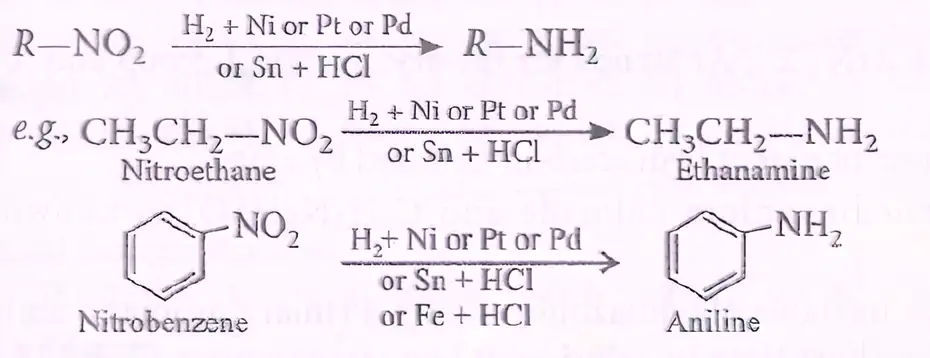
Nitro compounds (R–NO2) are reduced to amines (R–NH2) using hydrogen gas with Ni, Pd, or Pt catalysts or metals in acid.
Example: Nitroethane → Ethanamine; Nitrobenzene → Aniline.
Commercially, iron scrap and HCl are used; FeCl formed hydrolyses to release HCl, requiring only a small amount to start the reaction.
Solved Examples
Ex 1: Nitrobenzene reduced with H2/Pd → Aniline (C6H5NH2).
Practice Set
Q1: Which catalyst is used for reduction of nitro compounds to amines?
A. FeCl3
B. Ni
C. KOH
D. NaCl
Q2: Nitroethane on reduction gives:
A. Ethanol
B. Ethanamine
C. Ethanoic acid
D. Ethene
Q3: In commercial reduction of nitro compounds, which metal is commonly used?
A. Copper
B. Iron scrap
C. Zinc
D. Silver
Answer Key
Q1: B - Nickel is a common catalyst for hydrogenation of nitro compounds.
Q2: B - Nitroethane reduces to ethanamine (primary amine).
Q3: B - Iron scrap is used commercially due to FeCl hydrolysis releasing HCl.
Memory Aids
Reduction of R–NO2 → R–NH2 using H2/Ni, Pd, Pt or metals + acid.
Commercially: Fe + HCl used; FeCl hydrolyses to regenerate HCl.
From Alkyl Halides (Hoffmann Ammonolysis Method)
Reaction and Mechanism
Alkyl halides (R–X) react with ethanolic ammonia to form a mixture of primary, secondary, tertiary amines and quaternary ammonium salts.
Process called ammonolysis: cleavage of C–X bond by NH3.
Primary amines formed by using excess ammonia.
Order of halide reactivity: R–I > R–Br > R–Cl.
Reaction is nucleophilic substitution.
Ammonium salt formed can be treated with strong base (NaOH) to get amine:
R–N+H3 X– + NaOH → R–NH2 + H2O + NaX
Aryl halides do not undergo this reaction.
Tertiary butyl bromide prefers elimination over substitution with NH3.
Excess ammonia → primary amine; excess alkyl halide → tertiary amine.

Solved Examples
Ex 1: CH3Br + NH3 (excess) → CH3NH2 (methylamine, primary amine).
Ex 2: CH3Br + CH3NH2 → (CH3)2NH (secondary amine).
Practice Set
Q1: What is the main product when excess ammonia reacts with alkyl halide?
A. Secondary amine
B. Primary amine
C. Tertiary amine
D. Quaternary ammonium salt
Q2: Which halide reacts fastest in Hoffmann ammonolysis?
A. R–Cl
B. R–Br
C. R–I
D. Aryl halide
Q3: What happens when tertiary butyl bromide reacts with NH3?
A. Substitution to amine
B. Elimination
C. No reaction
D. Polymerization
Answer Key
Q1: B - Excess ammonia favors primary amine formation.
Q2: C - R–I is most reactive due to better leaving group ability.
Q3: B - Tertiary butyl bromide undergoes elimination, not substitution.
Memory Aids
Ammonolysis: R–X + NH3 → R–NH2 (primary amine) with excess NH3.
Halide reactivity: I > Br > Cl.
Tertiary alkyl halides prefer elimination over substitution.
From Nitriles (By Reduction)
Reaction and Mechanism
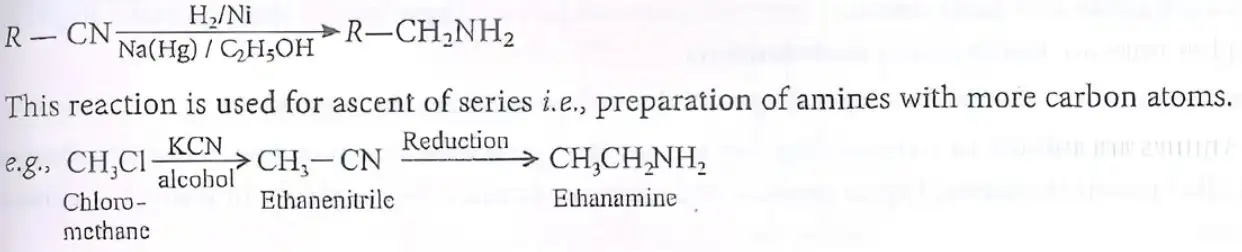
Nitriles (R–CN) reduced by LiAlH4 or catalytic hydrogenation produce primary amines (R–CH2NH2).
Reduction adds two hydrogens, converting –CN to –CH2NH2.
Example: CH3Cl + KCN → CH3CN (ethanenitrile), then reduced to CH3CH2NH2 (ethylamine).
Reduction by Na(Hg) and C2H5OH is called Mendius reduction.
Solved Examples
Ex 1: CH3CN + 4[H] (LiAlH4) → CH3CH2NH2.
Practice Set
Q1: Which reagent reduces nitriles to primary amines?
A. NaBH4
B. LiAlH4
C. H2SO4
D. KOH
Q2: Mendius reduction uses:
A. Na(Hg) and C2H5OH
B. LiAlH4
C. H2/Ni
D. Br2/KOH
Q3: Reduction of ethanenitrile produces:
A. Ethanol
B. Ethylamine
C. Ethanoic acid
D. Ethene
Answer Key
Q1: B - LiAlH4 is a strong reducing agent for nitriles.
Q2: A - Mendius reduction uses Na(Hg) and ethanol.
Q3: B - Ethanenitrile reduces to ethylamine (primary amine).
Memory Aids
Nitrile reduction: R–CN + 4[H] → R–CH2NH2.
Mendius reduction = Na(Hg) + C2H5OH.
From Amides (By Reduction)
Reduction and Hofmann Bromamide Degradation
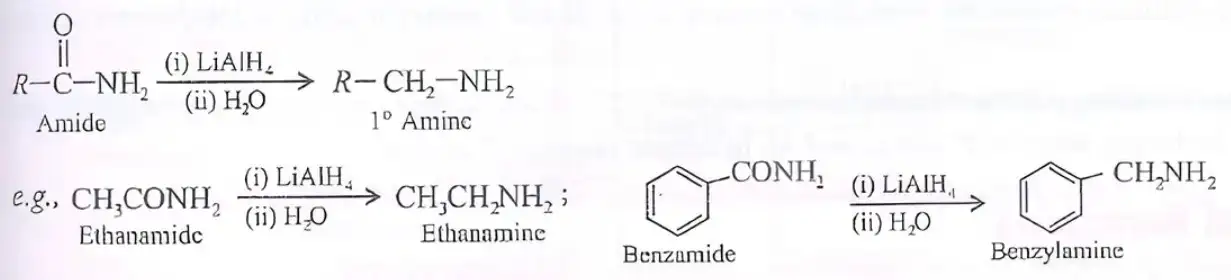
Alkanamides (R–CONH2) reduced by LiAlH4 give primary amines (R–CH2NH2).
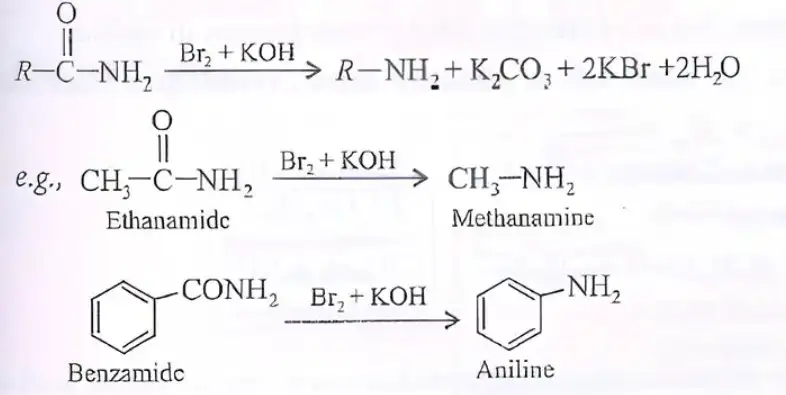
Hofmann bromamide degradation: Primary amide + Br2 + KOH → primary amine + K2CO3 + KBr + H2O.
Hofmann rearrangement mechanism:
Amide reacts with Br2 and base forming bromoamide.
Bromoamide loses water, rearranges to isocyanate intermediate.
Isocyanate hydrolyzed to primary amine with one less carbon.

Solved Examples
Ex 1: Ethanamide + LiAlH4 → Ethanamine.
Ex 2: Benzamide + Br2 + KOH → Aniline (one carbon less).
Practice Set
Q1: Which reagent reduces amides to primary amines?
A. LiAlH4
B. NaBH4
C. H2SO4
D. KOH
Q2: Hofmann bromamide degradation removes how many carbons?
A. None
B. One carbon less in amine
C. Two carbons less
D. Adds one carbon
Q3: In Hofmann rearrangement, the intermediate formed is:
A. Isocyanate
B. Carbocation
C. Carbene
D. Radical
Answer Key
Q1: A - LiAlH4 reduces amides to primary amines.
Q2: B - Amine formed has one carbon less than amide.
Q3: A - Isocyanate intermediate forms during rearrangement.
Memory Aids
Amide reduction: R–CONH2 + LiAlH4 → R–CH2NH2.
Hofmann degradation: amide + Br2 + KOH → amine (–1 C) + byproducts.
Intermediate: isocyanate (R–N=C=O).
Gabriel Phthalimide Synthesis
Reaction and Mechanism
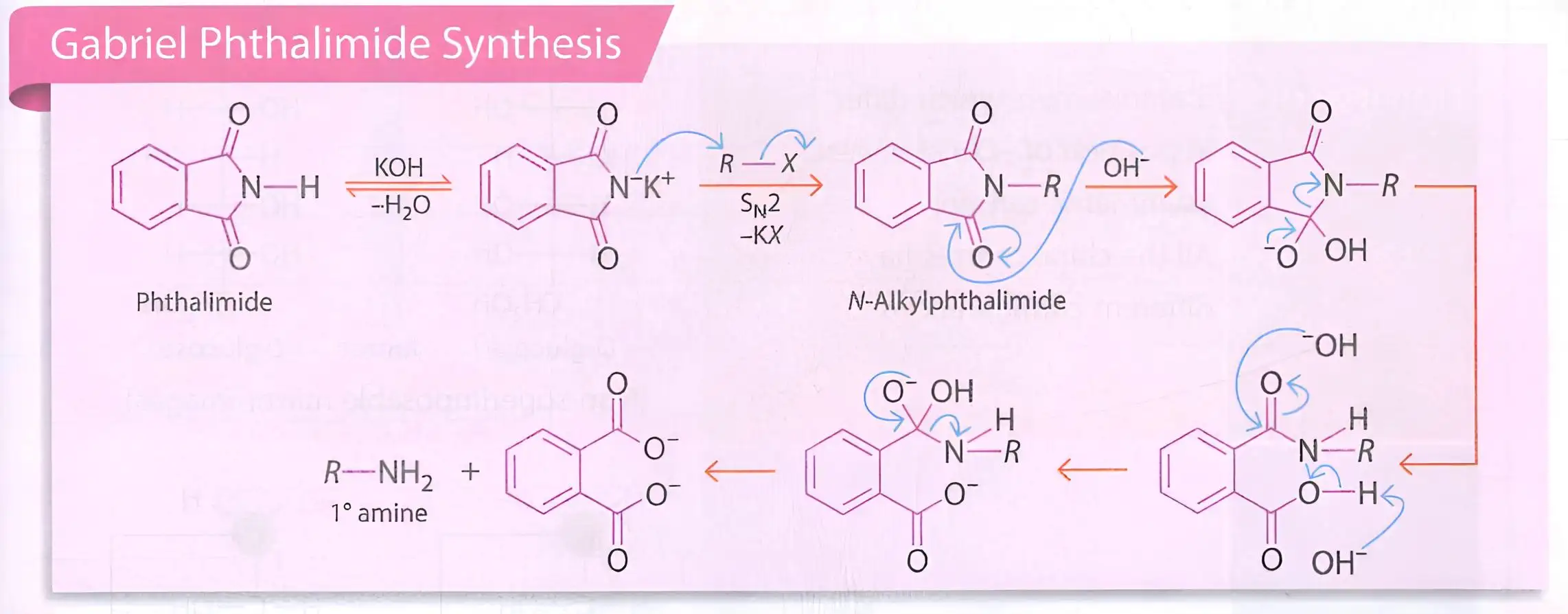
Potassium phthalimide formed by treating phthalimide with ethanolic KOH.
Potassium phthalimide reacts with alkyl halide (R–X) to form N-alkyl phthalimide (SN2 reaction).
Alkaline hydrolysis of N-alkyl phthalimide produces primary amine (R–NH2) and phthalate ion.
Method selectively produces primary amines without secondary or tertiary amines.
1° aromatic amines (aniline, toluidines) cannot be prepared by this method due to aryl halides' low reactivity.

Solved Examples
Ex 1: Phthalimide + KOH → potassium phthalimide.
Ex 2: Potassium phthalimide + R–X → N-alkyl phthalimide.
Ex 3: N-alkyl phthalimide + NaOH (aq) → R–NH2 + sodium phthalate.
Practice Set
Q1: Gabriel synthesis is used to prepare:
A. Secondary amines
B. Tertiary amines
C. Primary amines
D. Quaternary ammonium salts
Q2: Which reagent forms potassium phthalimide?
A. KOH + phthalimide
B. NaOH + phthalimide
C. HCl + phthalimide
D. NH3 + phthalimide
Q3: Why can't aromatic amines be prepared by Gabriel synthesis?
A. Aryl halides do not undergo nucleophilic substitution
B. Reaction is too slow
C. Phthalimide is unstable
D. Aromatic amines are unstable
Answer Key
Q1: C - Gabriel synthesis produces primary amines selectively.
Q2: A - KOH reacts with phthalimide to form potassium phthalimide.
Q3: A - Aryl halides do not undergo nucleophilic substitution under mild conditions.
Memory Aids
Gabriel synthesis: phthalimide → potassium salt → N-alkyl phthalimide → primary amine.
Selective for primary amines only.
Aryl halides unreactive in this method.
Physical Properties
Physical State
Lower aliphatic amines: gases with ammoniacal smell.
Primary amines (≥3 carbon atoms): liquids with fishy odour.
Lower aromatic amines: liquids with characteristic unpleasant odour.
Higher aromatic amines: solids, odourless.
Solved Examples
Ex 1: Identify the physical state of methylamine.
Answer: Methylamine is a lower aliphatic amine; it is a gas with ammoniacal smell.Ex 2: What is the state of aniline at room temperature?
Answer: Aniline (lower aromatic amine) is a liquid with unpleasant odour.
Practice Set
Q1: Which of the following amines is a gas at room temperature?
A. Aniline
B. Ethylamine
C. Butylamine
D. BenzylamineQ2: Primary amines with three or more carbon atoms are generally:
A. Gases
B. Liquids with fishy odour
C. Solids
D. Odourless liquidsQ3: Higher aromatic amines are:
A. Gases with ammoniacal smell
B. Liquids with fishy odour
C. Solids and odourless
D. Liquids with pleasant odour
Answer Key
Q1: B. Ethylamine is a lower aliphatic amine gas with ammoniacal smell.
Q2: B. Primary amines with ≥3 carbons are liquids with fishy odour.
Q3: C. Higher aromatic amines are solids and odourless.
Memory Aids
Lower aliphatic amines = gases (ammoniacal smell).
Primary amines (≥3 C) = liquids (fishy odour).
Higher aromatic amines = solids (odourless).
Colour
Colour Characteristics
Pure amines are colourless.
Exposure to air causes atmospheric oxidation, leading to coloured amines.
Solved Examples
Ex 1: Why do amines turn coloured on standing?
Answer: Due to atmospheric oxidation.
Practice Set
Q1: Pure amines are generally:
A. Coloured
B. Colourless
C. Brown
D. GreenQ2: The colour in amines on exposure to air is due to:
A. Reduction
B. Atmospheric oxidation
C. Polymerization
D. SublimationQ3: Which of the following is true about amine colour?
A. Pure amines are coloured and become colourless on oxidation.
B. Pure amines are colourless and become coloured on oxidation.
C. Amines are always coloured.
D. Amines never change colour.
Answer Key
Q1: B. Pure amines are colourless.
Q2: B. Colour arises due to atmospheric oxidation.
Q3: B. Pure amines are colourless and get coloured on oxidation.
Memory Aids
Amines: Colourless pure, coloured on air exposure.
Solubility
Solubility Trends
Amines are soluble in water due to hydrogen bonding.
Solubility decreases as alkyl group size increases.
Higher amines and aromatic amines are insoluble in water but soluble in organic solvents.
Solved Examples
Ex 1: Explain why methylamine is soluble in water.
Answer: Methylamine forms hydrogen bonds with water.Ex 2: Why is aniline less soluble in water?
Answer: Larger aromatic ring reduces hydrogen bonding; less soluble.
Practice Set
Q1: Amines are soluble in water because:
A. They are nonpolar
B. They form hydrogen bonds
C. They are ionic
D. They are large moleculesQ2: Solubility of amines in water decreases with:
A. Increasing alkyl size
B. Decreasing alkyl size
C. Increasing temperature only
D. Decreasing temperature onlyQ3: Aromatic amines are generally:
A. Soluble in water
B. Insoluble in water but soluble in organic solvents
C. Insoluble in all solvents
D. Soluble in water and organic solvents
Answer Key
Q1: B. Amines form hydrogen bonds with water.
Q2: A. Solubility decreases as alkyl size increases.
Q3: B. Aromatic amines are insoluble in water but soluble in organic solvents.
Memory Aids
Small amines = water soluble (H-bonding).
Large/aromatic amines = water insoluble, organic soluble.
Boiling Points
Boiling Point Characteristics
Amines are polar and form intermolecular hydrogen bonds (except tertiary amines).
They exist as associated molecules, leading to higher boiling points than hydrocarbons of similar mass.
Boiling points of amines are lower than alcohols and carboxylic acids of comparable molecular mass.
Order of boiling points for isomeric amines: 1° > 2° > 3° due to number of N-H bonds.
Solved Examples
Ex 1: Compare boiling points of 1° and 3° amines.
Answer: 1° amines have higher boiling points due to two N-H bonds enabling more H-bonding.Ex 2: Why do amines boil at higher temperatures than hydrocarbons?
Answer: Due to polar nature and hydrogen bonding.
Practice Set
Q1: Which amine has the highest boiling point?
A. 1° amine
B. 2° amine
C. 3° amine
D. Hydrocarbon of similar massQ2: Boiling points of amines are generally lower than:
A. Hydrocarbons
B. Alcohols and carboxylic acids
C. Ethers
D. AldehydesQ3: The order of boiling points of isomeric amines is:
A. 3° > 2° > 1°
B. 1° > 2° > 3°
C. 2° > 1° > 3°
D. 1° = 2° = 3°
Answer Key
Q1: A. 1° amines have highest boiling points due to maximum H-bonding.
Q2: B. Amines boil lower than alcohols and carboxylic acids.
Q3: B. Boiling points order: 1° > 2° > 3°.
Memory Aids
Boiling point order: 1° (2 N-H) > 2° (1 N-H) > 3° (no N-H).
Amines > hydrocarbons; < alcohols/carboxylic acids.
Chemical Reactions
Overview of Amines Reactions
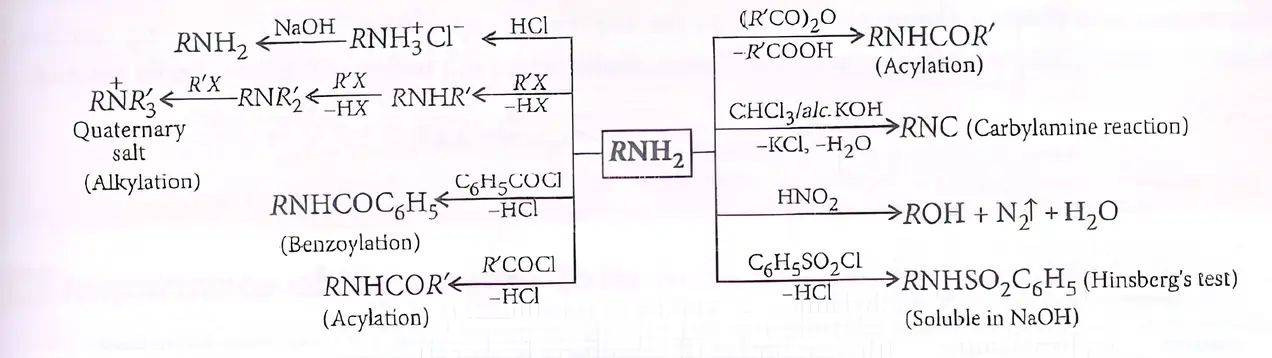
Primary amines (RNH2) undergo alkylation to form secondary and tertiary amines, and quaternary ammonium salts.
Acylation with acid chlorides or anhydrides forms amides.
Benzoylation with benzoyl chloride forms benzamides.
Carbylamine test: Primary amines react with chloroform and KOH to form isocyanides (RNC).
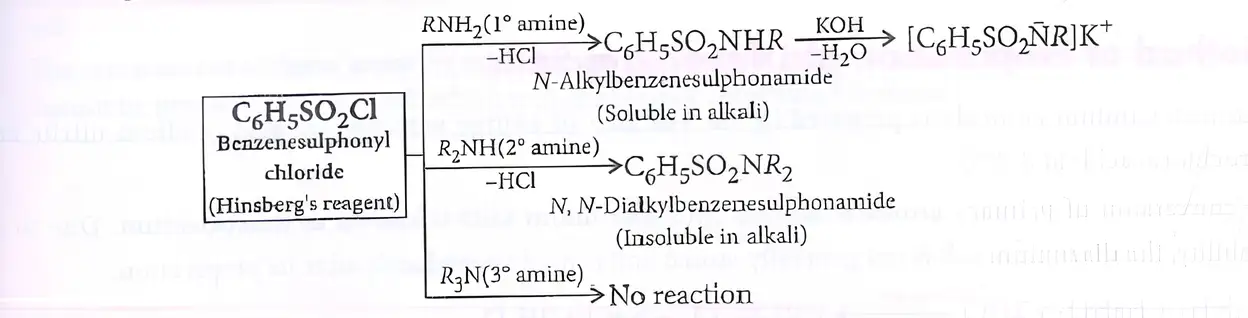
Hinsberg’s test distinguishes 1°, 2°, and 3° amines based on solubility of sulphonamide derivatives.
Reaction with nitrous acid: Primary amines form alcohols and nitrogen gas; aromatic primary amines form diazonium salts.
Solved Examples
Ex 1: Primary amine reacts with benzoyl chloride.
Step 1: RNH2 + C6H5COCl → RNHCOC6H5 + HCl (benzamide formation)
Practice Set
Q1: Which reagent is used in the carbylamine test?
A) Chloroform + KOH
B) Benzoyl chloride
C) Nitrous acid
D) Benzenesulfonyl chlorideQ2: What is the product when a primary amine reacts with nitrous acid?
A) Alcohol + N2 gas
B) Diazonium salt
C) N-nitrosamine
D) Quaternary ammonium saltQ3: In Hinsberg’s test, which amine forms a sulphonamide soluble in alkali?
A) Primary amine
B) Secondary amine
C) Tertiary amine
D) None
Answer Key
Q1: A) Chloroform + KOH - Used to detect primary amines by forming isocyanides.
Q2: A) Alcohol + N2 gas - Primary aliphatic amines react with nitrous acid to give alcohols and nitrogen gas.
Q3: A) Primary amine - Forms N-alkylbenzenesulphonamide soluble in alkali.
Memory Aids
Carbylamine test positive only for primary amines.
Hinsberg’s test: Primary amines soluble sulphonamide; secondary insoluble; tertiary no reaction.
Nitrous acid: Primary aliphatic amines → alcohols; aromatic → diazonium salts.
Basic Character of Amines
Key Points on Basicity
Amines are basic due to lone pair on nitrogen.
Aliphatic amines are stronger bases than ammonia due to +I effect of alkyl groups.
Other effects influencing basicity: steric, solvation, resonance.
Gaseous phase basicity order: 3° amine > 2° amine > 1° amine > NH3.
Aqueous phase basicity varies due to solvation; e.g., (C2H5)2NH > (C2H5)3N > C2H5NH3 > NH3.
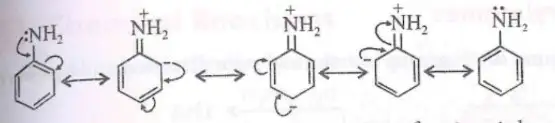
Aromatic amines are weaker bases due to resonance delocalization of lone pair.
Solved Examples
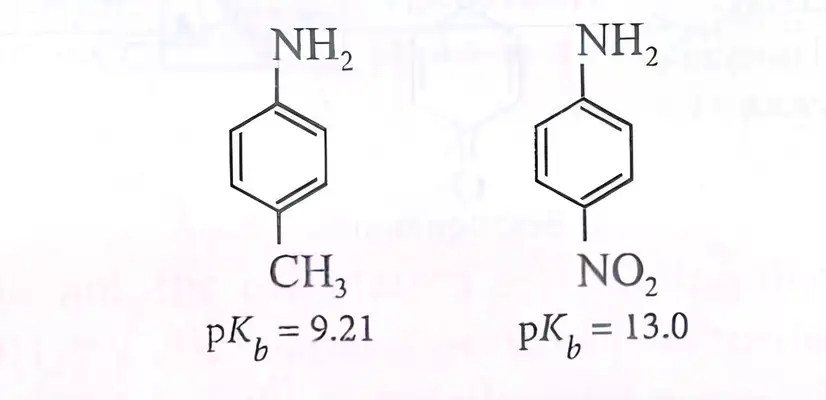
Ex 1: Compare basicity of aniline and methyl-substituted aniline.
Step 1: Methyl group is electron releasing, increases electron density on N.
Step 2: Methyl-substituted aniline is more basic than aniline.Practice Set
Q1: Why are aliphatic amines stronger bases than ammonia?
A) Resonance
B) +I effect of alkyl groups
C) Steric hindrance
D) Solvation effectQ2: Order of basicity in gaseous phase is:
A) 1° > 2° > 3° > NH3
B) 3° > 2° > 1° > NH3
C) NH3 > 1° > 2° > 3°
D) 2° > 3° > 1° > NH3Q3: Aromatic amines are weaker bases because:
A) Lone pair is localized
B) Lone pair is delocalized by resonance
C) No lone pair
D) Steric hindrance
Answer Key
Q1: B) +I effect of alkyl groups increases electron density on nitrogen.
Q2: B) 3° > 2° > 1° > NH3 in gaseous phase due to alkyl group effects.
Q3: B) Lone pair delocalized over benzene ring reduces availability for protonation.
Memory Aids
Alkyl groups donate electrons (+I), increasing basicity.
Resonance in aromatic amines reduces basicity.
Solvation stabilizes conjugate acid in aqueous phase.
Distinction Between 1°, 2° and 3° Amines
Hinsberg’s Test
Primary amines react with benzenesulphonyl chloride to form soluble sulphonamides in alkali.
Secondary amines form sulphonamides insoluble in alkali.
Tertiary amines do not react.
Solved Examples
Ex 1: Identify amine type by Hinsberg’s test.
Step 1: React amine with benzenesulphonyl chloride.
Step 2: If product soluble in alkali → primary amine.Practice Set
Q1: Which amine does not react with Hinsberg’s reagent?
A) Primary
B) Secondary
C) Tertiary
D) All reactQ2: Carbylamine test is positive for:
A) Secondary amines
B) Tertiary amines
C) Primary amines
D) All aminesQ3: Which amine gives orange azo dye test?
A) Primary aromatic amines
B) Secondary aromatic amines
C) Tertiary aromatic amines
D) Aliphatic amines
Answer Key
Q1: C) Tertiary amines do not react with Hinsberg’s reagent.
Q2: C) Only primary amines give positive carbylamine test.
Q3: A) Only primary aromatic amines give orange azo dyes.
Memory Aids
Hinsberg’s test: Soluble sulphonamide = primary; insoluble = secondary; no reaction = tertiary.
Carbylamine test positive only for primary amines.
Azo dye test specific for primary aromatic amines.
Electrophilic Substitution Reactions of Arylamines
Key Points
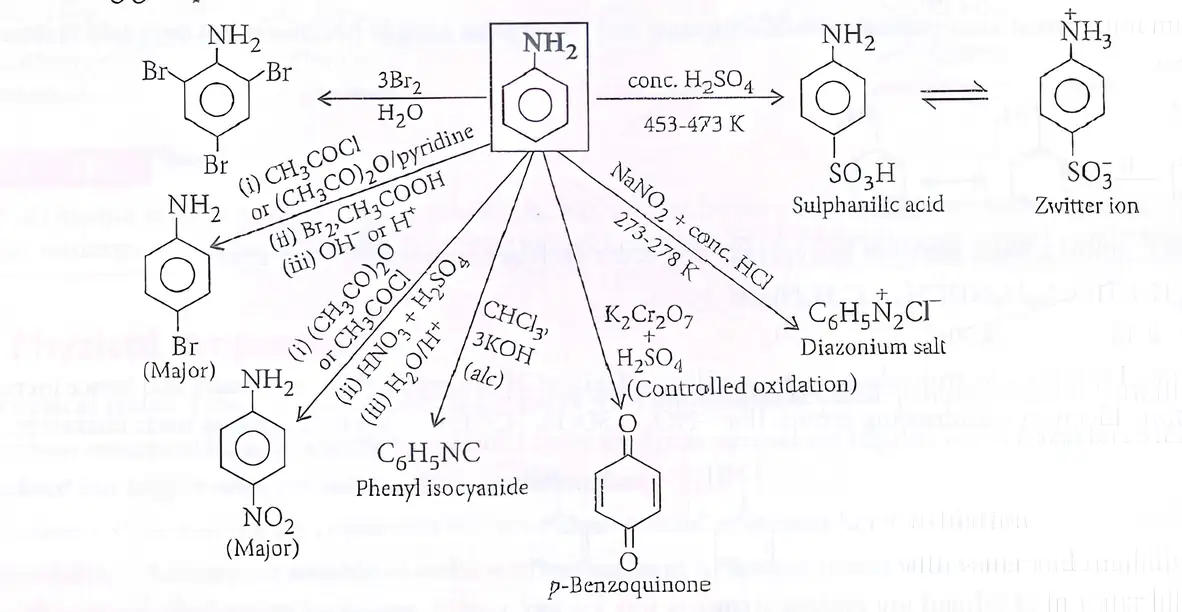
Aniline’s —NH2 group is a strong activating, ortho-para directing group.
Reactions include bromination, nitration, sulphonation, diazotization.
Aniline forms tribromoaniline with bromine.
Diazonium salts form with NaNO2 and HCl at 0-5 °C.
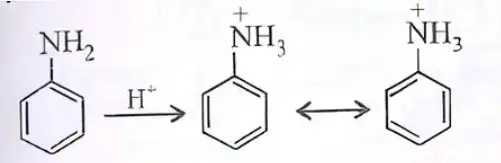
Aniline forms salts with Lewis acids (e.g., AlCl3), deactivating electrophilic substitution.
Aniline does not undergo Friedel-Crafts alkylation/acylation due to salt formation.
Solved Examples
Ex 1: Bromination of aniline.
Step 1: Aniline + Br2 → 2,4,6-tribromoaniline (white precipitate).Practice Set
Q1: The —NH2 group in aniline directs substitution to:
A) Meta
B) Ortho and para
C) Only para
D) Only orthoQ2: Why does aniline not undergo Friedel-Crafts alkylation?
A) No lone pair
B) Forms salt with AlCl3 deactivating ring
C) Too reactive
D) No reaction with alkyl halidesQ3: Diazonium salt formation requires:
A) NaNO2 and HCl at 0-5 °C
B) Br2 and FeBr3
C) HNO3 and H2SO4
D) AlCl3 and R-Cl
Answer Key
Q1: B) —NH2 is ortho and para directing.
Q2: B) Aniline forms salt with AlCl3, deactivating electrophilic substitution.
Q3: A) NaNO2 and HCl at low temperature form diazonium salts.
Memory Aids
—NH2 group activates ring, directs ortho/para.
Aniline + Br2 → tribromoaniline (white ppt).
Aniline forms salts with Lewis acids, blocking Friedel-Crafts reactions.


Method of Preparation of Diazonium Salts
Explanation
Benzenediazonium chloride is prepared by reacting aniline (C6H5NH2) with nitrous acid (HNO2), generated in situ from sodium nitrite (NaNO2) and hydrochloric acid (HCl).
The reaction is carried out at low temperature (0–5 °C) to stabilize the diazonium salt.
This process is called diazotisation, converting primary aromatic amines into diazonium salts.
Due to their instability, diazonium salts are not stored but used immediately in further reactions.
Chemical equation:
C6H5NH2 + NaNO2 + 2HCl → C6H5N2+Cl− + NaCl + 2H2O

Solved Examples
Ex 1: Write the reaction for the preparation of benzenediazonium chloride from aniline.
Step 1: Aniline reacts with NaNO2 and HCl at 0–5 °C.
Step 2: Formation of benzenediazonium chloride, NaCl, and water.
Equation: C6H5NH2 + NaNO2 + 2HCl → C6H5N2+Cl− + NaCl + 2H2O
Practice Set
Q1: What is the temperature range required for the diazotisation of aniline?
A. 25–30 °C
B. 0–5 °C
C. 50–60 °C
D. 10–15 °CQ2: Which reagent is NOT used in the preparation of benzenediazonium chloride?
A. Aniline
B. Sodium nitrite
C. Hydrochloric acid
D. Sulfuric acidQ3: Identify the correct product formed along with benzenediazonium chloride in the diazotisation reaction.
A. NaCl and H2O
B. NaOH and H2O
C. NaCl and CO2
D. NaNO3 and H2O
Answer Key
Q1: B. 0–5 °C
Low temperature stabilizes the diazonium salt during formation.Q2: D. Sulfuric acid
Hydrochloric acid is used, not sulfuric acid, for diazotisation.Q3: A. NaCl and H2O
By-products of the reaction are sodium chloride and water.
Memory Aids
Remember: "Diazotisation at 0–5 °C" to keep diazonium salt stable.
Diazonium salts are unstable and used immediately.
Reagents: Aniline + NaNO2 + HCl → Benzenediazonium chloride.
Importance of Diazonium Salts in Synthesis of Aromatic Compounds
Role in Aromatic Substitution
Diazonium salts act as versatile intermediates to introduce various substituents into aromatic rings.
They enable the replacement of the diazo group (-N2+) with groups like -F, -Cl, -Br, -I, -CN, -OH, and -NO2.
Direct halogenation cannot produce aryl fluorides and iodides efficiently; diazonium salts provide a route.
Cyanobenzene (benzonitrile) cannot be formed by nucleophilic substitution on chlorobenzene but can be synthesized via diazonium salt intermediates.
This method allows preparation of substituted aromatic compounds not accessible by direct electrophilic or nucleophilic substitution.
Solved Examples
Ex 1: Synthesis of fluorobenzene from aniline
Step 1: Convert aniline to diazonium salt using NaNO2 and HCl at 0–5°C.
Step 2: Treat diazonium salt with HBF4 to form diazonium tetrafluoroborate.
Step 3: Heat to decompose and replace -N2+ with -F, yielding fluorobenzene.
Ex 2: Preparation of benzonitrile
Diazonium salt reacts with CuCN (Sandmeyer reaction) to replace -N2+ with -CN.
Result: Formation of benzonitrile.
Practice Set
Q1: Which reagent is used to convert a diazonium salt into an aryl fluoride?
A) CuCl
B) HBF4
C) CuCN
D) H2SO4
Q2: Why can't aryl fluorides be prepared by direct halogenation of benzene?
A) Fluorine is too reactive and causes multiple substitutions.
B) Fluorine does not react with benzene.
C) Fluorine forms unstable intermediates.
D) Fluorine is not electrophilic enough.
Q3: Which group cannot be introduced into benzene by direct nucleophilic substitution but can be introduced via diazonium salt?
A) -OH
B) -CN
C) -NO2
D) -Cl
Answer Key
Q1: B) HBF4 - It forms diazonium tetrafluoroborate, which decomposes to give aryl fluoride.
Q2: A) Fluorine is too reactive and causes multiple substitutions, making direct halogenation impractical.
Q3: B) -CN - Cyanide group cannot be introduced by nucleophilic substitution on chlorobenzene but can be via diazonium salt.
Memory Aids
"Diazo to Halide" - Use Sandmeyer reactions with CuX (X = Cl, Br, CN) for substitution.
For fluorides, remember "HBF4 makes Fluoride" via diazonium tetrafluoroborate.
Diazonium salts enable substitutions impossible by direct methods, especially for -F and -CN groups.
Physical Properties
Benzenediazonium Chloride
Colourless crystalline solid
Readily soluble in water
Stable when cold
Reacts with water on warming
Decomposes easily in dry state
Benzenediazonium Fluoroborate
Insoluble in water
Stable at room temperature
Solved Examples
Ex 1: Identify the solubility of benzenediazonium chloride.
Answer: Soluble in water due to ionic nature.
Ex 2: Explain stability difference between benzenediazonium chloride and fluoroborate.
Answer: Fluoroborate is more stable at room temperature and insoluble in water, unlike chloride.
Practice Set
Q1: What is the physical state of benzenediazonium chloride?
A. Colourless liquid
B. Colourless crystalline solid
C. Yellow powder
D. Colourless gas
Q2: Which property is true for benzenediazonium fluoroborate?
A. Soluble in water
B. Stable in cold only
C. Insoluble in water and stable at room temperature
D. Decomposes easily when dry
Q3: What happens to benzenediazonium chloride when warmed with water?
A. Remains stable
B. Reacts with water
C. Becomes insoluble
D. Turns into fluoroborate
Answer Key
Q1: B — It is a colourless crystalline solid.
Q2: C — Benzenediazonium fluoroborate is water insoluble and stable at room temperature.
Q3: B — It reacts with water when warmed.
Memory Aids
Benzenediazonium chloride: "Cold stable, warm reacts"
Fluoroborate salt: "Fluoro means firm—stable and insoluble"
Reactions Involving Displacement of Nitrogen (Diazo Group)
Key Reactions and Products
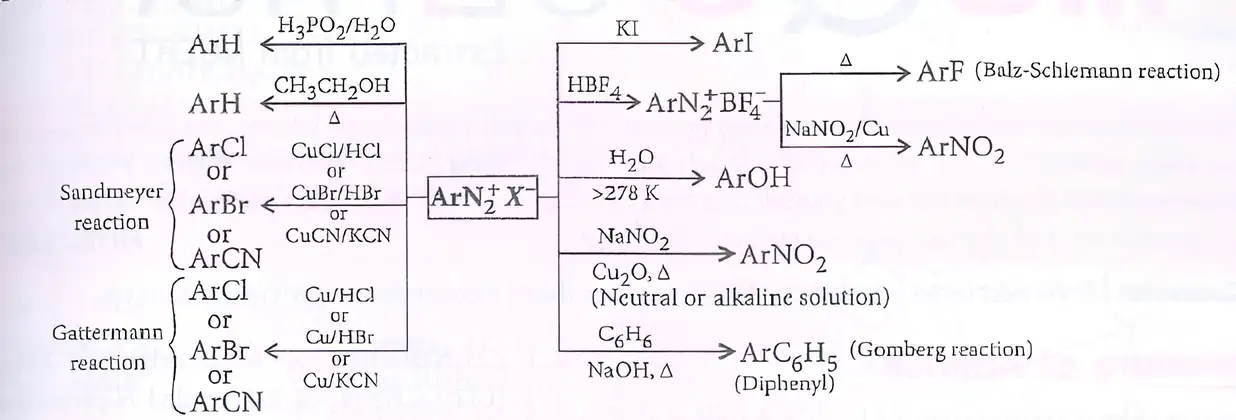
Start with arenediazonium salt (ArN2+X−).
Reagents determine product formed by displacement of N2 group.
Common transformations:
ArN2+X− + KI → ArI (aryl iodide)
ArN2+X− + HBF4, heat (Δ) → ArF (aryl fluoride) (Balz-Schiemann reaction)
ArN2+X− + H2O, heat → ArOH (phenol)
ArN2+X− + NaNO2 + Cu → ArNO2 (nitrobenzene)
ArN2+X− + NaOH + C6H6 → ArC6H5 (diphenyl) (Gomberg reaction)
ArN2+X− + CuCl or CuBr → ArCl or ArBr (Sandmeyer reaction)
ArN2+X− + CuCN → ArCN (Gattermann reaction)
Reduction of ArN2+X− can give ArH (aromatic hydrocarbon).
Solved Examples
Ex 1: Convert ArN2+Cl− to ArF.
Use HBF4 and heat (Balz-Schiemann reaction).
ArN2+Cl− → ArBF4− → ArF + BF3 + N2.
Ex 2: Prepare ArI from ArN2+X−.
React with KI to replace N2+ with I.
Practice Set
Q1: Which reagent converts ArN2+X− to ArOH?
A) KI
B) HBF4, heat
C) H2O, heat
D) NaNO2 + Cu
Q2: The Sandmeyer reaction is used to prepare:
A) ArF
B) ArCl or ArBr
C) ArI
D) ArNO2
Q3: Which product forms when ArN2+X− reacts with NaOH and benzene?
A) ArOH
B) ArC6H5
C) ArCN
D) ArH
Answer Key
Q1: C) H2O, heat – Water replaces diazo group with OH forming phenol.
Q2: B) ArCl or ArBr – Sandmeyer reaction uses CuCl or CuBr to form aryl halides.
Q3: B) ArC6H5 – Gomberg reaction forms diphenyl from arenediazonium salt and benzene.
Memory Aids
Balz-Schiemann: ArN2+ → ArF with HBF4 and heat.
Sandmeyer: Cu salts convert ArN2+ to ArCl, ArBr, or ArCN.
Gomberg: ArN2+ + benzene + NaOH → diphenyl (ArC6H5).
Reactions Involving Retention of Diazo Group (Coupling Reactions)
Key Concepts
Diazonium salts (ArN2+X−) act as electrophiles in coupling reactions.
Coupling occurs with activated aromatic compounds (e.g., phenol, aniline) retaining the diazo group.
Reaction conditions (pH, temperature) control product formation and position of coupling.
Example: p-aminoazobenzene forms diazonium salt intermediate at low temperature and acidic pH (4-5).
Adding phenol under basic conditions (pH 9-10) yields p-hydroxyazobenzene (orange dye).
In p-aminophenol, coupling position depends on pH:
Acidic (pH 4-5): coupling ortho to amino group.
Basic (pH 9-10): coupling ortho to phenolic group.


Solved Examples
Ex 1: Formation of p-hydroxyazobenzene from p-aminoazobenzene.
Diazotize p-aminoazobenzene at 0-5°C, pH 4-5 to form ArN2+X−.
Add phenol + OH− at pH 9-10, low temperature.
Coupling occurs to form p-hydroxyazobenzene (orange dye).
Ex 2: Coupling of phenyl diazonium chloride with p-aminophenol.
At acidic pH (4-5), forms 4-amino-3-phenylazophenol (coupling ortho to -NH2).
At basic pH (9-10), 4-amino-2-phenylazophenol converts back to p-aminophenol and diazonium salt.
Practice Set
Q1: At pH 4-5, coupling of phenyl diazonium salt with p-aminophenol occurs:
A) Ortho to -OH group
B) Ortho to -NH2 group
C) Para to -OH group
D) Para to -NH2 group
Q2: Which condition favors formation of p-hydroxyazobenzene from diazonium salt?
A) Acidic pH, 0-5°C
B) Basic pH, 9-10, low temperature
C) Neutral pH, room temperature
D) High temperature, acidic pH
Q3: What happens when 4-amino-2-phenylazophenol is treated with base (pH 9-10)?
A) Converts to p-aminophenol and phenyl diazonium chloride
B) Forms azo dye
C) Undergoes oxidation
D) No reaction
Answer Key
Q1: B) Ortho to -NH2 group – Acidic medium directs coupling ortho to amino group.
Q2: B) Basic pH, 9-10, low temperature – Phenol coupling under basic conditions forms p-hydroxyazobenzene.
Q3: A) Converts to p-aminophenol and phenyl diazonium chloride – Base reverses azo coupling.
Memory Aids
Coupling position depends on pH: Acidic → ortho to -NH2, Basic → ortho to -OH.
Diazonium salts couple with activated aromatics to form azo dyes.
Low temperature (0-5°C) needed to stabilize diazonium salts.
NEET Chemistry — ALL CHAPTERS
1
Some Basic Concepts of Chemistry
2
Structure of Atom
3
Classification of Elements and Periodicity in Properties
4
Chemical Bonding and Molecular Structure
5
Thermodynamics
6
Equilibrium
7
Redox Reactions
8
Organic Chemistry - Some Basic Principles and Techniques
9
Hydrocarbons
10
Solutions
11
Electrochemistry
12
Chemical Kinetics
13
The d- and f- Block Elements
14
Coordination Compounds
15
Haloalkanes and Haloarenes
16
Alcohols, Phenols and Ethers
17
Aldehydes, Ketones and Carboxylic Acids
18
Amines
19
Biomolecules
20
The p-Block Elements (Group 13 and 14)
21
The p-Block Elements (Group 15 to 18)
22
Principles Related to Practical Chemistry