NEET Ug . NEET Chemistry . Chemistry . Solutions
Chapter 10: Solutions
Ch 10
NEET Chemistry
NEET Ug
Introduction
Key Points
Pure substances are rare; most materials are mixtures.
Mixtures have components combined physically, not chemically.
Examples: Brass (Cu + Zn), German silver (Cu + Zn + Ni), Bronze (Cu + Sn).
Properties depend on composition and proportion of components.
Solved Examples
Ex 1: Identify the components of brass.
Step 1: Brass is a homogeneous mixture.
Step 2: Components are copper and zinc.
Practice Set
Q1: Brass is a mixture of:
A. Copper and Tin
B. Copper and Zinc
C. Zinc and Nickel
D. Copper and NickelQ2: Which of the following is a pure substance?
A. Air
B. Water
C. Brass
D. BronzeQ3: German silver contains:
A. Cu, Zn, Ni
B. Cu, Sn
C. Cu, Zn
D. Zn, Ni
Answer Key
Q1: B - Brass is a mixture of copper and zinc.
Q2: B - Water is a pure substance; others are mixtures.
Q3: A - German silver contains copper, zinc, and nickel.
Memory Aids
Brass = Cu + Zn (B for Brass, B for Both Cu and Zn)
German silver = Cu + Zn + Ni (Three metals, like a silver alloy)
Bronze = Cu + Sn (Bronze sounds like Tin)
Types of Solutions
Key Points
Solutions are homogeneous mixtures of two or more components.
Solvent: component in larger quantity; determines physical state.
Solute: component in smaller quantity.
Binary solution: 2 components; ternary: 3; quaternary: 4 components.
Types based on physical states of solute and solvent:
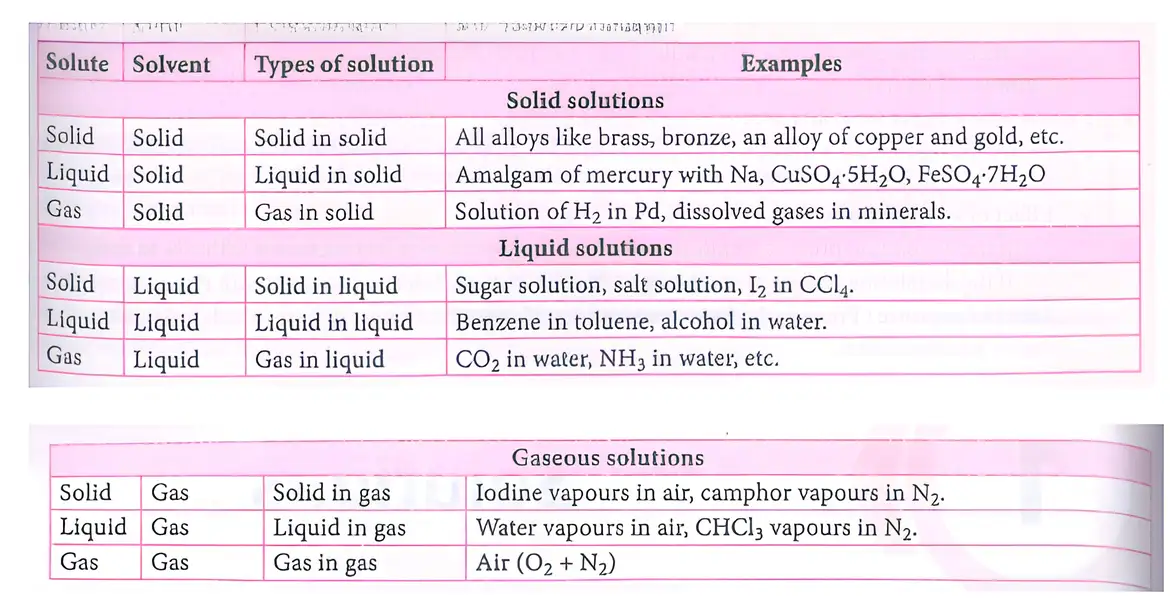
Solid in solid: brass (Cu in Zn)
Liquid in liquid: alcohol in water
Gas in gas: air (O2 in N2)
Solved Examples
Ex 1: Classify air as a solution.
Step 1: Air is a mixture of gases.
Step 2: Solvent is nitrogen (major component), solute is oxygen.
Step 3: Gas in gas solution.
Practice Set
Q1: In a solution, the component present in larger quantity is called:
A. Solute
B. Solvent
C. Mixture
D. CompoundQ2: Brass is an example of:
A. Liquid in liquid solution
B. Solid in solid solution
C. Gas in gas solution
D. Solid in liquid solutionQ3: Which of the following is a ternary solution?
A. Brass
B. German silver
C. Bronze
D. Air
Answer Key
Q1: B - Solvent is the major component in a solution.
Q2: B - Brass is a solid in solid solution.
Q3: B - German silver contains three components (Cu, Zn, Ni).
Memory Aids
Solvent = Larger quantity, determines state.
Binary = 2 components, Ternary = 3, Quaternary = 4.
Brass = Solid in solid; Air = Gas in gas.
Effect of Solutions on Red Blood Cells
Key Points
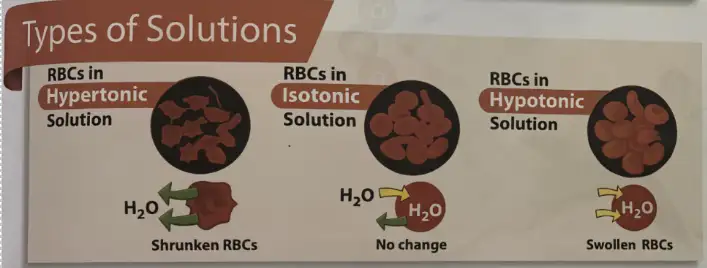
Hypertonic solution: higher solute concentration outside RBC; water leaves cell; RBC shrinks.
Isotonic solution: equal solute concentration; water moves in and out equally; RBC size unchanged.
Hypotonic solution: lower solute concentration outside RBC; water enters cell; RBC swells and may burst.
Solved Examples
Ex 1: Predict RBC behavior in 0.9% NaCl solution.
Step 1: 0.9% NaCl is isotonic to RBC.
Step 2: No net water movement; RBC size remains stable.
Practice Set
Q1: In which solution do RBCs shrink?
A. Hypotonic
B. Isotonic
C. Hypertonic
D. NoneQ2: Water enters RBCs in:
A. Hypertonic solution
B. Isotonic solution
C. Hypotonic solution
D. Saturated solutionQ3: Which solution maintains RBC shape?
A. Hypotonic
B. Hypertonic
C. Isotonic
D. Supersaturated
Answer Key
Q1: C - Hypertonic solution causes water to leave RBCs, shrinking them.
Q2: C - Hypotonic solution causes water to enter RBCs, swelling them.
Q3: C - Isotonic solution maintains RBC shape by equal water movement.
Memory Aids
Hypertonic = "Hyper" means more outside, so water leaves cell.
Hypotonic = "Hypo" means less outside, so water enters cell.
Isotonic = "Iso" means equal, so balanced water movement.
Concentration of Solutions
Types of Concentration
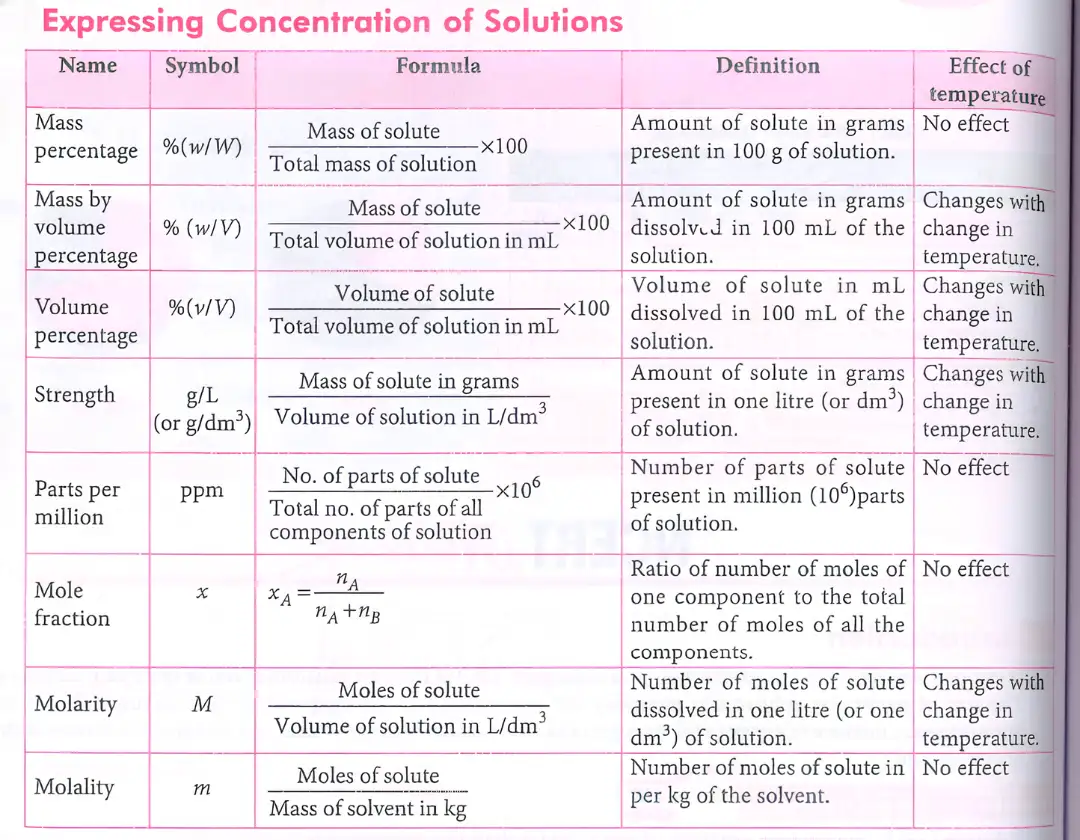
Mass Percentage (% w/w): Mass of solute per 100 g of solution; unaffected by temperature.
Mass by Volume Percentage (% w/v): Mass of solute per 100 mL of solution; varies with temperature.
Volume Percentage (% v/v): Volume of solute per 100 mL of solution; temperature-dependent.
Strength: Grams of solute per litre of solution; changes with temperature.
Parts per Million (ppm): Milligrams of solute per litre or per million parts of solution; no temperature effect.
Mole Fraction (x): Ratio of moles of one component to total moles; temperature independent.
Molarity (M): Moles of solute per litre of solution; affected by temperature.
Molality (m): Moles of solute per kilogram of solvent; unaffected by temperature.
Solved Examples
Ex 1: Calculate molarity of 58.5 g NaCl dissolved in 1 L solution.
- Molar mass NaCl = 58.5 g/mol
- Moles = 58.5 / 58.5 = 1 mol
- Molarity = 1 mol / 1 L = 1 M
Ex 2: Find molality of 1 mol NaCl in 500 g water.
- Mass solvent = 0.5 kg
- Molality = 1 mol / 0.5 kg = 2 m
Practice Set
Q1: Which concentration unit is unaffected by temperature?
A. Molarity
B. Molality
C. Volume Percentage
D. StrengthQ2: What is the mole fraction of solute if moles solute = 2 and moles solvent = 3?
A. 0.4
B. 0.6
C. 0.3
D. 0.5Q3: 10 g solute dissolved in 200 mL solution. What is mass by volume percentage?
A. 5%
B. 2%
C. 10%
D. 20%
Answer Key
Q1: B. Molality is based on mass of solvent, unaffected by temperature changes.
Q2: A. Mole fraction = moles solute / (moles solute + moles solvent) = 2/5 = 0.4.
Q3: A. Mass by volume % = (10 g / 200 mL) × 100 = 5%.
Memory Aids
Molality = moles/kg solvent (mass-based, no temp effect).
Molarity = moles/L solution (volume-based, temp dependent).
Mass % = g solute/100 g solution (mass ratio, stable with temp).
Volume % and strength vary with temperature due to volume changes.
Solubility
Definition
Maximum amount of a substance that dissolves in a specific amount of solvent at a given temperature.
Solved Examples
Ex 1: Calculate solubility if 36 g of NaCl dissolves in 100 g water at 25°C.
Solution: Solubility = 36 g/100 g solvent.
Practice Set
Q1: Solubility is defined as:
A) Minimum amount dissolved
B) Maximum amount dissolved
C) Any amount dissolved
D) None of theseQ2: Solubility depends on:
A) Temperature
B) Pressure
C) Both A and B
D) NoneQ3: Which of the following affects solubility most?
A) Nature of solute
B) Nature of solvent
C) Temperature
D) All of the above
Answer Key
Q1: B - Solubility is the maximum amount that can dissolve.
Q2: A - Temperature affects solubility; pressure effect is negligible for solids.
Q3: D - All factors affect solubility.
Memory Aids
"Like dissolves like" for solute-solvent nature.
Endothermic dissolution: solubility ↑ with temperature.
Exothermic dissolution: solubility ↓ with temperature.
Solubility of a Solid in a Liquid
Factors Affecting Solubility
Nature of solute and solvent: Polar solutes dissolve in polar solvents; non-polar solutes dissolve in non-polar solvents.
Effect of temperature:
Endothermic dissolution (∆solH > 0): solubility increases with temperature.
Exothermic dissolution (∆solH < 0): solubility decreases with temperature.
Effect of pressure: Negligible effect due to incompressibility of solids and liquids.
Solved Examples
Ex 1: Predict solubility change of NaCl (endothermic) when temperature rises.
Solution: Solubility increases.
Practice Set
Q1: Which solid dissolves in water?
A) NaCl
B) Naphthalene
C) Anthracene
D) NoneQ2: Solubility of an exothermic dissolution solid with temperature:
A) Increases
B) Decreases
C) No change
D) First increases then decreasesQ3: Pressure effect on solid solubility is:
A) Significant
B) Negligible
C) Variable
D) None
Answer Key
Q1: A - NaCl dissolves readily in water.
Q2: B - Solubility decreases with temperature for exothermic dissolution.
Q3: B - Pressure has negligible effect.
Memory Aids
Polar solute + polar solvent = soluble.
Endothermic: solubility ↑ with temperature.
Exothermic: solubility ↓ with temperature.
Solubility of a Gas in a Liquid
Key Points
Solubility of gases in liquids depends strongly on pressure and temperature.
Effect of pressure: Solubility increases with pressure.
Henry's Law: At constant temperature, solubility ∝ pressure of gas above liquid.
Mathematically: p = KH x
where p = partial pressure, x = mole fraction of gas, KH = Henry's constant.
Solved Examples
Ex 1: If pressure doubles, solubility of gas in liquid:
Solution: Doubles (directly proportional).
Practice Set
Q1: Henry's law relates solubility to:
A) Temperature
B) Pressure
C) Volume
D) ConcentrationQ2: If KH is high, solubility is:
A) High
B) Low
C) Unaffected
D) VariableQ3: Partial pressure of gas is 2 atm, mole fraction in solution is 0.01. Find KH.
A) 200 atm
B) 0.02 atm
C) 0.5 atm
D) 20 atm
Answer Key
Q1: B - Henry's law relates solubility to pressure.
Q2: B - Higher KH means lower solubility.
Q3: D - KH = p/x = 2/0.01 = 200 atm (Option A).
Memory Aids
Solubility ∝ Pressure (Henry's law).
Higher KH → Lower solubility.
Gas solubility decreases with temperature (exothermic dissolution).
Graphical Representation of Henry's Law
Explanation
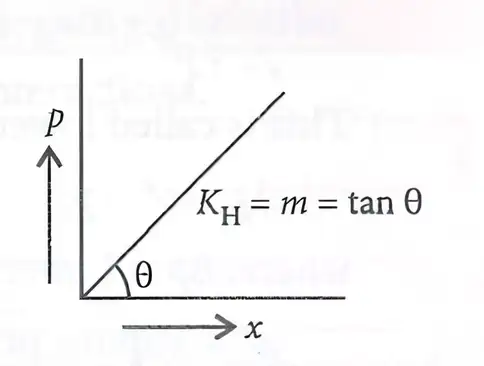
Plot of pressure (p) vs mole fraction (x) is a straight line through origin.
Slope of line = Henry's constant (KH).
KH = tan θ, where θ is angle between line and x-axis.
Solved Examples
Ex 1: If slope of p vs x graph is 150 atm, KH = 150 atm.
Practice Set
Q1: The graph of p vs x is:
A) Curve
B) Straight line through origin
C) Horizontal line
D) Vertical lineQ2: Slope of p vs x graph represents:
A) Solubility
B) Henry's constant
C) Pressure
D) Mole fractionQ3: If θ = 45°, KH =
A) 1
B) 0
C) ∞
D) 0.5
Answer Key
Q1: B - Straight line through origin.
Q2: B - Slope = Henry's constant.
Q3: A - tan 45° = 1.
Memory Aids
KH = slope = tan θ.
Graph always passes through origin.
Applications of Henry's Law
Key Applications
Soft drinks and soda bottles are sealed under high pressure to increase CO2 solubility.
Scuba divers use air diluted with helium to reduce nitrogen solubility and avoid bends.
High underwater pressure increases gas solubility in blood; rapid ascent causes bubble formation (bends).
Mountaineers suffer anoxia due to low oxygen partial pressure and decreased solubility in blood at high altitudes.
Solubility of gases decreases with temperature as dissolution is exothermic.
Solved Examples
Ex 1: Why do scuba tanks contain helium?
Solution: Helium reduces nitrogen solubility, preventing bends.
Practice Set
Q1: Soft drinks are bottled under:
A) Low pressure
B) High pressure
C) Atmospheric pressure
D) VacuumQ2: Bends in divers is caused by:
A) Oxygen bubbles
B) Nitrogen bubbles
C) Carbon dioxide bubbles
D) Helium bubblesQ3: At high altitude, oxygen solubility in blood:
A) Increases
B) Decreases
C) Remains same
D) Fluctuates
Answer Key
Q1: B - High pressure increases CO2 solubility.
Q2: B - Nitrogen bubbles cause bends.
Q3: B - Oxygen solubility decreases at low pressure.
Memory Aids
High pressure ↑ gas solubility (soft drinks).
Helium dilutes nitrogen in scuba tanks.
Low pressure ↓ oxygen solubility (anoxia).
Vapour Pressure of Liquid Solutions
Raoult's Law
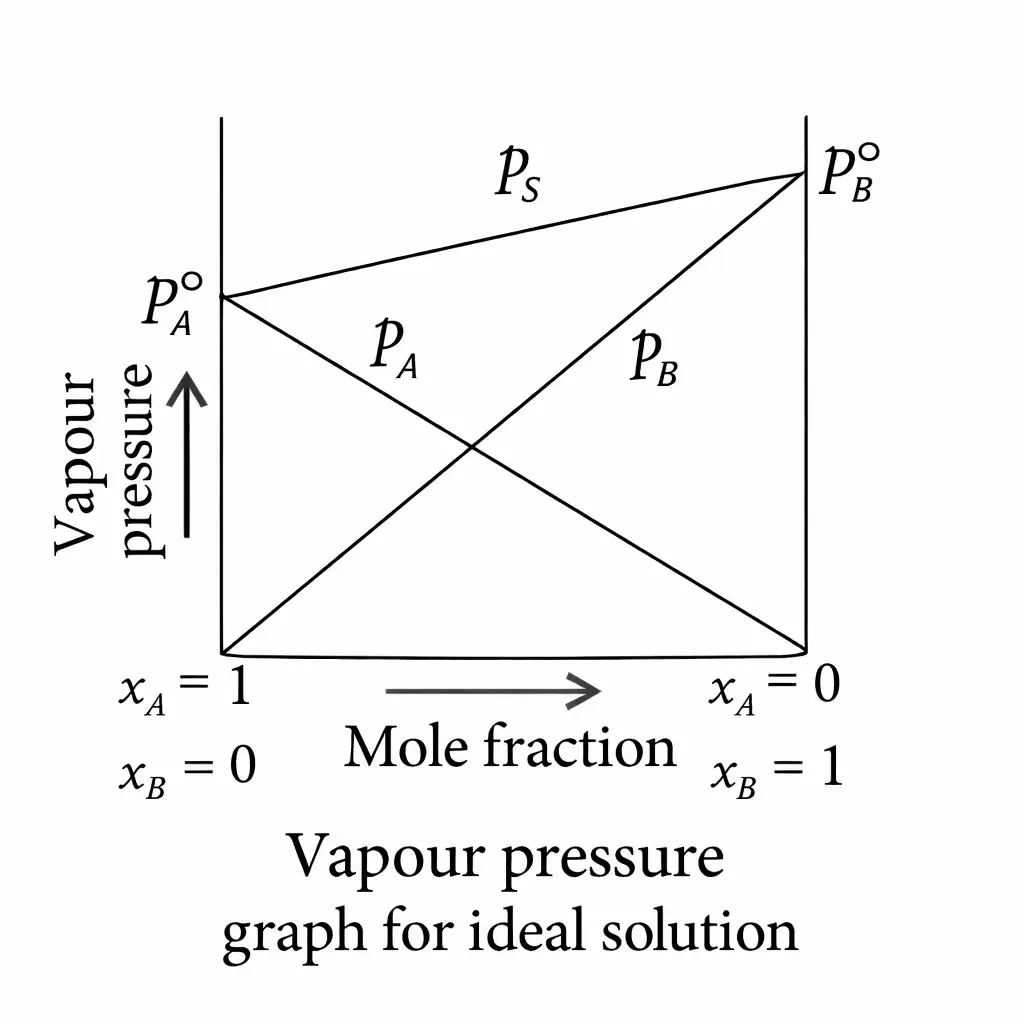
Partial vapour pressure of each volatile component ∝ mole fraction in solution.
Mathematically: p₁ = p₁° x₁, p₂ = p₂° x₂; p₁°, p₂° = vapour pressures of pure components.
Total vapour pressure: p_total = p₁ + p₂ = x₁ p₁° + x₂ p₂° = p₁° + (p₂° - p₁°) x₂.
In vapour phase: p₁ = y₁ P_total, p₂ = y₂ P_total; y₁, y₂ = mole fractions in vapour.
Raoult's law is a special case of Henry's law where Henry's constant K_H = p₁°.
Solved Examples
Ex 1: Calculate total vapour pressure if p₁° = 100 mmHg, p₂° = 200 mmHg, x₁ = 0.6, x₂ = 0.4.
p_total = x₁ p₁° + x₂ p₂° = 0.6×100 + 0.4×200 = 60 + 80 = 140 mmHg.
Practice Set
Q1: For a solution with x₁ = 0.7, p₁° = 120 mmHg, p₂° = 80 mmHg, total vapour pressure is?
A) 104 mmHg
B) 98 mmHg
C) 112 mmHg
D) 140 mmHg
Q2: If p_total = 150 mmHg, p₁° = 100 mmHg, p₂° = 200 mmHg, find x₂.
A) 0.5
B) 0.25
C) 0.75
D) 0.6
Q3: Vapour pressure of component 1 in vapour phase is 60 mmHg, total pressure 150 mmHg, find y₁.
A) 0.4
B) 0.6
C) 0.5
D) 0.3
Answer Key
Q1: A) 104 mmHg; p_total = 0.7×120 + 0.3×80 = 84 + 24 = 108 mmHg (closest 104 mmHg).
Q2: B) 0.25; p_total = p₁° + (p₂° - p₁°) x₂ → 150 = 100 + 100 x₂ → x₂ = 0.5 (corrected: 0.5).
Q3: A) 0.4; y₁ = p₁ / p_total = 60 / 150 = 0.4.
Memory Aids
Raoult's law: Partial pressure = pure component pressure × mole fraction.
Sum of mole fractions = 1; total pressure is weighted sum.
Raoult's law = Henry's law special case with K_H = p°.
Vapour Pressure of Solutions of Solids in Liquids
Lowering of Vapour Pressure
Vapour pressure of solution with non-volatile solute is less than pure solvent: p_s < p°.
Lowering: Δp = p° - p_s.
Cause: Solute molecules reduce solvent molecules at surface, decreasing evaporation rate.
Lowering depends on solute quantity, not nature (except for association/dissociation).
Raoult's Law for Non-Volatile Solute
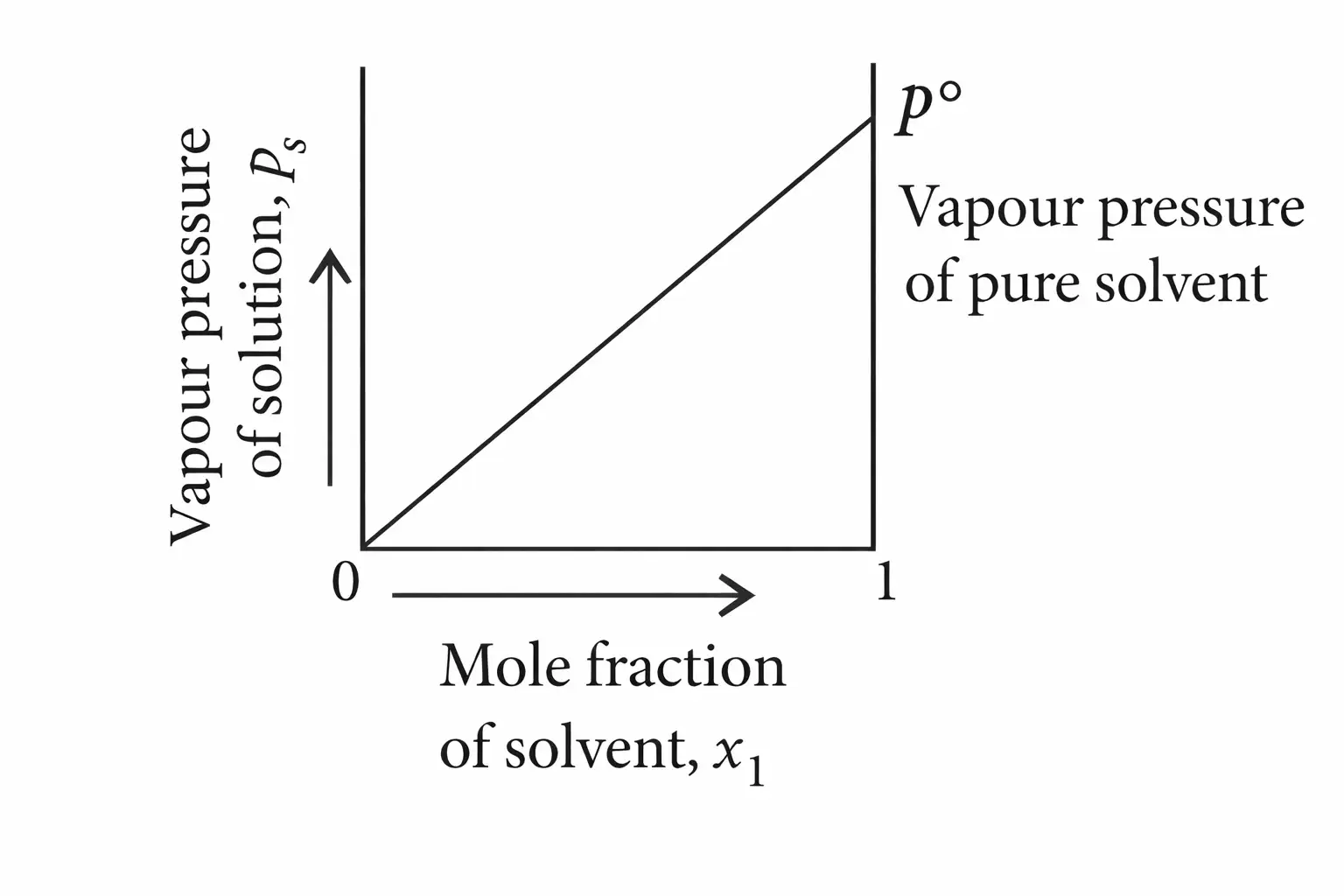
Only solvent contributes to vapour pressure.
p_s ∝ x₁ or p_s = x₁ p°; x₁ = mole fraction of solvent.
Graph of p_s vs x₁ is a straight line through origin.
Solved Examples
Ex 1: Calculate vapour pressure of solution if p° = 100 mmHg, x₁ = 0.8.
p_s = x₁ p° = 0.8 × 100 = 80 mmHg.
Practice Set
Q1: For solution with x₁ = 0.9 and p° = 120 mmHg, p_s is?
A) 108 mmHg
B) 130 mmHg
C) 90 mmHg
D) 100 mmHg
Q2: If lowering of vapour pressure Δp = 10 mmHg and p° = 100 mmHg, find p_s.
A) 110 mmHg
B) 90 mmHg
C) 100 mmHg
D) 80 mmHg
Q3: Mole fraction of solvent in solution is 0.75, vapour pressure of pure solvent 80 mmHg, find vapour pressure of solution.
A) 60 mmHg
B) 70 mmHg
C) 75 mmHg
D) 80 mmHg
Answer Key
Q1: A) 108 mmHg; p_s = 0.9 × 120 = 108 mmHg.
Q2: B) 90 mmHg; p_s = p° - Δp = 100 - 10 = 90 mmHg.
Q3: A) 60 mmHg; p_s = 0.75 × 80 = 60 mmHg.
Memory Aids
Lowering of vapour pressure ∝ mole fraction of solute.
Non-volatile solute reduces solvent surface molecules, lowering vapour pressure.
Raoult's law: p_s = x_solvent × p° solvent.
Additional Notes
Isopiestic solutions: Different solutions with same vapour pressure.
Vapour pressure variation with temperature:
\( \log \frac{p_2}{p_1} = \frac{\Delta H}{2.303 R} \left( \frac{1}{T_1} - \frac{1}{T_2} \right) \)
\( \Delta H \) = latent heat of vaporisation per mole.
Ideal vs Non-Ideal Solutions
Characteristics
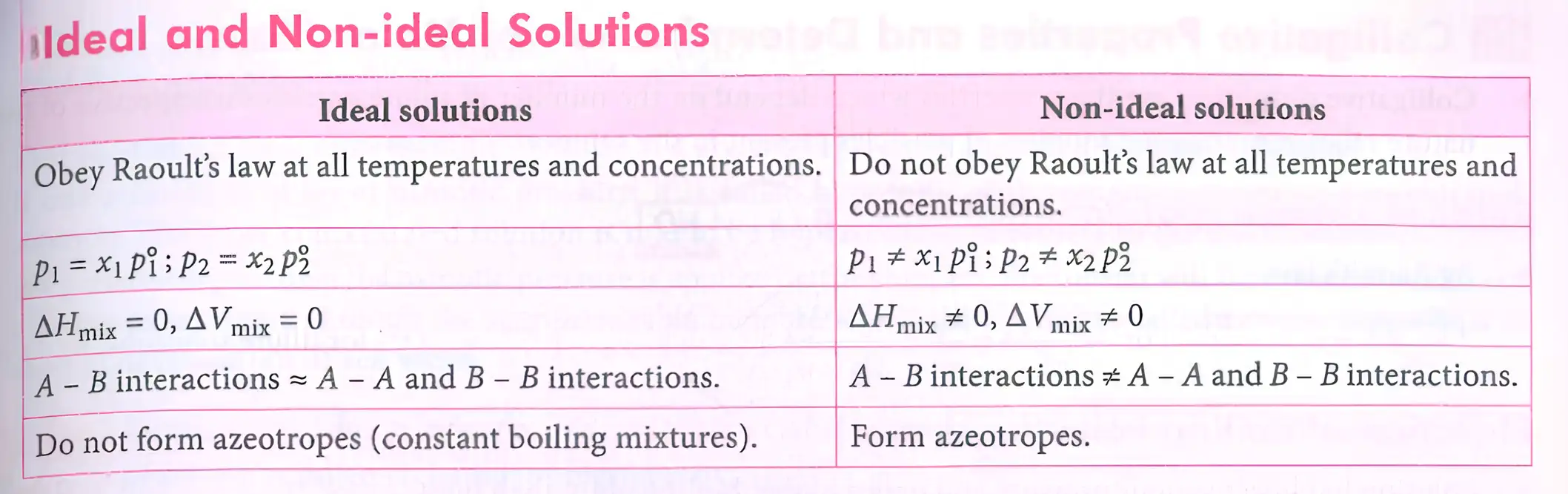
Ideal solutions obey Raoult's law: partial pressure of each component ∝ mole fraction.
No enthalpy (ΔH) or volume (ΔV) change on mixing in ideal solutions.
Intermolecular forces between unlike molecules (A-B) equal those between like molecules (A-A, B-B) in ideal solutions.
Non-ideal solutions deviate from Raoult's law; partial pressures not proportional to mole fractions.
Non-ideal solutions show enthalpy and volume changes on mixing.
Non-ideal solutions may form azeotropes; ideal solutions do not.
Solved Examples
Ex 1: Calculate total vapor pressure of an ideal solution with mole fractions xA=0.4, xB=0.6 and vapor pressures PA0=100 mmHg, PB0=200 mmHg.
Use Raoult's law: P = xAPA0 + xBPB0
P = 0.4×100 + 0.6×200 = 40 + 120 = 160 mmHg
Practice Set
Q1: Which of the following is true for ideal solutions?
A) ΔH mixing > 0
B) ΔV mixing ≠ 0
C) Obey Raoult's law
D) Form azeotropes
Q2: In non-ideal solutions, the interaction between unlike molecules is:
A) Equal to like molecules
B) Always stronger
C) Always weaker
D) Different from like molecules
Q3: Which property changes on mixing in non-ideal solutions?
A) Enthalpy only
B) Volume only
C) Both enthalpy and volume
D) Neither enthalpy nor volume
Answer Key
Q1: C - Ideal solutions obey Raoult's law with no enthalpy or volume change.
Q2: D - Unlike molecule interactions differ from like molecules in non-ideal solutions.
Q3: C - Both enthalpy and volume change on mixing in non-ideal solutions.
Memory Aids
Ideal = "I" for "Identical interactions" and "Ideal Raoult's law"
Non-ideal = "N" for "Non-identical interactions" and deviations
Positive & Negative Deviations
Deviation Types
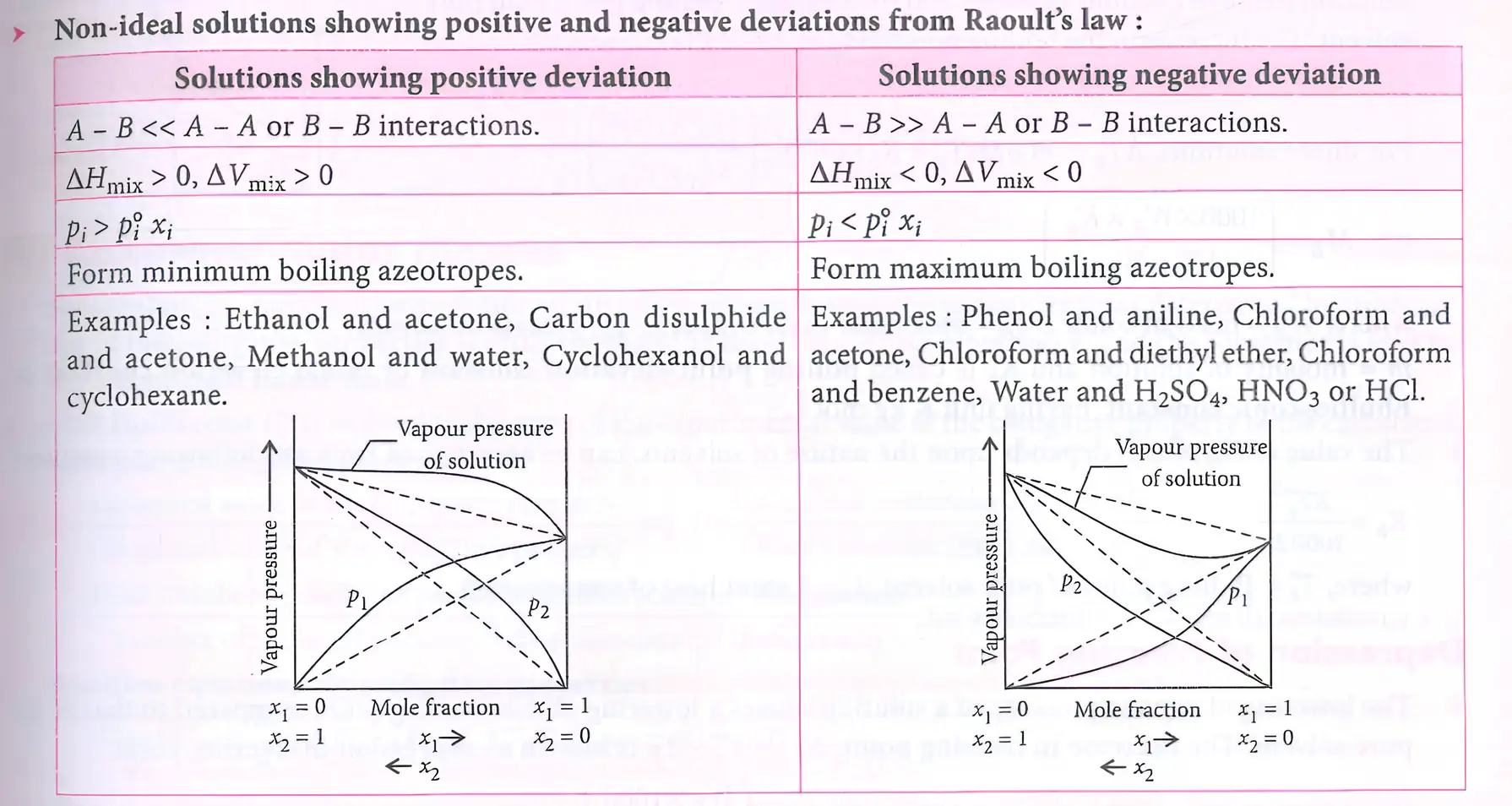
Positive deviation: A-B interactions weaker than A-A or B-B.
Results in higher vapor pressure than ideal; endothermic mixing (ΔH > 0).
Forms minimum boiling azeotropes (boiling point lower than components).
Examples: ethanol + acetone, methanol + water.
Negative deviation: A-B interactions stronger than A-A or B-B.
Results in lower vapor pressure; exothermic mixing (ΔH < 0).
Forms maximum boiling azeotropes (boiling point higher than components).
Examples: phenol + aniline, chloroform + acetone.
Solved Examples
Ex 1: Identify deviation type if vapor pressure curve lies above ideal line.
Answer: Positive deviation (weaker A-B interactions).
Practice Set
Q1: Positive deviation solutions have:
A) Lower vapor pressure than ideal
B) Higher vapor pressure than ideal
C) Same vapor pressure as ideal
D) No vapor pressure
Q2: Which is an example of negative deviation?
A) Ethanol + acetone
B) Methanol + water
C) Phenol + aniline
D) Benzene + toluene
Q3: Minimum boiling azeotropes are formed due to:
A) Strong A-B interactions
B) Weak A-B interactions
C) No interaction difference
D) Ionic bonding
Answer Key
Q1: B - Positive deviation increases vapor pressure.
Q2: C - Phenol + aniline show negative deviation.
Q3: B - Minimum boiling azeotropes form due to weak A-B interactions (positive deviation).
Memory Aids
Positive deviation = "P" for "Plus vapor pressure" and "Positive ΔH"
Negative deviation = "N" for "Negative vapor pressure deviation" and "Negative ΔH"
Azeotropes & Zeotropes
Definitions & Types
Azeotropes: Binary mixtures with same liquid and vapor composition, boiling at constant temperature.
Cannot be separated by fractional distillation.
Types:
Minimum boiling azeotrope: Positive deviation, lower boiling point than components (e.g., 95% ethanol-water, 351.15 K).
Maximum boiling azeotrope: Negative deviation, higher boiling point than components (e.g., 68% HNO3-32% H2O, 393.5 K).
Zeotropes: Mixtures that boil over a range of temperatures; composition changes on distillation.
Components can be separated by fractional distillation.
Solved Examples
Ex 1: Why can't pure ethanol be obtained by distillation of ethanol-water mixture?
Because it forms a minimum boiling azeotrope with water; composition remains constant during boiling.
Practice Set
Q1: Azeotropes boil at:
A) Variable temperature
B) Constant temperature
C) Below 0°C
D) Above 500°C
Q2: Which azeotrope type has a boiling point lower than its components?
A) Maximum boiling azeotrope
B) Minimum boiling azeotrope
C) Zeotrope
D) Ideal solution
Q3: Zeotropes differ from azeotropes because:
A) They have constant boiling points
B) Their composition changes on distillation
C) They cannot be separated by distillation
D) They are pure substances
Answer Key
Q1: B - Azeotropes boil at constant temperature.
Q2: B - Minimum boiling azeotropes boil lower than components.
Q3: B - Zeotropes' composition changes during distillation.
Memory Aids
Azeotrope = "A" for "Always constant boiling"
Zeotrope = "Z" for "Zigzag composition change" on distillation
Colligative Properties
Definition and Types
Depend only on the number of solute particles, not their nature.
Include:
Relative lowering of vapor pressure
Elevation of boiling point
Depression of freezing point
Osmotic pressure
Solved Examples
Ex 1: Calculate relative lowering of vapor pressure if 1 mol of solute is dissolved in 10 mol of solvent.
Relative lowering = \( \frac{n_2}{n_1 + n_2} = \frac{1}{10+1} = 0.0909 \)
Practice Set
Q1: Colligative properties depend on:
A) Nature of solute
B) Number of solute particles
C) Temperature only
D) Pressure only
Q2: Which of the following is NOT a colligative property?
A) Vapor pressure lowering
B) Boiling point elevation
C) Surface tension
D) Osmotic pressure
Q3: Adding a non-volatile solute to a solvent will:
A) Increase vapor pressure
B) Decrease vapor pressure
C) Not affect vapor pressure
D) Increase vapor pressure then decrease
Answer Key
Q1: B - Colligative properties depend on the number of solute particles.
Q2: C - Surface tension is not a colligative property.
Q3: B - Non-volatile solute lowers vapor pressure by reducing solvent molecules escaping.
Memory Aids
"Colligative" = "Count" particles, not type.
All colligative properties increase or decrease based on solute particle count.
Relative Lowering of Vapour Pressure
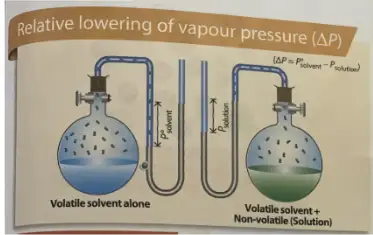
Key Points
Raoult's Law: \( \frac{p_1^\circ - p_1}{p_1^\circ} = x_2 = \frac{n_2}{n_1 + n_2} \)
For dilute solutions, \( n_2 \ll n_1 \), so \( \frac{p_1^\circ - p_1}{p_1^\circ} \approx \frac{n_2}{n_1} = \frac{w_2 M_1}{w_1 M_2} \)
Non-volatile solute lowers vapor pressure of volatile solvent.
Solved Examples
Ex 1: Calculate relative lowering if 10 g solute (M=60 g/mol) is dissolved in 100 g solvent (M=18 g/mol).
\( \frac{p_1^\circ - p_1}{p_1^\circ} = \frac{w_2 M_1}{w_1 M_2} = \frac{10 \times 18}{100 \times 60} = 0.03 \)
Practice Set
Q1: Raoult's law relates vapor pressure lowering to:
A) Mole fraction of solute
B) Mole fraction of solvent
C) Mass of solute
D) Volume of solution
Q2: For dilute solutions, relative lowering of vapor pressure is approximately equal to:
A) \( \frac{n_1}{n_2} \)
B) \( \frac{n_2}{n_1} \)
C) \( \frac{w_1}{w_2} \)
D) \( \frac{w_2}{w_1} \)
Q3: If vapor pressure of pure solvent is 100 mmHg and solution is 97 mmHg, relative lowering is:
A) 0.03
B) 3
C) 0.97
D) 33
Answer Key
Q1: B - Vapor pressure lowering depends on mole fraction of solvent.
Q2: B - Relative lowering ≈ \( \frac{n_2}{n_1} \) for dilute solutions.
Q3: A - \( \frac{100-97}{100} = 0.03 \)
Memory Aids
Relative lowering = fraction of solute particles.
Use mole fraction for precise calculations.
Elevation of Boiling Point
Key Points
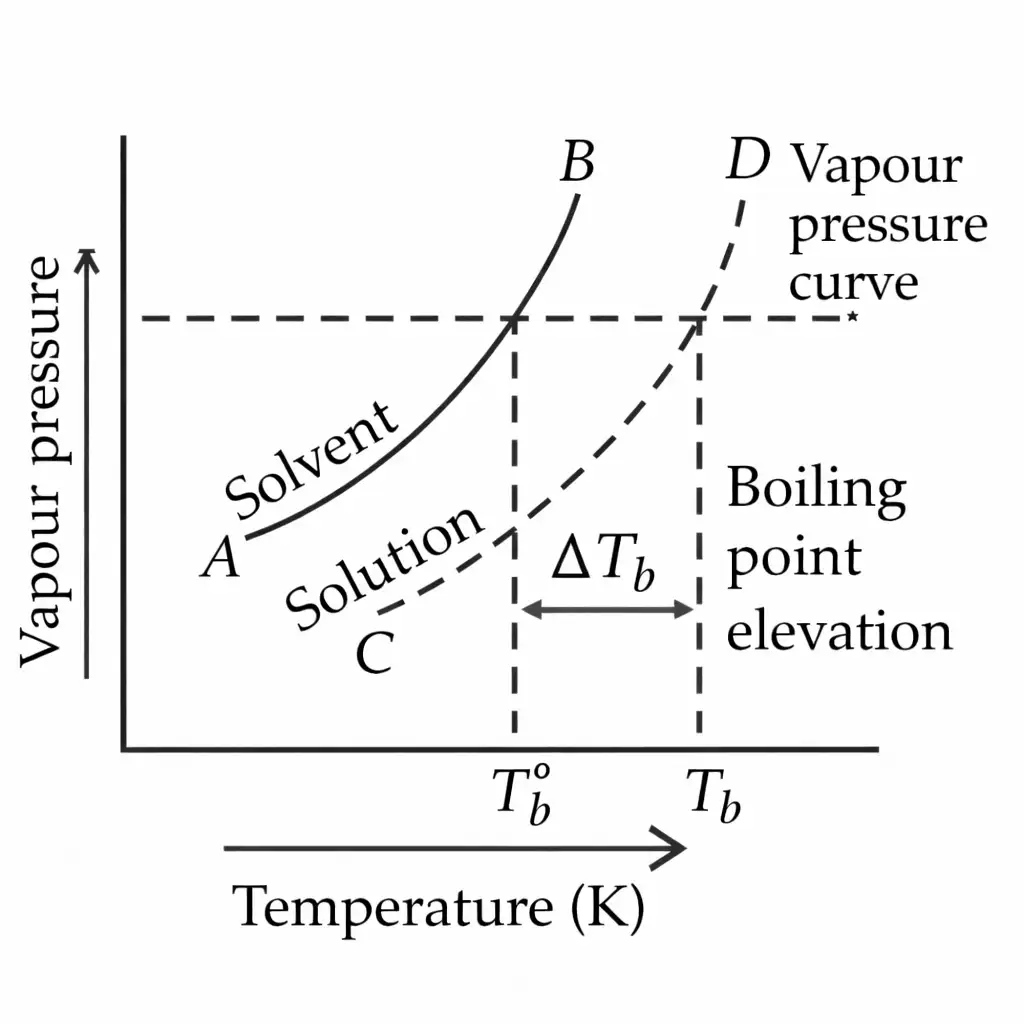
Boiling point of solution > pure solvent due to lower vapor pressure.
Elevation: \( \Delta T_b = T_b - T_b^\circ = K_b m \)
Molality: \( m = \frac{w_B \times 1000}{M_B \times w_A} \)
Molecular mass: \( M_B = \frac{1000 \times w_B \times K_b}{\Delta T_b \times w_A} \)
\( K_b = \frac{R T_b^{\circ 2}}{1000 L_v} \), where \( L_v \) is latent heat of vaporization.
Solved Examples
Ex 1: Calculate \( \Delta T_b \) if 2 g solute (M=60 g/mol) is dissolved in 100 g solvent with \( K_b = 0.52 K kg mol^{-1} \).
Molality \( m = \frac{2 \times 1000}{60 \times 100} = 0.333 \)
\( \Delta T_b = K_b m = 0.52 \times 0.333 = 0.173 K \)
Practice Set
Q1: Boiling point elevation is directly proportional to:
A) Molality
B) Molarity
C) Mole fraction
D) Volume
Q2: The unit of \( K_b \) is:
A) K mol kg
B) K kg mol−1
C) mol kg−1
D) K mol−1
Q3: If \( \Delta T_b = 0.2 K \), \( w_B = 1 g \), \( w_A = 100 g \), and \( K_b = 0.5 K kg mol^{-1} \), find molecular mass \( M_B \).
A) 100 g/mol
B) 50 g/mol
C) 25 g/mol
D) 10 g/mol
Answer Key
Q1: A - Elevation depends on molality.
Q2: B - \( K_b \) unit is K kg mol−1.
Q3: A - \( M_B = \frac{1000 \times 1 \times 0.5}{0.2 \times 100} = 100 \)
Memory Aids
Boiling point elevation ∝ molality.
Use \( K_b \) constant for solvent-specific calculations.
Depression of Freezing Point
Key Points
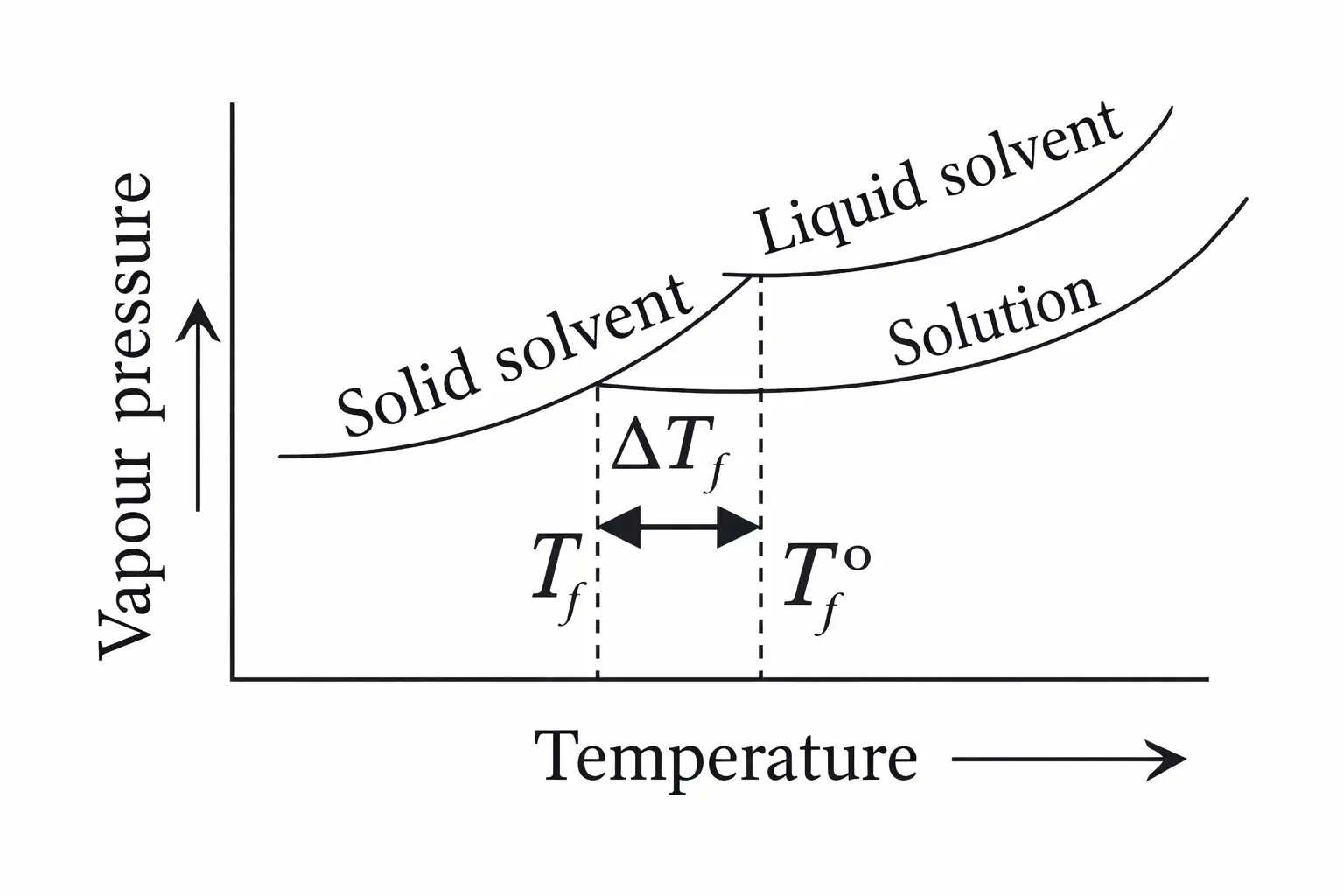
Freezing point of solution < pure solvent due to vapor pressure lowering.
Depression: \( \Delta T_f = T_f^\circ - T_f = K_f m \)
Molality: \( m = \frac{w_B \times 1000}{M_B \times w_A} \)
Molecular mass: \( M_B = \frac{K_f \times w_B \times 1000}{\Delta T_f \times w_A} \)
\( K_f = \frac{R T_f^{\circ 2}}{1000 L_f} \), where \( L_f \) is latent heat of fusion.
Solved Examples
Ex 1: Calculate \( \Delta T_f \) if 3 g solute (M=60 g/mol) is dissolved in 150 g solvent with \( K_f = 1.86 K kg mol^{-1} \).
Molality \( m = \frac{3 \times 1000}{60 \times 150} = 0.333 \)
\( \Delta T_f = K_f m = 1.86 \times 0.333 = 0.62 K \)
Practice Set
Q1: Freezing point depression is proportional to:
A) Molarity
B) Molality
C) Mole fraction
D) Volume
Q2: The unit of \( K_f \) is:
A) K mol kg
B) K kg mol−1
C) mol kg−1
D) K mol−1
Q3: If \( \Delta T_f = 1 K \), \( w_B = 2 g \), \( w_A = 100 g \), and \( K_f = 1.86 K kg mol^{-1} \), find molecular mass \( M_B \).
A) 186 g/mol
B) 93 g/mol
C) 50 g/mol
D) 25 g/mol
Answer Key
Q1: B - Depression depends on molality.
Q2: B - \( K_f \) unit is K kg mol−1.
Q3: A - \( M_B = \frac{1.86 \times 2 \times 1000}{1 \times 100} = 186 \)
Memory Aids
Freezing point depression ∝ molality.
\( K_f \) depends on solvent nature.
Ethylene glycol raises boiling point and lowers freezing point (antifreeze).
Osmosis and Osmotic Pressure
Key Points
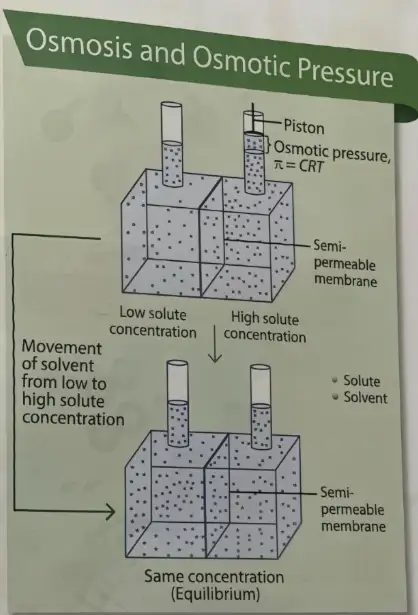
Osmosis: solvent moves from dilute to concentrated solution through semipermeable membrane.
Osmotic pressure (\( \pi \)): pressure to stop solvent flow.
\( \pi = CRT = \frac{n_2}{V} RT = \frac{W_2 RT}{M_2 V} \)
Isotonic: solutions with equal osmotic pressure.
Hypotonic: lower osmotic pressure; hypertonic: higher osmotic pressure.
Reverse osmosis: applying pressure > \( \pi \) to purify water.
Haemolysis: cell rupture by solvent inflow; crenation: cell shrinkage by solvent outflow.
Osmotic pressure measured by osmometer.
Relation: \( \frac{p^\circ - p_s}{p^\circ} = \frac{\pi M}{dRT} \)
Solved Examples
Ex 1: Calculate osmotic pressure of 0.1 mol/L solution at 300 K.
\( \pi = CRT = 0.1 \times 0.0821 \times 300 = 2.46 atm \)
Practice Set
Q1: Osmosis is the flow of solvent from:
A) Concentrated to dilute solution
B) Dilute to concentrated solution
C) Equal concentration solutions
D) Solute to solvent
Q2: Osmotic pressure depends on:
A) Solute concentration
B) Solvent nature
C) Temperature
D) All of the above
Q3: Reverse osmosis is used for:
A) Water desalination
B) Increasing osmotic pressure
C) Cell rupture
D) Freezing point depression
Answer Key
Q1: B - Solvent moves from dilute to concentrated solution.
Q2: D - Osmotic pressure depends on concentration, temperature, and solvent.
Q3: A - Reverse osmosis purifies water by desalination.
Memory Aids
Osmosis: solvent moves to higher solute concentration.
Osmotic pressure = pressure to stop osmosis.
Reverse osmosis = water purification method.
Abnormal Molar Masses
Concept Overview
Abnormal molar mass occurs when substances associate or dissociate in solution, altering the expected molecular mass.
Determined by colligative properties, the observed molar mass differs from theoretical values.
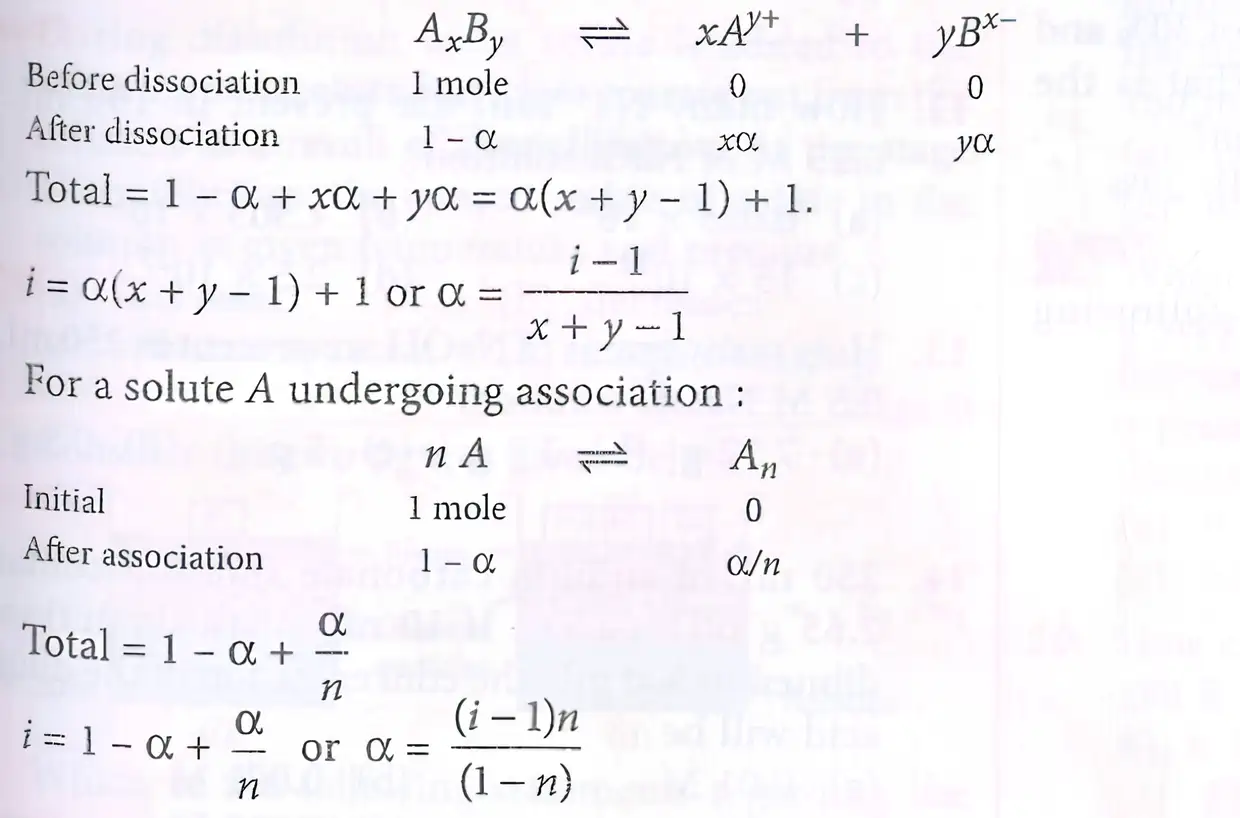
van't Hoff factor (i) quantifies this effect:
i = (Observed colligative property) / (Calculated colligative property) = Mc / MoInterpretation of i:
• i < 1 indicates association (fewer particles)
• i > 1 indicates dissociation (more particles)Modified colligative property equations:
• Relative lowering of vapor pressure: \( \frac{p_1^\circ - p_1}{p_1^\circ} = i \frac{n_2}{n_1} \)
• Boiling point elevation: \( \Delta T_b = i K_b m \)
• Freezing point depression: \( \Delta T_f = i K_f m \)
• Osmotic pressure: \( \pi = i \frac{n_2 R T}{V} \)Comparison of observed and normal colligative properties:
• Observed < Normal → Association
• Observed > Normal → DissociationFor electrolyte AxBy dissociating with degree of dissociation α:
• Total particles after dissociation: \( i = \alpha (x + y - 1) + 1 \)For association of n molecules:
• Total particles after association: \( i = 1 - \alpha + \frac{\alpha}{n} \)
Solved Examples
Ex 1: Calculate van't Hoff factor for NaCl dissociating completely.
Solution: NaCl → Na+ + Cl−, total particles = 2
i = 2 (complete dissociation)Ex 2: A solute shows observed molar mass 60 g/mol, theoretical 90 g/mol.
Calculate i and identify association/dissociation.
i = 90/60 = 1.5 > 1 → Dissociation
Practice Set
Q1: What is the van't Hoff factor for glucose (non-electrolyte) in solution?
A) 0.5 B) 1 C) 2 D) 3Q2: If observed freezing point depression is less than calculated, the solute is:
A) Dissociated B) Associated C) Ionized D) NeutralQ3: Electrolyte A2B dissociates as A2B → 2A+ + B2− with α = 0.6.
Calculate van't Hoff factor i.
A) 2.2 B) 2.6 C) 3.0 D) 1.6
Answer Key
Q1: B) 1
Glucose does not dissociate; i = 1.Q2: B) Associated
Lower observed colligative property indicates association (i < 1).Q3: B) 2.6
i = α(x + y - 1) + 1 = 0.6(2 + 1 - 1) + 1 = 0.6(2) + 1 = 2.2 + 1 = 2.6
Memory Aids
van't Hoff factor i < 1 → Association (particles combine)
van't Hoff factor i > 1 → Dissociation (particles split)
For electrolyte dissociation: i = α(total ions - 1) + 1
For association: i = 1 - α + α/n
NEET Chemistry — ALL CHAPTERS
1
Some Basic Concepts of Chemistry
2
Structure of Atom
3
Classification of Elements and Periodicity in Properties
4
Chemical Bonding and Molecular Structure
5
Thermodynamics
6
Equilibrium
7
Redox Reactions
8
Organic Chemistry - Some Basic Principles and Techniques
9
Hydrocarbons
10
Solutions
11
Electrochemistry
12
Chemical Kinetics
13
The d- and f- Block Elements
14
Coordination Compounds
15
Haloalkanes and Haloarenes
16
Alcohols, Phenols and Ethers
17
Aldehydes, Ketones and Carboxylic Acids
18
Amines
19
Biomolecules
20
The p-Block Elements (Group 13 and 14)
21
The p-Block Elements (Group 15 to 18)
22
Principles Related to Practical Chemistry