NEET Ug . NEET Chemistry . Chemistry . Coordination Compounds
Chapter 14: Coordination Compounds
Ch 14
NEET Chemistry
NEET Ug
Coordination Compounds Introduction
Key Features
Transition metals form complexes by coordinate bonds.
Central metal atom binds ions or neutral molecules donating lone pairs.
Examples: Chlorophyll (Mg), Haemoglobin (Fe), Vitamin B12 (Co).
Solved Examples
Ex 1: Identify the central metal in haemoglobin.
Answer: Iron (Fe).
Practice Set
Q1: What type of bond links ligands to the central metal?
A. Ionic
B. Covalent
C. Coordinate
D. MetallicQ2: Which metal is central in chlorophyll?
A. Iron
B. Magnesium
C. Cobalt
D. CopperQ3: Coordination compounds involve:
A. Only neutral molecules
B. Only ions
C. Both ions and neutral molecules
D. Only metals
Answer Key
Q1: C - Coordinate bonds involve donation of lone pairs from ligands to metal.
Q2: B - Magnesium is central in chlorophyll.
Q3: C - Both ions and neutral molecules act as ligands.
Memory Aids
Coordination = Central metal + ligands via coordinate bonds.
Chlorophyll = Mg; Haemoglobin = Fe; Vitamin B12 = Co.
Werner Theory
Main Postulates
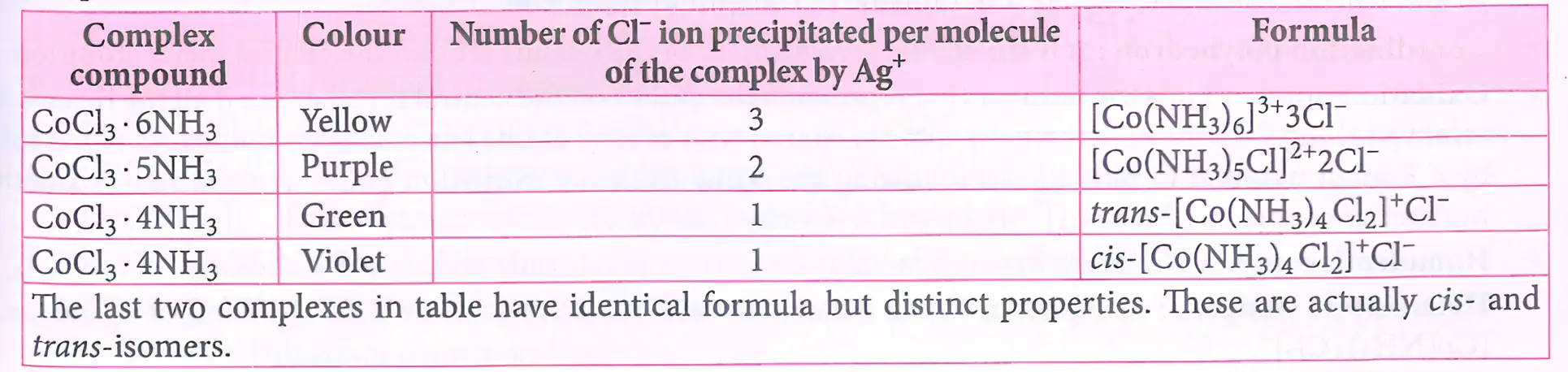
Metals show two valencies: primary (oxidation state) and secondary (coordination number).
Primary valency: ionisable, satisfied by negative ions, non-directional.
Secondary valency: non-ionisable, satisfied by ligands, directional, defines geometry.
Coordination number determines spatial arrangement (coordination polyhedra).
Common geometries: octahedral, tetrahedral, square planar.
Examples: [Co(NH3)6]3+ (octahedral), [Ni(CO)4] (tetrahedral), [PtCl4]2− (square planar).
Solved Examples
Ex 1: Determine coordination number of Co in [CoCl(NH3)5]2+.
Answer: 6 (5 NH3 + 1 Cl).
Practice Set
Q1: Primary valency corresponds to:
A. Coordination number
B. Oxidation state
C. Number of ligands
D. GeometryQ2: Which geometry is common for [Ni(CO)4] complex?
A. Octahedral
B. Tetrahedral
C. Square planar
D. LinearQ3: Secondary valency is satisfied by:
A. Negative ions only
B. Neutral molecules or ligands
C. Positive ions
D. Metals
Answer Key
Q1: B - Primary valency equals oxidation state.
Q2: B - [Ni(CO)4] is tetrahedral.
Q3: B - Secondary valency satisfied by ligands (neutral or ions).
Memory Aids
Primary valency = oxidation state, ionisable.
Secondary valency = coordination number, defines shape.
Octahedral = 6, Tetrahedral = 4, Square planar = 4.
Difference Between Double Salt and Complex
Key Differences
Both formed by combination of stable compounds in fixed ratio.
Double salts dissociate completely into ions in solution.
Complexes do not dissociate into ions; ligands remain bonded.
Examples of double salts: Carnallite (KCl·MgCl2·6H2O), Mohr's salt (FeSO4·(NH4)2SO4·6H2O), Potash alum (KAl(SO4)2·12H2O).
Solved Examples
Ex 1: Identify if Mohr's salt is a double salt or complex.
Answer: Double salt (dissociates into ions).
Practice Set
Q1: Double salts dissociate into:
A. Molecules
B. Ions
C. Complexes
D. AtomsQ2: Which is a double salt?
A. [Co(NH3)6]Cl3
B. KAl(SO4)2·12H2O
C. [Ni(CO)4]
D. [PtCl4]2−Q3: Complex compounds differ from double salts because:
A. They dissociate into ions
B. Ligands remain bonded to metal
C. They are ionic
D. They are mixtures
Answer Key
Q1: B - Double salts dissociate into ions.
Q2: B - Potash alum is a double salt.
Q3: B - Complexes have ligands bonded, do not dissociate.
Memory Aids
Double salts = dissociate; complexes = stable coordination entities.
Remember: Mohr's salt and alum are double salts.
Coordination Entity/Coordination Sphere
Definition
Central metal atom/ion and directly attached ligands enclosed in square brackets.
Collectively called coordination sphere.
Coordination sphere is non-ionisable.
Solved Examples
Ex 1: In K4[Fe(CN)6], coordination sphere is [Fe(CN)6]4−.
Practice Set
Q1: What is enclosed in the coordination sphere?
A) Only ligands
B) Only metal ion
C) Metal ion and ligands
D) Counter ionsQ2: Which of the following is non-ionisable?
A) Coordination sphere
B) Counter ions
C) Both A and B
D) NoneQ3: In K4[Fe(CN)6], what is the charge on coordination sphere?
A) 4+
B) 4−
C) 2+
D) 2−
Answer Key
Q1: C - Coordination sphere includes metal ion and ligands.
Q2: A - Coordination sphere is non-ionisable; counter ions are ionisable.
Q3: B - Coordination sphere [Fe(CN)6] carries 4− charge.
Memory Aids
Coordination sphere = [Metal + Ligands]
Counter ions always outside brackets
Counter Ions
Definition
Ionisable groups written outside the coordination sphere brackets.
Balance the charge of coordination entity.
Solved Examples
Ex 1: In K4[Fe(CN)6], K+ ions are counter ions.
Practice Set
Q1: Where are counter ions written?
A) Inside brackets
B) Outside brackets
C) Both inside and outside
D) Not writtenQ2: Counter ions are
A) Non-ionisable
B) Ionisable
C) Neutral molecules
D) LigandsQ3: In [Co(NH3)6]Cl3, what are the counter ions?
A) NH3
B) Cl−
C) Co3+
D) None
Answer Key
Q1: B - Counter ions are outside the brackets.
Q2: B - Counter ions are ionisable.
Q3: B - Cl− ions are counter ions.
Memory Aids
Counter ions = charge balancers outside []
Central Metal Atom/Ion
Definition
Metal atom/ion bonded to ligands by coordinate bonds in definite geometry.
Acts as Lewis acid (electron pair acceptor).
Solved Examples
Ex 1: In [NiCl2(H2O)4], central metal ion is Ni2+.
Ex 2: In [CoCl(NH3)5]2+, central metal ion is Co3+.
Practice Set
Q1: Central metal ion is a
A) Lewis base
B) Lewis acid
C) Ligand
D) Counter ionQ2: In [Fe(CN)6]3−, central metal ion is
A) Fe2+
B) Fe3+
C) CN−
D) FeQ3: Which of the following is NOT a central metal ion?
A) Ni2+
B) Co3+
C) NH3
D) Fe3+
Answer Key
Q1: B - Central metal ion is Lewis acid.
Q2: B - Fe3+ is central metal ion.
Q3: C - NH3 is a ligand, not metal ion.
Memory Aids
Metal ion = Lewis acid, accepts electron pairs.
Ligands
Definition and Types
Species donating lone pair to metal via coordinate bond.
Types based on donor atoms:
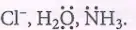
Unidentate: binds through 1 donor atom (e.g., Cl−, H2O, NH3).
Didentate: binds through 2 donor atoms (e.g., ethylenediamine H2NCH2CH2NH2, oxalate C2O42−).
Polydentate: binds through several donor atoms (e.g., EDTA4−).
Chelate ligand: didentate or polydentate forming 5 or 6 membered ring with metal.
Ambidentate: unidentate ligand coordinating through two different atoms (e.g., NO2−, SCN−).

Solved Examples
Ex 1: Cl− is unidentate ligand.
Ex 2: Ethylenediamine (en) is didentate ligand.
Ex 3: EDTA4− is polydentate ligand.
Ex 4: NO2− is ambidentate ligand.
Practice Set
Q1: Which ligand binds through one donor atom?
A) EDTA4−
B) Cl−
C) Ethylenediamine
D) OxalateQ2: Chelate ligands form
A) Single bonds
B) Five or six membered rings
C) Ionic bonds
D) No ringsQ3: Ambidentate ligand example is
A) NH3
B) NO2−
C) EDTA4−
D) Cl−
Answer Key
Q1: B - Cl− is unidentate.
Q2: B - Chelate ligands form 5 or 6 membered rings.
Q3: B - NO2− is ambidentate.
Memory Aids
Unidentate = 1 donor atom
Didentate = 2 donor atoms, forms rings
Polydentate = many donor atoms (EDTA)
Ambidentate = can bind via two different atoms
Coordination Number
Definition
Total number of coordinate bonds between central metal and ligands.
Depends on ligand denticity and number of ligands.
Solved Examples
Ex 1: In [PtCl6]2−, coordination number = 6 (6 unidentate Cl−).
Ex 2: In [Ni(NH3)4]2+, coordination number = 4 (4 unidentate NH3).
Ex 3: In [Fe(C2O4)3]3−, coordination number = 6 (3 didentate oxalate ligands × 2).
Ex 4: In [Co(en)3]3+, coordination number = 6 (3 didentate ethylenediamine ligands × 2).
Practice Set
Q1: Coordination number is the number of
A) Ligands
B) Coordinate bonds
C) Metal ions
D) Counter ionsQ2: Coordination number of [Ni(NH3)6]2+ is
A) 4
B) 6
C) 2
D) 3Q3: Coordination number of [Fe(C2O4)3]3− is
A) 3
B) 6
C) 9
D) 12
Answer Key
Q1: B - Number of coordinate bonds.
Q2: B - Six NH3 ligands, coordination number 6.
Q3: B - Three didentate ligands × 2 = 6.
Memory Aids
Coordination number = total donor atoms bonded to metal.
Oxidation Number
Definition
Charge on central metal if ligands removed with shared electron pairs.
Represented by Roman numeral in parentheses after metal name.
Solved Examples
Ex 1: In [Cu(CN)4]3−, oxidation number of Cu is +1 (Cu(I)).
Practice Set
Q1: Oxidation number is
A) Number of ligands
B) Charge on metal after removing ligands
C) Coordination number
D) Number of electrons donated by ligandsQ2: Oxidation number of Fe in [Fe(CN)6]3− is
A) +2
B) +3
C) 0
D) −3Q3: How is oxidation number represented?
A) Arabic numeral
B) Roman numeral in parentheses
C) Chemical symbol
D) Charge outside brackets
Answer Key
Q1: B - Charge on metal after removing ligands.
Q2: B - Fe is +3 in [Fe(CN)6]3−.
Q3: B - Roman numeral in parentheses.
Memory Aids
Oxidation number = metal charge after ligand removal
Represented as Metal(II), Metal(III), etc.
Homoleptic and Heteroleptic Complexes
Definitions
Homoleptic: Metal bound to only one kind of ligand (e.g., [Co(NH3)6]3+).
Heteroleptic: Metal bound to more than one kind of ligand (e.g., [Co(NH3)4Cl2]+).
Solved Examples
Ex 1: [Co(NH3)6]3+ is homoleptic.
Ex 2: [Co(NH3)4Cl2]+ is heteroleptic.
Practice Set
Q1: Homoleptic complex has
A) One type of ligand
B) Two types of ligands
C) No ligands
D) Only counter ionsQ2: Which is heteroleptic?
A) [Co(NH3)6]3+
B) [Co(NH3)4Cl2]+
C) [Fe(CN)6]3−
D) [Ni(CO)4]Q3: Homoleptic complexes are generally
A) Less stable
B) More stable
C) Unstable
D) Reactive only
Answer Key
Q1: A - One kind of ligand.
Q2: B - Contains NH3 and Cl− ligands.
Q3: B - Usually more stable due to uniform ligands.
Memory Aids
Homo = same ligands
Hetero = different ligands
Effective Atomic Number Rule (EAN Rule)
Definition
EAN = Atomic number of metal − electrons lost + electrons gained from ligands.
Used to predict stability of complexes.
Solved Examples
Ex 1: Complexes following EAN rule: [Pd(NH3)6]4+, [Pt(NH3)6]4+, [Cu(CN)4]3−.
Ex 2: Complexes not following EAN rule but stable: [PdCl4]2− (EAN=52), [Ag(NH3)2]+ (EAN=50), [Ni(CN)4]2− (EAN=34), [Ni(en)3]2+ (EAN=38).
Practice Set
Q1: EAN is calculated by
A) Atomic number + electrons lost − electrons gained
B) Atomic number − electrons lost + electrons gained
C) Atomic number + electrons lost + electrons gained
D) Atomic number − electrons lost − electrons gainedQ2: Which complex follows EAN rule?
A) [PdCl4]2−
B) [Pd(NH3)6]4+
C) [Ag(NH3)2]+
D) [Ni(CN)4]2−Q3: EAN rule helps to predict
A) Color
B) Stability
C) Solubility
D) Magnetic properties
Answer Key
Q1: B - EAN = Atomic number − electrons lost + electrons gained.
Q2: B - [Pd(NH3)6]4+ follows EAN rule.
Q3: B - EAN predicts complex stability.
Memory Aids
EAN = Metal atomic no. − lost e− + gained e−
Stable complexes often have EAN = noble gas configuration
Nomenclature of Coordination Compounds
Rules for Writing Formula
Write cation formula first, then anion.
Coordination sphere enclosed in square brackets; polyatomic ligands in parentheses.
List ligands alphabetically, ignoring charge.
Balance total positive and negative charges for neutrality.
Rules for Naming Coordination Compounds
Name cation first, then anion.
Within coordination sphere, name ligands alphabetically, then metal, then oxidation state in Roman numerals.
Start name with lowercase; write complex part as one word.
Naming of Ligands
Anionic ligands end with -ido (e.g., Cl-: Chlorido).
Neutral ligands retain names (e.g., NH3: Ammine, H2O: aqua).
Cationic ligands end with -ium (e.g., NO2+: Nitronium).
Some ligands use abbreviations in parentheses (e.g., ethylenediamine: en).
Ambidentate ligands named by donor atom or ligand name (e.g., SCN-: Thiocyanato-S or Thiocyanato-N).
Use prefixes di-, tri-, tetra-, etc. for ligand numbers; if ligand name has prefix, use bis-, tris-, tetrakis-, etc. with parentheses.
For anionic coordination spheres, metal name ends with -ate; for cationic/neutral, metal name unchanged.
Solved Examples
Ex 1: Name [CoCl(NO2)(NH3)4]NO3
Step 1: Ligands alphabetically: Ammine, Chlorido, Nitrito-N
Step 2: Metal: Cobalt, Oxidation state III
Step 3: Name: Tetraamminechloridonitrito-N-cobalt(III) nitrateEx 2: Write formula for Potassium trioxalatoferrate(III)
Step 1: Ligand: Oxalato (C2O42-)
Step 2: Metal: Fe, oxidation state III
Step 3: Formula: K3[Fe(C2O4)3]
Practice Set
Q1: In naming coordination compounds, which is named first?
A. Anion
B. Cation
C. Ligands
D. MetalQ2: What is the correct name for [Fe(CO)5]?
A. Pentacarbonyliron(0)
B. Pentacarbonyliron(II)
C. Iron pentacarbonyl
D. Carbonyliron(V)Q3: What is the formula of Potassium tetrachloridomercurate(II)?
A. K[HgCl4]
B. K2[HgCl4]
C. K3[HgCl4]
D. K[HgCl3]
Answer Key
Q1: B. Cation is named first as per nomenclature rules.
Q2: A. Neutral complex named Pentacarbonyliron with oxidation state 0.
Q3: B. Potassium tetrachloridomercurate(II) formula is K2[HgCl4].
Memory Aids
Ligand naming ends: anionic -ido, neutral unchanged, cationic -ium.
Use bis-, tris-, tetrakis- if ligand name has prefixes.
Metal name ends with -ate if coordination sphere is anionic.
Always write cation first in formula and name.
Examples of Nomenclature
Explanation
[CoCl(NO2)(NH3)4]NO3: Tetraamminechloridonitrito-N-cobalt(III) nitrate
[CoCl(ONO)(en)2]+: Chloridobis(ethane-1,2-diamine)nitrito-O-cobalt(III) ion
K3[Al(C2O4)3]: Potassium trioxalatoaluminate(III)
Fe4[Fe(CN)6]3: Ferric hexacyanidoferrate(II)
[PtCl2(NH3)4][PtCl4]: Tetraamminedichloridoplatinum(IV) tetrachloridoplatinate(II)
[Pt(NH3)4][CuCl4]: Tetraammineplatinum(II) tetrachloridocuperate(II)
[Cr(NH3)6][Co(C2O4)3]: Hexaamminechromium(III) trioxalatocobaltate(III)
[Ni(dmg)2]: bis(dimethylglyoximato)nickel(II)
K2[HgCl4]: Potassium tetrachloridomercurate(II)
Solved Examples
Ex 1: Name Fe4[Fe(CN)6]3
Step 1: Ligand: Cyanido
Step 2: Metal: Ferric (Fe3+) and Ferrous (Fe2+)
Step 3: Name: Ferric hexacyanidoferrate(II)Ex 2: Write formula for Tetraammineplatinum(II) tetrachloridocuperate(II)
Step 1: Cation: [Pt(NH3)4]2+
Step 2: Anion: [CuCl4]2-
Step 3: Formula: [Pt(NH3)4][CuCl4]
Practice Set
Q1: What is the correct name for [PtCl2(NH3)4][PtCl4]?
A. Tetraamminedichloridoplatinum(IV) tetrachloridoplatinate(II)
B. Tetrachloridoplatinum(II) tetraammineplatinate(IV)
C. Tetraamminedichloridoplatinum(II) tetrachloridoplatinate(IV)
D. Tetraamminedichloridoplatinum(IV) tetrachloridoplatinate(IV)Q2: Which ligand abbreviation represents ethylenediamine?
A. en
B. ed
C. eda
D. ethQ3: What is the oxidation state of cobalt in [CoCl(ONO)(en)2]+?
A. +1
B. +2
C. +3
D. 0
Answer Key
Q1: A. Correct name matches the given complex with oxidation states.
Q2: A. 'en' is the standard abbreviation for ethylenediamine.
Q3: C. Cobalt is in +3 oxidation state in the complex.
Memory Aids
Abbreviations: ethylenediamine = en.
Oxidation state found by balancing charges in complex ion.
Complex names combine ligand names alphabetically, metal, and oxidation state.
Isomerism in Coordination Compounds
Types of Isomerism
Structural Isomerism: Different connectivity or composition of ligands.
Ionisation Isomerism: Different ions released in solution.
Hydrate/Solvate Isomerism: Variation in water molecules inside/outside coordination sphere.
Linkage Isomerism: Ligands bind through different atoms (e.g., NO2- via N or O).
Coordination Isomerism: Ligand exchange between cationic and anionic complexes.
Stereoisomerism: Same ligands, different spatial arrangement.
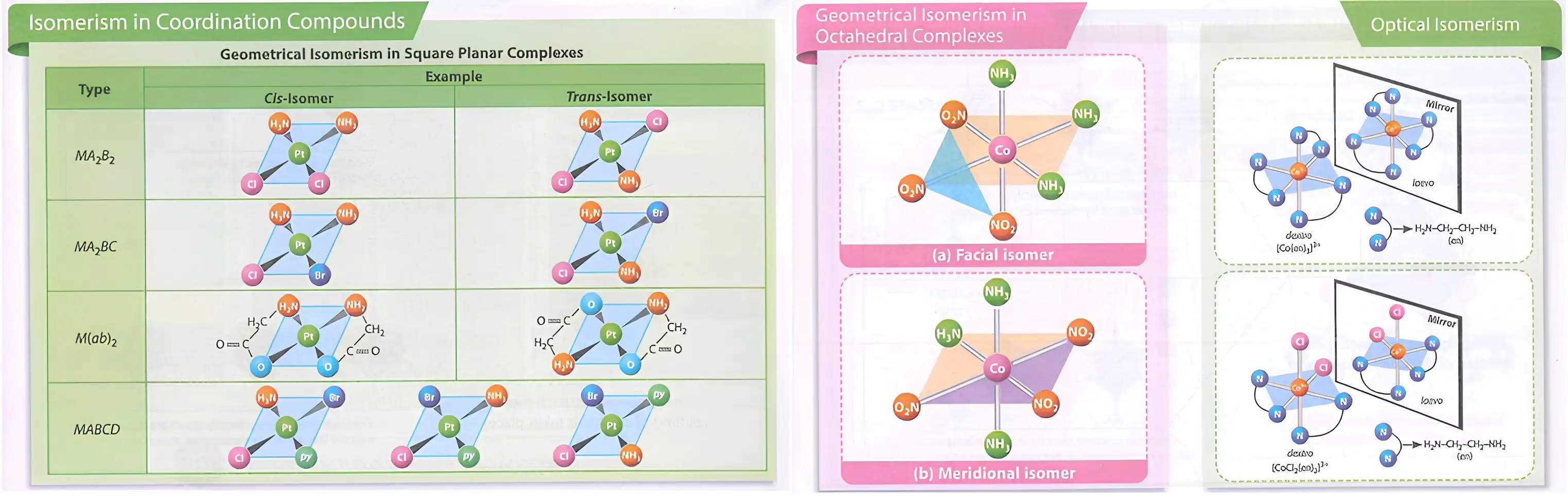
Geometrical Isomerism: Different ligand positions (cis/trans, fac/mer).
Optical Isomerism: Non-superimposable mirror images (enantiomers) that rotate plane-polarized light.
Geometrical Isomerism Details
Square Planar Complexes:
Cis-isomer: Similar ligands adjacent.
Trans-isomer: Similar ligands opposite.
Octahedral Complexes:
Facial (fac) isomer: Three identical ligands on one face.
Meridional (mer) isomer: Three identical ligands in a plane through the center.
Optical Isomerism
Enantiomers are mirror images, non-superimposable.
Rotate plane-polarized light in opposite directions: Dextro (+) and Laevo (−).
Optically inactive forms (meso, racemic) do not rotate light due to internal or external compensation.
Solved Examples
Ex 1: Identify cis and trans isomers in [Pt(NH3)2Cl2].
Cis: NH3 ligands adjacent; trans: NH3 ligands opposite.
Ex 2: Number of optical isomers for [Pt(Py)(NH3)(NO2)(Cl)(Br)(I)].
15 geometrical isomers × 2 (d and l forms) = 30 optical isomers.
Practice Set
Q1: Which is an example of linkage isomerism?
A) [Co(NH3)6]Cl3
B) [Co(NO2)(NH3)5]Cl2
C) [Co(NH3)4Cl2]Cl
D) [Co(H2O)6]Cl3
Q2: In octahedral complexes, the mer isomer has three identical ligands arranged:
A) On one face of the octahedron
B) In a plane passing through the center
C) Adjacent to each other
D) Opposite each other
Q3: Which statement about optical isomers is correct?
A) They are superimposable mirror images.
B) They rotate plane-polarized light in the same direction.
C) They are non-superimposable mirror images.
D) They do not affect plane-polarized light.
Answer Key
Q1: B - Linkage isomerism occurs when NO2- binds through N or O atoms.
Q2: B - Mer isomer has three identical ligands in a plane through the center.
Q3: C - Optical isomers are non-superimposable mirror images that rotate light differently.
Memory Aids
Linkage isomerism: Think "link" changes in ligand attachment atom.
Geometrical isomers: Cis = same side; Trans = opposite side.
Fac and Mer: Fac = face; Mer = meridian (plane).
Optical isomers: Like left and right hands, non-superimposable.
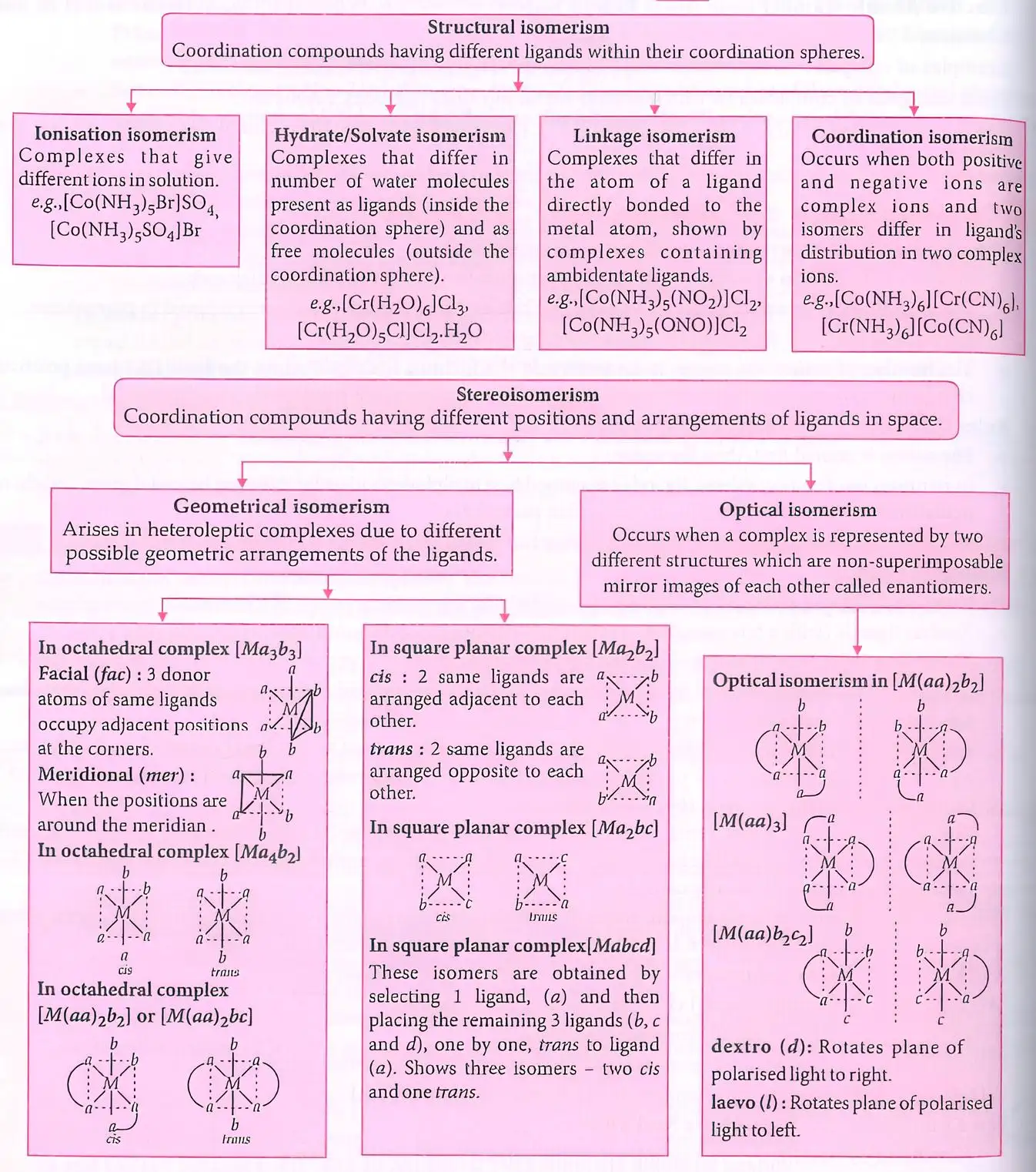
Classification of Isomerism
Structural Isomerism
Ionisation Isomerism: Different ions released in solution.
Hydrate/Solvate Isomerism: Variation in water molecules inside/outside coordination sphere.
Linkage Isomerism: Ligands bind through different atoms.
Coordination Isomerism: Ligand exchange between cationic and anionic complexes.
Stereoisomerism
Geometrical Isomerism: Different spatial arrangement of ligands (cis/trans, fac/mer).
Optical Isomerism: Non-superimposable mirror images (enantiomers) that rotate plane-polarized light.
Solved Examples
Ex 1: Identify the type of isomerism in [Co(NH3)5NO2]Cl2 and [Co(NH3)5ONO]Cl2.
Linkage isomerism due to NO2- binding through N or O.
Ex 2: Differentiate fac and mer isomers in [CoCl3(NH3)3].
Fac: Three Cl ligands on one face; Mer: three Cl ligands in a plane.
Practice Set
Q1: Which is an example of coordination isomerism?
A) [Co(NH3)6] [Cr(CN)6]
B) [Co(NH3)5NO2]Cl2
C) [Co(H2O)6]Cl3
D) [Co(NH3)4Cl2]Cl
Q2: Which is true for hydrate isomerism?
A) Different ions in solution
B) Different number of water molecules inside/outside coordination sphere
C) Ligands attached through different atoms
D) Ligand exchange between complexes
Q3: How many geometrical isomers are possible for an octahedral complex with six different monodentate ligands?
A) 3
B) 6
C) 15
D) 30
Answer Key
Q1: A - Coordination isomerism involves ligand exchange between cationic and anionic complexes.
Q2: B - Hydrate isomerism differs in water molecules inside or outside the coordination sphere.
Q3: C - 15 geometrical isomers possible for six different monodentate ligands in octahedral complex.
Memory Aids
Ionisation isomers: Different ions in solution.
Hydrate isomers: Water molecules location changes.
Linkage isomers: Ligand binds via different atoms.
Coordination isomers: Ligand swap between complexes.
Geometrical isomers: Cis/trans, fac/mer arrangements.
Optical isomers: Mirror images, rotate light.
Bonding in Coordination Compounds
Valence Bond Theory
Metal ion provides empty orbitals equal to coordination number.
Orbitals involved: inner (n-1)d, ns, np or outer nd, ns, np depending on ligand strength.
Vacant orbitals hybridize to form equivalent orbitals with definite geometry: octahedral, tetrahedral, square planar.
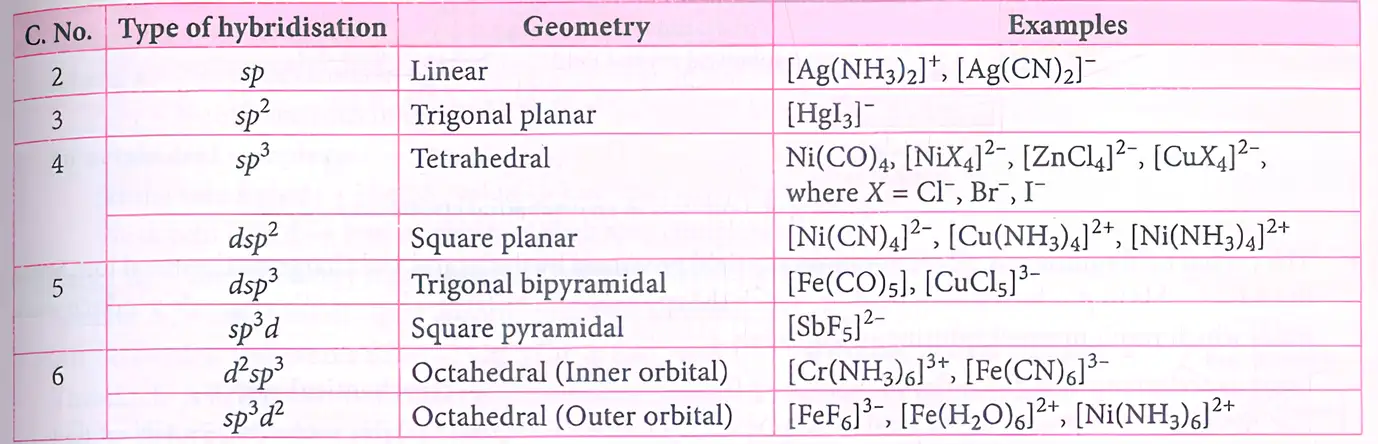
Coordination number (C. No.) determines hybridisation and geometry.
Examples: C. No. 2 → sp (linear), 4 → sp3 (tetrahedral), 6 → d2sp3 (octahedral).

Inner orbital complexes: use (n-1)d orbitals, form low spin complexes (few unpaired electrons).
Examples: [Co(NH3)6]3+, [Co(CN)6]4-.
Outer orbital complexes: use nd orbitals, form high spin complexes (many unpaired electrons).
Examples: [MnF6]3-, [CoF6]3-.
Magnetic Properties
Low spin complexes are diamagnetic; high spin complexes are paramagnetic.
Paramagnetism depends on number of unpaired electrons (n).
Magnetic moment, μ = √(n(n+2)) Bohr Magneton (B.M.).
Limitations of Valence Bond Theory
Based on many assumptions.
Cannot distinguish between weak and strong field ligands.
No quantitative interpretation of magnetic data.
Does not explain thermodynamic or kinetic stability quantitatively.
Fails to explain relative energies of different shapes.
Cannot explain color and spectral properties.
Fails to predict tetrahedral and square planar structures.
Solved Examples
Ex 1: Determine hybridisation and geometry of [Ni(CN)4]2-.
Solution: Coordination number = 4; CN- is strong field ligand → dsp2 hybridisation → square planar geometry.
Practice Set
Q1: Which hybridisation corresponds to octahedral geometry?
A) sp3 B) d2sp3 C) dsp2 D) sp
Q2: Inner orbital complexes are generally:
A) High spin B) Low spin C) Paramagnetic D) Outer orbital
Q3: Magnetic moment of a complex with 3 unpaired electrons is:
A) 3.87 B.M. B) 5.92 B.M. C) 4.90 B.M. D) 2.83 B.M.
Answer Key
Q1: B) d2sp3 - Octahedral complexes have d2sp3 hybridisation.
Q2: B) Low spin - Inner orbital complexes form low spin complexes.
Q3: A) 3.87 B.M. - μ = √(3(3+2)) = √15 ≈ 3.87 B.M.
Memory Aids
Strong field ligands → inner orbital → low spin.
Weak field ligands → outer orbital → high spin.
Octahedral → d2sp3, Tetrahedral → sp3, Square planar → dsp2.
Crystal Field Theory
Basic Concepts
Metal-ligand bond is ionic; interaction is electrostatic.
d-orbitals split into two groups due to ligand field: eg (higher energy) and t2g (lower energy) in octahedral complexes.
Energy difference between these sets is ligand field splitting parameter, ∆0.
Energy levels: t2g at -0.4∆0, eg at +0.6∆0, total energy zero.
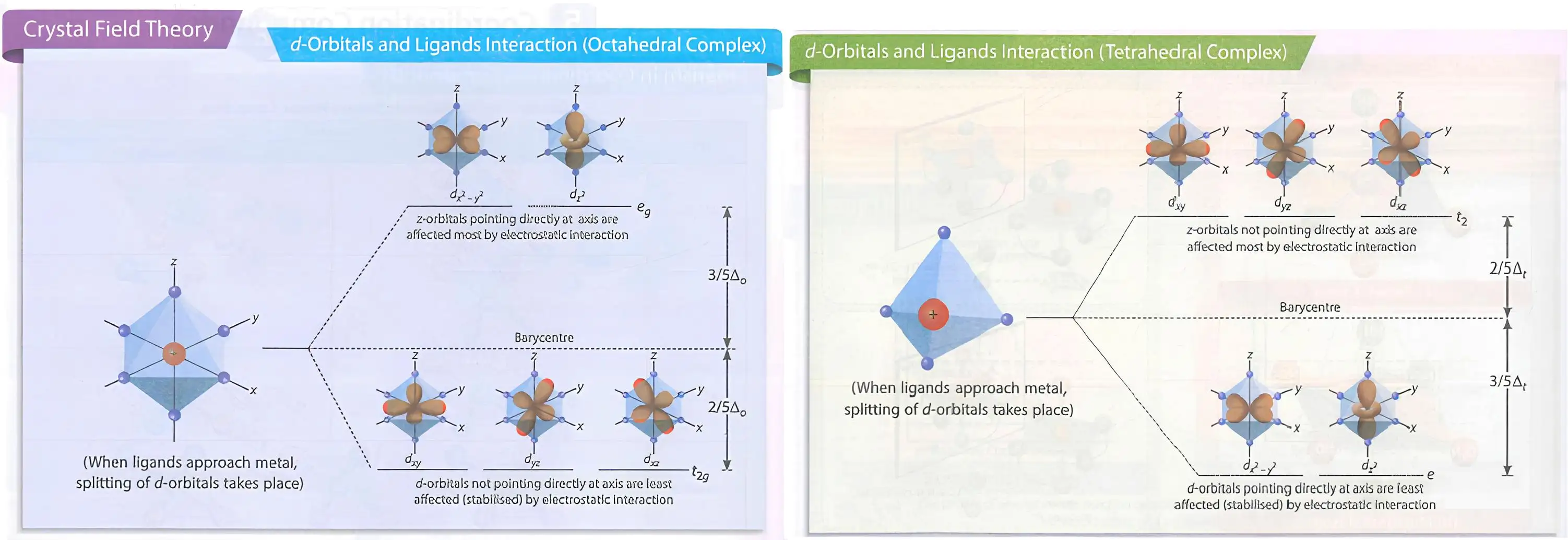
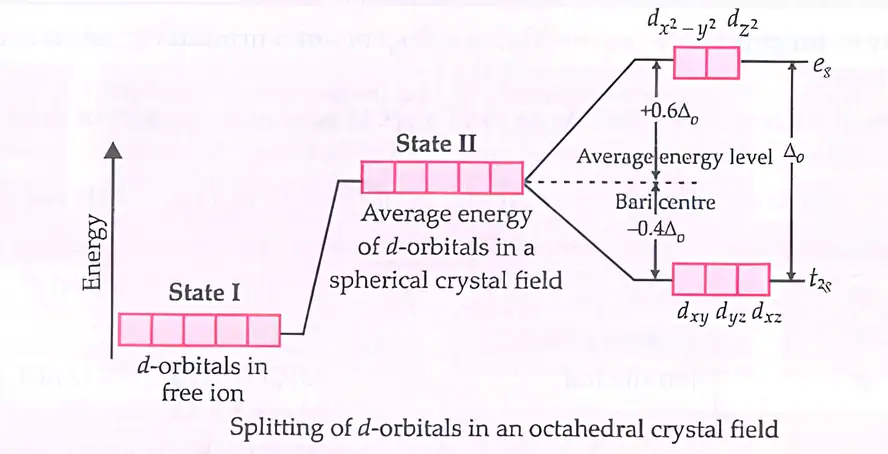
∆0 depends on ligand field strength and metal ion charge.
Spectrochemical series (increasing field strength): I- < Br- < SCN- < Cl- < S2- < F- < OH- < C2O42- < H2O < NCS- < EDTA4- < NH3 < en < NO2- < CN- < CO.

Electron Configuration and Spin States
If ∆0 > Pairing energy (P), electrons pair in lower orbitals → low spin complex.
If ∆0 < P, electrons occupy higher orbitals before pairing → high spin complex.
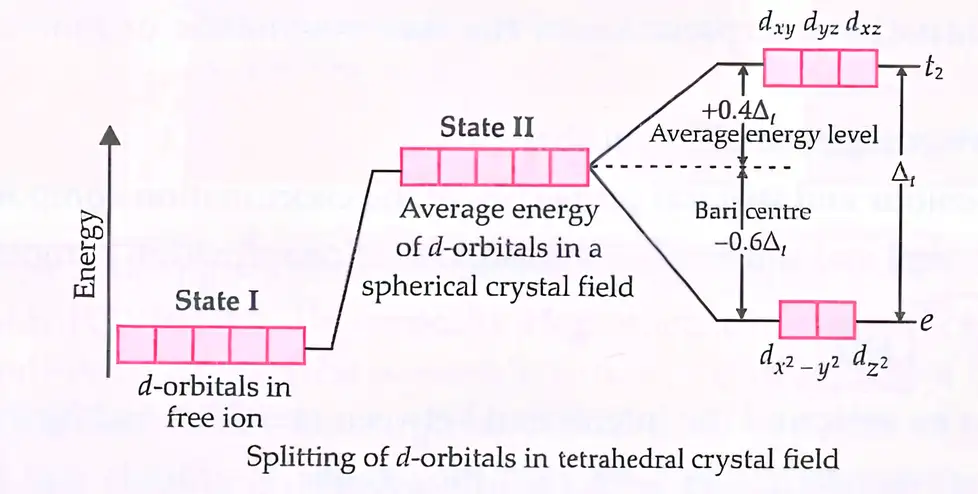
Tetrahedral splitting ∆t = (4/9) ∆0, usually small → mostly high spin complexes.
Tetrahedral complexes lack center of symmetry; no 'g' subscript used.
Colour in Coordination Compounds
Colour arises from d-d electronic transitions: electron jumps from t2g to eg level.
Absorbed light wavelength corresponds to ∆0; transmitted light is complementary colour.
Without ligands, no splitting → colourless complexes.
Examples: [Ti(H2O)6]3+ violet, [Cu(H2O)4]2+ blue.
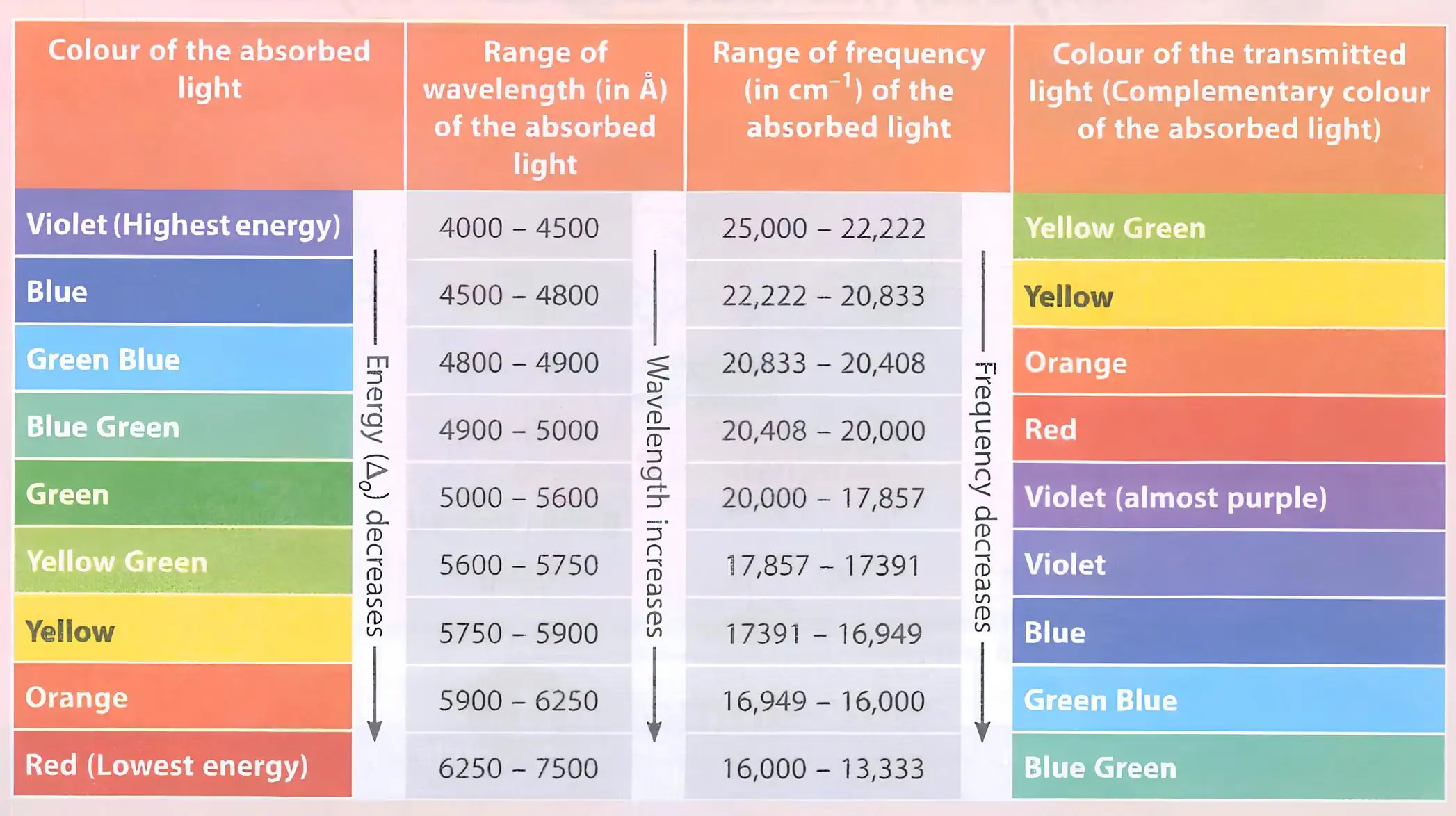
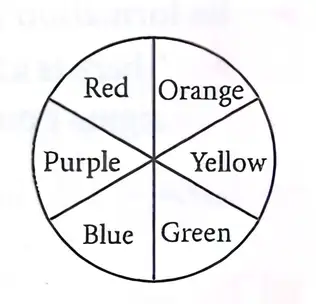
Colour absorbed and transmitted are complementary (e.g., yellow absorbed → purple seen).
Limitations of Crystal Field Theory
Does not consider metal-ligand covalent bonding (π-bonding).
Cannot explain relative ligand strengths fully (e.g., H2O stronger than OH-).
No account of partial covalent character of bonds.
Calculation of Crystal Field Stabilization Energy (CFSE)
CFSE = (-0.4 x + 0.6 y) ∆0, where x = electrons in t2g, y = electrons in eg.
Strong field ligands → high ∆0 → low spin complexes.
Weak field ligands → low ∆0 → high spin complexes.
Large ∆0 absorbs higher energy (shorter wavelength) light.
All octahedral complexes of Ni2+, Cu+, Cu2+, Zn2+, Co2+ are outer orbital complexes.
Solved Examples
Ex 1: Calculate CFSE for d6 low spin octahedral complex.
Solution: x=6 (t2g), y=0 (eg), CFSE = (-0.4×6 + 0.6×0)∆0 = -2.4∆0.
Practice Set
Q1: In octahedral complexes, which orbitals form the higher energy set?
A) t2g B) eg C) dxy, dxz, dyz D) All d orbitals equally
Q2: Which ligand is a strong field ligand?
A) I- B) H2O C) CN- D) F-
Q3: For tetrahedral complexes, the crystal field splitting energy ∆t is related to octahedral ∆0 as:
A) ∆t = ∆0 B) ∆t = 9/4 ∆0 C) ∆t = 4/9 ∆0 D) ∆t = 1/2 ∆0
Answer Key
Q1: B) eg - eg orbitals have higher energy in octahedral field.
Q2: C) CN- - CN- is a strong field ligand.
Q3: C) ∆t = 4/9 ∆0 - Tetrahedral splitting is smaller than octahedral.
Memory Aids
Spectrochemical series orders ligands by increasing ∆0.
Low spin if ∆0 > pairing energy; high spin if ∆0 < pairing energy.
Tetrahedral complexes usually high spin due to small ∆t.
Colour seen is complementary to colour absorbed (use colour wheel).
Bonding in Metal Carbonyls
Overview
Transition metal carbonyls are organometallic compounds with only CO ligands (homoleptic).
Metal–carbon bond has both sigma (σ) and pi (π) character.
Bonding involves:
σ-bond: Lone pair on carbon (CO) donates to empty metal orbital.
π-back bonding: Metal d-orbitals donate electrons to empty π* orbitals of CO.
Back bonding strengthens metal–ligand interaction (synergic effect).
Examples of Metal Carbonyls
Mononuclear: V(CO)5, Cr(CO)6, Mo(CO)6, W(CO)6, Ni(CO)4, Fe(CO)5
Polynuclear: Co2(CO)8, Co4(CO)12, Mn2(CO)10
Structures
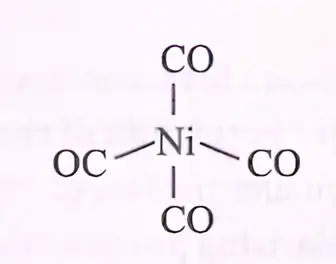
Ni(CO)4: Tetrahedral
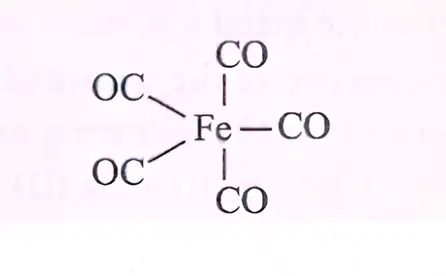
Fe(CO)5: Trigonal bipyramidal
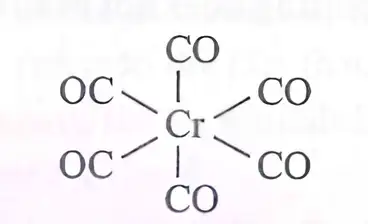
Cr(CO)6: Octahedral
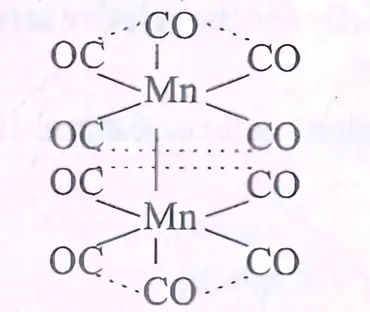
Mn2(CO)10: Two square pyramidal units joined by Mn–Mn bond
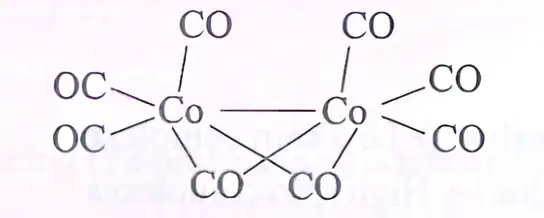
Co2(CO)8: Co–Co bond bridged by two CO ligands
Solved Examples
Ex 1
Identify the geometry of Fe(CO)5.
Answer: Trigonal bipyramidal due to 5 CO ligands arranged around Fe.
Practice Set
Q1: What type of bonding is involved in metal carbonyls?
A. Only σ-bonding
B. Only π-bonding
C. Both σ- and π-bonding
D. Ionic bonding
Q2: Which of the following metal carbonyls has octahedral geometry?
A. Ni(CO)4
B. Fe(CO)5
C. Cr(CO)6
D. Mn2(CO)10
Q3: In back bonding, electrons are donated from
A. CO to metal
B. Metal d-orbitals to CO π* orbitals
C. Metal s-orbitals to CO σ orbitals
D. CO π orbitals to metal d-orbitals
Answer Key
Q1: C - Metal carbonyls have both σ-donation from CO to metal and π-back bonding from metal to CO.
Q2: C - Cr(CO)6 has octahedral geometry with 6 CO ligands.
Q3: B - Back bonding involves metal d-orbitals donating electrons to empty π* orbitals of CO.
Memory Aids
Remember: Metal carbonyl bonding = σ-donation + π-back bonding (synergic effect).
Geometry clues:
4 CO ligands → Tetrahedral (Ni(CO)4)
5 CO ligands → Trigonal bipyramidal (Fe(CO)5)
6 CO ligands → Octahedral (Cr(CO)6)
Back bonding strengthens metal–CO bond and weakens C–O bond.
Stability of Coordination Compounds
Definition and Equilibrium
Stability refers to the extent of complex formation in solution.
Equilibrium: M + 4L ⇌ ML4
Equilibrium constant (K) indicates stability magnitude.
Factors Affecting Stability
Charge on metal ion: Higher charge → greater stability.
Basic nature of ligand: Stronger base ligands increase stability.
Chelate effect: Presence of chelate rings enhances stability.
Size of metal ion: Smaller ions form more stable complexes.
Electronegativity and polarising power: Higher values increase stability.
Irving-Williams Order
Stability of divalent first-row transition metal complexes follows:
Mn(II) < Fe(II) < Co(II) < Ni(II) < Cu(II) > Zn(II)
Solved Examples
Ex 1
Arrange the stability of complexes: Fe(II), Cu(II), Mn(II).
Answer: Mn(II) < Fe(II) < Cu(II) (Irving-Williams order).
Practice Set
Q1: Which factor does NOT increase complex stability?
A. Higher metal ion charge
B. Larger metal ion size
C. Presence of chelate rings
D. Strong basic ligands
Q2: According to Irving-Williams order, which complex is most stable?
A. Mn(II)
B. Fe(II)
C. Cu(II)
D. Zn(II)
Q3: Stability constant (K) for M + 4L ⇌ ML4 is 106. What does this imply?
A. Complex is unstable
B. Complex formation is favored
C. Ligand dissociation is favored
D. Equilibrium lies to left
Answer Key
Q1: B - Larger metal ion size decreases stability.
Q2: C - Cu(II) complexes are most stable in first-row divalent metals.
Q3: B - High K means complex formation is favored.
Memory Aids
Irving-Williams order mnemonic: "My FeCoNi Cu Zn" (Mn < Fe < Co < Ni < Cu > Zn).
Chelate rings = more stable complexes.
Higher metal charge and smaller size = stronger complexes.
Importance and Applications of Coordination Compounds
Qualitative and Quantitative Analysis
Dimethyl glyoxime (DMG) forms a coordination compound with Ni(II) used to detect nickel.
Cobalt is detected by forming a coordination compound with α-nitroso-β-naphthol.
EDTA acts as a ligand for detection and estimation of various metal ions.
Water hardness is estimated by titration with Na2EDTA; Ca2+ and Mg2+ form stable complexes with EDTA.
Selective estimation of Ca2+ and Mg2+ is possible due to different stability constants.
Extraction of Metals
Metals like Ag and Au are extracted as their cyanide complexes: [Ag(CN)2]− and [Au(CN)2]−.
Metals can be precipitated from solution by adding Zn.
Purification of Metals
Impure Ni forms Ni(CO)4, which decomposes to give pure nickel.
In Biological Systems
Chlorophyll: Mg-complex with macrocyclic porphyrin; responsible for photosynthesis.
Haemoglobin: Fe-complex with macrocyclic porphyrin; carries oxygen in blood.
Myoglobin: Stores oxygen and regulates respiration.
Vitamin B-12 (cyanocobalamine): Cobalt complex essential for health.
Enzymes like carboxypeptidase-A are Zn complexes with proteins.
Catalysts
Organometallic compounds act as catalysts.
Ziegler-Natta catalyst [TiCl4(C2H5)3Al] polymerizes alkenes at room temperature and atmospheric pressure.
Wilkinson's catalyst [RhCl(PPh3)3] catalyzes hydrogenation reactions.
Metal carbonyls serve as industrial catalysts.
Other Applications
Electroplating with silver and gold is smoother from complexes [Ag(CN)2]− and [Au(CN)2]− than from simple ions.
In black and white photography, hypo solution fixes film by forming [Ag(S2O3)2]3− complex.
Many medicines are coordination compounds.
Treatment of Diseases
Excess toxic metals are removed by chelating agents like penicillamine and desferrioxime-B.
EDTA is used to treat lead poisoning.
cis-Platin [PtCl2(NH3)2] is used in cancer treatment.
Solved Examples
Ex 1: Detect nickel in a sample using DMG.
Add DMG to the sample; formation of red precipitate confirms Ni presence.
Ex 2: Estimate water hardness using EDTA.
Titrate water sample with Na2EDTA; endpoint indicates total Ca2+ and Mg2+ concentration.
Ex 3: Purify nickel from impure sample.
Form Ni(CO)4 by passing CO gas; decompose to get pure Ni.
Practice Set
Q1: Which ligand is used to detect nickel?
A. α-nitroso-β-naphthol
B. Dimethyl glyoxime (DMG)
C. EDTA
D. Penicillamine
Q2: Which complex is used in the purification of nickel?
A. Ni(CO)4
B. [Ni(DMG)2]
C. [Ni(CN)4]2−
D. NiCl2
Q3: Which coordination compound is used in cancer treatment?
A. EDTA
B. cis-Platin [PtCl2(NH3)2]
C. Penicillamine
D. Vitamin B-12
Answer Key
Q1: B. DMG forms a red complex with Ni(II) for detection.
Q2: A. Ni(CO)4 is volatile and decomposes to pure Ni.
Q3: B. cis-Platin is a platinum coordination compound used in chemotherapy.
Memory Aids
DMG detects Ni by red precipitate formation.
Ni purification: Ni + CO → Ni(CO)4 (volatile) → pure Ni.
EDTA chelates Ca2+ and Mg2+ for water hardness estimation.
cis-Platin = cancer drug; remember Pt coordination.
NEET Chemistry — ALL CHAPTERS
1
Some Basic Concepts of Chemistry
2
Structure of Atom
3
Classification of Elements and Periodicity in Properties
4
Chemical Bonding and Molecular Structure
5
Thermodynamics
6
Equilibrium
7
Redox Reactions
8
Organic Chemistry - Some Basic Principles and Techniques
9
Hydrocarbons
10
Solutions
11
Electrochemistry
12
Chemical Kinetics
13
The d- and f- Block Elements
14
Coordination Compounds
15
Haloalkanes and Haloarenes
16
Alcohols, Phenols and Ethers
17
Aldehydes, Ketones and Carboxylic Acids
18
Amines
19
Biomolecules
20
The p-Block Elements (Group 13 and 14)
21
The p-Block Elements (Group 15 to 18)
22
Principles Related to Practical Chemistry