NEET Ug . NEET Chemistry . Chemistry . Redox Reactions
Chapter 7: Redox Reactions
Ch 7
NEET Chemistry
NEET Ug
Introduction
Overview of Redox Reactions
Chemistry studies matter and its transformations via chemical reactions.
Redox reactions involve transfer of electrons, changing one substance into another.
They occur in physical, biological, industrial, pharmaceutical, metallurgical, and agricultural processes.
Environmental phenomena like hydrogen fuel use and ozone depletion involve redox processes.
Solved Examples
Ex 1: Identify if the reaction 2Mg + O2 → 2MgO is redox.
Step 1: Mg gains oxygen → oxidation.
Step 2: O2 gains electrons → reduction.
Conclusion: Both oxidation and reduction occur simultaneously, so it is a redox reaction.
Practice Set
Q1: Which of the following is a redox reaction?
A. NaCl dissolution in water
B. 2Mg + O2 → 2MgO
C. H2O boiling
D. NaCl crystallizationQ2: Redox reactions are important in which of the following fields?
A. Metallurgy
B. Textile dyeing
C. Polymerization
D. None of theseQ3: Which environmental issue involves redox reactions?
A. Acid rain
B. Ozone hole formation
C. Soil erosion
D. Global warming
Answer Key
Q1: B - It involves simultaneous oxidation and reduction.
Q2: A - Metallurgy extensively uses redox reactions.
Q3: B - Ozone hole formation is a redox phenomenon.
Memory Aids
Redox = Reduction + Oxidation happening together.
Remember: "OIL RIG" - Oxidation Is Loss, Reduction Is Gain (of electrons).
Environmental redox: Think "Ozone hole" and "Hydrogen fuel" as key examples.
Classical Idea of Redox Reactions-Oxidation and Reduction Reactions
Oxidation
Addition of oxygen or electronegative element to a substance.
Removal of hydrogen or electropositive element from a substance.
Examples:
2Mg(s) + O2(g) → 2MgO(s)
2H2S(g) + O2(g) → 2S(s) + 2H2O(l)
Mg(s) + F2(g) → MgF2(s)
2K4[Fe(CN)6](aq) + H2O2(aq) → 2K3[Fe(CN)6](aq) + 2KOH(aq)
Reduction
Removal of oxygen or electronegative element from a substance.
Addition of hydrogen or electropositive element to a substance.
Examples:

HgO(s) heated → Hg(l) + O2(g)
FeCl3 + H2 → FeCl2 + HCl
CH2=CH2 + H2 → C2H6
Hg2Cl2 + SnCl2 → Hg2Cl2 + SnCl4
Redox Reactions
Reactions where oxidation and reduction occur simultaneously.
Examples:

Fe3O4 + Al → Fe + Al2O3
H2S + Cl2 → S + HCl
Oxidation: loss of electrons (gain of oxygen or loss of hydrogen).
Reduction: gain of electrons (loss of oxygen or gain of hydrogen).
Solved Examples
Ex 1: Identify oxidation and reduction in 2Mg + O2 → 2MgO.
Step 1: Mg gains oxygen → oxidation.
Step 2: O2 gains electrons → reduction.Ex 2: In Fe3O4 + 8Al → 4Al2O3 + 3Fe, identify oxidized and reduced species.
Step 1: Fe3O4 loses oxygen → reduction.
Step 2: Al gains oxygen → oxidation.
Practice Set
Q1: Which is oxidation in 2Mg + O2 → 2MgO?
A. Mg loses oxygen
B. Mg gains oxygen
C. O2 loses electrons
D. Mg loses electronsQ2: In the reaction Fe3O4 + Al → Fe + Al2O3, which is reduced?
A. Fe3O4
B. Al
C. Fe
D. Al2O3Q3: Which statement is correct about redox reactions?
A. Only oxidation occurs
B. Only reduction occurs
C. Oxidation and reduction occur simultaneously
D. Neither oxidation nor reduction occurs
Answer Key
Q1: B - Mg gains oxygen, so it is oxidized.
Q2: C - Fe is reduced by gaining electrons.
Q3: C - Redox reactions involve simultaneous oxidation and reduction.
Memory Aids
Oxidation: Add oxygen or remove hydrogen.
Reduction: Remove oxygen or add hydrogen.
Remember "OIL RIG" for electron transfer: Oxidation Is Loss, Reduction Is Gain.
Redox reactions always have both oxidation and reduction steps.
Redox Reactions Electron Transfer
Key Concepts
Oxidation: Loss of electrons in a half reaction.
Reduction: Gain of electrons in a half reaction.
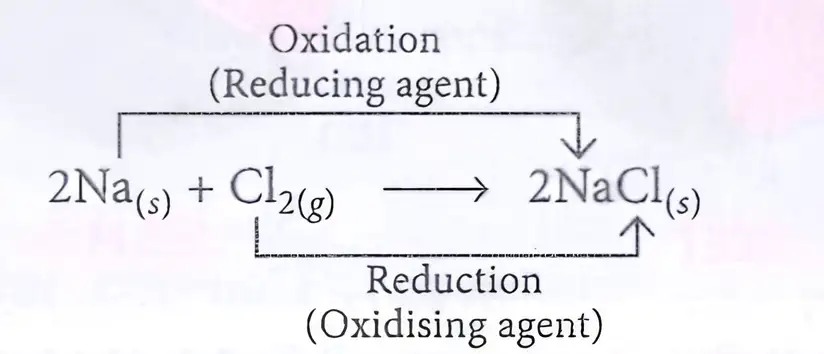
Oxidising agent: Substance that gains electrons and gets reduced; causes oxidation of other substances.
Reducing agent: Substance that loses electrons and gets oxidised; causes reduction of other substances.
Example reaction with oxidising agent (nitrate ion):
Cu(s) + 4H+(aq) + 2NO3−(aq) → Cu2+(aq) + 2H2O(l) + 2NO2(g)Example reaction with reducing agent (tin(II)):
Sn2+(aq) + 2Fe3+(aq) → Sn4+(aq) + 2Fe2+(aq)
Solved Examples
Ex 1: Identify oxidising and reducing agents in Na + Cl2 → NaCl.
- Na loses electrons (oxidised) → reducing agent.
- Cl2 gains electrons (reduced) → oxidising agent.
Practice Set
Q1: Which species is oxidised in Cu + 2Ag+ → Cu2+ + 2Ag?
A. Cu
B. Ag+
C. Cu2+
D. AgQ2: In the reaction Zn + Cu2+ → Zn2+ + Cu, what is the reducing agent?
A. Zn
B. Cu2+
C. Zn2+
D. CuQ3: Which ion acts as oxidising agent in Cu + 4H+ + 2NO3− → Cu2+ + 2H2O + 2NO2?
A. Cu
B. H+
C. NO3−
D. NO2
Answer Key
Q1: A. Cu is oxidised (loses electrons) forming Cu2+.
Q2: A. Zn is reducing agent as it loses electrons and oxidises.
Q3: C. NO3− is oxidising agent as it gains electrons and gets reduced.
Memory Aids
Oxidation = OIL (Oxidation Is Loss of electrons)
Reduction = RIG (Reduction Is Gain of electrons)
Oxidising agent gets reduced; reducing agent gets oxidised.
Competitive Electron Transfer Reactions
Key Concepts
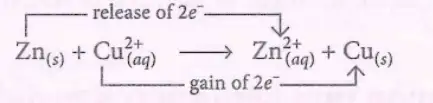
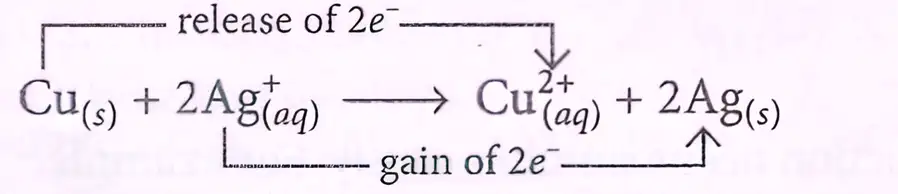
Metal with higher electron releasing tendency displaces metal ion with lower tendency from solution.
Zn + Cu2+ → Zn2+ + Cu: Zinc oxidised, copper ion reduced.
Cu + 2Ag+ → Cu2+ + 2Ag: Copper oxidised, silver ion reduced.
Electron releasing tendency order: Zn > Cu > Ag.
Basis for galvanic cells: chemical reactions producing electrical energy via electron transfer.


Solved Examples
Ex 1: Predict if Zn will displace Ag+ from solution.
- Zn > Ag in electron releasing tendency → Zn displaces Ag+.Ex 2: Write half reactions for Cu + 2Ag+ → Cu2+ + 2Ag.
- Oxidation: Cu → Cu2+ + 2e−
- Reduction: 2Ag+ + 2e− → 2Ag
Practice Set
Q1: Which metal will displace Cu2+ from solution?
A. Ag
B. Zn
C. Cu
D. AuQ2: In Cu + 2Ag+ → Cu2+ + 2Ag, which is oxidised?
A. Cu
B. Ag+
C. Cu2+
D. AgQ3: Arrange metals in increasing order of electron releasing tendency:
A. Ag < Cu < Zn
B. Zn < Cu < Ag
C. Cu < Zn < Ag
D. Ag < Zn < Cu
Answer Key
Q1: B. Zn displaces Cu2+ due to higher electron releasing tendency.
Q2: A. Cu is oxidised, losing electrons to Ag+.
Q3: A. Ag < Cu < Zn is correct order of electron releasing tendency.
Memory Aids
Remember: Zn > Cu > Ag for electron releasing tendency.
Higher metal in series displaces lower metal ions from solution.
Galvanic cells use these displacement reactions for electricity.
Oxidation Number
Rules for Assigning Oxidation Numbers
Oxidation number (ON) is the charge an atom appears to have in a compound.
ON of elements in free state = 0.
ON of monoatomic ion = charge on the ion.
Oxygen ON = -2 usually; exceptions: peroxides (-1), superoxides (-1/2), OF2 (+2), O2F2 (+1).
Hydrogen ON = +1; in metal hydrides = -1.
Fluorine ON = -1; exception: HOF (+1).
Sum of ONs in neutral compound = 0; in polyatomic ion = ion charge.
Fractional ON is average when atoms have different ONs in a compound.
Stock notation uses Roman numerals to indicate metal ON, e.g., FeSO4 = iron (II) sulfate.
Oxidation: increase in ON; Reduction: decrease in ON.
Oxidising agent: increases ON of element (oxidant).
Reducing agent: decreases ON of element (reductant).
Redox reactions involve change in ON of species.
Solved Examples
Ex 1: Find ON of Fe in [Fe(H2O)5(NO)]SO4.
Let Fe = x; H2O = 0, NO = +1, SO4 = -2
x + 5(0) + 1 - 2 = 0 ⇒ x - 1 = 0 ⇒ x = +1
Ex 2: ON of Fe in Fe3O4.
3x + 4(-2) = 0 ⇒ 3x - 8 = 0 ⇒ x = +8/3 (fractional ON)
Practice Set
Q1: ON of oxygen in H2O2 is:
A) -2
B) -1
C) -1/2
D) 0
Q2: In FeSO4, the ON of Fe is:
A) +1
B) +2
C) +3
D) +6
Q3: ON of Cr in CrO5 is:
A) +4
B) +5
C) +6
D) +7
Answer Key
Q1: B) -1; oxygen in peroxide has ON -1.
Q2: B) +2; Fe in FeSO4 is iron (II) sulfate.
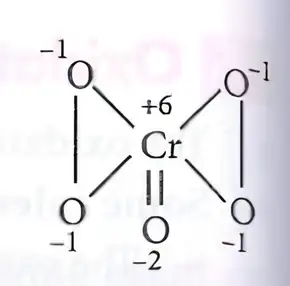
Q3: C) +6; CrO5 has two peroxo bonds, Cr ON = +6.
Memory Aids
Oxygen exceptions: peroxides (-1), superoxides (-1/2), OF2 (+2).
Hydrogen exceptions: metal hydrides (-1).
Fluorine always -1 except in HOF (+1).
Stock notation: Roman numerals indicate metal ON.
Oxidation Number of Important Compounds
Key Examples
C in C3O2: Two carbons have +2 ON, middle carbon 0.

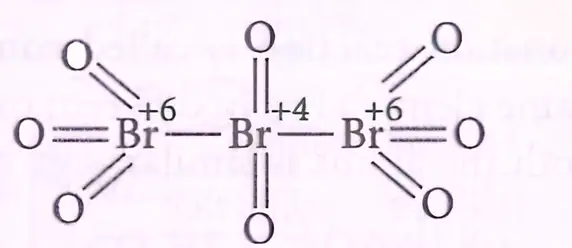
Br in Br3O8: Two Br atoms +6 ON, one Br +4 ON.
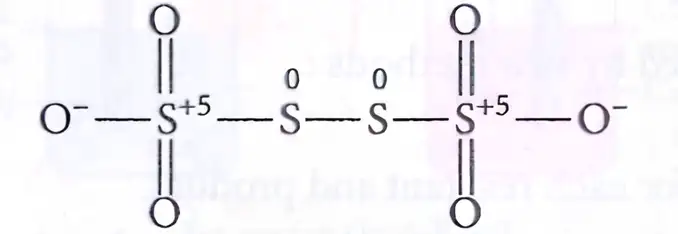
S in S4O62−: Two S atoms +5 ON, two S atoms 0.
Cl in Ca(OCl)Cl: Cl in OCl− is +1; overall Cl ON in compound is -1.
Cr in CrO5: Cr ON is +6 due to peroxo bonds.
Solved Examples
Ex 1: Determine ON of C in C3O2.
Two end carbons bonded to O have +2 ON; middle carbon is 0.
Ex 2: ON of Br in Br3O8.
Two Br atoms have +6 ON; one Br atom has +4 ON.
Practice Set
Q1: ON of S in S4O62− for two S atoms is:
A) 0
B) +2
C) +5
D) +6
Q2: ON of Cl in OCl− is:
A) -1
B) 0
C) +1
D) +2
Q3: ON of Fe in [Fe(H2O)5(NO)]SO4 is:
A) 0
B) +1
C) +2
D) +3
Answer Key
Q1: C) +5; two S atoms have +5 ON in tetrathionate ion.
Q2: C) +1; Cl in hypochlorite ion OCl− is +1.
Q3: B) +1; Fe ON calculated as +1 in complex.
Memory Aids
In polyatomic ions, sum of ON = ion charge.
Peroxo oxygen ON = -1; normal oxygen ON = -2.
Average ON used when multiple oxidation states present.
Types of Redox Reactions
Classification and Characteristics
Combination reactions: Two or more reactants combine; at least one reactant in elemental form.
Example: H2 + Cl2 → 2HCl (H: 0→+1, Cl: 0→-1)

Decomposition reactions: Compound breaks into two or more products; one product must be elemental for redox.
Example: 2H2O → 2H2 + O2 (H: +1→0, O: -2→0)

Displacement reactions: An atom/ion replaces another in a compound.
Metal displacement: TiCl4 + 2Mg → Ti + 2MgCl2

Non-metal displacement: Cl2 + 2KBr → 2KCl + Br2

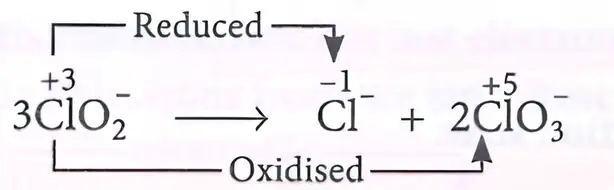
Disproportionation reactions: Single species is simultaneously oxidized and reduced.
Example: 3ClO2− → 2ClO3− + Cl−
Comproportionation reactions: Reverse of disproportionation; reactants with same element in different ON form product with same ON.
Example: Pb + PbO2 + 2H2SO4 → 2PbSO4 + 2H2O (lead storage battery)

Solved Examples
Ex 1: Identify type of reaction: Zn + H2SO4 → ZnSO4 + H2.
Non-metal displacement; Zn oxidized, H reduced.
Ex 2: Reaction in lead-acid battery.
Comproportionation; Pb and PbO2 react to form PbSO4.
Practice Set
Q1: Which is a disproportionation reaction?
A) 2H2O → 2H2 + O2
B) 3ClO2− → 2ClO3− + Cl−
C) Zn + H2SO4 → ZnSO4 + H2
D) TiCl4 + 2Mg → Ti + 2MgCl2
Q2: In which reaction does a metal displace another metal?
A) CuSO4 + Zn → ZnSO4 + Cu
B) Cl2 + 2KBr → 2KCl + Br2
C) 2H2O → 2H2 + O2
D) Pb + PbO2 + 2H2SO4 → 2PbSO4 + 2H2O
Q3: Which reaction is a combination reaction?
A) H2 + Cl2 → 2HCl
B) 2H2O → 2H2 + O2
C) Zn + H2SO4 → ZnSO4 + H2
D) 3ClO2− → 2ClO3− + Cl−
Answer Key
Q1: B) Disproportionation; ClO2− both oxidized and reduced.
Q2: A) Metal displacement; Zn displaces Cu.
Q3: A) Combination; H2 and Cl2 combine.
Memory Aids
Combination: reactants combine; decomposition: compound breaks down.
Displacement: one element replaces another.
Disproportionation: same species oxidized and reduced.
Comproportionation: species with different ON form same ON product.
Balancing of Redox Reactions
Oxidation Number Method
Write correct formulas for reactants and products.
Assign oxidation numbers to all elements.
Identify atoms with ON changes.
Calculate total increase and decrease in ON; multiply to equalize.
Add H+ (acidic) or OH− (basic) to balance charges.
Add H2O to balance hydrogen and oxygen atoms.
Half Reaction Method
Write ionic form of reaction.
Separate into oxidation and reduction half reactions.
Balance atoms except O and H in each half.
Balance O by adding H2O; balance H by adding H+ (acidic) or H2O and OH− (basic).
Add electrons to balance charge in each half.
Multiply half reactions to equalize electrons.
Add half reactions and cancel electrons.
Solved Examples
Ex 1: Balance MnO4− + Fe2+ → Mn2+ + Fe3+ in acidic medium using half reaction method.
Oxidation: Fe2+ → Fe3+ + e−
Reduction: MnO4− + 8H+ + 5e− → Mn2+ + 4H2O
Multiply oxidation by 5, add and cancel electrons.
Practice Set
Q1: In acidic medium, balance: Fe2+ + Cr2O72− → Fe3+ + Cr3+.
Q2: Balance in basic medium: SO32− + I2 → SO42− + I−.
Q3: Using oxidation number method, balance: H2S + Cl2 → S + HCl.
Answer Key
Q1: 6Fe2+ + Cr2O72− + 14H+ → 6Fe3+ + 2Cr3+ + 7H2O
Q2: SO32− + I2 + 2OH− → SO42− + 2I− + H2O
Q3: H2S + Cl2 → S + 2HCl
Memory Aids
Half reaction method: separate oxidation and reduction, balance atoms and charge, combine.
Oxidation number method: balance ON changes, then atoms and charges.
Use H+ in acidic, OH− in basic medium for balancing.
Redox Reactions as the Basis for Titrations
Redox Titrations and Indicators
Used to determine strength of oxidants or reductants.
Indicators show end point by color change.
Some reagents (e.g., MnO4−) act as self-indicators due to intense color.
Other indicators (e.g., diphenylamine) change color when oxidized or reduced at equivalence point.
Starch used as indicator for iodine-based titrations; forms intense blue complex with I2.
Solved Examples
Ex 1: In KMnO4 titration, color change from purple to colorless indicates end point.
Ex 2: Diphenylamine indicator turns blue when oxidized by Cr2O72− at equivalence point.
Practice Set
Q1: Which reagent acts as self-indicator in redox titration?
A) KMnO4
B) Diphenylamine
C) Starch
D) Phenolphthalein
Q2: Starch indicator is used to detect:
A) Cu2+
B) I2
C) S2O32−
D) Cr2O72−
Q3: Diphenylamine indicator changes color due to:
A) Reduction
B) Oxidation
C) Acid-base reaction
D) Precipitation
Answer Key
Q1: A) KMnO4; purple color acts as self-indicator.
Q2: B) I2; starch forms blue complex with iodine.
Q3: B) Oxidation; diphenylamine oxidized to show color change.
Memory Aids
KMnO4 is self-indicator (purple color).
Starch + I2 = intense blue color.
Diphenylamine changes color upon oxidation.
Redox Reactions and Electrode Processes
Key Concepts
Redox couple: Contains oxidised and reduced forms of a substance in a half-reaction, e.g., Zn2+/Zn and Cu2+/Cu in Daniell cell.
Salt bridge: Connects two solutions electrically without mixing them; maintains electrical neutrality.
Electrode potential: Potential difference at metal/ion interface; indicates tendency to gain or lose electrons.
Standard electrode potential (E°): Electrode potential measured at 1 M concentration and 298 K; hydrogen electrode is 0.00 V by convention.
Electrochemical series: List of reducing agents arranged by decreasing strength (activity series).
Negative E° means stronger reducing agent than H+/H2 couple; positive E° means weaker.
Only electrolytes with cations and anions of similar ionic mobility are used in salt bridges.
Equivalent mass of oxidising/reducing agent = (Equivalent mass) / (Change in oxidation state per mole).
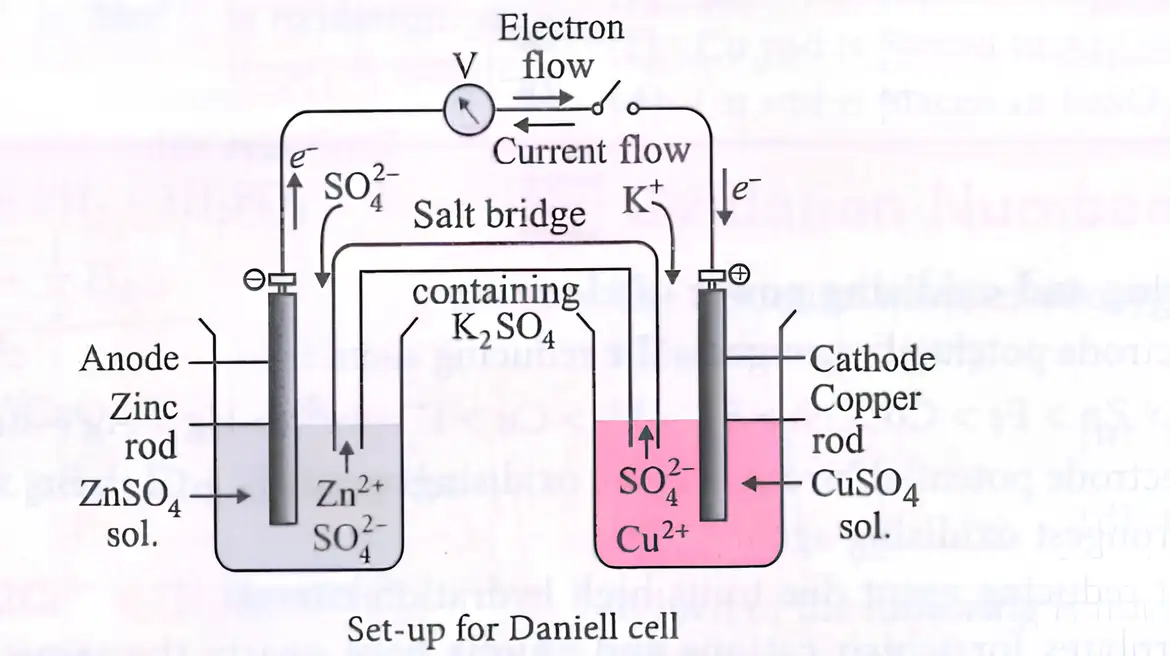
Setup of Daniell Cell
Zinc rod (anode) in ZnSO4 solution; copper rod (cathode) in CuSO4 solution.
Zinc oxidises: Zn → Zn2+ + 2e−.
Electrons flow from zinc to copper through external circuit.
Copper ions reduce: Cu2+ + 2e− → Cu.
Salt bridge (K2SO4) maintains charge balance by ion flow.
Electron flow produces electric current; voltmeter measures voltage.
Chemical energy converts to electrical energy.
Solved Examples
Ex 1: Write the half-reactions at anode and cathode in Daniell cell.
Anode (oxidation): Zn → Zn2+ + 2e−
Cathode (reduction): Cu2+ + 2e− → Cu
Practice Set
Q1: What is the role of the salt bridge in an electrochemical cell?
A) To allow mixing of solutions
B) To complete the circuit and maintain electrical neutrality
C) To increase voltage
D) To act as an electrodeQ2: In Daniell cell, which electrode acts as the cathode?
A) Zinc
B) Copper
C) Salt bridge
D) HydrogenQ3: Standard electrode potential of hydrogen is:
A) +0.34 V
B) 0.00 V
C) -0.76 V
D) +1.23 V
Answer Key
Q1: B - Salt bridge completes the circuit and maintains electrical neutrality without mixing solutions.
Q2: B - Copper electrode is cathode where reduction occurs.
Q3: B - Standard hydrogen electrode potential is defined as 0.00 V.
Memory Aids
Salt bridge = "Charge balancer" without mixing.
Daniell cell: Zn (anode, oxidation) → Cu (cathode, reduction).
Standard hydrogen electrode (SHE) potential = 0.00 V by definition.
Electrochemical Series and Prediction of Redox Power
Key Concepts
Electrochemical series arranges reducing agents by decreasing strength (activity series).
Lower (more negative) E° → stronger reducing agent.
Higher (more positive) E° → stronger oxidising agent.
Examples of reducing agents (strongest to weaker): Li > Mg > Al > Zn > Fe > Co > Ni > Sn > Pb > Cu > I− > Fe2+ > Hg > Ag > Br− > Cl− > F−
Examples of oxidising agents (strongest to weaker): F2 > Cl2 > Br2 > I2
Fluorine is the strongest oxidising agent.
Lithium is the strongest reducing agent due to high hydration energy.
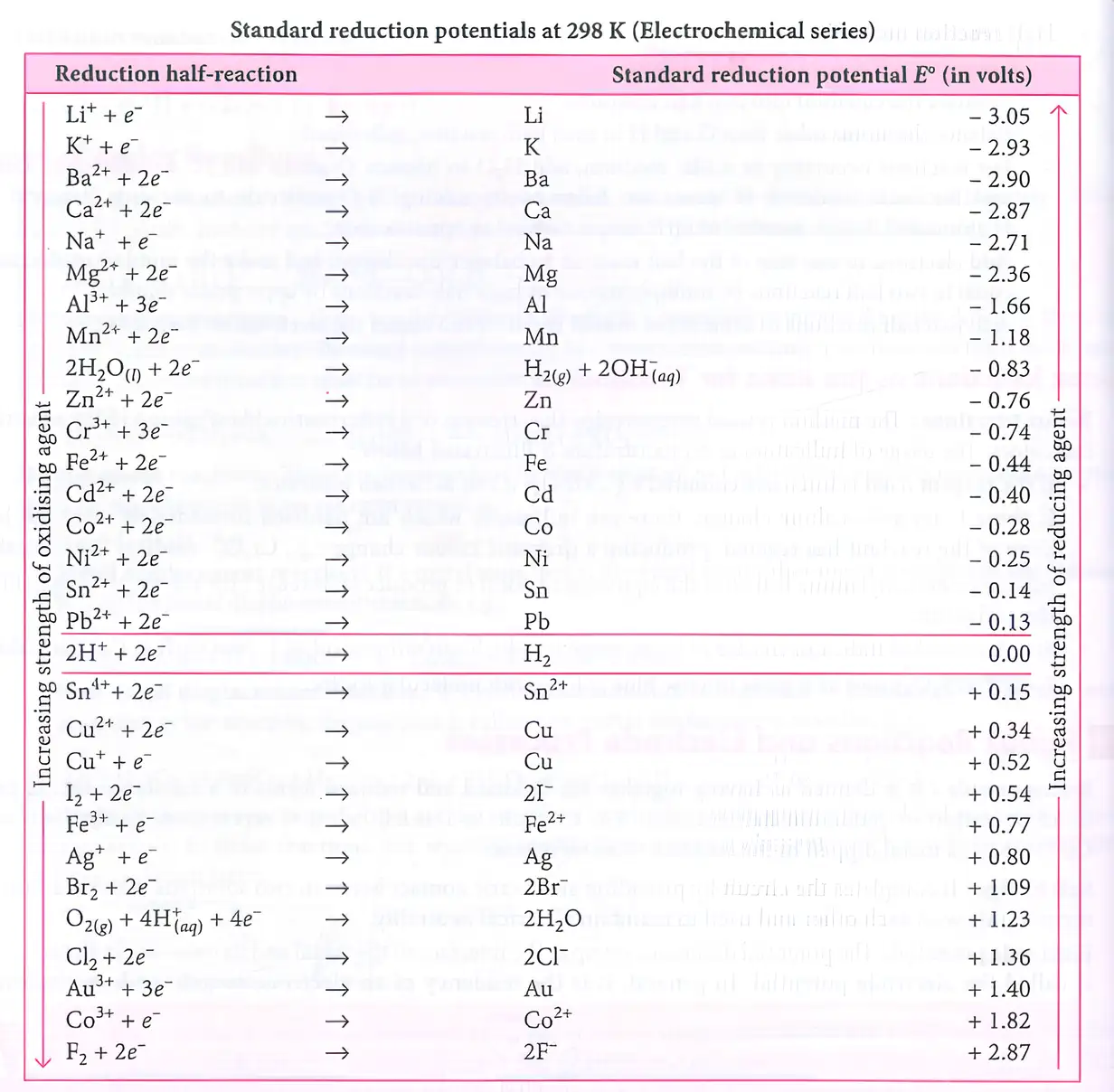
Standard Reduction Potentials Table
Lists half-reactions and their E° values at 298 K.
Negative E°: stronger oxidising agents, less likely to gain electrons.
Positive E°: stronger reducing agents, more likely to gain electrons.
Hydrogen half-reaction (2H+ + 2e− → H2) is reference at 0.00 V.
Solved Examples
Ex 1: Predict which is stronger reducing agent: Zn or Cu?
Zn has lower E° than Cu → Zn is stronger reducing agent.
Practice Set
Q1: Which element is the strongest oxidising agent?
A) Cl2
B) F2
C) Br2
D) I2Q2: Arrange the following in order of increasing reducing power: Cu, Li, Zn.
A) Li < Zn < Cu
B) Cu < Zn < Li
C) Zn < Cu < Li
D) Cu < Li < ZnQ3: Which statement is correct?
A) Higher E° means stronger reducing agent
B) Lower E° means stronger oxidising agent
C) Negative E° means stronger reducing agent
D) Positive E° means stronger oxidising agent
Answer Key
Q1: B - Fluorine (F2) is the strongest oxidising agent.
Q2: B - Increasing reducing power: Cu < Zn < Li (Li strongest).
Q3: C - Negative E° indicates stronger reducing agent.
Memory Aids
Remember: "Li is the strongest reducer" due to hydration energy.
Oxidising agents order: F2 > Cl2 > Br2 > I2.
Negative E° → strong reducer; Positive E° → strong oxidiser.
NEET Chemistry — ALL CHAPTERS
1
Some Basic Concepts of Chemistry
2
Structure of Atom
3
Classification of Elements and Periodicity in Properties
4
Chemical Bonding and Molecular Structure
5
Thermodynamics
6
Equilibrium
7
Redox Reactions
8
Organic Chemistry - Some Basic Principles and Techniques
9
Hydrocarbons
10
Solutions
11
Electrochemistry
12
Chemical Kinetics
13
The d- and f- Block Elements
14
Coordination Compounds
15
Haloalkanes and Haloarenes
16
Alcohols, Phenols and Ethers
17
Aldehydes, Ketones and Carboxylic Acids
18
Amines
19
Biomolecules
20
The p-Block Elements (Group 13 and 14)
21
The p-Block Elements (Group 15 to 18)
22
Principles Related to Practical Chemistry