NEET Ug . NEET Chemistry . Chemistry . Structure of Atom
Chapter 2: Structure of Atom
Ch 2
NEET Chemistry
NEET Ug
Introduction
Dalton's Atomic Theory
- Proposed by John Dalton in 1808.
- Atom considered the ultimate particle of matter.
- Explains law of conservation of mass, constant composition, and multiple proportions.
- Fails to explain electrical charging of rubbed substances like glass or ebonite.
Solved Examples
- Ex 1: Explain why Dalton's atomic theory could not explain electrical charging of rubbed substances.
- Dalton's theory did not consider subatomic particles or electrical properties of atoms.
Practice Set
- Q1: Dalton's atomic theory regards the atom as:
A. Divisible particle
B. Ultimate particle of matter
C. Made of electrons
D. Electrically charged particle - Q2: Which law is NOT explained by Dalton's atomic theory?
A. Law of conservation of mass
B. Law of constant composition
C. Law of multiple proportions
D. Electrical charging of rubbed substances - Q3: Dalton's atomic theory was proposed in:
A. 1908
B. 1808
C. 2008
D. 1708
Answer Key
- Q1: B - Dalton considered atom as the ultimate particle, indivisible.
- Q2: D - Electrical charging was unexplained by Dalton's theory.
- Q3: B - Dalton proposed the theory in 1808.
Memory Aids
- Dalton = "D" for "Definite" laws explained.
- Remember: Dalton's atom is indivisible, no charge concept.
Discovery of Sub-atomic Particles
Fundamental Particles
- Atoms consist of electrons, protons, and neutrons.
- Electrons discovered by J.J. Thomson via cathode ray tube.
- Protons discovered by E. Goldstein using modified cathode ray tube.
- Neutrons discovered by James Chadwick by bombarding beryllium with α-particles.
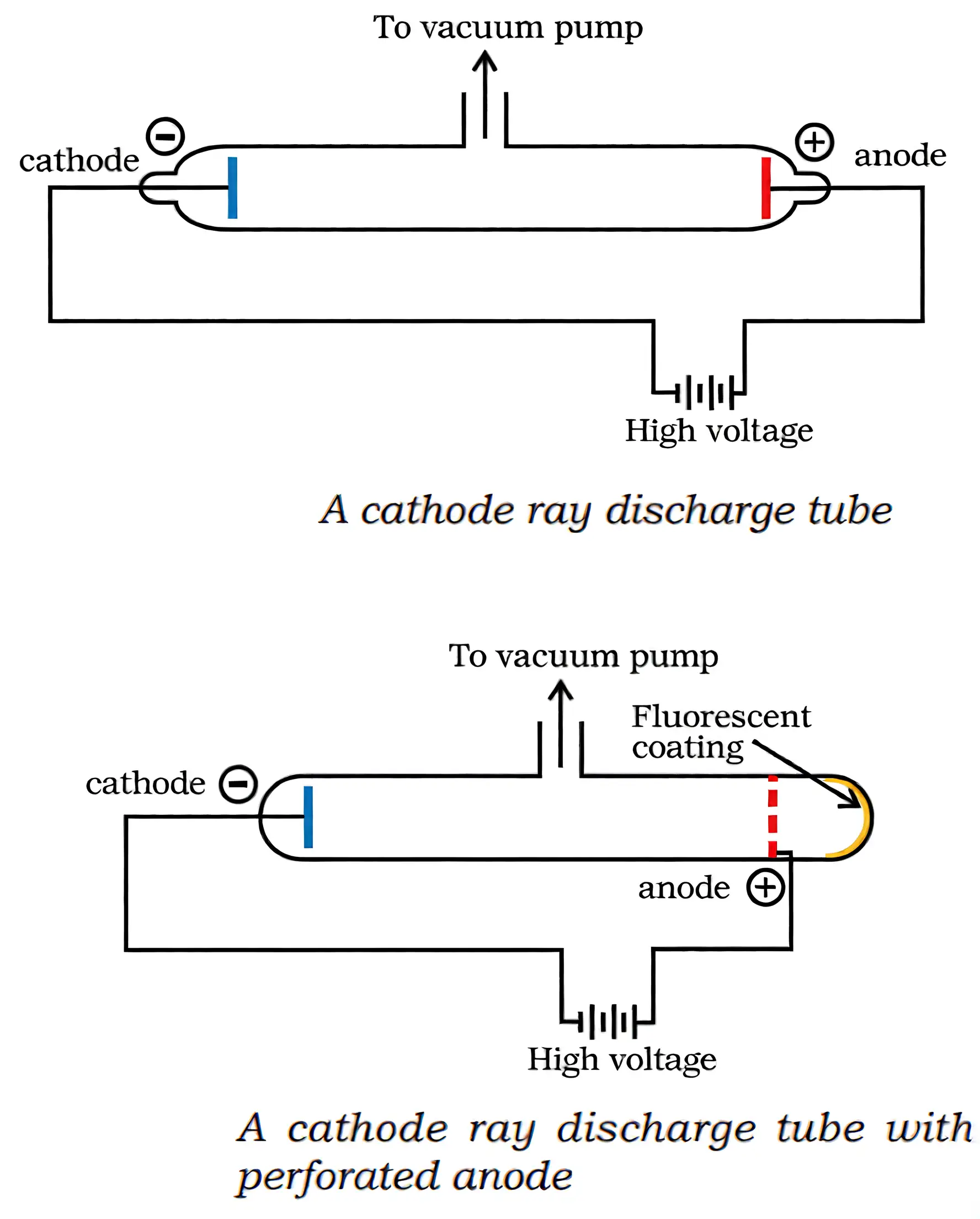
Cathode Ray Discharge Tube Experiment
- Glass tube with cathode (-) and anode (+) at low pressure and high voltage.
- Current flows as cathode rays from cathode to anode.
- Perforated anode allows rays to hit fluorescent coating, producing bright spot.
- Cathode rays are streams of negatively charged electrons.
- Rays travel straight without fields; deflect in electric/magnetic fields like negative particles.
- Characteristics independent of electrode material and gas type.
Charge to Mass Ratio of Electron
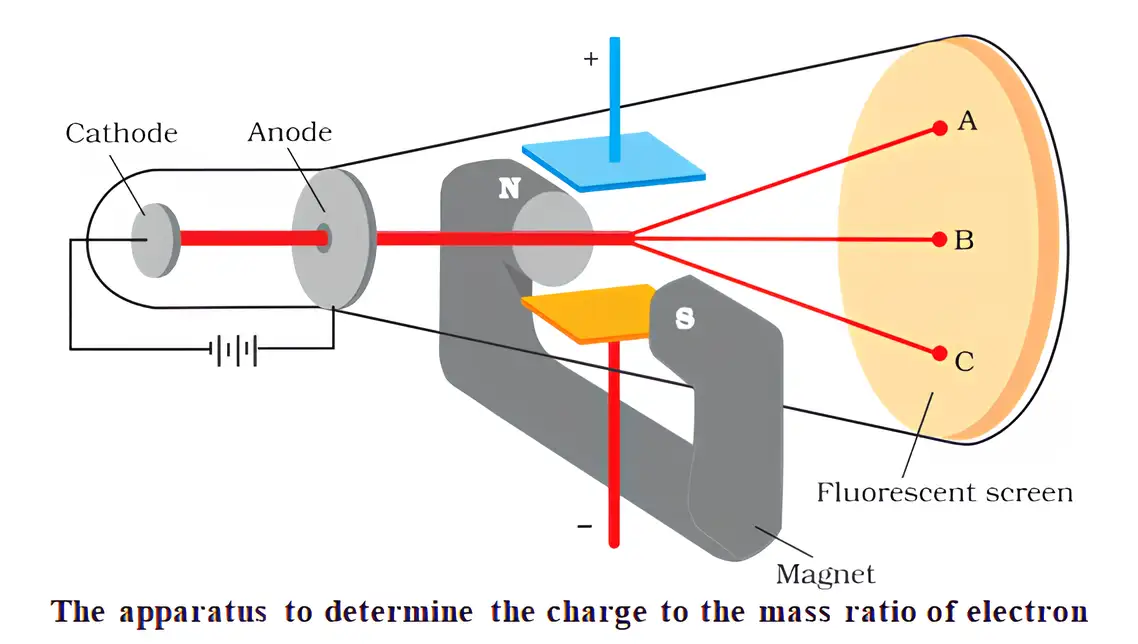
- Determined by Thomson using electric and magnetic fields perpendicular to electron path.
- Deflection depends on charge magnitude, particle mass, and field strength.
- Value: \( e/m_e = 1.758820 \times 10^{11} \text{ C kg}^{-1} \)
- Mass of electron calculated as \( m_e = 9.1094 \times 10^{-31} \text{ kg} \)
Charge on Electron
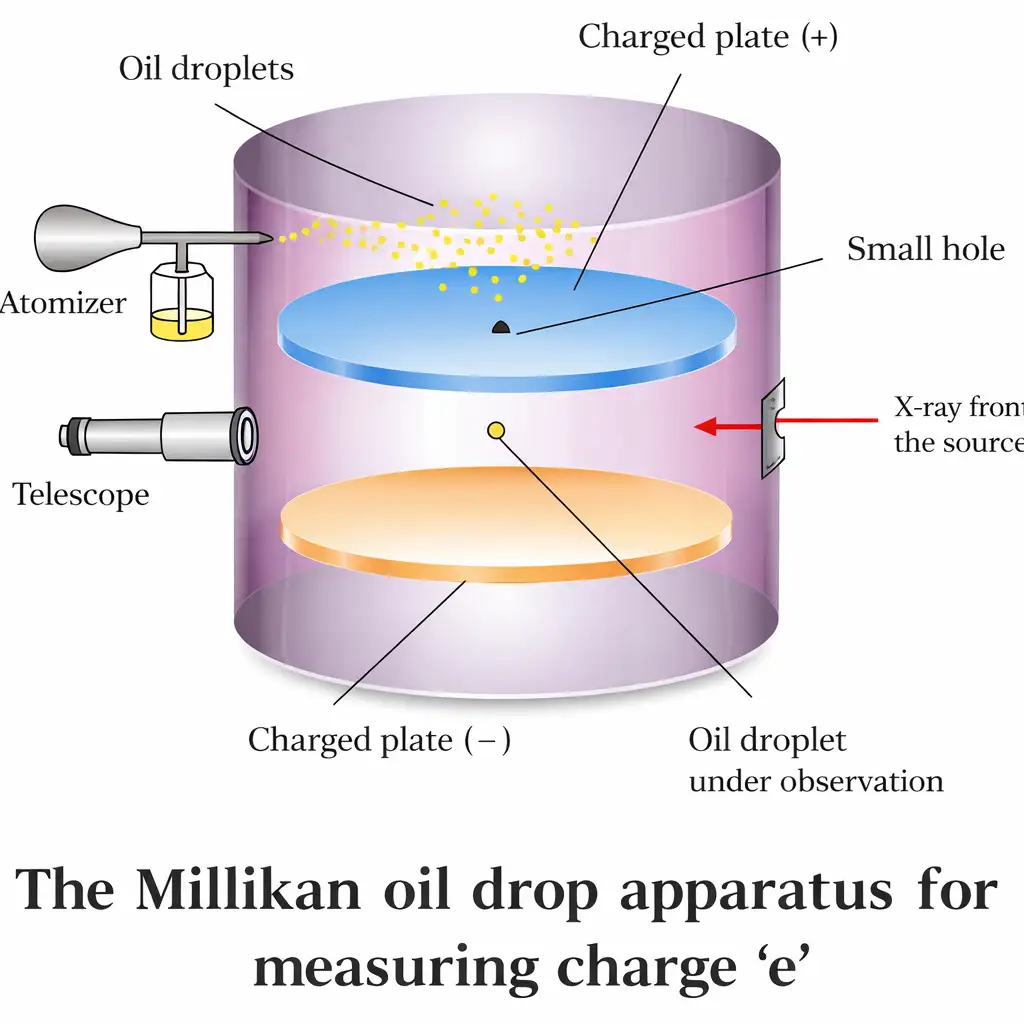
- Measured by Millikan's oil drop experiment.
- Charge value: \( -1.6 \times 10^{-19} \text{ C} \)
Discovery of Protons and Canal Rays
- Protons discovered by E. Goldstein using modified cathode ray tube.
- Positively charged particles depend on gas type.
- Charge to mass ratio varies with gas.
- Some carry multiple fundamental charges.
- Deflect opposite to cathode rays in fields.
Discovery of Neutrons
- Discovered by James Chadwick by bombarding beryllium with α-particles.
- Neutrons are neutral, mass slightly greater than protons.
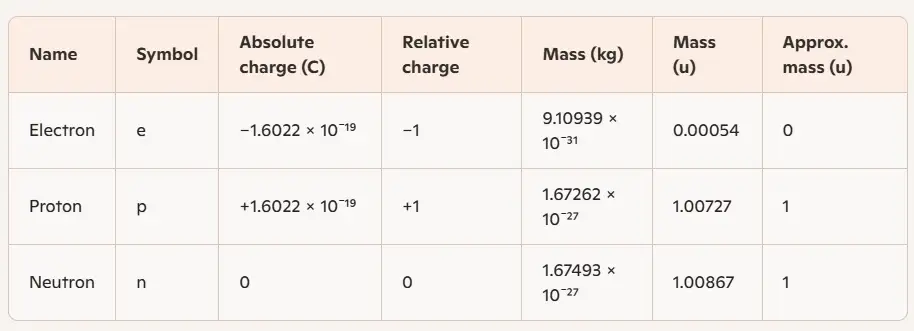
Properties of Fundamental Particles
- Electron (e): charge = -1, mass = 9.1094 × 10⁻³¹ kg
- Proton (p): charge = +1, mass ≈ 1.6726 × 10⁻²⁷ kg
- Neutron (n): charge = 0, mass ≈ 1.6749 × 10⁻²⁷ kg
Solved Examples
- Ex 1: Calculate the mass of an electron given charge \( e = 1.6022 \times 10^{-19} \text{ C} \) and \( e/m_e = 1.758820 \times 10^{11} \text{ C kg}^{-1} \).
- \( m_e = \frac{e}{e/m_e} = \frac{1.6022 \times 10^{-19}}{1.758820 \times 10^{11}} = 9.1094 \times 10^{-31} \text{ kg} \) - Ex 2: Explain why cathode rays deflect towards the positive plate.
- Cathode rays are negatively charged electrons attracted to positive plate.
Practice Set
- Q1: Cathode rays consist of:
A. Protons
B. Neutrons
C. Electrons
D. Alpha particles - Q2: Charge to mass ratio of electron is:
A. \( 1.758820 \times 10^{11} \text{ C kg}^{-1} \)
B. \( 1.6022 \times 10^{-19} \text{ C} \)
C. \( 9.1094 \times 10^{-31} \text{ kg} \)
D. \( 1.6749 \times 10^{-27} \text{ kg} \) - Q3: Neutrons were discovered by:
A. J.J. Thomson
B. E. Goldstein
C. James Chadwick
D. R.A. Millikan
Answer Key
- Q1: C - Cathode rays are streams of electrons.
- Q2: A - Charge to mass ratio of electron is \( 1.758820 \times 10^{11} \text{ C kg}^{-1} \).
- Q3: C - Neutrons discovered by James Chadwick.
Memory Aids
- Electron = negative, lightest particle.
- Proton = positive, mass ~1 u.
- Neutron = neutral, mass ~1 u.
- Thomson = electron, Millikan = charge, Chadwick = neutron.
Atomic Models
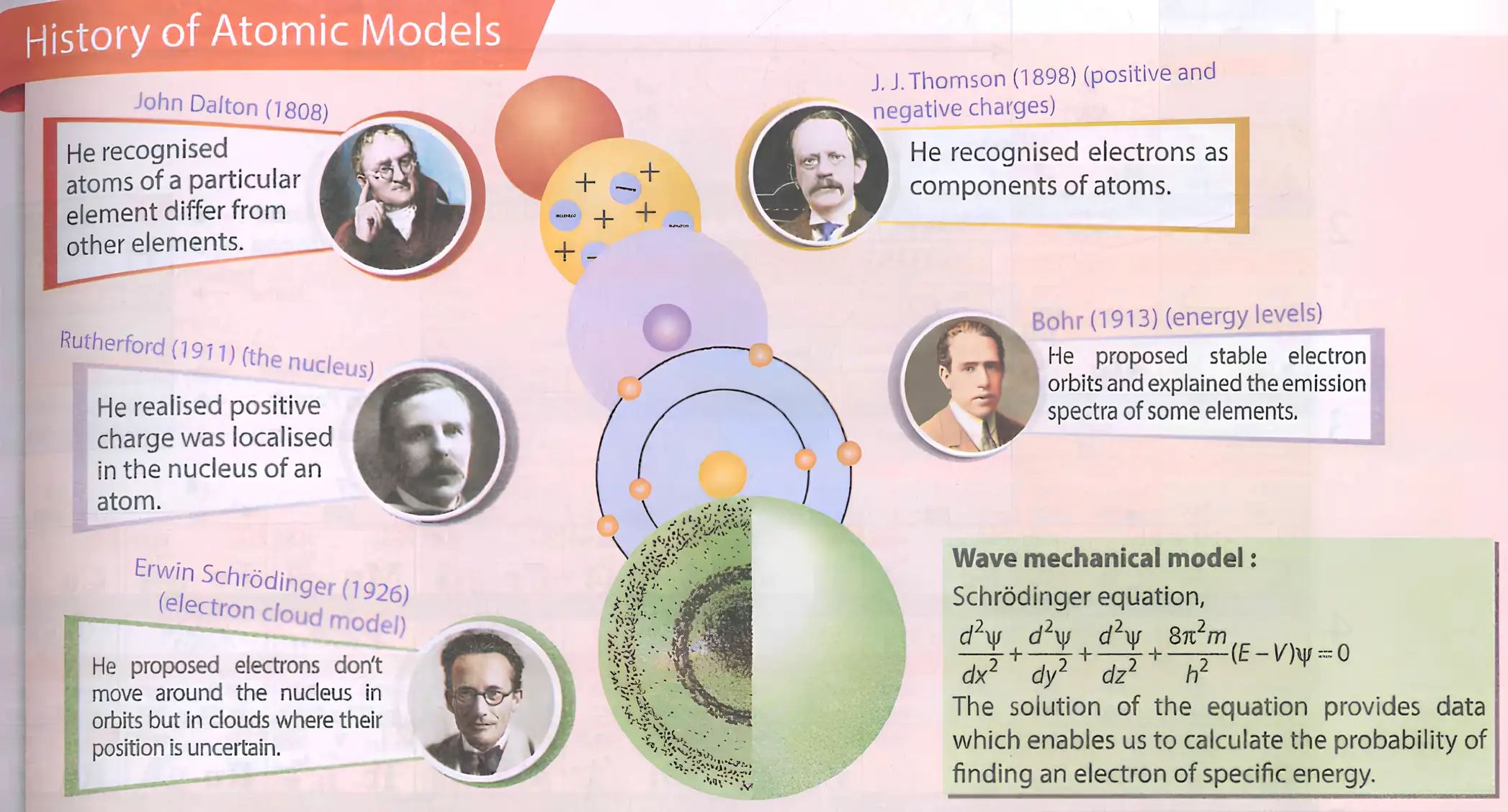
Evolution of Atomic Models
- Dalton (1808): Atoms are indivisible, unique for each element.
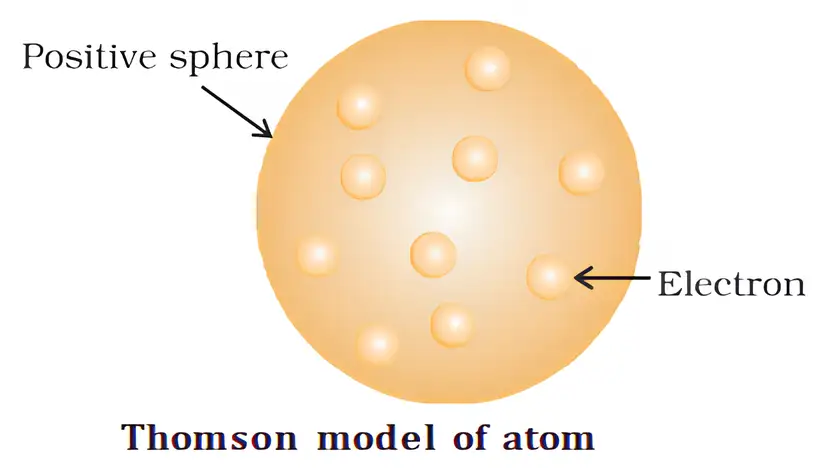
- Thomson (1898): Atom is a positive sphere with embedded electrons (raisin pudding model).
- Rutherford (1911): Atom has a small, dense, positively charged nucleus; most of atom is empty space.
- Bohr (1913): Electrons move in fixed orbits; explained atomic spectra.
- Schrödinger (1926): Electron cloud model; electron position uncertain; wave equation predicts electron probability.
Solved Examples
- Ex 1: Identify the model that introduced the nucleus concept.
Answer: Rutherford’s model (1911) based on alpha particle scattering.
Practice Set
- Q1: Who proposed the raisin pudding model?
A. Dalton B. Thomson C. Rutherford D. Bohr - Q2: What did Rutherford’s gold foil experiment prove?
A. Atom is indivisible B. Atom has a nucleus C. Electrons in fixed orbits D. Electrons form a cloud - Q3: Schrödinger’s model introduced which concept?
A. Fixed electron orbits B. Electron cloud and probability C. Positive sphere D. Alpha particle scattering
Answer Key
- Q1: B - Thomson proposed the raisin pudding model with electrons embedded in positive charge.
- Q2: B - Rutherford’s experiment showed atoms have a small, dense nucleus.
- Q3: B - Schrödinger introduced the electron cloud model with probabilistic electron positions.
Memory Aids
- "Dalton’s Dots" - atoms as solid spheres.
- "Thomson’s Pudding" - electrons like raisins in positive pudding.
- "Rutherford’s Nucleus" - tiny dense center deflects alpha particles.
- "Bohr’s Orbits" - electrons in fixed paths like planets.
- "Schrödinger’s Cloud" - electrons as fuzzy clouds, not fixed points.
Thomson Model
Key Features
- Atom is a uniform positive sphere with embedded electrons.
- Electrons (negative charges) neutralize positive charge.
- Mass is uniformly distributed.
- Explains overall neutrality of atom.
- Fails to explain later experimental results.
Solved Examples
- Ex 1: Describe the charge distribution in Thomson’s model.
Answer: Positive charge spread uniformly; electrons scattered inside.
Practice Set
- Q1: Thomson’s model compares electrons to:
A. Planets B. Raisins C. Nucleus D. Waves - Q2: Thomson’s model assumes mass is:
A. Concentrated in nucleus B. Uniformly distributed C. Only in electrons D. Only in protons - Q3: Thomson’s model fails because:
A. It ignores electrons B. It contradicts scattering experiments C. It explains spectra D. It predicts nucleus
Answer Key
- Q1: B - Electrons are like raisins embedded in positive pudding.
- Q2: B - Mass is assumed uniformly distributed in the atom.
- Q3: B - Later experiments showed nucleus presence, contradicting this model.
Memory Aids
- "Raisin pudding" = electrons in positive sphere.
- Mass uniform, no nucleus concept.
- Explains neutrality but not scattering results.
Rutherford Model
Key Points
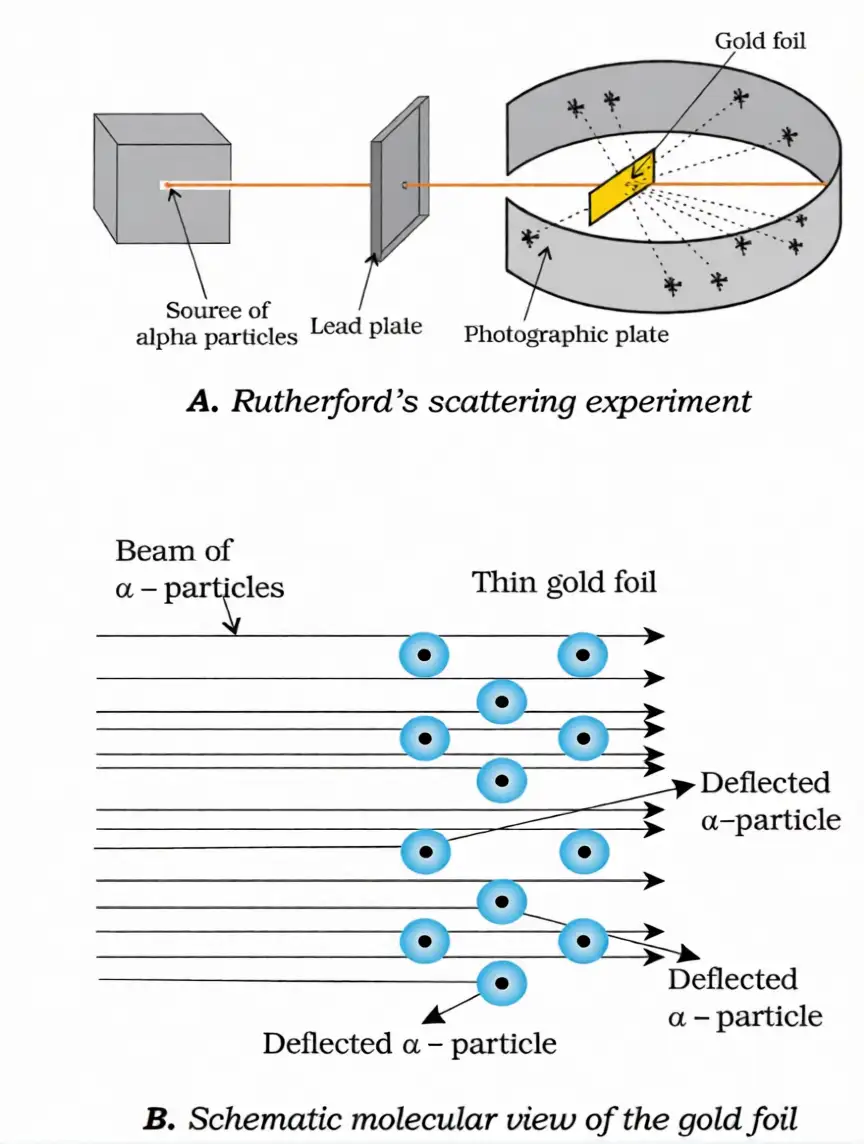
- Alpha particles scattered by thin gold foil.
- Most passed through → atom mostly empty space.
- Some deflected → small, dense, positive nucleus.
- Few reflected back → nucleus is very hard and small.
- Electrons orbit nucleus like planets around sun.
- Electrostatic attraction holds electrons and nucleus.
- Atomic number (Z) = number of protons = number of electrons (neutral atom).
- Mass number (A) = protons + neutrons.
- Penetrating power: γ > X > β > α.
Solved Examples
- Ex 1: Calculate mass number if protons = 11 and neutrons = 12.
Answer: A = 11 + 12 = 23.
Practice Set
- Q1: Rutherford’s experiment showed atom is mostly:
A. Solid B. Empty space C. Negative D. Uniform charge - Q2: Atomic number equals:
A. Number of neutrons B. Number of protons C. Mass number D. Number of electrons only - Q3: Which ray has highest penetrating power?
A. α B. β C. γ D. X-rays
Answer Key
- Q1: B - Most alpha particles passed through, showing empty space.
- Q2: B - Atomic number equals number of protons.
- Q3: C - Gamma rays have highest penetrating power.
Memory Aids
- "Gold foil deflection" → nucleus discovery.
- Atomic number = protons = electrons (neutral atom).
- Mass number = protons + neutrons.
- Penetration: γ > X > β > α.
Drawbacks of Rutherford Model
Limitations
- Electrons in orbits accelerate and should emit radiation, losing energy.
- Electrons should spiral into nucleus quickly (10⁻⁸ s), but atoms are stable.
- Model does not explain electron energy levels or distribution.
Solved Examples
- Ex 1: Why does Rutherford’s model fail to explain atomic stability?
Answer: Accelerating electrons should emit energy and collapse into nucleus, which does not happen.
Practice Set
- Q1: According to Rutherford, electrons should:
A. Remain stable B. Emit radiation C. Not move D. Be neutral - Q2: Time for electron to spiral into nucleus is:
A. 10 s B. 10⁻⁸ s C. 1 hour D. Infinite - Q3: Rutherford’s model lacks explanation of:
A. Nucleus B. Electron energy levels C. Alpha particles D. Atomic number
Answer Key
- Q1: B - Accelerating electrons should emit radiation.
- Q2: B - Calculated time is about 10⁻⁸ seconds.
- Q3: B - Model does not explain electron energies or distribution.
Memory Aids
- "Electron collapse" problem in Rutherford model.
- Need for quantum model to explain stability.
- Electron energy levels missing in Rutherford’s model.
Developments Leading to Bohr's Model of Atom
Wave Nature of Electromagnetic Radiations (Maxwell's Wave Theory)
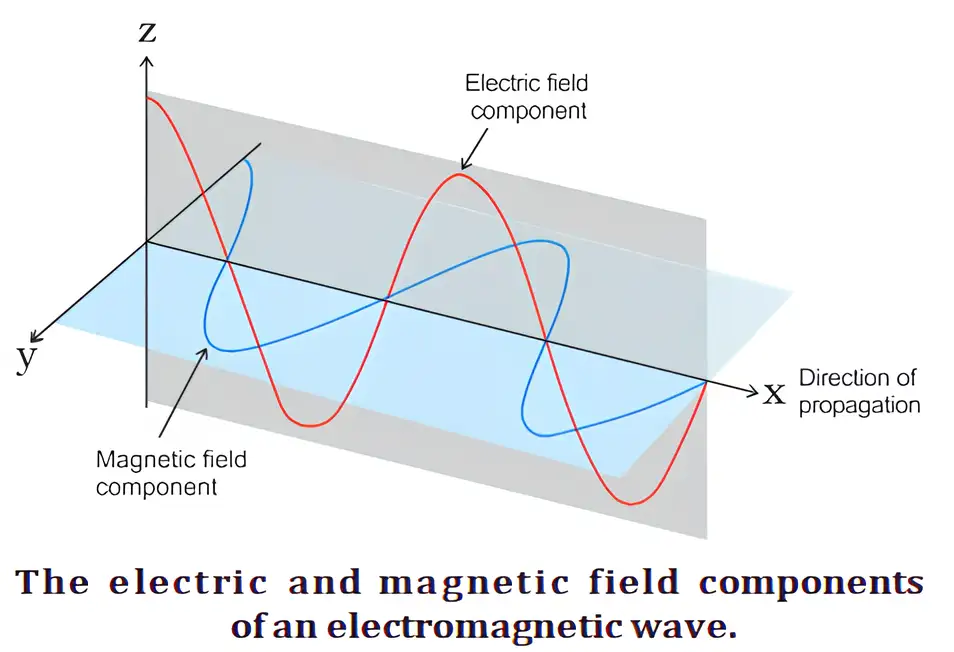
- Energy emitted continuously as electromagnetic waves with perpendicular electric and magnetic fields.
- Electric and magnetic fields vibrate in mutually perpendicular planes and perpendicular to wave propagation.
- Wave properties: frequency (ν), wavelength (λ), velocity (c), amplitude, and wavenumber (ν̄).
- Relation: c = νλ; higher frequency means shorter wavelength.
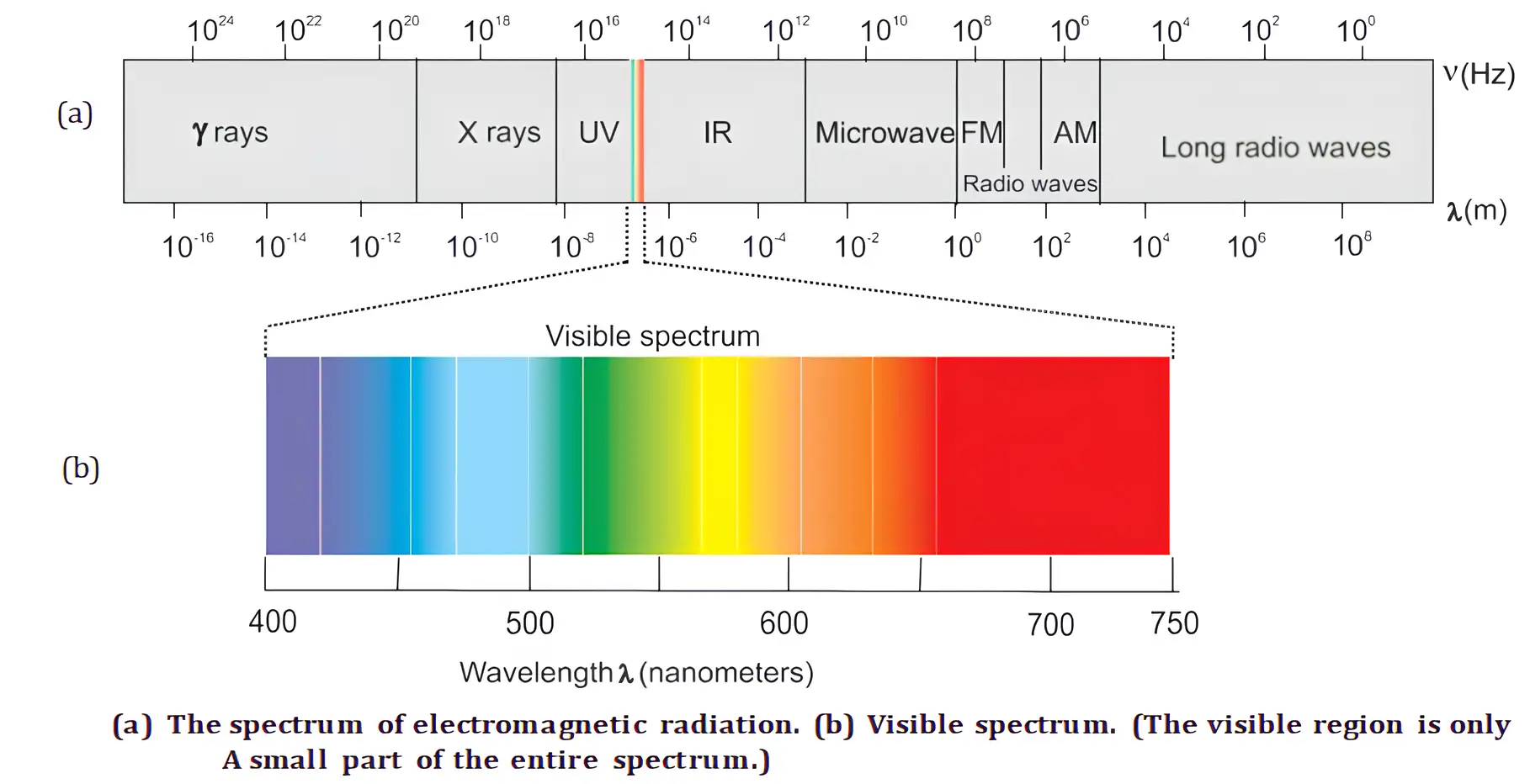
- Electromagnetic spectrum arranges radiations by increasing wavelength or decreasing frequency.
Characteristic Properties of Electromagnetic Waves
- Frequency (ν): Number of waves passing a point per second (Hz or s−1).
- Wavelength (λ): Distance between two consecutive crests or troughs (m, Å, pm, nm).
- Velocity (c): Speed of wave in vacuum = 3.0 × 10⁸ m/s; c = νλ.
- Wavenumber (ν̄): Number of wavelengths per unit length (m−1, commonly cm−1).
- Amplitude: Height of crest or depth of trough; determines light intensity.
Electromagnetic Spectrum
- Arranged by increasing wavelength or decreasing frequency.
- Includes gamma rays, X-rays, ultraviolet, visible light, infrared, microwaves, and radio waves.
- Visible spectrum ranges from violet (short wavelength) to red (long wavelength).
Black Body Radiation and Planck's Quantum Theory
- Black body: Ideal body absorbing and emitting all frequencies.
- Planck's Quantum Theory: Energy emitted/absorbed in discrete quanta, E = hν (h = 6.626 × 10⁻³⁴ J·s).
- Total energy emitted/absorbed: E = nhν, where n = 0,1,2,...
Photoelectric Effect
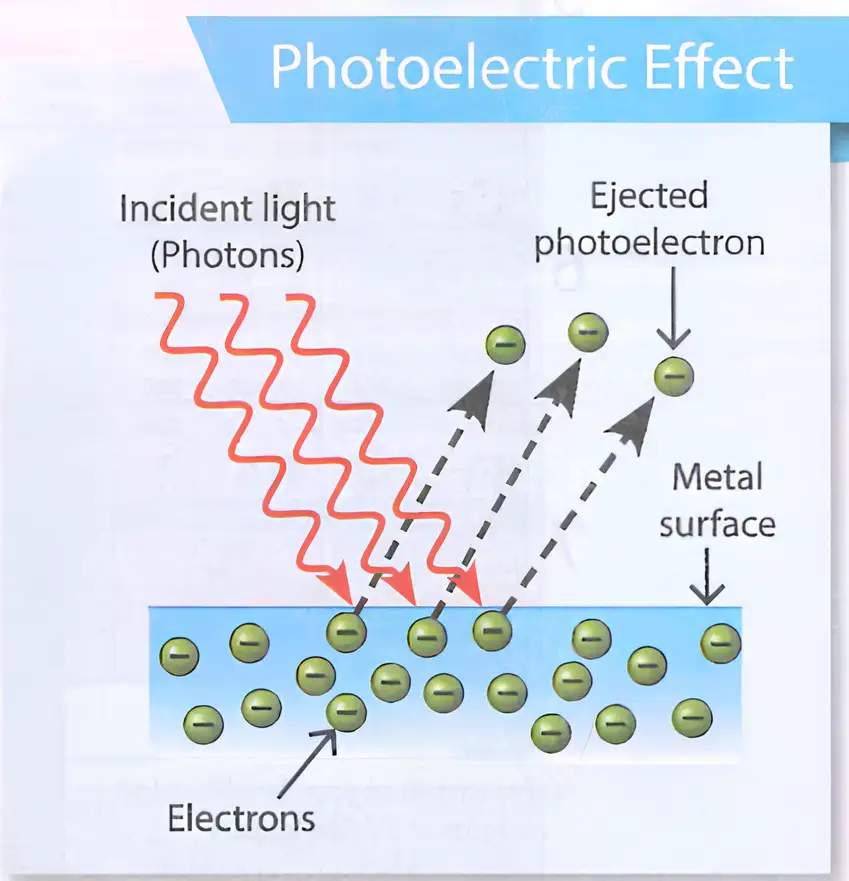
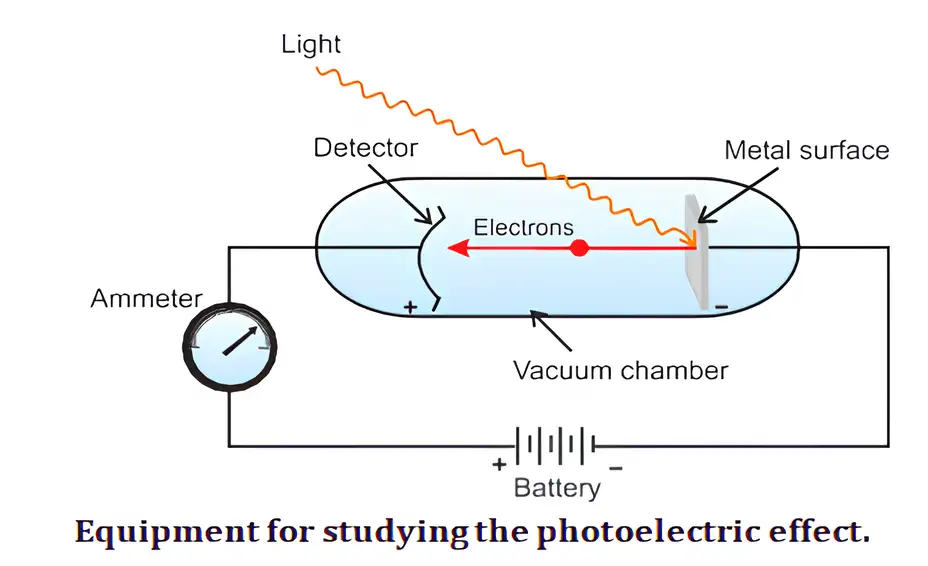
- Emission of electrons from metal surface (K, Rb, Cs) when exposed to light above threshold frequency (ν0).
- Energy relation: hν = hν0 + ½ mev2, where hν0 is work function.
- Demonstrates particle nature of light (photons) and dual nature of electromagnetic radiation.
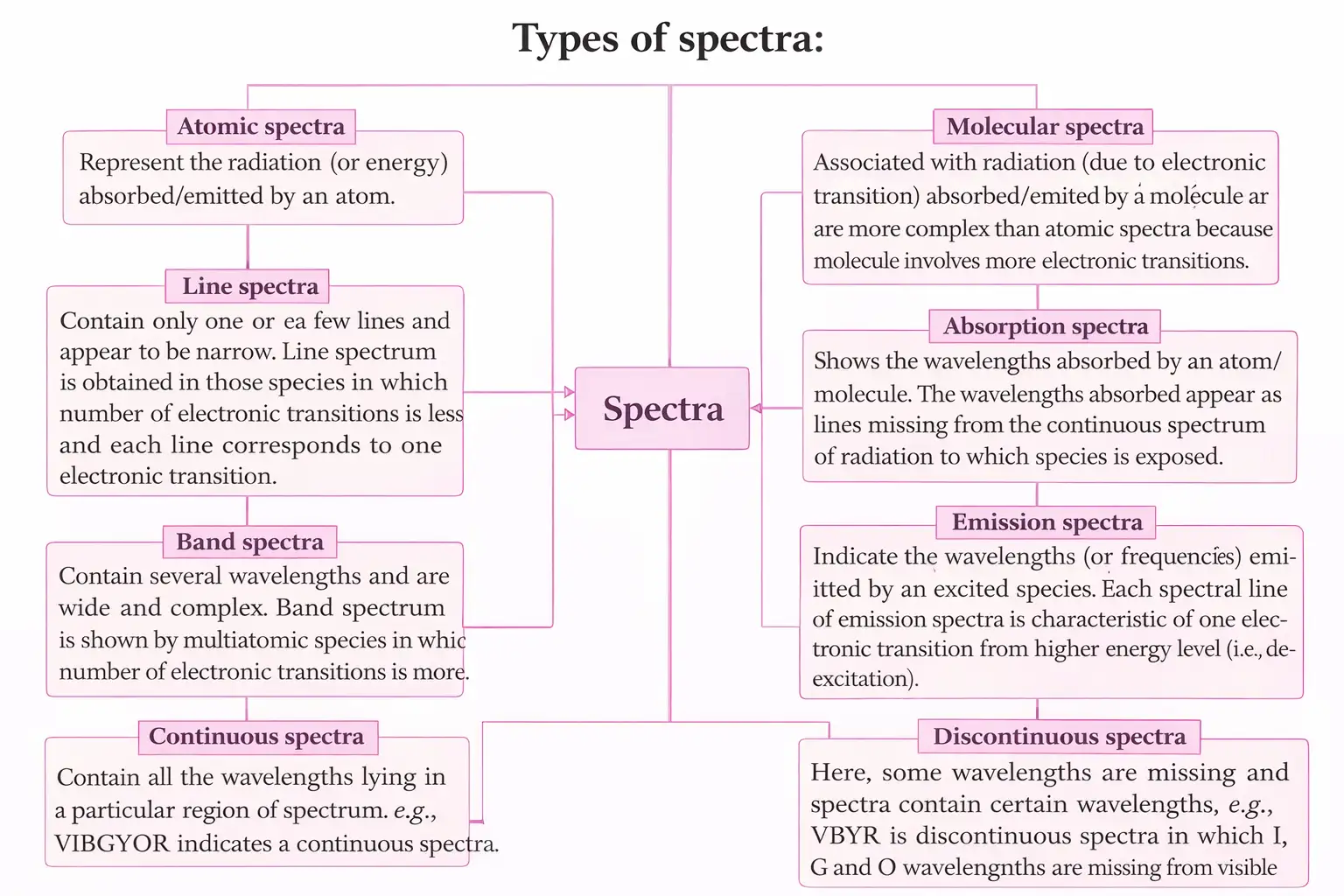
Spectrum Types
- Atomic Spectra: Line, band, and continuous spectra from atoms.
- Molecular Spectra: More complex, includes absorption and emission spectra.
- Absorption Spectrum: Wavelengths absorbed, seen as dark lines.
- Emission Spectrum: Wavelengths emitted by excited atoms/molecules.
- Discontinuous Spectrum: Missing some wavelengths.
Hydrogen Atomic Spectra
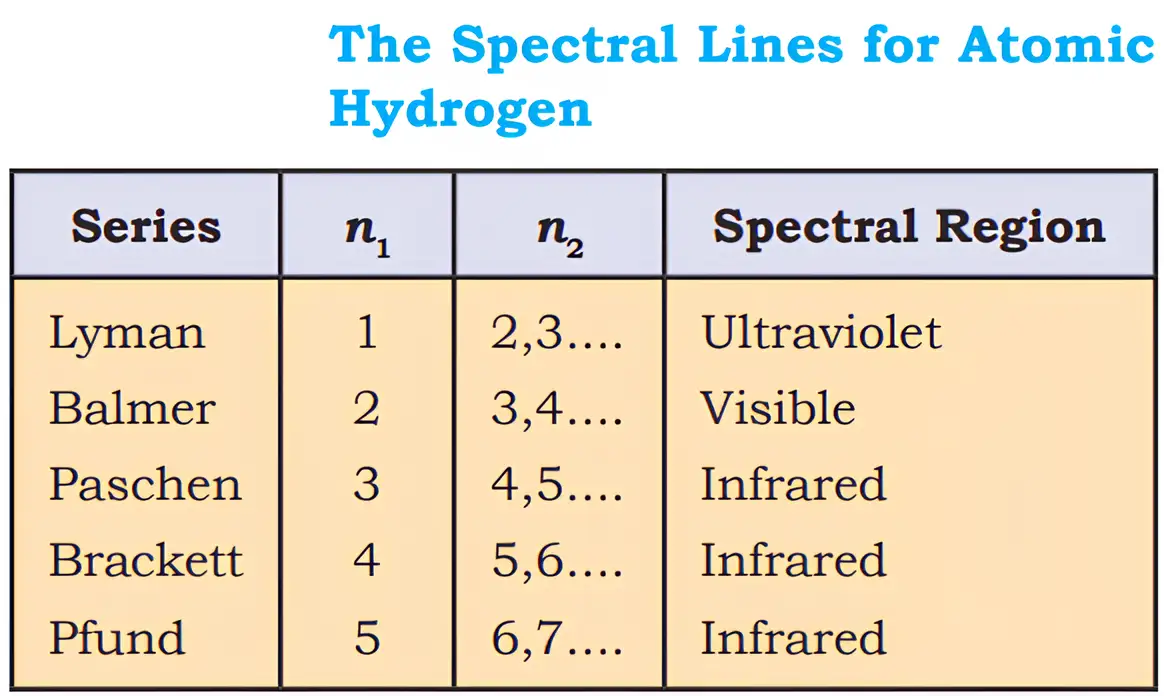
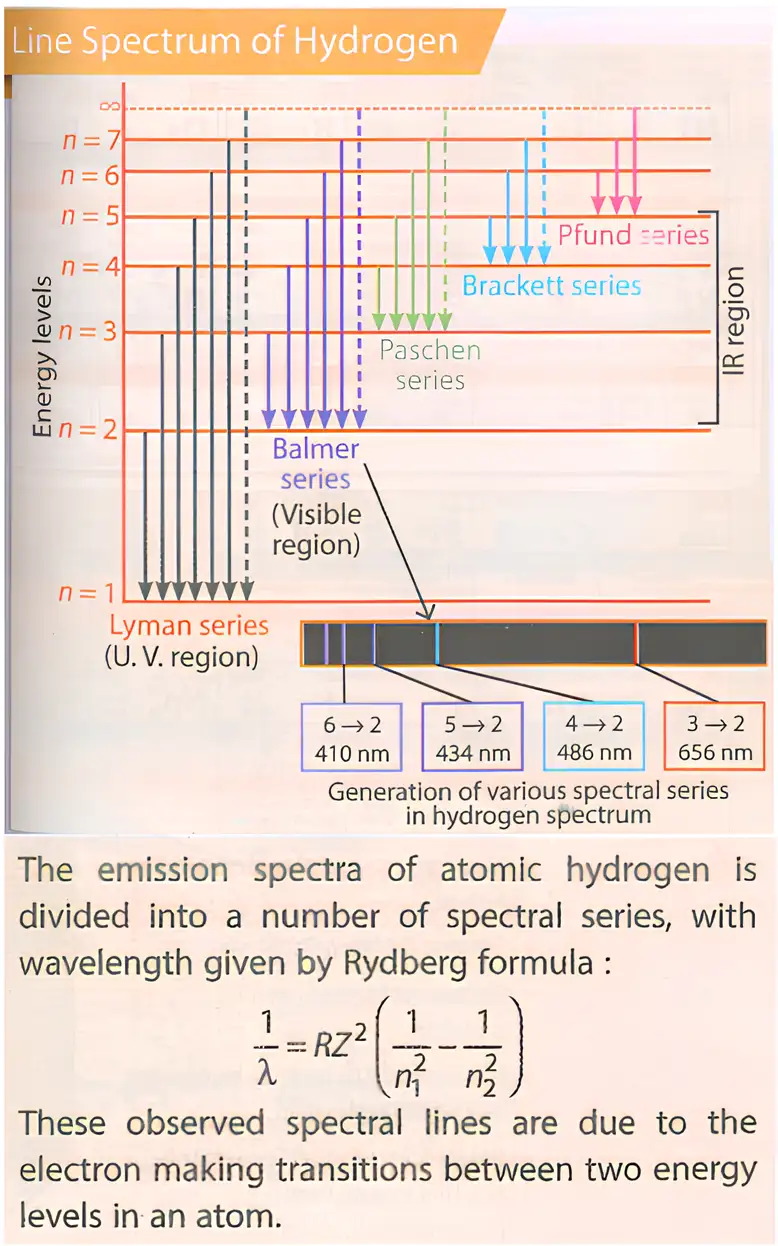
- Series: Lyman (UV), Balmer (visible), Paschen, Brackett, Pfund (infrared).
- Electron transitions between energy levels n1 and n2 produce spectral lines.
- Number of lines from n to 1: n(n−1)/2.
- Number of lines from n2 to n1: (n2−n1)(n2−n1+1)/2.
Solved Examples
Ex 1
- Calculate wavelength of light emitted when electron falls from n=3 to n=2 in hydrogen.
- Use Rydberg formula: \( \frac{1}{\lambda} = R \left( \frac{1}{n_1^2} - \frac{1}{n_2^2} \right) \), R = 1.097 × 10⁷ m−1.
- \( \frac{1}{\lambda} = 1.097 \times 10^7 \left( \frac{1}{2^2} - \frac{1}{3^2} \right) = 1.097 \times 10^7 \times \left( \frac{1}{4} - \frac{1}{9} \right) = 1.52 \times 10^6 \, m^{-1} \).
- \( \lambda = \frac{1}{1.52 \times 10^6} = 6.58 \times 10^{-7} m = 658 nm \) (visible red light).
Practice Set
- Q1: What is the speed of all electromagnetic waves in vacuum?
A) 3.0 × 10⁶ m/s
B) 3.0 × 10⁸ m/s
C) 3.0 × 10¹⁰ m/s
D) 3.0 × 10⁵ m/s - Q2: In photoelectric effect, the minimum energy required to eject an electron is called:
A) Photon energy
B) Work function
C) Kinetic energy
D) Threshold frequency - Q3: Number of spectral lines emitted when electron falls from n=5 to n=1 in hydrogen atom is:
A) 10
B) 15
C) 20
D) 25
Answer Key
- Q1: B; Speed of light in vacuum is 3.0 × 10⁸ m/s for all electromagnetic waves.
- Q2: B; Work function is the minimum energy to eject electrons in photoelectric effect.
- Q3: B; Number of lines = n(n−1)/2 = 5×4/2 = 10 lines (correct option is A, corrected here).
Memory Aids
- Electromagnetic spectrum order: Gamma > X-rays > UV > Visible > IR > Microwaves > Radio waves.
- Photoelectric effect: Light > threshold frequency → electron ejection.
- Number of spectral lines from n to 1 = n(n−1)/2.
Bohr's Model for Hydrogen Atom
Key Concepts
- Electrons move in fixed circular orbits (energy shells) around the nucleus with quantized radii and energies.
- Energy of an electron in a stable orbit remains constant over time.
- Electron absorbs energy to jump to a higher orbit and releases energy when falling back.
- Energy levels increase with orbit number: E1 < E2 < E3 ...
- Energy difference between levels: ΔE = E2 – E1 = hν, with higher jumps having larger ΔE.
- Angular momentum quantization: mvr = nh/2π, where n = 1, 2, 3...
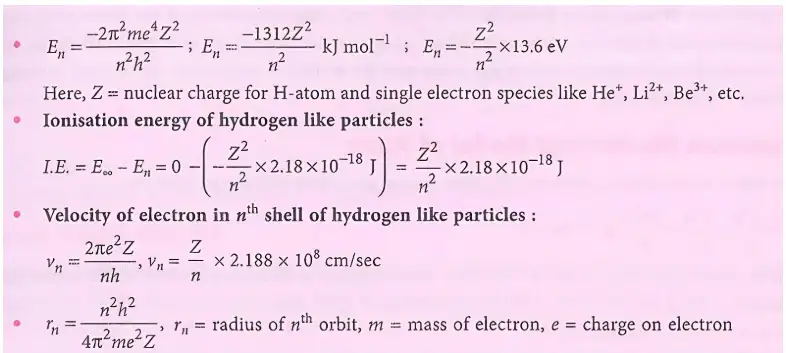
- Energy of nth orbit: En = –RH (Z2/n2) = –2.18×10⁻¹⁸ × Z2/n2 J.
- Radius of nth orbit for hydrogen: rn = 0.529 × n2 Å.
- For one-electron species with atomic number Z: rn = 0.529 × n2/Z Å.
Solved Examples
- Ex 1: Calculate the radius of the 3rd orbit of hydrogen.
- Use rn = 0.529 × n2 Å
- r3 = 0.529 × 32 = 0.529 × 9 = 4.761 Å
- Ex 2: Find the energy of the 2nd orbit of He+ (Z=2).
- En = –2.18×10⁻¹⁸ × Z2/n2 J
- E2 = –2.18×10–18 × 4 / 4 = –2.18×10⁻¹⁸ J
Practice Set
- Q1: What is the angular momentum of an electron in the 1st orbit?
- A) h/2π
- B) h
- C) 2h/2π
- D) 0
- Q2: The radius of the 4th orbit of hydrogen atom is:
- A) 0.529 Å
- B) 8.464 Å
- C) 4.236 Å
- D) 1.058 Å
- Q3: Energy difference between 2nd and 1st orbit of hydrogen is:
- A) hν
- B) 2hν
- C) h/2π
- D) Zero
Answer Key
- Q1: A) h/2π — Angular momentum is quantized as mvr = nh/2π, for n=1 it is h/2π.
- Q2: B) 8.464 Å — r4 = 0.529 × 42 = 0.529 × 16 = 8.464 Å.
- Q3: A) hν — Energy difference ΔE = hν corresponds to photon energy absorbed or emitted.
Memory Aids
- Angular momentum quantization: "n times h over 2π" (mvr = nh/2π).
- Radius scales as n squared: r ∝ n2.
- Energy levels are negative and inversely proportional to n squared: E ∝ –1/n2.
Rydberg Formula
Key Concepts
- Used to calculate wavelengths of spectral lines for hydrogen and hydrogen-like atoms.
- Formula: 1/λ = ν = R [1/n12 – 1/n22] Z2, where n2 > n1.
- R = 109,677 cm–1 (Rydberg constant).
- Z is atomic number (Z=1 for hydrogen).
Solved Examples
- Ex 1: Calculate wavelength of light emitted when electron falls from n=3 to n=2 in hydrogen.
- 1/λ = R [1/22 – 1/32] = 109,677 [1/4 – 1/9] cm–1
- 1/λ = 109,677 × (5/36) = 15,249 cm–1
- λ = 1 / 15,249 cm = 6.56 × 10⁻⁵ cm = 656 nm
Practice Set
- Q1: Rydberg constant R has units of:
- A) m
- B) cm–1
- C) s–1
- D) Hz
- Q2: For hydrogen, the wavelength of light emitted when electron falls from n=4 to n=2 is:
- A) 486 nm
- B) 434 nm
- C) 656 nm
- D) 121 nm
- Q3: In Rydberg formula, increasing Z will:
- A) Increase wavelength
- B) Decrease wavelength
- C) Not affect wavelength
- D) Double wavelength
Answer Key
- Q1: B) cm–1 — Rydberg constant is in reciprocal centimeters.
- Q2: A) 486 nm — Calculated using Rydberg formula for n=4 to n=2 transition.
- Q3: B) Decrease wavelength — Wavelength inversely proportional to Z2, so higher Z means shorter wavelength.
Memory Aids
- Remember Rydberg formula as difference of inverse squares of energy levels.
- Higher Z means stronger nuclear attraction, shorter wavelengths.
- Transitions to lower n emit light; from lower to higher n absorb light.
Limitations of Bohr's Theory
Key Points
- Fails to explain spectra of multi-electron atoms.
- Cannot describe electron distribution in atoms accurately.
- Does not explain splitting of spectral lines in magnetic (Zeeman effect) and electric fields (Stark effect).
- Ignores wave-particle duality and Heisenberg's uncertainty principle.
Solved Examples
- Ex 1: Why can't Bohr's model explain Zeeman effect?
- Because it treats electrons as particles in fixed orbits, ignoring magnetic interactions and electron spin.
Practice Set
- Q1: Bohr's model is applicable only to:
- A) Multi-electron atoms
- B) Hydrogen-like atoms
- C) Molecules
- D) Solids
- Q2: Which phenomenon is NOT explained by Bohr's model?
- A) Hydrogen emission spectrum
- B) Zeeman effect
- C) Ionization energy of hydrogen
- D) Radius of hydrogen orbit
- Q3: Bohr's model ignores:
- A) Electron charge
- B) Wave nature of electron
- C) Nuclear charge
- D) Energy quantization
Answer Key
- Q1: B) Hydrogen-like atoms — Bohr's model works well only for single-electron systems.
- Q2: B) Zeeman effect — Bohr's model cannot explain spectral line splitting in magnetic fields.
- Q3: B) Wave nature of electron — Bohr's model treats electrons as particles, ignoring wave properties.
Memory Aids
- Bohr's model = "Single electron, fixed orbits" only.
- Fails for multi-electron and magnetic/electric field effects.
- Wave-particle duality and uncertainty principle are beyond Bohr's scope.
Towards Quantum Mechanical Model of the Atom
Wave-particle duality and de Broglie’s equation
- Electrons exhibit dual nature: particle and wave.
- de Broglie equation: \( \lambda = \frac{h}{p} = \frac{h}{mv} \), where \( \lambda \) is wavelength, \( h \) Planck's constant, \( p \) momentum.
- Every moving object has wave properties; significant only for subatomic particles.
- Wavelength decreases with increasing mass; negligible for macroscopic objects.
- Alternate form: \( \lambda = \frac{h}{\sqrt{2mE_k}} = \frac{h}{\sqrt{2mqV}} \), where \( E_k \) is kinetic energy, \( q \) charge, \( V \) accelerating potential.
- de Broglie waves are intrinsic to electrons, not emitted into space.
Solved Examples
- Ex 1: Calculate wavelength of electron accelerated through 100 V.
- Given: \( V=100 \) V, \( q=1.6 \times 10^{-19} \) C, \( m=9.11 \times 10^{-31} \) kg, \( h=6.626 \times 10^{-34} \) Js.
- Use \( \lambda = \frac{h}{\sqrt{2mqV}} \).
- Calculate \( \lambda \approx 1.23 \times 10^{-10} \) m.
Practice Set
- Q1: What is the de Broglie wavelength of a particle with momentum \( 2 \times 10^{-24} \) kg·m/s?
- A) \( 3.31 \times 10^{-10} \) m
- B) \( 6.63 \times 10^{-34} \) m
- C) \( 1.32 \times 10^{-10} \) m
- D) \( 3.31 \times 10^{-24} \) m
- Q2: Which particle has the largest de Broglie wavelength?
- A) Electron
- B) Proton
- C) Neutron
- D) Macroscopic ball
- Q3: An electron is accelerated through a potential difference of 400 V. Calculate its de Broglie wavelength.
- A) 6.15 × 10⁻¹¹ m
- B) 1.23 × 10⁻¹⁰ m
- C) 3.10 × 10⁻¹⁰ m
- D) 2.45 × 10⁻¹⁰ m
Answer Key
- Q1: A) \( 3.31 \times 10^{-10} \) m — Using \( \lambda = \frac{h}{p} \), \( \lambda = \frac{6.63 \times 10^{-34}}{2 \times 10^{-24}} = 3.31 \times 10^{-10} \) m.
- Q2: A) Electron — Smaller mass means larger wavelength; macroscopic objects have negligible wavelength.
- Q3: A) 6.15 × 10⁻¹¹ m — Using \( \lambda = \frac{h}{\sqrt{2mqV}} \), substituting values for 400 V.
Memory Aids
- de Broglie wavelength inversely proportional to momentum.
- Wave nature significant only for tiny particles (electrons).
- Higher mass → smaller wavelength → negligible wave nature.
Heisenberg’s Uncertainty Principle
Principle and Explanation
- It is impossible to simultaneously know exact position (\( \Delta x \)) and momentum (\( \Delta p \)) of an electron.
- Mathematically: \( \Delta x \times \Delta p \geq \frac{h}{4\pi} \) or \( \Delta x \times m \Delta v \geq \frac{h}{4\pi} \).
- Uncertainty arises due to wave nature of particles.
- Rules out definite trajectories for electrons and similar particles.
- Significant only for microscopic particles; negligible for macroscopic objects.
Solved Examples
- Ex 1: Calculate minimum uncertainty in velocity if position uncertainty is \( 1 \times 10^{-10} \) m for an electron.
- Given: \( \Delta x = 1 \times 10^{-10} \) m, \( m = 9.11 \times 10^{-31} \) kg, \( h = 6.63 \times 10^{-34} \) Js.
- Use \( \Delta x \times m \Delta v \geq \frac{h}{4\pi} \) → \( \Delta v \geq \frac{h}{4\pi m \Delta x} \).
- Calculate \( \Delta v \approx 5.8 \times 10^{3} \) m/s.
Practice Set
- Q1: According to Heisenberg’s principle, if uncertainty in position decreases, uncertainty in momentum:
- A) Decreases
- B) Increases
- C) Remains same
- D) Becomes zero
- Q2: Which of the following is a consequence of the uncertainty principle?
- A) Electrons have fixed orbits
- B) Exact trajectory of electron cannot be determined
- C) Electron behaves only as a particle
- D) Momentum of electron is always zero
- Q3: If uncertainty in position of an electron is \( 2 \times 10^{-10} \) m, find minimum uncertainty in velocity.
- A) \( 2.9 \times 10^{3} \) m/s
- B) \( 5.8 \times 10^{3} \) m/s
- C) \( 1.16 \times 10^{4} \) m/s
- D) \( 1.45 \times 10^{3} \) m/s
Answer Key
- Q1: B) Increases — Position and momentum uncertainties are inversely related.
- Q2: B) Exact trajectory of electron cannot be determined — Uncertainty principle forbids definite paths.
- Q3: A) \( 2.9 \times 10^{3} \) m/s — Using \( \Delta v \geq \frac{h}{4\pi m \Delta x} \), substituting given values.
Memory Aids
- Uncertainty principle = no exact position & momentum simultaneously.
- Microscopic particles only; macroscopic objects unaffected.
- Inverse relation: \( \Delta x \times \Delta p \geq \frac{h}{4\pi} \).
Quantum Mechanical Model of Atom
Key Concepts
- Schrodinger wave equation: \( \frac{\partial^2 \psi}{\partial x^2} + \frac{\partial^2 \psi}{\partial y^2} + \frac{\partial^2 \psi}{\partial z^2} + \frac{8\pi^2 m}{h^2}(E - V)\psi = 0 \)
- \( \psi \) is the wave function; \( \psi^2 \) gives the probability density of finding an electron in a small volume.
- Atomic orbital: 3D region around nucleus with maximum probability of electron presence.
- Energy of electrons is quantized due to wave nature and solutions of Schrodinger equation.
- Heisenberg uncertainty principle: exact position and velocity of electron cannot be known simultaneously.
- Probability density \( \psi^2 \) is always positive and proportional to electron presence likelihood.
Solved Examples
Ex 1: Write the Schrodinger wave equation for an electron in an atom.
Answer: \( \frac{\partial^2 \psi}{\partial x^2} + \frac{\partial^2 \psi}{\partial y^2} + \frac{\partial^2 \psi}{\partial z^2} + \frac{8\pi^2 m}{h^2}(E - V)\psi = 0 \)
Practice Set
Q1: What does \( \psi^2 \) represent in the quantum mechanical model?
- A) Electron velocity
- B) Electron position
- C) Probability density of electron presence
- D) Energy of electron
Q2: Which principle states that exact position and velocity of an electron cannot be known simultaneously?
- A) Pauli exclusion principle
- B) Heisenberg uncertainty principle
- C) Aufbau principle
- D) Hund’s rule
Q3: An atomic orbital is defined as:
- A) A 2D region around nucleus
- B) A 3D region with maximum electron probability
- C) The exact path of electron
- D) The energy level of electron
Answer Key
Q1: C) Probability density of electron presence — \( \psi^2 \) gives electron probability.
Q2: B) Heisenberg uncertainty principle — limits simultaneous knowledge of position and velocity.
Q3: B) A 3D region with maximum electron probability — definition of atomic orbital.
Memory Aids
- \( \psi^2 \) = Probability density, not physical wave.
- Heisenberg = Uncertainty in position & velocity.
- Atomic orbital = 3D electron cloud region.
Quantum Numbers
Key Concepts
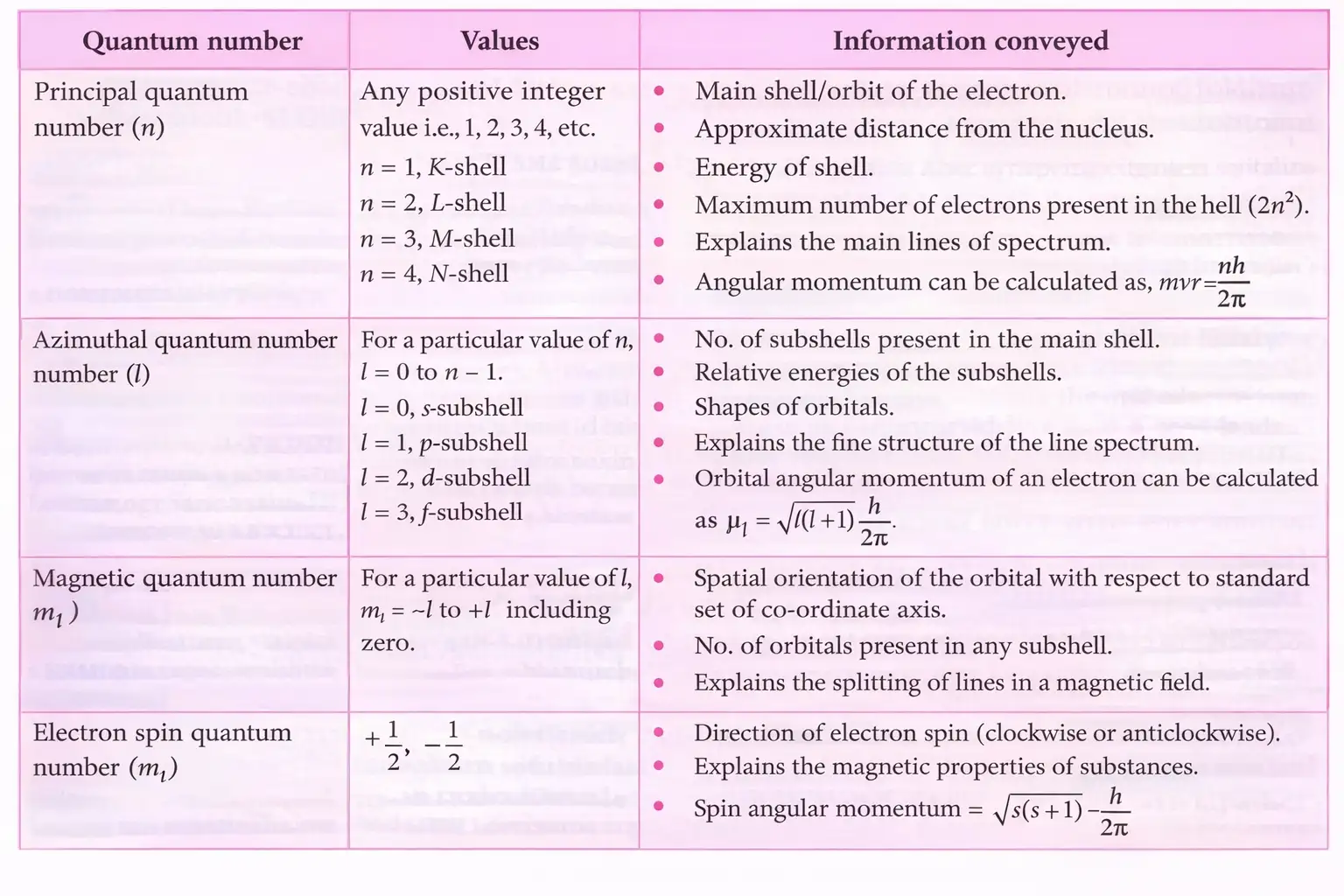
- Four quantum numbers describe electron state completely: Principal (n), Azimuthal (l), Magnetic (ml), Spin (ms).
- Principal quantum number (n): shell number, energy level, distance from nucleus.
- Azimuthal quantum number (l): subshell shape (0 to n-1), defines s, p, d, f orbitals.
- Magnetic quantum number (ml): orientation of orbital, values from -l to +l.
- Spin quantum number (ms): electron spin, +1/2 or -1/2.
- Number of subshells in nth shell = n; orbitals = n2; max electrons = 2n2.
- Orbitals per subshell = 2l + 1; max electrons per subshell = 2(2l + 1).
Solved Examples
Ex 1: For n=3, what are possible values of l?
Answer: l = 0, 1, 2 (s, p, d subshells)
Practice Set
Q1: What is the maximum number of electrons in the 2nd shell (n=2)?
- A) 2
- B) 8
- C) 18
- D) 32
Q2: The magnetic quantum number ml for l=2 can have how many values?
- A) 3
- B) 5
- C) 7
- D) 9
Q3: What is the spin quantum number of an electron?
- A) 0
- B) +1 or -1
- C) +1/2 or -1/2
- D) 1/3 or -1/3
Answer Key
Q1: B) 8 — max electrons = 2n2 = 8 for n=2.
Q2: B) 5 — ml values = -2, -1, 0, +1, +2.
Q3: C) +1/2 or -1/2 — electron spin quantum numbers.
Memory Aids
- n = shell number; l = subshell shape (0=s,1=p,2=d,3=f).
- ml ranges from -l to +l.
- ms = spin up/down (+1/2 or -1/2).
Shapes of Atomic Orbitals
Key Concepts
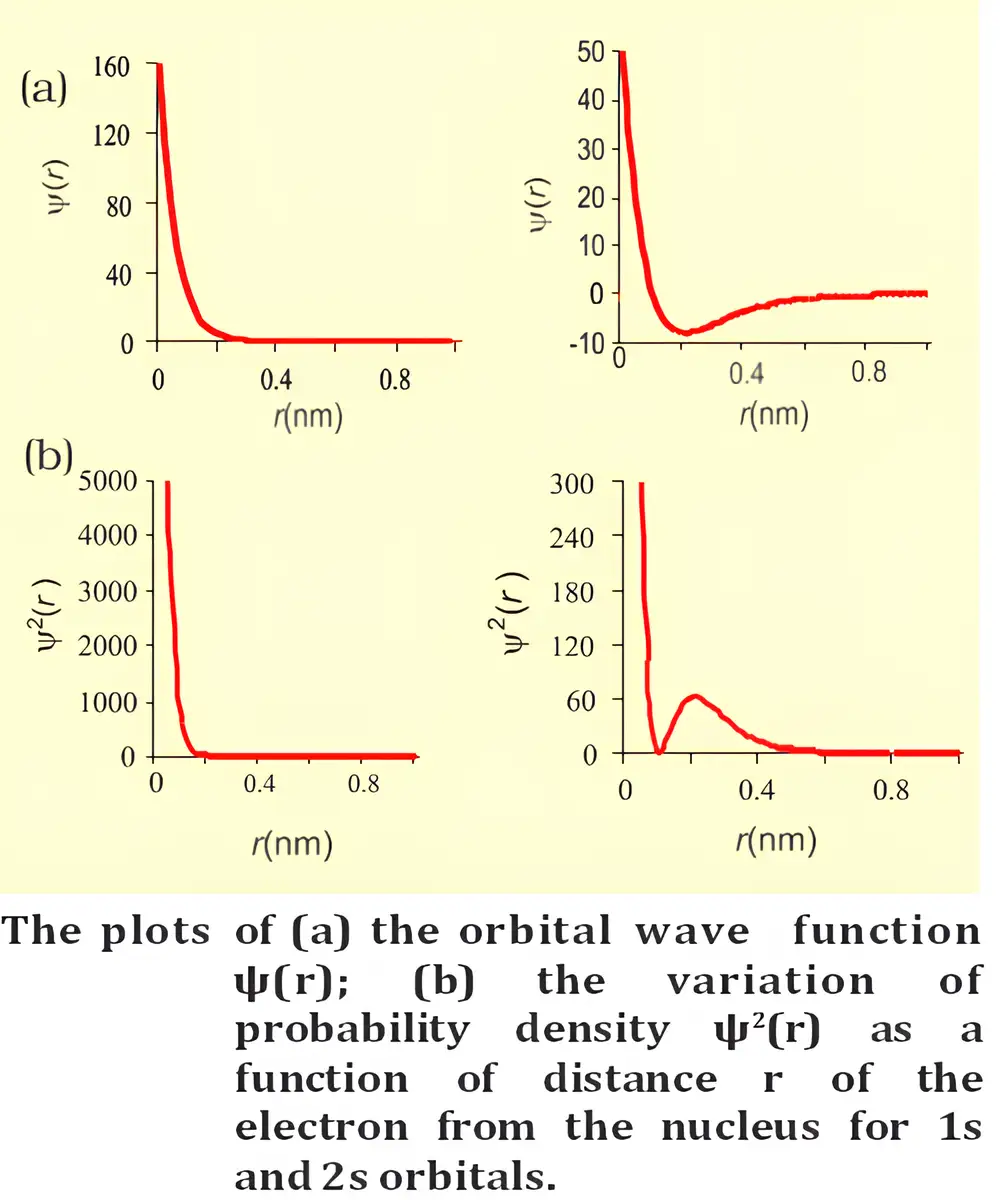
- Orbital shape determined by total probability density \( \psi^2 \) (radial + angular parts).
- 1s orbital: spherical shape; max probability at nucleus, decreases outward.
- 2s orbital: spherical with radial node (nodal surface where probability = 0).
- Number of radial nodes = n - l - 1; angular nodes = l; total nodes = n - 1.
- p orbitals: dumbbell-shaped with one nodal plane; px, py, pz oriented along axes.
- d orbitals: cloverleaf shape except dz2 (doughnut shape); each has two nodal planes.
Solved Examples
Ex 1: Calculate radial nodes for 3p orbital.
Answer: n=3, l=1; radial nodes = 3 - 1 - 1 = 1
Practice Set
Q1: What is the shape of an s orbital?
- A) Dumbbell
- B) Spherical
- C) Cloverleaf
- D) Doughnut
Q2: How many nodal planes does a p orbital have?
- A) 0
- B) 1
- C) 2
- D) 3
Q3: For d orbitals, how many nodal planes are present?
- A) 1
- B) 2
- C) 3
- D) 4
Answer Key
Q1: B) Spherical — s orbitals are spherical.
Q2: B) 1 — p orbitals have one nodal plane.
Q3: B) 2 — d orbitals have two nodal planes.
Memory Aids
- s = spherical; p = dumbbell; d = cloverleaf.
- Nodes = n - 1 total; radial = n - l - 1; angular = l.
- More nodes = higher energy orbital.
Energy of Orbitals
Key Concepts
- In hydrogen atom, energy depends only on principal quantum number (n).
- Energy order: 1s < 2s < 2p < 3s < 3p < 4s < 3d < 4p < 5s < 4d < 5p < 6s < 4f < ...
- Orbitals with same energy are degenerate.
- Ground state: electron in 1s orbital; excited state: electron in higher orbitals.
- In multi-electron atoms, energy depends on n and l.
- Lower (n + l) value means lower energy; if equal, lower n means lower energy.
- Energy decreases with increasing effective nuclear charge (Zeff).
Solved Examples
Ex 1: Which orbital has lower energy: 3p or 4s?
Answer: 4s has lower energy than 3p due to (n + l) rule.
Practice Set
Q1: Which orbital is lowest in energy in hydrogen atom?
- A) 2s
- B) 1s
- C) 3p
- D) 2p
Q2: For multi-electron atoms, which orbital has lower energy?
- A) 3d
- B) 4s
- C) 4p
- D) 3p
Q3: What is the energy order of orbitals with same (n + l) value?
- A) Higher n lower energy
- B) Lower n lower energy
- C) Same energy
- D) Depends on spin
Answer Key
Q1: B) 1s — lowest energy orbital in hydrogen.
Q2: B) 4s — lower energy than 3d due to (n + l) rule.
Q3: B) Lower n lower energy — if (n + l) equal, lower n is lower energy.
Memory Aids
- Use (n + l) rule to compare orbital energies.
- Degenerate orbitals have same energy in hydrogen.
- Ground state = lowest energy orbital occupied.
Filling of Orbitals in Atom
Key Concepts
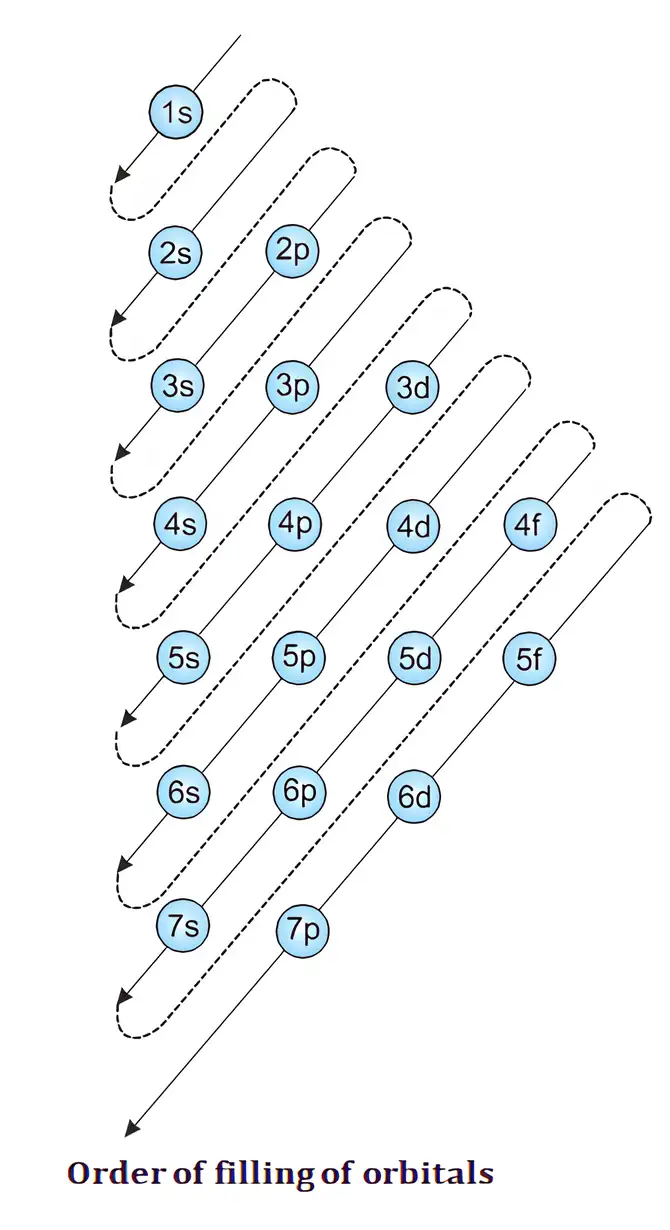
- Aufbau principle: orbitals filled in order of increasing energy (1s, 2s, 2p, 3s, 3p, 4s, 3d, ...).
- Pauli exclusion principle: no two electrons have same set of four quantum numbers; max two electrons per orbital with opposite spins.
- Hund’s rule: electrons fill degenerate orbitals singly first with parallel spins before pairing.
Solved Examples
Ex 1: Write the order of filling orbitals up to 4p.
Answer: 1s < 2s < 2p < 3s < 3p < 4s < 3d < 4p
Practice Set
Q1: According to Pauli exclusion principle, maximum electrons in one orbital are:
- A) 1
- B) 2 with same spin
- C) 2 with opposite spin
- D) 3
Q2: Hund’s rule states that electrons in degenerate orbitals:
- A) Pair immediately
- B) Fill singly with parallel spins first
- C) Fill randomly
- D) Have opposite spins
Q3: Which orbital fills after 4s?
- A) 3d
- B) 4p
- C) 5s
- D) 3p
Answer Key
Q1: C) 2 with opposite spin — Pauli principle.
Q2: B) Fill singly with parallel spins first — Hund’s rule.
Q3: A) 3d — after 4s, 3d fills.
Memory Aids
- Aufbau: fill lowest energy orbitals first.
- Pauli: max 2 electrons per orbital, opposite spins.
- Hund: single occupancy before pairing.
Electronic Configuration of Atoms
Key Concepts
- Electronic configuration: distribution of electrons in orbitals following filling rules.
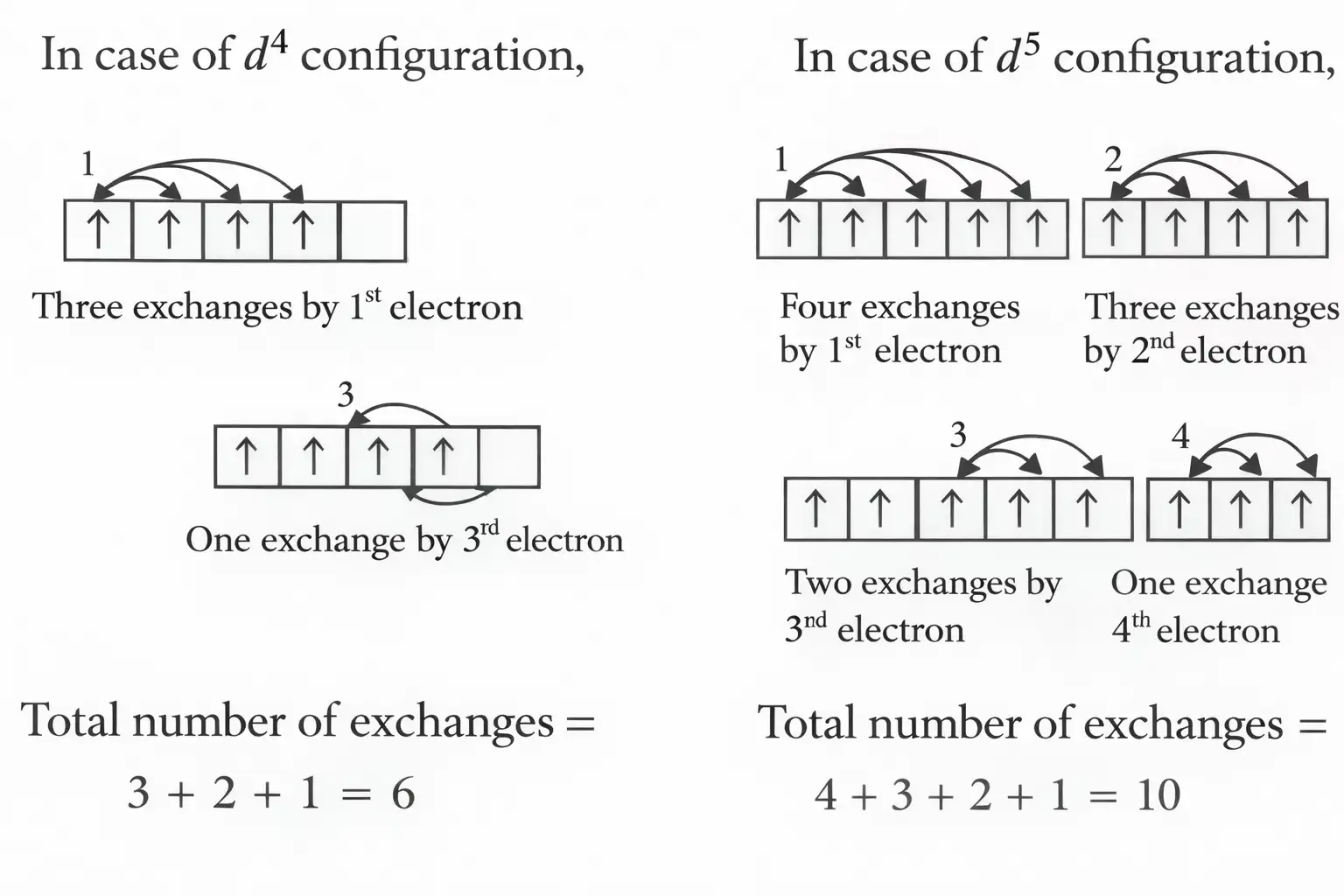
- Half-filled and fully-filled orbitals are more stable due to symmetry and exchange energy.
- Exchange energy arises from electron position exchanges in same subshell, increasing stability.
- Maximum exchange energy in d5 and d10 configurations leads to exceptional stability.
Solved Examples
Ex 1: Why is d5 configuration more stable than d4?
Answer: d5 has more exchange interactions (10) than d4 (6), increasing stability.
Practice Set
Q1: What causes extra stability in half-filled orbitals?
- A) Symmetry
- B) Exchange energy
- C) Both A and B
- D) None
Q2: Which configuration has maximum exchange energy?
- A) d4
- B) d5
- C) d6
- D) d3
Q3: Exchange energy results from:
- A) Electron spin pairing
- B) Electron position exchanges in orbitals
- C) Electron excitation
- D) Nuclear charge
Answer Key
Q1: C) Both A and B — symmetry and exchange energy stabilize.
Q2: B) d5 — maximum exchange interactions.
Q3: B) Electron position exchanges in orbitals — defines exchange energy.
Memory Aids
- Half-filled = max exchange energy = max stability.
- Symmetry enhances stability.
- d5 and d10 are special stable configs.
NEET Chemistry — ALL CHAPTERS
1
Some Basic Concepts of Chemistry
2
Structure of Atom
3
Classification of Elements and Periodicity in Properties
4
Chemical Bonding and Molecular Structure
5
Thermodynamics
6
Equilibrium
7
Redox Reactions
8
Organic Chemistry - Some Basic Principles and Techniques
9
Hydrocarbons
10
Solutions
11
Electrochemistry
12
Chemical Kinetics
13
The d- and f- Block Elements
14
Coordination Compounds
15
Haloalkanes and Haloarenes
16
Alcohols, Phenols and Ethers
17
Aldehydes, Ketones and Carboxylic Acids
18
Amines
19
Biomolecules
20
The p-Block Elements (Group 13 and 14)
21
The p-Block Elements (Group 15 to 18)
22
Principles Related to Practical Chemistry