NEET Ug . NEET Chemistry . Chemistry . Organic Chemistry Some Basic Principles and Techniques
Chapter 8: Organic Chemistry - Some Basic Principles and Techniques
Ch 8
NEET Chemistry
NEET Ug
Organic Chemistry Introduction
Definition and Scope
Study of hydrocarbons and their derivatives.
Includes compounds with C, H, and elements like N, O, S, P, halogens.
Originally thought to require a 'vital force' for formation (Berzelius).
Historical Significance
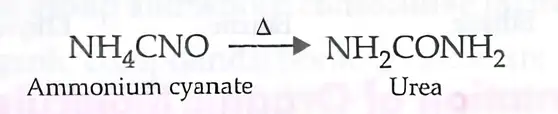
Friedrich Wöhler synthesized urea (organic) from ammonium cyanate (inorganic), disproving vitalism.
Kolbe synthesized acetic acid; Berthelot synthesized methane from inorganic sources.
Solved Examples
Ex 1: Conversion of ammonium cyanate to urea by heating.
Step 1: NH4CNO (ammonium cyanate) heated (Δ).
Step 2: Rearrangement occurs.
Step 3: Product formed is NH2CONH2 (urea).
Practice Set
Q1: What elements are primarily studied in organic chemistry?
A. Metals and non-metals
B. Carbon and hydrogen
C. Noble gases
D. Alkali metalsQ2: Who disproved the 'vital force' theory by synthesizing urea?
A. Kolbe
B. Berthelot
C. Wöhler
D. BerzeliusQ3: Which of the following reactions represents synthesis of an organic compound from inorganic sources?
A. NH4CNO → NH2CONH2
B. CH4 + 2O2 → CO2 + 2H2O
C. C2H5OH + O2 → CH3CHO + H2O
D. C6H12O6 → 2C2H5OH + 2CO2
Answer Key
Q1: B - Organic chemistry focuses on carbon and hydrogen compounds.
Q2: C - Wöhler synthesized urea from ammonium cyanate, disproving vitalism.
Q3: A - Conversion of ammonium cyanate (inorganic) to urea (organic) is synthesis from inorganic sources.
Memory Aids
"Organic = Carbon + Hydrogen" as a basic rule.
Wöhler’s urea synthesis = "Vital force" myth broken.
Kolbe and Berthelot = Lab synthesis of organic acids and methane.
Tetravalence of Carbon: Shapes of Organic Compounds
Hybridisation and Molecular Shapes
Carbon forms bonds using hybrid orbitals combining s and p orbitals.
Three common hybridisations: sp, sp2, sp3.
Shapes depend on hybridisation: linear (sp), trigonal planar (sp2), tetrahedral (sp3).
Bond angles: 180° (sp), 120° (sp2), 109.5° (sp3).
Percentage of s and p character varies: sp (50% s, 50% p), sp2 (33% s, 67% p), sp3 (25% s, 75% p).
Examples: Ethyne (sp), Ethene (sp2), Ethane (sp3).

Solved Examples
Ex 1: Identify the hybridisation of carbon in ethene (C2H4).
Carbon forms double bond → sp2 hybridisation.
Geometry: trigonal planar, bond angle ~120°.
Practice Set
Q1: What is the bond angle in methane (CH4)?
A) 180°
B) 120°
C) 109.5°
D) 90°
Q2: Which hybridisation corresponds to a linear shape?
A) sp3
B) sp2
C) sp
D) dsp2
Q3: In which molecule is carbon sp3 hybridised?
A) Ethyne (C2H2)
B) Ethene (C2H4)
C) Ethane (C2H6)
D) Benzene (C6H6)
Answer Key
Q1: C) 109.5° - Methane has sp3 hybridisation with tetrahedral geometry.
Q2: C) sp - sp hybridisation leads to linear shape with 180° bond angle.
Q3: C) Ethane - Carbon is sp3 hybridised in ethane with single bonds.
Memory Aids
"sp" = 2 groups, linear, 180°.
"sp2" = 3 groups, trigonal planar, 120°.
"sp3" = 4 groups, tetrahedral, 109.5°.
More s character → shorter, stronger bonds.
Characteristic Features of π Bonds
Properties of π Bonds
Formed by lateral (sideways) overlap of p orbitals.
Electron density lies above and below the internuclear axis.
Contains a nodal plane along the internuclear axis with zero electron density.
Weaker than σ bonds; formed only after σ bond formation.
No free rotation around π bonds, causing rigidity.
More reactive than σ bonds; reactive centers in multiple bonds.
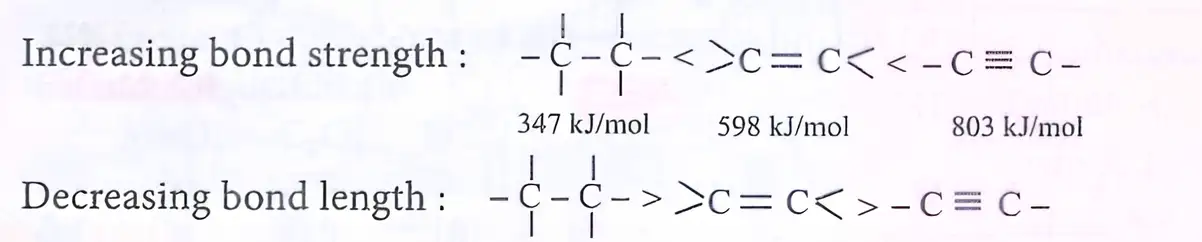
Bond multiplicity increases bond strength and decreases bond length.
Solved Examples
Ex 1: Compare bond strength and length in C–C single, double, and triple bonds.
Single bond: 347 kJ/mol, longest length.
Double bond: 598 kJ/mol, shorter length.
Triple bond: 803 kJ/mol, shortest length.
Practice Set
Q1: π bonds are formed by:
A) Head-on overlap of orbitals
B) Lateral overlap of orbitals
C) Ionic bonding
D) Hydrogen bonding
Q2: Which statement is true about π bonds?
A) They allow free rotation around the bond.
B) They are stronger than σ bonds.
C) They have electron density above and below the bond axis.
D) They form before σ bonds.
Q3: Arrange the following bonds in order of increasing bond strength: C–C, C=C, C≡C.
A) C≡C < C=C < C–C
B) C–C < C=C < C≡C
C) C=C < C–C < C≡C
D) C–C = C=C = C≡C
Answer Key
Q1: B) Lateral overlap - π bonds form by sideways overlap of p orbitals.
Q2: C) Electron density above and below bond axis - characteristic of π bonds.
Q3: B) C–C < C=C < C≡C - bond strength increases with bond multiplicity.
Memory Aids
π = sideways overlap, electron cloud above/below bond.
σ bond forms first, then π bond(s) add to increase bond order.
No rotation around π bonds → rigidity in double/triple bonds.
More bonds → stronger and shorter bond length.
Complete, Condensed and Bond-line Structural Formulas
Structural Formulas Explained
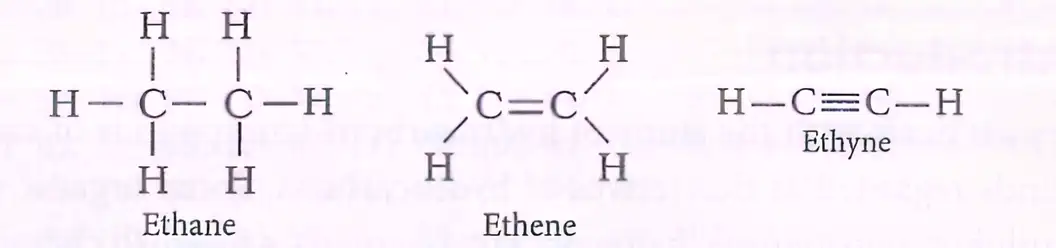
Complete Structural Formulas: Show all atoms and bonds explicitly (e.g., ethane C2H6 with all C–H and C–C bonds).
Condensed Structural Formulas: Bonds are omitted; groups are written together with subscripts (e.g., ethane as CH3CH3).
Bond-line Formulas: Carbon atoms are implied at line ends and bends; hydrogens on carbons are omitted for simplicity.
Ethane has single C–C bond; ethene has double C=C bond; ethyne has triple C≡C bond.
Bond type affects molecular shape and chemical reactivity.

Solved Examples
Ex 1: Write the condensed formula for ethene.
Solution: Ethene has a double bond between two carbons; condensed formula is H2C=CH2.Ex 2: Identify the bond type in ethyne.
Solution: Ethyne has a triple bond between two carbons; formula HC≡CH.
Practice Set
Q1: Which formula shows all bonds explicitly?
A) Condensed formula
B) Complete structural formula
C) Bond-line formula
D) Empirical formulaQ2: What type of bond is present between carbons in ethene?
A) Single bond
B) Double bond
C) Triple bond
D) Ionic bondQ3: Which condensed formula represents ethane?
A) CH3CH3
B) H2C=CH2
C) HC≡CH
D) C2H4
Answer Key
Q1: B - Complete structural formulas show all atoms and bonds explicitly.
Q2: B - Ethene contains a double bond between carbon atoms.
Q3: A - CH3CH3 is the condensed formula for ethane.
Memory Aids
Complete formula = all bonds shown.
Condensed formula = groups written together, no bonds.
Bond-line = zig-zag lines, carbons implied.
Ethane (single), Ethene (double), Ethyne (triple) bonds.
Three-Dimensional Representation of Organic Molecules
3D Molecular Representation
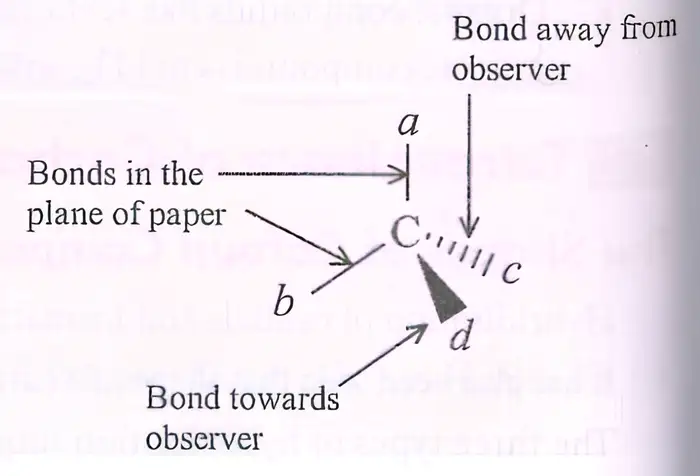
Solid wedge (▲): Bond projecting out of the plane towards the observer.
Dashed wedge (---): Bond projecting behind the plane away from the observer.
Normal line: Bond lying in the plane of the paper.
Used to depict tetrahedral molecules with four different groups attached to a central atom.
Helps visualize spatial arrangement critical for stereochemistry.
Solved Examples
Ex 1: Identify the bond type shown by a solid wedge.
Solution: Bond coming out of the plane towards the observer.Ex 2: What does a dashed wedge represent?
Solution: Bond going behind the plane away from the observer.
Practice Set
Q1: Which symbol represents a bond coming out of the plane?
A) Dashed wedge
B) Solid wedge
C) Normal line
D) Double lineQ2: In 3D representation, bonds in the plane are shown by:
A) Solid wedge
B) Dashed wedge
C) Normal line
D) Dotted lineQ3: Which representation helps in understanding stereochemistry?
A) Condensed formula
B) Bond-line formula
C) Wedge-dash formula
D) Empirical formula
Answer Key
Q1: B - Solid wedge shows bond coming out of the plane.
Q2: C - Normal lines represent bonds in the plane.
Q3: C - Wedge-dash formula shows 3D arrangement, important for stereochemistry.
Memory Aids
Solid wedge = towards you.
Dashed wedge = away from you.
Normal line = in the plane.
Use wedge-dash to visualize 3D shapes and chirality.
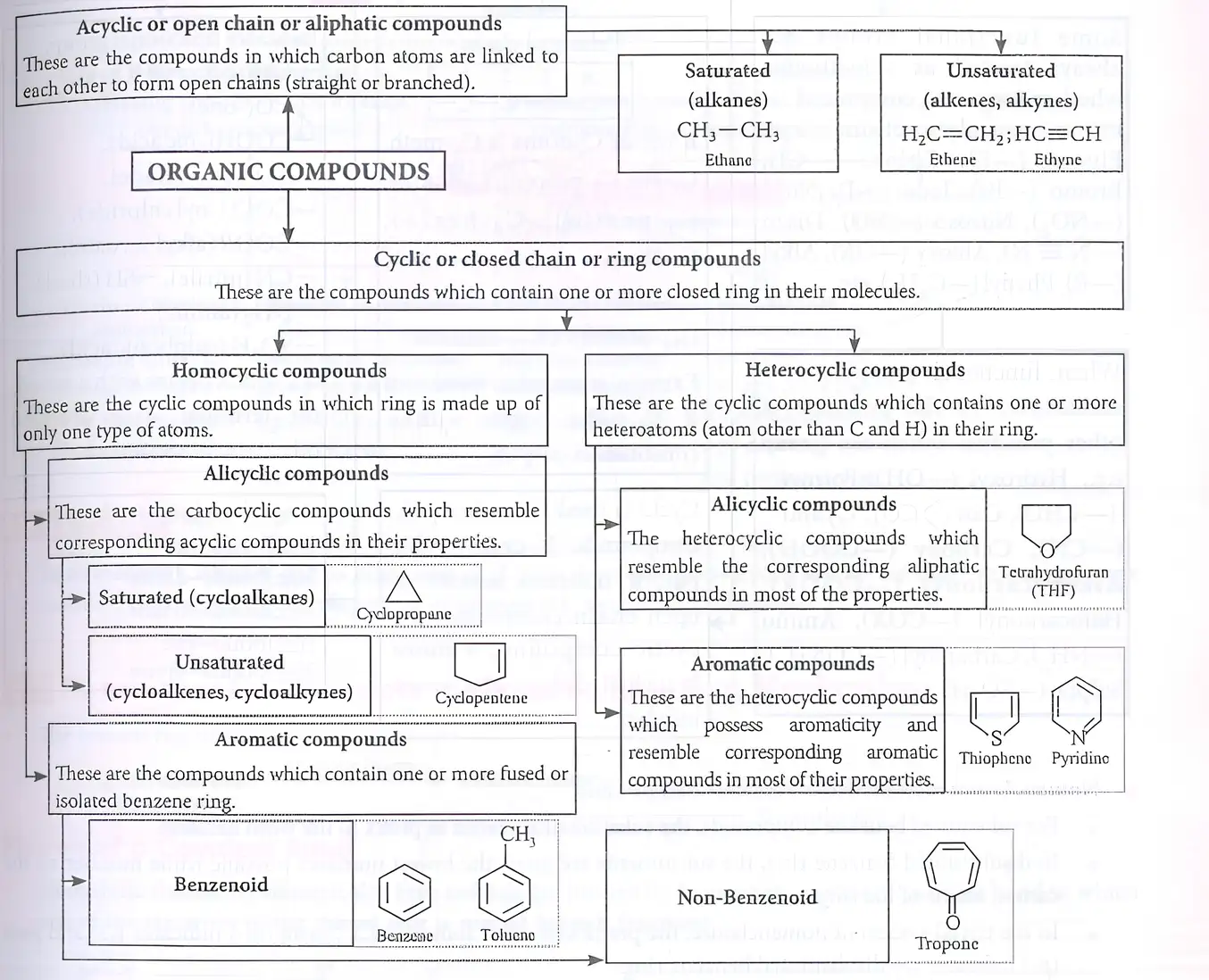
Classification of Organic Compounds
Overview
Organic compounds contain carbon atoms bonded together.
Divided into two main types based on carbon chain structure:
Acyclic (open chain): Straight or branched carbon chains.
Cyclic (closed ring): Carbon atoms form rings.
Acyclic compounds:
Saturated (alkanes): Only single bonds, e.g., ethane.
Unsaturated (alkenes, alkynes): Contain double or triple bonds, e.g., ethene, ethyne.
Cyclic compounds:
Homocyclic: Rings made of one type of atom (usually carbon).
Alicyclic: Non-aromatic rings, e.g., cyclopropane.
Aromatic: Contain benzene rings, e.g., benzene, toluene.
Heterocyclic: Rings contain atoms other than carbon.
Alicyclic heterocyclic: Non-aromatic heteroatom rings, e.g., tetrahydrofuran.
Aromatic heterocyclic: Aromatic rings with heteroatoms, e.g., thiophene, pyridine.
Aromatic compounds:
Benzenoid: Contain benzene rings.
Non-benzenoid: Aromatic but no benzene ring, e.g., tropone.
Solved Examples
Ex 1: Classify cyclohexane.
Cyclohexane is a cyclic compound.
Ring contains only carbon atoms → homocyclic.
Non-aromatic ring → alicyclic.
Ex 2: Identify the class of pyridine.
Pyridine is cyclic with nitrogen atom in ring → heterocyclic.
Has aromaticity → aromatic heterocyclic.
Practice Set
Q1: Which of the following is an acyclic saturated compound?
A. Ethene
B. Ethane
C. Benzene
D. Cyclopropane
Q2: Which compound is an aromatic heterocyclic?
A. Cyclohexane
B. Pyridine
C. Tetrahydrofuran
D. Ethyne
Q3: Identify the non-benzenoid aromatic compound.
A. Benzene
B. Toluene
C. Tropone
D. Cyclopropane
Answer Key
Q1: B - Ethane is an acyclic saturated hydrocarbon (alkane).
Q2: B - Pyridine is an aromatic heterocyclic compound with nitrogen in the ring.
Q3: C - Tropone is aromatic but does not contain a benzene ring (non-benzenoid).
Memory Aids
"Acyclic" = open chain; "Cyclic" = ring structures.
Homocyclic = only carbon atoms in ring; Heterocyclic = ring contains heteroatoms.
Aromatic rings: benzene (benzenoid) or others (non-benzenoid).
Remember: Aliphatic = acyclic or alicyclic non-aromatic.
Functional Group
Definition and Importance
Functional group: Specific atom/group responsible for characteristic chemical properties.
Determines reactivity and chemical behavior of organic compounds.
Common examples:
Hydroxyl group (-OH)
Aldehyde group (-CHO)
Carboxylic acid group (-COOH)
Solved Examples
Ex 1: Identify the functional group in ethanol (C2H5OH).
Contains -OH group → hydroxyl functional group.
Ex 2: Functional group in acetaldehyde (CH3CHO).
Contains -CHO group → aldehyde functional group.
Practice Set
Q1: Which functional group is present in carboxylic acids?
A. -OH
B. -CHO
C. -COOH
D. -NH2
Q2: The functional group -CHO is characteristic of which class?
A. Alcohols
B. Aldehydes
C. Ketones
D. Carboxylic acids
Q3: Which functional group is responsible for the acidic nature of organic acids?
A. -OH
B. -COOH
C. -CHO
D. -NH2
Answer Key
Q1: C - Carboxylic acids contain the -COOH group.
Q2: B - Aldehydes have the -CHO functional group.
Q3: B - The -COOH group imparts acidic properties.
Memory Aids
"-OH" = alcohols; "-CHO" = aldehydes; "-COOH" = acids.
Functional groups define chemical reactivity and naming.
Homologous Series
Definition and Characteristics
Family of organic compounds with same functional group.
Consecutive members differ by a -CH2- unit.
Members show gradual change in physical properties.
Examples include:
Alkanes (CnH2n+2)
Alkenes (CnH2n)
Alkynes (CnH2n-2)
Haloalkanes, alkanols, alkanals, alkanones, alkanoic acids, amines, etc.
Solved Examples
Ex 1: Identify the next member after propane in alkane series.
Propane (C3H8), next member adds -CH2 → butane (C4H10).
Ex 2: Difference in molecular formula between consecutive alkenes.
Difference is -CH2 unit, e.g., ethene (C2H4) to propene (C3H6).
Practice Set
Q1: Members of a homologous series differ by:
A. -OH group
B. -CH2- unit
C. Double bond
D. Ring size
Q2: Which of the following is NOT a homologous series?
A. Alkanes
B. Alkenes
C. Alcohols
D. Aromatic compounds
Q3: What is the molecular formula of the 5th member of alkane series?
A. C5H12
B. C5H10
C. C5H8
D. C4H10
Answer Key
Q1: B - Consecutive members differ by a -CH2- unit.
Q2: D - Aromatic compounds do not form a homologous series.
Q3: A - Pentane (5th alkane) is C5H12.
Memory Aids
Homologous series: same functional group, differ by -CH2-.
Alkanes: CnH2n+2, Alkenes: CnH2n.
Nomenclature of Organic Compounds
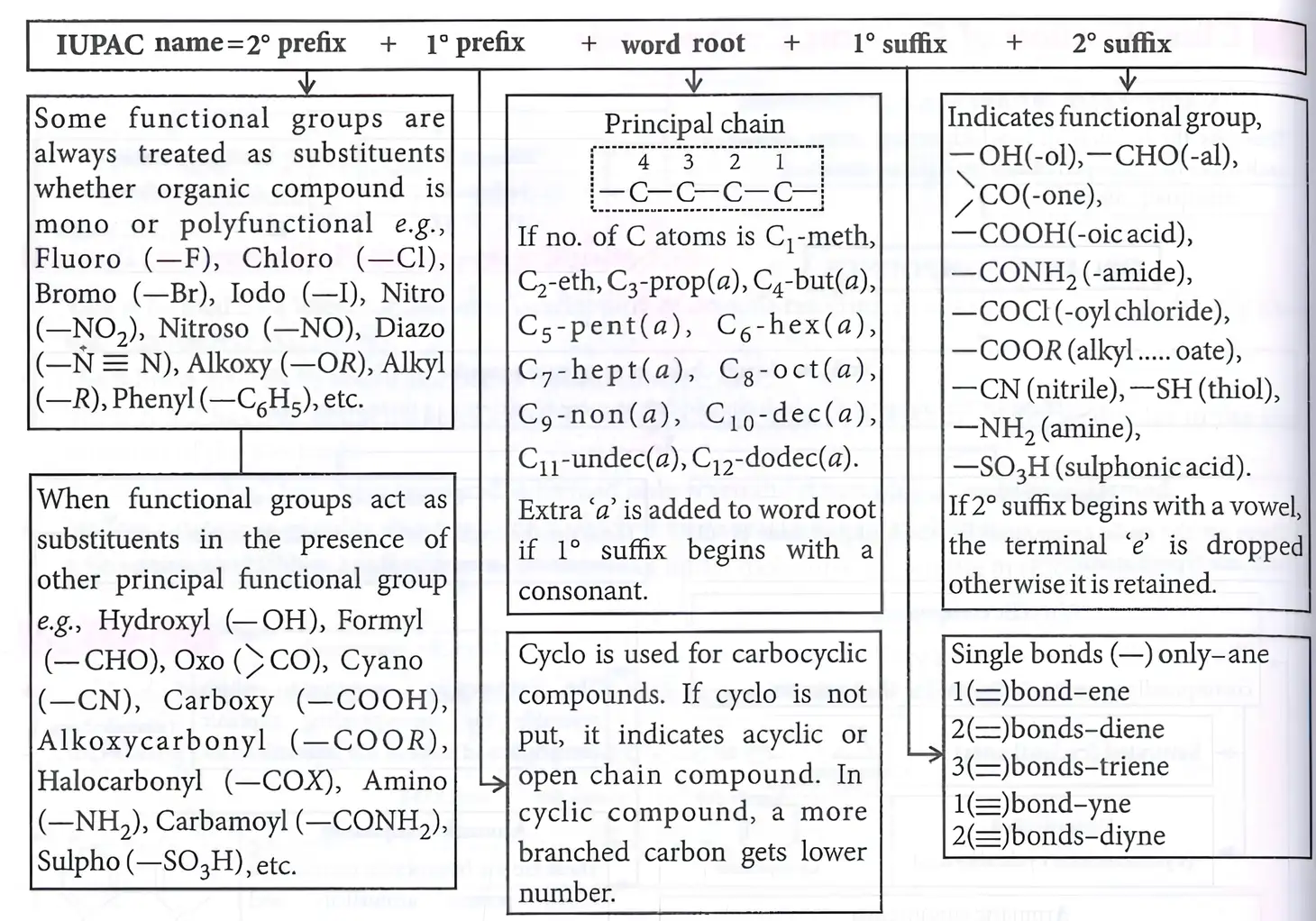
Basic Structure of IUPAC Names
Complete IUPAC name = Secondary prefix + Primary prefix + Word root + Primary suffix + Secondary suffix
Word root indicates the longest carbon chain (meth-, eth-, prop-, etc.)
Primary suffix shows main functional group (-ol, -al, -one, etc.)
Secondary suffix indicates additional functional groups
Prefixes denote substituents or multiple bonds (fluoro-, chloro-, cyclo-, -ene, -yne)
Functional Group Priority
Principal functional group chosen by priority order (highest to lowest): COOH > SO3H > COOR > COCl > CONH2 > CN > HC=O > C=O > OH > NH2 > C=C
Highest priority group determines suffix; others become prefixes

Rules for Naming
Identify principal chain and functional groups
Number chain to give principal group lowest number
Use "cyclo" prefix for rings
Attach suffix for main functional group
Add secondary suffixes for other groups, dropping 'e' if vowel follows
Indicate multiple bonds with -ane, -ene, -yne and position numbers
Combine all parts in order: secondary prefix + primary prefix + word root + primary suffix + secondary suffix
Solved Examples
Ex 1: Name CH3-CH=CH-CH2-OH
Longest chain: 4 carbons (but-)
Double bond at C2 (-ene)
OH group (-ol) as suffix
Name: But-2-en-1-ol
Ex 2: Name cyclohexanol
Ring: cyclohexane
OH group suffix: -ol
Name: Cyclohexanol
Practice Set
Q1: What is the correct IUPAC name for CH3-CH2-COOH?
A. Propanoic acid
B. Propanal
C. Propanone
D. Propanol
Q2: Which suffix indicates a ketone group?
A. -al
B. -one
C. -ol
D. -ene
Q3: Name the compound: CH2=CH-CH2-OH
A. Prop-2-en-1-ol
B. Prop-1-en-3-ol
C. Prop-1-en-2-ol
D. Prop-3-en-1-ol
Answer Key
Q1: A. Propanoic acid — COOH group suffix is -oic acid
Q2: B. -one — suffix for ketones
Q3: A. Prop-2-en-1-ol — double bond at C2, OH at C1
Memory Aids
Priority order: Acid > Ester > Aldehyde > Ketone > Alcohol > Amine
Suffixes: -oic acid (acid), -al (aldehyde), -one (ketone), -ol (alcohol)
Use "cyclo" for rings
Number chain to give lowest number to highest priority group
Nomenclature of Substituted Benzene Compounds
Basic Rules
Substituents are prefixes to "benzene"
Number ring carbons to give substituents lowest possible numbers
For disubstituted benzenes, use ortho (1,2-), meta (1,3-), para (1,4-) prefixes
For tri- or more substituted benzenes, assign 1 to base substituent and number others by lowest locant rule
Benzene ring acts as substituent (phenyl, Ph-) when attached to alkane with functional group
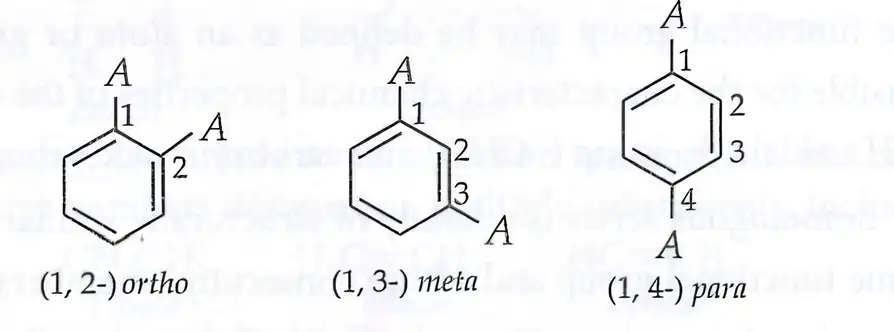
Substitution Positions
Ortho (o-) = 1,2- positions (adjacent)
Meta (m-) = 1,3- positions (separated by one carbon)
Para (p-) = 1,4- positions (opposite)
Solved Examples
Ex 1: Name C6H4Cl2 with substituents on carbons 1 and 3
Positions 1 and 3 = meta
Name: m-Dichlorobenzene
Ex 2: Name benzene with methyl and nitro groups at 1 and 4
Positions 1 and 4 = para
Name: p-Nitrotoluene
Practice Set
Q1: What is the correct name for benzene with two bromine atoms at positions 1 and 2?
A. o-Dibromobenzene
B. m-Dibromobenzene
C. p-Dibromobenzene
D. 1,3-Dibromobenzene
Q2: Which prefix indicates substituents at 1,3-positions on benzene?
A. ortho
B. meta
C. para
D. peri
Q3: Name the compound with methyl at 1 and nitro at 3 on benzene ring
A. m-Nitrotoluene
B. p-Nitrotoluene
C. o-Nitrotoluene
D. Nitrobenzene
Answer Key
Q1: A. o-Dibromobenzene — 1,2- positions are ortho
Q2: B. meta — 1,3- positions
Q3: A. m-Nitrotoluene — methyl at 1, nitro at 3
Memory Aids
Ortho = adjacent (1,2-)
Meta = separated by one carbon (1,3-)
Para = opposite (1,4-)
Use lowest locant rule for numbering substituents
Phenyl (Ph-) = benzene ring as substituent
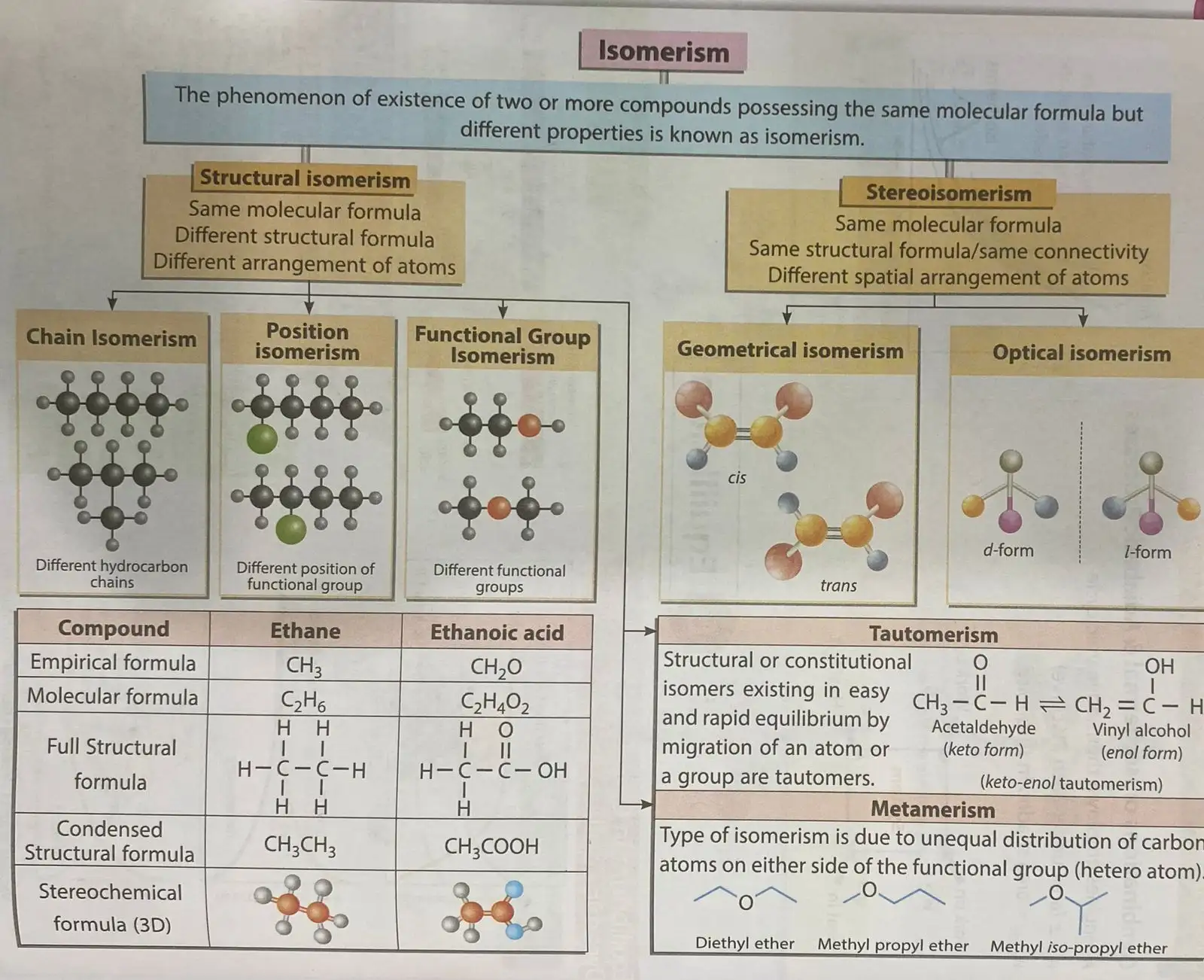
Isomerism
Definition and Concept
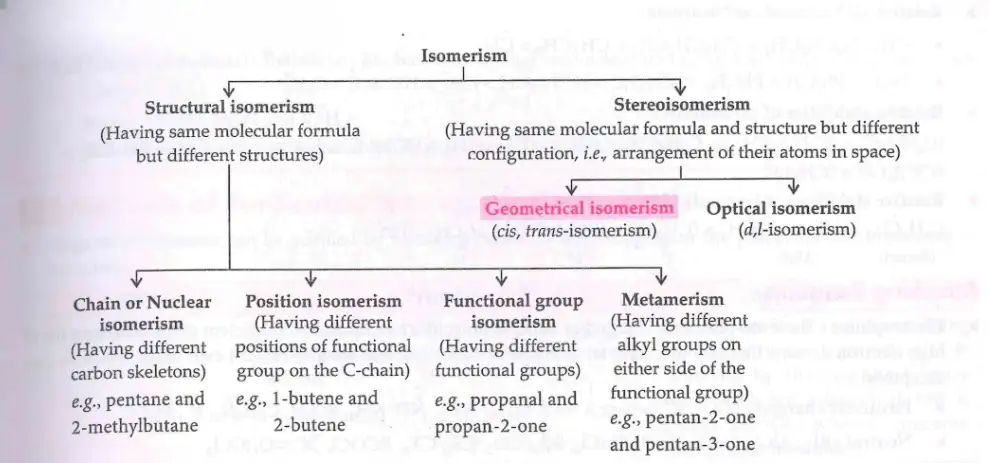
Isomerism: Compounds with same molecular formula but different properties.
Difference arises from variation in structure or spatial arrangement.
Types of Isomerism
Structural Isomerism: Different connectivity of atoms.
Stereoisomerism: Same connectivity, different spatial arrangement.
Solved Examples
Ex 1: Identify isomers of C5H12.
Answer: Pentane, isopentane (2-methylbutane), neopentane (2,2-dimethylpropane) are chain isomers.
Practice Set
Q1: Which is not a type of structural isomerism?
A. Chain isomerism
B. Position isomerism
C. Optical isomerism
D. Functional group isomerism
Q2: Stereoisomers differ in
A. Molecular formula
B. Connectivity of atoms
C. Spatial arrangement of atoms
D. Number of atoms
Q3: Which of the following shows geometrical isomerism?
A. 1-butene
B. 2-butene
C. Butane
D. 2-methylpropane
Answer Key
Q1: C - Optical isomerism is a type of stereoisomerism, not structural.
Q2: C - Stereoisomers differ in spatial arrangement, not formula or connectivity.
Q3: B - 2-butene shows cis-trans (geometrical) isomerism due to double bond.
Memory Aids
Structural isomers: "Chain, Position, Functional group, Metamerism"
Stereoisomers: "Geometrical (cis-trans), Optical (mirror images)"
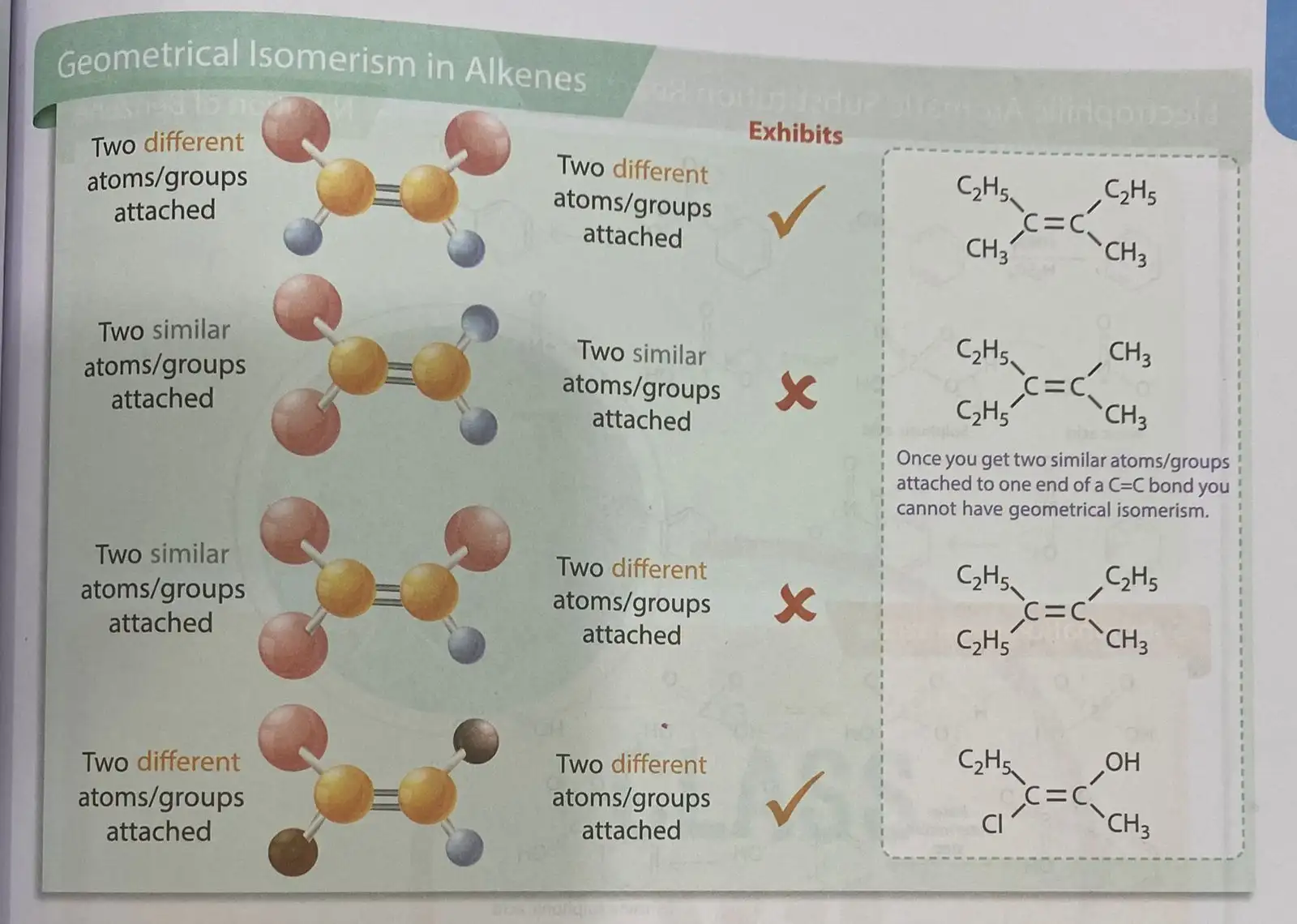
Geometrical isomerism requires different groups on each carbon of double bond.
Structural Isomerism
Types and Features
Chain isomerism: Different carbon skeletons.
Position isomerism: Functional groups at different positions.
Functional group isomerism: Different functional groups with same formula.
Metamerism: Different alkyl groups on either side of functional group.
Solved Examples
Ex 1: Identify position isomers of C3H7Cl.
Answer: 1-chloropropane and 2-chloropropane differ in Cl position.
Practice Set
Q1: Which is an example of functional group isomerism?
A. Ethanol and dimethyl ether
B. Butane and isobutane
C. 1-propanol and 2-propanol
D. 1-butene and 2-butene
Q2: Metamerism occurs in compounds having
A. Different functional groups
B. Same alkyl groups
C. Different alkyl groups around functional group
D. Different molecular formula
Q3: Chain isomerism is shown by
A. C4H10
B. C3H8
C. C2H6
D. C5H12
Answer Key
Q1: A - Ethanol and dimethyl ether have same formula but different functional groups.
Q2: C - Metamerism involves different alkyl groups around same functional group.
Q3: D - C5H12 shows chain isomerism (pentane isomers).
Memory Aids
Functional group isomers: Different functional groups, same formula.
Position isomers: Functional group shifts position.
Metamerism: Different alkyl groups around functional group.
Stereoisomerism
Types and Conditions
Geometrical isomerism: Different spatial arrangement around double bond (cis/trans).
Optical isomerism: Non-superimposable mirror images (enantiomers).
Geometrical isomerism requires two different groups on each carbon of double bond.
Solved Examples
Ex 1: Identify if 2-butene shows geometrical isomerism.
Answer: Yes, 2-butene has different groups on each double bonded carbon, so cis and trans forms exist.
Practice Set
Q1: Geometrical isomerism is possible in
A. Ethene
B. 1-butene
C. 2-butene
D. Butane
Q2: Optical isomerism arises due to
A. Different functional groups
B. Chiral center presence
C. Double bond
D. Same spatial arrangement
Q3: Which of the following is optically active?
A. 2-butanol
B. 1-butanol
C. Butane
D. 2-butene
Answer Key
Q1: C - 2-butene has different groups on double bonded carbons allowing cis-trans isomerism.
Q2: B - Optical isomerism requires chiral centers causing non-superimposable mirror images.
Q3: A - 2-butanol has a chiral center, making it optically active.
Memory Aids
Geometrical isomerism: "Different groups on each double bonded carbon"
Optical isomerism: "Chiral center = optical activity"
Tautomerism
Definition and Features
Isomers interconvert by migration of H-atom and rearrangement of bonds.
Common example: Keto-enol tautomerism.
Exists in equilibrium, affecting chemical properties.
Solved Examples
Ex 1: Write keto and enol forms of acetaldehyde.
Answer: Keto form: CH3–CHO; Enol form: CH2=CH–OH.
Practice Set
Q1: Tautomerism involves
A. Different molecular formula
B. Migration of H-atom within molecule
C. Different connectivity
D. Different elements
Q2: Keto-enol tautomerism is an example of
A. Structural isomerism
B. Stereoisomerism
C. Tautomerism
D. Metamerism
Q3: Which form is generally more stable in keto-enol tautomerism?
A. Enol form
B. Keto form
C. Both equal
D. Neither
Answer Key
Q1: B - Tautomerism involves H-atom migration within the molecule.
Q2: C - Keto-enol is a classic example of tautomerism.
Q3: B - Keto form is generally more stable than enol form.
Memory Aids
Tautomerism = "H shift + bond rearrangement"
Keto form usually dominates over enol form.
Fundamental Concepts in Organic Reaction Mechanism
General Reaction Overview
Organic molecule (substrate) reacts with attacking reagent.
Forms a temporary intermediate.
Intermediate converts to main product(s) and sometimes byproducts.

Solved Examples
Ex 1: Substrate + reagent → intermediate → product + byproduct (if any).
Practice Set
Q1: What is the intermediate in an organic reaction?
A) Reactant
B) Product
C) Temporary species formed during reaction
D) ByproductQ2: Which of the following is true about attacking reagents?
A) They are always negatively charged
B) They react with substrate to form intermediate
C) They are final products
D) They do not participate in reactionQ3: In a reaction, byproducts are:
A) Main products
B) Unreacted substrates
C) Side products formed along with main products
D) Intermediates
Answer Key
Q1: C - Intermediate is a temporary species formed during the reaction.
Q2: B - Attacking reagents react with substrate to form intermediates.
Q3: C - Byproducts are side products formed along with main products.
Memory Aids
Intermediate = Temporary species between reactant and product.
Attacking reagent = Reacts with substrate to start reaction.
Byproducts = Side products, not main products.
Fission of a Covalent Bond
Types of Bond Fission
Homolytic fission: Bond breaks symmetrically; each fragment gets one electron forming free radicals.
Heterolytic fission: Bond breaks unsymmetrically; both electrons go to more electronegative atom forming ions (carbocation and carbanion).


Solved Examples
Ex 1: Homolytic cleavage of R–X bond under heat/light forms R• and X• radicals.
Ex 2: Heterolytic cleavage of CH3–X bond where X is electronegative forms CH3+ (carbocation) and X−.
Practice Set
Q1: Homolytic fission produces:
A) Ions
B) Free radicals
C) Molecules
D) NoneQ2: In heterolytic fission, electrons move towards:
A) Less electronegative atom
B) More electronegative atom
C) Both atoms equally
D) Neither atomQ3: Which species is formed when bond breaks heterolytically with carbon more electronegative?
A) Carbocation
B) Carbanion
C) Free radical
D) Neutral molecule
Answer Key
Q1: B - Homolytic fission forms free radicals.
Q2: B - Electrons move towards more electronegative atom.
Q3: B - Carbanion forms when carbon takes both electrons.
Memory Aids
Homolytic = "homo" means same; electrons split equally.
Heterolytic = "hetero" means different; electrons go to one atom.
Electronegativity decides ion formation in heterolytic fission.
Reaction Intermediates
Types and Stability
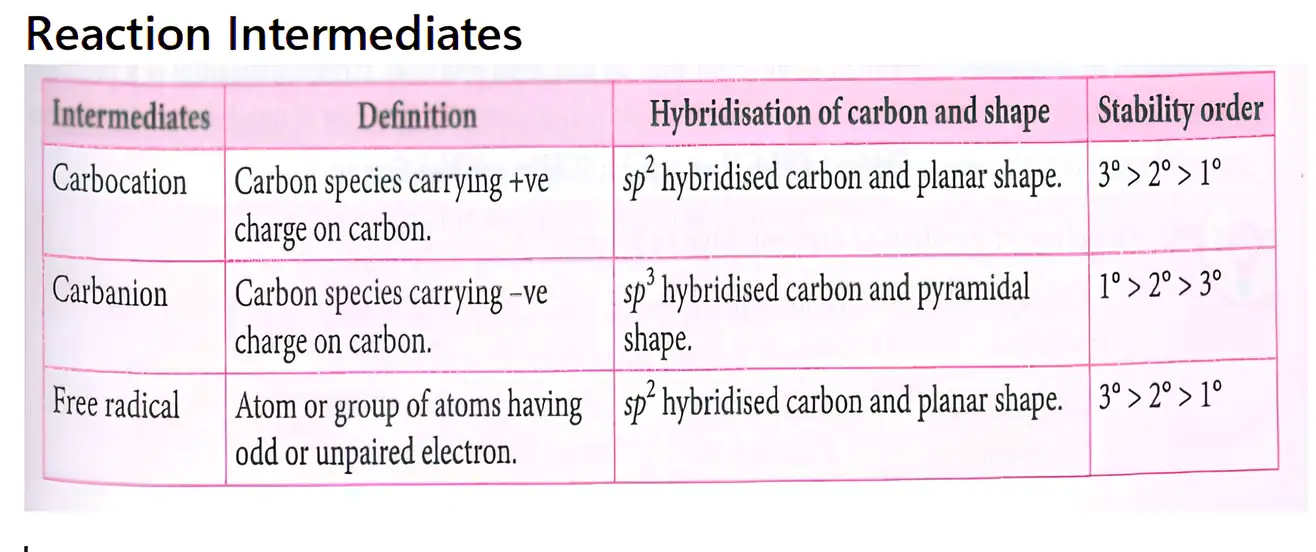
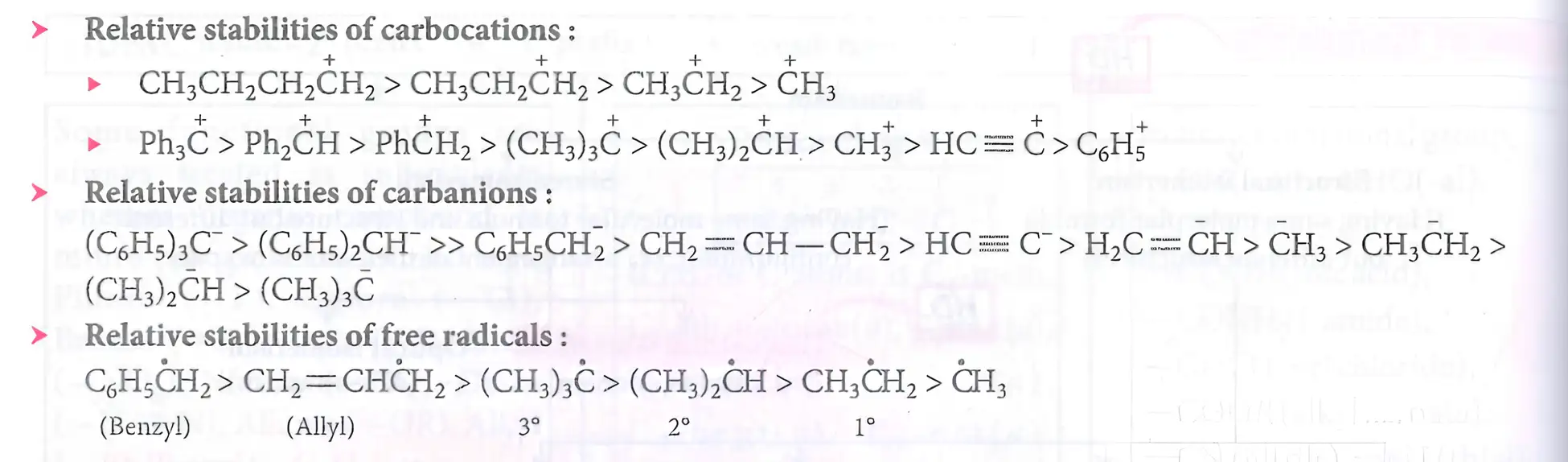
Carbocation: Positively charged carbon, sp2 hybridised, planar shape; stability: 3° > 2° > 1°.
Carbanion: Negatively charged carbon, sp3 hybridised, pyramidal shape; stability: 1° > 2° > 3°.
Free radical: Carbon with unpaired electron, sp2 hybridised, planar; stability: 3° > 2° > 1°.
Solved Examples
Ex 1: Tertiary carbocation is more stable than primary due to alkyl group donation.
Ex 2: Primary carbanion is more stable than tertiary due to less alkyl crowding.
Practice Set
Q1: Which intermediate has sp2 hybridisation?
A) Carbocation
B) Carbanion
C) Both
D) NoneQ2: Stability order of free radicals is:
A) 1° > 2° > 3°
B) 3° > 2° > 1°
C) Equal stability
D) NoneQ3: Which intermediate is pyramidal in shape?
A) Carbocation
B) Carbanion
C) Free radical
D) All
Answer Key
Q1: A - Carbocations are sp2 hybridised.
Q2: B - Free radicals stability: 3° > 2° > 1°.
Q3: B - Carbanions have pyramidal shape.
Memory Aids
Carbocation and free radical: planar, sp2, 3° most stable.
Carbanion: pyramidal, sp3, 1° most stable.
Alkyl groups stabilize carbocations and radicals but destabilize carbanions.
Attacking Reagents
Electrophiles and Nucleophiles
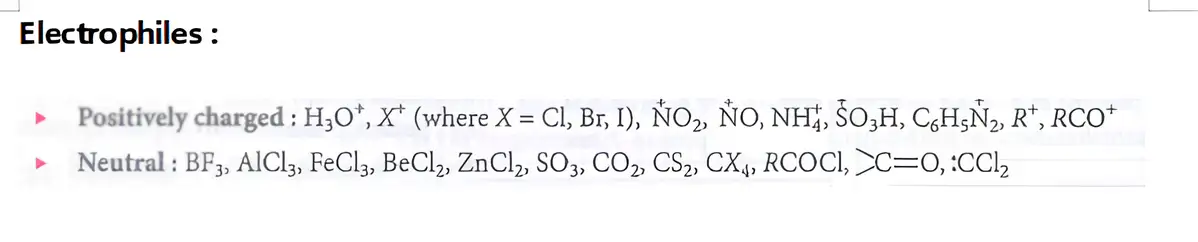
Electrophiles: Electron-deficient species (positive or neutral) seeking electrons; Lewis acids.
Examples: H3O+, NO2+, BF3, AlCl3, CO2.
Nucleophiles: Electron-rich species (negative or neutral) donating electron pairs; Lewis bases.
Examples: OH−, CN−, SH−, NH3, H2O.

Solved Examples
Ex 1: H3O+ acts as electrophile due to positive charge.
Ex 2: OH− acts as nucleophile due to lone pair and negative charge.
Practice Set
Q1: Electrophiles are:
A) Electron-rich
B) Electron-deficient
C) Neutral only
D) Negatively charged onlyQ2: Which is a neutral nucleophile?
A) OH−
B) NH3
C) NO2+
D) H3O+Q3: Lewis acids are:
A) Electron pair donors
B) Electron pair acceptors
C) Always negatively charged
D) Always neutral
Answer Key
Q1: B - Electrophiles are electron-deficient.
Q2: B - NH3 is a neutral nucleophile.
Q3: B - Lewis acids accept electron pairs.
Memory Aids
Electrophiles = Electron seekers (Lewis acids).
Nucleophiles = Electron donors (Lewis bases).
Charge helps identify electrophiles (+) and nucleophiles (−).
Electron Displacement Effects in Covalent Bonds
Types of Effects
Inductive effect: Shift of σ electrons along saturated chain due to attached groups.
Electron withdrawing (-I): —NO2 > —CN > —COOH > —F > —Cl > —Br > —I > —H
Electron donating (+I): (CH3)3C— > (CH3)2CH— > CH3CH— > CH3— > D— > H—
Electromeric effect: Temporary transfer of π electrons to one atom in presence of attacking reagent.
+E effect: Electron transfer towards atom where reagent attaches.
-E effect: Electron transfer away from atom where reagent attaches.
Resonance (Mesomeric) effect: Polarity due to interaction of π bonds or π bond and lone pair in conjugated systems.
+R/+M groups: —OH, —OR, —OCOR, —SH, —SR, —NH2, —NHR, —NR2, —Cl, —Br, —I
-R/-M groups: —COOH, >C=O, —CHO, —COOR, —CN, —NO2
Hyperconjugation: Delocalisation of σ electrons of C—H bond adjacent to unsaturated atom or p-orbital; permanent effect.
Hyperconjugation strength: CH3— > CH3CH2— > (CH3)2CH— > (CH3)3C—
Solved Examples
Ex 1: —NO2 shows strong -I effect, withdrawing electrons from chain.
Ex 2: —OH group shows +R effect, donating electrons via resonance.
Ex 3: Tertiary alkyl group shows stronger +I and hyperconjugation than primary.
Practice Set
Q1: Which group has strongest -I effect?
A) —F
B) —NO2
C) —Cl
D) —BrQ2: +R effect is shown by:
A) —NO2
B) —OH
C) —CN
D) —COOHQ3: Hyperconjugation decreases in order:
A) (CH3)3C— > (CH3)2CH— > CH3CH2— > CH3—
B) CH3— > CH3CH2— > (CH3)2CH— > (CH3)3C—
C) Equal
D) None
Answer Key
Q1: B - —NO2 has strongest -I effect.
Q2: B - —OH shows +R effect.
Q3: B - Hyperconjugation decreases as CH3— > CH3CH2— > (CH3)2CH— > (CH3)3C—.
Memory Aids
Inductive effect: Electron withdrawing (-I) groups pull electrons; donating (+I) groups push electrons.
Electromeric effect is temporary; resonance is permanent.
Hyperconjugation stabilizes carbocations; more alkyl groups increase effect.
Photolysis of Diazomethane and Ketene
Reactions and Products
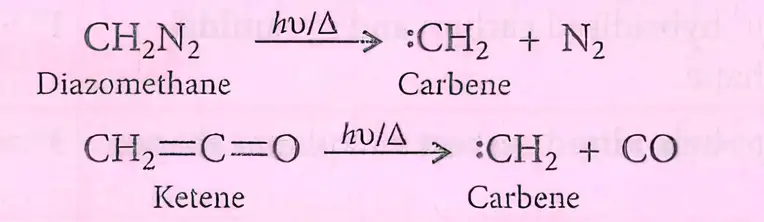
Diazomethane (CH2N2) under light/heat breaks into carbene (:CH2) and N2 gas.
Ketene (CH2=C=O) under light/heat breaks into carbene (:CH2) and CO gas.
Carbenes are reactive species with carbon having two unshared electrons.
Solved Examples
Ex 1: Photolysis of CH2N2 → :CH2 + N2
Ex 2: Photolysis of CH2=C=O → :CH2 + CO
Practice Set
Q1: Photolysis of diazomethane produces:
A) Carbene and CO
B) Carbene and N2
C) Carbocation and N2
D) Carbanion and COQ2: Ketene photolysis yields:
A) Carbene and CO
B) Carbocation and CO2
C) Carbene and N2
D) Carbanion and COQ3: Carbenes have:
A) One unpaired electron
B) Two unshared electrons
C) Positive charge
D) Negative charge
Answer Key
Q1: B - Diazomethane photolysis produces carbene and N2.
Q2: A - Ketene photolysis produces carbene and CO.
Q3: B - Carbenes have two unshared electrons on carbon.
Memory Aids
Diazomethane and ketene photolysis produce reactive carbene (:CH2).
Carbenes have divalent carbon with two lone electrons.
Ambiphiles (Ambidents)
Dual Nature of Ambiphiles
Ambiphiles behave as both electrophiles and nucleophiles (amphoteric).
Examples include species with oxygen or phosphorus atoms acting as nucleophiles and hydrogen atoms as electrophiles.
Charged species like H3O+ are electrophilic; neutral molecules with lone pairs on O or P are nucleophilic.

Solved Examples
Ex 1: H3O+ acts as electrophile due to positive charge.
Ex 2: RÖH and RPH2 act as nucleophiles via lone pairs on O and P.
Practice Set
Q1: Ambiphiles can act as:
A) Only electrophiles
B) Only nucleophiles
C) Both electrophiles and nucleophiles
D) NeitherQ2: In ambiphiles, oxygen atoms usually act as:
A) Electrophiles
B) Nucleophiles
C) Radicals
D) NoneQ3: Hydrogen atoms in ambiphiles behave as:
A) Nucleophiles
B) Electrophiles
C) Radicals
D) None
Answer Key
Q1: C - Ambiphiles have dual nature.
Q2: B - Oxygen atoms act as nucleophiles.
Q3: B - Hydrogen atoms act as electrophiles.
Memory Aids
Ambiphiles = Both electron donors and acceptors.
O and P atoms donate electrons; H atoms accept electrons.
Methods of Purification of Organic Compounds
Overview
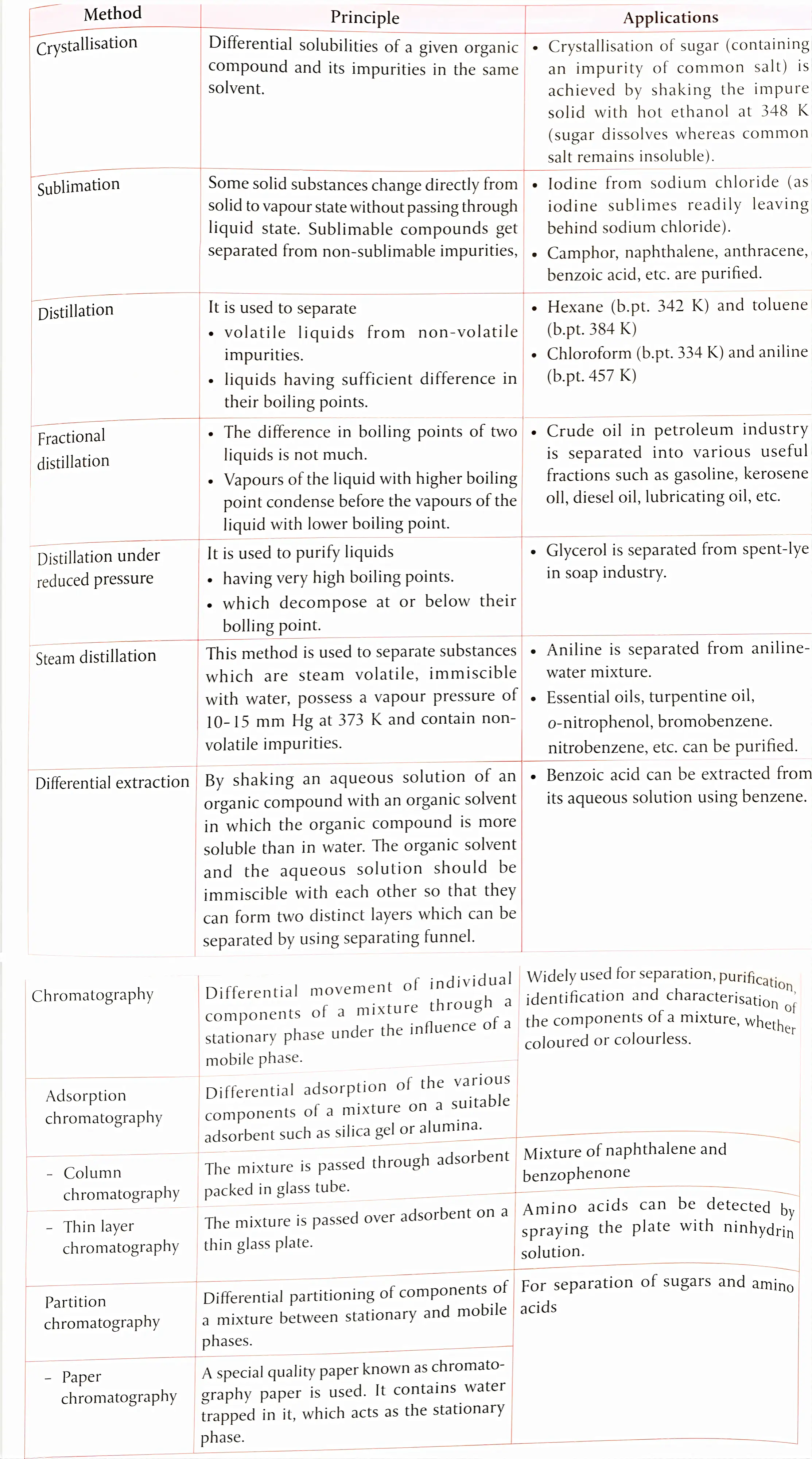
Organic compounds are purified based on physical properties like solubility, boiling point, and volatility.
Common methods include crystallisation, sublimation, distillation, extraction, and chromatography.
Choice of method depends on the nature of the mixture components.
Common Purification Methods
Crystallisation: Separates solids by solubility differences. Example: purify sugar from salt.
Sublimation: Separates solids that vaporize without melting. Example: purify iodine from salt.
Distillation: Separates liquids by boiling points. Example: separate hexane from toluene.
Fractional Distillation: Separates liquids with close boiling points by repeated condensation. Used in crude oil refining.
Distillation under Reduced Pressure: Purifies high boiling liquids by lowering pressure.
Steam Distillation: Separates steam-volatile, water-immiscible substances. Example: extract essential oils.
Differential Extraction: Uses two immiscible solvents to separate compounds by solubility.
Chromatography: Separates mixture components based on movement through a stationary phase.
Adsorption chromatography: uses adsorbents like silica gel.
Column chromatography: mixture passes through adsorbent-packed tube.
Thin layer chromatography: mixture moves over adsorbent on glass plate.
Partition chromatography (paper chromatography): separation between solvent and paper layers.
Solved Examples
Ex 1: Purify iodine from a mixture of iodine and salt.
Use sublimation: heat mixture; iodine vaporizes and condenses separately.
Ex 2: Separate hexane and toluene.
Use simple distillation: boil mixture; hexane (bp 69°C) vaporizes first, then toluene (bp 110°C).
Ex 3: Extract essential oil from plant material.
Use steam distillation: steam carries volatile oils; condense and separate oil layer.
Practice Set
Q1: Which method is suitable to separate a mixture of sugar and salt?
A. Sublimation
B. Crystallisation
C. Distillation
D. Chromatography
Q2: Which technique separates liquids with very close boiling points?
A. Simple distillation
B. Fractional distillation
C. Sublimation
D. Steam distillation
Q3: Which method is used to separate components based on their movement through a stationary phase?
A. Differential extraction
B. Chromatography
C. Sublimation
D. Distillation under reduced pressure
Answer Key
Q1: B. Crystallisation - Sugar and salt differ in solubility; crystallisation separates solids based on this.
Q2: B. Fractional distillation - Effective for liquids with close boiling points by repeated vaporization-condensation.
Q3: B. Chromatography - Separates components by differential movement through stationary phase.
Memory Aids
Crystallisation: "Solubility difference" separates solids.
Sublimation: "Solid to vapor" without melting (e.g., iodine).
Distillation: "Boiling point" difference separates liquids.
Fractional distillation: "Close boiling points" need repeated condensation.
Steam distillation: "Steam volatile" + water immiscible substances.
Chromatography: "Movement through stationary phase" separates mixtures.
Qualitative Analysis Organic Elements
Detection of Carbon and Hydrogen
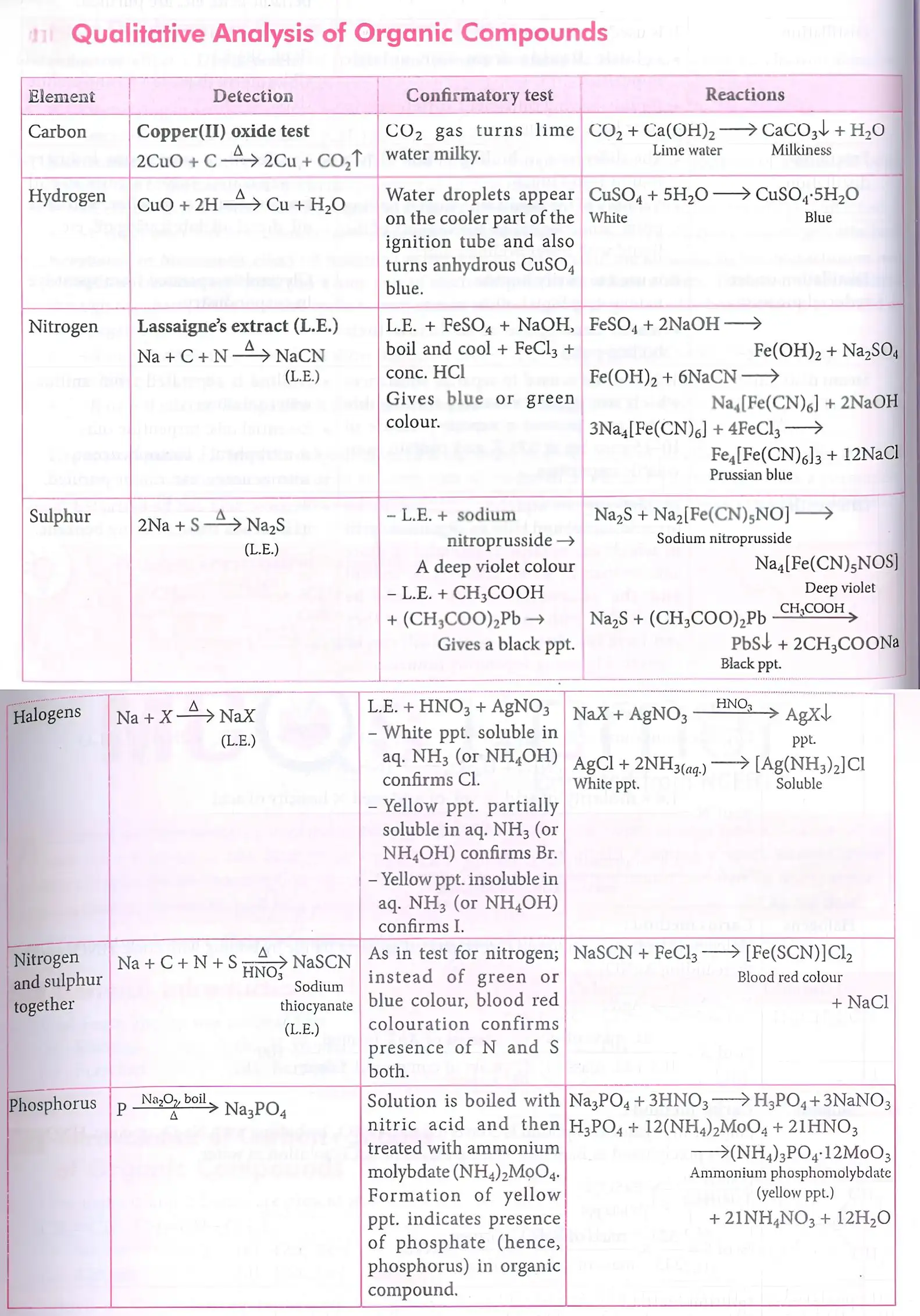
Heat organic compound with copper oxide (CuO).
Carbon forms CO2 detected by lime water turning milky.
Hydrogen forms H2O detected by cobalt chloride paper turning blue to pink.
Detection of Nitrogen
Heat compound with soda lime; ammonia (NH3) is released.
Confirm by moist red litmus turning blue.
Detection of Sulfur
Heat with sodium metal; sodium sulfide (Na2S) forms.
Confirm by adding sodium nitroprusside; violet color indicates sulfur.
Detection of Halogens (Cl, Br, I)
Boil compound with sodium metal to form sodium halide.
Confirm by adding silver nitrate (AgNO3):
White precipitate: AgCl
Pale yellow: AgBr
Yellow: AgI
Detection of Nitrogen and Sulfur Together
Heat with sodium metal; sodium sulfide and sodium cyanide form.
Confirm sulfur by sodium nitroprusside test (violet color).
Confirm nitrogen by adding ferrous sulfate and ferric chloride (Prussian blue precipitate).
Detection of Phosphorus
Heat compound with sodium metal; sodium phosphate forms.
Confirm by adding ammonium molybdate and nitric acid; yellow precipitate indicates phosphorus.
Solved Examples
Ex 1: Detect carbon and hydrogen in an organic compound.
Heat with CuO; pass gases through lime water and cobalt chloride paper.
Lime water turns milky (CO2), cobalt chloride paper turns pink (H2O).
Ex 2: Confirm presence of halogens in an organic compound.
Boil with sodium metal; add AgNO3 to solution.
Observe precipitate color to identify halogen.
Practice Set
Q1: Which test confirms presence of nitrogen in an organic compound?
A. Lime water test
B. Moist red litmus test after heating with soda lime
C. Sodium nitroprusside test
D. Silver nitrate test
Q2: What color precipitate indicates presence of bromine when treated with AgNO3?
A. White
B. Pale yellow
C. Yellow
D. Violet
Q3: Which confirmatory test is used for sulfur detection?
A. Lime water test
B. Sodium nitroprusside test
C. Ammonium molybdate test
D. Prussian blue test
Answer Key
Q1: B - Heating with soda lime releases NH3, confirmed by moist red litmus turning blue.
Q2: B - Pale yellow precipitate of AgBr confirms bromine.
Q3: B - Sodium nitroprusside test gives violet color confirming sulfur.
Memory Aids
Carbon & Hydrogen: CuO heating → CO2 (lime water) + H2O (cobalt chloride).
Nitrogen: Soda lime heating → NH3 (red litmus blue).
Sulfur: Sodium nitroprusside → violet color.
Halogens: AgNO3 precipitate colors - Cl (white), Br (pale yellow), I (yellow).
Phosphorus: Ammonium molybdate + HNO3 → yellow precipitate.
Quantitative Analysis of Organic Compounds
Principles and Methods
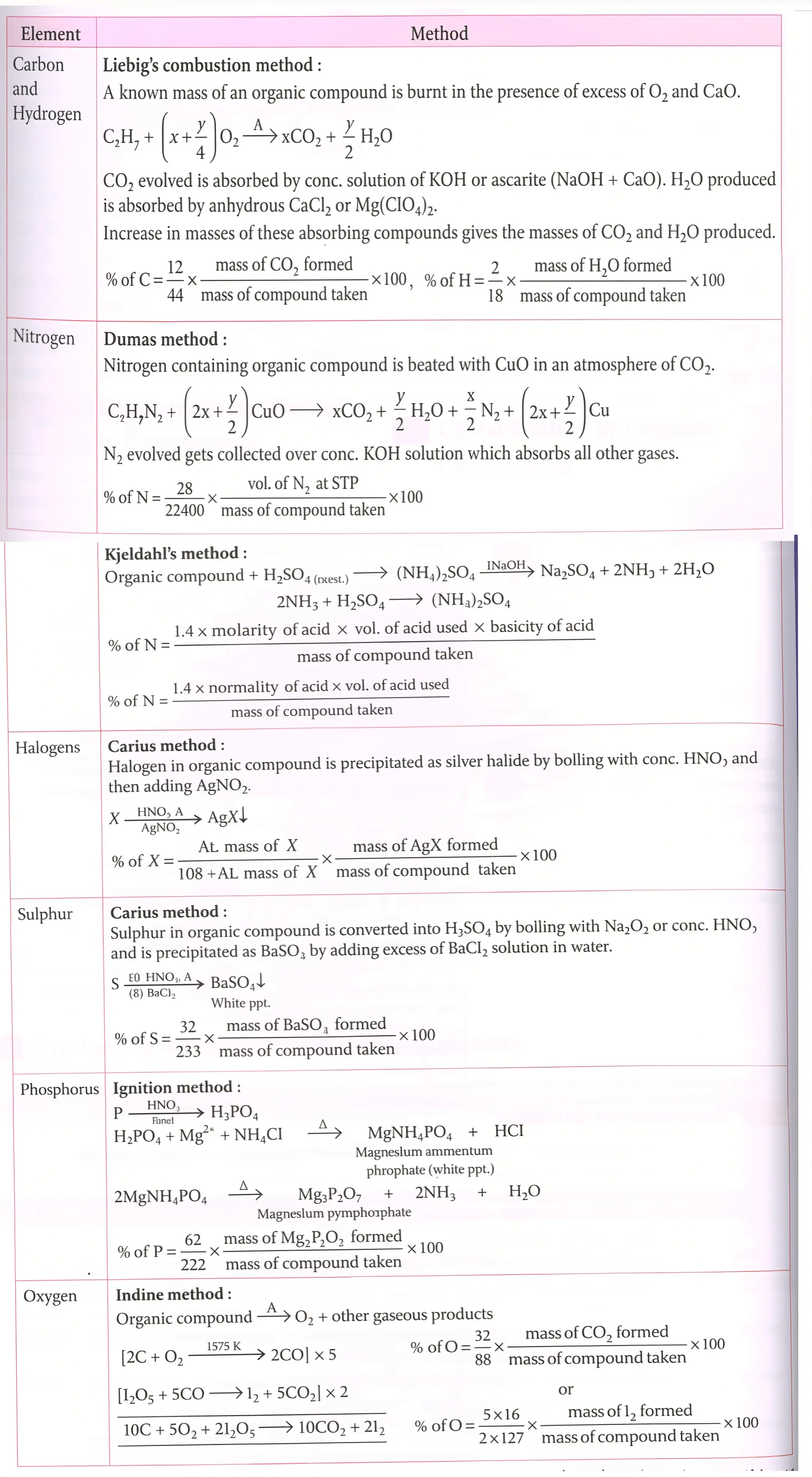
Determination of elemental composition (C, H, N, halogens, S, P, O) by specific chemical methods.
Carbon & Hydrogen: Liebig’s combustion method; burn compound, measure CO2 and H2O formed.
Nitrogen: Dumas method (nitrogen gas measurement) and Kjeldahl method (ammonia formation and titration).
Halogens: Carius method; convert halogen to silver halide, weigh precipitate.
Sulphur: Carius method; convert to barium sulfate, weigh precipitate.
Phosphorus: Ignition method; form magnesium pyrophosphate, weigh precipitate.
Oxygen: Indine method; measure CO2 or iodine formed to calculate oxygen content.
Solved Examples
Ex 1: Calculate %C and %H in a compound if 0.5 g produces 1.47 g CO2 and 0.6 g H2O on combustion.
Steps: Mass C = (mass CO2 × 12)/44 = (1.47 × 12)/44 = 0.4 g
Mass H = (mass H2O × 2)/18 = (0.6 × 2)/18 = 0.067 g
% C = (0.4/0.5) × 100 = 80%, % H = (0.067/0.5) × 100 = 13.4%Ex 2: Determine %N by Kjeldahl if 0.2 g compound requires 25 mL of 0.1 N acid for titration.
Steps: Moles acid = 0.025 × 0.1 = 0.0025 mol
Moles N = moles acid = 0.0025 mol
Mass N = 0.0025 × 14 = 0.035 g
% N = (0.035/0.2) × 100 = 17.5%
Practice Set
Q1: In Liebig’s combustion method, the carbon content is determined by measuring:
A. Mass of water formed
B. Mass of carbon dioxide formed
C. Volume of oxygen consumed
D. Mass of residue leftQ2: Which method is used to estimate nitrogen by measuring nitrogen gas?
A. Kjeldahl method
B. Dumas method
C. Carius method
D. Ignition methodQ3: In the Carius method for sulphur estimation, the sulphur is precipitated as:
A. Silver sulfate
B. Barium sulfate
C. Magnesium sulfate
D. Calcium sulfate
Answer Key
Q1: B. Carbon dioxide mass directly relates to carbon content.
Q2: B. Dumas method measures nitrogen gas evolved.
Q3: B. Sulphur is precipitated as barium sulfate in Carius method.
Memory Aids
Liebig’s method: CO2 for Carbon, H2O for Hydrogen.
Dumas = Nitrogen gas; Kjeldahl = Ammonia titration.
Carius method for halogens and sulphur involves silver halide and barium sulfate precipitates.
Phosphorus forms magnesium pyrophosphate on ignition.
Oxygen estimated indirectly via CO2 or iodine formed.
Modern Elemental Analysis
CHN Elemental Analyser
Automated instrument for rapid estimation of Carbon, Hydrogen, and Nitrogen.
Requires microgram to milligram quantities (1-3 mg) of sample.
Displays percentage composition on screen within minutes.
Highly accurate and efficient for organic compound analysis.
Solved Examples
Ex 1: A CHN analyser shows 40% C, 6.7% H, and 13.3% N in a sample. Calculate the remaining percentage assuming only C, H, N, and O are present.
Steps: Total = 100%
Sum C+H+N = 40 + 6.7 + 13.3 = 60%
Oxygen % = 100 - 60 = 40%
Practice Set
Q1: CHN analyser is used to determine:
A. Carbon, Hydrogen, Nitrogen
B. Carbon, Hydrogen, Oxygen
C. Nitrogen, Sulphur, Phosphorus
D. Halogens onlyQ2: Minimum sample size required for CHN analyser is:
A. 1-3 g
B. 1-3 mg
C. 10-30 mg
D. 10-30 gQ3: Which element is NOT directly measured by CHN analyser?
A. Carbon
B. Hydrogen
C. Nitrogen
D. Oxygen
Answer Key
Q1: A. CHN analyser measures Carbon, Hydrogen, and Nitrogen.
Q2: B. Requires 1-3 mg sample size.
Q3: D. Oxygen is calculated indirectly, not directly measured.
Memory Aids
CHN analyser = Carbon, Hydrogen, Nitrogen only.
Sample size tiny: mg scale.
Oxygen content found by difference.
NEET Chemistry — ALL CHAPTERS
1
Some Basic Concepts of Chemistry
2
Structure of Atom
3
Classification of Elements and Periodicity in Properties
4
Chemical Bonding and Molecular Structure
5
Thermodynamics
6
Equilibrium
7
Redox Reactions
8
Organic Chemistry - Some Basic Principles and Techniques
9
Hydrocarbons
10
Solutions
11
Electrochemistry
12
Chemical Kinetics
13
The d- and f- Block Elements
14
Coordination Compounds
15
Haloalkanes and Haloarenes
16
Alcohols, Phenols and Ethers
17
Aldehydes, Ketones and Carboxylic Acids
18
Amines
19
Biomolecules
20
The p-Block Elements (Group 13 and 14)
21
The p-Block Elements (Group 15 to 18)
22
Principles Related to Practical Chemistry