NEET Ug . NEET Chemistry . Chemistry . The D and F Block Elements
Chapter 13: The d- and f- Block Elements
Ch 13
NEET Chemistry
NEET Ug
Introduction
Overview of d- and f-block Elements
- Four series of d-block elements correspond to filling of 3d, 4d, 5d, and 6d orbitals.
- d-block elements are transition metals with valence electrons entering d-orbitals.
- f-block elements involve filling of 4f and 5f orbitals, forming the lanthanide and actinide series.
Solved Examples
- Ex 1: Identify the block of element with electronic configuration [Ar] 3d5 4s2.
Solution: Last electron enters 3d orbital → d-block element.
Practice Set
- Q1: Which orbital is being filled in the first series of d-block elements?
A. 3p
B. 3d
C. 4s
D. 4p - Q2: The f-block elements are characterized by filling which orbitals?
A. 3d and 4d
B. 4f and 5f
C. 5d and 6d
D. 4p and 5p - Q3: Transition elements are located between which blocks in the periodic table?
A. s- and p-block
B. p- and f-block
C. s- and f-block
D. p- and d-block
Answer Key
- Q1: B. 3d — First d-block series fills 3d orbitals.
- Q2: B. 4f and 5f — f-block elements fill 4f and 5f orbitals.
- Q3: A. s- and p-block — Transition elements lie between s- and p-block.
Memory Aids
- d-block = last electron in d-orbital.
- f-block = filling of f-orbitals (4f, 5f).
- Transition metals lie between s- and p-block in periodic table.
Transition Elements Position
Location in Periodic Table
- Transition elements are located in groups 3 to 12 of the periodic table.
- They lie between s-block (groups 1-2) and p-block (groups 13-18) elements.
- Called d-block elements because their last electron enters the d-orbital.
Solved Examples
- Ex 1: Determine the group of element with configuration [Ar] 3d7 4s2.
Solution: Last electron in 3d, total d-electrons = 7 → Group 9 (Co group).
Practice Set
- Q1: Which group contains transition elements?
A. 1 and 2
B. 3 to 12
C. 13 to 18
D. Lanthanides - Q2: Why are transition elements called d-block elements?
A. Last electron enters s-orbital
B. Last electron enters p-orbital
C. Last electron enters d-orbital
D. Last electron enters f-orbital - Q3: Which of the following is NOT a transition element?
A. Scandium
B. Zinc
C. Iron
D. Copper
Answer Key
- Q1: B. 3 to 12 — Transition elements occupy groups 3 to 12.
- Q2: C. Last electron enters d-orbital — Defines d-block elements.
- Q3: B. Zinc — Zn has full d10 shell and is not a transition element.
Memory Aids
- Transition elements = groups 3–12.
- Last electron in d-orbital defines transition metals.
- Zinc, cadmium, mercury are exceptions (not transition metals).
Electronic Configurations of the d-Block Elements
General Electronic Configuration
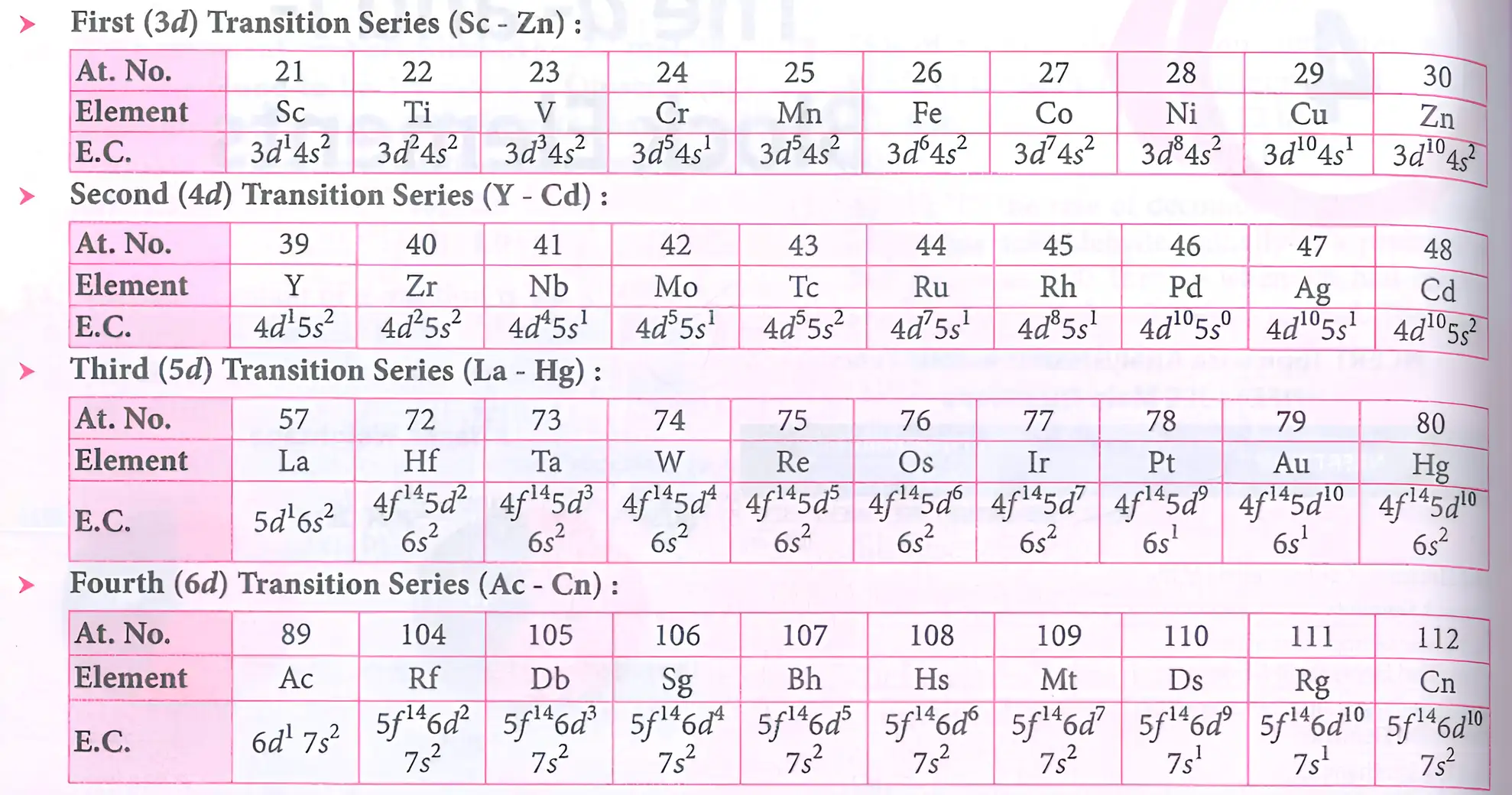
- d-Block elements have outer electronic configuration: (n-1)d1-10 ns0-2
- Zn, Cd, Hg, and Cn have completely filled d-orbitals: (n-1)d10 ns2
- These fully filled elements are not considered transition elements
Transition Series
- Four transition series in d-block:
- 1st series (3d): Sc (21) to Zn (30)
- 2nd series (4d): Y (39) to Cd (48)
- 3rd series (5d): La (57), Hf (72) to Hg (80)
- 4th series (6d): Ac (89), Rf (104) to Cn (112)
Solved Examples
- Ex 1: Write the electronic configuration of Sc (Z=21).
- Solution: 1s2 2s2 2p6 3s2 3p6 3d1 4s2 or simplified as 3d1 4s2.
- Ex 2: Identify if Zn is a transition element.
- Solution: Zn has configuration 3d10 4s2, fully filled d-orbitals; hence, not a transition element.
Practice Set
- Q1: What is the general electronic configuration of d-block elements?
- A. (n-1)d1-10 ns0-2
- B. ns2 np1-6
- C. (n-2)f1-14 (n-1)d0-1 ns2
- D. ns1 np5
- Q2: Which of the following is NOT a transition element?
- A. Fe
- B. Zn
- C. Cu
- D. Ni
- Q3: The 3rd transition series starts from which element?
- A. La (57)
- B. Hf (72)
- C. Hg (80)
- D. Ac (89)
Answer Key
- Q1: A. (n-1)d1-10 ns0-2 - Defines d-block electron filling.
- Q2: B. Zn - Has fully filled d-orbitals, not a transition element.
- Q3: A. La (57) - Start of 3rd transition series.
Memory Aids
- Transition elements: d-orbitals partially filled (except Zn, Cd, Hg, Cn).
- Series order: 3d (Sc-Zn), 4d (Y-Cd), 5d (La-Hg), 6d (Ac-Cn).
- Zn, Cd, Hg, Cn are d-block but NOT transition elements.
General Properties of Transition Elements
Metallic Characteristics
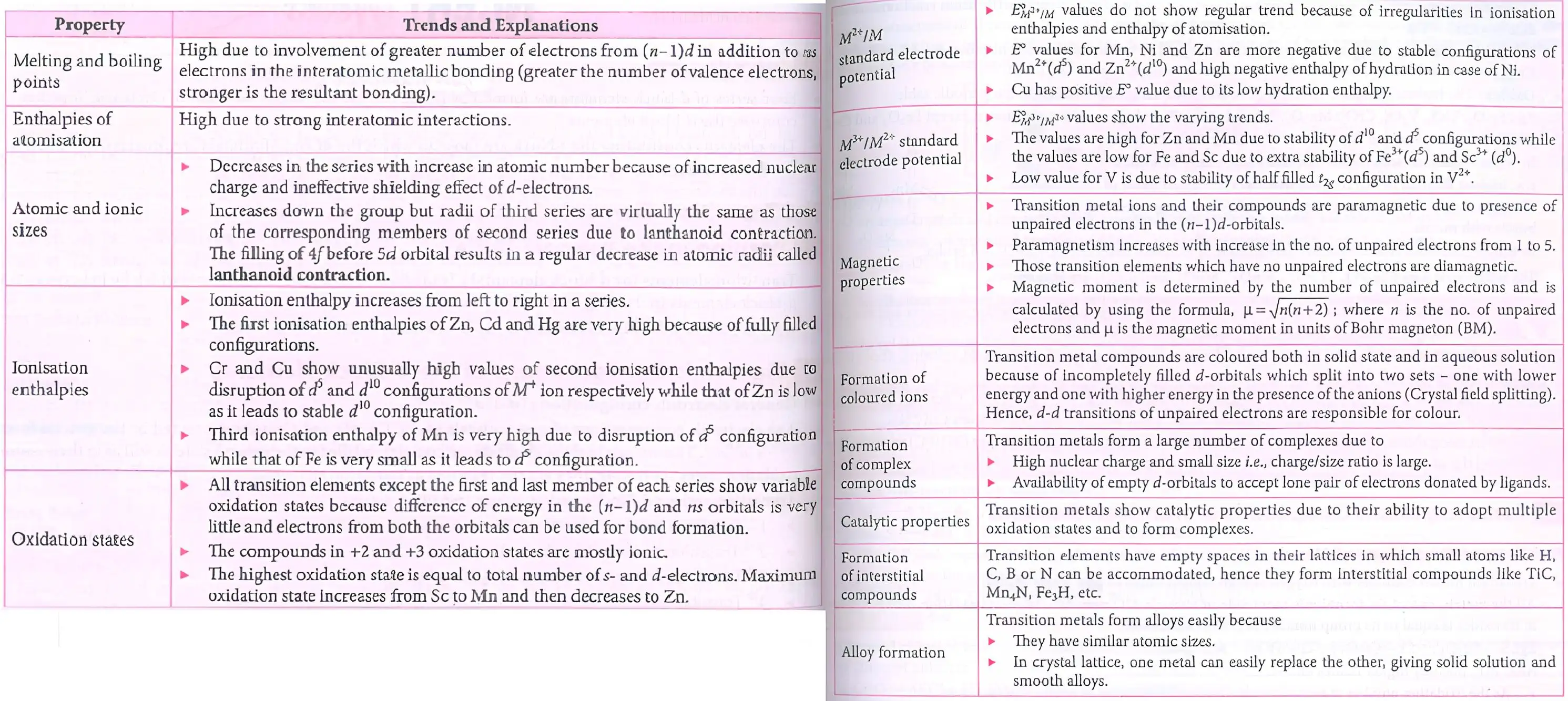
- Exhibit high tensile strength, ductility, malleability, and metallic lustre.
- High thermal and electrical conductivity due to metallic bonding.
- Most have typical metallic crystal structures except Zn, Cd, Hg, and Mn.
Physical and Chemical Trends
- High melting and boiling points due to strong metallic bonds involving d-electrons.
- High enthalpies of atomisation reflect strong interatomic forces.
- Atomic and ionic sizes decrease across a period due to increasing nuclear charge; increase down a group.
- Lanthanoid contraction causes smaller atomic sizes in 4d and 5d series.
- Ionisation enthalpy generally increases across the series; exceptions due to stable electron configurations.
- Multiple oxidation states arise from similar energy of 4s and 3d electrons.
- Standard electrode potentials vary with electron configuration and oxidation state stability.
- Magnetic properties due to unpaired d-electrons; paramagnetism increases with unpaired electrons.
- Formation of coloured ions due to d-d electronic transitions absorbing visible light.
- Form complex compounds due to small size and ability to accept electron pairs.
- Act as catalysts by changing oxidation states and forming complexes.
- Form interstitial compounds by small atoms fitting into metal lattices.
- Form alloys easily due to similar atomic sizes allowing substitution in crystal lattices.
Solved Examples
- Ex 1: Explain why transition metals have high melting points.
- Due to strong metallic bonds involving unpaired d-electrons, requiring more energy to break. - Ex 2: Why do transition metals form coloured compounds?
- d-d transitions absorb visible light, causing colour.
Practice Set
- Q1: Which property is NOT typical of transition metals?
A. High melting point
B. Multiple oxidation states
C. Colourless ions in all oxidation states
D. Formation of complex compounds - Q2: Why do atomic sizes decrease across a transition series?
A. Increase in nuclear charge
B. Increase in electron shielding
C. Lanthanoid contraction
D. Decrease in nuclear charge - Q3: Which factor contributes to catalytic activity of transition metals?
A. Fixed oxidation state
B. Ability to form coloured ions
C. Variable oxidation states
D. Large atomic size
Answer Key
- Q1: C - Some ions are coloured due to d-d transitions, not all are colourless.
- Q2: A - Increasing nuclear charge pulls electrons closer, reducing size.
- Q3: C - Variable oxidation states allow redox reactions essential for catalysis.
Memory Aids
- Transition metals = Multiple oxidation states + coloured ions + catalytic activity.
- Lanthanoid contraction = Smaller atomic size in 4d and 5d series.
- High melting point = Strong metallic bonds from unpaired d-electrons.
Colour and Electronic Transitions
Colour Origin
- Sc3+, Ti4+, V5+, Cr6+, Mn7+ have empty d-orbitals; no d-d transitions; colourless.
- VO2+ (pale yellow), CrO42− (deep yellow), MnO4− (intense purple) show colour due to charge transfer transitions.
Solved Examples
- Ex 1: Why is CrO42− yellow?
- Charge transfer from O to Cr causes absorption in visible region.
Practice Set
- Q1: Which ion is colourless?
A. MnO4−
B. Ti4+
C. VO2+
D. CrO42− - Q2: Colour in transition metal ions arises mainly due to:
A. d-d transitions
B. s-p transitions
C. Charge transfer
D. Nuclear spin - Q3: Which ion shows charge transfer colour?
A. Sc3+
B. MnO4−
C. Ti4+
D. V5+
Answer Key
- Q1: B - Ti4+ has empty d-orbitals, no d-d transitions.
- Q2: A - Colour mainly from d-d electronic transitions.
- Q3: B - MnO4− shows charge transfer colour.
Memory Aids
- Empty d-orbitals = Colourless ions.
- Charge transfer = Intense colours in oxoanions.
Stability of Higher Oxidation States
Halides
- Ti forms TiX4 with +4 oxidation state.
- Vanadium forms VF5 (+5), chromium forms CrF6 (+6).
- Mn does not form simple +7 halides; MnO3F is known.
- Fluorine stabilises higher oxidation states due to high lattice energy and bond enthalpy.
- CoF3 stable due to high lattice enthalpy.
- VF5 and CrF6 stable due to strong bonds.
- Other halides hydrolyse to oxohalides (VOX3).
- Cu(II) halides known except iodide; Cu2+ oxidises I− to I2.
- Copper(I) compounds disproportionate: 2Cu+ → Cu2+ + Cu.
- Cu2+ more stable than Cu+ in aqueous solution due to hydration enthalpy.
Oxides
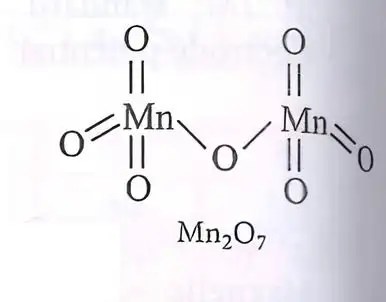
- Highest oxidation number equals group number: Sc2O3, TiO2, V2O5, CrO3, Mn2O7.
- No higher oxides beyond group 7 except Fe2O3 and Co3O4.
- Oxocations like TiO2+ and VO2+ exist.
- Oxides more stable than fluorides at high oxidation states due to multiple bonding by oxygen.
- MnF4 highest fluoride; Mn2O7 highest oxide.
- Mn2O7 structure: each Mn tetrahedrally surrounded by O; Mn-O-Mn bridge present.
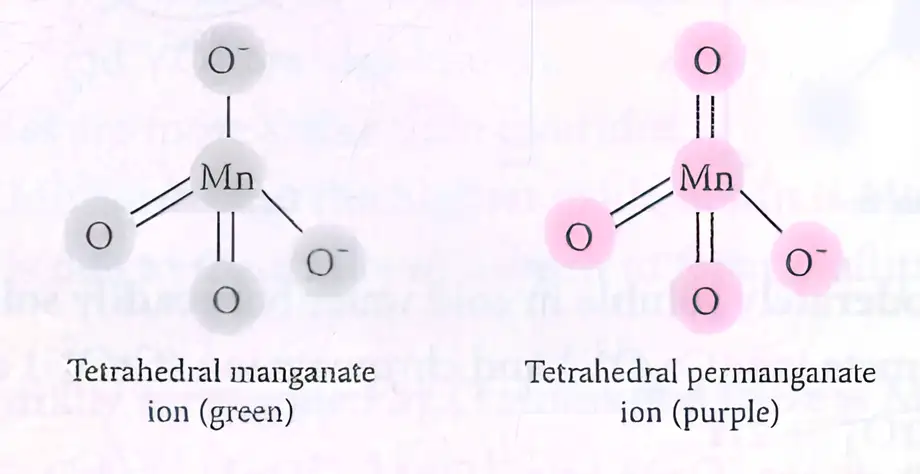
- Tetrahedral ions: VO43−, CrO42−, MnO43−, MnO42−, MnO4−.
Solved Examples
- Ex 1: Write the disproportionation reaction of Cu(I) in aqueous solution.
- 2Cu+ → Cu2+ + Cu - Ex 2: Why are fluorides more stable in higher oxidation states?
- Due to high lattice energy and strong covalent bonds with fluorine.
Practice Set
- Q1: Which halide shows highest oxidation state for vanadium?
A. VCl3
B. VF5
C. VBr4
D. VI2 - Q2: Which oxide corresponds to chromium in highest oxidation state?
A. CrO
B. Cr2O3
C. CrO3
D. CrO2 - Q3: Why is Mn2O7 more stable than MnF7 (hypothetical)?
A. Oxygen forms multiple bonds
B. Fluorine is less electronegative
C. Mn prefers lower oxidation states
D. Fluorides have lower lattice energy
Answer Key
- Q1: B - VF5 shows +5 oxidation state for vanadium.
- Q2: C - CrO3 corresponds to +6 oxidation state.
- Q3: A - Oxygen forms multiple bonds stabilizing higher oxidation states.
Memory Aids
- Fluorine stabilises high oxidation states by strong bonds and lattice energy.
- Highest oxide oxidation state = group number.
- Cu(I) disproportionates in aqueous solution.
Exceptions and Special Cases
Non-Typical Transition Elements
- Zn, Cd, Hg are d-block but not transition elements (pseudo transition metals).
- Anhydrous FeSO4 and CuSO4 are white due to absence of crystal field splitting despite unpaired electrons.
- Cu2+ (3d9, E° = 0.34 V) is more stable than Cu+ (3d10, E° = 0.54 V) except with large anions.
- Examples: CuI more stable than CuI2, CuCN more stable than Cu(CN)2.
- Among d-block, tungsten (W, Z=74) has highest melting point (3410°C), mercury (Hg, Z=80) lowest (-38.9°C).
Solved Examples
- Ex 1: Why is anhydrous CuSO4 white?
- No crystal field splitting without water ligands; no colour. - Ex 2: Which d-block element has highest melting point?
- Tungsten (W) at 3410°C.
Practice Set
- Q1: Which is NOT a typical transition metal?
A. Fe
B. Zn
C. Cr
D. Ni - Q2: Why is Cu2+ more stable than Cu+ in aqueous solution?
A. Higher ionisation energy
B. More negative hydration enthalpy
C. Larger ionic radius
D. Lower electrode potential - Q3: Which element has the lowest melting point among d-block?
A. W
B. Hg
C. Fe
D. Cu
Answer Key
- Q1: B - Zn is not a typical transition metal.
- Q2: B - Cu2+ has more negative hydration enthalpy stabilizing it.
- Q3: B - Mercury (Hg) has lowest melting point (-38.9°C).
Memory Aids
- Zn, Cd, Hg = pseudo transition metals.
- Cu2+ more stable than Cu+ in aqueous except with large anions.
- W highest melting point; Hg lowest among d-block.
Some Important Compounds of Transition Elements
Oxides and Oxoanions of Metals
- Transition metals form oxides by combining with oxygen at high temperatures.
- Except Sc, metals up to Mn form ionic monoxides (MO).
- Highest oxidation state in oxides equals group number.
- Examples: Sc2O3, Cr2O3, TiO2, Mn2O7, V2O5.
- After Mn, only Fe2O3 and Co3O4 higher oxides are known.
- Increasing oxidation number increases covalent character and acidic nature of oxides.
- Examples: V2O3 (basic), V2O4 (less basic), V2O5 (amphoteric).
- V2O5 reacts with alkalis and acids to form VO43− and VO2+ respectively.
- CrO is basic; Cr2O3 amphoteric; CrO3 and Mn2O7 acidic, forming acids in water.
- Reactions: CrO3 + H2O → H2CrO4; Mn2O7 + H2O → 2HMnO4.
Potassium Dichromate (K2Cr2O7)
Preparation
- Obtained by fusion of chromite ore (FeCr2O4):
- 4FeCr2O4 + 8Na2CO3 + 7O2 → 8Na2CrO4 + Fe2O3 + 8CO2
- Na2Cr2O7 + 2KCl → K2Cr2O7 + 2NaCl
Structure
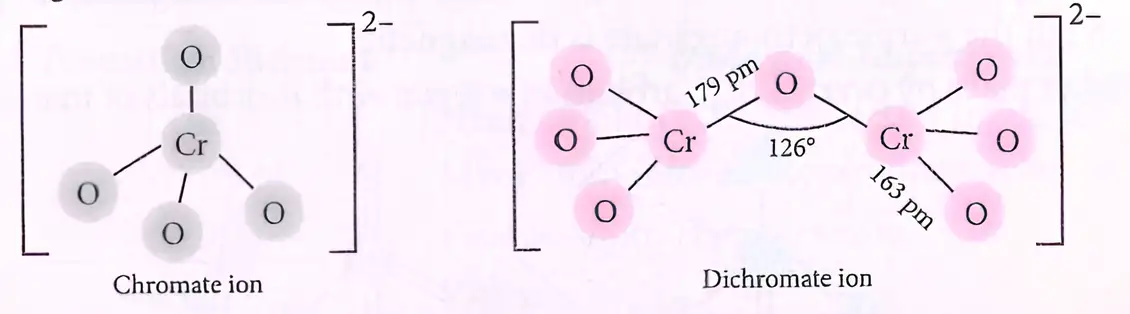
- Chromate ion (CrO42−) is tetrahedral.
- Dichromate ion (Cr2O72−) consists of two tetrahedra sharing one corner; Cr–O–Cr bond angle is 126°.
Properties
- Orange crystals, moderately soluble in cold water, readily soluble in hot water.
- In aqueous solution, equilibrium exists between dichromate and chromate ions:

- In alkaline medium: Cr2O72− + 2OH− ⇌ 2CrO42− + H2O (yellow solution)
- In acidic medium: 2CrO42− + 2H+ ⇌ Cr2O72− + H2O (orange solution)
- Strong oxidising agent in acidic medium:
- Cr2O72− + 14H+ + 6e− → 2Cr3+ + 7H2O
- Oxidises I− to I2, H2S to S, Sn2+ to Sn4+, Fe2+ to Fe3+.
- Chromyl chloride test: Metal chloride + K2Cr2O7 + conc. H2SO4 → red vapours of CrO2Cl2.
Potassium Permanganate (KMnO4)
Preparation
- From pyrolusite ore (MnO2):
- 2MnO2 + 4KOH + O2 → 2K2MnO4 + 2H2O
- K2MnO4 converted to KMnO4 by electrochemical oxidation:
- Anode: MnO42− → MnO4− + e− (green to purple)
- Cathode: 2H+ + 2e− → H2
- In acidic/neutral medium, manganate disproportionates:
- 3MnO42− + 4H+ → 2MnO4− + MnO2 + 2H2O

Laboratory Preparation
- Mn2+ salt oxidised by peroxodisulphate:
- 2Mn2+ + 5S2O82− + 8H2O → 2MnO4− + 10SO42− + 16H+
Structure
- Manganate and permanganate ions are tetrahedral.
- Manganate (green) is paramagnetic (1 unpaired electron); permanganate (purple) is diamagnetic.
- π-bonding via overlap of oxygen p-orbitals and manganese d-orbitals.
Properties
- Dark purple crystals, sparingly soluble in water, decompose on heating:
- 2KMnO4 → K2MnO4 + MnO2 + O2
- Strong oxidising agent in acidic and alkaline media.
- In acidic medium:
- MnO4− + 8H+ + 5e− → Mn2+ + 4H2O
- Oxidises I− to I2, Fe2+ to Fe3+, oxalate to CO2, H2S to S, sulphite to sulphate, nitrite to nitrate.
- In neutral/faintly alkaline medium:
- MnO4− + 2H2O + 3e− → MnO2 + 4OH−
- Used in volumetric titrations with dilute H2SO4 (not HCl or HNO3).
Uses
- Strong oxidant in organic and analytical chemistry.
- Bleaching agent for wool, cotton, silk, and textiles.
- Decolourises oils due to strong oxidising power.
The Inner Transition Elements (f-Block)
Definition and Series
- Elements with last electron entering f-orbital are f-block elements (inner transition elements).
- Consist of two series:
- Lanthanoids: 14 elements after lanthanum.
- Actinoids: 14 elements after actinium.
Solved Examples
Ex 1
- Write the reaction for preparation of potassium dichromate from chromite ore.
- Answer: 4FeCr2O4 + 8Na2CO3 + 7O2 → 8Na2CrO4 + Fe2O3 + 8CO2
Ex 2
- Show the equilibrium between chromate and dichromate ions in aqueous solution.
- Answer: Cr2O72− + 2OH− ⇌ 2CrO42− + H2O
Ex 3
- Write the half-reaction for reduction of permanganate ion in acidic medium.
- Answer: MnO4− + 8H+ + 5e− → Mn2+ + 4H2O
Practice Set
Q1
- Which oxide of vanadium is amphoteric?
- A) V2O3
- B) V2O4
- C) V2O5
- D) VO
Q2
- In acidic medium, potassium dichromate acts as a strong oxidising agent. What is the product formed after reduction?
- A) Cr6+
- B) Cr3+
- C) Cr2+
- D) Cr metal
Q3
- Which of the following statements about potassium permanganate is FALSE?
- A) It is purple and sparingly soluble in water.
- B) It decomposes on heating to give K2MnO4, MnO2, and O2.
- C) It acts as a reducing agent in acidic medium.
- D) It oxidises Fe2+ to Fe3+ in acidic medium.
Answer Key
- Q1: C) V2O5 - It is amphoteric; V2O3 is basic, V2O4 less basic.
- Q2: B) Cr3+ - Dichromate reduces to Cr3+ in acidic medium.
- Q3: C) It acts as a reducing agent in acidic medium - FALSE; it is a strong oxidising agent.
Memory Aids
- Dichromate-chromate equilibrium shifts yellow (alkaline) ↔ orange (acidic).
- Potassium permanganate is purple; manganate is green.
- KMnO4 oxidises Fe2+ to Fe3+ in acidic medium.
- Chromyl chloride test: red vapours indicate presence of chloride ion.
- f-Block = inner transition elements = lanthanoids + actinoids.
Lanthanoids Overview
Electronic Configurations
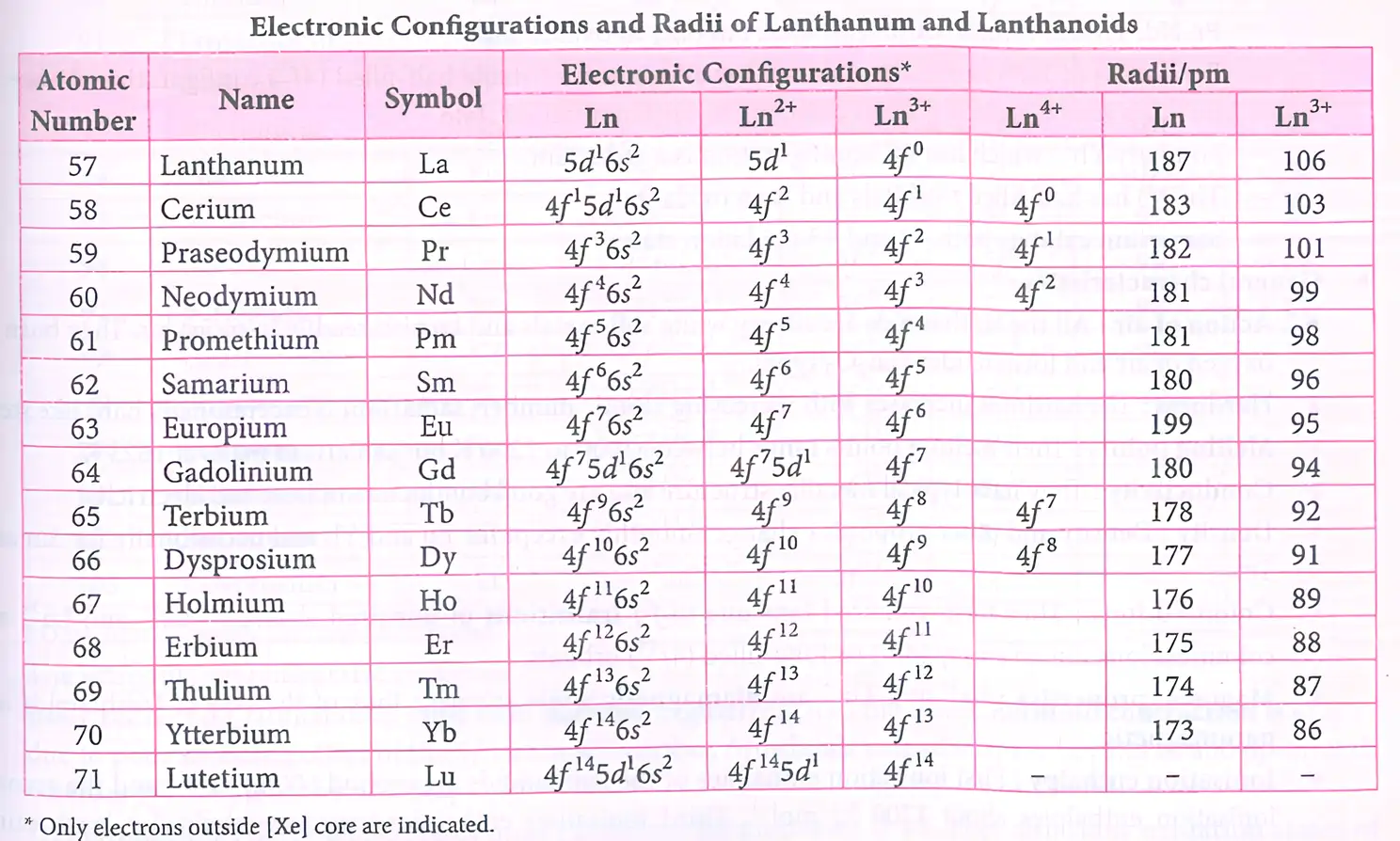
- General symbol: Ln
- Common configuration: 6s2 with variable 4f occupancy (4fn, n=1 to 14)
- Tripositive ions (Ln3+) have 4fn configurations
Atomic and Ionic Sizes
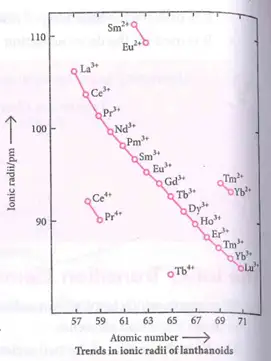
- Atomic and ionic radii decrease from La to Lu (lanthanoid contraction)
- Cause: Poor shielding by 4f electrons increases effective nuclear charge
- Atomic radii decrease irregularly; ionic radii decrease regularly
Oxidation States
- Predominant oxidation state: +3
- Other states: +2 and +4 due to stable empty (4f0), half-filled (4f7), fully-filled (4f14) subshells
- Examples: Ce4+ (4f0), Eu2+ (4f7), Tb4+ (4f7), Yb2+ (4f14)
- Ce4+ is a strong oxidant (E° = +1.74 V), used as analytical reagent
- Pr, Nd, Tb, Dy show +4 in oxides (MO2)
- Eu2+ and Yb2+ are strong reductants
- Samarium exhibits +2 and +3 states
General Characteristics
- Appearance: Silvery white, soft metals
- React with air: Tarnish in moist air, burn in oxygen forming Ln2O3
- Hardness increases with atomic number; samarium is very hard
- Melting points: 1000–1200 K; samarium melts at 1623 K
- Good conductors of heat and electricity
- Density varies smoothly except for Eu, Yb, Sm, Tm
- Colored ions due to f-f transitions; La3+ and Lu3+ are colorless
- Magnetic properties: La3+, Lu3+ diamagnetic; others paramagnetic
- Ionization enthalpy: 1st ~600 kJ/mol, 2nd ~1200 kJ/mol; 3rd varies due to stability of f-orbitals
- Standard electrode potentials: E°(Ln3+/Ln) ~ -2.2 to -2.4 V; Eu exception at -2.0 V
Chemical Behaviour
- React with H2 on gentle heating to form hydrides
- React with carbon on heating to form carbides (Ln3C, LnC2, Ln2C3)
- React with dilute acids to liberate H2: 2Ln + 6H+ → 2Ln3+ + 3H2
- Burn in halogens to form halides: 2Ln + 3X2 → 2LnX3
- Burn in oxygen to form oxides: 4Ln + 3O2 → 2Ln2O3
- Form basic oxides and hydroxides: M2O3 and M(OH)3
Solved Examples
Ex 1
- Explain why lanthanoid contraction occurs.
- Answer: Poor shielding by 4f electrons increases effective nuclear charge, pulling electrons closer and decreasing radii.
Ex 2
- Write the reaction of lanthanoids with dilute acid.
- Answer: 2Ln + 6H+ → 2Ln3+ + 3H2
Practice Set
Q1
Which lanthanoid ion is colorless due to fully filled 4f orbitals?
- A. Eu3+
- B. La3+
- C. Tb3+
- D. Gd3+
Q2
What is the predominant oxidation state of lanthanoids?
- A. +2
- B. +3
- C. +4
- D. +1
Q3
Which lanthanoid exhibits both +2 and +3 oxidation states?
- A. Samarium
- B. Cerium
- C. Ytterbium
- D. Terbium
Answer Key
- Q1: B. La3+ - has empty 4f orbitals (4f0), making it colorless.
- Q2: B. +3 - most stable and common oxidation state for lanthanoids.
- Q3: A. Samarium - exhibits both +2 and +3 states due to stable half-filled configuration.
Memory Aids
- Lanthanoid contraction: Poor 4f shielding → radius decreases across series.
- Stable oxidation states: +3 common; +2 and +4 due to empty, half, full 4f subshells.
- Colorless ions: La3+ (4f0), Lu3+ (4f14).
Actinoids Overview
Electronic Configuration
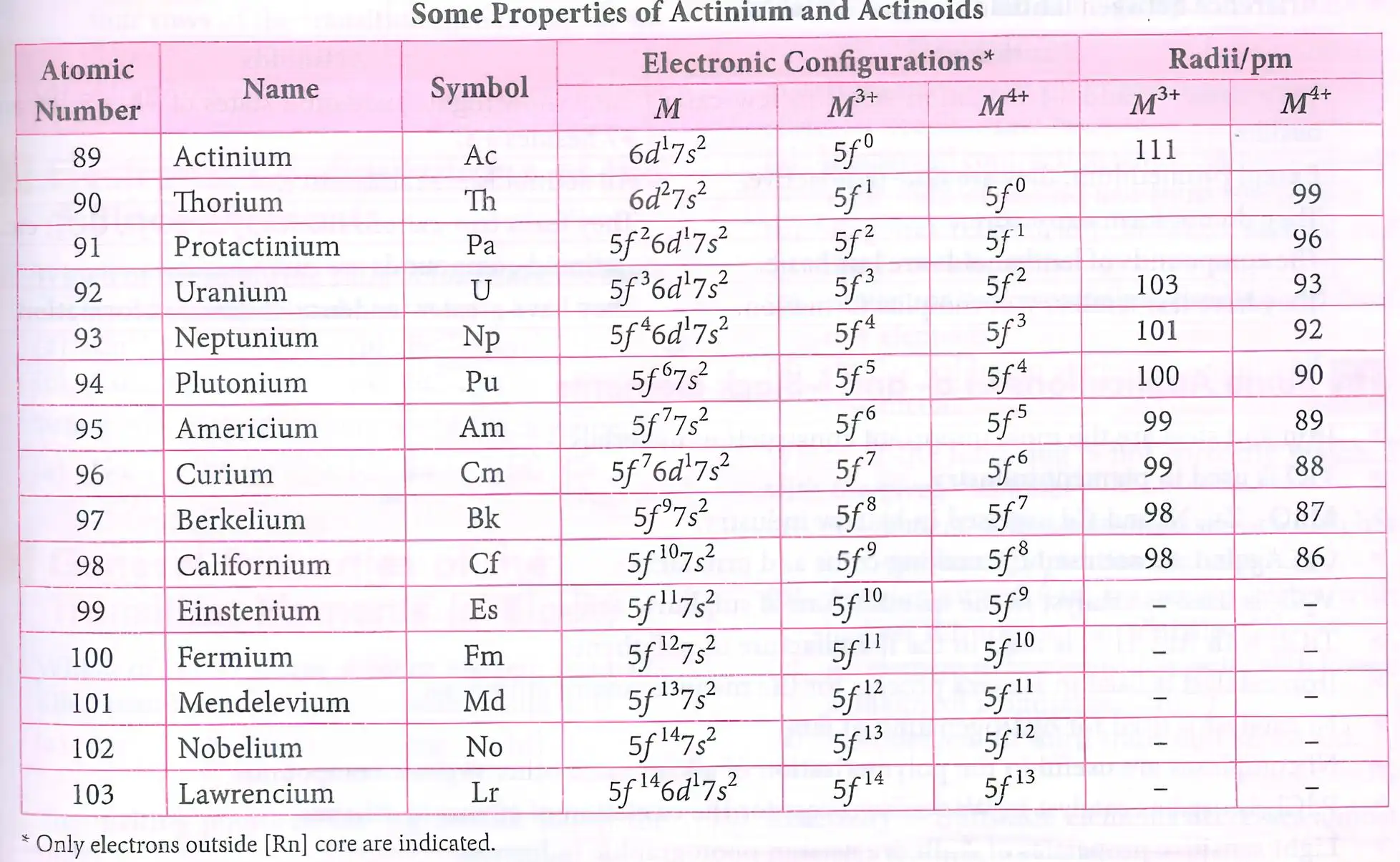
- Actinoids include 14 elements from Thorium (Th) to Lawrencium (Lr).
- General configuration: 5f0–14 6d0–2 7s2.
- Electrons fill 5f orbitals except Thorium (Z=90); filling continues till Lawrencium (Z=103).
- Irregularities due to extra stability at f0, f7, and f14 configurations.
- All actinoids are radioactive.
Ionic Radii
- Ionic radii decrease regularly across the series (actinoid contraction).
- Contraction is greater than lanthanoids due to poor shielding by 5f electrons.
- 5f orbitals extend beyond 6s and 6p orbitals; 4f orbitals are buried deeper.
Oxidation States
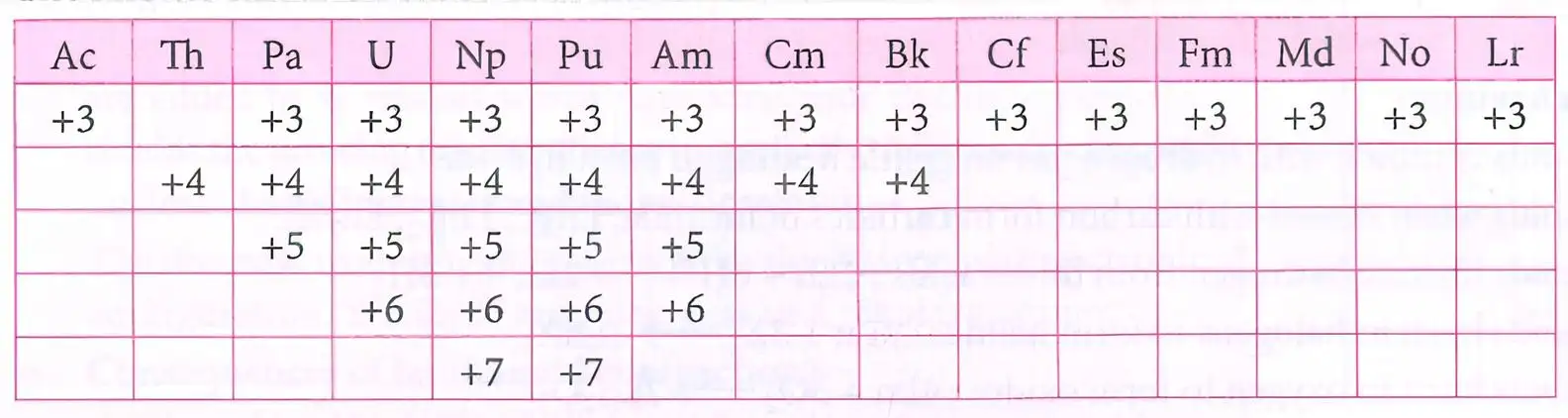
- Most common oxidation state is +3.
- Higher states +4, +5, +6, +7 occur in Th, Pa, U, Np respectively.
- Multiple oxidation states due to small energy gap between 5f, 6d, and 7s subshells.
Solved Examples
- Ex 1: Write the electronic configuration of Uranium (Z=92).
- U: [Rn] 5f3 6d1 7s2
- Ex 2: Identify the common oxidation states of Neptunium (Np).
- +3, +4, +5, +6, +7 (varies with compounds)
Practice Set
- Q1: Which element marks the start of the actinoid series?
- A. Thorium
- B. Actinium
- C. Uranium
- D. Lawrencium
- Q2: What is the most common oxidation state of actinoids?
- A. +2
- B. +3
- C. +4
- D. +5
- Q3: Why do actinoids show multiple oxidation states?
- A. Large energy gap between 5f and 6d orbitals
- B. Small energy gap between 5f, 6d, and 7s subshells
- C. Only 5f electrons involved
- D. Due to radioactive decay
Answer Key
- Q1: B - Actinium starts the actinoid series (Z=89).
- Q2: B - +3 is the most common oxidation state in actinoids.
- Q3: B - Small energy gap between 5f, 6d, and 7s allows multiple oxidation states.
Memory Aids
- Actinoids = 14 elements from Ac (89) to Lr (103).
- Common oxidation state +3; higher states in early actinoids.
- Actinoid contraction > lanthanoid contraction due to 5f poor shielding.
General Characteristics
Reactivity and Appearance
- Silvery white metals, tarnish rapidly in air forming oxide coating.
- Not attacked by alkalies; less reactive towards acids.
Colour and Magnetism
- Colored ions due to f–f transitions except Ac3+ (5f0), Cm3+ (5f7), Th4+ (5f0) which are colorless.
- Strongly paramagnetic.
Physical Properties
- High densities except Thorium and Americium.
- High melting and boiling points; no regular trend with atomic number.
- Low ionization energies.
Chemical Properties
- Strong reducing agents.
- Highly electropositive metals.
Solved Examples
- Ex 1: Explain why actinoids tarnish rapidly in air.
- They form oxide coating due to high reactivity with oxygen.
- Ex 2: Why are most actinoid ions colored?
- Due to f–f electronic transitions in 5f orbitals.
Practice Set
- Q1: Which actinoid ion is colorless?
- A. Cm3+
- B. Ac3+
- C. U3+
- D. Np3+
- Q2: Actinoids are strong reducing agents because they have:
- A. High ionization energy
- B. Low ionization energy
- C. High electronegativity
- D. Low atomic size
- Q3: Which property does NOT show a regular trend across actinoids?
- A. Ionic radii
- B. Melting point
- C. Oxidation state
- D. Paramagnetism
Answer Key
- Q1: B - Ac3+ (5f0) is colorless.
- Q2: B - Low ionization energy makes actinoids strong reducing agents.
- Q3: B - Melting and boiling points show no regular trend.
Memory Aids
- Colorless ions: Ac3+, Th4+, Cm3+.
- Actinoids tarnish fast due to oxide layer formation.
- Strong reducing agents due to low ionization energy.
Comparison: Lanthanoids vs Actinoids
Oxidation States
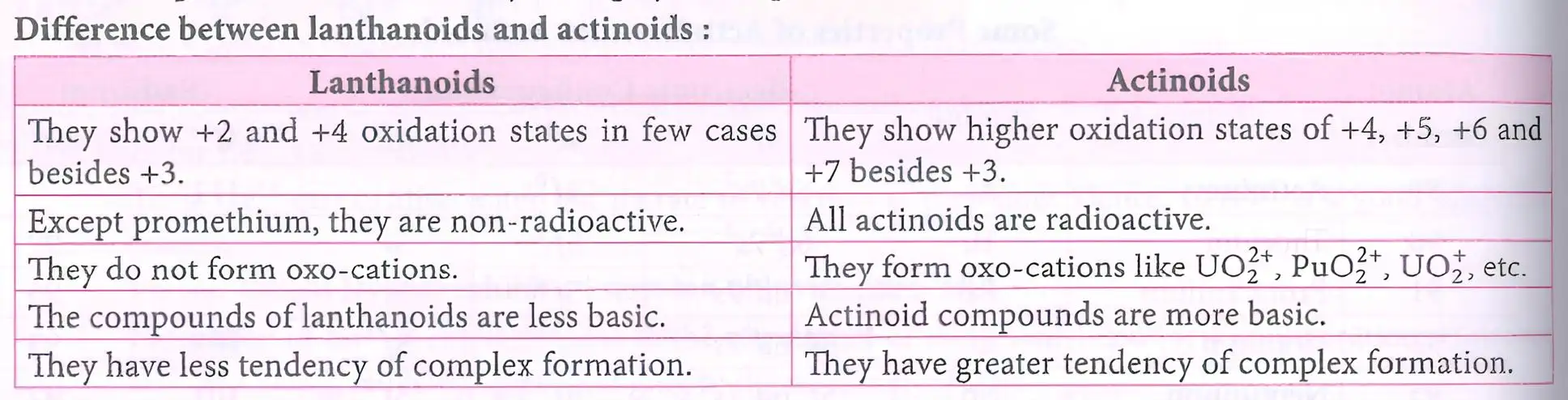
- Lanthanoids mostly +3; some +2 and +4.
- Actinoids show +3 and higher states (+4 to +7).
Radioactivity
- Lanthanoids mostly non-radioactive except Promethium.
- All actinoids are radioactive.
Cation Formation and Basicity
- Lanthanoids do not form oxo-cations.
- Actinoids form oxo-cations (e.g., UO22+, PuO22+).
- Actinoid compounds are more basic than lanthanoids.
Complex Formation
- Lanthanoids have less tendency to form complexes.
- Actinoids readily form complex compounds.
Solved Examples
- Ex 1: Identify which series forms oxo-cations.
- Actinoids form oxo-cations; lanthanoids do not.
- Ex 2: Which series is more radioactive?
- Actinoids are all radioactive; lanthanoids mostly not.
Practice Set
- Q1: Which series shows higher oxidation states?
- A. Lanthanoids
- B. Actinoids
- C. Both equal
- D. Neither
- Q2: Which series forms oxo-cations?
- A. Lanthanoids
- B. Actinoids
- C. Both
- D. None
- Q3: Which statement is true?
- A. Lanthanoids are mostly radioactive.
- B. Actinoids rarely form complexes.
- C. Actinoids are more basic than lanthanoids.
- D. Lanthanoids have higher oxidation states than actinoids.
Answer Key
- Q1: B - Actinoids show higher oxidation states (+4 to +7).
- Q2: B - Actinoids form oxo-cations like UO22+.
- Q3: C - Actinoids are more basic than lanthanoids.
Memory Aids
- Actinoids: radioactive, multiple oxidation states, oxo-cations.
- Lanthanoids: mostly +3, less reactive, no oxo-cations.
- Actinoids form complexes easily; lanthanoids less so.
Some Applications of d- and f-Block Elements
Key Industrial Uses
- Iron and steel: Primary materials for construction and infrastructure.
- Titanium dioxide (TiO2): Widely used as a white pigment in paints and coatings.
- Manganese dioxide (MnO2), Zinc (Zn), Nickel (Ni), Cadmium (Cd): Essential components in battery manufacturing.
- Copper (Cu), Silver (Ag), Gold (Au): Used in coins, jewelry, and ornaments due to their malleability and luster.
- Vanadium pentoxide (V2O5): Catalyst in the Contact process for sulphuric acid production.
- Titanium tetrachloride (TiCl4) with trimethylaluminium (Al(CH3)3): Catalysts in the polymerization of ethylene to polythene.
- Iron catalyst: Used in Haber’s process for ammonia synthesis from N2 and H2.
- Nickel catalyst: Facilitates hydrogenation of unsaturated fats to saturated fats.
- Nickel complexes: Catalyze polymerization of alkynes and other organic compounds.
- Palladium chloride (PdCl2): Catalyst in Wacker’s process converting ethyne to ethanal.
- Silver bromide (AgBr): Light-sensitive compound used in photographic films.
- Neodymium and praseodymium oxides: Used in colored glasses for goggles; absorb yellow sodium light, protecting glass blowers' eyes.
Solved Examples
- Ex 1: Identify the catalyst used in the Haber process.
Solution: Iron catalyst is used to synthesize ammonia (NH3) from nitrogen and hydrogen gases. - Ex 2: Write the catalyst combination used in polythene manufacture.
Solution: TiCl4 with Al(CH3)3 acts as catalyst in ethylene polymerization to polythene. - Ex 3: Name the catalyst for oxidation of ethyne to ethanal.
Solution: PdCl2 is used as catalyst in Wacker’s process.
Practice Set
- Q1: Which element is primarily used as a catalyst in the Haber process?
A. Nickel
B. Iron
C. Palladium
D. Vanadium - Q2: TiO2 is mainly used in which industry?
A. Battery
B. Pigment
C. Photographic
D. Polymerization - Q3: Which of the following is used as a catalyst in the manufacture of sulphuric acid?
A. V2O5
B. MnO2
C. PdCl2
D. Fe
Answer Key
- Q1: B. Iron
Iron acts as the catalyst in Haber’s process for ammonia synthesis. - Q2: B. Pigment
TiO2 is widely used as a white pigment in paints and coatings. - Q3: A. V2O5
Vanadium pentoxide catalyzes the Contact process for sulphuric acid production.
Memory Aids
- Haber’s process catalyst: Fe (Iron) for Ammonia.
- Polythene catalyst: TiCl4 + Al(CH3)3.
- Wacker’s process catalyst: PdCl2 for ethyne oxidation.
- Battery metals: MnO2, Zn, Ni, Cd.
- Photographic industry: AgBr light sensitivity.
- Colored goggles: Nd and Pr oxides absorb yellow sodium light.
NEET Chemistry — ALL CHAPTERS
1
Some Basic Concepts of Chemistry
2
Structure of Atom
3
Classification of Elements and Periodicity in Properties
4
Chemical Bonding and Molecular Structure
5
Thermodynamics
6
Equilibrium
7
Redox Reactions
8
Organic Chemistry - Some Basic Principles and Techniques
9
Hydrocarbons
10
Solutions
11
Electrochemistry
12
Chemical Kinetics
13
The d- and f- Block Elements
14
Coordination Compounds
15
Haloalkanes and Haloarenes
16
Alcohols, Phenols and Ethers
17
Aldehydes, Ketones and Carboxylic Acids
18
Amines
19
Biomolecules
20
The p-Block Elements (Group 13 and 14)
21
The p-Block Elements (Group 15 to 18)
22
Principles Related to Practical Chemistry