NEET Ug . NEET Chemistry . Chemistry . Alcohols Phenols and Ethers
Chapter 16: Alcohols, Phenols and Ethers
Ch 16
NEET Chemistry
NEET Ug
Introduction
Alcohols and Phenols
Alcohols: Hydroxyl (—OH) group replaces hydrogen in aliphatic hydrocarbons.
Phenols: Hydroxyl (—OH) group directly attached to aromatic ring (C6H5OH).
Monohydric alcohols general formula: CnH2n+1OH.
Phenol (C6H5OH) also called carbolic acid.
Ethers
Ethers: Alkoxy (R–O–R) or aryloxy (Ar–O–Ar) substitution in hydrocarbons.
General formula: CnH2n+2O, n > 1.
Solved Examples
Ex 1: Identify the functional group in C2H5OH.
Step: —OH group attached to aliphatic carbon → Alcohol.
Ex 2: Write formula of phenol.
Step: Hydroxyl attached to benzene ring → C6H5OH.
Practice Set
Q1: Which compound is a phenol?
A. C2H5OH B. C6H5OH C. CH3OCH3 D. C2H5OCH3Q2: General formula of ethers is:
A. CnH2n+1OH B. CnH2nO C. CnH2n+2O D. CnH2n+1OQ3: Which is carbolic acid?
A. C6H5OH B. C2H5OH C. CH3OH D. C6H5OCH3
Answer Key
Q1: B — C6H5OH is phenol with —OH on aromatic ring.
Q2: C — Ethers have formula CnH2n+2O.
Q3: A — Carbolic acid is phenol (C6H5OH).
Memory Aids
Alcohol = —OH on aliphatic carbon.
Phenol = —OH on benzene ring.
Ethers = R–O–R, formula CnH2n+2O.
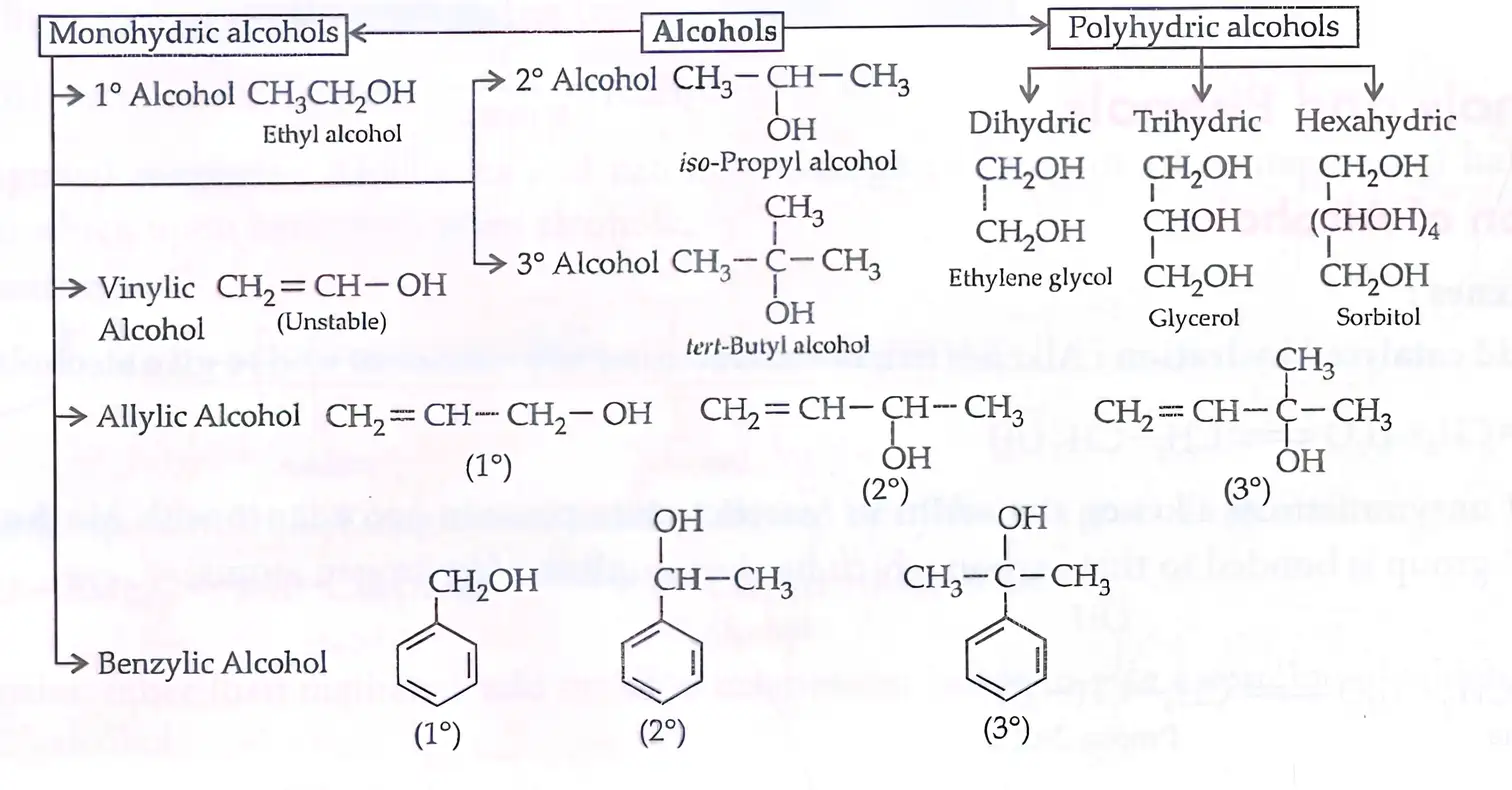
Classification
Alcohols
Monohydric: One —OH group.
Polyhydric: Two or more —OH groups.
Monohydric types:
Primary (1°): —OH on carbon attached to 1 carbon (e.g., ethyl alcohol).
Secondary (2°): —OH on carbon attached to 2 carbons (e.g., isopropyl alcohol).
Tertiary (3°): —OH on carbon attached to 3 carbons (e.g., tert-butyl alcohol).
Special types: Vinylic (unstable), Allylic (near double bond), Benzylic (attached to benzene ring).
Polyhydric types:
Dihydric (2 —OH): Ethylene glycol.
Trihydric (3 —OH): Glycerol.
Hexahydric (6 —OH): Sorbitol.
Phenols
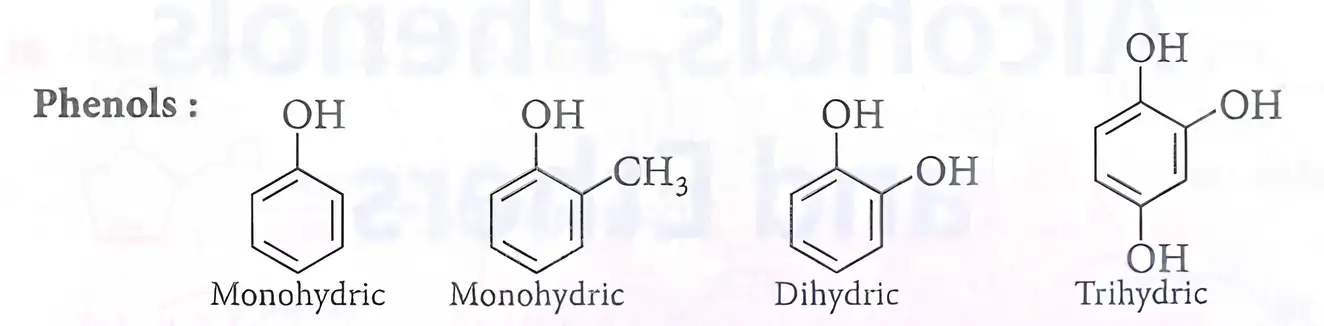
Monohydric: One —OH group (e.g., phenol, cresol).
Dihydric: Two —OH groups on benzene ring.
Trihydric: Three —OH groups on benzene ring.
Ethers
Simple/Symmetrical: Same alkyl/aryl groups on oxygen (e.g., diethyl ether C2H5OC2H5).
Mixed/Unsymmetrical: Different groups on oxygen (e.g., C2H5OCH3).
Solved Examples
Ex 1: Classify CH3CH(OH)CH3.
Step: —OH on carbon attached to two carbons → Secondary alcohol.
Ex 2: Identify ether type: C2H5OC6H5.
Step: Different alkyl and aryl groups → Unsymmetrical ether.
Practice Set
Q1: Which is a tertiary alcohol?
A. CH3CH2OH B. (CH3)3COH C. CH3CHOHCH3 D. CH2=CHCH2OHQ2: Which phenol has two —OH groups?
A. Monohydric B. Dihydric C. Trihydric D. NoneQ3: Diethyl ether is:
A. Symmetrical ether B. Unsymmetrical ether C. Alcohol D. Phenol
Answer Key
Q1: B — (CH3)3COH is tertiary alcohol.
Q2: B — Dihydric phenol has two —OH groups.
Q3: A — Diethyl ether has same alkyl groups, symmetrical ether.
Memory Aids
Primary alcohol: —OH on carbon with 1 carbon neighbor.
Secondary alcohol: —OH on carbon with 2 carbon neighbors.
Tertiary alcohol: —OH on carbon with 3 carbon neighbors.
Phenols classified by number of —OH on benzene.
Ethers: Symmetrical if groups same, unsymmetrical if different.
Nomenclature Alcohols
Common and IUPAC Naming
Common system: Named as alkyl alcohol (e.g., methyl alcohol).
IUPAC system: Named as alkanols by replacing 'e' in alkane with '-ol' (e.g., methanol).
Cyclic alcohols: Use prefix 'cyclo' and number —OH at C-1 (e.g., cyclohexanol).
Solved Examples
Ex 1: Name CH3CH2OH.
Ethane → Ethanol (IUPAC)
Ex 2: Name cyclo-C6H11OH.
Cyclohexane → Cyclohexanol
Practice Set
Q1: What is the IUPAC name of CH3CH2CH2OH?
A. Propanol
B. Propan-2-ol
C. Propanal
D. Propanone
Q2: How is cyclohexanol named?
A. Cyclohexane
B. Cyclohexanol
C. Hexanol
D. Cyclohexanone
Q3: Which suffix is used in IUPAC naming of alcohols?
A. -al
B. -one
C. -ol
D. -ene
Answer Key
Q1: A. Propanol - Three carbon alkane with -OH suffix is propanol.
Q2: B. Cyclohexanol - Cyclic alcohols use 'cyclo' prefix and '-ol' suffix.
Q3: C. -ol - Alcohols are named by replacing 'e' in alkane with '-ol'.
Memory Aids
Alcohols: Alkane name + 'ol' suffix.
Cyclic alcohols: 'cyclo' prefix + 'ol' suffix, —OH at C-1.
Remember: 'ol' indicates presence of —OH group.
Nomenclature Phenols
Basic Naming and Substitution
Phenol: Hydroxybenzene, simplest hydroxy derivative of benzene.
Phenol is both common and accepted IUPAC name.
Substituted phenols use ortho (1,2-), meta (1,3-), para (1,4-) for positions.
Dihydroxybenzenes named as 1,2-, 1,3-, 1,4-benzenediol.
Solved Examples
Ex 1: Name C6H4(OH)(NO2) with —NO2 at adjacent carbon.
Ortho-nitrophenol (1,2-disubstituted)
Ex 2: Name C6H4(OH)2 with —OH groups at 1 and 4.
1,4-benzenediol (para-dihydroxybenzene)
Practice Set
Q1: What is the common name of C6H5OH?
A. Benzene
B. Phenol
C. Aniline
D. Toluene
Q2: Which term describes 1,3-disubstituted phenol?
A. Ortho
B. Meta
C. Para
D. None
Q3: What is the IUPAC name of benzene with two —OH groups at 1 and 2?
A. 1,2-benzenediol
B. 1,3-benzenediol
C. 1,4-benzenediol
D. Phenol
Answer Key
Q1: B. Phenol - Hydroxybenzene is phenol.
Q2: B. Meta - 1,3-disubstitution is meta position.
Q3: A. 1,2-benzenediol - Dihydroxybenzene with —OH at 1 and 2.
Memory Aids
Ortho = adjacent (1,2-), Meta = separated by one carbon (1,3-), Para = opposite (1,4-).
Dihydroxybenzenes named as benzenediols with position numbers.
Phenol = benzene ring + —OH.
Nomenclature Ethers
Common and IUPAC Naming
Common names: Alkyl/aryl groups named alphabetically + 'ether' (e.g., ethyl methyl ether).
If alkyl groups are same, prefix 'di' is added (e.g., diethyl ether).
IUPAC: Ethers are hydrocarbon derivatives with —OR or —OAr substituent.
Larger alkyl group chosen as parent hydrocarbon; smaller as alkoxy substituent.
Solved Examples
Ex 1: Name CH3OCH2CH3.
Common: Ethyl methyl ether
IUPAC: Methoxyethane
Ex 2: Name CH3OCH3.
Common: Dimethyl ether
IUPAC: Methoxymethane
Practice Set
Q1: What is the common name of CH3OCH3?
A. Methyl ethyl ether
B. Dimethyl ether
C. Ethoxyethane
D. Methoxyethane
Q2: According to IUPAC, how is CH3OCH2CH3 named?
A. Ethoxyethane
B. Methoxyethane
C. Ethyl methyl ether
D. Methoxymethane
Q3: In IUPAC naming of ethers, which group is chosen as parent?
A. Smaller alkyl group
B. Larger alkyl group
C. Aryl group always
D. None
Answer Key
Q1: B. Dimethyl ether - Two methyl groups + ether.
Q2: B. Methoxyethane - Larger group ethane is parent; methoxy is substituent.
Q3: B. Larger alkyl group - Parent hydrocarbon is larger alkyl group.
Memory Aids
Common: Alphabetical alkyl groups + 'ether'.
IUPAC: Larger alkyl as parent, smaller as alkoxy substituent.
Same alkyl groups: use 'di' prefix in common names.
Structures of Functional Groups
Alcohols
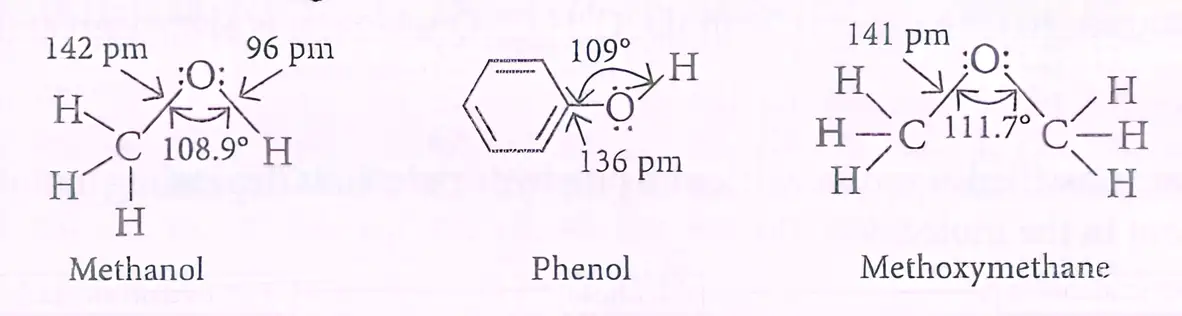
Hydroxyl group (–OH) attached to sp3 hybridised carbon atom.
Oxygen forms sigma (σ) bond with carbon via overlap of sp3 orbitals.
Bond angle around oxygen ~108.9° (tetrahedral geometry).
Phenols
Hydroxyl group (–OH) attached to sp2 hybridised carbon of aromatic ring.
Bond angle around oxygen ~109°.
Bond lengths differ due to resonance in aromatic system.
Ethers
Oxygen atom bonded to two carbon atoms.
Four electron pairs on oxygen: two bonding pairs and two lone pairs.
Electron pairs arranged approximately tetrahedrally.
Bond angle around oxygen ~111.7°.
Solved Examples
Ex 1: Identify hybridisation of oxygen in methanol.
- Oxygen in methanol is sp3 hybridised due to tetrahedral electron pair arrangement.Ex 2: Compare bond angles in phenol and ether.
- Phenol: ~109° (sp2 C attached), Ether: ~111.7° (two C atoms attached), showing slight variation due to bonding environment.
Practice Set
Q1: What is the hybridisation of oxygen in alcohols?
A. sp
B. sp2
C. sp3
D. dsp2Q2: In phenol, the –OH group is attached to which type of carbon?
A. sp hybridised carbon
B. sp2 hybridised carbon
C. sp3 hybridised carbon
D. None of theseQ3: Which statement about ethers is correct?
A. Oxygen has two lone pairs and two bonding pairs arranged tetrahedrally
B. Oxygen is bonded to one carbon and one hydrogen
C. Oxygen is sp hybridised
D. Bond angle around oxygen is 120°
Answer Key
Q1: C. sp3
- Oxygen in alcohols has tetrahedral electron pair geometry, indicating sp3 hybridisation.Q2: B. sp2 hybridised carbon
- Phenol’s –OH is attached to aromatic ring carbon which is sp2 hybridised.Q3: A. Oxygen has two lone pairs and two bonding pairs arranged tetrahedrally
- Ethers have oxygen bonded to two carbons with two lone pairs, forming tetrahedral electron pair geometry.
Memory Aids
Alcohol oxygen = sp3, tetrahedral, bond angle ~109°.
Phenol oxygen attached to aromatic sp2 carbon.
Ethers: oxygen bonded to two carbons + two lone pairs = tetrahedral arrangement.
Alcohols and Phenols
Preparation of Alcohols from Alkenes
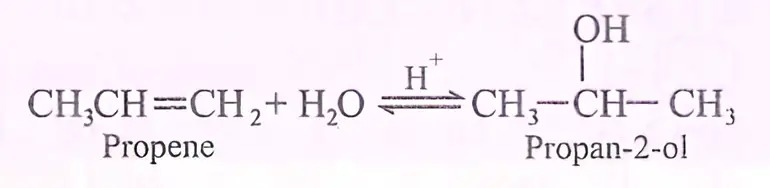
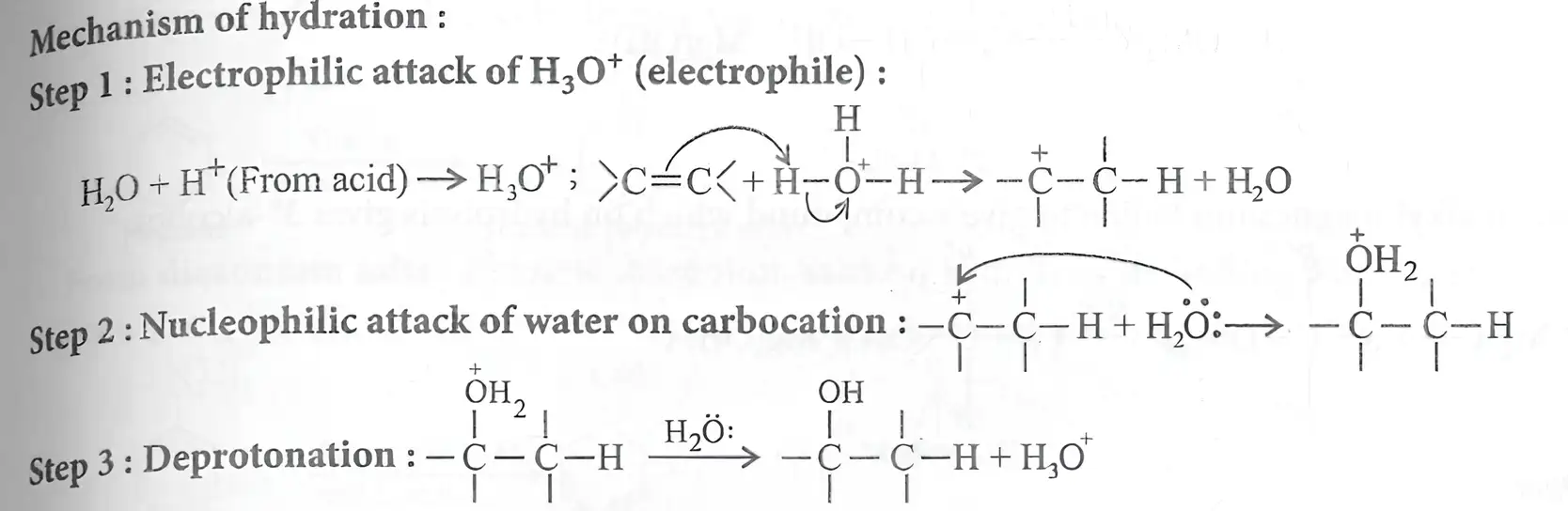
Acid catalysed hydration: Alkenes react with water in presence of acid (H+) to form alcohols.
Example: Ethene + H2O (acid catalyst) ⇌ Ethanol.

In unsymmetrical alkenes, -OH attaches to carbon with fewer hydrogens (Markownikov’s rule).
Hydroboration-oxidation: Alkene reacts with diborane (B2H6) forming trialkyl boranes, then oxidized with H2O2/OH− to give alcohols.
Follows anti-Markownikov’s rule; -OH attaches to less substituted carbon.
Solved Examples
Ex 1: Hydration of propene forms propan-2-ol via acid catalysis.
Ex 2: Hydroboration-oxidation of propene yields propan-1-ol.

Practice Set
Q1: In acid catalysed hydration of 1-butene, the major product is:
A) 1-butanol
B) 2-butanol
C) Butanal
D) ButanoneQ2: Hydroboration-oxidation of 2-methylpropene gives:
A) 2-methyl-2-propanol
B) 2-methyl-1-propanol
C) 1-propanol
D) 2-propanolQ3: Markownikov’s rule predicts the -OH group attaches to the carbon:
A) With more hydrogens
B) With fewer hydrogens
C) With more alkyl groups
D) With less alkyl groups
Answer Key
Q1: B; Markownikov’s rule directs -OH to more substituted carbon, forming 2-butanol.
Q2: B; Hydroboration-oxidation adds -OH to less substituted carbon, giving 2-methyl-1-propanol.
Q3: B; -OH attaches to carbon with fewer hydrogens (more substituted carbon).
Memory Aids
Markownikov’s rule: "Rich get richer" (more substituted carbon gets -OH).
Hydroboration-oxidation: Anti-Markownikov, syn addition, -OH on less substituted carbon.
Preparation of Alcohols from Carbonyl Compounds
Reduction of Aldehydes and Ketones
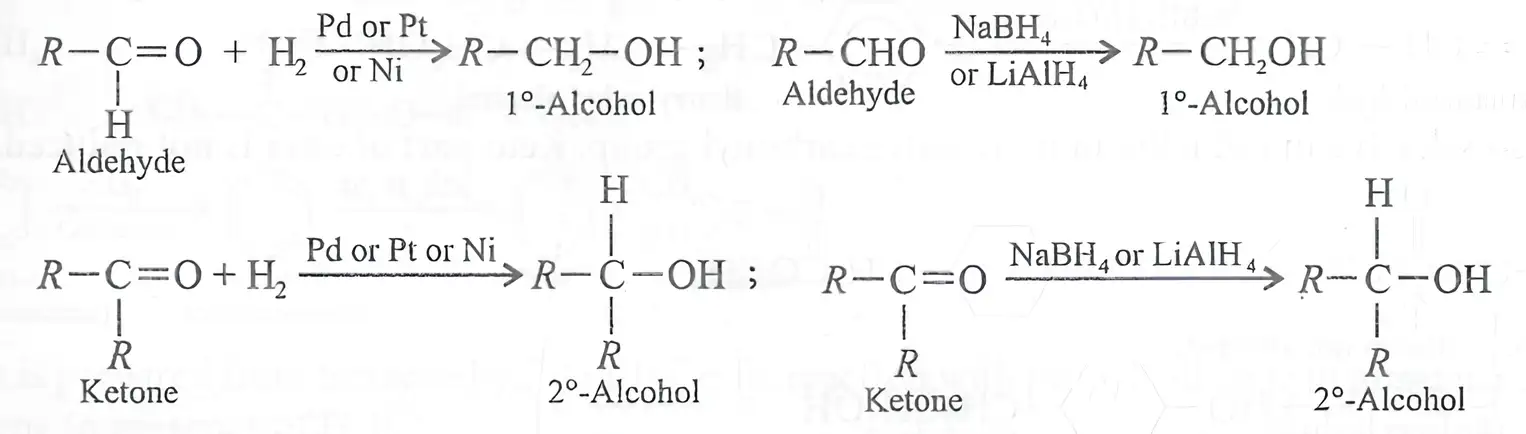
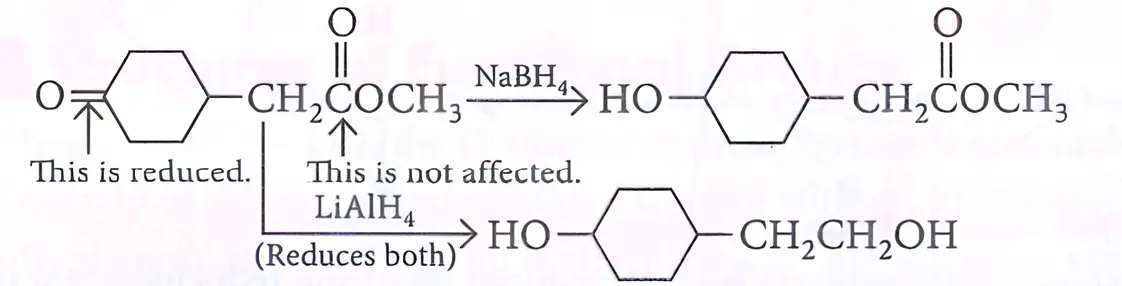
Aldehydes reduce to primary alcohols; ketones reduce to secondary alcohols.
Reducing agents: H2/metal catalyst (Pd, Pt, Ni), NaBH4, LiAlH4.
Reduction of Carboxylic Acids and Esters
Strong reducing agents like LiAlH4 reduce carboxylic acids and esters to primary alcohols.
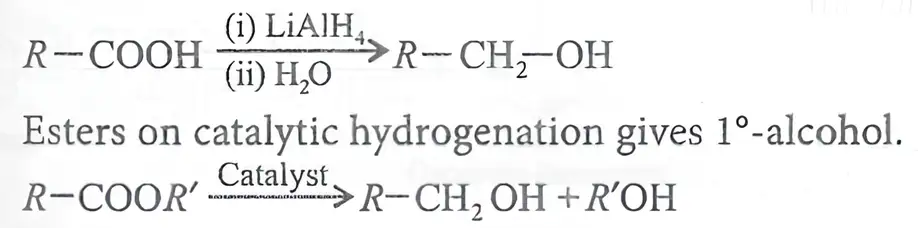

Commercially, acids are converted to esters then hydrogenated catalytically to alcohols.
From Grignard Reagents
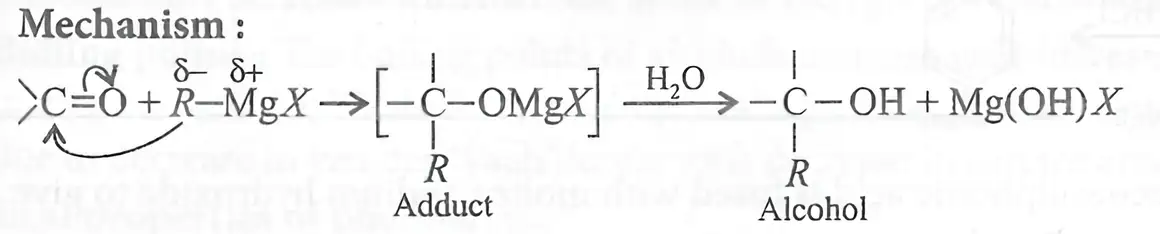
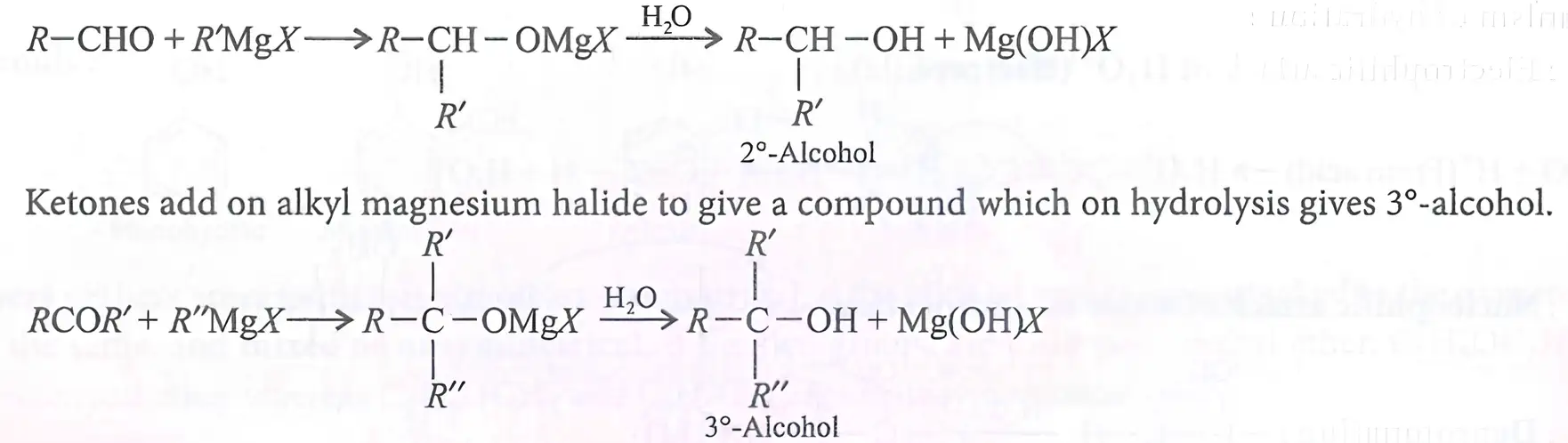
Grignard reagents (R–MgX) add to aldehydes and ketones forming alcohols after hydrolysis.
Methanal + Grignard → primary alcohol; other aldehydes → secondary alcohol; ketones → tertiary alcohol.

Solved Examples
Ex 1: Reduction of propanal with NaBH4 gives propanol (primary alcohol).
Ex 2: Reaction of acetone with methyl magnesium bromide followed by hydrolysis yields 2-methyl-2-propanol (tertiary alcohol).
Practice Set
Q1: Reduction of benzaldehyde with LiAlH4 produces:
A) Benzyl alcohol
B) Phenol
C) Benzoic acid
D) BenzeneQ2: Grignard reagent reacts with formaldehyde to give:
A) Primary alcohol
B) Secondary alcohol
C) Tertiary alcohol
D) KetoneQ3: Which reducing agent reduces both ketone and ester groups?
A) NaBH4
B) LiAlH4
C) H2/Pd
D) Zn/HCl
Answer Key
Q1: A; Benzaldehyde reduces to benzyl alcohol (primary alcohol).
Q2: A; Formaldehyde + Grignard gives primary alcohol after hydrolysis.
Q3: B; LiAlH4 reduces both ketone and ester groups; NaBH4 is selective.
Memory Aids
NaBH4 reduces aldehydes and ketones only; LiAlH4 reduces esters and acids too.
Grignard + formaldehyde → 1° alcohol; other aldehydes → 2°; ketones → 3° alcohols.
Preparation of Phenol
From Haloarenes (Dow's Process)
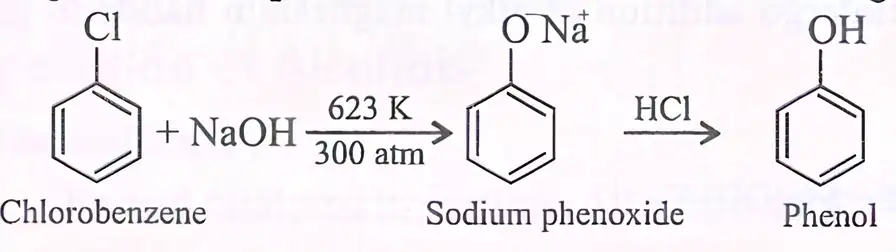
Chlorobenzene fused with NaOH at 623 K and 300 atm forms sodium phenoxide.
Acidification of sodium phenoxide yields phenol.
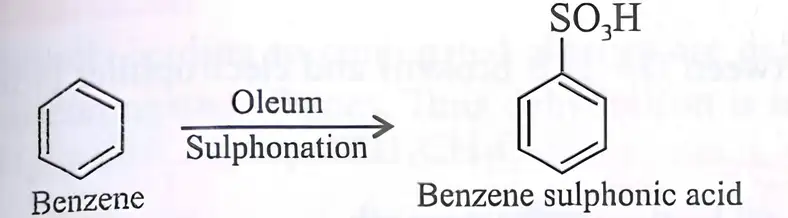
From Benzenesulphonic Acid
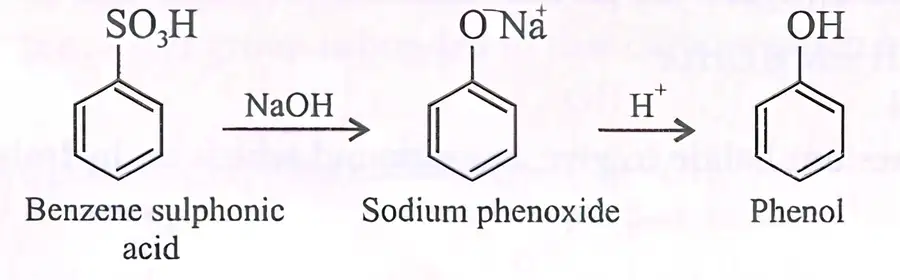
Benzenesulphonic acid fused with molten NaOH forms sodium phenoxide.
Acidification gives phenol.
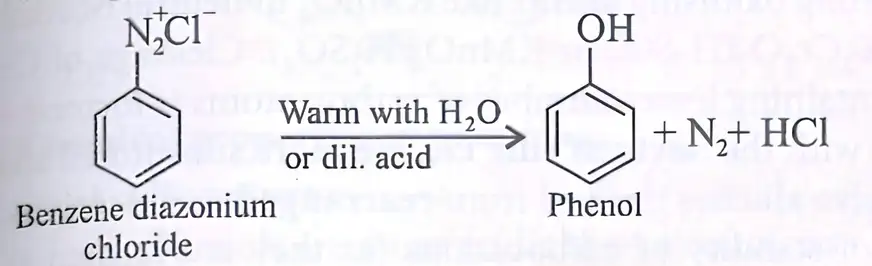
From Benzene Diazonium Salts
Benzene diazonium chloride hydrolyzed by heating with water or dilute acid forms phenol.
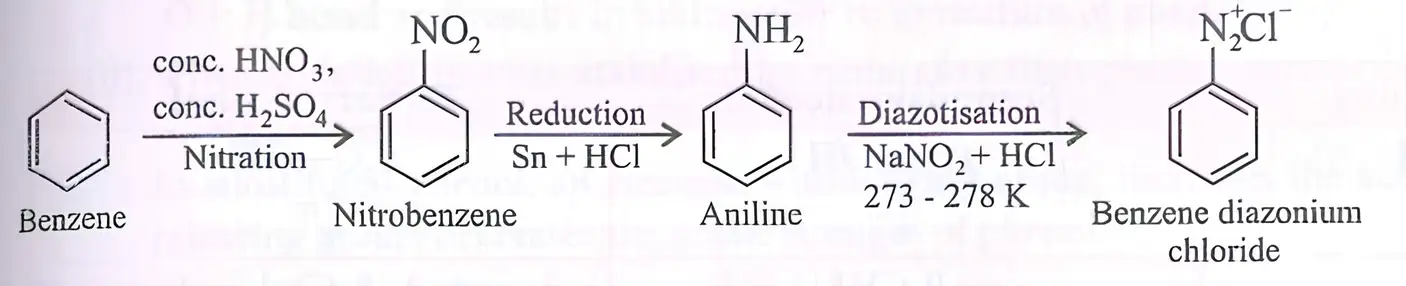
Benzene diazonium chloride prepared by nitration, reduction, and diazotisation of benzene.
From Cumene (Industrial Method)
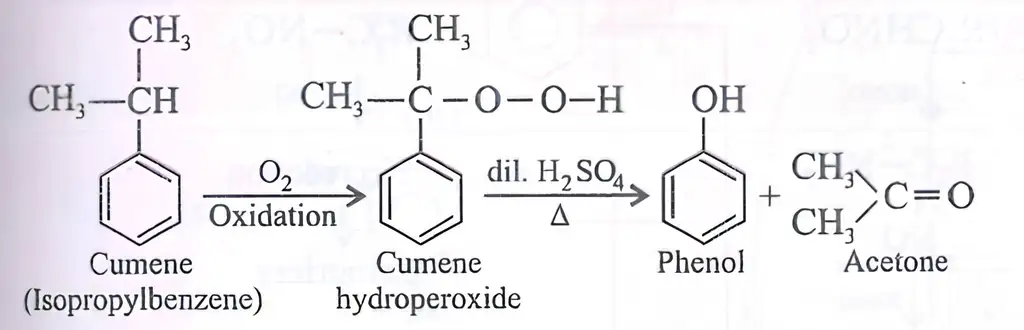
Cumene oxidized by air forms cumene hydroperoxide.
Acid treatment of cumene hydroperoxide yields phenol and acetone.
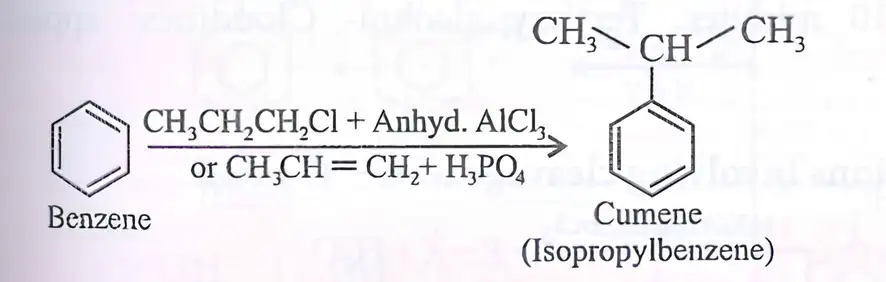
Cumene prepared by Friedel-Crafts alkylation of benzene with propyl chloride or propene.
Solved Examples
Ex 1: Dow's process: Chlorobenzene + NaOH (fused) → sodium phenoxide → phenol on acidification.
Ex 2: Cumene oxidation and acid treatment produce phenol and acetone.
Practice Set
Q1: Phenol is obtained from chlorobenzene by:
A) Nitration
B) Sulphonation
C) Fusion with NaOH
D) OxidationQ2: Benzene diazonium chloride is prepared by:
A) Reduction of aniline
B) Diazotisation of aniline
C) Nitration of benzene
D) Sulphonation of benzeneQ3: Industrial phenol production involves:
A) Benzene sulphonation
B) Cumene oxidation
C) Chlorobenzene hydrolysis
D) Benzene nitration
Answer Key
Q1: C; Chlorobenzene fused with NaOH forms sodium phenoxide, then phenol.
Q2: B; Diazotisation of aniline forms benzene diazonium chloride.
Q3: B; Cumene oxidation is the main industrial method for phenol.
Memory Aids
Dow's process: Chlorobenzene + NaOH (fused) → phenol.
Cumene process: Cumene → cumene hydroperoxide → phenol + acetone.
Diazotisation: Aniline + NaNO2/HCl → diazonium salt → phenol.
Physical Properties
Alcohols
Lower alcohols: colourless liquids with characteristic smell.
Higher alcohols: colourless, odourless waxy solids.
Solubility in water due to hydrogen bonding; decreases with longer alkyl chain, increases with branching.
Boiling points increase with carbon number (van der Waals forces), decrease with branching.
Phenols
Colourless crystalline solids or liquids with characteristic phenolic odour.
Boiling points higher than aromatic hydrocarbons due to intermolecular hydrogen bonding.
Soluble in water but less than alcohols due to large hydrophobic benzene ring.
Solved Examples
Ex 1: Phenol has higher boiling point than benzene due to hydrogen bonding.
Ex 2: Ethanol is miscible with water; octanol is less soluble due to longer alkyl chain.
Practice Set
Q1: Which alcohol is most soluble in water?
A) Methanol
B) Butanol
C) Hexanol
D) OctanolQ2: Phenol boiling point is higher than benzene because:
A) Larger molecular weight
B) Hydrogen bonding
C) Ionic bonding
D) Van der Waals forcesQ3: Boiling point of alcohols decreases with:
A) Increase in carbon atoms
B) Increase in branching
C) Increase in hydrogen bonding
D) Increase in polarity
Answer Key
Q1: A; Methanol is smallest and most soluble due to hydrogen bonding.
Q2: B; Phenol forms intermolecular hydrogen bonds, raising boiling point.
Q3: B; Branching reduces surface area, lowering van der Waals forces and boiling point.
Memory Aids
Solubility: Short chain + branching ↑ solubility.
Boiling point: H-bonding > van der Waals; branching ↓ boiling point.
Chemical Properties of Alcohols
General Reactivity
Alcohols act as nucleophiles (O–H bond cleavage) and electrophiles (C–O bond cleavage).
Acidity order: 1° > 2° > 3° alcohols.
Electron releasing groups decrease acidity.
Reactivity involving C–O bond cleavage: 3° > 2° > 1°.
3° alcohols resist oxidation in neutral/alkaline KMnO4 but oxidize in acidic conditions forming carboxylic acids.
Dehydration follows Saytzeff rule; more substituted alkene is major product.
Ease of dehydration: 3° > 2° > 1° (carbocation stability).
Tests to Distinguish Alcohols
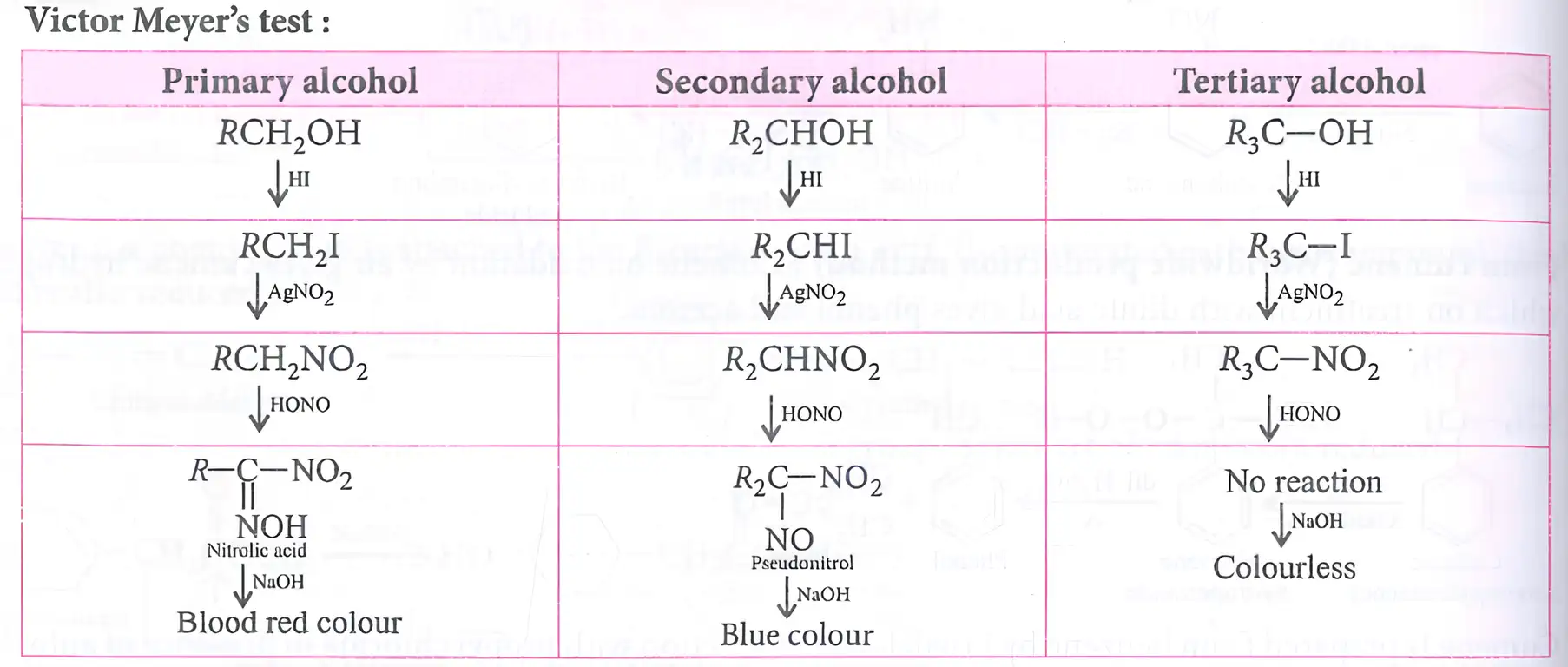
Victor Meyer test differentiates 1°, 2°, 3° alcohols by color changes.
Lucas test: Tertiary alcohols react immediately; secondary within 5-10 min; primary no reaction.
Chemical Reactions
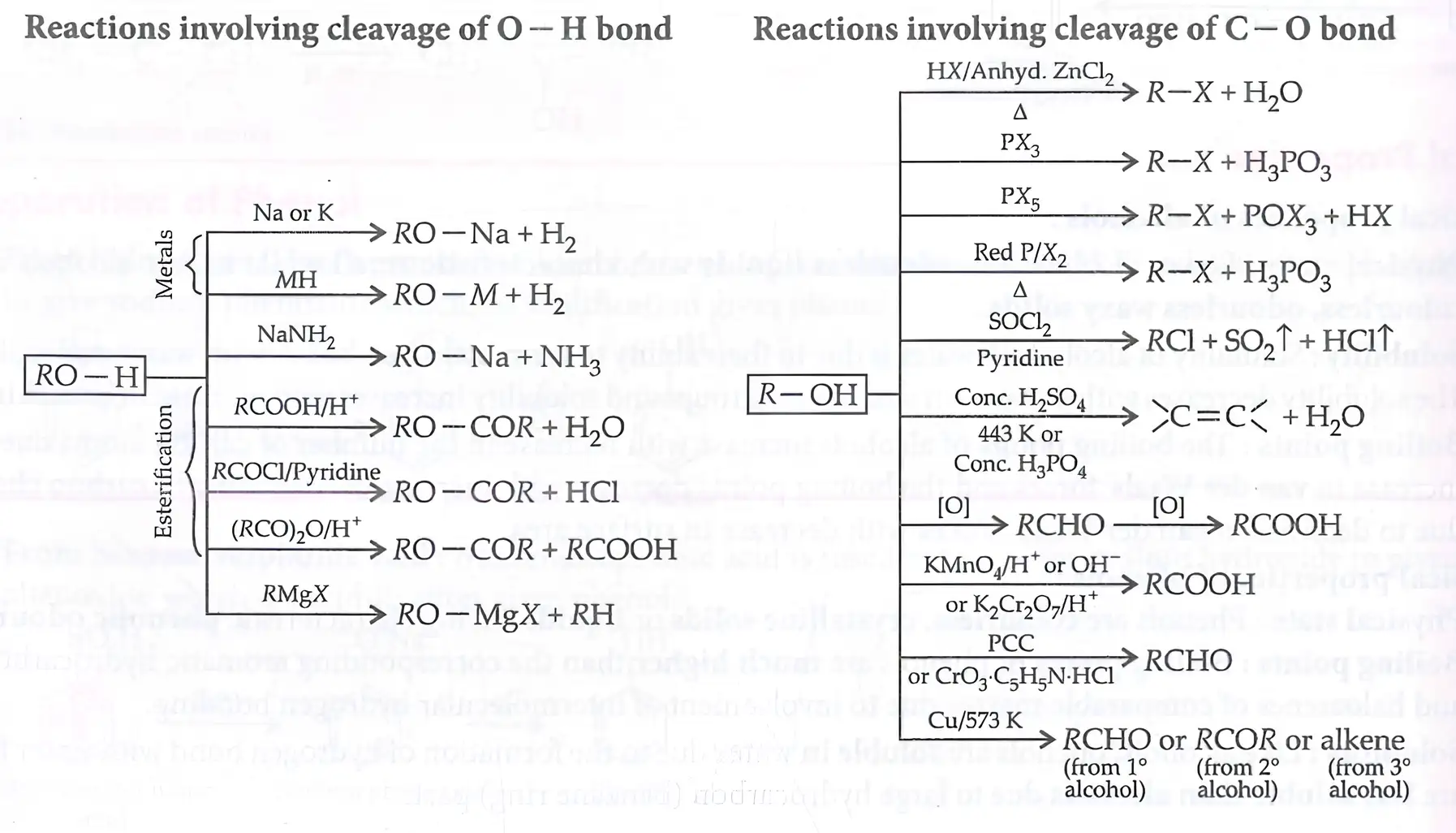
O–H bond cleavage: Reaction with metals (Na, K) forms alkoxides and H2 gas.
C–O bond cleavage: Reaction with HX forms alkyl halides.
Oxidation: 1° alcohols → aldehydes → carboxylic acids; 2° alcohols → ketones; 3° alcohols resist oxidation.
Dehydration forms alkenes.
Solved Examples
Ex 1: 2° alcohol reacts with Lucas reagent to give turbidity in 5 minutes.
Ex 2: Oxidation of 1-propanol with KMnO4 forms propanoic acid.
Practice Set
Q1: Which alcohol is most acidic?
A) 1° alcohol
B) 2° alcohol
C) 3° alcohol
D) PhenolQ2: Lucas test shows immediate turbidity for:
A) 1° alcohol
B) 2° alcohol
C) 3° alcohol
D) PhenolQ3: Oxidation of 2° alcohol produces:
A) Aldehyde
B) Ketone
C) Carboxylic acid
D) Alkene
Answer Key
Q1: D; Phenol is more acidic than alcohols.
Q2: C; 3° alcohols react immediately with Lucas reagent.
Q3: B; 2° alcohols oxidize to ketones.
Memory Aids
Acidity: Phenol > 1° > 2° > 3° alcohols.
Lucas test: 3° immediate, 2° slow, 1° no turbidity.
Oxidation: 1° → aldehyde → acid; 2° → ketone; 3° no oxidation.
Chemical Properties of Phenols
Acidic Nature
Phenols are more acidic than alcohols due to:
(i) -OH attached to electronegative sp2 carbon of benzene ring, increasing O–H bond polarity.
(ii) Phenoxide ion stabilized by resonance.
Electron withdrawing groups increase acidity; electron releasing groups decrease acidity.
Chemical Reactions
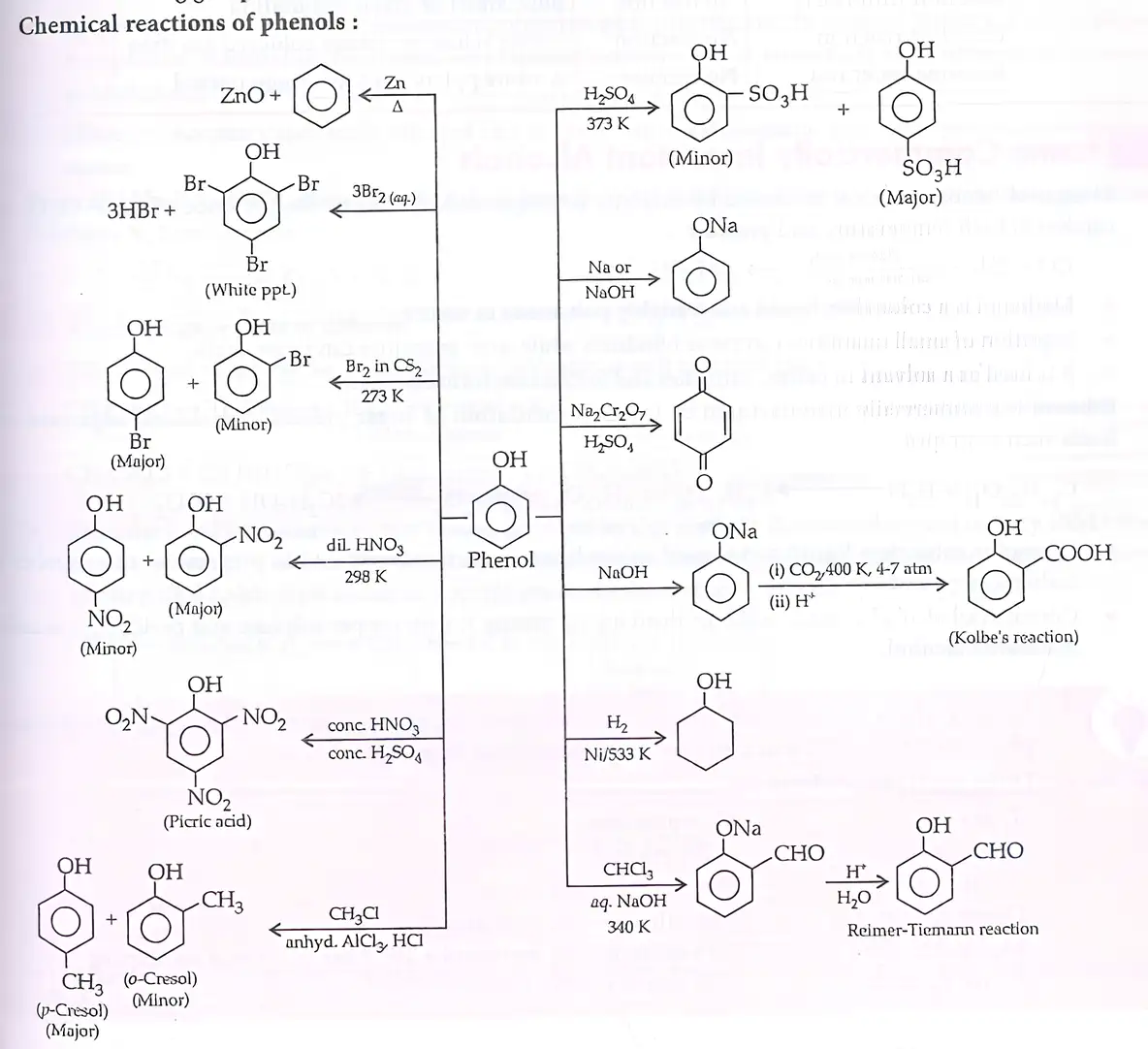
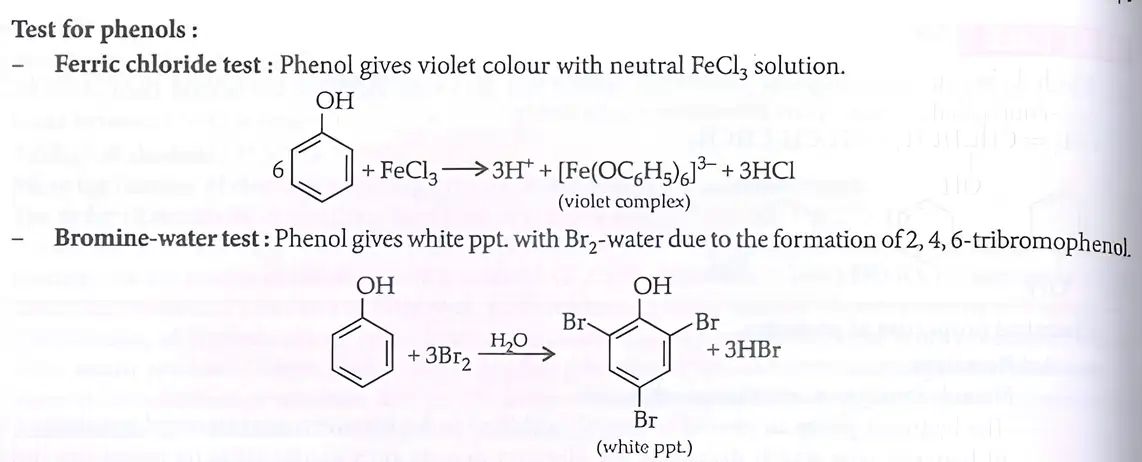
Bromination: Phenol reacts with Br2 to give 2,4,6-tribromophenol (white precipitate).
Nitration: Phenol reacts with HNO3 to form nitrophenols and picric acid.
Sulfonation: Phenol reacts with H2SO4 to form phenol sulfonic acids.
Neutralization: Phenol reacts with Na or NaOH to form sodium phenoxide.
Oxidation: Phenol oxidizes to p-benzoquinone.
Kolbe’s reaction: Sodium phenoxide + CO2 → salicylic acid.
Reimer-Tiemann reaction: Sodium phenoxide + CHCl3/NaOH → salicylaldehyde.
Alkylation: Phenol + CH3Cl/AlCl3 → cresols.
Identification Tests
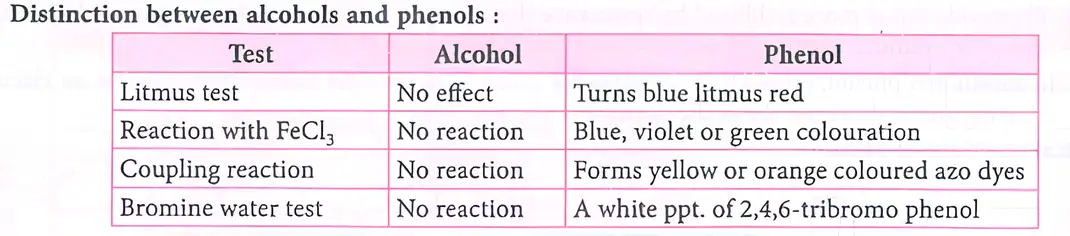
Ferric chloride test: Phenol gives violet color.
Bromine water test: Phenol forms white precipitate of 2,4,6-tribromophenol.
Phenol turns blue litmus red; alcohols do not.
Solved Examples
Ex 1: Phenol + Br2 → 2,4,6-tribromophenol (white precipitate).
Ex 2: Ferric chloride test: Phenol solution turns violet.
Practice Set
Q1: Phenol is more acidic than alcohol because:
A) sp3 carbon
B) Resonance stabilization of phenoxide ion
C) Less electronegative carbon
D) No hydrogen bondingQ2: Bromine water test with phenol produces:
A) No reaction
B) Yellow solution
C) White precipitate
D) Violet colorQ3: Kolbe’s reaction produces:
A) Salicylic acid
B) Benzoic acid
C) Phenol sulfonic acid
D) p-Benzoquinone
Answer Key
Q1: B; Resonance stabilizes phenoxide ion, increasing acidity.
Q2: C; 2,4,6-tribromophenol precipitates as white solid.
Q3: A; Kolbe’s reaction forms salicylic acid.
Memory Aids
Phenol acidity due to resonance and sp2 carbon.
Bromine water test: phenol → white precipitate.
Kolbe’s reaction: CO2 addition to sodium phenoxide → salicylic acid.
Some Commercially Important Alcohols
Methanol Production
Produced by catalytic hydrogenation of CO using ZnO-Cr2O3 catalyst.
Reaction conditions: 200-300 atm pressure, 573-673 K temperature.
Chemical reaction: CO + 2H2 → CH3OH (methanol)

Methanol Properties and Uses
Colourless liquid, highly poisonous.
Small ingestion causes blindness; large ingestion causes death.
Used as solvent in paints, varnishes, and for formaldehyde production.
Solved Examples
Ex 1: Write the reaction for methanol synthesis from CO and H2.
Answer: CO + 2H2 → CH3OH (using ZnO-Cr2O3 catalyst at high T and P)
Practice Set
Q1: What is the catalyst used in methanol production?
A) Cu-ZnO
B) ZnO-Cr2O3
C) Fe2O3
D) PtQ2: Methanol is poisonous because it causes:
A) Headache
B) Blindness
C) Fever
D) CoughQ3: Methanol is produced by:
A) Fermentation
B) Catalytic hydrogenation of CO
C) Distillation of wood
D) Electrolysis of water
Answer Key
Q1: B - ZnO-Cr2O3 catalyst is used for methanol synthesis.
Q2: B - Methanol ingestion causes blindness due to toxicity.
Q3: B - Methanol is produced by catalytic hydrogenation of CO.
Memory Aids
"Methanol = CO + H2 + ZnO-Cr2O3 catalyst"
Poisonous methanol causes "Blindness and Death"
Ethanol
Commercial Manufacture
Produced by fermentation of sugars in molasses, sugarcane, or fruits (e.g., grapes).
Enzymes involved: Invertase breaks sucrose into glucose and fructose.
Zymase converts glucose into ethanol and CO2.
Overall reaction: C6H12O6 → 2 C2H5OH + 2 CO2

Properties and Uses
Colourless liquid.
Used as solvent in paint industry and preparation of carbon compounds.
Denatured alcohol: ethanol mixed with copper sulphate and pyridine to make it unfit for drinking.
Solved Examples
Ex 1: Write the fermentation reaction of glucose to ethanol.
Answer: C6H12O6 → 2 C2H5OH + 2 CO2 (enzyme: zymase)
Practice Set
Q1: Which enzyme breaks sucrose into glucose and fructose?
A) Zymase
B) Invertase
C) Amylase
D) CatalaseQ2: Denatured alcohol contains:
A) Ethanol + methanol
B) Ethanol + copper sulphate + pyridine
C) Pure ethanol
D) Ethanol + waterQ3: Fermentation of glucose produces:
A) Ethanol + CO2
B) Methanol + CO2
C) Ethanol + H2O
D) Methane + CO2
Answer Key
Q1: B - Invertase breaks sucrose into glucose and fructose.
Q2: B - Denatured alcohol is ethanol mixed with copper sulphate and pyridine.
Q3: A - Fermentation produces ethanol and carbon dioxide.
Memory Aids
"Invertase splits sucrose; Zymase ferments glucose to ethanol."
Denatured alcohol = ethanol + copper sulphate + pyridine (unfit for drinking)
Ethylene Glycol
Uses and Properties
Used as antifreeze in car radiators.
50% aqueous ethylene glycol freezes at -34°C.
Used as de-icing fluid for airplane wings.
Types of Alcohols
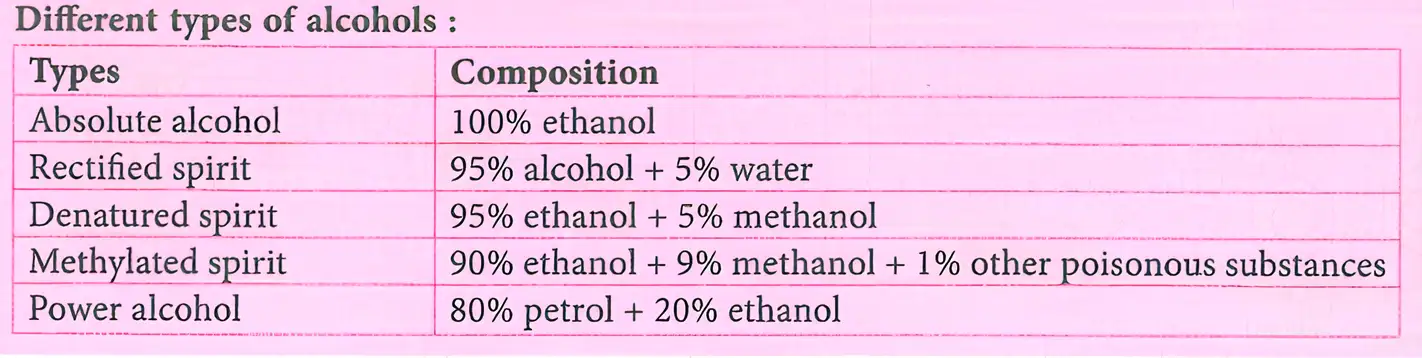
Absolute alcohol: 100% ethanol.
Rectified spirit: 95% alcohol + 5% water.
Denatured spirit: 95% ethanol + 5% methanol.
Methylated spirit: 90% ethanol + 9% methanol + 1% poisonous substances.
Power alcohol: 80% petrol + 20% ethanol.
Solved Examples
Ex 1: What is the freezing point of 50% ethylene glycol aqueous solution?
Answer: -34°C
Practice Set
Q1: Ethylene glycol is mainly used as:
A) Solvent
B) Antifreeze
C) Fuel
D) Paint thinnerQ2: Rectified spirit contains:
A) 100% ethanol
B) 95% alcohol + 5% water
C) 90% ethanol + 10% methanol
D) 80% petrol + 20% ethanolQ3: Methylated spirit contains:
A) Pure ethanol
B) Ethanol + methanol + poisonous substances
C) Ethanol + water
D) Ethanol + petrol
Answer Key
Q1: B - Ethylene glycol is used as antifreeze.
Q2: B - Rectified spirit is 95% alcohol and 5% water.
Q3: B - Methylated spirit contains ethanol, methanol, and poisonous substances.
Memory Aids
"Ethylene glycol = antifreeze, freezes below zero."
Alcohol types: Absolute (pure), Rectified (95% + water), Denatured (95% + methanol), Methylated (90% + methanol + poisons), Power (ethanol + petrol)."
Ethers
Preparation from Alcohols (Dehydration)
Primary alcohols heated with protic acid (H2SO4) at 413 K undergo dehydration to form ethers.
Low temperature favors substitution (ether formation); high temperature favors elimination (alkene formation).
Suitable only for primary, unhindered alkyl groups; secondary and tertiary alcohols mainly give alkenes.

Mechanism of Dehydration
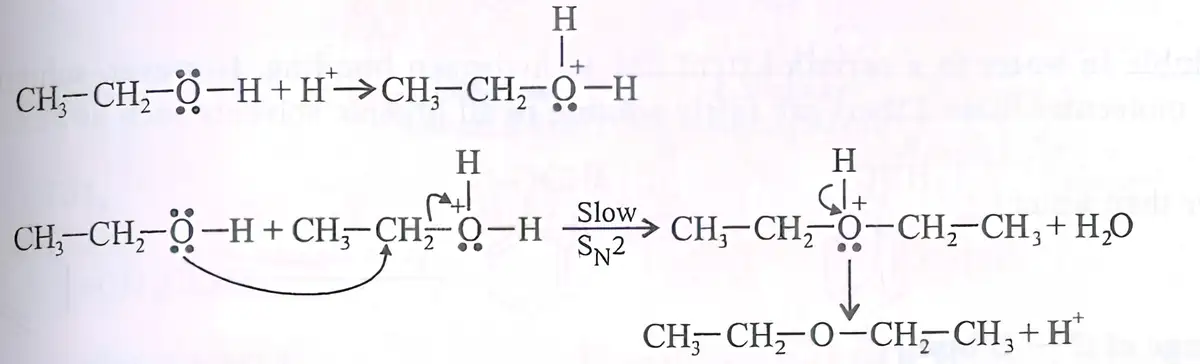
Acid protonates alcohol oxygen, making it a better leaving group.
Second alcohol molecule acts as nucleophile in SN2 reaction, forming ether and water.
Proton is regenerated, completing catalytic cycle.
Solved Examples
Ex 1
Heat ethanol with H2SO4 at 413 K → diethyl ether formed.
At 443 K, ethanol forms ethene instead.
Practice Set
Q1: Which alcohol gives ether on dehydration at low temperature?
A. Primary
B. Secondary
C. Tertiary
D. All
Q2: The mechanism of ether formation from alcohols is:
A. SN1
B. SN2
C. E1
D. E2
Q3: At high temperature, primary alcohols mainly give:
A. Ether
B. Alkene
C. Alcohol
D. Ketone
Answer Key
Q1: A - Primary alcohols give ethers on dehydration at low temperature.
Q2: B - Ether formation proceeds via SN2 mechanism.
Q3: B - High temperature favors elimination to give alkenes.
Memory Aids
Primary alcohol + H2SO4 + low temp → Ether (SN2)
Primary alcohol + H2SO4 + high temp → Alkene (Elimination)
Secondary/tertiary alcohols mainly give alkenes on dehydration.
Williamson Ether Synthesis
Preparation from Alkyl Halides
Primary alkyl halide reacts with sodium alkoxide (R–O−Na+) to form ether via SN2 mechanism.
R and R' can be same or different, allowing preparation of simple or mixed ethers.
Secondary and tertiary alkyl halides favor elimination; thus, not suitable for ether synthesis.
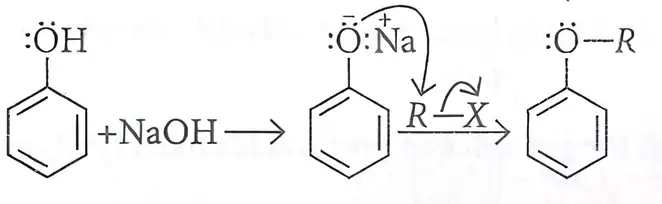
Phenols react with NaOH to form phenoxide ion, which then reacts with alkyl halide to form aryl ethers.

Solved Examples
Ex 1
Ethyl chloride + sodium methoxide → methoxyethane + NaCl.
Ethyl chloride + sodium ethoxide → ethoxyethane + NaCl.
Practice Set
Q1: Williamson synthesis involves which mechanism?
A. SN1
B. SN2
C. E1
D. E2
Q2: Which alkyl halide is best for Williamson synthesis?
A. Primary
B. Secondary
C. Tertiary
D. All
Q3: Phenol reacts with NaOH to form:
A. Phenol
B. Phenoxide ion
C. Ether
D. Alkyl halide
Answer Key
Q1: B - Williamson synthesis proceeds via SN2 mechanism.
Q2: A - Primary alkyl halides are suitable; secondary and tertiary favor elimination.
Q3: B - Phenol reacts with NaOH to form phenoxide ion.
Memory Aids
Williamson synthesis: Primary alkyl halide + sodium alkoxide → ether (SN2)
Secondary/tertiary alkyl halides → elimination, not ether.
Phenol + NaOH → phenoxide ion → reacts with alkyl halide to form aryl ether.
Physical Properties of Ethers
Key Properties
Dimethyl and diethyl ethers are gases at room temperature; others are colorless liquids with characteristic smell.
Ethers have bent structure, resulting in net dipole moment; they are polar.
Boiling points are lower than alcohols due to absence of hydrogen bonding.
Soluble in water to some extent; solubility decreases with molecular mass.
Fairly soluble in organic solvents like alcohol, chloroform, benzene.
Density less than water.
Solved Examples
Ex 1
Diethyl ether is liquid at room temperature with ethereal smell.
Boiling point lower than ethanol due to no H-bonding.
Practice Set
Q1: Ethers are generally:
A. Gases
B. Liquids
C. Solids
D. Plasma
Q2: Ethers have lower boiling points than alcohols because:
A. They are nonpolar
B. No hydrogen bonding
C. Higher molecular weight
D. Stronger dipole
Q3: Ethers are soluble in water due to:
A. Ionic bonding
B. Hydrogen bonding with water
C. Covalent bonding
D. Van der Waals forces
Answer Key
Q1: B - Most ethers are liquids at room temperature.
Q2: B - Ethers lack hydrogen bonding, lowering boiling points.
Q3: B - Ethers form hydrogen bonds with water, aiding solubility.
Memory Aids
Ethers: Polar but no H-bonding → lower boiling points than alcohols.
Small ethers (dimethyl, diethyl) are gases; others liquids.
Solubility decreases with increasing molecular size.
Chemical Reactions of Ethers
Reaction with Hydrogen Halides
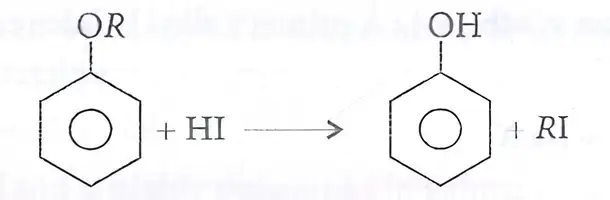
Ethers react with HX (X = Cl, Br, I) to cleave C–O bond, forming alcohol and alkyl halide.
Reactivity order: HI > HBr > HCl.
Alkyl aryl ethers cleave at R–O bond; Ar–O bond is stronger due to partial double bond character.
Mixed ethers: smaller alkyl group forms alkyl halide if 1° or 2°; 3° alkyl halide forms via SN1 mechanism.
Anisole protonates to methylphenyl oxonium ion; I− attacks O–CH3 bond, forming CH3I.
Phenols do not form halides due to sp2 carbon and lack of nucleophilic substitution.

Electrophilic Substitution on Aromatic Ethers
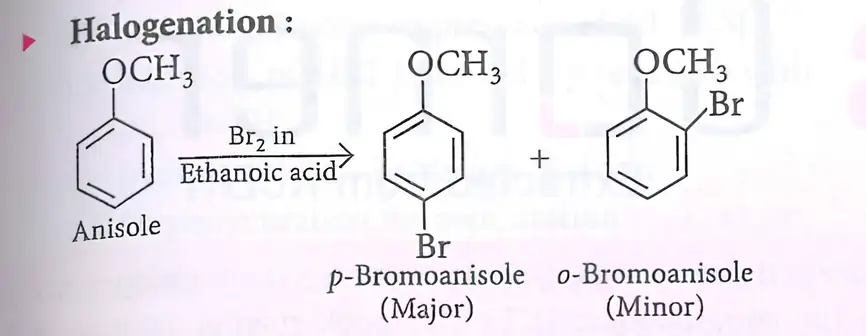
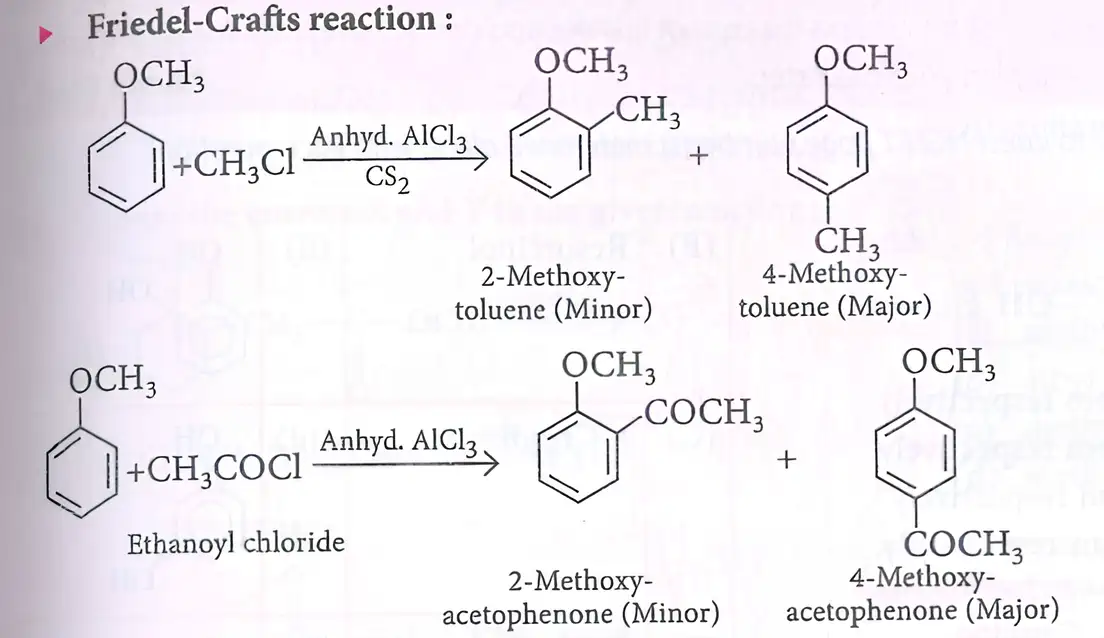
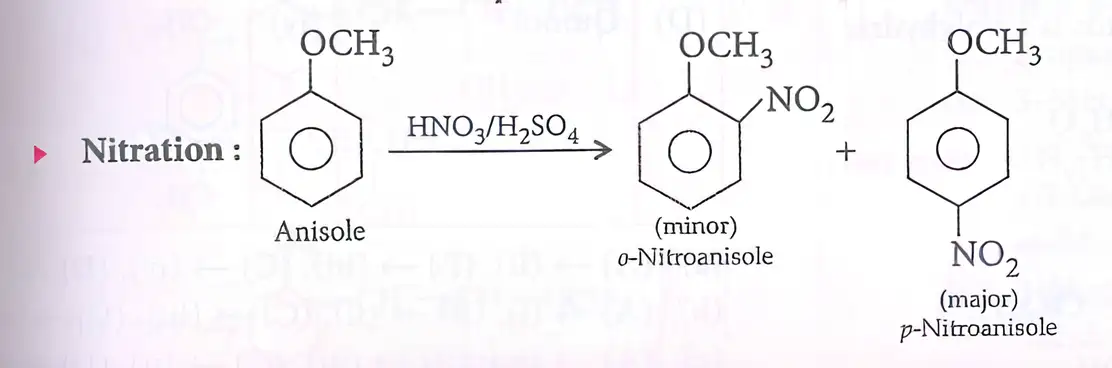
–OR group activates benzene ring and directs substitution to ortho and para positions.
Para product is major in halogenation, nitration, and Friedel-Crafts reactions.

Solved Examples
Ex 1
Ether + HI → Alcohol + Alkyl iodide (SN2 or SN1 depending on alkyl group).
Anisole + Br2 → para-bromoanisole (major) + ortho-bromoanisole (minor).
Anisole + HNO3/H2SO4 → p-nitroanisole (major) + o-nitroanisole (minor).
Practice Set
Q1: Order of reactivity of hydrogen halides with ethers is:
A. HCl > HBr > HI
B. HI > HBr > HCl
C. HBr > HI > HCl
D. HCl > HI > HBr
Q2: In cleavage of mixed ethers, which alkyl halide forms when one group is tertiary?
A. Primary alkyl halide
B. Secondary alkyl halide
C. Tertiary alkyl halide
D. No alkyl halide
Q3: The –OR group on benzene ring directs electrophilic substitution to:
A. Meta position
B. Ortho and para positions
C. Only para position
D. No substitution
Answer Key
Q1: B - HI is strongest acid, most reactive with ethers.
Q2: C - Tertiary alkyl halide forms via SN1 mechanism due to carbocation stability.
Q3: B - –OR group is activating and ortho/para directing.
Memory Aids
Ethers + HX → cleavage to alcohol + alkyl halide; HI most reactive.
Mixed ethers: smaller alkyl halide forms unless tertiary group present.
–OR group activates benzene, directs substitution ortho/para.
Crown Ethers
Structure and Properties
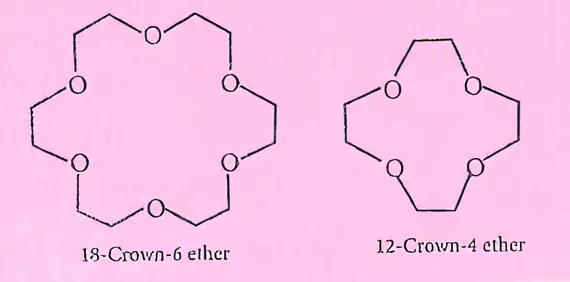
Cyclic polyethers with repeating –OCH2CH2– units forming crown-like rings.
Named by ring size and number of oxygen atoms, e.g., 18-Crown-6 has 18 atoms and 6 oxygens.
Can complex metal ions inside the ring, useful in phase transfer catalysis and ion transport.
Solved Examples
Ex 1
18-Crown-6 selectively complexes K+ ion due to size match.
12-Crown-4 complexes smaller ions like Li+.
Practice Set
Q1: Crown ethers are:
A. Linear polyethers
B. Cyclic polyethers
C. Aromatic ethers
D. Phenols
Q2: 18-Crown-6 has:
A. 18 oxygen atoms
B. 6 atoms in ring
C. 18 atoms in ring and 6 oxygen atoms
D. 6 atoms in ring and 18 oxygen atoms
Q3: Crown ethers are useful because they:
A. React with acids
B. Complex metal ions
C. Are strong bases
D. Are reducing agents
Answer Key
Q1: B - Crown ethers are cyclic polyethers.
Q2: C - 18 atoms in ring, 6 oxygen atoms.
Q3: B - They complex metal ions selectively.
Memory Aids
Crown ethers = cyclic polyethers with specific ring size and oxygen count.
18-Crown-6 best for K+, 12-Crown-4 for Li+.
Used in ion transport and phase transfer catalysis.
NEET Chemistry — ALL CHAPTERS
1
Some Basic Concepts of Chemistry
2
Structure of Atom
3
Classification of Elements and Periodicity in Properties
4
Chemical Bonding and Molecular Structure
5
Thermodynamics
6
Equilibrium
7
Redox Reactions
8
Organic Chemistry - Some Basic Principles and Techniques
9
Hydrocarbons
10
Solutions
11
Electrochemistry
12
Chemical Kinetics
13
The d- and f- Block Elements
14
Coordination Compounds
15
Haloalkanes and Haloarenes
16
Alcohols, Phenols and Ethers
17
Aldehydes, Ketones and Carboxylic Acids
18
Amines
19
Biomolecules
20
The p-Block Elements (Group 13 and 14)
21
The p-Block Elements (Group 15 to 18)
22
Principles Related to Practical Chemistry