NEET Ug . NEET Chemistry . Chemistry . The P Block Elements Group 13 and 14
Chapter 20: The p-Block Elements (Group 13 and 14)
Ch 20
NEET Chemistry
NEET Ug
Introduction to P-Block Elements
General Electronic Configuration
Last electron enters outermost p-orbital.
General configuration: ns2 np1-6 (except He).
Maximum oxidation state = total valence electrons (s + p).
Inert pair effect causes oxidation states two less than max.
First period elements show anomalous behavior due to smaller size and no d-orbitals.
Solved Examples
Ex 1: Determine max oxidation state of group 15 p-block element.
Solution: ns2 np3 → max oxidation state = 5.
Practice Set
Q1: What is the general electronic configuration of p-block elements?
A. ns2 np1-6 B. ns2 nd1-10 C. ns1 np0 D. ns2 nd0Q2: The inert pair effect causes oxidation states to be lower by how many units?
A. 1 B. 2 C. 3 D. 4Q3: Why do first period p-block elements show anomalous behavior?
A. Larger size B. Smaller size and no d-orbitals C. High electronegativity D. High atomic mass
Answer Key
Q1: A - General configuration is ns2 np1-6.
Q2: B - Oxidation states are two less due to inert pair effect.
Q3: B - Smaller size and absence of d-orbitals cause anomalies.
Memory Aids
p-block = last electron in p-orbital.
Max oxidation state = group number (valence electrons).
Inert pair effect lowers oxidation state by 2.
Group 13 Elements: Boron Family
Elements and Properties
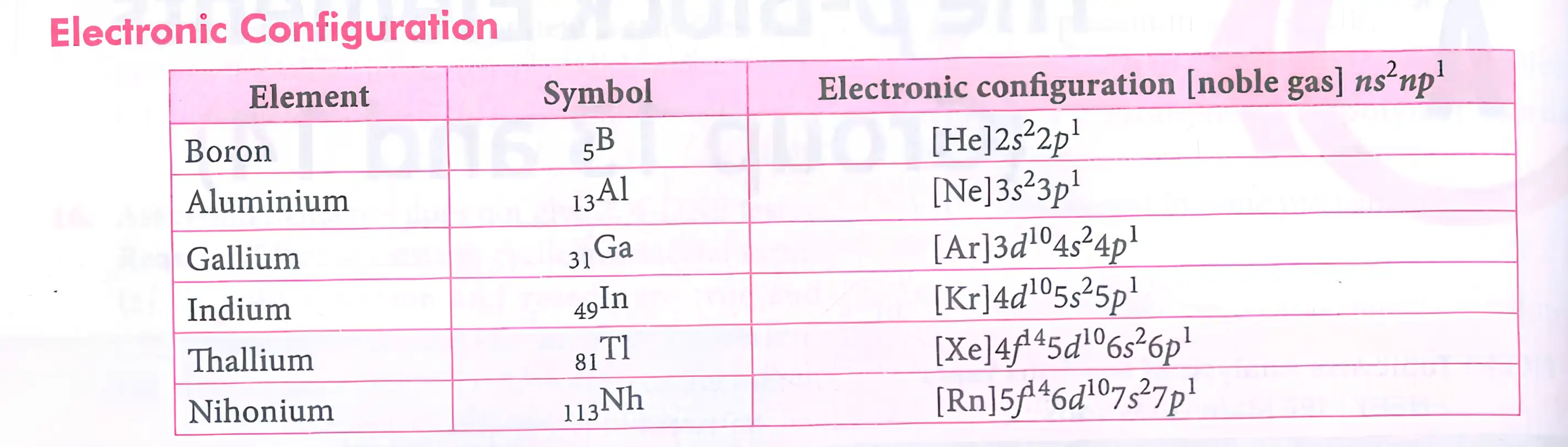
Elements: B, Al, Ga, In, Tl, Nh.
Boron: semi-metal, high ionisation energy, closer to non-metals.
Aluminium: metal, chemically similar to boron.
Ga, In, Tl, Nh: metallic character increases down the group.
Nh is radioactive, chemistry not well established.
Solved Examples
Ex 1: Identify the element with highest ionisation energy in group 13.
Solution: Boron (B) has highest ionisation energy.
Practice Set
Q1: Which element in group 13 is a semi-metal?
A. Al B. Ga C. B D. TlQ2: Which element is radioactive with a half-life of 20 seconds?
A. In B. Nh C. Tl D. GaQ3: Which element is the most abundant metal in earth's crust?
A. B B. Al C. Ga D. In
Answer Key
Q1: C - Boron is semi-metal.
Q2: B - Nihonium (Nh) is radioactive.
Q3: B - Aluminium is most abundant metal.
Memory Aids
Boron = semi-metal, high IE.
Aluminium = abundant metal.
Nh = radioactive, short half-life.
Atomic and Ionic Radii
Trends and Exceptions
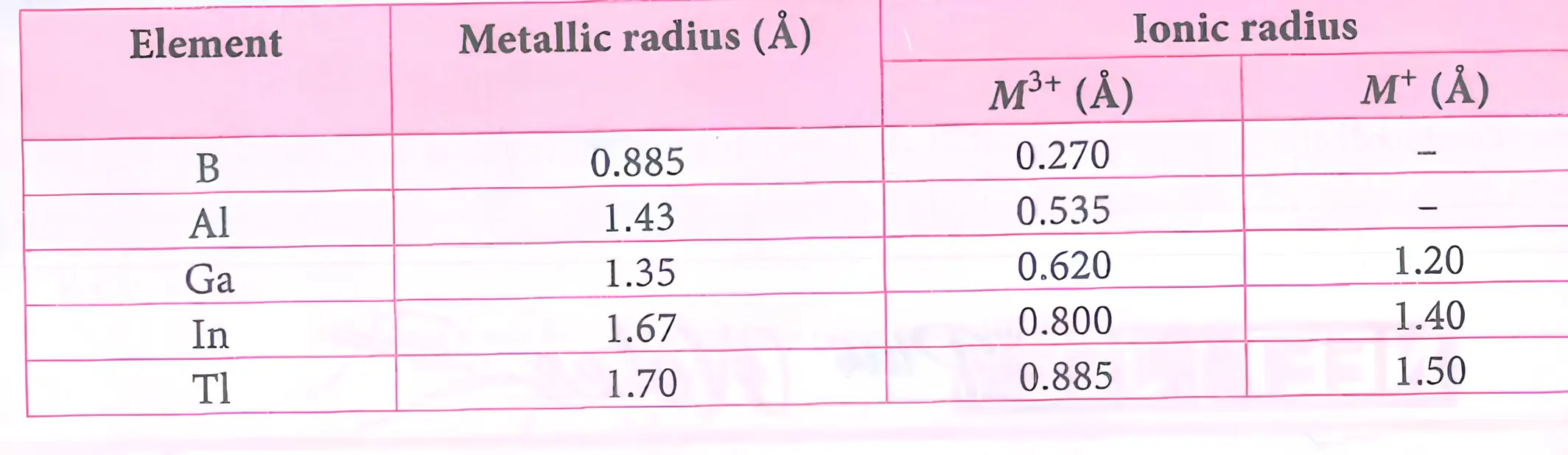
Group 13 elements smaller than group 2 due to higher nuclear charge.
Atomic and ionic radii increase down the group except Ga.
Ga atomic radius less than Al due to poor d-electron shielding.
Solved Examples
Ex 1: Compare atomic radius of Ga and Al.
Solution: Ga < Al due to d-electron poor shielding.
Practice Set
Q1: Which element has smaller atomic radius?
A. Al B. Ga C. In D. TlQ2: Why does Ga have smaller radius than Al?
A. Better shielding B. Poor d-electron shielding C. More electrons D. Less nuclear chargeQ3: Ionic radius of M3+ is generally ______ metallic radius.
A. Larger than B. Equal to C. Smaller than D. Unrelated
Answer Key
Q1: B - Ga has smaller radius than Al.
Q2: B - Poor d-electron shielding in Ga.
Q3: C - Ionic radius smaller than metallic radius for M3+.
Memory Aids
Ga radius < Al due to d-electrons.
Ionic radius < metallic radius for cations.
Ionisation Enthalpy
Trends and Observations
IE values do not decrease smoothly down group 13.
Irregularities in Ga and Tl due to d- and f-electron poor shielding.
Order: B > Tl > Ga > Al > In for first IE.
IEs less than corresponding group 2 elements due to p-electron shielding.
IE1 < IE2 < IE3; sum of first three IE very high.
Solved Examples
Ex 1: Arrange B, Al, Ga in order of IE.
Solution: B > Tl > Ga > Al > In.
Practice Set
Q1: Which element has highest first ionisation enthalpy?
A. Al B. Ga C. B D. InQ2: Why is IE of group 13 less than group 2?
A. More shielding B. Less penetrating p-electrons C. More protons D. Smaller sizeQ3: Sum of first three IE corresponds to formation of which ion?
A. M+ B. M2+ C. M3+ D. M4+
Answer Key
Q1: C - Boron has highest IE.
Q2: B - p-electrons less penetrating than s-electrons.
Q3: C - Sum of IE1 to IE3 forms M3+.
Memory Aids
IE irregular due to d- and f-electron shielding.
IE sum for M3+ very high.
Electronegativity
Trends
Electronegativity decreases from B to Al, then increases due to poor d- and f-electron shielding.
Group 13 elements more electronegative than groups 1 and 2.

Solved Examples
Ex 1: Which element has highest electronegativity?
Solution: Boron (2.0) highest among group 13.
Practice Set
Q1: Electronegativity order in group 13 is?
A. B > Al > Ga B. Al > B > Ga C. B > Ga > Al D. Ga > Al > BQ2: Why does electronegativity increase after Al?
A. Better shielding B. Poor d- and f-electron shielding C. Larger size D. More protonsQ3: Group 13 elements are more electronegative than?
A. Group 1 B. Group 2 C. Both A and B D. None
Answer Key
Q1: C - B > Ga > Al due to shielding effects.
Q2: B - Poor shielding increases effective nuclear charge.
Q3: C - More electronegative than groups 1 and 2.
Memory Aids
Electronegativity dips at Al, then rises.
Group 13 > groups 1 and 2 electronegativity.
Physical Properties
Key Points
Boron: hard, black solid, many allotropes, very high melting point.
Other members: soft metals, low melting points, high electrical conductivity.
Gallium: low melting point (303 K), liquid near room temp, high boiling point (2676 K).
Density increases down the group from B to Tl.
Solved Examples
Ex 1: Why is gallium used in high temperature thermometry?
Solution: High boiling point and low melting point.
Practice Set
Q1: Which element is hardest in group 13?
A. B B. Al C. Ga D. TlQ2: Gallium melts at?
A. 303 K B. 500 K C. 1000 K D. 2676 KQ3: Density trend down group 13 is?
A. Decreases B. Increases C. Constant D. Random
Answer Key
Q1: A - Boron is hardest.
Q2: A - Gallium melts at 303 K.
Q3: B - Density increases down the group.
Memory Aids
Boron = hard, high MP.
Gallium = melts near room temp.
Density increases down group.
Chemical Properties
Oxidation States and Reactivity
Valence config: ns2 np1 → +1 and +3 oxidation states.
+1 state stability increases down group due to inert pair effect.
Stability order +3: B3+ > Al3+ > Ga3+ > In3+ > Tl3+.
Stability order +1: Tl+ > In+ > Ga+ > Al+ > B+.
+1 compounds more ionic than +3 compounds.
Boron halides (BX3) are electron deficient, act as Lewis acids.

Solved Examples
Ex 1: Write reaction of BX3 with NH3.
Solution: BX3 + NH3 → {H3N → BX3} (Lewis acid-base complex).
Practice Set
Q1: Which oxidation state becomes more stable down group 13?
A. +3 B. +1 C. 0 D. -1Q2: Order of Lewis acid strength of boron halides?
A. BF3 < BCl3 < BBr3 < BI3 B. BI3 < BBr3 < BCl3 < BF3 C. BCl3 < BF3 < BI3 < BBr3 D. BBr3 < BI3 < BF3 < BCl3Q3: Which compound forms a dimer?
A. BCl3 B. AlCl3 C. BF3 D. BI3
Answer Key
Q1: B - +1 oxidation state more stable down group.
Q2: A - Lewis acid strength increases BF3 < BCl3 < BBr3 < BI3.
Q3: B - AlCl3 forms dimer Al2Cl6.
Memory Aids
Inert pair effect stabilizes +1 state down group.
Boron halides are Lewis acids.
AlCl3 forms dimers; BCl3 does not.

Reactivity towards Air, Acids, Alkalis, and Halogens
Reactivity towards Air
Group 13 elements form trioxides (E2O3) on heating in oxygen.
Tl also forms some Tl2O.


Reactivity towards Acids and Alkalis
Boron unaffected by non-oxidising acids (dil. HCl, H2SO4).
Other elements dissolve in acids forming M3+ salts and liberate H2.
Oxidising acids (conc. H2SO4, HNO3) react with all; conc. HNO3 passivates Al.
B, Al, Ga react with alkalis liberating H2.


Reactivity towards Halogens
Group 13 elements react with halogens to form trihalides (except TlI3).
Reaction: 2E(s) + 3X2(g) → 2EX3(s) (X = F, Cl, Br, I).
Solved Examples
Ex 1: Write reaction of Al with HCl.
Solution: 2Al + 6HCl → 2AlCl3 + 3H2.Ex 2: Write reaction of Al with NaOH.
Solution: 2Al + 2NaOH + 6H2O → 2Na[Al(OH)4] + 3H2.
Practice Set
Q1: Which oxide is acidic?
A. B2O3 B. Al2O3 C. In2O3 D. Tl2OQ2: Which element is not affected by dilute HCl?
A. B B. Al C. Ga D. TlQ3: Reaction of group 13 element with halogen forms?
A. EX B. EX2 C. EX3 D. EX4
Answer Key
Q1: A - B2O3 is acidic oxide.
Q2: A - Boron unaffected by dilute HCl.
Q3: C - Trihalides EX3 formed.
Memory Aids
Oxides: B2O3 acidic, Al2O3 amphoteric, others basic.
Boron inert to dilute acids.
Group 13 + halogens → trihalides.
Important Trends and Anomalous Properties of Boron
Key Characteristics
Boron is the first element of group 13 and shows unique behaviour compared to aluminium and others.
It has the smallest atomic size and highest ionisation energy in the group.
Highest electronegativity among group 13 elements.
Maximum covalency of 4 due to absence of d-orbitals; others can have covalency up to 6.
Exhibits only +3 oxidation state; others show +1 and +3.
Boron halides are monomeric; others form dimeric halides.
Does not exhibit inert pair effect unlike heavier group members.
Forms volatile, electron-deficient hydrides; others form polymeric hydrides; thallium does not form hydrides.
Combines with metals to form borides; others form alloys instead.
Solved Examples
Ex 1: Explain why boron shows only +3 oxidation state while thallium shows +1 and +3.
Boron lacks d-orbitals, so it cannot expand its octet; stable oxidation state is +3.
Thallium has inert pair effect; s-electrons are less involved, allowing +1 and +3 states.
Ex 2: Why are boron halides monomeric but aluminium halides dimeric?
Boron halides have small size and high charge density, forming strong covalent bonds as monomers.
Aluminium halides form dimers to satisfy electron deficiency via coordinate bonds.
Practice Set
Q1: Which property of boron is responsible for its anomalous behaviour in group 13?
A. Large atomic size
B. Low ionisation energy
C. Absence of d-orbitals
D. Presence of inert pair effect
Q2: Boron forms volatile hydrides because:
A. They are electron-rich compounds
B. Boron has d-orbitals to expand octet
C. They are electron-deficient compounds
D. Boron forms ionic hydrides
Q3: Which of the following statements is correct?
A. Boron halides are dimeric
B. Thallium forms hydrides
C. Boron forms borides with metals
D. Aluminium shows only +3 oxidation state
Answer Key
Q1: C. Absence of d-orbitals — Boron's lack of d-orbitals limits its covalency and oxidation states.
Q2: C. They are electron-deficient compounds — Boron's hydrides lack sufficient electrons, making them volatile.
Q3: C. Boron forms borides with metals — Boron forms borides; thallium does not form hydrides; boron halides are monomeric; aluminium shows +1 and +3 oxidation states.
Memory Aids
Boron’s small size and no d-orbitals = max covalency 4, only +3 state.
Halides: Boron monomeric, others dimeric.
Hydrides: Boron volatile & electron-deficient; others polymeric; Tl no hydrides.
Boron forms borides; others form alloys.
Some Important Compounds of Boron
Borax
White crystalline solid: Na2[B4O5(OH)4].8H2O (commonly Na2B4O7.10H2O)
Dissolves in water to give alkaline solution: Na2B4O7 + 7H2O → 2NaOH + 4H3BO3
On heating, loses water, swells, melts to transparent liquid, then solidifies to glass-like borax bead
Borax bead test identifies transition metals by characteristic colours of their metaborates

Solved Examples
Ex 1: Write the reaction when borax is heated.
Na2B4O7.10H2O (heat) → Na2B4O7 + 10H2O
Further heating: Na2B4O7 → 2NaBO2 + B2O3
Practice Set
Q1: Borax formula is:
A. Na2B4O7.10H2O
B. NaBO2
C. B2O3
D. NaOH
Q2: Borax bead test is used to identify:
A. Alkali metals
B. Transition metals
C. Halogens
D. Noble gases
Q3: On heating borax, which compound is NOT formed?
A. NaBO2
B. B2O3
C. NaOH
D. Borax bead
Answer Key
Q1: A - Borax is Na2B4O7.10H2O
Q2: B - Borax bead test identifies transition metals by their coloured metaborates
Q3: C - NaOH is formed in aqueous solution, not on heating borax
Memory Aids
Borax bead test: Transition metals give coloured beads
Borax formula: Think Na2B4O7.10H2O
Orthoboric Acid
Properties and Preparation
White crystalline solid with soapy touch
Sparingly soluble in cold water, highly soluble in hot water
Prepared by acidifying borax solution: Na2B4O7 + 2HCl + 5H2O → 2NaCl + 4B(OH)3
Layered structure with planar BO3 units joined by hydrogen bonds
Weak monobasic acid; acts as Lewis acid by accepting OH− electrons: B(OH)3 + 2H2O → [B(OH)4]− + H3O+
Thermal Decomposition
On heating above 370 K: H3BO3 → HBO2 (metaboric acid)
Further heating: HBO2 → B2O3 (boric oxide)

Detection Tests
Treated with HF or conc. H2SO4 + CaF2 to form BF3 gas, which gives green flame in Bunsen burner
Reaction: H3BO3 + 3HF → 2BF3 + 3H2O
With conc. H2SO4 and methyl alcohol, warmed and ignited, gives green flame
B(OH)3 + 3CH3OH → B(OCH3)3 + 3H2O
Solved Examples
Ex 1: Write the reaction for preparation of orthoboric acid from borax.
Na2B4O7 + 2HCl + 5H2O → 2NaCl + 4B(OH)3
Practice Set
Q1: Orthoboric acid acts as:
A. Strong acid
B. Lewis acid
C. Base
D. Salt
Q2: On heating orthoboric acid, the first product formed is:
A. Boric oxide
B. Metaboric acid
C. Borax
D. Borazine
Q3: BF3 gas formed during detection test imparts which flame colour?
A. Red
B. Blue
C. Green
D. Yellow
Answer Key
Q1: B - Orthoboric acid is a Lewis acid accepting electrons from OH−
Q2: B - Heating orthoboric acid first forms metaboric acid (HBO2)
Q3: C - BF3 gas gives green flame in Bunsen burner
Memory Aids
Orthoboric acid = Lewis acid, not proton donor
Heating sequence: H3BO3 → HBO2 → B2O3
BF3 gas → green flame
Diborane
Properties and Preparation
Simplest boron hydride: B2H6
Colourless, highly toxic gas; boiling point 180 K
Catches fire spontaneously in air: B2H6 + 3O2 → B2O3 + 3H2O; ΔH° = -1967 kJ/mol
Prepared by:
BF3 + LiAlH4 → B2H6 + LiF + AlF3
NaBH4 + I2 → B2H6 + NaI + H2
BF3 + NaH (450 K) → B2H6 + NaF

Undergoes hydrolysis: B2H6 + 6H2O → 2H3BO3 + 6H2
Cleavage with Lewis bases forms borane adducts: B2H6 + 2NMe3 → 2BH3NMe3
Structure
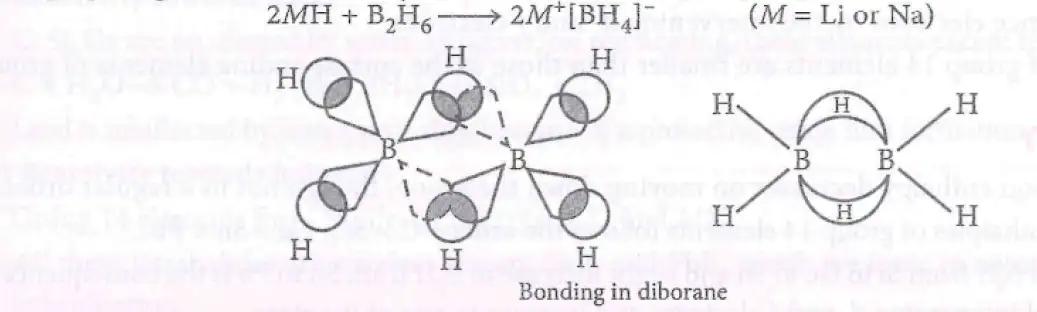
Non-planar; B is sp3 hybridised
Four normal 2c–2e B–H bonds in plane
Two 3c–2e bridge bonds (banana bonds) above and below plane
Reaction with Ammonia
Diborane + NH3 forms addition product
On heating, forms borazine (B3N3H6), called inorganic benzene

Borazine has alternating BH and NH groups in cyclic structure
Borohydrides
Tetrahydridoborates of metals prepared by metal hydrides + B2H6 in diethyl ether
LiBH4 and NaBH4 are important reducing agents in organic synthesis
Solved Examples
Ex 1: Write the reaction of NaBH4 with I2 to form diborane.
NaBH4 + I2 → B2H6 + NaI + H2
Practice Set
Q1: Diborane is:
A. Solid
B. Colourless gas
C. Coloured liquid
D. Metal
Q2: Borazine is called inorganic benzene because:
A. It is aromatic and cyclic with alternating BH and NH groups
B. It is a hydrocarbon
C. It is a metal complex
D. It is a salt
Q3: Which bond type is present in diborane?
A. Only 2c–2e bonds
B. Only ionic bonds
C. 3c–2e bridge bonds (banana bonds)
D. Metallic bonds
Answer Key
Q1: B - Diborane is a colourless gas
Q2: A - Borazine is aromatic with alternating BH and NH groups
Q3: C - Diborane has 3-center 2-electron bridge bonds
Memory Aids
Diborane = B2H6, sp3 hybridised B, banana bonds
Borazine = inorganic benzene, alternating BH and NH
LiBH4, NaBH4 = reducing agents
Uses of Boron and Aluminium
Applications of Boron and Its Compounds
Boron fibres: Used in bullet-proof vests and lightweight composite materials for aircraft.
Boron-10 isotope (\(^{10}B\)): High neutron absorption; metal borides used in nuclear reactors as control rods and protective shields.
Borax and boric acid: Manufacture of heat-resistant glass (e.g., Pyrex), glass-wool, and fibre glass.
Borax: Acts as a flux in soldering metals; provides heat, scratch, and stain-resistant glazed coatings on earthenware.
Orthoboric acid solution: Used as a mild antiseptic.
Applications of Aluminium
Aluminium: Bright silvery-white metal with high tensile strength.
Electrical conductivity: Aluminium's conductivity is twice that of copper.
Thermal conductivity: High thermal conductivity makes it useful in heat exchangers.
Extensive industrial and everyday use due to lightweight, strength, and conductivity.
Solved Examples
Ex 1: Why is boron-10 used in nuclear reactors?
Because \(^{10}B\) has a high neutron absorption cross-section, it effectively controls neutron flux.
Ex 2: Calculate the electrical conductivity ratio of aluminium to copper if aluminium's conductivity is twice that of copper.
Given: \(\sigma_{Al} = 2 \times \sigma_{Cu}\)
Ratio \(= \frac{\sigma_{Al}}{\sigma_{Cu}} = 2\)
Practice Set
Q1: Which isotope of boron is used in nuclear reactors for neutron absorption?
A. \(^{11}B\)
B. \(^{10}B\)
C. \(^{9}B\)
D. \(^{12}B\)
Q2: Borax is commonly used as:
A. A fuel
B. A flux in soldering metals
C. A reducing agent
D. An oxidizing agent
Q3: Aluminium is preferred over copper in electrical wiring because:
A. It has higher tensile strength and twice the electrical conductivity of copper
B. It is cheaper and has lower conductivity
C. It is heavier and more durable
D. It has lower thermal conductivity
Answer Key
Q1: B. \(^{10}B\) - It has a high neutron absorption capacity, making it ideal for nuclear control rods.
Q2: B. A flux in soldering metals - Borax lowers melting points and removes oxides during soldering.
Q3: A. It has higher tensile strength and twice the electrical conductivity of copper - Aluminium is lightweight and conducts electricity efficiently.
Memory Aids
Boron-10: "10 absorbs neutrons" - remember isotope 10 for neutron absorption.
Borax uses: Flux and glass - think "Borax fixes and glazes".
Aluminium conductivity: "Al is twice Cu" - aluminium's conductivity is double copper's.
Group 14 Elements
Overview
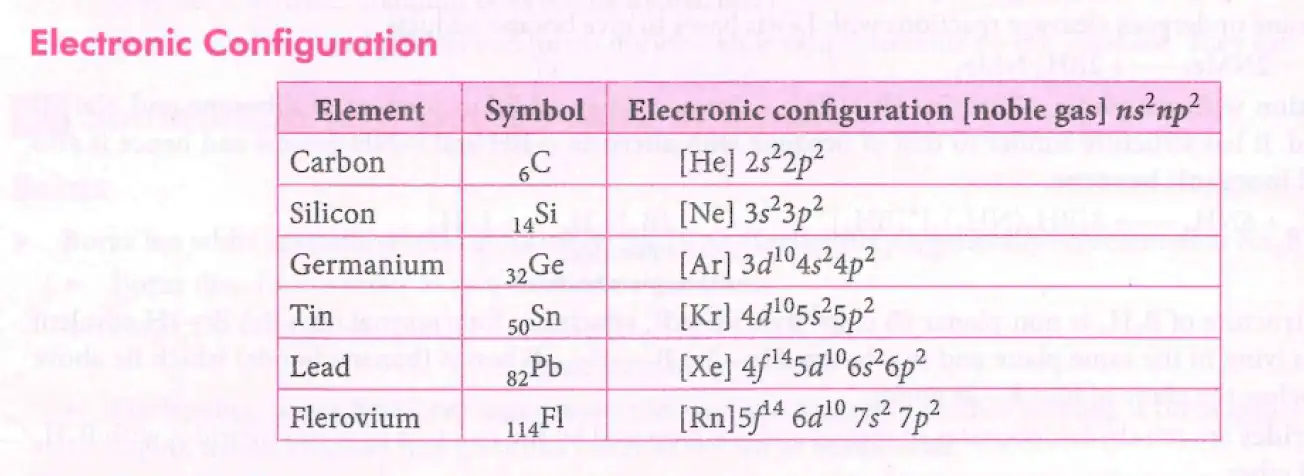
Group 14 contains C, Si, Ge, Sn, Pb, and synthetic Fl (Flerovium).
Carbon, silicon, tin, and lead are well-known; germanium is rare; flerovium is radioactive with short half-life.
Silicon is the second most abundant element in Earth's crust after oxygen.
Electronic configurations follow noble gas shorthand with outer electrons in s and p orbitals.
Solved Examples
Ex 1: Write the electronic configuration of Tin (Sn, Z=50).
Answer: [Kr] 4d10 5s2 5p2
Practice Set
Q1: Which element in group 14 is synthetic and radioactive?
A. Carbon
B. Silicon
C. Flerovium
D. LeadQ2: Which element is the second most abundant in Earth's crust?
A. Carbon
B. Silicon
C. Germanium
D. TinQ3: The electronic configuration of lead (Pb) ends with:
A. 6s2 6p2
B. 5d10 6s2 6p2
C. 4f14 5d10 6s2 6p2
D. 5s2 5p2
Answer Key
Q1: C - Flerovium is synthetic and radioactive.
Q2: B - Silicon is second most abundant after oxygen.
Q3: C - Lead's configuration includes 4f14 and 5d10 filled orbitals.
Memory Aids
Group 14 elements: C, Si, Ge, Sn, Pb, Fl (Flerovium).
Silicon abundant in crust; Flerovium synthetic and unstable.
Covalent Radius
Trends
Covalent radius increases down the group.
Increase from Si downwards is small due to poor shielding by d- and f-electrons.
Group 14 elements have smaller covalent radii than group 13 elements.
Solved Examples
Ex 1: Compare covalent radius of Si and Sn.
Answer: Sn has larger radius than Si but increase is small due to ineffective shielding.
Practice Set
Q1: Covalent radius trend in group 14 is:
A. Decreases down the group
B. Increases down the group
C. Remains constant
D. RandomQ2: Compared to group 13, group 14 elements have:
A. Larger covalent radii
B. Smaller covalent radii
C. Same covalent radii
D. No trendQ3: The small increase in covalent radius from Si to Sn is due to:
A. Effective shielding
B. Ineffective shielding by d- and f-electrons
C. Increase in nuclear charge
D. Decrease in atomic size
Answer Key
Q1: B - Covalent radius increases down the group.
Q2: B - Group 14 elements have smaller covalent radii than group 13.
Q3: B - Ineffective shielding by d- and f-electrons causes small increase.
Memory Aids
Radius increases down group 14 but less after Si due to poor shielding.
Group 14 smaller radius than group 13 due to higher nuclear charge.
Ionisation Enthalpy
Trends
Ionisation enthalpy decreases down the group, but not regularly.
Order: C > Si > Ge > Sn < Pb (Pb has slightly higher than Sn).
Small decrease from Si to Sn; slight increase from Sn to Pb due to poor shielding and atomic size.
Group 14 elements have higher ionisation enthalpy than group 13 due to greater nuclear charge and smaller size.
Solved Examples
Ex 1: Explain why Pb has higher ionisation enthalpy than Sn.
Answer: Poor shielding by d- and f-electrons and increased atomic size cause slight increase.
Practice Set
Q1: Ionisation enthalpy trend in group 14 is:
A. Increases down the group
B. Decreases down the group irregularly
C. Constant
D. RandomQ2: Which element has the highest ionisation enthalpy?
A. Carbon
B. Silicon
C. Tin
D. LeadQ3: Ionisation enthalpy of group 14 elements compared to group 13 is:
A. Lower
B. Higher
C. Same
D. No relation
Answer Key
Q1: B - Ionisation enthalpy decreases irregularly down the group.
Q2: A - Carbon has highest ionisation enthalpy.
Q3: B - Group 14 elements have higher ionisation enthalpy than group 13.
Memory Aids
Ionisation enthalpy decreases down group 14 but Pb shows slight increase due to inert pair effect.
Group 14 > Group 13 in ionisation enthalpy due to higher nuclear charge.
Electronegativity
Trends
Group 14 elements are slightly more electronegative than group 13 due to smaller size.
Electronegativity decreases from C to Si.
From Si to Pb, electronegativity values are almost constant.
Solved Examples
Ex 1: Arrange C, Si, Pb in order of decreasing electronegativity.
Answer: C > Si > Pb (Pb ~ Si)
Practice Set
Q1: Electronegativity trend in group 14 is:
A. Increases down the group
B. Decreases down the group
C. Constant
D. RandomQ2: Compared to group 13, group 14 elements are:
A. Less electronegative
B. More electronegative
C. Same electronegativity
D. No trendQ3: Electronegativity values from Si to Pb are:
A. Increasing
B. Decreasing
C. Almost same
D. Random
Answer Key
Q1: B - Electronegativity decreases down the group.
Q2: B - Group 14 elements are more electronegative than group 13.
Q3: C - Values from Si to Pb are almost the same.
Memory Aids
Electronegativity decreases from C to Si, then remains steady down to Pb.
Group 14 > Group 13 in electronegativity due to smaller atomic size.
Physical Properties
Key Points
Melting and boiling points of group 14 elements are higher than group 13 due to four covalent bonds.
Strong binding forces exist in solid and liquid states.
Melting and boiling points decrease down the group from C to Pb due to weaker M–M bonds from increased atomic size.
Solved Examples
Ex 1: Why does carbon have a higher melting point than lead?
Answer: Carbon forms strong covalent bonds; lead has larger atoms with weaker bonds.
Practice Set
Q1: Melting points of group 14 elements:
A. Increase down the group
B. Decrease down the group
C. Remain constant
D. RandomQ2: Compared to group 13, group 14 elements have:
A. Lower melting points
B. Higher melting points
C. Same melting points
D. No trendQ3: The reason for high melting points in group 14 is:
A. Ionic bonding
B. Metallic bonding
C. Four covalent bonds per atom
D. Van der Waals forces
Answer Key
Q1: B - Melting points decrease down the group.
Q2: B - Group 14 elements have higher melting points than group 13.
Q3: C - Due to four covalent bonds per atom.
Memory Aids
Group 14 elements have high melting points due to strong covalent bonding.
Melting points decrease down the group as atomic size increases.
Chemical Properties
Oxidation States and Reactivity
Group 14 elements show +4 and +2 oxidation states.
C⁴⁺ does not exist due to high ionisation enthalpy and small size; carbon forms negative oxidation states in carbides.
Silicon shows similar trends to carbon.
Ge, Sn, Pb show +2 and +4 states; +2 state stability increases down the group due to inert pair effect.
Compounds with +4 state are covalent; +2 state compounds are ionic (e.g., SnCl4 covalent, SnCl2 ionic).
Tendency to form covalent compounds decreases down the group; ionic compounds increase.
Reactivity Towards Oxygen
Elements form oxides on heating in air.
Reactions: C + O2 → CO2, Si + O2 → SiO2.
Monoxides CO, SiO, GeO exist; SiO is unstable.
Higher oxidation state oxides are more acidic.
PbO exists as red litharge and yellow massicot.
Pb3O4 (red lead) is a mixed oxide: 2PbO·PbO3.
Reactivity Towards Water
C, Si, Ge are unaffected by water but decompose steam on red heating.
Reactions: C + H2O → CO + H2, Si + 2H2O → SiO2 + 2H2.
Lead is unaffected by water due to protective oxide film.
Reactivity Towards Halogens
Group 14 elements form MX4 and MX2 halides.
Tetrahalides are covalent except SnF4 and PbF4 which are ionic.
Heavier elements (Ge, Sn, Pb) form stable dihalides MX2 due to inert pair effect.
CCl4 does not hydrolyze (no d-orbitals); SiCl4 and heavier halides hydrolyze due to vacant d-orbitals.
SiCl4 + 4H2O → Si(OH)4 + 4HCl (silicic acid formation).
Thermal stability of tetrahalides decreases down group: CX4 > SiX4 > GeX4 > SnX4 > PbX4.
Thermal stability decreases with heavier halogen: MF4 > MCl4 > MBr4 > MI4.
Solved Examples
Ex 1: Write the reaction of SiCl4 with water.
Answer: SiCl4 + 4H2O → Si(OH)4 + 4HCl
Practice Set
Q1: Which oxidation states are common in group 14?
A. +1 and +3
B. +2 and +4
C. +3 and +5
D. +1 and +4Q2: PbO exists in which forms?
A. Litharge and massicot
B. Red lead and litharge
C. Massicot and red lead
D. Only lithargeQ3: Which halide does not hydrolyze?
A. CCl4
B. SiCl4
C. SnCl4
D. PbCl4
Answer Key
Q1: B - +2 and +4 oxidation states are common.
Q2: A - PbO exists as litharge (red) and massicot (yellow).
Q3: A - CCl4 does not hydrolyze due to lack of d-orbitals.
Memory Aids
Inert pair effect increases down group 14, stabilizing +2 state.
PbO forms litharge (red) and massicot (yellow).
CCl4 is resistant to hydrolysis; SiCl4 hydrolyzes to silicic acid.
Allotropes of Carbon
Overview
Carbon exists in different structural forms called allotropes.
Main allotropes: Diamond, Graphite, Fullerene (Crystalline); Carbon black, Coke, Charcoal (Amorphous).
Allotropes differ in bonding, structure, and properties.
Solved Examples
Ex 1: Identify the allotrope of carbon used in jewellery.
Answer: Diamond, due to its brilliant shine and hardness.
Practice Set
Q1: Which allotrope of carbon is the hardest?
A. Graphite
B. Diamond
C. Fullerene
D. Carbon blackQ2: Which allotrope conducts electricity?
A. Diamond
B. Graphite
C. Charcoal
D. CokeQ3: Fullerene has a structure similar to:
A. Cube
B. Soccer ball
C. Sheet
D. Chain
Answer Key
Q1: B - Diamond is the hardest due to strong 3D covalent bonding.
Q2: B - Graphite conducts electricity because of delocalized electrons in layers.
Q3: B - Fullerene resembles a soccer ball with carbon atoms arranged in rings.
Memory Aids
Diamond = Hardest, 3D network.
Graphite = Conducts electricity, layered structure.
Fullerene = Soccer ball shape.
Crystalline Allotropes of Carbon
Properties and Structure
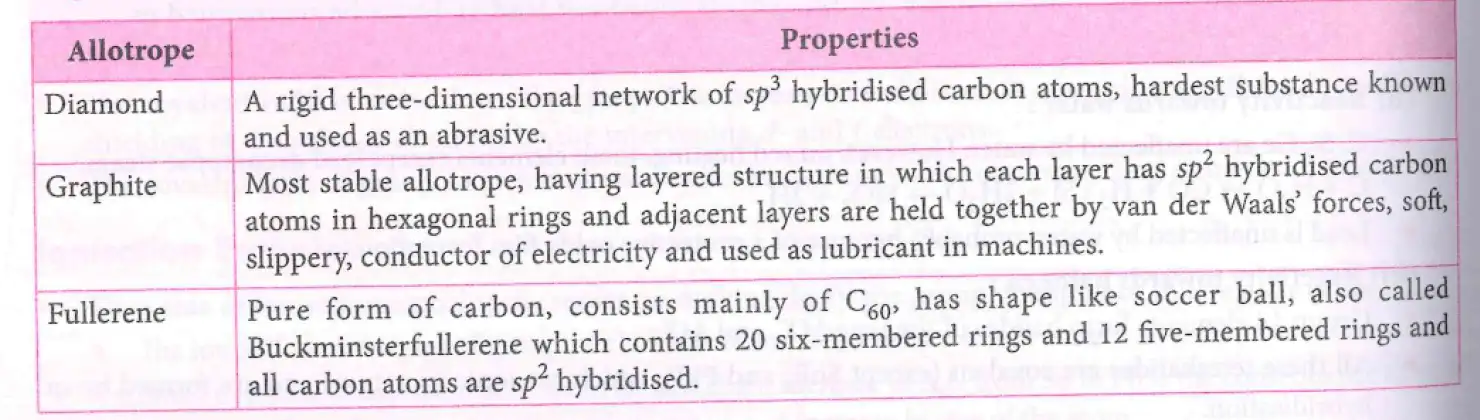
Diamond: Each carbon atom bonded tetrahedrally to 4 others; very hard; electrical insulator.
Graphite: Carbon atoms in layers with weak forces between layers; soft, slippery; conducts electricity.
Fullerene: Carbon atoms arranged in spherical shape (C60); resembles soccer ball; unique molecular structure.
Solved Examples
Ex 1: Explain why graphite is a good lubricant.
Answer: Layers slide over each other easily due to weak interlayer forces.
Practice Set
Q1: Which allotrope has a 3D network structure?
A. Graphite
B. Diamond
C. Fullerene
D. Carbon blackQ2: Why does graphite conduct electricity?
A. Free electrons between layers
B. Ionic bonding
C. Metallic bonding
D. None of the aboveQ3: Fullerene is also called:
A. Graphitic acid
B. Buckminsterfullerene
C. Carbon black
D. Coke
Answer Key
Q1: B - Diamond has a strong 3D covalent network.
Q2: A - Delocalized electrons between layers allow conductivity.
Q3: B - Fullerene is known as Buckminsterfullerene.
Memory Aids
Diamond = 3D network, hardest.
Graphite = Layers slide, conducts electricity.
Fullerene = Buckminsterfullerene, soccer ball shape.
Amorphous Allotropes of Carbon
Characteristics and Preparation
Amorphous carbon forms: Carbon black, Coke, Charcoal.
Carbon black: Produced by incomplete combustion of hydrocarbons.
Charcoal: Obtained by heating wood in absence of air.
Coke: Obtained by heating coal in absence of air.
These are impure forms of graphite or fullerenes.
Solved Examples
Ex 1: How is carbon black prepared?
Answer: By burning hydrocarbons with limited air supply.
Practice Set
Q1: Charcoal is prepared by:
A. Burning wood in air
B. Heating wood without air
C. Burning coal in air
D. Heating coal with airQ2: Carbon black is used as:
A. Fuel
B. Lubricant
C. Black pigment
D. Reducing agentQ3: Coke is mainly used as:
A. Fuel
B. Reducing agent in metallurgy
C. Lubricant
D. Pigment
Answer Key
Q1: B - Charcoal is made by heating wood in absence of air.
Q2: C - Carbon black is used as black pigment in ink and tyres.
Q3: B - Coke is used as a reducing agent in metallurgy.
Memory Aids
Carbon black = pigment, incomplete combustion.
Charcoal = heated wood, no air.
Coke = heated coal, reducing agent.
Uses of Carbon
Applications of Different Allotropes
Graphite: Lubricant at high temperatures; refractory material for crucibles and electrodes.
Carbon black: Black pigment in ink; filler in automobile tyres.
Coal and Charcoal: Used as fuels.
Coal: Used to manufacture producer gas and water gas.
Coke: Used as reducing agent in metallurgy.
Diamond: Used in jewellery for its brilliant shine.
Solved Examples
Ex 1: Why is graphite used in electrodes?
Answer: It withstands high temperatures and conducts electricity.
Practice Set
Q1: Which allotrope is used as a lubricant?
A. Diamond
B. Graphite
C. Coke
D. CharcoalQ2: Producer gas is made from:
A. Charcoal
B. Coal
C. Carbon black
D. FullereneQ3: Diamond is mainly used in:
A. Fuel
B. Jewellery
C. Pigment
D. Reducing agent
Answer Key
Q1: B - Graphite acts as a lubricant due to its layered structure.
Q2: B - Producer gas is manufactured from coal.
Q3: B - Diamond is used in jewellery for its brilliance.
Memory Aids
Graphite = lubricant, electrodes.
Carbon black = pigment, tyres.
Diamond = jewellery.
Chemical Reactions of Graphite
Oxidation Reactions
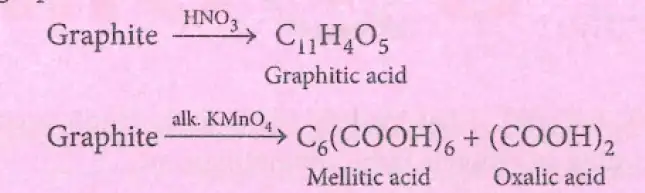
Graphite + Conc. HNO3 → Graphitic acid (C11H4O5).
Graphite + Alkaline KMnO4 → Mellitic acid (C6(COOH)6) + Oxalic acid ((COOH)2).
These reactions show oxidation of graphite to different acids.
Solved Examples
Ex 1: Write the product when graphite is oxidized with conc. HNO3.
Answer: Graphitic acid (C11H4O5).
Practice Set
Q1: Graphite reacts with conc. HNO3 to form:
A. Oxalic acid
B. Graphitic acid
C. Mellitic acid
D. Carbon blackQ2: Alkaline KMnO4 oxidizes graphite to:
A. Graphitic acid
B. Oxalic acid and Mellitic acid
C. Carbon black
D. CharcoalQ3: Which acid is benzene hexacarboxylic acid?
A. Graphitic acid
B. Oxalic acid
C. Mellitic acid
D. Citric acid
Answer Key
Q1: B - Conc. HNO3 produces graphitic acid.
Q2: B - Alkaline KMnO4 yields mellitic and oxalic acids.
Q3: C - Mellitic acid is benzene hexacarboxylic acid.
Memory Aids
Conc. HNO3 → Graphitic acid.
Alkaline KMnO4 → Mellitic + Oxalic acids.
Mellitic acid = benzene ring with 6 COOH groups.
Carbon Monoxide
Properties and Preparation
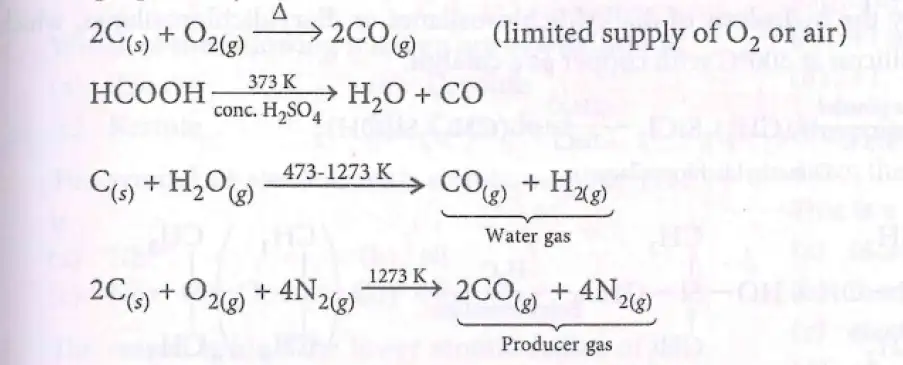
Colourless, odourless, poisonous, almost water-insoluble gas.
Prepared by:
Incomplete combustion of carbon: C + \(\frac{1}{2}\)O2 \(\rightarrow\) CO
Thermal decomposition of formic acid: HCOOH \(\xrightarrow{\Delta, H_2SO_4}\) CO + H2O
Reaction of carbon with steam (water gas): C + H2O \(\xrightarrow{\Delta}\) CO + H2
Reaction of carbon with air (producer gas): 2C + O2 + N2 \(\xrightarrow{\Delta}\) 2CO + N2
Strong reducing agent; reduces many metal oxides except alkali, alkaline earth, Al, and some transition metals.
Forms metal carbonyls by acting as a ligand (donor) to metals.
Toxic due to stable complex formation with haemoglobin, preventing oxygen transport.
Solved Examples
Ex 1: Write the reaction for preparation of CO from formic acid.
HCOOH \(\xrightarrow{\Delta, H_2SO_4}\) CO + H2O
Ex 2: Show the reaction of CO with iron oxide.
Fe2O3 + 3CO \(\rightarrow\) 2Fe + 3CO2
Practice Set
Q1: Which gas is formed by incomplete combustion of carbon?
A. CO2
B. CO
C. CH4
D. H2
Q2: CO acts as a reducing agent for which of the following?
A. Na2O
B. Fe2O3
C. CaO
D. Al2O3
Q3: Why is CO toxic?
A. It is acidic
B. It forms stable complex with haemoglobin
C. It is flammable
D. It is water soluble
Answer Key
Q1: B - CO is formed by incomplete combustion of carbon.
Q2: B - CO reduces Fe2O3 but not alkali or alkaline earth metal oxides.
Q3: B - CO binds strongly with haemoglobin, preventing oxygen transport.
Memory Aids
CO = Incomplete combustion product, strong reducing agent.
CO toxicity due to haemoglobin binding stronger than O2.
Metal carbonyls formed by CO acting as ligand.
Carbon Dioxide
Properties and Preparation
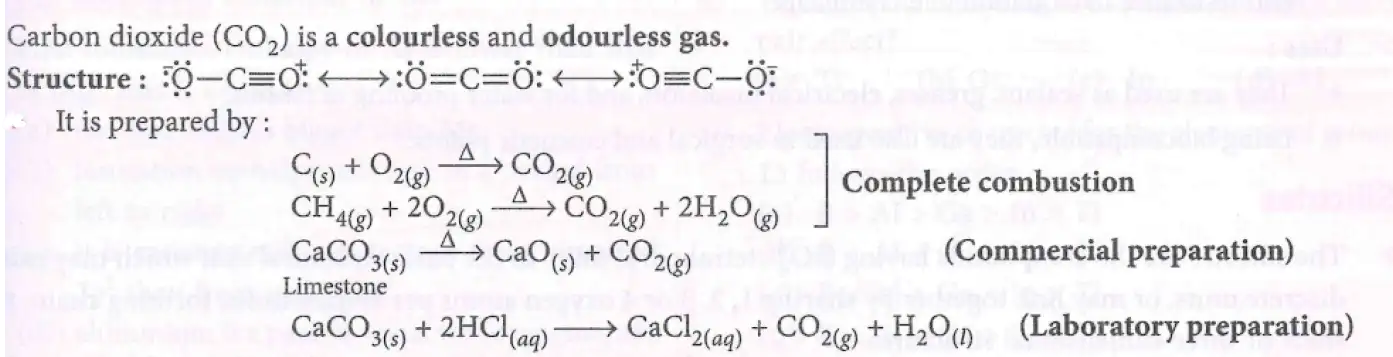
Colourless, odourless gas; molecular structure: O=C=O with resonance.
Prepared by:
Complete combustion of carbon or methane: C + O2 \(\rightarrow\) CO2
Heating limestone (CaCO3): CaCO3 \(\xrightarrow{\Delta}\) CaO + CO2
Reaction of calcium carbonate with HCl: CaCO3 + 2HCl \(\rightarrow\) CaCl2 + CO2 + H2O
Acidic oxide; reacts with bases to form salts.
Solid CO2 is dry ice; used as refrigerant.
Non-poisonous but excess causes greenhouse effect.
Removed from air by photosynthesis: 6CO2 + 12H2O \(\xrightarrow{light, chlorophyll}\) C6H12O6 + 6O2 + 6H2O

Solved Examples
Ex 1: Write the reaction for preparation of CO2 by heating limestone.
CaCO3 \(\xrightarrow{\Delta}\) CaO + CO2
Ex 2: Write the photosynthesis equation.
6CO2 + 12H2O \(\xrightarrow{light, chlorophyll}\) C6H12O6 + 6O2 + 6H2O
Practice Set
Q1: Which is an acidic oxide?
A. CO
B. CO2
C. SO2
D. NO
Q2: Dry ice is the solid form of:
A. CO
B. CO2
C. SO2
D. N2
Q3: Photosynthesis removes CO2 from air by producing:
A. Oxygen and glucose
B. Carbon monoxide
C. Methane
D. Water
Answer Key
Q1: B - CO2 is an acidic oxide.
Q2: B - Dry ice is solid CO2.
Q3: A - Photosynthesis produces oxygen and glucose.
Memory Aids
CO2 = Acidic oxide, dry ice = solid CO2.
Photosynthesis: 6CO2 + 12H2O \(\rightarrow\) glucose + O2.
CO2 not poisonous but causes greenhouse effect.
Silicon Dioxide
Properties and Reactions
Also called silica; found as sand and quartz.
Covalent, 3D network solid with high Si–O bond enthalpy.
Almost inert; attacked by HF and NaOH only.
Reactions:
SiO2 + 2NaOH \(\rightarrow\) Na2SiO3 + H2O
SiO2 + 4HF \(\rightarrow\) SiF4 + 2H2O
Uses
Quartz used in piezoelectric devices: clocks, radios, TVs, mobile communications.
Silica gel used as drying agent and catalyst support.
Kieselghur (amorphous silica) used in filtration.
Solved Examples
Ex 1: Write reaction of SiO2 with NaOH.
SiO2 + 2NaOH \(\rightarrow\) Na2SiO3 + H2O
Ex 2: Reaction of SiO2 with HF.
SiO2 + 4HF \(\rightarrow\) SiF4 + 2H2O
Practice Set
Q1: Silicon dioxide is commonly known as:
A. Quartz
B. Silica
C. Sand
D. All of the above
Q2: SiO2 reacts with which acid?
A. HCl
B. HF
C. H2SO4
D. HNO3
Q3: Kieselghur is used in:
A. Catalysts
B. Filtration
C. Electronics
D. Medicine
Answer Key
Q1: D - Quartz, silica, and sand are forms of SiO2.
Q2: B - SiO2 reacts with HF.
Q3: B - Kieselghur is used in filtration plants.
Memory Aids
SiO2 = quartz, sand, silica; attacked only by HF and NaOH.
Quartz = piezoelectric; silica gel = drying agent.
Kieselghur = filtration aid.
Silicones
Structure and Preparation
Organosilicon polymers with repeating unit (R2SiO).
Starting materials: alkyl/aryl substituted silicon chlorides RnSiCl4-n.
Prepared by hydrolysis of dialkyldichlorosilanes or diaryldichlorosilanes.
Preparation steps:
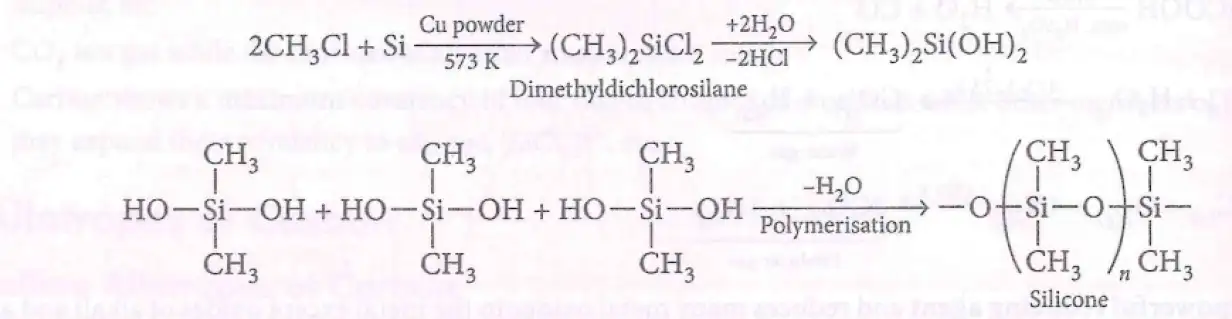
Silicon + methyl chloride (CH3Cl) with Cu catalyst at 573 K forms dimethyldichlorosilane.
Hydrolysis replaces Cl with OH forming silanols.
Polymerization of silanols releases water and forms silicone polymer.
Chain length controlled by adding (CH3)3SiCl to block ends.
Properties and Uses
Water repelling due to non-polar alkyl groups.
High thermal stability, dielectric strength, and chemical resistance.
Used as sealants, greases, electrical insulators, and waterproofing agents.
Biocompatible; used in surgical and cosmetic products.

Solved Examples
Ex 1: Write the reaction for hydrolysis of dimethyldichlorosilane.
(CH3)2SiCl2 + 2H2O \(\rightarrow\) (CH3)2Si(OH)2 + 2HCl
Ex 2: Polymerization of silanols.
2 (CH3)2Si(OH)2 \(\rightarrow\) [(CH3)2SiO]n + H2O
Practice Set
Q1: Silicones are polymers with repeating unit:
A. (SiO2)
B. (R2SiO)
C. (SiCl4)
D. (SiH4)
Q2: Which compound is used to control polymer chain length in silicones?
A. (CH3)3SiCl
B. SiCl4
C. H2O
D. CH3Cl
Q3: Silicones are used as:
A. Electrical insulators
B. Sealants
C. Biocompatible materials
D. All of the above
Answer Key
Q1: B - Silicones have repeating unit (R2SiO).
Q2: A - (CH3)3SiCl blocks polymer chain ends.
Q3: D - Silicones are used in all listed applications.
Memory Aids
Silicones = (R2SiO) polymers from hydrolysis and polymerization.
Chain length controlled by trimethylsilyl chloride.
Used as sealants, insulators, and biocompatible materials.
Silicates
Structure and Types
Compounds with SiO44− tetrahedral units as basic units.
Units may be discrete or linked by sharing 1–4 oxygen atoms forming chains, rings, sheets, or 3D structures.
Zeolites
Three-dimensional aluminosilicates with some Si replaced by Al3+.
Negative charge balanced by cations (Na+, K+, Ca2+, etc.).
Used as ion exchangers for water softening.
Act as catalysts in petrochemical industries.
ZSM-5 zeolite converts alcohols directly into gasoline.
Solved Examples
Ex 1: Describe the basic unit of silicates.
SiO44− tetrahedral unit.
Ex 2: Name a zeolite used in catalysis.
ZSM-5
Practice Set
Q1: The basic structural unit of silicates is:
A. SiO2
B. SiO44−
C. AlO45−
D. SiCl4
Q2: Zeolites are used as:
A. Ion exchangers
B. Catalysts
C. Both A and B
D. None
Q3: ZSM-5 is used to convert:
A. Alcohols to gasoline
B. Methane to CO
C. CO to CO2
D. Water to hydrogen
Answer Key
Q1: B - SiO44− is the basic silicate unit.
Q2: C - Zeolites act as ion exchangers and catalysts.
Q3: A - ZSM-5 converts alcohols to gasoline.
Memory Aids
Silicates = SiO44− units linked in various structures.
Zeolites = aluminosilicates, ion exchangers, catalysts.
ZSM-5 = alcohol to gasoline catalyst.
NEET Chemistry — ALL CHAPTERS
1
Some Basic Concepts of Chemistry
2
Structure of Atom
3
Classification of Elements and Periodicity in Properties
4
Chemical Bonding and Molecular Structure
5
Thermodynamics
6
Equilibrium
7
Redox Reactions
8
Organic Chemistry - Some Basic Principles and Techniques
9
Hydrocarbons
10
Solutions
11
Electrochemistry
12
Chemical Kinetics
13
The d- and f- Block Elements
14
Coordination Compounds
15
Haloalkanes and Haloarenes
16
Alcohols, Phenols and Ethers
17
Aldehydes, Ketones and Carboxylic Acids
18
Amines
19
Biomolecules
20
The p-Block Elements (Group 13 and 14)
21
The p-Block Elements (Group 15 to 18)
22
Principles Related to Practical Chemistry