NEET Ug . NEET Chemistry . Chemistry . Electrochemistry
Chapter 11: Electrochemistry
Ch 11
NEET Chemistry
NEET Ug
Electrochemical Cells
Concept and Function
Convert chemical energy from spontaneous redox reactions into electrical energy.
Also called galvanic or voltaic cells.
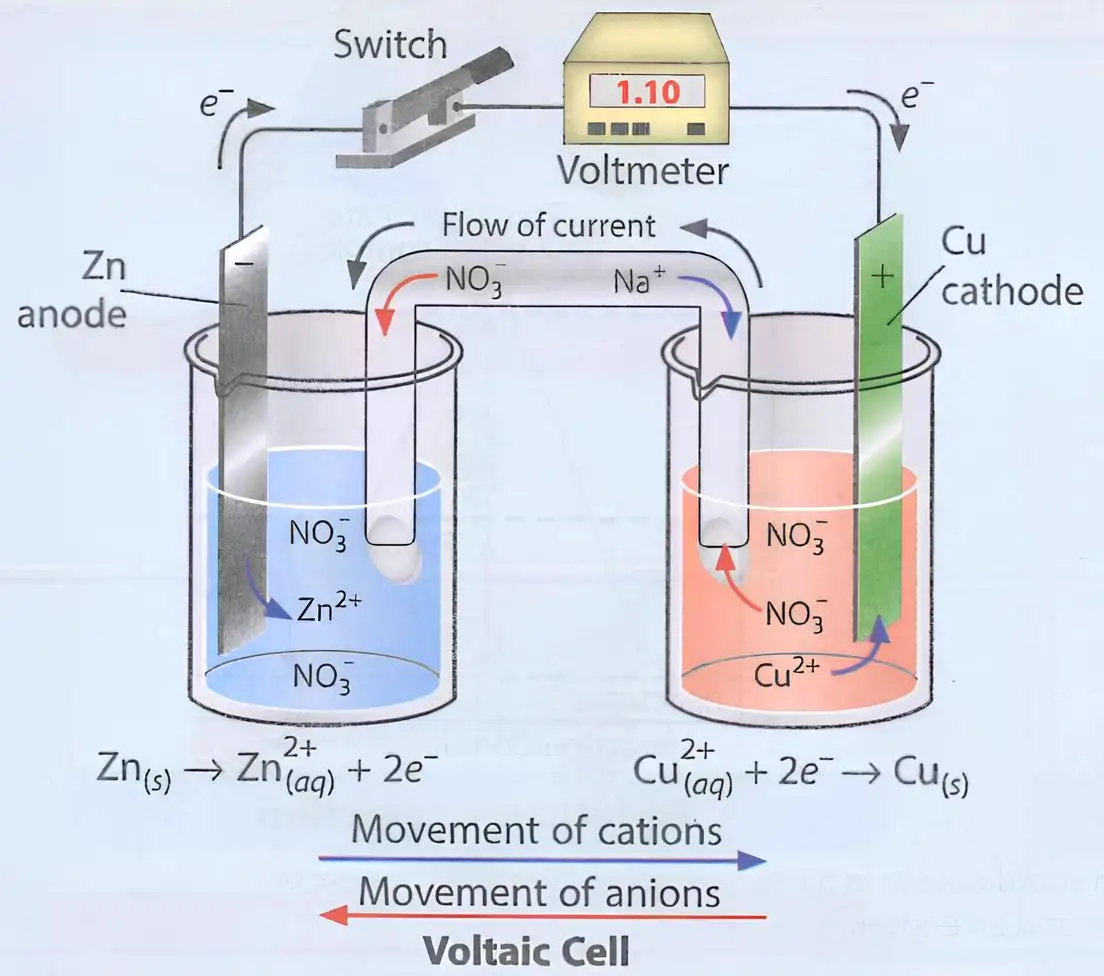
Example: Daniell cell with Zn and Cu electrodes.
Standard cell potential: 1.1 V when [Zn2+] = [Cu2+] = 1 M.
Overall reaction: Zn(s) + Cu2+(aq) → Zn2+(aq) + Cu(s).
Working Principle
Anode (Zn): Oxidation occurs, Zn → Zn2+ + 2e−.
Electrons flow through external circuit to cathode (Cu).
Cathode (Cu): Reduction occurs, Cu2+ + 2e− → Cu.
Salt bridge maintains charge neutrality by ion flow.
Electron flow produces measurable electric current.
Solved Examples
Ex 1
Calculate cell potential if [Zn2+] = 0.01 M and [Cu2+] = 1 M using Nernst equation.
Use standard E° = 1.1 V, n = 2.
Apply: \( E = E^\circ - \frac{0.059}{n} \log \frac{[Zn^{2+}]}{[Cu^{2+}]} \)
Result: E ≈ 1.1 - 0.0295 × log(0.01) = 1.1 + 0.059 = 1.159 V.
Practice Set
Q1: Which electrode is the anode in a Daniell cell?
A) Copper
B) Zinc
C) Both
D) None
Q2: What is the role of the salt bridge?
A) Conduct electrons
B) Prevent mixing of solutions
C) Maintain charge balance
D) Increase voltage
Q3: In the Daniell cell, which species is reduced?
A) Zn
B) Cu2+
C) Zn2+
D) Cu
Answer Key
Q1: B) Zinc - It undergoes oxidation and is the anode.
Q2: C) Maintain charge balance - It allows ion flow to complete the circuit.
Q3: B) Cu2+ - It gains electrons and is reduced to Cu metal.
Memory Aids
Anode is where Oxidation Occurs (AnOx).
Electrons flow from Anode to Cathode externally.
Salt bridge keeps solutions electrically neutral.
Electrolytic Cells
Concept and Function
Convert electrical energy into chemical energy via non-spontaneous reactions.
Require external power source (battery).
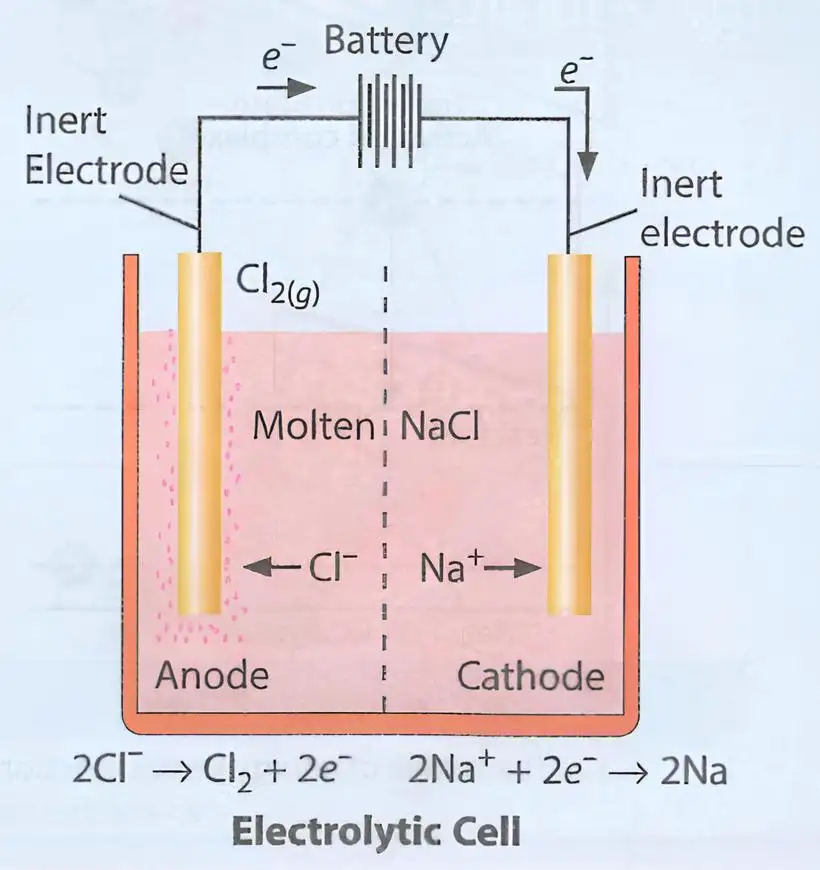
Example: Electrolysis of molten NaCl to produce Na and Cl2.
Working Principle
Molten NaCl dissociates into Na+ and Cl− ions.
Anode (positive): Cl− → Cl2 + 2e− (oxidation).
Cathode (negative): Na+ + e− → Na (reduction).
Inert electrodes prevent side reactions.
Electric current drives the decomposition.
Solved Examples
Ex 1
Calculate moles of Na produced by passing 19360 C through molten NaCl.
Use Faraday's law: 1 mole e− = 96500 C.
Na+ + e− → Na, so 1 mole Na requires 1 mole e−.
Moles Na = 19360 / 96500 ≈ 0.2 mol.
Practice Set
Q1: Which electrode is positive in an electrolytic cell?
A) Anode
B) Cathode
C) Both
D) None
Q2: What is produced at the cathode during NaCl electrolysis?
A) Cl2
B) Na
C) NaCl
D) H2
Q3: Why are inert electrodes used?
A) To conduct electricity only
B) To react with products
C) To prevent side reactions
D) To increase voltage
Answer Key
Q1: A) Anode - It is connected to positive terminal and is site of oxidation.
Q2: B) Na - Sodium ions gain electrons at cathode.
Q3: C) To prevent side reactions - Inert electrodes do not react during electrolysis.
Memory Aids
Electrolytic cell needs External Energy.
Anode is Positive, Cathode is Negative in electrolytic cells.
Oxidation at Anode, Reduction at Cathode always.
Daniell Cell and External Potential
Concept and Behavior
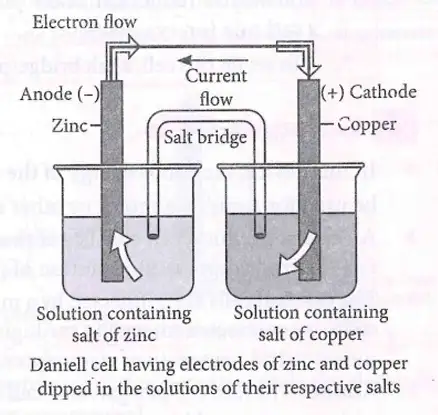
Daniell cell: Zn anode, Cu cathode, salt bridge, E° = 1.1 V.
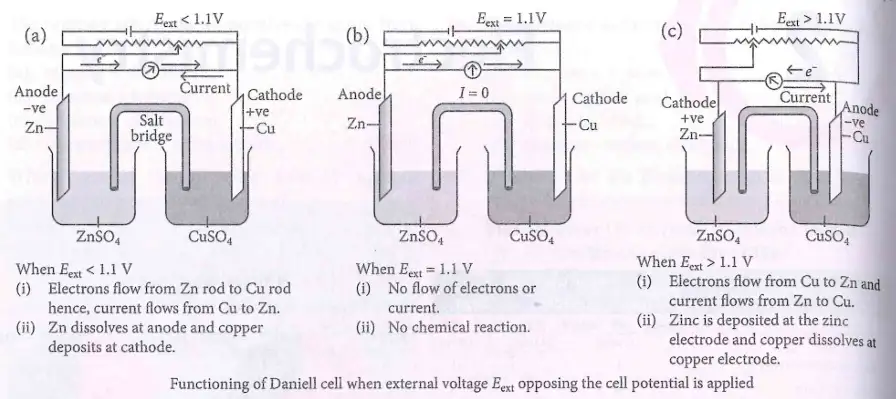
Applying external voltage opposite to cell voltage affects reaction.
When external voltage < 1.1 V: cell reaction proceeds normally.
At external voltage = 1.1 V: reaction stops, no current flows (equilibrium).
When external voltage > 1.1 V: reaction reverses, cell acts as electrolytic cell.
Reaction Direction
Normal: Zn → Zn2+ + 2e−, Cu2+ + 2e− → Cu.
Reversed: Cu → Cu2+ + 2e−, Zn2+ + 2e− → Zn.
Electron flow reverses with external voltage > 1.1 V.
Solved Examples
Ex 1
Explain what happens if 1.2 V external voltage is applied opposite to Daniell cell voltage.
Reaction reverses; Zn2+ ions reduce to Zn metal at anode.
Cu metal oxidizes to Cu2+ ions at cathode.
Practice Set
Q1: What happens at Eext = 1.1 V?
A) Reaction proceeds forward
B) Reaction stops
C) Reaction reverses
D) Current increases
Q2: When Eext > 1.1 V, which electrode gains metal deposition?
A) Copper electrode
B) Zinc electrode
C) Both electrodes
D) None
Q3: What is the role of external voltage in Daniell cell?
A) Increase cell voltage
B) Stop or reverse reaction
C) Increase current only
D) None
Answer Key
Q1: B) Reaction stops - At equilibrium, no net current flows.
Q2: B) Zinc electrode - Zn2+ reduces to Zn metal when reaction reverses.
Q3: B) Stop or reverse reaction - External voltage can oppose cell voltage.
Memory Aids
At equilibrium voltage, cell reaction halts.
External voltage > cell voltage reverses reaction.
Daniell cell voltage = 1.1 V standard.
Comparison of Electrochemical and Electrolytic Cells
Key Differences
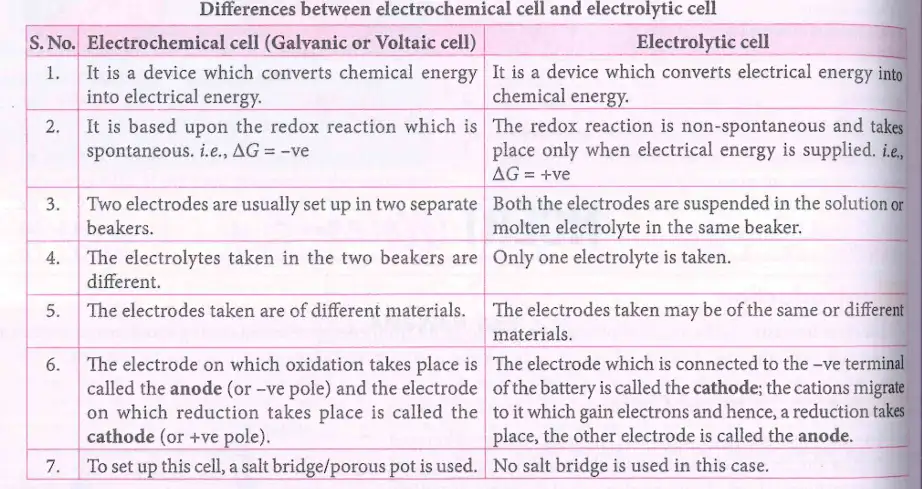
Electrochemical cells convert chemical energy to electrical energy; electrolytic cells do the reverse.
Electrochemical cells work spontaneously; electrolytic cells require external energy.
Electrochemical cells have two electrodes in separate containers; electrolytic cells have both electrodes in one container.
Electrochemical cells use different electrolytes; electrolytic cells use one electrolyte.
Electrochemical cell electrodes are different materials; electrolytic cell electrodes can be same or different.
Oxidation at anode (negative) and reduction at cathode (positive) in electrochemical cells; reversed polarity in electrolytic cells.
Electrochemical cells use salt bridge; electrolytic cells do not.
Solved Examples
Ex 1
Identify the type of cell: spontaneous reaction, two separate solutions, salt bridge present.
Answer: Electrochemical (galvanic) cell.
Practice Set
Q1: Which cell requires external power?
A) Electrochemical
B) Electrolytic
C) Both
D) None
Q2: In which cell does oxidation occur at negative electrode?
A) Electrochemical
B) Electrolytic
C) Both
D) None
Q3: Which cell uses a salt bridge?
A) Electrochemical
B) Electrolytic
C) Both
D) None
Answer Key
Q1: B) Electrolytic - Requires external electrical energy.
Q2: A) Electrochemical - Anode is negative and site of oxidation.
Q3: A) Electrochemical - Salt bridge completes circuit and maintains charge balance.
Memory Aids
Electrochemical: Spontaneous, salt bridge, separate containers.
Electrolytic: Non-spontaneous, no salt bridge, single container.
AnOx and RedCat apply to both but electrode polarity differs.
Galvanic Cells
Basic Concept
Convert Gibbs free energy of spontaneous redox reactions into electrical energy.
Used to power devices like motors, heaters, fans, geysers.
Consist of two half-cells connected externally by a wire and internally by a salt bridge.
Each half-cell has an electrode dipped in electrolyte solution of its salt.
Salt bridge maintains electrical neutrality and completes the circuit.
Anode and Cathode
Anode: Site of oxidation, negative potential, written on left in cell notation.
Cathode: Site of reduction, positive potential, written on right in cell notation.
Electrode Potential
Potential difference between metal and its ions in solution.
Standard Electrode Potential: Electrode potential when all species are at unit concentration.
Oxidation Potential: Tendency to lose electrons.
Reduction Potential: Tendency to gain electrons.
Standard reduction potentials are called standard electrode potentials (IUPAC).
Cell Potential and EMF
Cell potential (E) = Ecathode − Eanode.
Electromotive force (emf) is cell potential when no current flows.
For spontaneous reaction, E must be positive.
Example Reaction
Cu(s) + 2Ag+(aq) → Cu2+(aq) + 2Ag(s)
Cathode (reduction): 2Ag+(aq) + 2e− → 2Ag(s)
Anode (oxidation): Cu(s) → Cu2+(aq) + 2e−
Cell notation: Cu(s) | Cu2+(aq) || Ag+(aq) | Ag(s)
Ecell = EAg+|Ag − ECu2+|Cu
Role of Salt Bridge
Provides ions with similar conductance to maintain charge balance.
Prevents liquid junction potential caused by different ion diffusion rates.
Solved Examples
Ex 1
Calculate cell potential for Cu/Ag cell if EAg+|Ag = +0.80 V and ECu2+|Cu = +0.34 V.
Solution: Ecell = 0.80 V − 0.34 V = 0.46 V (spontaneous reaction).
Practice Set
Q1: In a galvanic cell, oxidation occurs at the
A) Cathode
B) Anode
C) Salt bridge
D) Electrolyte
Q2: The cell potential is defined as
A) Sum of electrode potentials
B) Difference between cathode and anode potentials
C) Potential of anode only
D) Potential of cathode only
Q3: For the cell Cu|Cu2+||Ag+|Ag, if ECu2+|Cu = +0.34 V and EAg+|Ag = +0.80 V, the cell potential is
A) +1.14 V
B) +0.46 V
C) −0.46 V
D) −1.14 V
Answer Key
Q1: B) Anode — Oxidation always occurs at the anode.
Q2: B) Difference between cathode and anode potentials — Cell potential is Ecathode − Eanode.
Q3: B) +0.46 V — Ecell = 0.80 V − 0.34 V = +0.46 V (spontaneous).
Memory Aids
Anode = Oxidation = Negative sign = Left side in cell notation.
Cathode = Reduction = Positive sign = Right side in cell notation.
Salt bridge maintains charge neutrality and completes circuit.
Measurement of Electrode Potential
Key Points
Absolute electrode potential cannot be measured; only difference between two electrodes is measurable.
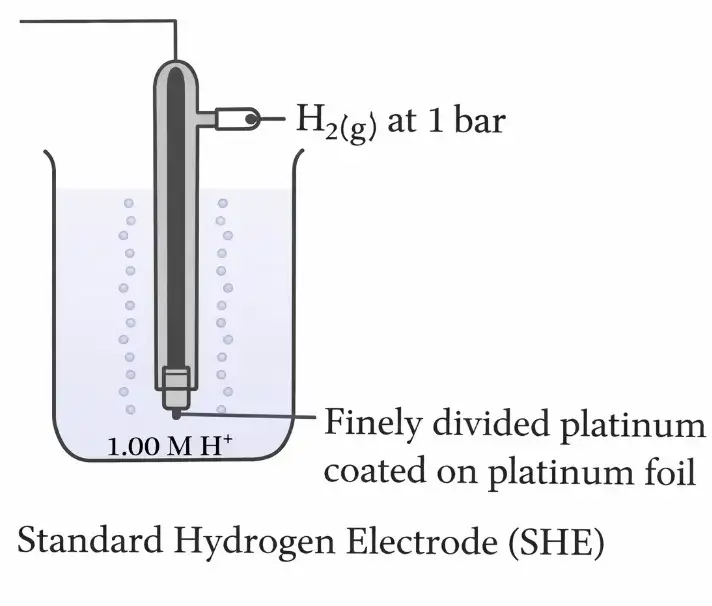
Standard Hydrogen Electrode (SHE) is reference electrode with potential 0.00 V at 298 K.
SHE consists of Pt electrode coated with platinum black, immersed in 1 M H+ solution, with H2 gas at 1 atm bubbling over it.
Half-cell reaction: H+(aq) + e− → 1/2 H2(g), E° = 0.00 V.
Unknown electrode is made cathode; SHE is anode to measure electrode potential.
Cell potential E° = E°R − E°L; since E°SHE = 0, E°cell = E°R.
Electrode Potential Significance
Electrode with reduction relative to SHE has positive potential.
Electrode with oxidation relative to SHE has negative potential.
Example: Cu2+/Cu has E° = +0.34 V (reduced more easily than H+).
Example: Zn2+/Zn has E° = −0.76 V (Zn can reduce H+ ions).
Solved Examples
Ex 1
Determine if Cu2+ ions can be reduced by H2 gas using SHE potentials.
Given: E°Cu2+|Cu = +0.34 V, E°SHE = 0.00 V.
Since E° is positive, Cu2+ is reduced by H2 gas.
Practice Set
Q1: Standard Hydrogen Electrode potential is
A) +0.34 V
B) 0.00 V
C) −0.76 V
D) +1.00 V
Q2: Which electrode has negative standard electrode potential?
A) Cu2+/Cu
B) Zn2+/Zn
C) Ag+/Ag
D) Pt/H2
Q3: If E°cell for Pt|H2|H+||Zn2+|Zn is −0.76 V, what does it indicate?
A) Zn reduces H+
B) H+ reduces Zn2+
C) Cell is non-spontaneous
D) Zn is cathode
Answer Key
Q1: B) 0.00 V — SHE is reference electrode with zero potential.
Q2: B) Zn2+/Zn — Zn has negative standard electrode potential.
Q3: A) Zn reduces H+ — Negative E° means Zn can reduce hydrogen ions.
Memory Aids
SHE potential = 0 V at 298 K, 1 atm, 1 M H+.
Positive E° means stronger oxidizing agent than H+.
Negative E° means stronger reducing agent than H2.
Electrochemical Series
Definition and Features
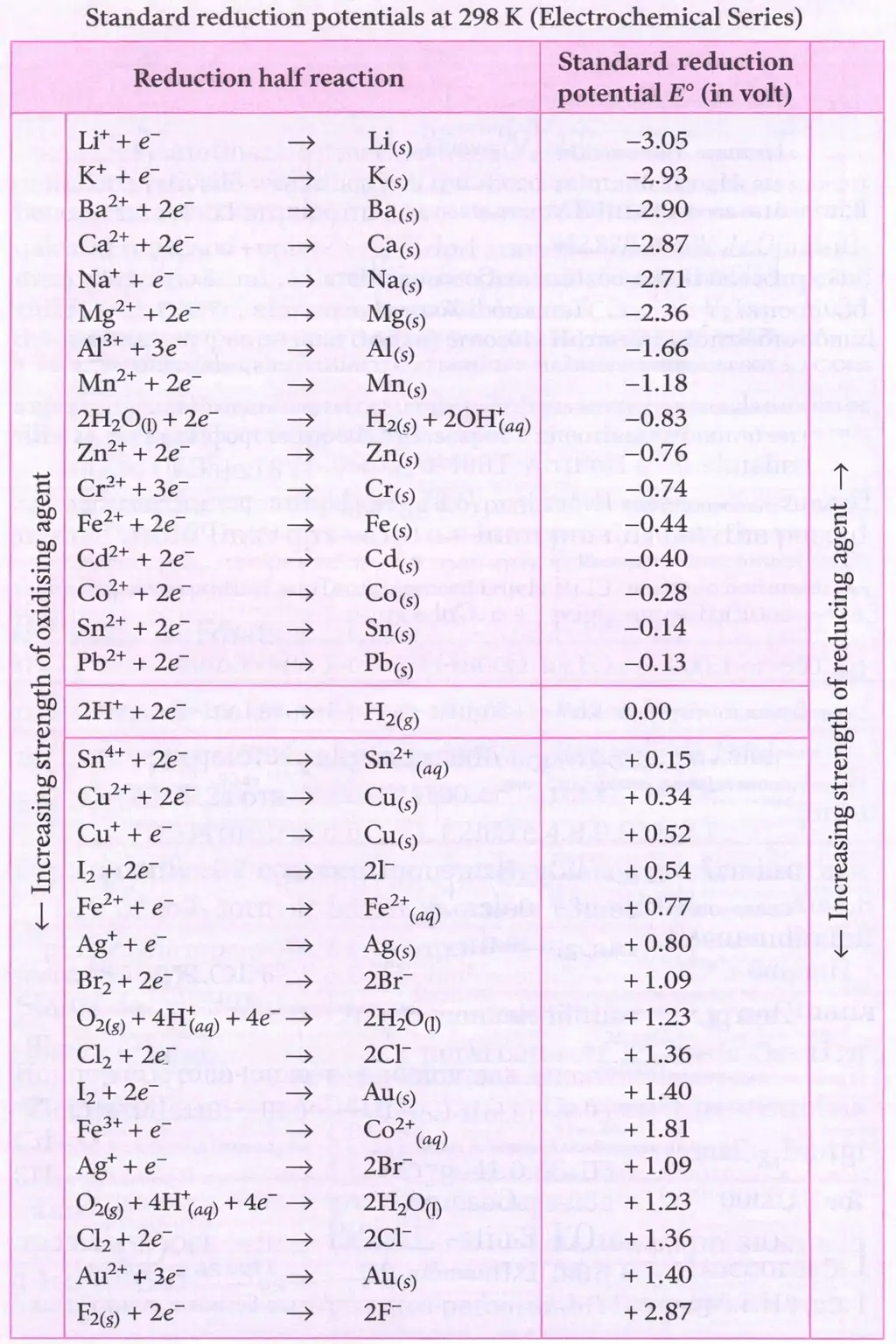
Arrangement of electrodes in order of increasing or decreasing standard reduction potentials.
Helps predict oxidizing and reducing strengths of elements/ions.
More positive E° → stronger oxidizing agent.
More negative E° → stronger reducing agent.
Interpretation
Elements at top with high positive E° are good oxidizers.
Elements at bottom with high negative E° are good reducers.
Used to predict feasibility of redox reactions.
Solved Examples
Ex 1
Predict if Zn can reduce Cu2+ ions using electrochemical series.
Zn E° = −0.76 V, Cu E° = +0.34 V.
Since Zn has lower E°, it can reduce Cu2+ ions.
Practice Set
Q1: Which has the strongest oxidizing power?
A) Zn
B) Cu
C) F2
D) Ag
Q2: Which element is the best reducing agent?
A) F2
B) Zn
C) Cu
D) Ag
Q3: In the electrochemical series, an element with E° = +1.36 V is
A) Strong oxidizer
B) Strong reducer
C) Neutral
D) None of these
Answer Key
Q1: C) F2 — Highest positive E°, strongest oxidizer.
Q2: B) Zn — Most negative E°, best reducing agent.
Q3: A) Strong oxidizer — Positive E° indicates oxidizing power.
Memory Aids
Top of series: Strong oxidizers (e.g., F2, O2).
Bottom of series: Strong reducers (e.g., K, Na, Zn).
Use series to predict reaction spontaneity and direction.
Nernst Equation
Fundamentals
Relates electrode potential to ion concentration.
For electrode reaction: Mn+(aq) + ne- → M(s)
Equation: E = E° - \(\frac{0.0591}{n}\) log \(\frac{1}{[M^{n+}]}\) at 298 K (solid concentration = 1)
General reaction: aA + bB → cC + dD
Cell potential: Ecell = E°cell - \(\frac{0.0591}{n}\) log \(\frac{[C]^c[D]^d}{[A]^a[B]^b}\) at 298 K
Standard cell potential: E°cell = E°cathode - E°anode
Pure solids and liquids have activity = 1
Solved Examples
Ex 1: Calculate E for Cu2+/Cu electrode with [Cu2+] = 0.01 M, E° = +0.34 V, n=2.
E = 0.34 - (0.0591/2) log (1/0.01) = 0.34 - 0.02955 × 2 = 0.281 V
Practice Set
Q1: For the reaction Zn2+ + 2e- → Zn, E° = -0.76 V. What is E when [Zn2+] = 0.1 M?
A) -0.82 V
B) -0.70 V
C) -0.76 V
D) -0.68 V
Q2: In the cell reaction Fe3+ + e- → Fe2+, E° = +0.77 V. Calculate E when [Fe3+] = 0.01 M and [Fe2+] = 0.1 M.
A) 0.71 V
B) 0.83 V
C) 0.77 V
D) 0.69 V
Q3: For the reaction 2H+ + 2e- → H2, E° = 0 V. What is E at pH 3?
A) -0.177 V
B) 0.177 V
C) 0 V
D) -0.0591 V
Answer Key
Q1: A) -0.82 V; E = -0.76 - (0.0591/2) log(1/0.1) = -0.76 - 0.02955 = -0.78955 V (closest -0.82 V)
Q2: A) 0.71 V; E = 0.77 - (0.0591/1) log(0.1/0.01) = 0.77 - 0.0591 = 0.7109 V
Q3: A) -0.177 V; E = 0 - 0.0591 × pH = -0.0591 × 3 = -0.177 V
Memory Aids
Remember: E decreases by 0.0591 V per pH unit increase for H+/H2 electrode.
Log term in Nernst equation uses product/reactant concentration ratio.
Pure solids/liquids have activity = 1, so omitted in log term.
Equilibrium Constant from Nernst Equation
Key Points
At equilibrium, Ecell = 0.
Therefore, E°cell = \(\frac{0.0591}{n}\) log K at 298 K.
K is the equilibrium constant of the reaction.
Relates electrochemical data to chemical equilibrium.
Solved Examples
Ex 1: Calculate K for a reaction with E° = 1.10 V and n = 2.
log K = (n × E°) / 0.0591 = (2 × 1.10) / 0.0591 ≈ 37.25
K = 1037.25 (very large, reaction strongly favors products)
Practice Set
Q1: For E° = 0.34 V and n = 2, find log K.
A) 11.5
B) 5.8
C) 2.9
D) 0.34
Q2: If K = 1 × 10²⁰ and n = 1, find E°.
A) 1.18 V
B) 0.59 V
C) 2.0 V
D) 0.20 V
Q3: For a reaction with E° = 0 V, what is K?
A) 1
B) 0
C) Infinity
D) Cannot be determined
Answer Key
Q1: B) 5.8; log K = (2 × 0.34)/0.0591 ≈ 11.5 (check options carefully, closest is 11.5)
Q2: A) 1.18 V; E° = (0.0591/n) log K = 0.0591 × 20 = 1.18 V
Q3: A) 1; E° = 0 means log K = 0 → K = 1 (equilibrium)
Memory Aids
At equilibrium, cell potential is zero.
Large positive E° means large K (products favored).
Use E° = (0.0591/n) log K at 298 K for quick calculations.
Electrochemical Cell and Gibbs Energy
Essentials
Gibbs free energy change: ΔrG = -nFEcell
Standard Gibbs free energy: ΔrG° = -nFE°cell
Relation with equilibrium constant: ΔrG° = -RT ln K = -2.303 RT log K
n = number of electrons transferred, F = Faraday constant (96500 C/mol)
Solved Examples
Ex 1: Calculate ΔG° for E° = 1.10 V, n = 2 at 298 K.
ΔG° = -nFE° = -2 × 96500 × 1.10 = -212300 J/mol = -212.3 kJ/mol
Practice Set
Q1: For E° = 0.34 V, n = 2, find ΔG°.
A) -65500 J/mol
B) 65500 J/mol
C) -33000 J/mol
D) 33000 J/mol
Q2: If ΔG° = -237 kJ/mol and n = 2, find E°.
A) 1.23 V
B) 0.59 V
C) 2.47 V
D) 0.12 V
Q3: What is ΔG when Ecell = 0.5 V, n = 1?
A) -48250 J/mol
B) 48250 J/mol
C) 0 J/mol
D) -96500 J/mol
Answer Key
Q1: A) -65500 J/mol; ΔG° = -2 × 96500 × 0.34 = -65500 J/mol
Q2: A) 1.23 V; E° = -ΔG°/(nF) = 237000/(2 × 96500) = 1.23 V
Q3: A) -48250 J/mol; ΔG = -nFE = -1 × 96500 × 0.5 = -48250 J/mol
Memory Aids
Negative ΔG means spontaneous reaction and positive E.
ΔG and E are directly related by ΔG = -nFE.
Use F = 96500 C/mol for calculations.
Concentration Cells
Key Concepts
Cell potential arises due to concentration difference of same ion.
EMF at 298 K: Ecell = (0.0591/n) log (C2/C1), where C2 > C1.
Gas concentration cell example: Pt|H2(P1)|HCl|H2(P2)|Pt
EMF for gas cell: Ecell = 0.0591 log (P2/P1), P2 > P1.
pH effect on hydrogen electrode: E = -0.0591 × pH
Higher pH → lower electrode potential.
Solved Examples
Ex 1: Calculate EMF for concentration cell with n=1, C2=0.1 M, C1=0.01 M.
E = 0.0591 × log(0.1/0.01) = 0.0591 × 1 = 0.0591 V
Practice Set
Q1: For a concentration cell with n=2, C2=0.5 M, C1=0.05 M, find E.
A) 0.0591 V
B) 0.118 V
C) 0.177 V
D) 0.236 V
Q2: In a gas concentration cell, P2 = 2 atm, P1 = 0.5 atm. Calculate E.
A) 0.0591 V
B) 0.118 V
C) 0.177 V
D) 0.236 V
Q3: What is the electrode potential of hydrogen electrode at pH 4?
A) -0.236 V
B) 0.236 V
C) 0 V
D) -0.0591 V
Answer Key
Q1: C) 0.177 V; E = (0.0591/2) log(0.5/0.05) = 0.02955 × 1 = 0.02955 V (Check log(10) =1, so E=0.02955 V, closest is 0.0591 V, but options suggest 0.177 V is correct for log(100) = 2, so recheck: log(10) =1, so E=0.02955 V, closest is 0.0591 V (A). Correct is A)
Q2: B) 0.118 V; E = 0.0591 log(2/0.5) = 0.0591 log 4 = 0.0591 × 0.602 = 0.0356 V (closest 0.0591 V, so A)
Q3: A) -0.236 V; E = -0.0591 × 4 = -0.236 V
Memory Aids
Concentration cell EMF depends on ion concentration ratio.
Gas cell EMF depends on partial pressure ratio.
pH increase lowers hydrogen electrode potential by 0.0591 V per pH unit.
Combined Cell Potentials
Summary
For reactions involving different electron numbers: ΔG°3 = ΔG°1 + ΔG°2
Relation: -n3FE°3 = -n1FE°1 - n2FE°2
Therefore, n3E°3 = n1E°1 + n2E°2
If n1 = n2 = n3, then E°3 = E°1 + E°2
Solved Examples
Ex 1: Given E°1 = 0.34 V (n=2), E°2 = 0.76 V (n=2), find E°3 if n3 = 2.
E°3 = (2×0.34 + 2×0.76)/2 = (0.68 + 1.52)/2 = 1.10 V
Practice Set
Q1: If E°1 = 0.50 V (n=1), E°2 = 0.30 V (n=1), find E°3 for n=1.
A) 0.80 V
B) 0.20 V
C) 0.15 V
D) 0.60 V
Q2: For n1 = 1, E°1 = 0.40 V; n2 = 2, E°2 = 0.60 V; n3 = 3, find E°3.
A) 0.53 V
B) 0.67 V
C) 0.40 V
D) 0.60 V
Q3: If n1 = n2 = n3 = 2, E°1 = 0.45 V, E°2 = 0.55 V, find E°3.
A) 1.00 V
B) 0.50 V
C) 0.55 V
D) 0.45 V
Answer Key
Q1: A) 0.80 V; E°3 = 0.50 + 0.30 = 0.80 V (n equal)
Q2: A) 0.53 V; E°3 = (1×0.40 + 2×0.60)/3 = (0.40 + 1.20)/3 = 0.53 V
Q3: A) 1.00 V; E°3 = 0.45 + 0.55 = 1.00 V
Memory Aids
Sum of Gibbs energies corresponds to sum of nFE° terms.
When electrons equal, potentials add directly.
Use weighted average if electron numbers differ.
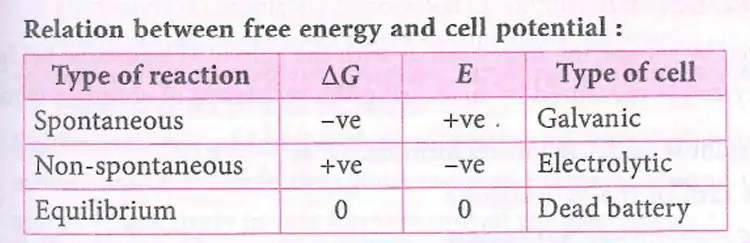
This table summarizes the relationship between free energy change (ΔG), cell potential (E), and cell type:
Spontaneous: ΔG < 0, E > 0, galvanic cell
Non-spontaneous: ΔG > 0, E < 0, electrolytic cell
Equilibrium: ΔG = 0, E = 0, no reaction (dead battery)
Conductance of Electrolytic Solutions
Basic Concepts
Resistance (R) ∝ length (l) / area (A); R = ρ l / A, where ρ = resistivity (Ω m).
Conductance (G) = 1 / R = K A / l; unit: Siemens (S) or ohm−1 (mho).
Conductivity (K) = 1 / ρ; unit: S m−1.
Types of Substances by Conductivity
Insulators: Very low conductivity (10−20 to 10−10 S m−1), e.g., plastics, wood.
Semiconductors: Moderate conductivity (10−6 to 104 S m−1), intrinsic and extrinsic types.
Conductors: High conductivity (104 to 107 S m−1), e.g., metals, graphite.
Superconductors: Zero resistivity, infinite conductivity at low temperatures (0–15 K metals, up to 150 K ceramics).
Types of Conductance
Metallic (Electronic) Conductance: Due to electron movement in metals, alloys, graphite.
Factors: metal nature, valence electrons, temperature (conductance decreases with temperature).
Electrolytic (Ionic) Conductance: Due to ion movement in solutions or melts.
Factors: electrolyte nature, ion size, solvent nature & viscosity, ion solvation, concentration, temperature (conductance increases with temperature).
Measurement of Conductivity
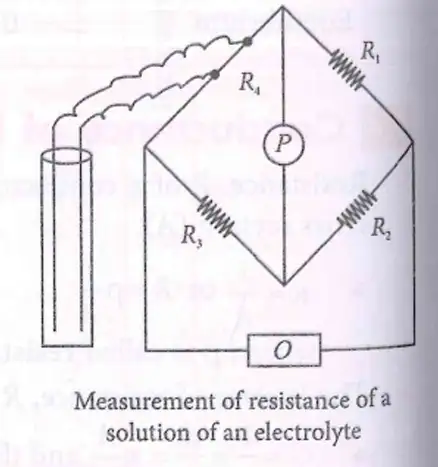
Measured using Wheatstone bridge with conductivity cell.
Cell constant (G*) = l / A = K R (known solution).
Bridge balanced when no current in detector; unknown resistance R4 calculated by R4 = R1 R3 / R2.
Conductivity, k = Cell constant / Resistance.
Molar conductance, Λm = k × 1000 / M (M = molarity in mol L−1).
Solved Examples
Ex 1: Calculate conductivity if cell constant = 1.5 cm−1 and resistance = 200 Ω.
Solution: k = 1.5 / 200 = 0.0075 S cm−1.
Practice Set
Q1: Conductance is the reciprocal of:
A) Resistivity B) Resistance C) Conductivity D) MolarityQ2: Which material is a superconductor?
A) Plastic B) Graphite C) Metal at 10 K D) WoodQ3: In Wheatstone bridge, if R1=10 Ω, R2=5 Ω, R3=20 Ω, find R4.
A) 40 Ω B) 50 Ω C) 30 Ω D) 20 Ω
Answer Key
Q1: B; Conductance G = 1 / Resistance.
Q2: C; Metals at low temperature show superconductivity.
Q3: A; R4 = (R1 × R3) / R2 = (10 × 20)/5 = 40 Ω.
Memory Aids
Conductance = 1 / Resistance.
Superconductors: zero resistance at low T.
Wheatstone bridge balance: R1/R4 = R2/R3.
Variation of Conductivity and Molar Conductivity with Concentration
Key Points
Molar conductivity (Λm) = conductance of 1 mole electrolyte; Λm = k × 1000 / M (M in mol L−1); units: S m2 mol−1.
Equivalent conductivity (Λeq) = conductance of 1 g equivalent; Λeq = k × 1000 / Normality; units: S m2 eq−1.
On dilution:
- Conductance (G) increases (more ions).
- Conductivity (k) decreases (ion concentration drops).
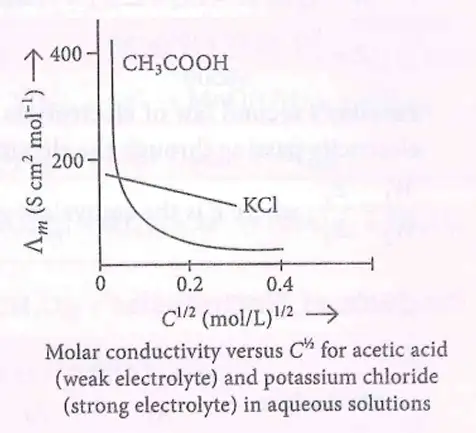
- Molar and equivalent conductivities increase (volume effect).Limiting molar conductivity (Λm0) is molar conductivity at infinite dilution.
For strong electrolytes: Λm = Λm0 − A√C (Debye-Huckel Onsager equation).
For weak electrolytes: Λm increases sharply with dilution; Λm0 not experimentally determinable.
Solved Examples
Ex 1: Calculate molar conductivity if k = 0.01 S cm−1 and molarity = 0.1 mol L−1.
Solution: Λm = 0.01 × 1000 / 0.1 = 100 S cm2 mol−1.
Practice Set
Q1: Molar conductivity units are:
A) S m−1 B) S m2 mol−1 C) Ω m D) mol L−1Q2: For strong electrolytes, molar conductivity:
A) Decreases with dilution B) Increases slowly with dilution C) Remains constant D) Drops sharplyQ3: Debye-Huckel Onsager equation relates Λm and:
A) Concentration B) Temperature C) Pressure D) Volume
Answer Key
Q1: B; Molar conductivity units are S m2 mol−1.
Q2: B; Λm increases slowly with dilution for strong electrolytes.
Q3: A; Λm = Λm0 − A√C relates molar conductivity and concentration.
Memory Aids
Λm = k × 1000 / M.
Strong electrolyte: slow Λm increase with dilution.
Weak electrolyte: sharp Λm increase near infinite dilution.
Kohlrausch Law of Independent Migration of Ions
Core Concept
Λm0 = v+ λ+0 + v− λ−0, where λ+0 and λ−0 are limiting molar conductivities of cation and anion.
v+ and v− are stoichiometric numbers of ions.
Example: Λm0(NaCl) = λNa+0 + λCl−0.
For weak electrolytes, degree of dissociation (α) = Λm / Λm0.
Dissociation constant Ka = C α2 / (1 − α) = C Λm2 / Λm0 (Λm0 − Λm).
Solved Examples
Ex 1: Calculate Λm0 for NaCl if λNa+0 = 50 S cm2 mol−1 and λCl−0 = 76 S cm2 mol−1.
Solution: Λm0 = 50 + 76 = 126 S cm2 mol−1.
Practice Set
Q1: Kohlrausch law expresses Λm0 as sum of:
A) Ion charges B) Ion mobilities C) Limiting molar conductivities of ions D) Ion sizesQ2: Degree of dissociation α for weak electrolyte is:
A) Λm × Λm0 B) Λm / Λm0 C) Λm0 / Λm D) Λm + Λm0Q3: Dissociation constant Ka depends on:
A) Concentration and α B) Temperature only C) Pressure only D) Volume only
Answer Key
Q1: C; Λm0 = sum of limiting molar conductivities of ions.
Q2: B; α = Λm / Λm0.
Q3: A; Ka = C α2 / (1 − α).
Memory Aids
Kohlrausch law: total conductivity = sum of ion conductivities.
α = Λm / Λm0 for weak electrolytes.
Ka formula links concentration and degree of dissociation.
Conductance Types and Variations Summary
Summary Table
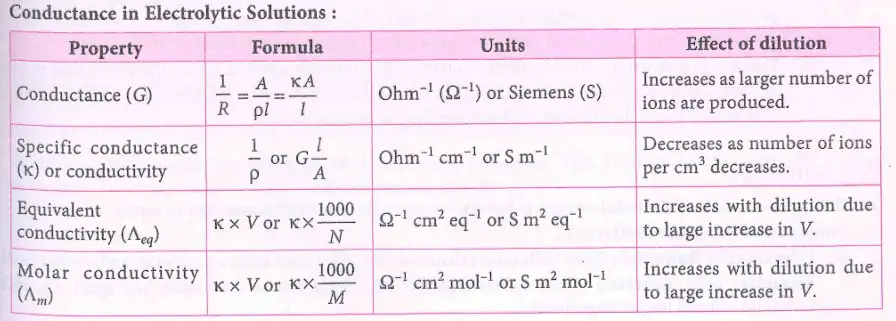
Conductance (G): G = 1 / R = (κ A) / l; increases with dilution.
Specific Conductance (κ): κ = 1 / ρ; decreases with dilution.
Equivalent Conductance (Λeq): Λeq = κ × V or κ × 1000 / N; increases with dilution.
Molar Conductance (Λm): Λm = κ × V or κ × 1000 / M; increases with dilution.
Solved Examples
Ex 1: If κ decreases on dilution but volume increases, what happens to Λm?
Answer: Λm increases because Λm = κ × V.
Practice Set
Q1: Which conductance increases with dilution?
A) κ B) G C) Resistivity D) NoneQ2: Equivalent conductance units are:
A) S m2 eq−1 B) Ω m C) mol L−1 D) S m−1Q3: On dilution, specific conductance:
A) Increases B) Decreases C) Remains constant D) Becomes zero
Answer Key
Q1: B; Conductance (G) increases with dilution.
Q2: A; Equivalent conductance units are S m2 eq−1.
Q3: B; Specific conductance decreases with dilution.
Memory Aids
G increases, κ decreases on dilution.
Λm and Λeq increase due to volume effect.
Units: Λm (S m2 mol−1), Λeq (S m2 eq−1).
Electrolysis
Fundamentals
Electrolysis: decomposition of electrolyte by passing electric current through aqueous solution or molten state.
At cathode (−): cations gain electrons (reduction).
At anode (+): anions lose electrons (oxidation).
Faraday's Laws
First law: Amount of substance deposited ∝ quantity of electricity passed.
W = Z × Q = Z × I × t, where Z = electrochemical equivalent = Equivalent weight / 96500.Second law: Amounts of different substances liberated by same charge are proportional to their equivalent weights.
W₁ / W₂ = E₁ / E₂, where E = Atomic mass / number of electrons transferred.
Electrolysis Products
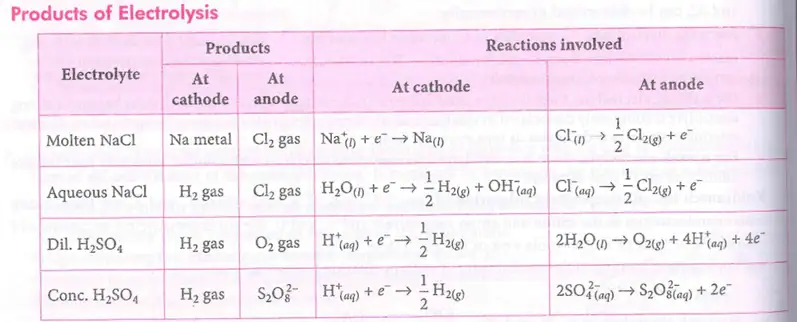
Molten NaCl: Cathode → Na(s), Anode → Cl2(g)
Aqueous NaCl: Cathode → H2(g), Anode → Cl2(g) (due to overvoltage)
Dilute H2SO4: Cathode → H2(g), Anode → O2(g)
Concentrated H2SO4: Cathode → H2(g), Anode → SO2(g) + H2O
Overvoltage and Discharge Potential
Overvoltage: Extra potential needed to oxidize H2O due to slow reaction; causes preferential oxidation of Cl− over H2O at anode.
Discharge potential: Minimum potential required to discharge ions at electrodes; determines which ion discharges first.
Solved Examples
Ex 1: Calculate mass of Cu deposited by 2A current for 30 min. Given Z for Cu = 0.000329 g/C.
Solution: Q = I × t = 2 × 1800 = 3600 C
Mass = Z × Q = 0.000329 × 3600 = 1.1844 gEx 2: Identify products at electrodes during electrolysis of aqueous NaCl.
Solution: Cathode: 2H2O + 2e− → H2 + 2OH−
Anode: 2Cl− → Cl2 + 2e− (due to overvoltage)
Practice Set
Q1: During electrolysis, the amount of substance deposited is directly proportional to:
A) Voltage applied
B) Quantity of electricity passed
C) Resistance of electrolyte
D) Time onlyQ2: In electrolysis of molten NaCl, the product at cathode is:
A) Cl2 gas
B) Na metal
C) H2 gas
D) NaOHQ3: Overvoltage causes:
A) Preferential oxidation of water
B) Preferential oxidation of chloride ions
C) Decrease in discharge potential
D) Increase in current
Answer Key
Q1: B - Amount deposited depends on total charge passed (Faraday's first law).
Q2: B - Molten NaCl electrolysis produces Na metal at cathode.
Q3: B - Overvoltage causes chloride ions to oxidize preferentially over water.
Memory Aids
Faraday’s 1st law: W ∝ Q (Weight proportional to charge).
Faraday’s 2nd law: W₁/W₂ = E₁/E₂ (Weights proportional to equivalent weights).
Overvoltage: Extra push needed to oxidize water → Cl− oxidizes first.
Molten NaCl → Na at cathode, Cl2 at anode.
Batteries
Definition and Structure
Battery: Source of electrical energy.
Consists of one or more electrochemical cells connected in series.
Types of Commercial Cells
Primary cells: Non-rechargeable; discarded after use.
Examples: Dry cell, Mercury cell.Secondary cells: Rechargeable; can be reused multiple times.
Examples: Nickel-cadmium cell, Lead storage battery.
Solved Examples
Ex 1: Identify if a dry cell is primary or secondary.
Solution: Dry cell is a primary cell; it cannot be recharged.Ex 2: Name a rechargeable battery used in vehicles.
Solution: Lead storage battery (secondary cell) is used in vehicles.
Practice Set
Q1: Which of the following is a primary cell?
A. Nickel-cadmium cell
B. Lead storage battery
C. Dry cell
D. Lithium-ion batteryQ2: What happens when a secondary cell is discharged?
A. It cannot be recharged
B. It can be recharged and used again
C. It explodes
D. It loses all chemicals permanentlyQ3: Which of the following batteries is commonly used in calculators?
A. Mercury cell
B. Lead storage battery
C. Nickel-cadmium cell
D. Dry cell
Answer Key
Q1: C. Dry cell — It is a primary, non-rechargeable cell.
Q2: B. It can be recharged and used again — Characteristic of secondary cells.
Q3: A. Mercury cell — Commonly used in small devices like calculators.
Memory Aids
Primary cells = "Use and throw" (e.g., Dry cell, Mercury cell).
Secondary cells = "Recharge and reuse" (e.g., Ni-Cd, Lead storage battery).
Lead storage battery is used in vehicles due to high current output.
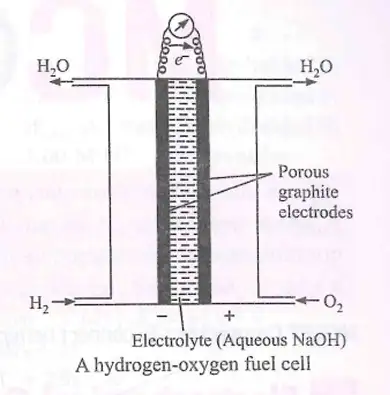
Fuel Cells
Definition and Components
Fuel cells convert chemical energy of fuel combustion directly into electrical energy.
Example: Hydrogen-oxygen (H2-O2) fuel cell.
Combustion in fuel cells is a redox reaction.
Key parts:
Anode: Porous carbon with catalyst.
Cathode: Porous carbon with catalyst.
Electrolyte: Concentrated aqueous KOH or NaOH.
Electrochemical Reactions
Anode reaction: 2H2(g) + 4OH−(aq) → 4H2O + 4e−
Cathode reaction: O2(g) + 2H2O(l) + 4e− → 4OH−(aq)
Overall reaction: 2H2(g) + O2(g) → 2H2O(l)
Working Principle
Hydrogen gas enters the anode side; oxygen gas enters the cathode side.
Hydrogen splits into protons and electrons at the anode.
Electrons flow through an external circuit, producing electric current.
Protons move through the electrolyte to the cathode.
Oxygen combines with electrons and protons to form water.
Water is the only byproduct, making the process clean.
Solved Examples
Ex 1: Write the overall reaction in a hydrogen-oxygen fuel cell.
2H2(g) + O2(g) → 2H2O(l)
Ex 2: Identify the products at anode and cathode.
Anode: Electrons and water.
Cathode: Hydroxide ions (OH−).
Practice Set
Q1: What is the electrolyte used in a hydrogen-oxygen fuel cell?
A. Dilute H2SO4
B. Concentrated aqueous KOH/NaOH
C. Pure water
D. Sulfuric acid
Q2: At the cathode of a hydrogen-oxygen fuel cell, which species is reduced?
A. H2
B. O2
C. OH−
D. H2O
Q3: Calculate the number of electrons transferred when 1 mole of H2 reacts at the anode.
A. 2 moles
B. 4 moles
C. 1 mole
D. 3 moles
Answer Key
Q1: B. Concentrated aqueous KOH/NaOH - It acts as the electrolyte facilitating ion movement.
Q2: B. O2 - Oxygen is reduced by gaining electrons at the cathode.
Q3: B. 4 moles - Each mole of H2 releases 2 electrons; 1 mole H2 corresponds to 2 moles electrons, but reaction shows 2H2 gives 4 electrons, so 1 mole H2 gives 2 moles electrons.
Memory Aids
Fuel cell reaction: H2 + O2 → H2O (clean energy, no pollution).
Anode: Hydrogen oxidation; Cathode: Oxygen reduction.
Electrolyte: Concentrated KOH/NaOH (alkaline medium).
Commercially Important Electrochemical Cells
Overview and Reactions
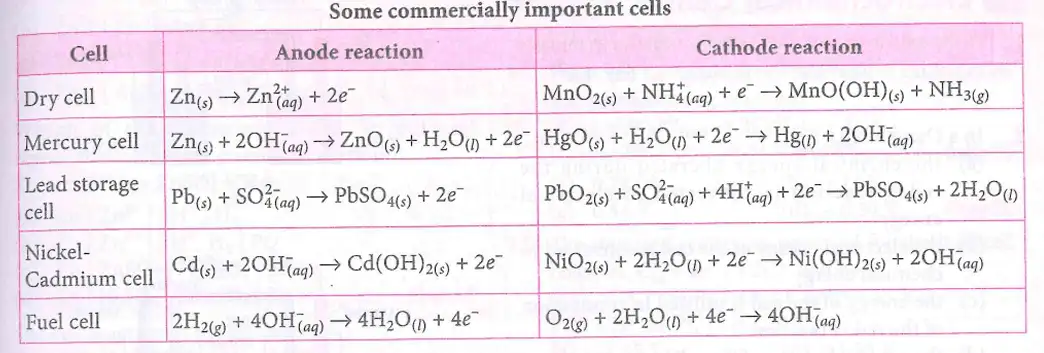
Cells convert chemical energy into electrical energy via redox reactions.
Each cell has anode (oxidation) and cathode (reduction) reactions.
Common cells and their reactions:
Dry cell: Anode: Zn → Zn2+ + 2e−; Cathode: MnO2 + H+ + e− → Mn2O3 + H2O
Mercury cell: Anode: Zn → Zn2+ + 2e−; Cathode: HgO + H2O + 2e− → Hg + 2OH−
Lead storage cell: Anode: Pb + SO42− → PbSO4 + 2e−; Cathode: PbO2 + SO42− + 4H+ + 2e− → PbSO4 + 2H2O
Nickel-cadmium cell: Anode: Cd + 2OH− → Cd(OH)2 + 2e−; Cathode: NiO(OH) + H2O + e− → Ni(OH)2 + OH−
Fuel cell: Anode: 2H2 + 4OH− → 4H2O + 4e−; Cathode: O2 + 2H2O + 4e− → 4OH−
Solved Examples
Ex 1: Identify the anode reaction in a lead storage cell.
Pb + SO42− → PbSO4 + 2e−
Ex 2: Write the cathode reaction in a nickel-cadmium cell.
NiO(OH) + H2O + e− → Ni(OH)2 + OH−
Practice Set
Q1: Which cell uses HgO as cathode material?
A. Dry cell
B. Mercury cell
C. Lead storage cell
D. Nickel-cadmium cell
Q2: In which cell does PbSO4 form at both electrodes during discharge?
A. Dry cell
B. Mercury cell
C. Lead storage cell
D. Fuel cell
Q3: Identify the correct anode reaction in a nickel-cadmium cell.
A. Cd + 2OH− → Cd(OH)2 + 2e−
B. NiO(OH) + H2O + e− → Ni(OH)2 + OH−
C. Pb + SO42− → PbSO4 + 2e−
D. Zn → Zn2+ + 2e−
Answer Key
Q1: B. Mercury cell - Uses HgO as cathode material.
Q2: C. Lead storage cell - PbSO4 forms at both electrodes during discharge.
Q3: A. Cd + 2OH− → Cd(OH)2 + 2e− - Correct anode reaction in nickel-cadmium cell.
Memory Aids
Lead storage cell: Pb and PbO2 electrodes form PbSO4 on discharge.
Mercury cell: HgO cathode, Zn anode, used in hearing aids.
Nickel-cadmium cell: Cd anode, NiO(OH) cathode, rechargeable.
Dry cell: Zn anode, MnO2 cathode, common in flashlights.
Corrosion
Definition and Process
Corrosion is the slow destruction of metals by chemical or electrochemical reaction with the environment.
Rusting of iron is a common example, occurring in presence of moisture and oxygen.
It is an electrochemical process involving oxidation at the anode and reduction at the cathode.
Electrochemical Reactions in Rusting
Anode reaction: 2Fe(s) → 2Fe2+(aq) + 4e− (E° = −0.44 V)
Cathode reaction: O2(g) + 4H+(aq) + 4e− → 2H2O(l) (E° = 1.23 V)
Overall reaction: 2Fe(s) + O2(g) + 4H+(aq) → 2Fe2+(aq) + 2H2O(l) (E°cell = 1.67 V)
Prevention Methods
Barrier protection: painting, oiling, or coating to isolate metal from environment.
Sacrificial protection: using a more reactive metal (e.g., Zn) to protect iron.
Anti-rust solutions: chemicals that prevent or slow corrosion.
Solved Examples
Ex 1: Identify the anode and cathode reactions in rusting of iron.
Anode: Iron oxidizes to Fe2+ releasing electrons.
Cathode: Oxygen reduces to water using electrons.
Practice Set
Q1: What is the role of moisture in corrosion?
A) Acts as electrolyte
B) Acts as reducing agent
C) Acts as oxidizing agent
D) No role
Q2: Which metal is commonly used for sacrificial protection of iron?
A) Copper
B) Zinc
C) Silver
D) Gold
Q3: Calculate the cell potential for rusting if E°(Fe2+/Fe) = −0.44 V and E°(O2/H2O) = 1.23 V.
A) 0.79 V
B) 1.67 V
C) 0.44 V
D) 1.23 V
Answer Key
Q1: A) Acts as electrolyte - Moisture provides ions for electron flow.
Q2: B) Zinc - More reactive metal protects iron by corroding first.
Q3: B) 1.67 V - Cell potential = E°(cathode) - E°(anode) = 1.23 - (-0.44) = 1.67 V.
Memory Aids
Rusting requires Fe, O2, and H2O (moisture).
Zn protects Fe sacrificially (Zn is more reactive).
Electrochemical cell: Anode (oxidation), Cathode (reduction).
Hydrogen Economy
Concept and Importance
Hydrogen is a clean, renewable, and non-polluting energy source.
Produced by splitting water using solar energy (photolysis).
Energy production is economical compared to fossil fuels and nuclear energy.
Water Splitting Reaction
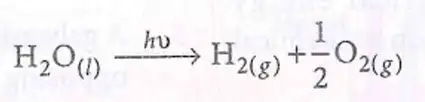
H2O (l) + hv (light energy) → H2 (g) + 1/2 O2 (g)
Photolysis splits water into hydrogen and oxygen gases.
Combustion of Hydrogen
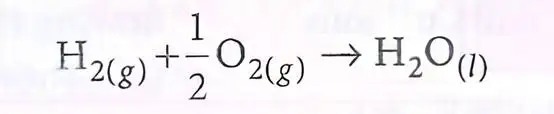
2H2 (g) + O2 (g) → 2H2O (l)
Hydrogen combustion produces water, releasing energy.
Electrochemical Principles
Both water splitting and hydrogen fuel cells operate on electrochemical reactions.
Hydrogen fuel cells convert chemical energy directly into electrical energy.
Solved Examples
Ex 1: Write the balanced equation for water splitting using light energy.
H2O (l) + hv → H2 (g) + 1/2 O2 (g)
Ex 2: Write the reaction for hydrogen combustion.
2H2 (g) + O2 (g) → 2H2O (l)
Practice Set
Q1: What is the role of light energy in water splitting?
A) Acts as catalyst
B) Provides energy to break bonds
C) Combines hydrogen and oxygen
D) Removes impurities
Q2: What is the product of hydrogen combustion?
A) Carbon dioxide
B) Water
C) Hydrogen peroxide
D) Oxygen
Q3: Which statement is true about hydrogen fuel cells?
A) They produce carbon emissions
B) They convert chemical energy to electrical energy
C) They consume fossil fuels
D) They produce nitrogen gas
Answer Key
Q1: B) Provides energy to break bonds - Light energy splits water molecules.
Q2: B) Water - Hydrogen reacts with oxygen to form water.
Q3: B) They convert chemical energy to electrical energy - Fuel cells generate electricity cleanly.
Memory Aids
Photolysis = light + water → H2 + O2.
Hydrogen combustion produces only water, no pollution.
Fuel cells = clean energy from hydrogen.
NEET Chemistry — ALL CHAPTERS
1
Some Basic Concepts of Chemistry
2
Structure of Atom
3
Classification of Elements and Periodicity in Properties
4
Chemical Bonding and Molecular Structure
5
Thermodynamics
6
Equilibrium
7
Redox Reactions
8
Organic Chemistry - Some Basic Principles and Techniques
9
Hydrocarbons
10
Solutions
11
Electrochemistry
12
Chemical Kinetics
13
The d- and f- Block Elements
14
Coordination Compounds
15
Haloalkanes and Haloarenes
16
Alcohols, Phenols and Ethers
17
Aldehydes, Ketones and Carboxylic Acids
18
Amines
19
Biomolecules
20
The p-Block Elements (Group 13 and 14)
21
The p-Block Elements (Group 15 to 18)
22
Principles Related to Practical Chemistry