NEET Ug . NEET Chemistry . Chemistry . Hydrocarbons
Chapter 9: Hydrocarbons
Ch 9
NEET Chemistry
NEET Ug
Introduction
Key Points
Hydrocarbons are organic compounds made up only of carbon (C) and hydrogen (H) atoms.
Main natural sources: natural gas, petroleum, and coal.
Solved Examples
Ex 1: Identify the elements present in hydrocarbons.
Answer: Carbon and hydrogen only.
Practice Set
Q1: What elements constitute hydrocarbons?
A. C and O
B. C and H
C. H and O
D. C, H, and OQ2: Which of the following is a major source of hydrocarbons?
A. Water
B. Natural gas
C. Air
D. SaltQ3: Hydrocarbons are primarily found in:
A. Minerals
B. Petroleum
C. Metals
D. Salts
Answer Key
Q1: B - Hydrocarbons contain only carbon and hydrogen atoms.
Q2: B - Natural gas is a main source of hydrocarbons.
Q3: B - Petroleum is a primary source of hydrocarbons.
Memory Aids
Hydrocarbons = C + H only.
Sources: Natural gas, Petroleum, Coal (NPC).
Classification
Types of Hydrocarbons
Based on carbon-carbon bonds, hydrocarbons are classified into:
Saturated: Only single bonds (C–C, C–H).
Unsaturated: Contain double (C=C) or triple (C≡C) bonds.
Aromatic: Special cyclic compounds with delocalized π electrons.
Subtypes
Alkanes: Saturated hydrocarbons with open chains.
Cycloalkanes: Saturated hydrocarbons with carbon atoms in rings.
Solved Examples
Ex 1: Classify CH4.
Answer: Saturated alkane (methane, single bonds, open chain).Ex 2: Classify C6H6.
Answer: Aromatic hydrocarbon (benzene ring with delocalized electrons).
Practice Set
Q1: Which hydrocarbon contains only single bonds?
A. Alkene
B. Alkyne
C. Alkane
D. AromaticQ2: Cycloalkanes are:
A. Unsaturated open chain hydrocarbons
B. Saturated ring hydrocarbons
C. Aromatic compounds
D. Unsaturated ring hydrocarbonsQ3: Which of the following is an aromatic hydrocarbon?
A. Ethane
B. Benzene
C. Ethene
D. Cyclohexane
Answer Key
Q1: C - Alkanes have only single bonds.
Q2: B - Cycloalkanes are saturated hydrocarbons with ring structures.
Q3: B - Benzene is a classic aromatic hydrocarbon.
Memory Aids
Saturated = single bonds only (alkanes, cycloalkanes).
Unsaturated = double/triple bonds (alkenes, alkynes).
Aromatic = special cyclic with delocalized π electrons (benzene).
Alkanes
Structure
General formula: CnH2n+2 (n = 1, 2, 3...)
Carbon atoms are sp3 hybridized, forming tetrahedral geometry
All C–C and C–H bonds are sigma (σ) bonds
C–C bond length: 1.54 Å; C–H bond length: 1.09 Å
Bond angles approximately 109°28'
Isomerism
Exhibit chain isomerism
First three alkanes (methane, ethane, propane) have no isomers
Number of isomers increases with carbon atoms: butane (2), pentane (3), hexane (5), heptane (9), octane (18), decane (75)

Preparation
By hydrogenation of unsaturated hydrocarbons
Alkenes and alkynes react with H2 in presence of Pt, Pd, or Ni catalysts
Double/triple bonds convert to single bonds forming alkanes

Reduction of alkyl halides
Alkyl halides (except fluorides) reduced by Zn and dilute HCl to form alkanes

Wurtz reaction
Alkyl halides react with sodium metal in dry ether to form higher alkanes
Used to prepare alkanes with even number of carbons

From carboxylic acids
Decarboxylation: Sodium salts of carboxylic acids heated with soda lime produce alkanes with one less carbon atom

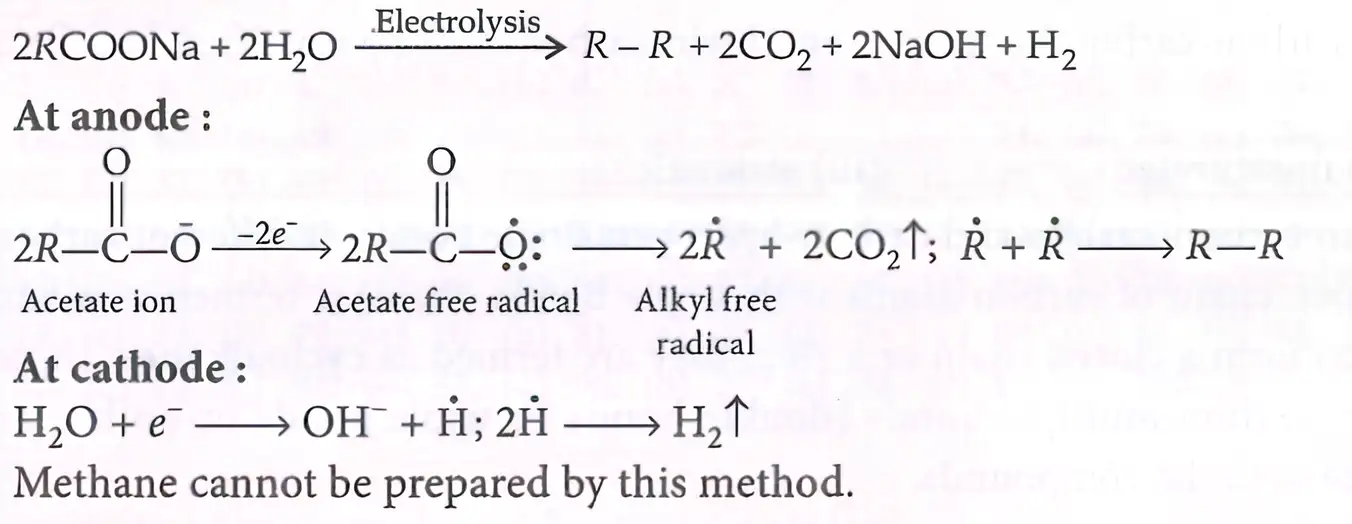
Kolbe’s electrolysis
Electrolysis of aqueous sodium or potassium salts of carboxylic acids produces alkanes with even number of carbons
Physical Properties
C1 to C4: gases; C5 to C17: liquids; C18 and above: solids at 298 K
Colourless, odourless, insoluble in water, soluble in non-polar solvents
Boiling points increase with molecular mass; decrease with branching
Alkanes with even number of carbons have higher melting points due to symmetry
Chemical Properties
Generally inert to acids, bases, oxidizing and reducing agents
Undergo halogenation under UV light or heat
Rate of halogenation: F2 > Cl2 > Br2 > I2
Rate of hydrogen replacement: 3° > 2° > 1°
Fluorination is violent; iodination is slow and reversible, requires oxidizing agents

Mechanism of Halogenation
Chain initiation: UV light splits Cl2 into 2 Cl radicals
Chain propagation: Cl radical abstracts H from alkane forming alkyl radical and HCl; alkyl radical reacts with Cl2 to form alkyl halide and Cl radical
Chain termination: radicals combine to form stable molecules

Other Reactions
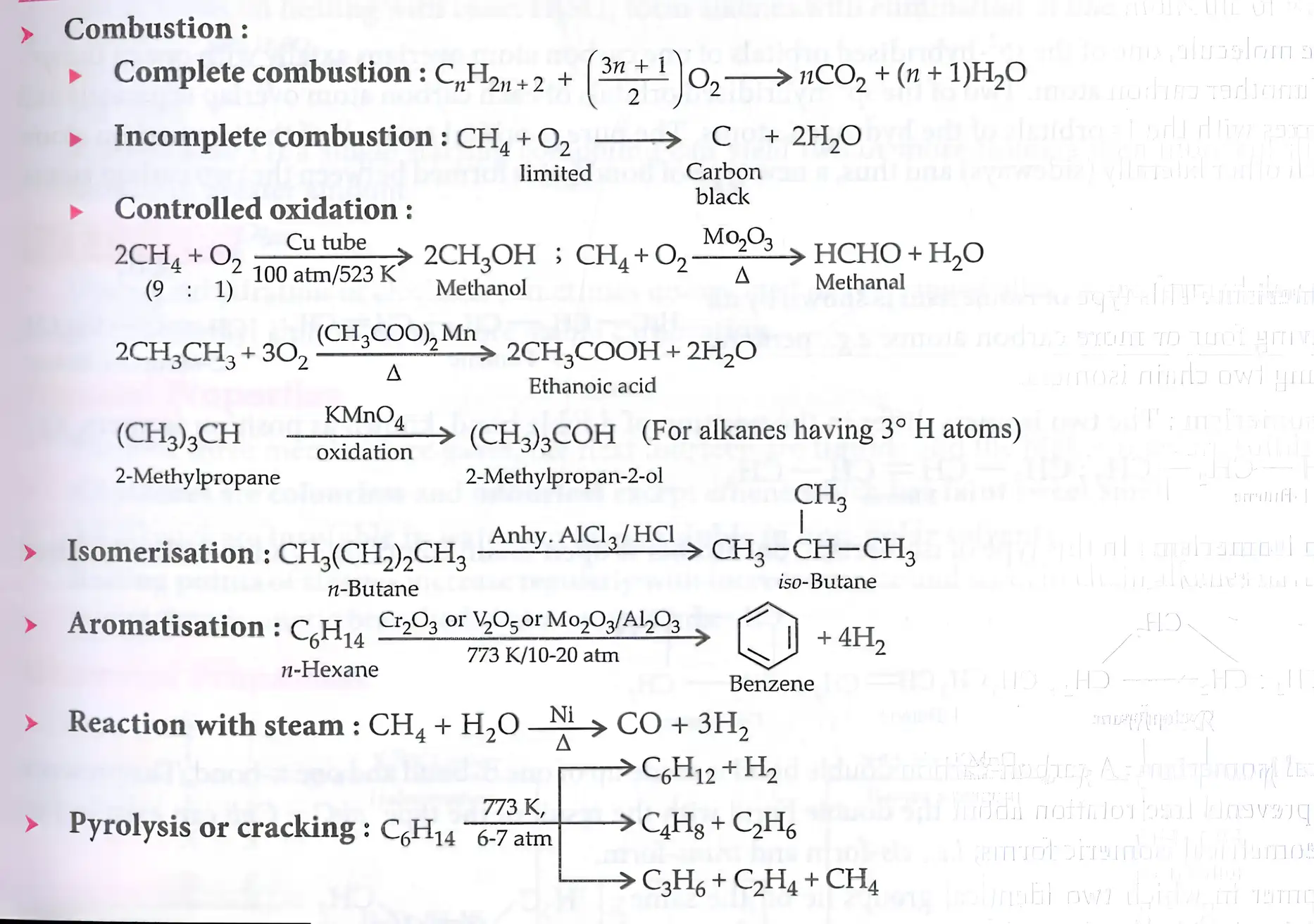
Combustion: Complete (CO2 + H2O), incomplete (C + H2O)
Controlled oxidation: partial oxidation to methanol, formaldehyde, acetic acid
Isomerisation: n-butane to iso-butane using AlCl3/HCl
Aromatisation: n-hexane to benzene using catalysts at high T and P
Reaction with steam: methane + steam → CO + H2 (Ni catalyst)
Pyrolysis/cracking: breaking large hydrocarbons into smaller ones
Conformations
Conformational Isomerism
Different spatial arrangements due to rotation about C–C single bond
Called conformational or rotational isomers
Conformations of Ethane
Infinite conformations possible by rotation about C–C bond
Eclipsed: hydrogens aligned, least stable
Staggered: hydrogens maximally apart, most stable (12.5 kJ/mol more stable than eclipsed)
Skew (gauche): intermediate conformations between eclipsed and staggered

Alkenes Structure
Orbital Overlap
Alkene carbon atoms are sp2 hybridised.
One sp2 orbital from each carbon overlaps axially to form a sigma (σ) bond.
Remaining sp2 orbitals form sigma bonds with hydrogen atoms.
Unhybridised p orbitals on each carbon overlap sideways to form a pi (π) bond.
Double bond = 1 σ + 1 π bond; π bond restricts rotation.
Solved Examples
Ex 1
Explain bonding in ethene: Two sp2 orbitals overlap to form σ bond; p orbitals form π bond.
Practice Set
Q1: What type of hybridisation is present in alkene carbons?
A. sp
B. sp2
C. sp3
D. dsp2
Q2: The pi bond in alkenes is formed by overlap of:
A. sp2 orbitals
B. p orbitals sideways
C. s orbitals
D. sp orbitals
Q3: Which bond restricts rotation in alkenes?
A. Sigma bond
B. Pi bond
C. Hydrogen bond
D. Ionic bond
Answer Key
Q1: B - Alkene carbons are sp2 hybridised.
Q2: B - Pi bond is formed by sideways overlap of p orbitals.
Q3: B - Pi bond restricts rotation around double bond.
Memory Aids
Alkene carbons: sp2 hybridised = 3 sigma bonds + 1 pi bond.
Pi bond = sideways p orbital overlap, no free rotation.
Alkenes Isomerism
Types of Isomerism
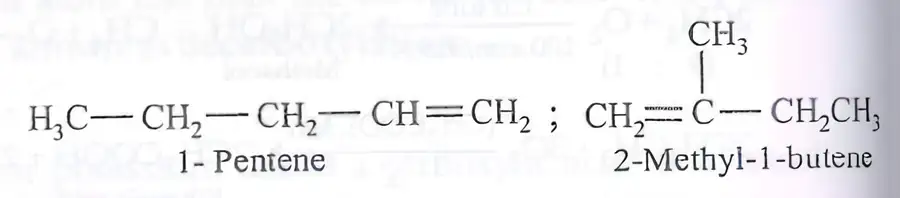
Chain isomerism: Different carbon chain arrangements (e.g., 1-pentene and 2-methyl-1-butene).
Position isomerism: Double bond at different positions (e.g., 1-butene and 2-butene).

Ring chain isomerism: Open chain vs cyclic compounds (e.g., propene and cyclopropane).

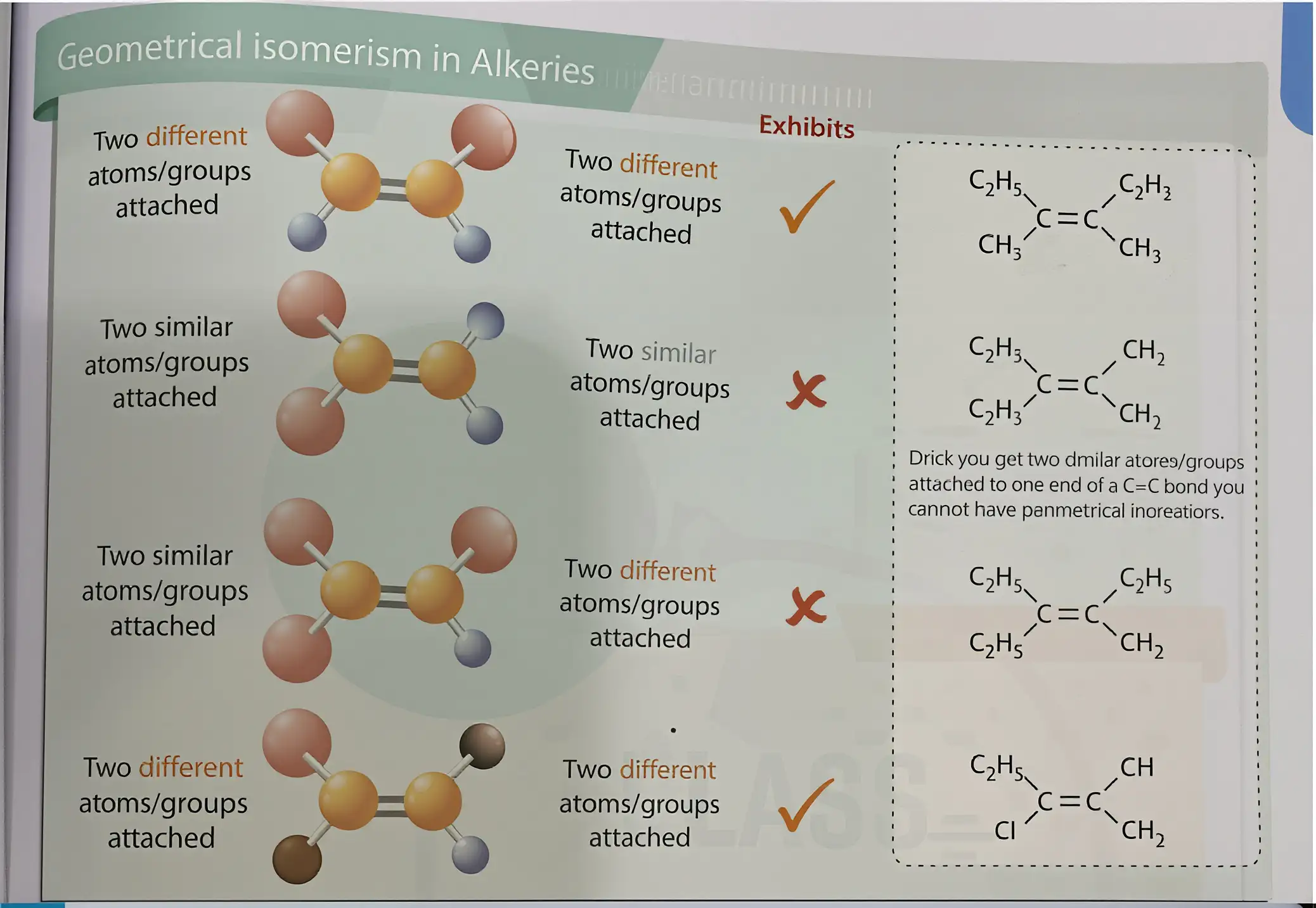
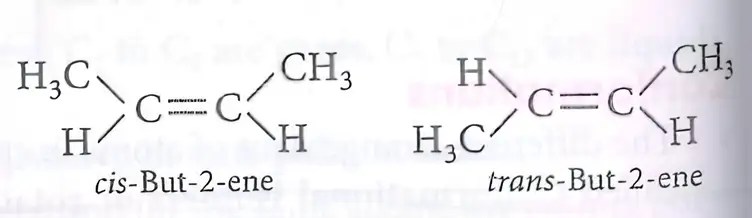
Geometrical isomerism: Cis (same side) and trans (opposite side) around double bond.
Trans isomers are generally more stable due to less steric hindrance.
Solved Examples
Ex 1
Identify isomers of butene: 1-butene (double bond at C1), 2-butene (double bond at C2).
Practice Set
Q1: Which is an example of chain isomerism?
A. 1-butene and 2-butene
B. 1-pentene and 2-methyl-1-butene
C. Cis-butene and trans-butene
D. Propene and cyclopropane
Q2: Geometrical isomers differ in:
A. Position of double bond
B. Arrangement around double bond
C. Carbon chain length
D. Functional group
Q3: Which is more stable?
A. Cis-isomer
B. Trans-isomer
C. Both equal
D. Depends on temperature
Answer Key
Q1: B - Chain isomerism involves different carbon chains.
Q2: B - Geometrical isomers differ in spatial arrangement around double bond.
Q3: B - Trans-isomers are more stable due to less steric hindrance.
Memory Aids
Chain isomers: different carbon skeletons.
Position isomers: double bond shifts.
Geometrical isomers: cis (same side), trans (opposite side).
Alkenes Preparation
Methods
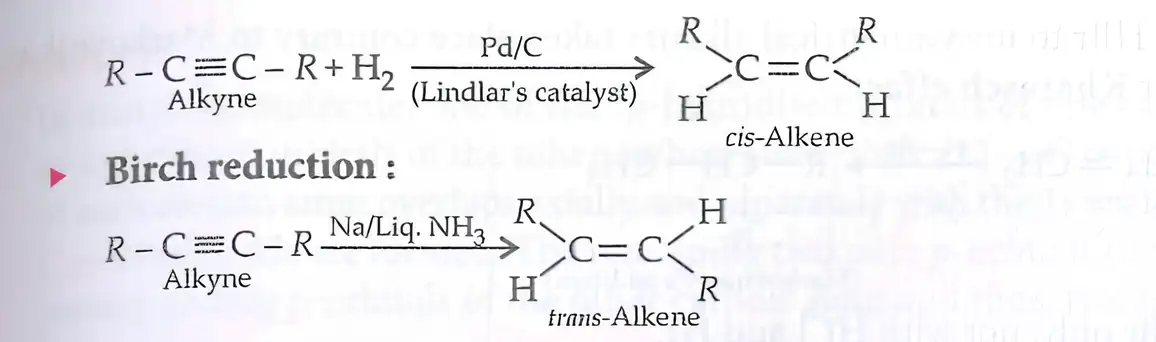
Partial hydrogenation of alkynes: Using Lindlar's catalyst yields cis-alkenes; Birch reduction (Na/NH3) yields trans-alkenes.
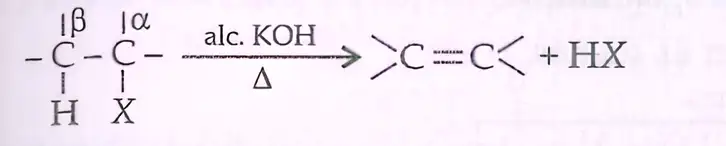
Dehydrohalogenation of alkyl halides: β-elimination with alcoholic KOH and heat removes HX to form alkene.
From vicinal dihalides: Reduction with Zn removes halogens to form alkene.
Dehydration of alcohols: Heating with conc. H2SO4 removes water to form alkene.
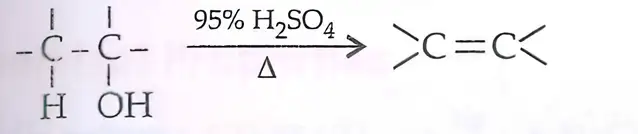
Saytzeff rule: More substituted alkene formed preferentially.
Solved Examples
Ex 1
Partial hydrogenation: HC≡CH + H2 (Lindlar's catalyst) → H2C=CH2 (cis-alkene)
Practice Set
Q1: Lindlar's catalyst produces:
A. Trans-alkene
B. Cis-alkene
C. Alkane
D. Alkyne
Q2: Dehydrohalogenation involves removal of:
A. Hydrogen and halogen from same carbon
B. Hydrogen and halogen from adjacent carbons
C. Two hydrogens
D. Two halogens
Q3: In dehydration of alcohols, the major product follows:
A. Less substituted alkene
B. More substituted alkene
C. Equal mixture
D. No alkene formed
Answer Key
Q1: B - Lindlar's catalyst yields cis-alkenes.
Q2: B - β-elimination removes H and halogen from adjacent carbons.
Q3: B - Saytzeff rule favors more substituted alkene.
Memory Aids
Lindlar's catalyst = partial hydrogenation → cis-alkene.
Dehydrohalogenation = β-elimination with KOH.
Saytzeff rule = more substituted alkene major product.
Alkenes Physical Properties
Key Points
First 3 alkenes are gases; next 14 are liquids; higher are solids.
All alkenes are colourless and odourless except ethene (faint sweet smell).
Insoluble in water; soluble in non-polar solvents.
Boiling points increase with molecular size.
Straight chain alkenes have higher boiling points than branched isomers.
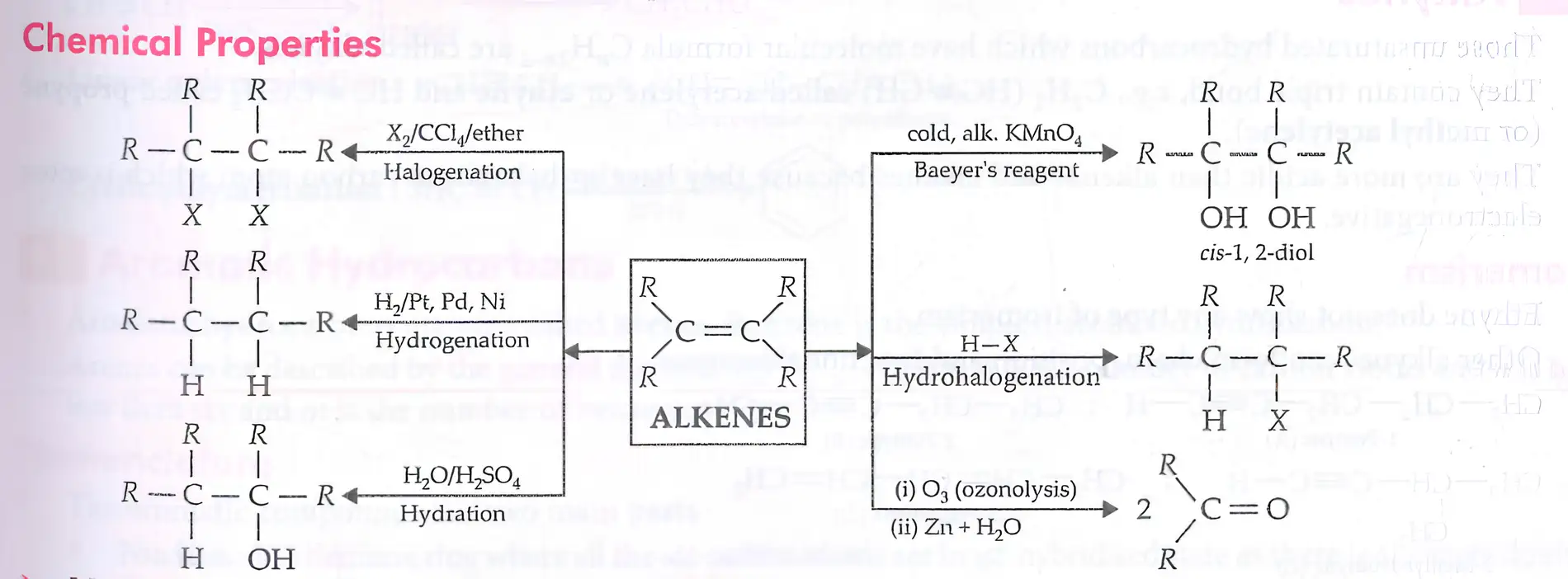
Solved Examples
Ex 1
Compare boiling points: n-butene > isobutene due to less branching.
Practice Set
Q1: Ethene is:
A. Colourless and odourless
B. Colourless with faint sweet smell
C. Coloured gas
D. Solid at room temperature
Q2: Alkenes are generally:
A. Soluble in water
B. Insoluble in water
C. Ionic compounds
D. Polar solvents
Q3: Boiling point trend in alkenes is:
A. Branched > straight chain
B. Straight chain > branched
C. No difference
D. Random
Answer Key
Q1: B - Ethene has faint sweet smell.
Q2: B - Alkenes are insoluble in water.
Q3: B - Straight chain alkenes have higher boiling points.
Memory Aids
Ethene smell: faint sweet.
Alkenes: non-polar, water insoluble.
Boiling point: straight > branched.
Markovnikov and Anti-Markovnikov Rule
Rules
Markovnikov's rule: In addition of HX to unsymmetrical alkene, H attaches to carbon with more H atoms; X attaches to carbon with fewer H atoms.
Anti-Markovnikov's rule (Peroxide effect): In presence of peroxide, HBr adds opposite to Markovnikov's rule.
Peroxide effect observed only with HBr, not HCl or HI.

Solved Examples
Ex 1
Addition of HBr to propene without peroxide: Br attaches to secondary carbon (Markovnikov product).
Addition of HBr to propene with peroxide: Br attaches to primary carbon (Anti-Markovnikov product).
Practice Set
Q1: Markovnikov's rule applies to addition of:
A. HCl
B. HBr without peroxide
C. HBr with peroxide
D. HI
Q2: Anti-Markovnikov addition occurs with:
A. HCl
B. HBr with peroxide
C. HI
D. HBr without peroxide
Q3: In Markovnikov addition, the halogen attaches to carbon with:
A. More hydrogen atoms
B. Fewer hydrogen atoms
C. Equal hydrogen atoms
D. No hydrogen atoms
Answer Key
Q1: B - Markovnikov's rule applies to HBr without peroxide.
Q2: B - Anti-Markovnikov addition occurs with HBr in presence of peroxide.
Q3: B - Halogen attaches to carbon with fewer hydrogen atoms.
Memory Aids
Markovnikov: "Rich get richer" (H to carbon with more H).
Anti-Markovnikov: peroxide reverses addition in HBr.
Peroxide effect only with HBr.
Dienes and Polymerization
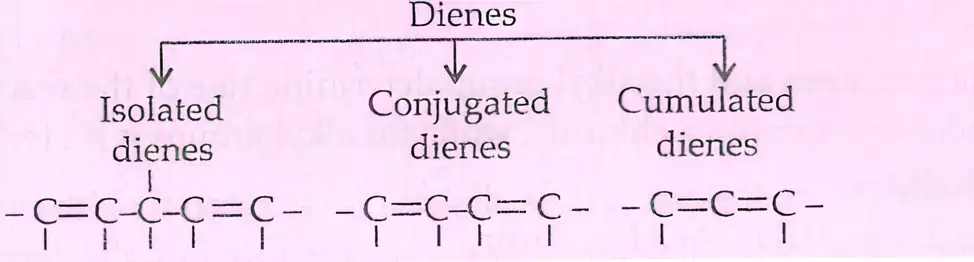
Dienes Classification
Isolated dienes: Double bonds separated by >1 single bond.
Conjugated dienes: Double bonds separated by exactly one single bond.
Cumulated dienes: Double bonds adjacent on same carbon.
Polymerization
Alkenes polymerize by opening double bonds under heat, pressure, and catalyst.
Example: Propene polymerizes to polypropylene.
Polymer structure: repeating units with side groups (e.g., CH3 in polypropylene).


Solved Examples
Ex 1
Polymerization of propene: n CH3-CH=CH2 → (−CH−CH2−)n with CH3 side group.
Practice Set
Q1: Conjugated dienes have double bonds separated by:
A. No bond
B. One single bond
C. Two single bonds
D. Adjacent carbons
Q2: Polymerization of alkenes requires:
A. Heat, pressure, catalyst
B. Cold temperature
C. No catalyst
D. Light only
Q3: Polypropylene is formed from:
A. Ethene
B. Propene
C. Butene
D. Benzene
Answer Key
Q1: B - Conjugated dienes have double bonds separated by one single bond.
Q2: A - Polymerization requires heat, pressure, and catalyst.
Q3: B - Polypropylene is polymer of propene.
Memory Aids
Dienes: isolated (separated), conjugated (one bond), cumulated (adjacent).
Polymerization: double bonds open and link to form long chains.
Alkynes
Definition and General Properties
Alkynes are unsaturated hydrocarbons with the general formula CnH2n-2.
They contain at least one carbon-carbon triple bond (≡).
Examples: Ethyne (acetylene) C2H2, Propyne (methyl acetylene) C3H4.
Alkynes have sp-hybridised carbons, making them more acidic than alkenes and alkanes.
Isomerism
Ethyne shows no isomerism.
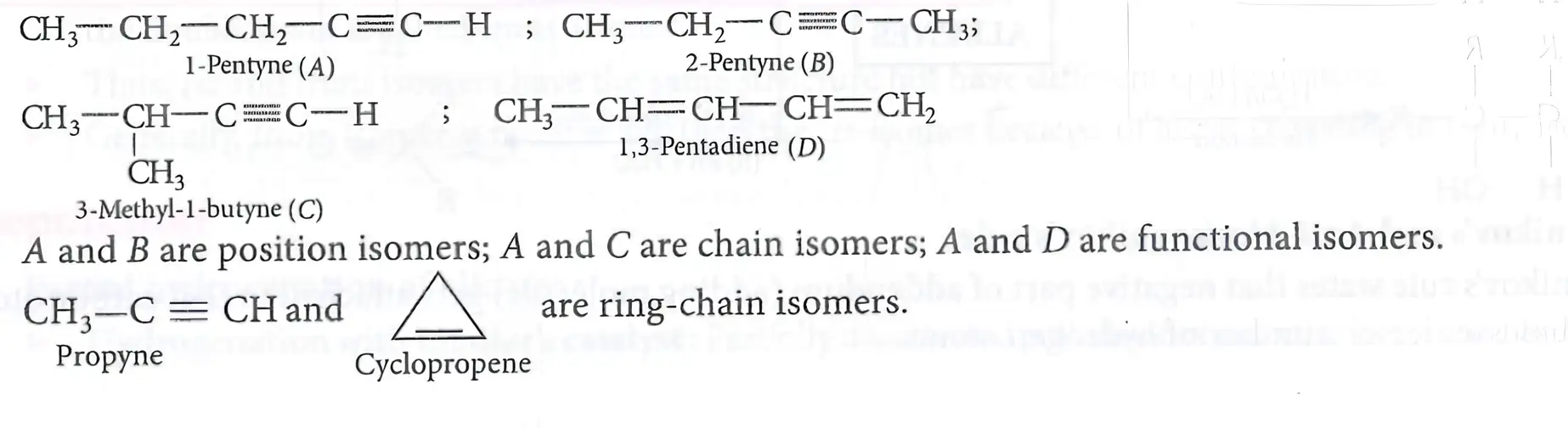
Other alkynes exhibit chain, position, and functional isomerism.
Ring-chain isomerism example: Propyne (alkyne) and cyclopropene (cycloalkene).
Structure
Each carbon in acetylene is sp-hybridised.
One sp orbital from each carbon overlaps axially to form a C–C σ bond.
Remaining sp orbitals overlap with hydrogen 1s orbitals forming two C–H σ bonds.
Two unhybridised p orbitals on each carbon overlap sideways forming two C–C π bonds.
Preparation of Acetylene
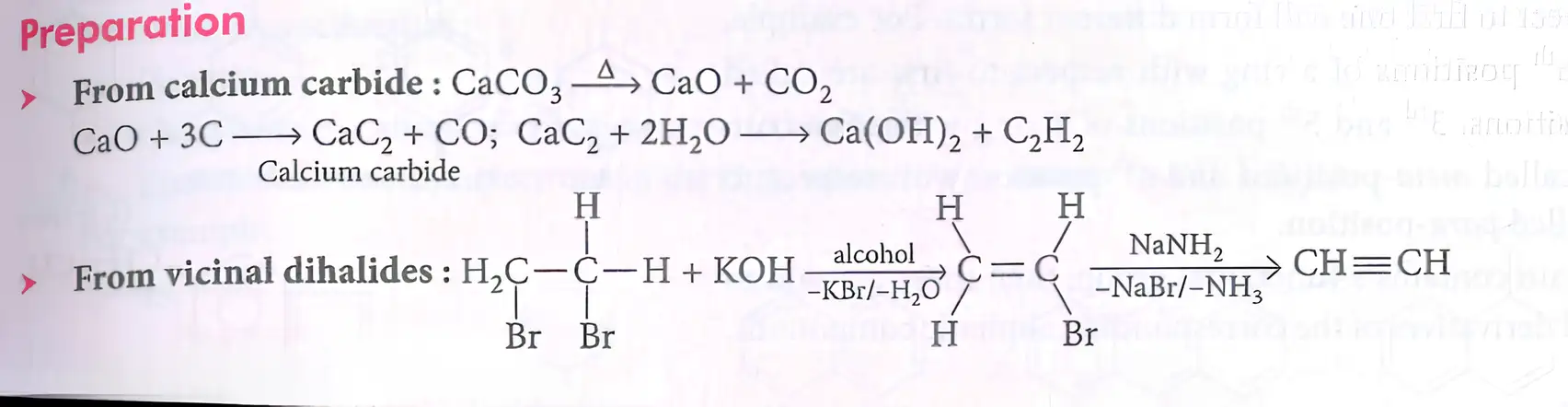
From calcium carbide (CaC2): CaC2 + 2H2O → C2H2 + Ca(OH)2
Calcium carbide is prepared by heating CaO with carbon.
From vicinal dihalides: Vicinal dihalide + 2KOH (alc) → alkene; then treated with NaNH2 to form acetylene.
Physical Properties
First three alkynes are gases; next eight are liquids; higher members are solids.
All are colourless and odourless except ethyne which has a characteristic odour.
Insoluble in water; soluble in non-polar solvents.
Melting point, boiling point, and density increase with molar mass.
Acidity
Alkynes are acidic due to sp-hybridised carbon with 50% s-character.
Acetylene reacts with sodium in liquid ammonia: 2Na + C2H2 → 2NaC≡CH + H2
Acidic strength order: Alkyne (CH≡CH) > Alkene (CH2=CH2) > Alkane (CH3–CH3).

Chemical Reactions
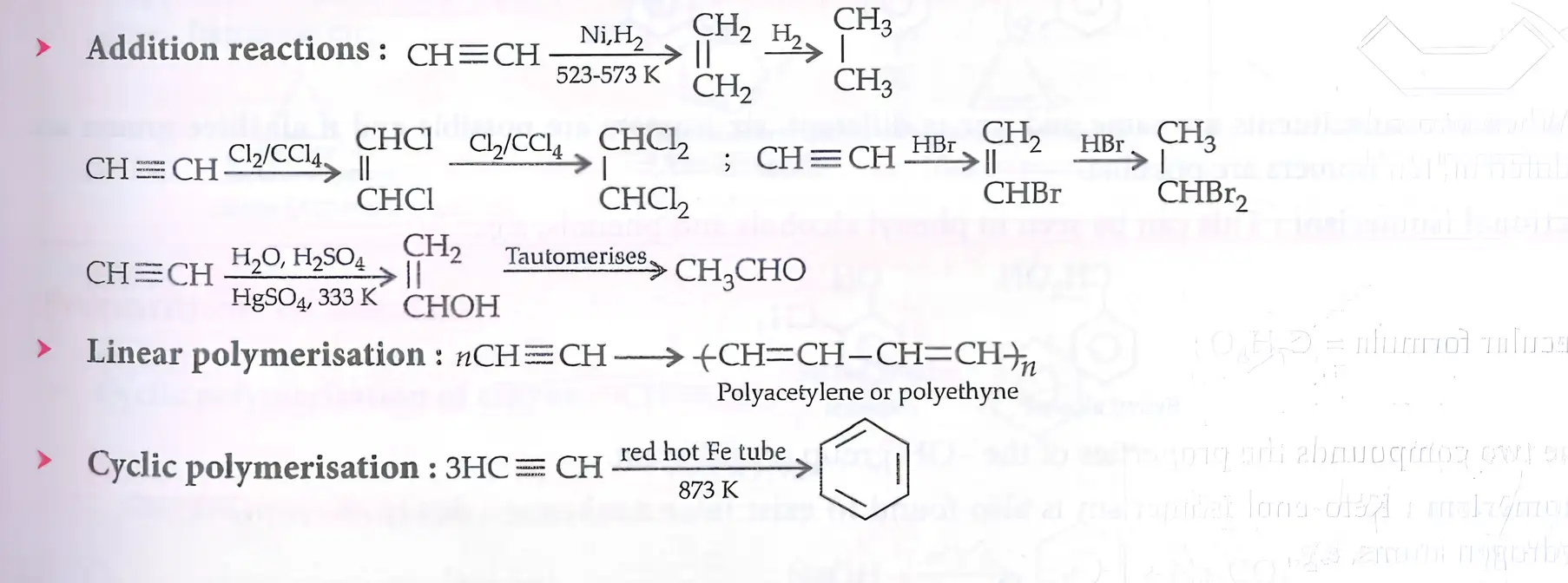
Addition Reactions:
Hydrogenation: C2H2 + 2H2 (Ni, heat) → C2H6
Halogenation: C2H2 + Cl2 → C2H2Cl2
Hydrohalogenation: Stepwise addition of HBr to form bromoalkenes and dibromoalkanes.
Hydration: C2H2 + H2O (H2SO4, HgSO4) → Acetaldehyde (via tautomerism).
Polymerisation:
Linear polymerisation forms polyacetylene.
Cyclic polymerisation of 3 acetylene molecules forms benzene.
Solved Examples
Ex 1
Write the product when acetylene reacts with excess hydrogen in presence of Ni catalyst.
Solution: C2H2 + 2H2 → C2H6 (ethane)
Ex 2
Explain the formation of sodium acetylide from acetylene.
Solution: C2H2 + 2Na → 2NaC≡CH + H2
Practice Set
Q1
Which of the following is the molecular formula of alkynes?
A. CnH2n+2
B. CnH2n
C. CnH2n-2
D. CnHn
Q2
What is the product when acetylene reacts with water in presence of H2SO4 and HgSO4?
A. Ethanol
B. Acetaldehyde
C. Ethane
D. Ethene
Q3
Which of the following shows ring-chain isomerism?
A. 1-Pentyne and 2-Pentyne
B. Propyne and Cyclopropene
C. 1-Pentyne and 3-Methyl-1-butyne
D. 1,3-Pentadiene and 1-Pentyne
Answer Key
Q1: C. Alkynes have formula CnH2n-2 due to one triple bond.
Q2: B. Hydration of acetylene forms acetaldehyde via tautomerism.
Q3: B. Propyne (alkyne) and cyclopropene (cycloalkene) are ring-chain isomers.
Memory Aids
Alkyne formula: "2n minus 2" hydrogens.
Acidity order: Alkyne > Alkene > Alkane due to s-character.
Ring-chain isomerism: Linear alkynes vs cyclic alkenes with same formula.
Preparation of acetylene: Calcium carbide + water or vicinal dihalides + strong base.
Aromatic Hydrocarbons
Overview
Aromatic hydrocarbons, also called arenes, contain benzene rings.
General formula: CnH2n-6m, where n ≥ 6, m = number of benzene rings.
Nomenclature
Nucleus: Benzene ring with sp2 hybridised carbons and alternating double bonds.
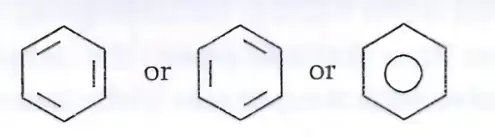
Side Chain: Alkyl or aliphatic groups replacing hydrogen on benzene.
Monosubstituted derivatives: One hydrogen replaced by a substituent.
Disubstituted derivatives: Positions relative to first substituent: ortho (1,2), meta (1,3), para (1,4).
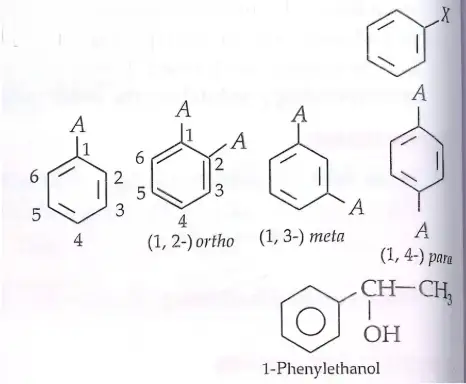
Isomerism
All six hydrogens in benzene are equivalent; only one monosubstituted derivative possible.
Position isomerism: Two substituents give ortho, meta, para isomers.
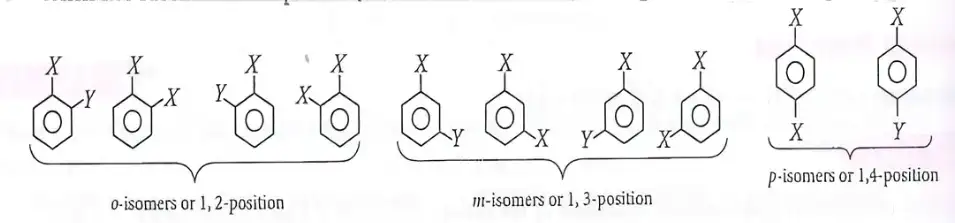
Three identical substituents yield three isomers; mixed substituents increase isomer count.
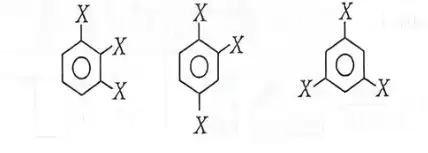
Functional isomerism: Example: Benzyl alcohol vs o-Cresol (C7H8O).

Tautomerism: Keto-enol tautomerism in acetophenone.
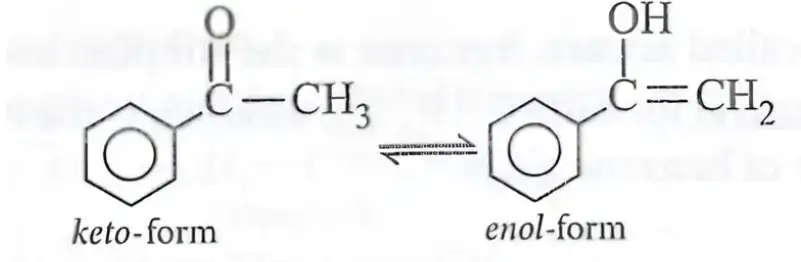
Structure of Benzene
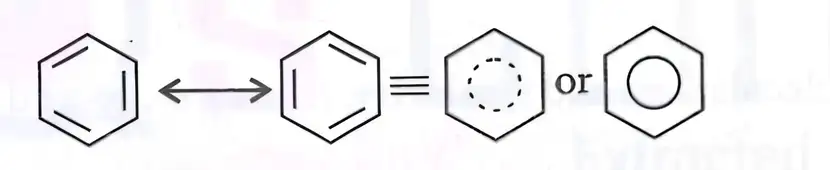
Each carbon is sp2 hybridised; forms σ bonds with adjacent carbons and hydrogen.
Unhybridised p orbitals overlap to form delocalised π-electron cloud above and below the plane.
High unsaturation and resonance stability.
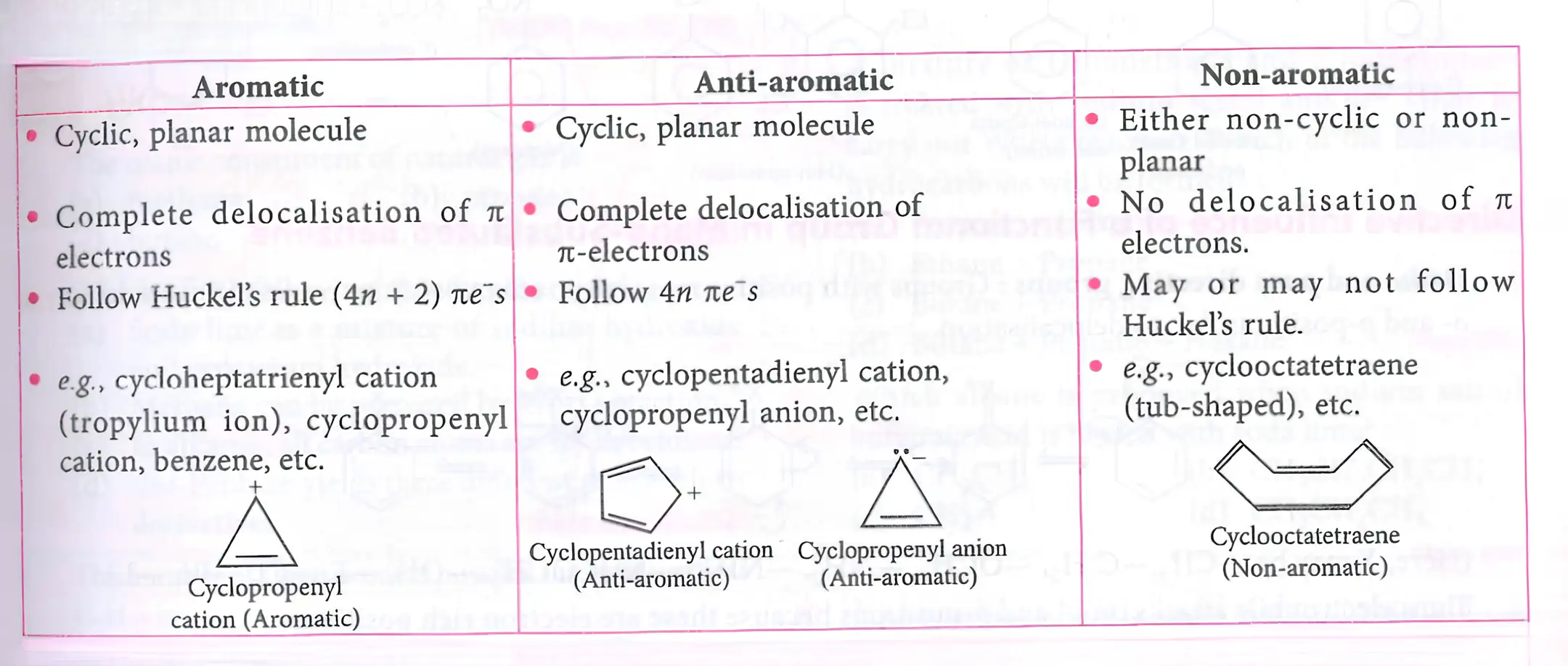
Huckel Rule of Aromaticity
Criteria for aromaticity:
Planar cyclic structure.
Complete delocalisation of π-electrons.
Contains (4n + 2) π-electrons, n = 0,1,2...
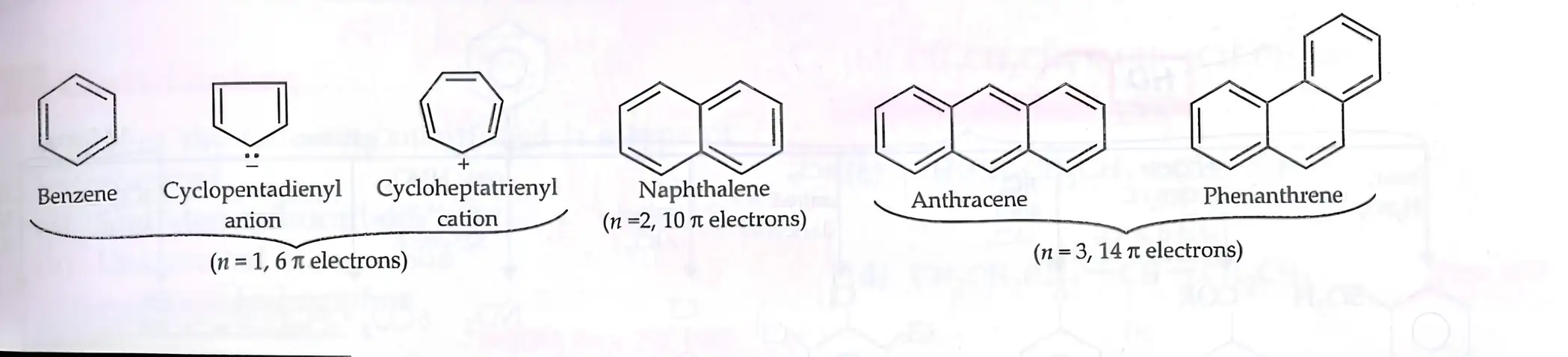
Comparison of aromatic, anti-aromatic, and non-aromatic compounds based on structure and electron count.
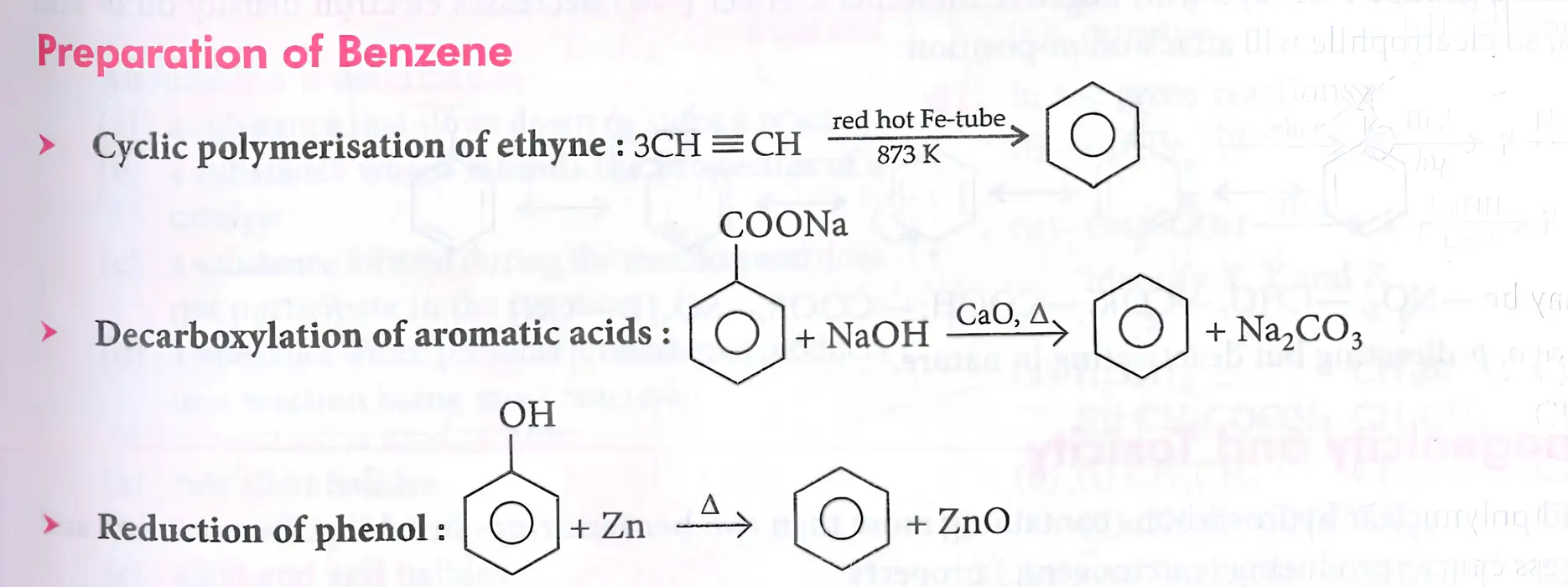
Preparation of Benzene
Cyclic polymerization of ethyne at 873 K in red-hot iron tube.
Decarboxylation of aromatic acids with NaOH and CaO.
Reduction of phenol with zinc and heat.
Physical Properties
Non-polar, colourless liquids or solids with characteristic aroma.
Immiscible with water, miscible with organic solvents.
Burn with sooty flame.
Boiling point increases with molecular size due to van der Waals forces.
Melting point depends on size and symmetry; p-isomer of xylenes has highest melting point.
Chemical Properties
Less reactive than alkenes/alkynes due to delocalised π-electrons.
Undergo electrophilic substitution reactions (EAS).
Can undergo addition and oxidation under special conditions.
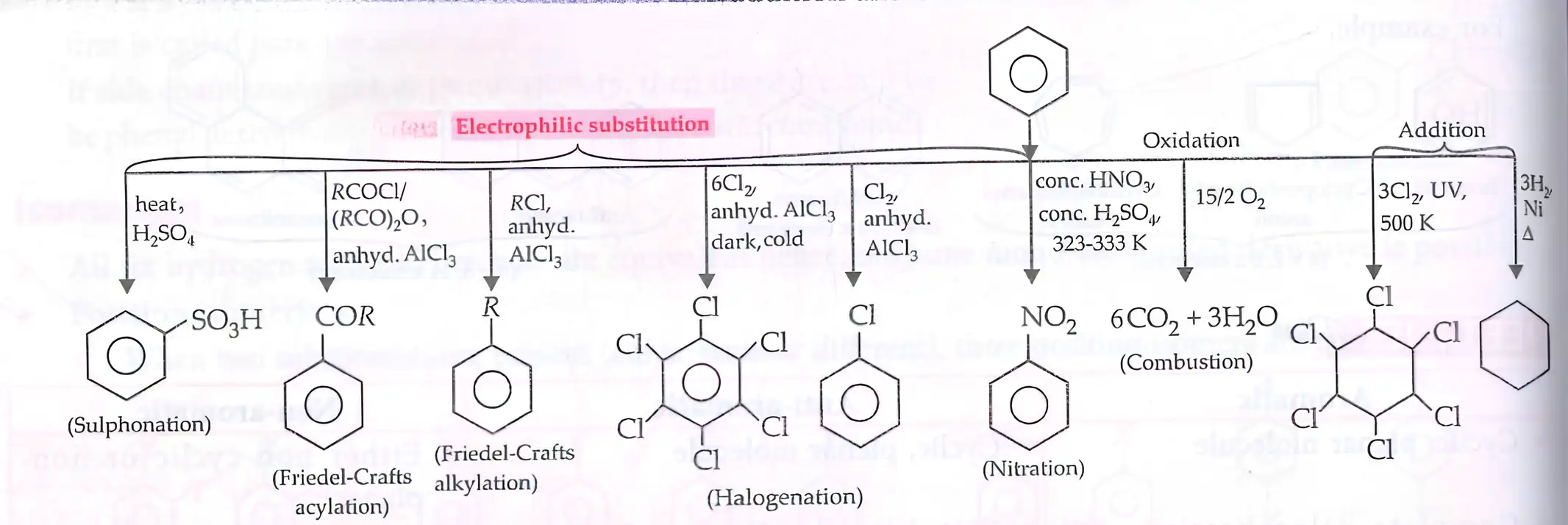
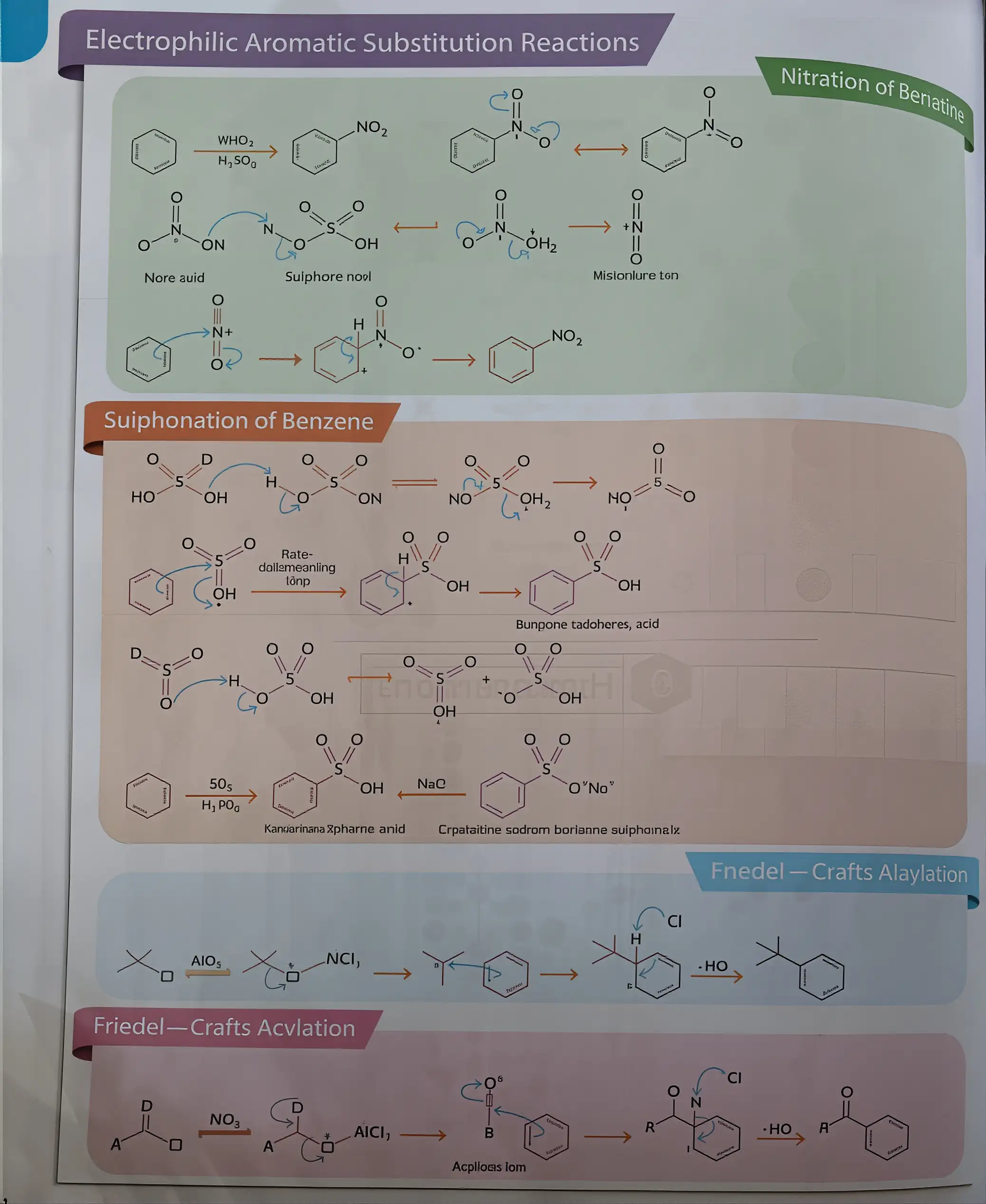
Common EAS reactions: nitration, sulphonation, Friedel-Crafts acylation and alkylation, halogenation.
Oxidation breaks side chains to CO2 and H2O.
Addition under UV light; reduction to cyclohexane with H2/Ni.
Directive Influence of Functional Groups
Ortho and para directing groups: Groups with +M effect increase electron density at ortho and para positions, favoring electrophilic attack there.
Examples: —CH3, —C2H5, —OCH3, —NH2, —OH, halogens (F, Cl, Br, I).
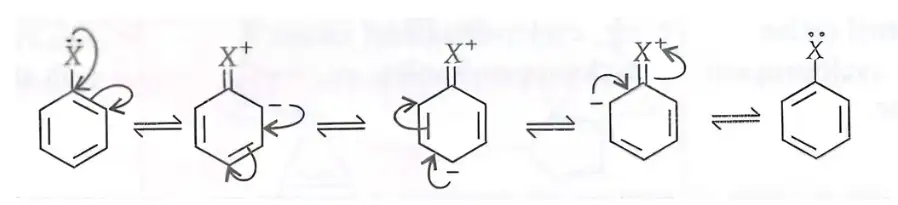
Meta directing groups: Groups with -M effect decrease electron density at ortho and para positions, directing electrophiles to meta position.
Examples: —NO2, —CHO, —COR, —COOH, —COOR, —SO3H, —CN.

Halogens are ortho/para directing but deactivating due to electronegativity.
Solved Examples
Ex 1: Identify the directing effect of —OH group in phenol.
Answer: —OH is an ortho/para directing group due to +M effect increasing electron density at these positions.Ex 2: Predict the major product of nitration of toluene.
Answer: Nitro group substitutes at ortho and para positions relative to —CH3 group (ortho/para directing).Ex 3: How many position isomers are possible for disubstituted benzene with two different substituents?
Answer: Three isomers (ortho, meta, para).
Practice Set
Q1: Which of the following is an ortho/para directing group?
A. —NO2
B. —CH3
C. —COOH
D. —CNQ2: How many π-electrons are present in benzene according to Huckel's rule?
A. 4
B. 6
C. 8
D. 10Q3: Which reaction converts phenol to benzene?
A. Decarboxylation
B. Reduction with Zn
C. Friedel-Crafts alkylation
D. Nitration
Answer Key
Q1: B —CH3 is ortho/para directing due to +M effect.
Q2: B Benzene has 6 π-electrons fitting (4n+2) with n=1.
Q3: B Reduction of phenol with Zn produces benzene.
Memory Aids
Huckel's rule: Aromatic if π-electrons = 4n + 2.
Ortho/para directors: Groups with lone pairs or alkyl groups (+M effect).
Meta directors: Electron withdrawing groups (-M effect).
Halogens: Ortho/para directing but deactivating.
Electrophilic substitution preferred over addition in benzene due to resonance stability.
Carcinogenicity and Toxicity
Overview
Benzene and polynuclear aromatic hydrocarbons (PAHs) with more than two fused benzene rings are toxic and carcinogenic.
PAHs form during incomplete combustion of organic materials such as tobacco, coal, and petroleum.
These compounds enter the human body, undergo biochemical transformations, damage DNA, and induce cancer.
Solved Examples
Ex 1: Identify a source of carcinogenic PAHs.
Answer: Incomplete combustion of tobacco produces carcinogenic PAHs.Ex 2: Explain the effect of PAHs on human DNA.
Answer: PAHs metabolize into reactive intermediates that bind DNA, causing mutations leading to cancer.
Practice Set
Q1: Which of the following is a carcinogenic compound?
A. Benzene
B. Methane
C. Ethanol
D. WaterQ2: Polynuclear aromatic hydrocarbons are primarily formed by:
A. Complete combustion of organic matter
B. Incomplete combustion of organic matter
C. Photosynthesis
D. Electrolysis of waterQ3: The mechanism by which PAHs cause cancer involves:
A. Direct DNA repair
B. DNA damage through reactive metabolites
C. Protein synthesis enhancement
D. Increased oxygen transport
Answer Key
Q1: A. Benzene - It is a toxic and carcinogenic aromatic hydrocarbon.
Q2: B. Incomplete combustion of organic matter - This process forms PAHs.
Q3: B. DNA damage through reactive metabolites - PAHs metabolize into compounds that bind and damage DNA.
Memory Aids
PAHs = Multiple fused benzene rings → Toxic + Carcinogenic.
Incomplete combustion = Source of PAHs (think tobacco smoke, coal burning).
PAHs → Metabolized → DNA damage → Cancer.
NEET Chemistry — ALL CHAPTERS
1
Some Basic Concepts of Chemistry
2
Structure of Atom
3
Classification of Elements and Periodicity in Properties
4
Chemical Bonding and Molecular Structure
5
Thermodynamics
6
Equilibrium
7
Redox Reactions
8
Organic Chemistry - Some Basic Principles and Techniques
9
Hydrocarbons
10
Solutions
11
Electrochemistry
12
Chemical Kinetics
13
The d- and f- Block Elements
14
Coordination Compounds
15
Haloalkanes and Haloarenes
16
Alcohols, Phenols and Ethers
17
Aldehydes, Ketones and Carboxylic Acids
18
Amines
19
Biomolecules
20
The p-Block Elements (Group 13 and 14)
21
The p-Block Elements (Group 15 to 18)
22
Principles Related to Practical Chemistry