NEET Ug . NEET Chemistry . Chemistry . Classification of Elements and Periodicity in Properties
Chapter 3: Classification of Elements and Periodicity in Properties
Ch 3
NEET Chemistry
NEET Ug
Periodic Table Importance
Significance of Periodic Table
- The periodic table organizes elements based on their chemical properties and atomic structure.
- It reveals periodic trends and families of elements with similar behavior.
- Enables prediction of element properties and chemical reactions.
- Serves as a fundamental tool for studying chemistry efficiently.
Solved Examples
- Ex 1: Identify the family of an element with atomic number 11.
Step 1: Atomic number 11 corresponds to Sodium (Na).
Step 2: Sodium is in Group 1 (alkali metals) with similar properties.
Practice Set
- Q1: Which property is common to elements in the same group?
A. Atomic mass
B. Number of valence electrons
C. Number of neutrons
D. Atomic number - Q2: The periodic table arranges elements in order of increasing:
A. Atomic mass
B. Atomic number
C. Density
D. Melting point - Q3: Which of the following elements is a noble gas?
A. Oxygen
B. Nitrogen
C. Argon
D. Chlorine
Answer Key
- Q1: B. Number of valence electrons — Elements in the same group have the same number of valence electrons, determining similar chemical properties.
- Q2: B. Atomic number — Modern periodic table is arranged by increasing atomic number, reflecting periodicity.
- Q3: C. Argon — Argon is a noble gas, chemically inert and located in Group 18.
Memory Aids
- Groups = Columns; same valence electrons.
- Periods = Rows; same number of electron shells.
- "Noble gases" end with "-on" (He, Ne, Ar, Kr, Xe, Rn).
Classification Need
Why Classify Elements?
- Number of known elements increased from 31 (1800) to 118 (present).
- Studying each element and its compounds individually is impractical.
- Classification groups elements with similar properties together.
- Systematic arrangement reveals chemical periodicity and trends.
- Facilitates easier study and prediction of element behavior.
Solved Examples
- Ex 1: Explain the benefit of classifying elements.
Step 1: Grouping elements reduces complexity.
Step 2: Similar properties in groups help predict reactions.
Practice Set
- Q1: The main purpose of classifying elements is to:
A. Increase the number of elements
B. Group elements with similar properties
C. Change atomic masses
D. Separate metals and non-metals only - Q2: Which scientist is credited with the early classification of elements?
A. Dalton
B. Mendeleev
C. Rutherford
D. Bohr - Q3: The periodic table shows chemical periodicity after:
A. Random intervals
B. Certain regular intervals
C. Equal atomic masses
D. Equal atomic radii
Answer Key
- Q1: B. Group elements with similar properties — Classification organizes elements to simplify study.
- Q2: B. Mendeleev — He developed the first periodic table based on atomic masses and properties.
- Q3: B. Certain regular intervals — Properties repeat periodically with increasing atomic number.
Memory Aids
- Mendeleev’s table arranged elements by increasing atomic mass and properties.
- Periodic law: Properties of elements are periodic functions of their atomic numbers.
- Classification groups elements into metals, non-metals, and metalloids.
Genesis of Periodic Classification
Dobereiner’s Triads (1829)
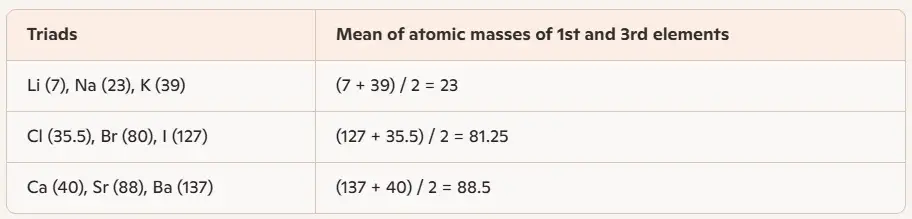
- Elements grouped in triads with similar properties.
- Atomic weight of middle element ≈ average of other two.
- Example triads: (Ca, Sr, Ba), (Cl, Br, I).
Newland’s Octaves Law (1865)
- Elements arranged by increasing atomic weight.
- Every 8th element has similar properties to the 1st, like musical notes.
- Example: Li to F, then Na to Cl.
Lothar Meyer’s Atomic Volume Curve (1869)
- Graph plotted: Atomic volume vs. Atomic weight.
- Elements with similar properties align at similar graph positions.
- Alkali metals at peaks; halogens on ascending curve.
Mendeleev’s Periodic Law (1869)
- Properties of elements are periodic functions of atomic weights.
- Elements arranged in increasing atomic weight; similar properties recur periodically.
- Table: 9 vertical columns (groups), 7 horizontal rows (periods).
- Elements with similar properties placed in same group.
- Order of atomic weights adjusted to fit properties.
- Vacant spaces left for undiscovered elements.
Demerits of Mendeleev’s Periodic Table
- Hydrogen’s position ambiguous (resembles group 1 and 17).
- Cobalt (58.9) placed before nickel (58.6) despite higher atomic weight.
- Isotopes not separately placed.
- Could not explain cause of periodicity.
- Lanthanoids and actinoids excluded.
Solved Examples
Ex 1
Find the atomic weight of the middle element in a triad if the first and third elements have atomic weights 40 and 88.
- Calculate average: (40 + 88) / 2 = 64.
- Middle element atomic weight ≈ 64.
Practice Set
Q1
Dobereiner’s triads are based on which property?
- A. Atomic number
- B. Atomic weight average
- C. Electron configuration
- D. Valency
Q2
According to Newland’s octaves, which element is similar to lithium (Li)?
- A. Sodium (Na)
- B. Magnesium (Mg)
- C. Potassium (K)
- D. Calcium (Ca)
Q3
Which is a limitation of Mendeleev’s periodic table?
- A. Included isotopes separately
- B. Based on atomic number
- C. Could not explain periodicity cause
- D. No vacant spaces for new elements
Answer Key
- Q1: B - Triads are based on the average atomic weight of the first and third elements.
- Q2: A - Sodium is the 8th element after lithium and shares similar properties.
- Q3: C - Mendeleev’s table could not explain the cause of periodicity.
Memory Aids
- Dobereiner’s triads: Middle atomic weight ≈ average of outer two.
- Newland’s octaves: Every 8th element repeats properties like musical notes.
- Mendeleev’s table: Left gaps for undiscovered elements; adjusted order for properties.
Modern Periodic Law
Concept and Significance
- Henry Moseley (1913) showed atomic number (Z) is fundamental, not atomic mass.
- Plot of \( \sqrt{\nu} \) (X-ray frequency) vs atomic number is linear.
- Modern periodic law: Properties of elements are periodic functions of their atomic numbers.
- Elements arranged by increasing atomic number show repeating properties at regular intervals.
Solved Examples
- Ex 1: Why is atomic number preferred over atomic mass in the periodic table?
Step 1: Moseley’s X-ray studies showed atomic number correlates with element properties.
Step 2: Atomic mass does not always increase regularly.
Step 3: Atomic number defines element identity and periodicity.
Practice Set
- Q1: Who established the modern periodic law?
A. Mendeleev
B. Henry Moseley
C. Dobereiner
D. Newlands - Q2: According to modern periodic law, element properties depend on:
A. Atomic mass
B. Atomic number
C. Number of neutrons
D. Isotopic mass - Q3: Moseley’s experiment involved plotting \( \sqrt{\nu} \) against:
A. Atomic mass
B. Atomic number
C. Number of neutrons
D. Electron affinity
Answer Key
- Q1: B - Henry Moseley established the modern periodic law through X-ray studies.
- Q2: B - Properties are periodic functions of atomic number, not atomic mass.
- Q3: B - Moseley plotted \( \sqrt{\nu} \) vs atomic number, showing linearity.
Memory Aids
- "Moseley Modernizes" - Moseley linked atomic number to element properties.
- Remember: Atomic Number = Number of Protons = Element Identity.
Periods and Groups
Definitions and Structure
- Periodic table has 7 horizontal rows called periods.
- There are 18 vertical columns called groups.
- Period number = highest principal quantum number (n) of elements in that period.
- Elements in a group have similar chemical properties.
Solved Examples
- Ex 1: Identify the period and group of an element with electronic configuration 1s2 2s2 2p6 3s1.
Step 1: Highest n = 3 → Period 3.
Step 2: Last electron in 3s → Group 1 (alkali metals).
Practice Set
- Q1: How many groups are there in the long form periodic table?
A. 7
B. 14
C. 18
D. 32 - Q2: The period number corresponds to:
A. Number of valence electrons
B. Highest principal quantum number (n)
C. Number of shells filled
D. Atomic mass - Q3: Elements in the same group have:
A. Same atomic number
B. Similar chemical properties
C. Same atomic mass
D. Different valence electrons
Answer Key
- Q1: C - There are 18 groups in the long form periodic table.
- Q2: B - Period number equals highest principal quantum number (n).
- Q3: B - Elements in a group share similar chemical properties.
Memory Aids
- Periods = Rows = Principal Quantum Number (n).
- Groups = Columns = Similar Properties.
Periodic Table Periods Details
Period Length and Orbital Filling
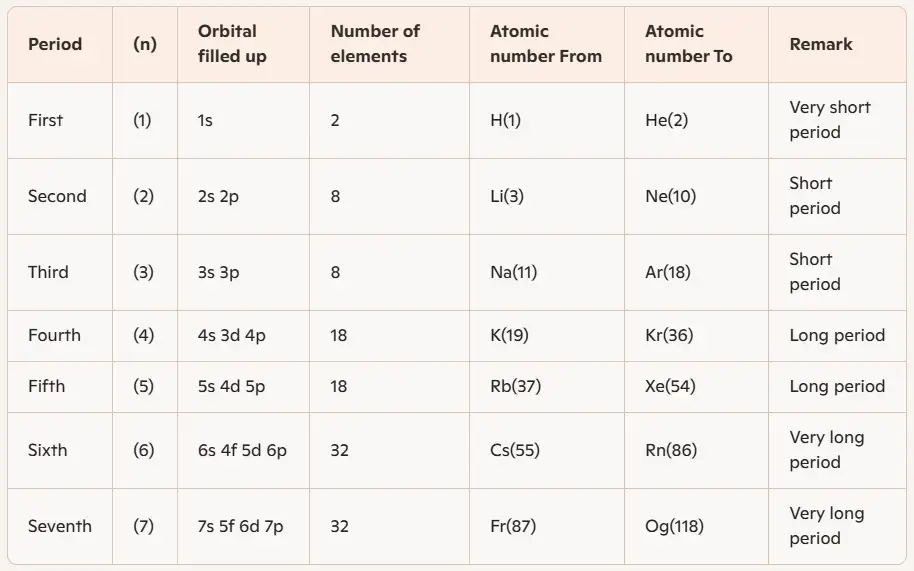
- Period 1: 2 elements, fills 1s orbital.
- Period 2: 8 elements, fills 2s and 2p orbitals.
- Period 3: 8 elements, fills 3s and 3p orbitals.
- Period 4 & 5: 18 elements, fills 4s, 3d, 4p and 5s, 4d, 5p orbitals.
- Period 6 & 7: 32 elements, includes filling of f orbitals (lanthanoids and actinoids).
- Length increases due to involvement of d and f orbitals.
Solved Examples
- Ex 1: Why does period 4 have 18 elements?
Step 1: Period 4 fills 4s, 3d, and 4p orbitals.
Step 2: 4s (2 electrons) + 3d (10 electrons) + 4p (6 electrons) = 18 elements.
Practice Set
- Q1: How many elements are in period 2?
A. 2
B. 8
C. 18
D. 32 - Q2: Which orbitals are filled in period 3?
A. 3s and 3p
B. 3s, 3p, and 3d
C. 4s and 3d
D. 2s and 2p - Q3: Lanthanoids belong to which period?
A. 4
B. 5
C. 6
D. 7
Answer Key
- Q1: B - Period 2 has 8 elements filling 2s and 2p orbitals.
- Q2: A - Period 3 fills 3s and 3p orbitals only.
- Q3: C - Lanthanoids are part of period 6.
Memory Aids
- Period length = number of electrons in orbitals filled.
- Remember: s (2), p (6), d (10), f (14) electrons per orbital block.
Classification of Elements
Metals, Non-metals, and Metalloids
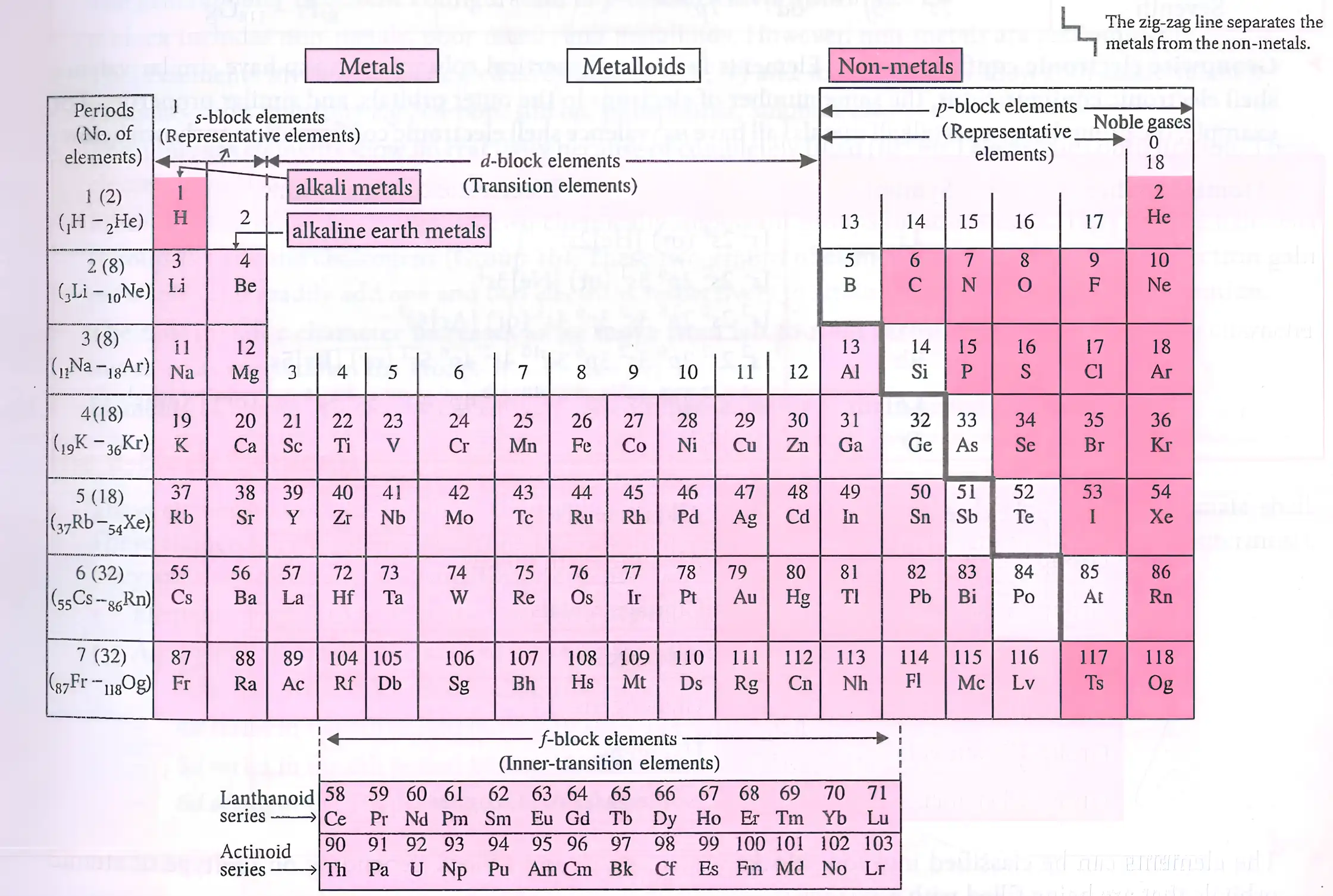
- Periodic table divided by zig-zag line separating metals and non-metals.
- Metals: Left and center, pink color; include alkali metals, alkaline earth metals, transition metals.
- Non-metals: Right side, pink color; include noble gases and other non-metals.
- Metalloids: Along zig-zag line, grey color; have properties intermediate between metals and non-metals.
- Lanthanides and actinides placed separately at bottom as inner transition elements.
Solved Examples
- Ex 1: Identify the type of element for silicon (Si).
Step 1: Si lies along the zig-zag line.
Step 2: It is a metalloid with mixed properties.
Practice Set
- Q1: Which group contains alkali metals?
A. Group 1
B. Group 2
C. Group 17
D. Group 18 - Q2: Metalloids are located:
A. Left side
B. Right side
C. Along zig-zag line
D. Bottom rows - Q3: Noble gases belong to which group?
A. 16
B. 17
C. 18
D. 1
Answer Key
- Q1: A - Alkali metals are in Group 1.
- Q2: C - Metalloids lie along the zig-zag line.
- Q3: C - Noble gases are in Group 18.
Memory Aids
- "Zig-zag line" separates metals and non-metals.
- Group 1 = Alkali metals; Group 2 = Alkaline earth metals; Group 18 = Noble gases.
Nomenclature of Elements with Atomic Numbers > 100
System Overview
- Elements with atomic number (Z) > 100 are named using the IUPAC systematic method.
- Names are derived from the digits of the atomic number using Latin and Greek roots.
- The suffix -ium is added at the end of the name.
- Element symbols are formed by taking the first letter of each numerical root word, capitalizing the first letter.
Example of Naming
- For element 115: digits are 1-1-5.
- Roots: 1 = un, 5 = pent.
- Name: ununpentium (now known as moscovium).
- Symbol: Uup (U from un, u from un, p from pent).
Solved Examples
- Ex 1: Name element 102.
- Digits: 1-0-2
- Roots: un (1), nil (0), bi (2)
- Name: unnilbium
- Symbol: Unb
- Ex 2: Symbol for element 118.
- Digits: 1-1-8
- Roots: un (1), un (1), oct (8)
- Symbol: Uuo
Practice Set
- Q1: What is the IUPAC name for element 113?
- A) Ununtrium
- B) Ununpentium
- C) Ununseptium
- D) Ununquadium
- Q2: The symbol for element 107 is:
- A) Uus
- B) Uup
- C) Uuo
- D) Uuq
- Q3: Which suffix is added to the root words in naming elements with Z > 100?
- A) -ine
- B) -on
- C) -ium
- D) -ide
Answer Key
- Q1: A) Ununtrium - Derived from digits 1-1-3 (un-un-tri) + -ium suffix.
- Q2: A) Uus - For element 107 (1-0-7), roots un-nil-sept, symbol Uus.
- Q3: C) -ium - Standard suffix for elements with atomic number > 100.
Memory Aids
- Remember roots: un (1), bi (2), tri (3), quad (4), pent (5), hex (6), sept (7), oct (8), enn (9), nil (0).
- Symbol letters come from first letter of each root word, first letter capitalized.
- Always add -ium at the end of the name.
Electronic Configurations of Elements and the Periodic Table
Electronic Configuration Basics
- Electronic configuration: distribution of electrons in atomic orbitals.
- Element's position in periodic table reflects quantum numbers of last filled orbital.
- Period number = principal quantum number (n) of valence shell.
- Successive periods fill higher principal energy levels (n=1, 2, 3...).
Electronic Configurations in Periods
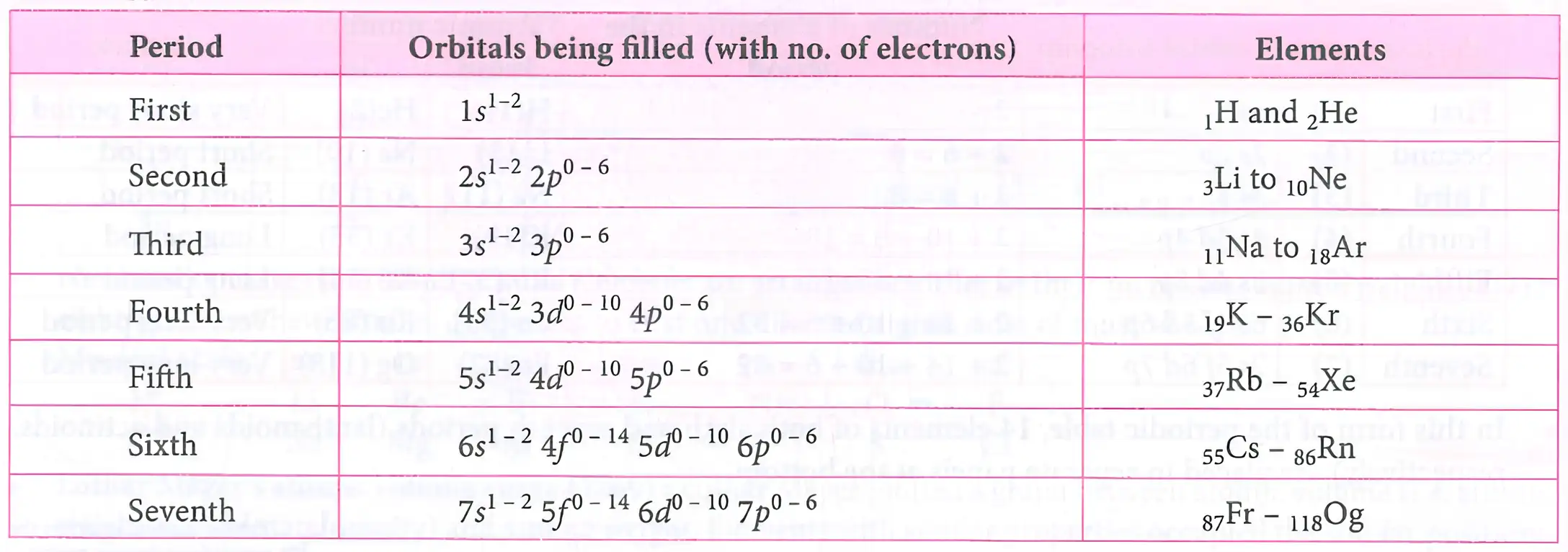
- Period 1: fills 1s orbital (2 electrons).
- Period 2: fills 2s and 2p orbitals (8 electrons).
- Period 3: fills 3s and 3p orbitals (8 electrons).
- Period 4: fills 4s, 3d, and 4p orbitals (18 electrons).
- Period 5: fills 5s, 4d, and 5p orbitals (18 electrons).
- Period 6: fills 6s, 4f, 5d, and 6p orbitals (32 electrons).
- Period 7: fills 7s, 5f, 6d, and 7p orbitals (32 electrons).
Solved Examples
- Ex 1: Write electronic configuration of Sulfur (Z=16).
- Period 3 element, valence shell n=3.
- Configuration: 1s2 2s2 2p6 3s2 3p4.
Practice Set
- Q1: Which orbital is being filled in period 4?
- A) 3p
- B) 4s
- C) 2p
- D) 5s
- Q2: The valence shell principal quantum number of elements in period 5 is:
- A) 3
- B) 4
- C) 5
- D) 6
- Q3: How many electrons are there in the valence shell of period 6 elements?
- A) 8
- B) 18
- C) 32
- D) 2
Answer Key
- Q1: B) 4s - Period 4 starts filling 4s orbital.
- Q2: C) 5 - Period number equals valence shell principal quantum number.
- Q3: C) 32 - Period 6 fills up to 32 electrons including 6s, 4f, 5d, 6p orbitals.
Memory Aids
- Period number = valence shell principal quantum number (n).
- Orbitals fill in order: s < p < d < f.
- Period 1: 2 electrons; Period 2 & 3: 8 electrons; Period 4 & 5: 18 electrons; Period 6 & 7: 32 electrons.
Groupwise Electronic Configuration
Group Electronic Configuration
- Elements in same group have similar valence shell configurations.
- Same number of electrons in outermost orbitals → similar chemical properties.
- Example: Group 1 (alkali metals) have ns1 valence configuration.
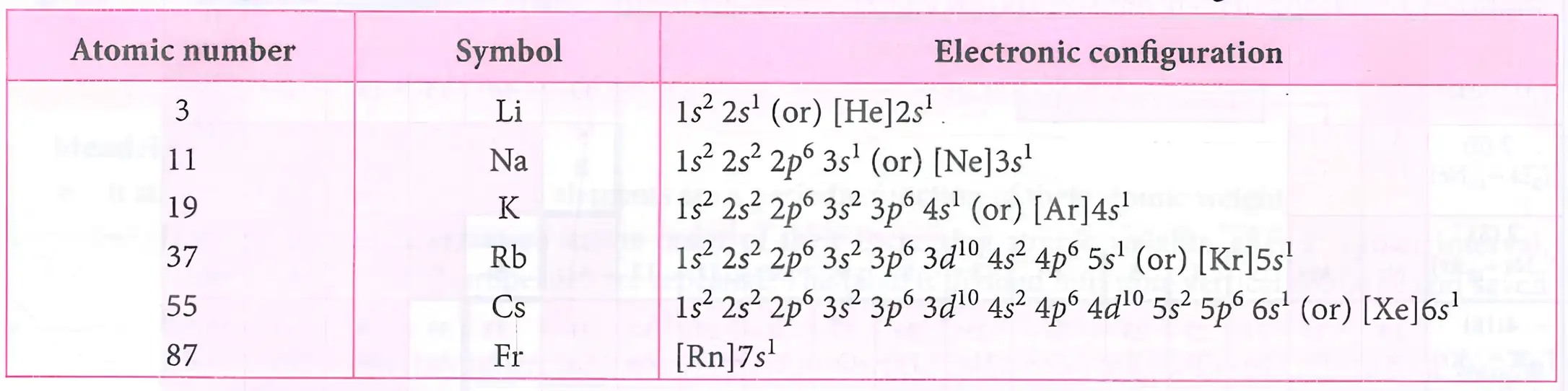
Group 1 Alkali Metals Configuration
- Li: [He] 2s1
- Na: [Ne] 3s1
- K: [Ar] 4s1
- Rb: [Kr] 5s1
- Cs: [Xe] 6s1
- Fr: [Rn] 7s1
Solved Examples
- Ex 1: Write valence shell configuration of Potassium (K).
- Group 1 element, valence shell: 4s1.
Practice Set
- Q1: What is the valence configuration of Group 2 elements?
- A) ns1
- B) ns2
- C) ns2 np1
- D) (n-1)d10 ns1
- Q2: Which element has configuration [Ne] 3s1?
- A) Sodium (Na)
- B) Magnesium (Mg)
- C) Aluminium (Al)
- D) Chlorine (Cl)
- Q3: Group 1 elements have valence configuration:
- A) ns2
- B) ns1
- C) (n-1)d10 ns2
- D) ns2 np5
Answer Key
- Q1: B) ns2 - Group 2 elements have two electrons in valence s orbital.
- Q2: A) Sodium (Na) - Atomic number 11, configuration [Ne] 3s1.
- Q3: B) ns1 - Alkali metals have one electron in valence s orbital.
Memory Aids
- Group 1: ns1 (alkali metals).
- Group 2: ns2 (alkaline earth metals).
- Valence electrons determine group properties.
Periodic Table Groups and Blocks
Group Names and Properties
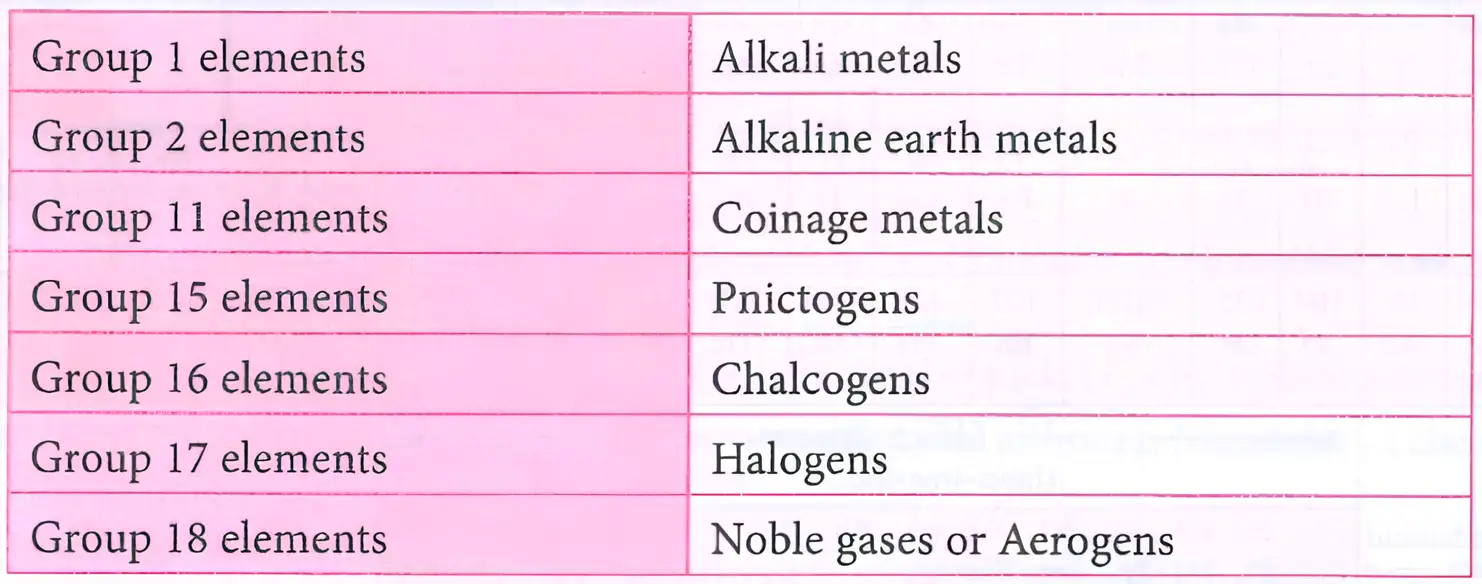
- Group 1: Alkali metals (ns1), very reactive metals.
- Group 2: Alkaline earth metals (ns2), less reactive than group 1.
- Group 11: Coinage metals (Cu, Ag, Au), good conductors.
- Group 15: Pnictogens, includes nitrogen family.
- Group 16: Chalcogens, oxygen family.
- Group 17: Halogens, highly reactive nonmetals.
- Group 18: Noble gases (aerogens), inert gases.
Blocks of Elements
- Elements classified into s-, p-, d-, and f-blocks based on last electron orbital filled.
- s-block: Groups 1 and 2, valence electrons in s orbital.
- p-block: Groups 13 to 18, valence electrons in p orbital.
- d-block: Transition metals, valence electrons in d orbital.
- f-block: Lanthanides and actinides, valence electrons in f orbital.
Solved Examples
- Ex 1: Identify the block of element with configuration [Ar] 3d5 4s1.
- Last electron enters 3d orbital → d-block element.
Practice Set
- Q1: Which group is called halogens?
- A) Group 15
- B) Group 16
- C) Group 17
- D) Group 18
- Q2: Elements with valence electrons in f orbital belong to:
- A) s-block
- B) p-block
- C) d-block
- D) f-block
- Q3: Which group contains coinage metals?
- A) Group 11
- B) Group 12
- C) Group 13
- D) Group 14
Answer Key
- Q1: C) Group 17 - Halogens.
- Q2: D) f-block - Lanthanides and actinides.
- Q3: A) Group 11 - Coinage metals (Cu, Ag, Au).
Memory Aids
- Group 1: Alkali metals; Group 2: Alkaline earth metals.
- Halogens: Group 17; Noble gases: Group 18.
- Blocks named after orbitals being filled: s, p, d, f.
s-Block Elements
Characteristics
- Valence electron enters s-orbital of outermost shell; general configuration: ns1-2.
- Includes Group 1 (alkali metals) and Group 2 (alkaline earth metals), except helium.
- Soft metals with low melting and boiling points.
- Highly reactive with low ionization enthalpy.
- Form +1 ions (alkali metals) or +2 ions (alkaline earth metals) by losing valence electrons.
- Strong reducing agents due to high electropositivity.
- Metallic character and reactivity increase down the group.
- Not found pure in nature due to high reactivity.
- Compounds mostly ionic, except lithium and beryllium.
Solved Examples
Ex 1: Write the electronic configuration of calcium and state its block.
- Calcium (Z=20): 1s2 2s2 2p6 3s2 3p6 4s2
- Valence electrons enter 4s orbital → s-block element.
Practice Set
- Q1: Which of the following is an s-block element?
- A. Carbon
- B. Sodium
- C. Chlorine
- D. Iron
- Q2: The general electronic configuration of s-block elements is:
- A. ns1-2
- B. ns2 np1-6
- C. (n-1)d1-10 ns0-2
- D. (n-2)f0-14 (n-1)d0-1 ns2
- Q3: Which ion is commonly formed by alkaline earth metals?
- A. +1
- B. +2
- C. -1
- D. 0
Answer Key
- Q1: B. Sodium is an s-block element with valence electron in s-orbital.
- Q2: A. s-block elements have general configuration ns1-2.
- Q3: B. Alkaline earth metals form +2 ions by losing two valence electrons.
Memory Aids
- s-block = Groups 1 & 2, valence electrons in s-orbital.
- Alkali metals form +1 ions; alkaline earth metals form +2 ions.
- Highly reactive, never found free in nature.
p-Block Elements
Characteristics
- Valence electrons enter outermost p-orbitals; general configuration: ns2 np1-6.
- Includes Groups 13 to 18; contains non-metals, metalloids, and poor metals.
- Exhibits covalent, electrovalent, and coordinate bonding.
- Show allotropy (e.g., carbon, phosphorus, sulfur).
- Noble gases (Group 18) are inert due to filled ns2 np6 configuration.
- Halogens (Group 17) and chalcogens (Group 16) have high negative electron gain enthalpy, readily gain electrons to achieve noble gas configuration.
- Non-metallic character increases left to right; metallic character increases down the group.
- s- and p-block elements together are called representative or main group elements.
Solved Examples
Ex 1: Identify the block and valence configuration of sulfur (S).
- Sulfur (Z=16): valence electrons in 3s2 3p4 → p-block element.
Practice Set
- Q1: The general electronic configuration of p-block elements is:
- A. ns1-2
- B. ns2 np1-6
- C. (n-1)d1-10 ns0-2
- D. (n-2)f0-14 (n-1)d0-1 ns2
- Q2: Which group contains the halogens?
- A. Group 16
- B. Group 17
- C. Group 18
- D. Group 15
- Q3: Which of the following is a noble gas?
- A. Neon
- B. Nitrogen
- C. Oxygen
- D. Fluorine
Answer Key
- Q1: B. p-block elements have ns2 np1-6 configuration.
- Q2: B. Halogens are in Group 17.
- Q3: A. Neon is a noble gas with filled valence shell.
Memory Aids
- p-block = Groups 13-18, valence electrons in p-orbitals.
- Halogens (Group 17) gain 1 electron; chalcogens (Group 16) gain 2 electrons.
- Noble gases are inert due to full valence shells.
d-Block Elements
Characteristics
- Valence electrons enter (n-1)d orbitals; general configuration: (n-1)d1-10 ns0-2.
- Groups 3 to 12; called transition elements.
- Four series: 3d (Sc-Zn), 4d (Y-Cd), 5d (La/Hf-Hg), 6d (Ac-Rf-Cn).
- High melting and boiling points; metals.
- Form coloured compounds and salts.
- Paramagnetic due to unpaired electrons.
- Exhibit variable oxidation states (e.g., Fe2+, Fe3+).
- Good catalysts.
- Zn, Cd, Hg (d10 s2) do not show typical transition properties.
- Properties intermediate between s- and p-block elements.
Solved Examples
Ex 1: Write the electronic configuration of iron (Fe) and state its common oxidation states.
- Fe (Z=26): [Ar] 3d6 4s2
- Common oxidation states: +2 and +3.
Practice Set
- Q1: Which group contains d-block elements?
- A. 1-2
- B. 3-12
- C. 13-18
- D. Lanthanoids
- Q2: Which element does NOT show typical transition element properties?
- A. Fe
- B. Cu
- C. Zn
- D. Ni
- Q3: The general electronic configuration of d-block elements is:
- A. ns1-2
- B. ns2 np1-6
- C. (n-1)d1-10 ns0-2
- D. (n-2)f0-14 (n-1)d0-1 ns2
Answer Key
- Q1: B. d-block elements are in groups 3 to 12.
- Q2: C. Zn has d10 s2 configuration and lacks typical transition properties.
- Q3: C. General configuration is (n-1)d1-10 ns0-2.
Memory Aids
- d-block = Groups 3-12, valence electrons in d-orbitals.
- Variable oxidation states and coloured compounds are key features.
- Zn, Cd, Hg are exceptions with filled d-subshells.
f-Block Elements
Characteristics
- Valence electrons enter (n-2)f orbitals; general configuration: (n-2)f0-14 (n-1)d0-1 ns2.
- Called inner-transition elements; include Lanthanoids and Actinoids (14 elements each).
- Heavy metals with high melting and boiling points.
- Exhibit variable oxidation states; +3 most common.
- Form coloured salts due to light absorption.
- All actinoids are radioactive.
- Transuranium elements: synthetic elements beyond uranium (Z>92).
Solved Examples
Ex 1: Identify the block and common oxidation state of cerium (Ce).
- Cerium is a lanthanoid (f-block) with common oxidation state +3.
Practice Set
- Q1: The general electronic configuration of f-block elements is:
- A. ns1-2
- B. ns2 np1-6
- C. (n-1)d1-10 ns0-2
- D. (n-2)f0-14 (n-1)d0-1 ns2
- Q2: Which series belongs to f-block elements?
- A. Lanthanoids
- B. Alkali metals
- C. Halogens
- D. Noble gases
- Q3: Which of the following is true about actinoids?
- A. Non-radioactive
- B. Radioactive
- C. Noble gases
- D. Alkali metals
Answer Key
- Q1: D. f-block elements have configuration (n-2)f0-14 (n-1)d0-1 ns2.
- Q2: A. Lanthanoids are f-block elements.
- Q3: B. All actinoids are radioactive.
Memory Aids
- f-block = inner transition metals, Lanthanoids & Actinoids.
- Common oxidation state +3; actinoids are radioactive.
- Transuranium elements are synthetic, Z > 92.
Metals, Non-metals and Metalloids
Characteristics
- Metals:
- Over 78% of elements, located left side of periodic table.
- Usually solids at room temperature (except Hg, Ga, Cs).
- High melting and boiling points.
- Good conductors of heat and electricity.
- Malleable and ductile.
- Non-metals:
- Located top right side of periodic table.
- Usually solids or gases at room temperature (exceptions: B, C).
- Low melting and boiling points.
- Poor conductors of heat and electricity.
- Brittle solids; not malleable or ductile.
- Metalloids (Semi-metals):
- Elements like Si, Ge, As, Sb, Te.
- Show properties intermediate between metals and non-metals.
Solved Examples
Ex 1: Classify silicon (Si) as metal, non-metal, or metalloid.
- Si shows properties of both metals and non-metals → metalloid.
Practice Set
- Q1: Which of the following is a metal?
- A. Oxygen
- B. Iron
- C. Sulfur
- D. Phosphorus
- Q2: Which property is NOT typical of metals?
- A. Malleability
- B. High electrical conductivity
- C. Brittle nature
- D. High melting point
- Q3: Metalloids are elements that:
- A. Are good conductors like metals
- B. Are poor conductors like non-metals
- C. Show properties intermediate between metals and non-metals
- D. Are all gases at room temperature
Answer Key
- Q1: B. Iron is a metal.
- Q2: C. Metals are malleable, not brittle.
- Q3: C. Metalloids have intermediate properties.
Memory Aids
- Metals: left side, good conductors, malleable, ductile.
- Non-metals: right side, poor conductors, brittle.
- Metalloids: intermediate properties, e.g., Si, Ge.
Periodicity
Definition and Cause
- Periodicity: Recurrence of similar properties after definite intervals in increasing atomic number order.
- Caused by repetition of similar valence shell electronic configurations at intervals: 2, 8, 8, 18, 18, 32.
- Observed in properties linked to electronic configuration.
Solved Examples
- Ex 1: Identify the periodicity interval after which properties repeat.
Answer: After 2, 8, 8, 18, 18, and 32 elements due to valence shell configuration repetition.
Practice Set
- Q1: What causes periodicity in elements?
A. Atomic mass
B. Atomic number
C. Valence electron configuration
D. Nuclear charge - Q2: After how many elements do similar properties repeat in the periodic table?
A. 2, 8, 8, 18, 18, 32
B. 1, 2, 3, 4, 5, 6
C. 8, 8, 18, 18, 32, 32
D. 2, 4, 6, 8, 10, 12 - Q3: Periodicity is primarily linked to which atomic property?
A. Nuclear stability
B. Electron configuration
C. Atomic mass
D. Ionization energy
Answer Key
- Q1: C - Periodicity arises due to repetition of valence electron configurations.
- Q2: A - Properties repeat after intervals of 2, 8, 8, 18, 18, and 32 elements.
- Q3: B - Periodicity is linked to electronic configuration of atoms.
Memory Aids
- Periodic intervals: 2, 8, 8, 18, 18, 32 (like electron shell capacities).
- Periodicity = repetition of valence shell electron patterns.
Atomic Radius
Types and Trends
- Atomic radius decreases across a period (left to right).
- Atomic radius increases down a group (top to bottom).
- Types of atomic radius:
- Metallic radius: Half distance between nuclei in metallic lattice (metals).
- Covalent radius: Half distance between nuclei of two atoms joined by single covalent bond (non-metals).
- van der Waals radius: Half distance between adjacent atoms in neighboring molecules (noble gases).
- Order: van der Waals radius > metallic radius > covalent radius.
Solved Examples
- Ex 1: Compare atomic radius trend in a period.
Answer: Atomic radius decreases due to increasing nuclear charge pulling electrons closer.
Practice Set
- Q1: Atomic radius generally ______ across a period.
A. Increases
B. Decreases
C. Remains constant
D. Varies randomly - Q2: Which radius is largest for an atom?
A. Metallic radius
B. Covalent radius
C. van der Waals radius
D. Ionic radius - Q3: Why does atomic radius increase down a group?
A. Nuclear charge decreases
B. Number of electron shells increases
C. Electron shielding decreases
D. Ionization energy increases
Answer Key
- Q1: B - Atomic radius decreases across a period due to increased nuclear charge.
- Q2: C - van der Waals radius is largest as it measures distance between molecules.
- Q3: B - Atomic radius increases down a group due to addition of electron shells.
Memory Aids
- Atomic radius trend: Left to right ↓, top to bottom ↑.
- van der Waals radius > metallic radius > covalent radius.
Ionic Radius
Definition and Trends
- Distance from nucleus to outermost electron shell in an ion.
- Trend similar to atomic radius: decreases across period, increases down group.
- Cations are smaller than parent atoms (loss of electrons, same nuclear charge).
- More electrons removed → smaller cation (e.g., Mg > Mg+ > Mg2+).
- Anions are larger than parent atoms (gain of electrons, same nuclear charge).
- Size explained by Z/e ratio (nuclear charge/electrons): higher ratio → smaller size.
- Isoelectronic species: same electron number, different nuclear charge; size decreases with increasing nuclear charge.
Solved Examples
- Ex 1: Arrange Mg, Mg+, Mg2+ in order of increasing size.
Answer: Mg2+ < Mg+ < Mg
Practice Set
- Q1: Which ion is smallest?
A. O2−
B. O−
C. O
D. F− - Q2: Isoelectronic ions have ______.
A. Same nuclear charge
B. Same number of electrons
C. Same size
D. Same number of protons - Q3: Why is a cation smaller than its parent atom?
A. More electrons
B. Less nuclear charge
C. Fewer electrons with same nuclear charge
D. Electron shielding increases
Answer Key
- Q1: C - Neutral oxygen atom is smaller than its anions due to less electron repulsion.
- Q2: B - Isoelectronic species have same number of electrons.
- Q3: C - Cations have fewer electrons but same nuclear charge, leading to smaller size.
Memory Aids
- Size order in isoelectronic series: higher positive charge → smaller size.
- Cations < parent atom < anions in size.
Ionisation Enthalpy
Definition and Factors
- Energy required to remove an electron from a gaseous atom in ground state.
- Successive ionisation energies increase: IE1 < IE2 < IE3.
- Screening effect: Inner electrons repel valence electrons, reducing nuclear attraction.
- Factors affecting IE:
- Atomic size: IE ∝ 1/size
- Nuclear charge: IE ∝ nuclear charge
- Screening effect: IE ∝ 1/screening
- Stable configurations (half/full orbitals) increase IE.
- Orbital type: IE decreases s > p > d > f.
- IE decreases down a group; increases across a period.
- Inert gases have exceptionally high IE due to stable configuration.
- Slater’s rule for effective nuclear charge: Zeff = Z - σ*
- Atomic radius ∝ 1/Zeff, IE ∝ Zeff.

Solved Examples
- Ex 1: Explain why IE increases across a period.
Answer: Nuclear charge increases, valence shell remains same, increasing effective nuclear charge.
Practice Set
- Q1: Ionisation enthalpy is highest for which element?
A. Helium
B. Neon
C. Argon
D. Krypton - Q2: Which factor decreases ionisation enthalpy?
A. Increased nuclear charge
B. Smaller atomic size
C. Increased screening effect
D. Half-filled orbitals - Q3: According to Slater’s rule, effective nuclear charge is calculated by:
A. Z + σ*
B. Z - σ*
C. σ* - Z
D. Z × σ*
Answer Key
- Q1: A - Helium has highest IE due to smallest size and full shell.
- Q2: C - Increased screening reduces effective nuclear charge, lowering IE.
- Q3: B - Zeff = Z - σ* (screening constant).
Memory Aids
- IE trend: increases across period, decreases down group.
- IE order of orbitals: s > p > d > f.
- Stable half/full orbitals increase IE.
Electron Gain Enthalpy
Definition and Factors
- Change in enthalpy when an electron is added to a gaseous atom.
- Factors affecting electron gain enthalpy (ΔegH):
- Size: ΔegH ∝ 1/size
- Nuclear charge: ΔegH ∝ effective nuclear charge
- Screening effect: ΔegH ∝ 1/screening
- ΔegH becomes less negative down a group.
- ΔegH becomes more negative across a period (except noble gases).
- F and O have less negative ΔegH than Cl and S due to electron-electron repulsion in smaller orbitals.
- Elements with half-filled or full orbitals (Be, Mg, N, noble gases) have positive ΔegH.
Solved Examples
- Ex 1: Why is ΔegH of F less negative than Cl?
Answer: Smaller size of F causes more electron-electron repulsion when adding electron.
Practice Set
- Q1: Electron gain enthalpy becomes ______ down a group.
A. More negative
B. Less negative
C. Constant
D. Positive - Q2: Which element has positive electron gain enthalpy?
A. Oxygen
B. Nitrogen
C. Chlorine
D. Sulfur - Q3: Electron gain enthalpy is influenced by:
A. Atomic size
B. Nuclear charge
C. Screening effect
D. All of the above
Answer Key
- Q1: B - ΔegH becomes less negative down the group.
- Q2: B - Nitrogen has half-filled orbitals, positive ΔegH.
- Q3: D - All factors affect electron gain enthalpy.
Memory Aids
- ΔegH trend: more negative across period, less negative down group.
- Half/full orbital elements have positive ΔegH.
Electronegativity
Definition and Trends
- Tendency of an atom to attract shared electrons in a covalent bond.
- Increases across a period (left to right).
- Decreases down a group (top to bottom).
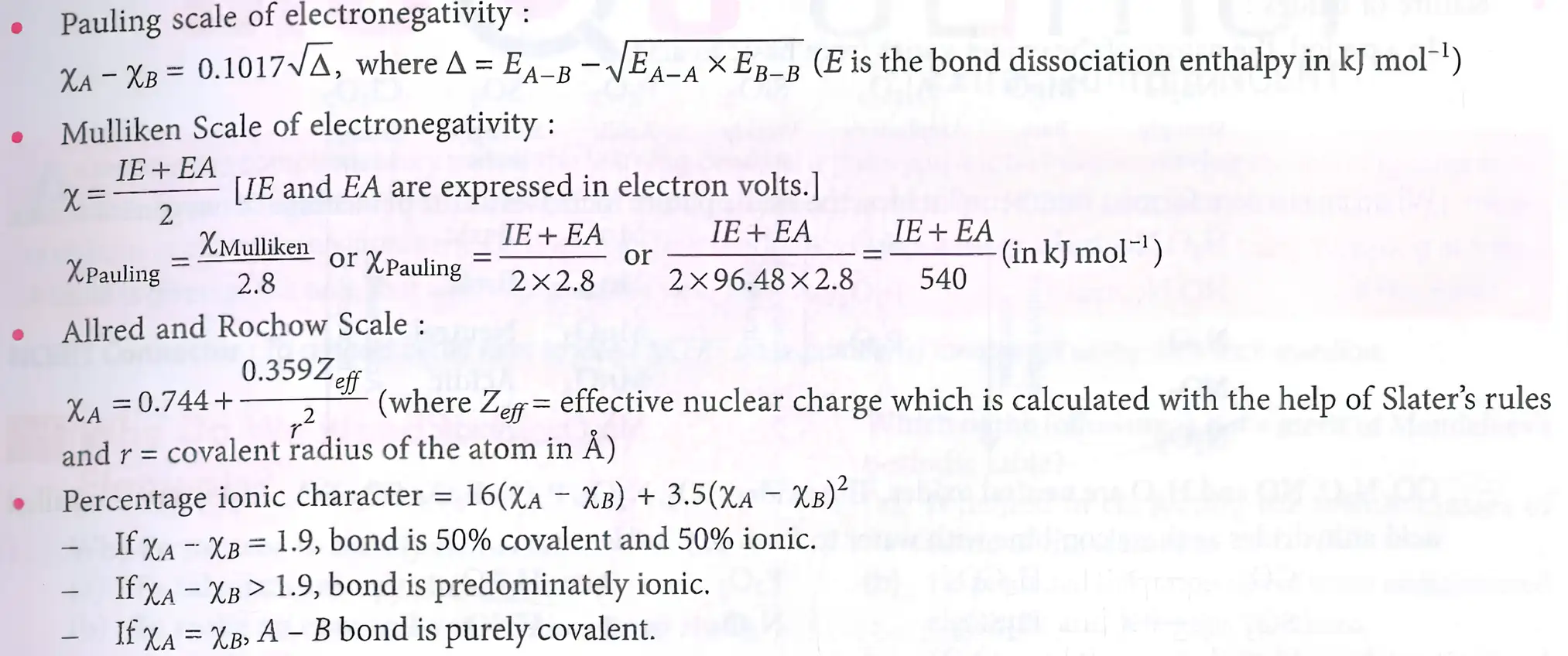
- Common scales:
- Pauling scale: Based on bond dissociation energies.
- Mulliken scale: Average of ionization energy and electron affinity.
- Allred-Rochow scale: Based on effective nuclear charge and atomic radius.
- Percentage ionic character of bond depends on electronegativity difference.
Solved Examples
- Ex 1: Calculate electronegativity difference using Pauling scale.
Answer: Use bond energies in formula \(\chi_A - \chi_B = \sqrt{E_{AB} - \frac{E_{AA} + E_{BB}}{2}}\).
Practice Set
- Q1: Electronegativity ______ across a period.
A. Increases
B. Decreases
C. Remains same
D. Varies randomly - Q2: Which scale uses average of ionization energy and electron affinity?
A. Pauling
B. Mulliken
C. Allred-Rochow
D. None - Q3: A bond with electronegativity difference of 1.9 is:
A. Purely covalent
B. Half covalent, half ionic
C. Mostly ionic
D. Purely ionic
Answer Key
- Q1: A - Electronegativity increases across a period.
- Q2: B - Mulliken scale uses average of IE and EA.
- Q3: B - 1.9 difference indicates half covalent, half ionic bond.
Memory Aids
- Electronegativity trend: increases across period, decreases down group.
- Pauling scale uses bond energies; Mulliken uses IE and EA.
Chemical Properties
Valence and Reactivity
- Valence usually equals number of outer electrons or 8 minus outer electrons.
- Oxidation state often used as valence.
- Transition elements and actinoids show variable valencies.
- Valency increases 1 to 4 then decreases 4 to 0 across a period.
- Elements in a group have same valency (same outer electrons).
- Second period elements show anomalous properties due to small size, high charge/radius ratio, and high electronegativity.
- Diagonal relationship: Li similar to Mg, Be similar to Al.
- Chemical reactivity highest at extremes of periodic table, lowest in center.
- Metallic character decreases left to right; non-metallic increases.
- Metallic character increases down group; non-metallic decreases.
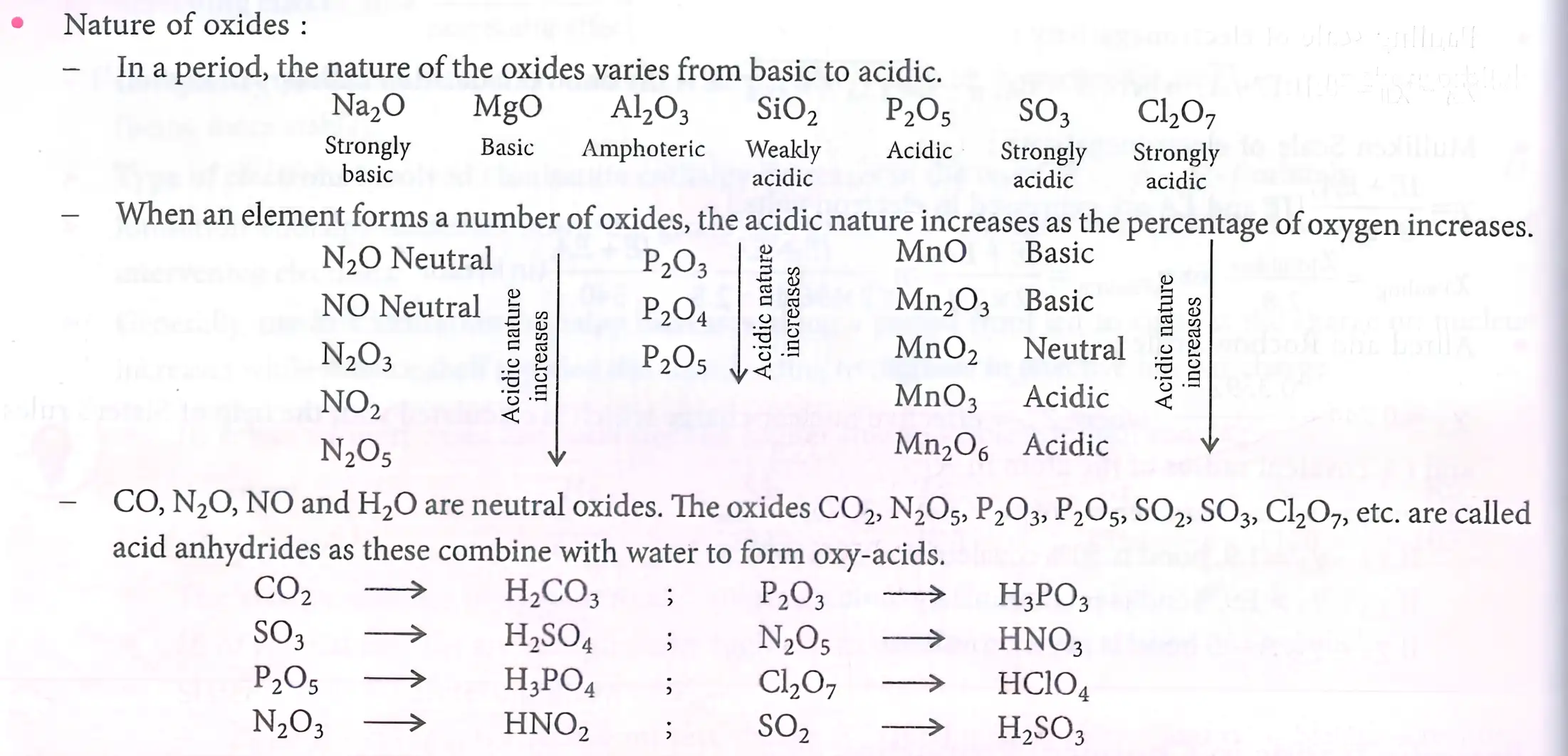
- Oxides:
- Left extreme: basic oxides (e.g., Na2O).
- Right extreme: acidic oxides (e.g., Cl2O7).
- Center: amphoteric (e.g., Al2O3) or neutral (e.g., CO, NO).
Solved Examples
- Ex 1: Explain why Li behaves like Mg.
Answer: Due to diagonal relationship caused by similar size and charge/radius ratio.
Practice Set
- Q1: Valency of elements in a group is generally:
A. Variable
B. Same
C. Increases down group
D. Decreases down group - Q2: Which oxide is amphoteric?
A. Na2O
B. Cl2O7
C. Al2O3
D. CO2 - Q3: Chemical reactivity is highest for elements:
A. In the center of periodic table
B. At the extremes of periodic table
C. In the middle of groups
D. None of the above
Answer Key
- Q1: B - Elements in a group have same valency.
- Q2: C - Al2O3 is amphoteric oxide.
- Q3: B - Reactivity highest at extremes (alkali metals and halogens).
Memory Aids
- Diagonal relationship: Li ~ Mg, Be ~ Al.
- Oxide nature: Left basic, center amphoteric, right acidic.
- Valency trend: increases 1 to 4, then decreases 4 to 0 across period.
Periodic Trends Summary
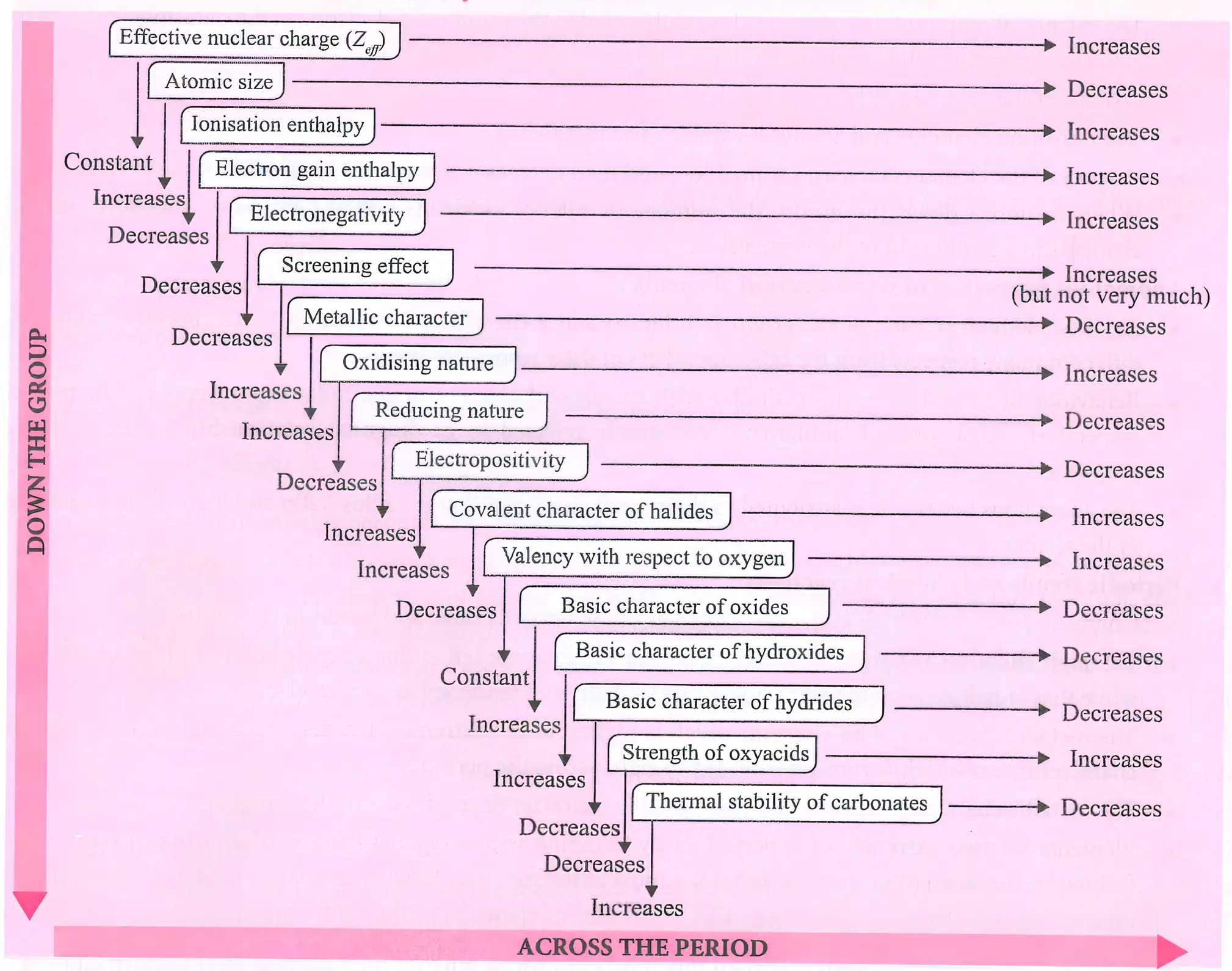
General Trends
- Effective nuclear charge (Zeff) increases across period.
- Atomic size decreases across period; increases down group.
- Ionisation enthalpy and electron gain enthalpy increase across period.
- Electronegativity increases across period; decreases down group.
- Screening effect slightly increases down group.
- Metallic character decreases across period; increases down group.
- Oxidising nature increases across period; reducing nature decreases.
- Electropositivity decreases across period; covalent character increases.
- Basic character of oxides, hydroxides, hydrides decreases across period.
- Strength of oxyacids increases; thermal stability of carbonates decreases across period.
Solved Examples
- Ex 1: Explain why atomic size decreases across a period.
Answer: Increasing Zeff pulls electrons closer, reducing size.
Practice Set
- Q1: Which property increases across a period?
A. Atomic size
B. Metallic character
C. Ionisation enthalpy
D. Electropositivity - Q2: Down a group, electronegativity generally:
A. Increases
B. Decreases
C. Remains constant
D. Varies randomly - Q3: Basic character of oxides across a period:
A. Increases
B. Decreases
C. Remains same
D. Varies randomly
Answer Key
- Q1: C - Ionisation enthalpy increases across period.
- Q2: B - Electronegativity decreases down group.
- Q3: B - Basic character decreases across period.
Memory Aids
- Across period: size ↓, IE ↑, EN ↑, metallic character ↓.
- Down group: size ↑, IE ↓, EN ↓, metallic character ↑.
- Oxide nature: basic → amphoteric → acidic across period.
NEET Chemistry — ALL CHAPTERS
1
Some Basic Concepts of Chemistry
2
Structure of Atom
3
Classification of Elements and Periodicity in Properties
4
Chemical Bonding and Molecular Structure
5
Thermodynamics
6
Equilibrium
7
Redox Reactions
8
Organic Chemistry - Some Basic Principles and Techniques
9
Hydrocarbons
10
Solutions
11
Electrochemistry
12
Chemical Kinetics
13
The d- and f- Block Elements
14
Coordination Compounds
15
Haloalkanes and Haloarenes
16
Alcohols, Phenols and Ethers
17
Aldehydes, Ketones and Carboxylic Acids
18
Amines
19
Biomolecules
20
The p-Block Elements (Group 13 and 14)
21
The p-Block Elements (Group 15 to 18)
22
Principles Related to Practical Chemistry