NEET Ug . NEET Chemistry . Chemistry . Some Basic Concepts of Chemistry
Chapter 1: Some Basic Concepts of Chemistry
Ch 1
NEET Chemistry
NEET Ug
Introduction
Definition and Scope
- Chemistry studies preparation, properties, structures, and reactions of substances.
- Focuses on composition, structure, properties, and interactions of matter.
- Atoms and molecules are the basic units studied.
- Known as the science of atoms and molecules.
Solved Examples
- Ex 1: Identify the basic units studied in chemistry.
Answer: Atoms and molecules.
Practice Set
- Q1: What is the primary focus of chemistry?
A. Study of living organisms
B. Study of atoms and molecules
C. Study of celestial bodies
D. Study of physical forces - Q2: Chemistry is also called the science of:
A. Cells and tissues
B. Atoms and molecules
C. Planets and stars
D. Energy and work - Q3: Which of the following is NOT a focus of chemistry?
A. Properties of substances
B. Reactions of substances
C. Structure of substances
D. Study of human behavior
Answer Key
- Q1: B - Chemistry focuses on atoms and molecules, the basic units of matter.
- Q2: B - Chemistry is known as the science of atoms and molecules.
- Q3: D - Chemistry does not study human behavior; it studies matter.
Memory Aids
- Chemistry = Science of Atoms + Molecules.
- Focus on composition, structure, properties, and reactions.
Importance of Chemistry
Applications and Role
- Studies properties, structures, and changes of substances.
- Central to science; linked with other branches.
- Explains weather, brain function, computer operation.
- Used in chemical industries: fertilizers, dyes, polymers, drugs, soaps, metals, alloys.
- Enables isolation and synthesis of lifesaving drugs (e.g., cisplatin, taxol, AZT).
- Develops safer alternatives to harmful refrigerants like CFCs.
Solved Examples
- Ex 1: Name a drug synthesized through chemistry used in cancer therapy.
Answer: Cisplatin or Taxol.
Practice Set
- Q1: Which branch of science studies changes in substances?
A. Physics
B. Chemistry
C. Biology
D. Astronomy - Q2: Which of the following is a product of chemical industry?
A. Fertilizers
B. Computers
C. Planets
D. Stars - Q3: Which drug is used to help AIDS patients?
A. Cisplatin
B. Taxol
C. AZT
D. Penicillin
Answer Key
- Q1: B - Chemistry studies properties and changes of substances.
- Q2: A - Fertilizers are produced using chemical principles.
- Q3: C - AZT is used for AIDS treatment.
Memory Aids
- Chemistry = Central science linking various fields.
- Drugs: Cisplatin & Taxol (cancer), AZT (AIDS).
- CFCs replaced by safer refrigerants.
Nature of Matter
Physical States of Matter
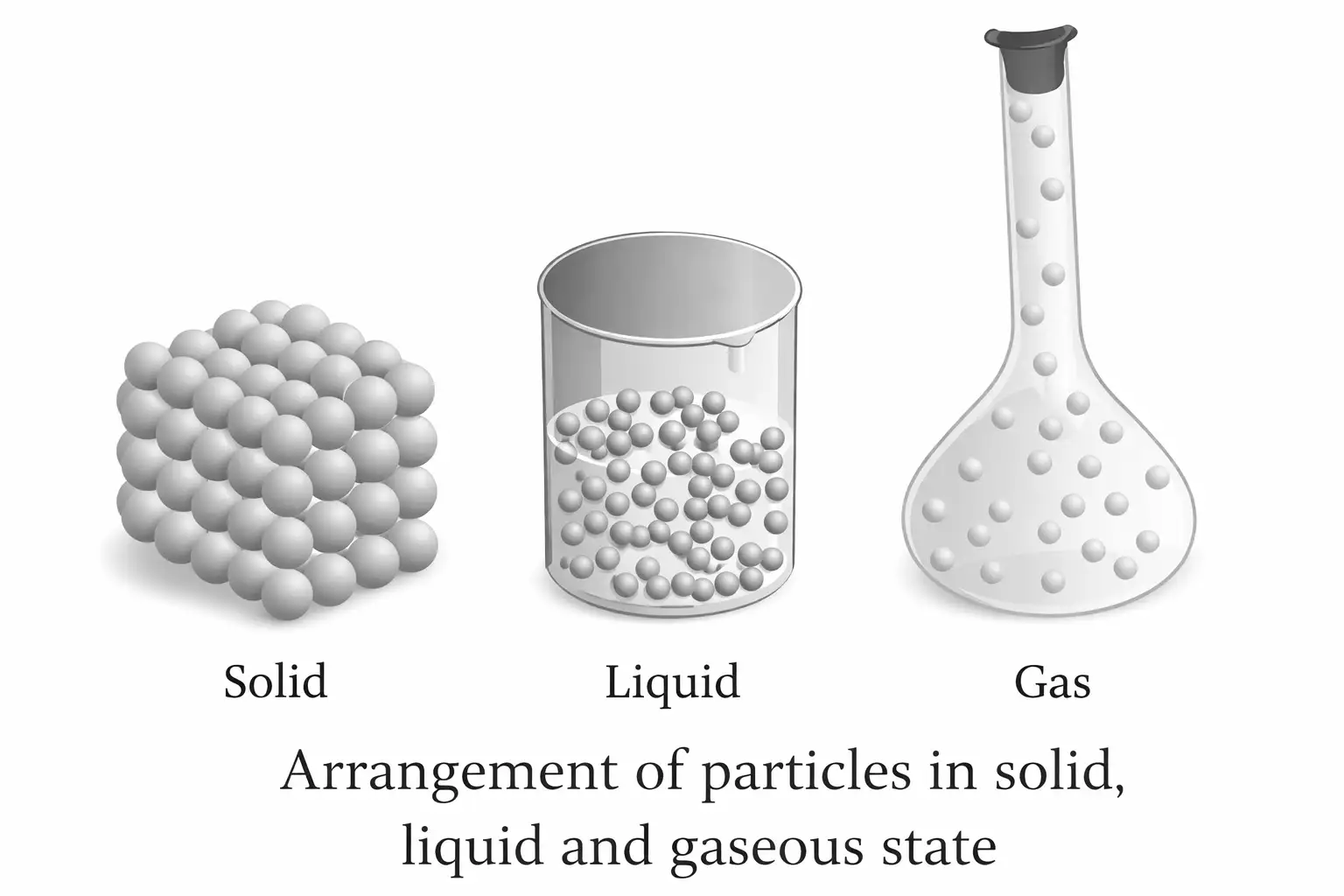
- Matter occupies space and has mass.
- Exists in three states: solid, liquid, gas.
- Solid: Particles tightly packed, strong attraction, fixed positions, definite shape and volume.
- Liquid: Particles close but weak attraction, move past each other, definite volume, shape of container.
- Gas: Particles far apart, random motion, no definite shape or volume, fills container.
Interconversion of States
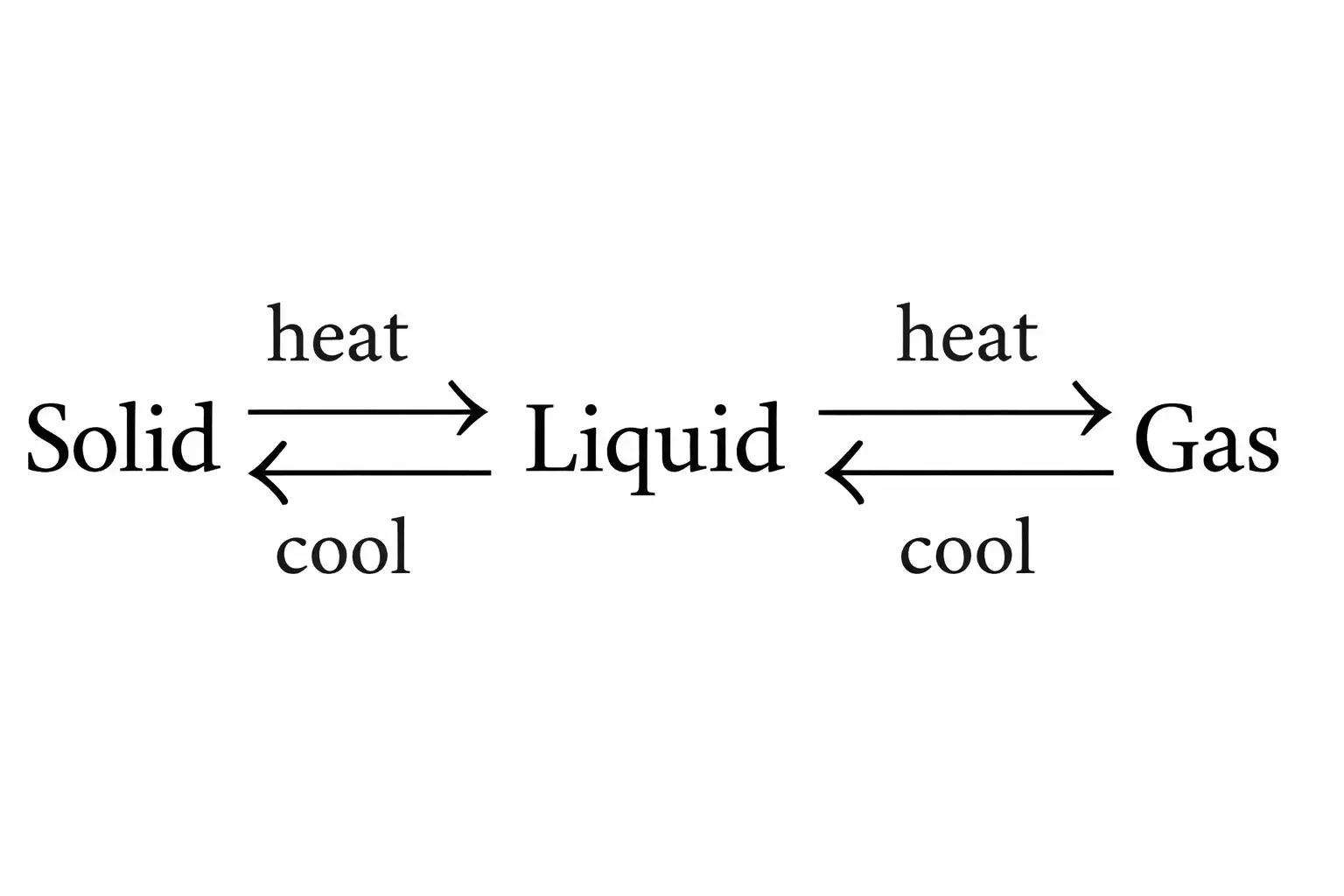
- States change by temperature and pressure.
- Heating solid → liquid (melting), liquid → gas (evaporation/boiling).
- Cooling gas → liquid (condensation), liquid → solid (freezing).
- Heating increases particle movement; cooling decreases it.
Classification of Matter
- Pure substances: Elements or compounds with fixed composition, e.g., copper, water, glucose.
- Cannot be separated by physical methods.
- Mixtures: Two or more substances, homogeneous or heterogeneous.
- Homogeneous mixture: Uniform composition, e.g., sugar solution, air.
- Heterogeneous mixture: Physically distinct phases, non-uniform, e.g., salt and sugar mix.
Solved Examples
- Ex 1: Identify the state of matter for a substance with fixed shape and volume.
Answer: Solid, due to fixed particle positions and strong attraction. - Ex 2: What happens when a liquid is heated?
Answer: It evaporates or boils to form gas. - Ex 3: Classify a mixture of salt and sugar.
Answer: Heterogeneous mixture, as components are physically distinct.
Practice Set
- Q1: Which state of matter has definite volume but no definite shape?
A. Solid
B. Liquid
C. Gas
D. Plasma - Q2: What process converts gas to liquid?
A. Melting
B. Freezing
C. Condensation
D. Evaporation - Q3: Which of the following is a homogeneous mixture?
A. Salt and sugar
B. Air
C. Oil and water
D. Sand and water
Answer Key
- Q1: B - Liquids have definite volume but take the shape of the container.
- Q2: C - Condensation is gas to liquid transition on cooling.
- Q3: B - Air is a homogeneous mixture with uniform composition.
Memory Aids
- Solid = fixed shape and volume (S for Stable).
- Liquid = definite volume, shape varies (L for Loose shape).
- Gas = no fixed shape or volume (G for Go anywhere).
- Heating: Solid → Liquid → Gas (S to L to G).
- Cooling: Gas → Liquid → Solid (reverse order).
- Pure substances = fixed composition, no physical separation.
- Mixtures = physical combination, can be separated.
Properties of Matter and their Measurement
Physical Properties
- Associated with physical existence of matter.
- Determined without changing composition.
- Examples: states of matter, colour, taste, odour, melting point, boiling point, density.
Chemical Properties
- Ability to form new substances by decomposition or reaction.
- Examples: acidity, basicity, combustibility.
International System of Units (SI)
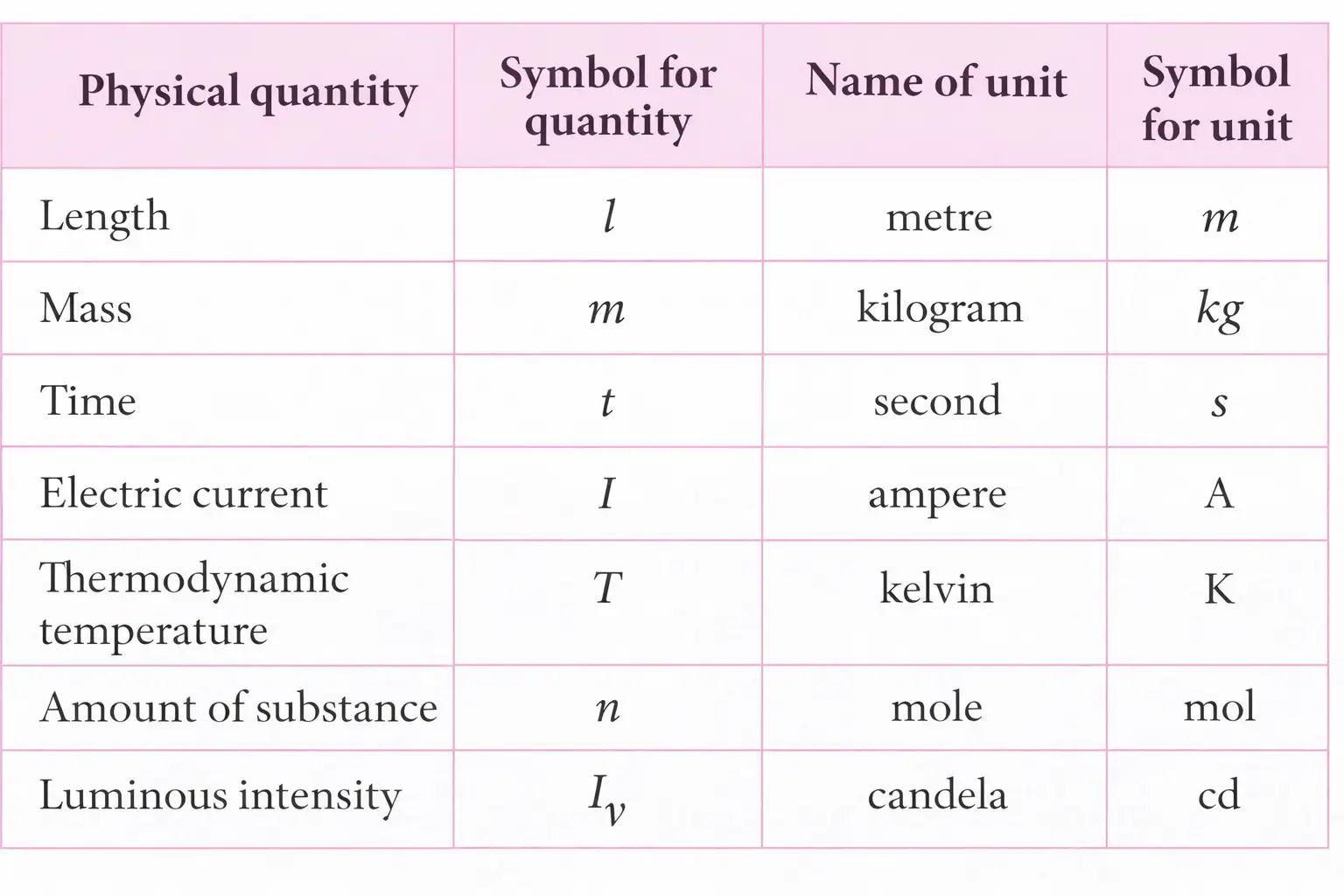
- Decimal system for measurement of physical quantities.
- Seven basic units: length (m), mass (kg), time (s), electric current (A), temperature (K), amount of substance (mol), luminous intensity (cd).
- Allows prefixes to indicate multiples or submultiples.
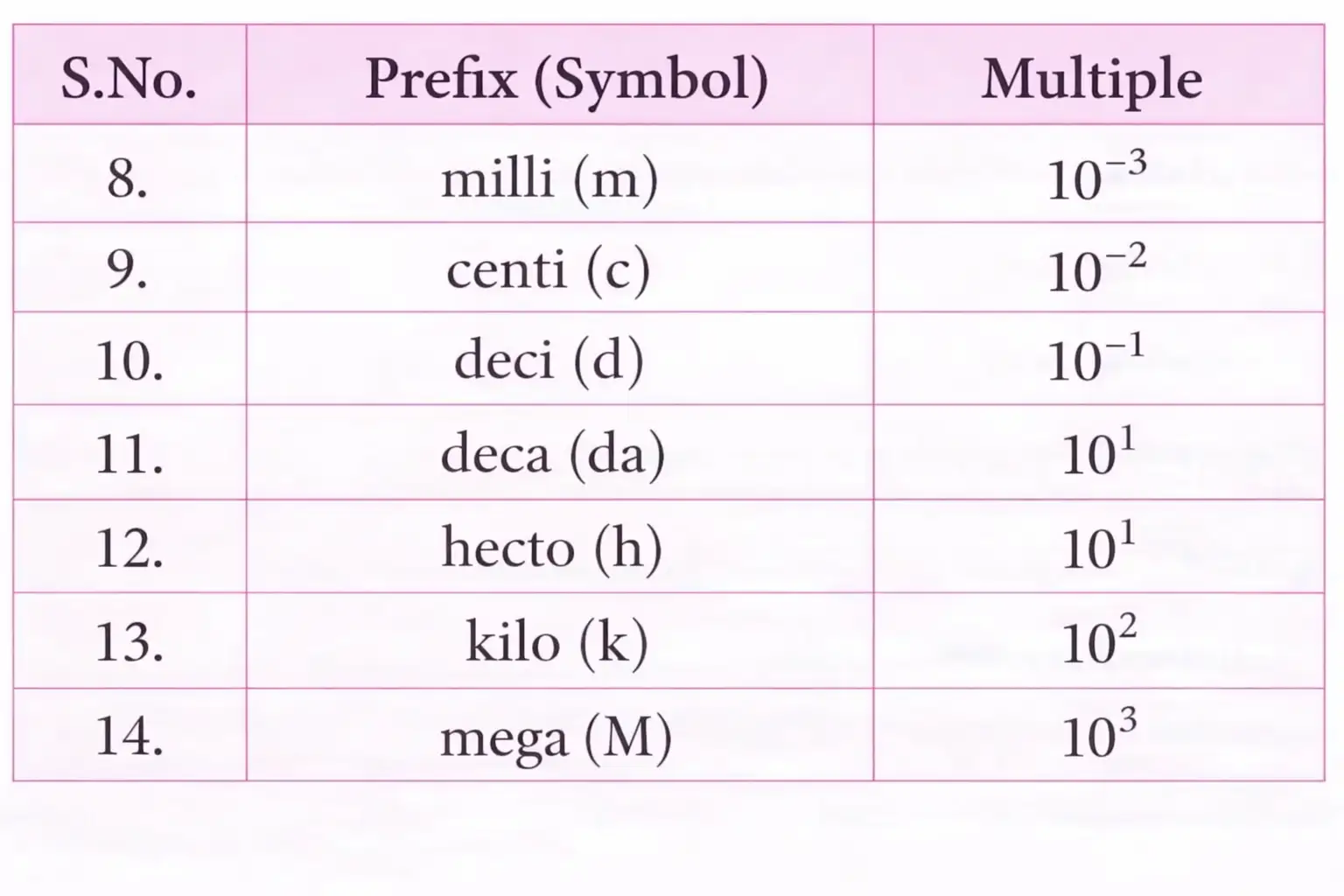
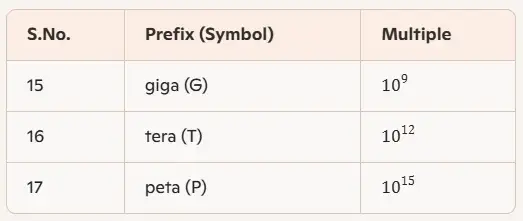
SI Prefixes
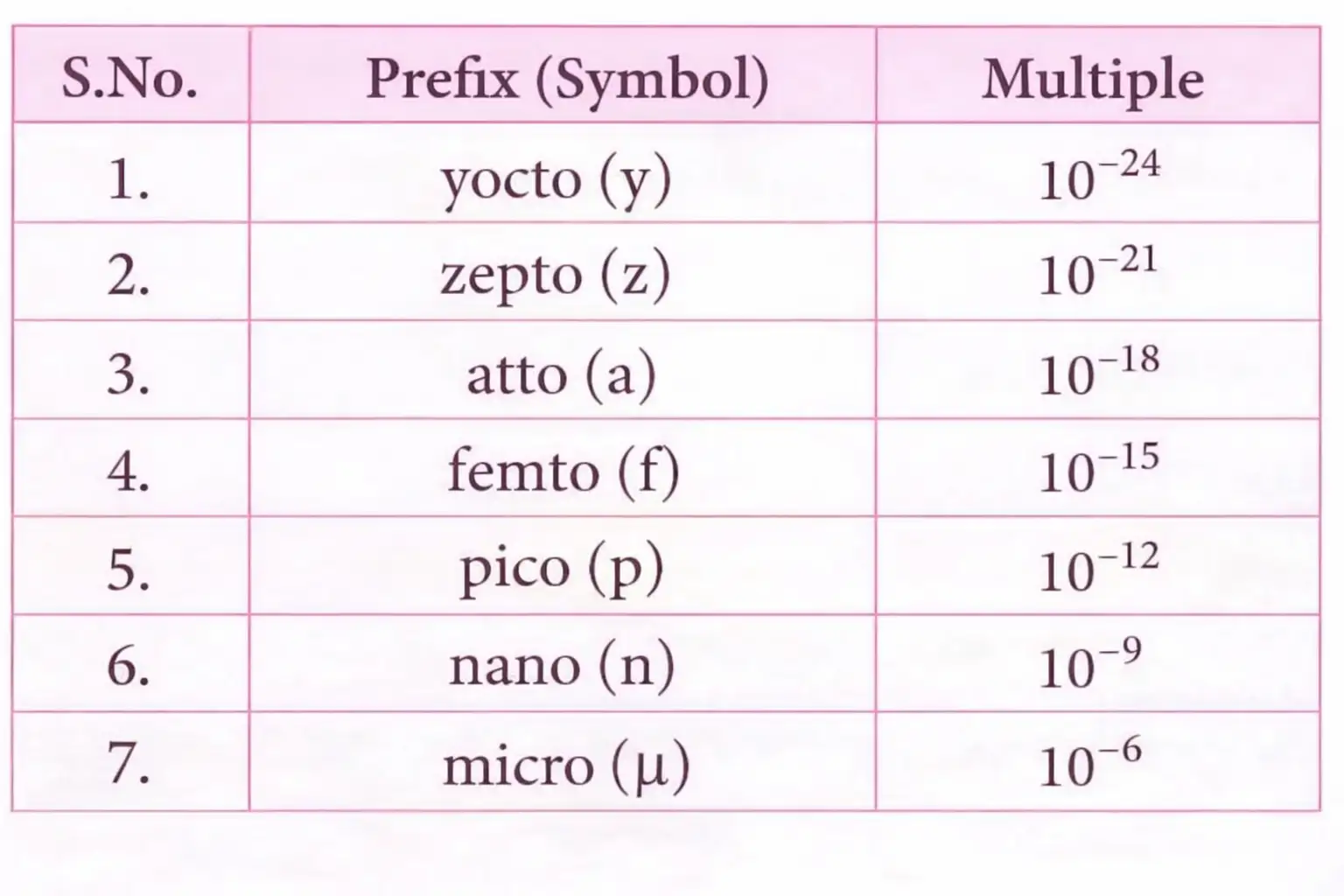
- Small prefixes: yocto (y, 10-24), nano (n, 10-9), micro (µ, 10-6), etc.
- Common prefixes: milli (m, 10-3), centi (c, 10-2), deci (d, 10-1), deca (da, 101), kilo (k, 103), mega (M, 106).
- Large prefixes: giga (G, 109), tera (T, 1012), peta (P, 1015).
Mass and Weight
- Mass: amount of matter in a substance; SI unit is kilogram (kg).
- Measured accurately using an analytical balance.
- Weight: force exerted by gravity on an object.
- Mass is constant; weight varies with gravity.
Volume
- Amount of space occupied by a substance.
- SI unit: cubic meter (m3).
- Common lab units: cubic centimeter (cm3) or cubic decimeter (dm3).
- Conversions: 1 L = 1000 mL; 1000 cm3 = 1 dm3.
Density
- Mass per unit volume.
- SI unit: kg m-3; commonly used unit: g cm-3.
Temperature
- SI unit: Kelvin (K).
- Also measured in degree Celsius (°C) and degree Fahrenheit (°F).
- Conversions: °F = \( \frac{9}{5} \)(°C) + 32; K = °C + 273.15.
Solved Examples
- Ex 1: Convert 25 °C to Kelvin.
Solution: K = 25 + 273.15 = 298.15 K. - Ex 2: Calculate density if mass = 500 g and volume = 250 cm3.
Solution: Density = mass/volume = 500/250 = 2 g cm-3.
Practice Set
- Q1: Which of the following is a chemical property?
A. Melting point
B. Colour
C. Combustibility
D. Density - Q2: What is the SI unit of electric current?
A. Ampere (A)
B. Kelvin (K)
C. Mole (mol)
D. Candela (cd) - Q3: Convert 1000 mL to dm3.
A. 0.1 dm3
B. 1 dm3
C. 10 dm3
D. 100 dm3
Answer Key
- Q1: C. Combustibility is a chemical property involving reaction to form new substances.
- Q2: A. Ampere (A) is the SI unit of electric current.
- Q3: B. 1000 mL = 1 dm3 as 1000 cm3 = 1 dm3.
Memory Aids
- Physical properties: No change in composition (e.g., colour, melting point).
- Chemical properties: Involve new substance formation (e.g., combustibility).
- SI units: 7 basics - m, kg, s, A, K, mol, cd.
- Common prefixes: milli (10-3), centi (10-2), kilo (103), mega (106).
- Temperature conversions: K = °C + 273.15; °F = 9/5(°C) + 32.
Uncertainty in Measurement
Scientific Notation
- Express numbers as N × 10n, where 1 ≤ N < 10 and n is an integer.
- Example: 0.0000298 = 2.98 × 10⁻⁵, 130596 = 1.30596 × 10⁵.
- Multiplication: (N1 × 10n1) × (N2 × 10n2) = (N1 × N2) × 10n1+n2.
- Division: (N1 × 10n1) / (N2 × 10n2) = (N1 / N2) × 10n1-n2.
- Addition/Subtraction: Convert to same exponent, then add/subtract mantissas.
Precision and Accuracy
- Precision: Closeness of repeated measurements.
- Accuracy: Closeness to true value.
- Uncertainty shown by significant figures.
- Significant figures include all certain digits plus one uncertain digit.
Rules for Significant Figures
- All non-zero digits are significant.
- Exact numbers have infinite significant figures.
- Leading zeros are not significant.
- Zeros between non-zero digits or after non-zero digits (right of decimal) are significant.
- Result cannot have more decimal digits than original numbers.
Rounding Off Rules
- Addition/Subtraction: Round to least decimal places among terms.
- Multiplication/Division: Round to least significant figures among terms.
- If digit to remove > 5, increase preceding digit by 1.
- If digit to remove < 5, leave preceding digit unchanged.
- If digit to remove = 5, increase preceding digit if odd, else leave unchanged.
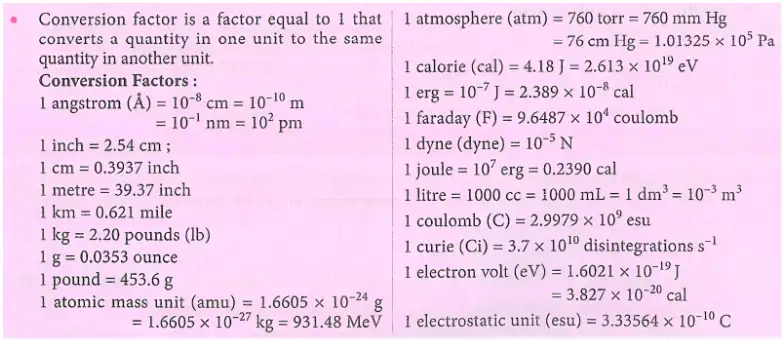
Dimensional Analysis
- Convert quantities using fundamental units.
- Use factor label or unit factor method.
- Example: 1 inch = 2.54 cm, so 1 inch / 2.54 cm = 1 = 2.54 cm / 1 inch.
- Unit conversion factors equal 1 and convert units without changing quantity.
- Quantity required = Quantity given × Conversion factor.
Solved Examples
- Ex 1: Multiply (5.6 × 10⁵) and (6.9 × 10⁸):
Step 1: Multiply mantissas: 5.6 × 6.9 = 38.64
Step 2: Add exponents: 5 + 8 = 13
Step 3: Result = 38.64 × 1013 = 3.864 × 10¹⁴. - Ex 2: Add 6.65 × 10⁴ and 8.95 × 10³:
Step 1: Convert 8.95 × 10³ to 0.895 × 10⁴
Step 2: Add mantissas: 6.65 + 0.895 = 7.545
Step 3: Result = 7.545 × 10⁴. - Ex 3: Convert 10 inches to cm:
Step 1: Use conversion factor 1 inch = 2.54 cm
Step 2: Multiply: 10 × 2.54 = 25.4 cm.
Practice Set
- Q1: What is the product of (3.2 × 10³) and (4.5 × 10²)?
A. 1.44 × 10⁵
B. 7.2 × 10⁵
C. 1.44 × 10⁶
D. 7.2 × 10⁶ - Q2: Which digit is significant in 0.00450?
A. Only 4 and 5
B. 4, 5 and trailing zero
C. Only 4
D. None - Q3: Round off 0.05678 to three significant figures.
A. 0.056
B. 0.057
C. 0.0567
D. 0.0570
Answer Key
- Q1: B. 7.2 × 10⁵ - Multiply mantissas (3.2 × 4.5 = 14.4), add exponents (3 + 2 = 5), adjust to 7.2 × 10⁵.
- Q2: B. 4, 5 and trailing zero - Leading zeros are not significant; trailing zeros after decimal are significant.
- Q3: B. 0.057 - Third digit is 6 (>5), so second digit increases from 5 to 7.
Memory Aids
- Scientific notation: Multiply/divide mantissas, add/subtract exponents.
- Significant figures: Non-zero digits always count; leading zeros never count.
- Rounding 5 rule: Increase if preceding digit odd, else keep same.
- Dimensional analysis: Multiply by conversion factor = 1 to change units.
Law of Conservation of Mass
Explanation
- Matter cannot be created or destroyed in a chemical reaction.
- Total mass of reactants equals total mass of products.
- Mass remains constant during physical or chemical changes.
Solved Examples
- Ex 1: If 10 g of reactants react, mass of products = 10 g (mass conserved).
Practice Set
- Q1: In a chemical reaction, the total mass of reactants is 20 g. What is the total mass of products?
- A. 10 g
- B. 20 g
- C. 30 g
- D. Cannot be determined
- Q2: Which law states that mass is neither created nor destroyed?
- A. Law of definite proportions
- B. Law of conservation of mass
- C. Law of multiple proportions
- D. Avogadro's law
- Q3: When 5 g of hydrogen reacts with 40 g of oxygen, the mass of water formed is?
- A. 35 g
- B. 45 g
- C. 50 g
- D. 55 g
Answer Key
- Q1: B - Mass of products equals mass of reactants as per the law.
- Q2: B - Law of conservation of mass states mass is conserved.
- Q3: C - Total mass = 5 g + 40 g = 45 g water formed.
Memory Aids
- Mass before = Mass after reaction.
- Think: "Mass is conserved like money in a closed system."
Law of Definite Proportions
Explanation
- Ratio of masses of elements in a compound is constant.
- Same compound always contains elements in fixed mass ratio.
- Also called Law of Definite Composition.
Solved Examples
- Ex 1: Water always contains hydrogen and oxygen in 1:8 mass ratio.
Practice Set
- Q1: What does the law of definite proportions state?
- A. Mass is conserved
- B. Elements combine in fixed mass ratio
- C. Gases combine in volume ratio
- D. Equal volumes have equal molecules
- Q2: If 18 g of water contains 2 g hydrogen, mass of oxygen is?
- A. 16 g
- B. 20 g
- C. 18 g
- D. 2 g
- Q3: Which law is also called law of definite composition?
- A. Law of conservation of mass
- B. Law of multiple proportions
- C. Law of definite proportions
- D. Avogadro's law
Answer Key
- Q1: B - Elements combine in fixed mass ratio in a compound.
- Q2: A - Oxygen mass = 18 g - 2 g = 16 g.
- Q3: C - Law of definite proportions is also called law of definite composition.
Memory Aids
- Fixed mass ratio = fixed compound composition.
- Water always H:O = 1:8 by mass.
Law of Multiple Proportions
Explanation
- Two elements form more than one compound.
- Masses of one element combining with fixed mass of other are in small whole number ratios.
- Example: CO and CO2 have C:O mass ratios in simple multiples.
Solved Examples
- Ex 1: Carbon monoxide and carbon dioxide show mass ratios 1:2 for oxygen combining with fixed carbon mass.
Practice Set
- Q1: Law of multiple proportions applies when?
- A. One element forms one compound
- B. Two elements form multiple compounds
- C. Gases combine in volume ratio
- D. Equal volumes have equal molecules
- Q2: If 1 g of element A combines with 2 g and 4 g of element B in two compounds, ratio is?
- A. 1:2
- B. 1:3
- C. 1:4
- D. 2:1
- Q3: Which pair illustrates law of multiple proportions?
- A. H2O and H2O2
- B. CO and CO2
- C. NaCl and KCl
- D. NH3 and CH4
Answer Key
- Q1: B - Two elements forming multiple compounds.
- Q2: A - Ratio of masses 2:4 = 1:2 small whole numbers.
- Q3: B - CO and CO2 show law of multiple proportions.
Memory Aids
- Multiple compounds = simple mass ratios.
- CO and CO2 classic example.
Gay Lussac's Law of Gaseous Volumes
Explanation
- Gases combine or form in simple volume ratios at same temperature and pressure.
- Volume ratios are small whole numbers.
- Example: 2 volumes H2 + 1 volume O2 → 2 volumes H2O (gas).
Solved Examples
- Ex 1: 2 L H2 reacts with 1 L O2 to produce 2 L H2O vapor.
Practice Set
- Q1: Gay Lussac's law relates to?
- A. Mass ratios
- B. Volume ratios of gases
- C. Mole ratios
- D. Energy changes
- Q2: If 3 L of N2 reacts with 9 L of H2, volume of NH3 formed is?
- A. 6 L
- B. 9 L
- C. 12 L
- D. 18 L
- Q3: In reaction 2H2 + O2 → 2H2O, volume ratio of reactants is?
- A. 1:1
- B. 2:1
- C. 1:2
- D. 3:2
Answer Key
- Q1: B - Law deals with volume ratios of gases.
- Q2: A - N2:H2:NH3 = 1:3:2 volume ratio.
- Q3: B - Volume ratio of H2 to O2 is 2:1.
Memory Aids
- Gas volumes combine in simple ratios.
- Remember: 2 volumes H2 + 1 volume O2 → 2 volumes H2O.
Avogadro Law
Explanation
- Equal volumes of gases at same temperature and pressure contain equal number of molecules.
- Volume proportional to number of molecules.
- Basis for molar volume concept (22.4 L at STP).
Solved Examples
- Ex 1: 22.4 L of any gas at STP contains 6.022 × 10²³ molecules.
Practice Set
- Q1: Avogadro's law states equal volumes of gases have?
- A. Equal mass
- B. Equal molecules
- C. Equal density
- D. Equal pressure
- Q2: Volume of 1 mole gas at STP is?
- A. 11.2 L
- B. 22.4 L
- C. 44.8 L
- D. 1 L
- Q3: If 2 volumes of gas A and 3 volumes of gas B contain equal molecules, which is true?
- A. Gas A is heavier
- B. Gas B is heavier
- C. Both have same mass
- D. Cannot determine
Answer Key
- Q1: B - Equal volumes have equal molecules at same T and P.
- Q2: B - Molar volume at STP is 22.4 L.
- Q3: B - More volume with same molecules means gas B is lighter.
Memory Aids
- Equal volume = equal molecules (Avogadro).
- Molar volume = 22.4 L at STP.
Law of Reciprocal Proportions
Explanation
- When two elements separately combine with fixed mass of third element, their mass ratio is same or simple multiple of ratio when they combine with each other.
- Helps in determining atomic masses.
- Example: If A combines with fixed mass of C, and B combines with same mass of C, ratio of A to B masses is simple multiple of A-B combination ratio.
Solved Examples
- Ex 1: If A and B combine with fixed mass of C in ratio 1:2, and A and B combine with each other in ratio 1:1 or 1:2.
Practice Set
- Q1: Law of reciprocal proportions relates to?
- A. Mass conservation
- B. Mass ratios of elements combining with third element
- C. Volume ratios of gases
- D. Mole ratios
- Q2: If A combines with fixed mass of C in 1:3 ratio and B combines with same mass of C in 1:6 ratio, ratio of A to B is?
- A. 1:2
- B. 2:1
- C. 1:1
- D. 3:6
- Q3: Which is true for law of reciprocal proportions?
- A. Ratios are always equal
- B. Ratios are simple multiples
- C. Ratios are unrelated
- D. Ratios depend on temperature
Answer Key
- Q1: B - It relates to mass ratios with a third element.
- Q2: A - 1:3 and 1:6 gives 1:2 ratio between A and B.
- Q3: B - Ratios are simple multiples or equal.
Memory Aids
- Mass ratios with third element guide element ratios.
- Simple multiples rule applies.
Dalton's Atomic Theory
Main Points
- Matter is made of indivisible atoms.
- Atoms of the same element have identical properties and mass; atoms of different elements differ in mass.
- Compounds form when atoms of different elements combine in fixed ratios.
- Chemical reactions rearrange atoms; atoms are neither created nor destroyed.
- Explains laws of chemical combination but not gaseous volume laws or reasons for atom combination.
Solved Examples
- Ex 1: Identify if the statement aligns with Dalton's theory: "Atoms can be divided into smaller particles."
Answer: No, Dalton's theory states atoms are indivisible. - Ex 2: If 2 atoms of element A combine with 3 atoms of element B to form a compound, what does this illustrate?
Answer: Fixed ratio combination of atoms forming compounds.
Practice Set
- Q1: According to Dalton's theory, atoms are:
A) Divisible
B) Indivisible
C) Created in reactions
D) Destroyed in reactions - Q2: Atoms of the same element have:
A) Different masses
B) Identical properties
C) Different chemical behavior
D) Different atomic numbers - Q3: Dalton's theory could NOT explain:
A) Law of conservation of mass
B) Law of definite proportions
C) Laws of gaseous volumes
D) Fixed ratio in compounds
Answer Key
- Q1: B - Dalton stated atoms are indivisible.
- Q2: B - Atoms of the same element have identical properties including mass.
- Q3: C - Dalton's theory could not explain gaseous volume laws.
Memory Aids
- Atoms are "A"tomic: indivisible units.
- Same element = Same mass and properties.
- Compounds = Fixed ratio combinations.
- Atoms rearranged, not created/destroyed in reactions.
Atomic and Molecular Masses
Concepts and Definitions
- Atomic mass (atomic weight) is the average relative mass of atoms compared to carbon-12, which is exactly 12 u.
- 1 unified mass unit (u) = 1.66056 × 10⁻²⁴ g; 1 u = 1/12 mass of carbon-12 atom.
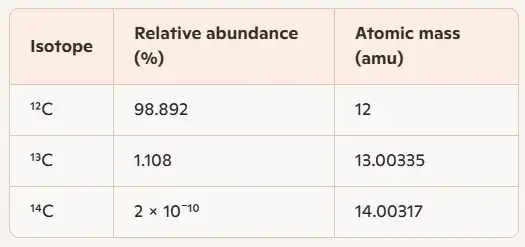
- Average atomic mass accounts for isotopes and their relative abundances.
- Formula: Atomic mass = (Average mass of atom) / (1/12 × mass of C-12 atom).
- Average atomic mass = \( \frac{(RA_1 \times At.mass_1) + (RA_2 \times At.mass_2)}{RA_1 + RA_2} \), where RA = relative abundance.
- Molecular mass = sum of atomic masses in a molecule; Formula mass applies to ionic compounds.
- Molecular mass = (Average mass of one molecule) / (1/12 × mass of C-12 atom).
- Key relations:
- Atomic mass = Equivalent mass × Valency
- Atomic mass = Molecular mass / Atomicity
- Actual mass of one molecule = Molecular mass × 1.66 × 10⁻²⁴ g
- Atomic mass = 6.4 / Specific heat (cal)
- Molecular mass = 2 × Vapour density
Isotopes and Average Atomic Mass
- Isotopes: atoms of same element with different neutrons.
- Example: Carbon isotopes - C-12 (98.892%), C-13 (1.108%), C-14 (trace).
- Average atomic mass of carbon = (0.98892 × 12 u) + (0.01108 × 13.00335 u) + (2 × 10-12 × 14.00317 u) = 12.011 u.
- Isotopic masses affect dating and chemical studies.
Solved Examples
- Ex 1: Calculate average atomic mass of carbon given isotopes and abundances.
- Use formula: Average atomic mass = Σ (RA × atomic mass).
- Substitute values: (0.98892 × 12) + (0.01108 × 13.00335) + (2 × 10-12 × 14.00317) = 12.011 u.
- Ex 2: Find molecular mass of H2O.
- Atomic masses: H = 1 u, O = 16 u.
- Molecular mass = 2 × 1 + 16 = 18 u.
Practice Set
- Q1: What is the atomic mass unit (u) defined as?
- A) Mass of one proton
- B) One-twelfth mass of carbon-12 atom
- C) Mass of one neutron
- D) Mass of one electron
- Q2: Which isotope of carbon is most abundant?
- A) Carbon-14
- B) Carbon-13
- C) Carbon-12
- D) Carbon-11
- Q3: Calculate molecular mass of CO2 (C=12 u, O=16 u).
- A) 28 u
- B) 44 u
- C) 32 u
- D) 16 u
Answer Key
- Q1: B - Atomic mass unit is defined as one-twelfth the mass of carbon-12 atom.
- Q2: C - Carbon-12 is the most abundant isotope (~98.9%).
- Q3: B - Molecular mass of CO2 = 12 + 2×16 = 44 u.
Memory Aids
- Atomic mass unit (u) = 1/12 mass of C-12.
- Average atomic mass = weighted average of isotopes.
- Molecular mass = sum of atomic masses in molecule.
- Use vapour density × 2 for molecular mass quick calculation.
Mole Concept and Molar Masses
Fundamentals
- One mole contains 6.023 × 10²³ particles (atoms, molecules, ions).
- Avogadro constant (Na) = 6.023 × 10²³ entities/mol.
- Molar mass (g/mol) = mass of 1 mole of substance; numerically equals atomic/molecular/formula mass in atomic mass units (u).
- At STP, 1 mole of gas occupies 22.4 L.
- 1 gram atom = Na atoms = gram atomic mass.
- 1 gram molecule = Na molecules = gram molecular mass.
Solved Examples
- Ex 1: Calculate number of atoms in 12 g of carbon.
- Given: 12 g of 12C = 1 mole.
- Number of atoms = 6.023 × 10²³ atoms.
- Ex 2: Find molar mass of H2O.
- Atomic masses: H = 1 u, O = 16 u.
- Molecular mass = 2 × 1 + 16 = 18 u.
- Molar mass = 18 g/mol.
Practice Set
- Q1: Avogadro number is:
- A) 6.023 × 10²²
- B) 6.023 × 10²³
- C) 6.023 × 1024
- D) 6.023 × 1025
- Q2: Molar mass of CO2 is:
- A) 12 g/mol
- B) 16 g/mol
- C) 44 g/mol
- D) 28 g/mol
- Q3: Volume occupied by 2 moles of gas at STP is:
- A) 11.2 L
- B) 22.4 L
- C) 44.8 L
- D) 56.0 L
Answer Key
- Q1: B) 6.023 × 10²³ - Avogadro number defines particles in 1 mole.
- Q2: C) 44 g/mol - CO2 molar mass = 12 + 2 × 16 = 44 g/mol.
- Q3: C) 44.8 L - 1 mole gas at STP = 22.4 L, so 2 moles = 44.8 L.
Memory Aids
- Avogadro number = 6.023 × 10²³ (think: 6.02 is a common constant).
- Molar mass in grams = atomic/molecular mass in u.
- Gas volume at STP = 22.4 L per mole.
Percentage Composition
Concept and Formula
- Mass % of an element = (Mass of that element in the compound × 100) / Molar mass of the compound
- Used to find the percentage by mass of each element in a compound
Empirical and Molecular Formulas
- Empirical formula: simplest whole number ratio of atoms in a compound
- Molecular formula: exact number of atoms of each element in a molecule
- Different compounds can share the same empirical formula but not the same molecular formula
- Molecular formula = n × Empirical formula = (Empirical formula)n
- n = Molecular mass / Empirical formula mass (n = 1, 2, 3, ...)
Solved Examples
- Ex 1: Calculate % of C in CO2.
- Molar mass CO2 = 12 + 2×16 = 44 g/mol
- %C = (12/44) × 100 = 27.27%
- Ex 2: Find molecular formula if empirical formula is CH2 and molecular mass is 56 g/mol.
- Empirical mass = 12 + 2×1 = 14 g/mol
- n = 56 / 14 = 4
- Molecular formula = (CH2)4 = C4H8
Practice Set
- Q1: What is the % of H in H2O?
- A) 11.11%
- B) 22.22%
- C) 66.67%
- D) 88.89%
- Q2: The empirical formula of a compound is CH2O. Its molecular mass is 180 g/mol. What is its molecular formula?
- A) CH2O
- B) C2H4O2
- C) C3H6O3
- D) C6H12O6
- Q3: Calculate the % of oxygen in H2SO4 (Molar mass = 98 g/mol).
- A) 32.65%
- B) 48.98%
- C) 65.31%
- D) 75.51%
Answer Key
- Q1: A) 11.11% - H mass = 2 g, molar mass H2O = 18 g; (2/18)×100 = 11.11%
- Q2: D) C6H12O6 - Empirical mass = 30 g; n = 180/30 = 6; molecular formula = (CH2O)6
- Q3: C) 65.31% - O mass = 4×16 = 64 g; (64/98)×100 = 65.31%
Memory Aids
- Empirical formula = simplest ratio; molecular formula = exact count
- Use n = Molecular mass / Empirical mass to find molecular formula
- Mass % = (mass of element / molar mass) × 100
Stoichiometry and Stoichiometric Calculations
Concepts
- Stoichiometry calculates masses or volumes of reactants and products in balanced chemical reactions.
- Limiting reagent: Reactant fully consumed, limits product formation.
- Concentration expressions:
- Mass percent = (Mass of solute / Mass of solution) × 100
- Volume percent = (Volume of solute / Volume of solution) × 100
- Mole fraction = Moles of solute / (Moles of solute + Moles of solvent)
- Molarity (M) = Moles of solute / Volume of solution (L)
- Molality (m) = Moles of solute / Mass of solvent (kg)
- Effect of temperature: Molality and mole fraction are temperature-independent; molarity changes with temperature due to volume change.
- Normality (N) = Gram equivalent of solute / Volume of solution (L) = (W × 1000) / (GEM × V in mL), where GEM = gram equivalent mass.
- Equivalent masses:
- Element = Atomic mass / Valency
- Acid = Molecular mass / Basicity
- Base = Molecular mass / Acidity
- Salt = Formula mass / Total positive or negative charge
- Oxidising agent = Molecular mass / Total change in oxidation number
- Relation: Molarity × GMM = Normality × GEM (GMM = gram molecular mass)
- Dilution equations:
- N₁V₁ = N₂V₂
- M₁V₁ = M₂V₂
- M₁V₁ / n₁ = M₂V₂ / n₂ (n = moles in balanced reaction)
- Mixing solutions: M₃(V₁ + V₂) = M₁V₁ + M₂V₂ (for non-reacting solutions)
- Conversions:
- Millimoles = Molarity × Volume (mL)
- Equivalents = Normality × Volume (L)
- Milliequivalents = Normality × Volume (mL)
- Gram atoms or moles = Mass of element / Gram atomic mass
- Mole definitions:
- 1 mole = 6.023 × 10²³ particles (atoms/molecules)
- 1 mole atoms = Gram atomic mass = 6.023 × 10²³ atoms
- 1 mole molecules = Gram molecular mass = 6.023 × 10²³ molecules = 22.4 L at STP
- 1 mole ionic compound = Gram formula mass = 6.023 × 10²³ formula units
- Gram equivalents = Weight of solute / Equivalent weight
- Milliequivalents = (Weight of solute / Equivalent weight) × 1000
- Strength of solution = Weight of solute (g) / Volume of solution (L)
- Parts per million (ppm) = (Mass or Volume of A / Mass or Volume of solution) × 106
Solved Examples
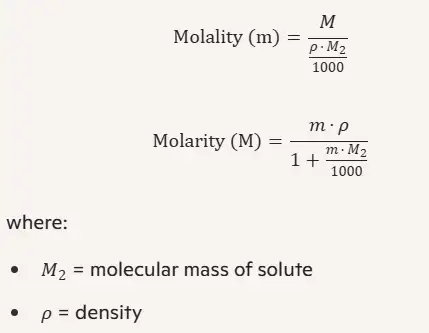
- Ex 1: Calculate molality if 2 moles of solute (M2 = 50 g/mol) are dissolved in 1 kg solvent with solution density 1.2 g/mL.
- Use formula: M = n1 / (n1M1 + n2M2) / ρ
- Calculate mass of solute and solvent, then molarity and molality.
- Ex 2: Find normality of 0.5 M H2SO4 (basicity = 2).
- Normality = Molarity × Basicity = 0.5 × 2 = 1 N
Practice Set
- Q1: What is the limiting reagent?
- A. Reactant in excess
- B. Reactant completely consumed
- C. Product formed first
- D. Catalyst
- Q2: Molarity is defined as:
- A. Moles of solute per kg solvent
- B. Moles of solute per L solution
- C. Mass of solute per mass of solution
- D. Volume of solute per volume of solution
- Q3: Calculate normality of 1 M H3PO4 (basicity = 3).
- A. 1 N
- B. 2 N
- C. 3 N
- D. 0.33 N
Answer Key
- Q1: B - Limiting reagent is the reactant fully consumed, limiting product formation.
- Q2: B - Molarity is moles of solute per liter of solution.
- Q3: C - Normality = Molarity × Basicity = 1 × 3 = 3 N.
Memory Aids
- Limiting reagent = fully consumed reactant.
- Molarity changes with temperature; molality does not.
- Normality = Molarity × Basicity/Acidity.
- 1 mole = 6.023 × 10²³ particles.
NEET Chemistry — ALL CHAPTERS
1
Some Basic Concepts of Chemistry
2
Structure of Atom
3
Classification of Elements and Periodicity in Properties
4
Chemical Bonding and Molecular Structure
5
Thermodynamics
6
Equilibrium
7
Redox Reactions
8
Organic Chemistry - Some Basic Principles and Techniques
9
Hydrocarbons
10
Solutions
11
Electrochemistry
12
Chemical Kinetics
13
The d- and f- Block Elements
14
Coordination Compounds
15
Haloalkanes and Haloarenes
16
Alcohols, Phenols and Ethers
17
Aldehydes, Ketones and Carboxylic Acids
18
Amines
19
Biomolecules
20
The p-Block Elements (Group 13 and 14)
21
The p-Block Elements (Group 15 to 18)
22
Principles Related to Practical Chemistry