NEET Ug . NEET Chemistry . Chemistry . Aldehydes Ketones and Carboxylic Acids
Chapter 17: Aldehydes, Ketones and Carboxylic Acids
Ch 17
NEET Chemistry
NEET Ug
Introduction to Carbonyl Compounds
Overview
Aldehydes and ketones contain a carbonyl group (>C=O) with general formula CnH2nO.
Aldehydes: Carbonyl attached to at least one hydrogen atom (–CHO group).
Ketones: Carbonyl attached to two carbon atoms (alkyl/aryl groups).
Carboxylic acids contain –COOH group, general formula CnH2nO2.
Solved Examples
Ex 1: Identify the functional group in propanal.
Solution: Propanal is an aldehyde with –CHO group.Ex 2: Write the general formula of ketones.
Solution: CnH2nO.
Practice Set
Q1: Which functional group is present in ketones?
A. –OH
B. –CHO
C. >C=O
D. –COOHQ2: The general formula of aldehydes is:
A. CnH2nO
B. CnH2n+2O
C. CnH2nO2
D. CnH2n-2OQ3: Which compound contains the –COOH group?
A. Aldehyde
B. Ketone
C. Carboxylic acid
D. Alcohol
Answer Key
Q1: C – Ketones have >C=O group bonded to two carbons.
Q2: A – Aldehydes and ketones have general formula CnH2nO.
Q3: C – Carboxylic acids contain –COOH group.
Memory Aids
Carbonyl group = C=O.
Aldehyde = Carbonyl + at least one H.
Ketone = Carbonyl between two carbons.
Carboxylic acid = Carbonyl + –OH (–COOH).
Nomenclature and Structure of Carbonyl Group
Nomenclature
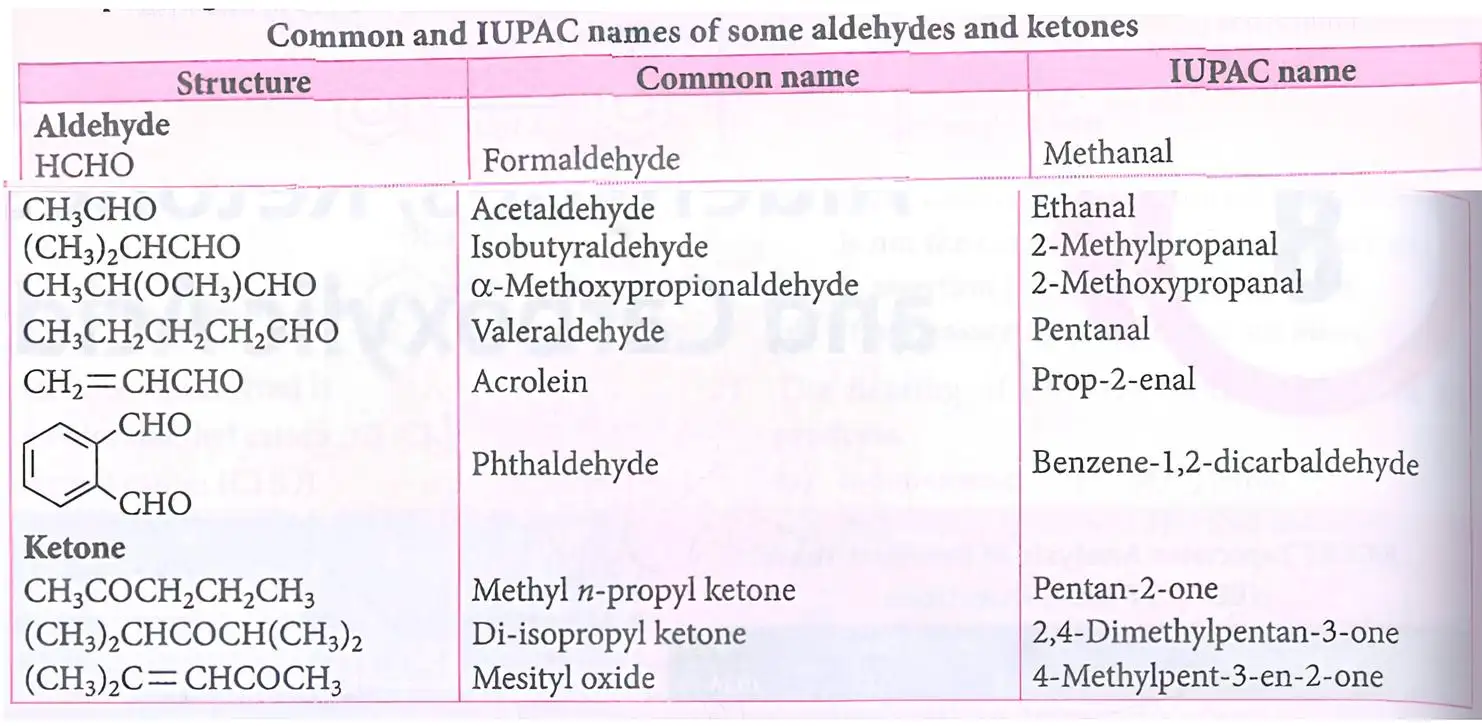
Aldehydes: Common names from corresponding acid by replacing ‘-ic acid’ with ‘aldehyde’.
Ketones: Named by listing alkyl/aryl groups attached to carbonyl.
Substituent positions indicated by Greek letters α, β, γ, δ starting from carbon next to carbonyl.
IUPAC names: Replace alkane ‘-e’ ending with ‘-al’ for aldehydes and ‘-one’ for ketones.
Structure
Carbonyl carbon is sp2 hybridized.
Forms three sigma (σ) bonds and one pi (π) bond with oxygen.
Atoms attached to carbonyl carbon lie in one plane with bond angle ~120° (trigonal planar).
π-electron cloud lies above and below the plane.
Carbonyl group exhibits resonance: C=O ↔ C+–O–.
Solved Examples
Ex 1: Name CH3CHO using IUPAC.
Solution: Ethanal (acetaldehyde).Ex 2: Describe hybridization of carbonyl carbon.
Solution: sp2 hybridized with trigonal planar geometry.
Practice Set
Q1: The IUPAC suffix for aldehydes is:
A. -one
B. -al
C. -ol
D. -oic acidQ2: Which hybridization is present in carbonyl carbon?
A. sp
B. sp2
C. sp3
D. dsp2Q3: The resonance structure of carbonyl group shows:
A. C=O double bond only
B. C–O single bond only
C. Partial positive charge on carbon and negative on oxygen
D. No charge separation
Answer Key
Q1: B – Aldehydes end with ‘-al’ in IUPAC nomenclature.
Q2: B – Carbonyl carbon is sp2 hybridized.
Q3: C – Resonance shows C+ and O– charges.
Memory Aids
‘-al’ suffix for aldehydes, ‘-one’ for ketones.
Carbonyl carbon = sp2, trigonal planar.
Resonance: C=O ↔ C+–O–.
Greek letters α, β indicate substituent positions next to carbonyl.
Preparation of Aldehydes and Ketones
Methods of Preparation
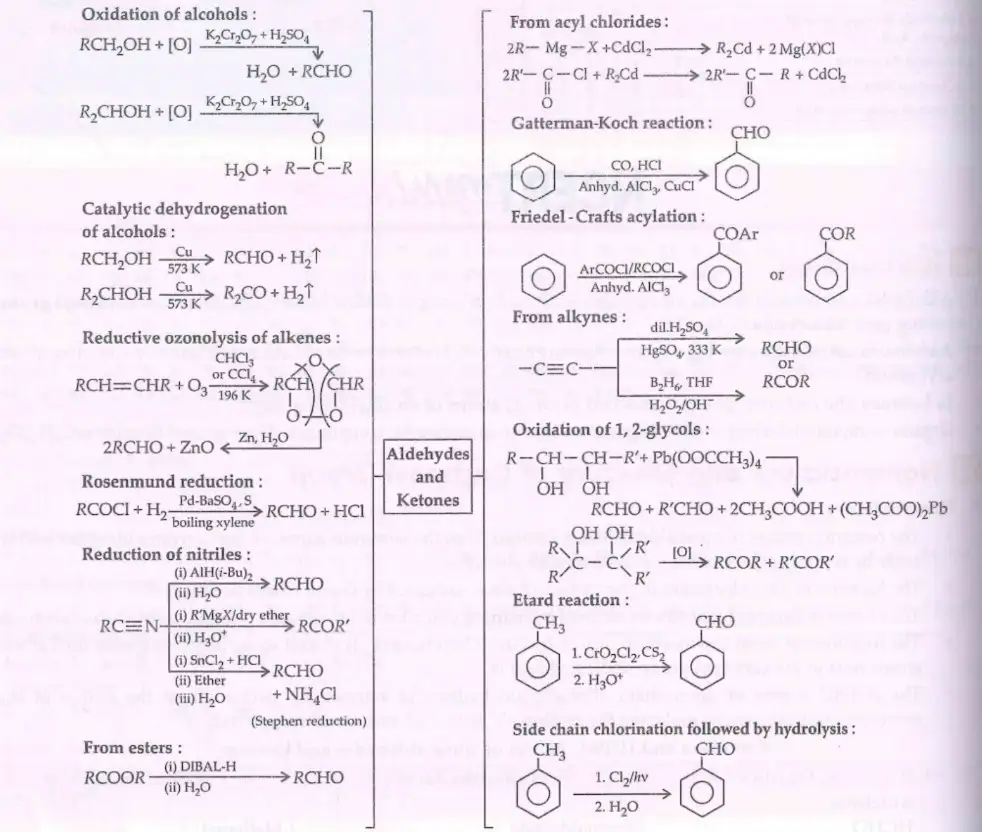
Oxidation of Alcohols: Primary alcohols oxidized by K2Cr2O7 form aldehydes; secondary alcohols form ketones.
Catalytic Dehydrogenation: Alcohols heated with Cu lose H2 to give aldehydes or ketones.
Reductive Ozonolysis: Alkenes cleaved by ozone yield aldehydes.
Rosenmund Reduction: Acyl chlorides reduced with H2/Pd-BaSO4 produce aldehydes.
Reduction of Nitriles: Controlled reduction converts nitriles to aldehydes.
Esters Reduction: DIBAL-H reduces esters to aldehydes after hydrolysis.
Acyl Chlorides + Organometallics: Reaction with RMgX or R2Cd forms ketones.
Gatterman-Koch Reaction: Benzene + CO + HCl with catalysts forms benzaldehyde.
Friedel-Crafts Acylation: Benzene + acyl chloride + AlCl3 yields aromatic ketones.
From Alkynes: Hydration or hydroboration-oxidation forms aldehydes or ketones.
Oxidation of 1,2-Glycols: Lead tetraacetate cleaves vicinal diols to aldehydes/ketones.
Etard Reaction: Methylbenzenes oxidized by chromium reagents to benzaldehydes.
Side Chain Chlorination: Methyl groups chlorinated then hydrolyzed to benzaldehydes.
Solved Examples
Ex 1: Convert ethanol to ethanal using K2Cr2O7 (oxidation of primary alcohol).
Ex 2: Prepare acetophenone by Friedel-Crafts acylation of benzene with acetyl chloride and AlCl3.
Ex 3: Obtain benzaldehyde from toluene via side chain chlorination followed by hydrolysis.
Practice Set
Q1: Which reagent is used in Rosenmund reduction to prepare aldehydes?
A. Pd on BaSO4
B. LiAlH4
C. K2Cr2O7
D. AlCl3
Q2: Which method converts esters to aldehydes?
A. DIBAL-H reduction
B. Ozonolysis
C. Friedel-Crafts acylation
D. Catalytic dehydrogenation
Q3: Which reaction sequence correctly forms benzaldehyde from benzene?
A. Gatterman-Koch reaction (CO + HCl + catalyst)
B. Friedel-Crafts acylation with acetyl chloride
C. Oxidation of methylbenzene with K2Cr2O7
D. Both A and C
Answer Key
Q1: A. Pd on BaSO4 is the catalyst in Rosenmund reduction for acyl chlorides to aldehydes.
Q2: A. DIBAL-H reduces esters to aldehydes under controlled conditions.
Q3: D. Both Gatterman-Koch reaction and oxidation of methylbenzene yield benzaldehyde.
Memory Aids
Rosenmund reduction uses Pd on BaSO4 to stop reduction at aldehyde stage.
DIBAL-H is a mild reducing agent for esters to aldehydes.
Friedel-Crafts acylation always gives ketones on aromatic rings.
Gatterman-Koch reaction introduces formyl group on benzene.
Oxidation of primary alcohols gives aldehydes; secondary gives ketones.
Physical Properties
Physical State
Lower aldehydes and ketones (up to C10) are colourless, volatile liquids.
Formaldehyde is a gas at room temperature.
Higher aldehydes and ketones are solids with fruity odour.
Lower aldehydes have unpleasant odour; ketones have pleasant smell.
Boiling Points
Boiling points of aldehydes and ketones are higher than hydrocarbons and ethers of similar molecular mass due to dipole-dipole interactions.
Boiling points are lower than alcohols of similar molecular mass because they lack intermolecular hydrogen bonding.
Among isomers, ketones have slightly higher boiling points than aldehydes due to two electron-releasing alkyl groups increasing polarity.
Solubility
Lower aldehydes and ketones (up to C4) are soluble in water due to hydrogen bonding between carbonyl group and water.
Solubility decreases with increasing molecular weight.
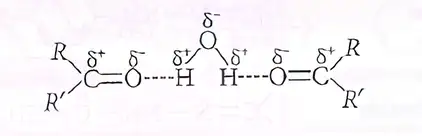
Hydrogen Bonding in Carboxyl Groups
Hydrogen bond forms between –OH hydrogen (δ⁺) of one molecule and carbonyl oxygen (δ⁻) of another.
Hydrogen bonds are weaker than covalent bonds but crucial for molecular structure and stability.
Solved Examples
Ex 1: Compare boiling points of propanal and propanone.
Step 1: Both have similar molecular mass.
Step 2: Propanone (ketone) has two alkyl groups increasing polarity.
Step 3: Propanone has higher boiling point due to stronger dipole interactions.
Practice Set
Q1: Which of the following is a gas at room temperature?
A. Acetaldehyde
B. Formaldehyde
C. Acetone
D. ButanalQ2: Why do aldehydes and ketones have higher boiling points than ethers?
A. Hydrogen bonding
B. Dipole-dipole interactions
C. Ionic bonding
D. Van der Waals forcesQ3: Which factor decreases solubility of aldehydes and ketones in water?
A. Presence of carbonyl group
B. Increase in molecular weight
C. Hydrogen bonding
D. Presence of alkyl groups
Answer Key
Q1: B. Formaldehyde is a gas at room temperature; others are liquids.
Q2: B. Dipole-dipole interactions increase boiling points compared to ethers.
Q3: B. Increasing molecular weight reduces solubility due to decreased hydrogen bonding.
Memory Aids
"Formaldehyde is a gas, others liquid up to C10".
"Ketones boil higher than aldehydes due to two alkyl groups".
"Solubility decreases as chain length increases".
Polarity of Carbonyl Group
Key Points
Carbonyl group (>C=O) is polar due to electronegative oxygen.
Carbonyl carbon is electrophilic (Lewis acid).
Carbonyl oxygen is nucleophilic (Lewis base).
Resonance structures show partial positive charge on carbon and negative on oxygen.
High dipole moment (2.3-2.8 D) due to resonance and polarity.
Aldehydes and ketones undergo nucleophilic addition, unlike alkenes which undergo electrophilic addition.

Solved Examples
Ex 1: Explain why carbonyl carbon is electrophilic.
- Oxygen's electronegativity pulls electron density, making carbon partially positive.
Practice Set
Q1: What is the nature of carbonyl carbon?
A. Nucleophilic B. Electrophilic C. Neutral D. RadicalQ2: Which resonance structure contributes to carbonyl polarity?
A. Double bond only B. Single bond with charges C. Both A and B D. NoneQ3: Carbonyl group polarity leads to which reaction type?
A. Electrophilic addition B. Nucleophilic addition C. Radical substitution D. Elimination
Answer Key
Q1: B - Carbonyl carbon is electrophilic due to oxygen's electronegativity.
Q2: C - Both resonance forms contribute to polarity.
Q3: B - Polarity causes nucleophilic addition reactions.
Memory Aids
Carbonyl carbon = Positive center (Electrophile).
Oxygen = Negative center (Nucleophile).
Resonance stabilizes polarity.
Acidity of α-Hydrogen
Key Points
α-Hydrogens in carbonyl compounds are acidic.
Acidity due to electron-withdrawing carbonyl group.
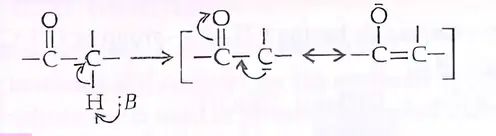
Conjugate base (enolate ion) stabilized by resonance.
Base removes α-H, forming resonance-stabilized enolate.
Solved Examples
Ex 1: Show resonance stabilization of enolate ion.
- Negative charge delocalizes between oxygen and α-carbon.
Practice Set
Q1: Why are α-hydrogens acidic?
A. Inductive effect B. Resonance stabilization C. Both A and B D. NoneQ2: What species forms after α-H removal?
A. Carbocation B. Radical C. Enolate ion D. CarbeneQ3: Which stabilizes the enolate ion?
A. Inductive effect B. Resonance C. Hyperconjugation D. None
Answer Key
Q1: C - Both inductive effect and resonance stabilize the conjugate base.
Q2: C - Enolate ion forms after α-H removal.
Q3: B - Resonance delocalizes negative charge.
Memory Aids
α-H acidic due to resonance-stabilized enolate.
Base removes α-H to form enolate.
Nucleophilic Addition Reactions
Key Points
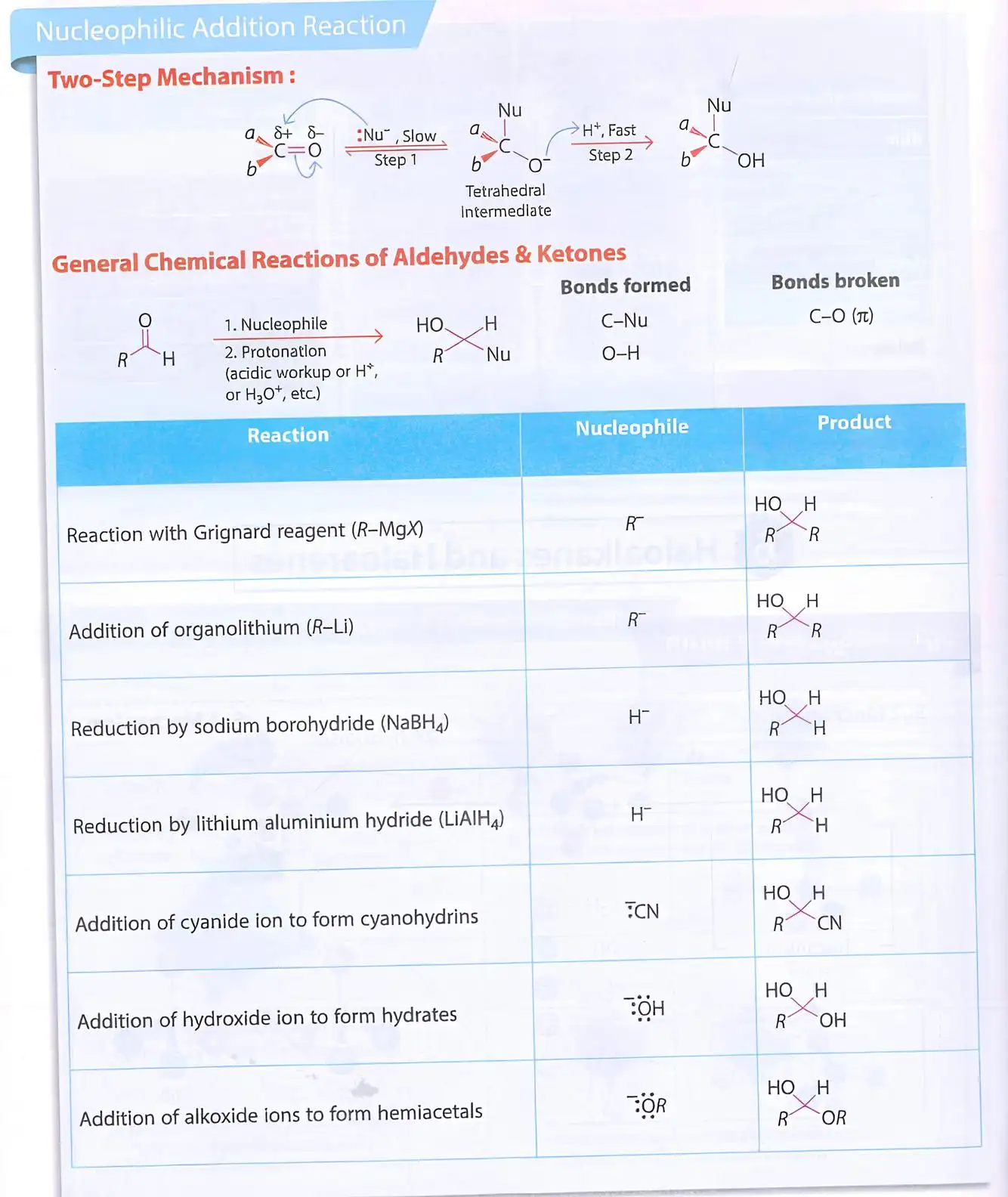
Nucleophile attacks electrophilic carbonyl carbon.
First step: slow nucleophilic attack forming tetrahedral intermediate.
Second step: fast protonation forming alcohol or derivative.
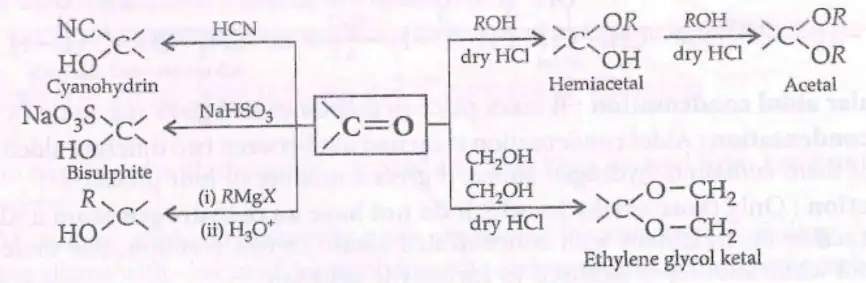
Common nucleophiles: Grignard reagents, hydride ions, cyanide, hydroxide, alkoxides.
Aldehydes more reactive than ketones due to steric and electronic factors.
Reactivity order: HCHO > RCHO > PhCHO > RCOR > RCOPh > PhCOPh.
Reactions form alcohols, cyanohydrins, hydrates, hemiacetals, acetals, ketals.
Solved Examples
Ex 1: Reaction of aldehyde with HCN.
- Nucleophile CN⁻ attacks carbonyl carbon forming cyanohydrin after protonation.Ex 2: Formation of hemiacetal.
- Alcohol attacks carbonyl carbon, followed by protonation.
Practice Set
Q1: Which reagent forms cyanohydrin with aldehydes?
A. HCN B. RMgX C. NaBH4 D. NH3Q2: Why are aldehydes more reactive than ketones?
A. Less steric hindrance B. More electrophilic C. Both A and B D. NoneQ3: Product of aldehyde + RMgX followed by acid workup?
A. Alcohol B. Ketone C. Alkane D. Ester
Answer Key
Q1: A - HCN provides CN⁻ nucleophile forming cyanohydrin.
Q2: C - Aldehydes have less steric hindrance and more electrophilic carbon.
Q3: A - Grignard reagent forms alcohol after protonation.
Memory Aids
Nucleophile attacks carbonyl carbon forming tetrahedral intermediate.
Aldehydes > Ketones in reactivity.
Common nucleophiles: CN⁻, RMgX, H⁻.
Nucleophilic Addition-Elimination Reactions
Key Points
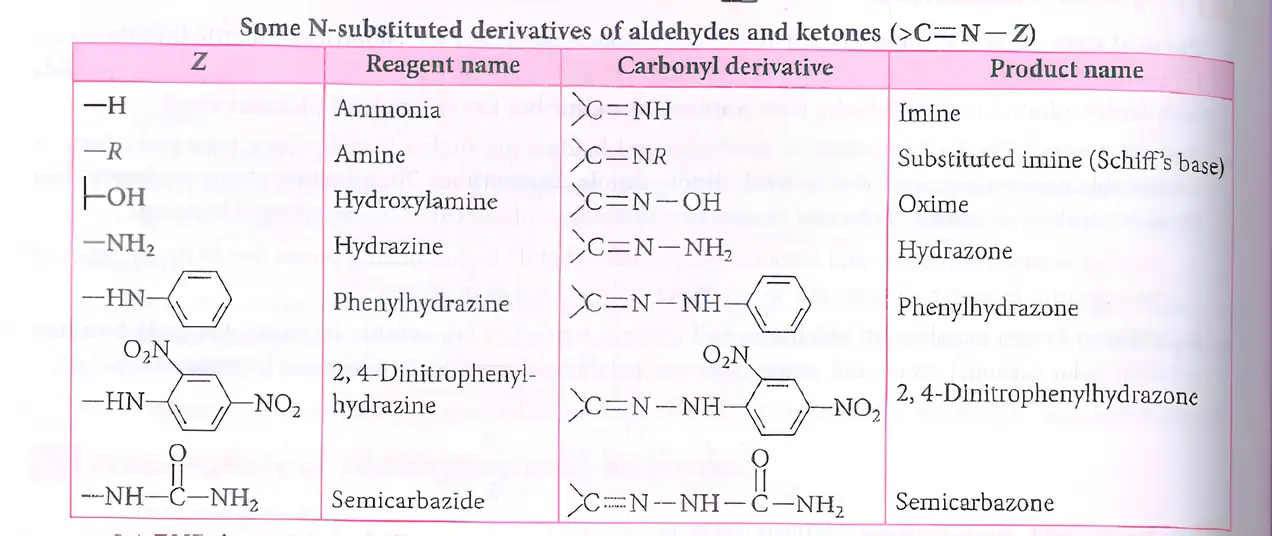
Carbonyl compounds react with nitrogen nucleophiles (NH3, amines) to form imines (Schiff bases).
Reaction involves nucleophilic addition followed by elimination of water.
Different nitrogen reagents form derivatives: imines, oximes, hydrazones, semicarbazones.
Useful for identification and characterization of aldehydes and ketones.

Solved Examples
Ex 1: Formation of imine from aldehyde and NH3.
- Nucleophilic attack by NH3, elimination of water forms C=NH.Ex 2: Formation of oxime with hydroxylamine.
- Similar mechanism forming C=NOH.
Practice Set
Q1: Product of aldehyde + NH3 + heat?
A. Oxime B. Imine C. Hydrazone D. SemicarbazoneQ2: Which reagent forms hydrazone?
A. NH2OH B. NH2NH2 C. NH3 D. RNH2Q3: Purpose of these derivatives?
A. Identification B. Reduction C. Oxidation D. Polymerization
Answer Key
Q1: B - Imine (Schiff base) forms with NH3.
Q2: B - Hydrazine (NH2NH2) forms hydrazone.
Q3: A - Used for identification and characterization.
Memory Aids
NH3 → imines; NH2OH → oximes; NH2NH2 → hydrazones.
Reaction: addition then elimination of water.
Oxidation and Reduction Reactions
Key Points
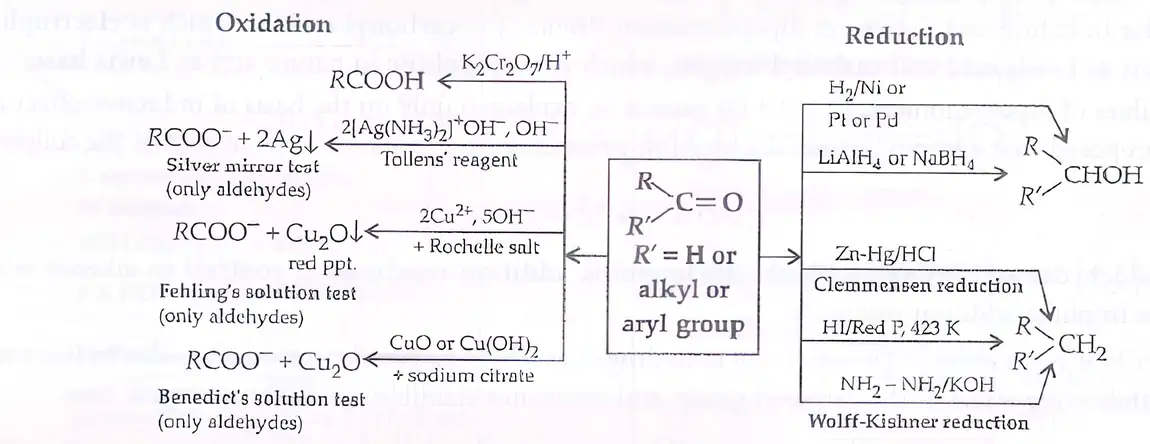
Aldehydes oxidize to carboxylic acids; ketones generally resist oxidation.
Oxidizing agents: K2Cr2O7, Tollens’ reagent, Fehling’s, Benedict’s solutions.
Tollens’ test: silver mirror with aldehydes.
Reduction of aldehydes/ketones to alcohols by H2 (Ni, Pt, Pd) or LiAlH4, NaBH4.
Further reduction of aldehydes to hydrocarbons by Clemmensen or Wolff-Kishner methods.
Solved Examples
Ex 1: Tollens’ test for aldehydes.
- Aldehyde oxidized, silver mirror formed.Ex 2: Reduction of ketone with NaBH4.
- Ketone converted to secondary alcohol.
Practice Set
Q1: Which reagent oxidizes aldehydes to acids?
A. NaBH4 B. K2Cr2O7 C. LiAlH4 D. RMgXQ2: Tollens’ reagent detects?
A. Ketones B. Aldehydes C. Alcohols D. AlkenesQ3: Clemmensen reduction converts aldehydes to?
A. Alcohols B. Hydrocarbons C. Acids D. Esters
Answer Key
Q1: B - K2Cr2O7 oxidizes aldehydes to acids.
Q2: B - Tollens’ reagent detects aldehydes.
Q3: B - Clemmensen reduces aldehydes to hydrocarbons.
Memory Aids
Aldehydes oxidize; ketones resist oxidation.
Tollens’ test = silver mirror for aldehydes.
NaBH4 and LiAlH4 reduce carbonyl to alcohol.
Haloform Reaction
Key Points
Occurs with compounds having CH3CO– or CH3CH(OH)– groups.
Reaction with halogen and base produces haloform (CHI3, CHBr3, CHCl3).
Used as a test for methyl ketones and related compounds.
Produces carboxylate salt and haloform precipitate.


Solved Examples
Ex 1: Iodoform test for acetyl group.
- Methyl ketone reacts with NaOI to give yellow CHI3 precipitate.
Practice Set
Q1: Haloform reaction requires?
A. Aldehyde B. Methyl ketone C. Alcohol D. Carboxylic acidQ2: Product of haloform reaction?
A. Alcohol B. Haloform C. Alkene D. EsterQ3: Iodoform test positive compound?
A. CH3COCH3 B. Benzaldehyde C. Ethanol D. Acetic acid
Answer Key
Q1: B - Methyl ketones give haloform reaction.
Q2: B - Haloform (CHI3, etc.) is formed.
Q3: A - Acetone (CH3COCH3) gives positive iodoform test.
Memory Aids
Haloform test detects methyl ketones.
Positive test: yellow precipitate of CHI3.
Aldol Condensation
Key Points
Aldehydes/ketones with at least one α-H undergo aldol condensation in dilute alkali.
Forms β-hydroxy aldehydes (aldol) or β-hydroxy ketones (ketol).
Upon heating, aldol loses water to form α,β-unsaturated carbonyl compounds.
Intramolecular aldol condensation forms cyclic products from diketones.
Cross aldol condensation between two different carbonyls with α-H gives mixture of products.

Solved Examples
Ex 1: Aldol condensation of acetaldehyde.
- Two molecules form β-hydroxy aldehyde, then dehydrate to crotonaldehyde.
Practice Set
Q1: Aldol condensation requires?
A. No α-H B. At least one α-H C. Acidic medium D. No baseQ2: Product after dehydration is?
A. Alcohol B. α,β-unsaturated carbonyl C. Ketone D. AlkaneQ3: Intramolecular aldol condensation forms?
A. Linear product B. Cyclic product C. Alcohol D. Ester
Answer Key
Q1: B - At least one α-H is needed.
Q2: B - α,β-unsaturated carbonyl compound forms.
Q3: B - Cyclic products form from diketones.
Memory Aids
Aldol = Aldehyde + Alcohol intermediate.
Heating causes dehydration to α,β-unsaturated product.
Intramolecular = cyclic products.
Cannizzaro Reaction
Key Points
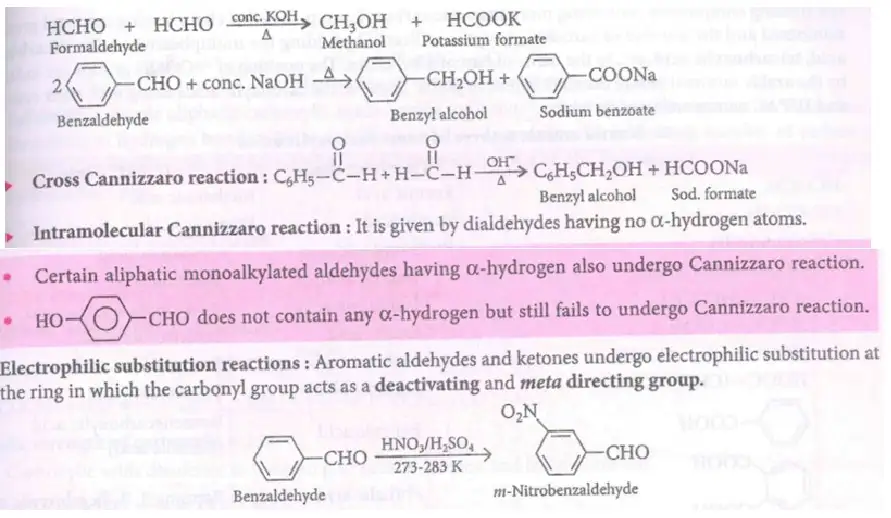
Occurs with aldehydes lacking α-H.
Self-oxidation and reduction in concentrated alkali.
One aldehyde molecule oxidized to carboxylate salt; another reduced to alcohol.
Cross and intramolecular Cannizzaro reactions also occur.
Some aromatic aldehydes undergo electrophilic substitution instead.
Solved Examples
Ex 1: Cannizzaro reaction of benzaldehyde.
- Benzaldehyde forms benzyl alcohol and benzoate salt.
Practice Set
Q1: Cannizzaro reaction requires aldehydes with?
A. α-H B. No α-H C. Ketones D. AlcoholsQ2: Products of Cannizzaro reaction?
A. Alcohol + acid salt B. Alcohol + ketone C. Acid + ketone D. Alcohol + esterQ3: Which aldehyde does NOT undergo Cannizzaro?
A. Benzaldehyde B. Formaldehyde C. Acetaldehyde D. p-Nitrobenzaldehyde
Answer Key
Q1: B - Aldehydes without α-H undergo Cannizzaro.
Q2: A - Alcohol and carboxylate salt form.
Q3: C - Acetaldehyde has α-H, does not undergo Cannizzaro.
Memory Aids
No α-H → Cannizzaro reaction.
One molecule oxidized, one reduced.
Aromatic aldehydes may undergo substitution instead.
Distinction Between Aldehydes and Ketones
Key Points
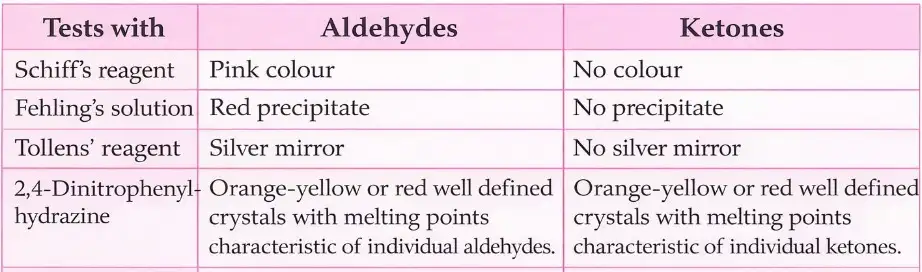
Schiff’s reagent: Aldehydes turn pink; ketones no change.
Fehling’s solution: Aldehydes give red precipitate; ketones do not.
Tollens’ reagent: Aldehydes form silver mirror; ketones do not.
2,4-Dinitrophenylhydrazine: Both form colored crystals; melting points identify compounds.
α-Hydroxy ketones reduce Tollens’, Fehling’s, and Benedict’s solutions.
Haloform reaction oxidizes α,β-unsaturated methyl ketones to acids without affecting double bond.
Solved Examples
Ex 1: Test to distinguish aldehyde and ketone.
- Use Tollens’ reagent; aldehyde gives silver mirror.
Practice Set
Q1: Which reagent gives silver mirror with aldehydes?
A. Fehling’s B. Tollens’ C. 2,4-DNP D. Schiff’sQ2: 2,4-DNP test detects?
A. Only aldehydes B. Only ketones C. Both aldehydes and ketones D. NeitherQ3: Which ketone reduces Tollens’ reagent?
A. Methyl ketone B. α-Hydroxy ketone C. Aromatic ketone D. No ketone
Answer Key
Q1: B - Tollens’ reagent forms silver mirror with aldehydes.
Q2: C - 2,4-DNP reacts with both aldehydes and ketones.
Q3: B - α-Hydroxy ketones reduce Tollens’ reagent.
Memory Aids
Tollens’ and Fehling’s positive for aldehydes.
2,4-DNP positive for both.
α-Hydroxy ketones are exceptions, reduce Tollens’.
Uses of Aldehydes and Ketones
Applications in Industry and Synthesis
Aldehydes and ketones serve as solvents in the chemical industry due to their polarity and ability to dissolve various compounds.
They act as key starting materials and reagents for synthesizing numerous organic compounds.
Formalin (40% formaldehyde solution) is widely used to preserve biological specimens by cross-linking proteins.
Formaldehyde is essential in producing bakelite (phenol-formaldehyde resin), urea-formaldehyde adhesives, and other polymers.
Acetaldehyde (CH3CHO) is a precursor for acetic acid, ethyl acetate, vinyl acetate, polymers, and pharmaceuticals.
Benzaldehyde is utilized in perfumery and dye manufacturing due to its aromatic properties.
Compounds like butyraldehyde, vanillin, acetophenone, and camphor are employed as flavoring agents.
Solved Examples
Ex 1: Identify the product formed when formaldehyde reacts with phenol.
Step 1: Formaldehyde + Phenol → Phenol-formaldehyde resin (Bakelite)Ex 2: Name the compound used as a starting material for vinyl acetate.
Answer: Acetaldehyde (CH3CHO)
Practice Set
Q1: Which aldehyde is used to preserve biological specimens?
A. Acetaldehyde
B. Formaldehyde
C. Benzaldehyde
D. ButyraldehydeQ2: Bakelite is synthesized from phenol and which compound?
A. Acetaldehyde
B. Formaldehyde
C. Benzaldehyde
D. VanillinQ3: Acetaldehyde is NOT used in the manufacture of:
A. Acetic acid
B. Ethyl acetate
C. Nylon
D. Vinyl acetate
Answer Key
Q1: B. Formaldehyde
Used as formalin (40% solution) for preservation.Q2: B. Formaldehyde
Phenol reacts with formaldehyde to form bakelite.Q3: C. Nylon
Acetaldehyde is not involved in nylon synthesis.
Memory Aids
Formalin = Formaldehyde solution for preservation.
Bakelite = Phenol + Formaldehyde polymer.
Acetaldehyde → Acetic acid, esters, vinyl acetate.
Benzaldehyde → Perfumes and dyes.
Flavor agents: Butyraldehyde, vanillin, camphor.
Nomenclature and Structure of Carboxyl Group
Nomenclature
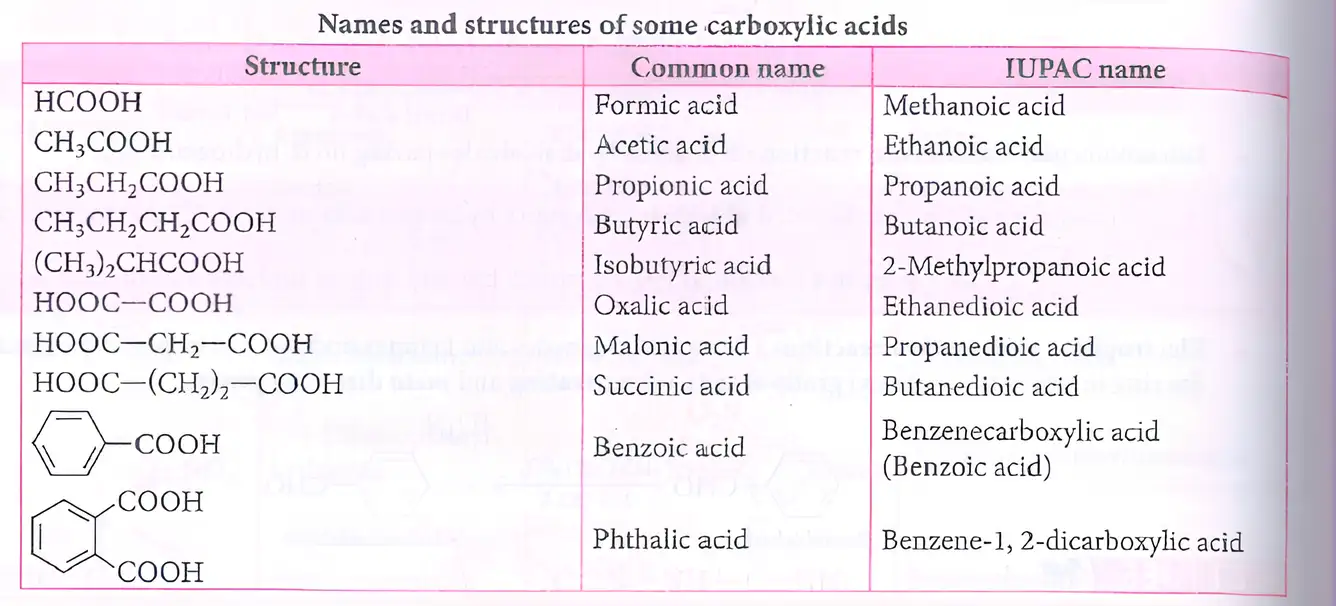
Common names end with suffix -ic acid, derived from Latin/Greek natural sources.
IUPAC names: replace alkane ending -e with -oic acid.
Numbering starts from carboxyl carbon as carbon 1.
For multiple carboxyl groups, use prefixes: dicarboxylic acid, tricarboxylic acid, etc.
Positions of –COOH groups indicated by Arabic numerals before prefix.
Examples include formic acid (HCOOH) = methanoic acid, acetic acid = ethanoic acid.
Structure
Carboxyl carbon bonds lie in one plane, separated by ~120°.
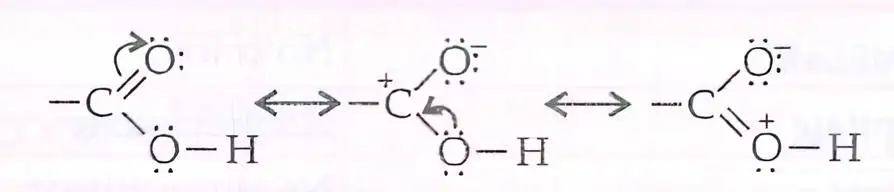
Carboxylic carbon less electrophilic than carbonyl carbon due to resonance.
Resonance stabilizes the –COOH group by delocalizing electrons.
Solved Examples
Ex 1: Name CH3–COOH using IUPAC.
Solution: Alkane is methane; replace -e with -oic acid → methanoic acid.Ex 2: Name HOOC–CH2–COOH.
Solution: Two –COOH groups, prefix dicarboxylic acid, numbering from one end → ethane-1,2-dicarboxylic acid.
Practice Set
Q1: What is the IUPAC name of CH3–CH2–COOH?
A. Propanoic acid
B. Propionic acid
C. Acetic acid
D. Methanoic acidQ2: How many carboxyl groups are present in benzene-1,2,3-tricarboxylic acid?
A. One
B. Two
C. Three
D. FourQ3: Which statement is correct about carboxyl carbon?
A. It is more electrophilic than carbonyl carbon
B. Bonds lie in one plane separated by 90°
C. Resonance decreases its electrophilicity
D. It has no resonance structures
Answer Key
Q1: A. Propanoic acid – IUPAC name replaces alkane ending with -oic acid.
Q2: C. Three – indicated by prefix tri in tricarboxylic acid.
Q3: C. Resonance delocalizes electrons, reducing electrophilicity of carboxyl carbon.
Memory Aids
Common acid names end with -ic acid, IUPAC with -oic acid.
Number carboxyl carbon as 1 always.
Multiple –COOH groups use prefixes: di-, tri-, etc.
Carboxyl carbon resonance lowers electrophilicity.
Methods of Preparation of Carboxylic Acids
Overview of Reactions
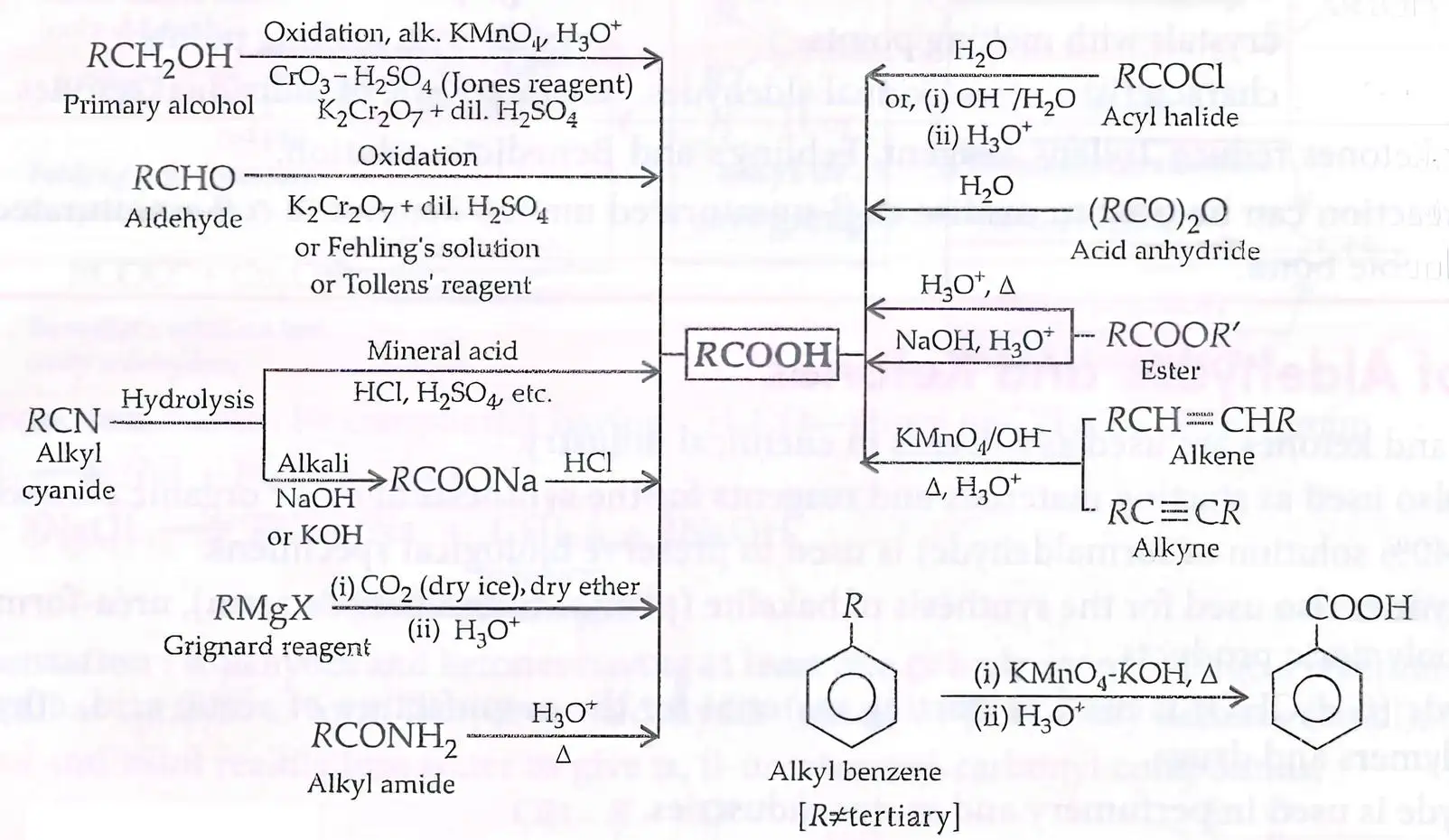
Primary alcohols (RCH2OH) oxidized to carboxylic acids (RCOOH) using strong oxidizers like KMnO4 or K2Cr2O7.
Aldehydes (RCHO) oxidized to carboxylic acids by similar oxidizing agents.
Alkyl cyanides (RCN) hydrolyzed under acidic or basic conditions to yield carboxylic acids.
Grignard reagents react with CO2 followed by acid workup to form carboxylic acids.
Amides hydrolyzed under acidic or basic conditions to carboxylic acids.
Alkenes and alkynes oxidized to carboxylic acids using strong oxidizers.
Acyl halides, acid anhydrides, and esters hydrolyzed to carboxylic acids.
Alkyl benzenes oxidized by KMnO4 to benzoic acid if side chain has benzylic hydrogens.
Solved Examples
Ex 1: Oxidation of ethanol to acetic acid using KMnO4.
CH3CH2OH + [O] → CH3COOH
Ex 2: Hydrolysis of ethyl cyanide to acetic acid.
CH3CN + 2H2O + H+ → CH3COOH + NH4+
Ex 3: Reaction of phenylmagnesium bromide with CO2.
C6H5MgBr + CO2 → C6H5COOMgBr → C6H5COOH (after acid workup)
Practice Set
Q1: Which reagent is used to oxidize primary alcohols to carboxylic acids?
A. LiAlH4
B. KMnO4
C. NaBH4
D. H2SO4
Q2: Hydrolysis of which compound yields a carboxylic acid?
A. Alkyl halide
B. Alkyl cyanide
C. Alkene
D. Ether
Q3: What is the product when benzyl chloride is oxidized with KMnO4?
A. Benzaldehyde
B. Benzoic acid
C. Benzene
D. Phenol
Answer Key
Q1: B. KMnO4 - Strong oxidizer converting primary alcohols to carboxylic acids.
Q2: B. Alkyl cyanide - Hydrolyzed under acidic/basic conditions to carboxylic acids.
Q3: B. Benzoic acid - Side chain oxidation of benzyl chloride yields benzoic acid.
Memory Aids
Primary alcohols and aldehydes → oxidize with KMnO4 or K2Cr2O7 to carboxylic acids.
Alkyl cyanides → hydrolysis → carboxylic acids.
Grignard + CO2 + acid → carboxylic acid.
Alkyl benzene side chains with benzylic H → oxidized to benzoic acid.
Physical Properties
Physical State
Lower fatty acids (up to C9) are colourless liquids.
Higher fatty acids are colourless waxy solids.
Odour
First three members have a sharp pungent odour.
Members from C4 to C9 smell like rancid butter.
Higher members are odourless.
Boiling Points
Carboxylic acids have higher boiling points than aldehydes, ketones, and alcohols of similar molecular mass.
Due to strong intermolecular hydrogen bonding forming dimers.
Hydrogen bonds persist even in the vapour phase.
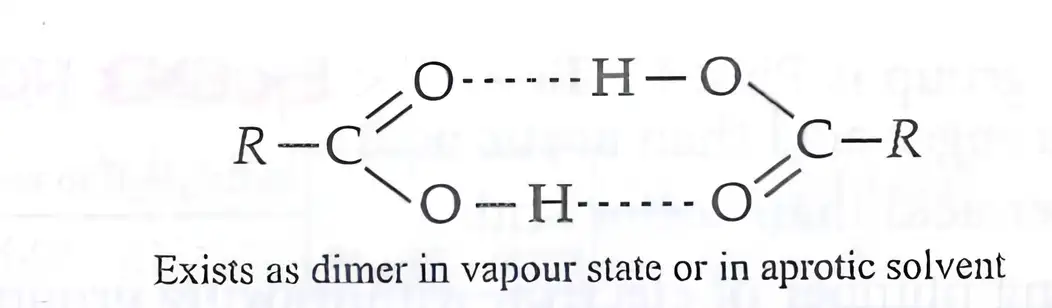
This image shows a dimer formed by two carboxylic acid molecules connected through hydrogen bonds:
Each molecule has a carboxyl group (R-COOH).
Hydrogen bonds form between the -OH hydrogen of one molecule and the C=O oxygen of the other.
This creates a stable ring-like dimer structure.
Common in vapor state or aprotic solvents.
Dotted lines represent hydrogen bonds.
Solubility
Simple aliphatic carboxylic acids (up to 4 carbons) are miscible with water due to hydrogen bonding.
Solubility decreases as carbon chain length increases.
Higher acids are practically insoluble due to hydrophobic hydrocarbon chains.
Solved Examples
Ex 1: Explain why acetic acid has a higher boiling point than ethanol.
Acetic acid forms dimers via hydrogen bonding, increasing intermolecular forces.
Ethanol forms hydrogen bonds but does not dimerize as strongly.
Result: Acetic acid has a higher boiling point.
Ex 2: Predict solubility of hexanoic acid in water.
Hexanoic acid has 6 carbons, longer hydrocarbon chain.
Less soluble due to increased hydrophobic interactions.
Expected to be sparingly soluble or insoluble.
Practice Set
Q1: Which of the following carboxylic acids is a colourless liquid at room temperature?
A. Nonanoic acid (C9H18O2)
B. Decanoic acid (C10H20O2)
C. Butanoic acid (C4H8O2)
D. Stearic acid (C18H36O2)
Q2: Why do carboxylic acids have higher boiling points than alcohols of similar molecular mass?
A. Due to ionic bonding
B. Due to dimer formation via hydrogen bonding
C. Due to van der Waals forces only
D. Due to lower molecular weight
Q3: Which statement about solubility of carboxylic acids is correct?
A. Solubility increases with increasing carbon chain length
B. All carboxylic acids are insoluble in water
C. Carboxylic acids up to 4 carbons are miscible with water
D. Higher carboxylic acids are more soluble than lower ones
Answer Key
Q1: C. Butanoic acid is a colourless liquid; acids up to C9 are liquids.
Q2: B. Carboxylic acids form dimers via hydrogen bonding, increasing boiling points.
Q3: C. Carboxylic acids with up to 4 carbons are miscible due to hydrogen bonding with water.
Memory Aids
"Up to C4, mix with H2O" – carboxylic acids soluble up to 4 carbons.
"Dimer doubles boiling" – dimer formation raises boiling points.
"Short chain liquid, long chain solid" – physical state trend.
Reactions Involving Cleavage of O — H Bond
Reactions with metals and alkalies
Carboxylic acid (R-COOH) reacts with sodium (Na) to form sodium salt (RCOONa) and hydrogen gas (H2).
Sodium salt (RCOONa) reacts with sodium carbonate (Na2CO3) or sodium bicarbonate (NaHCO3) to produce CO2, H2O, and regenerate sodium salt.
Sodium salt reacts with water and sodium hydroxide (NaOH) to revert back to carboxylic acid.
These reactions demonstrate acid-base behavior and salt formation of carboxylic acids.

Acidic strength of carboxylic acids
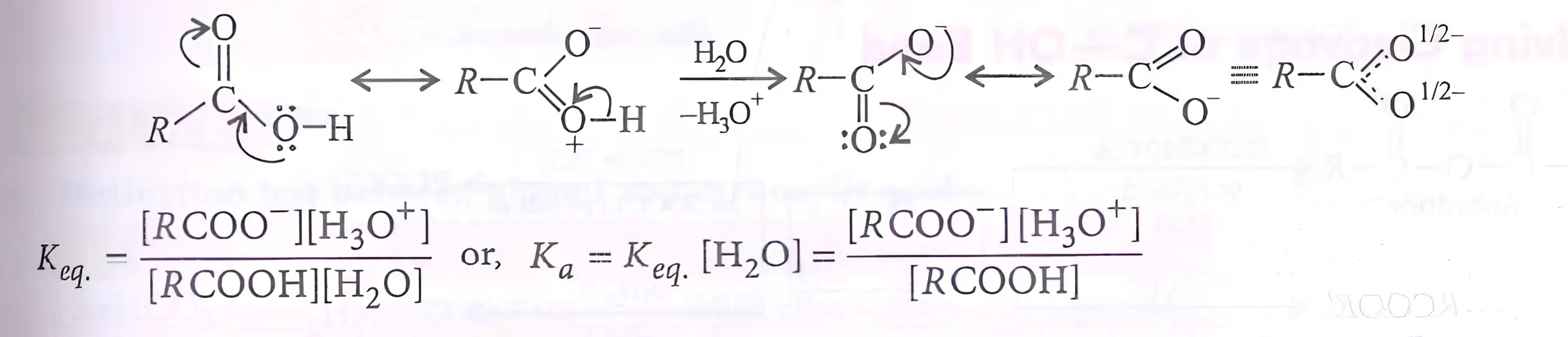
Carboxylic acids dissociate in water: RCOOH + H2O ⇌ RCOO− + H3O+
Acidity arises from proton liberation due to positive charge on oxygen; carboxylate ion is resonance stabilized.
Equilibrium constant (Keq) and acid dissociation constant (Ka) define acid strength; pKa = -log Ka.
Acid strength ∝ 1/pKa.
Carboxylic acids are weaker than mineral acids but stronger than phenols and alcohols.
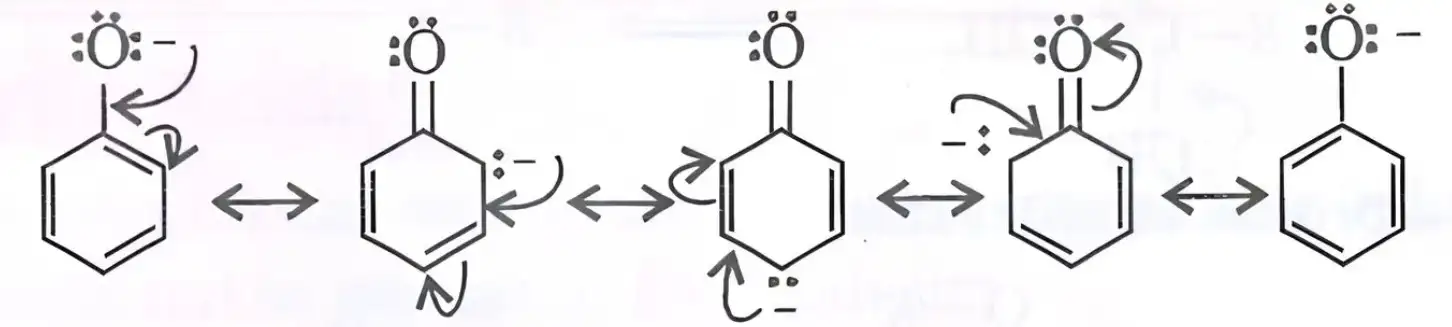
Carboxylate ion has two equivalent resonance structures with negative charge on electronegative oxygen, stabilizing it more than phenoxide ion.

Effect of substituents on acidity
Electron withdrawing groups (EWG) increase acidity by stabilizing conjugate base via inductive/resonance effects.
Acidity order: Ph < I < Br < Cl < F < CN < NO2 < CF3.
Examples: Chloroacetic acid > Acetic acid; Benzoic acid > Acetic acid.
Acidity increases with number and electronegativity of EWGs.
Acidity increases as halogen atom gets closer to carboxyl group.
Electron donating groups (EDG) decrease acidity by destabilizing conjugate base; e.g., formic acid > acetic acid.
In aromatic acids, EWGs on phenyl ring increase acidity; EDGs decrease acidity.
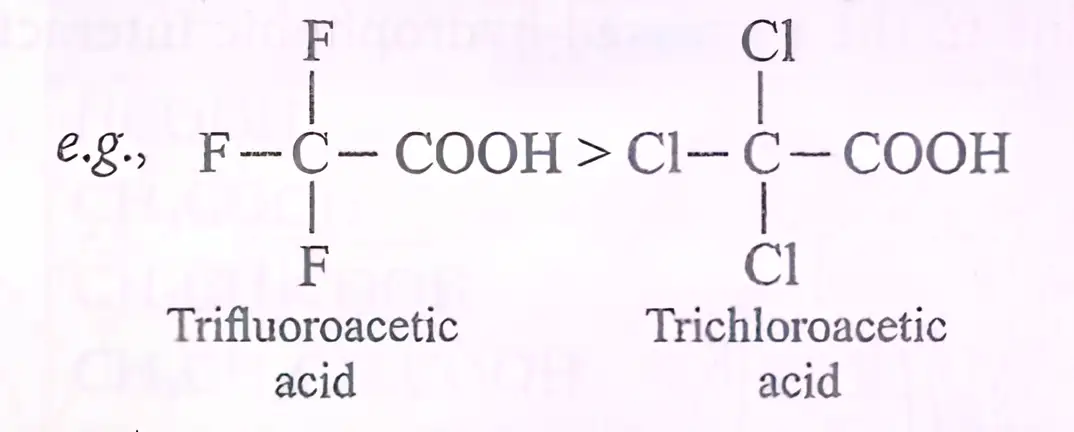

Solved Examples
Ex 1: Compare acidity of trifluoroacetic acid and trichloroacetic acid.
Answer: Trifluoroacetic acid is stronger due to higher electronegativity of F than Cl.Ex 2: Predict product when chloroacetic acid reacts with NaOH.
Answer: Sodium chloroacetate salt forms.
Practice Set
Q1: Which is the strongest acid?
A. Acetic acid
B. Chloroacetic acid
C. Benzoic acid
D. Formic acidQ2: What is the product when R-COOH reacts with NaHCO3?
A. R-COONa + CO2 + H2O
B. R-COOH + NaOH
C. R-COONa + H2
D. R-COONa + H2OQ3: Which substituent increases acidity the most?
A. -NO2
B. -CH3
C. -OH
D. -OCH3
Answer Key
Q1: B. Chloroacetic acid; EWG Cl increases acidity over acetic and benzoic acids.
Q2: A. R-COONa + CO2 + H2O; acid reacts with bicarbonate releasing CO2.
Q3: A. -NO2; strong EWG stabilizes conjugate base, increasing acidity.
Memory Aids
EWG increase acidity; EDG decrease acidity.
Closer and more electronegative substituents increase acid strength.
Carboxylate ion resonance stabilizes conjugate base, enhancing acidity.
Reactions Involving Cleavage of C—OH Bond
Derivatives formation from carboxylic acids
Carboxylic acid (R-COOH) reacts to form:
Acid anhydrides by heating with acid catalyst (removal of water).
Esters by reaction with alcohol (R'OH) under acid catalyst and heat (removal of water).
Acid chlorides by reaction with PCl3 or SOCl2 in pyridine.
Amides by reaction with NH3 and heat (removal of water).

Mechanism of esterification
Nucleophilic acyl substitution.
(a) Protonation of carbonyl oxygen increases electrophilicity.
(b) Nucleophilic attack by alcohol forms tetrahedral intermediate.
(c) Elimination of water forms protonated ester.
(d) Deprotonation yields ester.

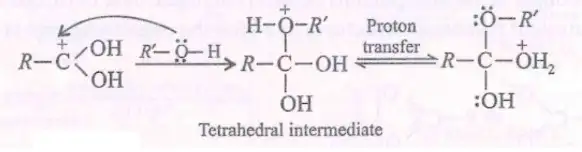
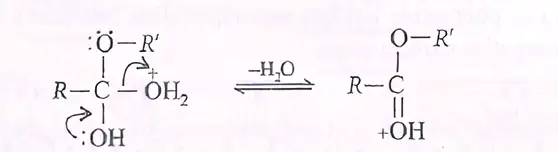
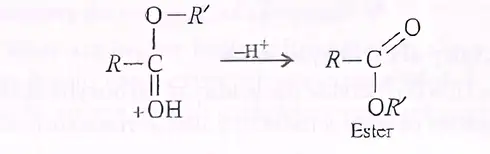
Solved Examples
Ex 1: Write the product of esterification of acetic acid with methanol.
Answer: Methyl acetate (CH3COOCH3) + H2O.Ex 2: Identify reagent to convert acetic acid to acetyl chloride.
Answer: SOCl2 in pyridine.
Practice Set
Q1: Which reagent converts R-COOH to R-COCl?
A. PCl3
B. NaOH
C. NH3
D. H2SO4Q2: Esterification requires:
A. Base catalyst
B. Acid catalyst and heat
C. No catalyst
D. Reducing agentQ3: In esterification, the leaving group is:
A. OH−
B. H2O
C. H+
D. R'
Answer Key
Q1: A. PCl3; converts acid to acid chloride.
Q2: B. Acid catalyst and heat; required for ester formation.
Q3: B. H2O; water is eliminated during esterification.
Memory Aids
Esterification: acid + alcohol + acid catalyst + heat → ester + water.
Acid chlorides formed using PCl3, SOCl2.
Amides formed by reaction with ammonia and heat.
Reactions Involving COOH Group
Reduction, decarboxylation, and electrolysis
Reduction of R-COOH to R-CH2OH using LiAlH4 or B2H6 followed by acid workup.
Decarboxylation: Heating R-COOH with NaOH and CaO produces alkane (RH) and Na2CO3.
Kolbe electrolysis: Electrolysis of RCOONa with NaOH produces coupled hydrocarbon (R-R), CO2, and NaOH.
LiAlH4 is stronger reducing agent than NaBH4, reducing more functional groups.
In α,β-unsaturated aldehydes/ketones, LiAlH4 reduces only C=O; NaBH4 reduces both C=O and C=C but C=O reduction predominates.

Substitution reactions in hydrocarbon part
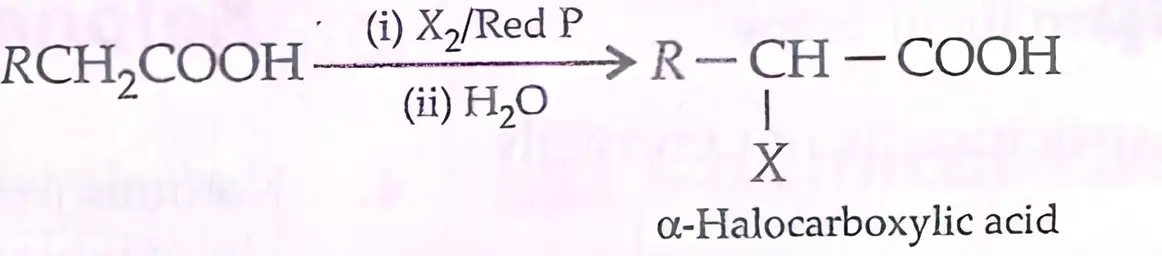
Hell-Volhard-Zelinsky reaction: RCH2COOH + X2/Red P → α-halocarboxylic acid.
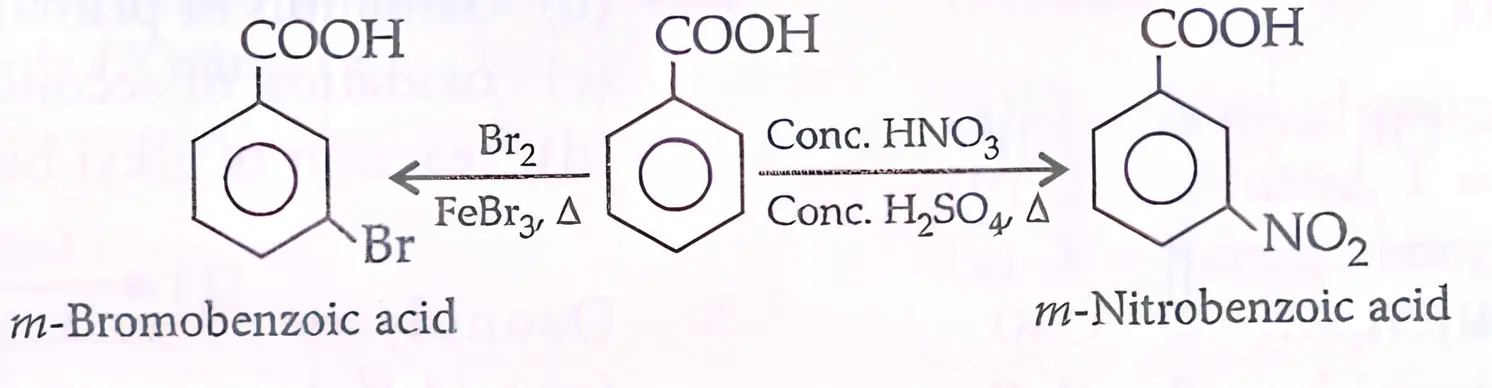
Aromatic carboxylic acids undergo electrophilic substitution; COOH is deactivating and meta-directing.
Distinction test between phenol and carboxylic acid
NaHCO3 test: Phenol no reaction; carboxylic acid gives effervescence (CO2).
FeCl3 test: Phenol gives violet color; carboxylic acid gives buff precipitate.

Abnormal behaviour of formic acid
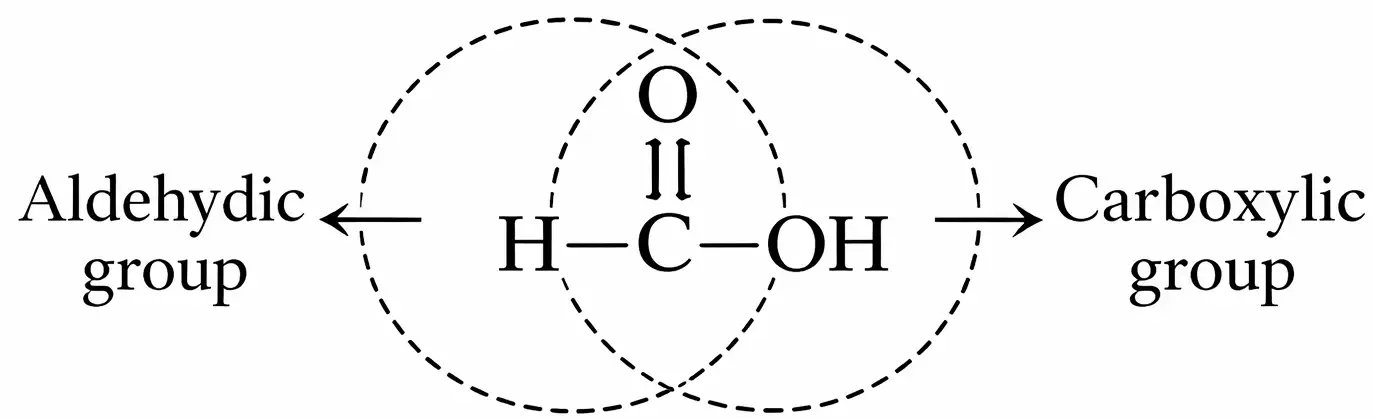
Due to aldehydic group presence.
Oxidizes Tollens’ reagent and Fehling solution like aldehydes.
Reactions:
HCOOH + Ag2O → CO2 + H2O + 2Ag (silver mirror)
HCOOH + Cu2+ + OH− → CO2 + H2O + Cu2O (red ppt.)
With mercuric chloride:
2HCOOH + 2HgCl2 → CO2 + Hg2Cl2 (white ppt.) + 2HCl
HCOOH + Hg2Cl2 → CO2 + 2Hg (grey ppt.) + 2HCl
Solved Examples
Ex 1: Write the product of Kolbe electrolysis of sodium acetate.
Answer: Ethane (C2H6), CO2, and NaOH.Ex 2: How to distinguish phenol and carboxylic acid using NaHCO3?
Answer: Carboxylic acid effervesces; phenol shows no reaction.
Practice Set
Q1: Which reagent reduces carboxylic acid to alcohol?
A. NaBH4
B. LiAlH4
C. H2SO4
D. NaOHQ2: Hell-Volhard-Zelinsky reaction introduces halogen at:
A. Carboxyl carbon
B. α-Carbon
C. β-Carbon
D. Aromatic ringQ3: Formic acid reduces Tollens’ reagent to:
A. Silver mirror
B. Red ppt.
C. White ppt.
D. No reaction
Answer Key
Q1: B. LiAlH4; strong reducing agent for carboxylic acids.
Q2: B. α-Carbon; halogen introduced next to COOH group.
Q3: A. Silver mirror; formic acid reduces Tollens’ reagent.
Memory Aids
LiAlH4 reduces carboxylic acids; NaBH4 does not.
Hell-Volhard-Zelinsky: α-halogenation of carboxylic acids.
Formic acid behaves like aldehyde in oxidation tests.
Uses of Carboxylic Acids
Industrial and Food Applications
Methanoic acid: Used in rubber, textile, dyeing, leather, and electroplating industries.
Ethanoic acid: Acts as a solvent and is the main component of vinegar in the food industry.
Hexanedioic acid: Used in manufacturing nylon-6,6 polymer.
Esters of benzoic acid: Employed in perfumery for fragrance production.
Sodium benzoate: Serves as a food preservative to inhibit microbial growth.
Higher fatty acids: Utilized in making soaps and detergents.
Solved Examples
Ex 1: Identify the carboxylic acid used in nylon-6,6 production.
Solution: Hexanedioic acid (adipic acid) is used in nylon-6,6 synthesis.Ex 2: Name the carboxylic acid component of vinegar.
Solution: Ethanoic acid (acetic acid) is the main acid in vinegar.
Practice Set
Q1: Which carboxylic acid is commonly used in the leather industry?
A. Ethanoic acid
B. Methanoic acid
C. Hexanedioic acid
D. Benzoic acidQ2: Sodium benzoate is primarily used as:
A. Solvent
B. Food preservative
C. Polymer precursor
D. DetergentQ3: Which acid is a key raw material for nylon-6,6 synthesis?
A. Methanoic acid
B. Ethanoic acid
C. Hexanedioic acid
D. Benzoic acid
Answer Key
Q1: B. Methanoic acid - Used in leather and related industries for its chemical properties.
Q2: B. Food preservative - Sodium benzoate inhibits microbial growth in foods.
Q3: C. Hexanedioic acid - Also known as adipic acid, essential for nylon-6,6 manufacture.
Memory Aids
Methanoic acid = "Meth" for "Manufacturing" industries (rubber, leather).
Ethanoic acid = "Eat" for food (vinegar solvent).
Hexanedioic acid = "Hexa" = 6 carbons, nylon-6,6 precursor.
Sodium benzoate = "Preserves" food by preventing spoilage.
Higher fatty acids = Soap and detergent production.
NEET Chemistry — ALL CHAPTERS
1
Some Basic Concepts of Chemistry
2
Structure of Atom
3
Classification of Elements and Periodicity in Properties
4
Chemical Bonding and Molecular Structure
5
Thermodynamics
6
Equilibrium
7
Redox Reactions
8
Organic Chemistry - Some Basic Principles and Techniques
9
Hydrocarbons
10
Solutions
11
Electrochemistry
12
Chemical Kinetics
13
The d- and f- Block Elements
14
Coordination Compounds
15
Haloalkanes and Haloarenes
16
Alcohols, Phenols and Ethers
17
Aldehydes, Ketones and Carboxylic Acids
18
Amines
19
Biomolecules
20
The p-Block Elements (Group 13 and 14)
21
The p-Block Elements (Group 15 to 18)
22
Principles Related to Practical Chemistry