NEET Ug . NEET Chemistry . Chemistry . Principles Related to Practical Chemistry
Chapter 22: Principles Related to Practical Chemistry
Ch 22
NEET Chemistry
NEET Ug
Lassaigne's Test
Preparation of Lassaigne's Extract
Heat a small piece of sodium in an ignition tube until it melts.
Add 50-60 mg of organic compound; heat strongly for 2-3 minutes to fuse.
Cool and break tube into distilled water; crush and boil the mixture.
Formed sodium salts (NaCN, Na2S, NaX, NaSCN) dissolve; excess sodium forms NaOH.
This alkaline solution is Lassaigne's extract.
Lithium and potassium are not used due to slow reaction and vigorous reaction respectively.
Detection of Nitrogen
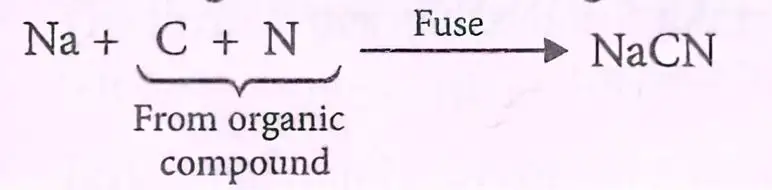
Nitrogen and carbon form sodium cyanide (NaCN) in extract.
NaCN reacts with FeSO4 to form sodium ferrocyanide, which with Fe3+ forms Prussian blue (ferric ferrocyanide).
FeSO4 + 2NaOH → Fe(OH)2 + Na2SO4
Fe(OH)2 + 6NaCN → Na4[Fe(CN)6] + 2NaOH
4Fe3+ + 3Na4[Fe(CN)6] → Fe4[Fe(CN)6]3 (Prussian blue)
Test fails if nitrogen present without carbon (e.g., hydrazine).
If nitrogen and sulphur both present, blood red colour due to ferric thiocyanate forms.
Na + C + N + S → NaCNS; 3NaCNS + Fe3+ → Fe(CNS)3 (blood red colour)
Excess sodium decomposes sodium thiocyanate, no red colour appears.
Detection of Sulphur
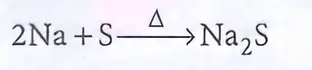
Sulphur converts to sodium sulphide (Na2S) in extract.
Na + S → Na2S (on heating)
Na2S reacts with sodium nitroprusside to give violet colour.
Na2S + Na2[Fe(CN)5(NO)] → Na4[Fe(CN)5NOS] (violet)
Na2S + Pb(CH3COO)2 → PbS (black precipitate) + 2CH3COONa
Detection of Halogens
Beilstein test: Burning organic compound on copper wire gives coloured flame if halogens present (except fluorine).
In Lassaigne's extract, halogens form sodium halides.
Boil extract with dilute HNO3 to remove interference.
React with AgNO3 to get precipitates:
AgCl: white, soluble in NH4OH (chlorine)
AgBr: pale yellow, sparingly soluble (bromine)
AgI: yellow, insoluble (iodine)
Chlorine water test: Boil extract with dilute H2SO4, add CS2 and chlorine water.
Orange colour in CS2 layer: bromine
Violet colour in CS2 layer: iodine

Solved Examples
Ex 1: Identify nitrogen in an organic compound using Lassaigne's test.
Fuse compound with sodium to form NaCN.
Boil extract with FeSO4; observe Prussian blue colour.
Ex 2: Detect halogen in compound.
Prepare Lassaigne's extract.
Boil with dilute HNO3, add AgNO3.
Observe precipitate colour and solubility in NH4OH.
Practice Set
Q1: Which metal is used in Lassaigne's test?
A. Lithium
B. Sodium
C. Potassium
D. Calcium
Q2: What colour indicates nitrogen presence in Lassaigne's test?
A. Blood red
B. Prussian blue
C. Violet
D. Black
Q3: Which precipitate is formed for bromine detection in Lassaigne's test?
A. White AgCl
B. Pale yellow AgBr
C. Yellow AgI
D. Black PbS
Answer Key
Q1: B. Sodium - Reacts efficiently to form sodium salts.
Q2: B. Prussian blue - Ferric ferrocyanide indicates nitrogen.
Q3: B. Pale yellow AgBr - Characteristic for bromine.
Memory Aids
Na used in Lassaigne's test; Li slow, K too reactive.
Prussian blue = nitrogen; blood red = N + S.
AgCl white soluble, AgBr pale yellow sparingly soluble, AgI yellow insoluble.
Alcohols
Detection Tests
Sodium metal test: Alcohol + Na → Sodium alkoxide + H2 (effervescence)

Ester test: Alcohol + Carboxylic acid + conc. H2SO4 → Ester (fruity smell)

Ceric ammonium nitrate test: Alcohol + ceric ammonium nitrate → Pink/red colour

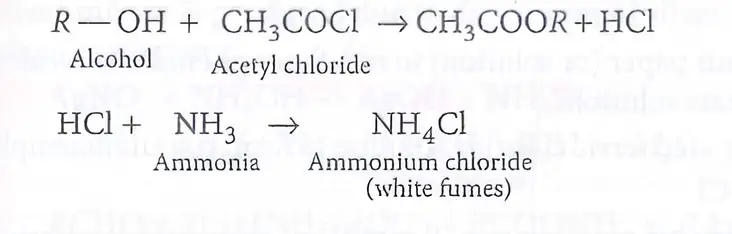
Acetyl chloride test: Alcohol + acetyl chloride → Ester + HCl (white fumes with NH3)
Distinction of Alcohols
Lucas test: Alcohol + Lucas reagent (HCl + ZnCl2) → Alkyl halide (cloudiness)
Tertiary: immediate cloudiness
Secondary: cloudiness in 5-10 min
Primary: no cloudiness at room temp

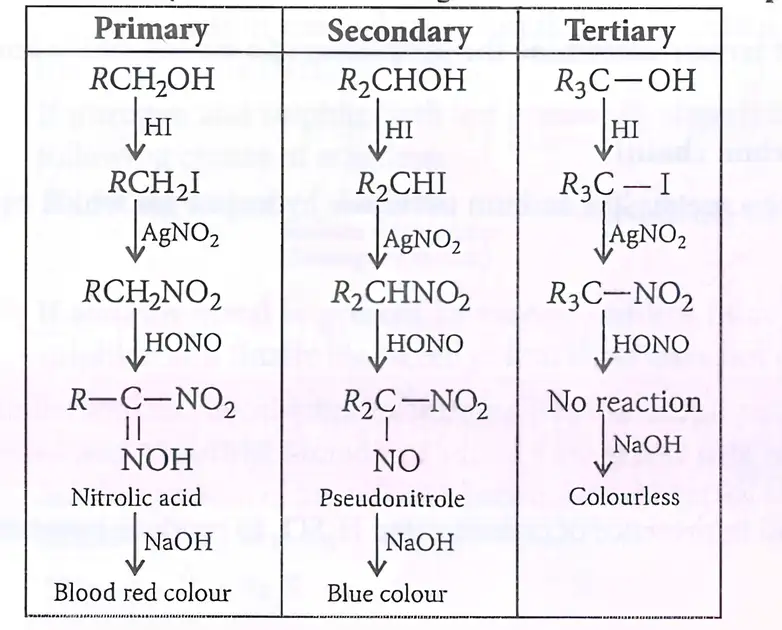
Victor Meyer test: Series of reactions producing colour:
Primary: blood red
Secondary: blue
Tertiary: colourless
Catalytic dehydrogenation:
Primary → Aldehydes
Secondary → Ketones
Tertiary → Olefins (dehydration)



Solved Examples
Ex 1: Identify type of alcohol using Lucas test.
Mix alcohol with Lucas reagent at room temp.
Observe time for cloudiness.
Immediate: tertiary; 5-10 min: secondary; no cloudiness: primary.
Ex 2: Confirm alcohol presence by ceric ammonium nitrate test.
Add ceric ammonium nitrate solution to sample.
Pink/red colour confirms alcohol.
Practice Set
Q1: Which alcohol gives immediate cloudiness with Lucas reagent?
A. Primary
B. Secondary
C. Tertiary
D. None
Q2: Product of catalytic dehydrogenation of secondary alcohol is?
A. Aldehyde
B. Ketone
C. Alkene
D. Ester
Q3: Reaction of alcohol with acetyl chloride produces?
A. Alcohol + HCl
B. Ester + HCl
C. Ether + H2O
D. Ketone + H2O
Answer Key
Q1: C. Tertiary - fastest reaction forming alkyl halide.
Q2: B. Ketone - secondary alcohols oxidize to ketones.
Q3: B. Ester + HCl - acetyl chloride reacts with alcohol forming ester.
Memory Aids
Lucas test: Tertiary > Secondary > Primary (rate of carbocation formation).
Dehydrogenation: Primary → Aldehyde, Secondary → Ketone, Tertiary → Alkene.
Acetyl chloride test: White fumes with NH3 confirm ester formation.
Phenols
Detection Tests
Litmus test: Phenols turn blue litmus red; no effervescence with Na2CO3.
Ferric chloride test: Phenol + FeCl3 → coloured complex (varies with phenol type).
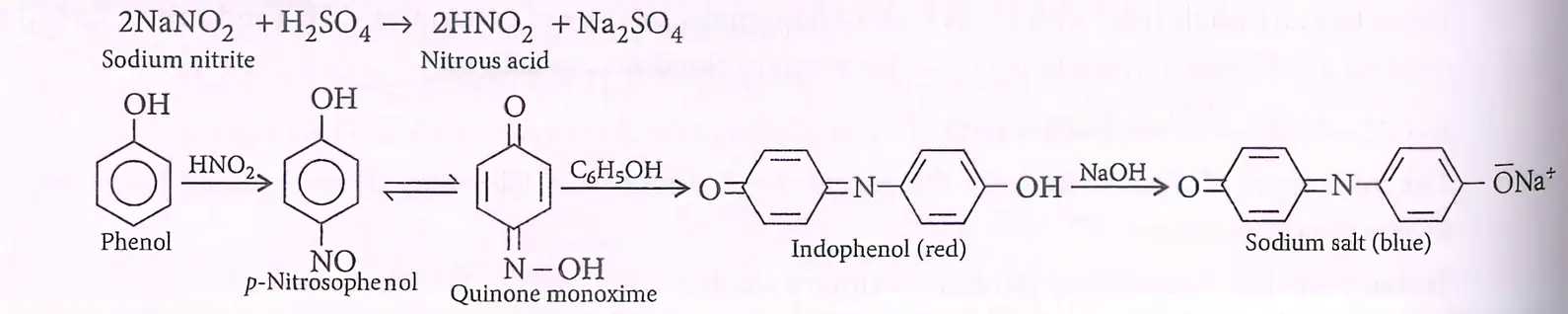
Liebermann’s nitroso test: Phenol + NaNO2 + conc. H2SO4 → blue colour, changes to red on dilution, blue restored in alkaline medium.
Solved Examples
Ex 1: Confirm phenol by ferric chloride test.
Add FeCl3 solution to phenol; observe colour change.
Ex 2: Perform Liebermann’s nitroso test.
React phenol with sodium nitrite and conc. H2SO4; observe blue colour.
Practice Set
Q1: Phenols react with ferric chloride to give?
A. Colourless solution
B. Coloured complex
C. Precipitate
D. No reaction
Q2: Phenols turn blue litmus paper?
A. Blue
B. Red
C. No change
D. Green
Q3: Liebermann’s nitroso test colour changes from blue to?
A. Green
B. Red
C. Yellow
D. Violet
Answer Key
Q1: B. Coloured complex - characteristic of phenols.
Q2: B. Red - phenols are acidic.
Q3: B. Red - blue changes to red on dilution.
Memory Aids
Phenols: acidic, blue to red litmus.
Ferric chloride test: coloured complexes.
Liebermann’s test: blue → red → blue (alkaline).
Carbonyl Compounds
Detection Tests
2,4-Dinitrophenyl hydrazine (DNP) test: Carbonyl + DNP → yellow-orange precipitate (hydrazone).


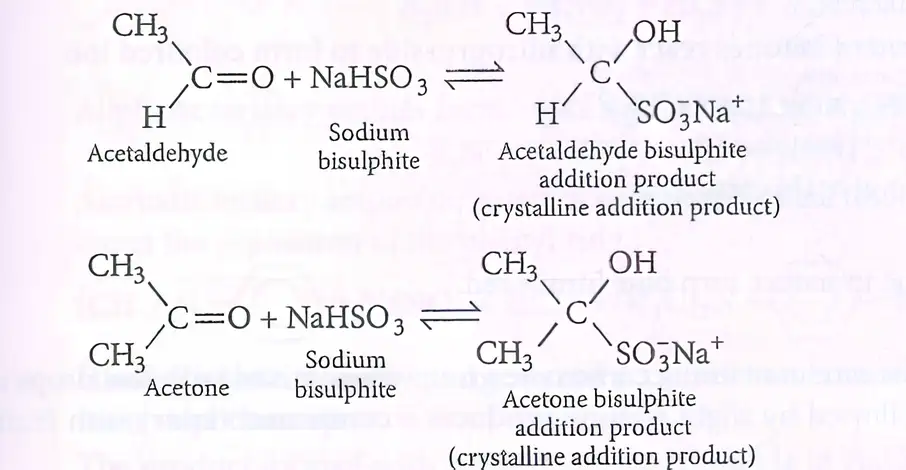
Sodium bisulphite test: Aldehydes and methyl ketones + NaHSO3 → crystalline addition product.
Tollens’ test: Aldehydes + Tollens’ reagent → silver mirror (Ag deposition).

Fehling’s test: Aldehydes + Fehling’s solution → red Cu2O precipitate.

Benedict’s test: Similar to Fehling’s; aldehydes give red precipitate.
Schiff’s test: Aldehydes + Schiff’s reagent → pink/magenta colour.
Distinction Between Aldehydes and Ketones
Aldehydes give Tollens’, Fehling’s, Benedict’s, Schiff’s tests; ketones do not.
Ketones give m-dinitrobenzene test (violet colour) and sodium nitroprusside test (red complex).

Solved Examples
Ex 1: Identify aldehyde using Tollens’ test.
Warm compound with Tollens’ reagent; silver mirror confirms aldehyde.
Ex 2: Distinguish ketone by m-dinitrobenzene test.
Mix compound with m-dinitrobenzene and alkali; violet colour confirms ketone.
Practice Set
Q1: Which test gives silver mirror for aldehydes?
A. Fehling’s
B. Tollens’
C. Schiff’s
D. DNP
Q2: Ketones give positive test with?
A. Tollens’ reagent
B. m-Dinitrobenzene
C. Fehling’s solution
D. Schiff’s reagent
Q3: Sodium bisulphite test forms?
A. Red precipitate
B. Crystalline addition product
C. Silver mirror
D. No reaction
Answer Key
Q1: B. Tollens’ - specific for aldehydes.
Q2: B. m-Dinitrobenzene - ketone test.
Q3: B. Crystalline addition product - aldehydes and methyl ketones.
Memory Aids
Aldehydes: Tollens’, Fehling’s, Schiff’s positive.
Ketones: m-Dinitrobenzene, sodium nitroprusside positive.
DNP test: yellow-orange precipitate for carbonyls.
Carboxylic Acids
Detection Tests
Litmus test: Turn blue litmus red (acidic).
Ester test: Carboxylic acid + ethyl alcohol + conc. H2SO4 → ester (fruity smell).

Sodium bicarbonate test: Carboxylic acid + NaHCO3 → brisk effervescence (CO2 gas).

Solved Examples
Ex 1: Confirm carboxylic acid by sodium bicarbonate test.
Add NaHCO3 to compound; observe effervescence.
Ex 2: Perform ester test.
Mix compound with ethyl alcohol and conc. H2SO4; heat and detect fruity smell.
Practice Set
Q1: Carboxylic acids turn blue litmus?
A. Blue
B. Red
C. No change
D. Green
Q2: Effervescence in sodium bicarbonate test is due to?
A. O2
B. CO2
C. H2
D. N2
Q3: Fruity smell in ester test confirms presence of?
A. Alcohol
B. Carboxyl
C. Ester
D. Ketone
Answer Key
Q1: B. Red - acidic nature.
Q2: B. CO2 - from reaction with bicarbonate.
Q3: B. Carboxyl - ester formed from carboxylic acid.
Memory Aids
Carboxylic acids: acidic, effervescence with NaHCO3.
Ester test: fruity smell confirms carboxyl group.
Amines
Detection Tests
Litmus test: Amines turn red litmus blue (basic).
Solubility test: Amines dissolve in mineral acids forming salts.
Carbylamine test: Primary amines + chloroform + alcoholic KOH → isocyanide (offensive smell).

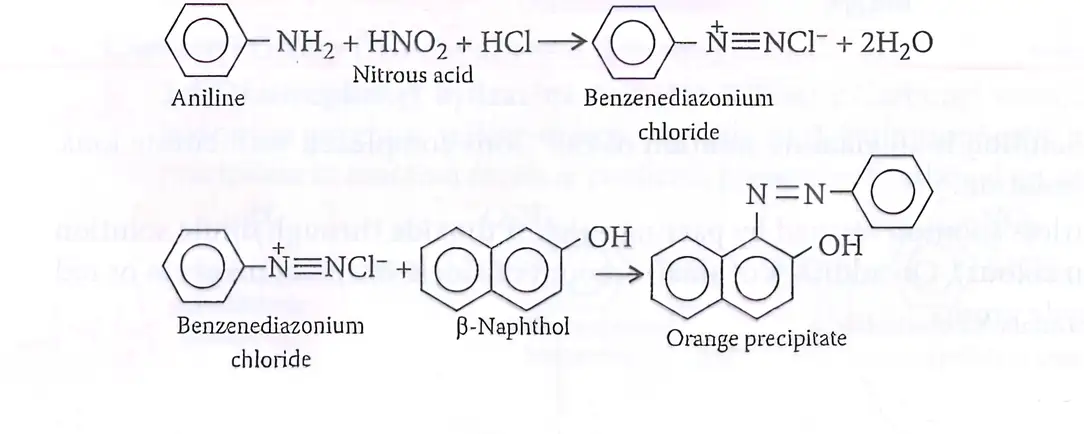
Azo-dye test: Primary aromatic amines + nitrous acid + phenol → coloured azo dye.
Nitrous acid test:
Primary amines liberate N2 gas (bubbles).
Secondary amines form yellow oily N-nitrosoamines.
Tertiary amines form water-soluble salts.


Hinsberg test: Primary and secondary amines react with benzene sulphonyl chloride forming sulphonamides; primary soluble in NaOH, secondary insoluble; tertiary do not react.


Solved Examples
Ex 1: Identify primary amine by carbylamine test.
Mix amine with chloroform and alcoholic KOH; warm and detect foul smell.
Ex 2: Differentiate amines by Hinsberg test.
React amine with benzene sulphonyl chloride; test solubility of product in NaOH.
Practice Set
Q1: Carbylamine test is positive for?
A. Primary amines
B. Secondary amines
C. Tertiary amines
D. All amines
Q2: In Hinsberg test, product soluble in NaOH indicates?
A. Primary amine
B. Secondary amine
C. Tertiary amine
D. None
Q3: Primary amines react with nitrous acid to liberate?
A. O2
B. N2
C. H2
D. CO2
Answer Key
Q1: A. Primary amines - form isocyanides.
Q2: A. Primary amine - sulphonamide soluble in NaOH.
Q3: B. N2 - nitrogen gas bubbles.
Memory Aids
Carbylamine test: only primary amines give foul smell.
Hinsberg test: solubility in NaOH distinguishes primary and secondary.
Nitrous acid: primary amines liberate N2 gas.
Acetanilide

Theory and Preparation

Prepared by acetylation of aniline with acetic anhydride in presence of glacial acetic acid.
Aniline + Acetic anhydride → Acetanilide + Acetic acid
Reaction carried out by boiling mixture with reflux, then cooling to get crude acetanilide.
Pure acetanilide obtained by recrystallisation.
Zinc added to prevent oxidation and impurities.
Cooling before pouring into ice water prevents hydrolysis.
Chemistry and Reactions

Acetylation can be done with acetyl chloride using pyridine as catalyst.
Acetanilide protects amino group in reactions.
Nitration of acetanilide with nitrating mixture at <25°C gives mainly p-nitroacetanilide.
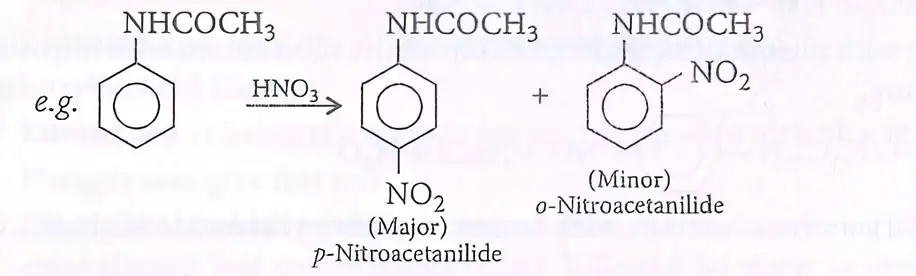

Direct nitration of aniline is avoided due to oxidation.
Solved Examples
Ex 1: Prepare acetanilide from aniline.
Mix aniline, acetic anhydride, glacial acetic acid; reflux and cool.
Filter crude product; recrystallise for pure acetanilide.
Ex 2: Nitrate acetanilide.
Mix acetanilide with nitrating mixture below 25°C.
Isolate p-nitroacetanilide by recrystallisation.
Practice Set
Q1: Acetanilide is prepared by acetylation of?
A. Phenol
B. Aniline
C. Benzene
D. Nitrobenzene
Q2: Catalyst used in acetyl chloride acetylation is?
A. Glacial acetic acid
B. Pyridine
C. Zinc
D. Sulfuric acid
Q3: Major product of nitration of acetanilide is?
A. o-Nitroacetanilide
B. p-Nitroacetanilide
C. m-Nitroacetanilide
D. Nitroaniline
Answer Key
Q1: B. Aniline - starting amine for acetanilide.
Q2: B. Pyridine - catalyst with acetyl chloride.
Q3: B. p-Nitroacetanilide - major nitration product.
Memory Aids
Acetanilide = aniline + acetyl group.
Pyridine catalyses acetyl chloride reaction.
Nitration: para product major due to sterics.
Aniline Yellow
Theory and Preparation
Basic azo dye with azo group (-N=N-).
Prepared by coupling aniline with benzenediazonium chloride in acidic medium.
Yellow solid formed; sensitive to acids, not used as dye.


Solved Examples
Ex 1: Prepare aniline yellow.
Mix aniline with cold benzenediazonium chloride solution; shake vigorously.
Yellow precipitate of aniline yellow forms.
Practice Set
Q1: Aniline yellow contains which characteristic group?
A. Nitro
B. Azo (-N=N-)
C. Amino
D. Carbonyl
Q2: Aniline yellow is prepared by coupling of?
A. Aniline and nitrobenzene
B. Aniline and benzenediazonium chloride
C. Benzene and diazonium salt
D. Aniline and benzene
Q3: Aniline yellow is sensitive to?
A. Bases
B. Acids
C. Heat
D. Light
Answer Key
Q1: B. Azo (-N=N-) - characteristic azo dye group.
Q2: B. Aniline and benzenediazonium chloride - coupling reaction.
Q3: B. Acids - dye is acid sensitive.
Memory Aids
Azo dyes contain -N=N- group.
Aniline yellow formed by diazonium coupling.
Acid sensitive; limits dye use.
Iodoform Test
Theory and Preparation
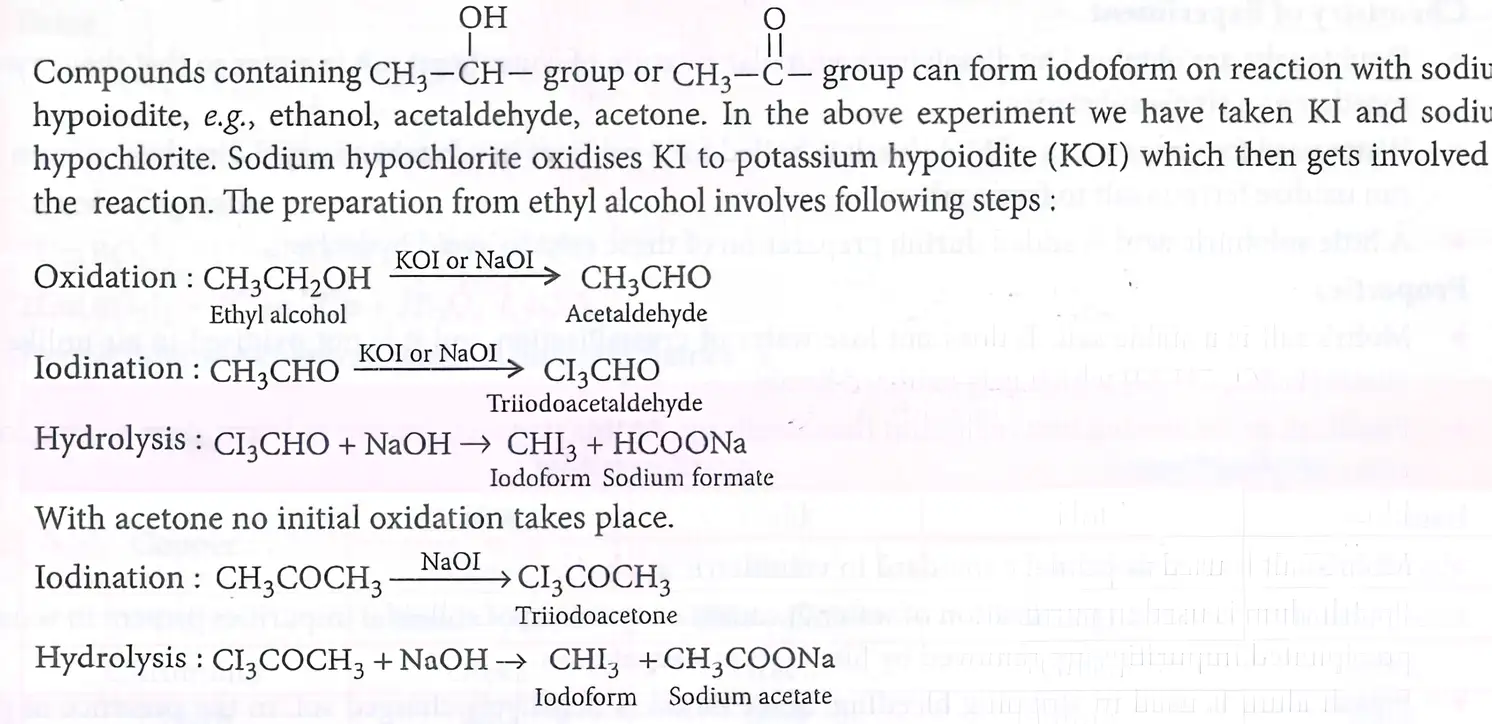
Iodoform (CHI3) is yellow solid with antiseptic properties.
Prepared from acetone or ethyl alcohol (better yield from acetone).
Reaction involves oxidation (for ethanol), iodination, and hydrolysis steps.
Ethyl alcohol oxidized to acetaldehyde, then iodinated to triiodoacetaldehyde, hydrolyzed to iodoform and sodium formate.
Acetone directly iodinated and hydrolyzed to iodoform and sodium acetate.
Solved Examples
Ex 1: Prepare iodoform from acetone.
Mix acetone, KI, NaOH, and sodium hypochlorite; yellow precipitate forms.
Filter and recrystallize iodoform.
Practice Set
Q1: Iodoform test detects which groups?
A. -CH2OH
B. -CH(OH)- and -CO- (methyl ketone)
C. -OH only
D. -COOH
Q2: Better yield of iodoform is obtained from?
A. Ethanol
B. Acetone
C. Methanol
D. Benzene
Q3: Iodoform is used as?
A. Solvent
B. Antiseptic
C. Dye
D. Fuel
Answer Key
Q1: B. -CH(OH)- and -CO- groups - methyl alcohol and methyl ketone groups.
Q2: B. Acetone - gives better yield.
Q3: B. Antiseptic - used for wound cleaning.
Memory Aids
Iodoform test positive for methyl ketones and ethanol.
Yellow precipitate confirms presence.
Used as antiseptic.
Preparation of Mohr's Salt and Potash Alum
Key Concepts
Mohr's salt: FeSO4(NH4)2SO4·6H2O, a double salt of ferrous sulfate and ammonium sulfate.
Potash alum: K2SO4·Al2(SO4)3·24H2O, a double sulfate of potassium and aluminum.
Double salts dissociate completely into their ions in aqueous solution.
General formula of alums: M2SO4·M'2(SO4)3·24H2O, where M = monovalent metal, M' = trivalent metal.
Mohr's salt preparation: equimolar hydrated ferrous sulfate + ammonium sulfate + dilute H2SO4 in boiled water to avoid oxidation.
Potash alum preparation: equimolar hydrated aluminum sulfate + potassium sulfate + dilute H2SO4.
Crystallization yields light green monoclinic Mohr's salt crystals and octahedral potash alum crystals.
Mohr's salt is stable, resists oxidation and loss of water of crystallization.
Potash alum melts and swells on heating, losing water to form burnt alum.


Solved Examples
Ex 1: Write the reaction for preparation of Mohr's salt.
FeSO4·7H2O + (NH4)2SO4 + H2SO4 → FeSO4(NH4)2SO4·6H2O + H2OEx 2: Identify the type of crystals formed by potash alum.
Octahedral crystals formed by crystallization.
Practice Set
Q1: Mohr's salt is a
A. Simple salt
B. Double salt
C. Complex salt
D. Acid saltQ2: Which acid is added during preparation of Mohr's salt to prevent hydrolysis?
A. Hydrochloric acid
B. Nitric acid
C. Sulfuric acid
D. Acetic acidQ3: Potash alum contains which of the following ions?
A. K+ and Fe3+
B. K+ and Al3+
C. Na+ and Al3+
D. Na+ and Fe3+
Answer Key
Q1: B - Mohr's salt is a double salt formed by combination of ferrous sulfate and ammonium sulfate.
Q2: C - Sulfuric acid is added to prevent hydrolysis during preparation.
Q3: B - Potash alum contains potassium (K+) and aluminum (Al3+) ions.
Memory Aids
Mohr's salt = Fe + NH4 + SO4, stable ferrous ammonium sulfate.
Alum formula: M2SO4·M'2(SO4)3·24H2O (M = monovalent, M' = trivalent metal).
Boil water before Mohr's salt prep to remove O2 and prevent oxidation.
Qualitative Salt Analysis
Dry Tests
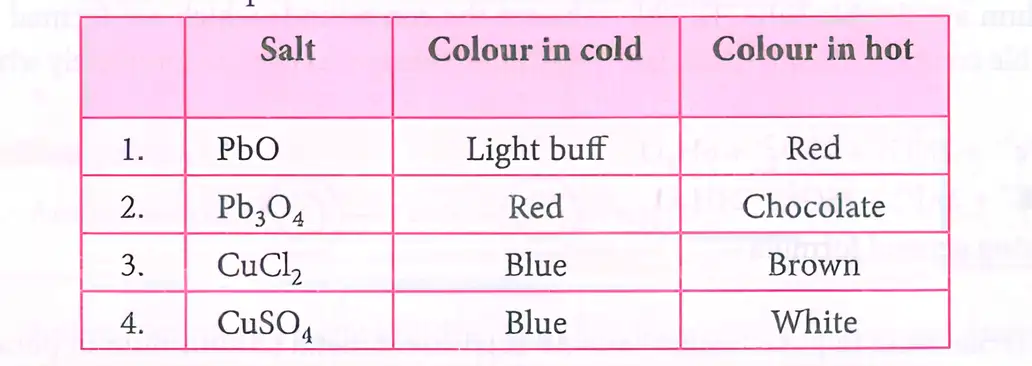
Action of Heat: Heating salts causes color changes useful for identification.
Example: PbO changes from light buff (cold) to red (hot).
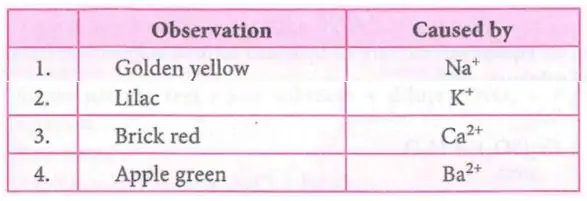
Flame Test: Salt + conc. HCl heated on Pt wire; metal ions give characteristic flame colors.
Na+: golden yellow; K+: lilac; Ca2+: brick red; Ba2+: apple green.
Pt wire preferred as it is inert and does not color flame.
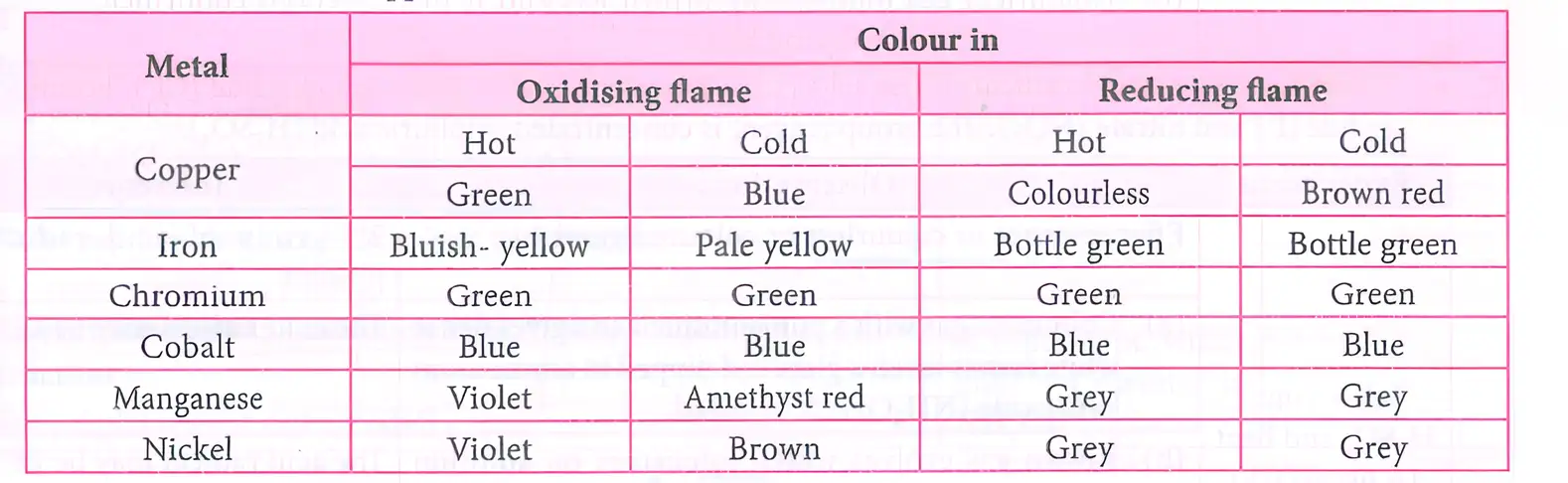
Borax Bead Test: Borax heated on Pt wire forms sodium metaborate bead; colored salts produce colored metaborates in oxidizing flame.

Wet Tests: Identification of Acid Radicals
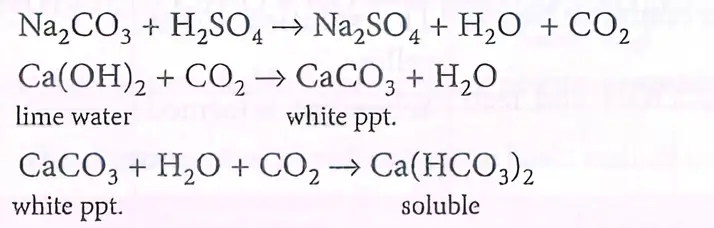
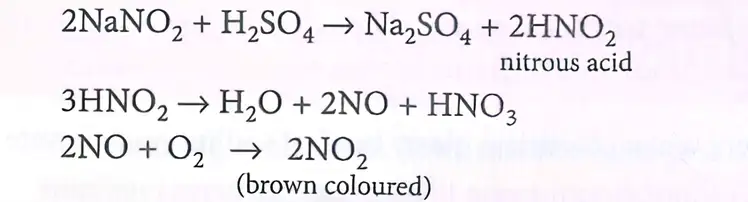
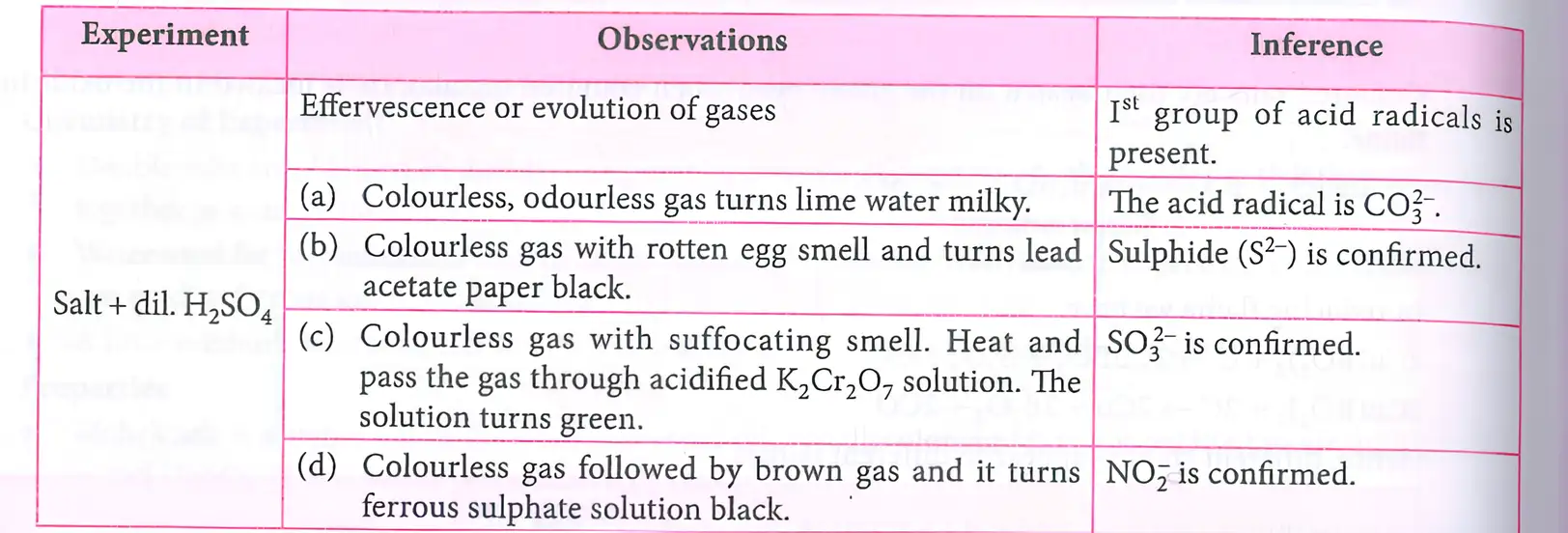
First Group Acid Radicals: CO32−, S2−, SO32−, NO2−; reagent: dilute H2SO4.
Carbonate: Effervescence of CO2 with dilute acid; lime water turns milky.
Sulphide: H2S gas with rotten egg smell; black precipitate with Pb(CH3COO)2.
Sulphite: SO2 gas evolved; reduces K2Cr2O7 from orange to green.
Nitrite: Brown gas (NO2) formed; blackens ferrous sulfate solution.


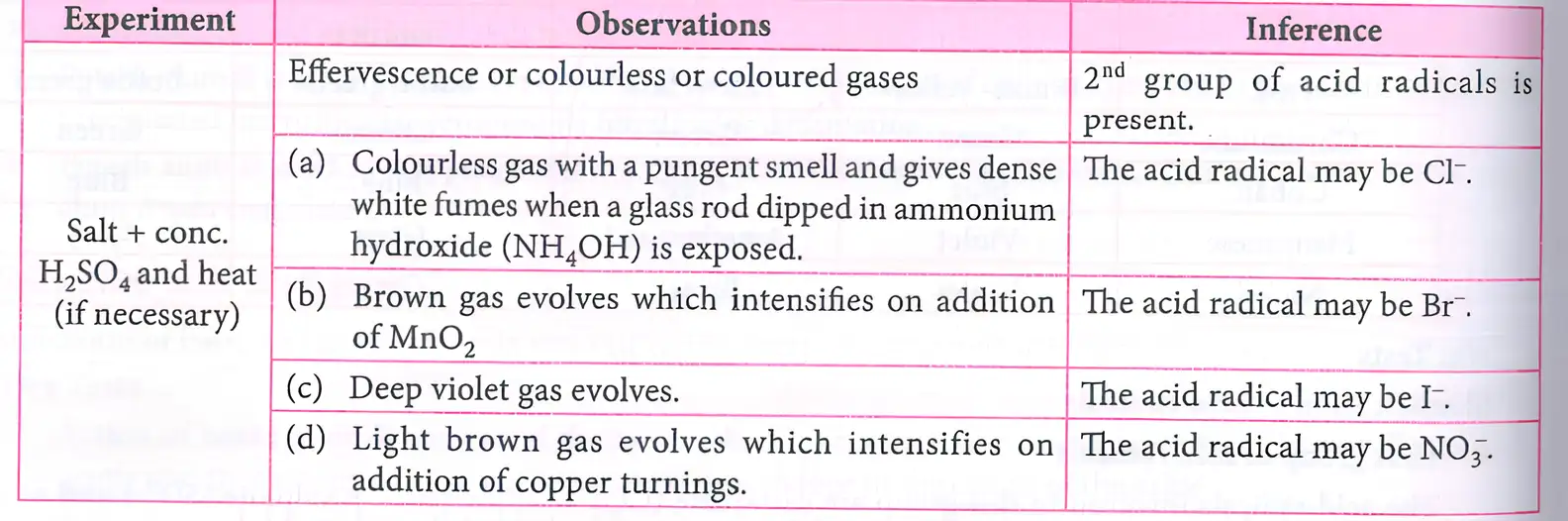
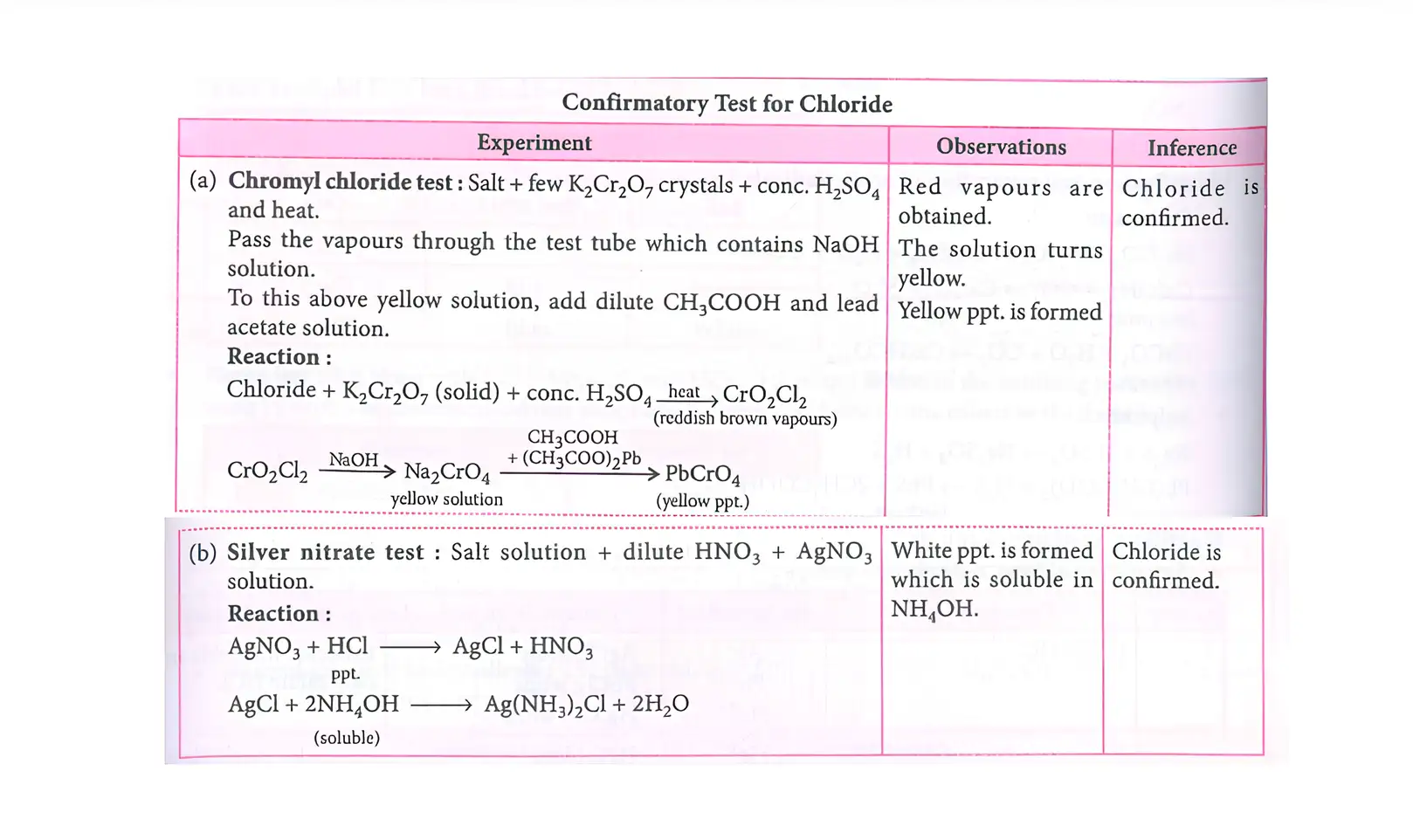
Second Group Acid Radicals: Cl−, Br−, I−, NO3−; reagent: concentrated H2SO4.
Chloride: Colorless gas with sharp smell; white fumes with NH4OH; confirmed by chromyl chloride and silver nitrate tests.
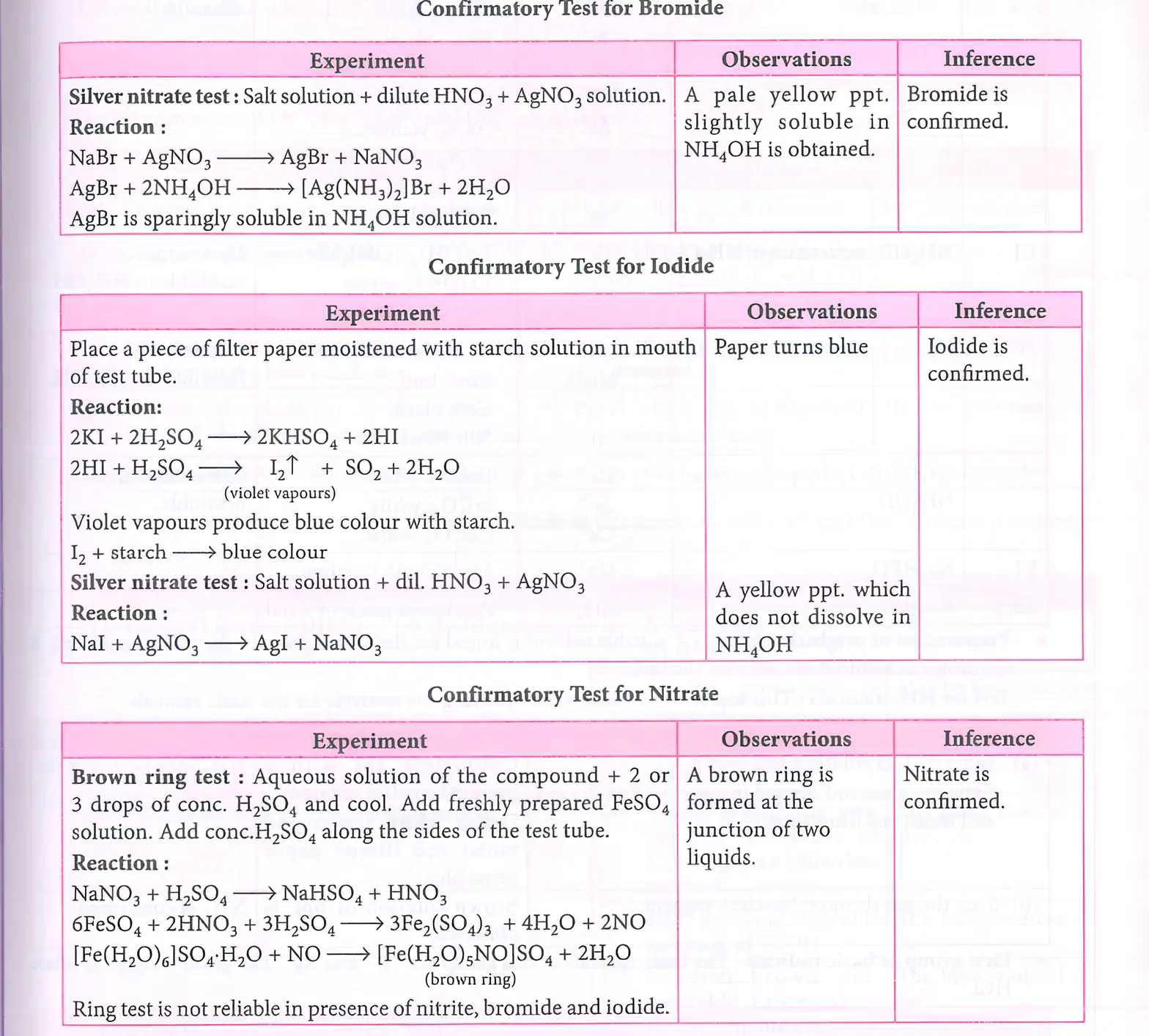
Bromide: Brown gas; pale yellow precipitate with AgNO3.
Iodide: Violet vapors; blue starch paper; yellow precipitate with AgNO3.
Nitrate: Brown ring test with FeSO4 and H2SO4.

Third Group Acid Radical: SO42−; confirmed by white precipitate of BaSO4 with BaCl2 in acidified solution.
Wet Tests: Identification of Basic Radicals
Basic radicals (cations) are separated into groups I to VI and zero based on their precipitation reactions.
Group I: Pb2+, Ag+; reagent: dilute HCl; white precipitate formed.
Group II: Pb2+, Hg2+, Cu2+, Cd2+; reagent: H2S in dilute HCl; black or yellow precipitates.
Group III: Al3+, Fe2+, Fe3+; reagent: NH4Cl + NH4OH; gelatinous or colored precipitates.
Group IV: Zn2+, Mn2+, Co2+, Ni2+; reagent: NH4Cl + NH4OH + H2S; white, pink, or black precipitates.
Group V: Ca2+, Sr2+, Ba2+; reagent: NH4Cl + NH4OH + (NH4)2CO3; white precipitates; flame tests confirm identity.
Group VI: Mg2+; reagent: NH4OH + NH4HPO4; white precipitate.
Zero group: NH4+; identified by evolution of NH3 gas on heating with NaOH.
H2S in dilute HCl precipitates only group II cations due to common ion effect reducing S2− concentration.
Solved Examples
Ex 1: Identify the cation if a white precipitate forms with dilute HCl and dissolves in hot water.
Answer: Pb2+Ex 2: Which test confirms presence of NH4+ ions?
Answer: Heating with NaOH produces NH3 gas turning moist red litmus blue; confirmed by Nessler's reagent.
Practice Set
Q1: Which acid radical gives a white precipitate with BaCl2 in acidified solution?
A. Carbonate
B. Sulfate
C. Sulfide
D. NitrateQ2: Which group of cations precipitates as sulfides in presence of H2S and dilute HCl?
A. Group I
B. Group II
C. Group III
D. Group IVQ3: In flame test, which ion gives lilac color?
A. Na+
B. K+
C. Ca2+
D. Ba2+
Answer Key
Q1: B - Sulfate ions form white BaSO4 precipitate with BaCl2.
Q2: B - Group II cations precipitate as sulfides in H2S and dilute HCl.
Q3: B - Potassium ion gives lilac flame color.
Memory Aids
Group I cations: Pb2+, Ag+ precipitate with dilute HCl.
Group II cations: precipitate as sulfides in acidic H2S solution.
Flame test colors: Na - yellow, K - lilac, Ca - brick red, Ba - apple green.
NH4+ detected by NH3 gas on heating with NaOH.
Volumetric Analysis
Overview
Measures concentration of a substance by volume of its solution in a chemical reaction.
Main process: titration.
Types: acid-base, redox, iodine, complexometric titrations.
Solved Examples
Ex 1: Calculate normality if 25 mL of titrant neutralizes 20 mL of analyte with known normality 0.1 N.
Solution: N1V1 = N2V2 → N2 = (N1V1)/V2 = (0.1 × 20)/25 = 0.08 N.
Practice Set
Q1: What is the main purpose of volumetric analysis?
A. Measure mass
B. Measure volume
C. Measure concentration
D. Measure temperatureQ2: Which of the following is NOT a type of titration?
A. Acid-base
B. Oxidation-reduction
C. Precipitation
D. ChromatographicQ3: In titration, the point where reaction is just complete is called:
A. End point
B. Equivalence point
C. Indicator point
D. Titration point
Answer Key
Q1: C - Volumetric analysis measures concentration by volume.
Q2: D - Chromatographic is not a titration type.
Q3: B - Equivalence point is where reaction is stoichiometrically complete.
Memory Aids
Volumetric = Volume-based concentration measurement.
Equivalence point = Stoichiometric completion.
Types: Acid-base, Redox, Iodine, Complexometric.
Titration Terms
Key Definitions
Analyte (Titre): Substance being analyzed.
Titrant: Solution added to analyte.
Equivalence Point: Reaction just complete; stoichiometric amounts reacted.
Indicator: Compound changing color near equivalence point.
Standard Solution: Solution with known concentration.
Standardization: Process to determine concentration of reagent using known standard.
Primary Standard: Pure reagent for direct standard solution preparation (e.g., oxalic acid, Mohr’s salt).
Secondary Standard: Reagent not pure enough for direct standard solution (e.g., KMnO4, NaOH).
Solved Examples
Ex 1: Identify primary standard among NaOH, oxalic acid, KMnO4.
Answer: Oxalic acid (pure, stable, non-hygroscopic).
Practice Set
Q1: What is the role of an indicator?
A. Reactant
B. Change color at equivalence point
C. Titrant
D. SolventQ2: Which is a primary standard?
A. KMnO4
B. NaOH
C. Oxalic acid
D. HClQ3: Standardization is:
A. Preparing solution
B. Measuring volume
C. Determining concentration of reagent
D. Mixing solutions
Answer Key
Q1: B - Indicator changes color at equivalence point.
Q2: C - Oxalic acid is primary standard.
Q3: C - Standardization finds reagent concentration.
Memory Aids
Primary standard: Pure, stable, non-hygroscopic.
Indicator = Color change at equivalence.
Standardization = Concentration determination.
Law of Chemical Equivalence
Concepts and Equations
Number of equivalents of analyte = Number of equivalents of titrant.
Equivalents = Normality (N) × Volume (V in L).
Normality equation: N1V1 = N2V2.
For volume in mL: milliequivalents = Normality × Volume (mL).
Molarity equation (for dilution): M1V1 = M2V2.
Normality = Molarity × valency factor (n).
Combined: M1V1n1 = M2V2n2.
Solved Examples
Ex 1: Calculate normality if 25 mL of 0.1 M acid reacts with 30 mL base of valency 1.
Solution: NacidVacid = NbaseVbase → (0.1×25×1) = Nbase×30×1 → Nbase = 0.0833 N.
Practice Set
Q1: Normality is defined as:
A. Molarity × Volume
B. Molarity × Valency factor
C. Volume × Valency
D. Molarity / ValencyQ2: If 20 mL of 0.1 N acid neutralizes 25 mL base, normality of base is:
A. 0.08 N
B. 0.125 N
C. 0.1 N
D. 0.2 NQ3: For diprotic acid titrated with monobasic base, relation is:
A. M1V1 = M2V2
B. M1V1n1 = M2V2n2
C. N1V1 = N2V2
D. None
Answer Key
Q1: B - Normality = Molarity × valency.
Q2: A - Nbase = (0.1×20)/25 = 0.08 N.
Q3: B - Use molarity × volume × valency relation.
Memory Aids
Normality = Molarity × n (valency).
Use N1V1 = N2V2 for titrations.
Valency factor = number of replaceable H+ or OH−.
Acid-Base Titration
Key Points
Neutralization: H+ + OH− → H2O.
Equivalence point: sudden pH change; end point detected by indicator.
Indicators: weak acids/bases changing color near equivalence point.
Common indicators: phenolphthalein (colorless to pink), methyl orange (red to yellow).
Indicator color change corresponds to pH range near equivalence point.
Strong acid + strong base: equivalence pH = 7.
Weak acid + strong base: equivalence pH > 7 (basic salt hydrolysis).
Strong acid + weak base: equivalence pH < 7 (acidic salt hydrolysis).
Weak acid + weak base: no sharp end point; pH ~7.
Solved Examples
Ex 1: Identify suitable indicator for strong acid-strong base titration.
Answer: Phenolphthalein or methyl orange.Ex 2: pH at equivalence point for HCl + NaOH titration.
Answer: 7 (neutral).
Practice Set
Q1: Which indicator is best for weak acid-strong base titration?
A. Methyl orange
B. Phenolphthalein
C. Thymol blue
D. Bromothymol blueQ2: pH at equivalence point of strong acid-weak base titration is:
A. 7
B. >7
C. <7
D. VariableQ3: In weak acid-weak base titration, the titration curve:
A. Has sharp end point
B. Has no sharp end point
C. pH at equivalence is 14
D. pH at equivalence is 0
Answer Key
Q1: B - Phenolphthalein suitable for weak acid-strong base.
Q2: C - pH < 7 due to acidic salt hydrolysis.
Q3: B - No sharp end point; pH ~7.
Memory Aids
Strong acid + strong base → pH 7 equivalence.
Weak acid + strong base → pH > 7 equivalence.
Strong acid + weak base → pH < 7 equivalence.
Phenolphthalein pink in base; methyl orange red in acid.
Redox Titrations
Essentials
Use KMnO4 as oxidizing agent in acidic medium.
Reducing agents: Mohr’s salt, oxalic acid, H2O2, etc.
KMnO4 acts as self-indicator: colorless to pink at end point.
Redox reaction example: MnO4− + 8H+ + 5Fe2+ → Mn2+ + 5Fe3+ + 4H2O.
Equivalent mass of KMnO4 in acid = Molar mass / 5 = 31.6 g/equiv.
Solved Examples
Ex 1: Calculate equivalent mass of KMnO4.
Answer: 158/5 = 31.6 g/equiv.Ex 2: Write ionic equation for oxalic acid titration with KMnO4.
Answer: 2MnO4− + 16H+ + 5C2O42− → 2Mn2+ + 8H2O + 10CO2.
Practice Set
Q1: KMnO4 acts as:
A. Reducing agent
B. Oxidizing agent
C. Indicator only
D. NoneQ2: End point color change in KMnO4 titration is:
A. Colorless to pink
B. Pink to colorless
C. Blue to colorless
D. Yellow to redQ3: Number of electrons lost by KMnO4 in acidic medium:
A. 1
B. 3
C. 5
D. 7
Answer Key
Q1: B - KMnO4 is oxidizing agent.
Q2: A - Colorless to permanent pink.
Q3: C - KMnO4 loses 5 electrons.
Memory Aids
KMnO4 self-indicator: pink color at end point.
Equivalent mass = molar mass / electrons transferred.
Redox titrations in acidic medium.
Enthalpy of Solution
Concepts
Enthalpy change when 1 mole of substance dissolves in excess solvent.
Heat of solution can be endothermic (+) or exothermic (−).
Measured using calorimeter (polythene bottle).
Formula: ΔH = (W + m) × Δt × 4.2 × M / w (J/mol), where W = water equivalent, m = water mass, Δt = temperature change, M = molar mass, w = solute mass.
Lattice energy: energy to dissociate ionic solid into ions.
Hydration energy: energy released when ions hydrate.
If lattice energy > hydration energy → endothermic dissolution.
If lattice energy < hydration energy → exothermic dissolution.
Example: CuSO4 anhydrous dissolution is exothermic; KCl dissolution is endothermic.
Solved Examples
Ex 1: Calculate enthalpy if 5 g CuSO4 dissolved in 150 mL water causes 2°C rise, W=10 g, M=160 g/mol.
Solution: ΔH = (10+150)×2×4.2×160/5 = 21504 J/mol.
Practice Set
Q1: Enthalpy of solution is:
A. Heat change on dissolving 1 mole
B. Heat change on mixing
C. Heat change on reaction
D. Heat change on evaporationQ2: If lattice energy > hydration energy, dissolution is:
A. Exothermic
B. Endothermic
C. Neutral
D. VariableQ3: Which salt dissolution is exothermic?
A. KCl
B. CuSO4 anhydrous
C. CuSO4.5H2O
D. NaCl
Answer Key
Q1: A - Enthalpy of solution is heat change on dissolving 1 mole.
Q2: B - Endothermic if lattice energy > hydration energy.
Q3: B - Anhydrous CuSO4 dissolution is exothermic.
Memory Aids
ΔH positive = endothermic; negative = exothermic.
Lattice energy vs hydration energy decides heat sign.
Hydrated salts often dissolve endothermically.
Preparation of Lyophilic and Lyophobic Sols
Types and Methods
Lyophilic sols: Dispersed phase has affinity for medium; stable; reversible; prepared by direct mixing (e.g., starch in water).
Lyophobic sols: Little affinity; unstable; irreversible; prepared by special methods.
Lyophobic sols prepared by condensation (chemical/physical) and dispersion methods.
Chemical methods: double decomposition, oxidation, reduction, hydrolysis.
Physical methods: solvent exchange, excessive cooling.
Dispersion methods: mechanical dispersion, electrical disintegration (Bredig’s arc), peptization.
Solved Examples
Ex 1: Prepare ferric hydroxide sol.
Answer: Hydrolysis of FeCl3 with water.Ex 2: Method to prepare gold sol.
Answer: Electrical disintegration (Bredig’s arc).
Practice Set
Q1: Lyophilic sols are:
A. Unstable
B. Stable and reversible
C. Irreversible
D. Prepared by special methods onlyQ2: Peptization is:
A. Breaking particles
B. Converting precipitate to sol
C. Mixing solvents
D. Cooling solutionQ3: Bredig’s arc method is used for:
A. Lyophilic sols
B. Lyophobic sols of metals
C. Organic sols
D. None
Answer Key
Q1: B - Lyophilic sols are stable and reversible.
Q2: B - Peptization converts precipitate to sol.
Q3: B - Bredig’s arc prepares metal lyophobic sols.
Memory Aids
Lyophilic = love solvent; stable, reversible.
Lyophobic = fear solvent; unstable, special prep.
Peptization = precipitate to sol by shaking with electrolyte.
Kinetic Study of Iodide with Hydrogen Peroxide
Reaction and Rate
Reaction: H2O2 + 2I− + 2H+ → I2 + 2H2O (slow).
Iodine reacts with sodium thiosulphate: I2 + 2S2O32− → 2I− + S4O62− (fast).
When thiosulphate is consumed, iodine reacts with starch to form blue complex.
Time for blue color appearance indicates reaction rate.
Rate ∝ concentration of reactants.
Rate law: Rate = k[X]a[Y]b, where a,b determined experimentally.
Order = a + b; molecularity = sum of stoichiometric coefficients.
Solved Examples
Ex 1: Write rate expression for A + B → products if order w.r.t A is 1 and B is 2.
Answer: Rate = k[A][B]2.
Practice Set
Q1: Rate of reaction is:
A. Change in concentration per unit time
B. Change in volume
C. Change in mass
D. Change in temperatureQ2: In rate law Rate = k[X]a[Y]b, a and b are:
A. Stoichiometric coefficients
B. Experimental orders
C. Rate constants
D. ConcentrationsQ3: Which factor does NOT affect reaction rate?
A. Concentration
B. Temperature
C. Catalyst
D. Color of reactants
Answer Key
Q1: A - Rate is change in concentration per time.
Q2: B - a and b are experimentally determined orders.
Q3: D - Color does not affect rate.
Memory Aids
Rate = change in concentration/time.
Order determined experimentally, not always stoichiometric.
Factors affecting rate: concentration, temperature, catalyst, surface area.
NEET Chemistry — ALL CHAPTERS
1
Some Basic Concepts of Chemistry
2
Structure of Atom
3
Classification of Elements and Periodicity in Properties
4
Chemical Bonding and Molecular Structure
5
Thermodynamics
6
Equilibrium
7
Redox Reactions
8
Organic Chemistry - Some Basic Principles and Techniques
9
Hydrocarbons
10
Solutions
11
Electrochemistry
12
Chemical Kinetics
13
The d- and f- Block Elements
14
Coordination Compounds
15
Haloalkanes and Haloarenes
16
Alcohols, Phenols and Ethers
17
Aldehydes, Ketones and Carboxylic Acids
18
Amines
19
Biomolecules
20
The p-Block Elements (Group 13 and 14)
21
The p-Block Elements (Group 15 to 18)
22
Principles Related to Practical Chemistry