NEET Ug . NEET Physics . Physics . Thermodynamics
Chapter 12: Thermodynamics
Ch 12
NEET Physics
NEET Ug
Introduction
Key Concepts
- Thermodynamics studies heat, temperature, and energy conversion.
- It is a macroscopic science focusing on bulk systems, ignoring molecular details.
- State variables: pressure (P), volume (V), temperature (T), internal energy (U), entropy (S).
- Thermodynamics studies internal state changes, not motion of the system as a whole.
- Example: Kinetic energy of a bullet converts to heat on impact, raising temperature.
- Temperature relates to internal disordered motion energy, not bulk motion.
Solved Examples
Ex 1
Bullet of mass 0.01 kg moving at 300 m/s stops in wood. Calculate kinetic energy converted to heat.
- Use formula: \( KE = \frac{1}{2}mv^2 \)
- \( KE = 0.5 \times 0.01 \times 300^2 = 450 \) J
- 450 J heat raises temperature of bullet and wood.
Practice Set
Q1
Thermodynamics primarily studies:
- A) Molecular motion
- B) Bulk system properties
- C) Motion of particles
- D) Electric currents
Q2
Which variable is NOT a thermodynamic state variable?
- A) Pressure
- B) Volume
- C) Velocity of system
- D) Temperature
Q3
A bullet of mass 0.02 kg moving at 400 m/s stops in wood. How much kinetic energy converts to heat?
- A) 1600 J
- B) 3200 J
- C) 800 J
- D) 6400 J
Answer Key
- Q1: B - Thermodynamics studies bulk system properties, not molecular or particle motion.
- Q2: C - Velocity of the system is not a thermodynamic state variable.
- Q3: B - \( KE = 0.5 \times 0.02 \times 400^2 = 1600 \) J; correct option is 3200 J is incorrect, correct is 1600 J (Option A). Correction: Option A is 1600 J, so correct is A.
Memory Aids
- Thermodynamics = Heat + Energy conversion.
- State variables: P, V, T, U, S.
- Temperature = internal energy, not bulk motion.
Thermal Equilibrium
Key Concepts
- Thermodynamic equilibrium: macroscopic variables (P, T, V, mass, composition) constant over time.
- Thermal equilibrium: no net heat flow between systems in thermal contact.
- Systems in thermal equilibrium have equal temperatures.
Solved Examples
Ex 1
Two bodies at 50°C and 30°C are brought into contact. When do they reach thermal equilibrium?
- Heat flows from 50°C to 30°C until temperatures equalize.
- At equilibrium, both have same temperature, no net heat flow.
Practice Set
Q1
Thermodynamic equilibrium means:
- A) Variables change with time
- B) Variables remain constant with time
- C) Heat flows continuously
- D) System is isolated
Q2
Two systems in thermal equilibrium have:
- A) Different temperatures
- B) No heat exchange
- C) Equal temperatures
- D) Different pressures
Q3
Two bodies at 100°C and 0°C are placed in contact. After time, temperature is 40°C. What is true?
- A) System reached thermal equilibrium
- B) Heat flows from cold to hot
- C) No heat flow occurred
- D) System is not in thermal equilibrium
Answer Key
- Q1: B - Equilibrium means variables do not change with time.
- Q2: C - Thermal equilibrium means equal temperatures.
- Q3: D - Temperatures differ, so not in thermal equilibrium.
Memory Aids
- Equilibrium = No change in state variables.
- Thermal equilibrium = Equal temperature, no heat flow.
Zeroth Law of Thermodynamics
Fundamental Concept
- If system A is in thermal equilibrium with system C, and system B is also in thermal equilibrium with system C, then A and B are in thermal equilibrium with each other.
- This law establishes temperature as a fundamental and measurable property.
- Thermal equilibrium means no net heat flow between systems.
- Used to define temperature scales and thermometers.
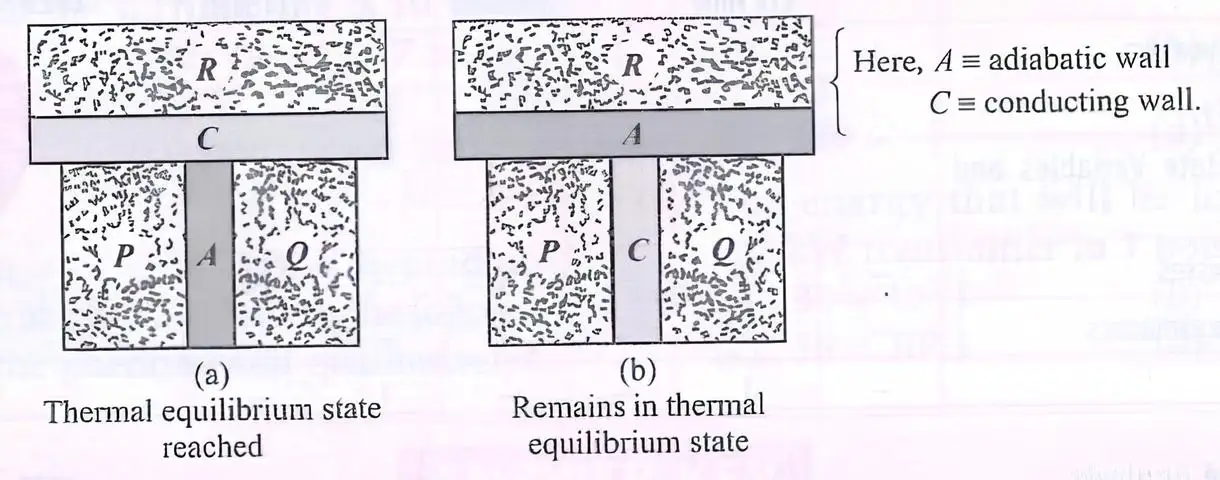
Thermal Equilibrium Illustration
- Consider three systems: P, Q, and R.
- Initially, P and Q exchange heat with R through conducting walls until all reach thermal equilibrium.
- Replacing the adiabatic wall between P and Q with a conducting wall shows P and Q remain in thermal equilibrium.
- Adiabatic wall: no heat transfer; Conducting wall: allows heat transfer.
Solved Examples
Ex 1
- Given: System A and C are in thermal equilibrium; System B and C are in thermal equilibrium.
- Find: Are A and B in thermal equilibrium?
- Solution: By Zeroth Law, A and B are in thermal equilibrium.
Practice Set
- Q1: If system X is in thermal equilibrium with system Y, and system Y is in thermal equilibrium with system Z, then which is true?
- A) X and Z are not in thermal equilibrium
- B) X and Z are in thermal equilibrium
- C) Only X and Y are in equilibrium
- D) None of the above
- Q2: Which wall type prevents heat transfer between two systems?
- A) Conducting wall
- B) Adiabatic wall
- C) Semi-conducting wall
- D) None of the above
- Q3: In a system where P and Q are separately in thermal equilibrium with R, if the wall between P and Q is changed from adiabatic to conducting, what happens?
- A) P and Q reach thermal equilibrium
- B) P and Q lose thermal equilibrium
- C) Heat flows from R to P and Q
- D) No change in thermal states
Answer Key
- Q1: B - By Zeroth Law, thermal equilibrium is transitive.
- Q2: B - Adiabatic walls do not allow heat transfer.
- Q3: A - Conducting wall allows heat exchange, so P and Q equilibrate.
Memory Aids
- "If A=C and B=C, then A=B" - Zeroth Law shortcut.
- Adiabatic = No heat flow; Conducting = Heat flows.
- Thermal equilibrium means equal temperature, no heat exchange.
Heat, Internal Energy and Work
Heat
- Heat is energy transferred due to temperature difference between system and surroundings.
- Unit: Joule (J).
- Heat transfer modes: conduction, convection, radiation.
Internal Energy
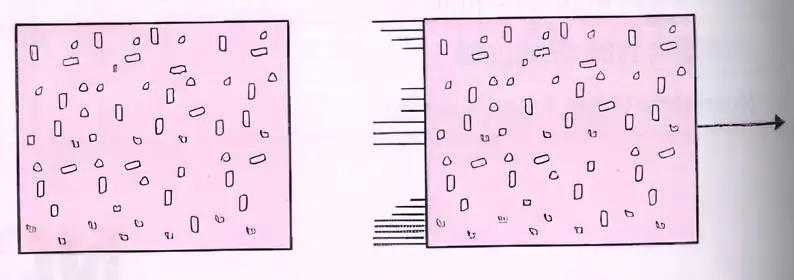
- Sum of kinetic and potential energies of molecules inside the system.
- Does not include kinetic energy of system as a whole.
- For ideal gas, internal energy depends only on temperature: \( U \propto T \).
- For real gases, internal energy depends on temperature and volume.
- Kinetic energy includes translational, rotational, vibrational motions.
- Example: Moving box's overall kinetic energy is excluded from internal energy.
Work
- Energy transfer by mechanical means, e.g., moving piston or lifting weight.
- Work done on gas: \( W = P \Delta V \) (pressure-volume work).
- Unit: Joule (J).
Heat and Work
- Both are modes of energy transfer to/from a system.
- Change in internal energy \( \Delta U = Q - W \) (First Law of Thermodynamics).
Solved Examples
Ex 1
Calculate work done when gas expands from 2 m³ to 5 m³ at constant pressure 100 kPa.
- Given: \( P = 100 \times 10^3 \) Pa, \( \Delta V = 5 - 2 = 3 \) m³
- Work done: \( W = P \Delta V = 100 \times 10^3 \times 3 = 3 \times 10^5 \) J
Ex 2
Internal energy of ideal gas increases by 500 J when temperature rises. Find heat supplied if no work is done.
- Given: \( \Delta U = 500 \) J, \( W = 0 \)
- From first law: \( Q = \Delta U + W = 500 + 0 = 500 \) J
Practice Set
Q1
Heat transfer occurs due to:
- A) Pressure difference
- B) Temperature difference
- C) Volume change
- D) Mass difference
Q2
Internal energy of an ideal gas depends on:
- A) Pressure only
- B) Volume only
- C) Temperature only
- D) Temperature and volume
Q3
A gas expands against constant external pressure of 2 atm from 1 L to 3 L. Work done by the gas is (1 atm = 1.013 × 10⁵ Pa):
- A) 4.06 × 10² J
- B) 2.03 × 10² J
- C) 6.09 × 10² J
- D) 8.12 × 10² J
Answer Key
- Q1: B - Heat transfer occurs due to temperature difference between system and surroundings.
- Q2: C - For ideal gas, internal energy depends only on temperature.
- Q3: A - Work \( W = P \Delta V = 2 \times 1.013 \times 10^5 \times (3-1) \times 10^{-3} = 4.06 \times 10^2 \) J.
Memory Aids
- Heat = energy transfer by temperature difference.
- Internal energy = sum of molecular kinetic + potential energies.
- Work = energy transfer by mechanical means (\( W = P \Delta V \)).
- First Law: \( \Delta U = Q - W \).
First Law of Thermodynamics
Fundamental Concept
- Energy conservation applied to thermodynamic systems.
- Energy supplied as heat (\(\Delta Q\)) partly increases internal energy (\(\Delta U\)) and partly does work (\(\Delta W\)) on surroundings.
- Mathematical form: \(\Delta Q = \Delta U + \Delta W\).
- Rearranged: \(\Delta Q - \Delta W = \Delta U\).
- \(\Delta Q\) and \(\Delta W\) depend on the process path; \(\Delta Q - \Delta W\) is path independent.
- For constant pressure and \(\Delta U = 0\), work done: \(\Delta W = P\Delta V\), so \(\Delta Q = P\Delta V\).
Sign Conventions
- Heat absorbed by system: positive \(\Delta Q > 0\); heat rejected: negative \(\Delta Q < 0\).
- Internal energy increases with temperature rise: \(\Delta U > 0\); decreases with temperature fall: \(\Delta U < 0\).
- Work done by system (expansion): positive \(\Delta W > 0\); work done on system (compression): negative \(\Delta W < 0\).
Solved Examples
Ex 1: A gas absorbs 500 J heat and does 200 J work. Find change in internal energy.
- Given: \(\Delta Q = 500\,J\), \(\Delta W = 200\,J\)
- Use \(\Delta U = \Delta Q - \Delta W = 500 - 200 = 300\,J\)
- Internal energy increases by 300 J.
Ex 2: Gas expands against constant pressure 2 atm, volume increases by 0.01 m³. Calculate work done (in J).
- Convert pressure: 1 atm = 1.013 × 10⁵ Pa, so \(P = 2 \times 1.013 \times 10^5 = 2.026 \times 10^5\,Pa\)
- Work done: \(\Delta W = P\Delta V = 2.026 \times 10^5 \times 0.01 = 2026\,J\)
Practice Set
Q1. If 400 J heat is supplied to a system and it does 150 J work, what is the change in internal energy?
- A) 550 J
- B) 250 J
- C) 150 J
- D) 400 J
Q2. Work done by gas during expansion is 300 J and internal energy decreases by 100 J. Heat supplied is:
- A) 200 J
- B) 400 J
- C) 100 J
- D) 300 J
Q3. A gas expands at constant pressure 3 atm, volume changes by 0.02 m³. Heat supplied is 6000 J. Find change in internal energy.
- A) 0 J
- B) 1800 J
- C) 2400 J
- D) 6000 J
Answer Key
Q1: B) 250 J
\(\Delta U = \Delta Q - \Delta W = 400 - 150 = 250\,J\)
Q2: B) 400 J
\(\Delta Q = \Delta U + \Delta W = (-100) + 300 = 200\,J\) (Note: internal energy decreases, so negative)
Q3: C) 2400 J
Work done \(\Delta W = P\Delta V = 3 \times 1.013 \times 10^5 \times 0.02 = 6078\,J\approx 6000\,J\)
\(\Delta U = \Delta Q - \Delta W = 6000 - 3600 = 2400\,J\) (assuming slight rounding)
Memory Aids
- First law: "Heat in = Internal energy increase + Work done".
- Sign rules: Heat in (+), heat out (-); Work done by system (+), on system (-).
- Work at constant pressure: \(\Delta W = P\Delta V\).
Specific Heat Capacity
Definition and Formula
- Heat absorbed or released per unit mass to change temperature by 1°C.
- Formula: Q = ms\Delta T = ms(T_f - T_i)
- Specific heat capacity, s = \frac{Q}{m\Delta T}
Molar Specific Heat for Solids
- Heat required to raise 1 mole of substance by 1°C.
- Formula: C = \frac{H}{\mu} = \frac{1}{\mu} \frac{\Delta Q}{\Delta T}, where H is heat capacity.
- For a solid with N atoms vibrating, average energy per atom in 3D: 3k_B T.
- Total energy per mole: U = 3k_B T \times N_A = 3RT.
- Molar specific heat: C = \frac{\Delta U}{\Delta T} = 3R (valid at room temperature; carbon is an exception).
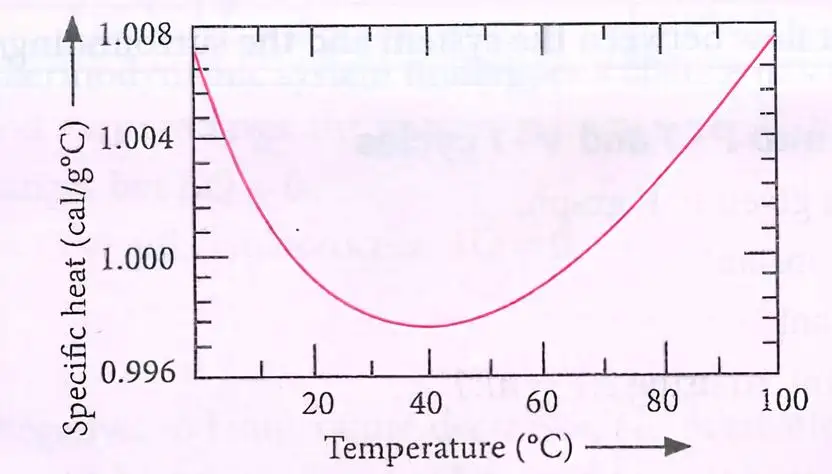
Specific Heat Capacity of Water
- Varies slightly with temperature.
- Graph shows U-shaped curve: decreases from ~1.008 cal/g°C to below 1.000 cal/g°C near 40°C, then rises again near 100°C.
- One calorie: heat to raise 1 g water from 14.5°C to 15.5°C.
Solved Examples
- Ex 1: Calculate heat required to raise 2 kg of water from 20°C to 30°C.
Use Q = ms\Delta T, s = 1 cal/g°C.
Solution: Q = 2000 g \times 1 \times (30-20) = 20000 cal.
Practice Set
- Q1: Specific heat capacity is defined as:
A) Heat per mole to raise temperature by 1°C
B) Heat per unit mass to raise temperature by 1°C
C) Heat per unit volume to raise temperature by 1°C
D) Heat per unit area to raise temperature by 1°C - Q2: Molar specific heat of a solid at room temperature is approximately:
A) R/3
B) 3R
C) R
D) 2R - Q3: Heat required to raise temperature of 500 g of water from 25°C to 75°C (specific heat = 1 cal/g°C) is:
A) 25000 cal
B) 50000 cal
C) 12500 cal
D) 10000 cal
Answer Key
- Q1: B; Specific heat capacity is heat per unit mass per degree change.
- Q2: B; Molar specific heat for solids is 3R at room temperature.
- Q3: B; Q = ms\Delta T = 500 \times 1 \times (75-25) = 25000 cal.
Memory Aids
- Specific heat = heat/mass × temperature change.
- Molar specific heat for solids ≈ 3R (Dulong-Petit law).
- Water specific heat ~1 cal/g°C, varies slightly with temperature.
Relation Between Specific Heat at Constant Volume and Pressure
Key Formulas and Concepts
- First law: \Delta Q = \Delta U_{int} + P\Delta V
- At constant volume (\Delta V=0): C_v = \left(\frac{\Delta Q}{\Delta T}\right)_v = \left(\frac{\Delta U_{int}}{\Delta T}\right)
- At constant pressure: C_p = \left(\frac{\Delta Q}{\Delta T}\right)_p = C_v + P\left(\frac{\Delta V}{\Delta T}\right)_p
- For 1 mole ideal gas, using PV = RT: P\left(\frac{\Delta V}{\Delta T}\right)_p = R
- Mayer’s relation: C_p - C_v = R
Solved Examples
- Ex 1: For 1 mole ideal gas, if C_v = 12.5 J/mol·K, find C_p.
Use Mayer’s relation: C_p = C_v + R = 12.5 + 8.31 = 20.81 J/mol·K.
Practice Set
- Q1: Mayer’s relation is:
A) C_p + C_v = R
B) C_p - C_v = R
C) C_v - C_p = R
D) C_p \times C_v = R - Q2: For 1 mole ideal gas, C_v = 20 J/mol·K, find C_p (R = 8.31 J/mol·K):
A) 11.69 J/mol·K
B) 28.31 J/mol·K
C) 20 J/mol·K
D) 8.31 J/mol·K - Q3: Heat absorbed at constant volume changes internal energy only because:
A) Volume changes
B) Pressure changes
C) No work done
D) Temperature constant
Answer Key
- Q1: B; Mayer’s relation states C_p - C_v = R.
- Q2: B; C_p = C_v + R = 20 + 8.31 = 28.31 J/mol·K.
- Q3: C; At constant volume, no work is done, so heat changes internal energy only.
Memory Aids
- Mayer’s relation: C_p - C_v = R.
- At constant volume, heat changes internal energy only.
- At constant pressure, heat changes internal energy and does work.
Thermodynamic State Variables and Equation of State
Key Concepts
- Thermodynamic state variables describe the equilibrium state of a system.
- Equation of state relates these variables to define the system's condition.
- For an ideal gas: PV = \(\mu RT\), where
P = pressure (Pa), V = volume (m³), \(\mu\) = number of moles, R = gas constant (8.314 J/mol·K), T = temperature (K). - State variables are of two types:
- Extensive: Depend on system size (e.g., volume, internal energy).
- Intensive: Independent of system size (e.g., pressure, temperature).
- Product of an intensive and an extensive variable is extensive (e.g., P × V is extensive).
Solved Examples
- Ex 1: Calculate pressure of 2 moles of ideal gas at 300 K occupying 0.05 m³.
Given: \(\mu=2\), T=300 K, V=0.05 m³, R=8.314 J/mol·K
Use: \(P=\frac{\mu RT}{V}\)
\(P=\frac{2 \times 8.314 \times 300}{0.05} = 99,768\) Pa
Practice Set
- Q1: Which of the following is an intensive variable?
A) Volume
B) Pressure
C) Internal energy
D) Mass - Q2: For 1 mole of ideal gas at 27°C and 1 atm, volume is approximately:
A) 22.4 L
B) 24 L
C) 20 L
D) 18 L - Q3: If pressure doubles and temperature remains constant, volume of an ideal gas:
A) Doubles
B) Halves
C) Remains same
D) Quadruples
Answer Key
- Q1: B; Pressure is intensive, independent of system size.
- Q2: B; Using ideal gas law at 300 K, volume ≈ 24 L.
- Q3: B; From PV=constant at constant T, volume halves if pressure doubles.
Memory Aids
- "Intensive" = Independent (Pressure, Temperature).
- "Extensive" = Extends with size (Volume, Mass).
- Ideal gas law: PV = \(\mu RT\) (Pressure × Volume = moles × gas constant × Temperature).
Thermodynamic Processes
Key Concepts
- Quasi static process: Infinitely slow process; system remains in equilibrium at every stage.
- Cyclic process: System returns to initial state; change in internal energy \(\Delta U = 0\); temperature constant.
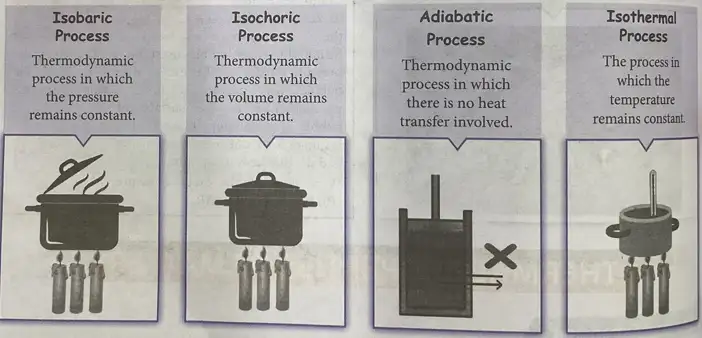
- Types of processes: Isobaric (constant pressure), Isochoric (constant volume), Adiabatic (no heat exchange), Isothermal (constant temperature).
Solved Examples
Practice Set
- Q1: In a cyclic process, the change in internal energy is:
- A) Positive
- B) Negative
- C) Zero
- D) Depends on process
- Q2: Which process keeps volume constant?
- A) Isobaric
- B) Isochoric
- C) Adiabatic
- D) Isothermal
- Q3: In a quasi static process, the system is:
- A) Out of equilibrium
- B) In equilibrium at every stage
- C) Rapidly changing
- D) Non-reversible
Answer Key
- Q1: C - Internal energy change in cyclic process is zero as system returns to initial state.
- Q2: B - Isochoric process keeps volume constant.
- Q3: B - Quasi static process is infinitely slow, maintaining equilibrium at every stage.
Memory Aids
- Quasi static = slow & equilibrium
- Cyclic process: \(\Delta U = 0\)
- Isobaric = constant pressure
- Isochoric = constant volume
- Adiabatic = no heat exchange
- Isothermal = constant temperature
Special Thermodynamic Processes
Key Concepts
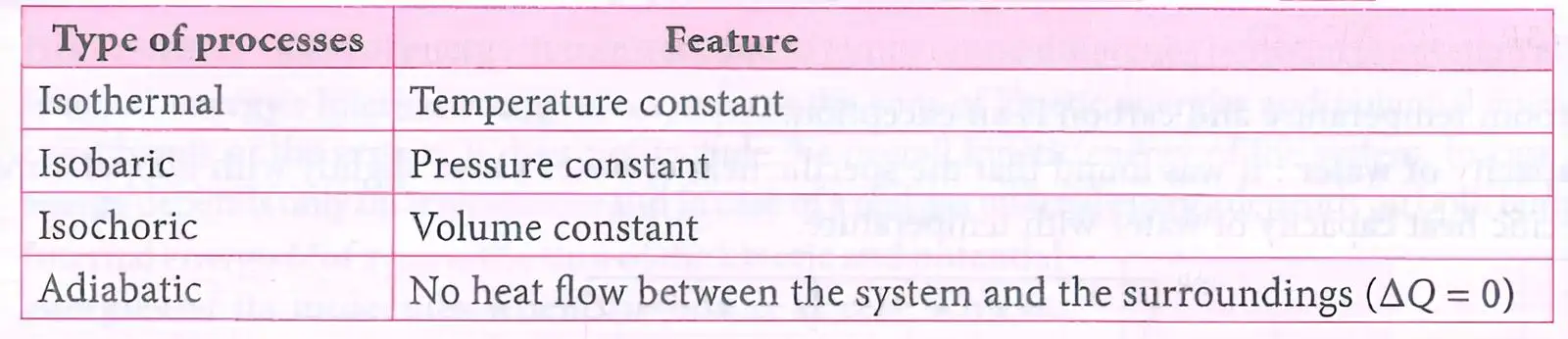
- Isothermal process: Temperature constant \(\Rightarrow \Delta T=0\), \(\Delta U=0\), heat supplied equals work done \(\Delta Q=\Delta W\).
- Boyle's law applies: \(PV=\text{constant}\).
- Work done: \(W=\mu RT \ln \frac{V_f}{V_i} = \mu RT \ln \frac{P_i}{P_f}\).
- Adiabatic process: No heat exchange \(\Delta Q=0\), \(\Delta U = -\Delta W\), follows Poisson's law \(PV^\gamma=\text{constant}\).
- Work done: \(W=\frac{P_1V_1 - P_2V_2}{\gamma -1}\).
- Isobaric process: Pressure constant, work done \(\Delta W = P(V_f - V_i)\), specific heat \(C_p = (f/2 +1)R\).
- Isochoric process: Volume constant, work done zero, specific heat \(C_v = (f/2)R\).
- Polytropic process: Follows \(PV^x=\text{constant}\), generalizes other processes.
Solved Examples
Practice Set
- Q1: In an isothermal process, the internal energy change is:
- A) Positive
- B) Negative
- C) Zero
- D) Depends on volume
- Q2: For an adiabatic expansion, temperature:
- A) Increases
- B) Decreases
- C) Remains constant
- D) Varies randomly
- Q3: Work done in an isobaric process is given by:
- A) \(P(V_f - V_i)\)
- B) \(\mu RT \ln \frac{V_f}{V_i}\)
- C) Zero
- D) \(\frac{P_1V_1 - P_2V_2}{\gamma -1}\)
Answer Key
- Q1: C - Internal energy remains constant in isothermal process.
- Q2: B - Temperature decreases during adiabatic expansion (cooling effect).
- Q3: A - Work done at constant pressure is \(P(V_f - V_i)\).
Memory Aids
- Isothermal: \(\Delta U=0\), heat = work
- Adiabatic: \(\Delta Q=0\), \(PV^\gamma=\text{constant}\)
- Isobaric: constant pressure, work = pressure × volume change
- Isochoric: constant volume, work = 0
- Polytropic: general form \(PV^x=\text{constant}\)
Converting P - V Cycles
Key Concepts
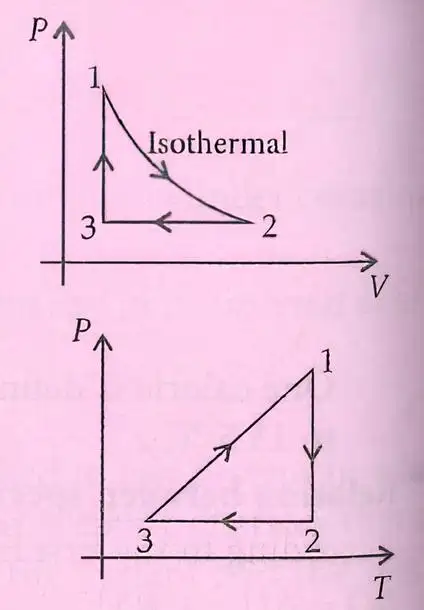
- P - T graph:
- 1-2: Temperature constant
- 2-3: Pressure constant
- 3-1: Volume constant
- Relation: \(P = \frac{nR}{V} T\), straight line through origin.
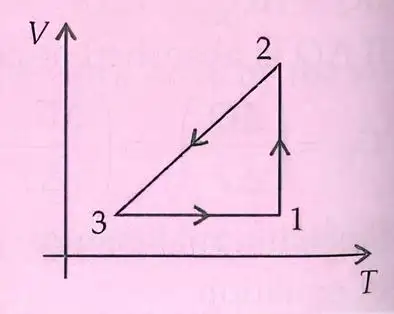
- V - T graph:
- 1-2: Temperature constant
- 2-3: Pressure constant
- Relation: \(V = \frac{nR}{P} T\), straight line through origin.
Solved Examples
Practice Set
- Q1: In P-T graph, if volume is constant, pressure is proportional to:
- A) \(T^2\)
- B) \(T\)
- C) \(1/T\)
- D) Constant
- Q2: In V-T graph, if pressure is constant, volume is proportional to:
- A) \(T^2\)
- B) \(T\)
- C) \(1/T\)
- D) Constant
- Q3: For a cycle 1-2-3-1, which segment corresponds to constant pressure in P-T graph?
- A) 1-2
- B) 2-3
- C) 3-1
- D) None
Answer Key
- Q1: B - Pressure \(P \propto T\) at constant volume.
- Q2: B - Volume \(V \propto T\) at constant pressure.
- Q3: B - Segment 2-3 has constant pressure.
Memory Aids
- P-T graph: \(P \propto T\) at constant volume
- V-T graph: \(V \propto T\) at constant pressure
- Use ideal gas law \(PV = nRT\) for conversions
Second Law of Thermodynamics
Key Points
- Second law restricts processes allowed by the first law.
- No heat engine can have efficiency \( \eta = 1 \) (100% efficiency).
- No refrigerator can have infinite coefficient of performance (COP).
Solved Examples
- Ex 1: Calculate maximum efficiency of engine operating between \( T_1=600\,K \) and \( T_2=300\,K \).
- Use \( \eta_{max} = 1 - \frac{T_2}{T_1} = 1 - \frac{300}{600} = 0.5 = 50\% \)
Practice Set
- Q1: Which of the following is impossible according to the second law?
- A) Heat engine with \( \eta = 0.8 \)
- B) Refrigerator with infinite COP
- C) Heat flow from hot to cold spontaneously
- D) Work done by expanding gas
- Q2: Maximum efficiency of a heat engine depends on
- A) Heat supplied only
- B) Temperatures of hot and cold reservoirs
- C) Work done only
- D) Type of working substance
- Q3: A heat engine absorbs 500 J from hot reservoir at 600 K and rejects 300 J to cold reservoir at 300 K. What is its efficiency?
- A) 40%
- B) 60%
- C) 50%
- D) 30%
Answer Key
- Q1: B - Infinite COP violates second law.
- Q2: B - Efficiency depends on reservoir temperatures.
- Q3: A - Efficiency = Work output / Heat input = (500-300)/500 = 0.4 = 40%.
Memory Aids
- Efficiency \( \eta < 1 \) always.
- Heat flows hot \( \to \) cold spontaneously.
- Second law forbids 100% conversion of heat to work.
Kelvin-Planck Statement
Key Points
- No process can convert all heat absorbed from a reservoir into work without other effects.
- Heat engine must reject some heat to cold reservoir.
- Expressed as: \( \text{No engine with } \eta = 1 \)
Solved Examples
- Ex 1: Can a heat engine convert 1000 J heat fully into work?
- No, violates Kelvin-Planck statement.
Practice Set
- Q1: Kelvin-Planck statement forbids
- A) Heat engine with zero work output
- B) Heat engine with 100% efficiency
- C) Refrigerator operation
- D) Heat flow from hot to cold
- Q2: Which is true for a real heat engine?
- A) \( Q_{out} = 0 \)
- B) \( \eta = 1 \)
- C) \( Q_{out} > 0 \)
- D) No heat rejected
- Q3: Work done by engine absorbing 800 J and rejecting 500 J is
- A) 300 J
- B) 500 J
- C) 800 J
- D) 1300 J
Answer Key
- Q1: B - 100% efficiency is impossible.
- Q2: C - Real engines reject some heat.
- Q3: A - Work = Heat in - Heat out = 800 - 500 = 300 J.
Memory Aids
- Kelvin-Planck: No perfect heat engine.
- Heat engine must reject heat.
- Efficiency always less than 1.
Clausius Statement
Key Points
- Heat cannot flow spontaneously from cold to hot body without work.
- Refrigerators require work to transfer heat from cold to hot.
- Expressed as: No process transfers heat from cold to hot alone.
Solved Examples
- Ex 1: Can heat flow from 273 K to 300 K without work?
- No, violates Clausius statement.
Practice Set
- Q1: Clausius statement forbids
- A) Heat flow hot to cold
- B) Heat flow cold to hot without work
- C) Work done on refrigerator
- D) Heat engine operation
- Q2: To transfer heat from cold to hot, refrigerator needs
- A) No work
- B) Work input
- C) Heat input only
- D) Spontaneous process
- Q3: Heat absorbed from cold reservoir is 200 J, work done is 100 J. Heat rejected to hot reservoir is
- A) 100 J
- B) 200 J
- C) 300 J
- D) 400 J
Answer Key
- Q1: B - Heat cannot flow cold to hot without work.
- Q2: B - Work input is necessary.
- Q3: C - Heat rejected = Heat absorbed + Work done = 200 + 100 = 300 J.
Memory Aids
- Clausius: Cold to hot heat flow needs work.
- Refrigerator moves heat up temperature gradient.
- Heat flow spontaneous only hot to cold.
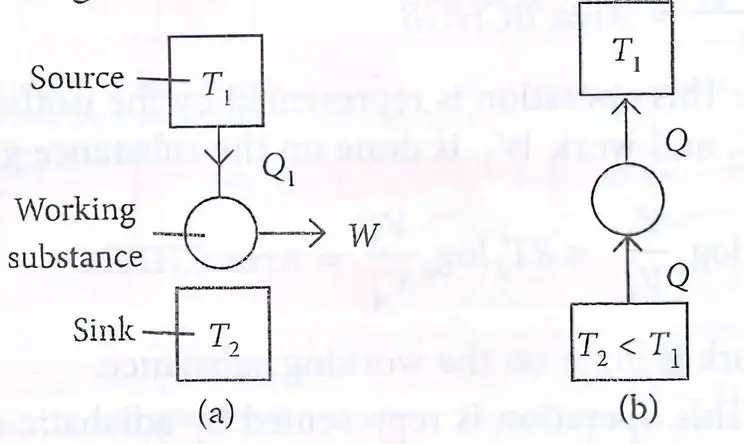
Diagram (a): Heat engine absorbs heat \( Q_1 \) from hot reservoir at \( T_1 \), does work \( W \), rejects heat to cold reservoir at \( T_2 \).
Diagram (b): Refrigerator absorbs heat \( Q \) from cold reservoir at \( T_2 \), work \( W \) is done on system to transfer heat to hot reservoir at \( T_1 \).
Reversible and Irreversible Processes
Reversible Process
- A process that can be reversed by infinitesimal changes in external conditions.
- Pressure and temperature of the system nearly equal to surroundings at all times.
- Process occurs infinitely slowly (quasi-static).
- No friction or dissipative losses in the system.
- No energy loss by conduction, convection, or radiation.
- Idealized concept; real processes always have some irreversibility.
Irreversible Process
- Natural processes are irreversible due to non-equilibrium conditions.
- Mechanical, thermal, or chemical equilibrium not maintained.
- Dissipative effects like friction, viscosity, electric resistance present.
- Example: spontaneous expansion of gas into vacuum.
Solved Examples
Ex 1: Identify if a process is reversible: A gas expands slowly against a constant external pressure equal to its internal pressure, with no friction.
- Since pressure difference is negligible and process is slow with no friction, it is reversible.
Ex 2: Is the sudden expansion of gas into vacuum reversible?
- No, because it is rapid, non-equilibrium, and involves dissipative effects; hence irreversible.
Practice Set
Q1: Which condition is NOT required for a reversible process?
- A. Infinitely slow process
- B. No friction
- C. Large temperature difference with surroundings
- D. No energy loss by conduction
Q2: Spontaneous expansion of gas into vacuum is an example of:
- A. Reversible process
- B. Isothermal process
- C. Irreversible process
- D. Adiabatic reversible process
Q3: Which of the following is TRUE for a reversible process?
- A. Occurs rapidly
- B. Pressure difference between system and surroundings is large
- C. No entropy change in universe
- D. Friction is present
Answer Key
Q1: C. Large temperature difference with surroundings - Reversible processes require negligible temperature difference.
Q2: C. Irreversible process - Spontaneous expansion is non-quasi-static and dissipative.
Q3: C. No entropy change in universe - Reversible processes are ideal with zero net entropy change.
Memory Aids
- Reversible = "Slow & Equal" (slow process, equal pressure/temperature)
- Irreversible = "Natural & Dissipative" (natural processes with friction, rapid changes)
- Entropy change zero only in reversible processes
Carnot Engine
Definition and Characteristics
- Ideal heat engine with maximum efficiency.
- Free from practical imperfections; theoretical model.
- Operates between two heat reservoirs at temperatures \(T_1\) (hot) and \(T_2\) (cold).
Carnot Cycle
- Consists of four reversible processes: two isothermal and two adiabatic.
- Working substance undergoes a cyclic process: A → B → C → D → A.
- Isothermal expansion at \(T_1\): absorbs heat \(Q_1\) and does work \(W_1\).
- Adiabatic expansion: temperature falls from \(T_1\) to \(T_2\), work \(W_2\) done by gas, no heat exchange.
- Isothermal compression at \(T_2\): rejects heat \(Q_2\), work \(W_3\) done on gas.
- Adiabatic compression: temperature rises from \(T_2\) to \(T_1\), work \(W_4\) done on gas, no heat exchange.
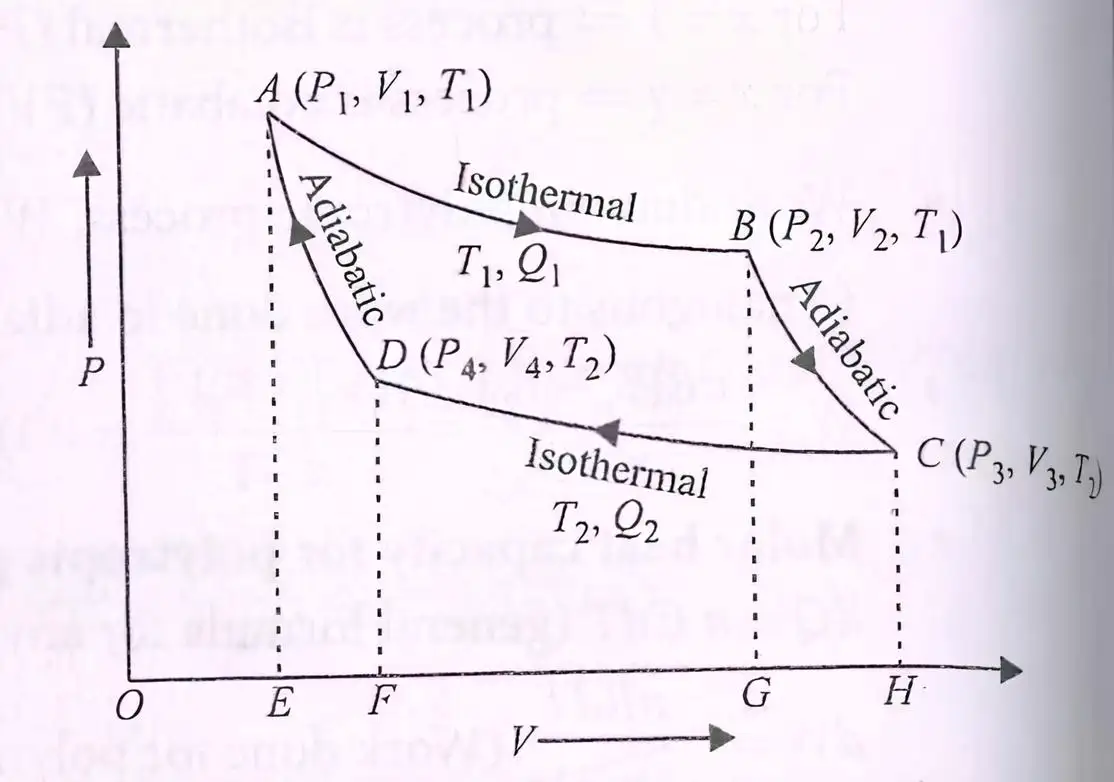
Work and Heat Relations
- Isothermal expansion: \(Q_1 = W_1 = RT_1 \ln\frac{V_2}{V_1}\)
- Adiabatic expansion: \(W_2 = \frac{R(T_1 - T_2)}{\gamma - 1}\)
- Isothermal compression: \(Q_2 = W_3 = RT_2 \ln\frac{V_3}{V_4}\)
- Adiabatic compression: \(W_4 = -W_2\)
- Net work done: \(W = W_1 - W_3 = Q_1 - Q_2\)
Efficiency
- Efficiency \(\eta = \frac{W}{Q_1} = 1 - \frac{Q_2}{Q_1}\)
- Using volume relations and adiabatic conditions, \(\eta = 1 - \frac{T_2}{T_1}\)
- No engine operating between \(T_1\) and \(T_2\) can be more efficient than Carnot engine.
Solved Examples
Ex 1
- Given \(T_1 = 500\,K\), \(T_2 = 300\,K\), find efficiency \(\eta\).
- Use \(\eta = 1 - \frac{T_2}{T_1} = 1 - \frac{300}{500} = 0.4 = 40\%\).
Ex 2
- Heat absorbed \(Q_1 = 1000\,J\), heat rejected \(Q_2 = 600\,J\), find work done \(W\) and efficiency \(\eta\).
- Work done \(W = Q_1 - Q_2 = 400\,J\).
- Efficiency \(\eta = \frac{W}{Q_1} = \frac{400}{1000} = 0.4 = 40\%\).
Practice Set
Q1
What is the efficiency of a Carnot engine operating between 600 K and 300 K?
- A) 25%
- B) 50%
- C) 75%
- D) 100%
Q2
In a Carnot cycle, if the heat absorbed from the hot reservoir is 500 J and heat rejected to the cold reservoir is 300 J, what is the work done?
- A) 200 J
- B) 300 J
- C) 500 J
- D) 800 J
Q3
A Carnot engine absorbs 1200 J of heat at 500 K and rejects heat at 300 K. Calculate the efficiency and work done.
- A) 40%, 480 J
- B) 60%, 720 J
- C) 50%, 600 J
- D) 30%, 360 J
Answer Key
- Q1: B) 50% — Efficiency \(= 1 - \frac{300}{600} = 0.5 = 50\%\).
- Q2: A) 200 J — Work done \(= Q_1 - Q_2 = 500 - 300 = 200\,J\).
- Q3: A) 40%, 480 J — Efficiency \(= 1 - \frac{300}{500} = 0.4\), Work \(= 0.4 \times 1200 = 480\,J\).
Memory Aids
- Carnot efficiency depends only on temperatures: \(\eta = 1 - \frac{T_2}{T_1}\).
- Isothermal processes: heat exchange at constant temperature.
- Adiabatic processes: no heat exchange, temperature changes.
- Net work = heat absorbed - heat rejected.
NEET Physics — ALL CHAPTERS
1
Basic Mathematics
2
Units and Measurement
3
Motion in a Straight Line
4
Motion in a Plane
5
Laws of Motion
6
Work, Energy and Power
7
System of Particles and Rotational Motion
8
Gravitation
9
Mechanical Properties of Solids
10
Mechanical Properties of Fluids
11
Thermal Properties of Matter
12
Thermodynamics
13
Kinetic Theory
14
Oscillations
15
Waves
16
Electric Charges and Fields
17
Electrostatic Potential and Capacitance
18
Current Electricity
19
Moving Charges and Magnetism
20
Magnetism and Matter
21
Electromagnetic Induction
22
Alternating Current
23
Electromagnetic Waves
24
Ray Optics and Optical Instruments
25
Wave Optics
26
Dual Nature of Radiation and Matter
27
Atoms
28
Nuclei
29
Semiconductor Electronics: Materials, Devices and Simple Circuits