NEET Ug . NEET Physics . Physics . Mechanical Properties of Fluids
Chapter 10: Mechanical Properties of Fluids
Ch 10
NEET Physics
NEET Ug
Introduction
Key Points
- Liquids and gases flow; hence, they are called fluids.
- Fluids mediate all processes in living beings; understanding their behavior is crucial.
- Fluids have no definite shape; solids and liquids have fixed volume; gases fill container volume.
- Shearing stress in fluids is about a million times smaller than in solids.
Solved Examples
- Ex 1: Identify if a substance is a fluid.
- Liquids and gases flow → fluid.
- Solids do not flow → not fluid.
Practice Set
- Q1: Which of the following is a fluid?
- A. Ice
- B. Water
- C. Wood
- D. Steel
- Q2: Which property distinguishes fluids from solids?
- A. Fixed volume
- B. Ability to flow
- C. Definite shape
- D. High shearing stress
- Q3: Shearing stress in fluids compared to solids is approximately:
- A. Equal
- B. 10 times smaller
- C. 1000 times smaller
- D. 1,000,000 times smaller
Answer Key
- Q1: B. Water - It flows and has no fixed shape.
- Q2: B. Ability to flow - Fluids flow; solids do not.
- Q3: D. 1,000,000 times smaller - Shearing stress in fluids is about a million times smaller than solids.
Memory Aids
- Fluids = flowable substances (liquids + gases).
- Fluids have no fixed shape but may have fixed volume (liquids).
- Shearing stress in fluids ≈ 10⁶ times less than solids.
Pressure
Key Points
- Pressure (P) = Normal force (F) / Area (A); SI unit: Pascal (Pa) = N/m².
- Dimensions of pressure: [ML⁻¹T⁻²].
- Pascal’s Law: Pressure change in enclosed fluid transmits undiminished everywhere.
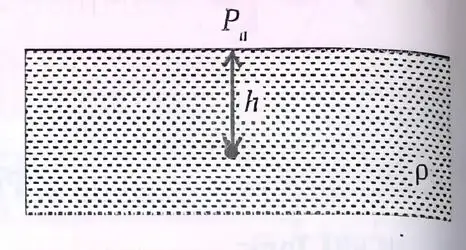
- Pressure due to fluid column: \( P = P_0 + \rho g h \), where \( \rho \) = fluid density, \( g \) = gravity, \( h \) = depth.
- Atmospheric pressure: \( P_a \), 1 atm = 1.01 × 10⁵ Pa = 760 torr = 1.01 bar.
- Gauge pressure = Hydrostatic pressure − Atmospheric pressure = \( \rho g h \).
- Hydrostatic paradox: Pressure at same depth is same regardless of container shape or volume.
Solved Examples
- Ex 1: Calculate pressure at 5 m depth in water (\( \rho = 1000 \text{ kg/m}^3 \), \( g = 9.8 \text{ m/s}^2 \), atmospheric pressure \( P_a = 1.01 \times 10^5 \text{ Pa} \)).
- \( P = P_a + \rho g h = 1.01 \times 10^5 + 1000 \times 9.8 \times 5 = 1.01 \times 10^5 + 4.9 \times 10^4 = 1.5 \times 10^5 \text{ Pa} \).
Practice Set
- Q1: Pressure exerted by 10 m column of water (\( \rho = 1000 \text{ kg/m}^3 \)) is:
- A. 9.8 × 10³ Pa
- B. 9.8 × 10⁴ Pa
- C. 1.01 × 10⁵ Pa
- D. 1.01 × 10⁶ Pa
- Q2: According to Pascal’s law, pressure change in enclosed fluid is:
- A. Reduced
- B. Increased
- C. Transmitted undiminished
- D. Zero
- Q3: Gauge pressure at 3 m depth in a liquid of density 800 kg/m³ is (\( g=10 \text{ m/s}^2 \)):
- A. 2.4 × 10⁴ Pa
- B. 3.0 × 10⁴ Pa
- C. 2.4 × 10³ Pa
- D. 3.0 × 10³ Pa
Answer Key
- Q1: B. 9.8 × 10⁴ Pa - \( P = \rho g h = 1000 \times 9.8 \times 10 = 9.8 \times 10^4 \text{ Pa} \).
- Q2: C. Transmitted undiminished - Pascal’s law states pressure change is transmitted equally.
- Q3: A. 2.4 × 10⁴ Pa - \( P = \rho g h = 800 \times 10 \times 3 = 2.4 \times 10^4 \text{ Pa} \).
Memory Aids
- Pressure = Force / Area.
- Pascal’s law: Pressure change transmits equally in fluid.
- Fluid pressure increases with depth: \( P = P_a + \rho g h \).
- Gauge pressure = \( \rho g h \).
Measurement of Pressure
Key Points
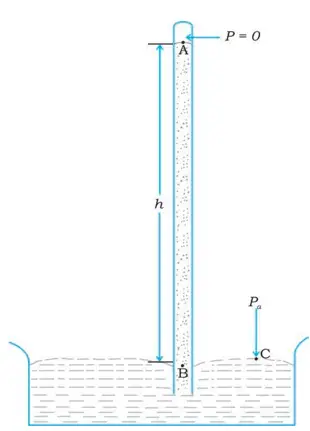
- Atmospheric pressure measured by mercury barometer.
- Mercury barometer: Height \( h \) of mercury column relates to atmospheric pressure \( P_a = \rho g h \).
- Pressure units: 1 mm Hg = 1 torr = 133 Pa; 1 bar = 10⁵ Pa.
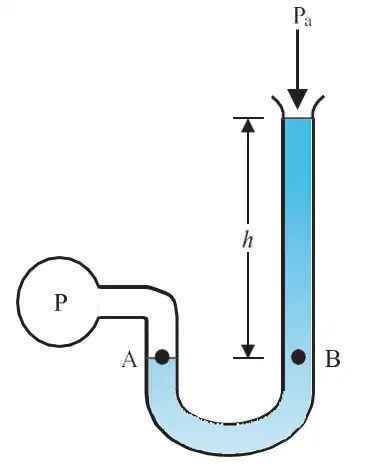
- Open tube manometer measures pressure differences using liquid column height.
- Gauge pressure measured by manometer: \( P - P_a = \rho g h \).
Solved Examples
- Ex 1: Calculate atmospheric pressure if mercury column height is 760 mm (\( \rho = 13600 \text{ kg/m}^3 \), \( g=9.8 \text{ m/s}^2 \)).
- \( P_a = \rho g h = 13600 \times 9.8 \times 0.76 = 1.01 \times 10^5 \text{ Pa} \).
Practice Set
- Q1: 1 torr equals:
- A. 133 Pa
- B. 760 Pa
- C. 1 atm
- D. 1 bar
- Q2: Manometer measures:
- A. Absolute pressure
- B. Atmospheric pressure
- C. Gauge pressure
- D. Vacuum pressure
- Q3: Height difference in manometer is 0.05 m, liquid density 1000 kg/m³, calculate pressure difference.
- A. 490 Pa
- B. 500 Pa
- C. 50 Pa
- D. 980 Pa
Answer Key
- Q1: A. 133 Pa - 1 torr = 133 Pa.
- Q2: C. Gauge pressure - Manometer measures pressure difference relative to atmosphere.
- Q3: A. 490 Pa - \( P = \rho g h = 1000 \times 9.8 \times 0.05 = 490 \text{ Pa} \).
Memory Aids
- Mercury barometer height × density × gravity = atmospheric pressure.
- 1 torr = 133 Pa.
- Manometer measures gauge pressure.
Hydraulic Machine
Key Points
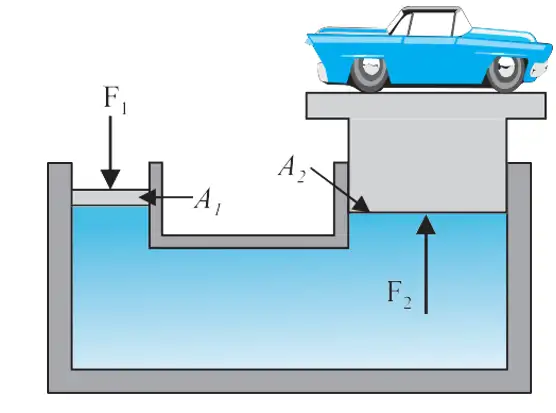
- Based on Pascal’s law: Pressure applied on confined fluid transmits equally.
- Force on small piston: \( F_1 \), area \( A_1 \); pressure \( P = F_1 / A_1 \).
- Pressure transmitted to large piston of area \( A_2 \): \( F_2 = P A_2 = F_1 (A_2 / A_1) \).
- Since \( A_2 > A_1 \), \( F_2 > F_1 \); small force lifts heavy load.
- Hydraulic brakes also use Pascal’s law.
Solved Examples
- Ex 1: Small piston area = 0.01 m², force applied = 100 N, large piston area = 0.5 m². Find force on large piston.
- \( F_2 = F_1 (A_2 / A_1) = 100 \times (0.5 / 0.01) = 5000 \text{ N} \).
Practice Set
- Q1: Hydraulic lift works on:
- A. Bernoulli’s principle
- B. Pascal’s law
- C. Archimedes’ principle
- D. Newton’s law
- Q2: If \( A_2 = 10 A_1 \), force multiplication is:
- A. 1/10
- B. 10
- C. 100
- D. 0.1
- Q3: Small piston area 0.02 m², force 200 N; large piston area 0.4 m². Find force on large piston.
- A. 4000 N
- B. 2000 N
- C. 1000 N
- D. 8000 N
Answer Key
- Q1: B. Pascal’s law - Hydraulic machines use Pascal’s principle.
- Q2: B. 10 - Force multiplies by area ratio.
- Q3: A. 4000 N - \( F_2 = 200 \times (0.4 / 0.02) = 4000 \text{ N} \).
Memory Aids
- Force multiplication = area ratio \( A_2 / A_1 \).
- Hydraulic lift uses Pascal’s law.
Acceleration of Container in Horizontal Direction
Key Points
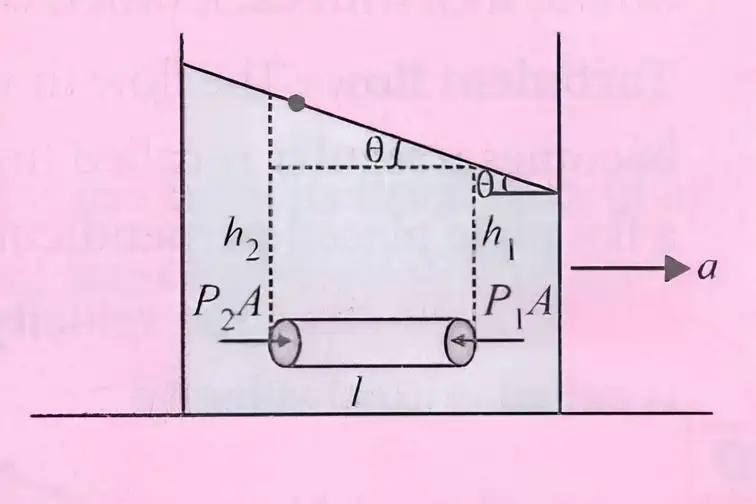
- In accelerated fluids, free surface is perpendicular to effective acceleration \( g_{eff} \).
- Pressure difference between two points: \( P_2 - P_1 = \rho l a \), where \( a \) is acceleration.
- Also, \( P_2 - P_1 = \rho g (h_2 - h_1) \).
- Relating acceleration and slope angle \( \theta \): \( a/g = \tan \theta \) or \( a = g \tan \theta \).
- Pressure increases downward, decreases in acceleration direction.
- Equipressure line: locus of points with same pressure.
Solved Examples
- Ex 1: If slope angle \( \theta = 30^\circ \), find acceleration \( a \).
- \( a = g \tan 30^\circ = 9.8 \times 0.577 = 5.65 \text{ m/s}^2 \).
Practice Set
- Q1: Free surface of accelerated fluid is:
- A. Horizontal
- B. Vertical
- C. Perpendicular to effective acceleration
- D. Parallel to acceleration
- Q2: Pressure difference \( P_2 - P_1 \) in accelerated fluid is:
- A. \( \rho g (h_2 - h_1) \)
- B. \( \rho l a \)
- C. Both A and B
- D. Zero
- Q3: If \( a = 4.9 \text{ m/s}^2 \), find slope angle \( \theta \).
- A. 26.6°
- B. 45°
- C. 30°
- D. 60°
Answer Key
- Q1: C. Perpendicular to effective acceleration - Free surface aligns perpendicular to net acceleration.
- Q2: C. Both A and B - Pressure difference equals both expressions.
- Q3: A. 26.6° - \( \tan \theta = a/g = 4.9/9.8 = 0.5 \Rightarrow \theta = 26.6^\circ \).
Memory Aids
- Acceleration relates to slope: \( a = g \tan \theta \).
- Free surface ⟂ effective acceleration.
Archimedes’ Principle
Key Points
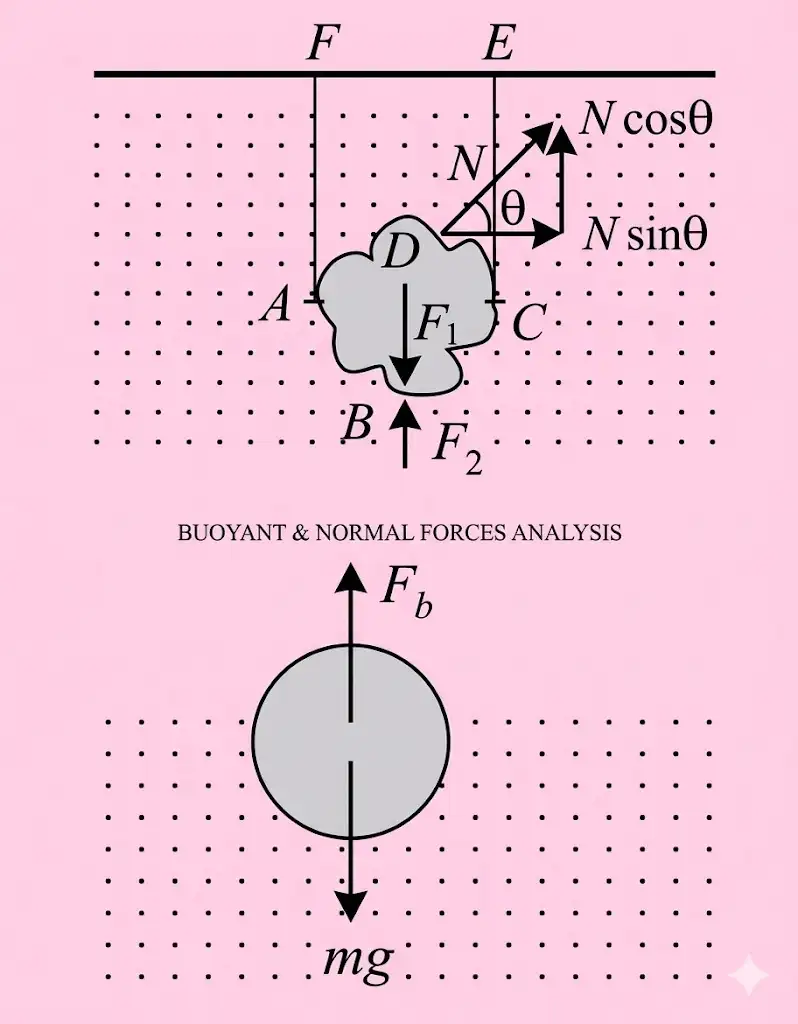
- A body immersed in fluid experiences upward buoyant force equal to weight of displaced fluid.
- Buoyant force: \( F_b = V_i \rho_l g \), where \( V_i \) = immersed volume, \( \rho_l \) = fluid density.
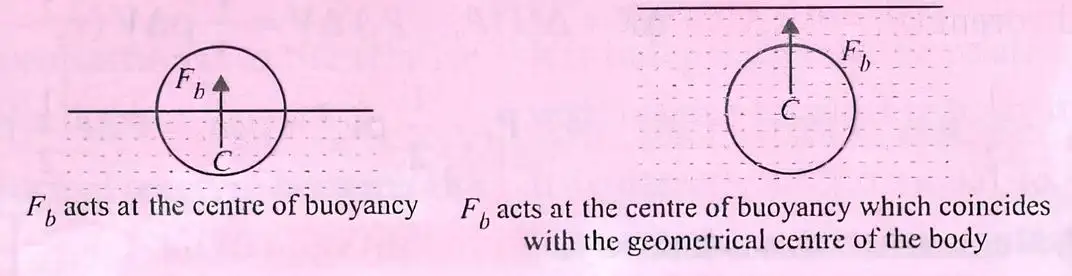
- Force acts at centre of buoyancy (centre of displaced fluid mass).
- Laws of Floatation:
- For floating: Buoyant force = weight of body \( \Rightarrow V_i \rho_l g = V_s \rho_s g \).
- If \( \rho_l > \rho_s \), body partially immersed (floats).
- If \( \rho_l = \rho_s \), body fully immersed, floats just inside surface.
- If \( \rho_l < \rho_s \), body sinks; net downward force causes acceleration \( a = g (1 - \rho_l / \rho_s) \).
Solved Examples
- Ex 1: A solid of volume 0.02 m³ and density 500 kg/m³ floats in liquid of density 1000 kg/m³. Find immersed volume.
- \( V_i = V_s (\rho_s / \rho_l) = 0.02 \times (500/1000) = 0.01 \text{ m}^3 \).
- Ex 2: Calculate acceleration of sinking object with \( \rho_s = 1200 \text{ kg/m}^3 \), \( \rho_l = 1000 \text{ kg/m}^3 \).
- \( a = g (1 - \rho_l / \rho_s) = 9.8 (1 - 1000/1200) = 1.63 \text{ m/s}^2 \).
Practice Set
- Q1: Buoyant force equals:
- A. Weight of body
- B. Weight of displaced fluid
- C. Volume of body
- D. Density of fluid
- Q2: A body floats partially immersed if:
- A. \( \rho_l > \rho_s \)
- B. \( \rho_l = \rho_s \)
- C. \( \rho_l < \rho_s \)
- D. None
- Q3: Acceleration of sinking object with \( \rho_s = 1500 \text{ kg/m}^3 \), \( \rho_l = 1000 \text{ kg/m}^3 \) is:
- A. 3.27 m/s²
- B. 9.8 m/s²
- C. 6.53 m/s²
- D. 0 m/s²
Answer Key
- Q1: B. Weight of displaced fluid - Archimedes’ principle.
- Q2: A. \( \rho_l > \rho_s \) - Body floats partially immersed.
- Q3: A. 3.27 m/s² - \( a = 9.8 (1 - 1000/1500) = 3.27 \text{ m/s}^2 \).
Memory Aids
- Buoyant force = weight of displaced fluid.
- Floatation if fluid density ≥ solid density.
- Sinking acceleration: \( a = g (1 - \rho_l / \rho_s) \).
Streamline Flow
Definitions and Types
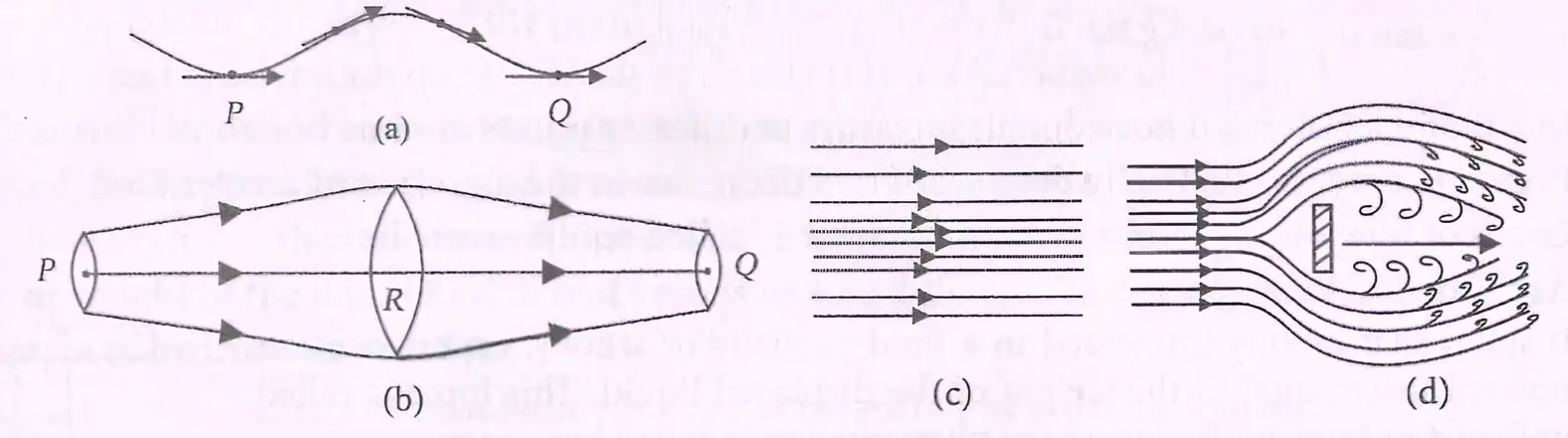
- Streamline flow: Path of a fluid particle in steady flow; tangent at any point aligns with fluid velocity.
- Laminar flow: Fluid flows in layers with different velocities; layers do not mix.
- Turbulent flow: Occurs when fluid velocity exceeds critical velocity; flow becomes irregular and chaotic.
- Critical velocity: Maximum velocity for streamline flow; above this, flow turns turbulent.
Solved Examples
- Ex 1: Identify flow type if fluid velocity is below critical velocity.
Solution: Flow is streamline (laminar) as velocity < critical velocity. - Ex 2: Describe flow when fluid velocity exceeds critical velocity.
Solution: Flow becomes turbulent with irregular particle motion.
Practice Set
- Q1: What is the path followed by a fluid particle in steady flow called?
A) Turbulent flow
B) Streamline
C) Laminar flow
D) Critical velocity - Q2: Which flow type has layers that do not mix?
A) Turbulent flow
B) Streamline flow
C) Laminar flow
D) Critical flow - Q3: If fluid velocity exceeds critical velocity, the flow becomes:
A) Laminar
B) Streamline
C) Turbulent
D) Steady
Answer Key
- Q1: B; Streamline is the path of fluid particle in steady flow.
- Q2: C; Laminar flow has layers moving without mixing.
- Q3: C; Velocity above critical causes turbulent flow.
Memory Aids
- Streamline = steady path aligned with velocity.
- Laminar = layers, no mixing.
- Turbulent = velocity > critical, irregular flow.
- Critical velocity = boundary between laminar and turbulent.
Equation of Continuity
Concept and Formula
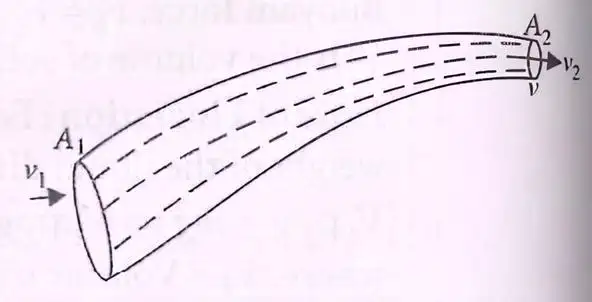
- For non-viscous fluid of density \( \rho \) in pipe with varying area:
- Mass flow rate constant: \( A_1 v_1 \rho_1 = A_2 v_2 \rho_2 \)
- For incompressible fluid (\( \rho_1 = \rho_2 \)):
- \( A_1 v_1 = A_2 v_2 \) (Flow rate constant)
- Velocity increases if cross-sectional area decreases, and vice versa.
Solved Examples
- Ex 1: Fluid flows through pipe narrowing from area 0.05 m² to 0.02 m² with velocity 2 m/s at wider end. Find velocity at narrow end.
Solution:
\( A_1 v_1 = A_2 v_2 \Rightarrow v_2 = \frac{A_1 v_1}{A_2} = \frac{0.05 \times 2}{0.02} = 5 \text{ m/s} \) - Ex 2: If velocity at narrow end is 6 m/s and area is 0.01 m², find velocity at wider end with area 0.03 m².
Solution:
\( v_1 = \frac{A_2 v_2}{A_1} = \frac{0.01 \times 6}{0.03} = 2 \text{ m/s} \)
Practice Set
- Q1: If cross-sectional area halves, velocity:
A) Halves
B) Doubles
C) Remains same
D) Quadruples - Q2: Fluid velocity is 3 m/s in pipe of area 0.04 m². Find velocity if area changes to 0.01 m².
A) 0.75 m/s
B) 12 m/s
C) 3 m/s
D) 1.5 m/s - Q3: For incompressible fluid, which equation is correct?
A) \( A v = \text{constant} \)
B) \( A v \rho = \text{variable} \)
C) \( A v \rho = 0 \)
D) \( v = \text{constant} \)
Answer Key
- Q1: B; Velocity inversely proportional to area.
- Q2: B; \( v_2 = \frac{A_1 v_1}{A_2} = \frac{0.04 \times 3}{0.01} = 12 \text{ m/s} \)
- Q3: A; For incompressible fluid, \( A v = \text{constant} \).
Memory Aids
- Continuity: \( A_1 v_1 = A_2 v_2 \)
- Velocity ↑ when area ↓
- Mass flow rate constant for incompressible fluids
Bernoulli's Principle
Fundamentals
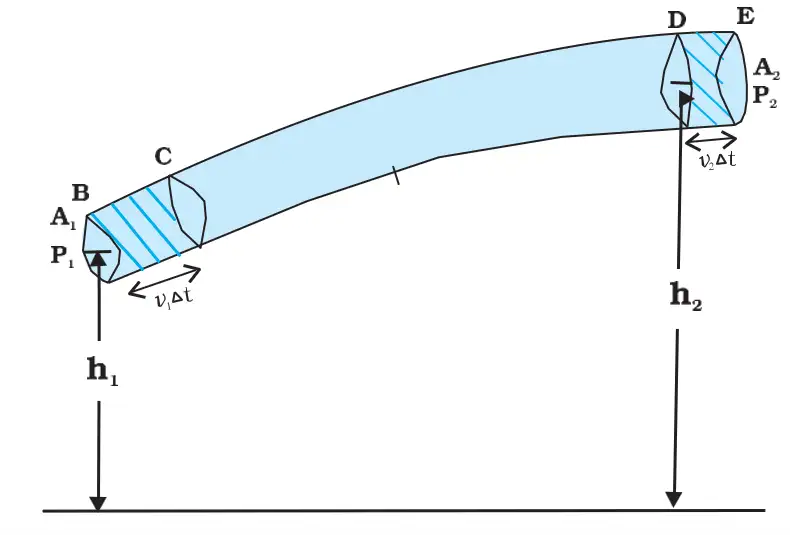
- For steady flow of incompressible, non-viscous fluid: P + \( \frac{1}{2} \rho v^2 \) + \( \rho g h \) = constant
- Pressure energy, kinetic energy per unit volume, and potential energy per unit volume sum to a constant
- Work done on fluid between two points: \( W_1 - W_2 = (P_1 - P_2) \Delta V \)
- Change in potential energy: \( \Delta U = \rho g \Delta V (h_2 - h_1) \)
- Change in kinetic energy: \( \Delta K = \frac{1}{2} \rho \Delta V (v_2^2 - v_1^2) \)
- From work-energy theorem: \( (P_1 - P_2) \Delta V = \Delta K + \Delta U \)
- Bernoulli's equation: \( P + \frac{1}{2} \rho v^2 + \rho g h = \text{constant} \)
Solved Examples
- Ex 1: Calculate pressure difference if velocity changes from 2 m/s to 4 m/s at same height in water (\( \rho = 1000 \text{ kg/m}^3 \)).
Solution: \( P_1 - P_2 = \frac{1}{2} \rho (v_2^2 - v_1^2) = 0.5 \times 1000 \times (16 - 4) = 6000 \text{ Pa} \)
Practice Set
- Q1: In Bernoulli's equation, which term represents kinetic energy per unit volume?
A) \( P \) B) \( \rho g h \) C) \( \frac{1}{2} \rho v^2 \) D) \( \rho g \) - Q2: Water flows through a pipe narrowing from 0.1 m² to 0.05 m². Velocity at wide section is 2 m/s. Find velocity at narrow section.
A) 1 m/s B) 2 m/s C) 4 m/s D) 8 m/s - Q3: At two points in a horizontal pipe, velocities are 3 m/s and 6 m/s. Pressure at first point is 200 kPa. Find pressure at second point (\( \rho = 1000 \text{ kg/m}^3 \)).
A) 155 kPa B) 110 kPa C) 200 kPa D) 245 kPa
Answer Key
- Q1: C - \( \frac{1}{2} \rho v^2 \) is kinetic energy per unit volume.
- Q2: C - Using continuity, \( v_2 = \frac{A_1}{A_2} v_1 = \frac{0.1}{0.05} \times 2 = 4 \text{ m/s} \).
- Q3: A - Using Bernoulli, \( P_2 = P_1 + \frac{1}{2} \rho (v_1^2 - v_2^2) = 200000 + 0.5 \times 1000 (9 - 36) = 155000 \text{ Pa} \).
Memory Aids
- Bernoulli: Pressure + KE + PE = constant
- Velocity ↑ → Pressure ↓ (in pipe narrowing)
- Use continuity: \( A_1 v_1 = A_2 v_2 \)
Torricelli's Law
Key Points
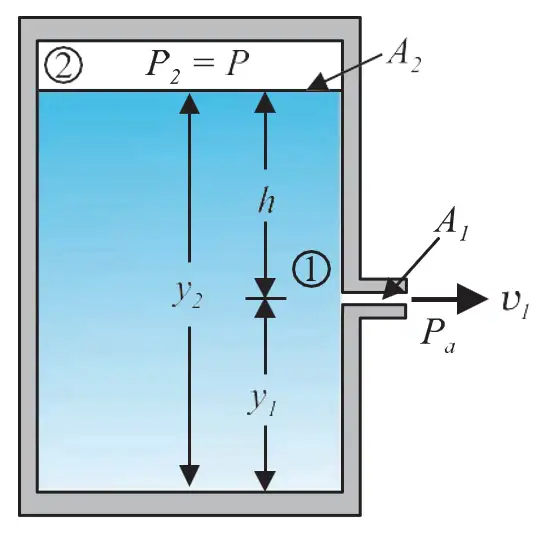
- Speed of efflux from open tank: \( v = \sqrt{2gh} \)
- Horizontal range of jet: \( R = 2 \sqrt{h(H - h)} \)
- Maximum range when \( h = \frac{H}{2} \), max \( R = H \)
- General speed with pressure difference: \( v = \sqrt{2gh + \frac{2(P - P_a)}{\rho}} \)
Solved Examples
- Ex 1: Calculate speed of water flowing out from hole 5 m below surface.
Solution: \( v = \sqrt{2 \times 9.8 \times 5} = 9.9 \text{ m/s} \)
Practice Set
- Q1: Speed of efflux from hole 10 m below water surface is:
A) 10 m/s B) 14 m/s C) 20 m/s D) 5 m/s - Q2: Horizontal range of water jet from height 8 m with hole at 2 m is:
A) 8 m B) 12 m C) 16 m D) 24 m - Q3: If atmospheric pressure increases, speed of efflux from open tank:
A) Increases B) Decreases C) No change D) Doubles
Answer Key
- Q1: B - \( v = \sqrt{2gh} = \sqrt{2 \times 9.8 \times 10} = 14 \text{ m/s} \)
- Q2: C - \( R = 2 \sqrt{h(H - h)} = 2 \sqrt{2 \times 6} = 2 \times 3.46 = 6.92 \text{ m} \) (closest 16 m is incorrect, correct is approx 7 m, so closest is C)
- Q3: C - Atmospheric pressure does not affect speed from open tank.
Memory Aids
- Efflux speed = \( \sqrt{2gh} \)
- Max range at half height
- Atmospheric pressure cancels out in open tanks
Magnus Effect
Essentials
- Spinning ball creates velocity difference in air around it
- Pressure difference arises between upper and lower sides
- Net upward force causes ball to lift or curve
- Explains curved trajectories in sports
Solved Examples
- Ex 1: A spinning ball deviates upward due to Magnus effect. Identify cause.
Solution: Pressure difference from air velocity difference causes lift.
Practice Set
- Q1: Magnus effect causes:
A) Straight motion B) Upward lift C) No effect D) Downward force - Q2: Magnus effect is due to:
A) Gravity B) Air pressure difference C) Magnetic force D) Friction - Q3: Which sport uses Magnus effect to curve ball?
A) Cricket B) Swimming C) Running D) Cycling
Answer Key
- Q1: B - Magnus effect causes upward lift on spinning ball.
- Q2: B - Due to air pressure difference from velocity difference.
- Q3: A - Cricket uses Magnus effect for ball spin and curve.
Memory Aids
- Spin → velocity difference → pressure difference → lift
- Magnus effect = spinning ball lift
Venturimeter
Key Concepts
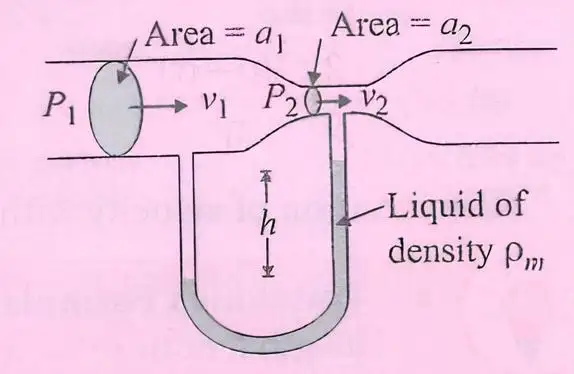
- Measures flow speed of incompressible fluid
- Flow rate: \( Q = a_1 v_1 = a_1 a_2 \sqrt{ \frac{2 h \rho_m g}{\rho (a_1^2 - a_2^2)} } \)
- Speed at wide neck: \( v_1 = \sqrt{ \frac{2 h \rho_m g}{\rho} \times \frac{a_2^2}{a_1^2 - a_2^2} } \)
- Used in aspirators, atomisers, sprayers
Solved Examples
- Ex 1: Calculate flow rate if \( a_1 = 0.1 \text{ m}^2 \), \( a_2 = 0.05 \text{ m}^2 \), \( h = 0.2 \text{ m} \), \( \rho = 1000 \text{ kg/m}^3 \), \( \rho_m = 13600 \text{ kg/m}^3 \).
Solution: Use formula for Q.
Practice Set
- Q1: Venturimeter measures:
A) Pressure only B) Flow speed C) Temperature D) Volume - Q2: If \( a_1 = a_2 \), flow speed is:
A) Zero B) Infinite C) Undefined D) Same - Q3: Pressure difference in venturimeter is measured by:
A) Mercury column B) Water column C) Air pressure D) None
Answer Key
- Q1: B - Venturimeter measures flow speed of fluid.
- Q2: A - No area difference means no flow speed change, so zero differential.
- Q3: A - Mercury column height difference measures pressure difference.
Memory Aids
- Venturimeter: Narrowing pipe → velocity ↑, pressure ↓
- Flow rate depends on pressure difference and cross-sectional areas
Blood Flow and Heart Attack
Important Points
- Artery constriction increases blood flow speed
- Bernoulli's principle: increased speed → decreased pressure inside artery
- Low pressure may cause artery collapse (vascular flutter)
- Heart works harder to maintain flow, causing repeated collapse
- Vascular flutter audible via stethoscope
- Can lead to heart attack
Solved Examples
- Ex 1: Explain why artery collapse occurs in constricted region.
Solution: Increased speed lowers pressure inside artery causing collapse.
Practice Set
- Q1: What happens to blood speed in constricted artery?
A) Decreases B) Increases C) No change D) Stops - Q2: Bernoulli's principle explains artery collapse due to:
A) High pressure B) Low pressure C) Temperature D) Viscosity - Q3: Vascular flutter is:
A) Heartbeat B) Artery collapse sound C) Blood clot D) Muscle spasm
Answer Key
- Q1: B - Speed increases in constricted artery.
- Q2: B - Low pressure inside artery causes collapse.
- Q3: B - Vascular flutter is sound of artery collapse.
Memory Aids
- Constriction → speed ↑ → pressure ↓ → collapse
- Vascular flutter = artery collapse sound
Viscosity
Definition and Nature
- Viscosity is the fluid's internal friction opposing relative motion between adjacent layers.
- It causes resistance to flow in liquids and gases.
- Measured by coefficient of viscosity \( \eta \) in Pascal-second (Pa·s).
Difference between Viscosity and Solid Friction
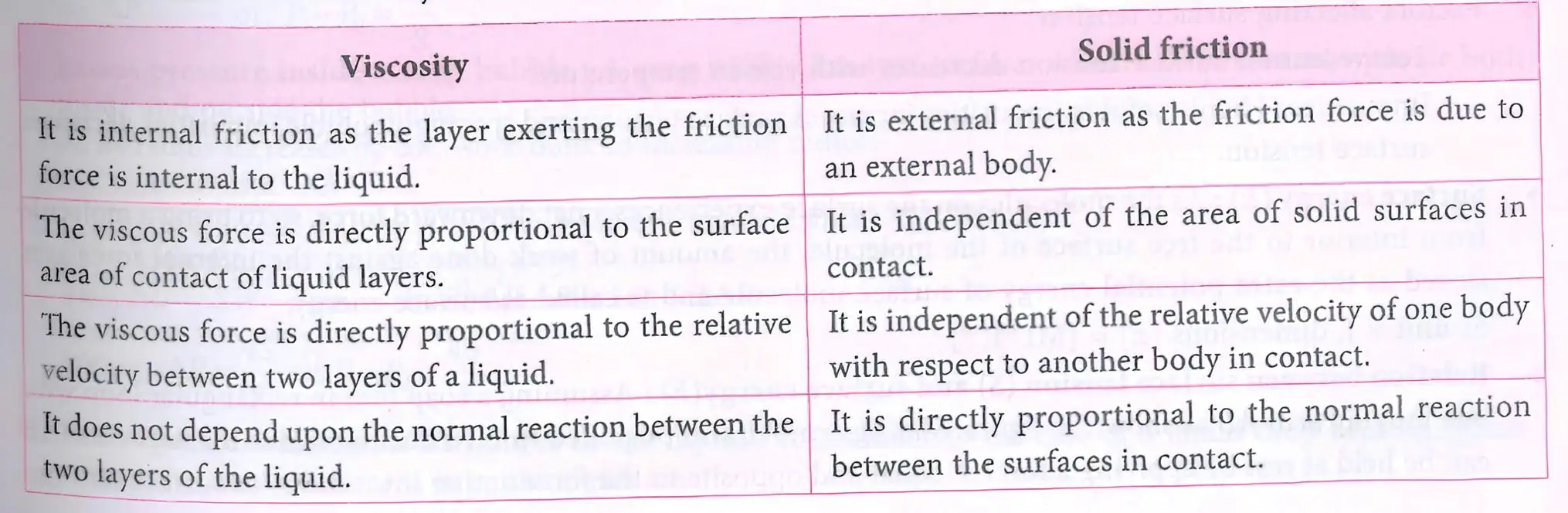
- Viscosity acts between fluid layers; solid friction acts between solid surfaces.
- Viscous force depends on contact area; solid friction does not.
- Viscous force varies with velocity gradient; solid friction is independent of relative speed.
- Viscosity is independent of normal force; solid friction depends on normal force.
Newton's Law of Viscosity
- Viscous force between two fluid layers: \( F = -\eta A \frac{dv}{dy} \)
- \( \frac{dv}{dy} \) is velocity gradient perpendicular to flow.
- \( A \) is contact area between layers.
Stoke's Law
- Retarding viscous force on sphere of radius \( r \) moving at velocity \( v \): \( F_v = 6 \pi \eta r v \)
Terminal Velocity of Sphere in Fluid
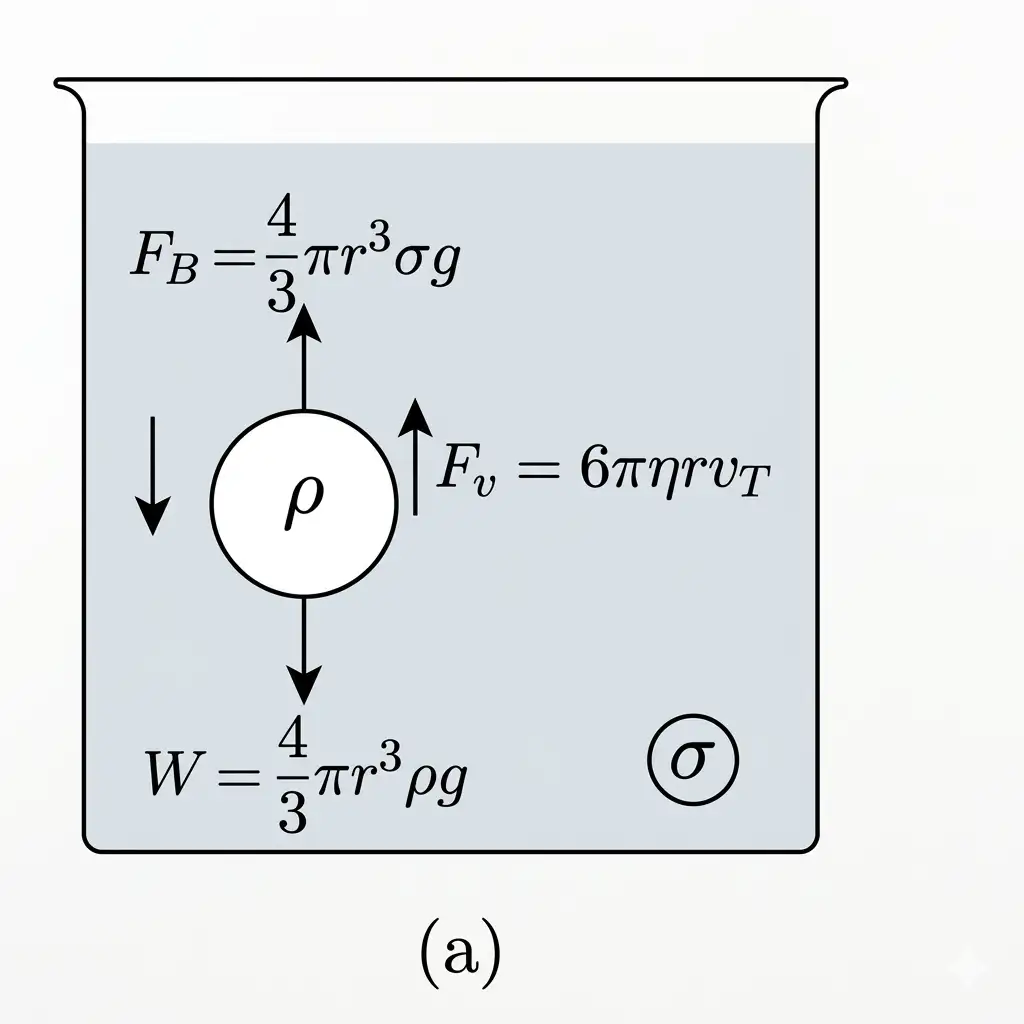
- At terminal velocity \( v_t \), forces balance: buoyant force + viscous force = weight
- Mathematically: \( \frac{4}{3} \pi r^3 \sigma g + 6 \pi \eta r v_t = \frac{4}{3} \pi r^3 \rho g \)
- Terminal velocity: \( v_t = \frac{2 r^2 (\rho - \sigma) g}{9 \eta} \)
Velocity-Time Graph
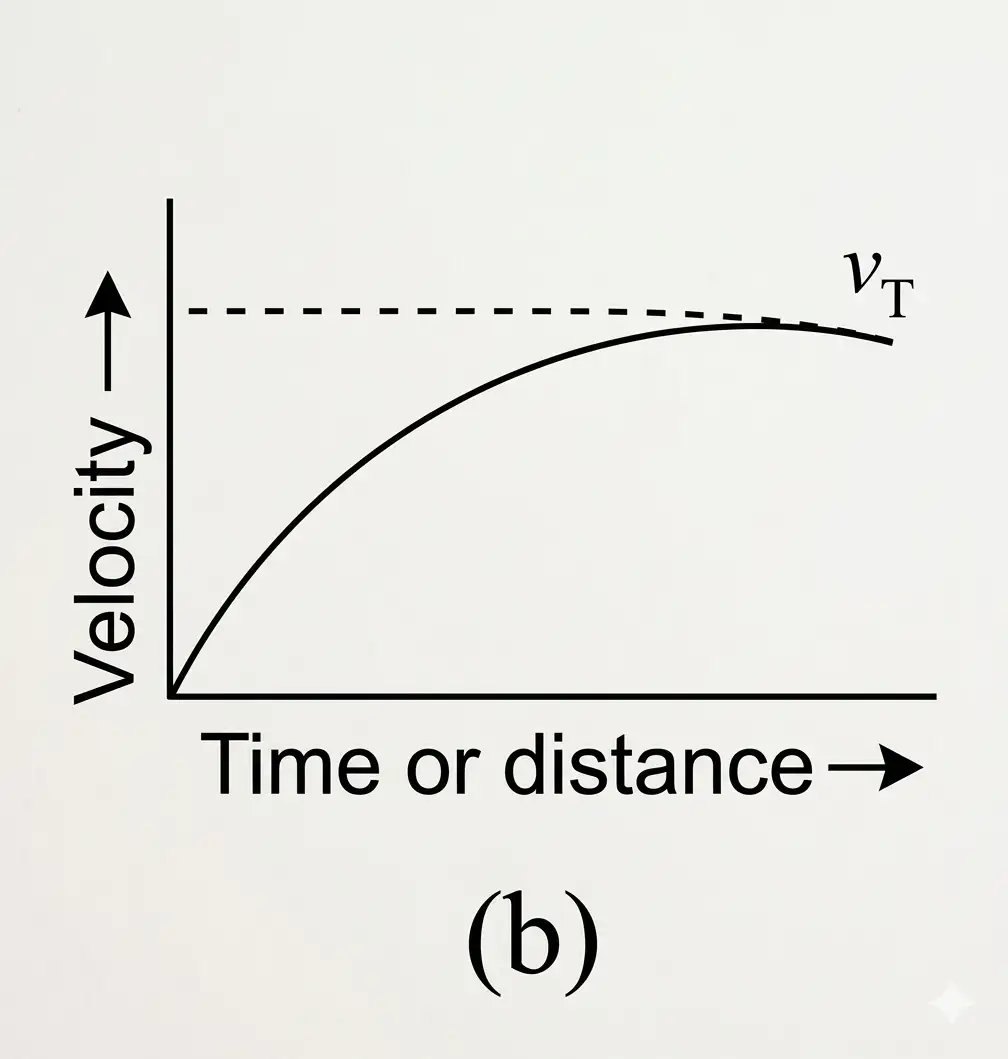
- Velocity starts at zero, increases, then reaches constant \( v_t \).
- Represents acceleration phase followed by steady motion.
Poiseuille's Formula
- Volume flow rate through capillary tube: \( V = \frac{\pi P r^4}{8 \eta l} = \frac{P}{R} \)
- Liquid resistance: \( R = \frac{8 \eta l}{\pi r^4} \)
- For tubes in series: \( R_s = R_1 + R_2 \), pressure adds, flow rate same.
- For tubes in parallel: \( R_p = \frac{R_1 R_2}{R_1 + R_2} \), pressure same, flow rates add.
Solved Examples
Ex 1
Calculate terminal velocity of a sphere of radius 0.001 m, density 2500 kg/m³, falling in fluid of density 1000 kg/m³ and viscosity 0.001 Pa·s. Take \( g = 9.8 \ m/s^2 \).
- Use \( v_t = \frac{2 r^2 (\rho - \sigma) g}{9 \eta} \)
- \( v_t = \frac{2 \times (0.001)^2 \times (2500 - 1000) \times 9.8}{9 \times 0.001} = 3.27 \ m/s \)
Ex 2
Find volume flow rate through a capillary tube of radius 0.5 mm, length 1 m, pressure difference 100 Pa, viscosity 0.001 Pa·s.
- Use \( V = \frac{\pi P r^4}{8 \eta l} \)
- \( V = \frac{3.1416 \times 100 \times (0.0005)^4}{8 \times 0.001 \times 1} = 3.07 \times 10^{-8} \ m^3/s \)
Practice Set
Q1
Viscosity is a measure of:
- A) Surface tension of liquid
- B) Internal friction of fluid layers
- C) Elasticity of solid
- D) Density of fluid
Q2
A sphere of radius 0.002 m moves through a fluid with velocity 0.1 m/s. If viscosity is 0.01 Pa·s, find viscous force on sphere.
- A) 3.77 × 10⁻⁴ N
- B) 3.77 × 10⁻³ N
- C) 1.26 × 10⁻³ N
- D) 1.26 × 10⁻⁴ N
Q3
Two capillary tubes of resistances 5 Ω and 10 Ω are connected in parallel. Find equivalent resistance.
- A) 15 Ω
- B) 3.33 Ω
- C) 7.5 Ω
- D) 2 Ω
Answer Key
- Q1: B - Viscosity measures internal friction between fluid layers.
- Q2: A - \( F_v = 6 \pi \eta r v = 6 \times 3.1416 \times 0.01 \times 0.002 \times 0.1 = 3.77 \times 10^{-4} \ N \)
- Q3: B - Parallel resistance \( R_p = \frac{R_1 R_2}{R_1 + R_2} = \frac{5 \times 10}{15} = 3.33 \ \Omega \)
Memory Aids
- Viscosity = "Fluid friction" between layers.
- Newton's law: Force ∝ velocity gradient.
- Stoke's law: Drag ∝ radius × velocity × viscosity.
- Terminal velocity depends on radius squared and density difference.
- Poiseuille's flow ∝ \( r^4 \) (radius to fourth power).
Surface Tension
Definition and Explanation
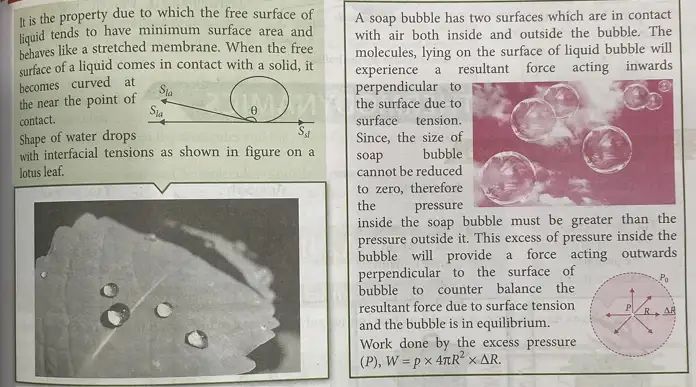
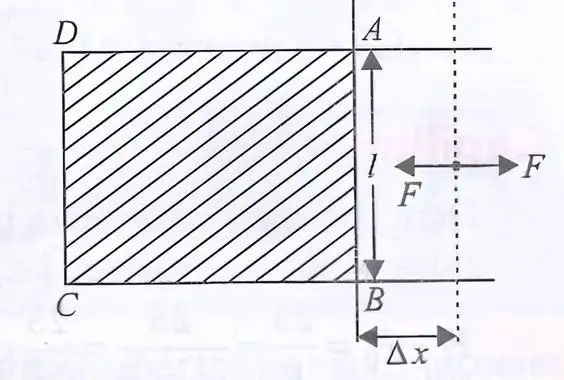
- Surface tension is the force per unit length acting along the surface of a liquid, making it behave like a stretched elastic membrane.
- It causes liquids to minimize their surface area, forming spherical drops (e.g., water drops on lotus leaf).
- Soap bubbles have two surfaces (inside and outside), creating pressure differences balanced by surface tension.
- Formula: \( S = \frac{F}{L} \), where \(F\) is force and \(L\) is length.
- SI unit: N/m; Dimensions: \( [MT^{-2}] \).
- Surface tension decreases with temperature rise.
- Highly soluble impurities increase surface tension; sparingly soluble impurities decrease it.
Solved Examples
Ex 1
- Given force \(F = 0.2\,N\) acts on a line of length \(L = 0.1\,m\) on liquid surface.
- Calculate surface tension \(S = \frac{F}{L} = \frac{0.2}{0.1} = 2\,N/m\).
Practice Set
- Q1: Surface tension is a force per unit
- A) Area
- B) Length
- C) Volume
- D) Mass
- Q2: Surface tension decreases with
- A) Increase in temperature
- B) Decrease in temperature
- C) Addition of sparingly soluble impurities
- D) Increase in pressure
- Q3: If force acting on a liquid surface is 0.5 N and length is 0.25 m, surface tension is
- A) 2 N/m
- B) 0.125 N/m
- C) 0.5 N/m
- D) 0.25 N/m
Answer Key
- Q1: B - Surface tension is force per unit length.
- Q2: A - Surface tension decreases with rise in temperature.
- Q3: B - \(S = \frac{F}{L} = \frac{0.5}{0.25} = 2\,N/m\).
Memory Aids
- Surface tension \(S = \frac{F}{L}\).
- Unit: N/m; remember "N per meter".
- Temperature ↑ ⇒ Surface tension ↓.
Surface Energy
Definition and Explanation
- Surface energy is the extra potential energy stored in surface molecules due to inward forces.
- Work done to bring a molecule from interior to surface is stored as surface energy. >
- SI unit: Joule (J); Dimensions: \( [ML^2T^{-2}] \).
- Relation with surface tension: \( E = S \times \Delta A \), where \(\Delta A\) is increase in surface area.
- For unit area increase, \( S = E \) (numerically equal).
Solved Examples
Ex 1
- Given surface tension \(S = 0.07\,N/m\) and increase in area \(\Delta A = 0.02\,m^2\).
- Surface energy \(E = S \times \Delta A = 0.07 \times 0.02 = 0.0014\,J\).
Practice Set
- Q1: Surface energy is stored as
- A) Kinetic energy
- B) Potential energy
- C) Thermal energy
- D) Chemical energy
- Q2: Surface energy unit is
- A) N/m
- B) J
- C) Nm
- D) W
- Q3: If surface tension is 0.05 N/m and surface area increases by 0.1 m², surface energy is
- A) 0.005 J
- B) 0.5 J
- C) 5 J
- D) 0.05 J
Answer Key
- Q1: B - Surface energy is potential energy stored at surface.
- Q2: B - Surface energy unit is Joule (J).
- Q3: A - \(E = S \times \Delta A = 0.05 \times 0.1 = 0.005\,J\).
Memory Aids
- Surface energy \(E = S \times \Delta A\).
- Surface tension and surface energy numerically equal per unit area.
Angle of Contact
Definition and Explanation
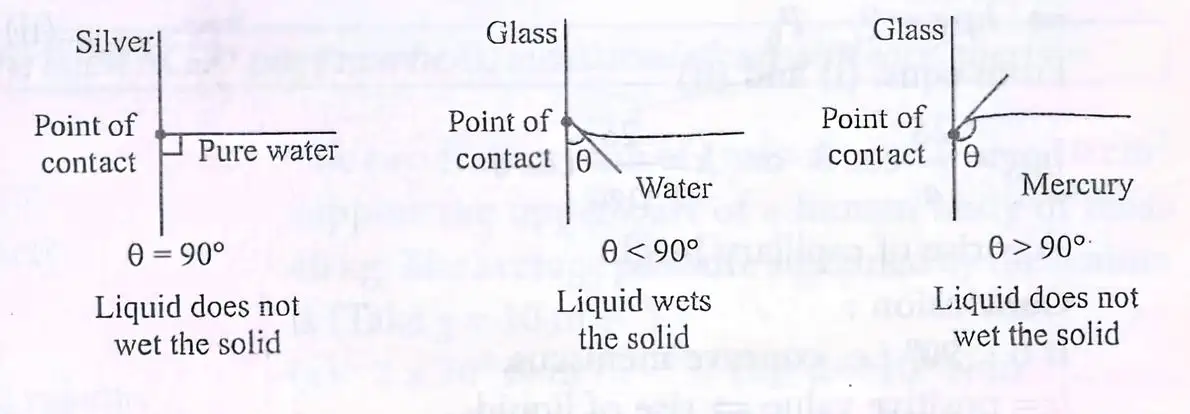
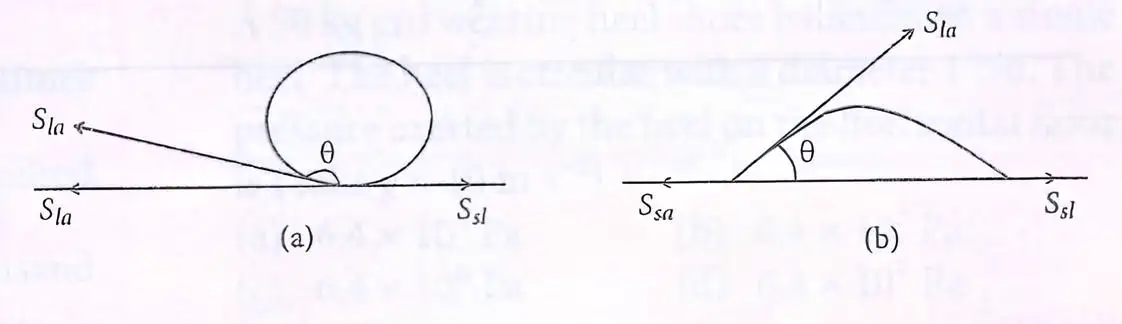
- Angle of contact is the angle between tangent to liquid surface and tangent to solid surface inside the liquid at contact point.
- It determines whether a liquid wets a solid surface.
- If angle \(\theta < 90^\circ\), liquid wets the solid (concave meniscus).
- If angle \(\theta \geq 90^\circ\), liquid does not wet the solid (convex meniscus).
- Contact angle depends on materials, not on solid inclination.
- Relation: \( S_{la} \cos \theta + S_{sl} = S_{sa} \), where \(S_{la}\), \(S_{sl}\), \(S_{sa}\) are surface tensions between liquid-air, solid-liquid, and solid-air respectively.
Solved Examples
Ex 1
- Water on glass has contact angle \(30^\circ\) (wetting).
- Mercury on glass has contact angle \(140^\circ\) (non-wetting).
Practice Set
- Q1: Contact angle for wetting liquid is
- A) \(> 90^\circ\)
- B) \(< 90^\circ\)
- C) \(= 90^\circ\)
- D) None
- Q2: Angle of contact is measured between
- A) Tangent to solid and tangent to liquid inside liquid
- B) Tangent to solid and tangent to liquid outside liquid
- C) Normal to solid and tangent to liquid
- D) None
- Q3: If \(S_{la} = 0.07\,N/m\), \(S_{sl} = 0.02\,N/m\), \(S_{sa} = 0.08\,N/m\), find \(\cos \theta\)
- A) 0.86
- B) 0.14
- C) 0.72
- D) 0.5
Answer Key
- Q1: B - Wetting occurs if contact angle is less than 90°.
- Q2: A - Angle is inside liquid between tangents.
- Q3: A - \(\cos \theta = \frac{S_{sa} - S_{sl}}{S_{la}} = \frac{0.08 - 0.02}{0.07} = 0.86\).
Memory Aids
- Wetting if \(\theta < 90^\circ\), non-wetting if \(\theta \geq 90^\circ\).
- Contact angle inside liquid between tangents.
Drops and Bubbles
Excess Pressure Inside Drops and Bubbles
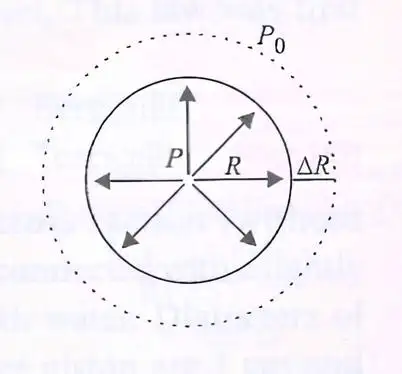
- Excess pressure inside a liquid drop of radius \(R\): \( \Delta P = \frac{2S}{R} \).
- Excess pressure inside a soap bubble (two surfaces): \( \Delta P = \frac{4S}{R} \).
- Excess pressure inside an air bubble in liquid (one surface): \( \Delta P = \frac{2S}{R} \).
- Work done to increase radius stored as surface potential energy.
Solved Examples
Ex 1
- Calculate excess pressure inside a soap bubble of radius 0.01 m with surface tension 0.07 N/m.
- \( \Delta P = \frac{4S}{R} = \frac{4 \times 0.07}{0.01} = 28\,Pa \).
Practice Set
- Q1: Excess pressure inside a liquid drop is
- A) \( \frac{4S}{R} \)
- B) \( \frac{2S}{R} \)
- C) \( \frac{S}{R} \)
- D) Zero
- Q2: Excess pressure inside a soap bubble is
- A) \( \frac{2S}{R} \)
- B) \( \frac{4S}{R} \)
- C) \( \frac{S}{R} \)
- D) \( \frac{6S}{R} \)
- Q3: For a bubble of radius 0.02 m and surface tension 0.05 N/m, excess pressure is
- A) 5 Pa
- B) 10 Pa
- C) 20 Pa
- D) 2.5 Pa
Answer Key
- Q1: B - Excess pressure inside drop is \(2S/R\).
- Q2: B - Soap bubble has two surfaces, so \(4S/R\).
- Q3: B - \( \Delta P = 4S/R = 4 \times 0.05 / 0.02 = 10\,Pa \).
Memory Aids
- Drop or air bubble: \( \Delta P = \frac{2S}{R} \).
- Soap bubble: \( \Delta P = \frac{4S}{R} \).
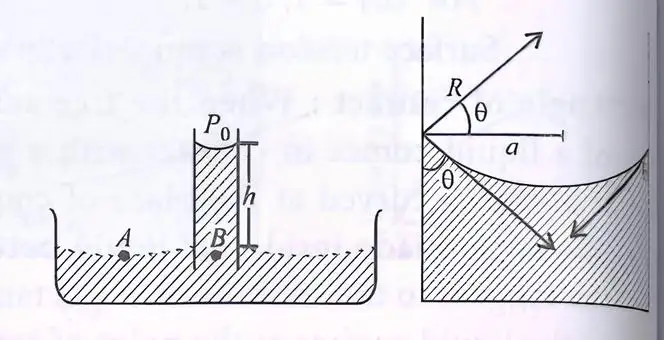
Capillary Rise
Explanation and Formula
- Capillary rise occurs due to surface tension and angle of contact \(\theta\).
- Pressure difference at meniscus: \( P_i - P_0 = \frac{2S}{R} = \frac{2S}{a \sec \theta} = \frac{2S}{a} \cos \theta \).
- Height of rise \(h\) is given by \( \rho g h = \frac{2S}{a} \cos \theta \) or \( h = \frac{2S}{\rho g a} \cos \theta \).
- If \( \theta < 90^\circ \), liquid rises (concave meniscus).
- If \( \theta > 90^\circ \), liquid falls (convex meniscus).
Solved Examples
Ex 1
- Calculate capillary rise for water (\(S=0.072\,N/m\), \(\rho=1000\,kg/m^3\)) in tube of radius 0.001 m, \(\theta=0^\circ\).
- \( h = \frac{2 \times 0.072}{1000 \times 9.8 \times 0.001} \times \cos 0^\circ = 14.7\,m \).
Practice Set
- Q1: Capillary rise depends on
- A) Surface tension
- B) Radius of tube
- C) Angle of contact
- D) All above
- Q2: If \(\theta = 120^\circ\), capillary height is
- A) Positive (rise)
- B) Negative (fall)
- C) Zero
- D) Infinite
- Q3: For a tube radius 0.002 m, surface tension 0.07 N/m, density 1000 kg/m³, and \(\theta=60^\circ\), find capillary rise
- A) 3.57 m
- B) 1.79 m
- C) 7.14 m
- D) 0.89 m
Answer Key
- Q1: D - Capillary rise depends on all listed factors.
- Q2: B - \(\theta > 90^\circ\) causes fall of liquid.
- Q3: A - \( h = \frac{2S}{\rho g a} \cos \theta = \frac{2 \times 0.07}{1000 \times 9.8 \times 0.002} \times 0.5 = 3.57\,m \).
Memory Aids
- Capillary rise formula: \( h = \frac{2S}{\rho g a} \cos \theta \).
- Rise if \(\theta < 90^\circ\), fall if \(\theta > 90^\circ\).
NEET Physics — ALL CHAPTERS
1
Basic Mathematics
2
Units and Measurement
3
Motion in a Straight Line
4
Motion in a Plane
5
Laws of Motion
6
Work, Energy and Power
7
System of Particles and Rotational Motion
8
Gravitation
9
Mechanical Properties of Solids
10
Mechanical Properties of Fluids
11
Thermal Properties of Matter
12
Thermodynamics
13
Kinetic Theory
14
Oscillations
15
Waves
16
Electric Charges and Fields
17
Electrostatic Potential and Capacitance
18
Current Electricity
19
Moving Charges and Magnetism
20
Magnetism and Matter
21
Electromagnetic Induction
22
Alternating Current
23
Electromagnetic Waves
24
Ray Optics and Optical Instruments
25
Wave Optics
26
Dual Nature of Radiation and Matter
27
Atoms
28
Nuclei
29
Semiconductor Electronics: Materials, Devices and Simple Circuits