NEET Ug . NEET Physics . Physics . Moving Charges and Magnetism
Chapter 19: Moving Charges and Magnetism
Ch 19
NEET Physics
NEET Ug
Introduction
Key Points
- In 1820, Hans Christian Oersted discovered that electric current in a wire produces a magnetic field affecting a compass needle.
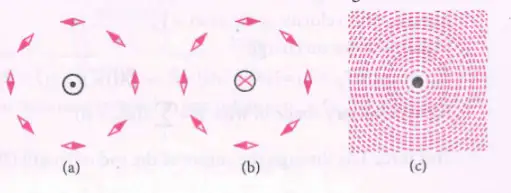
- The magnetic field lines form concentric circles around the wire; direction depends on current direction.
- A dot (⊙) indicates current/magnetic field coming out of the paper; a cross (⊗) indicates going into the paper.
- James Maxwell unified electricity and magnetism, showing light as an electromagnetic wave.
- Radio waves were discovered by Hertz and produced by J.C. Bose and G. Marconi.
- This chapter covers magnetic forces on moving charges and current-carrying wires, magnetic fields from currents, and galvanometer operation.
Solved Examples
- Ex 1: Determine the direction of magnetic field around a wire carrying current out of the paper.
- Use right-hand thumb rule: thumb points out of paper, fingers curl in direction of magnetic field.
Practice Set
- Q1: What does a dot (⊙) symbol represent in magnetic field diagrams?
- A) Field into paper
- B) Field out of paper
- C) No field
- D) Field parallel to paper
- Q2: Who unified electricity and magnetism?
- A) Oersted
- B) Maxwell
- C) Hertz
- D) Marconi
- Q3: The magnetic field lines around a current-carrying wire are:
- A) Straight lines
- B) Radial lines
- C) Concentric circles
- D) Random
Answer Key
- Q1: B - Dot (⊙) indicates magnetic field or current coming out of the paper.
- Q2: B - James Maxwell unified electricity and magnetism.
- Q3: C - Magnetic field lines form concentric circles around the wire.
Memory Aids
- Right-hand thumb rule: Thumb = current direction, fingers = magnetic field direction.
- Dot (⊙) = out of paper; Cross (⊗) = into paper.
Magnetic Force
Sources and Fields
- Moving charges and electric currents produce magnetic field \( \vec{B} \), a vector quantity defined at every point in space.
- Principle of Superposition: Total magnetic field is vector sum of fields from individual sources.
- Lorentz force on a charge \( q \) moving with velocity \( \vec{v} \) in electric \( \vec{E} \) and magnetic \( \vec{B} \) fields: \[ \vec{F} = q(\vec{E} + \vec{v} \times \vec{B}) = \vec{F}_e + \vec{F}_m \]
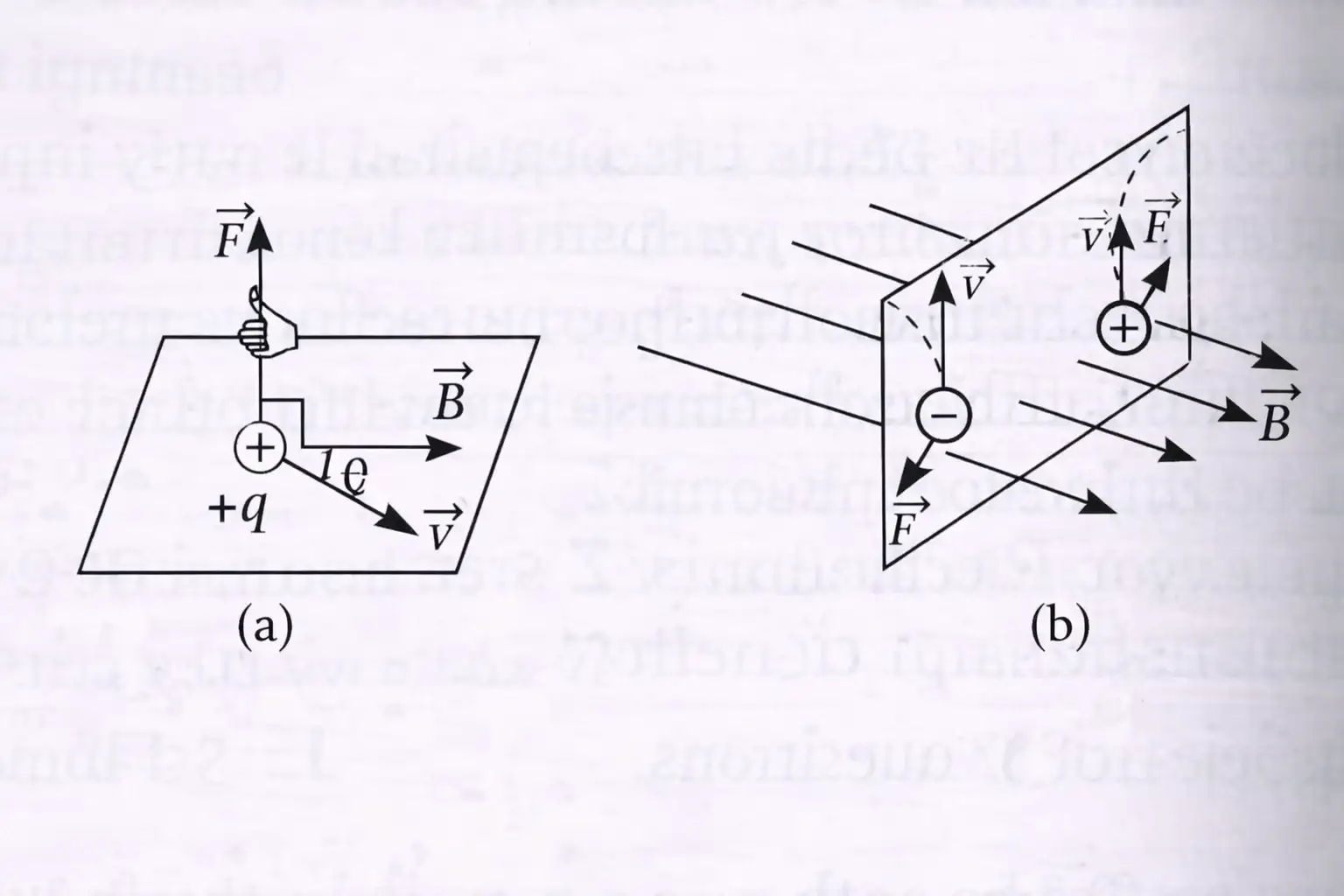
- Magnetic force magnitude: \[ |\vec{F}_m| = q v B \sin \theta \] where \( \theta \) is angle between \( \vec{v} \) and \( \vec{B} \).
- Magnetic force depends on charge \( q \), velocity \( \vec{v} \), and magnetic field \( \vec{B} \).
- Force is maximum when \( \vec{v} \perp \vec{B} \), zero when parallel or antiparallel.
- Only moving charges experience magnetic force.
- Direction of magnetic force on positive charge given by right-hand rule: point fingers along \( \vec{v} \), curl toward \( \vec{B} \), thumb points to \( \vec{F}_m \).
- Negative charges experience force in opposite direction.
- Unit of magnetic field (Tesla, T): \[ [B] = \frac{N}{C \cdot m/s} = \text{Tesla (T)} \] 1 gauss = \( 10^{-4} \) Tesla.
Magnetic Force on Current-Carrying Conductor
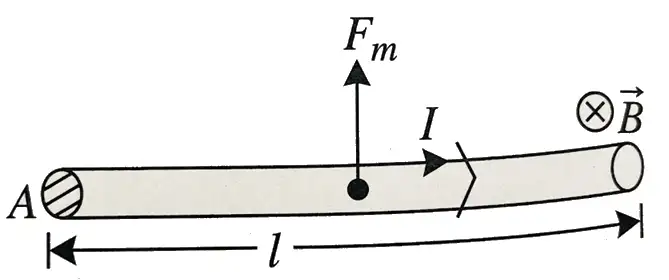
- Charge in conductor: \( q = n A l e \), where \( n \) = charge carrier density, \( A \) = cross-sectional area, \( l \) = length, \( e \) = charge.
- Drift velocity: \( \vec{v}_d \).
- Magnetic force on charges: \[ \vec{F}_m = (n A l) e (\vec{v}_d \times \vec{B}) = (\vec{J} A l) \times \vec{B} = I (\vec{l} \times \vec{B}) \] where \( \vec{J} = n e \vec{v}_d \) is current density, \( I \) is current, \( \vec{l} \) is length vector.
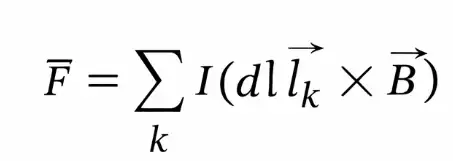
- For arbitrary wire shape: \[ \vec{F} = I \sum (d\vec{l}_k \times \vec{B}) \]
Solved Examples
- Ex 1: Calculate magnetic force on a wire of length 0.5 m carrying 3 A current perpendicular to a 0.2 T magnetic field.
- Use formula: \( F = I l B \sin 90^\circ = 3 \times 0.5 \times 0.2 = 0.3 \text{ N} \)
- Ex 2: Find direction of force on a positive charge moving right in a magnetic field into the page.
- Use right-hand rule: velocity right, magnetic field into page, force is upward.
Practice Set
- Q1: Magnetic force on a charge is zero when:
- A) \( \vec{v} \perp \vec{B} \)
- B) \( \vec{v} \parallel \vec{B} \)
- C) Charge is moving
- D) Magnetic field is zero
- Q2: Unit of magnetic field Tesla (T) is equivalent to:
- A) N/C
- B) N s C-1 m-1
- C) V/m
- D) Wb/m2
- Q3: A wire of length 0.4 m carries 5 A current in a magnetic field of 0.3 T at 60° angle. Find magnetic force magnitude.
- A) 0.6 N
- B) 0.52 N
- C) 1.0 N
- D) 0.3 N
Answer Key
- Q1: B - Force is zero when velocity is parallel or antiparallel to magnetic field.
- Q2: B - Tesla unit is N s C-1 m-1.
- Q3: A - \( F = I l B \sin \theta = 5 \times 0.4 \times 0.3 \times \sin 60^\circ = 0.6 \text{ N} \).
Memory Aids
- Magnetic force formula: \( F = q v B \sin \theta \).
- Force on wire: \( \vec{F} = I (\vec{l} \times \vec{B}) \).
- Right-hand rule for force direction on positive charges and current.
Motion in a Magnetic Field
Velocity Parallel or Anti-Parallel to Magnetic Field (\(\theta=0\) or \(\pi\))
- Magnetic force \(\vec{F} = q\vec{v} \times \vec{B} = 0\) since velocity and magnetic field are parallel.
- Particle moves in a straight line with constant speed.
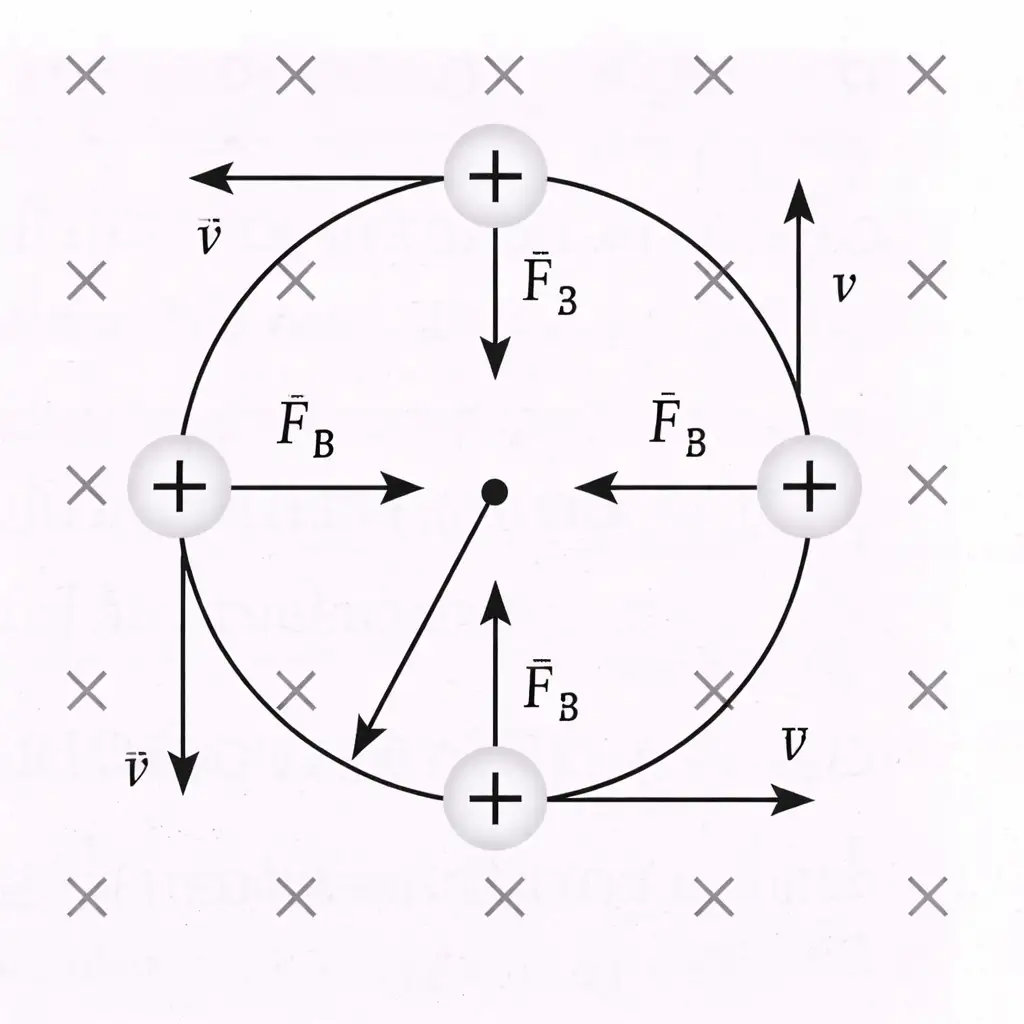
Velocity Perpendicular to Magnetic Field (\(\theta=\pi/2\))
- Magnetic force \(F_B = qvB\) acts perpendicular to velocity and magnetic field.
- Force acts as centripetal force: \(qvB = \frac{mv^2}{r}\).
- Radius of circular path: \(r = \frac{mv}{qB} = \frac{p}{qB} = \frac{\sqrt{2mK}}{qB}\), where \(p\) is momentum and \(K\) is kinetic energy.
- Time period of revolution: \(T = \frac{2\pi m}{qB}\).
- Frequency: \(f = \frac{qB}{2\pi m}\).
- Angular speed: \(\omega = \frac{qB}{m}\).
- Time period and frequency depend only on magnetic field \(B\) and charge-to-mass ratio \(\frac{q}{m}\), independent of speed and radius.
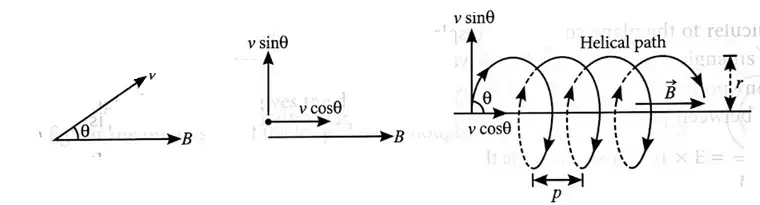
Velocity at an Angle to Magnetic Field (\(0 < \theta < \pi/2\))
- Velocity components: parallel \(v_{\parallel} = v \cos \theta\), perpendicular \(v_{\perp} = v \sin \theta\).
- Parallel component remains constant; perpendicular component causes circular motion.
- Particle moves in a helical path around magnetic field lines.
- Radius of circular motion: \(r = \frac{mv_{\perp}}{qB} = \frac{mv \sin \theta}{qB}\).
- Time period of revolution: \(T = \frac{2\pi m}{qB}\) (same as perpendicular case).
- Pitch of helix (distance moved along field in one revolution): \(P = v_{\parallel} T = \frac{2\pi m v \cos \theta}{qB}\).
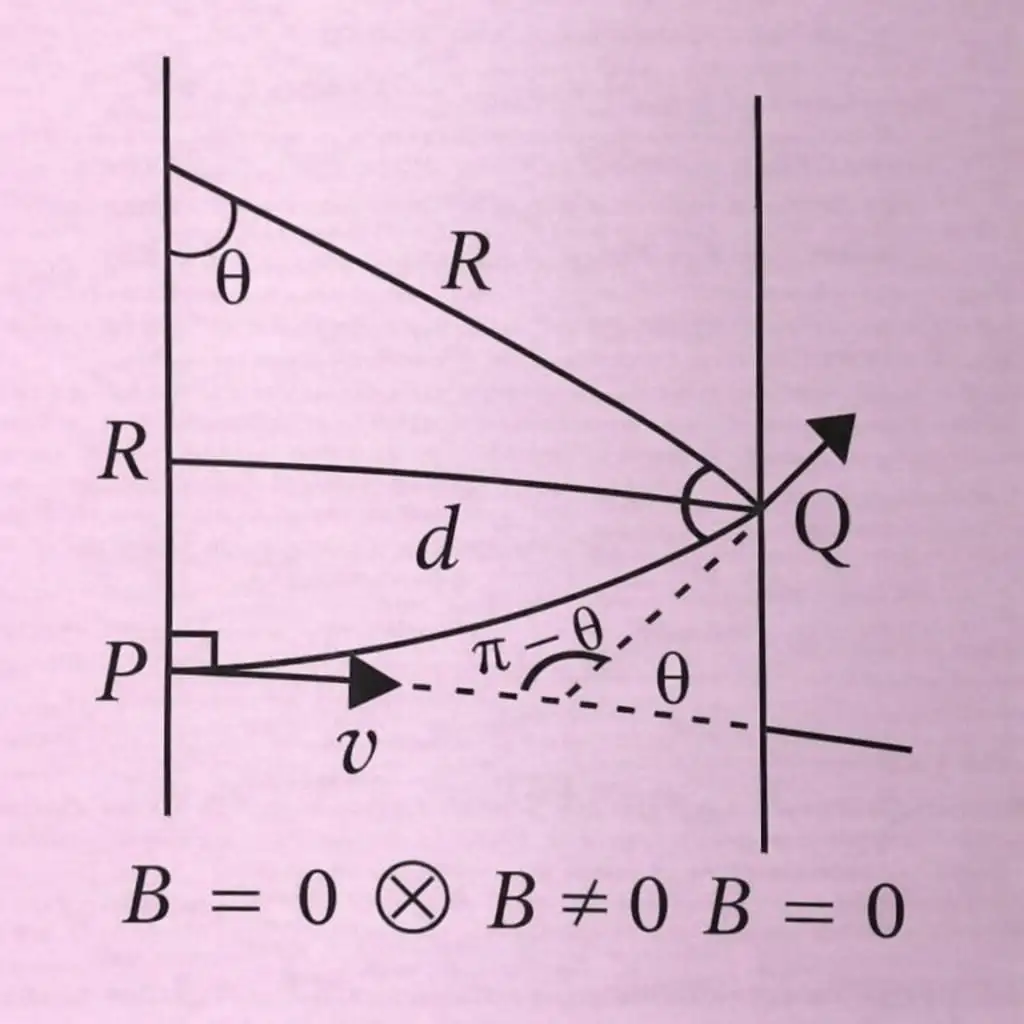
Deviation of Charged Particle in Magnetic Field
- Particle of charge \(q\) and mass \(m\) enters uniform magnetic field \(B\) of width \(d\).
- Moves in circular path of radius \(R = \frac{mv}{qB}\) inside field.
- Enters at point P, exits at Q, then moves straight.
- Angle of deviation \(\theta\) given by \(\sin \theta = \frac{d}{R}\) for \(d \leq R\).
- If \(d > R\), deviation angle \(\theta = \pi\) (particle reverses direction).
Solved Examples
Ex 1
- Calculate radius of circular path for electron (mass \(9.11 \times 10^{-31}\) kg, charge \(1.6 \times 10^{-19}\) C) moving at \(2 \times 10^6\) m/s in magnetic field \(0.01\) T.
- Use \(r = \frac{mv}{qB} = \frac{9.11 \times 10^{-31} \times 2 \times 10^6}{1.6 \times 10^{-19} \times 0.01} = 1.14 \times 10^{-3}\) m.
Ex 2
- Find time period of revolution for proton (mass \(1.67 \times 10^{-27}\) kg, charge \(1.6 \times 10^{-19}\) C) in magnetic field \(0.5\) T.
- Use \(T = \frac{2\pi m}{qB} = \frac{2\pi \times 1.67 \times 10^{-27}}{1.6 \times 10^{-19} \times 0.5} = 1.31 \times 10^{-7}\) s.
Ex 3
- A particle moves with velocity at \(30^\circ\) to magnetic field \(0.2\) T. Mass \(2 \times 10^{-27}\) kg, charge \(1.6 \times 10^{-19}\) C, speed \(3 \times 10^6\) m/s. Find radius of helical path.
- Calculate \(v_{\perp} = v \sin 30^\circ = 1.5 \times 10^6\) m/s.
- Radius \(r = \frac{mv_{\perp}}{qB} = \frac{2 \times 10^{-27} \times 1.5 \times 10^6}{1.6 \times 10^{-19} \times 0.2} = 9.38 \times 10^{-3}\) m.
Practice Set
Q1
- A charged particle moves parallel to a magnetic field. What is the path of the particle?
- A. Circular
- B. Helical
- C. Straight line
- D. Elliptical
Q2
- Radius of circular path of a charged particle in magnetic field depends on:
- A. Speed and magnetic field only
- B. Mass, speed, charge, and magnetic field
- C. Charge and magnetic field only
- D. Mass and charge only
Q3
- A proton moves with velocity \(4 \times 10^6\) m/s at \(60^\circ\) to a magnetic field of \(0.3\) T. Find the pitch of the helical path. (Mass of proton = \(1.67 \times 10^{-27}\) kg, charge = \(1.6 \times 10^{-19}\) C)
- A. \(2.2 \times 10^{-2}\) m
- B. \(4.4 \times 10^{-2}\) m
- C. \(1.1 \times 10^{-2}\) m
- D. \(3.3 \times 10^{-2}\) m
Answer Key
- Q1: C. No magnetic force acts when velocity is parallel; path is straight.
- Q2: B. Radius \(r = \frac{mv}{qB}\) depends on mass, speed, charge, and magnetic field.
- Q3: D. Pitch \(P = v_{\parallel} T = v \cos \theta \times \frac{2\pi m}{qB} = 4 \times 10^6 \times 0.5 \times \frac{2\pi \times 1.67 \times 10^{-27}}{1.6 \times 10^{-19} \times 0.3} = 3.3 \times 10^{-2}\) m.
Memory Aids
- Force zero if velocity \(\parallel\) magnetic field.
- Radius \(r = \frac{mv}{qB}\) for circular motion.
- Time period \(T = \frac{2\pi m}{qB}\) independent of speed.
- Helical path if velocity at angle; pitch \(P = v \cos \theta \times T\).
- Deviation angle \(\sin \theta = \frac{d}{R}\) for particle in magnetic field region.
Magnetic Field due to a Current Element, Biot-Savart Law
Explanation
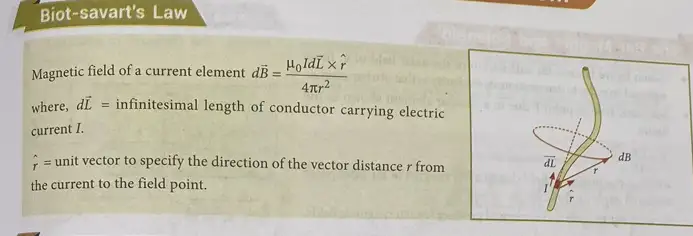
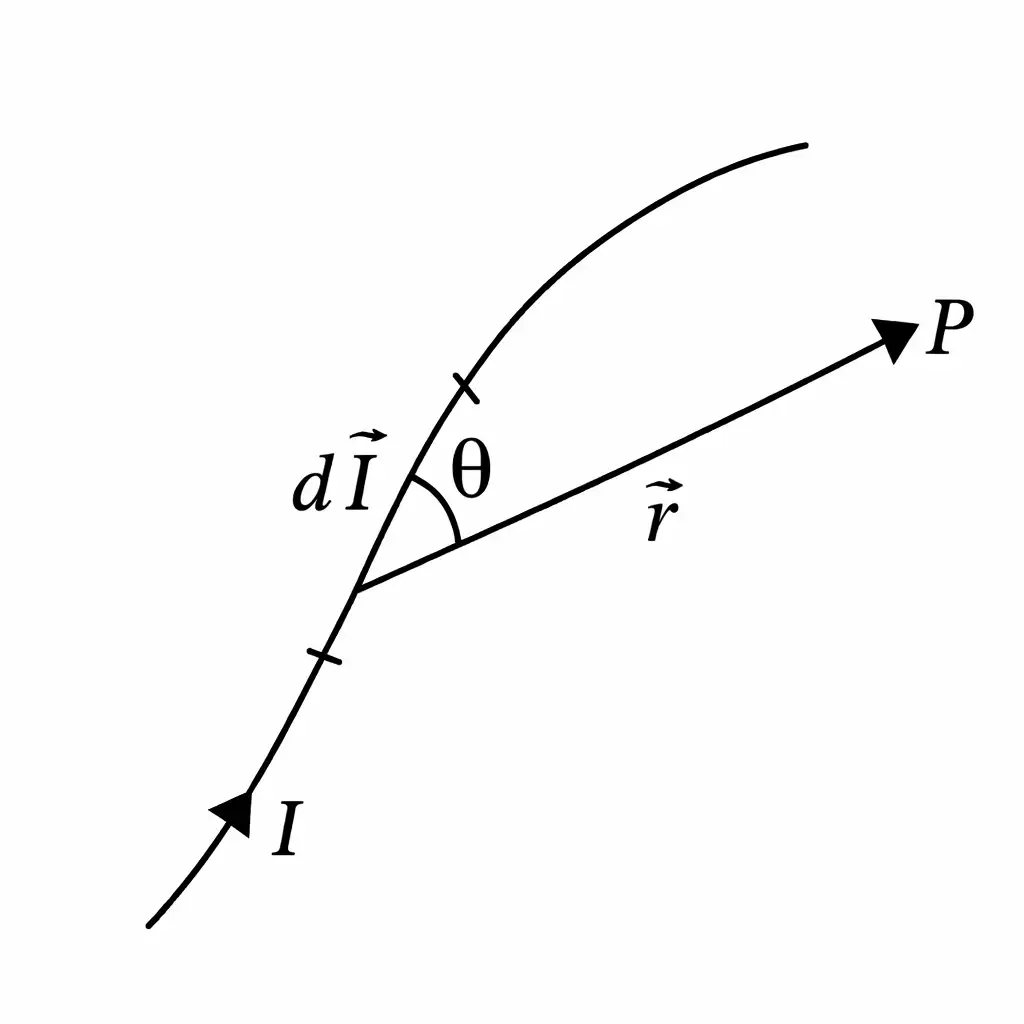
- A current element \( I d\vec{l} \) produces a magnetic field \( d\vec{B} \) at point P located at distance \( r \).
- Magnitude: \( |d\vec{B}| = \frac{\mu_0}{4\pi} \frac{I dl \sin \theta}{r^2} \), where \( \theta \) is angle between \( d\vec{l} \) and \( \vec{r} \).
- Vector form: \( d\vec{B} = \frac{\mu_0 I}{4\pi} \frac{d\vec{l} \times \vec{r}}{r^3} \).
- Direction of \( d\vec{B} \) is perpendicular to the plane containing \( d\vec{l} \) and \( \vec{r} \) (right-hand rule).
- Permeability of free space: \( \mu_0 = 4\pi \times 10^{-7} \ \mathrm{T \cdot m/A} \).
- Magnetic field is a vector field produced by vector source \( I d\vec{l} \), unlike electric field from scalar charge.
- Magnetic field depends on angle \( \theta \); zero along direction of \( d\vec{l} \).
- Relation: speed of light \( c = \frac{1}{\sqrt{\mu_0 \epsilon_0}} = 3 \times 10^8 \ \mathrm{m/s} \).
Solved Examples
- Ex 1: Calculate \( dB \) due to a current element \( I=2A \), length \( dl=0.01m \), at distance \( r=0.1m \), angle \( \theta=90^\circ \).
- Use formula: \( dB = \frac{\mu_0}{4\pi} \frac{I dl \sin \theta}{r^2} \)
- Substitute: \( dB = 10^{-7} \times \frac{2 \times 0.01 \times 1}{0.01} = 2 \times 10^{-7} \ \mathrm{T} \)
Practice Set
- Q1: The magnetic field \( dB \) due to a current element is zero when angle between \( d\vec{l} \) and \( \vec{r} \) is:
- A) 0°
- B) 45°
- C) 90°
- D) 180°
- Q2: The permeability of free space \( \mu_0 \) is:
- A) \( 4\pi \times 10^{-7} \ \mathrm{T \cdot m/A} \)
- B) \( 8.85 \times 10^{-12} \ \mathrm{F/m} \)
- C) \( 3 \times 10^8 \ \mathrm{m/s} \)
- D) \( 1.6 \times 10^{-19} \ \mathrm{C} \)
- Q3: The vector form of Biot-Savart law is:
- A) \( d\vec{B} = \frac{\mu_0 I}{4\pi} \frac{d\vec{l} \cdot \vec{r}}{r^3} \)
- B) \( d\vec{B} = \frac{\mu_0 I}{4\pi} \frac{d\vec{l} \times \vec{r}}{r^3} \)
- C) \( d\vec{B} = \frac{\mu_0 I}{4\pi} \frac{d\vec{l}}{r^2} \)
- D) \( d\vec{B} = \frac{\mu_0 I}{4\pi} \frac{\vec{r}}{r^2} \)
Answer Key
- Q1: A) 0° - Magnetic field is zero when \( \sin \theta = 0 \), i.e., \( \theta = 0^\circ \) or \( 180^\circ \).
- Q2: A) \( 4\pi \times 10^{-7} \ \mathrm{T \cdot m/A} \) - This is the permeability of free space.
- Q3: B) \( d\vec{B} = \frac{\mu_0 I}{4\pi} \frac{d\vec{l} \times \vec{r}}{r^3} \) - Vector form involves cross product.
Memory Aids
- Biot-Savart law formula: \( dB \propto I dl \sin \theta / r^2 \).
- Direction: Use right-hand thumb rule for \( d\vec{l} \times \vec{r} \).
- \( \mu_0 = 4\pi \times 10^{-7} \ \mathrm{T \cdot m/A} \).
- Magnetic field zero along current element direction.
Magnetic Field due to Current Carrying Straight Conductor
Explanation
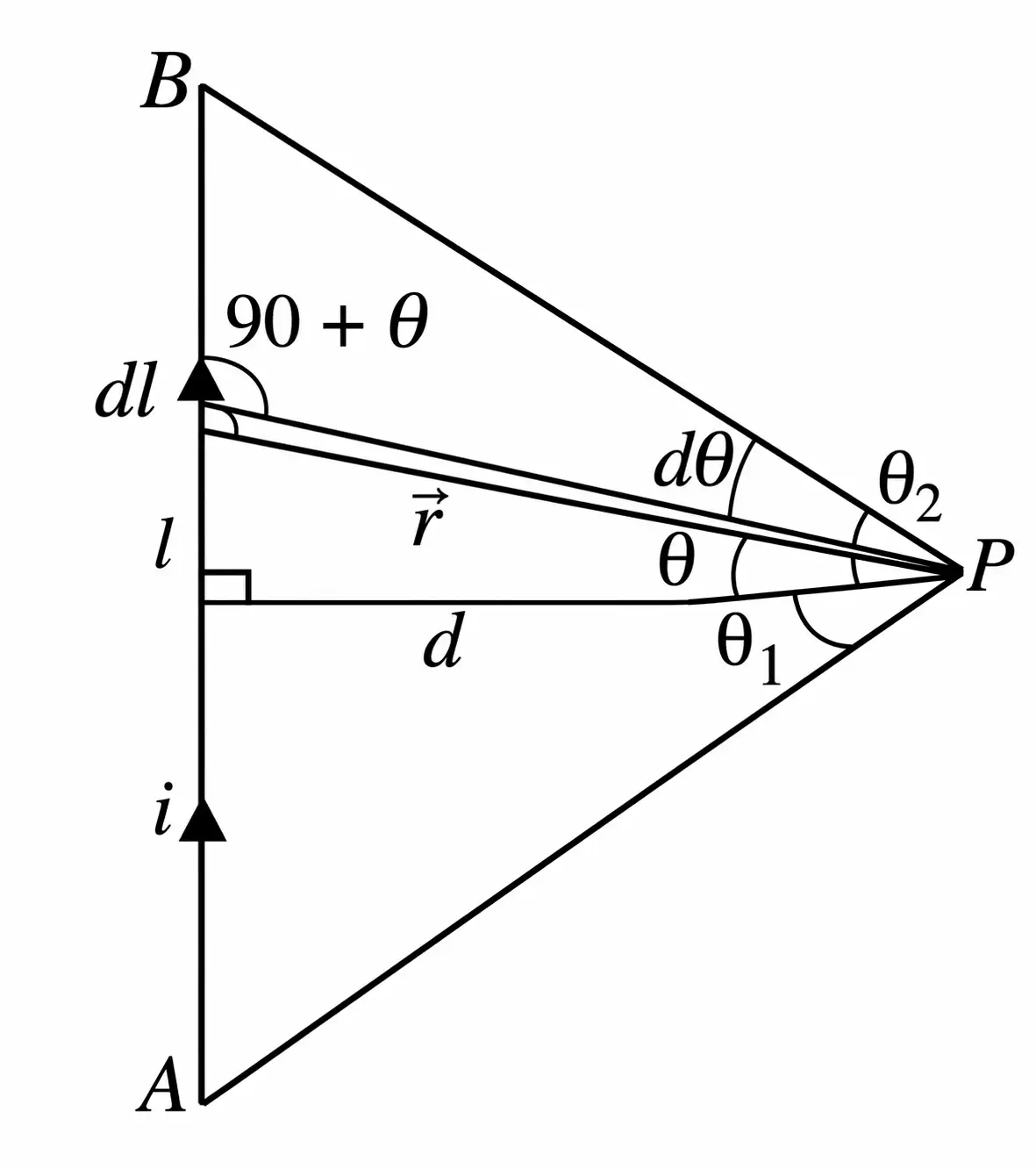
- Consider a straight wire AB carrying current \( I \), point P at perpendicular distance \( d \).
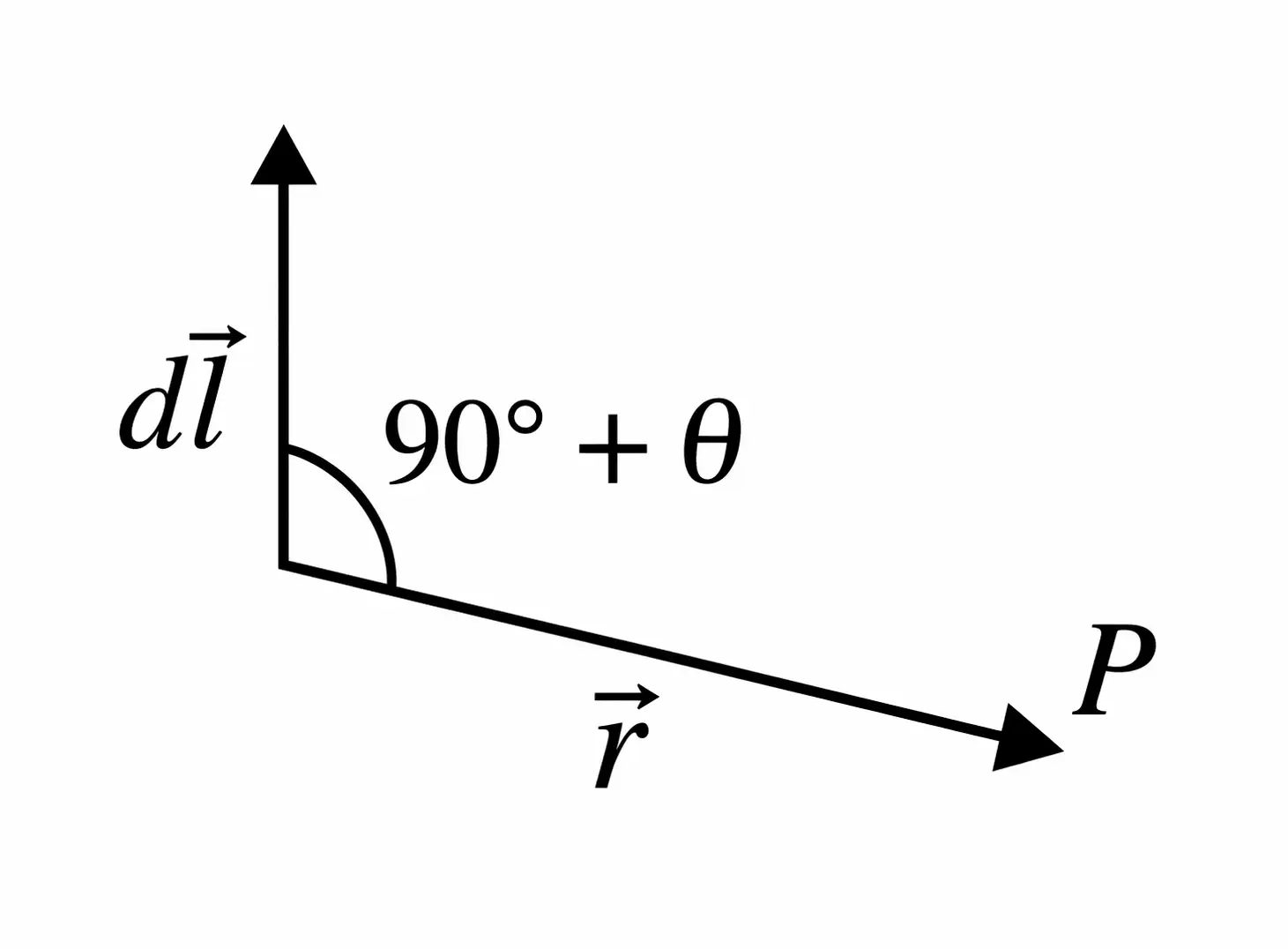
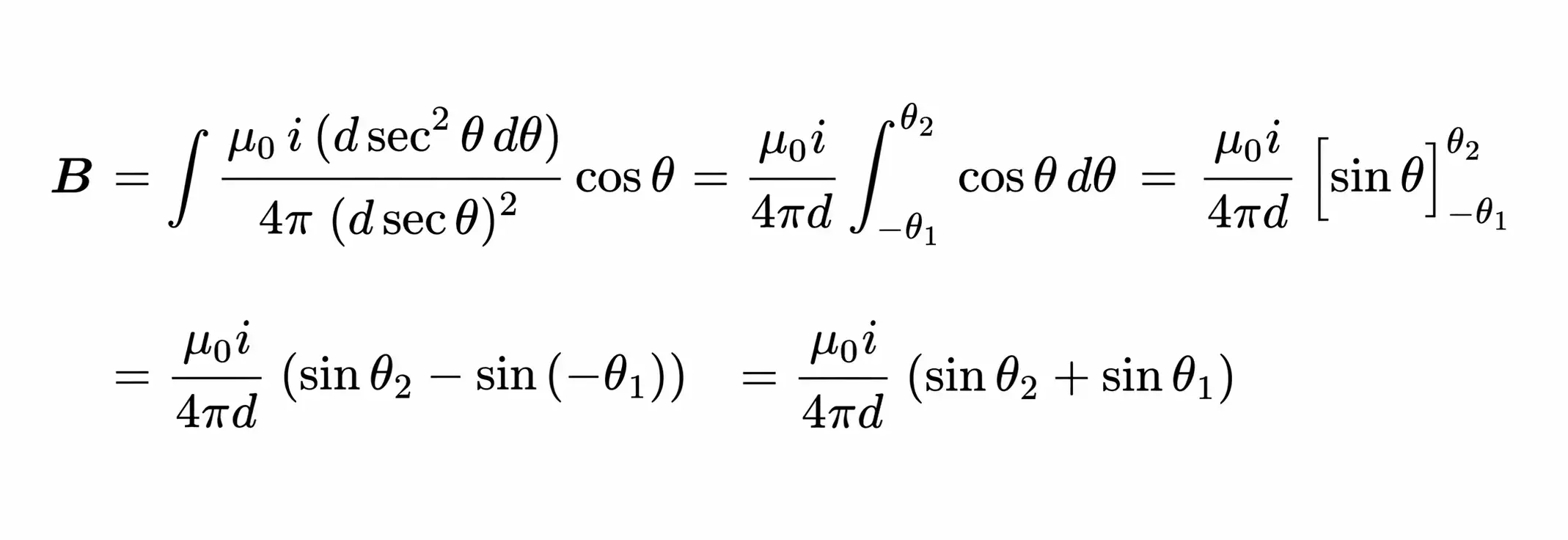
- Magnetic field contribution from element \( dl \) making angle \( 90^\circ + \theta \) with \( \vec{r} \): \( dB = \frac{\mu_0}{4\pi} \frac{I dl \sin(90^\circ + \theta)}{r^2} = \frac{\mu_0}{4\pi} \frac{I dl \cos \theta}{r^2} \).
- Using geometry: \( dl = d \sec^2 \theta d\theta \), \( r = d \sec \theta \).
- Total magnetic field at P: \[ B = \int dB = \frac{\mu_0 I}{4\pi d} \int_{\theta_1}^{\theta_2} \cos \theta d\theta = \frac{\mu_0 I}{4\pi d} (\sin \theta_2 - \sin \theta_1) \]
- For semi-infinite wire: \( \theta_1 = 0, \theta_2 = \frac{\pi}{2} \), so \( B = \frac{\mu_0 I}{4\pi d} \times 1 = \frac{\mu_0 I}{4\pi d} \).
- For infinite wire: \( \theta_1 = -\frac{\pi}{2}, \theta_2 = \frac{\pi}{2} \), so \( B = \frac{\mu_0 I}{2\pi d} \).
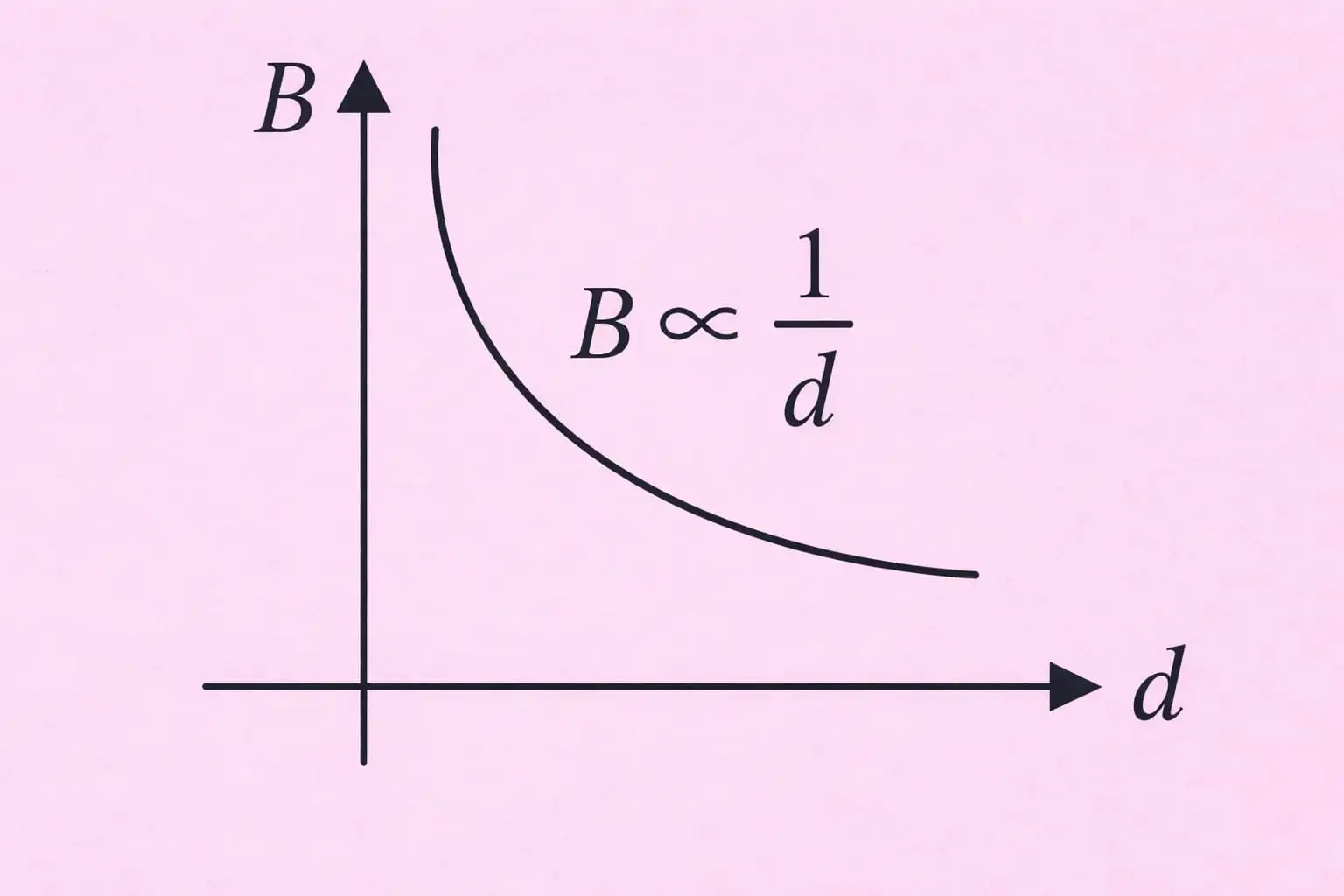
- Magnetic field decreases inversely with distance \( d \): \( B \propto \frac{1}{d} \).
Solved Examples
- Ex 1: Calculate magnetic field at point P due to a straight wire of length \( l=0.5m \), current \( I=3A \), distance \( d=0.1m \), angles \( \theta_1=30^\circ, \theta_2=90^\circ \).
- Use formula: \( B = \frac{\mu_0 I}{4\pi d} (\sin \theta_2 - \sin \theta_1) \)
- Calculate: \( B = 10^{-7} \times \frac{3}{0.1} (1 - 0.5) = 1.5 \times 10^{-6} \ \mathrm{T} \)
- Ex 2: Magnetic field due to infinite wire at distance \( d=0.2m \), current \( I=5A \).
- Use formula: \( B = \frac{\mu_0 I}{2\pi d} \)
- Calculate: \( B = \frac{4\pi \times 10^{-7} \times 5}{2\pi \times 0.2} = 5 \times 10^{-6} \ \mathrm{T} \)
Practice Set
- Q1: Magnetic field at point P due to semi-infinite wire carrying current \( I \) at distance \( d \) is:
- A) \( \frac{\mu_0 I}{2\pi d} \)
- B) \( \frac{\mu_0 I}{4\pi d} \)
- C) \( \frac{\mu_0 I}{\pi d} \)
- D) \( \frac{\mu_0 I}{8\pi d} \)
- Q2: For a finite wire, magnetic field depends on angles \( \theta_1 \) and \( \theta_2 \) as:
- A) \( \sin \theta_2 - \sin \theta_1 \)
- B) \( \cos \theta_2 - \cos \theta_1 \)
- C) \( \tan \theta_2 - \tan \theta_1 \)
- D) \( \sec \theta_2 - \sec \theta_1 \)
- Q3: Magnetic field at 0.1 m from infinite wire carrying 4 A current is:
- A) \( 8 \times 10^{-6} \ \mathrm{T} \)
- B) \( 2 \times 10^{-6} \ \mathrm{T} \)
- C) \( 4 \times 10^{-6} \ \mathrm{T} \)
- D) \( 1 \times 10^{-6} \ \mathrm{T} \)
Answer Key
- Q1: B) \( \frac{\mu_0 I}{4\pi d} \) - Semi-infinite wire formula.
- Q2: A) \( \sin \theta_2 - \sin \theta_1 \) - Magnetic field depends on sine difference of angles.
- Q3: C) \( 4 \times 10^{-6} \ \mathrm{T} \) - Using \( B = \frac{\mu_0 I}{2\pi d} \).
Memory Aids
- Magnetic field \( B \propto \frac{I}{d} \) for straight wire.
- Use \( B = \frac{\mu_0 I}{4\pi d} (\sin \theta_2 - \sin \theta_1) \) for finite wire.
- Infinite wire: \( B = \frac{\mu_0 I}{2\pi d} \).
- Angles \( \theta_1, \theta_2 \) measured from wire ends to point P.
Magnetic Field on the Axis of a Circular Current Loop
Concepts and Formulas
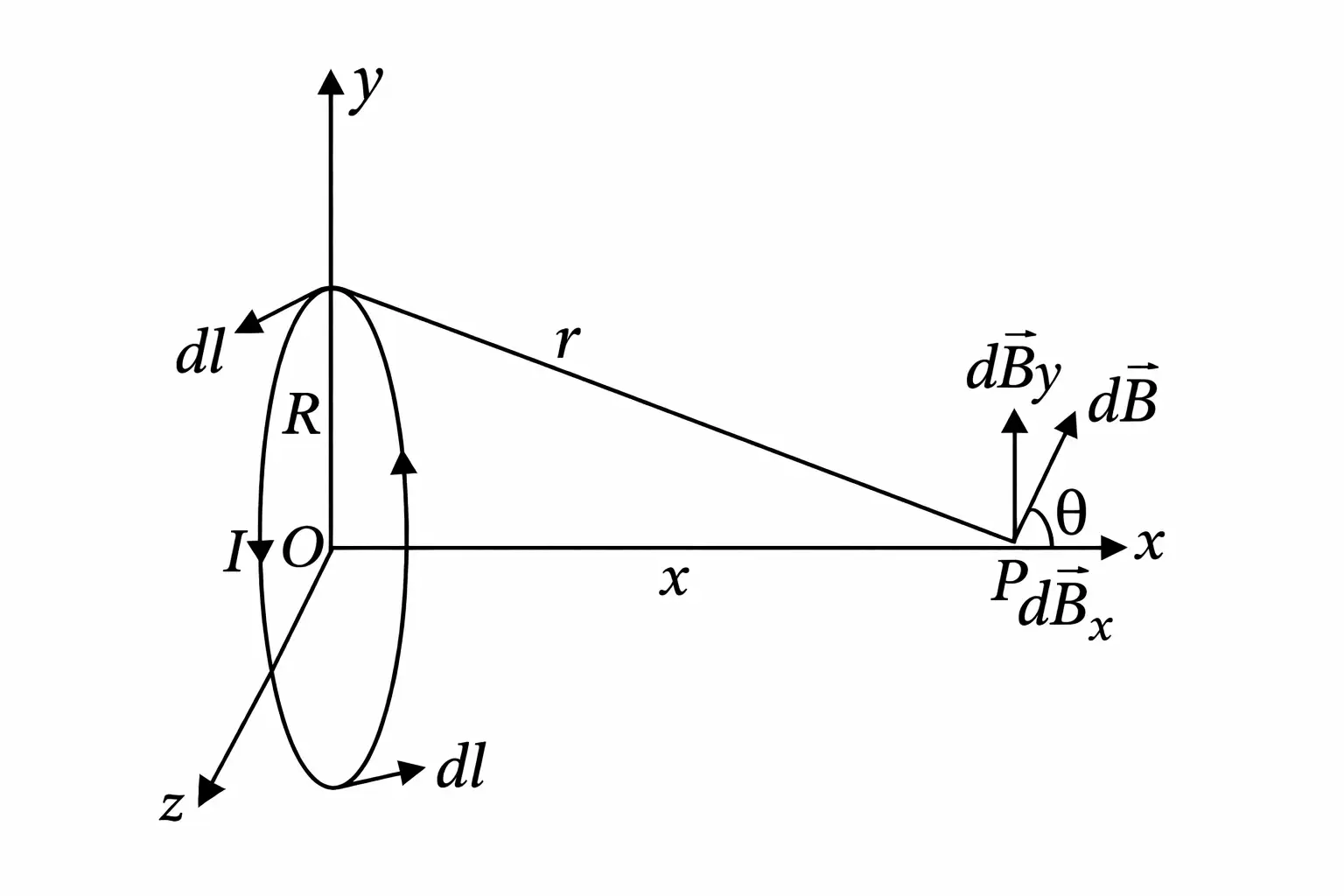
- Magnetic field due to small element \( d\vec{l} \) carrying current \( I \):
\( |d\vec{B}| = \frac{\mu_0}{4\pi} \frac{I |d\vec{l} \times \vec{r}|}{r^3} = \frac{\mu_0}{4\pi} \frac{I dl}{r^2} = \frac{\mu_0}{4\pi} \frac{I dl}{x^2 + R^2} \) - Due to symmetry, only the x-component \( dB_x = dB \cos \theta = \frac{\mu_0 I dl}{4\pi} \frac{R}{(x^2 + R^2)^{3/2}} \) contributes to net field.
- Net magnetic field at point \( P \) on axis:
\( \vec{B} = B_x \hat{i} = \frac{\mu_0 I R}{4\pi (x^2 + R^2)^{3/2}} \int dl \hat{i} \) - Since \( \int dl = 2\pi R \), total field:
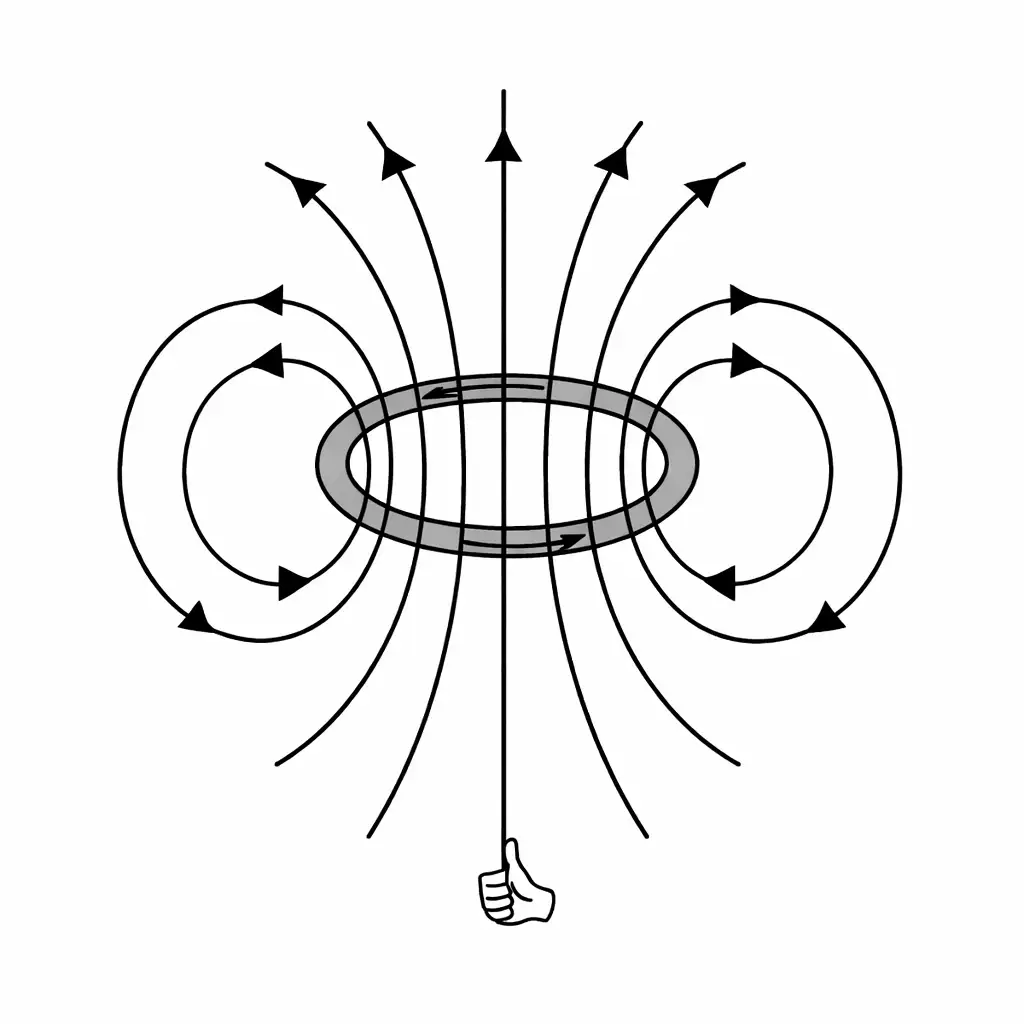
\( \vec{B} = \frac{\mu_0 I R^2}{2 (x^2 + R^2)^{3/2}} \hat{i} \) - Direction by right-hand thumb rule: Curl fingers in current direction, thumb points magnetic field direction.
- At center of loop (\( x=0 \)):
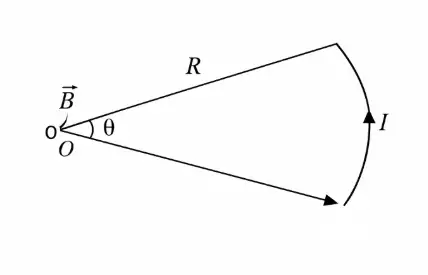
\( B = \frac{\mu_0 I}{2 R} \) - For current carrying arc subtending angle \( \theta \):
\( B = \frac{\mu_0 I \theta}{4 \pi R} \) - For \( x \gg R \), magnetic field:
\( B = \frac{\mu_0 I R^2}{2 x^3} \) (dipole field, \( B \propto \frac{1}{x^3} \))
Solved Examples
- Ex 1: Find magnetic field at center of loop with radius 0.1 m carrying 5 A current.
Solution:
\( B = \frac{\mu_0 I}{2 R} = \frac{4\pi \times 10^{-7} \times 5}{2 \times 0.1} = 3.14 \times 10^{-5} \text{ T} \) - Ex 2: Magnetic field at point 0.2 m from center on axis of loop with radius 0.1 m and current 3 A.
Solution:
\( B = \frac{\mu_0 I R^2}{2 (x^2 + R^2)^{3/2}} = \frac{4\pi \times 10^{-7} \times 3 \times 0.01}{2 (0.04 + 0.01)^{3/2}} = 1.7 \times 10^{-6} \text{ T} \)
Practice Set
- Q1: Magnetic field at center of circular loop of radius 0.05 m carrying 2 A current is:
A) \( 8 \times 10^{-6} \text{ T} \)
B) \( 2.5 \times 10^{-5} \text{ T} \)
C) \( 1.26 \times 10^{-5} \text{ T} \)
D) \( 5 \times 10^{-6} \text{ T} \) - Q2: Magnetic field at point on axis 0.1 m from center of loop radius 0.05 m, current 4 A:
A) \( 3.2 \times 10^{-6} \text{ T} \)
B) \( 1.6 \times 10^{-6} \text{ T} \)
C) \( 6.4 \times 10^{-6} \text{ T} \)
D) \( 8 \times 10^{-6} \text{ T} \) - Q3: Magnetic field at center due to arc of radius 0.1 m, current 3 A, subtending \( 90^\circ \):
A) \( 4.77 \times 10^{-6} \text{ T} \)
B) \( 9.55 \times 10^{-6} \text{ T} \)
C) \( 1.91 \times 10^{-5} \text{ T} \)
D) \( 3.82 \times 10^{-6} \text{ T} \)
Answer Key
- Q1: C
Using \( B = \frac{\mu_0 I}{2 R} = \frac{4\pi \times 10^{-7} \times 2}{2 \times 0.05} = 1.26 \times 10^{-5} \text{ T} \) - Q2: B
Calculate \( B = \frac{\mu_0 I R^2}{2 (x^2 + R^2)^{3/2}} \) with given values gives \( 1.6 \times 10^{-6} \text{ T} \) - Q3: A
Use \( B = \frac{\mu_0 I \theta}{4 \pi R} \), \( \theta = \frac{\pi}{2} \), so \( B = \frac{4\pi \times 10^{-7} \times 3 \times \pi/2}{4 \pi \times 0.1} = 4.77 \times 10^{-6} \text{ T} \)
Memory Aids
- Magnetic field at center: \( B = \frac{\mu_0 I}{2 R} \)
- On axis at distance \( x \): \( B = \frac{\mu_0 I R^2}{2 (x^2 + R^2)^{3/2}} \)
- Arc field: \( B = \frac{\mu_0 I \theta}{4 \pi R} \)
- Right-hand thumb rule for direction
- For \( x \gg R \), \( B \propto \frac{1}{x^3} \) (dipole behavior)
Ampere's Circuital Law
Fundamentals
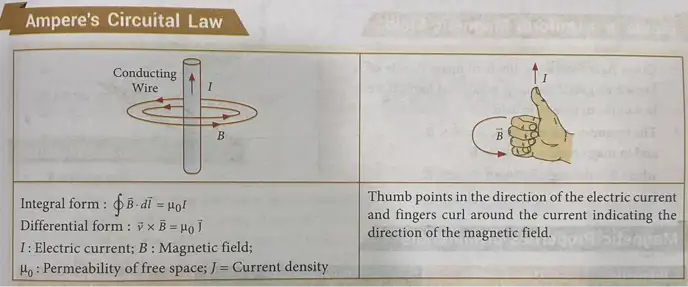
- Electric current \( I \) in a conductor produces magnetic field \( \mathbf{B} \) around it.
- Magnetic field lines form closed loops around the wire.
- Ampere's Law: \( \oint \mathbf{B} \cdot d\mathbf{l} = \mu_0 \sum I_{enc} \), where \( \mu_0 = 4\pi \times 10^{-7} \ \mathrm{T\cdot m/A} \).
- Right-hand rule: Thumb points in current direction; curled fingers show magnetic field direction.
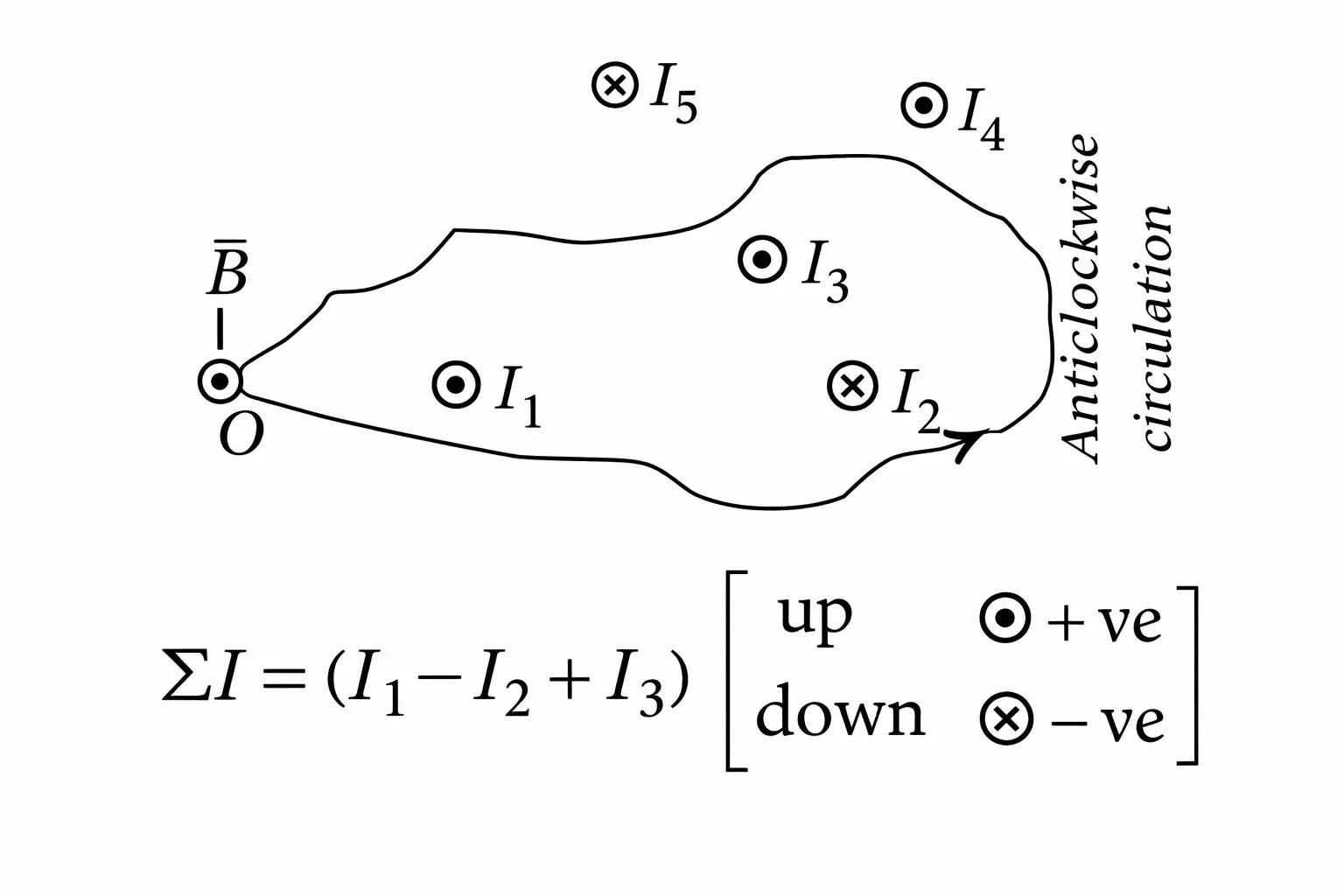
- Only currents enclosed by the chosen loop contribute to the integral.
Limitations
- Applicable only for infinitely long, straight, and symmetrical current distributions.
- Requires known radius and constant current density for thick cylindrical wires.
- Current density \( J = \frac{I}{\pi R^2} \) must be uniform.
Solved Examples
Ex 1: Calculate magnetic field at distance \( r \) from a long straight wire carrying current \( I \).
- Use Ampere's law: \( B(2\pi r) = \mu_0 I \Rightarrow B = \frac{\mu_0 I}{2\pi r} \).
Practice Set
Q1. Magnetic field around a long straight wire carrying 5 A current at 0.1 m distance is:
- A) \( 1 \times 10^{-5} \ \mathrm{T} \)
- B) \( 1 \times 10^{-6} \ \mathrm{T} \)
- C) \( 1 \times 10^{-4} \ \mathrm{T} \)
- D) \( 1 \times 10^{-3} \ \mathrm{T} \)
Q2. For a loop enclosing currents \( I_1=3A \) out of page and \( I_2=2A \) into page, net current is:
- A) 5 A
- B) 1 A
- C) -1 A
- D) 0 A
Q3. Ampere's law is NOT applicable for:
- A) Infinite long wire
- B) Thick wire with uniform current density
- C) Finite irregular shaped conductor
- D) Symmetrical current distribution
Answer Key
Q1: A; \( B = \frac{4\pi \times 10^{-7} \times 5}{2\pi \times 0.1} = 1 \times 10^{-5} \ \mathrm{T} \).
Q2: B; Net current = \( 3 - 2 = 1 \) A (out of page positive).
Q3: C; Ampere's law fails for finite irregular conductors due to lack of symmetry.
Memory Aids
- Right-hand thumb = current; fingers = magnetic field.
- Magnetic field \( B \propto \frac{I}{r} \) outside wire.
- Ampere's law integral equals \( \mu_0 \times \) net enclosed current.
Magnetic Field in Solid Cylindrical Conductor
Key Concepts
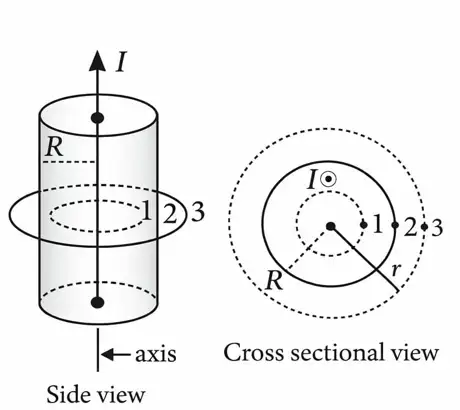
- Conductor radius: \( R \), current: \( I \), current density: \( J = \frac{I}{\pi R^2} \) (constant).
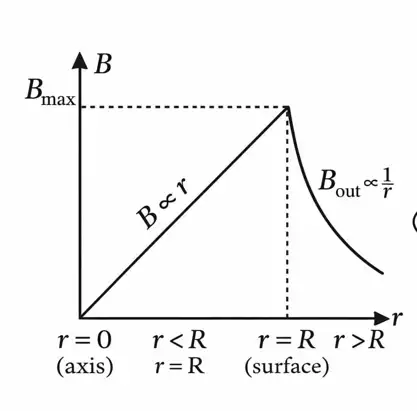
- For \( r < R \) (inside wire): \( B_{in} = \frac{\mu_0 I r}{2\pi R^2} \) (increases linearly with \( r \)).
- At surface \( r = R \): \( B_s = \frac{\mu_0 I}{2\pi R} \) (maximum).
- For \( r > R \) (outside wire): \( B_{out} = \frac{\mu_0 I}{2\pi r} \) (decreases inversely with \( r \)).
- At center \( r=0 \), magnetic field \( B = 0 \).
Solved Examples
Ex 1: Find magnetic field at \( r = \frac{R}{2} \) inside the wire carrying current \( I \).
- Use \( B_{in} = \frac{\mu_0 I r}{2\pi R^2} = \frac{\mu_0 I (R/2)}{2\pi R^2} = \frac{\mu_0 I}{4\pi R} \).
Practice Set
Q1. Magnetic field at surface of wire with \( I=4A \), \( R=0.01m \) is:
- A) \( 4 \times 10^{-5} \ \mathrm{T} \)
- B) \( 8 \times 10^{-5} \ \mathrm{T} \)
- C) \( 2 \times 10^{-5} \ \mathrm{T} \)
- D) \( 1 \times 10^{-4} \ \mathrm{T} \)
Q2. Inside wire at \( r=0.005m \), magnetic field is:
- A) Half of surface field
- B) Equal to surface field
- C) Double surface field
- D) Zero
Q3. Magnetic field outside wire at \( r=0.02m \) is:
- A) \( \frac{\mu_0 I}{2\pi \times 0.02} \)
- B) \( \frac{\mu_0 I}{2\pi \times 0.01} \)
- C) Zero
- D) \( \frac{\mu_0 I}{4\pi \times 0.02} \)
Answer Key
Q1: A; \( B_s = \frac{4\pi \times 10^{-7} \times 4}{2\pi \times 0.01} = 4 \times 10^{-5} \ \mathrm{T} \).
Q2: A; \( B_{in} \propto r \), so at half radius, field is half surface field.
Q3: A; Outside field \( B_{out} = \frac{\mu_0 I}{2\pi r} \) with \( r=0.02m \).
Memory Aids
- Inside wire: \( B \propto r \) (linear increase).
- Surface: Maximum magnetic field.
- Outside wire: \( B \propto \frac{1}{r} \) (inverse relation).
The Solenoid
Definition and Structure
- Solenoid: A long coil of wire with length much greater than its radius.
- Used to produce a uniform magnetic field over a long range.
- Consists of conducting wire tightly wound in identical circular turns on a cylindrical frame.
- Magnetic field at any axial point is the superposition of fields from all circular turns.
Magnetic Field Inside Solenoid
- Magnetic field at an axial point inside a finite solenoid: \[ B = \frac{\mu_0 n I}{2} (\cos \theta_1 - \cos \theta_2) \] where \( n = \frac{N}{l} \) is the turn density, \( N \) total turns, \( l \) length, \( I \) current.
- For an infinite solenoid: \[ B = \mu_0 n I \] (uniform field inside)
- At the end of an infinite solenoid: \[ B = \frac{\mu_0 n I}{2} \]
- Magnetic field outside an infinite solenoid is approximately zero.
- If the solenoid frame has relative permeability \( \mu_r \), then: \[ B = \mu_0 \mu_r n I \]
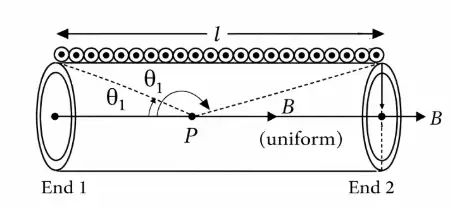
This image shows a uniform magnetic field \( B \) directed along the axis of a straight conductor of length \( l \). Angles \( \theta_1 \) indicate the direction of the magnetic field at different points.
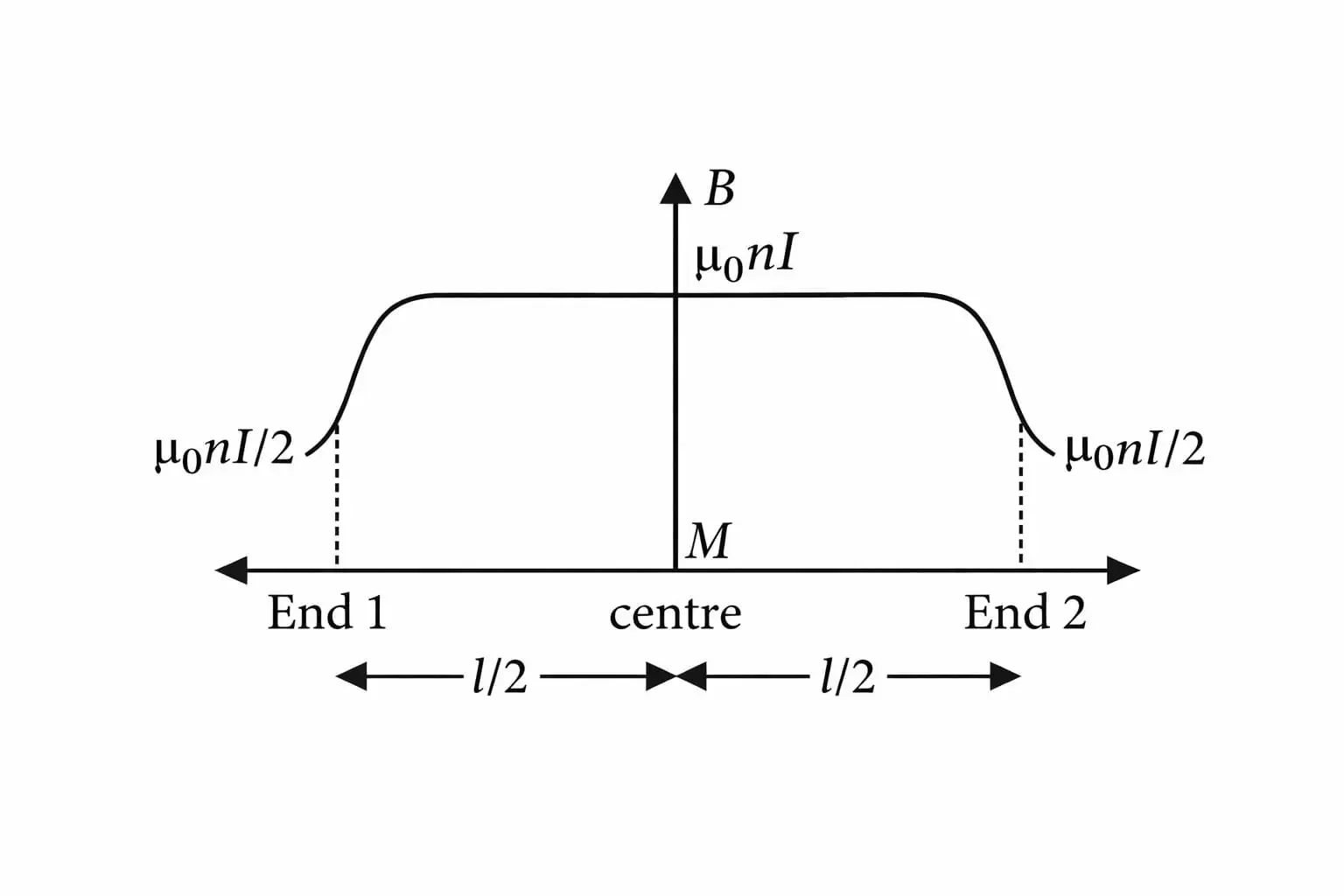
Graph of magnetic field strength \( B \) along the solenoid length: uniform and maximum at center \( \mu_0 n I \), decreasing to half at ends \( \frac{\mu_0 n I}{2} \).
Solved Examples
- Ex 1: Calculate magnetic field inside an infinite solenoid with 1000 turns/m and current 2 A.
- Use \( B = \mu_0 n I \)
- \( B = 4\pi \times 10^{-7} \times 1000 \times 2 = 2.51 \times 10^{-3} \text{ T} \)
- Ex 2: Find magnetic field at the end of the same solenoid.
- Use \( B = \frac{\mu_0 n I}{2} \)
- \( B = \frac{2.51 \times 10^{-3}}{2} = 1.25 \times 10^{-3} \text{ T} \)
Practice Set
- Q1: Magnetic field inside a solenoid depends on?
- A) Number of turns per unit length and current
- B) Radius of solenoid only
- C) Length of solenoid only
- D) Material outside solenoid
- Q2: Magnetic field at the end of an infinite solenoid is?
- A) \( \mu_0 n I \)
- B) \( \frac{\mu_0 n I}{2} \)
- C) Zero
- D) \( 2 \mu_0 n I \)
- Q3: A solenoid has 500 turns, length 0.5 m, current 3 A, and relative permeability 100. Calculate magnetic field inside.
- A) \( 7.54 \times 10^{-3} \text{ T} \)
- B) \( 1.51 \text{ T} \)
- C) \( 0.15 \text{ T} \)
- D) \( 0.75 \text{ T} \)
Answer Key
- Q1: A — Magnetic field depends on turn density \( n \) and current \( I \).
- Q2: B — At the end, field is half the inside value \( \frac{\mu_0 n I}{2} \).
- Q3: B — Calculate \( n = \frac{500}{0.5} = 1000 \), then \( B = \mu_0 \mu_r n I = 4\pi \times 10^{-7} \times 100 \times 1000 \times 3 = 1.51 \text{ T} \).
Memory Aids
- Inside infinite solenoid: \( B = \mu_0 n I \)
- At ends: field halves \( \Rightarrow B = \frac{\mu_0 n I}{2} \)
- Field outside infinite solenoid ≈ 0
- Use \( n = \frac{N}{l} \) for turn density
- Include \( \mu_r \) if magnetic material present: \( B = \mu_0 \mu_r n I \)
Force between Two Parallel Currents, the Ampere
Magnetic Force Between Wires
- Two parallel wires carry currents \(I_1\) and \(I_2\) separated by distance \(d\).
- Each wire produces magnetic field: \(B = \frac{\mu_0 I}{2 \pi d}\), where \(\mu_0 = 4\pi \times 10^{-7} \text{ Tm/A}\).
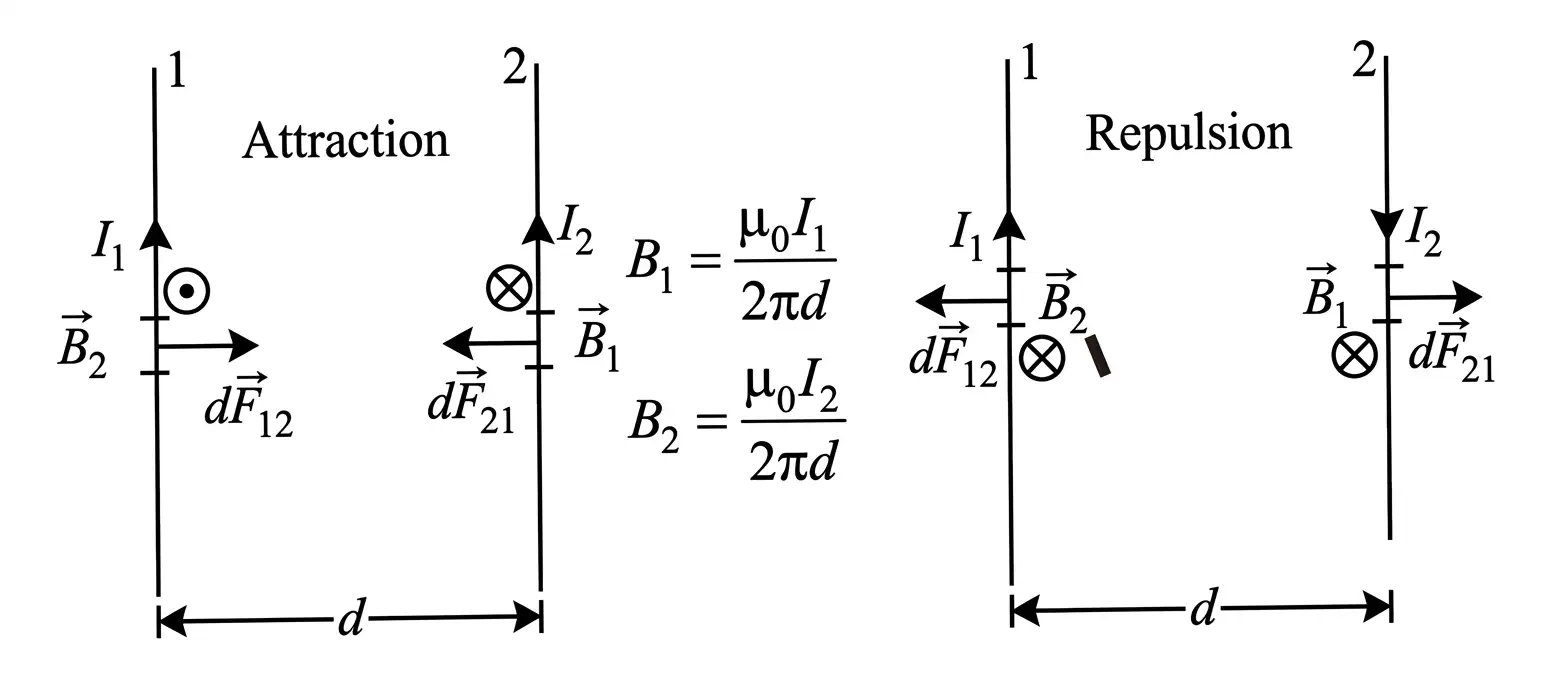
- Force on length \(dl\) of wire 1 due to wire 2: \(dF_{12} = B_2 I_1 dl = \frac{\mu_0 I_1 I_2}{2 \pi d} dl\).
- Force per unit length on each wire: \(\frac{dF}{dl} = \frac{\mu_0 I_1 I_2}{2 \pi d}\).
- Direction: Currents in same direction attract; opposite directions repel.
- Definition of ampere: Two wires 1 m apart carrying 1 A each experience force \(2 \times 10^{-7} \text{ N/m}\).
Equilibrium of Free Wire
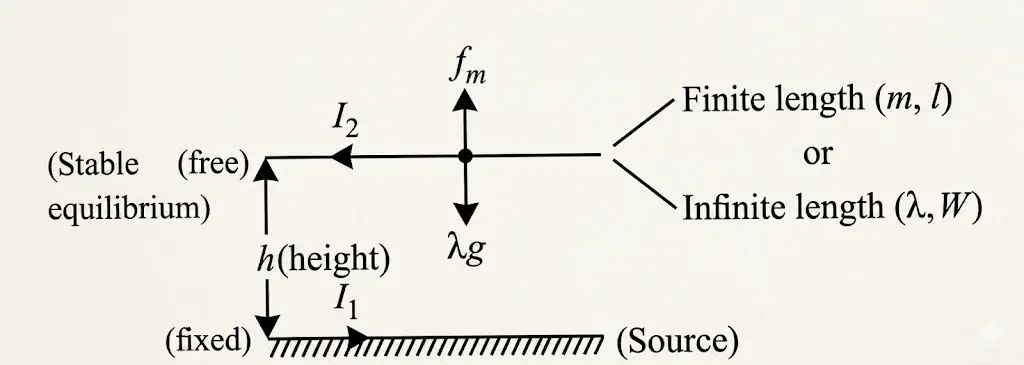
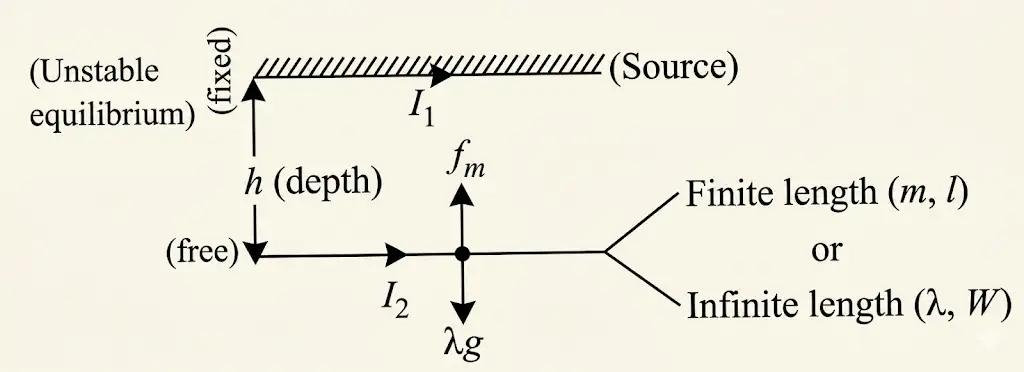
- Consider two wires: one fixed, one free, separated by height \(h\).
- Mass per unit length of free wire: \(\lambda = \frac{m}{l}\).
- Weight per unit length: \(W = \lambda g\).
- Stable equilibrium condition: \(\frac{\mu_0 I_1 I_2}{2 \pi h} = \lambda g\).
- If free wire displaced slightly, it executes vertical simple harmonic motion (S.H.M.).
- Time period of S.H.M.: \(T = 2 \pi \sqrt{\frac{h}{q}}\), where \(q\) depends on system parameters.
- Unstable equilibrium if lower wire is free: small displacement causes wire to move away.
Solved Examples
Ex 1
- Two parallel wires 0.5 m apart carry currents 3 A and 4 A in same direction.
- Find force per unit length between them.
- Use formula: \(\frac{dF}{dl} = \frac{\mu_0 I_1 I_2}{2 \pi d} = \frac{4\pi \times 10^{-7} \times 3 \times 4}{2 \pi \times 0.5} = 4.8 \times 10^{-6} \text{ N/m}\).
Ex 2
- Free wire of mass per unit length \(\lambda = 0.01 \text{ kg/m}\) is suspended at height 0.2 m from fixed wire carrying current 5 A.
- Find current in free wire for stable equilibrium.
- Use \(\frac{\mu_0 I_1 I_2}{2 \pi h} = \lambda g\), solve for \(I_2\): \(I_2 = \frac{2 \pi h \lambda g}{\mu_0 I_1} = \frac{2 \pi \times 0.2 \times 0.01 \times 9.8}{4\pi \times 10^{-7} \times 5} = 3920 \text{ A}\).
Practice Set
Q1
Two parallel wires 1 m apart carry currents 2 A and 3 A in opposite directions. What is the force per meter between them?
- A) \(1.2 \times 10^{-6} \text{ N}\)
- B) \(3.6 \times 10^{-7} \text{ N}\)
- C) \(1.2 \times 10^{-7} \text{ N}\)
- D) \(3.6 \times 10^{-6} \text{ N}\)
Q2
Two wires 0.25 m apart carry currents 5 A and 10 A in same direction. Calculate force per unit length.
- A) \(4 \times 10^{-5} \text{ N/m}\)
- B) \(2 \times 10^{-5} \text{ N/m}\)
- C) \(8 \times 10^{-6} \text{ N/m}\)
- D) \(1 \times 10^{-5} \text{ N/m}\)
Q3
A free wire of length 0.5 m and mass 0.02 kg is suspended at height 0.1 m from a fixed wire carrying 4 A. Find current in free wire for stable equilibrium.
- A) 490 A
- B) 980 A
- C) 245 A
- D) 1960 A
Answer Key
- Q1: A) \(1.2 \times 10^{-6} \text{ N}\) - Use \(\frac{\mu_0 I_1 I_2}{2 \pi d}\) with \(d=1\) m.
- Q2: A) \(4 \times 10^{-5} \text{ N/m}\) - Calculate force per unit length with given currents and distance.
- Q3: D) 1960 A - Use stable equilibrium formula \(I_2 = \frac{2 \pi h \lambda g}{\mu_0 I_1}\) with \(\lambda = \frac{m}{l}\).
Memory Aids
- Force per unit length \(\propto I_1 I_2 / d\).
- Same current direction → attraction; opposite → repulsion.
- Ampere defined by force \(2 \times 10^{-7} \text{ N/m}\) at 1 m distance.
- Stable equilibrium: magnetic force balances weight \(\Rightarrow \frac{\mu_0 I_1 I_2}{2 \pi h} = \lambda g\).
- Displaced free wire executes S.H.M. with period \(T = 2 \pi \sqrt{\frac{h}{q}}\).
Torque on Current Loop
Key Concepts
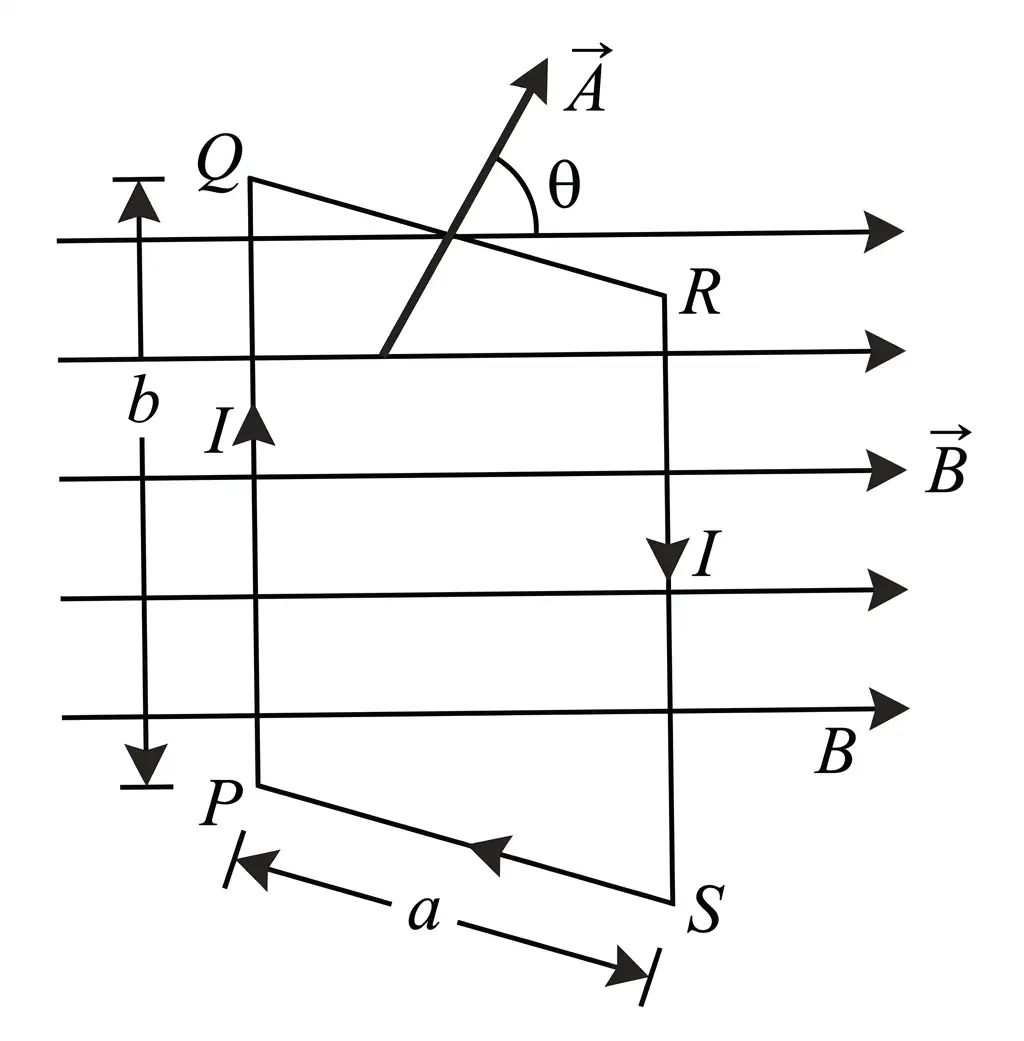
- Rectangular loop PQRS with sides a and b carries current I.
- Placed in uniform magnetic field \( \vec{B} \), area vector \( \vec{A} \) makes angle \( \theta \) with \( \vec{B} \).
- Forces on sides QR and SP are equal, opposite, and collinear; they cancel out.
- Forces on sides PQ and RS are equal, opposite, but not collinear; produce torque.
- Force on PQ or RS: \( F = I b B \sin 90^\circ = I b B \).
- Perpendicular distance between forces: \( r_\perp = a \sin \theta \).
- Torque on loop: \( \tau = F r_\perp = I b B a \sin \theta = I A B \sin \theta \), where \( A = a b \).
- For loop with N turns: \( \tau = N I A B \sin \theta \).
- Vector form: \( \vec{\tau} = \vec{M} \times \vec{B} \), where magnetic dipole moment \( \vec{M} = N I \vec{A} \).
- No torque when \( \theta = 0^\circ \) (loop plane normal to \( \vec{B} \)); torque maximum at \( \theta = 90^\circ \).
Solved Examples
- Ex 1: Calculate torque on a rectangular loop with \( I=2\,A \), \( a=0.1\,m \), \( b=0.2\,m \), \( B=0.5\,T \), and \( \theta=30^\circ \).
- Area \( A = 0.1 \times 0.2 = 0.02\,m^2 \).
- Torque \( \tau = I A B \sin \theta = 2 \times 0.02 \times 0.5 \times \sin 30^\circ = 0.01\,Nm \).
Practice Set
- Q1: A rectangular loop with area \( 0.05\,m^2 \) carries current \( 3\,A \) in a magnetic field of \( 0.4\,T \). If \( \theta = 90^\circ \), what is the torque?
- A) 0.06 Nm
- B) 0.12 Nm
- C) 0.15 Nm
- D) 0.20 Nm
- Q2: For a loop with \( N=5 \) turns, \( I=1\,A \), \( A=0.01\,m^2 \), \( B=0.3\,T \), and \( \theta=60^\circ \), torque is:
- A) 0.0075 Nm
- B) 0.015 Nm
- C) 0.025 Nm
- D) 0.03 Nm
- Q3: Torque on a single-turn loop is \( 0.02\,Nm \) in a field \( 0.5\,T \) with current \( 2\,A \). Find the area if \( \theta=45^\circ \).
- A) 0.0283 m²
- B) 0.0141 m²
- C) 0.0566 m²
- D) 0.0707 m²
Answer Key
- Q1: A) 0.06 Nm — \( \tau = IAB\sin 90^\circ = 3 \times 0.05 \times 0.4 = 0.06 \) Nm.
- Q2: B) 0.015 Nm — \( \tau = N I A B \sin 60^\circ = 5 \times 1 \times 0.01 \times 0.3 \times 0.866 = 0.013 \approx 0.015 \) Nm.
- Q3: B) 0.0141 m² — \( A = \frac{\tau}{I B \sin \theta} = \frac{0.02}{2 \times 0.5 \times 0.707} = 0.0141 \) m².
Memory Aids
- Torque \( \tau = N I A B \sin \theta \).
- Magnetic dipole moment \( \vec{M} = N I \vec{A} \).
- Torque vector \( \vec{\tau} = \vec{M} \times \vec{B} \).
- No torque when loop plane is perpendicular to \( \vec{B} \) (\( \theta=0^\circ \)).
Circular Current Loop Magnetic Dipole
Key Concepts
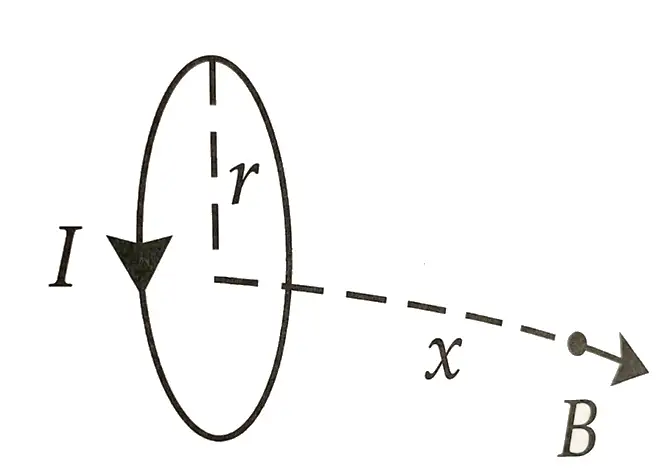
- Current loop of radius \( r \) carries current \( I \).
- Magnetic field at distance \( x \) on axis of loop: \[ B = \frac{\mu_0 I r^2}{2 (r^2 + x^2)^{3/2}} = \frac{\mu_0 I A}{2 \pi (r^2 + x^2)^{3/2}} \]
- Area of loop \( A = \pi r^2 \).
- For \( x \gg r \), field approximates to: \[ B = \frac{\mu_0 I A}{2 \pi x^3} = \frac{\mu_0}{4 \pi} \frac{2 M}{x^3} \]
- Magnetic dipole moment \( M = I A \).
Solved Examples
- Ex 1: Find magnetic field at \( x=0.1\,m \) on axis of loop with \( I=3\,A \), \( r=0.05\,m \).
- Area \( A = \pi (0.05)^2 = 7.85 \times 10^{-3} m^2 \).
- Calculate \( B = \frac{4\pi \times 10^{-7} \times 3 \times 7.85 \times 10^{-3}}{2 \pi (0.05^2 + 0.1^2)^{3/2}} \approx 1.2 \times 10^{-5} T \).
Practice Set
- Q1: Magnetic field at center (\( x=0 \)) of loop with \( I=2\,A \), \( r=0.1\,m \) is:
- A) \( 2 \times 10^{-6} T \)
- B) \( 4 \times 10^{-6} T \)
- C) \( 1.26 \times 10^{-5} T \)
- D) \( 5 \times 10^{-6} T \)
- Q2: For \( x \gg r \), magnetic field varies as:
- A) \( 1/x \)
- B) \( 1/x^2 \)
- C) \( 1/x^3 \)
- D) \( 1/x^4 \)
- Q3: Magnetic dipole moment of loop with \( I=4\,A \), \( r=0.05\,m \) is:
- A) \( 3.14 \times 10^{-2} A m^2 \)
- B) \( 1.57 \times 10^{-2} A m^2 \)
- C) \( 6.28 \times 10^{-3} A m^2 \)
- D) \( 7.85 \times 10^{-3} A m^2 \)
Answer Key
- Q1: C) \( 1.26 \times 10^{-5} T \) — At center, \( B = \frac{\mu_0 I}{2r} = 1.26 \times 10^{-5} T \).
- Q2: C) \( 1/x^3 \) — Field on axis far from loop decreases as inverse cube of distance.
- Q3: D) \( 7.85 \times 10^{-3} A m^2 \) — \( M = I A = 4 \times \pi (0.05)^2 = 7.85 \times 10^{-3} A m^2 \).
Memory Aids
- Magnetic field on axis: \( B = \frac{\mu_0 I A}{2 \pi (r^2 + x^2)^{3/2}} \).
- Far field: \( B \propto \frac{1}{x^3} \).
- Magnetic dipole moment: \( M = I A \).
The Moving Coil Galvanometer
Principle and Working
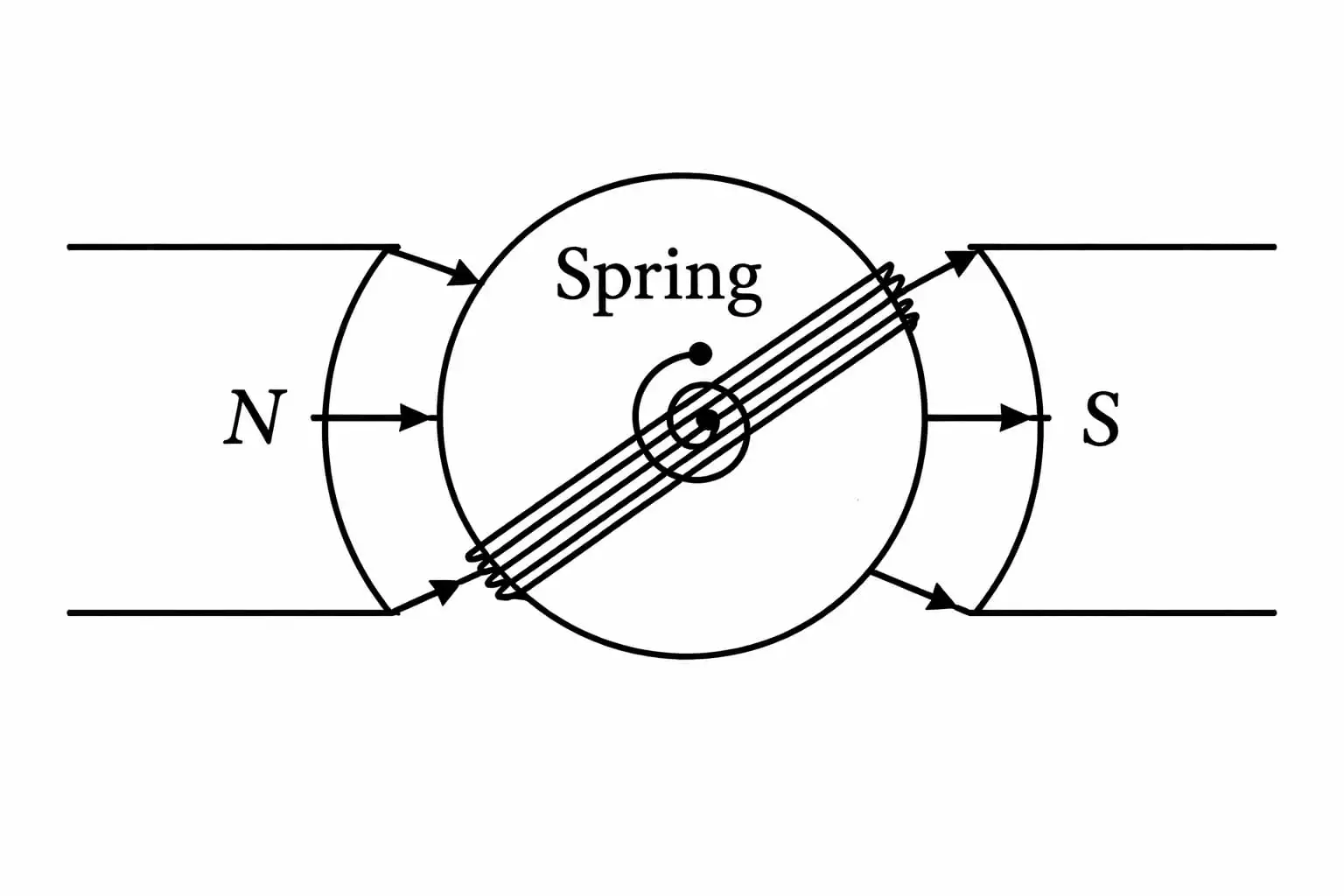
- A current-carrying coil in a magnetic field experiences a torque \( \tau = N I \mathbf{A} \times \mathbf{B} \).
- Here, \(N\) = number of turns, \(I\) = current, \(\mathbf{A}\) = area vector, \(\mathbf{B}\) = magnetic field.
- Torque causes coil deflection \( \Phi \), opposed by spring's restoring torque \( k \Phi \).
- At equilibrium: \( N I A B = k \Phi \) or \( I = \frac{k}{N A B} \Phi \).
- Current \(I\) is proportional to deflection \(\Phi\); constant \( \frac{k}{NAB} \) is galvanometer constant.
- Cylindrical pole pieces ensure uniform radial magnetic field.
Current and Voltage Sensitivity
- Current sensitivity \( = \frac{\Phi}{I} = \frac{NAB}{k} \) (deflection per unit current).
- Increasing \(N\) increases current sensitivity.
- Voltage sensitivity \( = \frac{\Phi}{V} = \frac{\Phi}{I} \times \frac{I}{V} = \frac{NAB}{k} \times \frac{1}{R} \) (deflection per unit voltage).
- Doubling \(N\) doubles current sensitivity but also doubles resistance \(R\), so voltage sensitivity remains unchanged.
Conversion to Ammeter
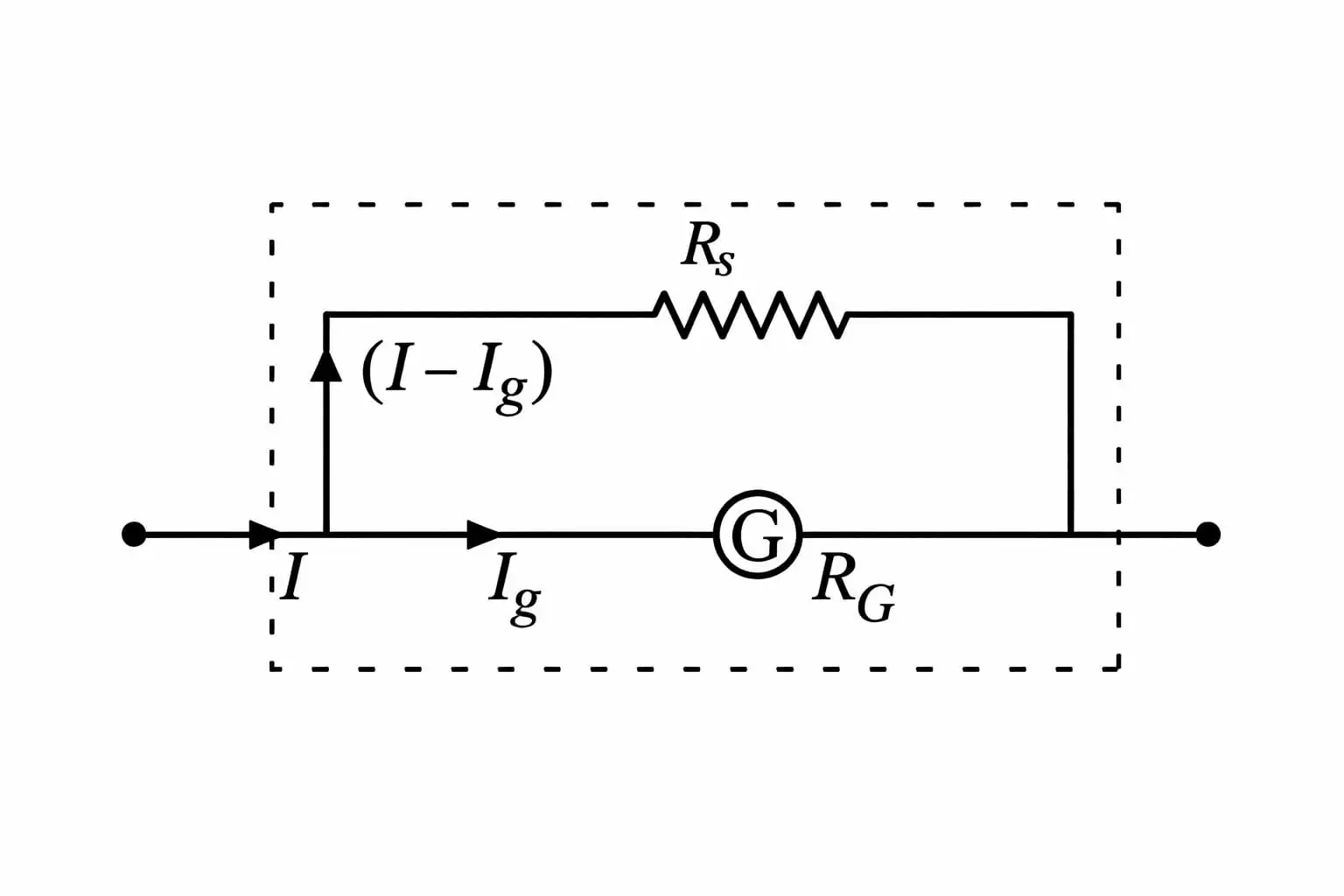
- Connect a low resistance shunt \( r_s \) in parallel with galvanometer.
- Shunt carries most current, protecting galvanometer.
- Shunt resistance: \( r_s = \frac{I_g}{I - I_g} R_G \), where \(I_g\) is galvanometer current, \(I\) total current, \(R_G\) galvanometer resistance.
Conversion to Voltmeter
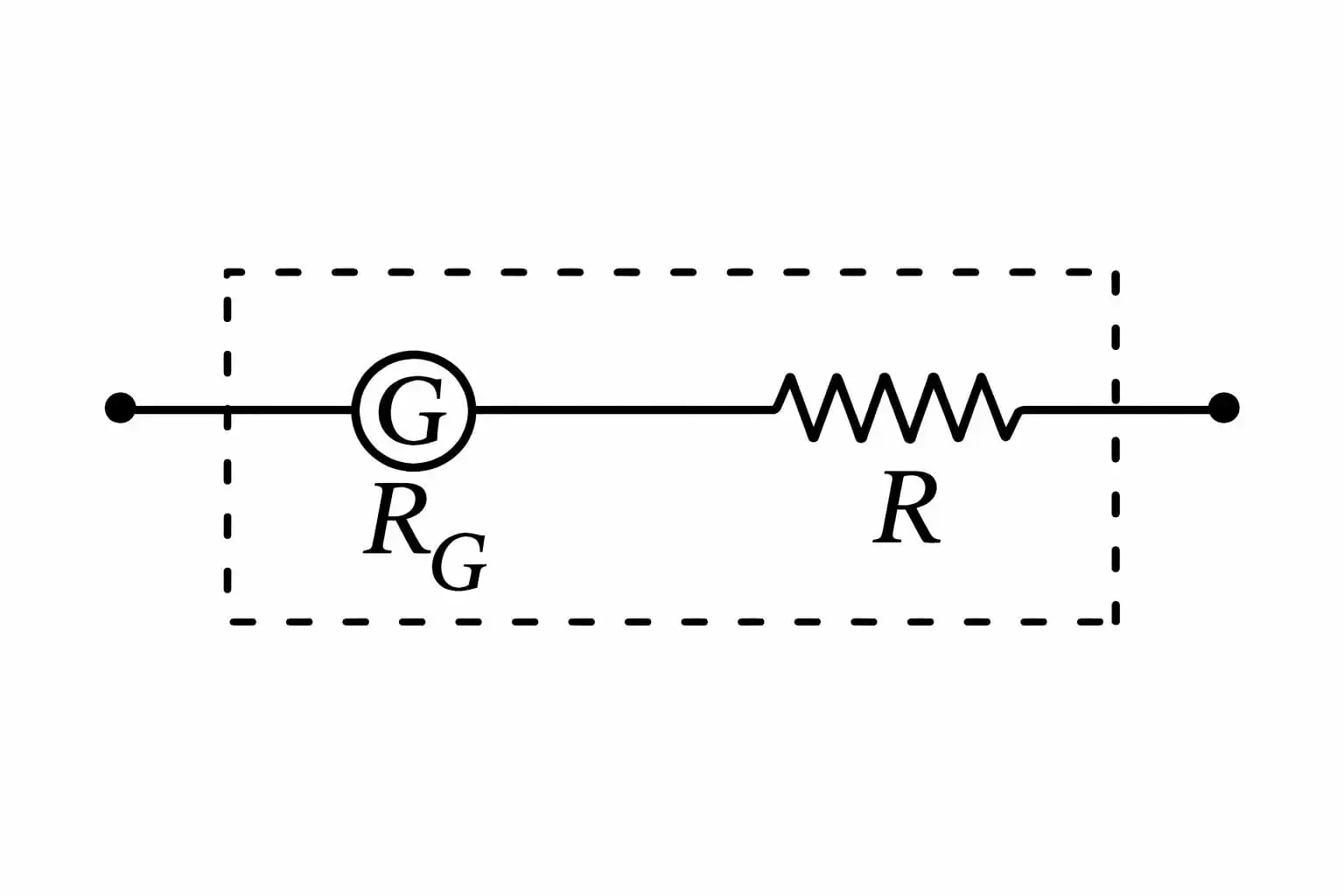
- Connect a large resistance \( R \) in series with galvanometer.
- Limits current through galvanometer for measuring voltage.
- Resistance \( R = \frac{V}{I_g} - R_G \), where \(V\) is voltage, \(I_g\) galvanometer current, \(R_G\) galvanometer resistance.
Solved Examples
Ex 1
- Given \( N=100, A=2 \times 10^{-4} \text{ m}^2, B=0.5 \text{ T}, k=0.02 \text{ Nm/rad} \), find current for \( \Phi=0.1 \text{ rad} \).
- Use \( I = \frac{k}{NAB} \Phi = \frac{0.02}{100 \times 2 \times 10^{-4} \times 0.5} \times 0.1 = 0.02 \text{ A} \).
Ex 2
- Galvanometer resistance \( R_G=50 \Omega \), current sensitivity \( \frac{\Phi}{I} = 100 \text{ rad/A} \), find shunt resistance to convert to ammeter for max current \( I=2 \text{ A} \) and max galvanometer current \( I_g=0.01 \text{ A} \).
- Use \( r_s = \frac{I_g}{I - I_g} R_G = \frac{0.01}{2 - 0.01} \times 50 \approx 0.25 \Omega \).
Practice Set
Q1
What is the relation between current \(I\) and deflection \(\Phi\) in a moving coil galvanometer?
- A) \( I \propto \Phi^2 \)
- B) \( I \propto \Phi \)
- C) \( I \propto \frac{1}{\Phi} \)
- D) \( I \propto \sqrt{\Phi} \)
Q2
Doubling the number of turns \(N\) in the coil affects the current sensitivity and voltage sensitivity as:
- A) Both double
- B) Current sensitivity doubles, voltage sensitivity unchanged
- C) Current sensitivity unchanged, voltage sensitivity doubles
- D) Both unchanged
Q3
A galvanometer with resistance \(50 \Omega\) is converted into an ammeter to measure 5 A max current. If max galvanometer current is 0.05 A, find the shunt resistance \(r_s\).
- A) 0.5 \(\Omega\)
- B) 0.51 \(\Omega\)
- C) 1 \(\Omega\)
- D) 5 \(\Omega\)
Answer Key
- Q1: B) \( I \propto \Phi \). Current is directly proportional to deflection.
- Q2: B) Current sensitivity doubles, voltage sensitivity unchanged. Doubling \(N\) doubles current sensitivity but also doubles resistance, keeping voltage sensitivity same.
- Q3: B) \( r_s = \frac{I_g}{I - I_g} R_G = \frac{0.05}{5 - 0.05} \times 50 = 0.51 \Omega \).
Memory Aids
- Current \(I\) ∝ deflection \(\Phi\): \( I = \frac{k}{NAB} \Phi \).
- Current sensitivity \(= \frac{NAB}{k} \), increase \(N\) to increase sensitivity.
- Voltage sensitivity \(= \frac{NAB}{kR} \), depends inversely on resistance.
- Shunt resistance for ammeter: \( r_s = \frac{I_g}{I - I_g} R_G \).
- Series resistance for voltmeter: \( R = \frac{V}{I_g} - R_G \).
NEET Physics — ALL CHAPTERS
1
Basic Mathematics
2
Units and Measurement
3
Motion in a Straight Line
4
Motion in a Plane
5
Laws of Motion
6
Work, Energy and Power
7
System of Particles and Rotational Motion
8
Gravitation
9
Mechanical Properties of Solids
10
Mechanical Properties of Fluids
11
Thermal Properties of Matter
12
Thermodynamics
13
Kinetic Theory
14
Oscillations
15
Waves
16
Electric Charges and Fields
17
Electrostatic Potential and Capacitance
18
Current Electricity
19
Moving Charges and Magnetism
20
Magnetism and Matter
21
Electromagnetic Induction
22
Alternating Current
23
Electromagnetic Waves
24
Ray Optics and Optical Instruments
25
Wave Optics
26
Dual Nature of Radiation and Matter
27
Atoms
28
Nuclei
29
Semiconductor Electronics: Materials, Devices and Simple Circuits