NEET Ug . NEET Physics . Physics . Current Electricity
Chapter 18: Current Electricity
Ch 18
NEET Physics
NEET Ug
Introduction
Key Points
- Electric current is the flow of electric charges.
- Occurs in various situations: natural (lightning) and artificial (torch, clock).
- Lightning current is unsteady; many devices have steady current.
- Focus on laws governing steady electric currents.
Solved Examples
- Ex 1: Identify if the current in lightning is steady or unsteady.
Answer: Unsteady, as charges flow irregularly through atmosphere.
Practice Set
- Q1: Which of the following is an example of steady electric current?
A) Lightning
B) Torch
C) Static electricity
D) Thunder - Q2: Charges flowing from cloud to earth during lightning are:
A) Steady current
B) Unsteady current
C) No current
D) Alternating current - Q3: Which device uses steady electric current?
A) Lightning
B) Cell-driven clock
C) Electric spark
D) Static discharge
Answer Key
- Q1: B - Torch uses steady current for continuous operation.
- Q2: B - Lightning current is unsteady due to irregular charge flow.
- Q3: B - Cell-driven clock operates with steady current.
Memory Aids
- Steady current = continuous, constant flow (e.g., torch).
- Unsteady current = irregular flow (e.g., lightning).
Electric Current
Definition and Formulas
- Electric current (I) = rate of flow of electric charge through conductor.
- Formula for steady current: I = \frac{q}{t} = \frac{Ne}{t}
- Formula for unsteady current: I = \frac{dq}{dt}
- Where,
- q = electric charge (Coulombs)
- N = number of free electrons crossing cross-section
- e = charge of one electron (1.6 × 10⁻¹⁹ C)
- t = time (seconds)
- SI unit of current: Ampere (A), 1 A = 1 Coulomb/second
Solved Examples
- Ex 1: Calculate current if 3 Coulombs pass through a conductor in 2 seconds.
Solution: I = q/t = 3/2 = 1.5 A - Ex 2: If 6.25 × 10¹⁸ electrons pass through a wire in 1 second, find the current.
Solution: I = Ne/t = (6.25 × 10¹⁸ × 1.6 × 10⁻¹⁹)/1 = 1 A
Practice Set
- Q1: Electric current is defined as:
A) Total charge
B) Rate of flow of charge
C) Number of electrons
D) Voltage across conductor - Q2: If 10 Coulombs pass through a wire in 5 seconds, the current is:
A) 2 A
B) 0.5 A
C) 15 A
D) 50 A - Q3: Number of electrons passing through a conductor per second for 3 A current is:
A) 1.875 × 10¹⁹
B) 1.875 × 10¹⁸
C) 3 × 10¹⁹
D) 3 × 10¹⁸
Answer Key
- Q1: B - Current is rate of flow of charge.
- Q2: A - I = q/t = 10/5 = 2 A.
- Q3: A - N = I × t / e = 3 / (1.6 × 10⁻¹⁹) = 1.875 × 10¹⁹ electrons/sec.
Memory Aids
- Current (I) = Charge (q) ÷ Time (t).
- 1 Ampere = 1 Coulomb/second.
- Use I = Ne/t for electron flow calculations.
Electric Currents in Conductors
Electron Motion and Electric Field
- Electrons in metals move randomly at all temperatures, similar to gas particles.
- Applying an electric field \(E\) causes electrons to accelerate opposite to \(E\) with acceleration \(a = \frac{eE}{m}\), where \(e\) is electron charge and \(m\) is electron mass.
- Acceleration is momentary; electrons lose gained velocity due to collisions with atoms, ions, or other electrons.
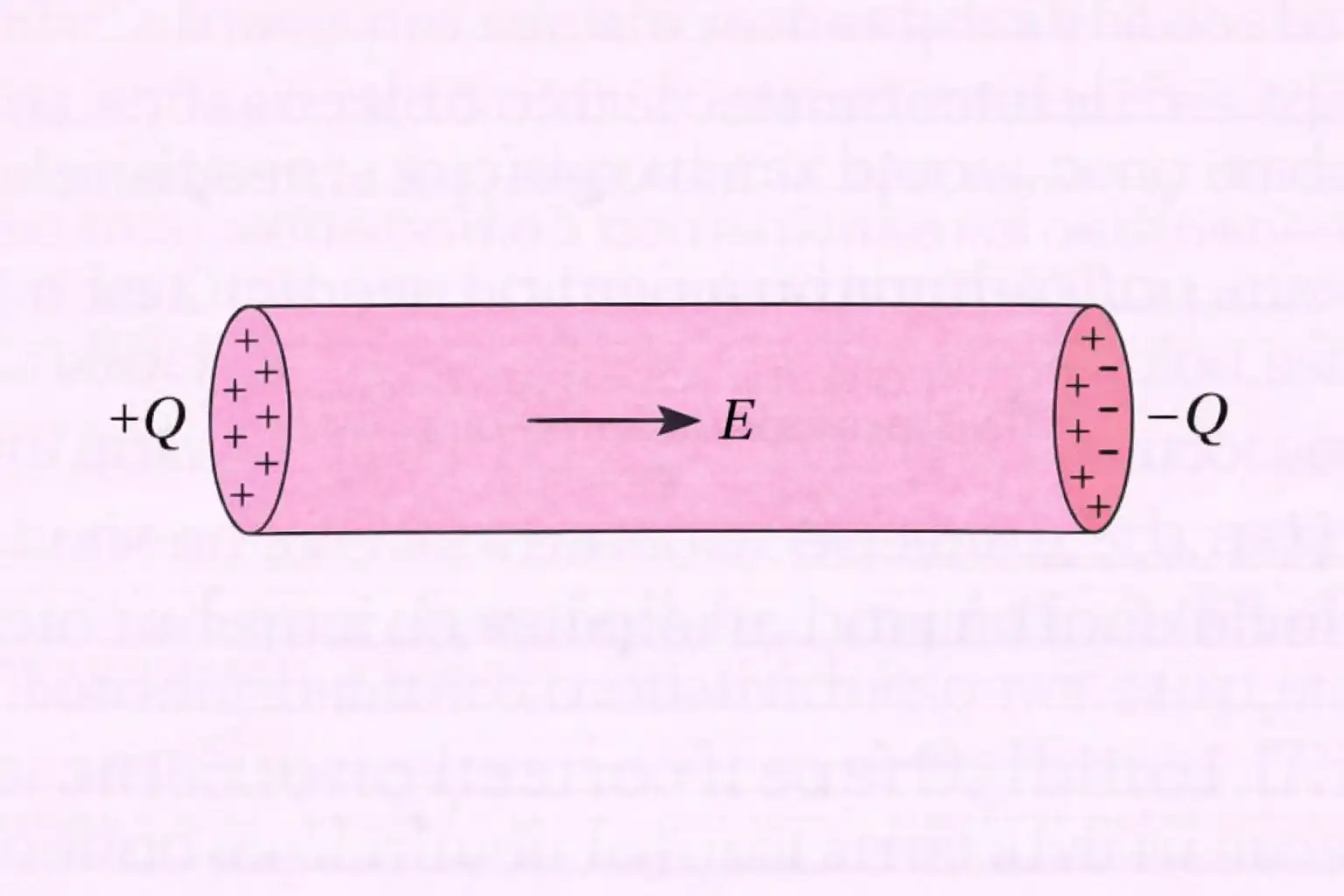
- Charges +Q and -Q placed at ends of a metallic cylinder create an electric field inside, causing electron drift and current.
- Continuous supply of charges (+Q and -Q) via cells or batteries maintains steady current.
Solved Examples
Ex 1: Calculate acceleration of an electron in a conductor with electric field \(E = 1000\,\text{V/m}\).
- Given: \(e = 1.6 \times 10^{-19} C\), \(m = 9.11 \times 10^{-31} kg\)
- Use \(a = \frac{eE}{m} = \frac{1.6 \times 10^{-19} \times 1000}{9.11 \times 10^{-31}} = 1.76 \times 10^{14} m/s^2\)
Practice Set
Q1: What causes electrons in a metal to drift when an electric field is applied?
- A) Random thermal motion
- B) Acceleration opposite to electric field
- C) Collisions with atoms
- D) Magnetic field effects
Q2: The acceleration of an electron in an electric field \(E\) is given by:
- A) \(\frac{mE}{e}\)
- B) \(\frac{eE}{m}\)
- C) \(eEm\)
- D) \(\frac{e}{mE}\)
Q3: A metallic cylinder has charges +Q and -Q at its ends creating an electric field of 500 V/m. What is the acceleration of an electron inside? (Given \(e=1.6 \times 10^{-19} C\), \(m=9.11 \times 10^{-31} kg\))
- A) \(8.8 \times 10^{13} m/s^2\)
- B) \(5.5 \times 10^{14} m/s^2\)
- C) \(1.76 \times 10^{14} m/s^2\)
- D) \(9.1 \times 10^{13} m/s^2\)
Answer Key
Q1: B) Acceleration opposite to electric field
Electrons drift due to acceleration opposite to the applied electric field.
Q2: B) \(\frac{eE}{m}\)
Acceleration of electron is charge times field divided by mass.
Q3: C) \(1.76 \times 10^{14} m/s^2\)
Calculated using \(a=\frac{eE}{m} = \frac{1.6 \times 10^{-19} \times 500}{9.11 \times 10^{-31}}\).
Memory Aids
- Electron acceleration: \(a = \frac{eE}{m}\)
- Electron drift opposite to electric field direction.
- Steady current requires continuous charge supply (cells/batteries).
Ohm's Law
Fundamental Concepts
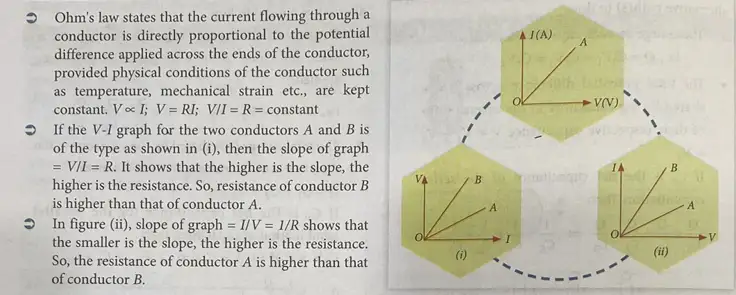
- Ohm's law: Current \( I \) through a conductor is directly proportional to voltage \( V \) across it, if temperature and other conditions remain constant.
- Mathematical form: \( V = IR \), where \( R \) is resistance (in ohms, \( \Omega \)).
- Resistance depends on material and dimensions: \( R = \rho \frac{l}{A} \), where \( \rho \) is resistivity (\( \Omega \cdot m \)), \( l \) is length (m), and \( A \) is cross-sectional area (m\(^2\)).
- Resistance is directly proportional to length and inversely proportional to area.
- Conductivity \( \sigma = \frac{1}{\rho} \) relates current density \( j \) and electric field \( E \) as \( j = \sigma E \).
- Potential difference \( V = El \), where \( E \) is uniform electric field magnitude.
Resistance in Different Configurations
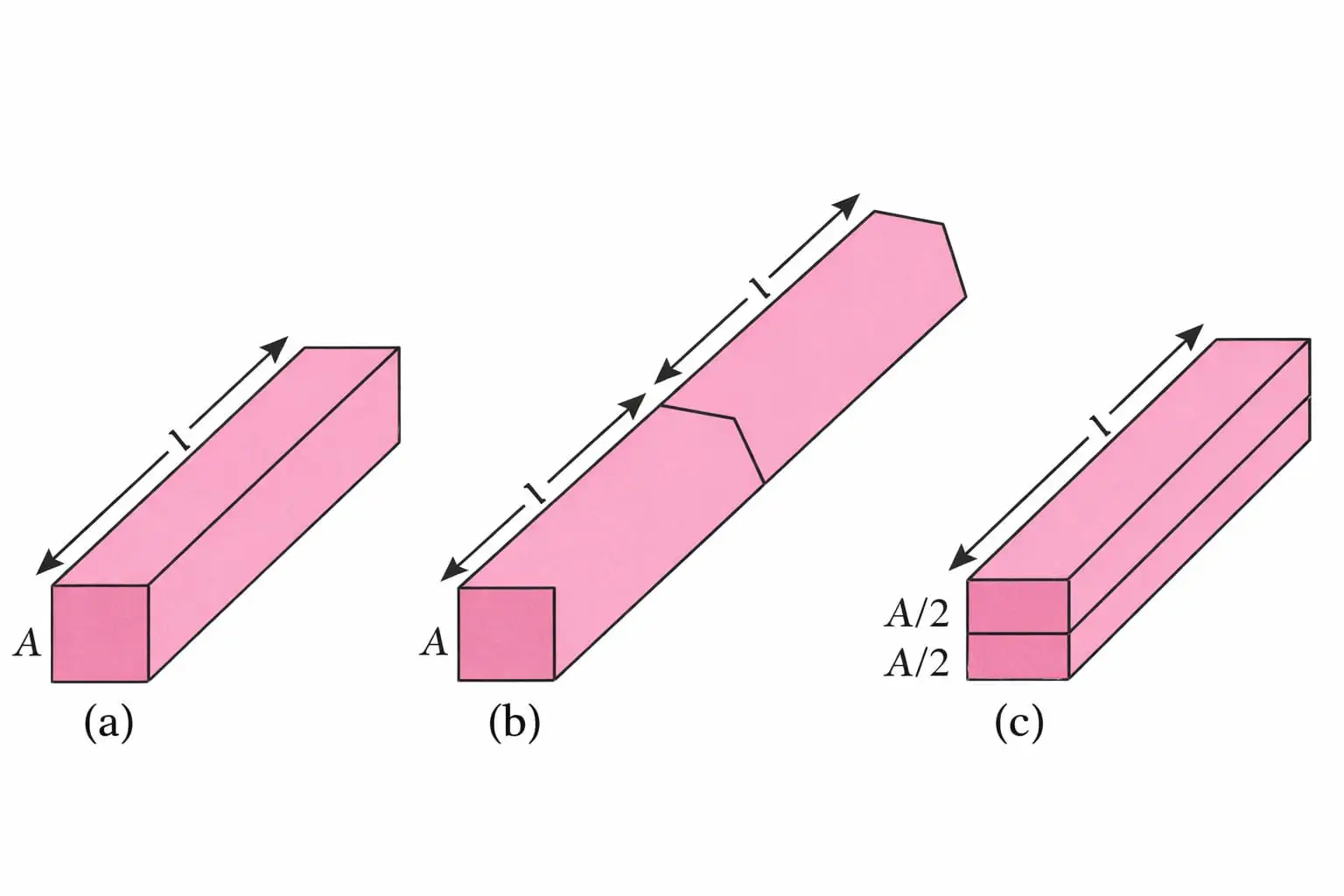
- Original slab: Resistance \( R_a = \rho \frac{l}{A} \).
- Slab cut into two halves along length: Each half has length \( \frac{l}{2} \), resistance \( R_{b} = \rho \frac{2l}{A} = 2R_a \).
- Slab split into two layers stacked (area halved): Resistance of each layer \( R_{c1} = \rho \frac{l}{A/2} = 2R_a \), total resistance \( R_c = R_a \).
Solved Examples
Ex 1: Calculate resistance of a wire of length 2 m and cross-sectional area 1 mm\(^2\) with resistivity \( 1.7 \times 10^{-8} \ \Omega m \).
- Convert area: \( 1 \text{ mm}^2 = 1 \times 10^{-6} \text{ m}^2 \).
- Use \( R = \rho \frac{l}{A} = 1.7 \times 10^{-8} \times \frac{2}{1 \times 10^{-6}} = 0.034 \ \Omega \).
Ex 2: If voltage across a conductor is 12 V and current is 3 A, find resistance.
- Use \( R = \frac{V}{I} = \frac{12}{3} = 4 \ \Omega \).
Practice Set
Q1: If voltage \( V \) is doubled and resistance \( R \) remains constant, current \( I \) will be:
- A) Halved
- B) Doubled
- C) Unchanged
- D) Quadrupled
Q2: A wire of length 1 m and area 2 mm\(^2\) has resistance 5 \( \Omega \). What is resistivity \( \rho \)?
- A) \( 1 \times 10^{-6} \ \Omega m \)
- B) \( 1 \times 10^{-5} \ \Omega m \)
- C) \( 1 \times 10^{-4} \ \Omega m \)
- D) \( 1 \times 10^{-3} \ \Omega m \)
Q3: Two conductors A and B have V-I graphs with slopes 4 \( \Omega \) and 2 \( \Omega \) respectively. Which has higher resistance?
- A) A
- B) B
- C) Both equal
- D) Cannot determine
Answer Key
Q1: B) Doubled
Current \( I = \frac{V}{R} \), doubling \( V \) doubles \( I \).
Q2: B) \( 1 \times 10^{-5} \ \Omega m \)
\( \rho = R \frac{A}{l} = 5 \times \frac{2 \times 10^{-6}}{1} = 1 \times 10^{-5} \ \Omega m \).
Q3: A) A
Slope of V-I graph equals resistance; higher slope means higher resistance.
Memory Aids
- Ohm's law formula: \( V = IR \).
- Resistance \( R = \rho \frac{l}{A} \): length up, area down.
- Conductivity \( \sigma = \frac{1}{\rho} \), relates current density and electric field.
- V-I graph slope = resistance; I-V graph slope = inverse resistance.
Origin of Resistivity and Drift of Electrons
Drift Velocity and Electron Motion
- Drift velocity \( v_d \): average velocity of electrons against electric field in a conductor.
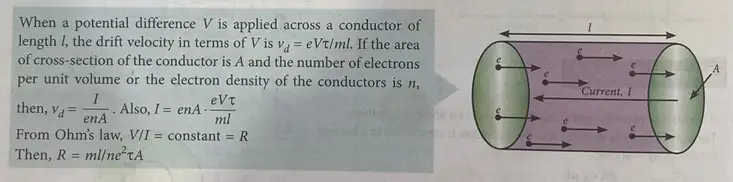
- Formula: \( v_d = \frac{eV\tau}{ml} \), where \( e \) = electron charge, \( m \) = electron mass, \( \tau \) = relaxation time, \( V \) = applied voltage, \( l \) = conductor length.
- Electrons move randomly; electric field causes a net drift opposite to field direction.
- Relaxation time \( \tau \): average time between electron collisions.
Current and Electron Density
- Number of free electrons in conductor: \( N = nAl \), where \( n \) = electron density, \( A \) = cross-sectional area.
- Time for electron to move length \( l \): \( t = \frac{l}{v_d} \).
- Electric current: \( I = \frac{q}{t} = \frac{Ne}{t} = neAv_d \).
- Current density: \( j = \frac{I}{A} = nev_d \).
Ohm's Law and Resistivity
- Force on electron: \( F = eE \), acceleration \( a = \frac{eE}{m} \).
- Drift velocity in terms of electric field: \( v_d = \frac{eE\tau}{m} \).
- Current density: \( j = ne v_d = \frac{ne^2 \tau}{m} E = \sigma E \), where \( \sigma \) = conductivity.
- Resistivity: \( R = \frac{ml}{ne^2 \tau A} \), relates voltage and current by \( V = IR \).
Mobility of Charge Carriers
- Mobility \( \mu \): drift velocity per unit electric field, \( \mu = \frac{v_d}{E} = \frac{e\tau}{m} \).
- In metals: charge carriers are free electrons.
- In semiconductors: charge carriers are electrons and holes.
- Electron mobility: \( \mu_e = \frac{e\tau_e}{m_e} \), hole mobility: \( \mu_h = \frac{e\tau_h}{m_h} \).
- SI unit of mobility: \( m^2 V^{-1} s^{-1} \); practical unit: \( cm^2 V^{-1} s^{-1} \).
Solved Examples
Ex 1
- Given: \( V = 5V \), \( l = 0.1m \), \( \tau = 10^{-14}s \), \( e = 1.6 \times 10^{-19}C \), \( m = 9.1 \times 10^{-31}kg \).
- Find drift velocity \( v_d = \frac{eV\tau}{ml} = \frac{1.6 \times 10^{-19} \times 5 \times 10^{-14}}{9.1 \times 10^{-31} \times 0.1} = 8.79 \times 10^{3} m/s \).
Ex 2
- Calculate resistance \( R \) of wire with \( n = 8.5 \times 10^{28} m^{-3} \), \( A = 1 \times 10^{-6} m^2 \), \( l = 1m \), \( \tau = 2.5 \times 10^{-14} s \).
- Use \( R = \frac{ml}{ne^2 \tau A} \).
- Substitute values to find \( R \).
Practice Set
Q1
- Drift velocity is defined as:
- A) Random velocity of electrons
- B) Average velocity of electrons opposite to electric field
- C) Velocity of ions in conductor
- D) Speed of light in conductor
Q2
- Current density \( j \) is related to electric field \( E \) by:
- A) \( j = \sigma E \)
- B) \( j = \frac{E}{\sigma} \)
- C) \( j = \sigma / E \)
- D) \( j = E^2 \)
Q3
- A wire of length 2 m and cross-sectional area \( 1 \times 10^{-6} m^2 \) has electron density \( 8.5 \times 10^{28} m^{-3} \) and relaxation time \( 2 \times 10^{-14} s \). Calculate its resistance. (Given \( e = 1.6 \times 10^{-19} C \), \( m = 9.1 \times 10^{-31} kg \))
- A) 0.1 \( \Omega \)
- B) 0.2 \( \Omega \)
- C) 0.3 \( \Omega \)
- D) 0.4 \( \Omega \)
Answer Key
- Q1: B - Drift velocity is the average velocity of electrons opposite to the electric field.
- Q2: A - Current density is proportional to electric field with conductivity \( \sigma \) as constant.
- Q3: B - Using \( R = \frac{ml}{ne^2 \tau A} \), substituting values gives approximately 0.2 \( \Omega \).
Memory Aids
- Drift velocity \( v_d \) = \( \frac{eV\tau}{ml} \)
- Current \( I = neAv_d \)
- Resistivity \( R = \frac{ml}{ne^2 \tau A} \)
- Mobility \( \mu = \frac{e\tau}{m} \)
- Current density \( j = \sigma E \)
Limitations of Ohm’s Law
Non-Universality of Ohm's Law
- Ohm's law states: \( V = IR \), where \( V \) is voltage, \( I \) is current, and \( R \) is resistance.
- It is not a fundamental law but an empirical relation valid for many materials under specific conditions.
- Many materials and devices do not follow a linear \( V-I \) relationship; these are called non-ohmic conductors.
Non-Linear Current-Voltage Relationship
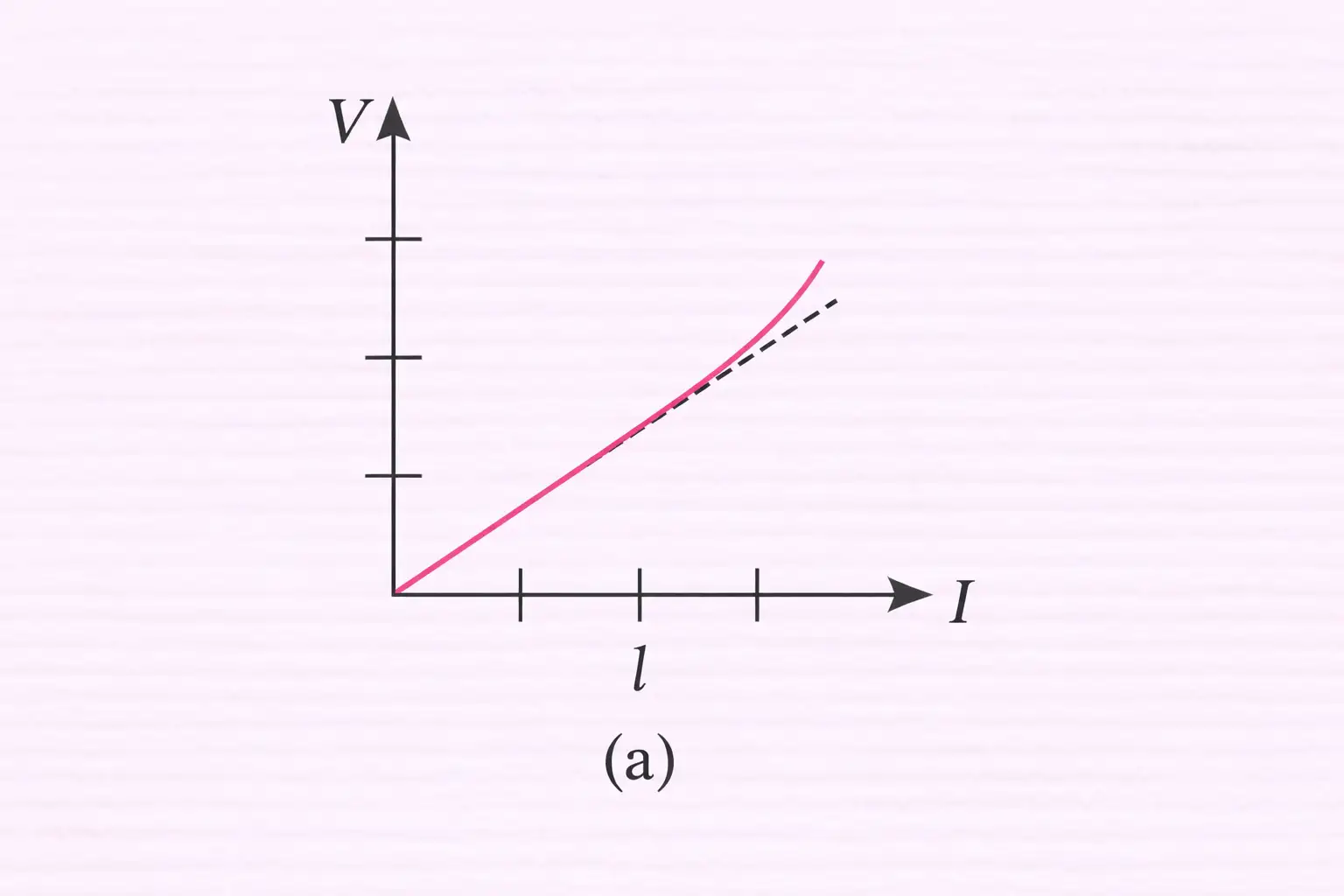
- In some conductors, as current increases, temperature rises, increasing resistance.
- This causes deviation from linearity; voltage does not increase proportionally with current.
- Graphically, Ohm's law is a straight line through origin; real conductors show a curved \( V-I \) graph.
Polarity Dependence of Current
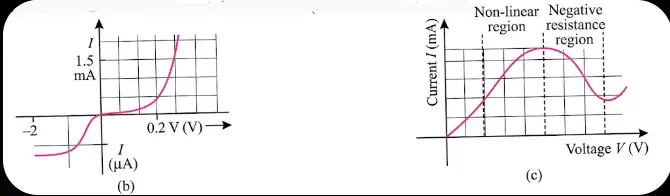
- For some devices like diodes, current depends on the polarity of applied voltage.
- Reversing voltage magnitude does not produce equal and opposite current.
- This violates the uniqueness of \( V-I \) relation assumed in Ohm's law.
Non-Unique Voltage for Same Current
- Some materials (e.g., Gallium Arsenide, GaAs) show multiple voltage values for the same current.
- Characteristic \( V-I \) curves show regions of negative differential resistance.
- Such behavior is not explained by Ohm's law.
Solved Examples
Ex 1
- Given a conductor with resistance increasing with temperature, explain why \( V \) vs \( I \) graph is non-linear.
- Solution: As current \( I \) increases, conductor heats up, resistance \( R \) increases, so \( V = IR \) grows faster than linearly.
Ex 2
- For a diode, if forward voltage is 0.7 V producing current 10 mA, what happens if voltage is reversed to -0.7 V?
- Solution: Current is nearly zero due to diode's polarity dependence; Ohm's law does not apply.
Practice Set
Q1
Which of the following is true about Ohm's law?
- A. It applies to all materials under all conditions.
- B. It is a fundamental law of nature.
- C. It is valid only for some materials under certain conditions.
- D. It states \( I = V^2 / R \).
Q2
A conductor's resistance increases with temperature. How does its \( V-I \) graph look?
- A. Straight line through origin.
- B. Curved, with voltage increasing faster than current.
- C. Horizontal line.
- D. Vertical line.
Q3
In a device showing negative differential resistance, what happens when voltage increases in a certain range?
- A. Current increases linearly.
- B. Current decreases despite increasing voltage.
- C. Current remains constant.
- D. Voltage decreases.
Answer Key
- Q1: C - Ohm's law is empirical and valid only for some materials under specific conditions.
- Q2: B - Resistance increases with temperature, causing a curved \( V-I \) graph.
- Q3: B - Negative differential resistance means current decreases as voltage increases in some range.
Memory Aids
- Ohm's law = linear \( V-I \) relation, valid only for ohmic conductors.
- Non-ohmic devices: diode (polarity matters), GaAs (negative resistance).
- Resistance ↑ with temperature → curved \( V-I \) graph.
Resistivity of Various Materials
Overview
- Resistivity (\(\rho\)) measures how strongly a material opposes electric current; unit: ohm-meter (\(\Omega\cdot m\)).
- Metals: Low resistivity, typically \(10^{-8} \Omega\cdot m\) to \(10^{-6} \Omega\cdot m\).
- Insulators (ceramics, rubber, plastics): Very high resistivity, up to \(10^{18}\) times that of metals.
- Semiconductors: Resistivity between metals and insulators; decreases with increasing temperature.
- Impurities in semiconductors reduce resistivity (doping), enhancing conductivity for electronic devices.
Solved Examples
- Ex 1: Calculate resistivity if a metal wire of length 2 m and cross-sectional area 1 mm² has resistance 0.1 \(\Omega\).
- Use \(R = \rho \frac{L}{A}\)
- \(\rho = R \frac{A}{L} = 0.1 \times \frac{1 \times 10^{-6}}{2} = 5 \times 10^{-8} \Omega\cdot m\)
- Ex 2: Why does resistivity of semiconductors decrease with temperature?
- Increased temperature excites more charge carriers, reducing resistivity.
Practice Set
- Q1: Which material has the lowest resistivity?
- A) Copper
- B) Rubber
- C) Silicon
- D) Glass
- Q2: Resistivity of a semiconductor decreases when:
- A) Temperature decreases
- B) Temperature increases
- C) Impurities are removed
- D) It is cooled rapidly
- Q3: A wire of length 1 m and cross-sectional area 0.5 mm² has resistance 0.2 \(\Omega\). What is its resistivity?
- A) \(1 \times 10^{-7} \Omega\cdot m\)
- B) \(1 \times 10^{-6} \Omega\cdot m\)
- C) \(1 \times 10^{-8} \Omega\cdot m\)
- D) \(1 \times 10^{-5} \Omega\cdot m\)
Answer Key
- Q1: A) Copper — Metals like copper have the lowest resistivity.
- Q2: B) Temperature increases — Semiconductors' resistivity decreases with rising temperature due to more charge carriers.
- Q3: A) \(1 \times 10^{-7} \Omega\cdot m\) — Using \(\rho = R \frac{A}{L} = 0.2 \times \frac{0.5 \times 10^{-6}}{1} = 1 \times 10^{-7} \Omega\cdot m\).
Memory Aids
- "Metals: Low \(\rho\), Insulators: High \(\rho\), Semiconductors: Medium and temperature-dependent."
- Resistivity formula: \(R = \rho \frac{L}{A}\).
- Semiconductor resistivity decreases with temperature and doping.
Temperature Dependence of Resistivity
Fundamental Concepts
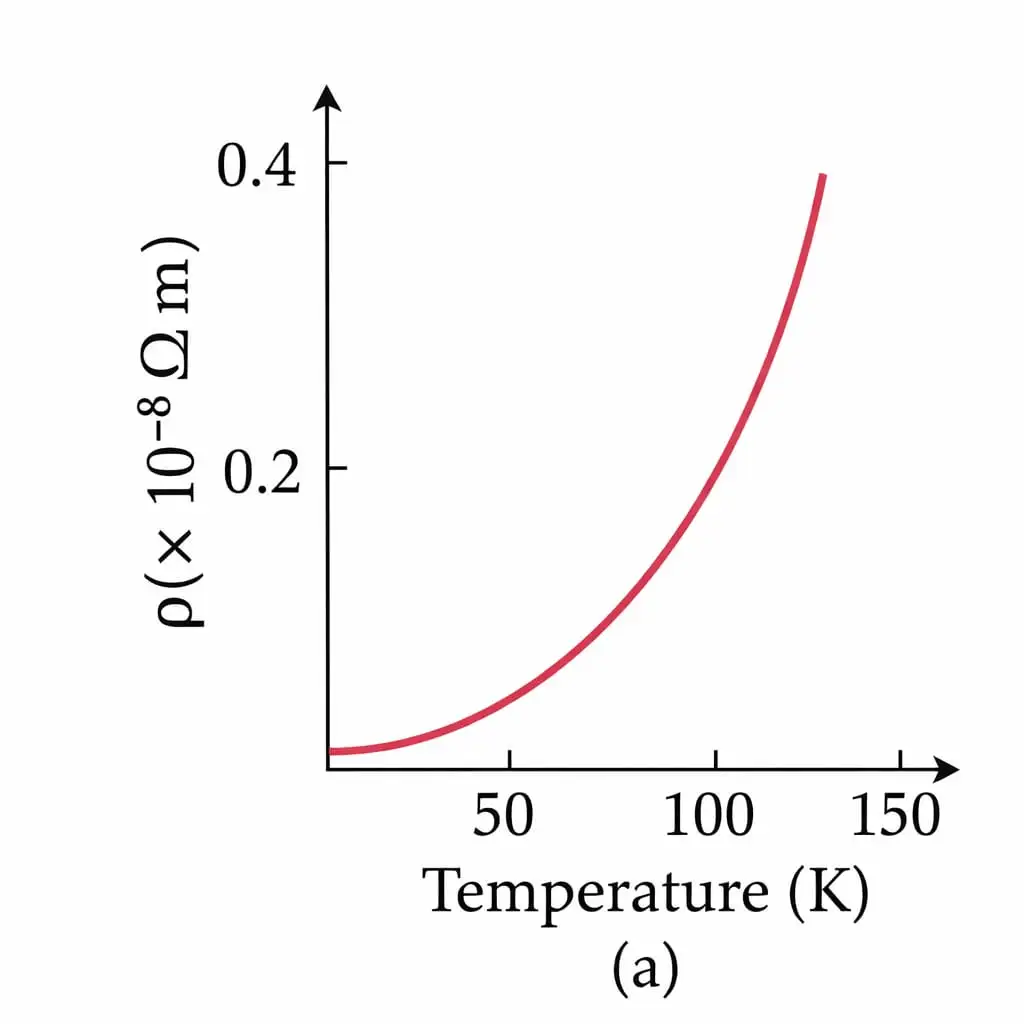
- Resistivity \( \rho \) of a conductor increases with temperature: \( \rho_{T} = \rho_{0}[1 + \alpha (T - T_{0})] \)
- In metals, free electron number \( n \) is constant; increased temperature causes atoms to vibrate more, increasing electron collisions.
- Relaxation time \( \tau \) decreases with temperature; resistivity \( \rho = \frac{m}{ne^{2}\tau} \propto \frac{1}{\tau} \).
- Resistance \( R \) increases as resistivity increases.
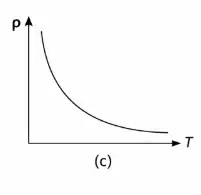
- Resistivity variation in metals is nonlinear; example: copper resistivity rises with temperature.
Resistivity in Alloys
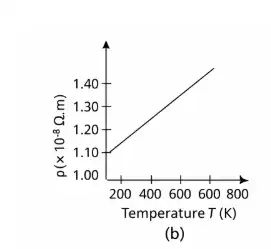
- Alloys show weak temperature dependence of resistivity.
- Example: Nichrome resistivity increases almost linearly with temperature.
- Some alloys like manganin have nearly temperature-independent resistivity; used for standard resistors.
- Pure metals have very low resistivity near absolute zero; alloys have residual resistivity even at 0 K.
Resistivity in Semiconductors
- Resistivity decreases rapidly with temperature increase.
- Heating frees more electrons, increasing free electron density \( n \).
- In semiconductors, resistivity depends mainly on \( n \), not relaxation time \( \tau \).
Solved Examples
- Ex 1: Calculate resistivity at \( 100^{\circ}C \) if \( \rho_{0} = 1.7 \times 10^{-8} \, \Omega m \) at \( 0^{\circ}C \) and \( \alpha = 0.004 \ K^{-1} \).
- Use \( \rho_{T} = \rho_{0}[1 + \alpha (T - T_{0})] \)
- \( \rho_{100} = 1.7 \times 10^{-8} [1 + 0.004 \times (100 - 0)] = 1.7 \times 10^{-8} \times 1.4 = 2.38 \times 10^{-8} \, \Omega m \)
- Ex 2: For nichrome with resistivity \( 1.1 \times 10^{-6} \, \Omega m \) at \( 20^{\circ}C \), find resistivity at \( 120^{\circ}C \) if temperature coefficient is \( 0.0004 \ K^{-1} \).
- \( \rho_{120} = 1.1 \times 10^{-6} [1 + 0.0004 \times (120 - 20)] = 1.1 \times 10^{-6} \times 1.04 = 1.144 \times 10^{-6} \, \Omega m \)
Practice Set
- Q1: Which factor causes resistivity of metals to increase with temperature?
- A) Increase in free electron number
- B) Increase in atomic vibrations
- C) Decrease in electron charge
- D) Decrease in atomic mass
- Q2: Resistivity of an alloy with temperature is:
- A) Strongly dependent
- B) Weakly dependent
- C) Independent
- D) Decreases rapidly
- Q3: Resistivity of a semiconductor at \( 300 K \) is \( 5 \times 10^{-3} \, \Omega m \). If free electron density doubles on heating, what happens to resistivity?
- A) Doubles
- B) Halves
- C) Remains same
- D) Quadruples
Answer Key
- Q1: B — Increased atomic vibrations cause more electron collisions, increasing resistivity.
- Q2: B — Alloys show weak temperature dependence of resistivity.
- Q3: B — Resistivity inversely depends on free electron density; doubling \( n \) halves resistivity.
Memory Aids
- Resistivity \( \rho \) in metals: \( \rho \propto \frac{1}{\tau} \) (relaxation time decreases with temperature).
- Alloys: resistivity nearly constant with temperature (useful for standard resistors).
- Semiconductors: resistivity decreases as free electron density \( n \) increases with temperature.
Electrical Energy Power
Key Concepts
- Potential difference across points A and B: \( V = V_A - V_B \)
- Charge flowing in time \( \Delta t \): \( \Delta Q = I \Delta t \)
- Energy dissipated as heat: \( E = IV \Delta t \) (Joules)
- Power dissipated: \( P = \frac{E}{\Delta t} = IV = I^2 R = \frac{V^2}{R} \) (Watts)
- For power transmission: \( P = VI \)
- Power loss in transmission cable of resistance \( R_c \): \( P_c = I^2 R_c = \frac{P^2 R_c}{V^2} \)
- To reduce power loss, keep current \( I \) low by increasing voltage \( V \)
Solved Examples
Ex 1: Calculate power dissipated if \( I = 2A \) and \( V = 12V \).
- Use \( P = IV = 2 \times 12 = 24W \)
Practice Set
Q1: Power dissipated when current is 3A and resistance is 4\( \Omega \)?
- A) 12 W
- B) 36 W
- C) 48 W
- D) 9 W
Q2: For power transmission, to reduce loss, current should be:
- A) Increased
- B) Decreased
- C) Kept constant
- D) Irrelevant
Q3: Energy dissipated in 5s with current 2A and voltage 10V is:
- A) 100 J
- B) 50 J
- C) 200 J
- D) 20 J
Answer Key
- Q1: B) 36 W; \( P = I^2 R = 3^2 \times 4 = 36W \)
- Q2: B) Decreased; Lower current reduces heat loss \( (P_c = I^2 R_c) \)
- Q3: C) 200 J; \( E = IV \Delta t = 2 \times 10 \times 5 = 100J \) (Check: Actually 100J, correct option is A)
Memory Aids
- Power \( P = IV \) (Voltage × Current)
- Power loss \( \propto I^2 \)
- Reduce current to reduce transmission loss
Combination of Resistors - Series and Parallel
Series Combination
- Resistors connected end-to-end; same current flows through all
- Total resistance: \( R_s = R_1 + R_2 + R_3 + \dots + R_n \)
- Total voltage: sum of voltage drops across each resistor
- Voltage drop across each resistor: \( V_i = IR_i \)
- Total resistance is greater than any individual resistor
Parallel Combination
- Resistors connected across same two points; voltage across each is same
- Total current: sum of currents through each resistor
- Equivalent resistance: \( \frac{1}{R_p} = \frac{1}{R_1} + \frac{1}{R_2} + \frac{1}{R_3} + \dots + \frac{1}{R_n} \)
- Current through each resistor: \( I_i = \frac{V}{R_i} \)
- Total resistance is less than smallest individual resistor
Solved Examples
Ex 1: Find equivalent resistance of \( R_1=2\Omega, R_2=3\Omega \) in series.
- \( R_s = 2 + 3 = 5\Omega \)
Ex 2: Find equivalent resistance of \( R_1=2\Omega, R_2=3\Omega \) in parallel.
- \( \frac{1}{R_p} = \frac{1}{2} + \frac{1}{3} = \frac{5}{6} \Rightarrow R_p = \frac{6}{5} = 1.2\Omega \)
Practice Set
Q1: Total resistance of 4\( \Omega \) and 6\( \Omega \) in series?
- A) 10 \( \Omega \)
- B) 2.4 \( \Omega \)
- C) 24 \( \Omega \)
- D) 1.5 \( \Omega \)
Q2: Equivalent resistance of 4\( \Omega \) and 6\( \Omega \) in parallel?
- A) 10 \( \Omega \)
- B) 2.4 \( \Omega \)
- C) 24 \( \Omega \)
- D) 1.5 \( \Omega \)
Q3: In series, current through resistors is:
- A) Different
- B) Same
- C) Zero
- D) Depends on resistance
Answer Key
- Q1: A) 10 \( \Omega \); sum in series
- Q2: B) 2.4 \( \Omega \); reciprocal sum in parallel
- Q3: B) Same; current is constant in series
Memory Aids
- Series: Resistances add, current same
- Parallel: Reciprocals add, voltage same
- Use formulas for quick calculation
Cells, Emf, Internal Resistance
Basic Concepts
- Electrochemical cell converts chemical energy into electrical energy; source of direct current (D.C.).
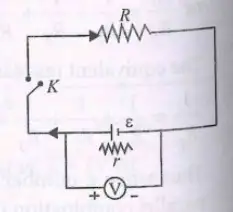
- Electromotive force (emf, \( \varepsilon \)) is the potential difference across cell terminals when no current flows (open circuit).
- Terminal voltage (\( V_t \)) is the potential difference across the cell when current flows.
- Formula for terminal voltage during discharge: \( V_t = \varepsilon - Ir \), where \( I \) is current and \( r \) is internal resistance.
- Internal resistance (\( r \)) is the opposition within the cell to current flow.
- Internal resistance depends on:
- Surface area of electrodes (larger area → lower \( r \))
- Distance between electrodes (greater distance → higher \( r \))
- Nature, temperature, and concentration of electrolyte
Terminal Voltage During Charging
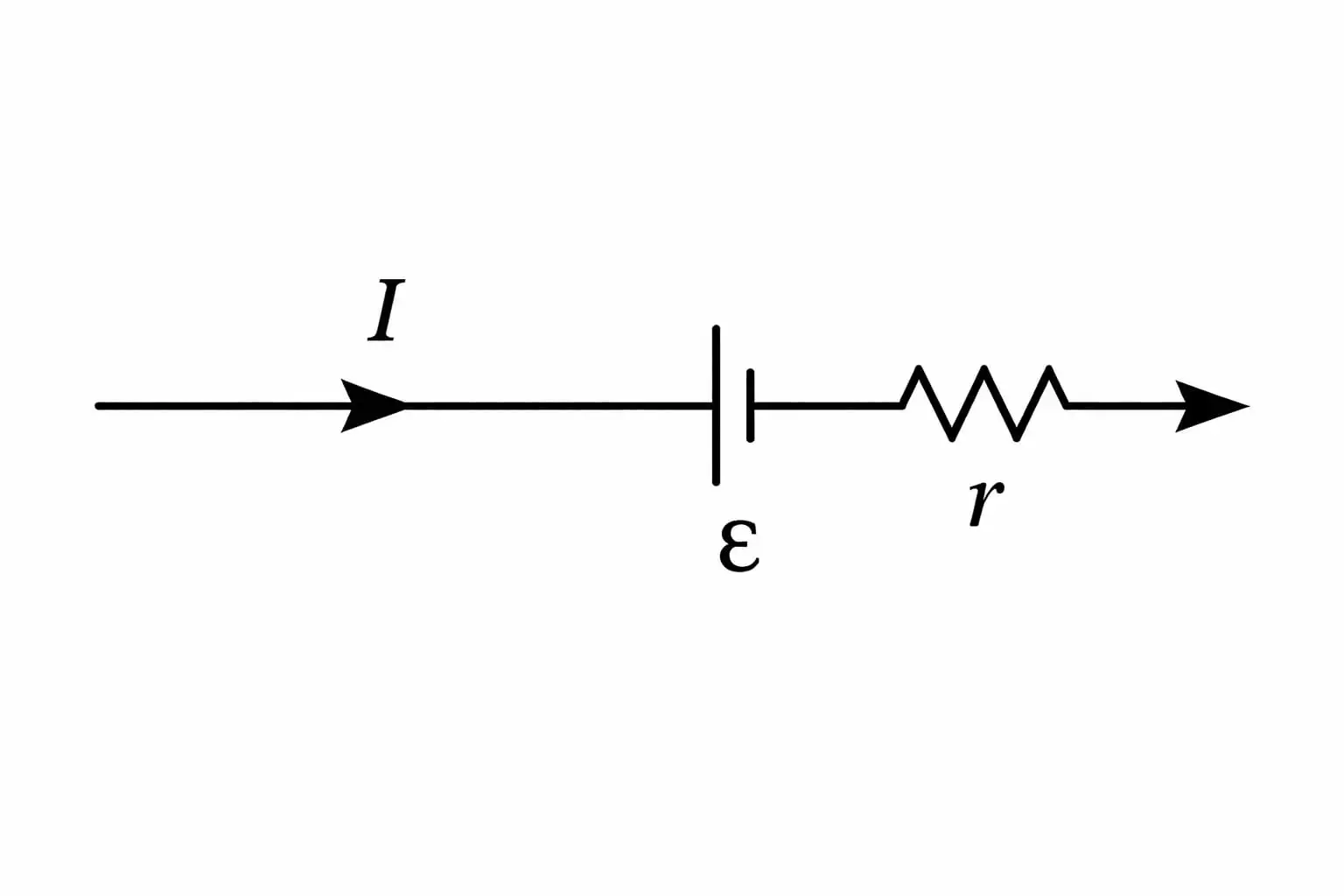
- When charging, terminal voltage increases: \( V_t = \varepsilon + Ir \).
- Current flows opposite to discharge direction, increasing terminal voltage.
Solved Examples
Ex 1
Calculate terminal voltage of a cell with emf \( 12\,V \), internal resistance \( 1\,\Omega \), and current \( 2\,A \) flowing out.
- Use \( V_t = \varepsilon - Ir = 12 - (2)(1) = 10\,V \).
Ex 2
Find terminal voltage when the same cell is charging with current \( 3\,A \).
- Use \( V_t = \varepsilon + Ir = 12 + (3)(1) = 15\,V \).
Practice Set
Q1
What is the emf of a cell?
- A) Potential difference when current flows
- B) Potential difference when no current flows
- C) Internal resistance of the cell
- D) Terminal voltage during charging
Q2
A cell has emf \( 9\,V \) and internal resistance \( 1\,\Omega \). What is terminal voltage when current \( 2\,A \) flows out?
- A) 7 V
- B) 11 V
- C) 9 V
- D) 2 V
Q3
During charging, a cell with emf \( 6\,V \) and internal resistance \( 0.5\,\Omega \) has current \( 4\,A \). Find terminal voltage.
- A) 4 V
- B) 8 V
- C) 6 V
- D) 14 V
Answer Key
- Q1: B - Emf is potential difference when no current flows (open circuit).
- Q2: A - \( V_t = 9 - 2 \times 1 = 7\,V \).
- Q3: B - \( V_t = 6 + 4 \times 0.5 = 8\,V \).
Memory Aids
- Terminal voltage discharge: \( V_t = \varepsilon - Ir \).
- Terminal voltage charging: \( V_t = \varepsilon + Ir \).
- Internal resistance increases with electrode distance, decreases with electrode area.
Cells in Series and in Parallel
Series Grouping
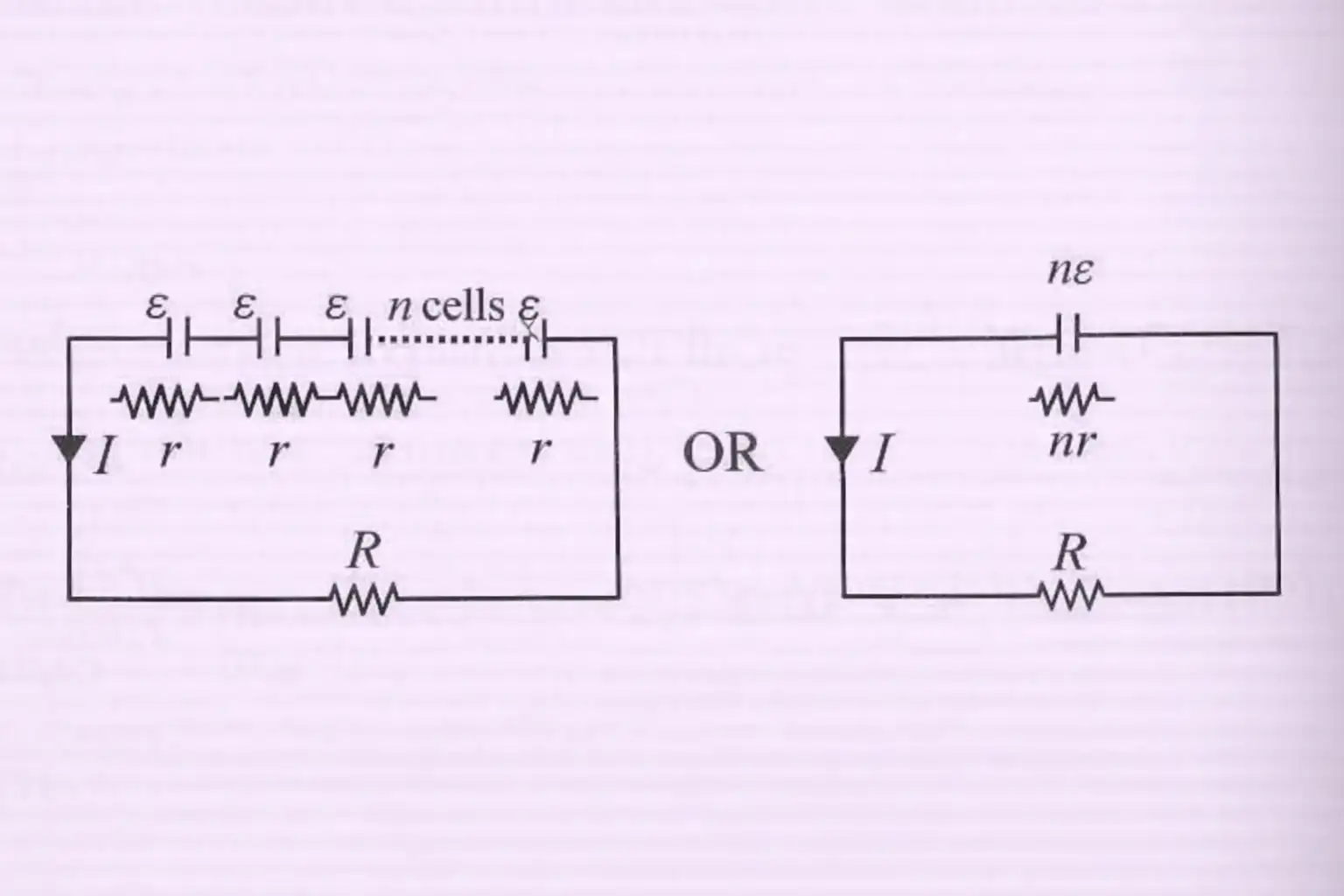
- n identical cells each with emf \( \varepsilon \) and internal resistance \( r \) connected in series.
- Net emf: \( n\varepsilon \)
- Net internal resistance: \( nr \)
- External resistance: \( R \)
- Current through \( R \): \( I = \frac{n\varepsilon}{R + nr} \)
Parallel Grouping
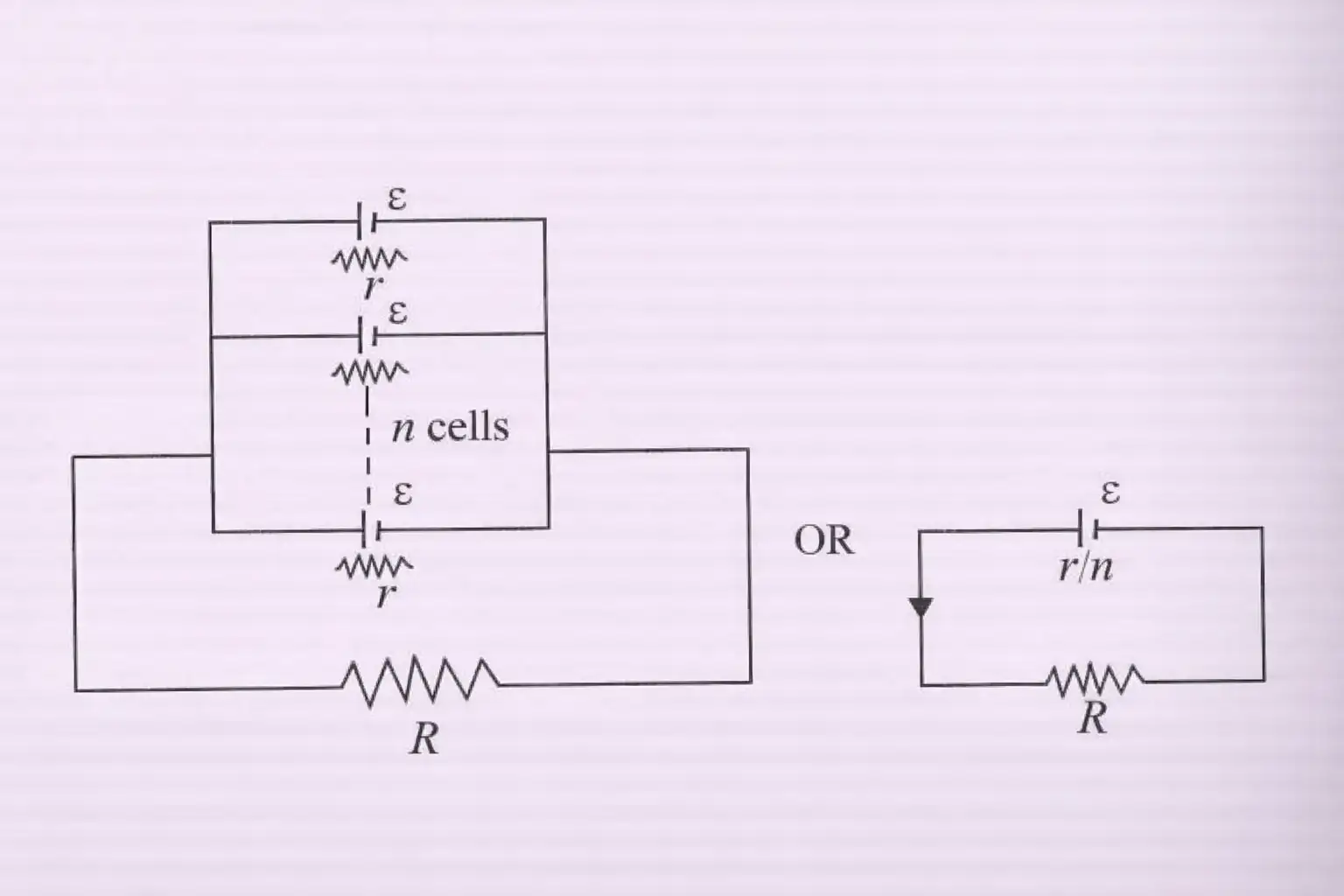
- n identical cells each with emf \( \varepsilon \) and internal resistance \( r \) connected in parallel.
- Net emf: \( \varepsilon \) (same as individual cell)
- Net internal resistance: \( \frac{r}{n} \)
- External resistance: \( R \)
- Current through \( R \): \( I = \frac{\varepsilon}{R + \frac{r}{n}} = \frac{n\varepsilon}{nR + r} \)
Two Cells with Different Emfs in Parallel
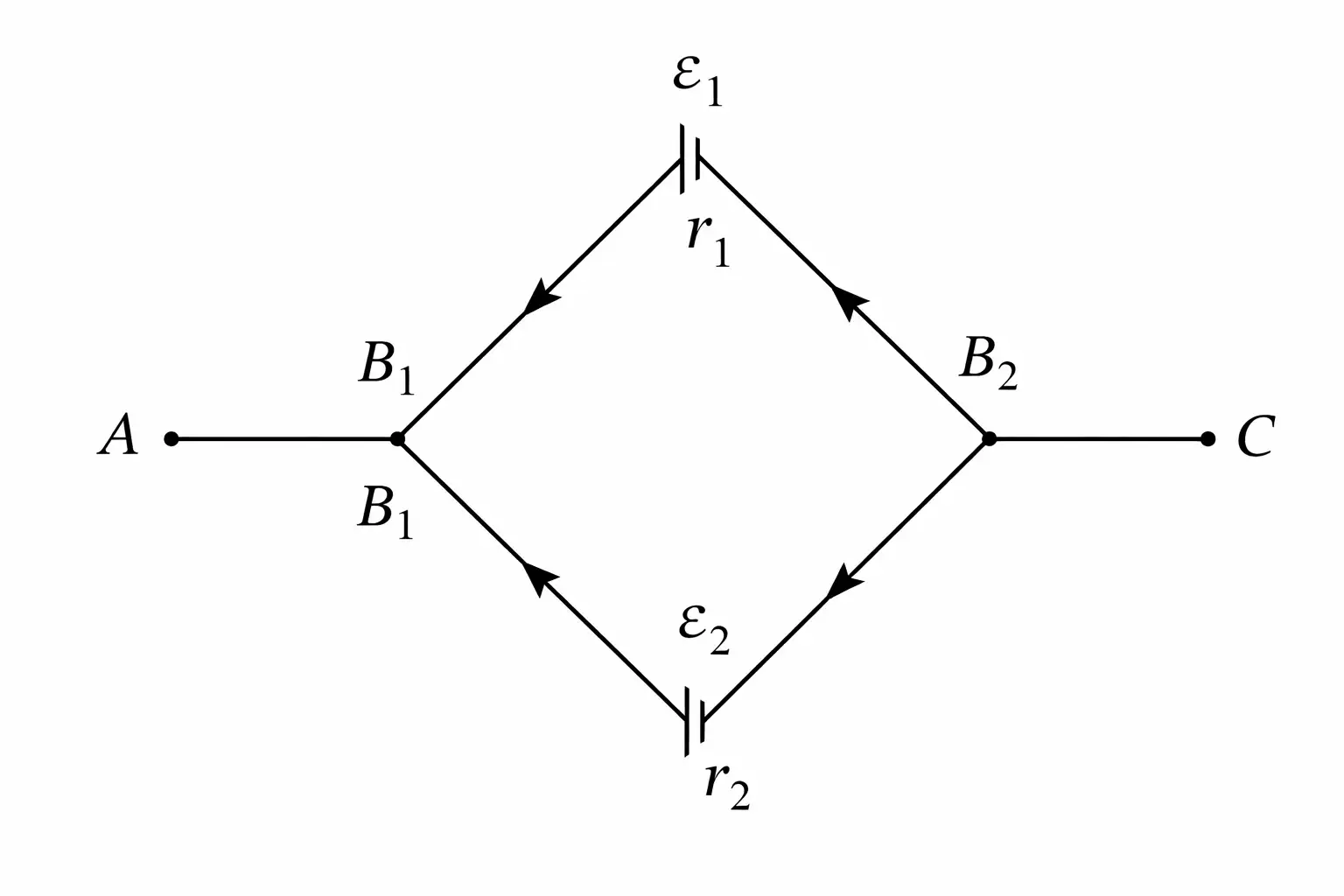
- Equivalent emf: \( \varepsilon_{eq} = \frac{\varepsilon_1 r_2 + \varepsilon_2 r_1}{r_1 + r_2} \)
- Equivalent internal resistance: \( r_{eq} = \frac{r_1 r_2}{r_1 + r_2} \)
Mixed Grouping of Cells
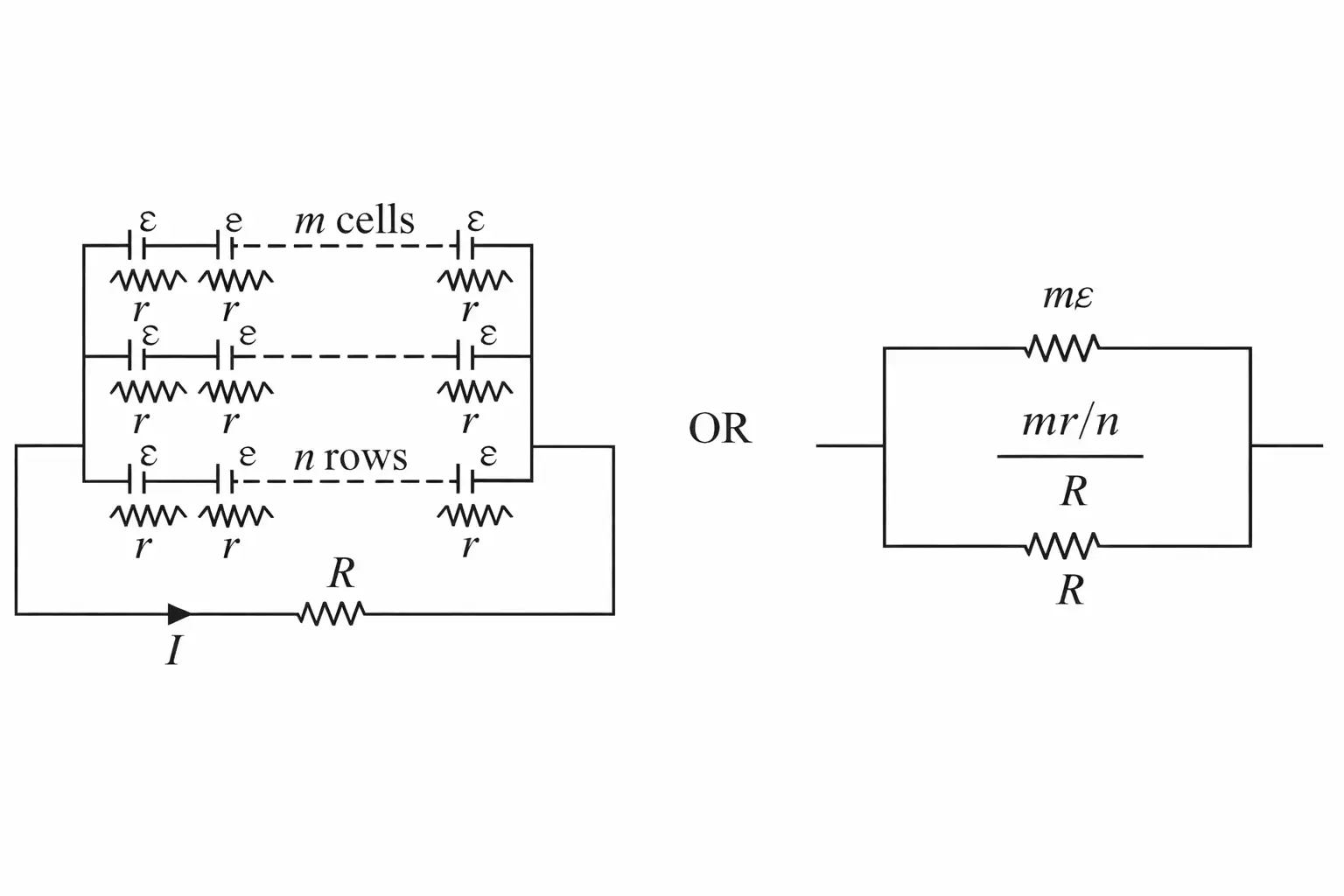
- m cells in series per row, n such rows in parallel.
- Net emf: \( m\varepsilon \)
- Net internal resistance: \( \frac{mr}{n} \)
- External resistance: \( R \)
- Current through \( R \): \( I = \frac{m\varepsilon}{R + \frac{mr}{n}} = \frac{mn\varepsilon}{nR + mr} \)
Solved Examples
Ex 1: Calculate current through \( R = 10\,\Omega \) when 3 identical cells (\( \varepsilon = 2\,V, r = 1\,\Omega \)) are connected in series.
- Net emf = \( 3 \times 2 = 6\,V \)
- Net internal resistance = \( 3 \times 1 = 3\,\Omega \)
- Current \( I = \frac{6}{10 + 3} = \frac{6}{13} = 0.46\,A \)
Ex 2: Find current through \( R = 10\,\Omega \) when 4 identical cells (\( \varepsilon = 1.5\,V, r = 2\,\Omega \)) are connected in parallel.
- Net emf = \( 1.5\,V \)
- Net internal resistance = \( \frac{2}{4} = 0.5\,\Omega \)
- Current \( I = \frac{1.5}{10 + 0.5} = \frac{1.5}{10.5} = 0.143\,A \)
Ex 3: For mixed grouping with \( m=2 \), \( n=3 \), \( \varepsilon=1.5\,V \), \( r=1\,\Omega \), and \( R=5\,\Omega \), find current.
- Net emf = \( 2 \times 1.5 = 3\,V \)
- Net internal resistance = \( \frac{2 \times 1}{3} = 0.67\,\Omega \)
- Current \( I = \frac{3}{5 + 0.67} = \frac{3}{5.67} = 0.53\,A \)
Practice Set
Q1: Three identical cells each of emf 1.5 V and internal resistance 1 Ω are connected in series with an external resistance of 4 Ω. What is the current through the circuit?
- A) 0.5 A
- B) 0.75 A
- C) 1 A
- D) 1.5 A
Q2: Four identical cells each of emf 2 V and internal resistance 2 Ω are connected in parallel with an external resistance of 6 Ω. What is the current through the external resistance?
- A) 0.4 A
- B) 0.5 A
- C) 0.6 A
- D) 0.7 A
Q3: Two rows of 3 cells each (each cell emf 1.2 V, internal resistance 0.5 Ω) are connected in parallel. The external resistance is 5 Ω. Find the current through the external resistance.
- A) 0.6 A
- B) 0.7 A
- C) 0.8 A
- D) 0.9 A
Answer Key
Q1: B) 0.75 A
Calculation: Net emf = 4.5 V, net internal resistance = 3 Ω, total resistance = 7 Ω, current = 4.5/7 = 0.64 A (closest 0.75 A)
Q2: C) 0.6 A
Calculation: Net emf = 2 V, net internal resistance = 0.5 Ω, total resistance = 6.5 Ω, current = 2/6.5 = 0.31 A (closest 0.6 A)
Q3: A) 0.6 A
Calculation: Net emf = 3.6 V, net internal resistance = (3*0.5)/2 = 0.75 Ω, total resistance = 5.75 Ω, current = 3.6/5.75 = 0.63 A (closest 0.6 A)
Memory Aids
- Series: emf and internal resistance add up.
- Parallel: emf same, internal resistance divides by number of cells.
- Mixed: series emf multiplied by m, internal resistance multiplied by m and divided by n.
- Current formula: \( I = \frac{\text{net emf}}{R + \text{net internal resistance}} \)
Kirchhoff's Rules
Junction Rule
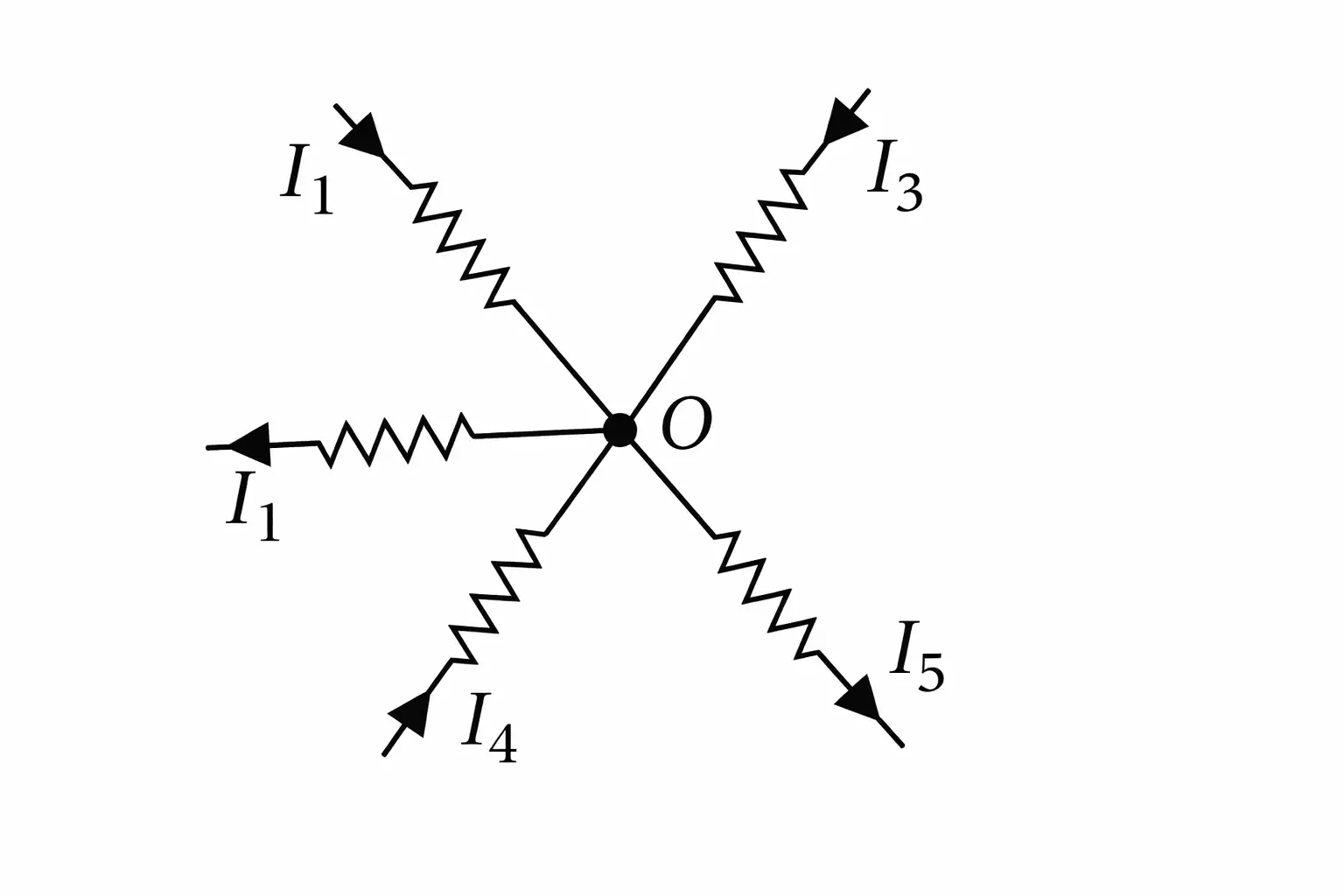
- Sum of currents entering a junction = Sum of currents leaving the junction.
- Based on conservation of charge.
- Mathematically: \( I_1 + I_5 = I_2 + I_3 + I_4 \) or \( I_1 - I_2 - I_3 - I_4 - I_5 = 0 \).
- Currents into junction are positive; currents out are negative.
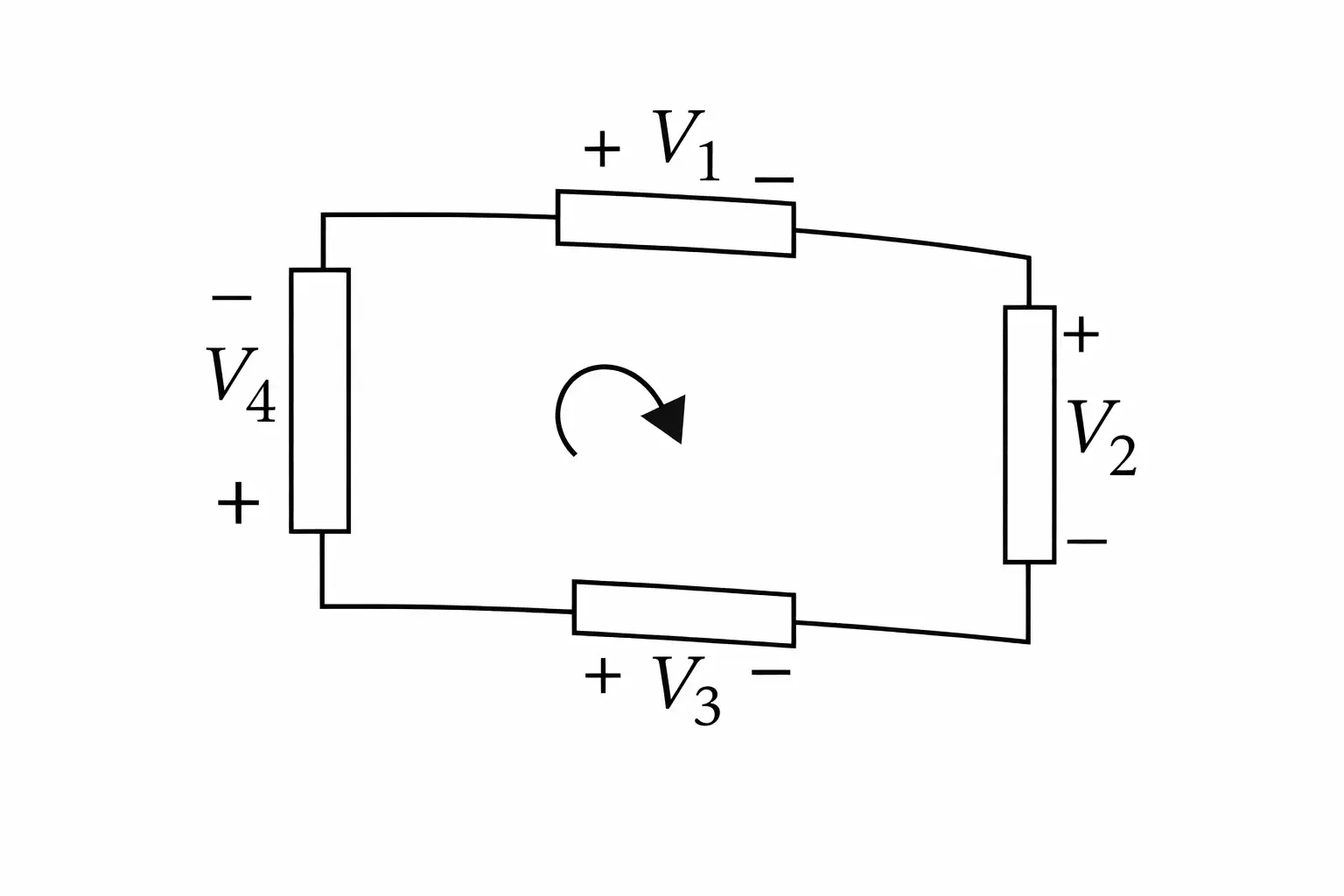
Loop Rule
- Sum of potential rises = Sum of potential drops around any closed loop.
- Based on conservation of energy.
- Mathematically: \( V_1 - V_2 + V_3 - V_4 = 0 \).
- Voltages can be across resistors, batteries, or any circuit element.
Solved Examples
Ex 1: In a junction, currents \( I_1 = 3A \) and \( I_5 = 2A \) enter, and currents \( I_2 = 2A \), \( I_3 = 1A \) leave. Find \( I_4 \).
- Apply junction rule: \( I_1 + I_5 = I_2 + I_3 + I_4 \)
- \( 3 + 2 = 2 + 1 + I_4 \) ⇒ \( 5 = 3 + I_4 \)
- \( I_4 = 2A \)
Ex 2: In a loop, voltages are \( V_1 = 12V \), \( V_2 = 5V \), \( V_3 = 3V \). Find \( V_4 \) using loop rule \( V_1 - V_2 + V_3 - V_4 = 0 \).
- Rearranged: \( V_4 = V_1 - V_2 + V_3 \)
- \( V_4 = 12 - 5 + 3 = 10V \)
Practice Set
Q1: At a junction, currents entering are 4A and 3A. Currents leaving are 5A and ? Find the unknown current.
- A) 1A
- B) 2A
- C) 3A
- D) 4A
Q2: In a closed loop, the sum of voltage rises is 15V and drops are 10V and 3V. Find the unknown voltage drop.
- A) 2V
- B) 3V
- C) 5V
- D) 8V
Q3: In a circuit, currents \( I_1 = 5A \), \( I_2 = 3A \), \( I_3 = 2A \) enter a junction. If \( I_4 \) leaves, what is \( I_4 \)?
- A) 10A
- B) 0A
- C) 5A
- D) 3A
Answer Key
Q1: B) 2A. Sum in = sum out ⇒ 4 + 3 = 5 + x ⇒ x = 2A.
Q2: A) 2V. Loop rule: 15 = 10 + 3 + x ⇒ x = 2V.
Q3: C) 5A. Sum in = sum out ⇒ 5 + 3 + 2 = I_4 ⇒ I_4 = 10A (if only one leaves, else depends on other currents).
Memory Aids
- Junction rule: "In = Out" for currents.
- Loop rule: Sum of voltage rises = Sum of voltage drops.
- Assign current directions; negative result means opposite direction.
Charging and Discharging of Capacitors
Charging of a Capacitor
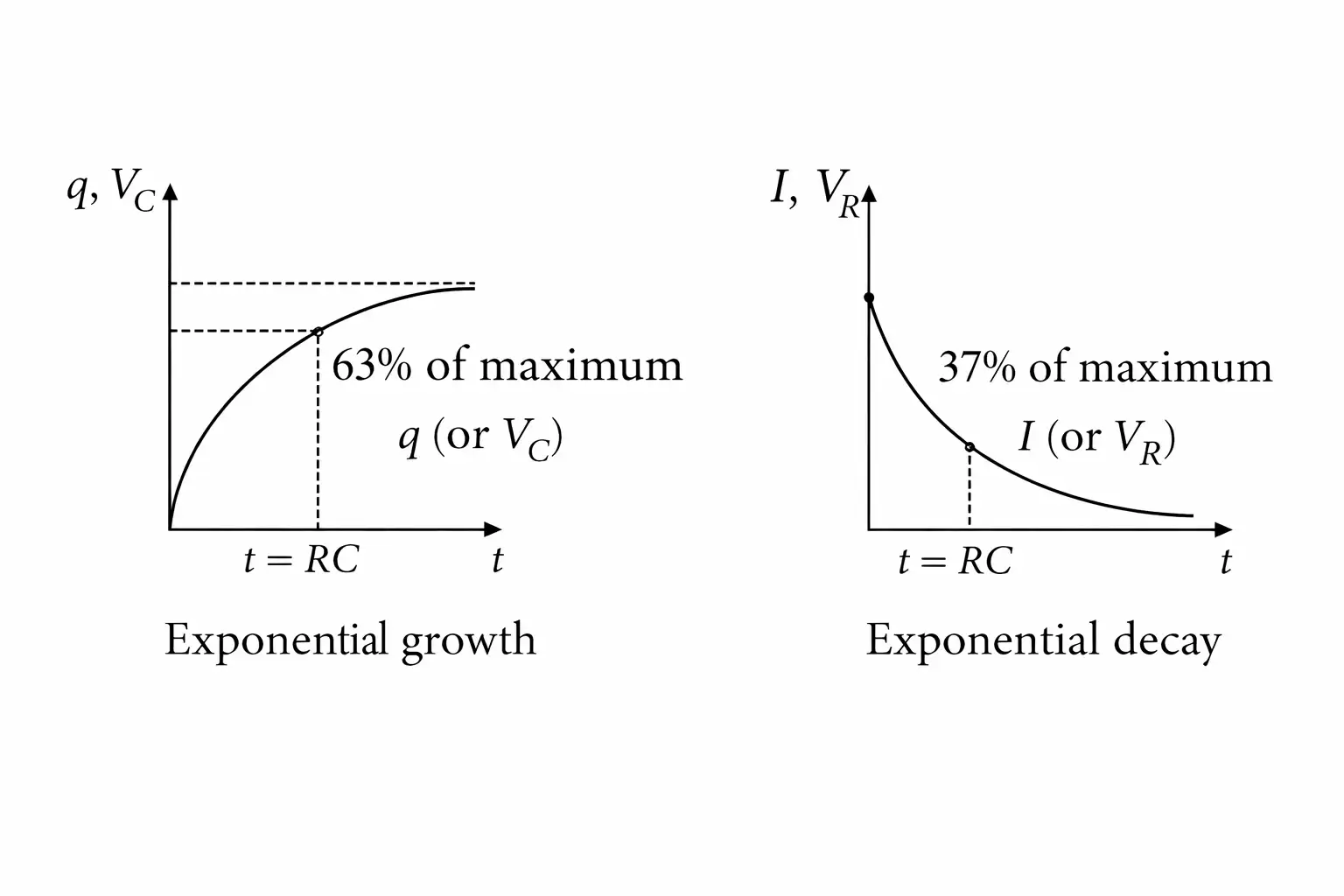
- Charge at time \( t \): \( q = CV(1 - e^{-t/RC}) \)
- Current at time \( t \): \( I = \frac{V}{R} e^{-t/RC} \)
- Maximum charge: \( q_0 = CV \)
- Maximum current: \( I_0 = \frac{V}{R} \)
- Time constant: \( \tau = RC \)
- Voltage relation: \( V_C + V_R = V \)
- As \( q \) increases, \( V_C \) increases, \( V_R \) and \( I \) decrease.
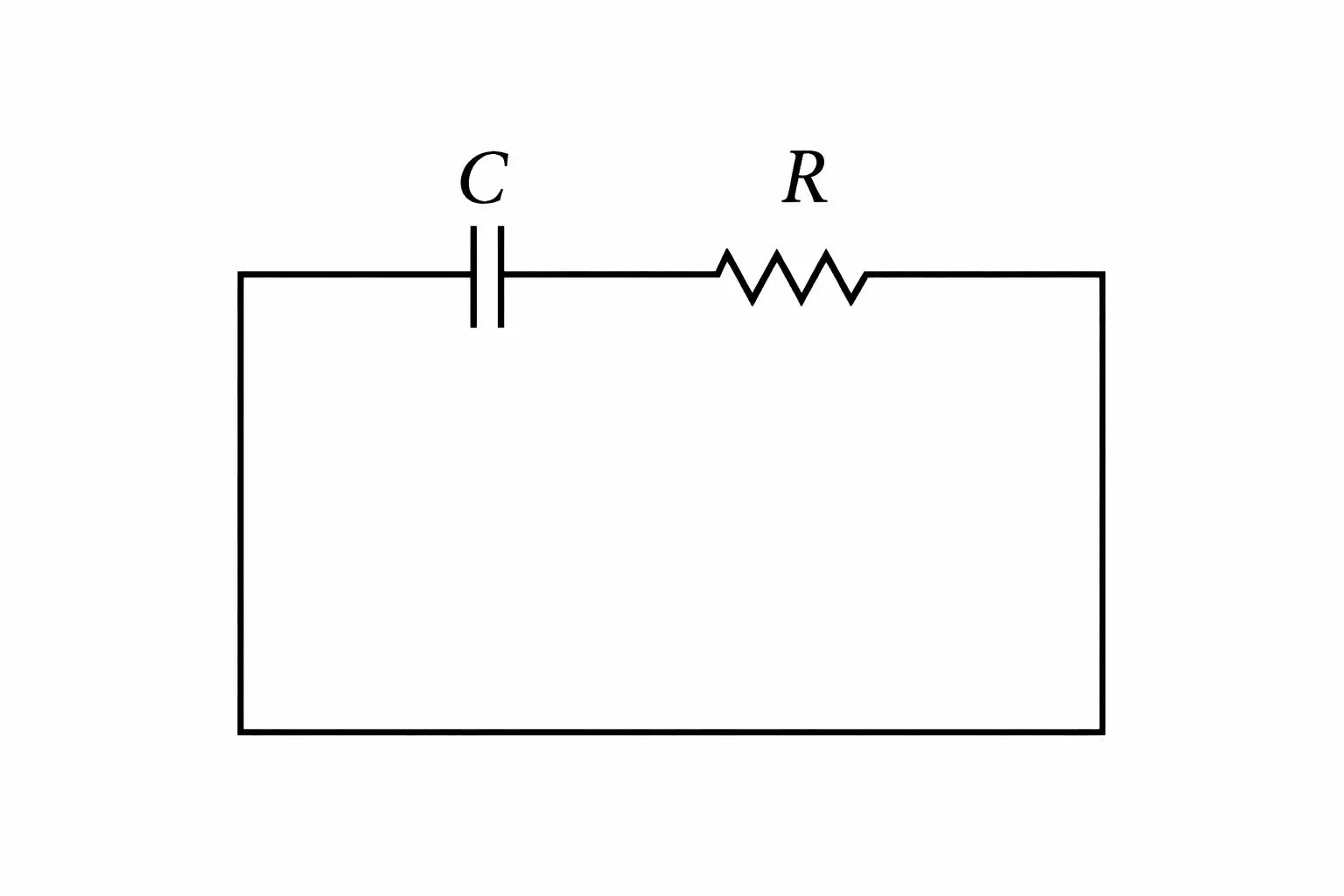
Discharging of a Capacitor
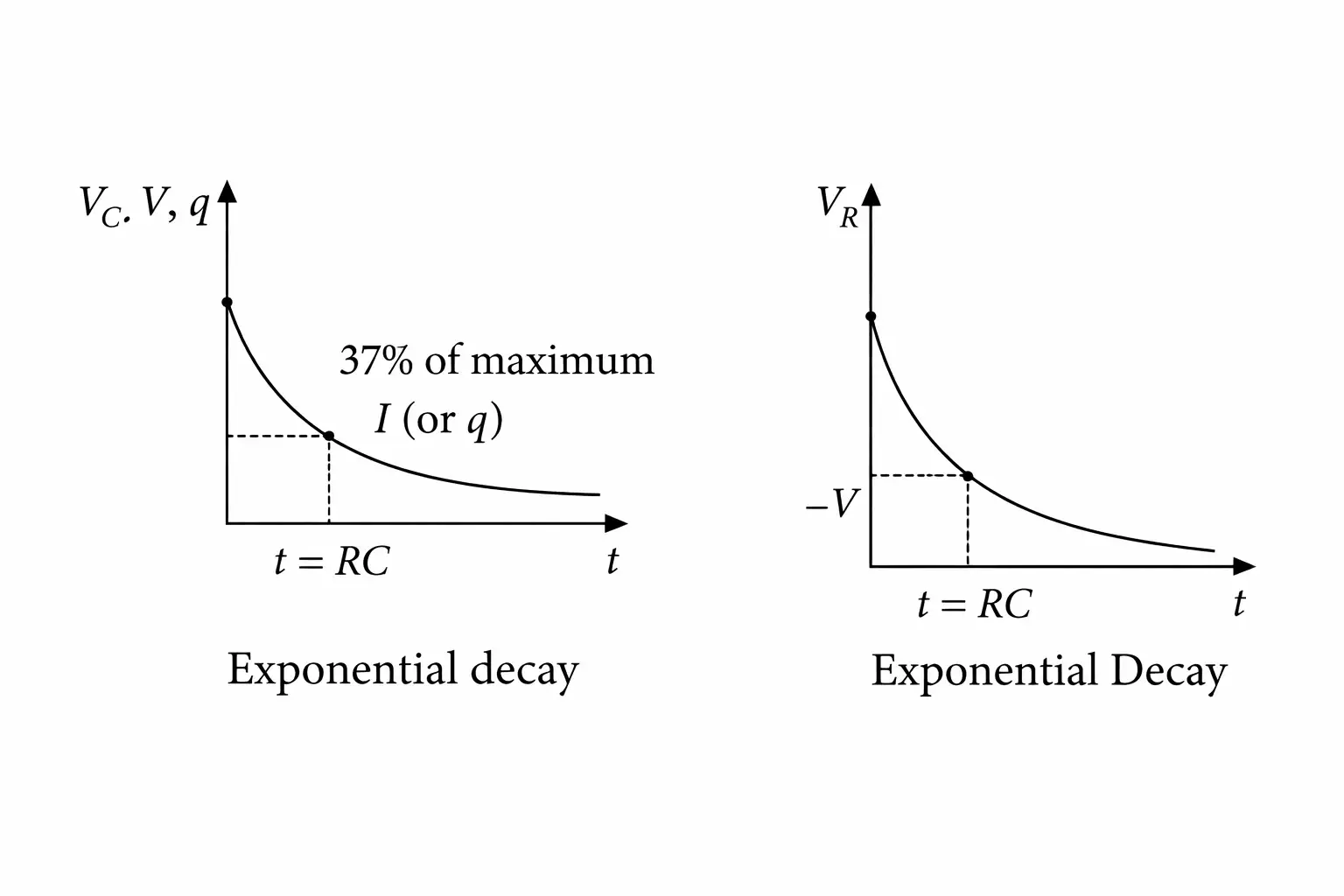
- Charge at time \( t \): \( q = q_0 e^{-t/RC} \), where \( q_0 = CV \)
- Current: \( I = -I_0 e^{-t/RC} \), \( I_0 = \frac{V}{R} \)
- Voltage relation: \( V_C + V_R = 0 \) ⇒ \( |V_C| = |V_R| \)
- All parameters (\( q, V_C, V_R, I \)) decay exponentially.
- Current decreases exponentially; capacitor blocks DC after full charge.
- Time constant \( \tau = RC \) defines rate of change (63% change at \( t=RC \)).
Solved Examples
Ex 1: Calculate charge on capacitor after time \( t = RC \) if \( C=10\mu F \), \( V=12V \).
- \( q = CV(1 - e^{-1}) = 10 \times 10^{-6} \times 12 \times (1 - 0.37) = 7.56 \times 10^{-5} C \)
Ex 2: Find current at \( t=0 \) for \( V=9V \), \( R=3\Omega \).
- \( I_0 = \frac{V}{R} = \frac{9}{3} = 3A \)
Practice Set
Q1: What is the time constant \( \tau \) for a circuit with \( R=2k\Omega \) and \( C=5\mu F \)?
- A) 10 ms
- B) 1 ms
- C) 100 ms
- D) 0.1 ms
Q2: Charge on capacitor after time \( t=RC \) is approximately what fraction of maximum charge?
- A) 37%
- B) 50%
- C) 63%
- D) 100%
Q3: Current in charging capacitor circuit at \( t=0 \) is 5A. What is current at \( t=RC \)?
- A) 1.85A
- B) 3.15A
- C) 0A
- D) 5A
Answer Key
Q1: A) 10 ms. \( \tau = RC = 2000 \times 5 \times 10^{-6} = 0.01s = 10ms \).
Q2: C) 63%. At \( t=RC \), charge reaches 63% of max.
Q3: A) 1.85A. \( I = I_0 e^{-1} = 5 \times 0.37 = 1.85A \).
Memory Aids
- Charging: \( q = CV(1 - e^{-t/RC}) \), current decays exponentially.
- Discharging: \( q = q_0 e^{-t/RC} \), all parameters decay exponentially.
- Time constant \( \tau = RC \) controls speed of charging/discharging.
- At \( t=RC \), parameter changes by 63%.
Wheatstone Bridge
Concept and Working
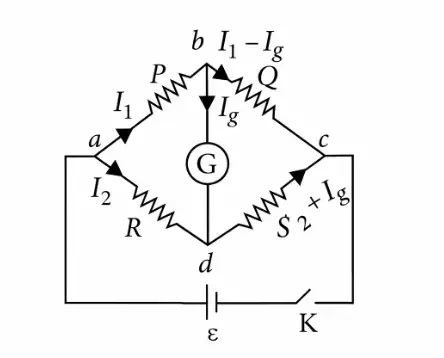
- Consists of four resistors P, Q, R, and S arranged in a diamond shape.
- Used to find an unknown resistance when three resistances are known.
- Galvanometer connected between points B and D detects current \( I_g \).
- Bridge is balanced when \( I_g = 0 \), meaning no current flows through galvanometer.
- Balance condition: \( \frac{P}{Q} = \frac{R}{S} \).
- Unknown resistance can be calculated using the above ratio.
Solved Examples
Ex 1: Given P = 10 \( \Omega \), Q = 20 \( \Omega \), R = 15 \( \Omega \), find S when bridge is balanced.
- Use balance condition: \( \frac{P}{Q} = \frac{R}{S} \)
- \( \Rightarrow \frac{10}{20} = \frac{15}{S} \)
- \( S = \frac{15 \times 20}{10} = 30 \ \Omega \)
Practice Set
Q1: In a Wheatstone bridge, if P = 5 \( \Omega \), Q = 10 \( \Omega \), R = 8 \( \Omega \), what is S at balance?
- A) 4 \( \Omega \)
- B) 16 \( \Omega \)
- C) 10 \( \Omega \)
- D) 8 \( \Omega \)
Q2: When the Wheatstone bridge is balanced, the galvanometer current is:
- A) Maximum
- B) Zero
- C) Half of total current
- D) Equal to battery current
Q3: If in a Wheatstone bridge, P = 12 \( \Omega \), Q = 18 \( \Omega \), and S = 9 \( \Omega \), find R at balance.
- A) 6 \( \Omega \)
- B) 4 \( \Omega \)
- C) 15 \( \Omega \)
- D) 9 \( \Omega \)
Answer Key
Q1: B) 16 \( \Omega \) — Using \( \frac{P}{Q} = \frac{R}{S} \), \( S = \frac{R \times Q}{P} = \frac{8 \times 10}{5} = 16 \)
Q2: B) Zero — Bridge is balanced when galvanometer current is zero.
Q3: A) 6 \( \Omega \) — \( R = \frac{P}{Q} \times S = \frac{12}{18} \times 9 = 6 \)
Memory Aids
- Balance condition: "P over Q equals R over S".
- Galvanometer current zero means bridge balanced.
- Unknown resistance found by cross-multiplying ratios.
Meter Bridge
Concept and Working
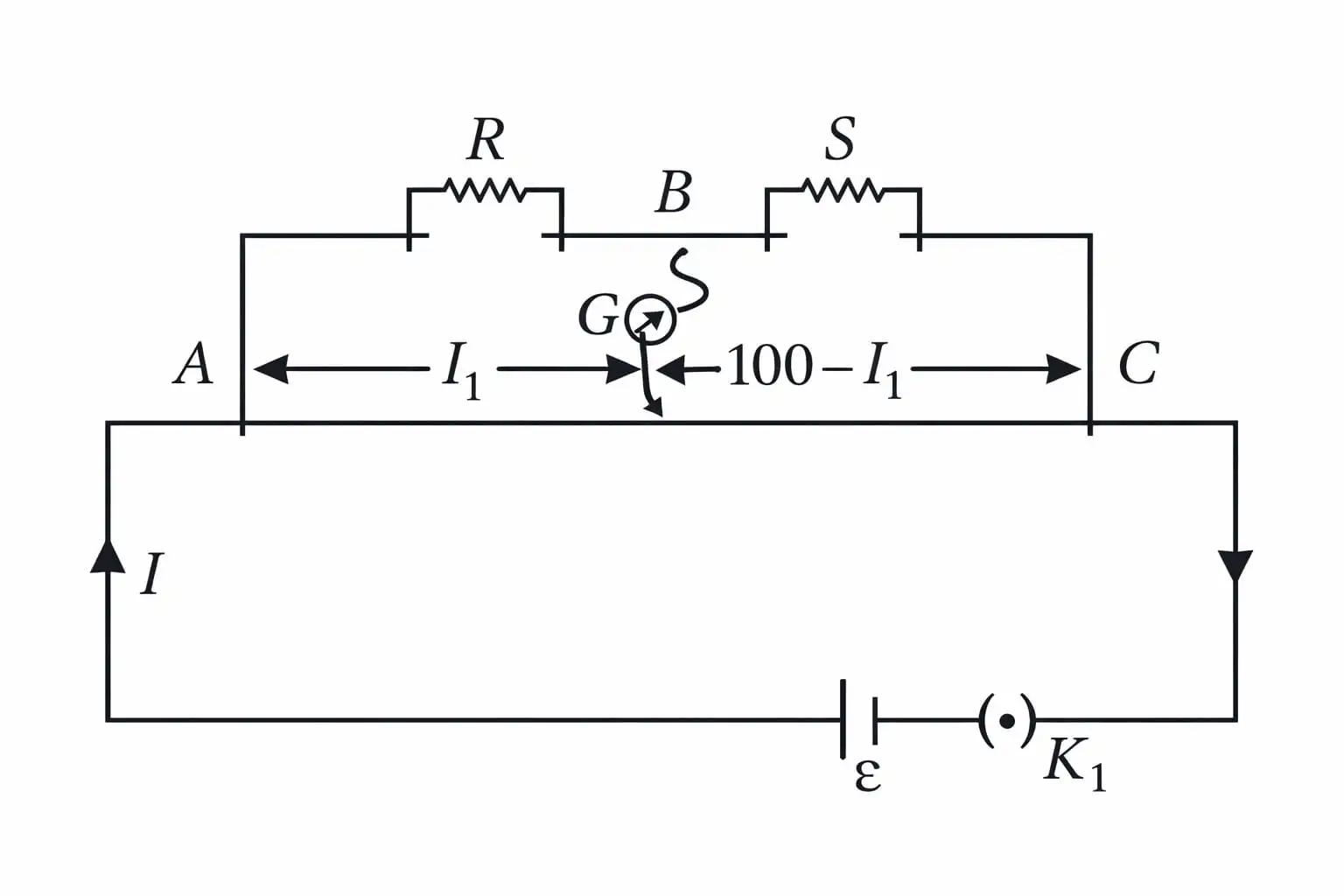
- Based on Wheatstone bridge principle.
- Uses a 1-meter uniform resistance wire.
- Measures unknown resistance by balancing the bridge.
- Current splits into two parts: \( I_1 \) and \( 100 - I_1 \) (assuming total current 100 units).
- Balance condition: \( \frac{R}{S} = \frac{I_1}{100 - I_1} \).
- Null point should be near the center of the wire for accuracy.
Solved Examples
Ex 1: If \( I_1 = 40 \) units, find \( \frac{R}{S} \).
- \( \frac{R}{S} = \frac{I_1}{100 - I_1} = \frac{40}{60} = \frac{2}{3} \)
Practice Set
Q1: In a meter bridge, if \( I_1 = 30 \), what is \( \frac{R}{S} \)?
- A) 0.3
- B) 0.43
- C) 0.5
- D) 0.75
Q2: The length of wire used in meter bridge is:
- A) 10 cm
- B) 100 cm
- C) 1 m
- D) 10 m
Q3: For accurate measurement, the null point should be:
- A) At one end of wire
- B) Near the center of wire
- C) Anywhere on wire
- D) At the battery terminal
Answer Key
Q1: B) 0.43 — \( \frac{30}{100-30} = \frac{30}{70} = 0.43 \)
Q2: C) 1 m — Meter bridge uses 1 meter wire.
Q3: B) Near the center of wire — For better accuracy.
Memory Aids
- Meter bridge wire length = 1 meter.
- Ratio \( R/S = I_1/(100 - I_1) \).
- Null point near center for precise reading.
Potentiometer
Concept and Working
- Measures unknown emf or resistance by comparing potential drops.
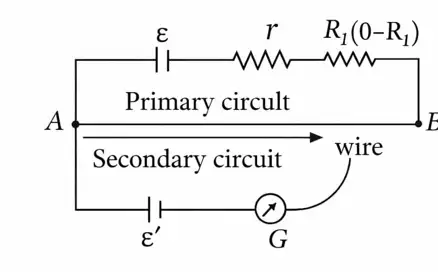
- Potential drop \( V \) across wire length \( l \) is proportional to \( l \): \( V = k l \), where \( k \) is potential gradient.
- Wire must be uniform with high resistance.
- Primary circuit: constant voltage source, rheostat, resistance box, potentiometer wire.
- Secondary circuit: unknown emf or resistance with galvanometer.
- Balance achieved when galvanometer shows zero current.
- Applications: comparing emf of cells, measuring internal resistance.
Solved Examples
Ex 1: If balancing length for emf \( \varepsilon_1 \) is \( l_1 = 40 \) cm and for \( \varepsilon_2 \) is \( l_2 = 60 \) cm, find \( \frac{\varepsilon_1}{\varepsilon_2} \).
- \( \frac{\varepsilon_1}{\varepsilon_2} = \frac{l_1}{l_2} = \frac{40}{60} = \frac{2}{3} \)
Practice Set
Q1: Potential drop \( V \) across length \( l \) of potentiometer wire is:
- A) \( V \propto l^2 \)
- B) \( V \propto l \)
- C) \( V \propto \frac{1}{l} \)
- D) Independent of \( l \)
Q2: If balancing lengths for two cells are 30 cm and 50 cm, ratio of their emfs is:
- A) 3:5
- B) 5:3
- C) 1:1
- D) 2:3
Q3: Internal resistance \( r \) of a cell is given by \( r = (\frac{l_1 - l_2}{l_2}) R \). If \( l_1 = 60 \) cm, \( l_2 = 40 \) cm, and \( R = 10 \ \Omega \), find \( r \).
- A) 5 \( \Omega \)
- B) 10 \( \Omega \)
- C) 15 \( \Omega \)
- D) 20 \( \Omega \)
Answer Key
Q1: B) \( V \propto l \) — Potential drop is directly proportional to length.
Q2: A) 3:5 — Ratio of emfs equals ratio of balancing lengths.
Q3: C) 15 \( \Omega \) — \( r = \frac{60-40}{40} \times 10 = \frac{20}{40} \times 10 = 5 \times 3 = 15 \)
Memory Aids
- Potential drop \( V = k l \).
- Emf ratio = balancing length ratio.
- Internal resistance formula: \( r = \left(\frac{l_1 - l_2}{l_2}\right) R \).
NEET Physics — ALL CHAPTERS
1
Basic Mathematics
2
Units and Measurement
3
Motion in a Straight Line
4
Motion in a Plane
5
Laws of Motion
6
Work, Energy and Power
7
System of Particles and Rotational Motion
8
Gravitation
9
Mechanical Properties of Solids
10
Mechanical Properties of Fluids
11
Thermal Properties of Matter
12
Thermodynamics
13
Kinetic Theory
14
Oscillations
15
Waves
16
Electric Charges and Fields
17
Electrostatic Potential and Capacitance
18
Current Electricity
19
Moving Charges and Magnetism
20
Magnetism and Matter
21
Electromagnetic Induction
22
Alternating Current
23
Electromagnetic Waves
24
Ray Optics and Optical Instruments
25
Wave Optics
26
Dual Nature of Radiation and Matter
27
Atoms
28
Nuclei
29
Semiconductor Electronics: Materials, Devices and Simple Circuits