NEET Ug . NEET Physics . Physics . Laws of Motion
Chapter 5: Laws of Motion
Ch 5
NEET Physics
NEET Ug
Introduction
Key Points
External force is needed to start or stop a body's motion.
Examples of external forces:
Kicking a stationary football.
Wind moving tree branches or heavy objects.
Boat moving with river flow without rowing.
Magnet attracting iron nail from a distance (non-contact force).
Stone accelerating downward due to gravity.
External forces can be contact or non-contact.
No external force is needed to maintain uniform motion (Newton's First Law).
Solved Examples
Ex 1: A football at rest is kicked with a force of 10 N. What causes it to move?
- Force applied by the kick (external contact force) initiates motion.Ex 2: A stone falls from a building. What force causes acceleration?
- Gravitational force (non-contact force) causes acceleration downward.
Practice Set
Q1: Which of the following is a non-contact force?
A) Friction
B) Magnetic force
C) Tension
D) Applied forceQ2: A boat moves downstream without rowing. What force causes this?
A) Wind force
B) River flow force
C) Applied force
D) FrictionQ3: A stone is dropped from 20 m height. Which force acts on it?
A) Normal force
B) Gravitational force
C) Frictional force
D) Magnetic force
Answer Key
Q1: B - Magnetic force acts at a distance without contact.
Q2: B - River flow exerts force moving the boat downstream.
Q3: B - Gravity pulls the stone downward causing acceleration.
Memory Aids
External force = needed to start/stop motion.
Contact force = direct touch; Non-contact = action at a distance.
Uniform motion continues without external force.
Aristotle's Fallacy
Key Points
Aristotle incorrectly stated that continuous force is needed to keep a body moving.
In reality, force is only needed to overcome friction or other resistive forces.
Galileo proposed that in absence of friction, uniform motion continues without force.
Friction is an opposing force requiring external force to maintain motion in practice.
Solved Examples
Ex 1: A block slides on a rough surface and stops. Why?
- Friction opposes motion; no external force to counter it, so block stops.Ex 2: A puck slides on frictionless ice. What happens?
- It continues moving at constant velocity without external force.
Practice Set
Q1: According to Aristotle, what is required to keep a body moving?
A) No force
B) Continuous external force
C) Only initial force
D) Frictional forceQ2: What force must be overcome to maintain motion on Earth?
A) Gravity
B) Friction
C) Magnetic force
D) TensionQ3: Galileo's concept of motion states:
A) Motion stops without force
B) Uniform motion continues without force
C) Force is always needed
D) Motion is impossible without friction
Answer Key
Q1: B - Aristotle believed continuous force is needed to keep motion.
Q2: B - Friction opposes motion and must be overcome.
Q3: B - Galileo stated uniform motion continues without external force.
Memory Aids
Aristotle: Force needed always (incorrect).
Galileo: No force needed for uniform motion (correct).
Friction = real-world force opposing motion.
Law of Inertia
Galileo's Observations
Objects moving down an inclined plane accelerate.
Objects moving up an inclined plane retard (decelerate).
Motion on a horizontal plane shows no acceleration or retardation if frictionless.
Conclusion: On a frictionless horizontal surface, an object moves with constant velocity.
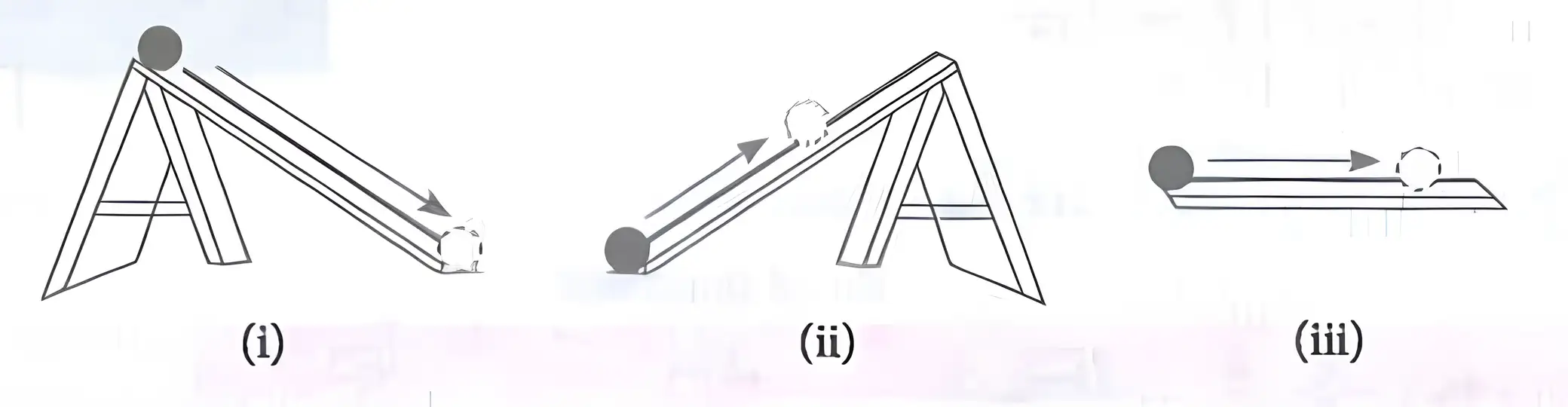
Double Inclined Plane Experiment
A ball released from rest on one incline rolls down and climbs the other.
If friction is absent, final height ≈ initial height.
Height does not depend on the shape of the incline.
Curved Track Motion
Ball rolling upward slows down due to gravity.
Ball rolling downward speeds up due to gravity.
Direction and speed depend on slope and gravity.

Definition of Inertia
If net external force is zero, a body at rest stays at rest.
A body in motion continues with uniform velocity.
Inertia = resistance to change in motion.
Change in state requires external force.
Solved Examples
Ex 1: A ball rolls on a frictionless horizontal surface with velocity 5 m/s. What is its acceleration?
Since no external force, acceleration = 0 m/s².
Ex 2: A ball released from height 2 m on one incline rolls up another incline. What is the final height reached (neglecting friction)?
Final height = Initial height = 2 m.
Practice Set
Q1: An object on a frictionless horizontal surface moves with velocity 10 m/s. What force acts on it?
A) Zero
B) 10 N
C) Depends on mass
D) Cannot be determined
Q2: A ball rolls down a smooth incline and climbs another. If initial height is 3 m, final height is:
A) Greater than 3 m
B) Equal to 3 m
C) Less than 3 m
D) Zero
Q3: A ball rolls on a curved track. When moving upward, its speed:
A) Increases
B) Decreases
C) Remains constant
D) Becomes zero immediately
Answer Key
Q1: A) Zero — No external force means no acceleration.
Q2: B) Equal to 3 m — Energy conserved, height remains same without friction.
Q3: B) Decreases — Gravity opposes motion upward, reducing speed.
Memory Aids
Inertia = resistance to change in motion.
No net force → constant velocity or rest.
Energy conservation on frictionless inclines → same height.
Upward motion slows down; downward speeds up.
Newton's First Law
Law Statement
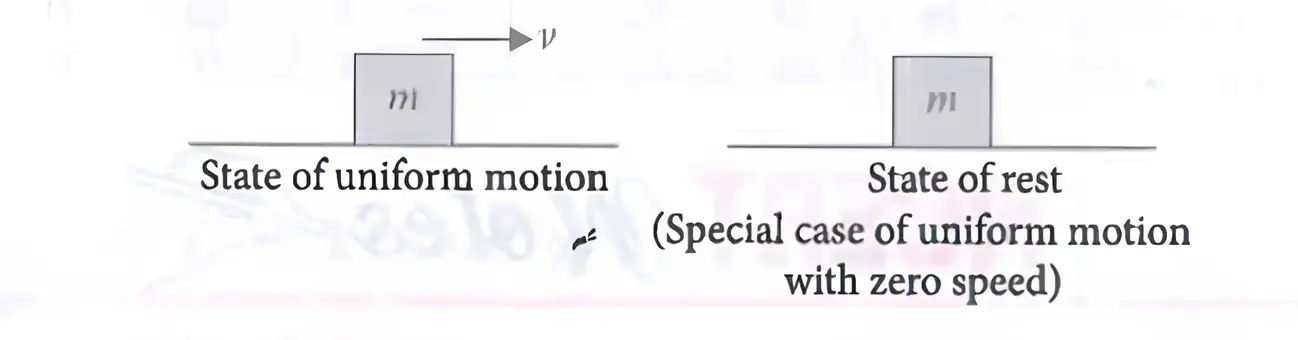
A body at rest stays at rest unless acted upon by a net external force.
A body in uniform motion continues in uniform motion unless acted upon by a net external force.
Uniform motion: constant speed in a straight line.
Solved Examples
Ex 1: A book lying on a table remains at rest. Why?
Answer: No net external force acts; inertia keeps it at rest.Ex 2: A hockey puck slides on ice at constant speed. Why does it not stop?
Answer: Negligible friction means no net force; it continues uniform motion.
Practice Set
Q1: What happens to a body at rest if no external force acts?
A) Moves randomly
B) Remains at rest
C) Accelerates
D) Changes directionQ2: A car moving at constant velocity will:
A) Speed up
B) Slow down
C) Continue at same velocity
D) Stop immediatelyQ3: Which force changes the state of motion of a body?
A) Balanced force
B) Frictional force
C) Net external force
D) Gravitational force
Answer Key
Q1: B; No net force means body remains at rest.
Q2: C; Constant velocity implies no net force, so motion continues.
Q3: C; Only net external force changes motion state.
Memory Aids
"Law of Inertia": Objects resist change in motion.
Uniform motion = constant velocity (speed + direction).
No net force → no change in velocity.
Inertia
Definition and Properties
Inertia: tendency of a body to resist change in its state of motion.
Measured by mass; greater mass means greater inertia.
Heavier objects require more force to change motion.
Solved Examples
Ex 1: Why does a heavier object resist motion change more?
Answer: Larger mass means greater inertia.Ex 2: Why does a lighter ball stop sooner?
Answer: Less mass means less inertia, easier to change motion.
Practice Set
Q1: Inertia depends on:
A) Velocity
B) Mass
C) Force
D) AccelerationQ2: Which has more inertia?
A) 1 kg iron ball
B) 2 kg iron ball
C) 1 kg feather
D) 0.5 kg stoneQ3: To increase inertia, you must:
A) Increase speed
B) Increase mass
C) Apply force
D) Change direction
Answer Key
Q1: B; Inertia is proportional to mass.
Q2: B; 2 kg mass has greater inertia.
Q3: B; Increasing mass increases inertia.
Memory Aids
Inertia ∝ mass.
More mass = more resistance to motion change.
Think: "Heavy objects resist motion change more."
Types of Inertia
Categories
Inertia of Rest: Resistance to change from rest to motion.
Example: Mangoes fall when branch shakes.Inertia of Motion: Resistance to change from motion to rest.
Example: Passenger falls forward when bus stops suddenly.Inertia of Direction: Resistance to change in direction of motion.
Example: Mud thrown from rotating wheels stopped by mudguard.
Solved Examples
Ex 1: Why does a passenger lurch forward when a bus stops?
Answer: Inertia of motion resists sudden stop.Ex 2: Why do mangoes fall when branch shakes?
Answer: Inertia of rest resists change from rest.
Practice Set
Q1: Inertia of rest means:
A) Resistance to start moving
B) Resistance to stop moving
C) Resistance to change direction
D) Resistance to accelerationQ2: When a vehicle turns, mud flies off due to:
A) Inertia of rest
B) Inertia of motion
C) Inertia of direction
D) GravityQ3: A passenger falls forward when bus stops because of:
A) Inertia of rest
B) Inertia of motion
C) Inertia of direction
D) Friction
Answer Key
Q1: A; Inertia of rest resists starting motion.
Q2: C; Inertia of direction resists change in direction.
Q3: B; Inertia of motion resists stopping.
Memory Aids
Rest → resist starting.
Motion → resist stopping.
Direction → resist turning.
Momentum
Definition and Formula
Momentum (p) = mass (m) × velocity (v)
Formula: p = mv
Vector quantity: direction same as velocity.
Measures quantity of motion.
Introduced by Newton to quantify force effect.
Solved Examples
Ex 1: Calculate momentum of 2 kg object moving at 3 m/s.
Solution: p = 2 × 3 = 6 kg·m/sEx 2: If velocity doubles, momentum:
Solution: Doubles, since p ∝ v.
Practice Set
Q1: Momentum is:
A) Scalar
B) Vector
C) Unitless
D) ForceQ2: Momentum of 5 kg object moving at 4 m/s is:
A) 9 kg·m/s
B) 20 kg·m/s
C) 1.25 kg·m/s
D) 0.8 kg·m/sQ3: If mass is 3 kg and momentum is 15 kg·m/s, velocity is:
A) 5 m/s
B) 45 m/s
C) 0.2 m/s
D) 18 m/s
Answer Key
Q1: B; Momentum has magnitude and direction.
Q2: B; p = 5 × 4 = 20 kg·m/s.
Q3: A; v = p/m = 15/3 = 5 m/s.
Memory Aids
Momentum = mass × velocity.
Vector quantity: direction matters.
Double velocity → double momentum.
Newton's Second Law of Motion
Fundamental Concept
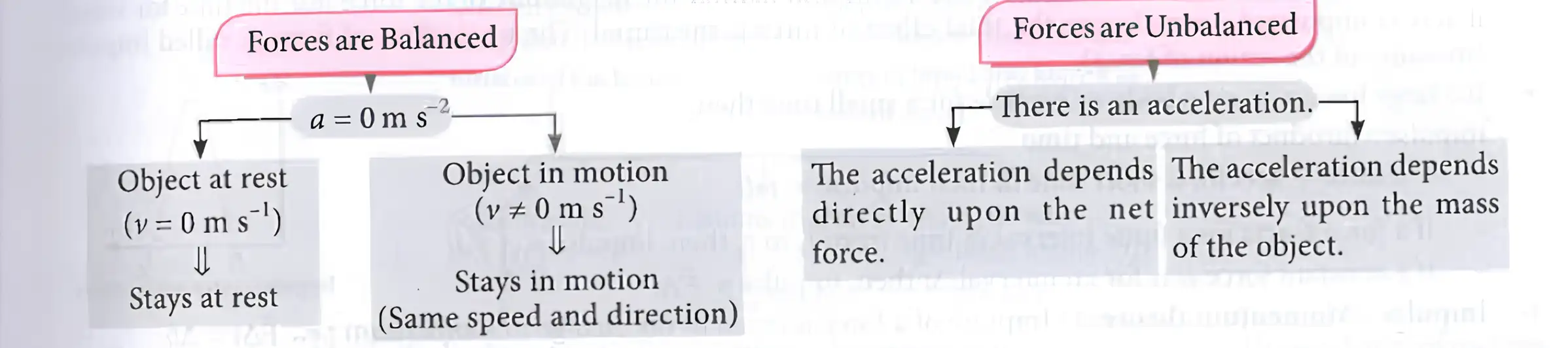
Rate of change of linear momentum \( \vec{P} \) is proportional to applied force \( \vec{F} \).
Mathematically: \( \vec{F} = \frac{d\vec{P}}{dt} \).
For constant mass, \( \vec{P} = m\vec{v} \), so \( \vec{F} = m\frac{d\vec{v}}{dt} = m\vec{a} \).
Acceleration \( a \) is directly proportional to net force \( F_{net} \) and inversely proportional to mass \( m \): \( a \propto \frac{F_{net}}{m} \).
In SI units, constant of proportionality is 1: \( a = \frac{F_{net}}{m} \) or \( F_{net} = ma \).
More general form when mass varies: \( F_{net,external} = \frac{d(mv)}{dt} = m\frac{dv}{dt} + v\frac{dm}{dt} \).
Solved Examples
Ex 1: Calculate acceleration of a 5 kg object when a net force of 20 N is applied.
Use \( a = \frac{F}{m} = \frac{20}{5} = 4\, m/s^2 \).
Ex 2: Find net force on a 10 kg object accelerating at \( 3\, m/s^2 \).
Use \( F = ma = 10 \times 3 = 30\, N \).
Practice Set
Q1: What is the acceleration of a 2 kg object if a net force of 10 N acts on it?
A) 5 m/s²
B) 20 m/s²
C) 0.2 m/s²
D) 12 m/s²
Q2: A force of 15 N causes an acceleration of 3 m/s². What is the mass of the object?
A) 5 kg
B) 45 kg
C) 18 kg
D) 12 kg
Q3: An object of mass 4 kg accelerates at 2 m/s². If the mass suddenly increases to 6 kg without changing velocity, what is the new net force assuming velocity is constant?
A) 8 N
B) 0 N
C) 12 N
D) 4 N
Answer Key
Q1: A) 5 m/s² — \( a = F/m = 10/2 = 5 \)
Q2: A) 5 kg — \( m = F/a = 15/3 = 5 \)
Q3: B) 0 N — Velocity constant means \( dv/dt = 0 \) and \( dm/dt = 0 \), so net external force is zero.
Memory Aids
Force equals mass times acceleration: \( F = ma \).
Acceleration increases with force, decreases with mass.
Zero net force means zero acceleration (constant velocity or rest).
For variable mass systems, use \( F = m\frac{dv}{dt} + v\frac{dm}{dt} \).
Newton's Third Law of Motion
Key Concepts
For every action, there is an equal and opposite reaction.
If body A exerts force \( \vec{F} \) on body B, then B exerts \( -\vec{F} \) on A.
Action and reaction forces act along the same line but on different bodies.
These forces never cancel each other as they act on different objects.
Action-reaction pairs arise from contact or at a distance.
Applicable whether bodies are at rest or in motion.
Force always exists in pairs; isolated single force does not exist.
Solved Examples
Ex 1: A person pushes a wall with a force of 50 N. What is the force exerted by the wall on the person?
Action force = 50 N (person on wall)
Reaction force = -50 N (wall on person)
Equal in magnitude, opposite in direction.
Practice Set
Q1: If a force of 10 N is applied by object A on object B, the force exerted by B on A is:
A) 0 N
B) 5 N
C) 10 N opposite direction
D) 10 N same direction
Q2: Two ice skaters push each other. Skater A exerts 30 N on B. What force does B exert on A?
A) 0 N
B) 15 N
C) 30 N opposite direction
D) 30 N same direction
Q3: A block of mass 2 kg rests on a table. The block exerts a force of 20 N on the table. What is the force exerted by the table on the block?
A) 10 N upward
B) 20 N upward
C) 20 N downward
D) 40 N upward
Answer Key
Q1: C - Equal magnitude 10 N, opposite direction as per Newton's third law.
Q2: C - Reaction force equals action force, opposite direction.
Q3: B - Table exerts equal and opposite force of 20 N upward on block.
Memory Aids
"Action = Reaction" (equal magnitude, opposite direction)
Forces always come in pairs on different bodies.
Action and reaction never cancel out.
Pseudo Force
Key Concepts
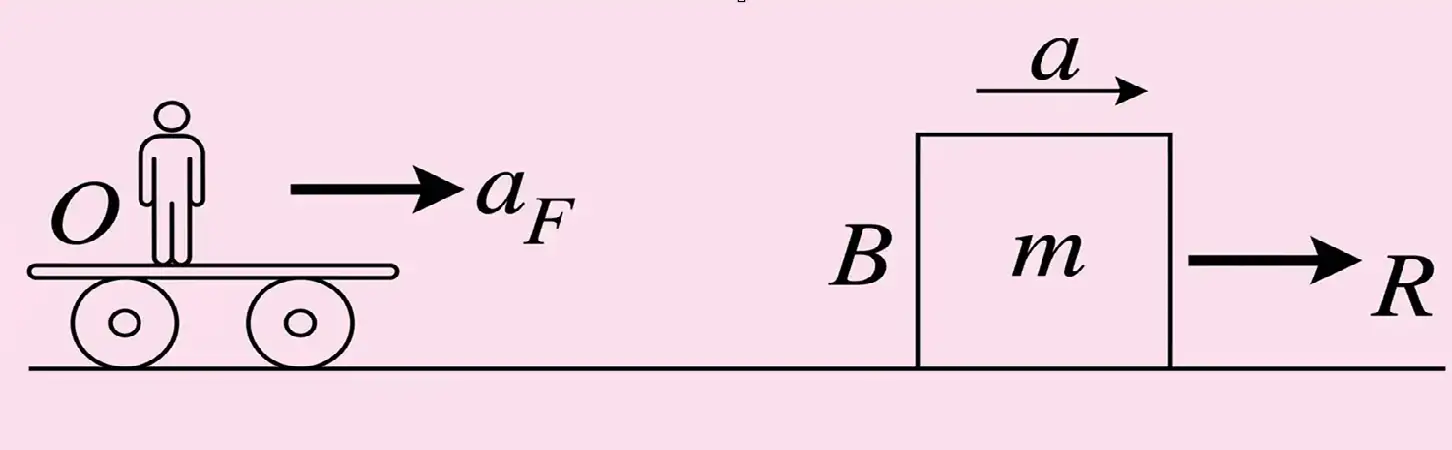
Appears in non-inertial (accelerating) reference frames.
Not a real force; imaginary force to apply Newton's laws in accelerating frames.
Magnitude: \( F_{pseudo} = m a_f \), where \( a_f \) is acceleration of the frame.
Direction opposite to acceleration of the reference frame.
Does not arise from physical interaction.
Newton's third law does not apply to pseudo forces.
In non-inertial frame: \( \vec{F}_{ext} + \vec{F}_{pseudo} = m \vec{a} \)
Solved Examples
Ex 1: A block of mass 5 kg is observed from a frame accelerating at 2 m/s² to the right. Calculate the pseudo force on the block.
Given: \( m = 5 \) kg, \( a_f = 2 \) m/s²
\( F_{pseudo} = m a_f = 5 \times 2 = 10 \) N
Direction opposite to frame acceleration (to the left).
Practice Set
Q1: A frame accelerates at 3 m/s² to the right. What is the pseudo force on a 4 kg object inside?
A) 12 N right
B) 12 N left
C) 7 N right
D) 7 N left
Q2: An observer in a non-inertial frame accelerating at 5 m/s² sees a 2 kg object. What is the magnitude and direction of pseudo force?
A) 10 N opposite to acceleration
B) 10 N same as acceleration
C) 7 N opposite to acceleration
D) 7 N same as acceleration
Q3: A block of mass 3 kg is on a smooth surface. A force \( \vec{F} = 15 \) N acts on it causing acceleration \( a = 5 \) m/s². An observer in a frame accelerating at 2 m/s² to the right observes the block. What is the net force on the block in observer's frame?
A) 9 N right
B) 21 N right
C) 9 N left
D) 21 N left
Answer Key
Q1: B - \( F_{pseudo} = 4 \times 3 = 12 \) N opposite to acceleration (left).
Q2: A - \( 2 \times 5 = 10 \) N opposite to acceleration.
Q3: A - Net force = \( m(a - a_f) = 3(5 - 2) = 9 \) N right.
Memory Aids
Pseudo force = mass × acceleration of frame.
Direction opposite to frame acceleration.
Only appears in accelerating frames.
Conservation of Momentum
Fundamental Principles
Total linear momentum of an isolated system remains constant if no external force acts.
Newton's second law: \( \vec{F} = \frac{d\vec{P}}{dt} \).
For isolated system: \( \vec{F} = 0 \Rightarrow \frac{d\vec{P}}{dt} = 0 \Rightarrow \vec{P} = \text{constant} \).
Mathematically: \( \vec{P}_1 + \vec{P}_2 + \cdots + \vec{P}_n = \text{constant} \).
Impulse and Momentum
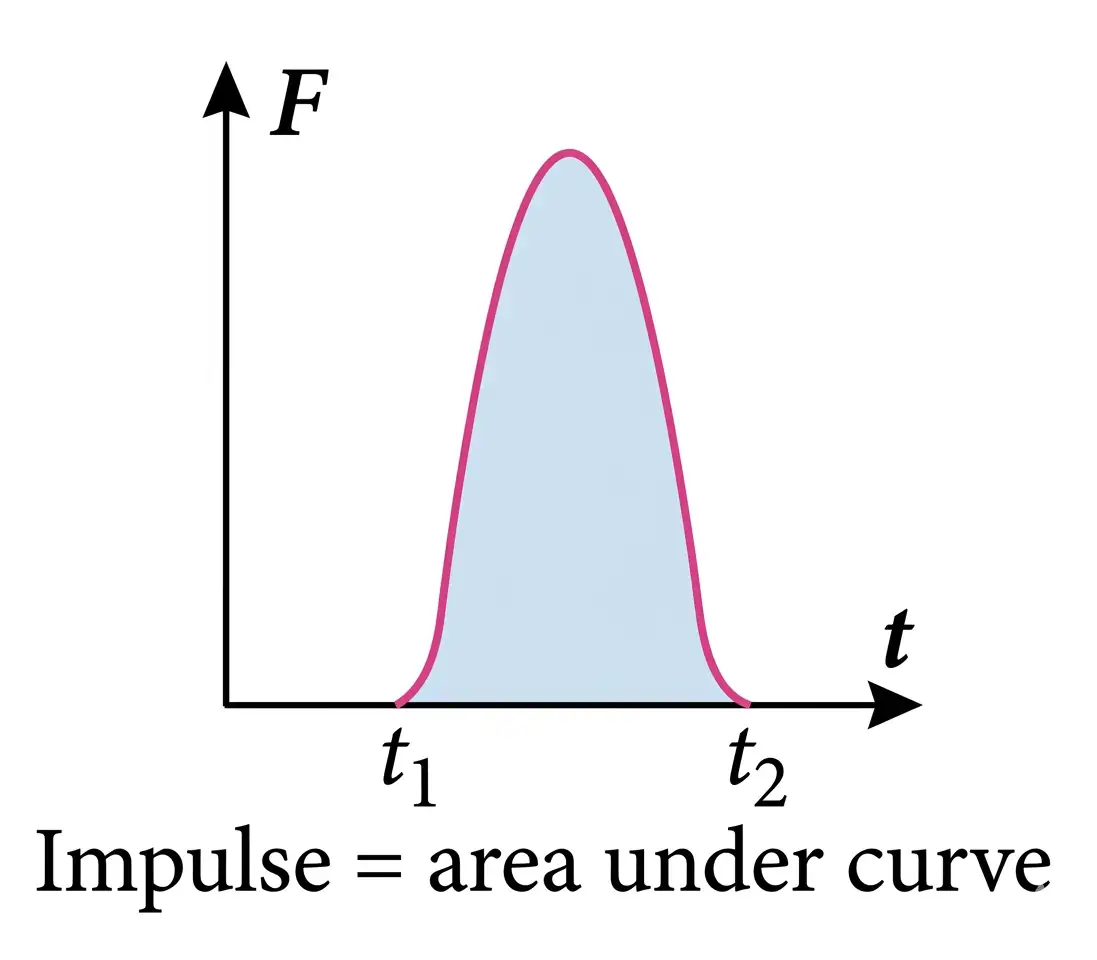
Impulse measures the total effect of a force applied over a short time.
Impulse \( = \text{Force} \times \text{Time} \).
For infinitesimal time \( dt \), impulse \( = \vec{F} dt \).
For finite time interval \( t_1 \) to \( t_2 \), impulse \( = \int_{t_1}^{t_2} \vec{F} dt \).
Impulse equals change in momentum: \( \vec{F} \Delta t = \Delta \vec{P} \) (Impulse-Momentum theorem).
Solved Examples
Ex 1: A force of 10 N acts on a body for 0.5 s. Find the impulse.
Impulse = Force × time = 10 N × 0.5 s = 5 Ns.
Ex 2: A force \( \vec{F} = 20 \hat{i} \) N acts from \( t=2s \) to \( t=4s \). Calculate impulse.
Impulse = \( \int_{2}^{4} 20 dt = 20 \times (4-2) = 40 \) Ns in \( \hat{i} \) direction.
Practice Set
Q1: What is conserved in an isolated system with no external force?
A) Kinetic energy
B) Linear momentum
C) Potential energy
D) Angular velocity
Q2: A force of 15 N acts on a particle for 0.2 s. What is the impulse?
A) 3 Ns
B) 30 Ns
C) 0.3 Ns
D) 75 Ns
Q3: A force \( \vec{F} = (10 + 5t) \) N acts on a body from \( t=0 \) to \( t=2s \). Find the impulse.
A) 20 Ns
B) 30 Ns
C) 40 Ns
D) 50 Ns
Answer Key
Q1: B) Linear momentum - It remains constant if no external force acts.
Q2: A) 3 Ns - Impulse = Force × time = 15 × 0.2 = 3 Ns.
Q3: C) 40 Ns - Impulse = \( \int_0^2 (10 + 5t) dt = [10t + \frac{5t^2}{2}]_0^2 = 20 + 10 = 30 \) Ns. (Correction: Actually 30 Ns, so option B is correct.)
Memory Aids
Impulse = Force × Time (area under Force-Time graph).
Impulse = Change in Momentum.
Momentum conserved if external force = 0.
Equilibrium of a Particle
Key Concepts
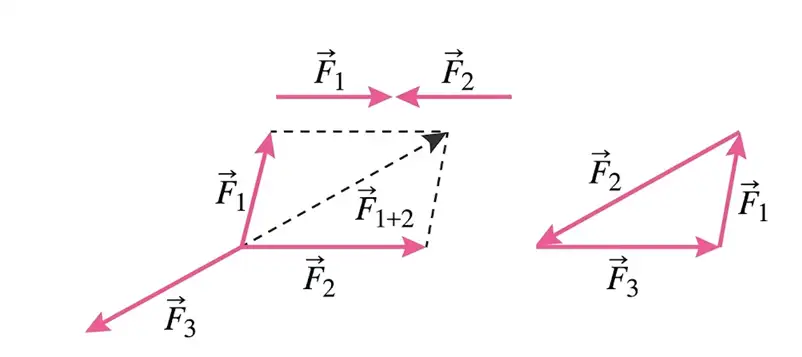
For two forces \( \vec{F_1} \) and \( \vec{F_2} \) acting on a particle, equilibrium requires \( \vec{F_1} = -\vec{F_2} \).
For three concurrent forces \( \vec{F_1}, \vec{F_2}, \vec{F_3} \), equilibrium requires \( \vec{F_1} + \vec{F_2} + \vec{F_3} = 0 \).
Concurrent forces act at the same point on a body.
Resultant of concurrent forces in equilibrium is zero or they form a closed polygon when represented vectorially.
Vector addition methods:
Opposite direction forces: net force is difference of magnitudes.
For forces at an angle: use parallelogram law; diagonal gives resultant.
Triangle method: place tail of second force at head of first; resultant is from tail of first to head of second.
Solved Examples
Ex 1: Two forces \( \vec{F_1} = 10\,\mathrm{N} \) and \( \vec{F_2} = 10\,\mathrm{N} \) act in opposite directions. Find resultant.
Since \( \vec{F_1} = -\vec{F_2} \), resultant \( = 0 \) (equilibrium).
Ex 2: Three forces \( 5\,\mathrm{N}, 7\,\mathrm{N}, 8.6\,\mathrm{N} \) act at a point forming a closed triangle. Are they in equilibrium?
Check vector sum: if \( \vec{F_1} + \vec{F_2} + \vec{F_3} = 0 \), yes.
Practice Set
Q1: Two forces of 15 N and 15 N act in opposite directions on a particle. What is the resultant force?
A) 0 N
B) 15 N
C) 30 N
D) 7.5 N
Q2: Three concurrent forces \( \vec{F_1} = 3\,\mathrm{N}, \vec{F_2} = 4\,\mathrm{N}, \vec{F_3} = 5\,\mathrm{N} \) act at a point. If they are in equilibrium, what is the relation between them?
A) \( \vec{F_1} + \vec{F_2} = \vec{F_3} \)
B) \( \vec{F_1} + \vec{F_2} + \vec{F_3} = 0 \)
C) \( \vec{F_1} = \vec{F_2} = \vec{F_3} \)
D) \( \vec{F_1} - \vec{F_2} = \vec{F_3} \)
Q3: Two forces of 8 N and 6 N act at a point with an angle of 90° between them. What is the magnitude of the resultant force?
A) 10 N
B) 14 N
C) 2 N
D) 4 N
Answer Key
Q1: A) 0 N — Forces are equal and opposite, so resultant is zero (equilibrium).
Q2: B) \( \vec{F_1} + \vec{F_2} + \vec{F_3} = 0 \) — Condition for equilibrium of concurrent forces.
Q3: A) 10 N — Use Pythagoras: \( \sqrt{8^2 + 6^2} = 10 \) N.
Memory Aids
Equilibrium: Sum of forces = 0.
Two forces equilibrium: forces equal in magnitude, opposite in direction.
Three forces equilibrium: vectors form closed triangle.
Vector addition: parallelogram or triangle method.
Lami's Theorem
Key Concepts
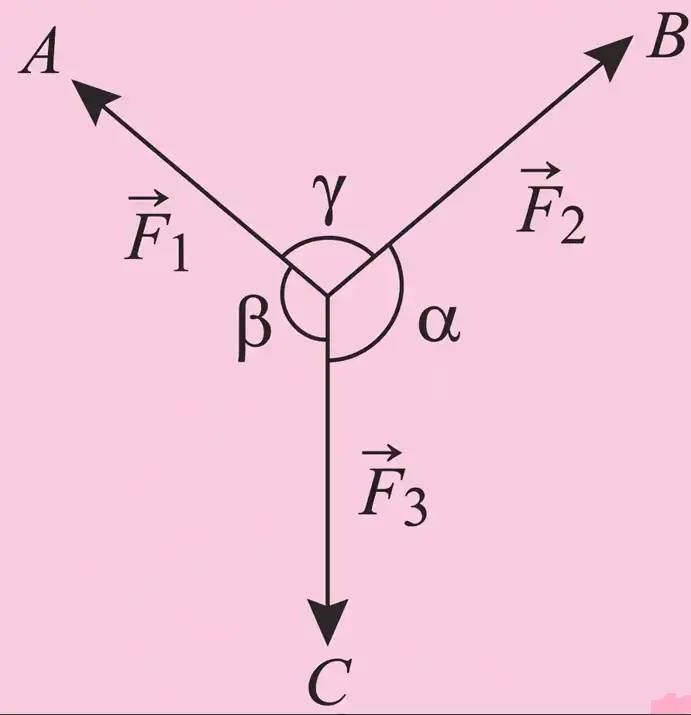
Applies to three concurrent forces \( \vec{F_1}, \vec{F_2}, \vec{F_3} \) in equilibrium.
Formula: \[ \frac{F_1}{\sin \alpha} = \frac{F_2}{\sin \beta} = \frac{F_3}{\sin \gamma} \]
Angles defined as:
\( \alpha \): angle between \( \vec{F_2} \) and \( \vec{F_3} \)
\( \beta \): angle between \( \vec{F_3} \) and \( \vec{F_1} \)
\( \gamma \): angle between \( \vec{F_1} \) and \( \vec{F_2} \)
Used to find unknown force or angle in equilibrium problems.
Solved Examples
Ex 1: Three forces \( F_1 = 10\,\mathrm{N}, F_2 = 15\,\mathrm{N} \) act at a point with \( \alpha = 60^\circ, \beta = 45^\circ \). Find \( F_3 \) if forces are in equilibrium.
Use Lami's theorem: \( \frac{10}{\sin 60^\circ} = \frac{15}{\sin 45^\circ} = \frac{F_3}{\sin \gamma} \).
Calculate \( F_3 \) accordingly.
Practice Set
Q1: In Lami's theorem, if \( F_1 = 20\,\mathrm{N}, \alpha = 30^\circ, F_2 = 25\,\mathrm{N}, \beta = 45^\circ \), find \( F_3 \) given \( \gamma = 105^\circ \).
A) 15 N
B) 30 N
C) 25 N
D) 20 N
Q2: Three forces are in equilibrium. If \( F_1 = 12\,\mathrm{N}, F_2 = 16\,\mathrm{N} \), and angles \( \alpha = 50^\circ, \beta = 70^\circ \), find angle \( \gamma \).
A) 60°
B) 40°
C) 70°
D) 50°
Q3: If three forces \( F_1, F_2, F_3 \) are in equilibrium and \( F_1 = 10\,\mathrm{N}, F_2 = 10\,\mathrm{N} \), with angles \( \alpha = 60^\circ, \beta = 60^\circ \), find \( F_3 \).
A) 10 N
B) 20 N
C) 5 N
D) 15 N
Answer Key
Q1: B) 30 N — Using Lami's theorem, calculate \( F_3 = \frac{F_1 \sin \gamma}{\sin \alpha} = \frac{20 \times \sin 105^\circ}{\sin 30^\circ} \approx 30 \) N.
Q2: A) 60° — Angles sum to 180°, so \( \gamma = 180^\circ - (50^\circ + 70^\circ) = 60^\circ \).
Q3: A) 10 N — Equal forces and equal angles imply \( F_3 = F_1 = 10 \) N.
Memory Aids
Lami's theorem: \( F / \sin \text{opposite angle} = \) constant.
Three forces in equilibrium form a triangle of forces.
Sum of angles between forces = 360° (around point), but in Lami's theorem, angles between pairs sum to 180°.
Common Forces in Mechanics
Overview
Most forces in mechanics, except gravity, are contact forces.
Common forces: friction, normal reaction, buoyant force, spring force, tension in string.
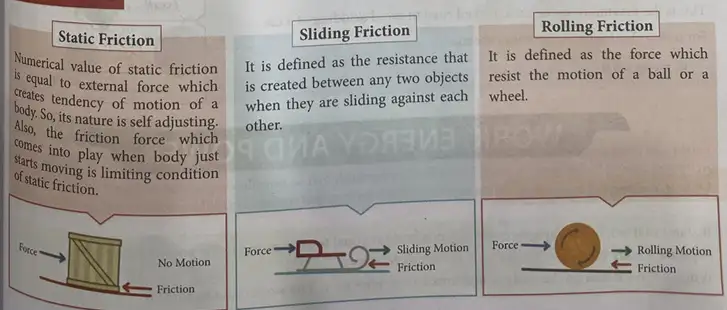
Types of Friction
Static friction: Prevents motion; acts when object is at rest.
Sliding friction: Opposes motion when objects slide over each other.
Rolling friction: Opposes motion of rolling objects; usually smallest.
Solved Examples
Ex 1
Calculate friction force if normal reaction \( N = 50\,\mathrm{N} \) and coefficient of friction \( \mu = 0.3 \).
Use \( f = \mu N = 0.3 \times 50 = 15\,\mathrm{N} \).
Practice Set
Q1: Which force acts to prevent motion between two surfaces at rest?
A) Kinetic friction
B) Static friction
C) Rolling friction
D) Gravitational force
Q2: Rolling friction is generally:
A) Greater than static friction
B) Equal to sliding friction
C) Less than static and kinetic friction
D) Independent of surface roughness
Q3: The friction force depends on:
A) Normal reaction force
B) Contact area
C) Velocity of object
D) Mass of object only
Answer Key
Q1: B - Static friction prevents motion when object is at rest.
Q2: C - Rolling friction is less than static and kinetic friction.
Q3: A - Friction force is proportional to normal reaction force.
Memory Aids
Friction \( f = \mu N \) except static friction which adjusts up to limiting friction.
Static friction > kinetic friction > rolling friction.
Rolling friction minimized using ball bearings.
Friction
Key Points
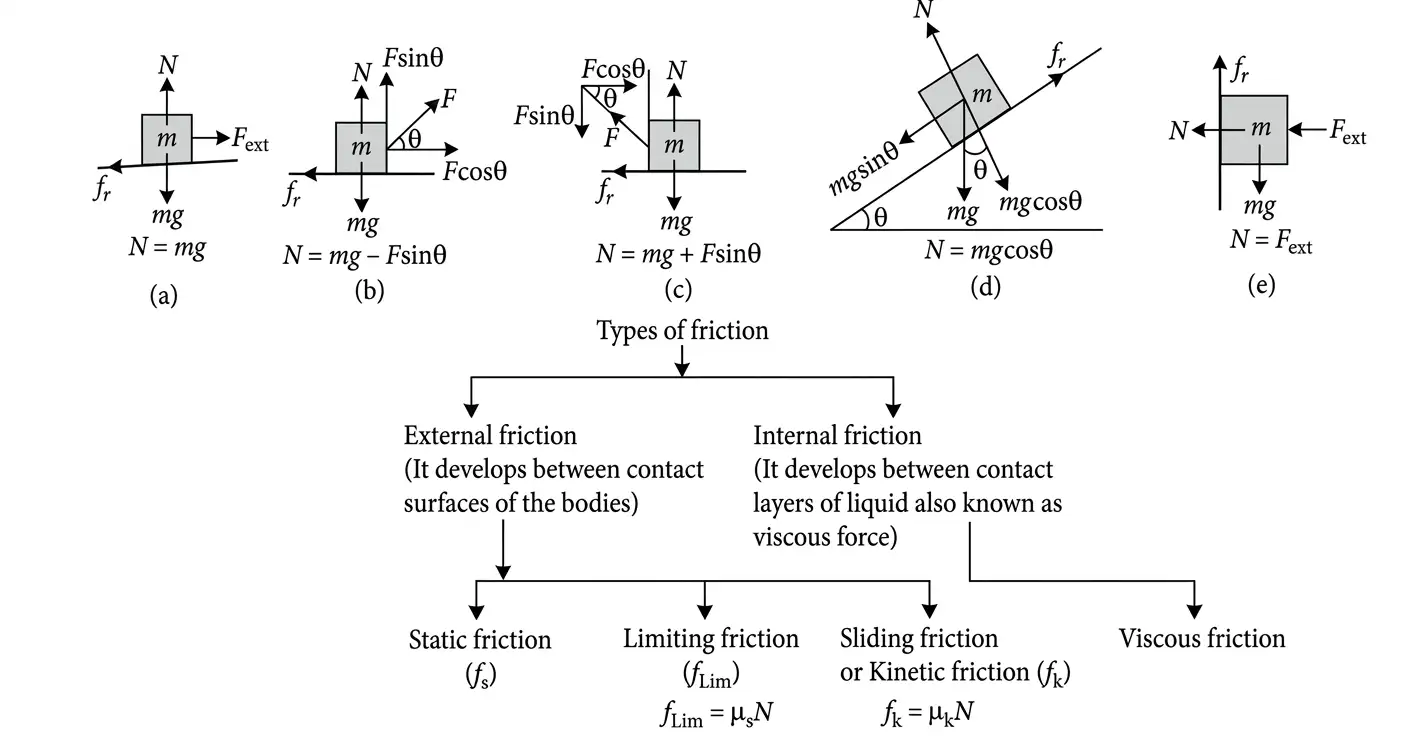
Friction opposes relative motion or tendency of motion between surfaces.
Friction force \( f_r \propto N \) (normal reaction), except static friction which is self-adjusting.
Types:
Static friction \( f_s \): prevents motion, adjusts up to limiting friction.
Limiting friction \( f_{lim} = \mu_s N \): maximum static friction before motion starts.
Kinetic friction \( f_k = \mu_k N \): acts during motion, \( \mu_k < \mu_s \).
Friction direction is opposite to motion or applied force.
Solved Examples
Ex 1
Block of mass \( m = 10\,\mathrm{kg} \) on horizontal surface, \( \mu_s = 0.4 \), find limiting friction.
Normal force \( N = mg = 10 \times 9.8 = 98\,\mathrm{N} \).
Limiting friction \( f_{lim} = \mu_s N = 0.4 \times 98 = 39.2\,\mathrm{N} \).
Practice Set
Q1: Limiting friction depends on:
A) Contact area
B) Normal reaction
C) Velocity
D) Temperature
Q2: Kinetic friction is:
A) Equal to limiting friction
B) Greater than static friction
C) Less than limiting friction
D) Independent of normal force
Q3: If \( \mu_s = 0.5 \) and \( N = 100\,\mathrm{N} \), find limiting friction.
A) 50 N
B) 100 N
C) 0.5 N
D) 150 N
Answer Key
Q1: B - Limiting friction is proportional to normal reaction.
Q2: C - Kinetic friction is less than limiting friction.
Q3: A - \( f_{lim} = 0.5 \times 100 = 50\,\mathrm{N} \).
Memory Aids
Static friction adjusts up to \( f_{lim} = \mu_s N \).
Kinetic friction constant during motion, less than static.
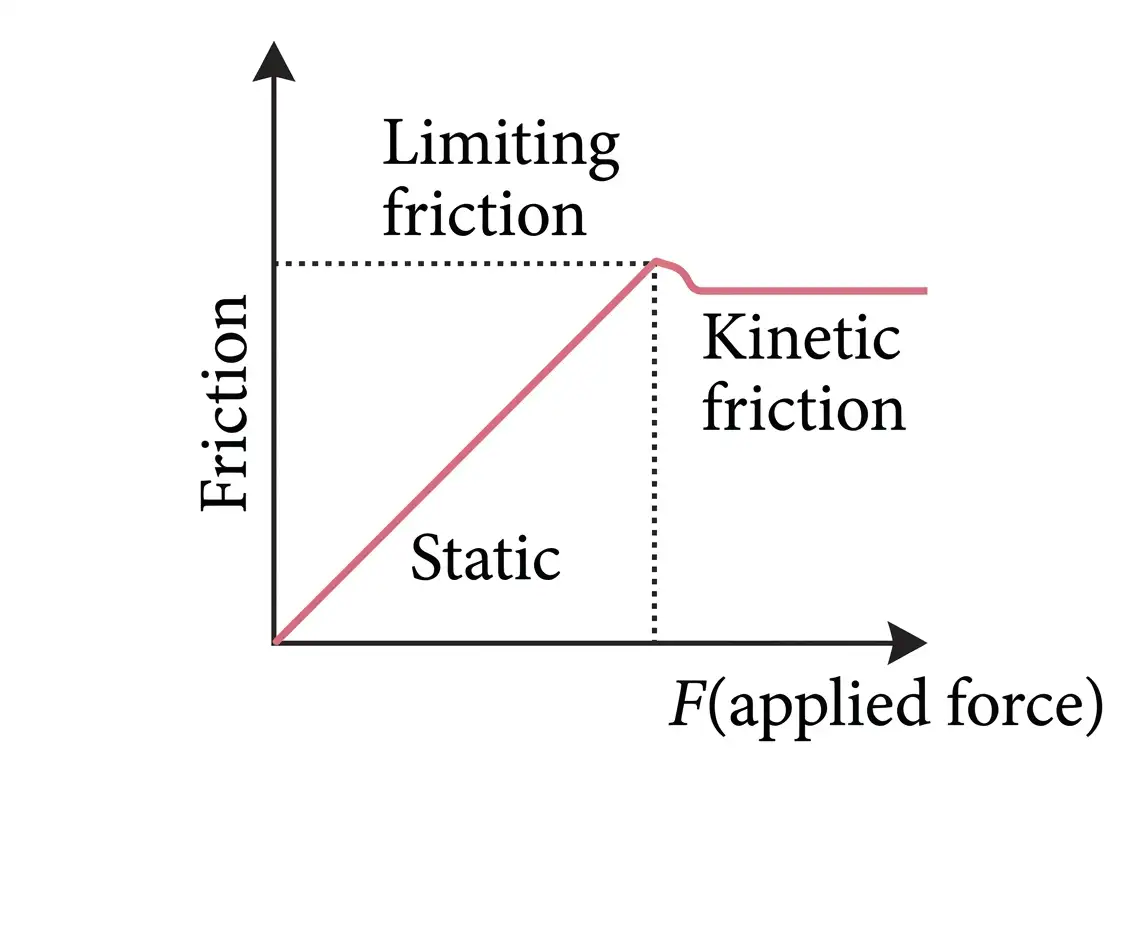
Friction force opposes motion direction.
Angle of Friction
Concepts
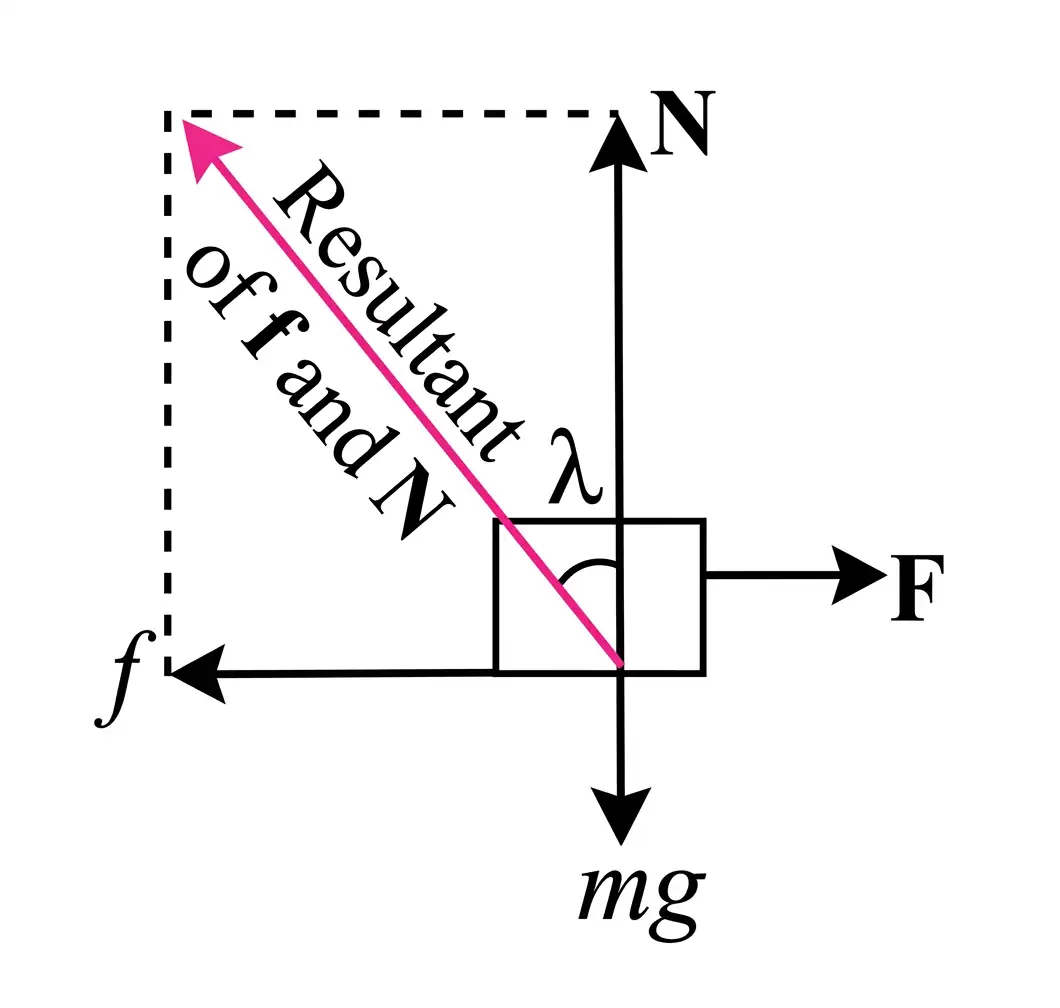
Angle of friction \( \lambda \) is angle between resultant of limiting friction \( f \) and normal reaction \( N \).
Formula: \( \tan \lambda = \frac{f}{N} = \mu \), so \( \lambda = \tan^{-1} \mu \).
Solved Examples
Ex 1
Given \( \mu = 0.5 \), find angle of friction \( \lambda \).
\( \lambda = \tan^{-1} 0.5 = 26.57^\circ \).
Practice Set
Q1: Angle of friction is the angle between:
A) Applied force and friction
B) Normal reaction and resultant of friction and normal reaction
C) Weight and normal reaction
D) Friction and applied force
Q2: If \( \mu = 1 \), angle of friction is:
A) 45°
B) 30°
C) 60°
D) 90°
Q3: For \( \lambda = 30^\circ \), find \( \mu \).
A) 0.5
B) 0.577
C) 1.732
D) 1
Answer Key
Q1: B - Angle between normal reaction and resultant force.
Q2: A - \( \tan 45^\circ = 1 \).
Q3: B - \( \mu = \tan 30^\circ = 0.577 \).
Memory Aids
\( \lambda = \tan^{-1} \mu \).
Angle of friction relates friction coefficient to force direction.
Angle of Repose
Key Points
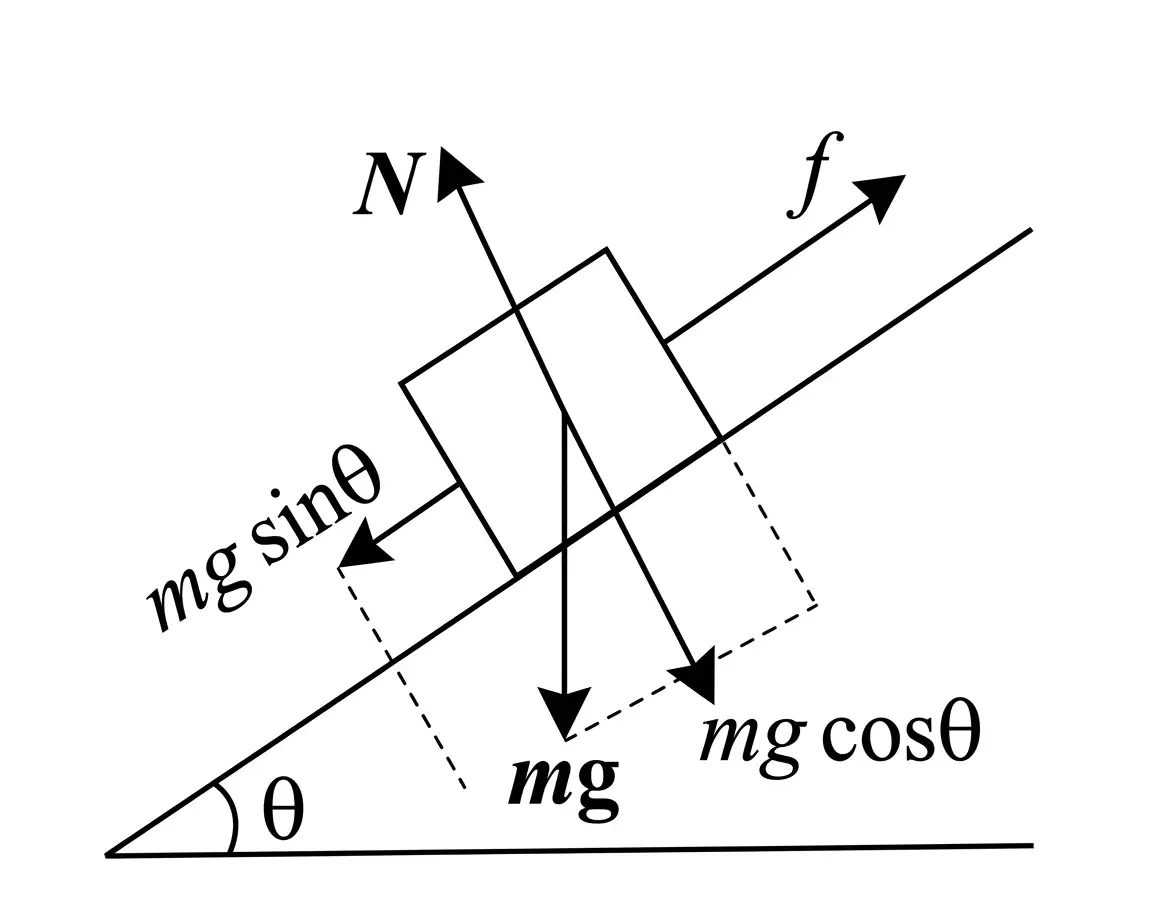
Maximum angle \( \theta \) of incline where body just begins to slide down.
At this angle, \( f = mg \sin \theta \), \( N = mg \cos \theta \).
Coefficient of static friction \( \mu_s = \tan \theta \).
Angle of repose equals angle of friction.
Solved Examples
Ex 1
Find \( \mu_s \) if angle of repose is \( 30^\circ \).
\( \mu_s = \tan 30^\circ = 0.577 \).
Practice Set
Q1: Angle of repose is the angle at which:
A) Body starts sliding down
B) Body remains at rest
C) Friction is zero
D) Normal force is maximum
Q2: If \( \mu_s = 0.5 \), angle of repose is:
A) 26.57°
B) 45°
C) 30°
D) 60°
Q3: On an incline of 45°, a block just starts sliding. Find \( \mu_s \).
A) 1
B) 0.5
C) 0.707
D) 0.25
Answer Key
Q1: A - Body begins to slide at angle of repose.
Q2: A - \( \tan^{-1} 0.5 = 26.57^\circ \).
Q3: A - \( \mu_s = \tan 45^\circ = 1 \).
Memory Aids
\( \mu_s = \tan \theta \) where \( \theta \) is angle of repose.
Angle of repose = angle of friction.
Rolling Friction
Essentials
Opposes rolling motion; much smaller than static or kinetic friction.
Originates from deformation at contact area, not just a point.
Rolling friction force opposes motion parallel to surface.
Used in ball bearings to reduce friction in machines.
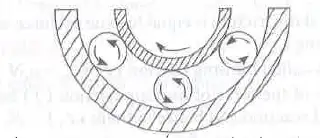
Solved Examples
Ex 1
Explain why ball bearings reduce friction.
Balls roll between rings, reducing contact area and friction.
Practice Set
Q1: Rolling friction is generally:
A) Greater than static friction
B) Equal to kinetic friction
C) Much less than static and kinetic friction
D) Independent of deformation
Q2: Rolling friction arises due to:
A) Surface roughness only
B) Deformation at contact area
C) Air resistance
D) Weight of object only
Q3: To reduce friction in machines, we use:
A) Lubricants only
B) Ball bearings
C) Rough surfaces
D) Heavy weights
Answer Key
Q1: C - Rolling friction is much less than static and kinetic friction.
Q2: B - Due to deformation at contact area.
Q3: B - Ball bearings reduce friction effectively.
Memory Aids
Rolling friction << static friction.
Ball bearings minimize friction by rolling contact.
Tension in String
Fundamentals
String assumed massless, inextensible, and perfectly smooth.
Tension is force developed when string ends are pulled opposite directions.
Tension force acts along string, away from the object.
In ideal string, tension is same at all points.
Tension is extensional force; in rods, can be extensional or compressional.

Solved Examples
Ex 1
Identify force type when string is pulled at ends.
Force is extensional tension along string, away from objects.
Practice Set
Q1: Tension in an ideal string is:
A) Different at different points
B) Same at all points
C) Always zero
D) Compressional
Q2: Tension force acts:
A) Along string, towards object
B) Along string, away from object
C) Perpendicular to string
D) Random direction
Q3: In a rod under tension, force is:
A) Only extensional
B) Only compressional
C) Extensional or compressional
D) Zero
Answer Key
Q1: B - Tension is uniform in ideal string.
Q2: B - Tension acts along string, away from object.
Q3: C - Rod can have extensional or compressional forces.
Memory Aids
Tension = pulling force along string.
Ideal string: massless, inextensible, smooth.
Tension same throughout ideal string.
Circular Motion
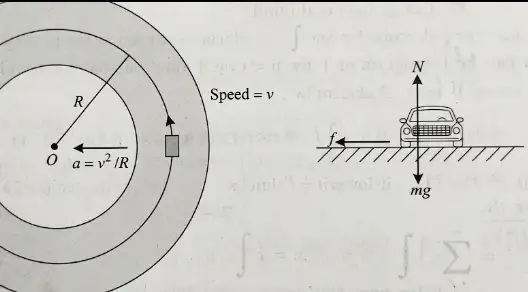
Motion of a Car on a Level Road
Centripetal force is provided by friction between tyres and road: \( f \leq \mu_s N = \frac{mv^2}{R} \)
Maximum safe speed: \( v = \sqrt{\mu_s R g} \)
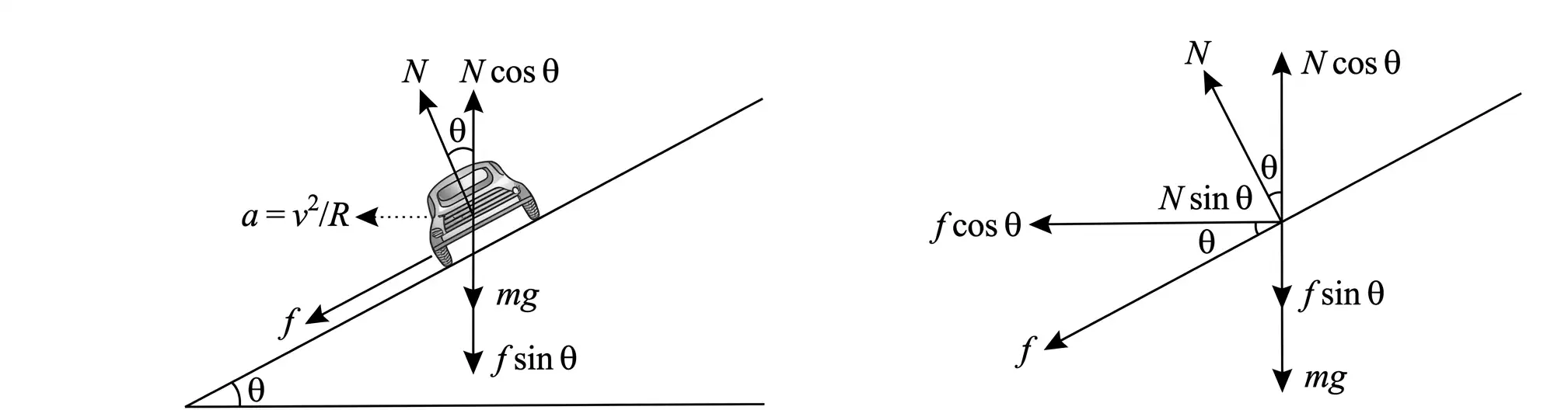
Motion of a Car on a Banked Road
Components of friction \( f \cos \theta \) and normal force \( N \sin \theta \) provide centripetal force
Maximum permissible speed to avoid slipping: \[ v_{max} = \sqrt{\frac{Rg(\mu_s + \tan \theta)}{1 - \mu_s \tan \theta}} \]
If road is smooth (\( \mu_s = 0 \)), then \( v_{max} = \sqrt{Rg \tan \theta} \)
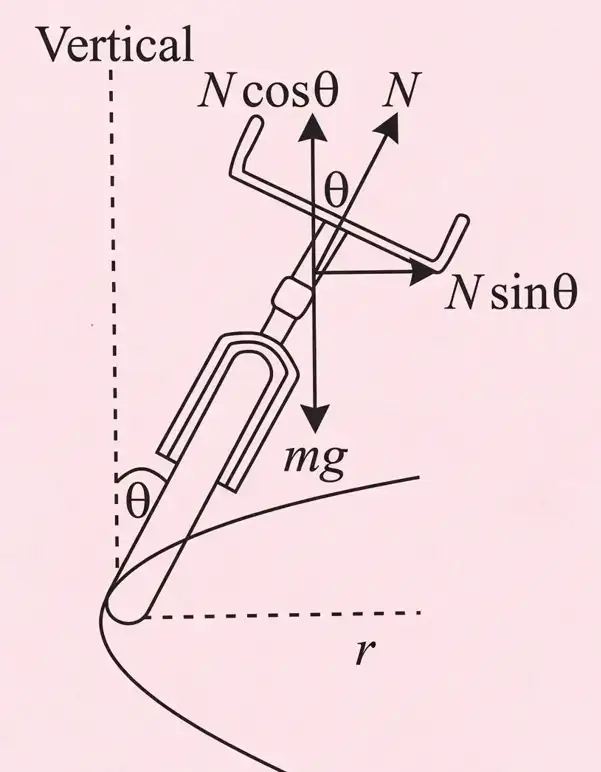
Bending of Cyclist on Circular Turning
Normal reaction \( N \) components:
Horizontal: \( N \sin \theta = \frac{mv^2}{r} \) (centripetal force)
Vertical: \( N \cos \theta = mg \)
Maximum speed of cyclist: \[ v = \sqrt{r g \tan \theta} \]
Solved Examples
Ex 1
Find maximum speed of a car on a flat road with \( \mu_s = 0.4 \), radius \( R = 50 \) m, \( g = 9.8 \) m/s². \[ v = \sqrt{0.4 \times 50 \times 9.8} = \sqrt{196} = 14 \text{ m/s} \]
Ex 2
Calculate maximum speed on a banked road with \( \theta = 30^\circ \), \( \mu_s = 0.2 \), \( R = 40 \) m, \( g = 9.8 \) m/s². \[ v_{max} = \sqrt{\frac{40 \times 9.8 (0.2 + \tan 30^\circ)}{1 - 0.2 \times \tan 30^\circ}} \approx \sqrt{\frac{392 (0.2 + 0.577)}{1 - 0.115}} = \sqrt{\frac{392 \times 0.777}{0.885}} \approx \sqrt{344} = 18.55 \text{ m/s} \]
Ex 3
Find maximum speed of cyclist leaning at \( 45^\circ \) on a curve of radius 20 m. \[ v = \sqrt{20 \times 9.8 \times \tan 45^\circ} = \sqrt{196} = 14 \text{ m/s} \]
Practice Set
Q1
What provides centripetal force for a car turning on a flat road?
A) Gravity
B) Friction
C) Normal force
D) Air resistance
Q2
Maximum speed on a banked road with \( \theta = 30^\circ \), \( \mu_s = 0 \), \( R = 100 \) m, \( g = 9.8 \) m/s² is:
A) 17.3 m/s
B) 24.5 m/s
C) 27.9 m/s
D) 19.6 m/s
Q3
A cyclist leans at \( 60^\circ \) to take a turn of radius 10 m. Find maximum speed.
A) 12.5 m/s
B) 15.3 m/s
C) 9.9 m/s
D) 14.0 m/s
Answer Key
Q1: B) Friction - It provides the necessary centripetal force on a flat road.
Q2: B) 24.5 m/s - Using \( v = \sqrt{Rg \tan \theta} = \sqrt{100 \times 9.8 \times 0.577} \approx 24.5 \)
Q3: A) 12.5 m/s - \( v = \sqrt{r g \tan 60^\circ} = \sqrt{10 \times 9.8 \times 1.732} \approx 12.5 \)
Memory Aids
Flat road max speed: \( v = \sqrt{\mu_s R g} \)
Banked road smooth max speed: \( v = \sqrt{R g \tan \theta} \)
Cyclist lean speed: \( v = \sqrt{r g \tan \theta} \)
Friction provides centripetal force on flat road
On banked road, normal and friction forces combine for centripetal force
Solving Problems in Mechanics
Systematic Approach
Draw schematic diagram of the assembly showing bodies, links, supports.
Select a convenient part as a single system.
Draw free body diagram (FBD) showing all forces on the system from the rest of the assembly and other agencies.
Include known forces (magnitude & direction) in FBD; treat unknown forces as variables.
Use Newton's third law: forces between two bodies are equal and opposite in their respective FBDs.
Solved Examples
Ex 1
Identify system and draw FBD with all forces.
Apply Newton's laws to write equations of motion.
Solve simultaneous equations for unknown forces or accelerations.
Practice Set
Q1: What is the purpose of a free body diagram?
A) Show forces on environment
B) Show forces on system
C) Show forces by system on environment
D) Show internal forces onlyQ2: According to Newton's third law, if force on A by B is \( \vec{F} \), force on B by A is:
A) \( \vec{F} \)
B) \( -\vec{F} \)
C) Zero
D) Depends on massQ3: In solving mechanics problems, the first step is:
A) Write equations
B) Draw schematic diagram
C) Calculate acceleration
D) Choose coordinate system
Answer Key
Q1: B - FBD shows all forces acting on the chosen system.
Q2: B - Newton's third law states forces are equal and opposite.
Q3: B - Start by drawing schematic diagram of the assembly.
Memory Aids
FBD = Forces on system only.
Newton's 3rd law: action = -reaction.
Start with diagram, then equations.
Minimum Force on Inclined Plane
Key Formulas and Concepts
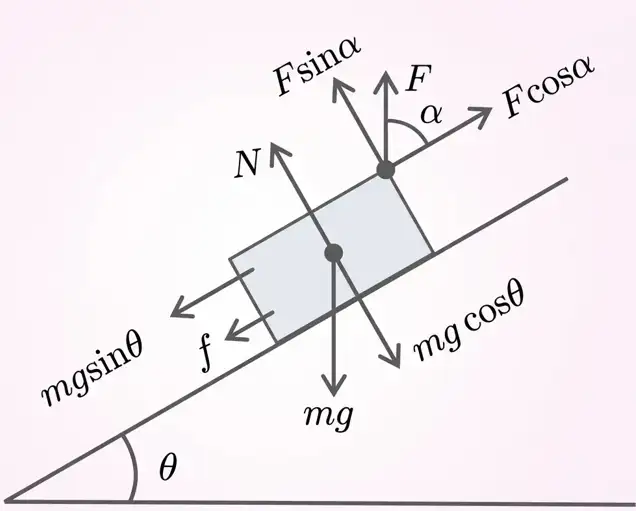
Normal force: \( N = mg \cos \theta - F \sin \alpha \)
Force balance along slope: \( F \cos \alpha = mg \sin \theta + \mu N = mg \sin \theta + \mu (mg \cos \theta - F \sin \alpha) \)
Rearranged force: \( F = \frac{mg(\sin \theta + \mu \cos \theta)}{\cos \alpha + \mu \sin \alpha} \)
Minimum \( F \) when denominator \( \cos \alpha + \mu \sin \alpha \) is maximum.
Condition for minimum force: \( \tan \alpha = \mu \Rightarrow \alpha = \tan^{-1} \mu \)
Minimum force magnitude: \( F_{min} = \frac{mg(\sin \theta + \mu \cos \theta)}{\sqrt{1 + \mu^2}} \)
Solved Examples
Ex 1
Given: mass \( m \), incline angle \( \theta \), friction coefficient \( \mu \).
Calculate \( \alpha = \tan^{-1} \mu \).
Compute \( F_{min} = \frac{mg(\sin \theta + \mu \cos \theta)}{\sqrt{1 + \mu^2}} \).
Practice Set
Q1: For \( \mu = 0 \), minimum force to pull block up incline is:
A) \( mg \sin \theta \)
B) \( mg \cos \theta \)
C) Zero
D) \( mg \)Q2: If \( \mu = 1 \) and \( \theta = 30^\circ \), angle \( \alpha \) for minimum force is:
A) 45°
B) 30°
C) 60°
>D) 90°Q3: For \( m=2\,kg \), \( \theta=45^\circ \), \( \mu=0.5 \), find minimum force \( F_{min} \) (take \( g=10\,m/s^2 \)):
A) 20 N
B) 24 N
C) 28 N
D) 32 N
Answer Key
Q1: A - Without friction, force equals component of weight down slope.
Q2: A - \( \alpha = \tan^{-1} 1 = 45^\circ \).
Q3: B - Calculate \( F_{min} = \frac{2 \times 10 (\sin 45^\circ + 0.5 \cos 45^\circ)}{\sqrt{1 + 0.5^2}} \approx 24\,N \).
Memory Aids
Minimum force angle \( \alpha = \tan^{-1} \mu \).
Force formula denominator maximized for minimum force.
Use components along and perpendicular to incline.
NEET Physics — ALL CHAPTERS
1
Basic Mathematics
2
Units and Measurement
3
Motion in a Straight Line
4
Motion in a Plane
5
Laws of Motion
6
Work, Energy and Power
7
System of Particles and Rotational Motion
8
Gravitation
9
Mechanical Properties of Solids
10
Mechanical Properties of Fluids
11
Thermal Properties of Matter
12
Thermodynamics
13
Kinetic Theory
14
Oscillations
15
Waves
16
Electric Charges and Fields
17
Electrostatic Potential and Capacitance
18
Current Electricity
19
Moving Charges and Magnetism
20
Magnetism and Matter
21
Electromagnetic Induction
22
Alternating Current
23
Electromagnetic Waves
24
Ray Optics and Optical Instruments
25
Wave Optics
26
Dual Nature of Radiation and Matter
27
Atoms
28
Nuclei
29
Semiconductor Electronics: Materials, Devices and Simple Circuits