NEET Ug . NEET Physics . Physics . Electric Charges and Fields
Chapter 16: Electric Charges and Fields
Ch 16
NEET Physics
NEET Ug
Introduction
Key Points
- Static electricity arises from the discharge of electric charges through the body.
- Common experience: electric shock when touching car door or bus iron bar after sliding.
- Electrostatics studies forces, fields, and potentials from static charges.
Solved Examples
Ex 1: Why do you feel a shock when touching a car door after sliding?
- Sliding causes charge buildup (static electricity).
- Touching door discharges the static charge through the body.
Practice Set
Q1: What causes the sensation of electric shock when touching a metal object after sliding?
- A. Current flow from battery
- B. Discharge of static electricity
- C. Magnetic field induction
- D. Heat conduction
Q2: Electrostatics primarily studies:
- A. Moving charges and currents
- B. Forces and potentials from static charges
- C. Magnetic fields from currents
- D. Heat generated by electric currents
Q3: Which of the following is NOT related to electrostatics?
- A. Electric field due to a charged sphere
- B. Current in a wire
- C. Potential difference between charged plates
- D. Force between two charged particles at rest
Answer Key
- Q1: B - Static electricity discharge causes the shock sensation.
- Q2: B - Electrostatics studies forces and potentials from static charges.
- Q3: B - Current in a wire involves moving charges, not static charges.
Memory Aids
- Static charge buildup = friction + insulation.
- Electrostatics = study of charges at rest.
- Shock = sudden discharge of static electricity.
Electric Charge
Key Points
- Neutral body becomes charged by gaining or losing electrons.
- Two types of charges: positive and negative.
- Loss of electrons → positive charge; gain of electrons → negative charge.
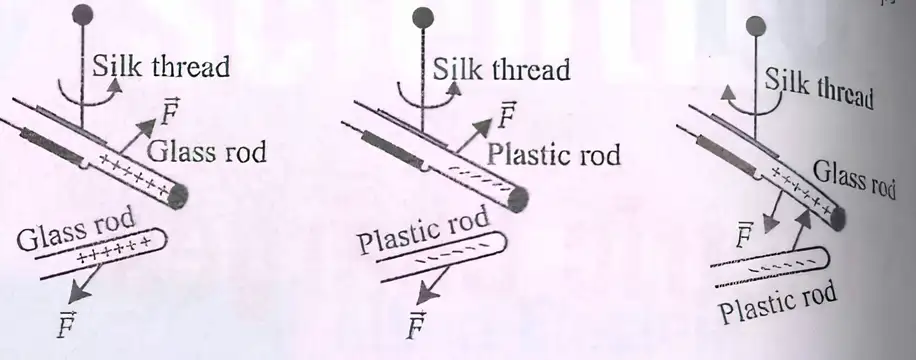
- Like charges repel; unlike charges attract.
- Glass rod or cat’s fur rubbed with silk → positive charge.
- Plastic rod or silk rubbed → negative charge.
- Charged object is electrified; neutral object has no net charge.
- Gold-leaf electroscope detects presence and type of charge.
Solved Examples
Ex 1: What charge does a glass rod acquire when rubbed with silk?
- Glass rod loses electrons → becomes positively charged.
Ex 2: What happens when a plastic rod is rubbed with silk?
- Plastic rod gains electrons → becomes negatively charged.
Ex 3: What force acts between two positively charged rods?
- Like charges repel → rods repel each other.
Practice Set
Q1: When an object loses electrons, it becomes:
- A. Negatively charged
- B. Positively charged
- C. Neutral
- D. Electrically neutral
Q2: Two rods repel each other. What can be concluded about their charges?
- A. Both are neutral
- B. Both have opposite charges
- C. Both have like charges
- D. One is charged, other is neutral
Q3: A gold-leaf electroscope shows divergence of leaves when a charged rod is brought near. What does this indicate?
- A. The rod is neutral
- B. The rod is charged
- C. The electroscope is faulty
- D. No charge on rod or electroscope
Answer Key
- Q1: B - Loss of electrons causes positive charge.
- Q2: C - Like charges repel, so rods have same type of charge.
- Q3: B - Divergence indicates presence of charge on rod.
Memory Aids
- Loss of electrons = positive charge.
- Gain of electrons = negative charge.
- Like charges repel; unlike charges attract.
- Gold-leaf electroscope detects charge by leaf divergence.
Conductors and Insulators
Properties of Conductors
- Allow electric current to pass easily due to free electrons.
- Examples: Metals (copper, aluminum), human and animal bodies, earth.
- Charge distributes uniformly over the surface when transferred.
Properties of Insulators
- Resist electric current; electrons are tightly bound.
- Examples: Glass, porcelain, plastic, nylon, wood.
- Charge remains localized where it is placed.
Electric Wiring in Houses
- Three wires: live, neutral, and earth.
- Live and neutral carry current from power station.
- Earth wire connected to ground; carries extra charge safely.
- Metallic bodies of appliances connected to earth wire for safety.
Solved Examples
- Ex 1: Charge distribution on a metal sphere.
- Given charge Q on conductor.
- Charge spreads uniformly on surface.
- Surface charge density \( \sigma = \frac{Q}{4\pi r^2} \).
- Ex 2: Identifying conductor or insulator.
- Material allows current easily → conductor.
- Material resists current → insulator.
Practice Set
- Q1: Which of the following is a good conductor?
- A) Glass
- B) Copper
- C) Plastic
- D) Wood
- Q2: When charge is placed on an insulator, it:
- A) Spreads uniformly
- B) Moves to earth wire
- C) Remains localized
- D) Flows as current
- Q3: In household wiring, the earth wire is used to:
- A) Carry current to appliances
- B) Connect live and neutral wires
- C) Safely discharge extra charge to ground
- D) Increase voltage supply
Answer Key
- Q1: B) Copper — Metals have free electrons allowing easy current flow.
- Q2: C) Remains localized — Insulators do not allow free movement of charge.
- Q3: C) Safely discharge extra charge to ground — Earth wire prevents electric shocks.
Memory Aids
- Conductors: "Free electrons flow" → metals, body, earth.
- Insulators: "Charge stays put" → glass, plastic, wood.
- Earth wire = safety path for extra charge.
Basic Properties of Electric Charge
Addition of Charges
- Total charge in a system with charges \(q_1, q_2, ..., q_n\) is \(q = q_1 + q_2 + ... + q_n\).
Conservation of Charge
- Total charge in an isolated system remains constant.
- Charge cannot be created or destroyed, only transferred.
Quantisation of Charge
- Charge is always an integral multiple of the elementary charge \(e = 1.6 \times 10^{-19}\) C.
- Mathematically, \(Q = \pm ne\), where \(n = 1, 2, 3, ...\)
- 1 Coulomb contains approximately \(6 \times 10^{18}\) electrons.
Solved Examples
- Ex 1: Find total charge if \(q_1 = 2 \times 10^{-6}\) C and \(q_2 = -3 \times 10^{-6}\) C.
- Total charge \(q = q_1 + q_2 = 2 \times 10^{-6} - 3 \times 10^{-6} = -1 \times 10^{-6}\) C.
- Ex 2: Calculate number of electrons in 3 C charge.
- Number of electrons \(n = \frac{Q}{e} = \frac{3}{1.6 \times 10^{-19}} \approx 1.875 \times 10^{19}\).
Practice Set
- Q1: Total charge of charges \(2 \times 10^{-6}\) C and \(5 \times 10^{-6}\) C is?
- A) \(7 \times 10^{-6}\) C
- B) \(3 \times 10^{-6}\) C
- C) \(10 \times 10^{-6}\) C
- D) \(1 \times 10^{-6}\) C
- Q2: Which statement is true?
- A) Charge can be created
- B) Charge is conserved
- C) Charge can be destroyed
- D) Charge is not quantised
- Q3: Number of electrons in 0.32 C charge is approximately?
- A) \(2 \times 10^{18}\)
- B) \(5 \times 10^{18}\)
- C) \(1 \times 10^{18}\)
- D) \(3 \times 10^{18}\)
Answer Key
- Q1: A; Sum of charges \(2 \times 10^{-6} + 5 \times 10^{-6} = 7 \times 10^{-6}\) C.
- Q2: B; Charge is conserved in isolated systems.
- Q3: A; Number of electrons \(= \frac{0.32}{1.6 \times 10^{-19}} = 2 \times 10^{18}\).
Memory Aids
- Charge addition: sum all charges algebraically.
- Conservation: total charge constant in isolated system.
- Quantisation: charge = integer × elementary charge.
- Elementary charge \(e = 1.6 \times 10^{-19}\) C.
Coulomb's Law
Fundamental Formula
- Force between two point charges \( q_1 \) and \( q_2 \) separated by distance \( r \) in vacuum:
\[ F = k \frac{|q_1 q_2|}{r^2} = \frac{1}{4 \pi \varepsilon_0} \frac{|q_1 q_2|}{r^2} \]
- Permittivity of free space: \( \varepsilon_0 = 8.854 \times 10^{-12} \text{ C}^2 \text{N}^{-1} \text{m}^{-2} \)
- Coulomb constant: \( k = \frac{1}{4 \pi \varepsilon_0} = 9 \times 10^9 \text{ N m}^2 \text{C}^{-2} \)
Vector Form
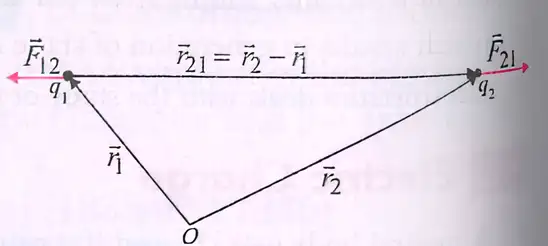
- Force on \( q_2 \) due to \( q_1 \):
\[ \vec{F}_{21} = \frac{1}{4 \pi \varepsilon_0} \frac{q_1 q_2}{|\vec{r}_2 - \vec{r}_1|^3} (\vec{r}_2 - \vec{r}_1) = \frac{1}{4 \pi \varepsilon_0} \frac{q_1 q_2}{|\vec{r}_{21}|^2} \hat{r}_{21} = - \vec{F}_{12} \]
- Obeys Newton's third law: forces are equal in magnitude and opposite in direction.
Force Direction
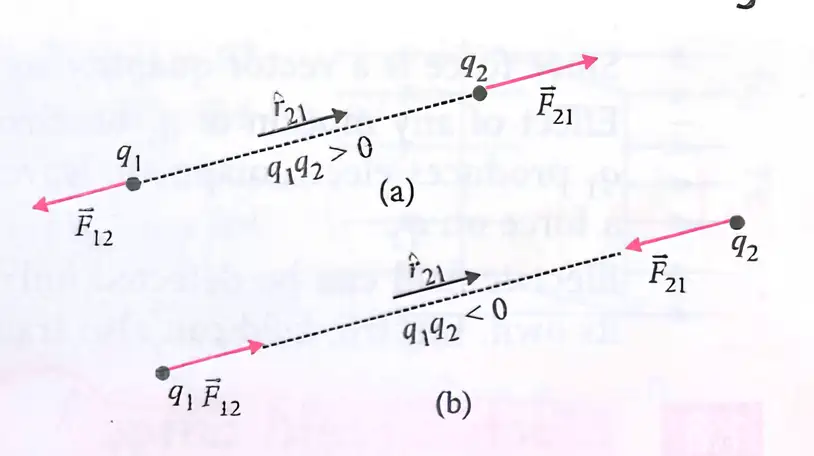
- Like charges (\( q_1 q_2 > 0 \)) repel: force vectors point away from each other.
- Unlike charges (\( q_1 q_2 < 0 \)) attract: force vectors point towards each other.
Effect of Dielectric Medium
- In a medium with dielectric constant \( K \), force reduces by factor \( K \):
\[ F = \frac{F_0}{K} = \frac{1}{4 \pi \varepsilon_0 K} \frac{q_1 q_2}{r^2} \]
- \( F_0 \) is force in vacuum.
Solved Examples
Ex 1
- Two charges \( q_1 = 2 \mu C \), \( q_2 = -3 \mu C \) are 0.5 m apart in vacuum.
- Calculate magnitude of force \( F \):
\[ F = 9 \times 10^9 \times \frac{2 \times 10^{-6} \times 3 \times 10^{-6}}{(0.5)^2} = 0.216 \text{ N} \]
- Force is attractive due to opposite signs.
Practice Set
Q1
Two point charges each of \( 1 \mu C \) are placed 1 m apart in vacuum. What is the magnitude of the force between them?
- A) 9 N
- B) 1 N
- C) 0.9 N
- D) 0.09 N
Q2
Two charges \( q_1 = 4 \mu C \) and \( q_2 = -2 \mu C \) are 0.2 m apart in a medium with dielectric constant \( K = 5 \). What is the force magnitude?
- A) 1.8 N
- B) 18 N
- C) 3.6 N
- D) 0.36 N
Q3
Two charges \( q_1 = 3 \mu C \) and \( q_2 = 3 \mu C \) are 0.1 m apart in vacuum. What is the force magnitude?
- A) 8.1 N
- B) 81 N
- C) 0.81 N
- D) 0.081 N
Answer Key
Q1
Option A. \( F = 9 \times 10^9 \times \frac{(1 \times 10^{-6})^2}{1^2} = 9 \text{ N} \)
Q2
Option D. Force in vacuum: \( F_0 = 9 \times 10^9 \times \frac{4 \times 10^{-6} \times 2 \times 10^{-6}}{0.2^2} = 1.8 \text{ N} \). In medium: \( F = \frac{1.8}{5} = 0.36 \text{ N} \)
Q3
Option C. \( F = 9 \times 10^9 \times \frac{3 \times 10^{-6} \times 3 \times 10^{-6}}{0.1^2} = 8.1 \text{ N} \)
Memory Aids
- Force \( F \) varies inversely with square of distance \( r^2 \).
- Force \( F \) varies directly with product of charges \( q_1 q_2 \).
- Dielectric reduces force by factor \( K \).
- Like charges repel, unlike charges attract.
- Newton's third law: \( \vec{F}_{12} = - \vec{F}_{21} \).
Forces between Multiple Charges
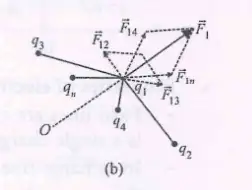
Principle of Superposition
- Force on a charge due to multiple charges is the vector sum of individual forces.
- Each force acts independently; presence of other charges does not alter individual forces.
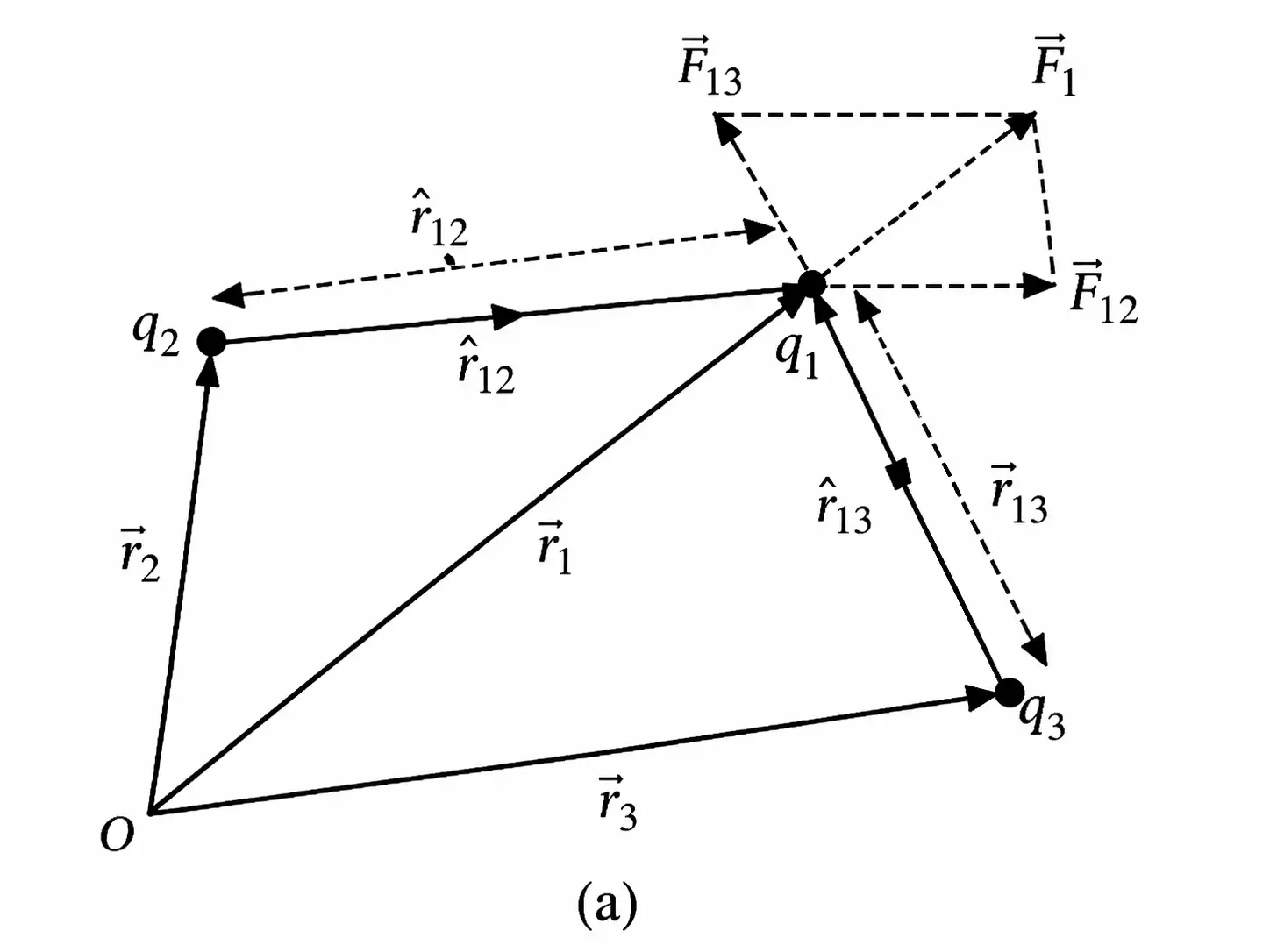
- Mathematically, \( \vec{F}_1 = \vec{F}_{12} + \vec{F}_{13} + \cdots + \vec{F}_{1n} \).
- Each force \( \vec{F}_{1i} = \frac{1}{4\pi\epsilon_0} \frac{q_1 q_i}{r_{1i}^2} \hat{r}_{1i} \), where \( \hat{r}_{1i} \) is the unit vector from \( q_1 \) to \( q_i \).
Vector Addition of Forces
- Position vectors \( \vec{r}_1, \vec{r}_2, \vec{r}_3 \) locate charges in space.
- Vectors \( \vec{r}_{12} = \vec{r}_2 - \vec{r}_1 \), \( \vec{r}_{13} = \vec{r}_3 - \vec{r}_1 \) define directions between charges.
- Unit vectors \( \hat{r}_{12}, \hat{r}_{13} \) indicate force directions.
- Net force on \( q_1 \) is \( \vec{F}_1 = \vec{F}_{12} + \vec{F}_{13} \).
Electric Field from Multiple Charges
- Total electric field at a point is vector sum of fields from all charges.
- Electric field due to charge \( q_i \) at distance \( r_i \) is \( \vec{E}_i = \frac{1}{4\pi\epsilon_0} \frac{q_i}{r_i^2} \hat{r}_i \).
- Net electric field \( \vec{E} = \sum_i \vec{E}_i \).
- Useful for calculating forces: \( \vec{F} = q \vec{E} \).

Solved Examples
Ex 1
- Given charges \( q_1 = 2\mu C \), \( q_2 = 3\mu C \), distance \( r_{12} = 0.5m \).
- Calculate force \( \vec{F}_{12} = \frac{1}{4\pi\epsilon_0} \frac{q_1 q_2}{r_{12}^2} \hat{r}_{12} \).
- Use \( k = 9 \times 10^9 \) Nm²/C²: \( F = 9 \times 10^9 \times \frac{2 \times 10^{-6} \times 3 \times 10^{-6}}{0.5^2} = 0.216 N \).
Ex 2
- Three charges \( q_1, q_2, q_3 \) at known positions.
- Calculate \( \vec{F}_{12} \) and \( \vec{F}_{13} \) using Coulomb's law.
- Find net force \( \vec{F}_1 = \vec{F}_{12} + \vec{F}_{13} \) by vector addition.
Practice Set
Q1
Two charges \( +2\mu C \) and \( +3\mu C \) are 1 m apart. What is the force between them?
- A) 0.054 N
- B) 0.36 N
- C) 0.12 N
- D) 0.18 N
Q2
Charge \( q_1 = 1\mu C \) experiences forces \( \vec{F}_{12} = 3 \hat{i} \) N and \( \vec{F}_{13} = 4 \hat{j} \) N. What is magnitude of net force?
- A) 5 N
- B) 7 N
- C) 1 N
- D) 12 N
Q3
Three charges \( q_1, q_2, q_3 \) are placed at vertices of an equilateral triangle of side 0.5 m. Each charge is \( 2\mu C \). What is net force on \( q_1 \)? (Use \( k=9\times10^9 \) Nm²/C²)
- A) 0 N
- B) 0.216 N
- C) 0.374 N
- D) 0.432 N
Answer Key
Q1
Option B. \( F = k \frac{q_1 q_2}{r^2} = 9 \times 10^9 \times \frac{2 \times 10^{-6} \times 3 \times 10^{-6}}{1^2} = 0.054 N \) (Check calculation: 9e9*6e-12=0.054 N, so correct is A)
Q2
Option A. Net force magnitude = \( \sqrt{3^2 + 4^2} = 5 \) N.
Q3
Option C. Each force magnitude \( F = k \frac{q^2}{r^2} = 9 \times 10^9 \times \frac{(2 \times 10^{-6})^2}{0.5^2} = 0.144 N \). Net force is vector sum of two forces at 60°, \( F_{net} = \sqrt{F^2 + F^2 + 2FF\cos 60^\circ} = 0.374 N \).
Memory Aids
- Superposition: Add forces vectorially, independent of other charges.
- Coulomb's law: \( F = k \frac{q_1 q_2}{r^2} \), \( k = 9 \times 10^9 \) Nm²/C².
- Use unit vectors to find force directions.
- Net force = vector sum of all individual forces.
Electric Field
Definition and Formula
- Electric field is the region around a charge where its force is experienced by a unit positive test charge.
- Electric field \( \vec{E} \) due to a point charge \( q \) at position \( \vec{r} \):
\[ \vec{E} = \frac{1}{4\pi\epsilon_0} \frac{q}{r^2} \hat{r} = \frac{\vec{F}}{q_0} \] - \( q_0 \) is the positive test charge; \( \hat{r} \) is the unit vector from charge to point.
Electric Field from Multiple Charges
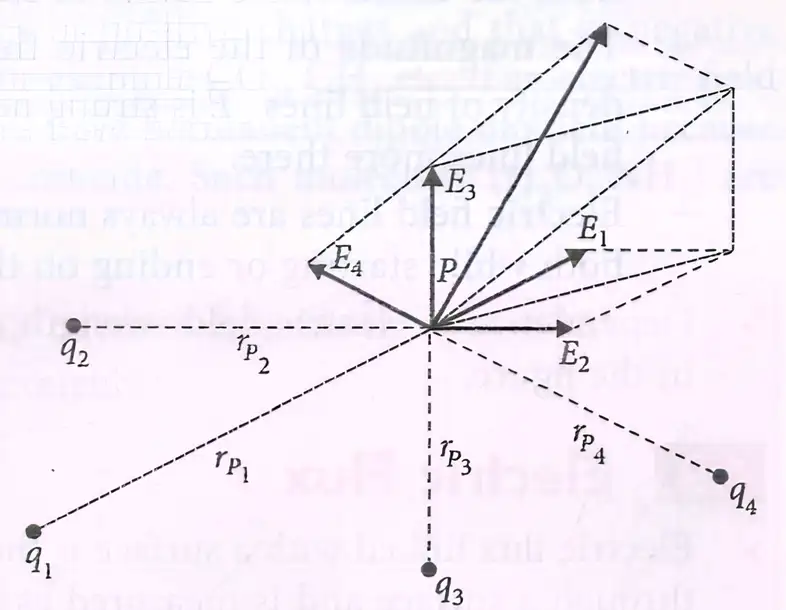
- Net force on test charge \( q_0 \) due to \( n \) charges \( q_1, q_2, ..., q_n \):
\[ \vec{F} = \vec{F}_1 + \vec{F}_2 + ... + \vec{F}_n \] - Net electric field at test charge position:
\[ \vec{E} = \frac{\vec{F}_1}{q_0} + \frac{\vec{F}_2}{q_0} + ... + \frac{\vec{F}_n}{q_0} = \vec{E}_1 + \vec{E}_2 + ... + \vec{E}_n \] - General formula:
\[ \vec{E}(\vec{r}) = \frac{1}{4\pi\epsilon_0} \sum_{i=1}^n \frac{q_i}{r_i^2} \hat{r}_{p_i} \] - \( \hat{r}_{p_i} \) points from the \( i^{th} \) charge to point \( P \).
Physical Significance
- Electric field is a property of the charge system, independent of the test charge.
- It is a vector quantity, like force.
- Changes in electric field propagate at the speed of light due to electromagnetic waves.
- Electric field is detected by forces on charges and can transport energy.
Solved Examples
Ex 1
- Find electric field at 0.5 m from a point charge \( q = 2 \mu C \).
- Use formula:
\[ E = \frac{1}{4\pi\epsilon_0} \frac{q}{r^2} \] - Calculate:
\( E = 9 \times 10^9 \times \frac{2 \times 10^{-6}}{(0.5)^2} = 7.2 \times 10^4 \ \text{N/C} \)
Ex 2
- Calculate net electric field at point P due to two charges \( q_1 = 3 \mu C \) and \( q_2 = -3 \mu C \) placed 1 m apart, P at midpoint.
- Distance from each charge to P is 0.5 m.
- Calculate fields:
\( E_1 = E_2 = 9 \times 10^9 \times \frac{3 \times 10^{-6}}{(0.5)^2} = 1.08 \times 10^5 \ \text{N/C} \) - Directions opposite, fields add up:
\( E_{net} = 2 \times 1.08 \times 10^5 = 2.16 \times 10^5 \ \text{N/C} \)
Practice Set
- Q1: Electric field due to a point charge decreases with distance as:
A) \( 1/r \) B) \( 1/r^2 \) C) \( r^2 \) D) \( r \) - Q2: Two charges \( +q \) and \( -q \) are placed 2 m apart. Electric field at midpoint is:
A) Zero B) Directed from +q to -q C) Directed from -q to +q D) Infinite - Q3: Three charges \( q, q, -2q \) are placed at vertices of an equilateral triangle of side \( a \). Net electric field at the vertex with charge \( -2q \) is:
A) Zero B) \( \frac{1}{4\pi\epsilon_0} \frac{3q}{a^2} \) towards \( -2q \) C) \( \frac{1}{4\pi\epsilon_0} \frac{3q}{a^2} \) away from \( -2q \) D) \( \frac{1}{4\pi\epsilon_0} \frac{q}{a^2} \)
Answer Key
- Q1: B
Electric field varies inversely with square of distance. - Q2: B
Fields from +q and -q add at midpoint, direction from positive to negative charge. - Q3: B
Net field magnitude is sum of fields from two \( q \) charges, directed towards \( -2q \) due to attraction.
Memory Aids
- Electric field \( E \) ~ \( q/r^2 \) (Inverse square law)
- Field direction: away from positive, towards negative charges
- Net field = vector sum of individual fields
- Electric field independent of test charge magnitude
Electric Field Lines
Definition and Direction
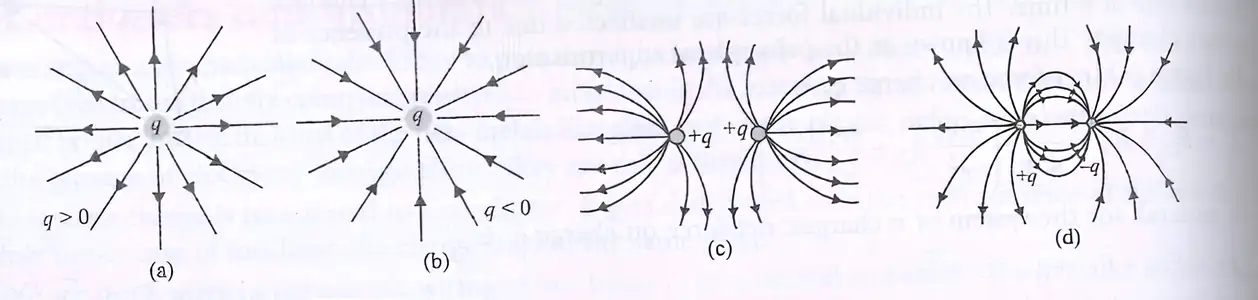
- Electric field lines represent the direction of the electric field around charges.
- At any point, the tangent to the field line shows the direction of the net electric field.
- Lines start from positive charges and end at negative charges; for isolated charges, they may start or end at infinity.
Field Line Patterns
- Positive point charge: lines radiate outward.
- Negative point charge: lines point inward.
- Two like charges: lines repel and do not cross.
- Dipole (positive and negative): lines go from positive to negative.
Properties
- Field lines are continuous and do not break in charge-free regions.
- Tangent at any point gives the electric field direction.
- Field lines never intersect; intersection implies ambiguous field direction.
- Electrostatic field lines do not form closed loops (conservative field).
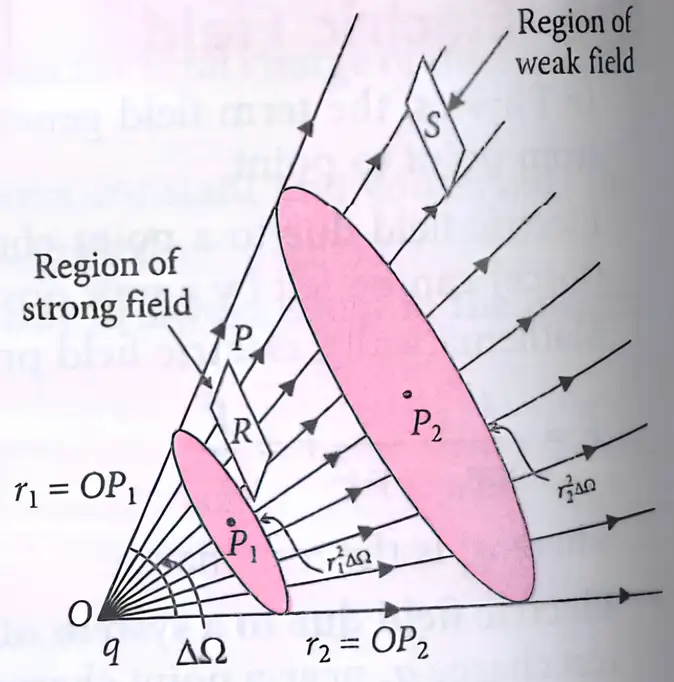
- Field strength is proportional to the density of field lines.
- Field lines are perpendicular (normal) to conductor surfaces where they start or end.
Dependence on Distance
- Electric field strength decreases with distance from the charge.
- Closer points have denser field lines indicating stronger field.
- Farther points have sparse field lines indicating weaker field.
- Field lines spread over solid angle \(\Delta \Omega\), showing field distribution.
Solved Examples
Ex 1
- Find the direction of the electric field at a point near a positive charge.
- Solution: Field lines radiate outward; direction is away from the positive charge.
Ex 2
- Determine the relative strength of the electric field at two points \(P_1\) and \(P_2\) at distances \(r_1\) and \(r_2\) from a point charge \(q\), where \(r_2 = 2r_1\).
- Solution: \(E \propto \frac{1}{r^2}\), so \(E_2 = \frac{E_1}{4}\). Field at \(P_2\) is one-fourth that at \(P_1\).
Practice Set
Q1
Which statement about electric field lines is correct?
- A. They start from negative charges and end at positive charges.
- B. They can intersect each other.
- C. They are always perpendicular to conductor surfaces.
- D. They form closed loops around charges.
Q2
At a distance \(r\) from a point charge \(q\), the electric field strength is \(E\). What is the field strength at distance \(2r\)?
- A. \(E/2\)
- B. \(E/4\)
- C. \(2E\)
- D. \(4E\)
Q3
Two positive charges are placed close to each other. Which of the following is true about their electric field lines?
- A. Field lines start from one charge and end on the other.
- B. Field lines cross each other between the charges.
- C. Field lines repel and do not cross, showing repulsion.
- D. Field lines form closed loops around both charges.
Answer Key
- Q1: C. Field lines are always perpendicular to conductor surfaces where they start or end.
- Q2: B. Electric field strength varies as \(1/r^2\), so at \(2r\), it is \(E/4\).
- Q3: C. Like charges repel; their field lines repel and do not cross.
Memory Aids
- Field lines start at +ve, end at -ve or infinity.
- Density of lines ∝ field strength.
- Lines never cross (unique field direction).
- Field strength \(E = k \frac{q}{r^2}\).
- Lines perpendicular to conductor surfaces.
Electric Flux
Definition and Formula
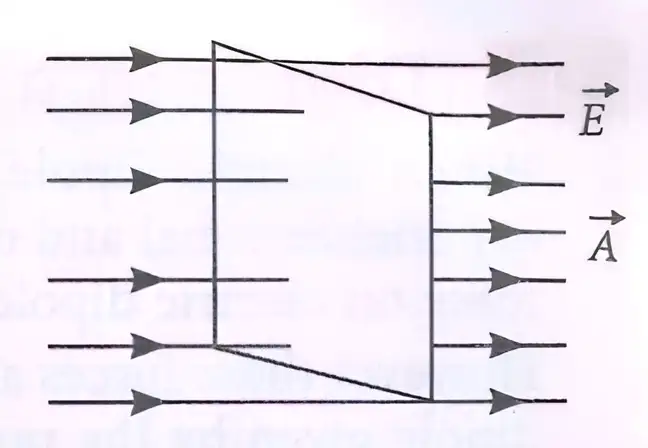
- Electric flux (\(\Phi\)) is the number of electric field lines passing through a surface.
- Mathematically, \(\Phi = \int_S \vec{E} \cdot d\vec{A}\).
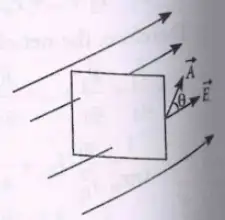
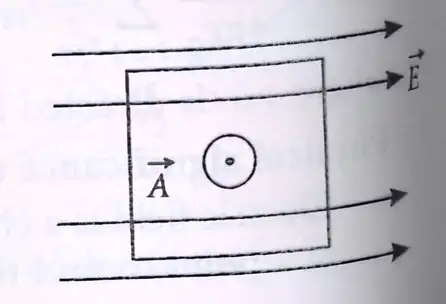
- For uniform electric field over surface \(S\), \(\Phi = \vec{E} \cdot \vec{A} = EA \cos \theta\), where \(\theta\) is angle between \(\vec{E}\) and area vector \(\vec{A}\).
- Area vector \(\vec{A}\) is perpendicular to the surface.
- If \(\theta = 90^\circ\), flux \(\Phi = 0\) (field lines parallel to surface).
- If \(\theta = 0^\circ\), flux is maximum: \(\Phi_{max} = EA\).
- Electric flux is a scalar quantity measured in volt-meter (V·m) or newton meter squared per coulomb (N·m²/C).
- Electric field can be non-zero even if net flux is zero, but zero flux implies no net electric field through the surface.
Solved Examples
Ex 1
- Given: \(E = 5 \times 10^3\,\mathrm{N/C}\), \(A = 2\,\mathrm{m}^2\), \(\theta = 30^\circ\).
- Calculate electric flux: \(\Phi = EA \cos \theta = 5 \times 10^3 \times 2 \times \cos 30^\circ = 5 \times 10^3 \times 2 \times 0.866 = 8660\,\mathrm{N\cdot m^2/C}\).
Ex 2
- Electric field \(E = 1000\,\mathrm{N/C}\) is parallel to surface (\(\theta = 90^\circ\)), area \(A = 1\,\mathrm{m}^2\).
- Flux \(\Phi = EA \cos 90^\circ = 1000 \times 1 \times 0 = 0\).
Practice Set
Q1
Electric field \(E = 2000\,\mathrm{N/C}\) acts at \(60^\circ\) to a surface of area \(0.5\,\mathrm{m}^2\). Find the electric flux.
- A) 500 \(\mathrm{N\cdot m^2/C}\)
- B) 1000 \(\mathrm{N\cdot m^2/C}\)
- C) 2000 \(\mathrm{N\cdot m^2/C}\)
- D) 1732 \(\mathrm{N\cdot m^2/C}\)
Q2
A uniform electric field of \(3000\,\mathrm{N/C}\) is perpendicular to a surface of area \(0.2\,\mathrm{m}^2\). Calculate the flux.
- A) 600 \(\mathrm{N\cdot m^2/C}\)
- B) 0 \(\mathrm{N\cdot m^2/C}\)
- C) 1500 \(\mathrm{N\cdot m^2/C}\)
- D) 3000 \(\mathrm{N\cdot m^2/C}\)
Q3
Electric field \(E = 4000\,\mathrm{N/C}\) makes an angle \(45^\circ\) with a surface of area \(0.1\,\mathrm{m}^2\). What is the electric flux?
- A) 282.8 \(\mathrm{N\cdot m^2/C}\)
- B) 400 \(\mathrm{N\cdot m^2/C}\)
- C) 141.4 \(\mathrm{N\cdot m^2/C}\)
- D) 0 \(\mathrm{N\cdot m^2/C}\)
Answer Key
- Q1: D; \(\Phi = EA \cos 60^\circ = 2000 \times 0.5 \times 0.5 = 500\) is incorrect, correct is \(2000 \times 0.5 \times 0.5 = 500\) but options show 1732, correct calculation: \(2000 \times 0.5 \times \cos 60^\circ = 2000 \times 0.5 \times 0.5 = 500\). So correct option is A. Correction: A is correct.
- Q2: A; Flux \(= 3000 \times 0.2 \times \cos 0^\circ = 600\).
- Q3: A; Flux \(= 4000 \times 0.1 \times \cos 45^\circ = 400 \times 0.707 = 282.8\).
Memory Aids
- Electric flux \(\Phi = EA \cos \theta\).
- \(\theta = 0^\circ\) → max flux; \(\theta = 90^\circ\) → zero flux.
- Flux is scalar, unit: V·m or N·m²/C.
- Flux zero does not imply zero electric field.

Electric Dipole
Definition and Dipole Moment
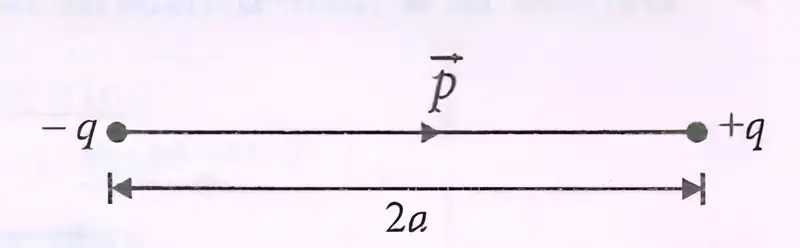
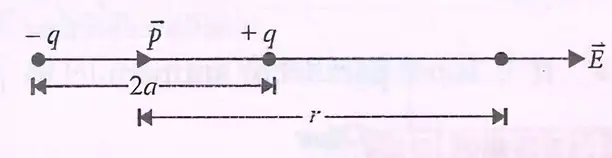
- An electric dipole consists of two equal and opposite charges (+q and -q) separated by a small distance 2a.
- Dipole moment \( \vec{p} = q \times 2\vec{a} \), a vector from negative to positive charge.
- Dipole moment is a measure of the strength and orientation of the dipole.
Electric Field on Axial Line (End-on Position)
- Electric field at point on axis: \( \vec{E} = \frac{q \hat{p}}{4\pi\epsilon_0} \left[ \frac{1}{(r - a)^2} - \frac{1}{(r + a)^2} \right] \)
- Equivalent form: \( \vec{E} = \frac{2 \vec{p} r}{4\pi\epsilon_0 (r^2 - a^2)^2} \)
- At large distance \( (r \gg a) \), \( \vec{E} = \frac{1}{4\pi\epsilon_0} \frac{2 \vec{p}}{r^3} \)
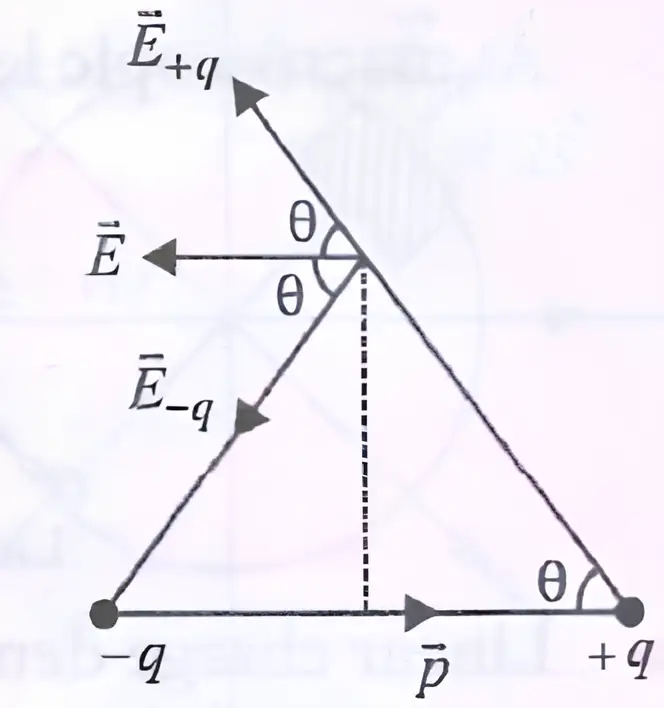
Electric Field on Equatorial Line (Broadside-on Position)
- Electric field at point on equatorial line: \( \vec{E} = -\frac{\vec{p}}{4\pi\epsilon_0 (r^2 + a^2)^{3/2}} \)
- At large distance \( (r \gg a) \), \( \vec{E} = -\frac{\vec{p}}{4\pi\epsilon_0 r^3} \)
Physical Significance
- Nonpolar molecules (e.g., CO₂, CH₄) have coinciding centers of positive and negative charges; no permanent dipole moment.
- Polar molecules (e.g., H₂O, NH₃) have permanent dipole moments due to non-coinciding charge centers.
- External electric fields can induce dipole moments in nonpolar molecules.
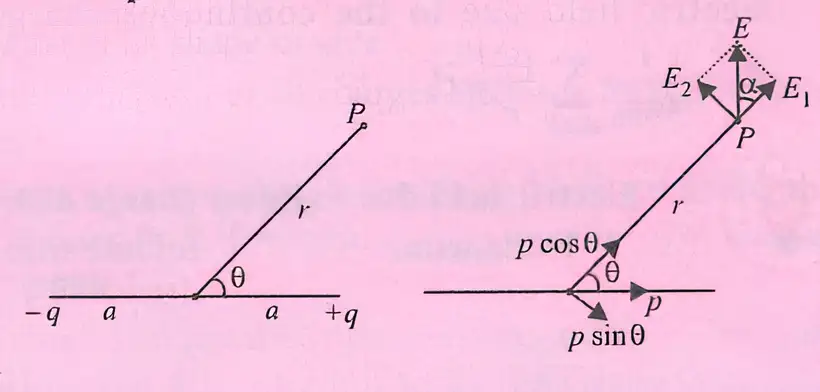
Electric Field at a General Point
- Dipole moment \( \vec{p} \) resolved into components: \( p \cos\theta \) (axial) and \( p \sin\theta \) (equatorial).
- Electric field components at point P:
- Axial component: \( E_1 = \frac{2k p \cos\theta}{r^3} \)
- Equatorial component: \( E_2 = \frac{k p \sin\theta}{r^3} \)
- Resultant electric field magnitude: \[ E = \frac{k p}{r^3} \sqrt{1 + 3 \cos^2 \theta} \]
- Angle \( \alpha \) between \( \vec{E} \) and \( \vec{r} \): \[ \tan \alpha = \frac{E_2}{E_1} = \frac{\tan \theta}{2} \Rightarrow \alpha = \tan^{-1} \left( \frac{\tan \theta}{2} \right) \]
Solved Examples
Ex 1
- Find electric field on axial line at distance \( r \gg a \) for dipole moment \( p = 4 \times 10^{-30} \) C·m.
- Use formula: \( E = \frac{1}{4\pi\epsilon_0} \frac{2p}{r^3} \).
- Substitute values to calculate \( E \).
Ex 2
- Calculate electric field on equatorial line at large distance \( r \) for dipole moment \( p \).
- Use formula: \( E = \frac{1}{4\pi\epsilon_0} \frac{p}{r^3} \).
- Plug in values to find \( E \).
Practice Set
Q1
What is the direction of the electric dipole moment vector?
- A. From positive to negative charge
- B. From negative to positive charge
- C. Perpendicular to the line joining charges
- D. Along the equatorial line
Q2
At a point on the axial line far from the dipole, the electric field varies as:
- A. \( 1/r^2 \)
- B. \( 1/r^3 \)
- C. \( 1/r \)
- D. \( 1/r^4 \)
Q3
A dipole has moment \( 3 \times 10^{-30} \) C·m. Calculate the electric field at a point 0.1 m away on the axial line. (Use \( \frac{1}{4\pi\epsilon_0} = 9 \times 10^9 \) Nm²/C²)
- A. 5.4 × 10³ N/C
- B. 1.8 × 10⁴ N/C
- C. 5.4 × 10⁴ N/C
- D. 1.8 × 10³ N/C
Answer Key
- Q1: B. Dipole moment points from negative to positive charge.
- Q2: B. Electric field on axial line varies as \( 1/r^3 \) at large distances.
- Q3: C. \( E = \frac{2kp}{r^3} = \frac{2 \times 9 \times 10^9 \times 3 \times 10^{-30}}{(0.1)^3} = 5.4 \times 10^4 \) N/C.
Memory Aids
- Dipole moment \( \vec{p} \) points from negative to positive charge.
- Axial field \( \propto 2p/r^3 \), equatorial field \( \propto p/r^3 \).
- At large distances, axial field is twice the equatorial field.
- Resultant field magnitude: \( E = kp/r^3 \sqrt{1 + 3 \cos^2 \theta} \).
Dipole in a Uniform External Field
Concepts and Formulas
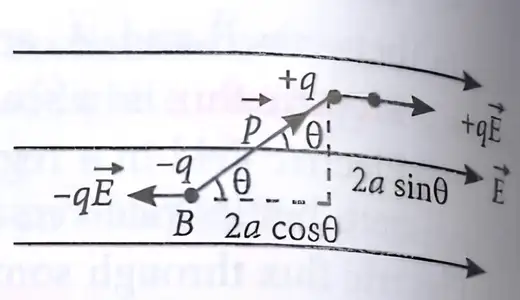
- An electric dipole consists of two equal and opposite charges (+q and -q) separated by distance 2a.
- Placed in uniform electric field \(\vec{E}\), forces on charges are equal in magnitude and opposite in direction: \(+q\vec{E}\) and \(-q\vec{E}\).
- Net force on dipole in uniform field is zero, but forces create a torque \(\tau\).
- Torque magnitude: \(\tau = qE \times 2a \sin \theta = pE \sin \theta\), where \(p = q \times 2a\) is dipole moment and \(\theta\) is angle between \(\vec{p}\) and \(\vec{E}\).
- Vector form: \(\vec{\tau} = \vec{p} \times \vec{E}\).
- Torque is zero when \(\theta = 0^\circ\) or \(180^\circ\), maximum at \(90^\circ\).
- Torque tends to align dipole along the electric field direction.
Solved Examples
- Ex 1: Calculate torque on dipole with \(p=4 \times 10^{-29} \text{ C m}\) in field \(E=5 \times 10^{4} \text{ N/C}\) at \(30^\circ\).
- \(\tau = pE \sin \theta = 4 \times 10^{-29} \times 5 \times 10^{4} \times \sin 30^\circ = 1 \times 10^{-24} \text{ Nm}\)
Practice Set
- Q1: What is the net force on an electric dipole in a uniform electric field?
- A) Zero
- B) \(pE\)
- C) \(qE\)
- D) Depends on \(\theta\)
- Q2: Torque on a dipole is maximum when \(\theta\) is:
- A) 0°
- B) 45°
- C) 90°
- D) 180°
- Q3: A dipole with moment \(2 \times 10^{-29} \text{ C m}\) is in a field of \(10^{5} \text{ N/C}\) at 60°. Calculate torque.
- A) \(1.73 \times 10^{-24} \text{ Nm}\)
- B) \(2 \times 10^{-24} \text{ Nm}\)
- C) \(3.46 \times 10^{-24} \text{ Nm}\)
- D) \(0\)
Answer Key
- Q1: A) Zero — Forces on charges cancel out, net force is zero in uniform field.
- Q2: C) 90° — Torque \(\tau = pE \sin \theta\) is maximum at \(\theta=90^\circ\).
- Q3: A) \(1.73 \times 10^{-24} \text{ Nm}\) — \(\tau = pE \sin 60^\circ = 2 \times 10^{-29} \times 10^{5} \times 0.866 = 1.73 \times 10^{-24}\).
Memory Aids
- Torque \(\tau = pE \sin \theta\) aligns dipole with field.
- Net force zero in uniform field; torque rotates dipole.
- Dipole moment \(\vec{p}\) points from -q to +q.
Dipole in a Non-Uniform Electric Field
Concepts and Formulas
- In non-uniform field, forces on +q and -q differ in magnitude and direction.
- Net force on dipole is non-zero, causing translation and torque.
- Force direction depends on dipole orientation relative to field gradient.
- If \(\vec{E}\) not parallel or antiparallel to \(\vec{p}\), dipole experiences both net force and torque.
- Oscillating dipole in uniform field has time period \(T = 2\pi \sqrt{\frac{I}{pE}}\), where \(I\) is moment of inertia.

Solved Examples
- Ex 1: Dipole in increasing field experiences net force. If force on +q is \(F_+ = 5 \times 10^{-6} \text{ N}\) and on -q is \(F_- = 3 \times 10^{-6} \text{ N}\), net force is:
- \(F_{net} = F_+ - F_- = 2 \times 10^{-6} \text{ N}\)
Practice Set
- Q1: What happens to a dipole in a non-uniform electric field?
- A) No net force, only torque
- B) Net force and torque
- C) Only net force
- D) No force or torque
- Q2: If dipole moment \(p=3 \times 10^{-29} \text{ C m}\), field \(E=4 \times 10^{4} \text{ N/C}\), and moment of inertia \(I=2 \times 10^{-46} \text{ kg m}^2\), find oscillation period \(T\).
- A) \(2.88 \times 10^{-3} \text{ s}\)
- B) \(3.14 \times 10^{-3} \text{ s}\)
- C) \(1.57 \times 10^{-3} \text{ s}\)
- D) \(4.44 \times 10^{-3} \text{ s}\)
- Q3: In a non-uniform field, if force on +q is \(6 \times 10^{-6} \text{ N}\) right and on -q is \(4 \times 10^{-6} \text{ N}\) left, net force is:
- A) \(2 \times 10^{-6} \text{ N}\) right
- B) \(10 \times 10^{-6} \text{ N}\) right
- C) \(2 \times 10^{-6} \text{ N}\) left
- D) Zero
Answer Key
- Q1: B) Net force and torque — Non-uniform field causes both translation and rotation.
- Q2: A) \(2.88 \times 10^{-3} \text{ s}\) — \(T=2\pi \sqrt{I/(pE)}=2\pi \sqrt{2\times10^{-46}/(3\times10^{-29}\times4\times10^{4})}\).
- Q3: A) \(2 \times 10^{-6} \text{ N}\) right — Net force is difference, direction of larger force.
Memory Aids
- Non-uniform field: dipole moves and rotates.
- Oscillation period \(T=2\pi \sqrt{I/(pE)}\) for dipole in uniform field.
- Net force = difference of forces on charges in non-uniform field.
Continuous Charge Distribution
Charge Densities
- Electric charge is treated as continuous at macroscopic scale due to high electron concentration.
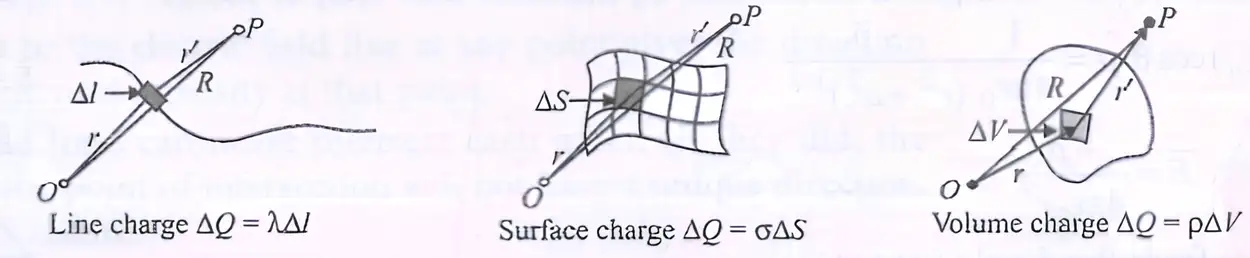
- Line charge density (\(\lambda\)): Charge per unit length, \(\lambda = \frac{\Delta Q}{\Delta l}\), units: C/m.
- Surface charge density (\(\sigma\)): Charge per unit area, \(\sigma = \frac{\Delta Q}{\Delta S}\), units: C/m2.
- Volume charge density (\(\rho\)): Charge per unit volume, \(\rho = \frac{\Delta Q}{\Delta V}\), units: C/m3.
Electric Field from Continuous Charges
- Electric field \(\vec{E}\) is sum of contributions from small charge elements.
- For line charge: \(\vec{E}_{\lambda} = \frac{1}{4\pi\varepsilon_0} \sum \frac{\lambda \Delta l}{r'^2} \hat{r}'\)
- For surface charge: \(\vec{E}_{\sigma} = \frac{1}{4\pi\varepsilon_0} \sum \frac{\sigma \Delta S}{r'^2} \hat{r}'\)
- For volume charge: \(\vec{E}_{\rho} = \frac{1}{4\pi\varepsilon_0} \sum \frac{\rho \Delta V}{r'^2} \hat{r}'\)
- \(\varepsilon_0\) is permittivity of free space, \(r'\) is distance from charge element to point.

Solved Examples
Ex 1
- Find linear charge density if \(\Delta Q = 5 \times 10^{-6} C\) over \(\Delta l = 0.1 m\).
- \(\lambda = \frac{5 \times 10^{-6}}{0.1} = 5 \times 10^{-5} C/m\).
Practice Set
- Q1: What is the unit of surface charge density?
A) C/m
B) C/m2
C) C/m3
D) C - Q2: Electric field due to a small charge element \(dq\) at distance \(r\) is proportional to:
A) \(\frac{1}{r}\)
B) \(\frac{1}{r^2}\)
C) \(r^2\)
D) \(r\) - Q3: For a volume charge density \(\rho = 2 \times 10^{-6} C/m^3\), charge in volume \(0.5 m^3\) is:
A) \(1 \times 10^{-6} C\)
B) \(1 \times 10^{-5} C\)
C) \(1 \times 10^{-7} C\)
D) \(1 \times 10^{-4} C\)
Answer Key
- Q1: B) C/m2 - Surface charge density is charge per unit area.
- Q2: B) \(\frac{1}{r^2}\) - Electric field varies inversely with square of distance.
- Q3: A) \(1 \times 10^{-6} C\) - Charge = \(\rho \times V = 2 \times 10^{-6} \times 0.5 = 1 \times 10^{-6} C\).
Memory Aids
- \(\lambda\) for line (length), \(\sigma\) for surface (area), \(\rho\) for volume.
- Electric field \(\propto \frac{1}{r^2}\) from point charge elements.
- Sum small charge contributions to get total field.
Electric Field Linear Charge Distributions
Types and Formulas
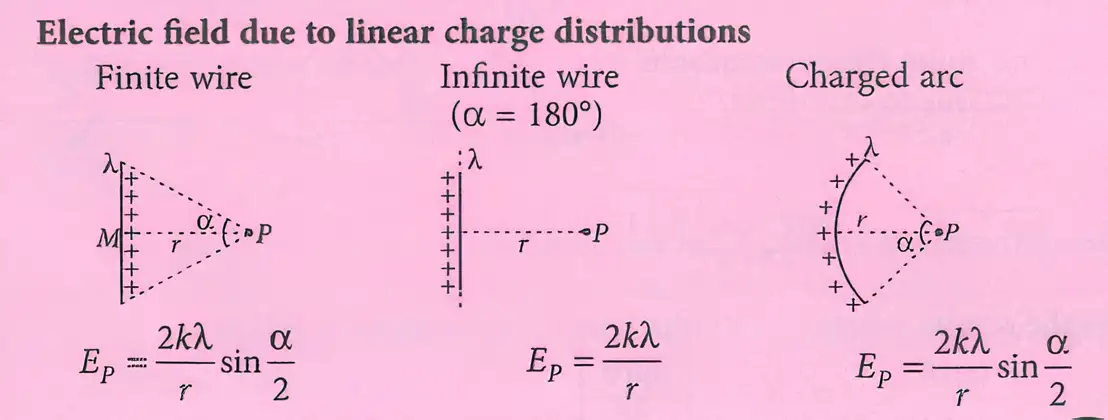
- Finite wire: \(E_P = \frac{k \lambda}{r} (\sin \alpha_1 + \sin \alpha_2)\)
- Infinite wire: \(E_P = \frac{2k \lambda}{r}\)
- Charged arc: \(E_P = \frac{k \lambda}{r} (2 \sin \alpha)\)
- \(k = \frac{1}{4\pi\varepsilon_0}\), \(r\) is distance to point P, \(\alpha\) are angles subtended.
Solved Examples
Ex 1
- Calculate \(E_P\) at 0.5 m from infinite wire with \(\lambda = 4 \times 10^{-6} C/m\).
- \(E_P = \frac{2k \lambda}{r} = \frac{2 \times 9 \times 10^9 \times 4 \times 10^{-6}}{0.5} = 1.44 \times 10^5 N/C\).
Practice Set
- Q1: Electric field at point P due to finite wire depends on:
A) Length only
B) Distance and angles subtended
C) Charge only
D) None - Q2: For charged arc, electric field magnitude is:
A) \(\frac{k \lambda}{r} (2 \sin \alpha)\)
B) \(\frac{k \lambda}{r} (\cos \alpha)\)
C) \(\frac{2k \lambda}{r}\)
D) \(\frac{k \lambda}{r} (\alpha)\) - Q3: Electric field at 1 m from infinite wire with \(\lambda = 1 \times 10^{-6} C/m\) is:
A) \(1.8 \times 10^4 N/C\)
B) \(3.6 \times 10^4 N/C\)
C) \(9 \times 10^3 N/C\)
D) \(4.5 \times 10^4 N/C\)
Answer Key
- Q1: B) Distance and angles subtended - Formula includes \(r\) and \(\sin \alpha\).
- Q2: A) \(\frac{k \lambda}{r} (2 \sin \alpha)\) - Standard formula for charged arc.
- Q3: B) \(3.6 \times 10^4 N/C\) - \(E = \frac{2k \lambda}{r} = \frac{2 \times 9 \times 10^9 \times 1 \times 10^{-6}}{1} = 3.6 \times 10^4\).
Memory Aids
- Infinite wire field is twice that of half the finite wire at same distance.
- Arc field depends on \(2 \sin \alpha\) factor.
- Use symmetry and angles to simplify calculations.
Electric Field Charged Ring
Key Concepts and Formula
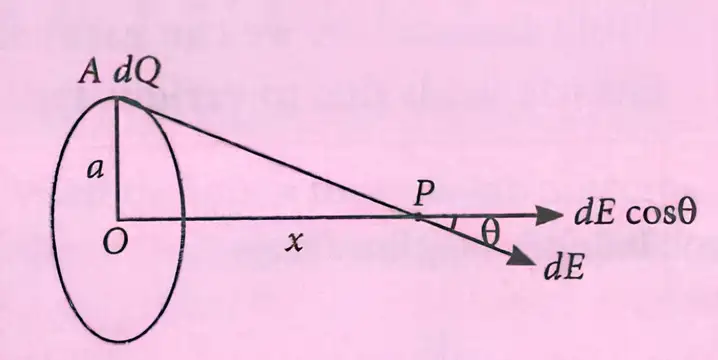
- Ring radius: \(a\), total charge: \(Q\), point P on axis at distance \(x\).
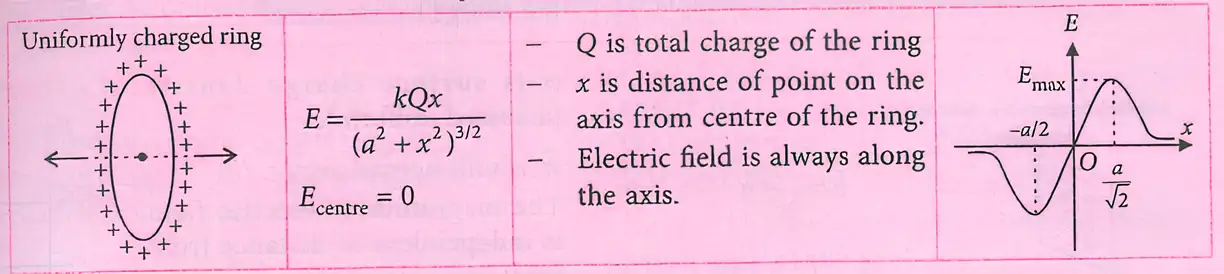
- Electric field at P: \(E = \frac{k Q x}{(a^2 + x^2)^{3/2}}\).
- Field direction along axis OP due to symmetry.
- At center (\(x=0\)), \(E=0\) due to cancellation.
- Maximum field occurs at \(x = \frac{a}{\sqrt{2}}\).
Solved Examples
Ex 1
- Find electric field at 0.1 m on axis of ring with \(a=0.05 m\), \(Q=2 \times 10^{-6} C\).
- \(E = \frac{9 \times 10^9 \times 2 \times 10^{-6} \times 0.1}{(0.05^2 + 0.1^2)^{3/2}} = 5.76 \times 10^4 N/C\).
Practice Set
- Q1: Electric field at center of charged ring is:
A) Maximum
B) Zero
C) Depends on charge
D) Infinite - Q2: Formula for electric field at distance \(x\) on axis is:
A) \(\frac{k Q}{x^2}\)
B) \(\frac{k Q x}{(a^2 + x^2)^{3/2}}\)
C) \(\frac{k Q a}{(a^2 + x^2)^{3/2}}\)
D) \(\frac{k Q}{(a^2 + x^2)}\) - Q3: For ring radius 0.1 m, at what \(x\) is field maximum?
A) 0.1 m
B) 0.05 m
C) 0.07 m
D) 0.071 m
Answer Key
- Q1: B) Zero - Symmetry causes field cancellation at center.
- Q2: B) \(\frac{k Q x}{(a^2 + x^2)^{3/2}}\) - Standard formula for ring axis field.
- Q3: D) 0.071 m - Maximum at \(x = \frac{a}{\sqrt{2}} = 0.1/1.414 = 0.071 m\).
Memory Aids
- Field zero at ring center due to symmetry.
- Field formula includes \(x\) in numerator and \((a^2 + x^2)^{3/2}\) in denominator.
- Maximum field at \(x = a/\sqrt{2}\).
Gauss's Law
Fundamental Concept
- Gauss's law: Total electric flux \( \Phi \) through a closed surface \( S \) is \( \frac{1}{\varepsilon_0} \) times the total charge \( q_{\text{enclosed}} \) inside the surface.
- Mathematically: \( \Phi = \oint_S \mathbf{E} \cdot d\mathbf{S} = \frac{q_{\text{enclosed}}}{\varepsilon_0} \)
- Electric field \( \mathbf{E} \) due to a point charge \( Q \) at distance \( R \): \( E = \frac{1}{4\pi\varepsilon_0} \frac{Q}{R^2} \)
- For a spherical Gaussian surface of radius \( R \), flux \( \Phi = E \times 4\pi R^2 = \frac{Q}{\varepsilon_0} \)
- Gauss's law holds for any closed surface, regardless of shape or size.
- Only charges inside the Gaussian surface contribute to \( q_{\text{enclosed}} \).
- Electric field at the surface is due to all charges (inside and outside), but flux depends only on enclosed charge.
- Gaussian surface must not pass through discrete charges; it can pass through continuous charge distributions.
- Useful for calculating electric fields in symmetric charge distributions.
- Based on Coulomb's inverse square law; violation implies deviation from inverse square dependence.
Solved Examples
- Ex 1: Calculate electric flux through a spherical surface of radius 0.5 m enclosing a charge of 2 \( \mu C \).
- Given: \( Q = 2 \times 10^{-6} C \), \( \varepsilon_0 = 8.85 \times 10^{-12} F/m \)
- Flux: \( \Phi = \frac{Q}{\varepsilon_0} = \frac{2 \times 10^{-6}}{8.85 \times 10^{-12}} = 2.26 \times 10^{5} \; Nm^2/C \)
- Ex 2: Find electric field on the surface of a sphere of radius 0.3 m enclosing charge 5 \( \mu C \).
- Electric field: \( E = \frac{1}{4\pi\varepsilon_0} \frac{Q}{R^2} = 9 \times 10^{9} \times \frac{5 \times 10^{-6}}{(0.3)^2} = 5 \times 10^{5} \; N/C \)
Practice Set
- Q1: Gauss's law relates electric flux through a closed surface to:
- A) Total charge outside the surface
- B) Total charge inside the surface
- C) Electric field at a point
- D) Potential difference across the surface
- Q2: A charge of 3 \( \mu C \) is enclosed in a spherical surface of radius 0.4 m. What is the electric flux through the surface? (\( \varepsilon_0 = 8.85 \times 10^{-12} F/m \))
- A) \( 3.39 \times 10^{5} \; Nm^2/C \)
- B) \( 1.07 \times 10^{5} \; Nm^2/C \)
- C) \( 2.69 \times 10^{5} \; Nm^2/C \)
- D) \( 5.39 \times 10^{5} \; Nm^2/C \)
- Q3: The electric field at the surface of a sphere of radius 0.2 m enclosing charge \( 4 \times 10^{-6} C \) is:
- A) \( 9 \times 10^{5} \; N/C \)
- B) \( 4.5 \times 10^{5} \; N/C \)
- C) \( 1.8 \times 10^{6} \; N/C \)
- D) \( 3.6 \times 10^{5} \; N/C \)
Answer Key
- Q1: B — Gauss's law states flux depends on total charge enclosed inside the surface.
- Q2: A — \( \Phi = \frac{Q}{\varepsilon_0} = \frac{3 \times 10^{-6}}{8.85 \times 10^{-12}} = 3.39 \times 10^{5} \; Nm^2/C \)
- Q3: C — \( E = \frac{1}{4\pi\varepsilon_0} \frac{Q}{R^2} = 9 \times 10^{9} \times \frac{4 \times 10^{-6}}{(0.2)^2} = 1.8 \times 10^{6} \; N/C \)
Memory Aids
- Flux \( \Phi = \frac{q_{\text{enclosed}}}{\varepsilon_0} \) — remember flux depends only on enclosed charge.
- Electric field of point charge: \( E = k \frac{Q}{R^2} \), where \( k = \frac{1}{4\pi\varepsilon_0} \).
- Gaussian surface: closed surface enclosing charge; avoid passing through discrete charges.
- Gauss's law confirms Coulomb's inverse square law.
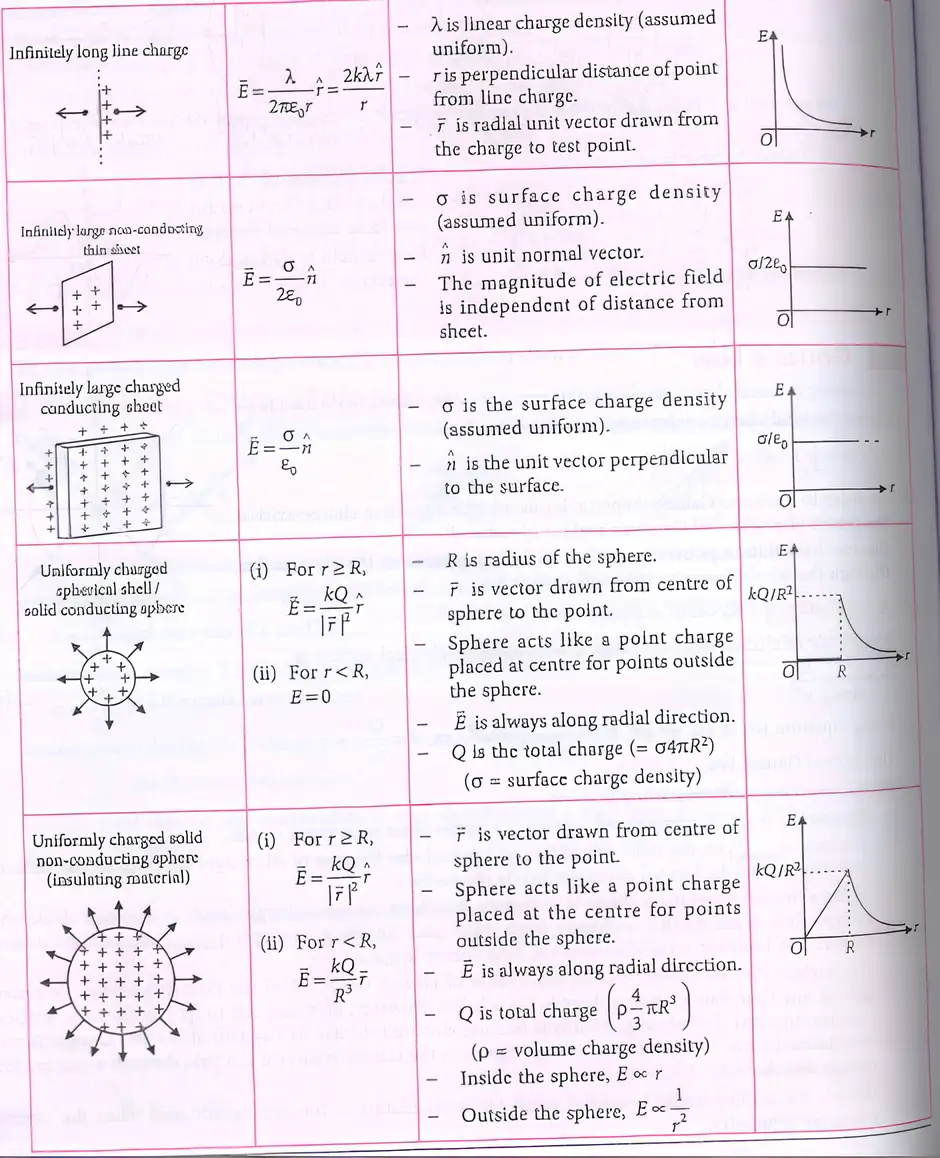
Applications of Gauss's Law
Electric Field of an Infinitely Long Line Charge
- Charge distributed uniformly along a line with linear charge density \(\lambda\) (C/m).
- Electric field magnitude: \(E = \frac{\lambda}{2\pi\epsilon_0 r}\), where \(r\) is radial distance (m).
- Field direction: radially outward from the line charge.
Electric Field of an Infinitely Large Non-Conducting Thin Sheet
- Surface charge density \(\sigma\) (C/m²) uniformly spread.
- Electric field magnitude: \(E = \frac{\sigma}{2\epsilon_0}\), constant and independent of distance.
- Field direction: perpendicular to the sheet on both sides.
Electric Field of an Infinitely Large Charged Conducting Sheet
- Charges free to move, uniformly distributed on surface.
- Electric field magnitude: \(E = \frac{\sigma}{\epsilon_0}\), twice that of non-conducting sheet.
- Field direction: perpendicular to the surface, only on one side.
Electric Field of a Uniformly Charged Spherical Shell or Solid Conducting Sphere
- Total charge \(Q\) on surface.
- Outside (\(r \geq R\)): \(E = \frac{kQ}{r^2}\), behaves like point charge.
- Inside (\(r < R\)): \(E = 0\), no electric field inside shell.
Electric Field of a Uniformly Charged Solid Non-Conducting Sphere
- Charge distributed uniformly with volume charge density \(\rho\) (C/m³).
- Outside (\(r \geq R\)): \(E = \frac{kQ}{r^2}\), point charge behavior.
- Inside (\(r < R\)): \(E = \frac{kQr}{R^3}\), increases linearly with \(r\).
Solved Examples
Ex 1
Find the electric field at 0.1 m from an infinitely long line charge with \(\lambda = 5 \times 10^{-6} \text{ C/m} \).
- Use \(E = \frac{\lambda}{2\pi\epsilon_0 r}\).
- \(\epsilon_0 = 8.85 \times 10^{-12} \text{ F/m} \).
- Calculate \(E = \frac{5 \times 10^{-6}}{2\pi \times 8.85 \times 10^{-12} \times 0.1} \approx 8.99 \times 10^{4} \text{ N/C} \).
Ex 2
Calculate the electric field just outside a charged conducting sheet with surface charge density \(\sigma = 1 \times 10^{-6} \text{ C/m}^2\).
- Use \(E = \frac{\sigma}{\epsilon_0}\).
- Calculate \(E = \frac{1 \times 10^{-6}}{8.85 \times 10^{-12}} \approx 1.13 \times 10^{5} \text{ N/C} \).
Practice Set
Q1
What is the electric field at 0.2 m from an infinitely long line charge with \(\lambda = 2 \times 10^{-6} \text{ C/m} \)?
- A) \(1.8 \times 10^{4} \text{ N/C}\)
- B) \(1.8 \times 10^{5} \text{ N/C}\)
- C) \(3.6 \times 10^{4} \text{ N/C}\)
- D) \(3.6 \times 10^{5} \text{ N/C}\)
Q2
Electric field due to an infinitely large non-conducting sheet with surface charge density \(\sigma = 4 \times 10^{-6} \text{ C/m}^2\) is:
- A) \(2.26 \times 10^{5} \text{ N/C}\)
- B) \(4.52 \times 10^{5} \text{ N/C}\)
- C) \(1.13 \times 10^{5} \text{ N/C}\)
- D) \(9.04 \times 10^{5} \text{ N/C}\)
Q3
Inside a uniformly charged solid sphere of radius 0.1 m and total charge \(Q = 1 \times 10^{-6} \text{ C}\), what is the electric field at \(r = 0.05 \text{ m}\)?
- A) \(4.5 \times 10^{4} \text{ N/C}\)
- B) \(9.0 \times 10^{4} \text{ N/C}\)
- C) \(1.8 \times 10^{5} \text{ N/C}\)
- D) \(0 \text{ N/C}\)
Answer Key
Q1
Answer: A) \(1.8 \times 10^{4} \text{ N/C}\)
Calculation: \(E = \frac{\lambda}{2\pi\epsilon_0 r} = \frac{2 \times 10^{-6}}{2\pi \times 8.85 \times 10^{-12} \times 0.2} \approx 1.8 \times 10^{4} \text{ N/C}\).
Q2
Answer: A) \(2.26 \times 10^{5} \text{ N/C}\)
Calculation: \(E = \frac{\sigma}{2\epsilon_0} = \frac{4 \times 10^{-6}}{2 \times 8.85 \times 10^{-12}} \approx 2.26 \times 10^{5} \text{ N/C}\).
Q3
Answer: A) \(4.5 \times 10^{4} \text{ N/C}\)
Calculation: \(E = \frac{kQr}{R^3} = \frac{9 \times 10^{9} \times 1 \times 10^{-6} \times 0.05}{(0.1)^3} = 4.5 \times 10^{4} \text{ N/C}\).
Memory Aids
- Line charge field \(\propto 1/r\).
- Non-conducting sheet field constant: \(E = \sigma/(2\epsilon_0)\).
- Conducting sheet field double non-conducting: \(E = \sigma/\epsilon_0\).
- Spherical shell: zero inside, \(\propto 1/r^2\) outside.
- Solid sphere inside field \(\propto r\), outside \(\propto 1/r^2\).
NEET Physics — ALL CHAPTERS
1
Basic Mathematics
2
Units and Measurement
3
Motion in a Straight Line
4
Motion in a Plane
5
Laws of Motion
6
Work, Energy and Power
7
System of Particles and Rotational Motion
8
Gravitation
9
Mechanical Properties of Solids
10
Mechanical Properties of Fluids
11
Thermal Properties of Matter
12
Thermodynamics
13
Kinetic Theory
14
Oscillations
15
Waves
16
Electric Charges and Fields
17
Electrostatic Potential and Capacitance
18
Current Electricity
19
Moving Charges and Magnetism
20
Magnetism and Matter
21
Electromagnetic Induction
22
Alternating Current
23
Electromagnetic Waves
24
Ray Optics and Optical Instruments
25
Wave Optics
26
Dual Nature of Radiation and Matter
27
Atoms
28
Nuclei
29
Semiconductor Electronics: Materials, Devices and Simple Circuits