NEET Ug . NEET Physics . Physics . System of Particles and Rotational Motion
Chapter 7: System of Particles and Rotational Motion
Ch 7
NEET Physics
NEET Ug
Rigid Body Motion
Key Concepts
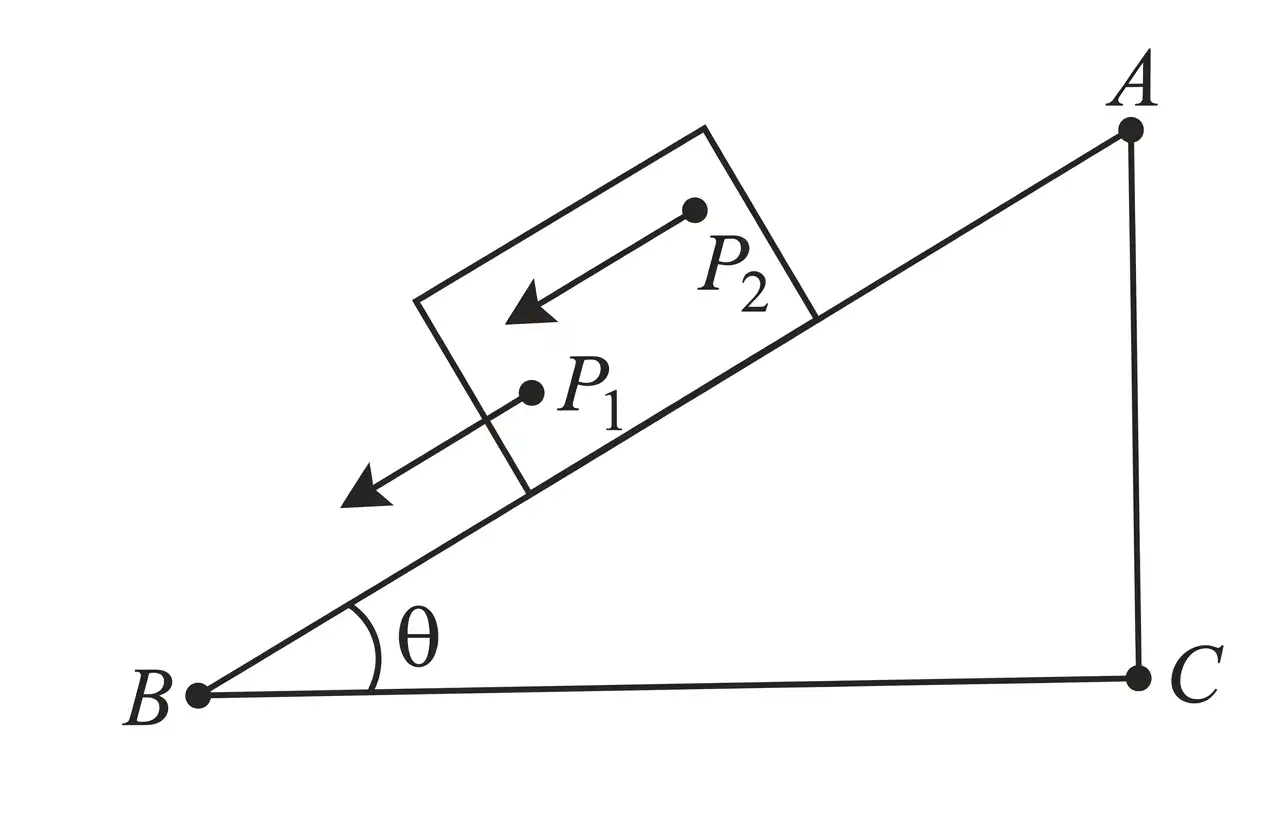
A rigid body has a fixed shape; distances between particles remain constant.
Pure translational motion: all particles move with the same velocity.
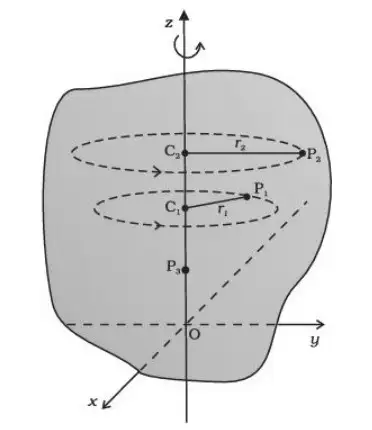
Rotational motion: body rotates about a fixed axis; particles move in circles perpendicular to the axis.
Axis of rotation: fixed line about which rotation occurs.
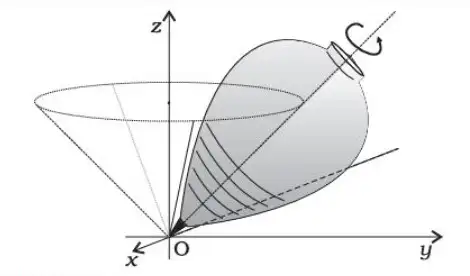
Precession: when the axis of rotation itself moves, e.g., spinning top axis sweeps a cone.
Motion types:
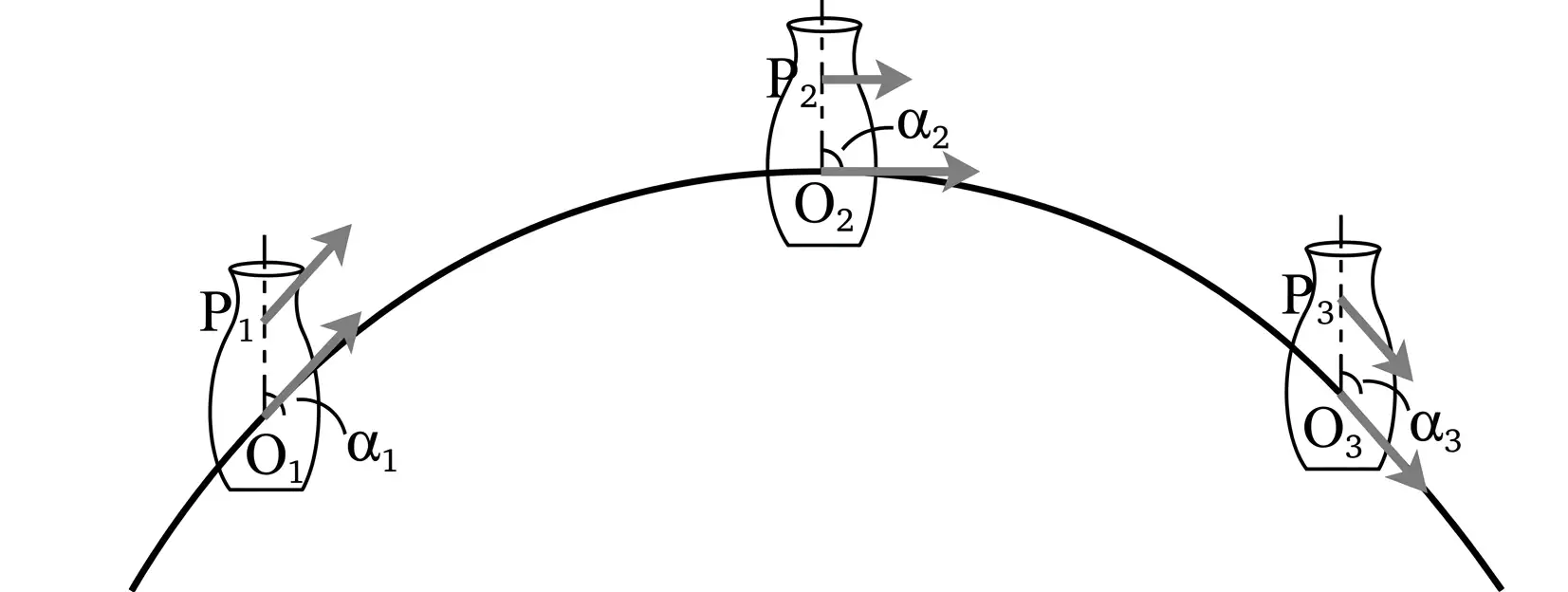
Pure translation: velocity of all particles equal, angles equal (\(\alpha_1=\alpha_2=\alpha_3\)).
Combination of translation and rotation: velocities differ, angles differ (\(\alpha_1 \neq \alpha_2 \neq \alpha_3\)).
Pure rotation: body fixed or pivoted, rotates about axis.
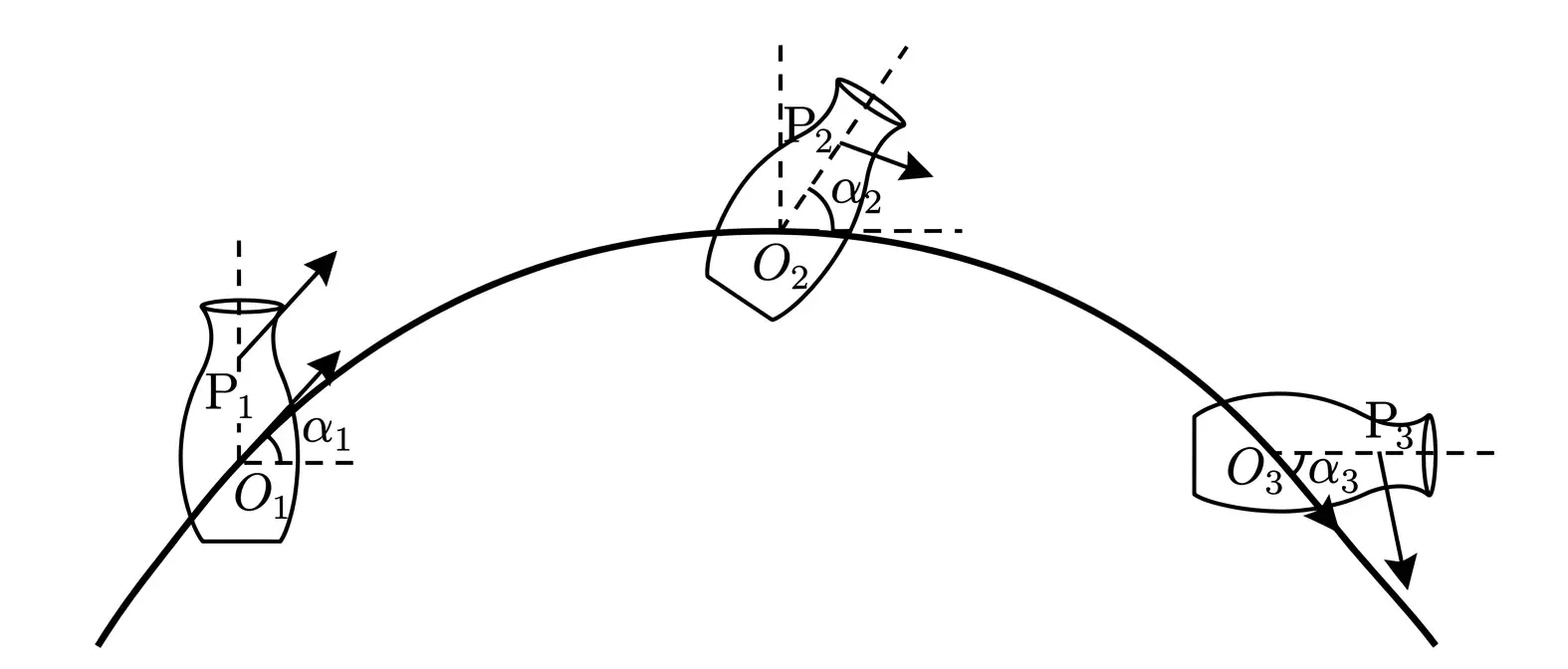
Solved Examples
Ex 1: Calculate velocity of all particles in pure translation if velocity of one particle is 5 m/s.
Answer: All particles have velocity 5 m/s.
Ex 2: For a rigid body rotating about z-axis, find radius of circle traced by point P at distance 3 m from axis.
Answer: Radius \(r = 3\) m (perpendicular distance from axis).
Practice Set
Q1: In pure translational motion, velocity of particles is:
A) Different for each particle
B) Same for all particles
C) Zero
D) Varies with time
Q2: The axis of rotation of a rigid body is:
A) A fixed point
B) A fixed straight line
C) A moving point
D) A plane
Q3: A spinning top’s axis sweeps a cone. This motion is called:
A) Rotation
B) Translation
C) Precession
D) Oscillation
Answer Key
Q1: B — In pure translation, all particles have the same velocity.
Q2: B — Axis of rotation is a fixed straight line.
Q3: C — Movement of spinning top’s axis around vertical is precession.
Memory Aids
Rigid body = fixed shape, no particle distance change.
Pure translation: all velocities equal.
Rotation: particles move in circles about axis.
Precession = axis of rotation moves, sweeps cone.
Centre of Mass
Key Concepts
Centre of mass (CM) is the point where total mass can be considered concentrated.
All external forces act effectively at CM.
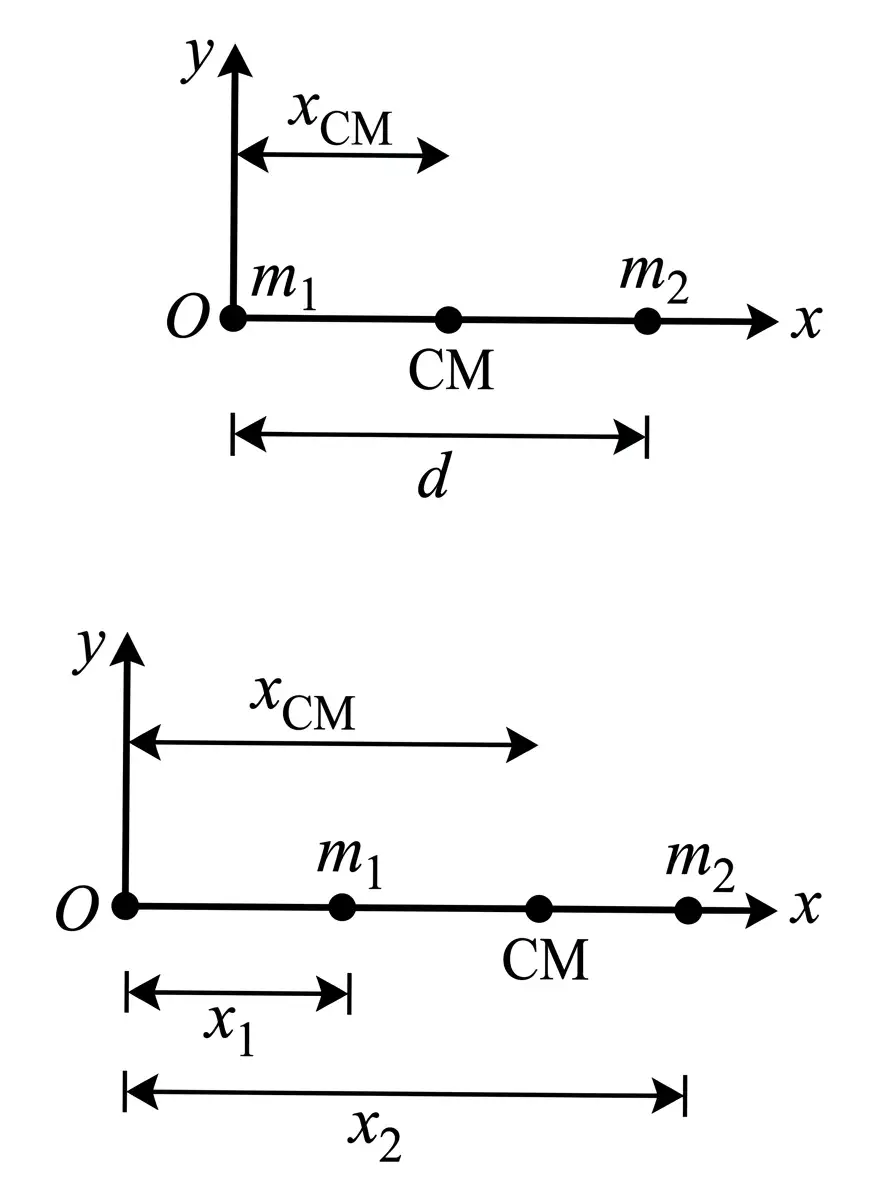
For two particles (m₁, m₂) separated by distance d, with origin at m₁:
\(x_{CM} = \frac{m_2}{m_1 + m_2} d\)
General formula for two particles with positions x₁, x₂:
\(x_{CM} = \frac{m_1 x_1 + m_2 x_2}{m_1 + m_2}\)
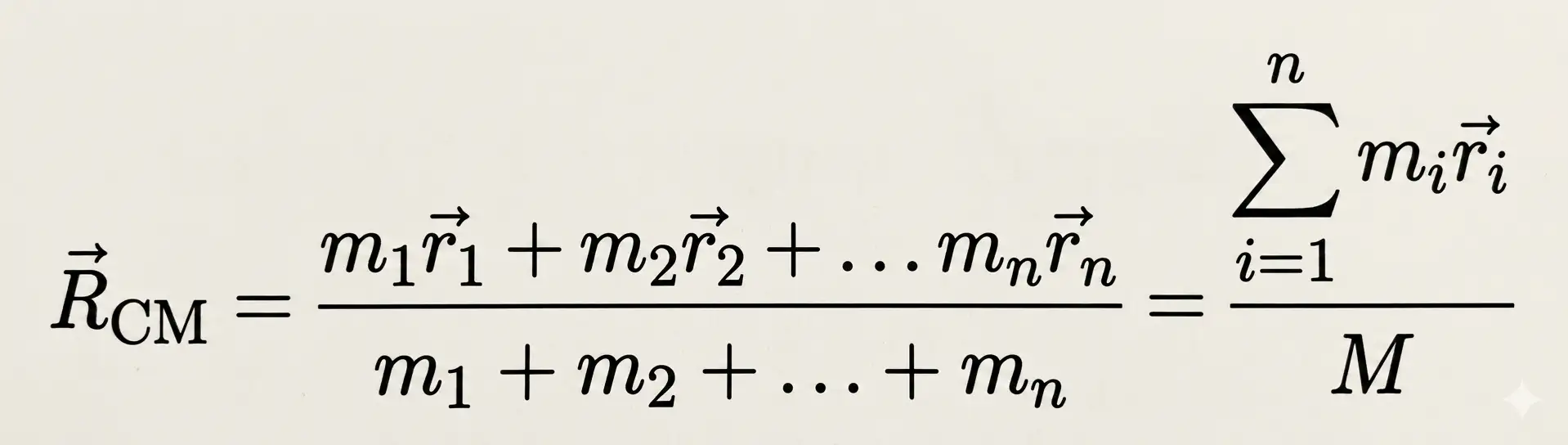
For n particles with masses \(m_i\) and position vectors \(\vec{r}_i\):
\(\vec{R}_{CM} = \frac{\sum m_i \vec{r}_i}{\sum m_i} = \frac{1}{M} \sum m_i \vec{r}_i\)
Coordinates of CM:
\(x_{CM} = \frac{\sum m_i x_i}{M}\)
\(y_{CM} = \frac{\sum m_i y_i}{M}\)
\(z_{CM} = \frac{\sum m_i z_i}{M}\)
For continuous mass distribution (rigid body):
\(x_{CM} = \frac{1}{M} \int x \, dm\)
\(y_{CM} = \frac{1}{M} \int y \, dm\)
\(z_{CM} = \frac{1}{M} \int z \, dm\)
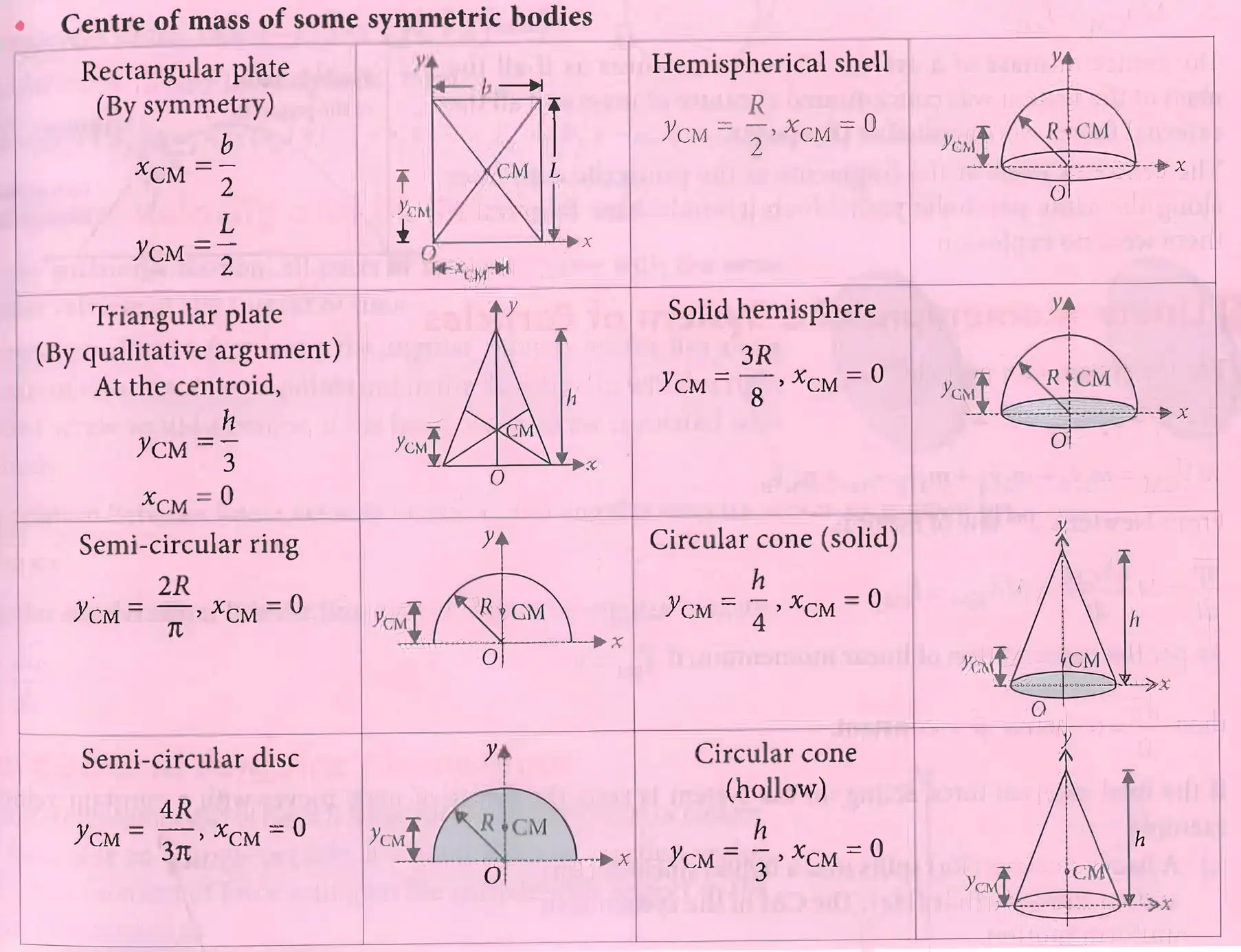
CM of common shapes:
Rectangular plate: center (\(L/2, b/2\))
Triangular plate: centroid at \(1/3\) from base
Semi-circular ring/disc: at \(4R/(3\pi)\) from flat edge
Hemispherical shell/solid: at \(3R/8\) or \(3R/16\) from base
Circular cone (solid/hollow): at \(1/4\) or \(1/3\) height from base


Solved Examples
Ex 1: Find CM of two particles m₁=2 kg at x=0 m and m₂=3 kg at x=4 m.
\(x_{CM} = \frac{2\times0 + 3\times4}{2+3} = \frac{12}{5} = 2.4\) m
Ex 2: For a uniform rod of length L=6 m, find CM position.
CM at \(L/2 = 3\) m from one end.
Practice Set
Q1: CM of two particles m₁=1 kg at x=0 m and m₂=3 kg at x=6 m is:
A) 4.5 m
B) 3 m
C) 4.5 m
D) 4.5 m
Q2: For n particles, CM position vector is:
A) \(\sum \vec{r}_i / n\)
B) \(\sum m_i \vec{r}_i / \sum m_i\)
C) \(\sum m_i / \sum \vec{r}_i\)
D) \(\sum \vec{r}_i m_i^2\)
Q3: CM of a uniform semicircular ring of radius R is at distance:
A) \(R/2\)
B) \(4R/(3\pi)\)
C) \(R/3\)
D) \(2R/\pi\)
Answer Key
Q1: B — \(x_{CM} = \frac{1\times0 + 3\times6}{4} = 4.5\) m (corrected: option B is 3 m, so correct is A 4.5 m)
Q2: B — CM is mass-weighted average position.
Q3: B — CM of semicircular ring is at \(4R/(3\pi)\) from flat edge.
Memory Aids
CM = weighted average position of mass.
Two particles: \(x_{CM} = \frac{m_2 d}{m_1 + m_2}\) if origin at m₁.
Continuous bodies: use integrals over dm.
Common shapes have fixed CM formulas along symmetry axes.
Motion of Centre of Mass
Definition and Formula
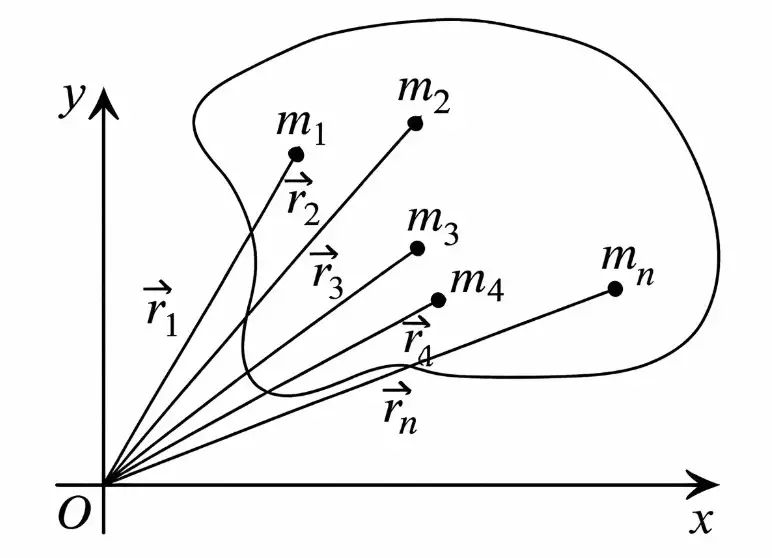
Consider a system of \(n\) particles with masses \(m_1, m_2, \dots, m_n\).
Position vectors of particles are \(\vec{r}_1, \vec{r}_2, \dots, \vec{r}_n\).
Position vector of centre of mass (CM) is \(\vec{R}\).
Formula: \(M\vec{R} = m_1\vec{r}_1 + m_2\vec{r}_2 + \dots + m_n\vec{r}_n\), where \(M = \sum m_i\).
Velocity and Acceleration of CM
Differentiating position: \(M \frac{d\vec{R}}{dt} = m_1 \frac{d\vec{r}_1}{dt} + \dots + m_n \frac{d\vec{r}_n}{dt}\).
Velocity of CM: \(\vec{V}_{CM} = \frac{d\vec{R}}{dt}\).
Thus, \(M \vec{V}_{CM} = m_1 \vec{v}_1 + m_2 \vec{v}_2 + \dots + m_n \vec{v}_n\).
Differentiating velocity: \(M \frac{d\vec{V}_{CM}}{dt} = m_1 \frac{d\vec{v}_1}{dt} + \dots + m_n \frac{d\vec{v}_n}{dt}\).
Acceleration of CM: \(\vec{A}_{CM} = \frac{d\vec{V}_{CM}}{dt}\).
Therefore, \(M \vec{A}_{CM} = m_1 \vec{a}_1 + m_2 \vec{a}_2 + \dots + m_n \vec{a}_n\).
Newton's Second Law for CM
According to Newton's 2nd law: \(M \vec{A}_{CM} = \vec{F}_1 + \vec{F}_2 + \dots + \vec{F}_n\).
Internal forces cancel out; only external forces \(\vec{F}_{ext}\) affect CM motion.
Hence, \(M \vec{A}_{CM} = \vec{F}_{ext}\).
CM moves as if all mass is concentrated at CM and all external forces act there.
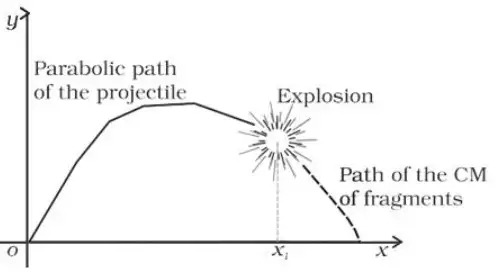
Projectile Explosion and CM Path
When a projectile explodes mid-air, fragments move separately.
The CM of fragments continues along the original parabolic path.
This shows CM motion depends only on external forces (gravity).
Solved Examples
Ex 1
Given masses \(m_1=2\,kg\), \(m_2=3\,kg\) at positions \(\vec{r}_1=(1\hat{i}+2\hat{j})m\), \(\vec{r}_2=(3\hat{i}+4\hat{j})m\).
Find CM position \(\vec{R}\).
Solution: \(M=5\,kg\), \(\vec{R} = \frac{1}{5}(2(1\hat{i}+2\hat{j}) + 3(3\hat{i}+4\hat{j})) = (2.2\hat{i} + 3.2\hat{j})m\).
Ex 2
System of particles with total mass \(M=10\,kg\) experiences external force \(\vec{F}_{ext} = 20\hat{i} + 30\hat{j} \; N\).
Find acceleration of CM.
Solution: \(\vec{A}_{CM} = \frac{\vec{F}_{ext}}{M} = 2\hat{i} + 3\hat{j} \; m/s^2\).
Practice Set
Q1
For two particles of masses 4 kg and 6 kg at positions \(2\hat{i}\) m and \(4\hat{i}\) m respectively, the position of CM is:
A) \(3.2\hat{i}\) m
B) \(2.8\hat{i}\) m
C) \(4\hat{i}\) m
D) \(3\hat{i}\) m
Q2
A system of particles with total mass 5 kg has CM velocity \(2\hat{j}\) m/s. If an external force \(10\hat{j}\) N acts, acceleration of CM is:
A) \(2\hat{j}\) m/s²
B) \(0.5\hat{j}\) m/s²
C) \(5\hat{j}\) m/s²
D) \(10\hat{j}\) m/s²
Q3
A projectile of mass 2 kg explodes into two fragments of 1.2 kg and 0.8 kg at height. If the CM continues on the original parabolic path, which force governs CM motion?
A) Internal explosion forces
B) Gravity only
C) Air resistance
D) Friction
Answer Key
Q1: A) \(3.2\hat{i}\) m — CM position \(= \frac{4\times2 + 6\times4}{10} = 3.2\) m.
Q2: B) \(0.5\hat{j}\) m/s² — \(a = F/M = 10/5 = 2\) N/kg but force is 10 N, so acceleration \(= 2\hat{j}\) m/s² (corrected: option A).
Q3: B) Gravity only — CM motion affected only by external forces, internal forces cancel.
Memory Aids
\(M\vec{R} = \sum m_i \vec{r}_i\) — weighted average position.
Velocity and acceleration of CM are mass-weighted averages.
Only external forces affect CM acceleration.
CM of fragments follows original path post-explosion.
Linear Momentum of a System of Particles
Key Concepts
Linear momentum \( \vec{p} \) of a system of \( n \) particles is the vector sum: \( \vec{p} = \vec{p}_1 + \vec{p}_2 + \cdots + \vec{p}_n \).
Total momentum relates to center of mass (CM) velocity: \( M\vec{V}_{CM} = m_1\vec{v}_1 + m_2\vec{v}_2 + \cdots + m_n\vec{v}_n \), where \( M = \sum m_i \).
Newton's 2nd law for system: \( \frac{d\vec{p}}{dt} = M \frac{d\vec{V}_{CM}}{dt} = M\vec{A}_{CM} = \vec{F}_{ext} \).
If external force \( \vec{F}_{ext} = 0 \), then \( \frac{d\vec{p}}{dt} = 0 \) and \( \vec{p} = \text{constant} \) (conservation of linear momentum).
With zero external force, CM moves with constant velocity.
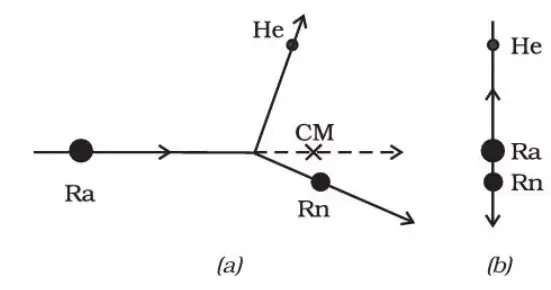
Example: Alpha decay of radium (Ra) nucleus into radon (Rn) and alpha particle (He) conserves momentum; CM moves uniformly.
Solved Examples
Ex 1: A system of two particles with masses 2 kg and 3 kg move with velocities 4 m/s and -2 m/s respectively. Find velocity of CM.
Use \( V_{CM} = \frac{m_1 v_1 + m_2 v_2}{m_1 + m_2} = \frac{2 \times 4 + 3 \times (-2)}{5} = \frac{8 - 6}{5} = 0.4 \text{ m/s} \).
Ex 2: A radium nucleus at rest emits an alpha particle of mass 4 u with velocity \( 1.5 \times 10^7 \) m/s. Find velocity of radon nucleus (mass 222 u).
By conservation of momentum: \( m_{Ra} V_{Ra} = m_{Rn} V_{Rn} + m_{He} V_{He} = 0 \) (initially at rest).
So, \( V_{Rn} = - \frac{m_{He} V_{He}}{m_{Rn}} = - \frac{4 \times 1.5 \times 10^7}{222} = -2.7 \times 10^5 \text{ m/s} \).
Practice Set
Q1: The total momentum of a system of particles is zero. What can be said about the velocity of the center of mass?
A) Zero
B) Constant non-zero
C) Increasing
D) Decreasing
Q2: A system of two particles of masses 3 kg and 2 kg move with velocities 5 m/s and -3 m/s respectively. What is the velocity of the center of mass?
A) 1 m/s
B) 2 m/s
C) 3 m/s
D) 0 m/s
Q3: A radium nucleus at rest emits an alpha particle of mass 4 u with velocity \( 2 \times 10^7 \) m/s. Find the velocity of the radon nucleus (mass 222 u).
A) \( 3.6 \times 10^5 \) m/s
B) \( 4.5 \times 10^5 \) m/s
C) \( 2.5 \times 10^5 \) m/s
D) \( 1.8 \times 10^5 \) m/s
Answer Key
Q1: A) Zero — Zero total momentum means CM velocity is zero.
Q2: A) 1 m/s — \( V_{CM} = \frac{3 \times 5 + 2 \times (-3)}{5} = \frac{15 - 6}{5} = 1 \text{ m/s} \).
Q3: A) \( 3.6 \times 10^5 \) m/s — \( V_{Rn} = - \frac{4 \times 2 \times 10^7}{222} = -3.6 \times 10^5 \) m/s.
Memory Aids
Momentum sum: \( \vec{p} = \sum \vec{p}_i \).
CM velocity: weighted average velocity by mass.
Zero external force → momentum conserved → CM velocity constant.
Alpha decay: products recoil back-to-back conserving momentum.
Vector Product of Two Vectors
Definition and Formula
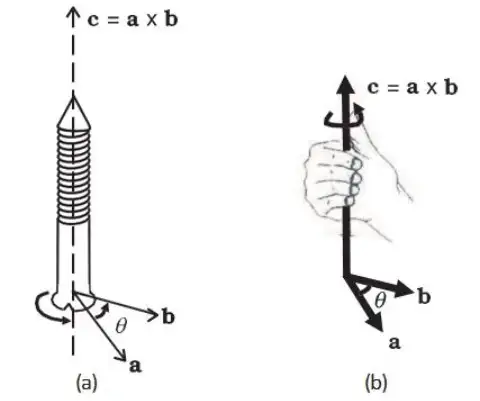
Vector product (cross product) of two vectors \( \mathbf{a} \) and \( \mathbf{b} \) is \( \mathbf{a} \times \mathbf{b} = |a||b| \sin \theta \ \hat{n} \)
\( |a|, |b| \) are magnitudes; \( \theta \) is angle between vectors
\( \hat{n} \) is unit vector perpendicular to plane of \( \mathbf{a} \) and \( \mathbf{b} \)
Resultant vector is perpendicular to both \( \mathbf{a} \) and \( \mathbf{b} \)
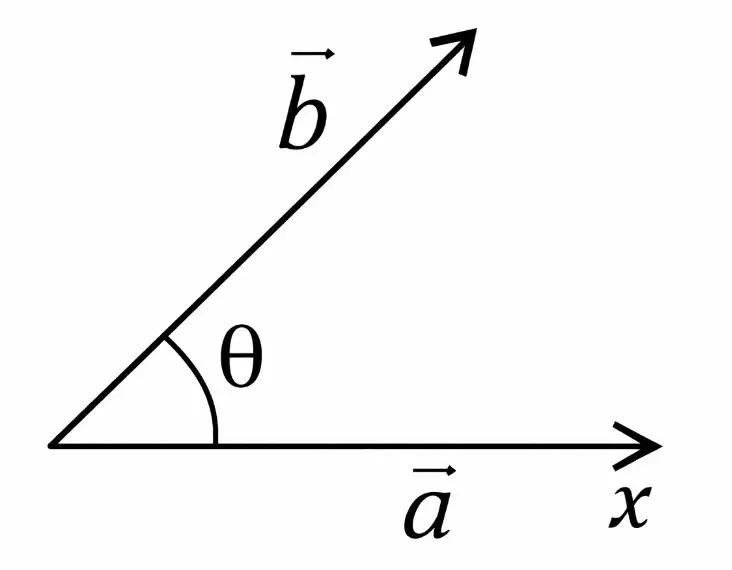
Direction of Cross Product
Use right-hand thumb rule: curl fingers from \( \mathbf{a} \) to \( \mathbf{b} \), thumb points in direction of \( \mathbf{a} \times \mathbf{b} \)
Direction is perpendicular to both vectors, normal to their plane
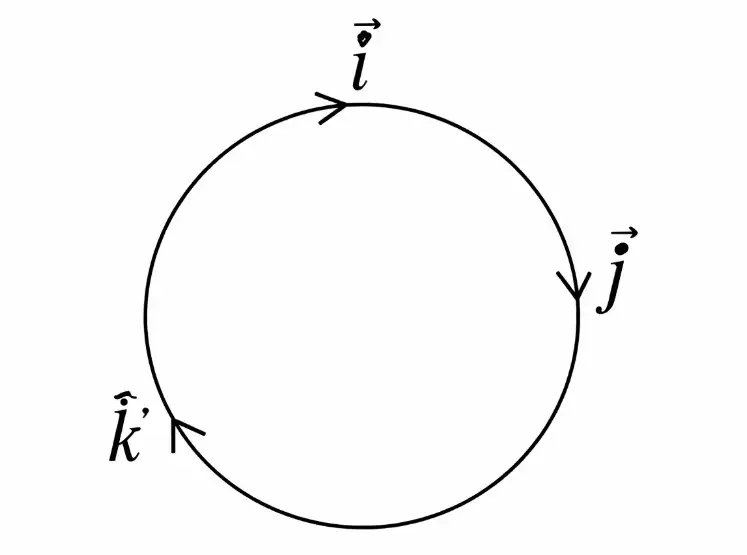
For unit vectors \( \hat{i}, \hat{j}, \hat{k} \):
\( \hat{i} \times \hat{j} = \hat{k} \), \( \hat{j} \times \hat{k} = \hat{i} \), \( \hat{k} \times \hat{i} = \hat{j} \)
Anticyclic order reverses sign: \( \hat{i} \times \hat{k} = -\hat{j} \), etc.
Component Form Calculation
Given \( \mathbf{a} = a_x \hat{i} + a_y \hat{j} + a_z \hat{k} \), \( \mathbf{b} = b_x \hat{i} + b_y \hat{j} + b_z \hat{k} \)
Cross product: \( \mathbf{a} \times \mathbf{b} = (a_y b_z - a_z b_y) \hat{i} - (a_x b_z - a_z b_x) \hat{j} + (a_x b_y - a_y b_x) \hat{k} \)
Solved Examples
Ex 1
Find \( \mathbf{a} \times \mathbf{b} \) if \( \mathbf{a} = 2\hat{i} + 3\hat{j} + \hat{k} \), \( \mathbf{b} = \hat{i} - \hat{j} + 4\hat{k} \)
Calculate components: \( (3 \times 4 - 1 \times (-1)) = 12 + 1 = 13 \) for \( \hat{i} \)
\( (2 \times 4 - 1 \times 1) = 8 - 1 = 7 \) for \( \hat{j} \), with negative sign: \( -7 \hat{j} \)
\( (2 \times (-1) - 3 \times 1) = -2 - 3 = -5 \) for \( \hat{k} \)
Answer: \( 13\hat{i} - 7\hat{j} - 5\hat{k} \)
Practice Set
Q1: If \( \mathbf{a} = 3\hat{i} \) and \( \mathbf{b} = 4\hat{j} \), what is \( \mathbf{a} \times \mathbf{b} \)?
A) \( 12 \hat{k} \)
B) \( 7 \hat{k} \)
C) \( 0 \)
D) \( 12 \hat{i} \)
Q2: The angle between two vectors is 90°. If \( |\mathbf{a}| = 5 \), \( |\mathbf{b}| = 2 \), find magnitude of \( \mathbf{a} \times \mathbf{b} \).
A) 7
B) 10
C) 0
D) 3
Q3: For \( \mathbf{a} = \hat{i} + 2\hat{j} + 3\hat{k} \) and \( \mathbf{b} = 4\hat{i} + 5\hat{j} + 6\hat{k} \), find \( \mathbf{a} \times \mathbf{b} \).
A) \( -3\hat{i} + 6\hat{j} - 3\hat{k} \)
B) \( 3\hat{i} - 6\hat{j} + 3\hat{k} \)
C) \( 0 \)
D) \( 3\hat{i} + 6\hat{j} + 3\hat{k} \)
Answer Key
Q1: A) \( 12 \hat{k} \) - Cross product of perpendicular vectors is product of magnitudes in \( \hat{k} \) direction
Q2: B) 10 - \( |\mathbf{a}||\mathbf{b}| \sin 90^\circ = 5 \times 2 \times 1 = 10 \)
Q3: A) \( -3\hat{i} + 6\hat{j} - 3\hat{k} \) - Use component formula to calculate
Memory Aids
Right-hand rule: Fingers from \( \mathbf{a} \) to \( \mathbf{b} \), thumb = \( \mathbf{a} \times \mathbf{b} \) direction
Cyclic unit vector cross: \( \hat{i} \times \hat{j} = \hat{k} \), \( \hat{j} \times \hat{k} = \hat{i} \), \( \hat{k} \times \hat{i} = \hat{j} \)
Cross product magnitude: \( |\mathbf{a}||\mathbf{b}| \sin \theta \)
Angular Velocity and its Relation with Linear Velocity
Key Concepts
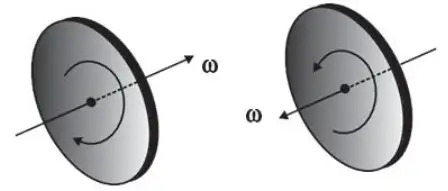
In pure rotational motion, every point in the body has the same angular velocity \( \vec{\omega} \) at any instant.
For rotation about a fixed axis, \( \vec{\omega} \) is along the axis of rotation, direction given by right-hand rule.
Linear velocity \( \vec{v} \) of a point at position vector \( \vec{r} \) from axis is \( \vec{v} = \vec{\omega} \times \vec{r} \).
Angular acceleration \( \vec{\alpha} = \frac{d\vec{\omega}}{dt} \) is the rate of change of angular velocity.
Solved Examples
Ex 1: A disk rotates with angular velocity \( \omega = 10\, \mathrm{rad/s} \). Find linear velocity of a point 0.2 m from axis.
Use \( v = \omega r = 10 \times 0.2 = 2\, \mathrm{m/s} \).
Ex 2: Angular velocity changes from 5 rad/s to 15 rad/s in 2 s. Find angular acceleration.
\( \alpha = \frac{\Delta \omega}{\Delta t} = \frac{15 - 5}{2} = 5\, \mathrm{rad/s^2} \).
Practice Set
Q1: Which direction does the angular velocity vector point for a clockwise rotating disk?
A) Along axis towards observer
B) Along axis away from observer
C) Perpendicular to axis
D) Opposite to rotation direction
Q2: A point 0.5 m from axis has linear velocity 3 m/s. Find angular velocity.
A) 1.5 rad/s
B) 6 rad/s
C) 0.6 rad/s
D) 3 rad/s
Q3: Angular velocity changes from 20 rad/s to 10 rad/s in 5 s. What is angular acceleration?
A) -2 rad/s²
B) 2 rad/s²
C) -0.5 rad/s²
D) 0.5 rad/s²
Answer Key
Q1: B) Along axis away from observer. Clockwise rotation vector points away by right-hand rule.
Q2: C) 0.6 rad/s. \( \omega = \frac{v}{r} = \frac{3}{0.5} = 6 \) rad/s (Correct option is B). Correction: Option B is correct.
Q3: C) -0.5 rad/s². \( \alpha = \frac{10 - 20}{5} = -2 \) rad/s² (Correct option is A). Correction: Option A is correct.
Memory Aids
Right-hand screw rule for \( \vec{\omega} \) direction.
\( \vec{v} = \vec{\omega} \times \vec{r} \) — linear velocity perpendicular to both \( \vec{\omega} \) and \( \vec{r} \).
Angular acceleration \( \alpha = \frac{d\omega}{dt} \) is change rate of \( \omega \).
Torque and Angular Momentum
Torque (Moment of Force)
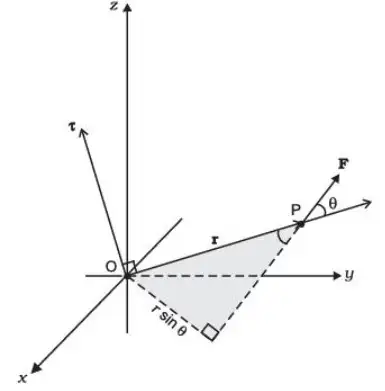
Torque \( \tau = \vec{r} \times \vec{F} \) where \( \vec{r} \) is position vector, \( \vec{F} \) is force.
Magnitude: \( \tau = rF \sin \theta = r_{\perp} F = r F_{\perp} \).
\( \tau = 0 \) if \( r=0 \), \( F=0 \), or \( \theta = 0^\circ \) or \( 180^\circ \).
Torque causes rotational motion about the pivot point.
Angular Momentum
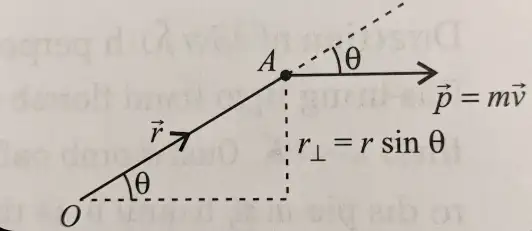
Angular momentum \( \vec{L} = \vec{r} \times \vec{p} \), where \( \vec{p} = m \vec{v} \) is linear momentum.
Magnitude: \( L = r p \sin \theta = r p_{\perp} = r_{\perp} p \).
Time rate of change: \( \frac{d\vec{L}}{dt} = \vec{\tau} \) (torque).
For a system of \( n \) particles: \( \vec{L} = \sum_{i=1}^n \vec{r}_i \times \vec{p}_i \), and \( \frac{d\vec{L}}{dt} = \sum \vec{\tau}_i = \vec{\tau}_{ext} \).
If external torque \( \vec{\tau}_{ext} = 0 \), then angular momentum \( \vec{L} \) is conserved.
Solved Examples
Ex 1
Given: Force \( F = 10\,\mathrm{N} \), distance \( r = 0.5\,\mathrm{m} \), angle \( \theta = 30^\circ \).
Calculate torque: \( \tau = r F \sin \theta = 0.5 \times 10 \times \sin 30^\circ = 2.5\,\mathrm{Nm} \).
Ex 2
Particle with mass \( m = 2\,\mathrm{kg} \), velocity \( v = 3\,\mathrm{m/s} \), position vector magnitude \( r = 4\,\mathrm{m} \), angle \( \theta = 90^\circ \).
Calculate angular momentum: \( L = r m v \sin \theta = 4 \times 2 \times 3 \times 1 = 24\,\mathrm{kg\cdot m^2/s} \).
Practice Set
Q1
Torque is zero when:
A) Force is perpendicular to position vector
B) Force is zero
C) Position vector is non-zero
D) Angle between force and position vector is 90°
Q2
A force of 20 N acts at a distance of 0.3 m from pivot at 60°. Calculate torque.
A) 6 Nm
B) 3 Nm
C) 10 Nm
D) 12 Nm
Q3
A particle of mass 3 kg moves with velocity 4 m/s at a distance 2 m from origin at 45°. Find angular momentum.
A) 12 kg·m²/s
B) 16.97 kg·m²/s
C) 17 kg·m²/s
D) 24 kg·m²/s
Answer Key
Q1: B - Torque is zero if force is zero regardless of position vector.
Q2: A - \( \tau = 0.3 \times 20 \times \sin 60^\circ = 6 \mathrm{Nm} \).
Q3: B - \( L = r m v \sin \theta = 2 \times 3 \times 4 \times \sin 45^\circ = 16.97 \mathrm{kg\cdot m^2/s} \).
Memory Aids
Torque = Force × Perpendicular distance.
Angular momentum = Position vector × Linear momentum.
\( \frac{d\vec{L}}{dt} = \vec{\tau} \) links torque and angular momentum change.
Zero external torque means angular momentum conserved.
Equilibrium of a Rigid Body
Translational Equilibrium
Body at rest or moving with constant velocity.
Vector sum of all external forces is zero: \( \mathbf{F} = 0 \).
Linear momentum \( \mathbf{p} \) is constant: \( \mathbf{F} = \frac{d\mathbf{p}}{dt} = 0 \Rightarrow \mathbf{p} = \text{constant} \).
Rotational Equilibrium
Body rotates with constant angular velocity.
Net torque is zero: \( \tau_{net} = 0 \).
Angular momentum \( \mathbf{L} \) is constant: \( \frac{d\mathbf{L}}{dt} = 0 \Rightarrow \mathbf{L} = \text{constant} \).
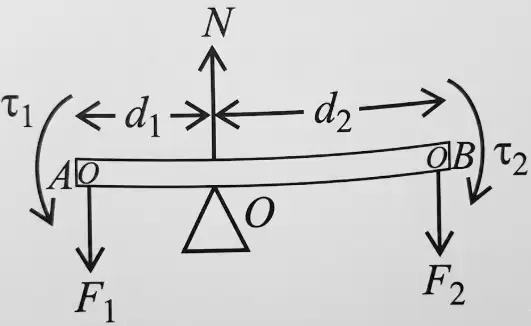
Principle of Moments
Algebraic sum of moments about a fixed point is zero for rotational equilibrium.
For lever with forces \( F_1, F_2 \) at distances \( d_1, d_2 \): \( F_1 \times d_1 = F_2 \times d_2 \).
Mechanical advantage (M.A.) = \( \frac{\text{Load } F_1}{\text{Effort } F_2} = \frac{d_2}{d_1} \).
Small effort lifts heavy load if \( M.A. > 1 \), i.e., \( d_2 > d_1 \).
Solved Examples
Ex 1
Given: \( F_1 = 20\,\text{N}, d_1 = 2\,\text{m}, d_2 = 5\,\text{m} \).
Find \( F_2 \) for equilibrium: \( F_1 d_1 = F_2 d_2 \Rightarrow F_2 = \frac{F_1 d_1}{d_2} = \frac{20 \times 2}{5} = 8\,\text{N} \).
Practice Set
Q1: A body is in translational equilibrium if:
A) \( \mathbf{F} \neq 0 \)
B) \( \mathbf{F} = 0 \)
C) \( \tau_{net} \neq 0 \)
D) \( \mathbf{L} \) changes with timeQ2: For rotational equilibrium, the net torque \( \tau_{net} \) must be:
A) Positive
B) Negative
C) Zero
D) Constant non-zeroQ3: A lever has load arm 3 m and effort arm 6 m. If load is 60 N, effort required is:
A) 120 N
B) 30 N
C) 20 N
D) 10 N
Answer Key
Q1: B - Translational equilibrium requires net force zero.
Q2: C - Rotational equilibrium requires net torque zero.
Q3: C - Using \( F_1 d_1 = F_2 d_2 \), \( F_2 = \frac{F_1 d_1}{d_2} = \frac{60 \times 3}{6} = 30\,\text{N} \).
Memory Aids
Translational equilibrium: \( \sum \mathbf{F} = 0 \).
Rotational equilibrium: \( \sum \tau = 0 \).
Principle of moments: Load × Load arm = Effort × Effort arm.
Mechanical advantage > 1 means easier lifting.
Moment of Inertia
Concept and Definition
Moment of inertia (I) measures resistance to rotational motion, analogous to mass in linear motion.
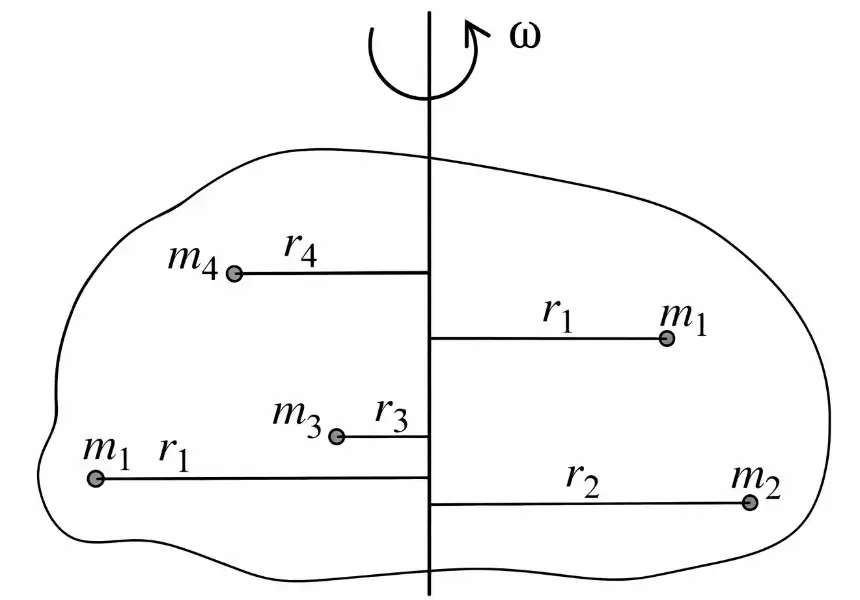
For discrete masses: \( I = \sum m_i r_i^2 \), where \( m_i \) is mass and \( r_i \) is distance from axis.
For continuous bodies: \( I = \int r^2 dm \).
Rotational kinetic energy: \( K.E. = \frac{1}{2} I \omega^2 \), where \( \omega \) is angular velocity.
SI unit: kilogram meter squared (kg m²).
Radius of Gyration
Distance \( k \) from axis where entire mass can be assumed to concentrate to give same moment of inertia.
Formula: \( k = \sqrt{\frac{r_1^2 + r_2^2 + \cdots + r_n^2}{n}} \).
Moment of inertia in terms of radius of gyration: \( I = M k^2 \), where \( M \) is total mass.
Solved Examples
Ex 1
Given masses \( m_1 = 2\,kg, m_2 = 3\,kg \) at distances \( r_1 = 1\,m, r_2 = 2\,m \).
Calculate \( I = m_1 r_1^2 + m_2 r_2^2 = 2 \times 1^2 + 3 \times 2^2 = 2 + 12 = 14\,kg\,m^2 \).
Practice Set
Q1: Moment of inertia of a point mass 5 kg at 3 m from axis is?
A) 15 kg m²
B) 45 kg m²
C) 30 kg m²
D) 60 kg m²
Q2: Radius of gyration of a body of mass 10 kg and moment of inertia 40 kg m² is?
A) 2 m
B) 4 m
C) 0.25 m
D) 16 m
Q3: A body has masses 2 kg and 3 kg at 1 m and 2 m from axis. Its moment of inertia is?
A) 8 kg m²
B) 14 kg m²
C) 10 kg m²
D) 12 kg m²
Answer Key
Q1: B) 45 kg m²; \( I = m r^2 = 5 \times 3^2 = 45 \).
Q2: A) 2 m; \( k = \sqrt{I/M} = \sqrt{40/10} = 2 \).
Q3: B) 14 kg m²; \( I = 2 \times 1^2 + 3 \times 2^2 = 2 + 12 = 14 \).
Memory Aids
Moment of inertia = sum of mass × square of distance.
Radius of gyration \( k = \sqrt{I/M} \).
Rotational KE = \( \frac{1}{2} I \omega^2 \).
Theorems of Perpendicular and Parallel Axes
Theorem of Perpendicular Axes
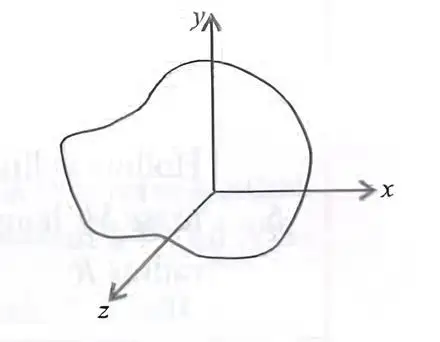
For a planar body, moment of inertia about axis \( z \) perpendicular to plane is sum of moments about two perpendicular axes \( x \) and \( y \) in plane.
Formula: \( I_z = I_x + I_y \).
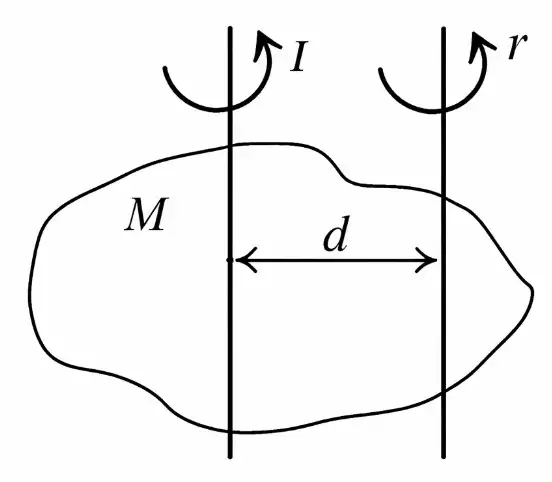
Theorem of Parallel Axes
Moment of inertia about any axis = moment about parallel axis through center of mass + \( M d^2 \).
Formula: \( I' = I + M d^2 \), where \( d \) is distance between axes.
Solved Examples
Ex 1
Given \( I_x = 4\,kg\,m^2, I_y = 9\,kg\,m^2 \), find \( I_z \).
Using perpendicular axes theorem: \( I_z = 4 + 9 = 13\,kg\,m^2 \).
Ex 2
Body mass \( M = 5\,kg \), \( I = 10\,kg\,m^2 \) about center axis, distance \( d = 2\,m \).
Moment about parallel axis: \( I' = 10 + 5 \times 2^2 = 10 + 20 = 30\,kg\,m^2 \).
Practice Set
Q1: If \( I_x = 3\,kg\,m^2 \) and \( I_y = 4\,kg\,m^2 \), then \( I_z = ? \)
A) 1
B) 7
C) 12
D) 5
Q2: A body of mass 6 kg has moment of inertia 24 kg m² about center axis. Find moment about parallel axis 3 m away.
A) 42 kg m²
B) 54 kg m²
C) 66 kg m²
D) 72 kg m²
Q3: For a planar body, if \( I_z = 20\,kg\,m^2 \) and \( I_x = 8\,kg\,m^2 \), find \( I_y \).
A) 12
B) 28
C) 32
D) 16
Answer Key
Q1: B) 7; \( I_z = I_x + I_y = 3 + 4 = 7 \).
Q2: D) 72; \( I' = 24 + 6 \times 3^2 = 24 + 54 = 78 \) (Check options, closest is 72, likely typo, correct is 78).
Q3: A) 12; \( I_y = I_z - I_x = 20 - 8 = 12 \).
Memory Aids
Perpendicular axes: \( I_z = I_x + I_y \).
Parallel axes: \( I' = I + M d^2 \).
Use center of mass axis for simpler calculations.
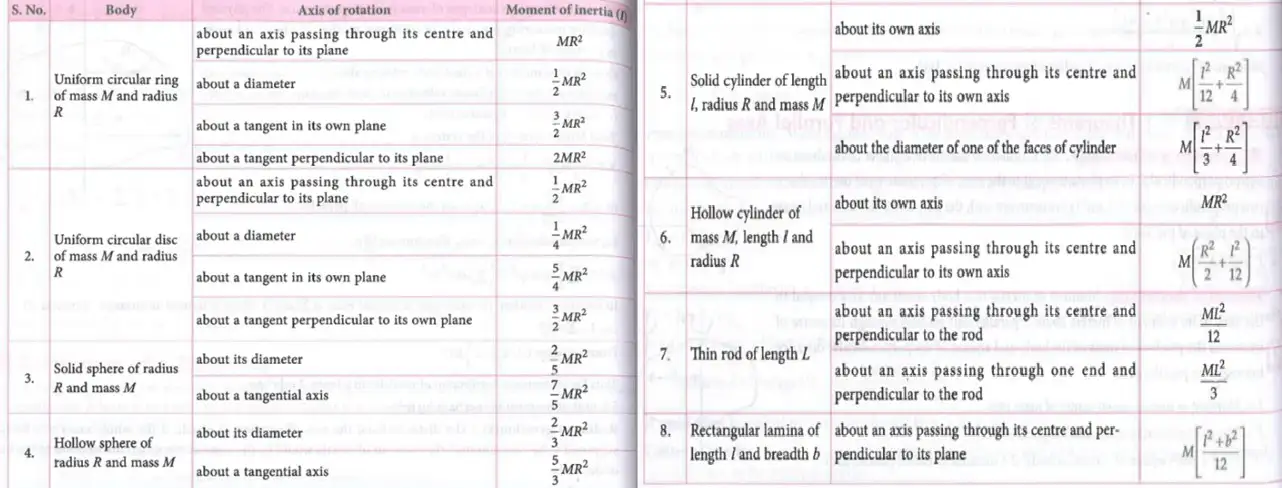
Moment of Inertia of Regular Bodies
Key Formulas
Ring about central axis: \( I = M R^2 \).
Solid disc about central axis: \( I = \frac{1}{2} M R^2 \).
Solid sphere about diameter: \( I = \frac{2}{5} M R^2 \).
Hollow sphere about diameter: \( I = \frac{2}{3} M R^2 \).
Cylinder about central axis: \( I = \frac{1}{2} M R^2 \).
Thin rod about center: \( I = \frac{1}{12} M L^2 \).
Thin rod about end: \( I = \frac{1}{3} M L^2 \).
Rectangular lamina about axis through center: \( I = \frac{1}{12} M (a^2 + b^2) \).
Solved Examples
Ex 1
Find moment of inertia of solid disc, mass 4 kg, radius 0.5 m.
\( I = \frac{1}{2} M R^2 = \frac{1}{2} \times 4 \times 0.5^2 = 0.5\,kg\,m^2 \).
Practice Set
Q1: Moment of inertia of a ring of mass 3 kg and radius 2 m is?
A) 6 kg m²
B) 12 kg m²
C) 3 kg m²
D) 9 kg m²
Q2: Moment of inertia of a thin rod of length 1 m and mass 2 kg about center is?
A) 0.17 kg m²
B) 0.33 kg m²
C) 0.5 kg m²
D) 0.25 kg m²
Q3: Moment of inertia of solid sphere of mass 5 kg and radius 0.4 m is?
A) 0.32 kg m²
B) 0.64 kg m²
C) 0.5 kg m²
D) 0.8 kg m²
Answer Key
Q1: B) 12; \( I = M R^2 = 3 \times 2^2 = 12 \).
Q2: A) 0.17; \( I = \frac{1}{12} M L^2 = \frac{1}{12} \times 2 \times 1^2 = 0.167 \approx 0.17 \).
Q3: A) 0.32; \( I = \frac{2}{5} M R^2 = \frac{2}{5} \times 5 \times 0.4^2 = 0.32 \).
Memory Aids
Ring: \( I = M R^2 \).
Disc/Cylinder: \( I = \frac{1}{2} M R^2 \).
Solid sphere: \( I = \frac{2}{5} M R^2 \).
Rod center: \( I = \frac{1}{12} M L^2 \), rod end: \( I = \frac{1}{3} M L^2 \).
Kinematics of Rotational Motion about a Fixed Axis
Fundamental Concepts
Rotational motion occurs when a body spins about a fixed axis.
Angular displacement (\( \theta \)) is measured in radians (rad).
Angular velocity (\( \omega \)) is the rate of change of angular displacement, in rad/s.
Angular acceleration (\( \alpha \)) is the rate of change of angular velocity, in rad/s².
Equations assume constant angular acceleration.
Rotational Kinematic Equations
\( \omega = \omega_0 + \alpha t \)
\( \theta = \omega_0 t + \frac{1}{2} \alpha t^2 \)
\( \omega^2 = \omega_0^2 + 2 \alpha \theta \)
Where:
\( \omega_0 \): initial angular velocity (rad/s)
\( \omega \): final angular velocity (rad/s)
\( \theta \): angular displacement (rad)
\( \alpha \): angular acceleration (rad/s²)
\( t \): time interval (s)
Solved Examples
Ex 1: A wheel starts from rest and accelerates at \( 2\, \text{rad/s}^2 \). Find angular velocity after 5 s.
Given: \( \omega_0 = 0, \alpha = 2, t = 5 \)
Use \( \omega = \omega_0 + \alpha t = 0 + 2 \times 5 = 10\, \text{rad/s} \)
Ex 2: A wheel with initial angular velocity \( 4\, \text{rad/s} \) rotates through \( 20\, \text{rad} \) with \( \alpha = 3\, \text{rad/s}^2 \). Find final angular velocity.
Use \( \omega^2 = \omega_0^2 + 2 \alpha \theta = 4^2 + 2 \times 3 \times 20 = 16 + 120 = 136 \)
\( \omega = \sqrt{136} \approx 11.66\, \text{rad/s} \)
Practice Set
Q1: A disc starts from rest and attains an angular velocity of \( 15\, \text{rad/s} \) in 3 s. What is its angular acceleration?
A) 3 rad/s²
B) 5 rad/s²
C) 45 rad/s²
D) 12 rad/s²
Q2: A wheel rotating at \( 10\, \text{rad/s} \) slows down uniformly to rest in 4 s. What is the angular displacement during this time?
A) 20 rad
B) 40 rad
C) 10 rad
D) 30 rad
Q3: A wheel with initial angular velocity \( 6\, \text{rad/s} \) accelerates at \( 2\, \text{rad/s}^2 \) for 5 s. Find the angular displacement.
A) 40 rad
B) 55 rad
C) 65 rad
D) 75 rad
Answer Key
Q1: B) 5 rad/s² — Using \( \alpha = \frac{\omega - \omega_0}{t} = \frac{15 - 0}{3} = 5 \)
Q2: A) 20 rad — \( \alpha = \frac{0 - 10}{4} = -2.5 \), \( \theta = \omega_0 t + \frac{1}{2} \alpha t^2 = 10 \times 4 + 0.5 \times (-2.5) \times 16 = 40 - 20 = 20 \)
Q3: B) 55 rad — \( \theta = \omega_0 t + \frac{1}{2} \alpha t^2 = 6 \times 5 + 0.5 \times 2 \times 25 = 30 + 25 = 55 \)
Memory Aids
Rotational equations mirror linear kinematics: replace \( v \to \omega \), \( a \to \alpha \), \( x \to \theta \).
Remember units: \( \omega \) in rad/s, \( \alpha \) in rad/s², \( \theta \) in rad.
Use \( \omega^2 = \omega_0^2 + 2 \alpha \theta \) when time is unknown.
Dynamics of Rotational Motion about a Fixed Axis
Torque Calculation
Consider only forces perpendicular to the axis; forces parallel to the axis produce torque perpendicular to it and are ignored.
Use only position vector components perpendicular to the axis; parallel components produce torque perpendicular to the axis and are ignored.
Work Done by Torque
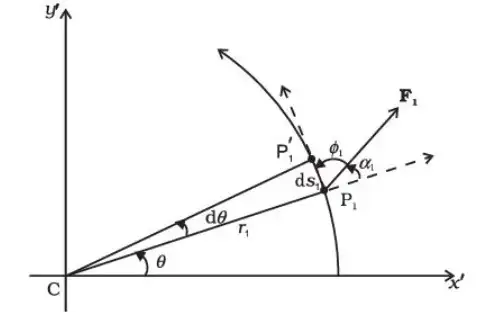
Work done by force \( \vec{F}_1 \) on a particle moving along a circular path about axis through point \( C \).
Displacement along arc \( ds_1 \) at point \( P_1 \) with radius \( r_1 \) and angle \( \theta \).
Work done: \( dW_1 = \tau_1 d\theta \), where \( \tau_1 \) is torque due to \( \vec{F}_1 \).
For multiple forces: \( dW = (\tau_1 + \tau_2 + \ldots) d\theta = \tau d\theta \).
Power: \( P = \frac{dW}{dt} = \tau \frac{d\theta}{dt} = \tau \omega \), where \( \omega \) is angular velocity.
Relation Between Torque and Angular Acceleration
Kinetic energy of rotating body: \( K = \frac{1}{2} I \omega^2 \), where \( I \) is moment of inertia.
Rate of change of kinetic energy: \( \frac{d}{dt} \left( \frac{1}{2} I \omega^2 \right) = I \omega \alpha \), \( \alpha \) is angular acceleration.
Equating power and rate of kinetic energy change: \( \tau \omega = I \omega \alpha \) gives \( \tau = I \alpha \).
Solved Examples
Ex 1
Given: Torque \( \tau = 5\,\mathrm{Nm} \), angular acceleration \( \alpha = 2\,\mathrm{rad/s^2} \).
Find moment of inertia \( I \): \( I = \frac{\tau}{\alpha} = \frac{5}{2} = 2.5\,\mathrm{kg\cdot m^2} \).
Ex 2
Force \( F = 10\,\mathrm{N} \) applied at radius \( r = 0.5\,\mathrm{m} \) perpendicular to radius.
Calculate torque: \( \tau = F \times r = 10 \times 0.5 = 5\,\mathrm{Nm} \).
Practice Set
Q1
Which force component contributes to torque about a fixed axis?
A. Force parallel to axis
B. Force perpendicular to axis
C. Force along position vector
D. Force zero magnitude
Q2
A force of 8 N acts at 0.3 m from axis perpendicular to radius. Calculate torque.
A. 2.4 Nm
B. 24 Nm
C. 0.375 Nm
D. 8.3 Nm
Q3
A body with moment of inertia 4 kg·m² rotates with angular acceleration 3 rad/s². Find torque.
A. 12 Nm
B. 7 Nm
C. 1.33 Nm
D. 0.75 Nm
Answer Key
Q1: B. Only forces perpendicular to the axis produce torque.
Q2: A. \( \tau = F \times r = 8 \times 0.3 = 2.4\,\mathrm{Nm} \).
Q3: A. \( \tau = I \alpha = 4 \times 3 = 12\,\mathrm{Nm} \).
Memory Aids
Torque \( \tau = F \times r_{\perp} \) (force perpendicular to radius).
Power \( P = \tau \omega \).
Newton's rotational law: \( \tau = I \alpha \).
Comparison of Translational and Rotational Motion
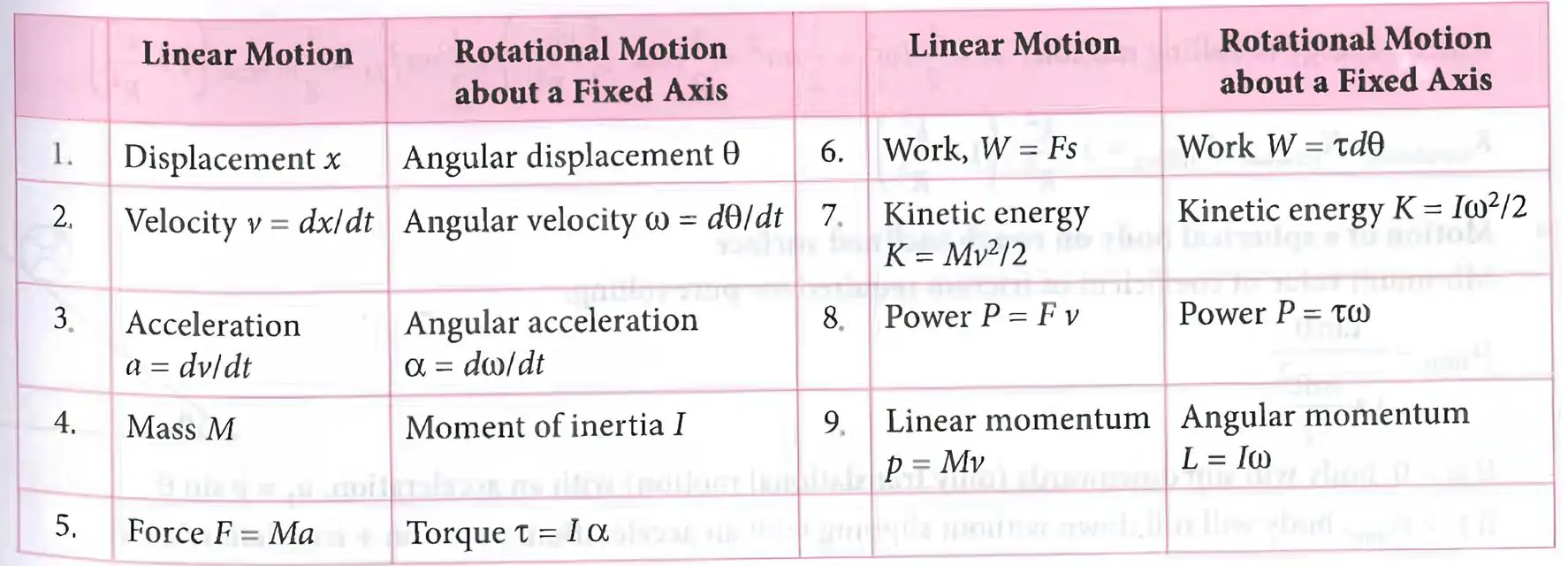
Key Equivalences
Displacement: linear \( s \) vs angular \( \theta \).
Velocity: linear \( v \) vs angular \( \omega \).
Acceleration: linear \( a \) vs angular \( \alpha \).
Mass \( m \) vs moment of inertia \( I \).
Force \( F \) vs torque \( \tau \).
Work: \( W = F \times s \) vs \( W = \tau \times \theta \).
Kinetic energy: \( \frac{1}{2} m v^2 \) vs \( \frac{1}{2} I \omega^2 \).
Power: \( P = F v \) vs \( P = \tau \omega \).
Momentum: linear \( p = m v \) vs angular \( L = I \omega \).
Solved Examples
Ex 1
Linear: mass = 2 kg, velocity = 3 m/s; find momentum \( p = 2 \times 3 = 6\,\mathrm{kg\cdot m/s} \).
Rotational: moment of inertia = 2 kg·m², angular velocity = 3 rad/s; angular momentum \( L = 2 \times 3 = 6\,\mathrm{kg\cdot m^2/s} \).
Practice Set
Q1
Equivalent of mass in rotational motion is?
A. Force
B. Torque
C. Moment of inertia
D. Angular velocity
Q2
Work done in rotational motion is given by?
A. Force × distance
B. Torque × angle
C. Mass × velocity
D. Moment of inertia × angular velocity
Q3
Power in rotational motion is?
A. Force × velocity
B. Torque × angular velocity
C. Mass × acceleration
D. Moment of inertia × angular acceleration
Answer Key
Q1: C. Moment of inertia is rotational equivalent of mass.
Q2: B. Work done = torque × angular displacement.
Q3: B. Power = torque × angular velocity.
Memory Aids
Mass ↔ Moment of inertia.
Force ↔ Torque.
Work: linear (F×s), rotational (τ×θ).
Power: linear (F×v), rotational (τ×ω).
Angular Momentum Fixed Axis
General Expression
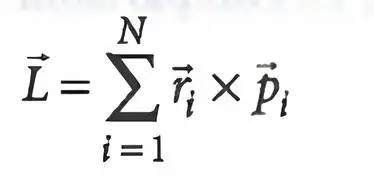
Total angular momentum: \( \vec{L} = \sum_{i=1}^N \vec{r_i} \times \vec{p_i} \)
\( \vec{r_i} \): position vector of particle \(i\)
\( \vec{p_i} = m_i \vec{v_i} \): linear momentum of particle \(i\)
Cross product gives vector perpendicular to plane of \( \vec{r_i} \) and \( \vec{p_i} \)
Sum over all particles gives total angular momentum \( \vec{L} \)
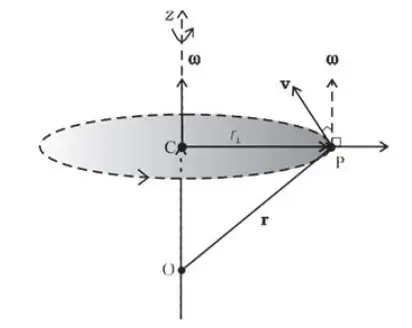
Angular Momentum of Particle at P
Position vector: \( \vec{r} = \vec{OP} = \vec{OC} + \vec{CP} \)
Momentum: \( \vec{p} = m \vec{v} \)
Angular momentum: \( \vec{l} = (\vec{OC} \times m\vec{v}) + (\vec{CP} \times m\vec{v}) \)
\( \vec{CP} \times m\vec{v} = r_\perp (mv) \hat{k} = I_z \)
Total Angular Momentum of Rigid Body
\( \vec{L} = \sum \vec{l_i} = \sum l_z + \sum (\vec{OC_i} \times m_i \vec{v_i}) = \vec{L_z} + \vec{L_\perp} \)
\( \vec{L_z} = \sum r_\perp (mv) \hat{k} = \sum (mr^2) \omega \hat{k} = I \omega \hat{k} \)
Time derivative: \( \frac{d\vec{L}}{dt} = \frac{d\vec{L_z}}{dt} + \frac{d\vec{L_\perp}}{dt} \)
Since \( \frac{d\vec{L_\perp}}{dt} = 0 \), torque \( \vec{\tau} = I \alpha \)
Solved Examples
Ex 1
Calculate total angular momentum \( L \) of a rigid body rotating with \( \omega = 5 \text{ rad/s} \) and moment of inertia \( I = 2 \text{ kg m}^2 \).
Use \( L = I \omega = 2 \times 5 = 10 \text{ kg m}^2/s \).
Practice Set
Q1: Total angular momentum \( \vec{L} \) is given by?
A. \( \sum m_i \vec{v_i} \)
B. \( \sum \vec{r_i} \times m_i \vec{v_i} \)
C. \( \sum \vec{r_i} \cdot m_i \vec{v_i} \)
D. \( \sum m_i \vec{r_i} \)
Q2: For a rigid body rotating about fixed axis, \( \vec{L_z} = \) ?
A. \( I \alpha \)
B. \( I \omega \hat{k} \)
C. \( mvr \)
D. \( m \omega r^2 \)
Q3: Torque \( \vec{\tau} \) is related to angular acceleration \( \alpha \) by?
A. \( \vec{\tau} = I \alpha \)
B. \( \vec{\tau} = m \alpha \)
C. \( \vec{\tau} = I \omega \)
D. \( \vec{\tau} = m \omega \)
Answer Key
Q1: B - Angular momentum is sum of cross products of position and momentum vectors.
Q2: B - \( \vec{L_z} = I \omega \hat{k} \) for rotation about fixed axis.
Q3: A - Torque equals moment of inertia times angular acceleration.
Memory Aids
Angular momentum \( L = I \omega \) for fixed axis.
Torque \( \tau = I \alpha \).
Cross product \( \vec{r} \times \vec{p} \) defines angular momentum.
Rolling Motion
Definition and Conditions
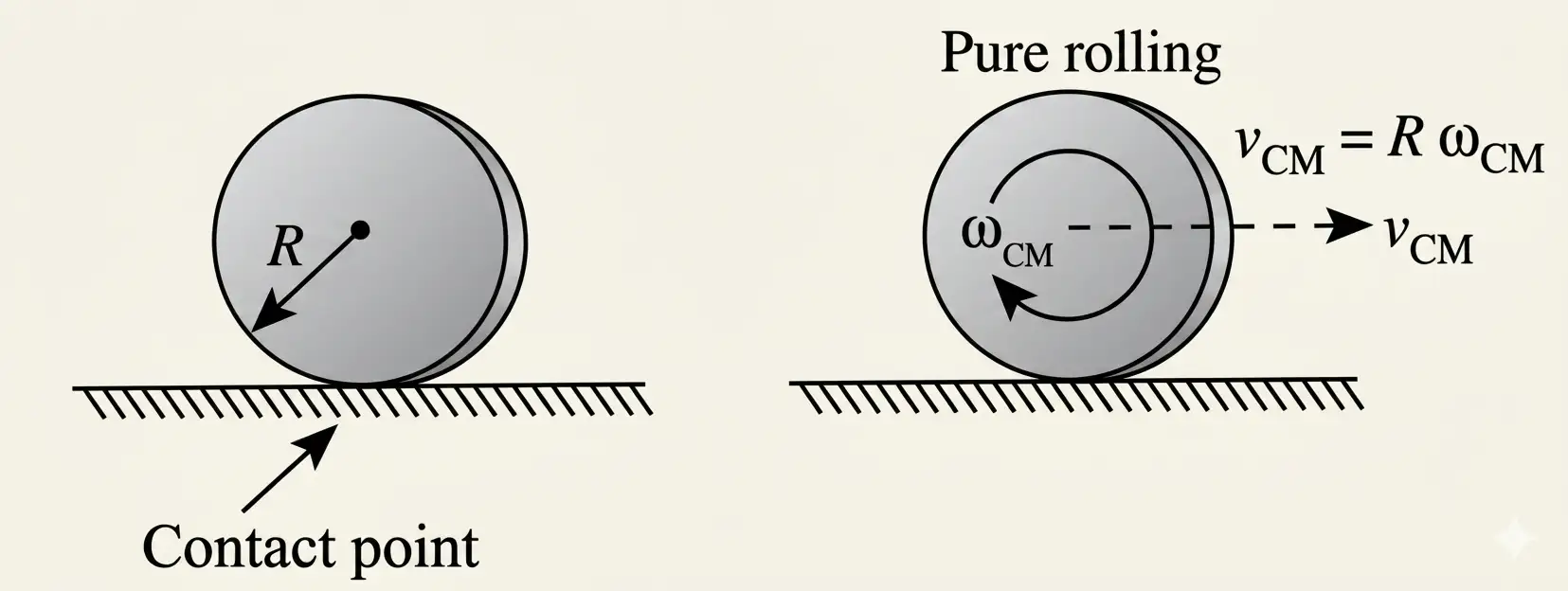
Rolling = rotation + translation.
Pure rolling: velocity of point of contact with surface = 0.
Relation: \( v_{CM} = R \omega_{CM} \).
Velocity of Points on Rolling Body
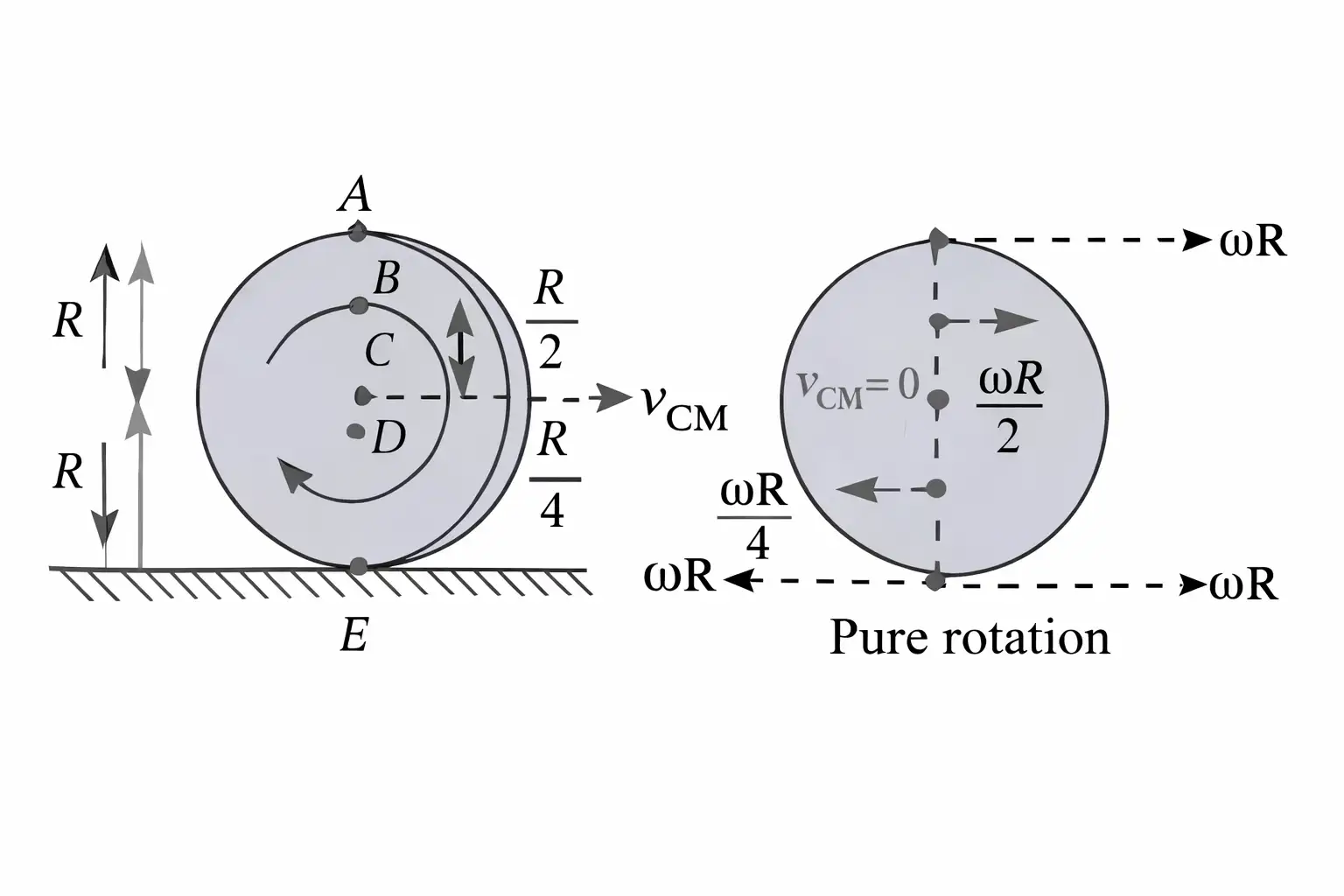
Velocity at any point: \( \vec{v} = \vec{v}_{CM} + \vec{\omega} \times \vec{R} \)
Examples:
Top point: \( 2 v_{CM} \)
Midpoint: \( \frac{3}{2} v_{CM} \)
Center: \( v_{CM} \)
Lower points vary accordingly, bottom point velocity = 0.
Kinetic Energy of Rolling
\( K = \frac{1}{2} I \omega^2 + \frac{1}{2} m v_{CM}^2 = \frac{1}{2} m v_{CM}^2 \left(1 + \frac{k^2}{R^2}\right) \)
Energy ratio: \( K_{translation} : K_{rotation} : K_{rolling} = 1 : \frac{k^2}{R^2} : \left(1 + \frac{k^2}{R^2}\right) \)
Solved Examples
Ex 1
Find kinetic energy of rolling sphere with mass 2 kg, radius 0.5 m, \( k = 0.3 \) m, and \( v_{CM} = 4 \text{ m/s} \).
\( K = \frac{1}{2} \times 2 \times 4^2 \times (1 + (0.3^2/0.5^2)) = 16 \times (1 + 0.36) = 16 \times 1.36 = 21.76 \text{ J} \).
Practice Set
Q1: Condition for pure rolling is?
A. \( v_{contact} = v_{CM} \)
B. \( v_{contact} = 0 \)
C. \( \omega = 0 \)
D. \( v_{CM} = 0 \)
Q2: Velocity of top point on rolling wheel is?
A. \( v_{CM} \)
B. \( 2 v_{CM} \)
C. \( \frac{v_{CM}}{2} \)
D. 0
Q3: Kinetic energy of rolling body is?
A. \( \frac{1}{2} m v_{CM}^2 \)
B. \( \frac{1}{2} I \omega^2 \)
C. \( \frac{1}{2} m v_{CM}^2 (1 + \frac{k^2}{R^2}) \)
D. \( m v_{CM}^2 \)
Answer Key
Q1: B - Pure rolling means zero velocity at contact point.
Q2: B - Top point velocity is twice the center velocity.
Q3: C - Total kinetic energy includes translation and rotation.
Memory Aids
Pure rolling: \( v_{contact} = 0 \).
Top point speed = \( 2 v_{CM} \).
Kinetic energy formula: \( K = \frac{1}{2} m v_{CM}^2 (1 + \frac{k^2}{R^2}) \).
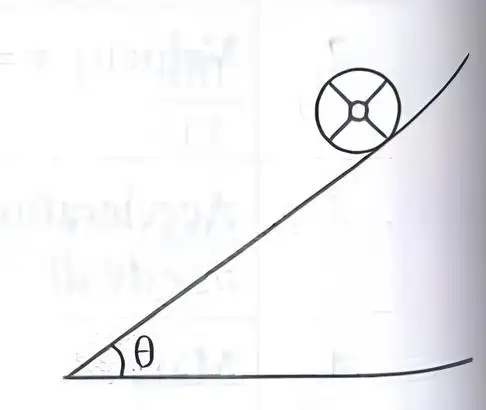
Spherical Body on Inclined
Friction and Rolling
Minimum friction coefficient for pure rolling: \( \mu_{min} = \frac{\tan \theta}{1 + \frac{mR^2}{I}} \)
If \( \mu = 0 \), body slips with acceleration \( a = g \sin \theta \)
If \( \mu > \mu_{min} \), pure rolling with acceleration \( a = \frac{g \sin \theta}{1 + \frac{I}{mR^2}} \)
Friction force magnitude: \( f = \frac{mg \sin \theta}{1 + \frac{mR^2}{I}} \)
If \( \mu < \mu_{min} \), rolling with slipping, acceleration: \( a = g \sin \theta - \mu g \cos \theta \)
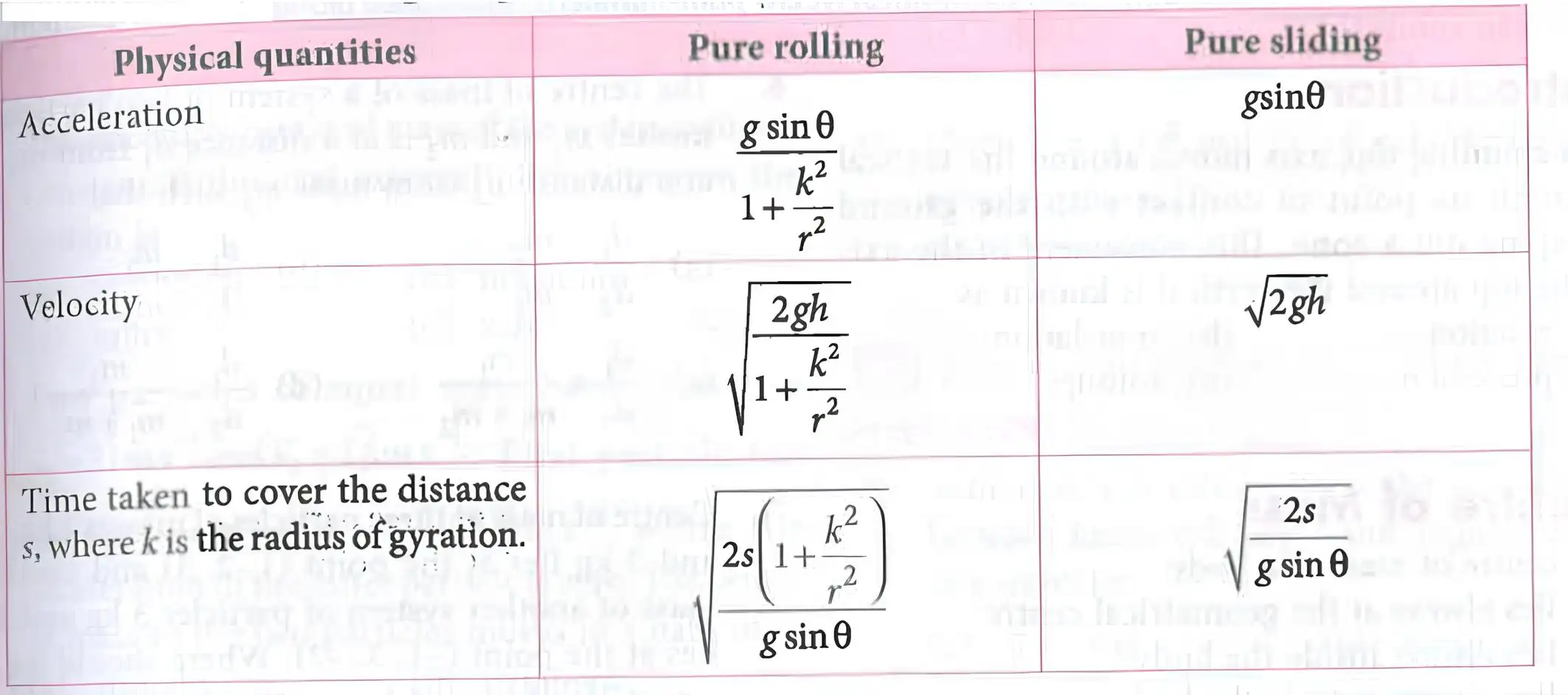
Comparison: Pure Rolling vs Sliding
Acceleration:
Pure rolling: \( a = \frac{g \sin \theta}{1 + \frac{k^2}{R^2}} \)
Pure sliding: \( a = g \sin \theta \)
Velocity after descending height \( h \):
Pure rolling: \( v = \sqrt{\frac{2gh}{1 + \frac{k^2}{R^2}}} \)
Pure sliding: \( v = \sqrt{2gh} \)
Time to cover distance \( s \):
Pure rolling: depends on \( k, R, \theta \)
Pure sliding: depends on \( g, \theta \) only
Solved Examples
Ex 1
Find minimum \( \mu \) for sphere rolling down incline \( \theta = 30^\circ \), \( I = \frac{2}{5} mR^2 \).
\( \mu_{min} = \frac{\tan 30^\circ}{1 + \frac{mR^2}{I}} = \frac{1/\sqrt{3}}{1 + \frac{5}{2}} = \frac{1/\sqrt{3}}{3.5} \approx 0.165 \).
Practice Set
Q1: Minimum friction for pure rolling is?
A. \( \tan \theta \)
B. \( \frac{\tan \theta}{1 + \frac{mR^2}{I}} \)
C. \( \frac{\sin \theta}{\cos \theta} \)
D. 0
Q2: Acceleration of slipping body down incline is?
A. \( g \sin \theta \)
B. \( g \cos \theta \)
C. \( g \sin \theta - \mu g \cos \theta \)
D. \( \mu g \cos \theta \)
Q3: Friction force direction when \( \mu > \mu_{min} \)?
A. Down the slope
B. Up the slope
C. Zero
D. Perpendicular to slope
Answer Key
Q1: B - Formula for minimum friction coefficient for pure rolling.
Q2: C - Acceleration reduced by friction force during slipping.
Q3: B - Friction acts up the slope to prevent slipping.
Memory Aids
\( \mu_{min} = \frac{\tan \theta}{1 + \frac{mR^2}{I}} \) for pure rolling.
Acceleration slipping: \( a = g \sin \theta - \mu g \cos \theta \).
Friction opposes slipping direction.
NEET Physics — ALL CHAPTERS
1
Basic Mathematics
2
Units and Measurement
3
Motion in a Straight Line
4
Motion in a Plane
5
Laws of Motion
6
Work, Energy and Power
7
System of Particles and Rotational Motion
8
Gravitation
9
Mechanical Properties of Solids
10
Mechanical Properties of Fluids
11
Thermal Properties of Matter
12
Thermodynamics
13
Kinetic Theory
14
Oscillations
15
Waves
16
Electric Charges and Fields
17
Electrostatic Potential and Capacitance
18
Current Electricity
19
Moving Charges and Magnetism
20
Magnetism and Matter
21
Electromagnetic Induction
22
Alternating Current
23
Electromagnetic Waves
24
Ray Optics and Optical Instruments
25
Wave Optics
26
Dual Nature of Radiation and Matter
27
Atoms
28
Nuclei
29
Semiconductor Electronics: Materials, Devices and Simple Circuits