NEET Ug . NEET Physics . Physics . Nuclei
Chapter 28: Nuclei
Ch 28
NEET Physics
NEET Ug
Introduction
Key Points
- Positive charge and mass concentrated in nucleus at atom's center.
- Nucleus volume ≈ 10⁻¹⁵ times atom's volume; atom is mostly empty space.
- Study of nucleus properties: size, mass, stability, radioactivity, fission, fusion.
Solved Examples
Ex 1
- Calculate ratio of nucleus volume to atom volume if nucleus radius is 10⁻¹⁵ m and atom radius is 10⁻¹⁰ m.
- Use volume ratio = (r_nucleus / r_atom)^3 = (10⁻¹⁵ / 10⁻¹⁰)^3 = (10⁻⁵)^3 = 10⁻¹⁵.
Practice Set
- Q1: Where is most of the atom's mass located?
- A) Electron cloud
- B) Nucleus
- C) Entire atom evenly
- D) Outer shells
- Q2: The volume of the nucleus is approximately how many times smaller than the atom?
- A) 10⁻⁵
- B) 10⁻¹⁰
- C) 10⁻¹⁵
- D) 10⁻²⁰
- Q3: Which phenomenon is NOT related to the nucleus?
- A) Radioactivity
- B) Fission
- C) Chemical bonding
- D) Fusion
Answer Key
- Q1: B - Nucleus contains most of the atom's mass.
- Q2: C - Nucleus volume is about 10⁻¹⁵ times the atom's volume.
- Q3: C - Chemical bonding involves electrons, not the nucleus.
Memory Aids
- "Nucleus = dense core, mass center."
- Volume ratio = (radius ratio)^3 = 10⁻¹⁵.
- Radioactivity, fission, fusion = nuclear phenomena.
Atomic Masses and Composition of Nucleus
Key Points
- Atomic mass = weighted average of isotopes' masses.
- 1 amu = \( \frac{1}{12} \times \) mass of carbon-12 atom = 1.660539 × 10⁻²⁷ kg = 931 MeV/c².
- Nucleons = protons + neutrons in nucleus.
- Atomic number (Z) = number of protons.
- Mass number (A) = protons (Z) + neutrons (N).
- Nuclear mass = total mass of protons and neutrons.
- Nuclide notation: \( ^A_Z X \), where X = chemical symbol.
Solved Examples
Ex 1
- Find mass of 1 amu in kg.
- Given: 1 amu = 1/12 mass of carbon-12 = 1.660539 × 10⁻²⁷ kg.
- Ex 2
- Write nuclide notation for carbon-14.
- Protons (Z) = 6, Mass number (A) = 14.
- Notation: \( ^{14}_6 C \).
Practice Set
- Q1: 1 amu equals approximately:
- A) 1.66 × 10⁻²⁷ kg
- B) 1.66 × 10⁻²⁶ kg
- C) 931 MeV/c²
- D) Both A and C
- Q2: Atomic number (Z) represents:
- A) Number of neutrons
- B) Number of protons
- C) Mass number
- D) Number of electrons
- Q3: Mass number (A) is:
- A) Number of protons
- B) Number of neutrons
- C) Sum of protons and neutrons
- D) Number of electrons
Answer Key
- Q1: D - 1 amu = 1.66 × 10⁻²⁷ kg and 931 MeV/c².
- Q2: B - Atomic number = number of protons.
- Q3: C - Mass number = protons + neutrons.
Memory Aids
- 1 amu ≈ mass of 1 nucleon.
- Z = protons; A = protons + neutrons.
- Nuclide: \( ^A_Z X \).
Properties of Nucleons
Key Points
- Proton (p): charge +e, mass ≈ 1 amu, rest energy ≈ 938 MeV.
- Neutron (n): charge 0, mass ≈ 1 amu, rest energy ≈ 940 MeV.
- Masses of proton and neutron nearly equal.

Solved Examples
Ex 1
- Compare rest energies of proton and neutron.
- Proton: 938 MeV, Neutron: 940 MeV; difference ≈ 2 MeV.
Practice Set
- Q1: Proton charge is:
- A) 0
- B) +e
- C) -e
- D) +2e
- Q2: Neutron mass compared to proton is:
- A) Much less
- B) Much more
- C) Nearly equal
- D) Zero
- Q3: Rest energy of proton is approximately:
- A) 1 MeV
- B) 938 MeV
- C) 931 MeV
- D) 940 MeV
Answer Key
- Q1: B - Proton charge is +e.
- Q2: C - Neutron mass nearly equals proton mass.
- Q3: B - Proton rest energy ≈ 938 MeV.
Memory Aids
- Proton: +e charge, neutron: neutral.
- Mass ~1 amu for both nucleons.
- Rest energy ~938 MeV proton, ~940 MeV neutron.
Isotopes, Isobars, Isotones and Isomers
Key Points
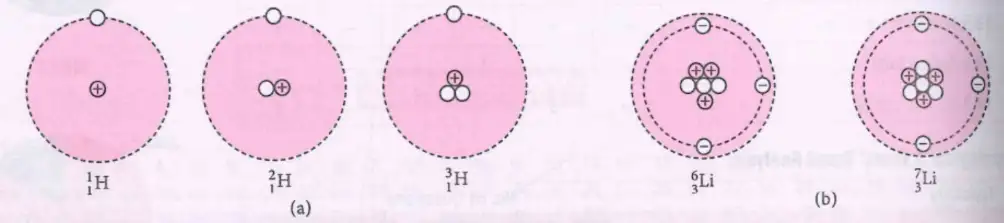
- Isotopes: same Z, different A (different neutrons).
- Isobars: same A, different Z.
- Isotones: same neutron number, different Z.
- Isomers: same Z and A, different energy states.
Solved Examples
Ex 1
- Identify isotopes of hydrogen:
- ¹H (protium), ²H (deuterium), ³H (tritium) differ in neutrons.
- Ex 2
- Example of isobars: ³₁H and ³₂He (same A=3, different Z).
Practice Set
- Q1: Isotopes have:
- A) Same Z, different A
- B) Same A, different Z
- C) Same neutron number, different Z
- D) Same Z and A, different energy
- Q2: Which pair are isobars?
- A) ³₁H and ³₂He
- B) ¹H and ²H
- C) ³⁷₁₇Cl and ³⁹₁₉K
- D) ⁶Li and ⁷Li
- Q3: Isotones have:
- A) Same Z, different A
- B) Same neutron number, different Z
- C) Same A, different Z
- D) Same Z and A, different energy
Answer Key
- Q1: A - Isotopes have same atomic number, different mass number.
- Q2: A - ³₁H and ³₂He have same mass number (3), different atomic number.
- Q3: B - Isotones have same neutron number, different atomic number.
Memory Aids
- Isotopes: "Same Z, different N."
- Isobars: "Same A, different Z."
- Isotones: "Same N, different Z."
- Isomers: "Same Z & A, different energy."
Size of the Nucleus
Nuclear Size
- Volume of nucleus ∝ number of nucleons (mass number A)
- Formula: \( \frac{4}{3} \pi R^3 \propto A \) or \( R \propto A^{1/3} \)
- Radius: \( R = R_0 A^{1/3} \), where \( R_0 = 1.2 \times 10^{-15} \) m
Solved Examples
- Ex 1: Find radius of nucleus with \( A=27 \).
- Use \( R = 1.2 \times 10^{-15} \times 27^{1/3} = 1.2 \times 10^{-15} \times 3 = 3.6 \times 10^{-15} \) m
Practice Set
- Q1: Radius of nucleus with \( A=64 \) is?
- A) \(4.8 \times 10^{-15} \) m
- B) \(1.2 \times 10^{-15} \) m
- C) \(3.6 \times 10^{-15} \) m
- D) \(6.0 \times 10^{-15} \) m
- Q2: If radius of nucleus is \( 6 \times 10^{-15} \) m, find mass number A.
- A) 125
- B) 216
- C) 343
- D) 64
- Q3: Radius of nucleus doubles, mass number changes by factor?
- A) 2
- B) 4
- C) 8
- D) 16
Answer Key
- Q1: A; \( R = 1.2 \times 10^{-15} \times 64^{1/3} = 1.2 \times 4 = 4.8 \times 10^{-15} \) m
- Q2: B; \( A = \left( \frac{R}{R_0} \right)^3 = \left( \frac{6 \times 10^{-15}}{1.2 \times 10^{-15}} \right)^3 = 5^3 = 125 \)
- Q3: C; \( R \propto A^{1/3} \Rightarrow A \propto R^3 \), doubling radius means \( A \) increases by \( 2^3 = 8 \)
Memory Aids
- Radius \( R = R_0 A^{1/3} \) (cube root relation)
- \( R_0 = 1.2 \times 10^{-15} \) m (constant nuclear radius parameter)
- Volume ∝ mass number (A)
Nuclear Density
Density of Nucleus
- Density \( \rho = \frac{\text{mass}}{\text{volume}} = \frac{A \times 1.66 \times 10^{-27} \text{ kg}}{\frac{4}{3} \pi R^3} \)
- Using \( R = R_0 A^{1/3} \), density simplifies to \( \rho = \frac{1.66 \times 10^{-27}}{\frac{4}{3} \pi R_0^3} = 2.29 \times 10^{17} \text{ kg/m}^3 \)
- Density is constant for all nuclei, independent of mass number
- Density highest at center, decreases towards edges; nucleus has no sharp boundary
- High density (~\(10^{17} \text{ kg/m}^3\)) indicates nucleus is highly compact
Solved Examples
- Ex 1: Calculate nuclear density using \( R_0 = 1.2 \times 10^{-15} \) m.
- \( \rho = \frac{1.66 \times 10^{-27}}{\frac{4}{3} \pi (1.2 \times 10^{-15})^3} = 2.29 \times 10^{17} \text{ kg/m}^3 \)
Practice Set
- Q1: Nuclear density is approximately?
- A) \(10^{3} \text{ kg/m}^3\)
- B) \(10^{10} \text{ kg/m}^3\)
- C) \(10^{17} \text{ kg/m}^3\)
- D) \(10^{27} \text{ kg/m}^3\)
- Q2: If nuclear radius doubles, density changes by?
- A) Doubles
- B) Halves
- C) Remains same
- D) Quadruples
- Q3: Which statement is true about nuclear density?
- A) Varies with mass number
- B) Maximum at edges
- C) Independent of mass number
- D) Much less than atomic density
Answer Key
- Q1: C; Nuclear density is about \( 2.29 \times 10^{17} \text{ kg/m}^3 \)
- Q2: C; Density is constant, independent of radius or mass number
- Q3: C; Density does not depend on mass number, uniform for all nuclei
Memory Aids
- Density formula simplifies to constant value
- \( \rho \approx 2.3 \times 10^{17} \text{ kg/m}^3 \)
- Density highest at center, no sharp boundary
Mass-Energy and Nuclear Binding Energy
Key Concepts
- Mass-energy equivalence: \( E = mc^2 \) (Einstein's relation)
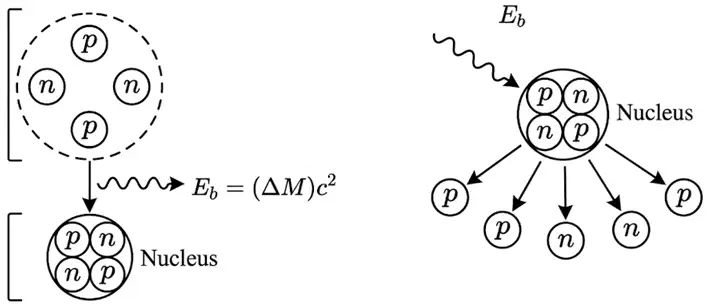
- Binding energy (\( E_b \)) is the energy holding nucleons (protons and neutrons) together in a nucleus.
- Mass defect (\( \Delta M \)) = \( [Z m_p + (A - Z) m_n] - M \), where \(Z\) = number of protons, \(A\) = mass number, \(m_p\) = proton mass, \(m_n\) = neutron mass, \(M\) = nucleus mass.
- Binding energy formula: \( E_b = \Delta M c^2 = \left([Z m_p + (A - Z) m_n] - M\right) c^2 \)
- Binding energy per nucleon: \( \Delta E_{bn} = \frac{E_b}{A} \) (average energy to remove one nucleon)
Solved Examples
Ex 1: Calculate binding energy if mass defect \( \Delta M = 0.0015 \) u. (1 u = 931.5 MeV/c²)
- \( E_b = \Delta M c^2 = 0.0015 \times 931.5 = 1.397 \text{ MeV} \)
Practice Set
- Q1: What is the mass defect for a nucleus with \( Z=2 \), \( A=4 \), proton mass = 1.0073 u, neutron mass = 1.0087 u, nucleus mass = 4.0026 u?
- A) 0.0301 u
- B) 0.0251 u
- C) 0.0201 u
- D) 0.0151 u
- Q2: Binding energy per nucleon for a nucleus with total binding energy 28 MeV and mass number 7 is:
- A) 4 MeV
- B) 3 MeV
- C) 5 MeV
- D) 6 MeV
- Q3: If mass defect is 0.002 u, what is the binding energy? (1 u = 931.5 MeV/c²)
- A) 1.863 MeV
- B) 0.931 MeV
- C) 2.863 MeV
- D) 3.863 MeV
Answer Key
- Q1: A) 0.0301 u — Calculated as \( (2 \times 1.0073 + 2 \times 1.0087) - 4.0026 = 0.0301 \) u
- Q2: A) 4 MeV — Binding energy per nucleon = \( 28 / 7 = 4 \) MeV
- Q3: A) 1.863 MeV — \( 0.002 \times 931.5 = 1.863 \) MeV
Memory Aids
- Mass defect = sum of nucleon masses - nucleus mass
- Binding energy \( E_b = \Delta M c^2 \)
- Binding energy per nucleon = total binding energy / mass number
- 1 atomic mass unit (u) = 931.5 MeV/c²
Binding Energy Curve and Nuclear Stability
Key Concepts
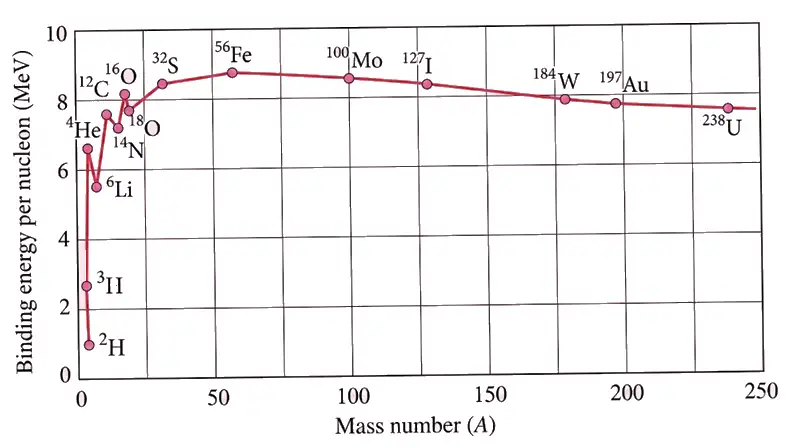
- Binding energy per nucleon vs mass number (A) graph shows nuclear stability.
- Peak at \( A \approx 56 \) (Iron-56) with max binding energy per nucleon ~8.75 MeV.
- Nuclei with low or very high mass numbers have lower binding energy per nucleon and are less stable.
- Higher binding energy per nucleon means more stable nucleus.
- Energy release occurs via:
- Nuclear fission: Heavy nucleus splits into lighter nuclei with higher binding energy per nucleon.
- Nuclear fusion: Light nuclei combine to form heavier nucleus with higher binding energy per nucleon.
Solved Examples
Ex 1: Why does fusion of light nuclei release energy?
- Because final nucleus has higher binding energy per nucleon than initial nuclei.
Ex 2: Why does fission of heavy nuclei release energy?
- Because resulting lighter nuclei have higher binding energy per nucleon than original heavy nucleus.
Practice Set
- Q1: Which nucleus is most stable based on binding energy per nucleon?
- A) Hydrogen (A=1)
- B) Iron (A=56)
- C) Uranium (A=238)
- D) Helium (A=4)
- Q2: Energy is released in nuclear fusion because:
- A) Binding energy per nucleon decreases
- B) Binding energy per nucleon increases
- C) Mass number decreases
- D) Mass number increases
- Q3: Nuclear fission occurs when:
- A) Light nuclei combine
- B) Heavy nucleus splits into lighter nuclei with higher binding energy per nucleon
- C) Binding energy per nucleon decreases
- D) Mass defect is zero
Answer Key
- Q1: B) Iron (A=56) — It has the highest binding energy per nucleon, hence most stable.
- Q2: B) Binding energy per nucleon increases — Fusion forms a nucleus with higher binding energy per nucleon, releasing energy.
- Q3: B) Heavy nucleus splits into lighter nuclei with higher binding energy per nucleon — This releases energy in fission.
Memory Aids
- Peak of binding energy curve = most stable nucleus (Iron-56)
- Fusion: light nuclei → heavier nucleus + energy
- Fission: heavy nucleus → lighter nuclei + energy
- Higher binding energy per nucleon = greater stability
Nuclear Force
Key Properties
- Electrostatic repulsion between protons is much stronger than gravitational attraction: \( \frac{F_e}{F_g} = 10^{36} \).
- Nuclear force is a strong attractive force acting at short range (~4.2 × 10⁻¹⁵ m).
- It balances electrostatic repulsion, holding nucleons (protons and neutrons) together in the nucleus.
- Charge independent: same magnitude between proton-proton, proton-neutron, and neutron-neutron pairs.
- Attractive force arises from exchange of π mesons (\( \pi^0, \pi^+, \pi^- \)).
- Acts only between nearest neighbors (saturated force), not all nucleons.
- Strongest force in nature within its range: ~102 times stronger than electrostatic, ~1038 times stronger than gravitational force.
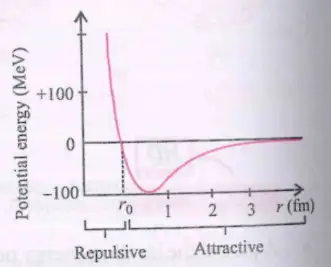
- Potential energy vs. separation graph shows:
- Strong repulsion at distances < \( r_0 \) (~1 fm).
- Strong attraction at distances > \( r_0 \), with minimum potential energy at \( r_0 \).
Solved Examples
Ex 1: Calculate the ratio of electrostatic to gravitational force between two protons.
- Given: \( \frac{F_e}{F_g} = 10^{36} \) (from nuclear force context)
- Answer: \( 10^{36} \)
Ex 2: Describe the nature of nuclear force at \( r < r_0 \) and \( r > r_0 \).
- At \( r < r_0 \): Force is strongly repulsive.
- At \( r > r_0 \): Force is attractive, stabilizing the nucleus.
Practice Set
Q1: Which of the following is true about nuclear force?
- A. Acts over long distances
- B. Is charge dependent
- C. Is saturated force
- D. Weaker than gravitational force
Q2: The nuclear force is approximately how many times stronger than the electrostatic force?
- A. 102
- B. 104
- C. 106
- D. 108
Q3: At what approximate distance does the nuclear force become repulsive?
- A. Greater than 4.2 × 10⁻¹⁵ m
- B. Less than 1 femtometer
- C. At 10−10 m
- D. At 1 meter
Answer Key
Q1: C. Nuclear force is a saturated force acting only with nearest neighbors.
Q2: A. Nuclear force is about 102 times stronger than electrostatic force within its range.
Q3: B. Nuclear force becomes repulsive at distances less than about 1 femtometer (\( r_0 \)).
Memory Aids
- "Nuclear force: Short, Strong, Saturated, and Charge-independent."
- Remember: \( F_e / F_g = 10^{36} \) shows electrostatic repulsion dominates gravity.
- Potential energy minimum at \( r_0 \) (~1 fm) indicates stable nucleon separation.
Radioactivity
Overview
- Discovered in 1896 by Antoine Henri Becquerel.
- Spontaneous disintegration of certain nuclei (radionuclides) emitting alpha (\(\alpha\)), beta (\(\beta\)) particles, and gamma (\(\gamma\)) rays.
- Three natural decay types: alpha decay, beta decay, gamma decay.
Solved Examples
Ex 1: Identify the type of radiation emitted when a nucleus emits a helium nucleus.
- Helium nucleus emission = alpha decay.
Practice Set
Q1: Who discovered radioactivity?
- A) Marie Curie
- B) Antoine Henri Becquerel
- C) Ernest Rutherford
- D) Niels Bohr
Q2: Radioactivity is the spontaneous disintegration of nuclei with emission of:
- A) Only alpha particles
- B) Alpha, beta particles and gamma rays
- C) Only beta particles
- D) Only gamma rays
Q3: Which of the following is NOT a type of natural radioactive decay?
- A) Alpha decay
- B) Beta decay
- C) Gamma decay
- D) Positron decay
Answer Key
Q1: B) Antoine Henri Becquerel - He discovered radioactivity in 1896.
Q2: B) Alpha, beta particles and gamma rays - All three are emitted in natural radioactivity.
Q3: D) Positron decay - Positron emission is a type of beta decay, not a separate decay type.
Memory Aids
- Radioactivity = spontaneous nucleus decay emitting \(\alpha\), \(\beta\), \(\gamma\).
- Discovered by Becquerel in 1896.
- Three decay types: alpha (helium nucleus), beta (electron/positron), gamma (photon).
- Emission of alpha particle \( ^4_2He \) from heavy nucleus.
- General reaction: \( ^A_ZX \rightarrow ^{A-4}_{Z-2}Y + ^4_2He + Q \)
- Energy released (Q) = \( (m_X - m_Y - m_{He})c^2 \)
- Energy shared between daughter nucleus and alpha particle.
- Example: Alpha decay of \( ^{238}_{92}U \) releases 4.25 MeV.
- Proton emission requires more energy (7.68 MeV for \( ^{238}_{92}U \)), so not spontaneous.
- \( Q = (238.05 - 234.04 - 4.00) \times 931.5 = 0.01 \times 931.5 = 9.315 \text{ MeV} \)
- A) 1
- B) 2
- C) 4
- D) 0
- A) \( (m_X + m_Y + m_{He})c^2 \)
- B) \( (m_X - m_Y - m_{He})c^2 \)
- C) \( (m_Y - m_X - m_{He})c^2 \)
- D) \( (m_{He} - m_X - m_Y)c^2 \)
- A) Electron
- B) Positron
- C) Helium nucleus
- D) Photon
- Alpha decay: loses 2 protons and 2 neutrons.
- Q value formula: \( Q = (m_X - m_Y - m_{He})c^2 \).
- Energy shared between alpha particle and daughter nucleus.
- Spontaneous emission of electron (\( \beta^- \)) or positron (\( \beta^+ \)) from nucleus.
- \( \beta^- \) decay: neutron \( \to \) proton + electron + antineutrino.
- Atomic number increases by 1; mass number \( A \) unchanged.
- \( \beta^+ \) decay: proton \( \to \) neutron + positron + neutrino.
- Atomic number decreases by 1; mass number \( A \) unchanged.
- New atomic number = \( Z + 1 \)
- A) Proton + electron + neutrino
- B) Proton + electron + antineutrino
- C) Neutron + positron + neutrino
- D) Proton + positron + neutrino
- A) +1
- B) -1
- C) 0
- D) +2
- A) +1
- B) -1
- C) 0
- D) +2
- \( \beta^- \): neutron \( \to \) proton + electron + antineutrino; Z increases by 1.
- \( \beta^+ \): proton \( \to \) neutron + positron + neutrino; Z decreases by 1.
- Mass number \( A \) unchanged.
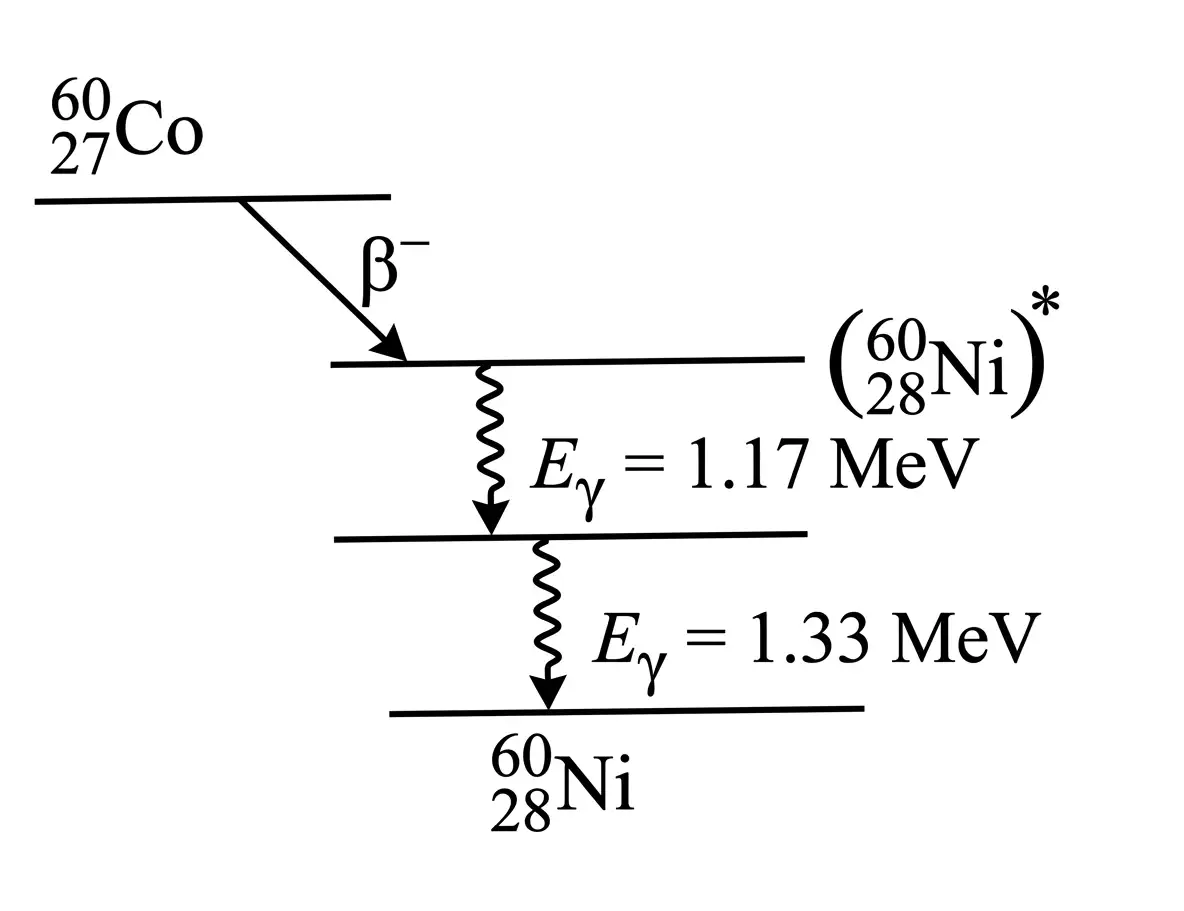
- Emission of high-energy photons (\( \gamma \)-rays) from excited nucleus to ground state.
- Occurs after alpha or beta decay leaves nucleus in excited state.
- Example: \( ^{60}_{27}Co \) undergoes beta decay to excited \( ^{60}_{28}Ni^* \), which emits two gamma rays (1.17 MeV and 1.33 MeV) to reach ground state.
- Gamma emission does not change atomic or mass number.
- Atomic number remains the same.
- A) Electron
- B) Positron
- C) Photon
- D) Alpha particle
- A) Stable
- B) Excited
- C) Ionized
- D) Neutral
- A) 0.5 MeV and 0.7 MeV
- B) 1.17 MeV and 1.33 MeV
- C) 2 MeV and 3 MeV
- D) 4 MeV and 5 MeV
- Gamma decay = photon emission, no change in Z or A.
- Follows alpha or beta decay to release excess energy.
- Example: \( ^{60}Co \to ^{60}Ni^* \to ^{60}Ni + \gamma \).
- Nuclear reaction general form: A + a → B + b + Q (Q = energy released)
- Q-value = (mass of reactants - mass of products) × c²; positive Q = exothermic, negative Q = endothermic
- Conservation laws in nuclear reactions:
- Number of nucleons conserved: A + a = B + b
- Atomic number conserved: Z(A + a) = Z(B + b)
- Energy change equals mass difference energy equivalent
- Linear momentum conserved: total momentum before = total momentum after
- Q1: What is conserved in a nuclear reaction?
- A) Only mass
- B) Only energy
- C) Number of nucleons and atomic number
- D) Neither mass nor energy
- Q2: If Q-value is negative, the reaction is:
- A) Exothermic
- B) Endothermic
- C) Spontaneous
- D) Impossible
- Q3: In a reaction, if mass of reactants is 12 u and products 11.995 u, energy released is:
- A) 4.66 MeV
- B) 0.005 MeV
- C) 466 MeV
- D) 0.5 MeV
- Q1: C - Number of nucleons and atomic number are conserved in nuclear reactions.
- Q2: B - Negative Q-value means energy is absorbed; reaction is endothermic.
- Q3: A - Energy = mass difference × 931.5 MeV = 0.005 × 931.5 = 4.66 MeV.
- Q-value positive = energy released (exo)
- Q-value negative = energy absorbed (endo)
- Conservation: nucleons and charge always conserved
- Fission: splitting heavy nucleus into smaller nuclei + energy
- Example: \( _{92}^{235}U + _{0}^{1}n \to _{56}^{144}Ba + _{36}^{89}Kr + 3 _{0}^{1}n + Q \)
- Energy released per fission ≈ 200 MeV
- Applications:
- Controlled energy in nuclear reactors
- Sudden energy release in atomic bombs
- Q1: Nuclear fission involves:
- A) Fusion of light nuclei
- B) Splitting of heavy nucleus
- C) Emission of alpha particles only
- D) Electron capture
- Q2: Energy released per fission of uranium-235 is approximately:
- A) 2 MeV
- B) 20 MeV
- C) 200 MeV
- D) 2000 MeV
- Q3: Number of neutrons released in uranium-235 fission is:
- A) 1
- B) 2
- C) 3
- D) 4
- Q1: B - Fission is splitting of heavy nucleus into smaller nuclei.
- Q2: C - About 200 MeV energy is released per uranium-235 fission.
- Q3: C - Typically 3 neutrons are emitted per fission.
- Fission = "F" for "Fragmentation" (splitting)
- U-235 + neutron → Ba + Kr + 3 neutrons + energy
- Energy ~ 200 MeV per fission event
- Fusion: combining light nuclei to form heavier nucleus + energy
- Energy released due to higher binding energy per nucleon in heavier nucleus
- Examples:
- \( _1^1H + _1^1H \to _1^2H + e^+ + \nu + 0.42 \text{ MeV} \)
- \( _1^2H + _1^2H \to _2^3He + _0^1n + 3.27 \text{ MeV} \)
- \( _1^2H + _1^2H \to _1^3H + _1^1H + 4.03 \text{ MeV} \)
- Thermonuclear fusion: fusion at very high temperatures (~10⁷–10⁸ K) to overcome Coulomb barrier
- Fusion powers stars; proton-proton cycle in sun converts hydrogen to helium releasing 26.7 MeV
- Q1: Fusion reaction releases energy because:
- A) Heavier nucleus has lower binding energy
- B) Heavier nucleus has higher binding energy per nucleon
- C) Mass is created
- D) Neutrons are lost
- Q2: The main fuel in the sun's core is:
- A) Helium
- B) Hydrogen
- C) Carbon
- D) Oxygen
- Q3: Energy released in proton-proton fusion cycle per 4 protons is approximately:
- A) 2.67 MeV
- B) 26.7 MeV
- C) 267 MeV
- D) 0.267 MeV
- Q1: B - Fusion releases energy as heavier nucleus has higher binding energy per nucleon.
- Q2: B - Hydrogen is the main fuel in the sun's core.
- Q3: B - About 26.7 MeV energy released per 4 protons fused.
- Fusion = "F" for "Fusing" light nuclei
- Sun's core temperature ~1.5×10⁷ K for fusion
- Proton-proton cycle: 4H → He + energy (26.7 MeV)
- Goal: steady power generation by heating fuel to ~10⁸ K
- Fuel is plasma: mixture of ions and electrons
- Challenge: confining plasma at high temperature without material container
- Global research ongoing; success could provide unlimited clean energy
- Q1: Controlled fusion reactors aim to heat fuel to about:
- A) 10³ K
- B) 10⁵ K
- C) 10⁸ K
- D) 10¹¹ K
- Q2: Plasma in fusion reactors consists of:
- A) Neutral atoms
- B) Ions and electrons
- C) Only electrons
- D) Only ions
- Q3: Main challenge in controlled fusion is:
- A) Fuel availability
- B) Plasma confinement
- C) Energy measurement
- D) Cooling the reactor
- Q1: C - Fusion requires ~10⁸ K to overcome Coulomb barrier.
- Q2: B - Plasma is ionized gas of ions and electrons.
- Q3: B - Confining plasma at high temperature is the main challenge.
- Controlled fusion needs "C" for "Confinement" and "Centillion" K (~10⁸)
- Plasma = charged particles, not neutral gas
- Magnetic confinement is key technology
Alpha Decay
Key Points

Solved Examples
Ex 1: Calculate Q value if \( m_X = 238.05u \), \( m_Y = 234.04u \), \( m_{He} = 4.00u \), \( c^2 = 931.5 MeV/u \).
Practice Set
Q1: In alpha decay, the atomic number decreases by:
Q2: The energy released in alpha decay is given by:
Q3: Which particle is emitted in alpha decay?
Answer Key
Q1: B) 2 - Alpha particle has 2 protons, so atomic number decreases by 2.
Q2: B) \( (m_X - m_Y - m_{He})c^2 \) - Energy released equals mass difference times \( c^2 \).
Q3: C) Helium nucleus - Alpha particle is a helium nucleus.
Memory Aids
Beta Decay
Key Points

Solved Examples
Ex 1: In \( \beta^- \) decay, if original element has atomic number Z, what is atomic number after decay?
Practice Set
Q1: In \( \beta^- \) decay, a neutron converts into:
Q2: During beta decay, the mass number changes by:
Q3: In \( \beta^+ \) decay, the atomic number changes by:
Answer Key
Q1: B) Proton + electron + antineutrino - This is the \( \beta^- \) decay process.
Q2: C) 0 - Mass number remains unchanged in beta decay.
Q3: B) -1 - Atomic number decreases by 1 in \( \beta^+ \) decay.
Memory Aids
Gamma Decay
Key Points
Solved Examples
Ex 1: What happens to the atomic number during gamma decay?
Practice Set
Q1: Gamma decay involves emission of:
Q2: After beta decay, the nucleus is often:
Q3: The energies of gamma rays emitted by \( ^{60}Ni^* \) are approximately:
Answer Key
Q1: C) Photon - Gamma decay emits high-energy photons.
Q2: B) Excited - Beta decay leaves nucleus in excited state.
Q3: B) 1.17 MeV and 1.33 MeV - These are the gamma energies emitted by \( ^{60}Ni^* \).
Memory Aids
Nuclear Energy
Key Concepts
Solved Examples
Ex 1
Calculate Q-value if mass of reactants = 10.005 u and products = 9.995 u. (1 u = 931.5 MeV/c²)
Q = (10.005 - 9.995) × 931.5 = 0.01 × 931.5 = 9.315 MeV (exothermic)
Practice Set
Answer Key
Memory Aids
Nuclear Fission
Key Concepts

Solved Examples
Ex 1
Calculate total energy released if 1 mole of \( _{92}^{235}U \) undergoes fission releasing 200 MeV per atom.
Energy = 200 MeV × Avogadro's number = 200 × 1.6×10⁻¹³ J × 6.022×10²³ ≈ 1.93×10¹³ J
Practice Set
Answer Key
Memory Aids
Nuclear Fusion
Key Concepts
Solved Examples
Ex 1
Calculate total energy released when 4 hydrogen nuclei fuse to form 1 helium nucleus in the sun.
Energy released = 26.7 MeV per 4 protons fused
Practice Set
Answer Key
Memory Aids
Controlled Thermonuclear Fusion
Key Concepts
Solved Examples
Ex 1
Explain why plasma confinement is necessary in fusion reactors.
Because no material can withstand ~10⁸ K, plasma must be confined by magnetic or inertial methods.
Practice Set
Answer Key
Memory Aids
NEET Physics — ALL CHAPTERS
1
Basic Mathematics
2
Units and Measurement
3
Motion in a Straight Line
4
Motion in a Plane
5
Laws of Motion
6
Work, Energy and Power
7
System of Particles and Rotational Motion
8
Gravitation
9
Mechanical Properties of Solids
10
Mechanical Properties of Fluids
11
Thermal Properties of Matter
12
Thermodynamics
13
Kinetic Theory
14
Oscillations
15
Waves
16
Electric Charges and Fields
17
Electrostatic Potential and Capacitance
18
Current Electricity
19
Moving Charges and Magnetism
20
Magnetism and Matter
21
Electromagnetic Induction
22
Alternating Current
23
Electromagnetic Waves
24
Ray Optics and Optical Instruments
25
Wave Optics
26
Dual Nature of Radiation and Matter
27
Atoms
28
Nuclei
29
Semiconductor Electronics: Materials, Devices and Simple Circuits