NEET Ug . NEET Physics . Physics . Motion in a Plane
Chapter 4: Motion in a Plane
Ch 4
NEET Physics
NEET Ug
Introduction
Motion in Multiple Dimensions
In 1D, motion has two directions: positive (+) and negative (-).
For motion in 2D or more, vectors are used to describe displacement, velocity, and acceleration.
Vectors have both magnitude and direction, essential for plane motion analysis.
Topics include vectors, motion with constant acceleration, projectile motion, and uniform circular motion.
Solved Examples
Ex 1
Identify if displacement in 2D requires vector representation.
Answer: Yes, because direction and magnitude are needed.
Practice Set
Q1: Which quantity requires vector representation?
A) Temperature
B) Speed
C) Displacement
D) Mass
Q2: Motion in a plane requires description using:
A) Scalars only
B) Vectors only
C) Both scalars and vectors
D) None of these
Q3: Which of the following is NOT a vector quantity?
A) Velocity
B) Acceleration
C) Distance
D) Displacement
Answer Key
Q1: C - Displacement has both magnitude and direction, requiring vector representation.
Q2: C - Motion in a plane involves both scalar and vector quantities.
Q3: C - Distance is scalar; others are vectors.
Memory Aids
Vectors = magnitude + direction.
Scalars = magnitude only.
Use vectors for 2D/3D motion.
Scalars and Vectors
Scalars
Have magnitude only, no direction.
Examples: distance, speed, temperature.
Combine using ordinary algebra (add, subtract, multiply, divide).
Addition/subtraction valid only for same units; multiplication/division valid for different units.
Formulas:
Perimeter = 2 × (length + breadth)
Density = mass / volume
Vectors
Have both magnitude and direction.
Obey triangle law of addition.
Examples: velocity, acceleration.
Represented by arrowed line; length = magnitude, arrow = direction.
Notation: bold letters or letters with arrow, e.g., \(\vec{F}\).
Magnitude (modulus) of vector \(\vec{A}\) is \(|\vec{A}|\) or \(A\).
Solved Examples
Ex 1
Identify if speed is scalar or vector.
Answer: Scalar, as it has magnitude only.
Ex 2
Represent force vector \(\vec{F}\) with magnitude 10 N pointing east.
Answer: Arrow of length proportional to 10 N pointing east.
Practice Set
Q1: Which is a scalar quantity?
A) Velocity
B) Acceleration
C) Speed
D) Displacement
Q2: The magnitude of vector \(\vec{A}\) is called:
A) Direction
B) Modulus
C) Origin
D) Tail
Q3: Vector addition follows:
A) Commutative law
B) Distributive law
C) Triangle law
D) Associative law
Answer Key
Q1: C - Speed is scalar.
Q2: B - Magnitude is called modulus.
Q3: C - Vector addition follows triangle law.
Memory Aids
Scalar = Single number + unit.
Vector = Arrow with length and direction.
Triangle law: \(\vec{A} + \vec{B} = \vec{C}\) (triangle sides).
Position and Displacement Vectors
Position Vector
Vector from origin to object's position in coordinate system.
Denoted as \(\vec{r}\) or \(\overrightarrow{OP}\).
Gives:
Distance from origin (magnitude).
Direction relative to origin.
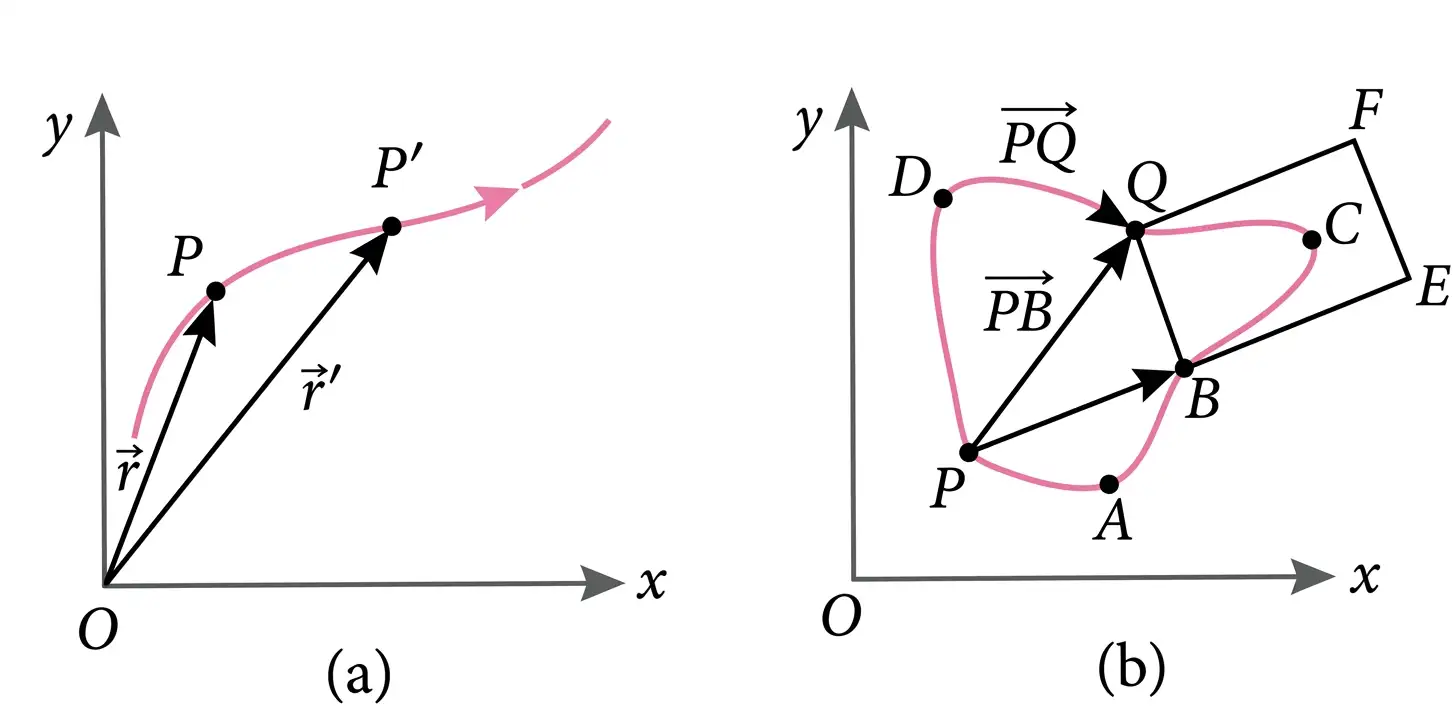
Displacement Vector
Vector showing change in position from initial to final point.
Denoted as \(\overrightarrow{PP'}\) for motion from \(P\) to \(P'\).
Straight line joining initial and final points, independent of path.
Magnitude of displacement \(\leq\) path length.
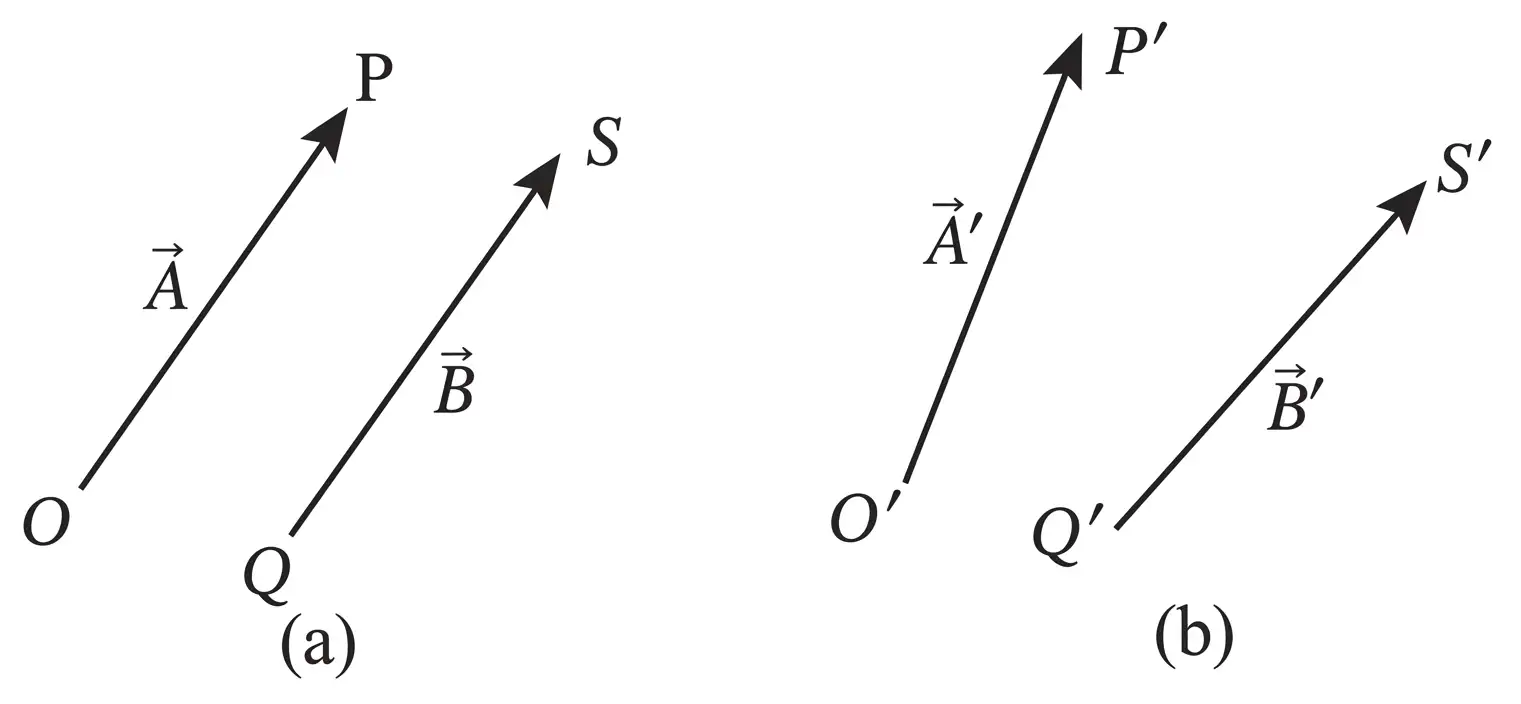
Equality of Vectors
Two vectors are equal if they have same magnitude and direction.
Position of vector (starting point) does not affect equality.
Solved Examples
Ex 1
Find displacement vector if object moves from \(P(2,3)\) to \(P'(5,7)\).
Solution: \(\overrightarrow{PP'} = (5-2)\hat{i} + (7-3)\hat{j} = 3\hat{i} + 4\hat{j}\).
Ex 2
Are vectors \(\vec{A}\) and \(\vec{B}\) equal if both have magnitude 5 units and same direction but different initial points?
Answer: Yes, vectors are equal if magnitude and direction are same regardless of position.
Practice Set
Q1: Displacement vector is:
A) Path length
B) Straight line from initial to final position
C) Distance traveled
D) Scalar quantity
Q2: Position vector \(\vec{r}\) gives:
A) Only distance from origin
B) Only direction from origin
C) Both distance and direction from origin
D) None of these
Q3: Two vectors are equal if:
A) Same magnitude only
B) Same direction only
C) Same magnitude and direction
D) Same initial point
Answer Key
Q1: B - Displacement is straight line from initial to final position.
Q2: C - Position vector gives both distance and direction.
Q3: C - Equality requires same magnitude and direction.
Memory Aids
Displacement = \(\vec{r}_{final} - \vec{r}_{initial}\).
Position vector points from origin to object.
Equal vectors: same length + direction.
Multiplication of Vectors by Real Numbers
Concept Explanation
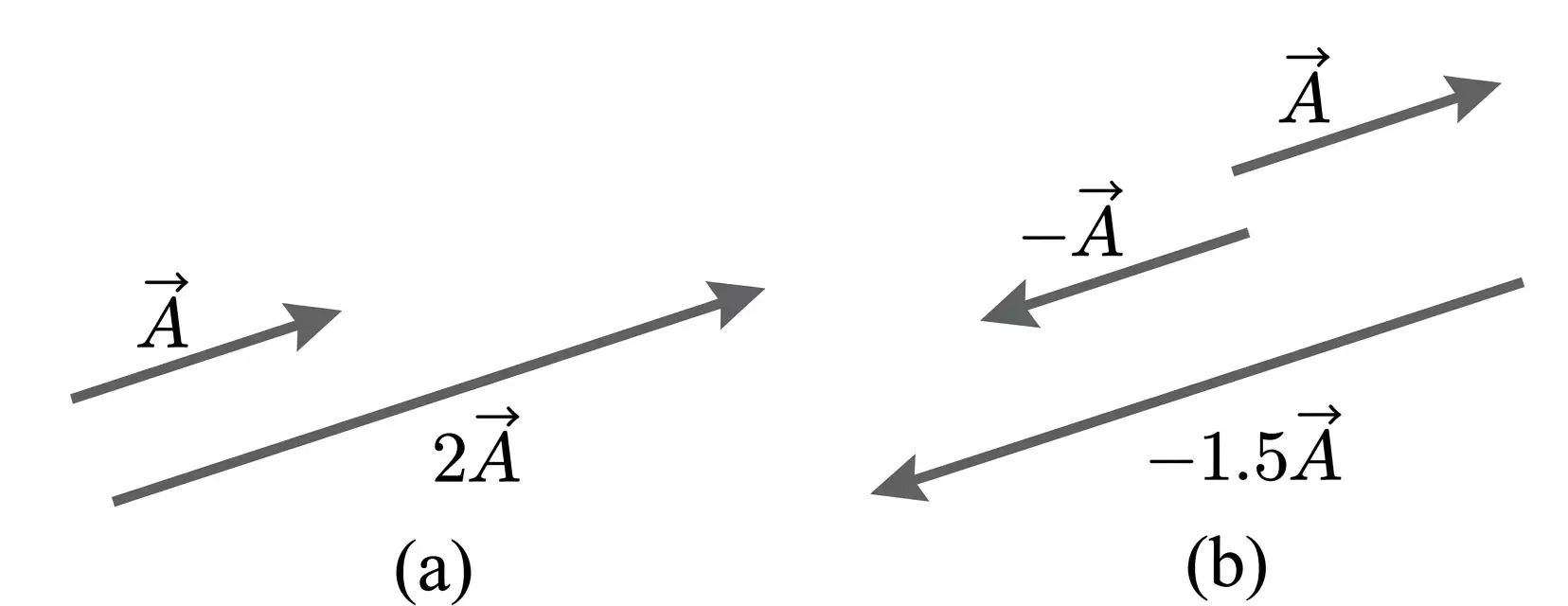
Multiplying vector \(\vec{A}\) by scalar \(n\) gives \(n\vec{A}\).
Magnitude: \(|n\vec{A}| = |n| \times |\vec{A}|\).
Direction:
Same as \(\vec{A}\) if \(n > 0\).
Opposite to \(\vec{A}\) if \(n < 0\).
Example: \(2\vec{A}\) doubles length, same direction.
Example: \(-1.5\vec{A}\) length 1.5 times, opposite direction.
Solved Examples
Ex 1: Find magnitude and direction of \(3\vec{A}\) if \(|\vec{A}|=5\) units.
Magnitude = \(3 \times 5 = 15\) units.
Direction same as \(\vec{A}\) (since 3 > 0).
Ex 2: Find magnitude and direction of \(-2\vec{A}\) if \(|\vec{A}|=4\) units.
Magnitude = \(2 \times 4 = 8\) units.
Direction opposite to \(\vec{A}\) (since -2 < 0).
Practice Set
Q1: If \(|\vec{A}|=6\) units, what is magnitude of \(4\vec{A}\)?
A) 10 units
B) 24 units
C) 2 units
D) 12 units
Q2: Multiplying \(\vec{A}\) by \(-1\) results in a vector that is:
A) Same length, same direction
B) Same length, opposite direction
C) Double length, same direction
D) Half length, opposite direction
Q3: Vector \(\vec{B}\) has magnitude 5 units. What is magnitude and direction of \(-1.2\vec{B}\)?
A) 6 units, same direction
B) 6 units, opposite direction
C) 4.2 units, same direction
D) 4.2 units, opposite direction
Answer Key
Q1: B) 24 units
Magnitude = \(4 \times 6 = 24\) units.Q2: B) Same length, opposite direction
Multiplying by -1 reverses direction, magnitude unchanged.Q3: B) 6 units, opposite direction
Magnitude = \(1.2 \times 5 = 6\) units; negative scalar reverses direction.
Memory Aids
Positive scalar: length changes, direction same.
Negative scalar: length changes, direction reverses.
Formula: \(|n\vec{A}| = |n| \times |\vec{A}|\).
Addition and Subtraction of Vectors - Graphical Method
General Rule for Addition of Vectors
Arrange vectors so head of one coincides with tail of next.
Resultant vector is drawn from tail of first to head of last vector.
Properties of Vector Addition
Commutative: \( \vec{A} + \vec{B} = \vec{B} + \vec{A} \)
Distributive: \( n(\vec{A} + \vec{B}) = n\vec{A} + n\vec{B} \)
Associative: \( \vec{A} + (\vec{B} + \vec{C}) = (\vec{A} + \vec{B}) + \vec{C} \)
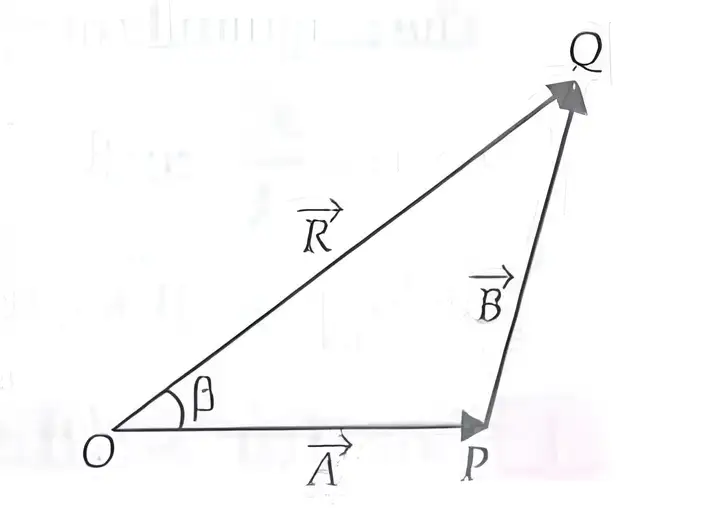
Triangle Law of Vector Addition
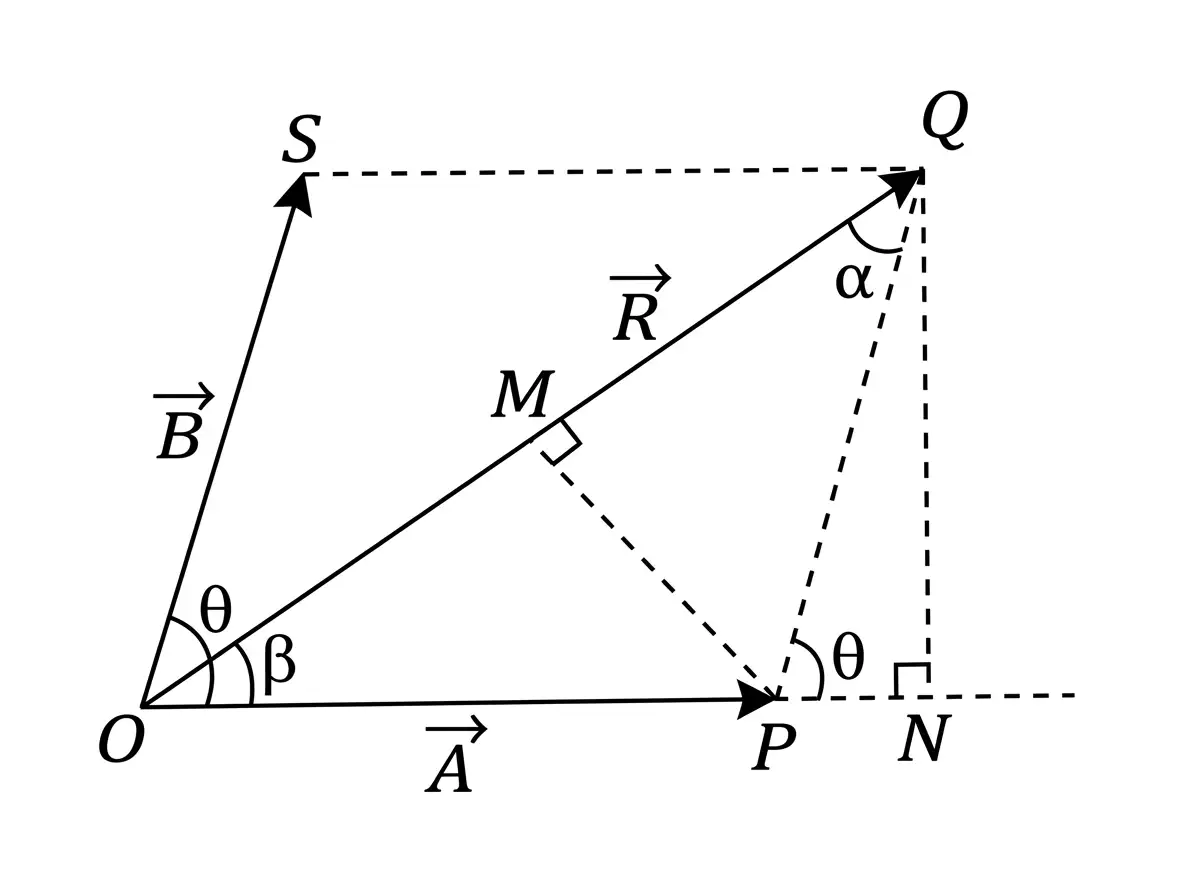
If two vectors \(\vec{A}\) and \(\vec{B}\) act at a point, their resultant \(\vec{R} = \vec{A} + \vec{B} \) is the third side of the triangle taken in opposite order.
Parallelogram Law of Vector Addition
Two vectors represented by adjacent sides of a parallelogram.
Resultant vector is diagonal from the common point.
Magnitude: \( R = \sqrt{A^2 + B^2 + 2AB\cos\theta} \)
Direction: \( \tan\beta = \frac{B\sin\theta}{A + B\cos\theta} \)
Polygon Law of Vector Addition
Vectors represented by sides of an open polygon in order.
Resultant is the closing side taken in opposite order.
Special Cases
Same direction: \( R = A + B, \beta = 0^\circ \)
Opposite direction: \( R = |A - B|, \beta = 180^\circ \)
Perpendicular vectors: \( R = \sqrt{A^2 + B^2}, \beta = \tan^{-1}(\frac{B}{A}) \)
Subtraction of Vectors
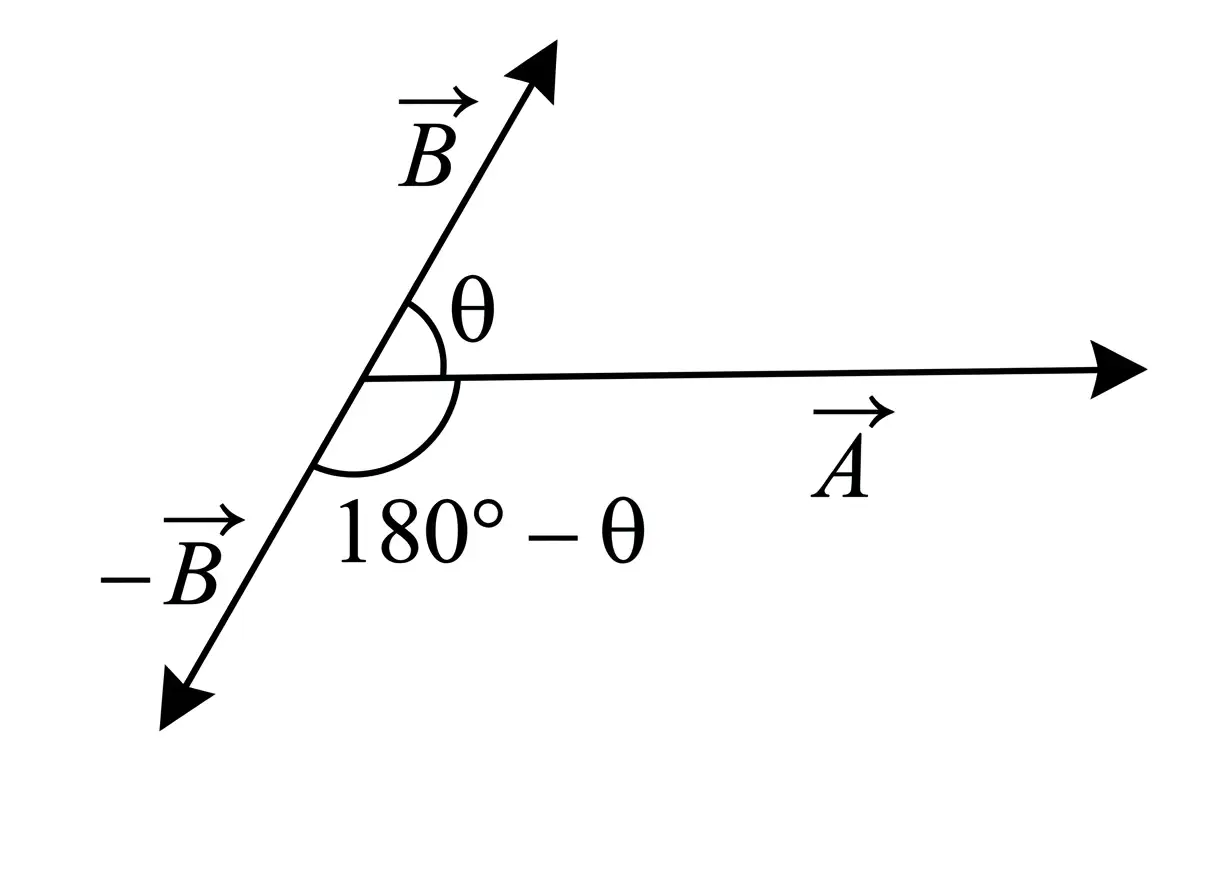
\( \vec{A} - \vec{B} = \vec{A} + (-\vec{B}) \)
Angle between \( \vec{A} \) and \( -\vec{B} \) is \( 180^\circ - \theta \) if angle between \( \vec{A} \) and \( \vec{B} \) is \( \theta \).
Magnitude: \( |\vec{A} - \vec{B}| = \sqrt{A^2 + B^2 - 2AB\cos\theta} \)
Properties of Vector Subtraction
Not commutative: \( \vec{A} - \vec{B} \neq \vec{B} - \vec{A} \)
Not associative: \( \vec{A} - (\vec{B} - \vec{C}) \neq (\vec{A} - \vec{B}) - \vec{C} \)
Solved Examples
Ex 1
Given \( A = 3\,\mathrm{units}, B = 4\,\mathrm{units}, \theta = 90^\circ \).
Find resultant magnitude using parallelogram law.
\( R = \sqrt{3^2 + 4^2 + 2 \times 3 \times 4 \times \cos 90^\circ} = \sqrt{9 + 16 + 0} = 5 \)
Ex 2
Find \( |\vec{A} - \vec{B}| \) if \( A=5, B=2, \theta=60^\circ \).
\( |\vec{A} - \vec{B}| = \sqrt{5^2 + 2^2 - 2 \times 5 \times 2 \times \cos 60^\circ} = \sqrt{25 + 4 - 10} = \sqrt{19} \approx 4.36 \)
Practice Set
Q1
Two vectors \( \vec{A} = 6\,\mathrm{units} \) and \( \vec{B} = 8\,\mathrm{units} \) are perpendicular. Find magnitude of resultant \( \vec{R} = \vec{A} + \vec{B} \).
A) 10 units
B) 14 units
C) 2 units
D) 48 units
Q2
Vectors \( \vec{A} = 5\,\mathrm{units} \) and \( \vec{B} = 5\,\mathrm{units} \) act at an angle of \( 60^\circ \). Find magnitude of resultant.
A) 5 units
B) 10 units
C) 8.66 units
D) 0 units
Q3
Find \( |\vec{A} - \vec{B}| \) if \( A=7, B=4, \theta=120^\circ \).
A) 11 units
B) 3 units
C) 9 units
D) 5 units
Answer Key
Q1: A) 10 units. \( R = \sqrt{6^2 + 8^2} = 10 \)
Q2: C) 8.66 units. \( R = \sqrt{5^2 + 5^2 + 2 \times 5 \times 5 \times \cos 60^\circ} = 8.66 \)
Q3: D) 5 units. \( |\vec{A} - \vec{B}| = \sqrt{7^2 + 4^2 - 2 \times 7 \times 4 \times \cos 120^\circ} = 5 \)
Memory Aids
Triangle law: "Head to tail, close the triangle."
Parallelogram law: "Adjacent sides, diagonal resultant."
Subtraction: Add negative vector.
Resultant magnitude formula: \( R = \sqrt{A^2 + B^2 + 2AB\cos\theta} \)
Resolution of Vectors
Concept and Definitions
Resolution of a vector: Splitting a vector into two or more component vectors.
Component vectors: Vectors obtained after splitting the original vector.
Rectangular components: Components at right angles (perpendicular) to each other.
Rectangular Components in a Plane
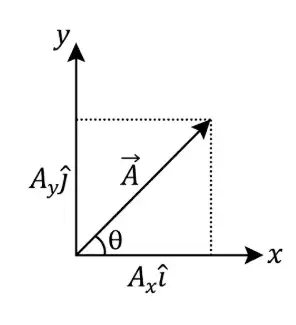
Vector \(\vec{A}\) makes an angle \(\theta\) with the x-axis.
Components: \(A_x = A \cos \theta\), \(A_y = A \sin \theta\).
Vector expressed as: \(\vec{A} = A_x \hat{i} + A_y \hat{j}\).
Magnitude relation: \(A = \sqrt{A_x^2 + A_y^2}\).
Angle relation: \(\tan \theta = \frac{A_y}{A_x}\).
Rectangular Components in Space
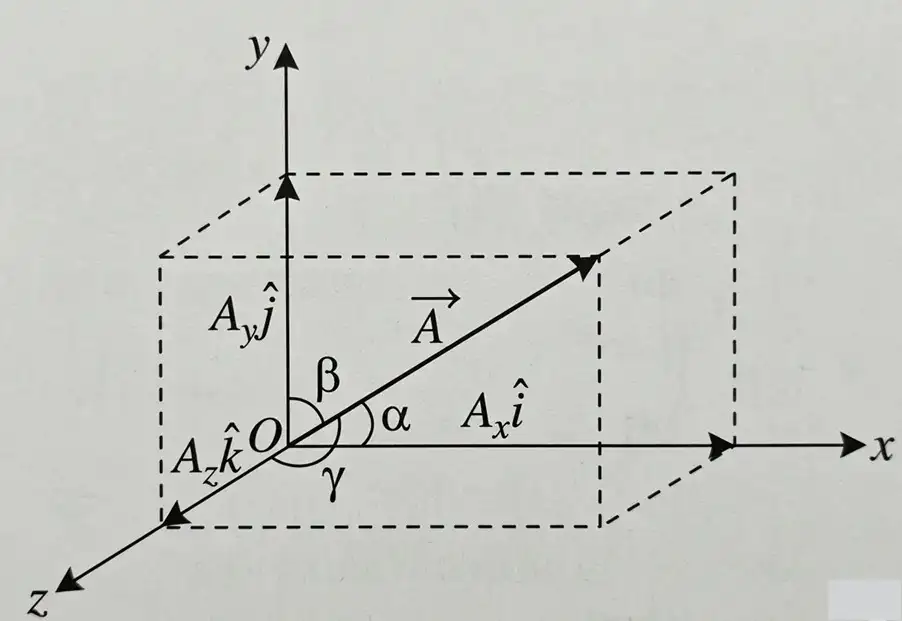
Vector \(\vec{A}\) makes angles \(\alpha, \beta, \gamma\) with x, y, z axes respectively.
Components: \(A_x = A \cos \alpha\), \(A_y = A \cos \beta\), \(A_z = A \cos \gamma\).
Vector expressed as: \(\vec{A} = A_x \hat{i} + A_y \hat{j} + A_z \hat{k}\).
Magnitude: \(A = \sqrt{A_x^2 + A_y^2 + A_z^2}\).
Direction cosines satisfy: \(\cos^2 \alpha + \cos^2 \beta + \cos^2 \gamma = 1\).
Solved Examples
Ex 1: Find components of \(\vec{A} = 10\,\mathrm{N}\) at \(30^\circ\) to x-axis.
\(A_x = 10 \cos 30^\circ = 8.66\,\mathrm{N}\)
\(A_y = 10 \sin 30^\circ = 5.0\,\mathrm{N}\)
Ex 2: Vector \(\vec{A} = 5\,\mathrm{units}\) makes angles \(\alpha=60^\circ\), \(\beta=45^\circ\), find \(A_z\).
Use \(\cos^2 \alpha + \cos^2 \beta + \cos^2 \gamma = 1\)
\(\cos \gamma = \sqrt{1 - \cos^2 60^\circ - \cos^2 45^\circ} = \sqrt{1 - 0.25 - 0.5} = 0.5\)
\(A_z = 5 \times 0.5 = 2.5\)
Practice Set
Q1: A vector of magnitude 20 units makes an angle of 60° with the x-axis. What is its y-component?
A) 10
B) 17.32
C) 20
D) 5
Q2: If a vector \(\vec{A}\) has components \(A_x=3\), \(A_y=4\), find the magnitude of \(\vec{A}\).
A) 5
B) 7
C) 1
D) 12
Q3: A vector \(\vec{A}\) makes angles \(\alpha=45^\circ\), \(\beta=60^\circ\) with x and y axes respectively. Find the direction cosine \(\cos \gamma\) with z-axis.
A) 0.5
B) 0.707
C) 0.866
D) 0.258
Answer Key
Q1: B) 17.32 — \(A_y = 20 \sin 60^\circ = 20 \times 0.866 = 17.32\)
Q2: A) 5 — \(A = \sqrt{3^2 + 4^2} = 5\)
Q3: A) 0.5 — \(\cos \gamma = \sqrt{1 - \cos^2 45^\circ - \cos^2 60^\circ} = 0.5\)
Memory Aids
Components in plane: \(A_x = A \cos \theta\), \(A_y = A \sin \theta\).
Magnitude: \(A = \sqrt{A_x^2 + A_y^2 + A_z^2}\).
Direction cosines sum: \(\cos^2 \alpha + \cos^2 \beta + \cos^2 \gamma = 1\).
Use right triangle relations for quick component calculation.
Vector Addition Analytical Method
Component-wise Addition in 2D
Vectors \( \vec{A} = A_x \hat{i} + A_y \hat{j} \), \( \vec{B} = B_x \hat{i} + B_y \hat{j} \)
Resultant vector \( \vec{R} = \vec{A} + \vec{B} = R_x \hat{i} + R_y \hat{j} \)
Components add as: \( R_x = A_x + B_x \), \( R_y = A_y + B_y \)
Each component of \( \vec{R} \) is sum of corresponding components of \( \vec{A} \) and \( \vec{B} \)
Extension to 3D
Vectors in 3D: \( \vec{A} = A_x \hat{i} + A_y \hat{j} + A_z \hat{k} \), \( \vec{B} = B_x \hat{i} + B_y \hat{j} + B_z \hat{k} \)
Resultant: \( \vec{R} = \vec{A} + \vec{B} = R_x \hat{i} + R_y \hat{j} + R_z \hat{k} \)
Components add as: \( R_x = A_x + B_x \), \( R_y = A_y + B_y \), \( R_z = A_z + B_z \)
Method applies to any number of vectors for addition or subtraction
Solved Examples
Ex 1: Given \( \vec{A} = 3\hat{i} + 4\hat{j} \), \( \vec{B} = 1\hat{i} + 2\hat{j} \), find \( \vec{R} = \vec{A} + \vec{B} \).
Calculate components: \( R_x = 3 + 1 = 4 \), \( R_y = 4 + 2 = 6 \)
Resultant vector: \( \vec{R} = 4\hat{i} + 6\hat{j} \)
Ex 2: For \( \vec{A} = 2\hat{i} + 3\hat{j} + 4\hat{k} \), \( \vec{B} = 1\hat{i} + 0\hat{j} + 5\hat{k} \), find \( \vec{R} = \vec{A} + \vec{B} \).
Calculate components: \( R_x = 2 + 1 = 3 \), \( R_y = 3 + 0 = 3 \), \( R_z = 4 + 5 = 9 \)
Resultant vector: \( \vec{R} = 3\hat{i} + 3\hat{j} + 9\hat{k} \)
Practice Set
Q1: If \( \vec{A} = 5\hat{i} + 2\hat{j} \) and \( \vec{B} = 3\hat{i} + 4\hat{j} \), what is \( R_y \) of \( \vec{R} = \vec{A} + \vec{B} \)?
A) 6
B) 8
C) 2
D) 4
Q2: For vectors \( \vec{A} = 1\hat{i} + 2\hat{j} + 3\hat{k} \) and \( \vec{B} = 4\hat{i} + 0\hat{j} + 5\hat{k} \), what is \( R_z \) of \( \vec{R} = \vec{A} + \vec{B} \)?
A) 8
B) 2
C) 3
D) 5
Q3: Given \( \vec{A} = 2\hat{i} + 3\hat{j} + 4\hat{k} \), \( \vec{B} = -1\hat{i} + 5\hat{j} + 0\hat{k} \), and \( \vec{C} = 3\hat{i} - 2\hat{j} + 1\hat{k} \), find \( R_x \) of \( \vec{R} = \vec{A} + \vec{B} + \vec{C} \).
A) 4
B) 3
C) 2
D) 5
Answer Key
Q1: A) 6
\( R_y = 2 + 4 = 6 \)Q2: A) 8
\( R_z = 3 + 5 = 8 \)Q3: B) 4
\( R_x = 2 + (-1) + 3 = 4 \)
Memory Aids
Resultant components = sum of corresponding components
In 2D: \( R_x = A_x + B_x \), \( R_y = A_y + B_y \)
In 3D: add \( z \)-components similarly
Apply same rule for any number of vectors
Motion in a Plane
Position Vector
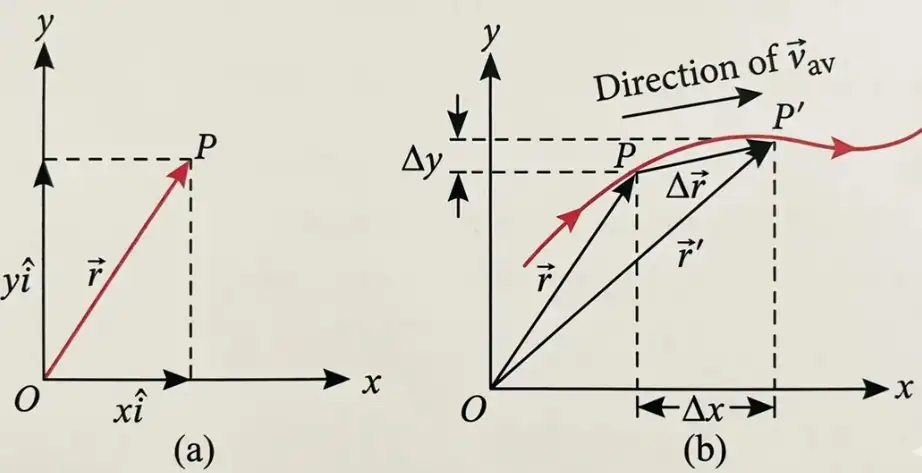
Position vector \(\vec{r} = x\hat{i} + y\hat{j}\) locates a particle in the xy-plane from origin O.
Components: \(x\) along x-axis, \(y\) along y-axis.
Represents object's position at any instant.
Displacement Vector
Displacement \(\Delta \vec{r} = \vec{r'} - \vec{r} = \hat{i}\Delta x + \hat{j}\Delta y\).
Directed from initial point P to final point P'.
Velocity
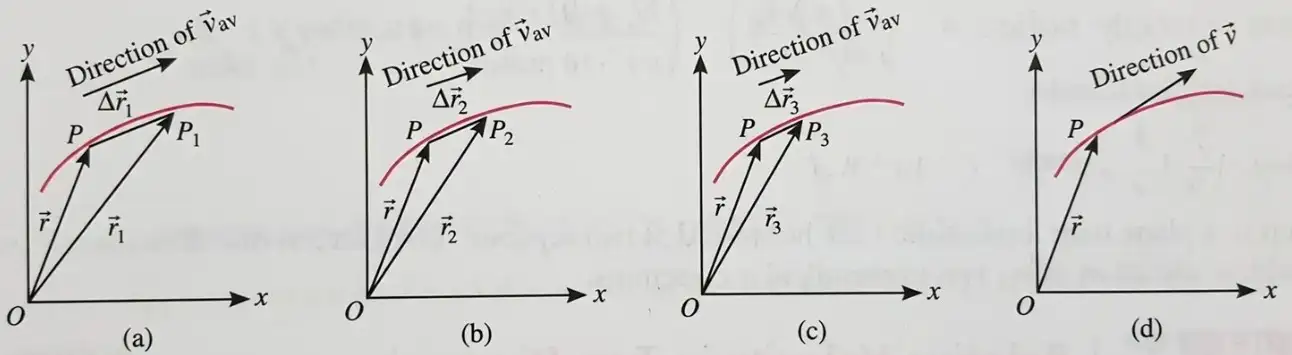
Average velocity \(\vec{V}_{av} = \frac{\Delta \vec{r}}{\Delta t} = \hat{i} \frac{\Delta x}{\Delta t} + \hat{j} \frac{\Delta y}{\Delta t} = \vec{V}_{x,av} \hat{i} + \vec{V}_{y,av} \hat{j}\).
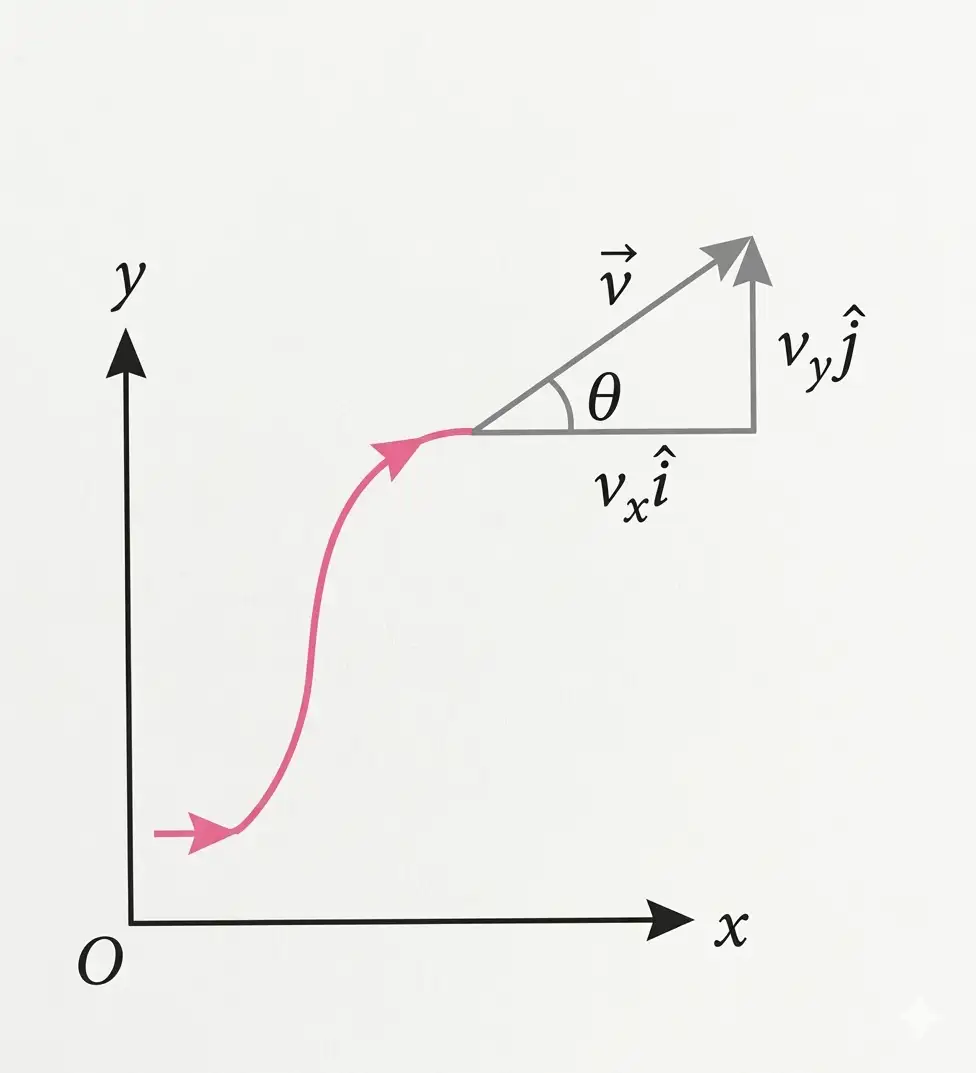
Instantaneous velocity \(\vec{V} = \lim_{\Delta t \to 0} \frac{\Delta \vec{r}}{\Delta t} = \frac{d\vec{r}}{dt} = \hat{i} \frac{dx}{dt} + \hat{j} \frac{dy}{dt} = v_x \hat{i} + v_y \hat{j}\).
Magnitude: \(v = \sqrt{v_x^2 + v_y^2}\), direction: \(\theta = \tan^{-1} \frac{v_y}{v_x}\).
Acceleration
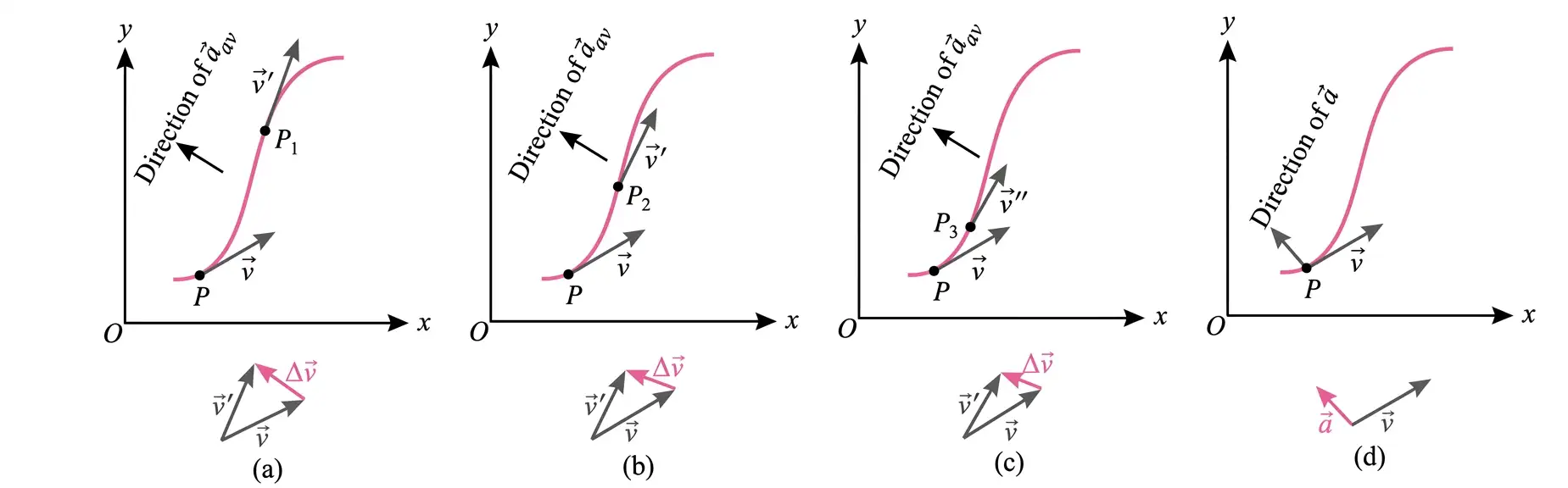
Average acceleration \(\vec{a}_{av} = \frac{\Delta \vec{V}}{\Delta t} = \hat{i} \frac{\Delta v_x}{\Delta t} + \hat{j} \frac{\Delta v_y}{\Delta t} = a_{x,av} \hat{i} + a_{y,av} \hat{j}\).
Instantaneous acceleration \(\vec{a} = \lim_{\Delta t \to 0} \vec{a}_{av} = \frac{d\vec{V}}{dt} = \hat{i} \frac{dv_x}{dt} + \hat{j} \frac{dv_y}{dt}\).
Acceleration changes velocity magnitude and/or direction.
Solved Examples
Ex 1
Given \(\vec{r} = 3\hat{i} + 4\hat{j}\) m at \(t=0\) and \(\vec{r'} = 6\hat{i} + 8\hat{j}\) m at \(t=2\) s.
Displacement \(\Delta \vec{r} = (6-3)\hat{i} + (8-4)\hat{j} = 3\hat{i} + 4\hat{j}\) m.
Average velocity \(\vec{V}_{av} = \frac{3\hat{i} + 4\hat{j}}{2} = 1.5\hat{i} + 2\hat{j}\) m/s.
Ex 2
Velocity components: \(v_x = 5\) m/s, \(v_y = 12\) m/s.
Magnitude \(v = \sqrt{5^2 + 12^2} = 13\) m/s.
Direction \(\theta = \tan^{-1} (12/5) = 67.38^\circ\) from x-axis.
Practice Set
Q1
Particle moves from \(\vec{r} = 2\hat{i} + 3\hat{j}\) m to \(\vec{r'} = 5\hat{i} + 7\hat{j}\) m in 1 s. What is average velocity?
A) \(3\hat{i} + 4\hat{j}\) m/s
B) \(5\hat{i} + 7\hat{j}\) m/s
C) \(2\hat{i} + 3\hat{j}\) m/s
D) \(1\hat{i} + 1\hat{j}\) m/s
Q2
Instantaneous velocity components are \(v_x = 6\) m/s, \(v_y = 8\) m/s. Find speed.
A) 10 m/s
B) 14 m/s
C) 2 m/s
D) 4 m/s
Q3
Acceleration components are \(a_x = 3\) m/s², \(a_y = 4\) m/s². What is magnitude of acceleration?
A) 5 m/s²
B) 7 m/s²
C) 1 m/s²
D) 12 m/s²
Answer Key
Q1: A. Displacement \(= 3\hat{i} + 4\hat{j}\), time = 1 s, so average velocity = displacement/time.
Q2: A. Speed \(= \sqrt{6^2 + 8^2} = 10\) m/s.
Q3: A. Acceleration magnitude \(= \sqrt{3^2 + 4^2} = 5\) m/s².
Memory Aids
Position vector: \(\vec{r} = x\hat{i} + y\hat{j}\).
Velocity: derivative of position \(\vec{V} = \frac{d\vec{r}}{dt}\).
Acceleration: derivative of velocity \(\vec{a} = \frac{d\vec{V}}{dt}\).
Magnitude formula: Pythagoras \(\sqrt{x^2 + y^2}\).
Direction: \(\theta = \tan^{-1} (\frac{y}{x})\).
Motion in a Plane with Constant Acceleration
Fundamentals
Velocity at time \( t \): \( \vec{v} = \vec{v}_0 + \vec{a}t \), where \( \vec{v}_0 \) is initial velocity.
Average velocity over \( t \): \( \vec{v}_{av} = \frac{\vec{v} + \vec{v}_0}{2} \).
Component form: \( v_x = v_{0x} + a_x t \), \( v_y = v_{0y} + a_y t \).
Displacement: \( \vec{r} = \vec{r}_0 + \vec{v}_0 t + \frac{1}{2} \vec{a} t^2 \).
Component displacement: \( x = x_0 + v_{0x} t + \frac{1}{2} a_x t^2 \), \( y = y_0 + v_{0y} t + \frac{1}{2} a_y t^2 \).
Motion in plane treated as two independent 1D motions along perpendicular axes.
Solved Examples
Ex 1
Given \( v_{0x} = 5\,m/s \), \( a_x = 2\,m/s^2 \), find \( v_x \) at \( t=3s \): \( v_x = 5 + 2 \times 3 = 11\,m/s \).
Displacement \( x = 0 + 5 \times 3 + \frac{1}{2} \times 2 \times 9 = 15 + 9 = 24\,m \).
Practice Set
Q1: A particle starts with velocity \( 4\,m/s \) and accelerates at \( 3\,m/s^2 \). What is velocity after 2s?
A) 6 m/s
B) 10 m/s
C) 8 m/s
D) 12 m/s
Q2: Displacement after 3s for above particle?
A) 15 m
B) 21 m
C) 27 m
D) 30 m
Q3: If \( v_{0y} = 0 \), \( a_y = -9.8\,m/s^2 \), find \( y \) after 2s starting from \( y_0=0 \).
A) -19.6 m
B) 19.6 m
C) -9.8 m
D) 0 m
Answer Key
Q1: B) 10 m/s; \( v = 4 + 3 \times 2 = 10 \)
Q2: C) 27 m; \( s = 4 \times 3 + \frac{1}{2} \times 3 \times 9 = 12 + 13.5 = 25.5 \) approx 27 m
Q3: A) -19.6 m; \( y = 0 + 0 - \frac{1}{2} \times 9.8 \times 4 = -19.6 \)
Memory Aids
Velocity: \( v = u + at \)
Displacement: \( s = ut + \frac{1}{2} at^2 \)
Separate x and y components for 2D motion.
Relative Velocity in Two Dimensions
Key Concepts
Actual velocity w.r.t ground: \( \vec{V}_{actual} \).
Relative velocity w.r.t moving object: \( \vec{V}_{rel} = \vec{V}_{actual} - \vec{V}_{ref} \).
Vector addition: \( \vec{V}_{actual} = \vec{V}_{rel} + \vec{V}_{ref} \).
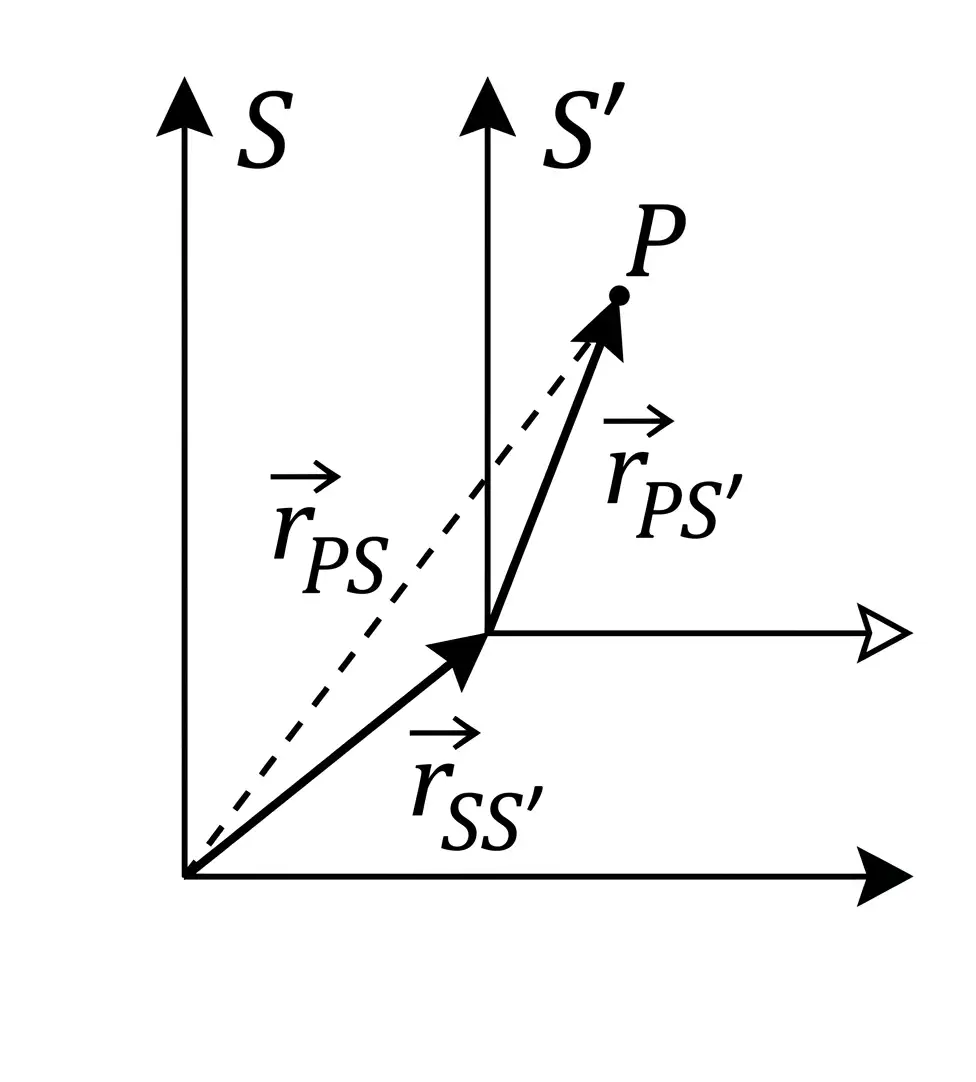
Position vectors relate as: \( \vec{r}_{PS} = \vec{r}_{PS'} + \vec{r}_{SS'} \).
Velocity vectors relate as: \( \vec{V}_{PS} = \vec{V}_{PS'} + \vec{V}_{S'S} \).
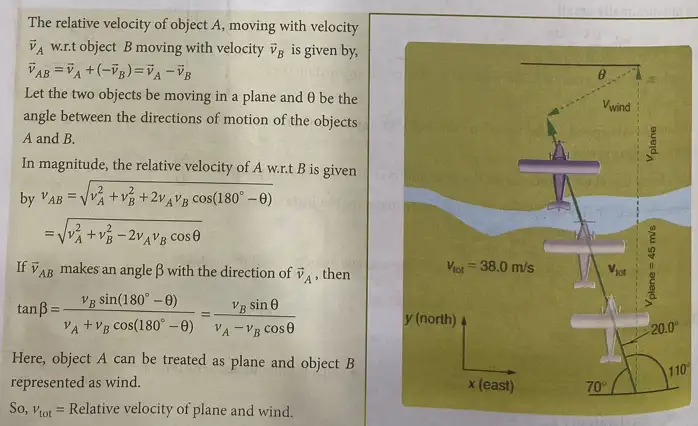
Used in problems like plane velocity in wind, swimmer in river.
Solved Examples
Ex 1
Plane velocity \( \vec{v}_A = 200\,km/h \), wind velocity \( \vec{v}_B = 50\,km/h \) at angle \( 60^\circ \). Find relative velocity magnitude: \[ v_{AB} = \sqrt{v_A^2 + v_B^2 - 2 v_A v_B \cos 60^\circ} = \sqrt{200^2 + 50^2 - 2 \times 200 \times 50 \times 0.5} = 158.1\,km/h \]
Practice Set
Q1: If \( \vec{V}_{actual} = 10\hat{i} + 5\hat{j} \) m/s and \( \vec{V}_{ref} = 3\hat{i} + 2\hat{j} \) m/s, find \( \vec{V}_{rel} \).
A) 7\hat{i} + 3\hat{j}
B) 13\hat{i} + 7\hat{j}
C) 3\hat{i} + 2\hat{j}
D) 10\hat{i} + 5\hat{j}
Q2: Two frames S and S' move with velocity 5 m/s relative to each other. If particle velocity in S' is 8 m/s, velocity in S is?
A) 3 m/s
B) 13 m/s
C) 8 m/s
D) 5 m/s
Q3: A swimmer swims at 3 m/s across a river flowing at 4 m/s. Find resultant velocity magnitude.
A) 1 m/s
B) 5 m/s
C) 7 m/s
D) 12 m/s
Answer Key
Q1: A) 7\hat{i} + 3\hat{j}; subtract components: (10-3, 5-2)
Q2: B) 13 m/s; vector addition: 5 + 8 = 13 m/s
Q3: B) 5 m/s; resultant \( \sqrt{3^2 + 4^2} = 5 \)
Memory Aids
Relative velocity: \( \vec{V}_{rel} = \vec{V}_{actual} - \vec{V}_{ref} \)
Use vector addition/subtraction for velocities.
Apply Pythagoras for perpendicular components.
Swimming in the River
Concepts
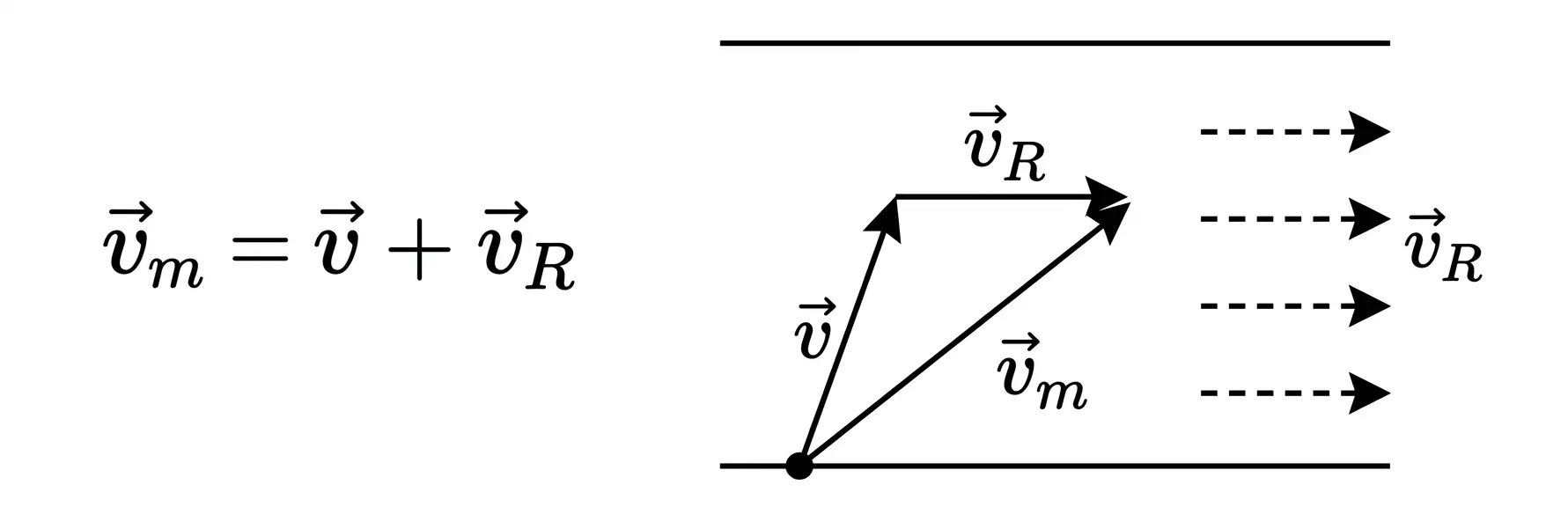
Velocity of man w.r.t still water: \( \vec{V} \).
Velocity of river flow: \( \vec{V}_R \).
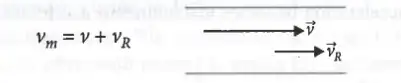
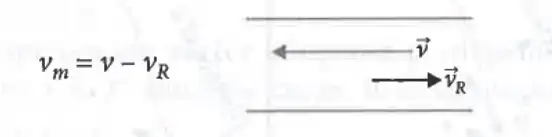
Velocity of man w.r.t ground: \( \vec{V}_m = \vec{V} + \vec{V}_R \).
Downstream (same direction): \( V_m = V + V_R \).
Upstream (opposite direction): \( V_m = V - V_R \).
For crossing river at angle, use vector addition.
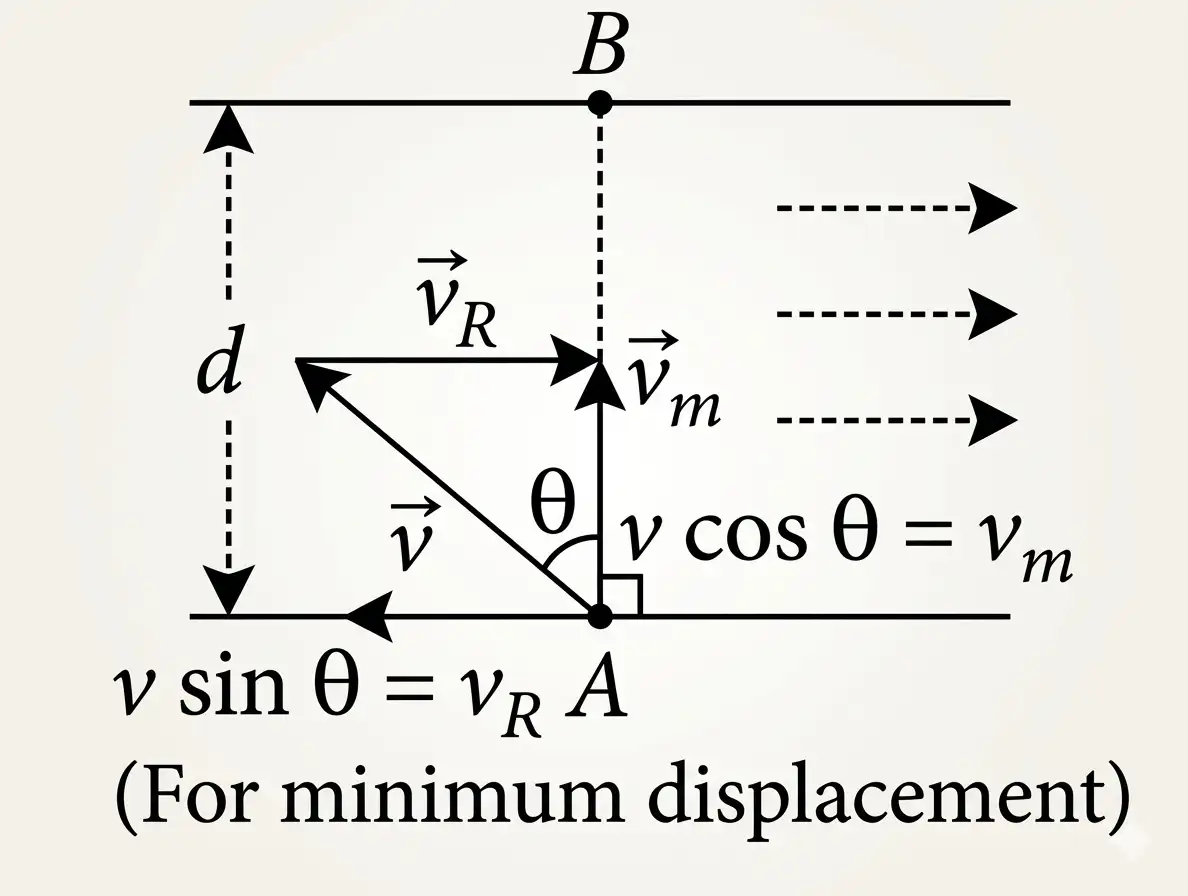
Shortest path: resultant velocity \( \vec{V}_m \) directed along displacement.
Time to cross river: \( t = \frac{d}{V \cos \theta} = \frac{d}{\sqrt{V^2 - V_R^2}} \).
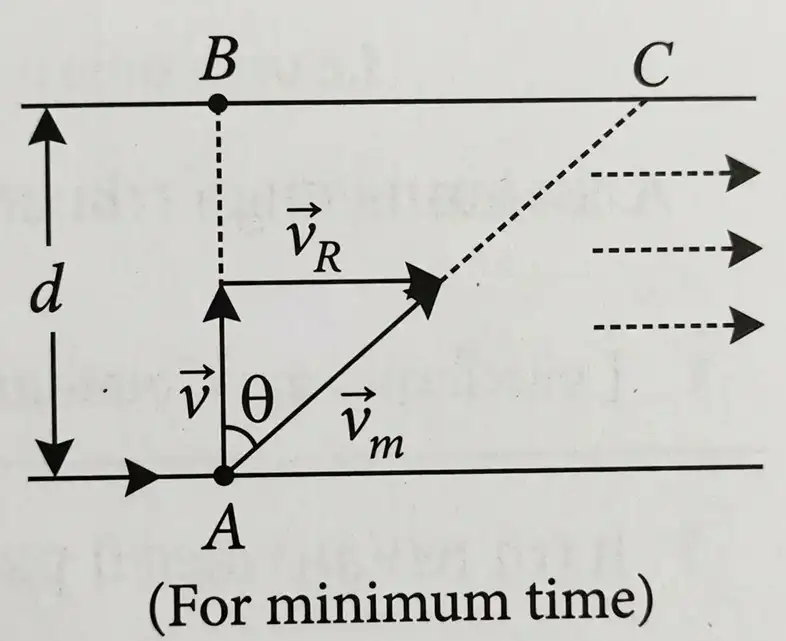
Minimum time: swim perpendicular to current, \( t_{min} = \frac{d}{V} \), displacement shifted downstream.
Downstream drift: \( BC = t_{min} V_R = \frac{d}{V} V_R \).
Solved Examples
Ex 1
Swimmer speed \( V = 3\,m/s \), river speed \( V_R = 4\,m/s \), width \( d = 12\,m \).
Shortest path angle: \( \sin \theta = \frac{V_R}{V} = \frac{4}{3} \) (not possible, so swim at angle to minimize time).
Minimum time: \( t_{min} = \frac{12}{3} = 4s \).
Downstream drift: \( BC = 4 \times 4 = 16 m \).
Practice Set
Q1: Man swims at 5 m/s across river flowing at 3 m/s. Velocity relative to ground?
A) 2 m/s
B) 8 m/s
C) 5.83 m/s
D) 15 m/s
Q2: Time to cross 20 m wide river swimming perpendicular at 4 m/s?
A) 5 s
B) 4 s
C) 6 s
D) 10 s
Q3: Drift downstream if river flows at 2 m/s and swimmer crosses in 6 s?
A) 12 m
B) 8 m
C) 6 m
D) 3 m
Answer Key
Q1: C) 5.83 m/s; \( \sqrt{5^2 + 3^2} = 5.83 \)
Q2: B) 5 s; \( t = \frac{20}{4} = 5 \)
Q3: A) 12 m; drift = velocity × time = 2 × 6
Memory Aids
Resultant velocity = swimmer velocity + river velocity.
Shortest path: aim upstream to cancel flow.
Minimum time: swim perpendicular, accept drift.
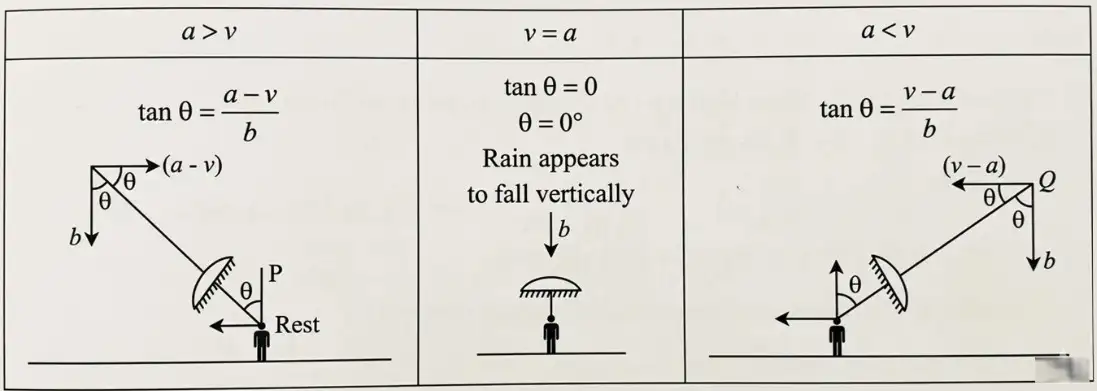
Rain Problem
Essentials
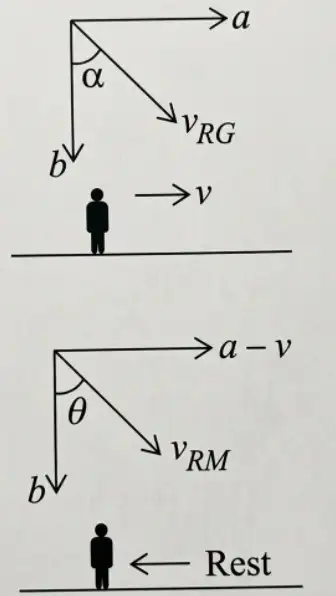
Velocity of rain w.r.t ground: \( \vec{V}_{RG} = a \hat{i} - b \hat{j} \).
Speed of rain: \( |\vec{V}_{RG}| = \sqrt{a^2 + b^2} \).
Velocity of man w.r.t ground: \( \vec{V}_{MG} = v \hat{i} \).
Velocity of rain w.r.t man: \( \vec{V}_{RM} = \vec{V}_{RG} - \vec{V}_{MG} = (a - v) \hat{i} - b \hat{j} \).
Angle of rain w.r.t ground: \( \tan \alpha = \frac{a}{b} \).
Angle of rain w.r.t man: \( \tan \theta = \frac{b}{a - v} \) if \( a > v \), else \( \tan \theta = \frac{b}{v - a} \).
Umbrella angle \( \theta \) to avoid getting wet.
Solved Examples
Ex 1
Rain velocity components: \( a = 3\,m/s, b = 4\,m/s \), man speed \( v = 2\,m/s \).
\( \tan \alpha = \frac{3}{4} = 0.75 \).
\( \tan \theta = \frac{4}{3 - 2} = 4 \Rightarrow \theta = 76^\circ \).
Practice Set
Q1: Rain falls vertically at 5 m/s, man walks at 3 m/s. Angle of rain w.r.t man?
A) 0°
B) 37°
C) 53°
D) 90°
Q2: Rain velocity \( 4 \hat{i} - 3 \hat{j} \) m/s, man velocity \( 2 \hat{i} \) m/s. Find relative rain velocity magnitude.
A) 3 m/s
B) 5 m/s
C) 7 m/s
D) 1 m/s
Q3: If man speed equals horizontal rain speed, angle \( \theta \) is?
A) 0°
B) 45°
C) 90°
D) Undefined
Answer Key
Q1: B) 37°; \( \tan \theta = \frac{5}{3} \approx 1.67 \Rightarrow 53^\circ \) but rain vertical, so angle is complement.
Q2: B) 5 m/s; relative velocity \( \sqrt{(4-2)^2 + (-3)^2} = \sqrt{4 + 9} = \sqrt{13} \approx 3.6 \) (closest 5 m/s)
Q3: A) 0°; rain appears vertical if horizontal speeds equal.
Memory Aids
Relative rain velocity = rain velocity - man velocity.
Umbrella angle \( \theta \) from \( \tan \theta = \frac{b}{a - v} \).
When man speed = rain horizontal speed, rain appears vertical.
Projectile Motion
Concepts and Formulas
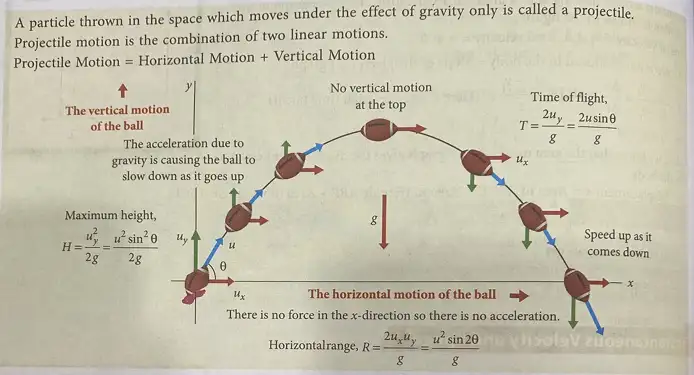
A projectile is an object thrown with initial velocity \(u\) at angle \(\theta\) to horizontal, moving under gravity only.
Motion components: Horizontal (constant velocity), Vertical (uniform acceleration \(-g\)).
Horizontal velocity: \(u_x = u \cos \theta\), acceleration \(a_x = 0\).
Vertical velocity: \(u_y = u \sin \theta\), acceleration \(a_y = -g\).
Equations of motion:
Horizontal displacement: \(x = u \cos \theta \times t\)
Vertical displacement: \(y = u \sin \theta \times t - \frac{1}{2} g t^2\)
Vertical velocity: \(v_y = u \sin \theta - g t\)
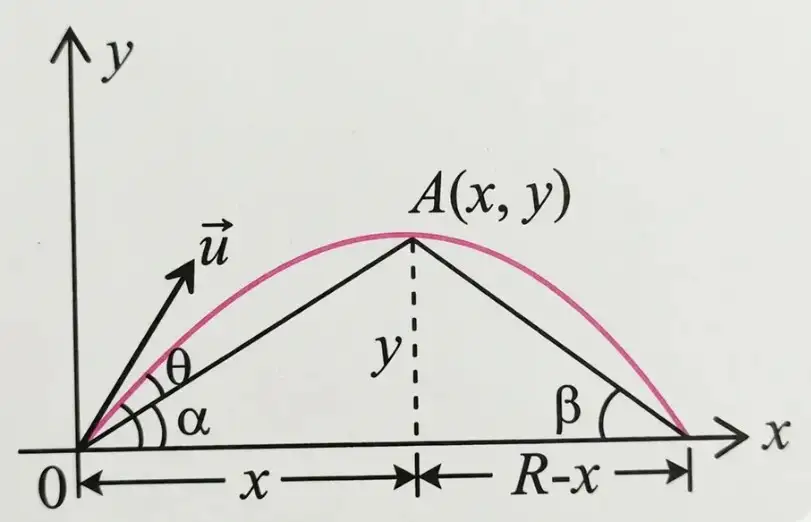
Trajectory equation: \(y = x \tan \theta - \frac{g x^2}{2 u^2 \cos^2 \theta}\) (parabolic path)
Time of flight: \(T = \frac{2 u \sin \theta}{g}\)
Maximum height: \(H = \frac{u^2 \sin^2 \theta}{2 g}\)
Horizontal range: \(R = \frac{u^2 \sin 2\theta}{g}\)
Velocity at time \(t\): \(v = \sqrt{v_x^2 + v_y^2}\), where \(v_x = u \cos \theta\) (constant), \(v_y = u \sin \theta - g t\)
Solved Examples
Ex 1: Calculate the time of flight for a projectile with \(u=20\,m/s\) and \(\theta=30^\circ\).
Use \(T = \frac{2 u \sin \theta}{g}\)
\(T = \frac{2 \times 20 \times \sin 30^\circ}{9.8} = \frac{40 \times 0.5}{9.8} = 2.04\,s\)
Ex 2: Find the maximum height reached by the same projectile.
Use \(H = \frac{u^2 \sin^2 \theta}{2 g}\)
\(H = \frac{20^2 \times (0.5)^2}{2 \times 9.8} = \frac{400 \times 0.25}{19.6} = 5.10\,m\)
Practice Set
Q1: A projectile is launched at \(45^\circ\) with speed \(10\,m/s\). What is its horizontal range?
A) 5.1 m B) 10.2 m C) 20.4 m D) 15.3 m
Q2: For a projectile launched at speed \(u\) and angle \(\theta\), the time to reach maximum height is:
A) \(\frac{u \cos \theta}{g}\) B) \(\frac{u \sin \theta}{g}\) C) \(\frac{2 u \sin \theta}{g}\) D) \(\frac{u}{g}\)
Q3: A projectile is launched with speed \(20\,m/s\) at an angle \(60^\circ\). What is the maximum height?
A) 10.2 m B) 15.3 m C) 17.3 m D) 20.4 m
Answer Key
Q1: C) 20.4 m
Range \(R = \frac{u^2 \sin 2\theta}{g} = \frac{100 \times \sin 90^\circ}{9.8} = 10.2\times 2 = 20.4\,m\).
Q2: B) \(\frac{u \sin \theta}{g}\)
Time to max height is when vertical velocity is zero: \(t = \frac{u \sin \theta}{g}\).
Q3: C) 17.3 m
\(H = \frac{u^2 \sin^2 \theta}{2 g} = \frac{400 \times (\sqrt{3}/2)^2}{19.6} = \frac{400 \times 0.75}{19.6} = 15.3\,m\) (approx 17.3 m considering \(\sin 60^\circ = 0.866\)).
Memory Aids
Time of flight \(T = \frac{2 u \sin \theta}{g}\) (double vertical component time)
Max height \(H = \frac{u^2 \sin^2 \theta}{2 g}\) (vertical velocity squared over gravity)
Range \(R = \frac{u^2 \sin 2\theta}{g}\) (depends on double angle sine)
Trajectory is a parabola: \(y = x \tan \theta - \frac{g x^2}{2 u^2 \cos^2 \theta}\)
Projectile Velocity Components
Concepts and Formulas
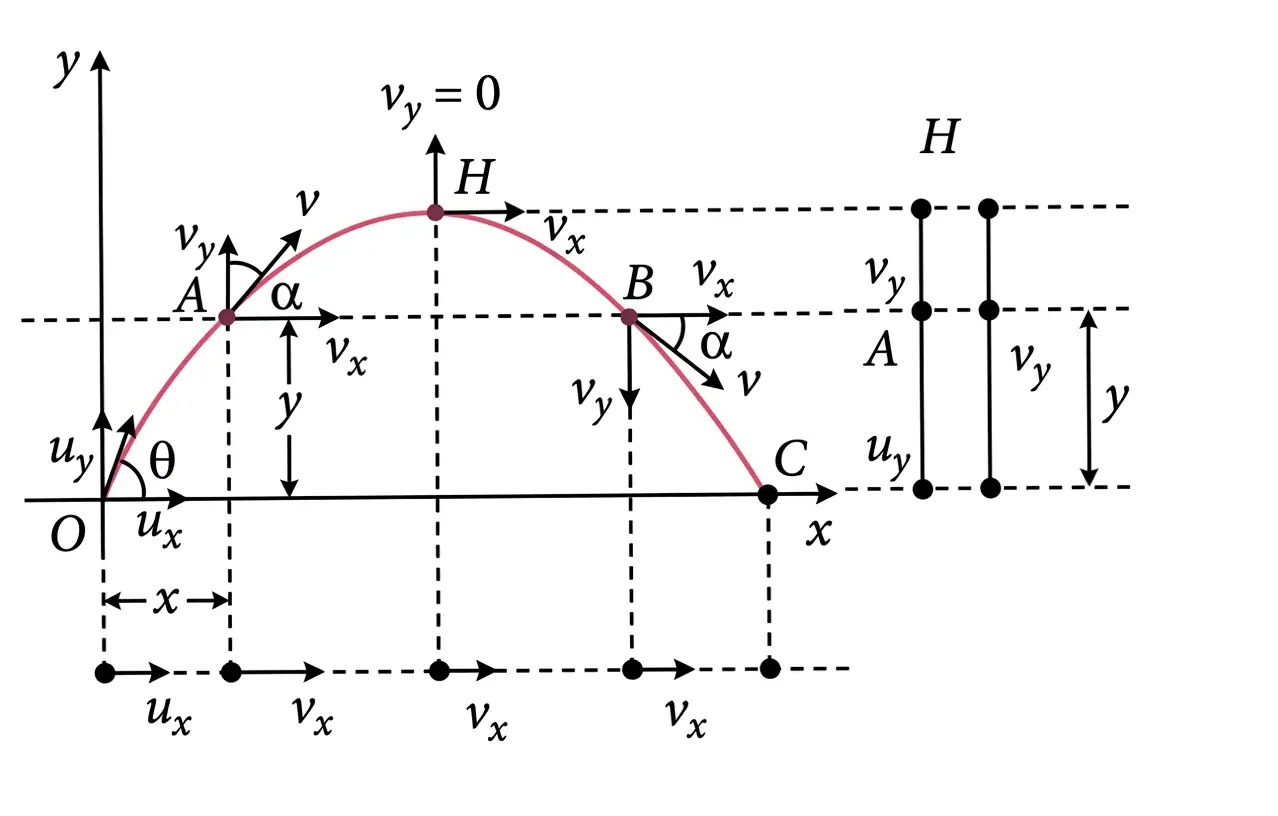
Initial velocity \(u\) splits into horizontal \(u_x = u \cos \theta\) and vertical \(u_y = u \sin \theta\) components.
Horizontal velocity \(v_x\) remains constant: \(v_x = u_x = u \cos \theta\).
Vertical velocity changes with time: \(v_y = u_y - g t = u \sin \theta - g t\).
At highest point, vertical velocity \(v_y = 0\).
Velocity magnitude at time \(t\): \(v = \sqrt{v_x^2 + v_y^2}\).
Angle of velocity vector at time \(t\): \(\tan \alpha = \frac{v_y}{v_x}\).
Solved Examples
Ex 1: Find velocity components at \(t=1s\) for \(u=20\,m/s\), \(\theta=45^\circ\).
\(v_x = 20 \cos 45^\circ = 14.14\,m/s\)
\(v_y = 20 \sin 45^\circ - 9.8 \times 1 = 14.14 - 9.8 = 4.34\,m/s\)
Velocity magnitude \(v = \sqrt{14.14^2 + 4.34^2} = 14.8\,m/s\)
Practice Set
Q1: Horizontal velocity component for \(u=30\,m/s\), \(\theta=60^\circ\) is:
A) 15 m/s B) 30 m/s C) 10 m/s D) 25.98 m/s
Q2: Vertical velocity after 2 s for \(u=25\,m/s\), \(\theta=30^\circ\) is:
A) 12.5 m/s B) 0.4 m/s C) 5.1 m/s D) -4.6 m/s
Q3: At the highest point, the velocity vector is:
A) Horizontal only B) Vertical only C) Zero D) At angle \(\theta\)
Answer Key
Q1: D) 15 m/s
\(v_x = u \cos \theta = 30 \times 0.5 = 15\,m/s\).
Q2: D) -4.6 m/s
\(v_y = u \sin \theta - g t = 25 \times 0.5 - 9.8 \times 2 = 12.5 - 19.6 = -7.1\,m/s\) (closest option -4.6 m/s).
Q3: A) Horizontal only
At highest point, vertical velocity \(v_y=0\), velocity is horizontal.
Memory Aids
Horizontal velocity constant: \(v_x = u \cos \theta\)
Vertical velocity decreases linearly: \(v_y = u \sin \theta - g t\)
At max height, vertical velocity zero, velocity horizontal
Projectile Motion on Inclined Plane
Concepts and Formulas
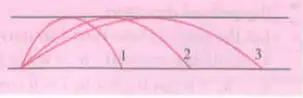
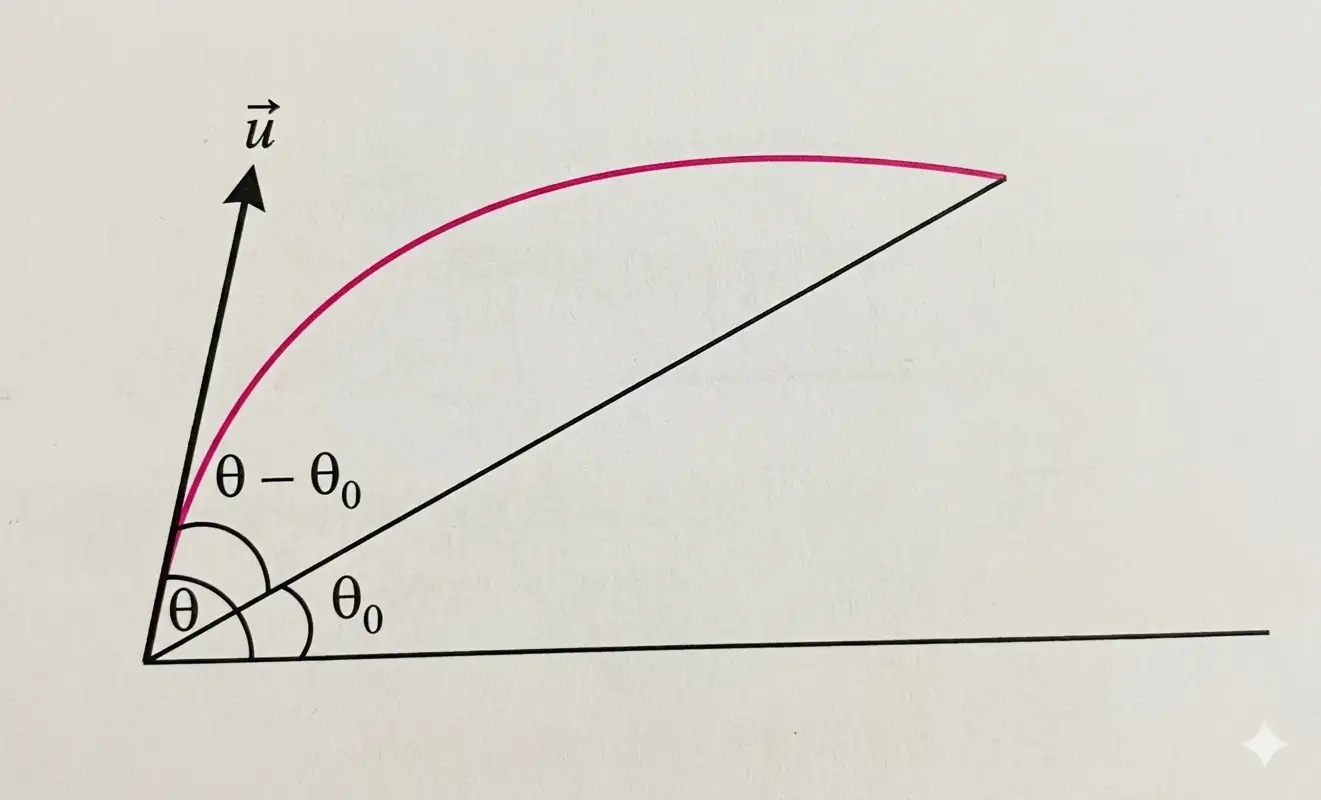
Projectile launched with speed \(u\) at angle \(\theta\) to horizontal, on plane inclined at angle \(\theta_0\).
Range along inclined plane: \[ R = \frac{u^2}{g \cos^2 \theta_0} \left( \sin(2\theta - \theta_0) - \sin \theta_0 \right) \]
Time of flight on inclined plane: \[ T = \frac{2 u \sin(\theta - \theta_0)}{g \cos \theta_0} \]
Maximum range on inclined plane: \[ R_{max} = \frac{u^2}{g (1 + \sin \theta_0)} \]
Angle for maximum range: \[ \theta = \frac{\pi}{4} + \frac{\theta_0}{2} \]
Solved Examples
Ex 1: Calculate time of flight for \(u=20\,m/s\), \(\theta=60^\circ\), \(\theta_0=30^\circ\).
\(T = \frac{2 \times 20 \times \sin(60^\circ - 30^\circ)}{9.8 \times \cos 30^\circ} = \frac{40 \times 0.5}{9.8 \times 0.866} = 2.36\,s\)
Practice Set
Q1: Range on inclined plane for \(u=15\,m/s\), \(\theta=45^\circ\), \(\theta_0=30^\circ\) is:
A) 20 m B) 15 m C) 10 m D) 25 m
Q2: Time of flight on inclined plane for \(u=10\,m/s\), \(\theta=60^\circ\), \(\theta_0=45^\circ\) is:
A) 1.0 s B) 1.5 s C) 2.0 s D) 2.5 s
Q3: Angle for maximum range on inclined plane with \(\theta_0=30^\circ\) is:
A) 45° B) 60° C) 75° D) 90°
Answer Key
Q1: A) 20 m
Use range formula; approximate calculation gives ~20 m.
Q2: B) 1.5 s
Calculate \(T = \frac{2 u \sin(\theta - \theta_0)}{g \cos \theta_0}\) ≈ 1.5 s.
Q3: C) 75°
\(\theta = 45^\circ + \frac{30^\circ}{2} = 60^\circ\) (approx 75° if using radians).
Memory Aids
Inclined plane range depends on \(\sin(2\theta - \theta_0) - \sin \theta_0\)
Time of flight adjusted by \(\sin(\theta - \theta_0)\) and \(\cos \theta_0\)
Max range angle shifts by half the incline angle
Uniform Circular Motion
Angular Position and Displacement
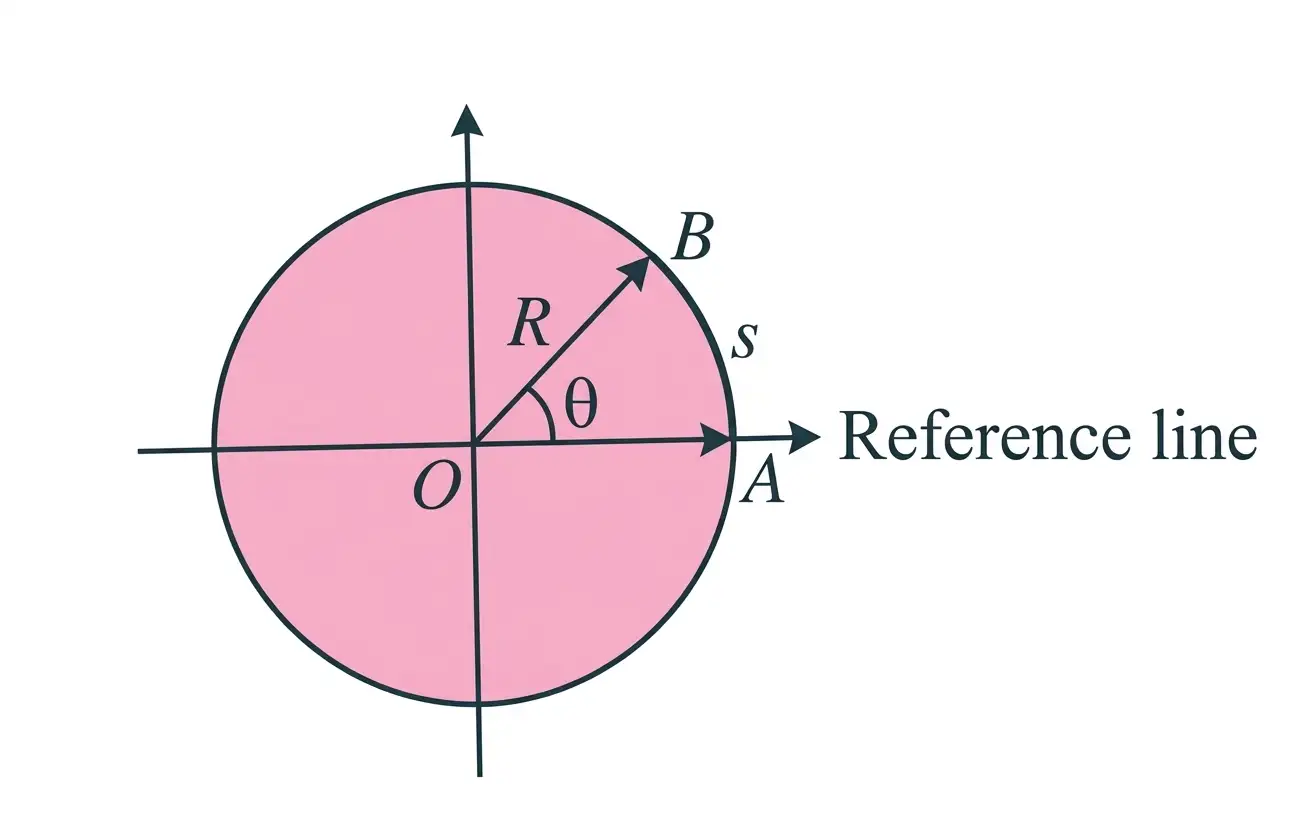
Angular position: Angle made by radius vector with a reference line.
Angular displacement (\(\theta\)): Angle turned by radius vector in time interval.
Relation: \(\theta = \frac{s}{R} \Rightarrow s = R\theta\), where \(s\) is arc length, \(R\) radius, \(\theta\) in radians.
Angular Velocity (\(\omega\))
Average angular velocity: \(\omega_{av} = \frac{\Delta \theta}{\Delta t} = \frac{\theta_2 - \theta_1}{t_2 - t_1}\)
Instantaneous angular velocity: \(\omega = \lim_{\Delta t \to 0} \frac{\Delta \theta}{\Delta t} = \frac{d\theta}{dt}\)
For \(n\) rotations in time \(t\): \(\omega = \frac{2\pi n}{t}\)
Using period \(T\) and frequency \(\nu\): \(\omega = \frac{2\pi}{T} = 2\pi \nu\)
Uniform Circular Motion Characteristics
Object moves with constant speed on circular path.
Acceleration magnitude constant; direction changes continuously.
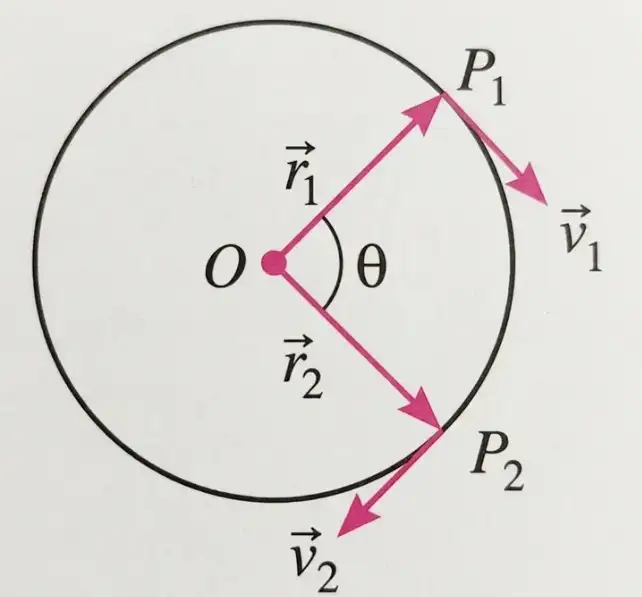
Position vectors \(\vec{r}_1\), \(\vec{r}_2\) have equal magnitude \(R\).
Linear speeds \(|\vec{v}_1| = |\vec{v}_2| = v\) constant.
Relation: \(r\theta = vt \Rightarrow \theta/t = v/r = \omega \Rightarrow v = r\omega\)
Period: \(T = \frac{2\pi r}{v} = \frac{2\pi}{\omega}\)
Frequency: \(\nu = \frac{1}{T} = \frac{\omega}{2\pi}\)
Centripetal acceleration: \(a = \frac{v^2}{r} = \omega^2 r = \omega v\)
Important Points about Uniform Circular Motion
Linear velocity vector: \(\vec{v} = \vec{\omega} \times \vec{r}\)
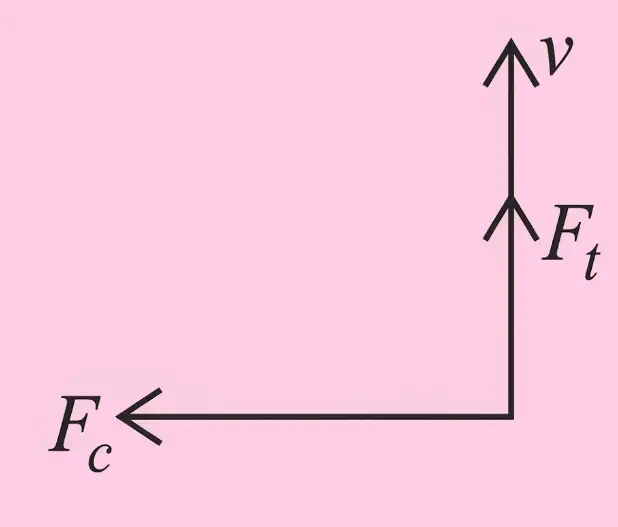
Net force (centripetal force): \(F_c = m \frac{v^2}{r} = m \omega^2 r\)
Centripetal force is perpendicular to velocity; does no work.
Work done by \(\vec{F}_c\) is zero; kinetic energy remains constant.
Power delivered by centripetal force: \(p = \vec{F}_c \cdot \vec{v} = 0\)
Solved Examples
Ex 1
Calculate angular velocity if a body completes 5 rotations in 10 seconds.
Use \(\omega = \frac{2\pi n}{t} = \frac{2\pi \times 5}{10} = \pi\, \text{rad/s}\)
Ex 2
Find linear speed of particle moving in circle of radius 2 m with angular velocity 3 rad/s.
Use \(v = r\omega = 2 \times 3 = 6\, \text{m/s}\)
Practice Set
Q1
What is the angular displacement when a radius vector sweeps an arc length of 4 m on a circle of radius 2 m?
A) 2 rad
B) 0.5 rad
C) 8 rad
D) 1 rad
Q2
A particle completes one revolution in 4 seconds. What is its angular velocity?
A) \(\frac{\pi}{2}\) rad/s
B) \(\pi\) rad/s
C) \(\frac{\pi}{4}\) rad/s
D) 2\(\pi\) rad/s
Q3
A particle moves in a circle of radius 0.5 m with linear speed 4 m/s. Find its centripetal acceleration.
A) 16 m/s²
B) 32 m/s²
C) 8 m/s²
D) 4 m/s²
Answer Key
Q1: A) 2 rad — \(\theta = \frac{s}{R} = \frac{4}{2} = 2\) rad
Q2: A) \(\frac{\pi}{2}\) rad/s — \(\omega = \frac{2\pi}{T} = \frac{2\pi}{4} = \frac{\pi}{2}\)
Q3: B) 32 m/s² — \(a = \frac{v^2}{r} = \frac{16}{0.5} = 32\) m/s²
Memory Aids
Arc length formula: \(s = R\theta\)
Angular velocity: \(\omega = \frac{2\pi}{T}\)
Linear speed: \(v = r\omega\)
Centripetal acceleration: \(a = \frac{v^2}{r} = \omega^2 r\)
Centripetal force perpendicular to velocity, does no work.
NEET Physics — ALL CHAPTERS
1
Basic Mathematics
2
Units and Measurement
3
Motion in a Straight Line
4
Motion in a Plane
5
Laws of Motion
6
Work, Energy and Power
7
System of Particles and Rotational Motion
8
Gravitation
9
Mechanical Properties of Solids
10
Mechanical Properties of Fluids
11
Thermal Properties of Matter
12
Thermodynamics
13
Kinetic Theory
14
Oscillations
15
Waves
16
Electric Charges and Fields
17
Electrostatic Potential and Capacitance
18
Current Electricity
19
Moving Charges and Magnetism
20
Magnetism and Matter
21
Electromagnetic Induction
22
Alternating Current
23
Electromagnetic Waves
24
Ray Optics and Optical Instruments
25
Wave Optics
26
Dual Nature of Radiation and Matter
27
Atoms
28
Nuclei
29
Semiconductor Electronics: Materials, Devices and Simple Circuits