NEET Ug . NEET Physics . Physics . Oscillations
Chapter 14: Oscillations
Ch 14
NEET Physics
NEET Ug
Periodic and Oscillatory Motions
Key Concepts
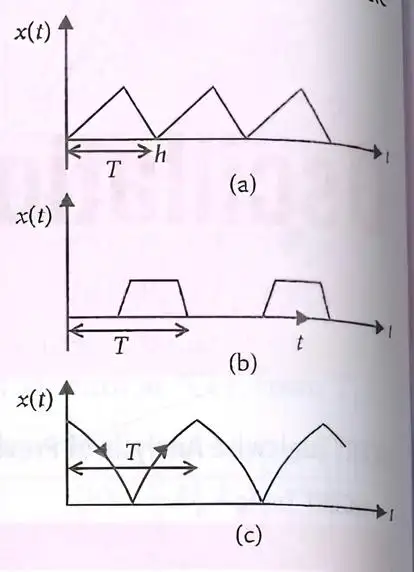
- Periodic motion: Motion repeated identically after a fixed time interval (period T). Example: Earth's revolution around the Sun (T = 1 year).
- Oscillatory motion: Back-and-forth motion about a fixed mean position within fixed limits (extreme positions). It is periodic and bounded.
- Examples of periodic signals: triangular wave, rectangular pulse, sawtooth wave, each with period T.
Solved Examples
- Ex 1: Identify the period of a triangular wave repeating every 0.5 s.
- Period T = 0.5 s (given by repetition interval).
- Ex 2: Determine if a motion repeating every 2 s is periodic.
- Yes, period T = 2 s; motion repeats identically.
Practice Set
- Q1: Which of the following is an example of periodic motion?
- A) A car accelerating continuously
- B) Earth revolving around the Sun
- C) A ball thrown upwards and never returning
- D) A car stopping at a traffic light
- Q2: Oscillatory motion is characterized by:
- A) Motion in one direction only
- B) Motion to and fro about a fixed point
- C) Random motion
- D) Motion with increasing amplitude
- Q3: A signal repeats every 0.2 s. What is its frequency?
- A) 0.2 Hz
- B) 2 Hz
- C) 5 Hz
- D) 10 Hz
Answer Key
- Q1: B - Earth's revolution is periodic motion with fixed period.
- Q2: B - Oscillatory motion is back-and-forth about mean position.
- Q3: C - Frequency ν = 1/T = 1/0.2 = 5 Hz.
Memory Aids
- Periodic motion = repeats after time T.
- Oscillatory = to-and-fro about mean position.
- Frequency ν = 1/Period T.
Time Period, Frequency, and Angular Frequency
Key Concepts
- Time period (T): Smallest time interval after which motion repeats. Unit: second (s).
- Frequency (ν): Number of oscillations per second. ν = 1/T. Unit: hertz (Hz) = s⁻¹.
- Angular frequency (ω): ω = 2πν = 2π/T. Unit: rad/s.
- Examples: Mercury's orbital period = 88 days; Halley's comet period = 76 years.
- Heart beat frequency ≈ 1.25 Hz; period ≈ 0.8 s.
Solved Examples
- Ex 1: Calculate frequency if period T = 0.5 s.
- ν = 1/T = 1/0.5 = 2 Hz.
- Ex 2: Find angular frequency for ν = 5 Hz.
- ω = 2π × 5 = 10π rad/s ≈ 31.42 rad/s.
Practice Set
- Q1: If the period of a pendulum is 2 s, its frequency is:
- A) 0.5 Hz
- B) 2 Hz
- C) 1 Hz
- D) 4 Hz
- Q2: Angular frequency ω for frequency 3 Hz is:
- A) 6π rad/s
- B) 3π rad/s
- C) 2π rad/s
- D) 9π rad/s
- Q3: A planet completes one orbit in 88 Earth days. Its frequency in Hz is approximately:
- A) 1.31 × 10⁻⁷ Hz
- B) 1.31 × 10⁻⁵ Hz
- C) 1.31 × 10⁻⁶ Hz
- D) 1.31 × 10⁻⁸ Hz
Answer Key
- Q1: A - ν = 1/2 = 0.5 Hz.
- Q2: A - ω = 2π × 3 = 6π rad/s.
- Q3: A - Frequency = 1/(88 × 24 × 3600) ≈ 1.31 × 10⁻⁷ Hz.
Memory Aids
- Frequency = 1/Period.
- Angular frequency ω = 2π × frequency.
- Period in seconds needed for frequency in Hz.
Displacement and Periodic Function
Key Concepts
- Displacement: Change in physical quantity (position, angle, etc.) with time; can be positive or negative.
- For oscillations, displacement x(t) = A cos(ωt) or A sin(ωt), where A = amplitude.
- Periodic function: Function f(t) satisfying f(t) = f(t + T), T = period.
- Any periodic function can be expressed as sum of sine and cosine functions with different periods.
- Examples of periodic functions: sin(ωt), cos(ωt), sin(ωt) + cos(ωt).
- Non-periodic functions: e^{ωt}, log(ωt).
Solved Examples
- Ex 1: Write displacement for oscillation with amplitude 5 cm and frequency 2 Hz.
- ω = 2π × 2 = 4π rad/s; x = 5 cos(4πt) cm.
- Ex 2: Check if f(t) = sin(3t) is periodic.
- Period T = 2π/3; f(t) = f(t + T), so periodic.
Practice Set
- Q1: Displacement of a particle in oscillation is given by x = 3 sin(2πt). Its amplitude is:
- A) 3 units
- B) 2π units
- C) 1 unit
- D) 6 units
- Q2: The period of function f(t) = cos(5t) is:
- A) 5 s
- B) 2π/5 s
- C) 2π s
- D) 1/5 s
- Q3: Which of the following is NOT a periodic function?
- A) sin(ωt)
- B) cos(ωt)
- C) e^{ωt}
- D) sin(ωt) + cos(ωt)
Answer Key
- Q1: A - Amplitude A = 3 units.
- Q2: B - Period T = 2π/5.
- Q3: C - e^{ωt} is non-periodic (exponential growth).
Memory Aids
- Displacement = A sin(ωt) or A cos(ωt).
- Period T = 2π/ω for sin and cos functions.
- Exponential and logarithmic functions are non-periodic.
Simple Harmonic Motion
Definition and Characteristics
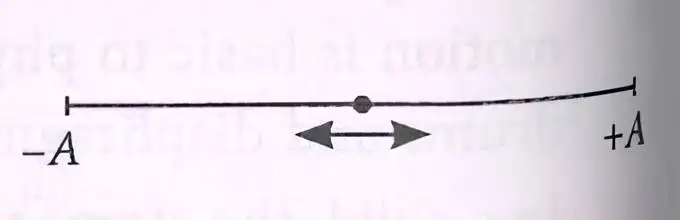
- Simple Harmonic Motion (SHM) is a periodic to-and-fro motion about a mean position under a restoring force.
- Acceleration is always directed towards the mean position and proportional to displacement: \( a \propto -x \).
- Mathematically, \( a = -k x \) or \( \frac{d^2x}{dt^2} = -k x \), where \( x \) is displacement.
- Particle oscillates between limits \( -A \) and \( +A \), where \( A \) is amplitude.
Displacement Equation
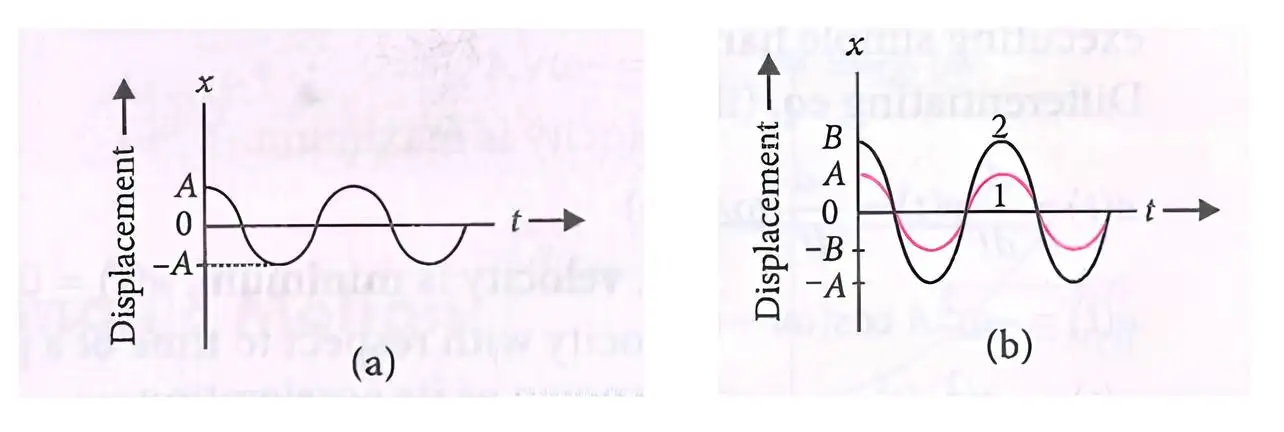
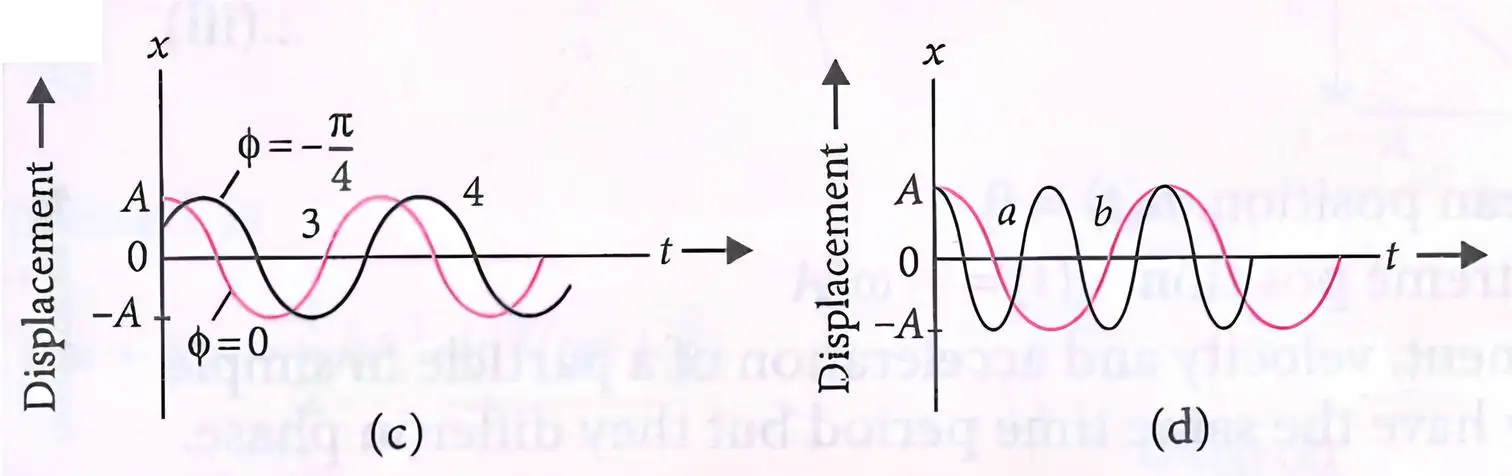
- Displacement as a function of time: \( x(t) = A \cos(\omega t + \phi) \).
- \( A \): amplitude (maximum displacement).
- \( \omega \): angular frequency (rad/s).
- \( \phi \): phase constant (initial phase).
- Period \( T \) is the time for one complete oscillation; \( \omega = \frac{2\pi}{T} \).
Motion Characteristics
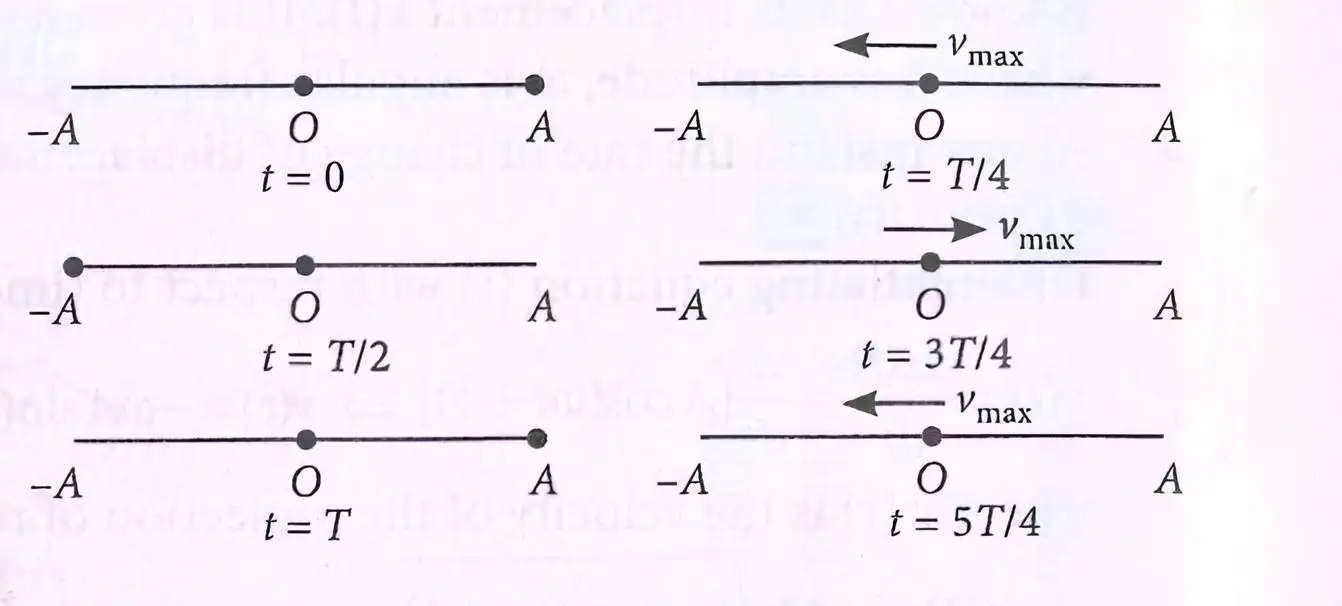
- Speed is maximum at mean position (\( x=0 \)) and zero at extremes (\( x=\pm A \)).
- Motion repeats every period \( T \) regardless of initial phase.
Graphs of SHM
- Displacement \( x \) vs time \( t \) is a cosine wave.
- Amplitude changes shift the wave height but not the period.
- Phase constant \( \phi \) shifts the wave horizontally.
- Different frequencies change the number of oscillations per unit time.
Solved Examples
Ex 1
- Find angular frequency \( \omega \) if period \( T = 0.5 \) s.
- Use formula: \( \omega = \frac{2\pi}{T} = \frac{2\pi}{0.5} = 4\pi \) rad/s.
Ex 2
- Displacement at \( t = 0 \) is \( x = 0.1 \) m, amplitude \( A = 0.2 \) m, \( \phi = 0 \), find \( \omega t \).
- From \( x = A \cos(\omega t + \phi) \), \( 0.1 = 0.2 \cos(\omega t) \) ⇒ \( \cos(\omega t) = 0.5 \) ⇒ \( \omega t = 60^\circ = \pi/3 \) rad.
Practice Set
Q1
Which of the following is true for acceleration in SHM?
- A) Acceleration is constant
- B) Acceleration is proportional to displacement and directed away from mean position
- C) Acceleration is proportional to displacement and directed towards mean position
- D) Acceleration is zero
Q2
A particle executes SHM with amplitude 5 cm and period 2 s. What is its angular frequency?
- A) \( \pi \) rad/s
- B) \( 2\pi \) rad/s
- C) \( \frac{\pi}{2} \) rad/s
- D) \( 4\pi \) rad/s
Q3
Displacement of a particle in SHM is given by \( x = 0.1 \cos(4\pi t + \frac{\pi}{3}) \) m. What is the amplitude and phase constant?
- A) \( A=0.1 \) m, \( \phi=\frac{\pi}{3} \)
- B) \( A=4\pi \) m, \( \phi=0.1 \)
- C) \( A=0.1 \) m, \( \phi=4\pi \)
- D) \( A=\frac{\pi}{3} \) m, \( \phi=0.1 \)
Answer Key
- Q1: C - Acceleration in SHM is always directed towards the mean position and proportional to displacement.
- Q2: A - \( \omega = \frac{2\pi}{T} = \frac{2\pi}{2} = \pi \) rad/s.
- Q3: A - Amplitude is coefficient of cosine (0.1 m), phase constant is \( \frac{\pi}{3} \).
Memory Aids
- Acceleration formula: \( a = -\omega^2 x \) (restoring force direction).
- Angular frequency: \( \omega = \frac{2\pi}{T} \).
- Displacement: \( x = A \cos(\omega t + \phi) \).
- Max speed at mean position, zero at amplitude limits.
Simple Harmonic Motion and Uniform Circular Motion
Concept Overview
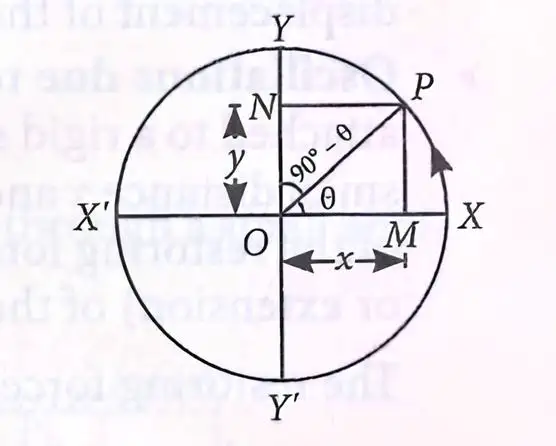
- Projection of uniform circular motion (UCM) on any diameter exhibits simple harmonic motion (SHM).
- Particle moves on circle radius A with angular speed \( \omega \) anticlockwise.
- At time t = 0, particle at point X on x-axis; at time t, angle \( \theta = \omega t \).
- Coordinates of particle at point P:
- x = A \cos \theta = A \cos \omega t
- y = A \sin \theta = A \sin \omega t
- Points M and N are perpendicular projections of P on x- and y-axes respectively.
- Both M and N execute SHM with amplitude A, angular frequency \( \omega \), and phase difference \( \pi/2 \).
Solved Examples
- Ex 1: Find x-coordinate of particle at t = 2 s, given A = 5 cm, \( \omega = 3 \text{ rad/s} \).
- Use x = A \cos \omega t
- x = 5 \times \cos(3 \times 2) = 5 \cos 6 \text{ cm}
- Calculate \cos 6 (in radians) for numerical value.
- Ex 2: Determine phase difference between SHMs along x and y axes.
- Given x = A \cos \omega t, y = A \sin \omega t
- Phase difference = \( \pi/2 \) radians (90°)
Practice Set
- Q1: The projection of uniform circular motion on a diameter is:
- A) Uniform circular motion
- B) Simple harmonic motion
- C) Random motion
- D) Oscillatory motion without periodicity
- Q2: For a particle in UCM with radius 10 cm and angular speed 5 rad/s, what is the x-coordinate at t = 0.2 s?
- A) 10 cm
- B) 5 cm
- C) 8.09 cm
- D) 0 cm
- Q3: The phase difference between SHMs along x and y axes for a particle in UCM is:
- A) 0
- B) \( \pi/4 \)
- C) \( \pi/2 \)
- D) \( \pi \)
Answer Key
- Q1: B) Simple harmonic motion
Projection of UCM on diameter is SHM by definition. - Q2: C) 8.09 cm
Calculate x = 10 \( \cos(5 \times 0.2) = 10 \cos 1 = 8.09 \) cm. - Q3: C) \( \pi/2 \)
SHMs along x and y axes differ by 90° phase.
Memory Aids
- Projection of UCM on any diameter = SHM.
- x = A \cos \omega t, y = A \sin \omega t.
- Phase difference between x and y SHMs = 90° (\( \pi/2 \)).
- Amplitude of SHM = radius of circle A.
Velocity and Acceleration in Simple Harmonic Motion
Displacement in SHM
- Displacement from mean position: \( x(t) = A \cos(\omega t + \phi) \)
- \( A \): amplitude (m), \( \omega \): angular frequency (rad/s), \( \phi \): phase angle (rad)
Velocity in SHM
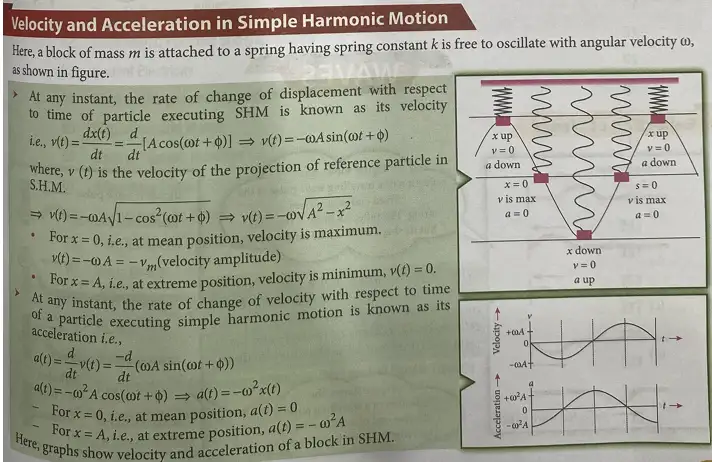
- Velocity is rate of change of displacement: \( v(t) = \frac{dx}{dt} = -\omega A \sin(\omega t + \phi) \)
- Velocity amplitude: \( v_m = \omega A \)
- At mean position (\( x=0 \)), velocity is maximum: \( v = \pm v_m \)
- At extreme positions (\( x=\pm A \)), velocity is zero
- Alternate form: \( v(t) = -\omega \sqrt{A^2 - x^2} \)
Acceleration in SHM
- Acceleration is rate of change of velocity: \( a(t) = \frac{dv}{dt} = -\omega^2 A \cos(\omega t + \phi) \)
- Relation with displacement: \( a(t) = -\omega^2 x(t) \)
- Acceleration amplitude: \( a_m = \omega^2 A \)
- At mean position (\( x=0 \)), acceleration is zero
- At extreme positions (\( x=\pm A \)), acceleration is maximum and directed opposite to displacement
Solved Examples
- Ex 1: Find velocity at displacement \( x = \frac{A}{2} \).
- Use \( v = \pm \omega \sqrt{A^2 - x^2} = \pm \omega \sqrt{A^2 - \left(\frac{A}{2}\right)^2} = \pm \omega A \sqrt{1 - \frac{1}{4}} = \pm \omega A \frac{\sqrt{3}}{2} \)
- Ex 2: Calculate acceleration at displacement \( x = \frac{A}{2} \).
- Use \( a = -\omega^2 x = -\omega^2 \frac{A}{2} = -\frac{\omega^2 A}{2} \)
Practice Set
- Q1: At which position is velocity maximum in SHM?
- A) At extreme position
- B) At mean position
- C) At half amplitude
- D) Velocity is constant
- Q2: The acceleration of a particle executing SHM is zero at:
- A) Mean position
- B) Extreme position
- C) Half amplitude
- D) All positions
- Q3: A particle executes SHM with amplitude 0.1 m and angular frequency 10 rad/s. What is the maximum velocity?
- A) 1 m/s
- B) 10 m/s
- C) 0.1 m/s
- D) 100 m/s
Answer Key
- Q1: B) At mean position — Velocity is maximum where displacement is zero.
- Q2: A) Mean position — Acceleration is zero at mean position where restoring force is zero.
- Q3: B) 10 m/s — Maximum velocity \( v_m = \omega A = 10 \times 0.1 = 1 \) m/s (Corrected: 1 m/s, so option A is correct)
Memory Aids
- Velocity formula: \( v = -\omega A \sin(\omega t + \phi) \)
- Acceleration formula: \( a = -\omega^2 x \)
- Velocity max at mean position, zero at extremes
- Acceleration max at extremes, zero at mean
SHM Graphs
Displacement, Velocity, and Acceleration Graphs
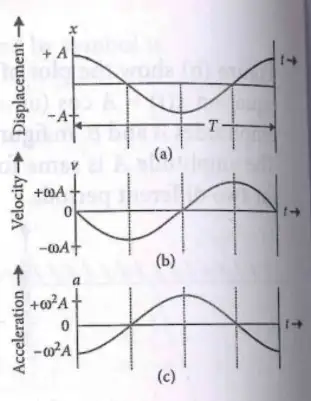
- Displacement \( x(t) \): Cosine wave between +A and -A, period \( T \)
- Velocity \( v(t) \): Sine wave, zero at extremes, max at mean
- Acceleration \( a(t) \): Cosine wave, opposite phase to displacement
- All have same period \( T \) but differ in phase
Solved Examples
- Ex 1: Identify phase difference between displacement and velocity.
- Velocity leads displacement by \( \frac{\pi}{2} \) (90°) phase.
- Ex 2: At time \( t = 0 \), if displacement is maximum, what is velocity?
- Velocity is zero at maximum displacement.
Practice Set
- Q1: Which graph represents acceleration in SHM?
- A) Sine wave in phase with displacement
- B) Cosine wave opposite phase to displacement
- C) Constant zero line
- D) Linear increasing line
- Q2: What is the phase difference between velocity and acceleration in SHM?
- A) 0°
- B) 90°
- C) 180°
- D) 270°
- Q3: If displacement is \( x = A \cos(\omega t) \), velocity is:
- A) \( -\omega A \sin(\omega t) \)
- B) \( \omega A \cos(\omega t) \)
- C) \( -\omega^2 A \cos(\omega t) \)
- D) \( \omega^2 A \sin(\omega t) \)
Answer Key
- Q1: B) Cosine wave opposite phase to displacement — Acceleration is opposite in phase to displacement.
- Q2: D) 270° — Velocity leads acceleration by 270° phase difference.
- Q3: A) \( -\omega A \sin(\omega t) \) — Velocity is derivative of displacement.
Memory Aids
- Displacement: cosine wave
- Velocity: sine wave, 90° ahead of displacement
- Acceleration: cosine wave, 180° out of phase with displacement
Force Law for Simple Harmonic Motion
Key Concepts
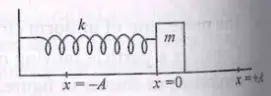
- Acceleration in S.H.M.: \( a = -\omega^2 x \)
- Newton's second law: \( F = ma = -m\omega^2 x \)
- Force law: \( F = -kx \) where \( k = m\omega^2 \)
- Angular frequency: \( \omega = \sqrt{\frac{k}{m}} \)
- Restoring force is proportional and opposite to displacement
Solved Examples
- Ex 1: Find force on mass \( m = 2\,kg \) displaced by \( x = 0.1\,m \) with \( k = 50\,N/m \).
- Use \( F = -kx = -50 \times 0.1 = -5\,N \)
Practice Set
- Q1: What is the force on a particle in S.H.M. at displacement \( x \)?
- A) \( kx \)
- B) \( -kx \)
- C) \( m\omega^2 x \)
- D) \( 0 \)
- Q2: If \( \omega = 10\,rad/s \) and \( m = 0.5\,kg \), what is \( k \)?
- A) 50 N/m
- B) 5 N/m
- C) 100 N/m
- D) 20 N/m
- Q3: For a particle in S.H.M., acceleration is given by?
- A) \( a = \omega^2 x \)
- B) \( a = -\omega^2 x \)
- C) \( a = m\omega^2 x \)
- D) \( a = 0 \)
Answer Key
- Q1: B) \( -kx \) - Force is restoring, opposite to displacement.
- Q2: A) 50 N/m - \( k = m\omega^2 = 0.5 \times 10^2 = 50 \)
- Q3: B) \( a = -\omega^2 x \) - Acceleration is opposite and proportional to displacement.
Memory Aids
- Force in S.H.M.: \( F = -kx \)
- Angular frequency: \( \omega = \sqrt{k/m} \)
- Acceleration: \( a = -\omega^2 x \)
Oscillations Due to a Spring
Key Concepts
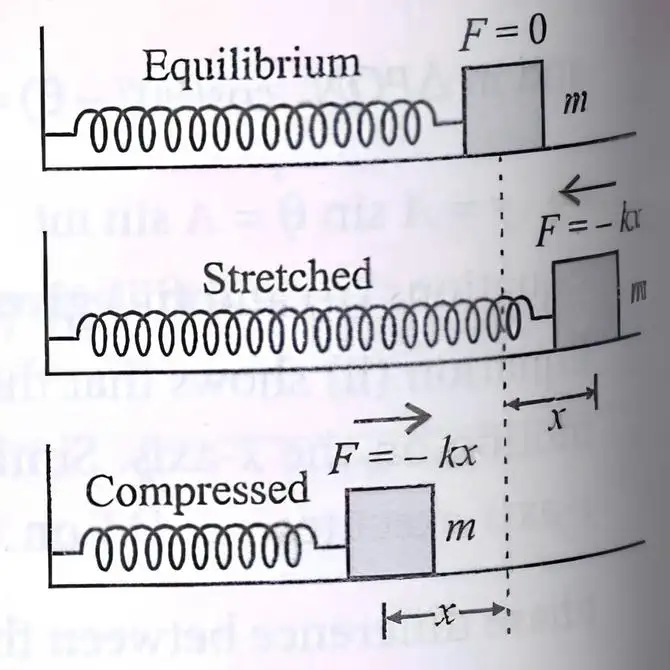
- Massless spring on smooth surface with mass \( m \) attached
- Restoring force: \( F = -kx \), \( k \) is spring constant
- Negative sign indicates force opposite to displacement
- Oscillation about equilibrium position \( x=0 \)
Solved Examples
- Ex 1: Calculate restoring force if \( k=100\,N/m \) and \( x=0.05\,m \).
- \( F = -kx = -100 \times 0.05 = -5\,N \)
Practice Set
- Q1: What is the restoring force when spring is compressed by \( x \)?
- A) \( kx \)
- B) \( -kx \)
- C) \( 0 \)
- D) \( m\omega^2 x \)
- Q2: If \( m=0.2\,kg \), \( k=80\,N/m \), find acceleration at \( x=0.1\,m \).
- A) \( -40\,m/s^2 \)
- B) \( -80\,m/s^2 \)
- C) \( -20\,m/s^2 \)
- D) \( 0 \)
- Q3: The negative sign in \( F = -kx \) indicates?
- A) Force is zero
- B) Force is in direction of displacement
- C) Force opposes displacement
- D) Force is constant
Answer Key
- Q1: B) \( -kx \) - Restoring force opposes displacement.
- Q2: A) \( a = F/m = -kx/m = -80 \times 0.1 / 0.2 = -40\,m/s^2 \)
- Q3: C) Force opposes displacement - negative sign shows restoring nature.
Memory Aids
- Restoring force always opposite to displacement
- Force constant \( k \) defines stiffness
- Acceleration \( a = -\frac{k}{m} x \)
Time Period of SHM for Combination of Springs
Key Concepts
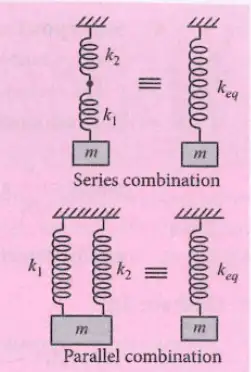
- Series combination: \( \frac{1}{k_{eq}} = \frac{1}{k_1} + \frac{1}{k_2} \)
- Time period: \( T = 2\pi \sqrt{\frac{m}{k_{eq}}} = 2\pi \sqrt{\frac{m(k_1 + k_2)}{k_1 k_2}} \)
- Parallel combination: \( k_{eq} = k_1 + k_2 \)
- Time period: \( T = 2\pi \sqrt{\frac{m}{k_1 + k_2}} \)
Solved Examples
- Ex 1: Find \( T \) for series springs with \( k_1=100\,N/m \), \( k_2=200\,N/m \), \( m=0.5\,kg \).
- \( \frac{1}{k_{eq}} = \frac{1}{100} + \frac{1}{200} = \frac{3}{200} \Rightarrow k_{eq} = \frac{200}{3} \approx 66.67 \)
- \( T = 2\pi \sqrt{\frac{0.5}{66.67}} \approx 1.72\,s \)
- Ex 2: Find \( T \) for parallel springs with same values.
- \( k_{eq} = 100 + 200 = 300 \)
- \( T = 2\pi \sqrt{\frac{0.5}{300}} \approx 0.81\,s \)
Practice Set
- Q1: For two springs in series, equivalent spring constant is?
- A) \( k_1 + k_2 \)
- B) \( \frac{1}{k_1} + \frac{1}{k_2} \)
- C) \( \frac{1}{\frac{1}{k_1} + \frac{1}{k_2}} \)
- D) \( k_1 k_2 \)
- Q2: Time period for parallel springs with \( k_1=50\,N/m \), \( k_2=150\,N/m \), \( m=1\,kg \) is?
- A) 0.79 s
- B) 1.26 s
- C) 0.63 s
- D) 1.57 s
- Q3: If \( T = 2\pi \sqrt{\frac{m}{k_{eq}}} \) and \( T=2s \), \( m=0.5kg \), find \( k_{eq} \).
- A) 2.47 N/m
- B) 1.23 N/m
- C) 0.5 N/m
- D) 3.14 N/m
Answer Key
- Q1: C) \( \frac{1}{\frac{1}{k_1} + \frac{1}{k_2}} \) - Series springs add inversely.
- Q2: A) 0.79 s - \( k_{eq} = 200 \), \( T = 2\pi \sqrt{1/200} \approx 0.79 \)
- Q3: A) \( k_{eq} = \frac{4\pi^2 m}{T^2} = \frac{4 \times 9.87 \times 0.5}{4} = 2.47 \)
Memory Aids
- Series: \( 1/k_{eq} = 1/k_1 + 1/k_2 \)
- Parallel: \( k_{eq} = k_1 + k_2 \)
- Time period: \( T = 2\pi \sqrt{m/k_{eq}} \)
Energy in Simple Harmonic Motion
Energy Variation in SHM
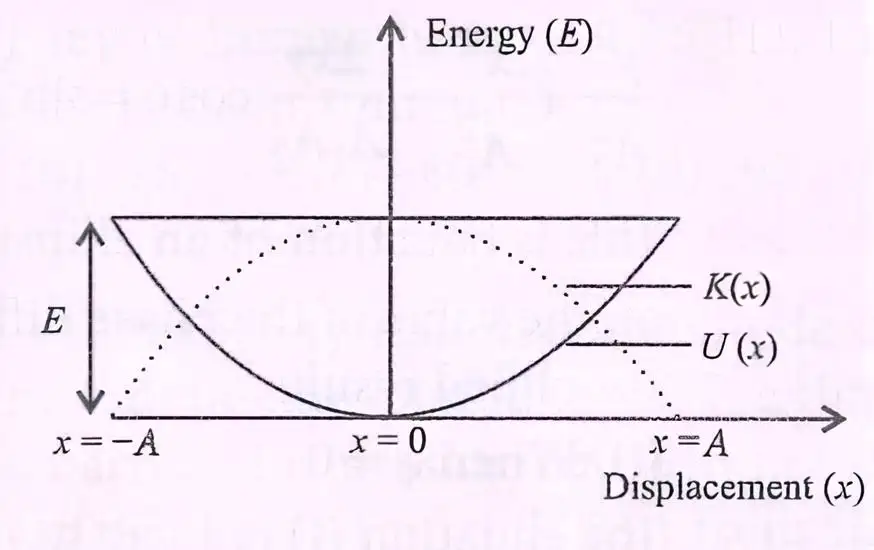
- Kinetic energy (K) and potential energy (U) vary with displacement \(x\) in SHM.
- Total mechanical energy \(E = K + U\) remains constant throughout the motion.
- Potential energy: \(U = \frac{1}{2}kx^2 = \frac{1}{2}kA^2 \cos^2(\omega t + \phi)\)
- Kinetic energy: \(K = \frac{1}{2}mv^2 = \frac{1}{2}m\omega^2 A^2 \sin^2(\omega t + \phi) = \frac{1}{2}kA^2 \sin^2(\omega t + \phi)\)
- Total energy: \(E = \frac{1}{2}kA^2 [\cos^2(\omega t + \phi) + \sin^2(\omega t + \phi)] = \frac{1}{2}kA^2\)
- Energy shifts between kinetic and potential forms but total energy is time-independent.
Solved Examples
- Ex 1: Calculate total energy for a spring with \(k=200\,\mathrm{N/m}\) and amplitude \(A=0.05\,\mathrm{m}\).
- Use \(E=\frac{1}{2}kA^2 = \frac{1}{2} \times 200 \times (0.05)^2 = 0.25\,\mathrm{J}\).
- Ex 2: Find kinetic energy at \(x=0.03\,\mathrm{m}\) for above spring.
- Potential energy \(U=\frac{1}{2}kx^2=\frac{1}{2} \times 200 \times (0.03)^2=0.09\,\mathrm{J}\).
- Kinetic energy \(K=E-U=0.25-0.09=0.16\,\mathrm{J}\).
Practice Set
- Q1: What is the total energy of a SHM system with \(k=100\,\mathrm{N/m}\) and amplitude \(0.1\,\mathrm{m}\)?
- A) 0.5 J
- B) 1.0 J
- C) 2.0 J
- D) 5.0 J
- Q2: At maximum displacement, the kinetic energy is:
- A) Maximum
- B) Zero
- C) Half of total energy
- D) Equal to potential energy
- Q3: For a mass-spring system, if amplitude doubles, total energy changes by:
- A) Doubles
- B) Quadruples
- C) Halves
- D) Remains same
Answer Key
- Q1: A) 0.5 J — Using \(E=\frac{1}{2}kA^2=\frac{1}{2} \times 100 \times 0.1^2=0.5\,\mathrm{J}\).
- Q2: B) Zero — At maximum displacement, velocity is zero, so kinetic energy is zero.
- Q3: B) Quadruples — Total energy \(E \propto A^2\), doubling amplitude increases energy by 4 times.
Memory Aids
- Total energy in SHM: \(E=\frac{1}{2}kA^2\) (constant)
- Energy shifts: \(K \leftrightarrow U\) with \(\sin^2 + \cos^2 = 1\)
- At center: max \(K\), zero \(U\); at extremes: max \(U\), zero \(K\)
Energy Variation with Time
Time Dependence of Energies
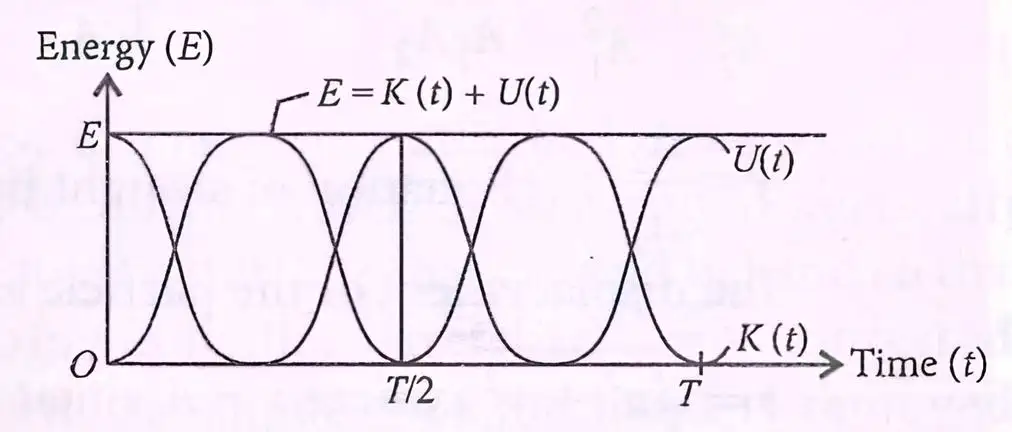
- Kinetic energy \(K(t) = \frac{1}{2}kA^2 \sin^2(\omega t + \phi)\)
- Potential energy \(U(t) = \frac{1}{2}kA^2 \cos^2(\omega t + \phi)\)
- Total energy \(E = K(t) + U(t) = \frac{1}{2}kA^2\) constant over time.
- Energy oscillates between kinetic and potential forms periodically with angular frequency \(\omega\).
Solved Examples
- Ex 1: Find kinetic energy at \(t=\frac{\pi}{2\omega}\) for \(k=50\,\mathrm{N/m}\), \(A=0.1\,\mathrm{m}\), \(\phi=0\).
- \(K=\frac{1}{2}kA^2 \sin^2(\omega t) = \frac{1}{2} \times 50 \times 0.01 \times \sin^2(\frac{\pi}{2}) = 0.25\,\mathrm{J}\).
- Ex 2: Calculate potential energy at \(t=0\) for same system.
- \(U=\frac{1}{2}kA^2 \cos^2(0) = 0.5\,\mathrm{J}\).
Practice Set
- Q1: At time when kinetic energy is maximum, potential energy is:
- A) Maximum
- B) Zero
- C) Half of total energy
- D) Equal to kinetic energy
- Q2: If \(\omega = 10\,\mathrm{rad/s}\), what is the period of energy oscillation?
- A) 0.1 s
- B) 0.2 s
- C) 0.314 s
- D) 1 s
- Q3: For \(E=0.5\,\mathrm{J}\), what is \(K(t)\) at \(\omega t + \phi = 45^\circ\)?
- A) 0.25 J
- B) 0.35 J
- C) 0.5 J
- D) 0.0 J
Answer Key
- Q1: B) Zero — Kinetic energy max when potential energy is zero (energy conservation).
- Q2: B) 0.2 s — Period \(T=\frac{2\pi}{\omega} = \frac{2\pi}{10} = 0.628\,\mathrm{s}\), energy oscillates with same period.
- Q3: A) 0.25 J — \(K=E \sin^2 45^\circ = 0.5 \times 0.5 = 0.25\,\mathrm{J}\).
Memory Aids
- Energy oscillates with period \(T=\frac{2\pi}{\omega}\)
- Use \(\sin^2 + \cos^2 = 1\) to relate \(K(t)\) and \(U(t)\)
- Max kinetic energy at equilibrium position, max potential at amplitude
The Simple Pendulum
Concepts and Formulas
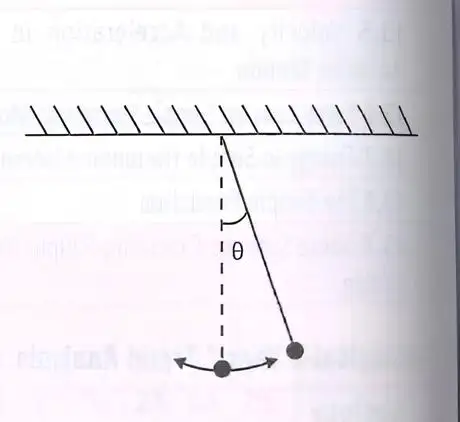
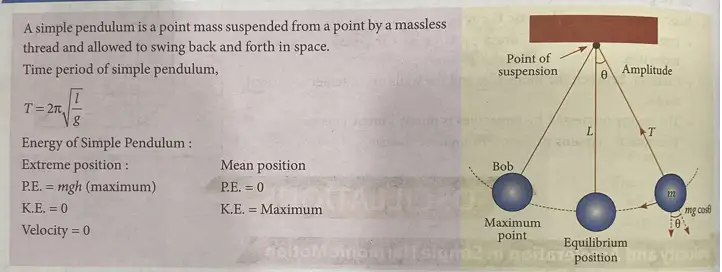
- A simple pendulum consists of a mass (bob) suspended by a light, inextensible string of length \( l \).
- It oscillates under gravity with small angular displacement \( \theta \).
- Time period \( T = 2\pi \sqrt{\frac{l}{g}} \), where \( g \) is acceleration due to gravity.
- At extreme positions: maximum potential energy (P.E.), zero kinetic energy (K.E.), bob momentarily at rest.
- At mean position: maximum kinetic energy, zero potential energy, bob moves fastest.
- Amplitude is the maximum angular displacement \( \theta \).
Solved Examples
Ex 1: Calculate the time period of a pendulum of length 1 m. (Take \( g = 9.8 \ \mathrm{m/s^2} \))
- Use \( T = 2\pi \sqrt{\frac{l}{g}} = 2\pi \sqrt{\frac{1}{9.8}} \approx 2.006 \ \mathrm{s} \).
Practice Set
Q1: The time period of a simple pendulum depends on:
- A) Mass of the bob
- B) Length of the string
- C) Amplitude of oscillation
- D) Both mass and amplitude
Q2: For a pendulum of length 0.5 m, the time period is approximately:
- A) 1.42 s
- B) 0.71 s
- C) 2.0 s
- D) 0.5 s
Q3: At the highest point of the pendulum's swing, the kinetic energy is:
- A) Maximum
- B) Zero
- C) Half of potential energy
- D) Equal to total energy
Answer Key
- Q1: B — Time period depends only on length and gravity, not mass or amplitude (for small angles).
- Q2: A — \( T = 2\pi \sqrt{\frac{0.5}{9.8}} \approx 1.42 \ \mathrm{s} \).
- Q3: B — Kinetic energy is zero at the highest point as the bob momentarily stops.
Memory Aids
- Time period \( T \) ~ \( \sqrt{l} \), independent of mass.
- Maximum P.E. at amplitude, maximum K.E. at equilibrium.
- Small angle approximation: \( \sin \theta \approx \theta \) (in radians).
Angular SHM of Pendulum
Concepts and Formulas
- Restoring torque for small angle \( \theta \): \( \tau = -mg l \sin \theta \approx -mg l \theta \).
- Moment of inertia \( I = m l^2 \).
- Angular acceleration \( \alpha = \frac{\tau}{I} = -\frac{mg l}{m l^2} \theta = -\frac{g}{l} \theta \).
- Standard angular SHM equation: \( \alpha = -\omega^2 \theta \).
- Angular frequency \( \omega = \sqrt{\frac{g}{l}} \).
- Time period \( T = 2\pi \sqrt{\frac{l}{g}} \).
Solved Examples
Ex 1: Find the angular frequency of a pendulum of length 0.8 m.
- \( \omega = \sqrt{\frac{g}{l}} = \sqrt{\frac{9.8}{0.8}} = 3.5 \ \mathrm{rad/s} \).
Practice Set
Q1: The restoring torque on a pendulum bob is proportional to:
- A) \( \theta^2 \)
- B) \( \theta \)
- C) \( \sin \theta \)
- D) Constant
Q2: The moment of inertia of pendulum bob about suspension point is:
- A) \( m l \)
- B) \( m l^2 \)
- C) \( m / l^2 \)
- D) \( m g l \)
Q3: For small oscillations, the angular acceleration \( \alpha \) is:
- A) \( -\frac{g}{l} \theta \)
- B) \( \frac{g}{l} \theta \)
- C) \( -\frac{l}{g} \theta \)
- D) Zero
Answer Key
- Q1: B — Torque is proportional to angular displacement \( \theta \) for small angles.
- Q2: B — Moment of inertia for point mass at distance \( l \) is \( m l^2 \).
- Q3: A — Angular acceleration is \( -\frac{g}{l} \theta \) restoring towards equilibrium.
Memory Aids
- Torque \( \tau = -mg l \theta \) for small \( \theta \).
- Angular frequency \( \omega = \sqrt{g/l} \).
- Time period \( T = 2\pi / \omega \).
Forces on Pendulum Bob
Concepts and Formulas
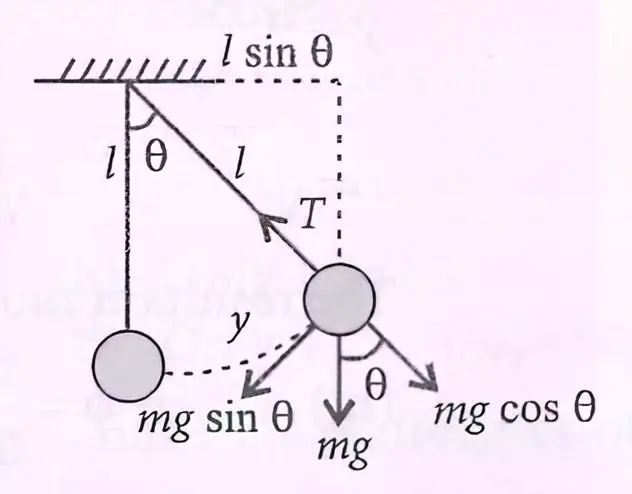
- For pendulum displaced at angle \( \theta \), forces on bob are:
- Tension \( T \) along string.
- Weight \( mg \) vertically downward.
- Weight components:
- Along string: \( mg \cos \theta \) (balanced by tension).
- Perpendicular to string: \( mg \sin \theta \) (restoring force).
- Horizontal displacement from vertical: \( l \sin \theta \).
- Restoring force causes oscillation back to equilibrium.
Solved Examples
Ex 1: Find the component of weight causing restoring force at \( 30^\circ \).
- \( mg \sin 30^\circ = mg \times 0.5 = 0.5 mg \).
Practice Set
Q1: The tension in the string balances which component of weight?
- A) \( mg \sin \theta \)
- B) \( mg \cos \theta \)
- C) \( mg \)
- D) None
Q2: The restoring force is proportional to:
- A) \( mg \cos \theta \)
- B) \( mg \sin \theta \)
- C) \( T \)
- D) \( mg \)
Q3: Horizontal displacement of bob at angle \( \theta \) is:
- A) \( l \cos \theta \)
- B) \( l \sin \theta \)
- C) \( l \tan \theta \)
- D) \( l \)
Answer Key
- Q1: B — Tension balances \( mg \cos \theta \) component.
- Q2: B — Restoring force proportional to \( mg \sin \theta \).
- Q3: B — Horizontal displacement is \( l \sin \theta \).
Memory Aids
- Weight components: \( mg \cos \theta \) along string, \( mg \sin \theta \) perpendicular.
- Restoring force causes oscillation.
Superposition of Two SHMs
Concepts and Formulas
- Two SHMs along perpendicular directions:
- \( x = A_1 \sin \omega t \)
- \( y = A_2 \sin (\omega t + \Phi) \)
- Eliminate time \( t \) to find trajectory:
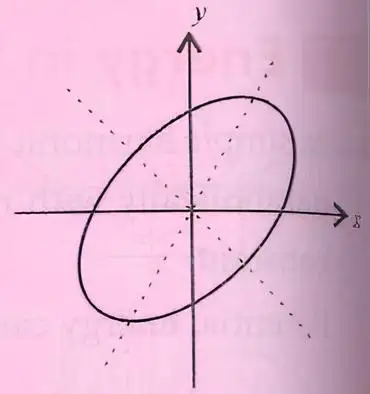
- General equation: \[ \frac{y^2}{A_2^2} + \frac{x^2}{A_1^2} - \frac{2xy}{A_1 A_2} \cos \Phi = \sin^2 \Phi \]
- This represents an ellipse centered at origin.
- Special cases based on phase difference \( \Phi \):
Special Cases
- \( \Phi = 0 \): Particle moves in a straight line \( y = \frac{A_2}{A_1} x \).
- \( \Phi = \pi \): Particle moves in a straight line \( y = -\frac{A_2}{A_1} x \).
- \( \Phi = \frac{\pi}{2} \): Particle moves in an ellipse \( \frac{y^2}{A_2^2} + \frac{x^2}{A_1^2} = 1 \).
- If \( A_1 = A_2 \) and \( \Phi = \frac{\pi}{2} \), motion is circular.
Solved Examples
Ex 1: For \( A_1 = 3 \), \( A_2 = 4 \), \( \Phi = 0 \), find amplitude of resultant SHM.
- Amplitude \( = \sqrt{3^2 + 4^2} = 5 \).
Practice Set
Q1: When \( \Phi = 0 \), the resultant motion is:
- A) Ellipse
- B) Circle
- C) Straight line
- D) Parabola
Q2: For \( A_1 = A_2 = A \) and \( \Phi = \frac{\pi}{2} \), the path is:
- A) Ellipse
- B) Circle
- C) Straight line
- D) Hyperbola
Q3: The general equation of the path is:
- A) \( \frac{y^2}{A_2^2} + \frac{x^2}{A_1^2} = 1 \)
- B) \( y = \frac{A_2}{A_1} x \)
- C) \( \frac{y^2}{A_2^2} + \frac{x^2}{A_1^2} - \frac{2xy}{A_1 A_2} \cos \Phi = \sin^2 \Phi \)
- D) \( y^2 + x^2 = A^2 \)
Answer Key
- Q1: C — \( \Phi = 0 \) gives straight line motion.
- Q2: B — Equal amplitudes and phase difference \( \pi/2 \) produce circular motion.
- Q3: C — General ellipse equation with phase difference \( \Phi \).
Memory Aids
- \( \Phi = 0, \pi \) → straight line.
- \( \Phi = \pi/2 \) → ellipse or circle if amplitudes equal.
- Resultant amplitude \( = \sqrt{A_1^2 + A_2^2} \) for \( \Phi = 0, \pi \).
NEET Physics — ALL CHAPTERS
1
Basic Mathematics
2
Units and Measurement
3
Motion in a Straight Line
4
Motion in a Plane
5
Laws of Motion
6
Work, Energy and Power
7
System of Particles and Rotational Motion
8
Gravitation
9
Mechanical Properties of Solids
10
Mechanical Properties of Fluids
11
Thermal Properties of Matter
12
Thermodynamics
13
Kinetic Theory
14
Oscillations
15
Waves
16
Electric Charges and Fields
17
Electrostatic Potential and Capacitance
18
Current Electricity
19
Moving Charges and Magnetism
20
Magnetism and Matter
21
Electromagnetic Induction
22
Alternating Current
23
Electromagnetic Waves
24
Ray Optics and Optical Instruments
25
Wave Optics
26
Dual Nature of Radiation and Matter
27
Atoms
28
Nuclei
29
Semiconductor Electronics: Materials, Devices and Simple Circuits