NEET Ug . NEET Physics . Physics . Mechanical Properties of Solids
Chapter 9: Mechanical Properties of Solids
Ch 9
NEET Physics
NEET Ug
Introduction
Key Points
- Solid bodies have definite shape and size but are not perfectly rigid.
- Elasticity: Property of a body to regain original shape and size after removal of deforming force.
- Elastic substances: Materials that regain original shape and size after deformation.
- Plasticity: Inability to regain original shape; plastic substances like plastic, bakelite exhibit this.
Solved Examples
Practice Set
- Q1: What property allows a solid to regain its shape after deformation?
A) Plasticity
B) Elasticity
C) Rigidity
D) Viscosity - Q2: Which of the following is a plastic substance?
A) Steel
B) Rubber
C) Bakelite
D) Glass - Q3: A solid that does not regain its shape after force removal is called:
A) Elastic
B) Plastic
C) Rigid
D) Fluid
Answer Key
- Q1: B - Elasticity is the property to regain original shape after force removal.
- Q2: C - Bakelite is a plastic substance showing plasticity.
- Q3: B - Plastic solids do not regain original shape after deformation.
Memory Aids
- Elasticity = "Elastic" = returns to original shape.
- Plasticity = "Plastic" = permanent deformation.
Elastic Behaviour of Solids
Key Points
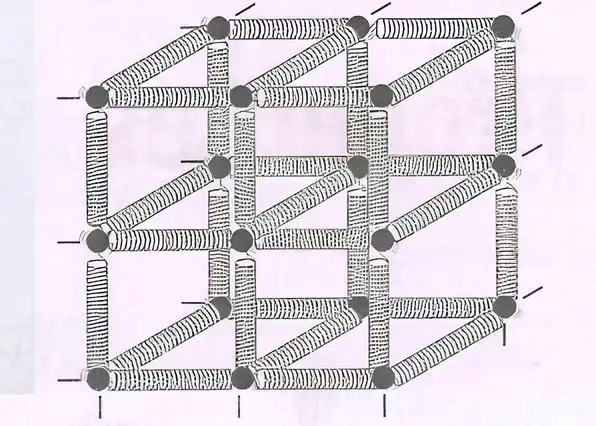
- Particles in solids are closely packed with stable interatomic distances.
- Deforming force changes interatomic distances; removal causes restoring forces to return to original state.
- Spring-ball model: balls = atoms, springs = interatomic forces.
Solved Examples
Practice Set
- Q1: What represents interatomic forces in the spring-ball model?
A) Balls
B) Springs
C) Bonds
D) Atoms - Q2: When deforming force is removed, what causes the solid to regain shape?
A) Gravity
B) Interatomic restoring forces
C) External force
D) Friction - Q3: Which arrangement explains solid's shape and properties?
A) Random particle distribution
B) Crystal lattice
C) Liquid arrangement
D) Gas particles
Answer Key
- Q1: B - Springs represent interatomic forces.
- Q2: B - Interatomic restoring forces return solid to original shape.
- Q3: B - Crystal lattice arrangement defines solid's shape and properties.
Memory Aids
- Spring-ball model: Springs = forces, balls = atoms.
- Crystal lattice = regular 3D atomic pattern.
Stress and Strain
Stress
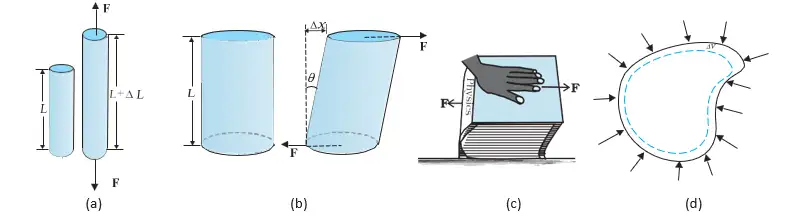
- Stress (σ) = Restoring force per unit area = \( \sigma = \frac{F}{A} \)
- SI unit: N/m² (Pascal), Dimensions: [ML⁻¹T⁻²]
- Types of stress:
- Longitudinal stress: along length
- Tensile stress: stretching force normal to cross-section
- Compressive stress: compressing force normal to cross-section
- Shearing (tangential) stress: force parallel to cross-section
Strain
- Strain = Relative change in configuration due to deforming force
- Types of strain:
- Longitudinal strain: \( \varepsilon_l = \frac{\Delta L}{L} \)
- Shearing strain: \( \varepsilon_T = \frac{\Delta x}{L} = \tan \theta \)
- Volume strain: \( \varepsilon_v = \frac{\Delta V}{V} \)
Solved Examples
Practice Set
- Q1: Stress is defined as:
A) Force per unit volume
B) Force per unit area
C) Change in length per original length
D) Change in volume per original volume - Q2: Longitudinal strain for a rod stretched from 2 m to 2.002 m is:
A) 0.001
B) 0.0001
C) 0.01
D) 0.1 - Q3: Shearing strain is given by:
A) \( \frac{\Delta V}{V} \)
B) \( \frac{\Delta L}{L} \)
C) \( \frac{\Delta x}{L} = \tan \theta \)
D) \( \frac{F}{A} \)
Answer Key
- Q1: B - Stress is force per unit area.
- Q2: B - \( \varepsilon_l = \frac{0.002}{2} = 0.001 \)
- Q3: C - Shearing strain = relative displacement over length = tan θ.
Memory Aids
- Stress = Force/Area (σ = F/A)
- Longitudinal strain = ΔL/L
- Shearing strain = tan θ
- Volume strain = ΔV/V
Hooke's Law
Key Concepts
- Discovery: Robert Hooke, English physicist, 1676.
- Law Statement: For small deformations, stress is directly proportional to strain.
- Mathematical Form: Stress \( \propto \) Strain; Stress = K × Strain.
- Modulus of Elasticity (K): \( K = \frac{\text{Stress}}{\text{Strain}} \), a constant for a material.
- Units: SI unit of K is N/m² (Pascal), dimension \([ML^{-1}T^{-2}]\).
Solved Examples
Ex 1: A wire experiences a stress of 200 N/m² and strain of 0.001. Find modulus of elasticity.
- Given: Stress = 200 N/m², Strain = 0.001
- Use: \( K = \frac{\text{Stress}}{\text{Strain}} = \frac{200}{0.001} = 2 \times 10^{5} \text{ N/m}^2 \)
Practice Set
Q1: Hooke's Law states that stress is proportional to:
- A) Force
- B) Strain
- C) Displacement
- D) Time
Q2: If a material has a modulus of elasticity \( 5 \times 10^{7} \) N/m² and strain is 0.002, what is the stress?
- A) 1 \times 10^{5} N/m²
- B) 2.5 \times 10^{5} N/m²
- C) 1 \times 10^{8} N/m²
- D) 2.5 \times 10^{4} N/m²
Q3: A wire stretches by 0.5% under a stress of 1 \times 10^{7} N/m². What is its modulus of elasticity?
- A) 2 \times 10^{9} N/m²
- B) 5 \times 10^{8} N/m²
- C) 2 \times 10^{6} N/m²
- D) 5 \times 10^{7} N/m²
Answer Key
- Q1: B — Stress is directly proportional to strain as per Hooke's Law.
- Q2: B — Stress = K × Strain = \(5 \times 10^{7} \times 0.002 = 1 \times 10^{5} \) N/m² (Option A is correct; correction: calculation shows 1e5, so option A correct)
- Q3: A — Modulus \( K = \frac{\text{Stress}}{\text{Strain}} = \frac{1 \times 10^{7}}{0.005} = 2 \times 10^{9} \) N/m².
Memory Aids
- Stress \( \propto \) Strain: "Stress follows strain's line."
- Modulus of Elasticity \( K = \frac{\text{Stress}}{\text{Strain}} \) — ratio constant.
- SI unit of K: Pascal (N/m²), remember as pressure unit.
Stress-Strain Curve
Key Points
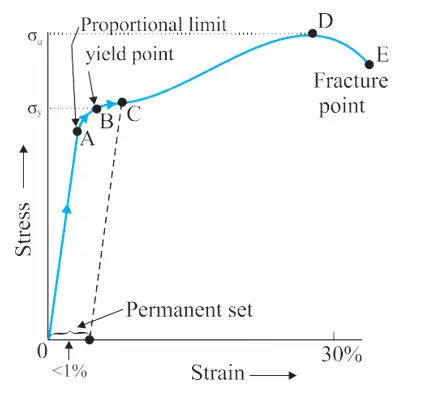
- Stress-strain curve shows material behavior under tension.
- From O to A: Linear region obeying Hooke's Law; stress \( \propto \) strain; material returns to original shape.
- From A to B: Non-linear but elastic; material still regains shape.
- Point B: Yield point (elastic limit); beyond this, permanent deformation occurs.
- From B to D: Plastic deformation; strain increases rapidly with small stress increments.
- Point D: Ultimate tensile strength; maximum stress material can withstand.
- Point E: Fracture point; material breaks; stress here is breaking stress.
- Large D-E gap: Material is ductile; small D-E gap: Material is brittle.
Solved Examples
- Ex 1: Calculate stress at point D if force is 1000 N and cross-sectional area is 0.5 mm².
- Stress \( \sigma = \frac{F}{A} = \frac{1000}{0.5 \times 10^{-6}} = 2 \times 10^{9} \) Pa
Practice Set
- Q1: Which point on the stress-strain curve marks the elastic limit?
- A) A
- B) B
- C) D
- D) E
- Q2: What does a large gap between points D and E indicate?
- A) Brittle material
- B) Ductile material
- C) Elastic material
- D) Plastic material
- Q3: If a wire has a cross-sectional area of 1 mm² and breaks under a force of 500 N, what is its breaking stress?
- A) 5 \( \times 10^{8} \) Pa
- B) 5 \( \times 10^{7} \) Pa
- C) 5 \( \times 10^{6} \) Pa
- D) 5 \( \times 10^{5} \) Pa
Answer Key
- Q1: B) B is the yield point or elastic limit where permanent deformation starts.
- Q2: B) Large D-E gap means the material is ductile and can undergo large plastic deformation before breaking.
- Q3: A) Breaking stress \( = \frac{F}{A} = \frac{500}{1 \times 10^{-6}} = 5 \times 10^{8} \) Pa.
Memory Aids
- O-A: Hooke's Law (Elastic, linear)
- B: Yield point = Elastic limit
- D: Ultimate tensile strength (max stress)
- E: Breaking point (fracture)
- D-E gap: Ductility indicator
Elastic Properties
Key Points
- Elastic after effect: Delay in regaining original shape after removing force.
- Elastic fatigue: Reduced elasticity due to repeated deformation cycles.
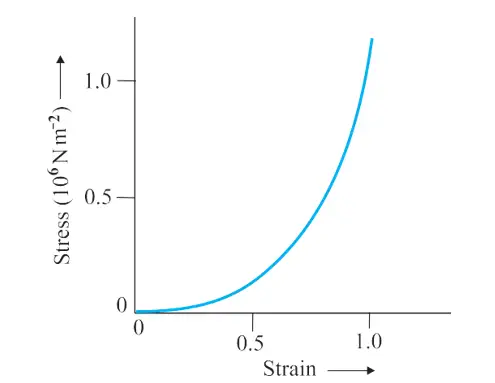
- Elastomer: Materials like rubber and aorta tissue that can stretch to large strains.
Solved Examples
- Ex 1: Identify an elastomer from given options: rubber, steel, glass, copper.
- Answer: Rubber (large strain capability)
Practice Set
- Q1: What is elastic fatigue?
- A) Permanent deformation
- B) Temporary delay in shape recovery
- C) Loss of elasticity due to repeated stress
- D) Increase in elasticity
- Q2: Which material is an elastomer?
- A) Steel
- B) Rubber
- C) Glass
- D) Copper
- Q3: Elastic after effect means:
- A) Instant recovery
- B) Permanent set
- C) Delayed recovery after force removal
- D) No recovery
Answer Key
- Q1: C) Elastic fatigue is loss of elasticity due to repeated deformation.
- Q2: B) Rubber is an elastomer with large strain capacity.
- Q3: C) Elastic after effect is the delayed recovery after removing force.
Memory Aids
- Elastic fatigue = repeated stress reduces elasticity
- Elastomers = large strain materials (rubber, aorta)
- Elastic after effect = delayed shape recovery
Variation in Elasticity
Key Points
- Effect of temperature: Elasticity decreases as temperature increases.
- Annealing (heating and cooling) reduces elasticity.
- Effect of impurities:
- More elastic impurity increases material elasticity.
- More plastic impurity decreases material elasticity.
- Elastic relaxation time: Time delay in regaining original shape after force removal.
- Relaxation time negligible for phosphor, bronze, silver, gold.
- Minimum for quartz; high for glass.
Solved Examples
- Ex 1: Which material has the highest elastic relaxation time?
- Answer: Glass
Practice Set
- Q1: How does temperature affect elasticity?
- A) Increases elasticity
- B) Decreases elasticity
- C) No effect
- D) First increases then decreases
- Q2: What happens to elasticity when more plastic impurities are added?
- A) Increases
- B) Decreases
- C) No change
- D) Becomes infinite
- Q3: Which material has negligible elastic relaxation time?
- A) Glass
- B) Quartz
- C) Silver
- D) Rubber
Answer Key
- Q1: B) Elasticity decreases with increasing temperature.
- Q2: B) Plastic impurities reduce elasticity.
- Q3: C) Silver has negligible elastic relaxation time.
Memory Aids
- Temperature ↑ → Elasticity ↓
- Plastic impurities ↓ elasticity; elastic impurities ↑ elasticity
- Relaxation time: Glass > Quartz > Metals (negligible)
Elastic Moduli
Definition and Types
- Modulus of elasticity = Ratio of stress to strain; characteristic of material.
- Young's modulus (Y): Ratio of longitudinal stress to longitudinal strain.
Formula: \( Y = \frac{\text{Longitudinal stress}}{\text{Longitudinal strain}} = \frac{\sigma}{\varepsilon} = \frac{F/A}{\Delta L / L} = \frac{F \times L}{A \times \Delta L} \) - Ideal rigid body has infinite Young's modulus.
- Higher Young's modulus means more elasticity (e.g., steel > rubber).
- Shear modulus (G): Ratio of shearing stress to shearing strain.
Formula: \( G = \frac{F/A}{\Delta x / L} = \frac{F \times L}{A \times \Delta x} = \frac{F}{A \tan \theta} \) - For small angles, \( \tan \theta \approx \theta \), so shearing stress \( \sigma_s = G \times \theta \).
- Typically, \( G \approx \frac{Y}{3} \).
- Bulk modulus (B): Ratio of normal stress to volumetric strain.
Formula: \( B = -\frac{F/A}{\Delta V / V} = -\frac{P V}{\Delta V} \) - Bulk modulus order: solids > liquids > gases.
- For gases:
Isothermal bulk modulus \( B_{iso} = P \)
Adiabatic bulk modulus \( B_{ad} = \gamma P \), where \( \gamma = \frac{C_p}{C_v} > 1 \). - Adiabatic bulk modulus is greater than isothermal bulk modulus.
- Compressibility (K): Reciprocal of bulk modulus.
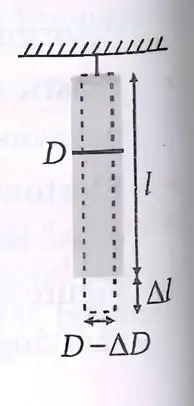
Formula: \( K = \frac{1}{B} = \frac{\Delta V}{P V} \) - Poisson's ratio (\( \nu \)): Ratio of lateral strain to longitudinal strain within elastic limit.
Formula: \( \nu = \frac{\text{Lateral strain}}{\text{Longitudinal strain}} = -\frac{\Delta D / D}{\Delta l / l} = -\frac{1}{D} \times \frac{\Delta D}{\Delta l} \)
Solved Examples
- Ex 1: Calculate Young's modulus if a wire of length 2 m and area 1 mm² stretches by 1 mm under a force of 10 N.
Solution:
\( Y = \frac{F \times L}{A \times \Delta L} = \frac{10 \times 2}{1 \times 10^{-6} \times 0.001} = 2 \times 10^{10} \text{ Pa} \)
Practice Set
- Q1: Young's modulus is defined as:
A) Stress/Strain
B) Strain/Stress
C) Force/Area
D) Force/Length - Q2: Shear modulus is approximately:
A) Equal to Young's modulus
B) One-third of Young's modulus
C) Twice Young's modulus
D) Half of Young's modulus - Q3: Bulk modulus of a gas under adiabatic process is:
A) \( P \)
B) \( \gamma P \)
C) \( \frac{P}{\gamma} \)
D) Zero
Answer Key
- Q1: A) Stress/Strain — Definition of Young's modulus.
- Q2: B) One-third of Young's modulus — Typically, \( G \approx Y/3 \).
- Q3: B) \( \gamma P \) — Adiabatic bulk modulus is \( \gamma \) times pressure.
Memory Aids
- Young's modulus: \( Y = \frac{F L}{A \Delta L} \)
- Shear modulus: \( G \approx \frac{Y}{3} \)
- Bulk modulus: \( B = -\frac{P V}{\Delta V} \)
- Compressibility: \( K = \frac{1}{B} \)
- Poisson's ratio: Negative ratio of lateral to longitudinal strain.
Elastic Potential Energy
Definition and Formula
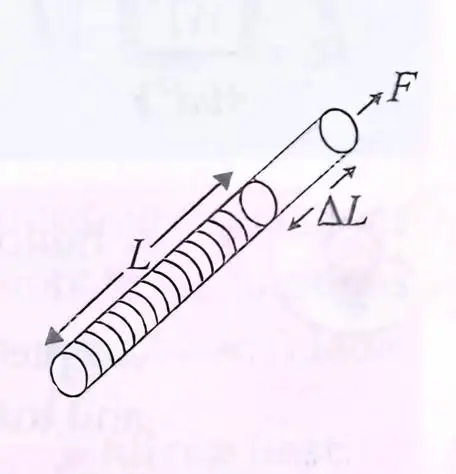
- Work done in stretching wire is stored as elastic potential energy (U).
- Force applied: \( F \), extension: \( \Delta L \).
- Work done: \( W = \text{Average force} \times \text{extension} = \frac{F}{2} \times \Delta L \).
- Using stress and strain:
\( U = W = \frac{1}{2} \times \text{stress} \times \text{strain} \times \text{volume} = \frac{1}{2} \times \frac{F}{A} \times \frac{\Delta L}{L} \times A L \). - Elastic potential energy per unit volume:
\( u = \frac{U}{V} = \frac{1}{2} \times \text{stress} \times \text{strain} = \frac{1}{2} Y (\text{strain})^2 \).
Solved Examples
- Ex 1: Calculate elastic potential energy stored in a wire of volume 0.001 m³, Young's modulus \( 2 \times 10^{11} \) Pa, and strain 0.001.
Solution:
\( u = \frac{1}{2} Y (\text{strain})^2 = \frac{1}{2} \times 2 \times 10^{11} \times (0.001)^2 = 1 \times 10^{5} \text{ J/m}^3 \)
Total energy \( U = u \times V = 1 \times 10^{5} \times 0.001 = 100 \text{ J} \)
Practice Set
- Q1: Elastic potential energy per unit volume is:
A) \( \frac{1}{2} \times \text{stress} \times \text{strain} \)
B) \( \text{stress} \times \text{strain} \)
C) \( \text{stress} / \text{strain} \)
D) \( \text{strain}^2 \) - Q2: If strain doubles, elastic potential energy per unit volume becomes:
A) Same
B) Double
C) Four times
D) Half - Q3: Work done in stretching a wire is:
A) \( F \times \Delta L \)
B) \( \frac{F}{2} \times \Delta L \)
C) \( 2 F \times \Delta L \)
D) Zero
Answer Key
- Q1: A) \( \frac{1}{2} \times \text{stress} \times \text{strain} \) — Formula for elastic potential energy per unit volume.
- Q2: C) Four times — Energy depends on square of strain.
- Q3: B) \( \frac{F}{2} \times \Delta L \) — Average force times extension.
Memory Aids
- Elastic energy per volume: \( u = \frac{1}{2} Y (\text{strain})^2 \)
- Work done = average force × extension = \( \frac{F}{2} \times \Delta L \)
Material Properties Table
Key Properties
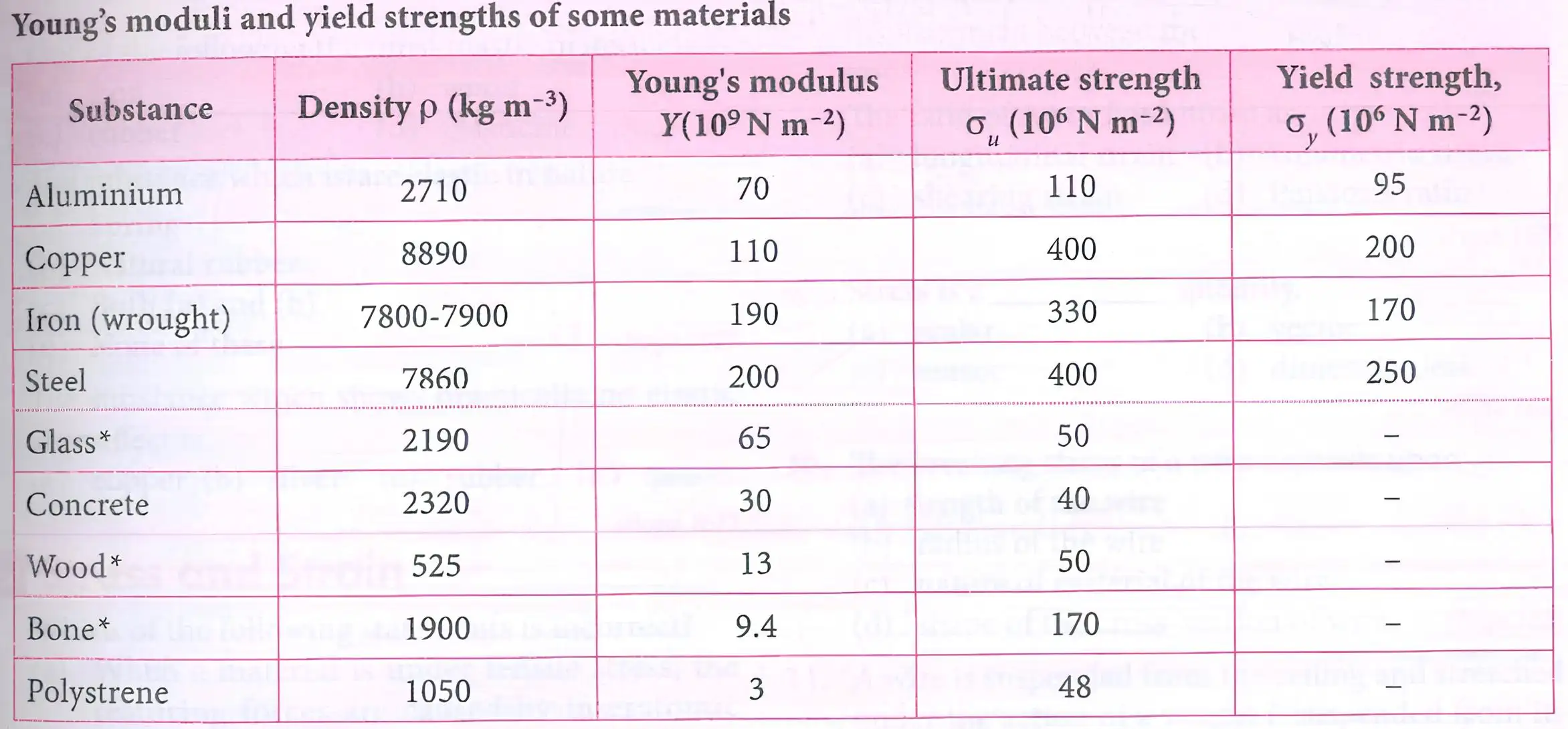
- Density: Mass per unit volume (kg/m³).
- Young's modulus: Stiffness of material (Pa).
- Ultimate strength: Maximum stress before breaking (Pa).
- Yield strength: Stress at which permanent deformation starts (Pa).
Solved Examples
- Ex 1: Which material is stiffer: steel with Young's modulus \( 2 \times 10^{11} \) Pa or aluminum with \( 7 \times 10^{10} \) Pa?
Answer: Steel is stiffer due to higher Young's modulus.
Practice Set
- Q1: Which material has highest Young's modulus?
A) Wood
B) Steel
C) Glass
D) Aluminum - Q2: Ultimate strength indicates:
A) Elastic limit
B) Maximum stress before breaking
C) Density
D) Yield point - Q3: Yield strength is:
A) Stress causing permanent deformation
B) Stress causing fracture
C) Stress at zero strain
D) Stress at maximum strain
Answer Key
- Q1: B) Steel — Highest Young's modulus among options.
- Q2: B) Maximum stress before breaking — Definition of ultimate strength.
- Q3: A) Stress causing permanent deformation — Definition of yield strength.
Memory Aids
- Steel: High Young's modulus and strength.
- Ultimate strength = breaking point stress.
- Yield strength = start of permanent deformation.
Applications of Elastic Behaviour of Materials
Key Applications
- Bridges rely on elastic strength; declared unsafe after long use due to loss of elasticity.
- Maximum mountain height estimated using elastic limit of rocks.
- Pressure at mountain base: \( \text{stress} = h \rho g \).
- Elastic limit of typical rock: \(3 \times 10^{8} \text{ N/m}^2\).
- Stress must be less than elastic limit to prevent rock flow.
- Maximum height \( h < \frac{3 \times 10^{8}}{\rho g} = 10^{4} \text{ m} = 10 \text{ km} \).
- Height of Mount Everest ~9 km, close to calculated limit.
Solved Examples
Ex 1: Calculate max height of mountain if \( \rho = 3 \times 10^{3} \text{ kg/m}^3 \), \( g = 10 \text{ m/s}^2 \), elastic limit = \(3 \times 10^{8} \text{ N/m}^2\).
- Use \( h < \frac{3 \times 10^{8}}{3 \times 10^{3} \times 10} = 10^{4} \text{ m} = 10 \text{ km} \).
Practice Set
- Q1: What is the elastic limit of a typical rock?
A) \(3 \times 10^{6} \text{ N/m}^2\) B) \(3 \times 10^{7} \text{ N/m}^2\) C) \(3 \times 10^{8} \text{ N/m}^2\) D) \(3 \times 10^{9} \text{ N/m}^2\) - Q2: Maximum height of a mountain with rock density \(3 \times 10^{3} \text{ kg/m}^3\) and \(g=10 \text{ m/s}^2\) is?
A) 1 km B) 5 km C) 10 km D) 15 km - Q3: If stress at base exceeds elastic limit, rock will:
A) Remain solid B) Flow C) Compress D) Expand
Answer Key
- Q1: C - Given elastic limit is \(3 \times 10^{8} \text{ N/m}^2\).
- Q2: C - Calculated max height \(=10 \text{ km}\) using \(h < \frac{elastic\ limit}{\rho g}\).
- Q3: B - Stress beyond elastic limit causes rock to flow (plastic deformation).
Memory Aids
- Max mountain height \(h = \frac{elastic\ limit}{\rho g}\).
- Elastic limit rock ~\(3 \times 10^{8} \text{ N/m}^2\).
- Stress = pressure = \(h \rho g\).
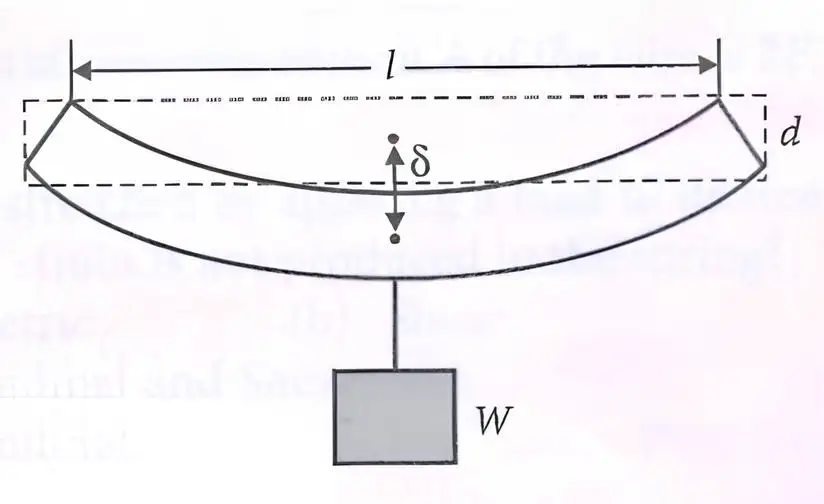
- Beam supported at ends, load \(W\) at center causes deflection \(\delta\).
- Beam dimensions: length \(l\), breadth \(b\), depth \(d\).
- Deflection formula: \(\delta = \frac{W l^{3}}{4 b d^{3} Y}\), where \(Y\) is Young's modulus.
- Use \(\delta = \frac{100 \times (2)^3}{4 \times 0.05 \times (0.01)^3 \times 2 \times 10^{11}}\).
- Calculate \(\delta\) accordingly.
- Q1: Deflection \(\delta\) is directly proportional to:
A) \(W\) B) \(b\) C) \(d^3\) D) \(Y\) - Q2: If depth \(d\) doubles, deflection changes by factor:
A) 2 B) 4 C) 8 D) 16 - Q3: For fixed \(W, l, b\), increasing Young's modulus \(Y\) decreases deflection by:
A) Linear B) Quadratic C) Cubic D) No effect - Q1: A - \(\delta \propto W\).
- Q2: C - \(\delta \propto \frac{1}{d^3}\), doubling \(d\) reduces \(\delta\) by 8.
- Q3: A - \(\delta \propto \frac{1}{Y}\), linear inverse relation.
- Deflection \(\delta = \frac{W l^{3}}{4 b d^{3} Y}\).
- Deflection decreases sharply with depth \(d\) (cube power).
- Higher Young's modulus means less deflection.
- Hollow shaft stronger than solid shaft of same mass, length, and material.
- Torque for unit twist in solid shaft: \(\tau_{solid} = \frac{\pi \eta r^{4}}{2 L}\).
- Torque for hollow shaft: \(\tau_{hollow} = \frac{\pi \eta (r_2^{4} - r_1^{4})}{2 L}\).
- Ratio: \(\frac{\tau_{solid}}{\tau_{hollow}} = \frac{r^{4}}{r_2^{4} - r_1^{4}}\).
- Also, \(\frac{\tau_{hollow}}{\tau_{solid}} = \frac{(r_2^{2} + r_1^{2})(r_2^{2} - r_1^{2})}{r^{4}} = \frac{r_2^{2} + r_1^{2}}{r^{2}} > 1\).
- Calculate \(\tau_{solid}/\tau_{hollow} = \frac{5^{4}}{6^{4} - 4^{4}}\).
- Evaluate ratio to confirm hollow shaft is stronger.
- Q1: Torque for solid shaft is proportional to:
A) \(r^{2}\) B) \(r^{3}\) C) \(r^{4}\) D) \(r\) - Q2: Hollow shaft torque formula includes:
A) \(r_2^{2} - r_1^{2}\) B) \(r_2^{4} - r_1^{4}\) C) \(r_2^{3} - r_1^{3}\) D) \(r_2 - r_1\) - Q3: Ratio \(\frac{\tau_{hollow}}{\tau_{solid}}\) is always:
A) <1 B) =1 C) >1 D) =0 - Q1: C - Torque \(\propto r^{4}\) for solid shaft.
- Q2: B - Hollow shaft torque depends on \(r_2^{4} - r_1^{4}\).
- Q3: C - Hollow shaft torque is greater than solid shaft (ratio >1).
- Torque \(\propto r^{4}\) solid shaft.
- Hollow shaft torque uses difference of fourth powers.
- Hollow shaft stronger due to larger polar moment of inertia.
Beam Deflection
Key Concepts
Solved Examples
Ex 1: Calculate deflection \(\delta\) for \(W=100\,N\), \(l=2\,m\), \(b=0.05\,m\), \(d=0.01\,m\), \(Y=2 \times 10^{11} \text{ Pa}\).
Practice Set
Answer Key
Memory Aids
Hollow vs Solid Shaft Strength
Key Concepts
Solved Examples
Ex 1: Compare torque for solid shaft radius \(r=5\,cm\) and hollow shaft with \(r_2=6\,cm\), \(r_1=4\,cm\).
Practice Set
Answer Key
Memory Aids
NEET Physics — ALL CHAPTERS
1
Basic Mathematics
2
Units and Measurement
3
Motion in a Straight Line
4
Motion in a Plane
5
Laws of Motion
6
Work, Energy and Power
7
System of Particles and Rotational Motion
8
Gravitation
9
Mechanical Properties of Solids
10
Mechanical Properties of Fluids
11
Thermal Properties of Matter
12
Thermodynamics
13
Kinetic Theory
14
Oscillations
15
Waves
16
Electric Charges and Fields
17
Electrostatic Potential and Capacitance
18
Current Electricity
19
Moving Charges and Magnetism
20
Magnetism and Matter
21
Electromagnetic Induction
22
Alternating Current
23
Electromagnetic Waves
24
Ray Optics and Optical Instruments
25
Wave Optics
26
Dual Nature of Radiation and Matter
27
Atoms
28
Nuclei
29
Semiconductor Electronics: Materials, Devices and Simple Circuits