NEET Ug . NEET Zoology . Zoology . Reproductive Health
Chapter 8: Reproductive Health
Ch 8
NEET Zoology
NEET Ug
Reproductive Health-Problems and Strategies
Meaning of Reproductive Health and RCH Programmes
Reproductive health — A state of total well-being in all aspects of reproduction—physical, emotional, behavioural and social.
Features of reproductive health
- Physical and functional health: Reproductive organs function normally.
- Healthy interactions: People show normal behavioural and emotional interactions in sex-related aspects.
- Broad meaning: It includes social and emotional well-being, not only the absence of disease.
Reproductive and Child Health (RCH) programmes
- National initiative: India was among the first countries to launch national programmes for reproductive health as a social goal.
- Purpose: Build awareness of reproductive organs, accessory organs, secondary sexual characters, adolescence and STDs, and provide appropriate services and support.
- Key services: Maternal and child health care and family planning are important components of health-care centres.
Problems and Strategies
| Problem | Key point |
|---|---|
| Overpopulation | A major reproductive-health challenge requiring awareness and appropriate action. |
| Early marriage | In some areas, children marry soon after attaining puberty. |
| Maternal health risks | Early marriage can lead to several diseases and health problems in mothers. |
Family-planning initiative
- 1951India initiated its family-planning programme.
Strategies to achieve reproductive health
- Family planning: Promote informed planning of family size and birth control.
- Sex education: Provide accurate information in schools to correct myths and misconceptions about sex-related matters.
- Birth control and care: Inform fertile couples and people of marriageable age about contraceptive devices, pregnancy care, postnatal care and breastfeeding.
- Equal value: Emphasise equal importance of male and female children.
- Safety and awareness: Address uncontrolled population growth, sex abuse and sex-related crimes; encourage steps to prevent them.
- Health services: Provide infrastructure, trained professionals and material support for menstrual problems, infertility, pregnancy, delivery, contraception, abortions and STDs; use improved techniques and strategies.
Amniocentesis
Amniocentesis — A prenatal test that examines the chromosomal pattern in amniotic fluid surrounding the developing embryo.
Uses and misuse
- Medical use: Helps detect certain genetic disorders, including Down syndrome, haemophilia and sickle-cell anaemia, and assess fetal survivability.
- Sex determination: Chromosomal analysis can reveal fetal sex, but using the test for this purpose is legally banned.
- Misuse: Sex determination has been misused to abort normal female fetuses, contributing to female foeticide.
What does reproductive health mean according to WHO?
Name key strategies for achieving reproductive health.
What is amniocentesis, and why is its use for fetal sex determination banned?
Quick recap
- Reproductive health is total physical, emotional, behavioural and social well-being in reproduction.
- India’s RCH programmes combine awareness with reproductive, maternal and child health services.
- Overpopulation, early marriage and risks to maternal health are key concerns.
- Family planning began in India in 1951; strategies also include sex education and improved health services.
- Amniocentesis can detect certain fetal genetic disorders, but its use for sex determination is legally banned.
Population Stabilisation and Birth Control
Population Growth and Stabilisation
Population explosion — A rapid increase in population over a relatively short period.
Causes and effects
- Causes: Better health facilities and living conditions lowered death rate, maternal mortality rate (MMR) and infant mortality rate (IMR); the reproductive-age population also increased.
- RCH programmes: Reproductive and Child Health programmes brought down population growth marginally.
- Concern: Even a growth rate below 2% (about 20 per 1,000 people per year) could rapidly increase population and cause scarcity of food, shelter and clothing.
Population figures cited
- 1900World population was about 2 billion.
- 2000World population was about 6 billion.
- 2011World population was about 7.2 billion.
- At Indian independenceIndia's population was approximately 350 million.
- May 2011India's population had crossed 1.2 billion.
Population — The total number of individuals of a species in a particular area at a given time.
Demography — The scientific study of human populations.
Measures to stabilise population
- Smaller families: Promote contraception and the two-child norm, commonly expressed as “Hum Do Hamare Do”; some couples adopt a one-child norm.
- Marriage age: The statutory minimum marriageable age is 18 years for females and 21 years for males.
- Incentives: Couples with small families may receive incentives.
Birth Control or Contraception
Birth control (contraception) — Regulation of conception using preventive methods or devices to limit the number of offspring; methods generally prevent fertilisation.
Principles and ideal features
- Targets: Contraception may prevent sperm transport to the ovum, ovulation, or implantation of the early embryo.
- Ideal method: User-friendly, easily available, effective and reversible, with minimal side effects and no interference with sexual drive, desire or the sexual act.
- Main groups: Temporary methods postpone or space births; permanent methods are intended to prevent further pregnancies.
Temporary Methods of Birth Control
1. Natural methods
- Principle: Avoid the meeting of sperm and ovum. No medicines or devices are used, so side effects are absent; failure rates are comparatively high.
| Method | How it works | Key point |
|---|---|---|
| Periodic abstinence (rhythm method) | Avoid coitus during days 10–17 of the menstrual cycle, when fertility is usually high. | Limited effectiveness: cycles and ovulation timing vary, making the fertile period hard to predict. |
| Coitus interruptus (withdrawal) | The penis is withdrawn from the vagina before ejaculation. | Only moderately effective; pre-ejaculatory lubricating fluid may contain sperm. |
| Lactational amenorrhea | Intense lactation after childbirth can suppress ovulation and menstruation. | Effective only up to a maximum of six months after parturition. |
2. Barrier Methods
Barrier methods — Methods that physically prevent sperm and ovum from meeting.
| Method | Use and action | Examples / features |
|---|---|---|
| Condoms | Thin rubber or latex sheath over the penis, or covering the vagina and cervix, stops semen entering the female reproductive tract. | Male brand: Nirodh; female condoms: femidoms. Disposable and self-inserted; also reduce STI and AIDS transmission risk. |
| Diaphragms, cervical caps and vaults | Reusable rubber devices inserted into the female reproductive tract to cover the cervix and block sperm entry. | Used during coitus. |
3. Chemical Methods
- Spermicides: Creams, jellies and foams are inserted into the vagina before intercourse to prevent sperm from entering the uterus; they are often combined with barriers to improve effectiveness.
- Examples listed: Lactic acid, citric acid, boric acid, zinc sulphate and potassium permanganate.
- Other products: “Today” sponge is a foam suppository or tablet containing nonoxynol; Delfin is a cream. These are relatively unreliable; avoid them if allergic to the spermicide.
4. Intrauterine Contraceptive Devices (IUCDs)
IUCDs — Plastic or metal devices inserted into the uterus through the vagina by a doctor; widely used to delay pregnancy and space children.
| Type | Action | Examples |
|---|---|---|
| Non-medicated | Increase phagocytosis of sperm within the uterus. | Lippes loop |
| Hormone-releasing | Make the uterus unsuitable for implantation and the cervix hostile to sperm. | LNG-20, Progestasert |
| Copper-releasing | Copper ions suppress sperm motility and fertilising capacity. | CuT, Cu7, Multiload 375 |
IUCD limitations
- Expulsion: Unnoticed expulsion occurs in about 10–15% of users and can leave them at risk of pregnancy.
- Other risks: Uterine perforation, infection, excessive menstrual bleeding and pain.
5. Oral Contraceptive Pills
- Composition: Small doses of progestogen alone or a progestogen–estrogen combination, taken as tablets.
- Combined pills: Contain synthetic progesterone and estrogen; examples include Mala D and Mala N.
- Mini pills: Contain progestin only, without estrogen; the lecture lists Saheli as an example. Saheli itself contains the non-steroidal compound centchroman.
- Saheli history: Introduced by CDRI, Lucknow, in 1991 as the world's first non-steroidal oral contraceptive; taken once a week.
Pill use and action
- Schedule: Take pills daily for 21 days, preferably starting within the first five days of the menstrual cycle; pause for seven days, then repeat while contraception is desired.
- Action: Pills inhibit ovulation and implantation and alter cervical mucus, making sperm entry difficult.
- Effectiveness: Generally very effective, with fewer side effects, and well accepted by users.
Risks and side effects
- Important risk: Oral pills increase the risk of intravascular clotting; they are not recommended for women with clotting disorders, cerebral blood-vessel damage, hypertension or heart disease.
- Possible effects: Acne, weight gain, depression, hypertension, leukorrhea, reduced menstrual flow, breast pain (mastalgia), nausea, vomiting and melasma.
- Saheli: Centchroman inhibits implantation. Its non-steroidal nature means it does not cause effects such as nausea, vomiting and weight gain; delayed menstruation occurs in about 8% of women.
- Other Saheli points: Described as safe for long-term use and beneficial for dysfunctional uterine bleeding, breast pain and benign breast tumours.
6. Hormone Injections and Subcutaneous Implants
- Hormones used: Progestogens alone or combined with estrogen may be given by injection or implanted under the skin.
- Action: Like oral contraceptives, they block ovulation and thicken cervical mucus to hinder sperm transport.
- Injectables: DMPA (depot medroxyprogesterone acetate) and NET-EN (norethisterone enanthate) are convenient and highly effective; occasional heavy menstrual bleeding may occur.
- Emergency contraception: Progestogens, progestogen–estrogen combinations or IUCDs used within 72 hours of coitus can help prevent pregnancy after rape or unprotected intercourse.
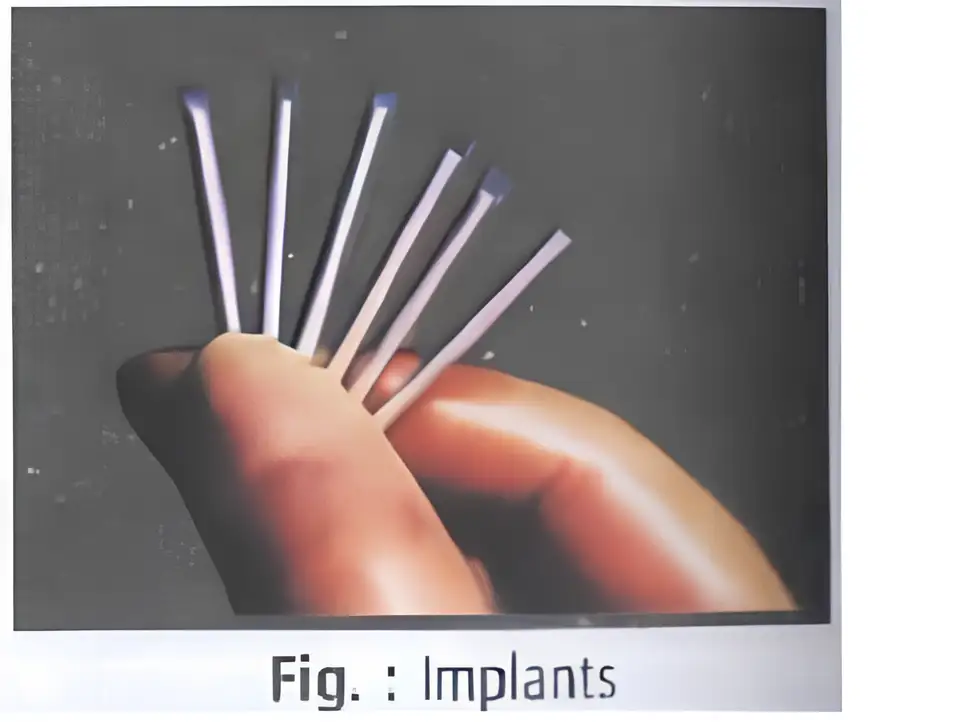
Implants
- Design and duration: Six matchstick-sized steroid capsules are placed under the skin of the inner arm above the elbow; they release synthetic progesterone for about five years.
- Features: Implants are safe, convenient, effective and long-lasting.
7. Permanent Methods of Birth Control
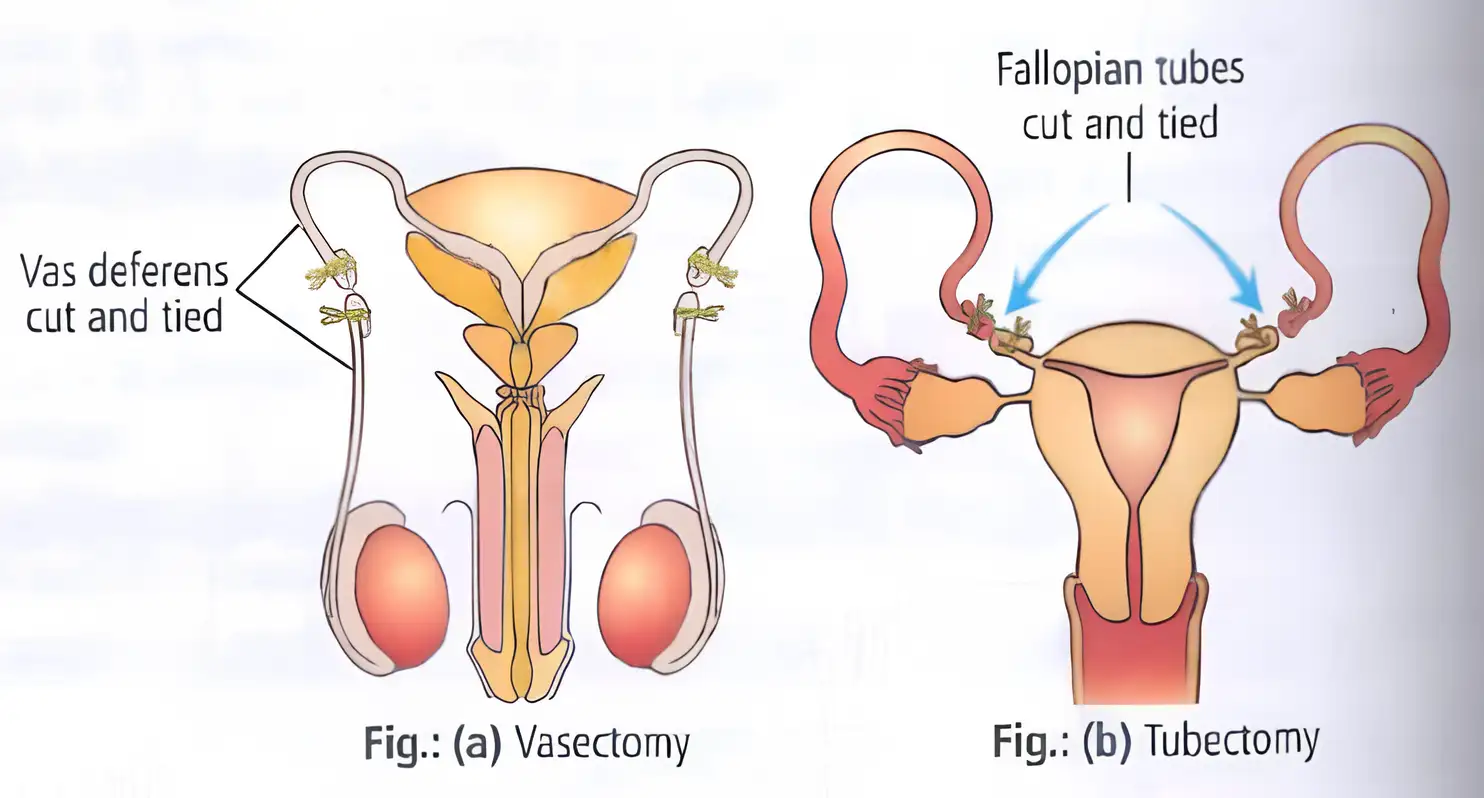
Sterilisation — A surgical, usually terminal, contraceptive method that blocks gamete transport and thereby prevents conception.
| Point | Vasectomy | Tubectomy |
|---|---|---|
| Partner | Male | Female |
| Procedure | A small part of the vas deferens is cut out or tied through a small scrotal incision. | A small part of the Fallopian tube is cut out or tied through a small abdominal incision or through the vagina. |
| Effect | Blocks sperm transport. | Blocks ovum transport through the Fallopian tube. |
| Effectiveness and reversal | Highly effective; reversibility is very poor. | Highly effective; reversibility is very poor. |
Choose and use a contraceptive method with guidance from a qualified medical professional. Possible effects such as nausea, abdominal or breast pain and irregular bleeding should not be ignored.
Name three mechanisms by which contraception can prevent conception.
Differentiate vasectomy and tubectomy.
Quick recap
- Population growth is linked to improved survival and a larger reproductive-age population; stabilisation measures promote small families.
- Natural methods avoid sperm–ovum contact but have comparatively high failure rates.
- Barrier methods physically block sperm; condoms also reduce STI and AIDS transmission risk.
- IUCDs include non-medicated, hormone-releasing and copper-releasing types, each with a distinct action.
- Pills, injections and implants use hormonal or related effects; emergency contraception is used within 72 hours.
- Vasectomy and tubectomy are permanent sterilisation methods that block gamete transport and have poor reversibility.
Medical Termination of Pregnancy (MTP)
Medical termination of pregnancy (MTP) — Intentional or voluntary termination of a pregnancy before full term; also called induced abortion.
Scale and legal status
- Global scale: About 45–50 million MTPs are performed worldwide each year—approximately one-fifth of all pregnancies conceived annually.
- India: MTP was legalised in 1971, subject to strict conditions intended to prevent misuse.
- Safeguard: Restrictions are especially important because indiscriminate and illegal female foeticide is reported to be high in India.
Reasons and safety of MTP
When MTP may be considered
- Unwanted pregnancy: May result from unprotected intercourse, contraceptive failure during coitus, or rape.
- Medical reasons: MTP may be necessary when continuing the pregnancy could harm the mother, the foetus, or both.
| Stage | Timing | Relative safety |
|---|---|---|
| First trimester | Up to 12 weeks | Relatively safe |
| Second trimester | Second trimester | Much riskier |
Unsafe practices and prevention
- Illegal procedures: The majority of MTPs are performed illegally by unqualified practitioners; these procedures are unsafe and can be fatal.
- Sex determination misuse: Using amniocentesis to determine foetal sex and then terminating a female foetus is dangerous and should be avoided.
- Prevention: Effective counselling can reduce unprotected intercourse and help people avoid the risks of illegal abortions.
Common mistake: MTP is relatively safer in the first trimester, not risk-free; second-trimester abortions are much riskier.
What is MTP, and when is it considered relatively safe?
Give two reasons for MTP.
Why is the misuse of amniocentesis for foetal sex determination dangerous?
Quick recap
- MTP is the intentional termination of pregnancy before full term, also called induced abortion.
- India legalised MTP in 1971 under strict conditions to prevent misuse; illegal female foeticide is reported to be high in India.
- MTP may address unwanted pregnancies or serious risks to the mother or foetus.
- The first trimester, up to 12 weeks, is relatively safer; second-trimester abortions are much riskier.
- The majority of MTPs are performed illegally by unqualified practitioners, and these procedures can be fatal.
- Amniocentesis must not be misused for sex determination and sex-selective termination.
Sexually Transmitted Infections (STIs)
Sexually transmitted infections (STIs) — Infections transmitted through sexual intercourse; also called venereal diseases (VDs) or reproductive tract infections (RTIs).
Important STIs, Causal Agents and Detection
| STI | Causal agent | Detection techniques |
|---|---|---|
| Syphilis | *Treponema pallidum* | Antibody detection, e.g. VDRL and ELISA |
| Gonorrhoea | *Neisseria gonorrhoeae* | Gram-staining of discharge, culture, microscopic examination |
| Enterobiasis | *Enterobius vermicularis* | Microscopic examination |
| AIDS | Human immunodeficiency virus (HIV) | ELISA, PCR |
| Hepatitis B | Hepatitis B virus (HBV) | ELISA |
| Genital herpes | Herpes simplex virus | Clinical diagnosis, antigen test, PCR |
| Genital warts | Human papillomavirus (HPV) | Clinical diagnosis, antibody detection, culture, DNA hybridisation |
| Chlamydiasis | *Chlamydia trachomatis* | Clinical diagnosis, Gram-staining of discharge, antigen detection, nucleic acid hybridisation |
| Trichomoniasis | *Trichomonas vaginalis* | Microscopic examination, culture |
Transmission, Symptoms and Effects
Transmission and health effects
- Transmission: Sexual intercourse with an infected person; sharing injection needles or surgical instruments; infected blood transfusion; and transmission from an infected mother to the fetus.
- Early symptoms: Itching, swellings, fluid discharge and slight pain.
- Untreated infection: May lead to abortion, stillbirth, ectopic pregnancy, infertility, reproductive-tract cancer or pelvic inflammatory disease.
- Higher incidence: STIs can affect anyone, but reported incidence is especially high among people aged 15–24 years.
| Category | STIs |
|---|---|
| Completely curable with early detection and proper treatment | All listed STIs except HIV infection, hepatitis B and genital herpes |
| Exceptions | HIV infection, hepatitis B and genital herpes |
Prevention
- Partners: Avoid sex with unknown or multiple partners.
- Condoms: Always use condoms during coitus.
- Medical care: If infection is suspected, consult a qualified doctor promptly; complete the prescribed treatment if diagnosed.
Name the common routes of STI transmission apart from sexual intercourse.
What complications can result from untreated STIs?
Quick recap
- STIs are also known as VDs or RTIs.
- They can spread sexually and through contaminated instruments, needles, blood or mother-to-fetus transmission.
- Itching, swelling, fluid discharge and slight pain are possible early symptoms.
- Untreated STIs can cause reproductive and pregnancy-related complications.
- Early diagnosis and proper treatment cure all except HIV infection, hepatitis B and genital herpes, as stated in the lecture.
- Prevention includes avoiding unknown or multiple partners, using condoms and seeking prompt medical care.
Infertility
Infertility and Assisted Reproductive Technologies
Test-Tube Baby Programme: IVF and Embryo Transfer
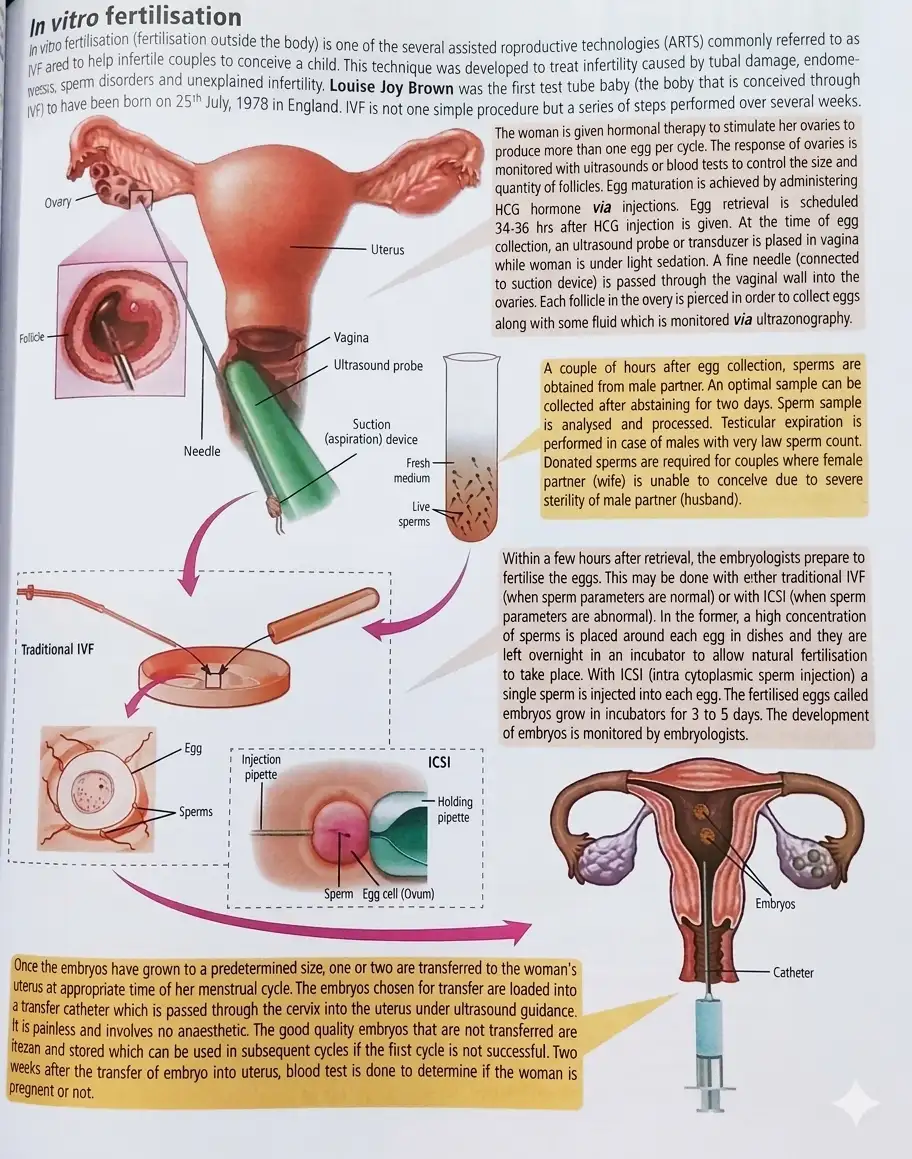
Key IVF Milestone
- First test-tube baby: Louise Joy Brown was born in 1978 to Lesley and Gilbert Brown.
- Doctors: The procedure was developed with Dr. Patrick Steptoe and Dr. Robert Edwards; Edwards received the 2010 Nobel Prize for developing the technique.
Other ART Techniques
Access to Parenthood
Detection of Fetal Disorders
Distinguish between ZIFT and IUT.
What is GIFT, and when is it used?
What is the basic difference between amniocentesis and CVS?
Quick recap
- Infertility is inability to conceive or produce children despite unprotected sexual cohabitation; causes may be physical, congenital, immunological or psychological.
- IVF forms a zygote outside the body, followed by embryo transfer.
- ZIFT transfers embryos with up to 8 blastomeres to the Fallopian tube; IUT transfers embryos with more than 8 to the uterus.
- GIFT transfers donor ovum and sperm into the Fallopian tube; ICSI injects sperm into an ovum’s cytoplasm.
- AI introduces semen into the vagina or uterus; IUI is the intrauterine route.
- Amniocentesis, CVS, ultrasound and fetoscopy are methods used to assess fetal condition or obtain fetal information.
NEET Zoology — ALL CHAPTERS
1
Structural Organisation in Animals
2
Breathing and Exchange of Gases
3
Body Fluids and Circulation
4
Excretory Products and their Elimination
5
Locomotion and Movement
6
Neural Control and Coordination
7
Human Reproduction
8
Reproductive Health
9
Evolution
10
Microbes in Human Welfare
11
Organism and Population
12
Ecosystem
13
Biodiversity and Conservation