NEET Ug . NEET Zoology . Zoology . Biodiversity and Conservation
Chapter 13: Biodiversity and Conservation
Ch 13
NEET Zoology
NEET Ug
Introduction
Overview
- Earth hosts vast life diversity: 20,000+ ant species, 300,000 beetles, 28,000 fishes, 20,000 orchids.
Memory Aids
- Remember: Ants and beetles dominate insect diversity.
Quick Checkpoints
- What are examples of species diversity on Earth?
Biodiversity
Definition and Levels
- Biodiversity: Variety of ecosystems, species, biotypes, and genes with interactions.
- Term coined by Walter G. Rosen (1985), popularised by Edward Wilson (1992).
- Varies by environment and species tolerance.
- Described species: ~1.5 million; estimated total species: ~7 million (Robert May).
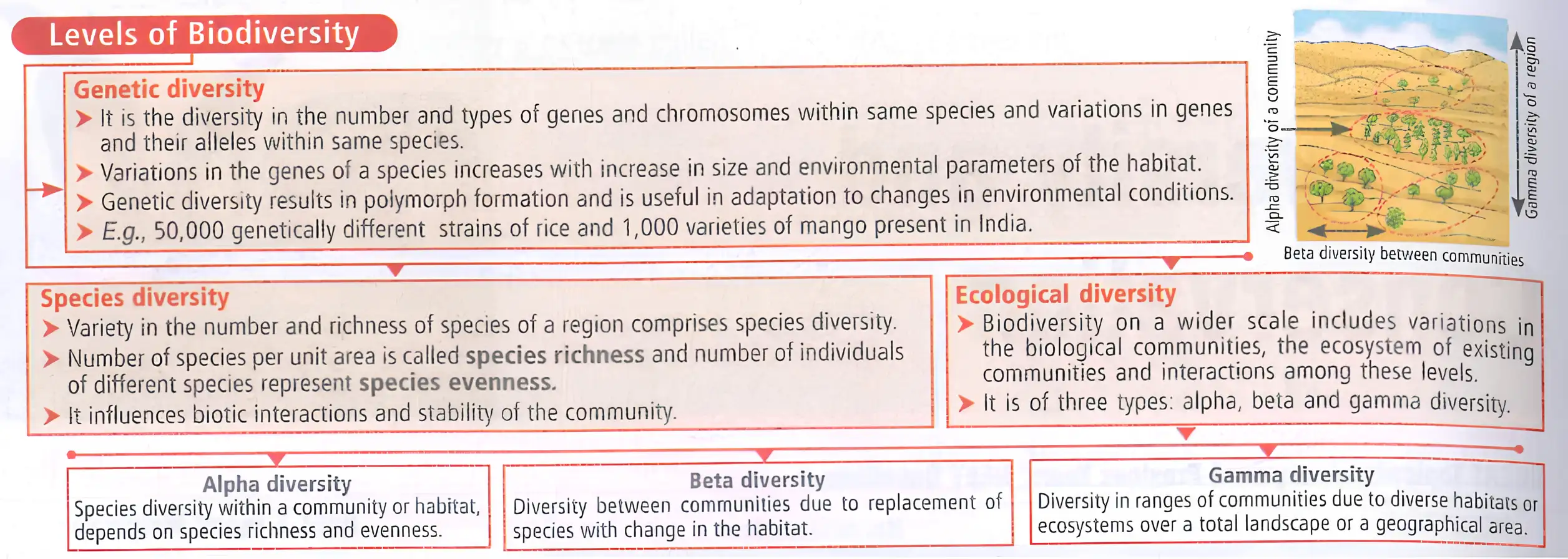
- Three levels: Genetic, Species, Ecological diversity.
- Ecological diversity types: Alpha (within habitat), Beta (between habitats), Gamma (across regions).
Memory Aids
- Alpha = local diversity, Beta = habitat difference, Gamma = regional diversity.
Quick Checkpoints
- What are the three hierarchical levels of biodiversity?
- Define alpha, beta, and gamma diversity.
Global Species Distribution
Key Facts
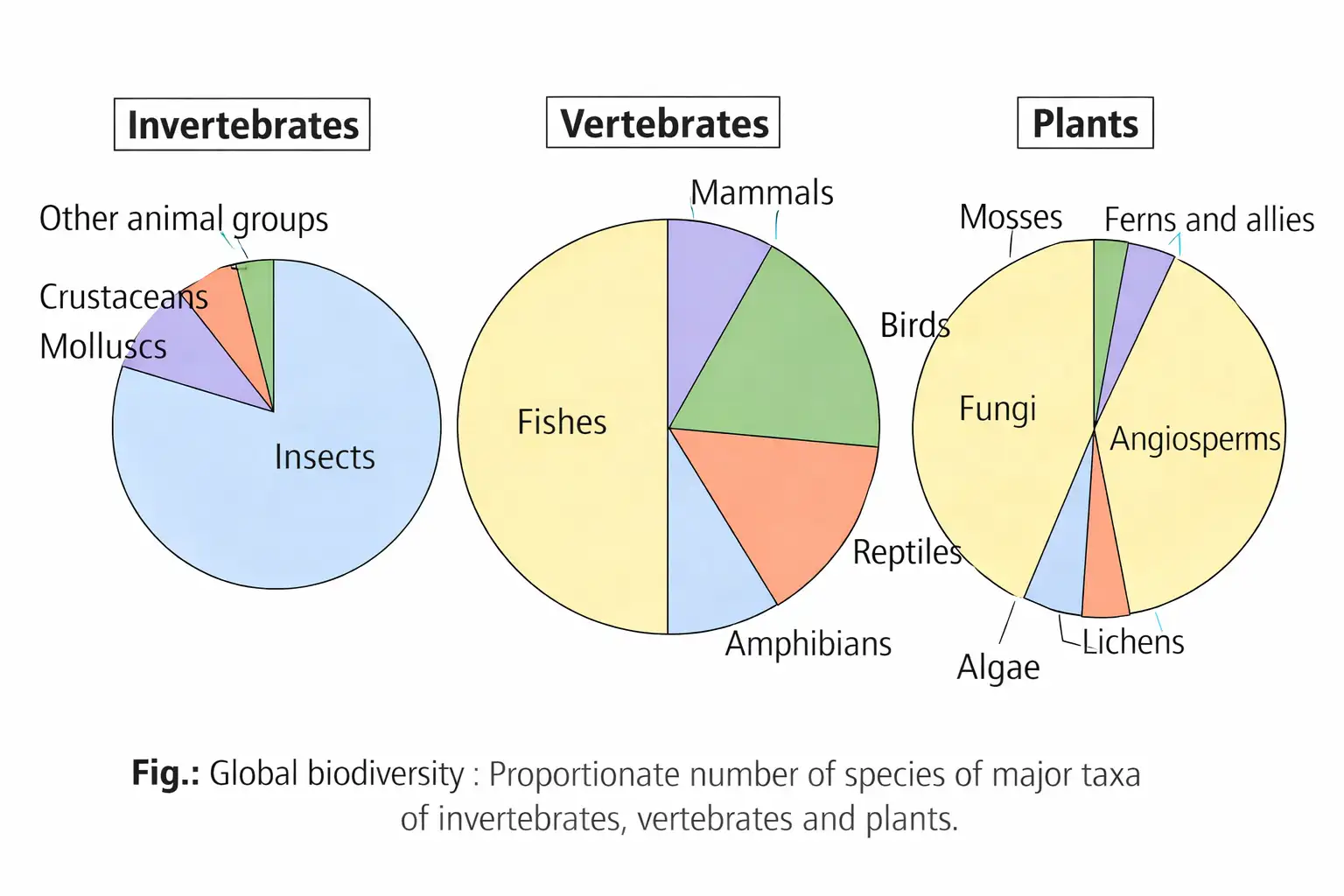
- Animals: >70% of species; plants: ~22%.
- Insects: >70% of animal species.
- Fungi species outnumber fishes, amphibians, reptiles, mammals combined.
- India: 2.4% land area, 8.1% global species diversity; one of 12 mega-diversity countries.
- India's biogeographical regions: 10 distinct zones.
- Recorded species in India: ~45,000 plants, double animals.
- Estimated undiscovered species: >100,000 plants, >300,000 animals.
- Endemic species: confined to specific regions (e.g., Western Ghats amphibians).
Memory Aids
- India: Small land, big biodiversity.
- Insects dominate animal diversity.
Quick Checkpoints
- What percentage of global species diversity does India hold?
- Which group forms the largest proportion of animal species?
Patterns of Biodiversity
Latitudinal Gradients
- Species diversity decreases from equator to poles.
- Tropics (23.5°N to 23.5°S) have highest species richness.
- Examples: Colombia (~1,400 bird species), New York (105), Greenland (56).
- Amazon rainforest: richest biodiversity globally.
- Hypotheses for tropical diversity:
- Long evolutionary time (less glaciation).
- Stable, less seasonal environment promotes niche specialization.
- Higher solar energy increases productivity and diversity.
Species-Area Relationship
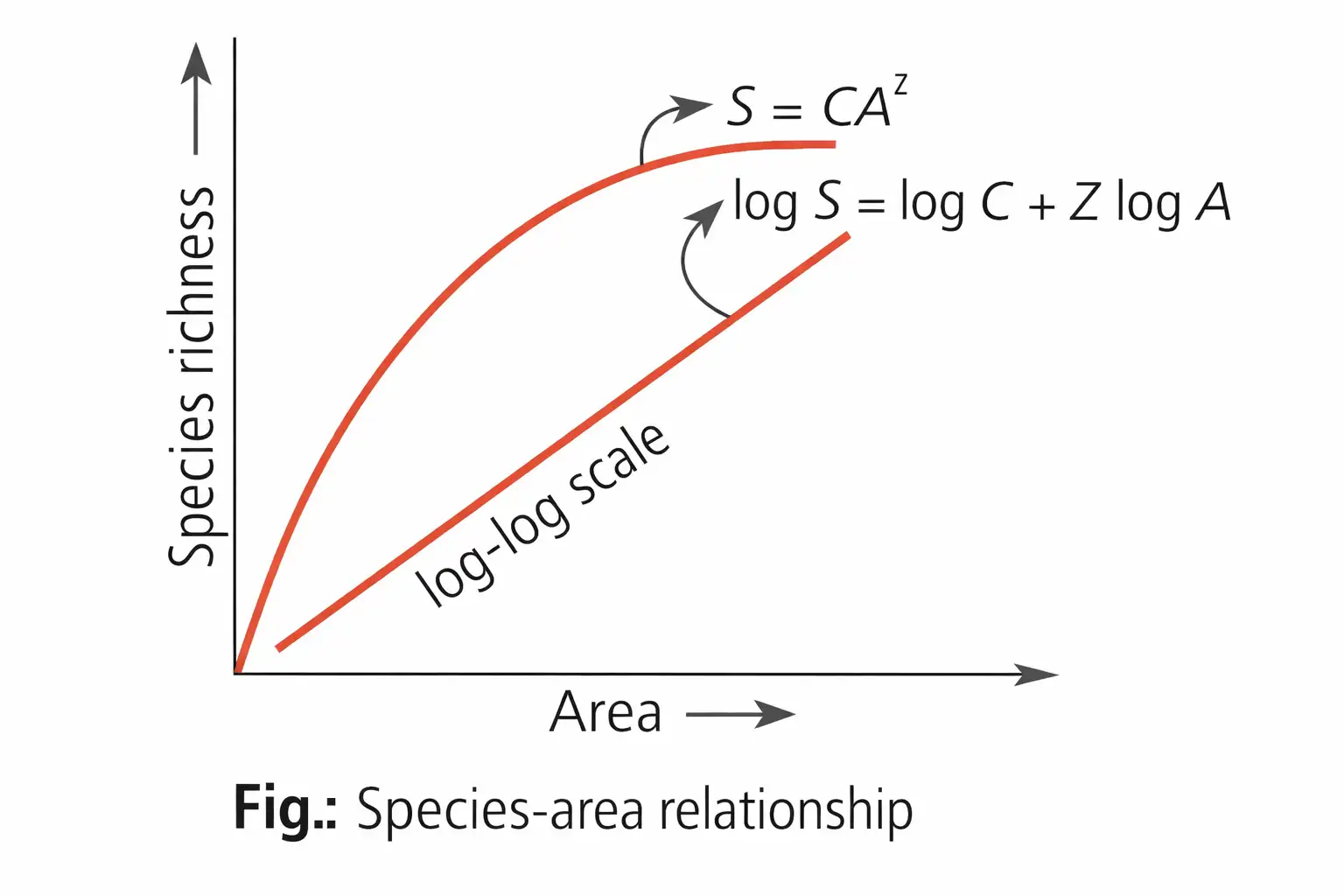
- Species richness increases with area but plateaus.
- Relationship: log S = log C + z log A (S=species, A=area).
- Z value: 0.1-0.2 generally; higher for continents (0.6-1.2).
Memory Aids
- More area = more species (up to a limit).
- Tropics = species hotspot.
Quick Checkpoints
- Why does species diversity decrease towards poles?
- Explain the species-area relationship.
Importance of Species Diversity
Key Points
- Ecological stability: Diverse ecosystems resist stress better.
- Higher productivity in biodiverse ecosystems.
- Maintains ecosystem health via checks, feedbacks, keystone species.
- Rivet popper hypothesis: Loss of species weakens ecosystem like rivets in a plane.
Memory Aids
- More species = stronger ecosystem.
- Rivet analogy: Each species vital for ecosystem safety.
Quick Checkpoints
- How does species diversity contribute to ecosystem stability?
- What is the rivet popper hypothesis?
Loss of Biodiversity
Overview
- Rapid decline due to human activities.
- IUCN Red List (2004): 784 species extinct in last 500 years.
- 15,500+ species currently threatened.
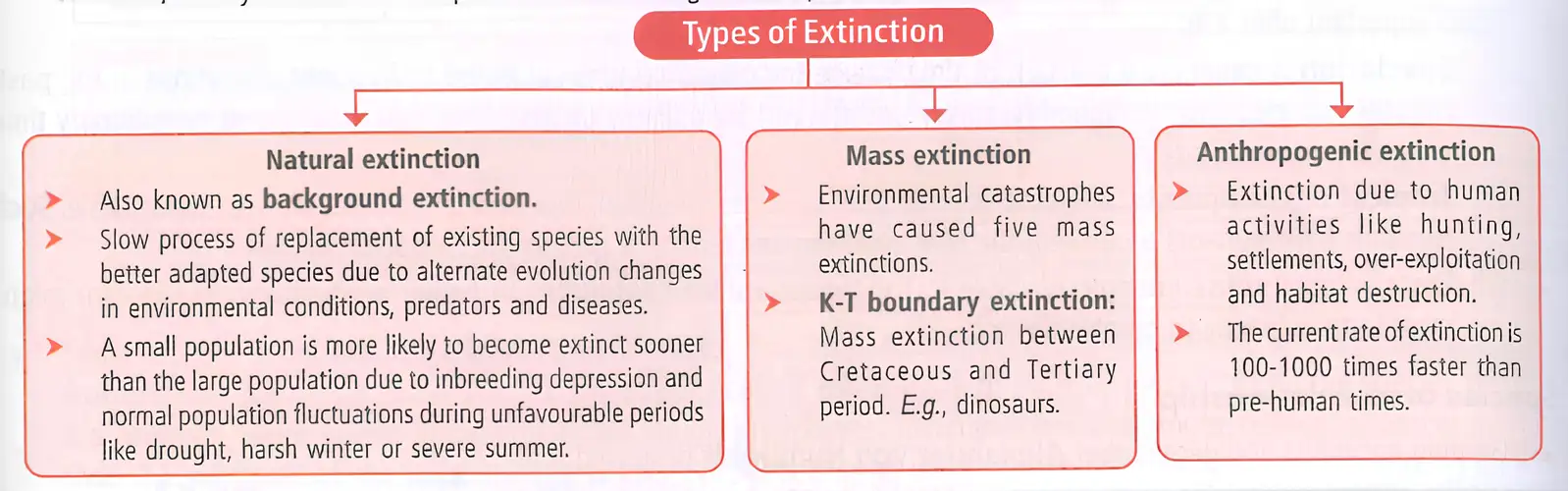
- Extinction rates 100-1,000 times faster than pre-human times.
- Five mass extinctions in Earth's history; current trend alarming.
Memory Aids
- Extinction types: Natural, Mass, Anthropogenic.
- Current extinction mainly anthropogenic.
Quick Checkpoints
- What are the three types of extinction?
- Why is current extinction rate alarming?
Causes of Biodiversity Loss
The Evil Quartet
- Habitat loss and fragmentation: Main cause; reduces shelter, increases predation, disrupts species interactions.
- Over-exploitation: Excessive hunting/fishing reduces populations, leading to extinction.
- Alien species invasion: Non-native species outcompete natives, causing declines.
- Co-extinction: Extinction of one species causes dependent species to vanish.
Other Causes
- Disturbance and degradation: Fires, pest attacks, human clearing.
- Pollution: Pesticides cause biomagnification; heavy metals and oil spills harm species.
- Intensive agriculture: Habitat destruction and reduced genetic diversity.
- Forestry: Monocultures reduce species diversity and increase vulnerability.
Memory Aids
- Remember "Evil Quartet": Habitat loss, Over-exploitation, Alien invasion, Co-extinction.
Quick Checkpoints
- List the four major causes of biodiversity loss.
- How does habitat fragmentation affect species?
Red List Categories
Definitions
- Extinct: Species completely gone (e.g., Dodo).
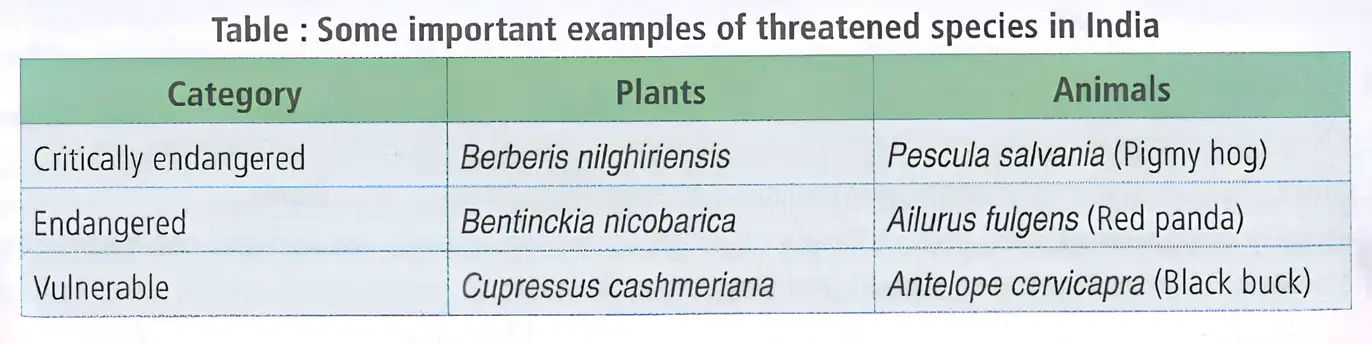
- Critically Endangered: Very high risk of extinction soon (e.g., Pigmy Hog).
- Endangered: High risk of extinction in near future (e.g., Lion-tailed Macaque).
- Vulnerable: Population declining, risk in medium term (e.g., Clouded Leopard).
- Extinct in Wild: Only survives in captivity.
- Lower Risk: Threatened but stable.
- Data Deficient: Insufficient data to assess risk.
- Rare Species: Naturally small populations, vulnerable.
- Not Evaluated: No assessment done.
- Indeterminate: At risk, cause unknown.
Memory Aids
- Extinct = gone; Critically Endangered = immediate risk.
- Endangered and Vulnerable = declining populations.
Quick Checkpoints
- What category describes species extinct in the wild?
- Define Critically Endangered and Vulnerable categories.
Biodiversity Conservation
Concept and Importance
- Protection and scientific management of biodiversity to maintain optimal levels for sustainable benefits.
- Reasons to conserve biodiversity:
- Narrowly utilitarian: Direct economic benefits like food, medicine, industrial products; over 25% of drugs are plant-derived.
- Broadly utilitarian: Ecosystem services like oxygen production, pollination, and aesthetic value.
- Ethical: Every species has intrinsic value beyond economic use.
- Red List Purpose: Awareness of threat levels, global biodiversity index, identify species at extinction risk, set conservation priorities, inform international agreements like CBD and CITES.
Memory Aids
- 3 reasons to conserve: Narrow, Broad, Ethical (NBE).
- Red List = Risk awareness + Conservation priority.
Quick Checkpoints
- What are the three categories of reasons to conserve biodiversity?
- What is the main purpose of the Red List?
- Give examples of economic benefits from biodiversity.
Conservation Strategies
Types and Methods
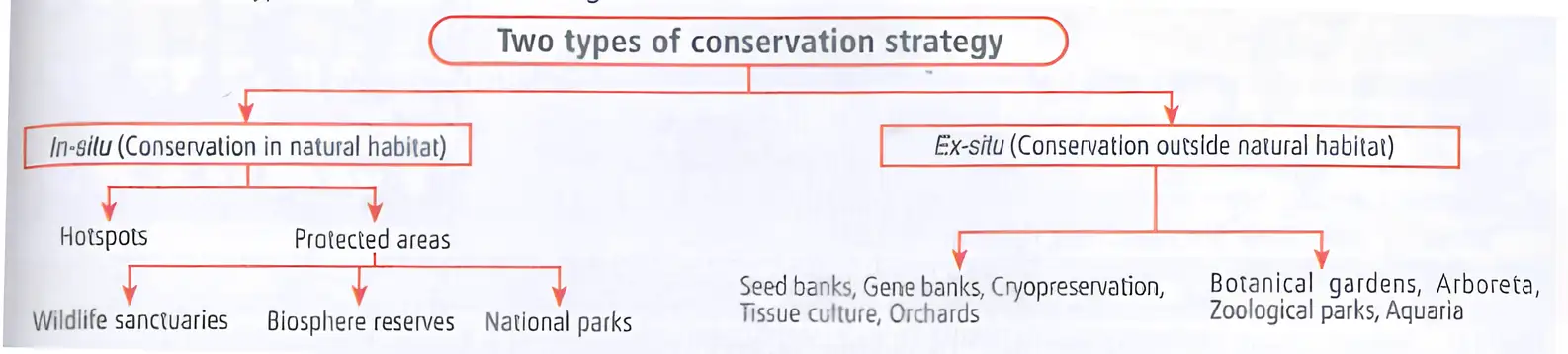
- In-situ Conservation: Protecting species in natural habitats; includes hotspots and protected areas.
- Ex-situ Conservation: Protecting species outside natural habitats; includes seed banks, gene banks, botanical gardens, zoos.
Memory Aids
- In-situ = "In place"; Ex-situ = "Out of place" conservation.
- In-situ protects ecosystems; Ex-situ preserves genetic material.
Quick Checkpoints
- Define in-situ and ex-situ conservation.
- List examples of in-situ conservation areas.
- What are gene banks used for?
In-situ Conservation
Details and Examples
- Conservation of ecosystems and biodiversity in natural habitats.
- Includes:
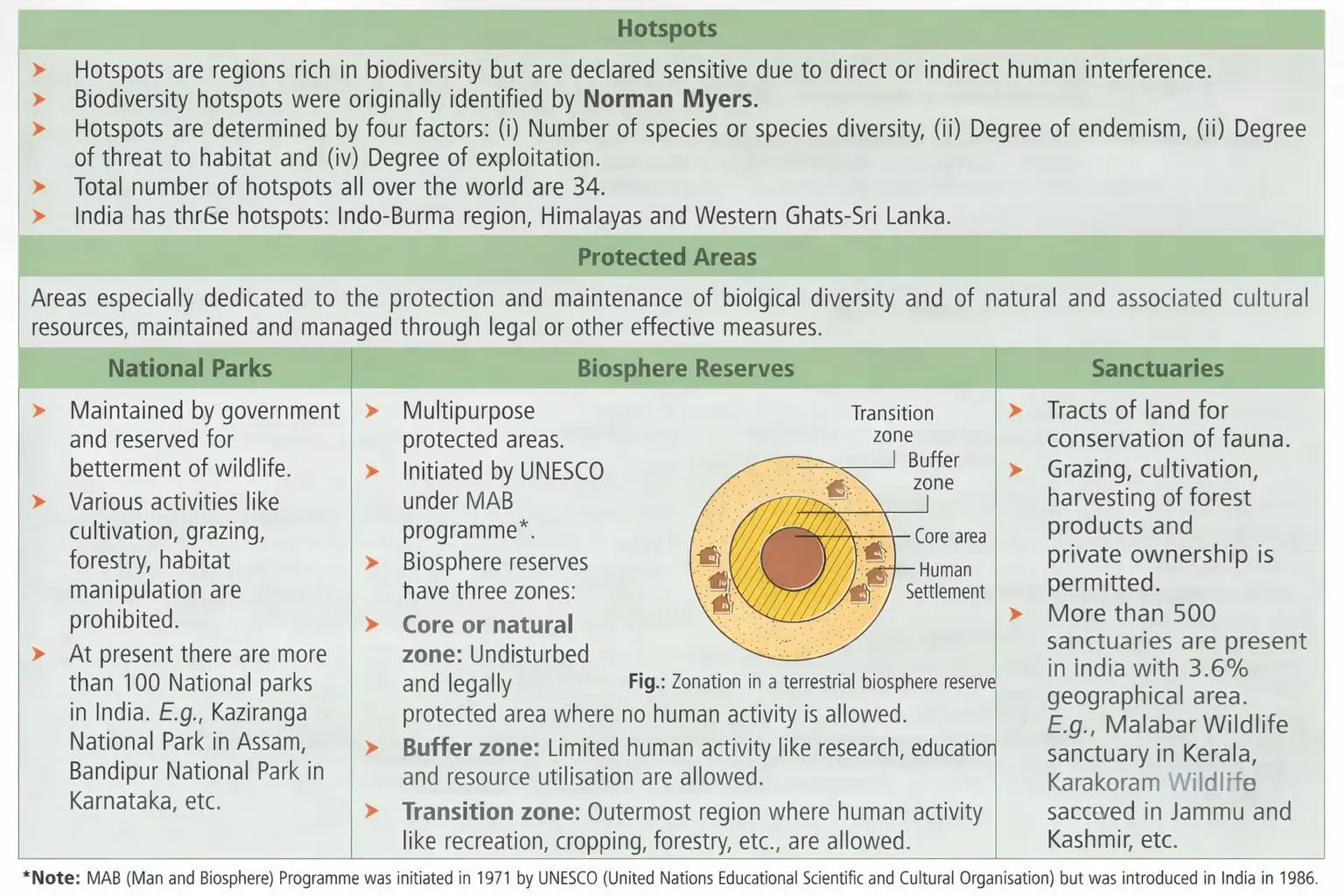
- Hotspots: Areas rich in endemic species but vulnerable; 34 globally, 3 in India.
- Protected Areas:
- National Parks: Strict protection, no farming or grazing.
- Biosphere Reserves: UNESCO designated; zones - Core (no human activity), Buffer (limited research), Transition (sustainable use).
- Sanctuaries: Protect animals, allow limited human use like grazing.
- India's sacred groves protect rare species; examples include Khasi Hills, Aravalli Hills, Western Ghats.
- Religious traditions aid conservation (e.g., Bishnois protect Prosopis cineraria and Black Buck).
Memory Aids
- Hotspots = High diversity + High threat.
- Biosphere Reserve zones: Core (strict), Buffer (limited), Transition (sustainable).
- Sanctuaries allow some human activity; National Parks do not.
Quick Checkpoints
- What defines a biodiversity hotspot?
- Difference between National Parks and Sanctuaries?
- What are the three zones of a Biosphere Reserve?
Ex-situ Conservation
Methods and Applications
- Conservation outside natural habitats; includes offsite collections and gene banks.
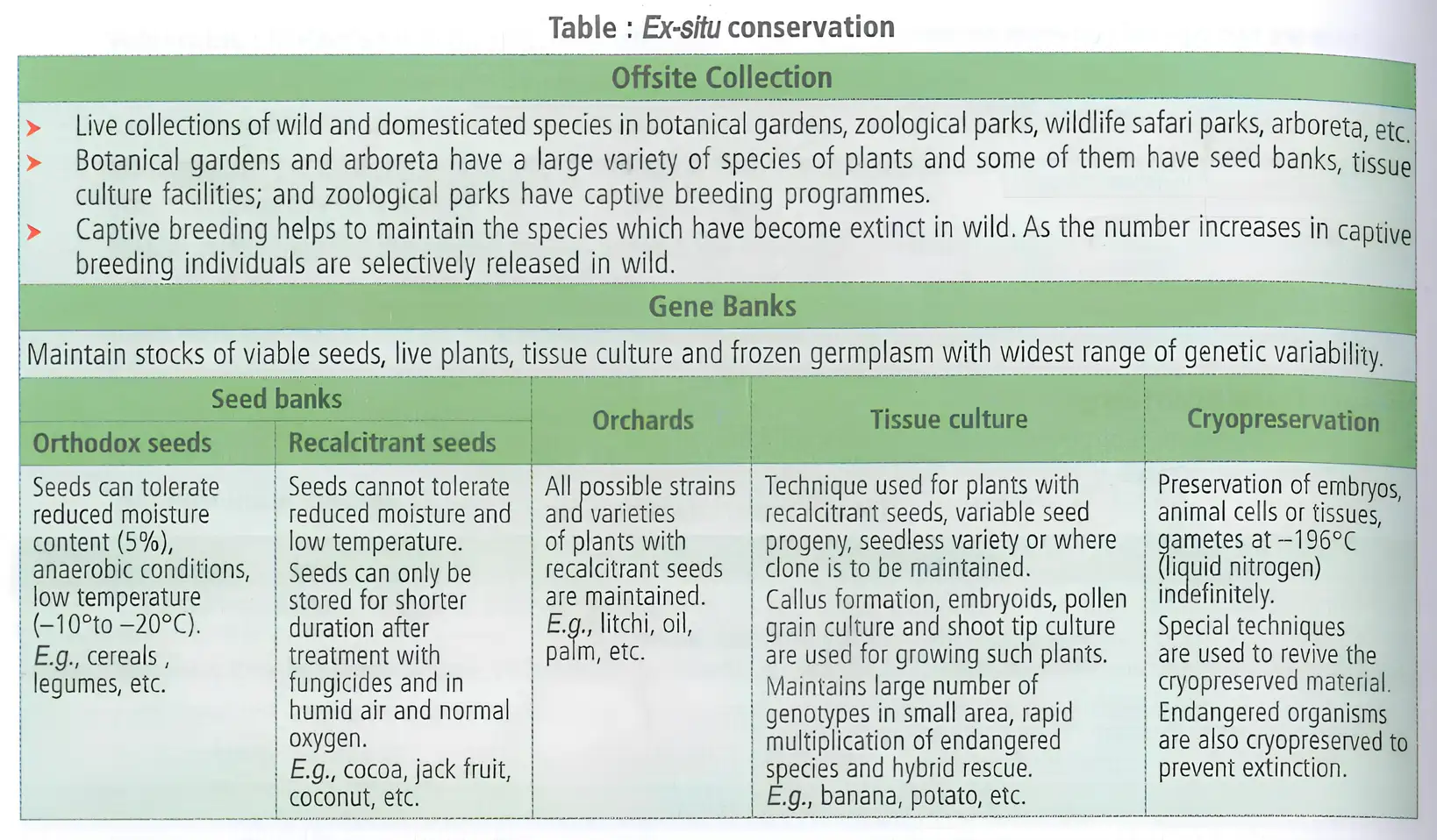
- Offsite collections: Botanical gardens, zoos, wildlife parks breed and maintain species; some released back to wild.
- Gene banks: Preserve seeds, live plants, genetic material with diversity.
- Seed types:
- Orthodox seeds: Can be dried and stored cold (e.g., cereals, legumes).
- Recalcitrant seeds: Cannot tolerate drying/cold (e.g., cocoa, coconut).
- Orchards maintain plants with recalcitrant seeds (e.g., litchi, oil palm).
- Tissue culture: Multiplication of plants from parts like pollen or embryos; useful for seedless or endangered plants.
- Cryopreservation: Freezing cells/tissues at -196°C for indefinite preservation; revivable when needed.
Memory Aids
- Offsite = Botanical gardens + Zoos; Gene banks = Seed + Tissue storage.
- Orthodox seeds = Dry + Cold tolerant; Recalcitrant = Sensitive.
- Tissue culture and cryopreservation aid rapid multiplication and long-term storage.
Quick Checkpoints
- What is the difference between orthodox and recalcitrant seeds?
- List two methods of ex-situ conservation.
- What is cryopreservation used for?
International Efforts
Key Agreements and Organisations
- Earth Summit (1992): Promoted Convention on Biological Diversity (CBD); signed by 152 nations; India joined in 1994.
- Commitments:
- Conserve biodiversity.
- Manage biodiversity sustainably.
- Equitable sharing of benefits from genetic resources.
- Earth Summit (Rio+20, 2012): New sustainable development strategies.
- Agenda 21: Blueprint for sustainable development in 21st century.
- World Conservation Union (IUCN): Leadership in conservation.
- World Wide Fund for Nature (WWF): International conservation support.
- CITES: Restricts trade in endangered species; helped save elephants.
- UNESCO MAB Programme: Supports biosphere reserves.
Memory Aids
- CBD = Conservation + Sustainable use + Benefit sharing.
- CITES = Trade control to protect species.
- Agenda 21 = 21st-century sustainability plan.
Quick Checkpoints
- What are the main goals of the Convention on Biological Diversity?
- Which organisation restricts international trade of endangered species?
- What is the purpose of Agenda 21?
Biodiversity Conservation in India
National Initiatives
- In-situ conservation managed by Ministry of Environment and Forests.
- Ex-situ conservation managed by National Bureau of Plant, Animal and Fish Genetic Resources.
- International Crop Research Institute for Semi-Arid Tropics (ICRISAT), Hyderabad conserves germplasm of crops like groundnut, pigeon pea, chickpea, pearl millet, sorghum.
- Multiple centres maintain diverse crop varieties for conservation.
Memory Aids
- ICRISAT = Crop germplasm conservation in semi-arid tropics.
- Ministry of Environment = In-situ; National Bureau = Ex-situ.
Quick Checkpoints
- Which Indian institute conserves crop germplasm for semi-arid tropics?
- Who manages in-situ conservation in India?
- What is the role of the National Bureau of Plant, Animal and Fish Genetic Resources?
NEET Zoology — ALL CHAPTERS
1
Structural Organisation in Animals
2
Breathing and Exchange of Gases
3
Body Fluids and Circulation
4
Excretory Products and their Elimination
5
Locomotion and Movement
6
Neural Control and Coordination
7
Human Reproduction
8
Reproductive Health
9
Evolution
10
Microbes in Human Welfare
11
Organism and Population
12
Ecosystem
13
Biodiversity and Conservation