NEET Ug . NEET Zoology . Zoology . Organism and Population
Chapter 11: Organism and Population
Ch 11
NEET Zoology
NEET Ug
Organism and its Environment
Ecology and Levels of Organisation
Organism and Its Environment
- Distinct niches: Each species occupies a distinct ecological niche; no two species occupy the same niche.
- Niche: It includes the organism’s tolerance range, resources used and functional role in the ecosystem.
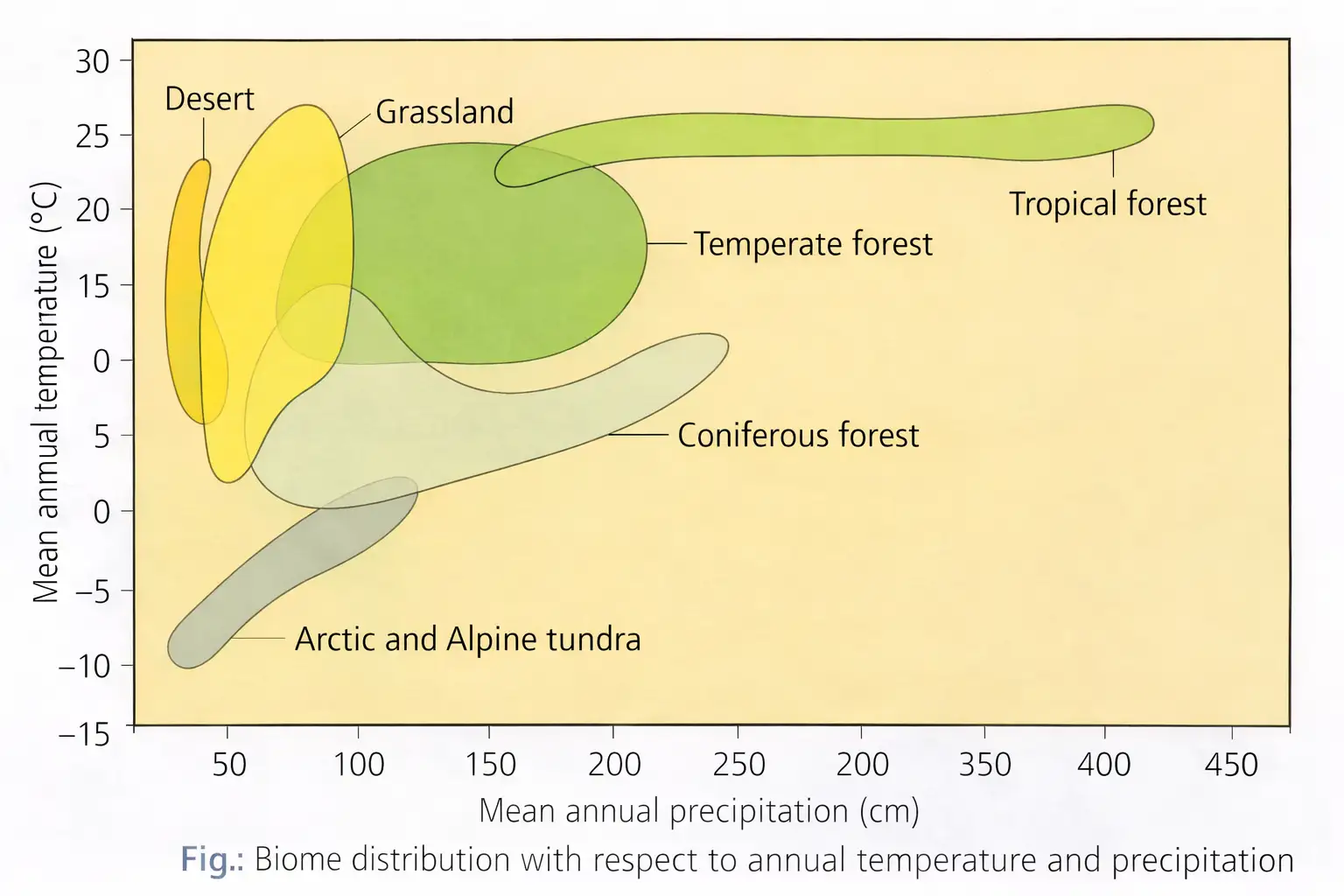
Major Abiotic Factors
Temperature
Water
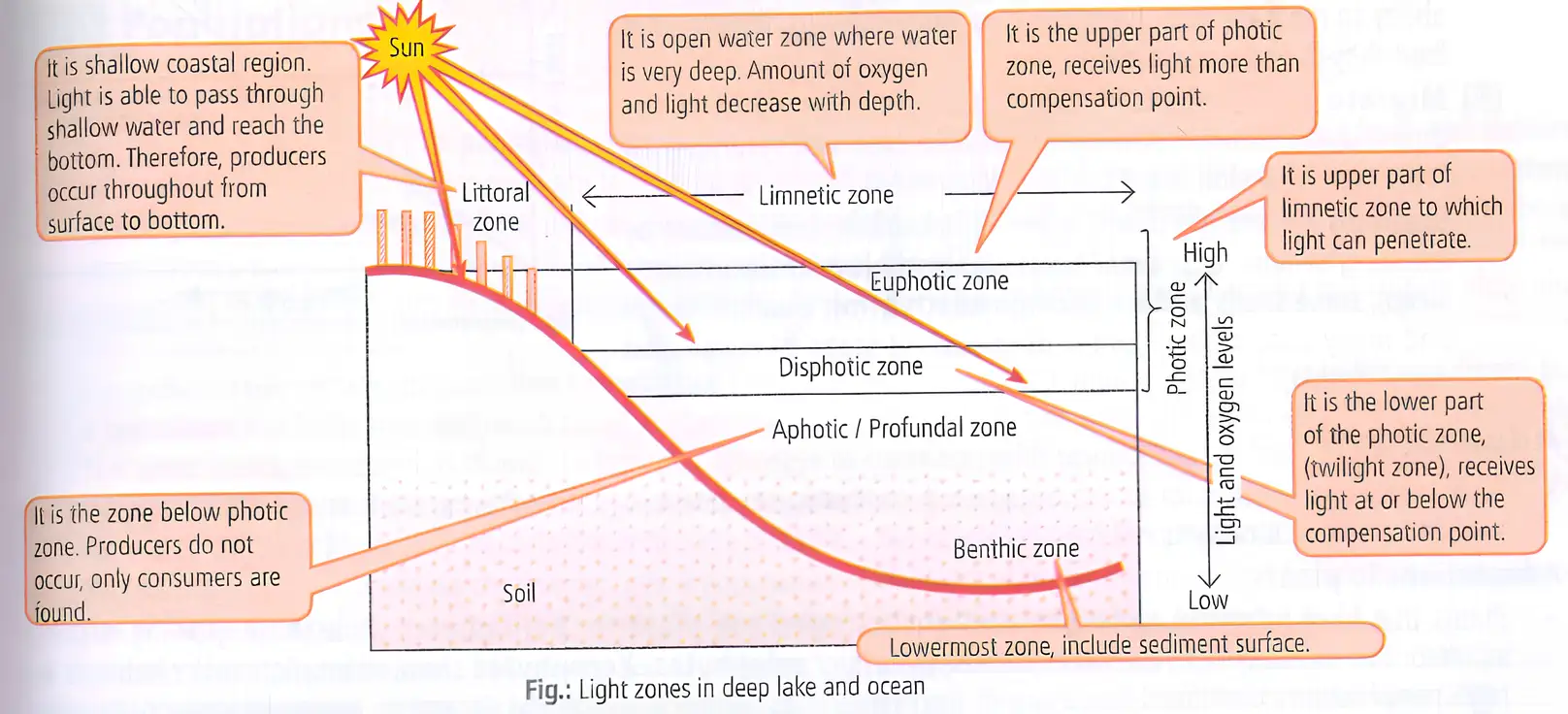
Light
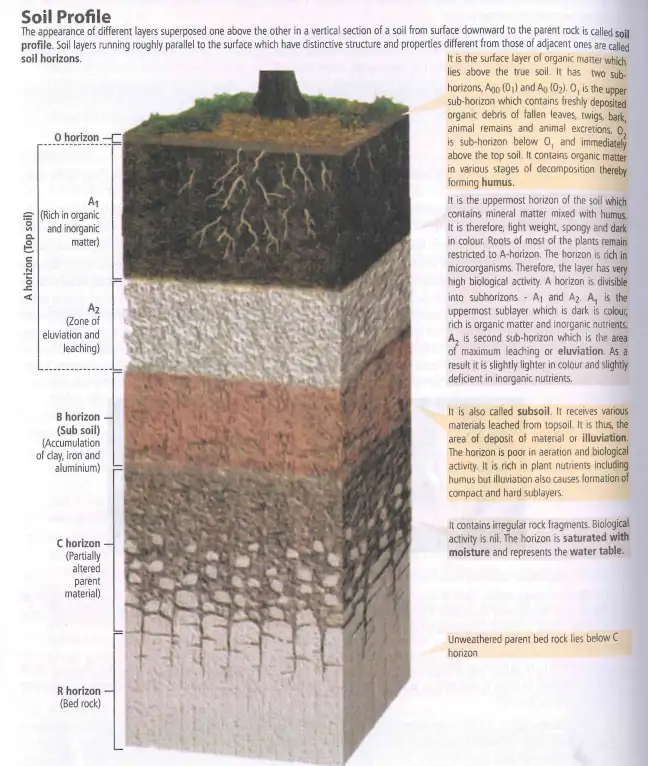
Soil
| Plant type | Soil or site condition |
|---|---|
| Halophytes | Saline soil. |
| Oxylophytes | Acidic soil. |
| Psammophytes | Sandy soil. |
| Chasmophytes | Rock crevices. |
| Lithophytes | Rocks. |
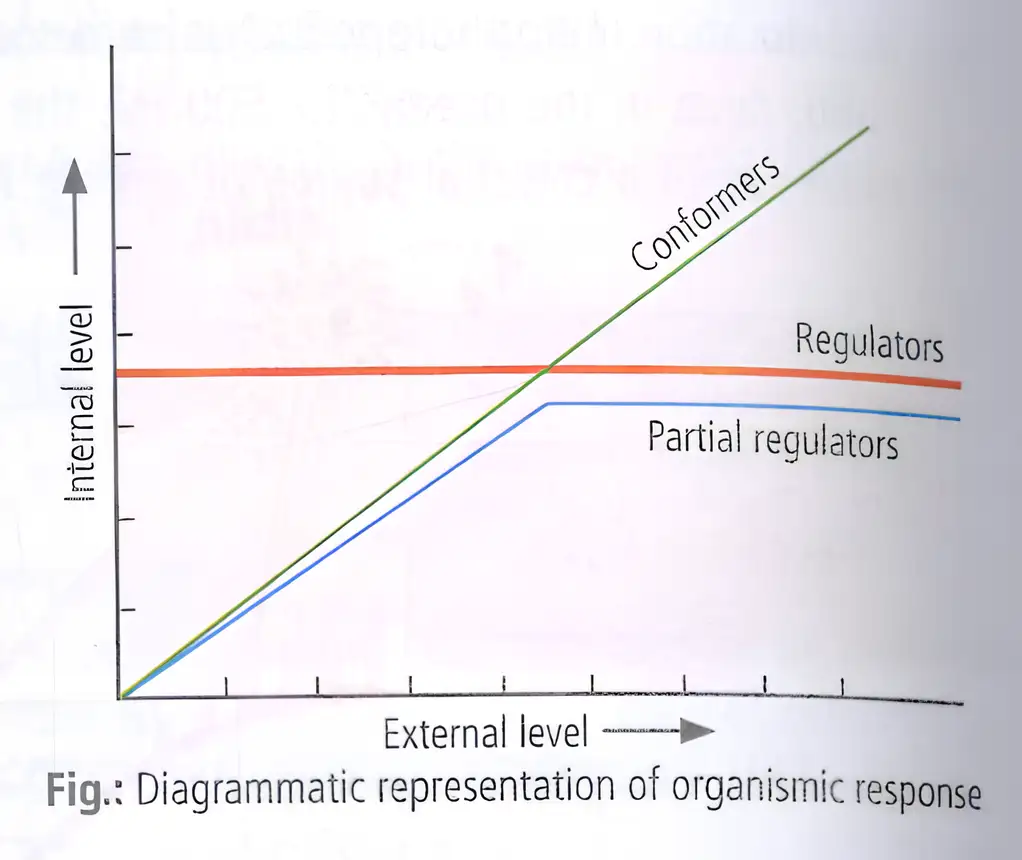
Responses to Abiotic Factors
Adaptations
Adaptations in Plants
| Plant group | Adaptations |
|---|---|
| Hydrophytes | Mucilage protects against epiphytes, pathogens and animals and acts as a lubricant; roots may be absent, poorly developed or used for balance; root caps may be replaced by root pockets; xylem is reduced or absent; aerenchyma stores air. |
| Halophytes | Tolerate high salt concentrations and obtain water from saline conditions; may have succulent leaves or stems, salt-secreting glands and sometimes pneumatophores. |
Adaptations in Animals
Differentiate eurythermal and stenothermal organisms.
Name the four ways organisms cope with stressful abiotic conditions.
How do desert plants reduce water loss?
Quick recap
- Ecology studies interactions among organisms and with their abiotic environment; the individual organism is its basic unit.
- Temperature, water, light and soil are major abiotic factors shaping habitats and organisms.
- Each species occupies a distinct niche; no two species occupy the same niche.
- Organisms may regulate, conform, migrate or suspend activity when conditions become stressful.
- Adaptations improve survival and reproduction and may be morphological, physiological or behavioural.
- Plant adaptations include light and drought strategies, while animal adaptations include camouflage, mimicry, water conservation and ecological rules.
Populations
Population Attributes
If 20 lotus plants produce 8 new plants in one year, the birth rate is 0.4 offspring per lotus per year.
Sex Ratio and Age Structure
- Sex ratio: The proportion of males and females in a population; for example, 60% females and 40% males.
- Age structure: The proportions of individuals in different age groups; it influences natality and mortality.
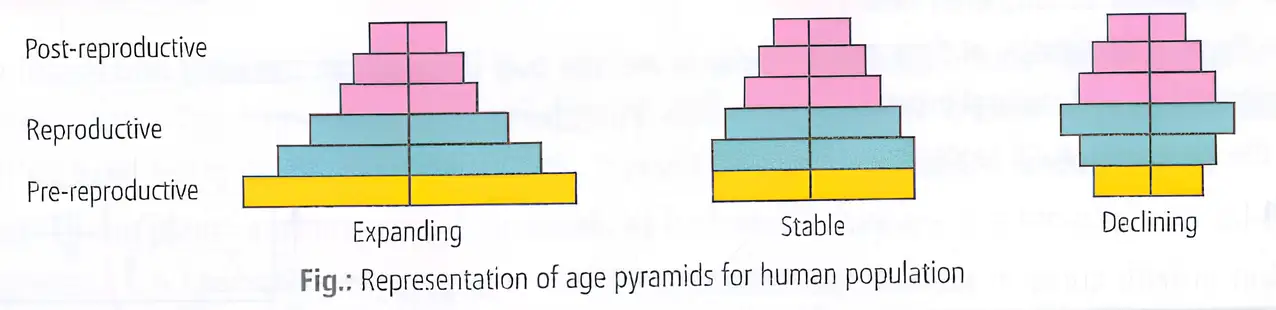
- Ecological age groups: Pre-reproductive (juvenile/dependent), reproductive (adult) and post-reproductive (old age).
- Age pyramid: A graph of the percentage of individuals in each age group; human age pyramids commonly display males and females together.
| Pyramid shape | Population represented |
|---|---|
| Triangular | Young or rapidly growing |
| Bell-shaped | Stable or stationary; growth is nearly zero |
| Urn-shaped | Declining or diminishing |
- Deme (local population)
- A subgroup of a population living in a particular area.
- Sister populations
- Populations of the same kind of organisms living in different places.
- Demography
- The study of population size.
Population Growth
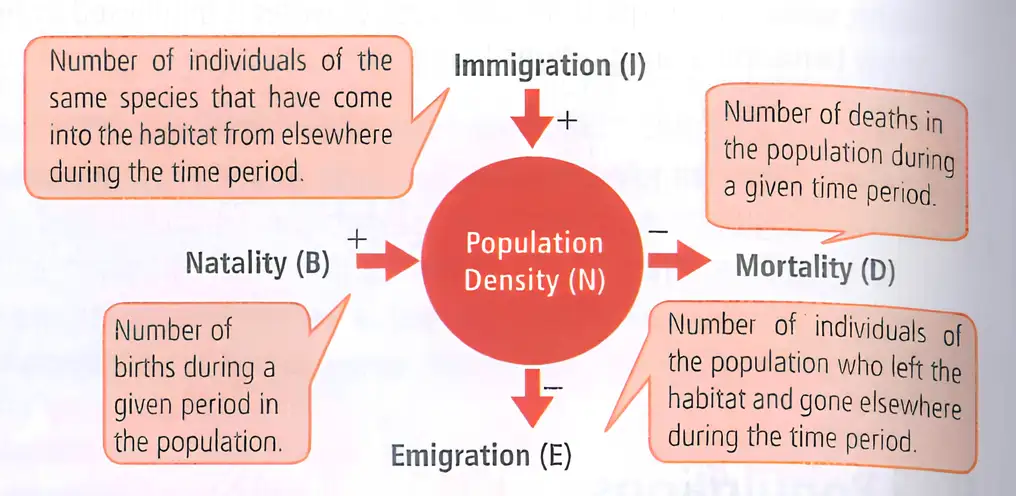
Population density at the next time step equals current density plus additions minus losses.
Estimating Population Size
- Relative density: Population size can be estimated using relative density when a direct count is impractical.
- Indirect estimate: Tiger censuses may use pugmarks and faecal pellets in national parks and tiger reserves.
Population Growth Models
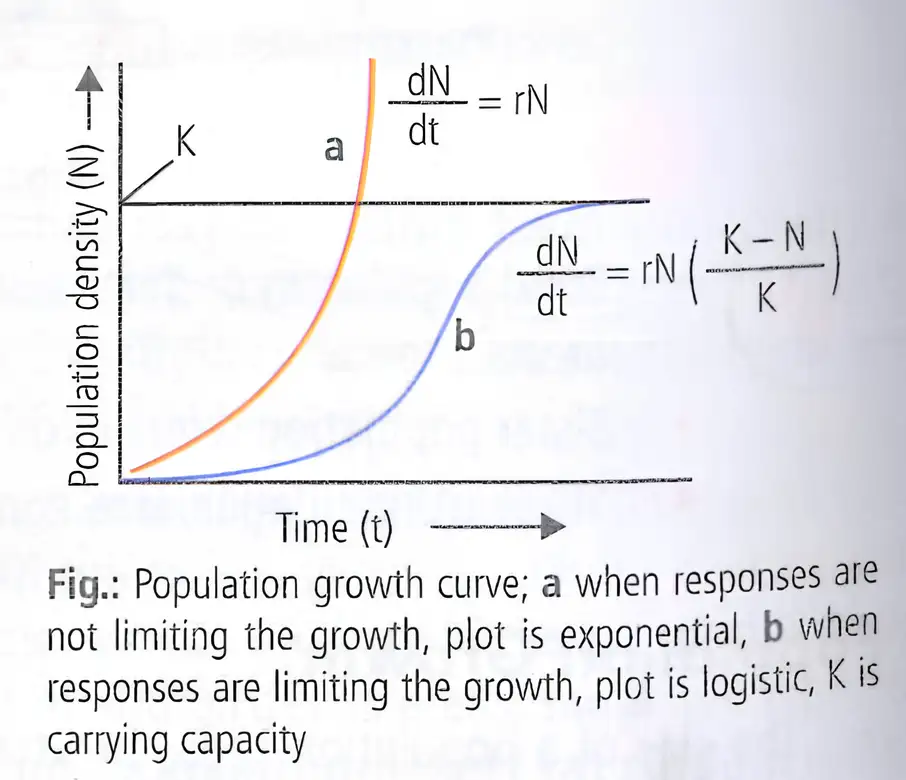
| Point | Exponential growth | Logistic growth |
|---|---|---|
| Resource condition | Resources are unlimited | Resources are finite and become limiting |
| Pattern and curve | Rapid increase; J-shaped curve | Initially slow, then rapid, then slows; S-shaped curve |
| Population limit | Growth eventually stops abruptly due to environmental resistance | Population approaches carrying capacity, \(K\) |
| Examples / significance | Potential growth when a species fully realises its innate capacity | Observed in human populations and laboratory growth of yeast, Drosophila and rabbits; more realistic for most animal populations |
\(r\) is the intrinsic rate of natural increase; \(b\) and \(d\) are birth and death rates, and \(N\) is population density. The integrated form gives density after time \(t\).
\(N\) is population density at time \(t\), \(r\) is the intrinsic rate of natural increase and \(K\) is carrying capacity—the maximum population the environment can support.
Life-History Variation
| Trait | \(r\)-selected species | \(K\)-selected species |
|---|---|---|
| Body size | Small | Large |
| Offspring | Many | Few |
| Life span | Short | Long |
| Metabolic rate | High | Low |
Population Interactions
| Species A | Species B | Interaction |
|---|---|---|
| \(+\) | \(+\) | Mutualism |
| \(-\) | \(-\) | Competition |
| \(+\) | \(-\) | Predation |
| \(+\) | \(-\) | Parasitism |
| \(+\) | \(0\) | Commensalism |
| \(-\) | \(0\) | Amensalism |
Predation
| Prey or plant defence | Examples / how it works |
|---|---|
| Camouflage | Cryptically coloured insects and frogs are harder for predators to detect. |
| Chemical defence in animals | The Monarch butterfly is distasteful to birds; it acquires the defensive chemical as a caterpillar by feeding on a poisonous weed. |
| Morphological defence in plants | Thorns on Acacia and cactus deter herbivores. |
| Chemical defence in plants | Chemicals can cause illness, deter feeding or digestion, disrupt reproduction or kill herbivores; some plants contain poisonous cardiac glycosides. |
| Defensive plant products | Nicotine, caffeine, quinine, strychnine and opium are plant chemicals that can act as defences against grazers and browsers; Calotropis is an example. |
Competition
Resource Partitioning Example
- MacArthur’s warblers: Five closely related warbler species lived on the same tree and coexisted by differing in their foraging behaviour.
Parasitism
| Point | Ectoparasites | Endoparasites |
|---|---|---|
| Location | On the host’s external surface | Inside the host, for example in the liver, kidney, lungs or red blood cells |
| Examples | Lice on humans, ticks on dogs, copepods on marine fish; Cuscuta on hedge plants | Parasites living within host organs or tissues |
| Adaptation / life cycle | External attachment to the host | Often complex life cycles and strong specialisation; body structures may be simplified while reproductive capacity is high |
Special Forms of Parasitism
- Cuscuta: A parasitic plant that has lost chlorophyll and leaves; it obtains nutrition from its host plant.
- Brood parasitism: A parasitic bird lays eggs in a host’s nest and leaves the host to incubate them. Similarity in egg size and colour reduces detection and ejection.
- Ectozooparasites: Parasites on animals, such as leeches on cattle, copepods on marine fish and lice on humans.
- Ectophytoparasites: Parasites on plants, such as aphids, lac insects and red cotton bugs.
Commensalism
Mutualism
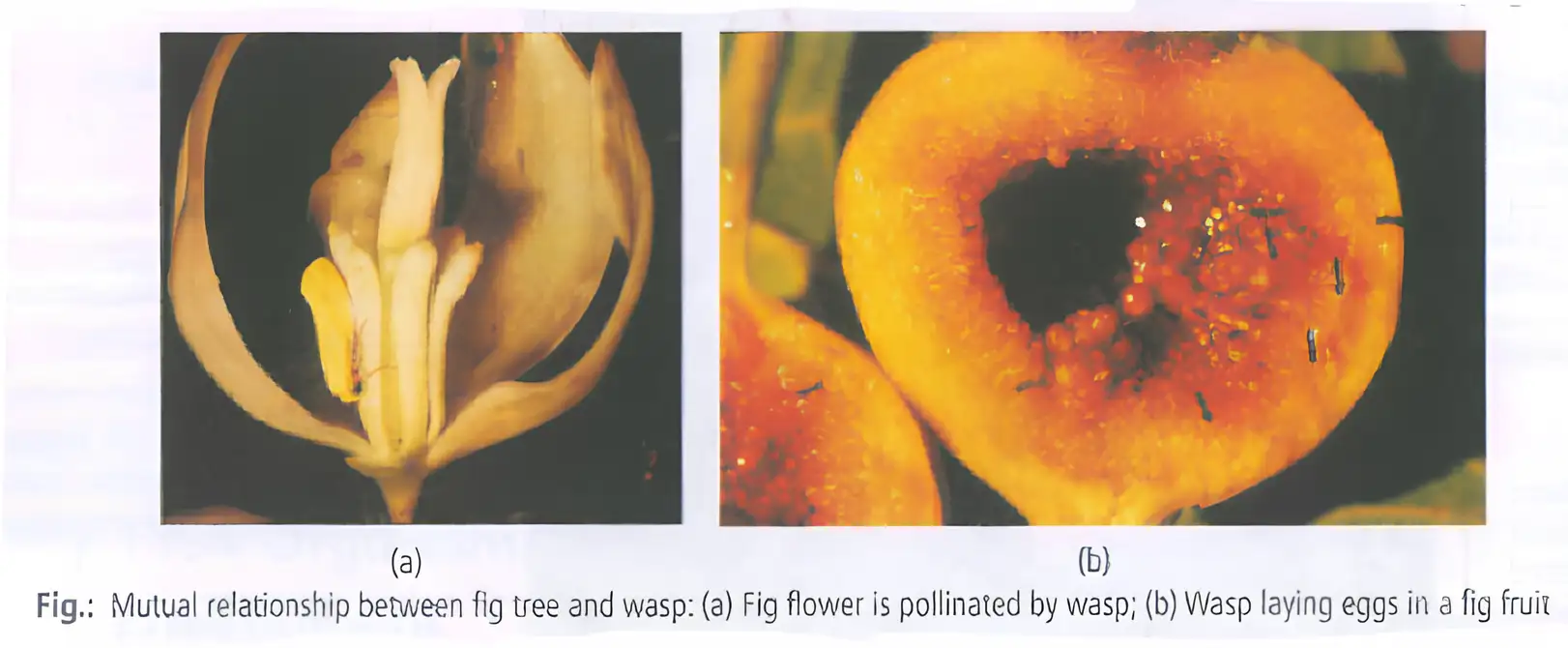
Fig and Wasp Mutualism
- A female wasp enters the fig inflorescence to find a site for laying eggs.
- While moving inside, the wasp pollinates the fig.
- The fig provides some developing seeds as food for wasp larvae.
Sexual Deceit in Ophrys
- Ophrys orchid: A petal resembles a female bee in size, colour and markings. A male bee pseudocopulates with the flower, thereby pollinating it.
Amensalism and Protocooperation
Differentiate exponential and logistic population growth.
What is resource partitioning? Give an example.
Distinguish mutualism from protocooperation.
Quick recap
- A population has attributes such as per-capita birth and death rates, sex ratio and age structure.
- Triangular, bell-shaped and urn-shaped age pyramids indicate growing, stable and declining populations, respectively.
- Natality and immigration increase density; mortality and emigration decrease it.
- Exponential growth is J-shaped; logistic growth is S-shaped and limited by carrying capacity \(K\).
- Life-history traits vary in breeding frequency and offspring number and size; \(r\)- and \(K\)-selected species show contrasting typical traits.
- Predation, competition, parasitism, commensalism, mutualism and amensalism differ in their effects on the interacting species.
- Resource partitioning can support coexistence, while parasite adaptations and prey defences shape interactions.
NEET Zoology — ALL CHAPTERS
1
Structural Organisation in Animals
2
Breathing and Exchange of Gases
3
Body Fluids and Circulation
4
Excretory Products and their Elimination
5
Locomotion and Movement
6
Neural Control and Coordination
7
Human Reproduction
8
Reproductive Health
9
Evolution
10
Microbes in Human Welfare
11
Organism and Population
12
Ecosystem
13
Biodiversity and Conservation