NEET Ug . NEET Zoology . Zoology . Evolution
Chapter 9: Evolution
Ch 9
NEET Zoology
NEET Ug
Origin of Life
Evolution and the Origin of Life
Evolutionary biology — The study of the history of life forms on Earth.
Evolution — An orderly change from one condition to another, including changes in Earth's flora and fauna over millions of years.
Early Earth and biopoiesis
- Universe: About 13.8 billion years old; it contains galaxies made of stars, gas and dust.
- Big Bang theory: An immense explosion began the universe. Expansion caused cooling; hydrogen and helium formed, and gravity gathered gases into galaxies.
- Earth: Formed about 4.5 billion years ago in the Milky Way's solar system; it was initially hot and barren. Earth is the only known place that supports life.
- Biopoiesis: The origin of life on Earth from non-living matter; it occurred about 4,000–4,200 million years ago.
Theories for the Origin of Life
| Theory | Main idea | Key proponents or points |
|---|---|---|
| Special creation | A supernatural power created life, either once or at successive intervals. | Proposed by Hebrew et al. and supported by Father Suarez; organisms were said to appear suddenly and remain unchanged. These ideas were challenged in the nineteenth century. |
| Cosmic panspermia | Life came to Earth from outside it. | Some ancient Greek thinkers proposed that life-bearing spores travelled between planets; the idea remains favoured by some astronomers. |
| Spontaneous generation | Life arose directly from decaying or rotting matter. | Ancient Greeks supported it; Egyptians linked life to sun-warmed Nile mud. Van Helmont claimed sweat and wheat grains could produce organisms. |
| Biogenesis | Life comes only from pre-existing life. | Experiments by Francesco Redi, Lazzaro Spallanzani and Louis Pasteur supported biogenesis and disproved spontaneous generation. |
Pasteur's swan-neck flask experiment
- Finding: Pre-sterilised flasks did not develop life from killed yeast; microorganisms appeared in a flask open to air.
- Conclusion: Air carried microorganisms that could cause fermentation or putrefaction; life did not arise spontaneously from nutrient media.
- Principle: New life comes from pre-existing life, supporting biogenesis and rejecting spontaneous generation.
Oparin–Haldane Theory and Chemical Evolution
Modern chemical theory
- Proponents: Oparin of Russia and Haldane of England proposed that chemical evolution preceded life.
- Proposal: The first life could have arisen from non-living organic molecules, such as RNA and proteins, under early-Earth conditions radically different from today's.
- Present conditions: Spontaneous generation of life is not possible under present environmental conditions.
- Other names: Oparin's theory is also called the chemical theory or naturalistic theory; he published it in *The Origin of Life*.
Miller's experiment and the early organic mixture
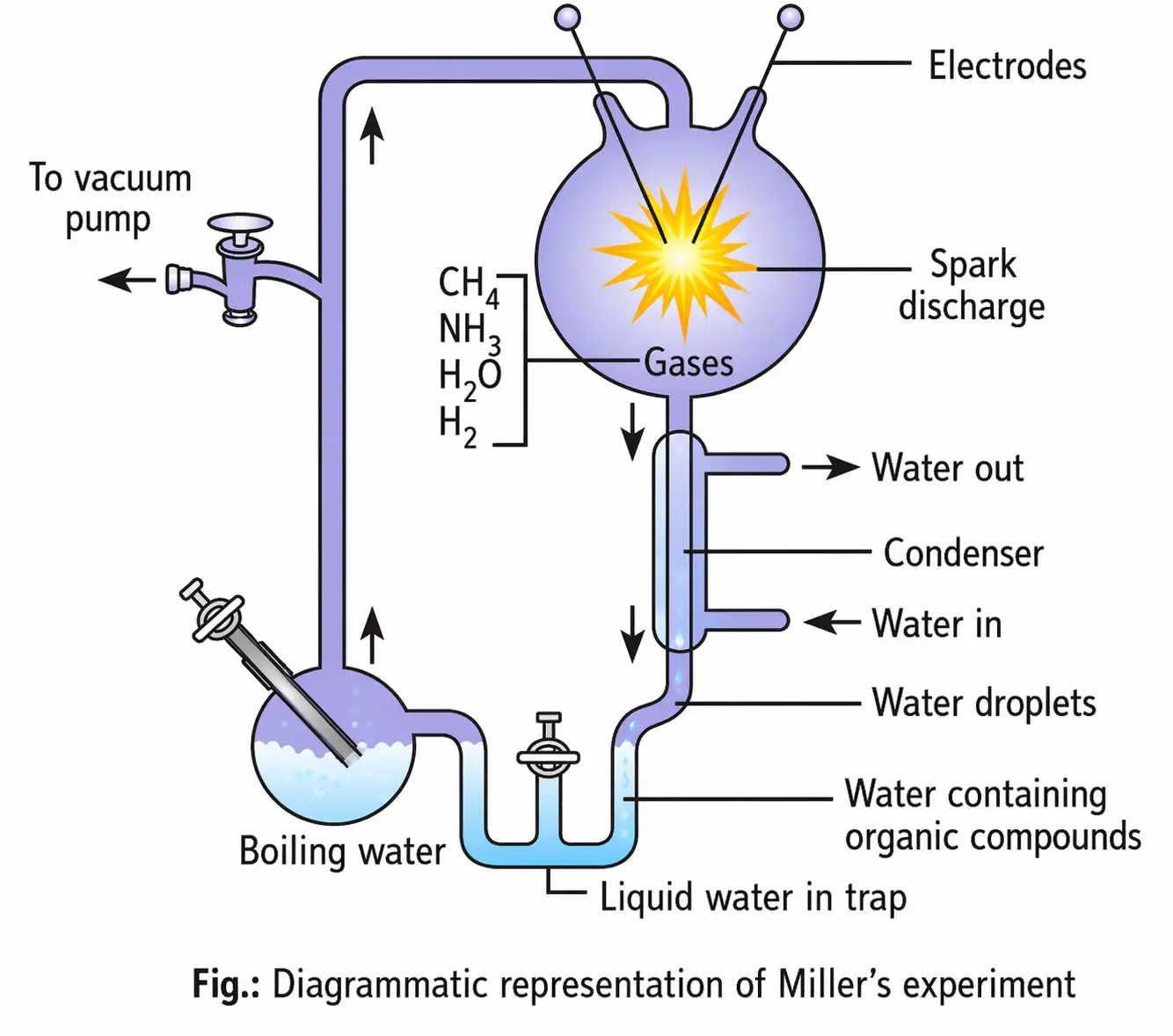
- Miller (1953): S. L. Miller, a student of Harold C. Urey, simulated primitive Earth in a closed flask containing \(CH_4\), \(H_2\), \(NH_3\) and water vapour at 800°C, with an electric discharge.
- Result: Amino acids formed; similar experiments produced sugars, nitrogen bases, pigments and fats.
- Hot dilute soup: Haldane described the early sea, where organic substances probably accumulated, as a “hot dilute soup.”
- Significance: The formation of protein molecules is considered a landmark in the origin of life.
Biological Evolution
From macromolecules to early cells
- Early non-cellular forms: Around 3 billion years ago, giant molecules such as RNA, proteins and polysaccharides may have formed the earliest non-cellular life-like structures.
- Protobionts: Abiotic macromolecules in primitive oceans assembled into large colloidal, drop-like clusters of proteins, polysaccharides, lipids and nucleic acids. They could grow by absorbing surrounding molecules and show simple metabolism, but could not reproduce.
- Coacervates: Oparin made protobionts without a lipid membrane in the laboratory and called them coacervates.
- Microspheres: Sydney Fox made microscopic protein-like bodies with a lipid coat and called them microspheres.
- Nucleoproteins: After mutation, nucleic acids gained self-duplication ability and combined with proteins; these nucleoproteins were the first sign of life.
- Protocells: Lipid-coated clusters of nucleoproteins formed protocells, considered the first form of life.
- Prokaryotes: Mutations made protocells more complex and efficient at using their surroundings, leading to prokaryotic cells.
Proposed development of early life
- Abiotic macromolecules → protobionts → self-duplicating nucleic acids and proteins
- Nucleoproteins → lipid-coated protocells → prokaryotic cells
- Anaerobic chemoheterotrophs → chemoautotrophs → photosynthetic bacteria
- Oxygenic photosynthesis → oxygen accumulation → free-living eukaryote-like cells
Nutrition, photosynthesis and eukaryotic cells
- First organisms: Single-celled prokaryotes, like bacteria with naked DNA, were probably anaerobic chemoheterotrophs.
- Chemoautotrophs: Some chemoheterotrophs evolved to make organic food from inorganic materials without oxygen, using chemosynthesis; examples include iron and nitrifying bacteria.
- Photosynthesis: The development of bacteriochlorophyll enabled some chemoautotrophs to convert light energy into chemical energy.
- Oxygenic photosynthesis: Changes in bacteriochlorophyll produced true chlorophyll. These organisms used water as the hydrogen source and released oxygen; cyanobacteria (blue-green algae) are examples.
- Oxygen release: Free oxygen released by cyanobacteria was a revolutionary change in Earth's history.
- Eukaryote-like cells: Nuclei, mitochondria and other organelles developed, making cells more metabolically active. Free-living eukaryote-like cells appeared in primitive oceans about 1.5 billion years ago.
How did Pasteur's swan-neck flask experiment support biogenesis?
What did Miller's 1953 experiment demonstrate?
Outline the proposed progression from protobionts to early photosynthetic life.
Quick recap
- Evolutionary biology studies the history of life forms on Earth; evolution is orderly change over time.
- Life originated from non-living matter about 4,000–4,200 million years ago.
- Biogenesis states that life comes from pre-existing life; Pasteur's experiment supported it.
- Oparin and Haldane proposed chemical evolution under early-Earth conditions unlike those of today.
- Miller's 1953 experiment produced amino acids; related experiments produced other organic compounds.
- Protobionts, including coacervates and microspheres, preceded protocells and early prokaryotes.
- Photosynthetic cyanobacteria released oxygen; eukaryote-like cells appeared about 1.5 billion years ago.
Evolution of Life Form- A Theory
Evidence and Pattern of Evolution
Darwin’s observations
- Charles Darwin developed his conclusions from observations during a world voyage on the ship H.M.S. Beagle.
- Similarity: Living forms share similarities with one another and with organisms that lived millions of years ago.
- Change over time: Some life forms became extinct while new forms arose; life has evolved gradually.
- Common ancestry: Existing life forms share common ancestors, which lived in different periods of Earth’s history.
- Variation
- Differences in characteristics among individuals within a population.
- Fitness
- Darwin’s measure of success in leaving progeny; it ultimately means reproductive fitness.
- Natural selection
- The process by which nature favours individuals that are better suited to their environment.
- Common ancestor
- An ancestral life form from which different related forms evolved.
Natural Selection
Natural selection — A mechanism of evolution in which individuals better suited to natural conditions leave more offspring and are favoured by nature.
How selection works
- Variation: Populations naturally contain differences in characteristics.
- Environmental conditions: Climate, food availability and other physical factors affect survival.
- Differential reproduction: Better-adapted individuals leave more progeny than less well-adapted individuals.
- Evolutionary outcome: Favoured characteristics become more represented over generations.
Natural Selection: Cause and Effect
- Variation exists within a population
- Environmental conditions favour some characteristics
- Individuals with favourable characteristics leave more offspring
- Those characteristics become more common over generations
Common mistake: Fitness does not simply mean strength or survival. In Darwin’s explanation, it ultimately refers to reproductive success—leaving more progeny.
Wallace and the History of Life
Related conclusions and Earth’s history
- Alfred Wallace, a naturalist working in the Malay Archipelago, reached similar conclusions around the same time as Darwin.
- New forms: Over time, apparently new types of organisms become recognisable.
- Geological and biological history: The history of life closely corresponds with Earth’s geological history, which is divided into epochs, periods and eras.
What does fitness mean in Darwin’s theory?
How does natural selection contribute to evolution?
Quick recap
- Darwin’s observations on the H.M.S. Beagle supported the idea that life forms change over time.
- Extinction and the appearance of new forms are part of the history of life.
- Populations contain variations, and environmental conditions affect which individuals reproduce more.
- Darwinian fitness means reproductive success, not merely strength or survival.
- Natural selection is a mechanism of evolution that favours individuals leaving more progeny.
- Wallace independently reached similar conclusions; biological history closely correlates with geological history.
What are the Evidences For Evolution?
Evidence for evolution — Observations from fossils, anatomy, embryology and natural selection that support the occurrence and processes of evolution.
Palaeontological Evidence
Fossils — Preserved remains of the hard parts of organisms found in rocks.
What Fossils Reveal
- Sedimentary layers: Different-aged rock layers contain fossils of organisms that lived when those sediments formed.
- Geological age: Fossils in different layers help identify the geological period in which organisms existed.
- Change over time: Fossil records show that life forms varied through time, and some existed only during particular geological spans.
- Vertebrate succession: Fossil fishes appear earliest, followed by amphibians, reptiles, birds and mammals.
| Type | How preserved | Examples / features |
|---|---|---|
| Unaltered fossils | Preserved in original or intact form | Woolly mammoths frozen in Siberian ice for over 25,000 years; insects or plant parts in amber |
| Petrified fossils | Organic or soft parts are replaced by mineral deposits | Hard parts such as bones, teeth, shells and wood are preserved; the most common type |
Geological time — A chronological history of evolution inferred from fossils, divided into eras, periods and epochs.
Mass extinction — The extinction of large groups of plants and animals over a short span of time.
Possible Causes of Mass Extinction
- External impact: A meteor or comet may collide with Earth.
- Continental movement: Continents may drift, join together and later break apart.
Comparative Anatomy and Morphology
- Comparative study: Similarities and differences in organisms living today and those from the past help infer whether they share common ancestors.
- Evidence: Structural, developmental and biochemical similarities can indicate common ancestry.
Homology
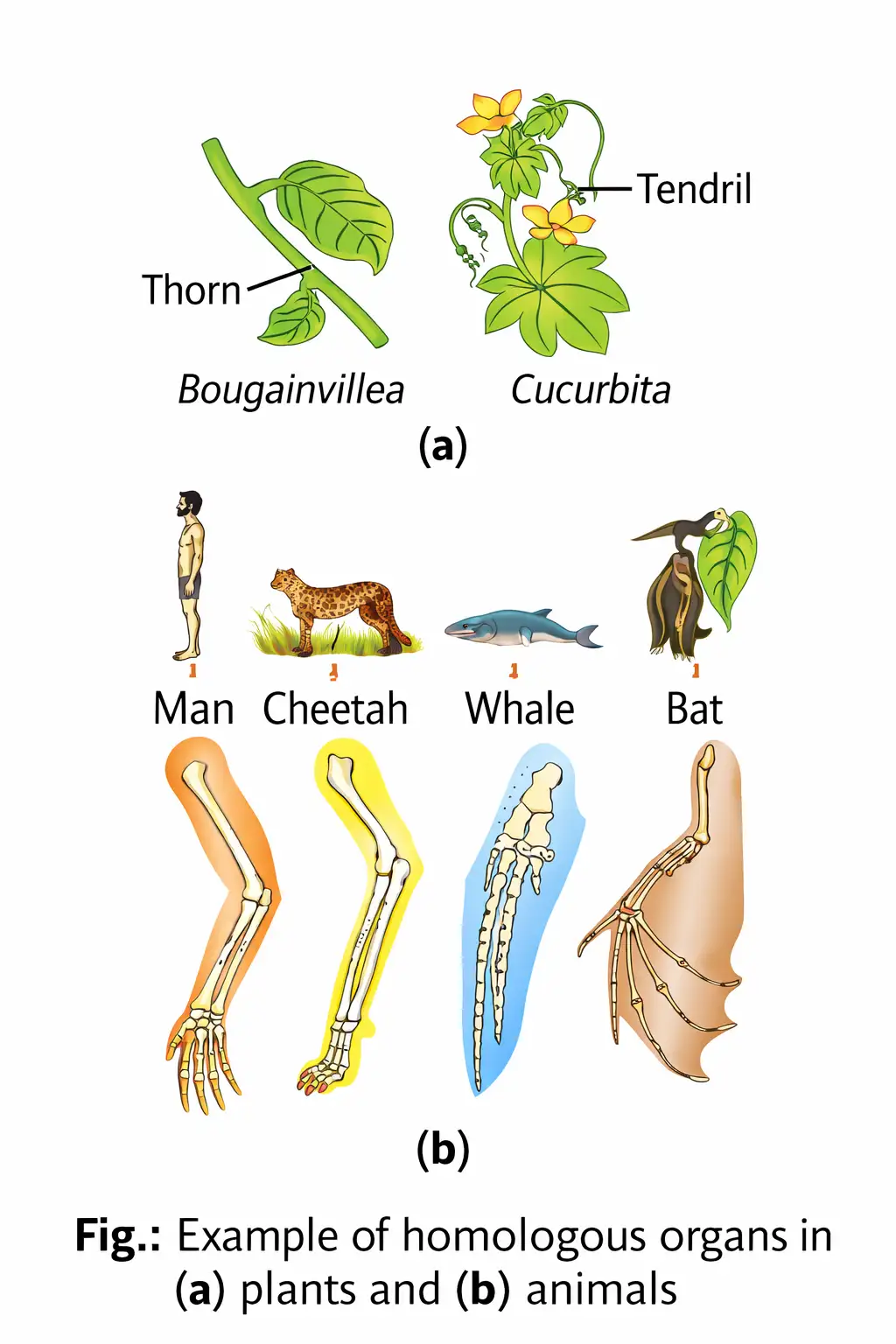
Homologous organs — Organs with a common ancestry or embryonic origin and the same basic structural plan, but different appearances and functions.
Homology and Divergent Evolution
- Mammalian forelimbs: Humans, cheetahs, whales and bats share the same bone pattern: humerus, radius, ulna, carpals, metacarpals and phalanges.
- Different functions: The shared plan is adapted for tasks such as grasping, running, swimming and flying.
- Evolutionary meaning: Modification of a common structure in different directions is divergent evolution (adaptive radiation); homology indicates common ancestry.
| Group | Heart structure and circulation |
|---|---|
| Fishes | Two chambers; venous heart; branchial circulation; single circulation |
| Amphibians | Three chambers; mixed blood is pumped |
| Reptiles | Three chambers, with an incompletely partitioned ventricle |
| Birds and mammals | Four chambers; ventricle completely partitioned |
Heart as Evolutionary Evidence
- Shared plan: Vertebrate hearts occupy a similar position and share a general chambered organisation and cardiac muscle.
- Trend: Internal structure shows increasing complexity from fishes to birds and mammals, supporting evolutionary change across vertebrates.
Analogy
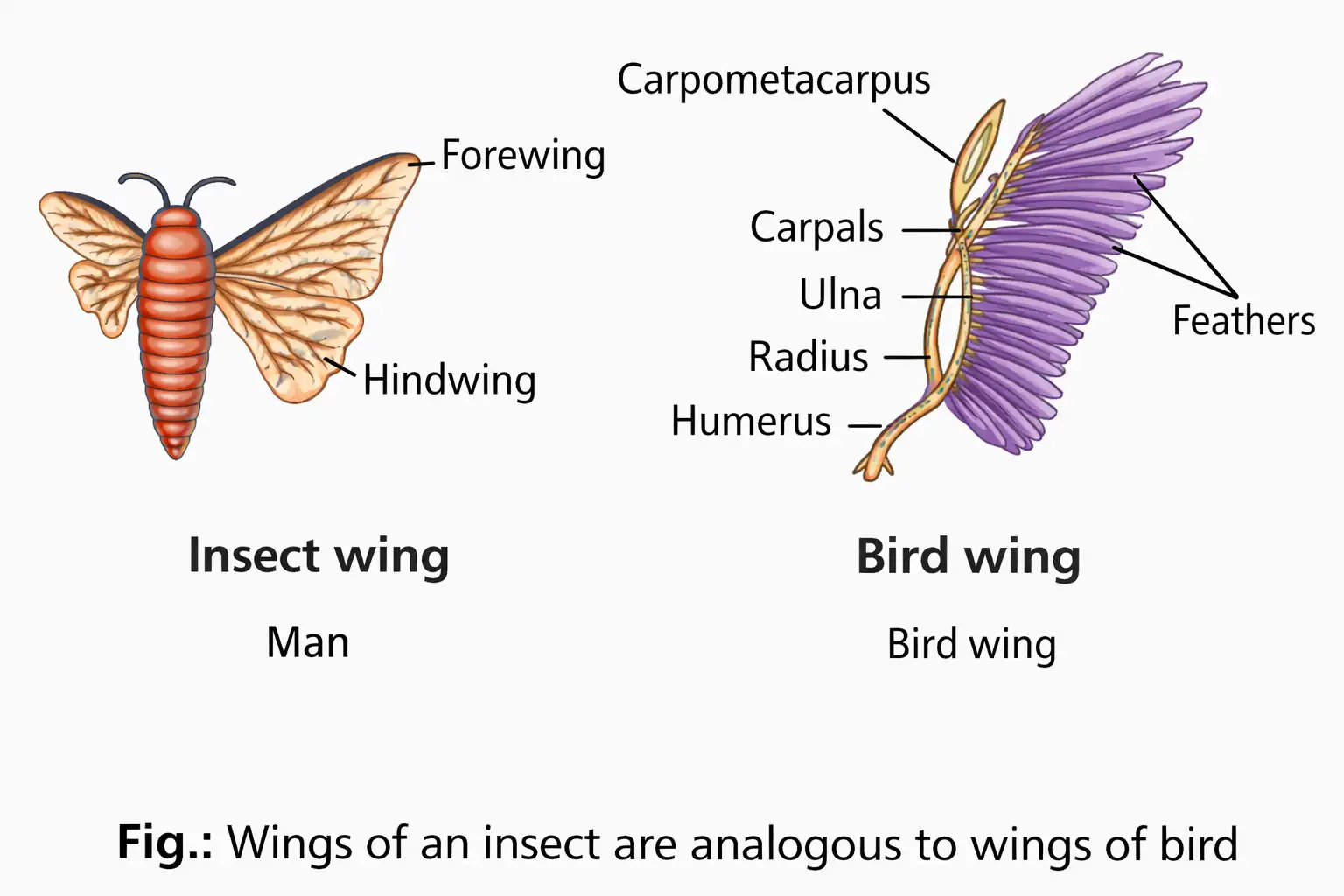
Analogous organs — Organs with different basic structures and developmental origins that perform similar functions.
| Point | Homology | Analogy |
|---|---|---|
| Basic structure and origin | Similar | Different |
| Function | May differ | Similar |
| Evolutionary pattern | Divergent evolution / adaptive radiation | Convergent evolution / adaptive convergence |
| Example | Forelimbs of mammals | Wings of butterflies and birds |
Other Examples and Related Evidence
- Analogous organs: Octopus and mammalian eyes; penguin and dolphin flippers; sweet potato (modified root) and potato (modified stem).
- Biochemical evidence: Similarities in proteins and genes that perform the same function across diverse organisms support common ancestry.
- Connecting links: Organisms with characters of two taxonomic groups; *Protopterus* (lungfish) links bony fishes and amphibians.
- Sphenodon: A primitive reptile with amphibian characters.
Vestigial organs — Reduced organs that do not perform a function in the body but correspond to fully developed functional organs in related animals.
Atavism — Reappearance or renewed functioning of an ancestral feature that had disappeared or remained only as a vestige.
Examples
- Vestigial organ: Nictitating membrane in humans.
- Atavism: Development of the ability to move the pinna in some people.
Embryological Evidence
| Evidence | Key idea / example |
|---|---|
| Common early development | Multicellular organisms begin as a fertilised egg (zygote); repeated divisions form a blastula, then a two-layered gastrula. |
| Gastrula layers | The outer layer develops into ectoderm; the inner layer develops into endoderm. |
| Similarity of vertebrate embryos | Early embryos of humans, chicks, lizards, frogs and fishes are remarkably similar and difficult to distinguish. |
| Recapitulation theory / biogenetic law | Formulated by Haeckel: “ontogeny recapitulates phylogeny”—an organism’s life history recapitulates its evolutionary history. |
| Retrogressive metamorphosis | The free-swimming ascidian tadpole has chordate features, but loses the notochord, nerve cord and myotomes during metamorphosis. |
| Neoteny | Retention of larval or embryonic traits in an adult; examples include an embryonic cartilaginous skeleton in adult Chondrichthyes and larval gills in some adult salamanders. |
Natural Selection: Industrial Melanism
Industrial melanism — The increased survival and frequency of dark-coloured forms in industrial regions where soot darkens the background.
Peppered Moth Example
- Species: The best-studied example is the peppered moth, *Biston betularia*.
- Forms: The light, creamy-white *B. betularia typica* has dark blotches; the dark melanic form, *B. betularia carbonaria*, is described as arising from a mutation in a colour-determining gene.
- Before industrialisation: Whitish lichens covered tree bark, so light moths were camouflaged from predatory birds.
- After industrialisation: Soot darkened tree bark; birds more easily spotted and ate light moths, while dark moths were better camouflaged.
- Outcome: Dark moths survived and became more numerous, while light moths decreased.
Industrial Melanism by Natural Selection
- Industrial soot darkens tree bark.
- Light moths become more visible to predatory birds; dark moths are better camouflaged.
- Bird predation removes more light moths, so dark moths survive and reproduce more.
- The population shifts toward a higher proportion of dark moths.
Study and Report
- Researchers: R. A. Fischer, E. B. Ford and H. B. D. Kettlewell studied industrial melanism.
- Kettlewell (1958): Reported melanic forms in 70 moth species from Britain and Europe.
Differentiate homologous and analogous organs with one example each.
What is industrial melanism? Explain it using the peppered moth.
Define neoteny and give one example.
Quick recap
- Fossil layers reveal the history and succession of life forms through geological time.
- Homologous structures share a basic plan and ancestry; analogous structures share function but not basic structure or origin.
- Vertebrate hearts show a progression from two chambers in fishes to four in birds and mammals.
- Connecting links, vestigial organs, atavism and biochemical similarities provide additional evolutionary evidence.
- Embryonic similarities, recapitulation, retrogressive metamorphosis and neoteny support evolutionary relationships.
- Industrial melanism shows natural selection changing trait frequencies through differential survival.
What is Adaptive Radiation ?
Adaptive Radiation
Examples of Adaptive Radiation
Convergent Evolution
Parallel Evolution
| Point | Convergent evolution | Parallel evolution |
|---|---|---|
| Relationship between groups | Different groups evolve similar adaptations independently. | Closely related species evolve similar adaptations. |
| Example | Placental wolf and Tasmanian wolf. | Running habit in deer and horse. |
How do Darwin’s finches illustrate adaptive radiation?
Quick recap
- Adaptive radiation produces multiple species from a common ancestor in different habitats.
- Galápagos finches evolved different beaks suited to different feeding habits.
- Australian marsupials evolved from an ancestral stock within Australia.
- Convergent evolution produces similar adaptations in different groups.
- Parallel evolution is convergence between closely related species.
Biological Evolution
Lamarck’s Theory
Lamarckism — Evolution through the inheritance and accumulation of characters acquired during an organism’s lifetime in response to its environment.
Four propositions of Lamarckism
- Internal vital force: Living organisms and their component parts continually increase due to an internal force.
- Environment and new needs: Environmental changes create new needs; these alter habits and may produce new structures. The doctrine of desires is called appetency.
- Use and disuse: Constant use makes an organ better developed, while disuse causes its degeneration.
- Inheritance of acquired characters: Characters acquired during life are transmitted to offspring; their accumulation over generations may lead to new species.
Lamarck’s publication
- 1809Jean-Baptiste Lamarck published his theory in *Philosophie Zoologique*.
Example supporting Lamarckism
- Giraffe: Lamarck proposed that giraffes evolved from short-necked, short-forelimbed deer-like ancestors.
- Proposed explanation: Food scarcity on the barren ground encouraged stretching; repeated use gradually lengthened the neck and forelimbs, and these acquired changes were inherited.
Criticism of Lamarckism
Weismann’s evidence
- August Weismann opposed the inheritance of acquired characters and proposed the continuity of germplasm: only characters that influence germ cells are inherited.
- Tail-cutting experiment: He cut rats’ tails for 22 generations, but their offspring were never born tailless.
Darwin’s Theory
Background and key ideas
- Charles Darwin (1809–1882): An English naturalist who studied nature during a world voyage aboard the *H.M.S. Beagle*.
- Observations: Darwin explored the flora and fauna of many continents and islands, including the Galapagos Islands, where he observed great variation among organisms.
- Galapagos Islands: Darwin described them as a “living laboratory of evolution.”
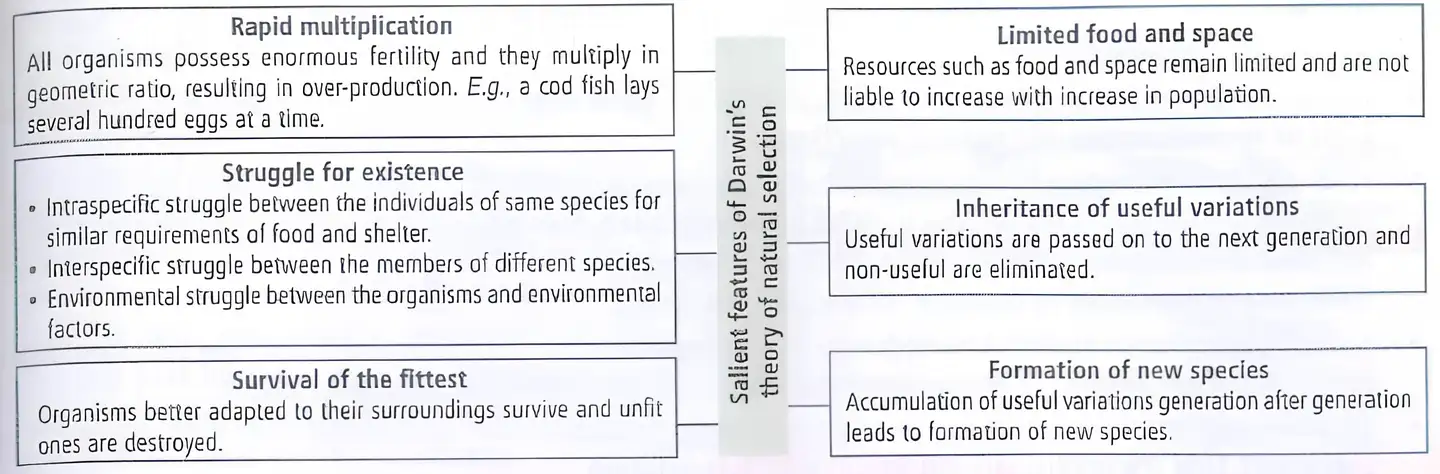
- Key concepts: Darwin’s theory centres on branching descent and natural selection.
Announcement of natural selection
- June 30, 1858Charles Darwin and Alfred Russel Wallace (1823–1913) announced the theory of natural selection in a paper titled “Origin of Species by Means of Natural Selection.”
Evidence supporting Darwinism
- Variation: Individuals within a population show abundant variations.
- Adaptations: Mimicry and protective colouration in animals are examples.
- Flower–pollinator relation: The position of flower nectaries correlates with the proboscis length of pollinating insects.
- Lederberg’s replica experiment: Using penicillin, the experiment illustrates adaptation and helps explain Darwin’s theory.
Criticism of Darwinism
Limitations identified in the lecture
- Variation: Darwin did not distinguish somatic from germinal variations and treated all variations as heritable.
- Unresolved patterns: His theory could not explain organisms remaining unchanged for millions of years or the occurrence of discontinuous variations.
- Other limitations: It could not explain survival of the fittest, effects of use and disuse, or the presence of vestigial organs.
What is the central claim of Lamarckism, and what did Weismann’s experiment show?
Name the two key concepts of Darwinian evolution.
Quick recap
- Lamarckism explains evolution through acquired characters inherited and accumulated across generations.
- Lamarck’s four propositions are internal vital force, environmental needs, use and disuse, and inheritance of acquired characters.
- Weismann’s germplasm theory holds that only characters influencing germ cells are inherited.
- Darwin’s theory is based on branching descent and natural selection; Darwin and Wallace announced it in 1858.
- Variation, mimicry, protective colouration, flower–pollinator relations, and Lederberg’s replica experiment are cited as evidence.
- Darwinism was criticised for not distinguishing somatic and germinal variation and for failing to explain several evolutionary patterns and features.
Mechanism of Evolution
Hugo de Vries’ Mutation Theory
Neo-Darwinism
Quick recap
- Hugo de Vries proposed mutation theory from observations of Oenothera lamarckiana.
- Mutations are sudden, discontinuous, inheritable variations and provide raw material for evolution.
- Mutation theory describes mutations as random and directionless; Darwinian variations as small and directional.
- de Vries proposed that a large mutation could cause speciation in one step, called saltation.
- Neo-Darwinism combines Darwinism with later research and identifies variation, isolation, heredity and natural selection as factors in speciation.
Hardy-Weinberg Principle
Genetic Equilibrium
Hardy–Weinberg principle — In a large, randomly mating sexual population, allele frequencies remain constant across generations when mutation, selection and gene flow are absent.
Allele and genotype frequencies
- Population: The principle applies to a large, randomly mating (panmictic) sexual population.
- Alleles: For alleles \(D\) and \(d\), their frequencies are \(p\) and \(q\), respectively.
- Genotypes: \(DD\) occurs at frequency \(p^2\), \(Dd\) at \(2pq\), and \(dd\) at \(q^2\).
- Meaning: \(p^2\) is the homozygous-dominant frequency; \(2pq\) is the heterozygous frequency; \(q^2\) is the homozygous-recessive frequency.
The two allele frequencies sum to one.
The genotype frequencies sum to one.
Factors That Disturb Equilibrium
- Five factors: Gene migration or gene flow, genetic drift, mutation, genetic recombination and natural selection can alter Hardy–Weinberg equilibrium.
Gene Migration, Gene Flow and Genetic Drift
| Point | Gene migration / gene flow | Genetic drift |
|---|---|---|
| Cause | Movement of a population section to another population | Chance changes in allele frequencies |
| Effect | Alleles are added to the receiving population and lost from the source population | Allele frequencies shift randomly; the change may be pronounced in a small sample |
- Gene flow: Repeated gene migration between populations produces gene flow.
- Founder effect: A founding population may have allele frequencies very different from the source because of chance. This divergence can sometimes contribute to speciation.
Mutation and Recombination
- Mutation: Microbial experiments show that selecting pre-existing advantageous mutations can produce new phenotypes; over generations, this may lead to speciation.
- Recombination: During gametogenesis, recombination creates new gene combinations that contribute to variation.
Natural Selection
Natural selection — Heritable variations that improve survival allow their bearers to reproduce and leave more progeny.
How allele frequencies change
- Mutation or recombination creates variation; gene flow and genetic drift can also change variation in populations.
- These influences alter gene and allele frequencies.
- Natural selection favours heritable variations that improve survival and reproduction.
- Allele frequencies may therefore change in future generations.
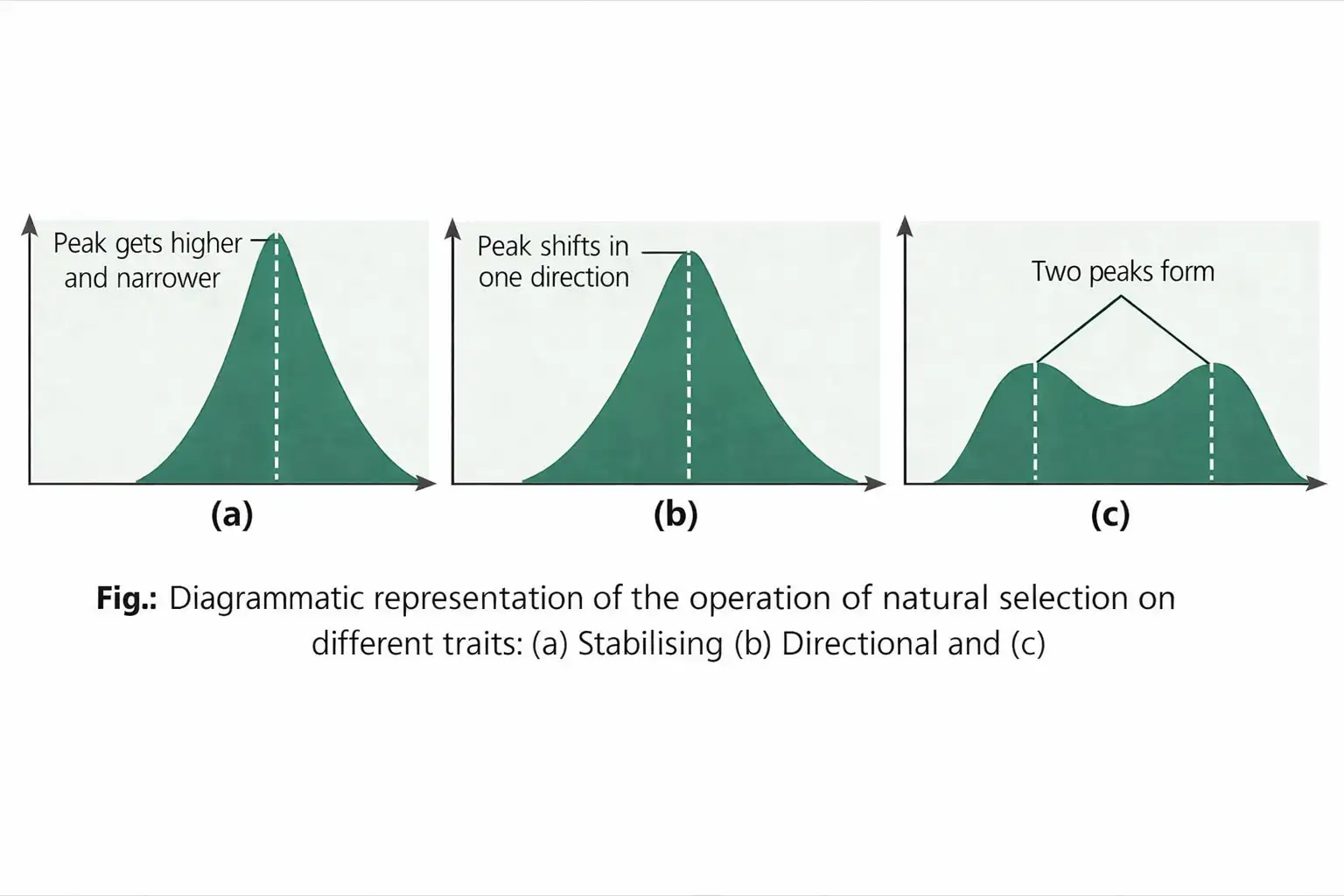
| Pattern | Effect on character distribution |
|---|---|
| Stabilising | More individuals acquire the mean character value. |
| Directional | More individuals acquire a value different from the mean, shifting the distribution. |
| Disruptive | More individuals acquire peripheral character values at both ends. |
State the Hardy–Weinberg equations and explain their terms.
Name the five factors that disturb Hardy–Weinberg equilibrium.
Distinguish stabilising, directional and disruptive selection.
Quick recap
- Hardy–Weinberg equilibrium describes stable allele frequencies in a large, randomly mating population when disturbing influences are absent.
- For two alleles, \(p+q=1\) and genotype frequencies are \(p^2\), \(2pq\) and \(q^2\).
- Migration transfers alleles between populations; repeated migration is gene flow, while chance frequency shifts are genetic drift.
- The five factors are gene flow, drift, mutation, recombination and natural selection.
- Natural selection favours heritable survival advantages and may be stabilising, directional or disruptive.
A brief Account of Evolution
Early Life and the Move to Land
Early evolution
- First life: Cellular life appeared about 2000 million years ago (mya); single-celled organisms gradually gave rise to multicellular forms.
- Invertebrates: They had formed and were active by about 500 mya.
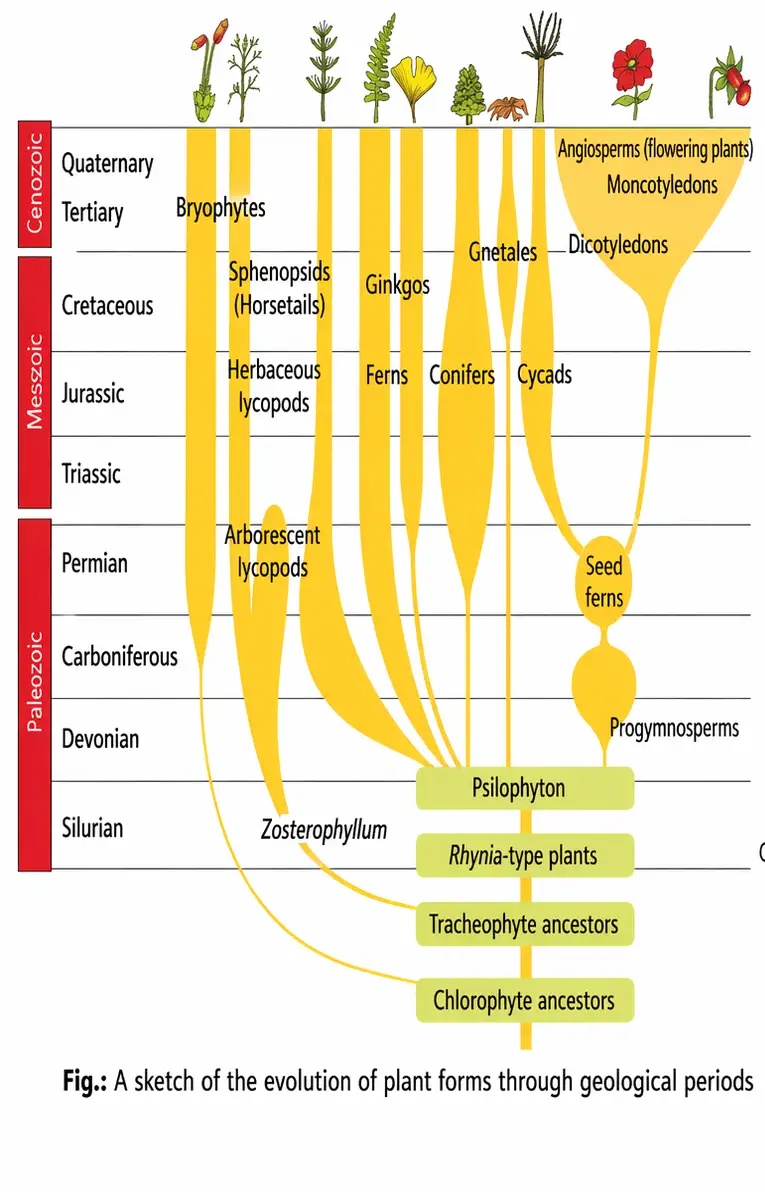
- Plants on land: Plants were the first organisms to invade land and were widespread before animals moved onto land.
- Early aquatic life: Jawless fish probably evolved around 350 mya; seaweeds and a few plants existed around 320 mya.
Major stages in the evolutionary account
- About 2000 myaThe first cellular forms of life appeared.
- About 500 myaInvertebrates had formed and were active.
- About 350 myaJawless fish probably evolved; strong-finned fish could move onto land and return to water.
- About 320 myaSeaweeds and a few plants existed.
- About 200 myaSome land reptiles probably returned to water and evolved into fish-like reptiles.
- About 65 myaDinosaurs disappeared from Earth.
- 1938A Coelacanth, thought to be extinct, was caught in South Africa.
From Finned Fish to Reptiles
Vertebrate transition
- Strong-finned fish could move onto land and return to water.
- Lobefins gave rise to the first amphibians, which lived both on land and in water.
- Amphibians gave rise to reptiles, which laid thick-shelled eggs that did not dry out in the sun.
Lobefins and amphibians
- Coelacanth: A Coelacanth was caught in South Africa in 1938, although it had been thought extinct.
- Ancestry: The early amphibians have no surviving specimens; they were ancestors of modern frogs and salamanders.
Reptiles and the Rise of Mammals
Reptile dominance
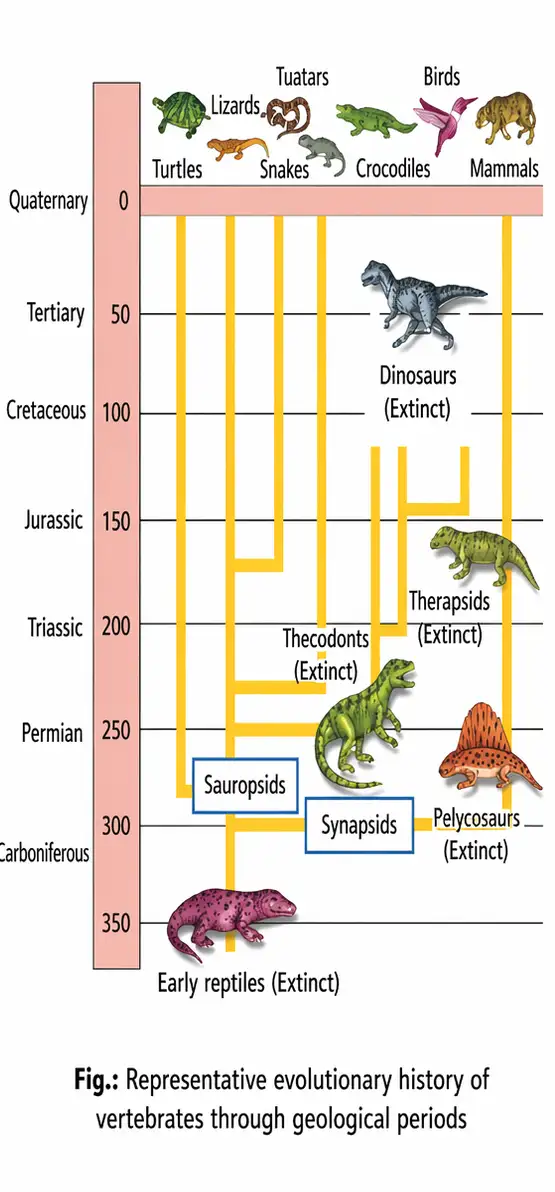
- Dominance: Reptiles of many shapes and sizes dominated Earth for roughly the next 200 million years.
- Living reptiles: Small-sized reptiles from that era still exist today.
- Pteridophytes: Giant ferns grew during this period; their remains gradually formed coal deposits.
- Aquatic reptiles: Some land reptiles returned to water, probably around 200 mya; Ichthyosaurs are an example.
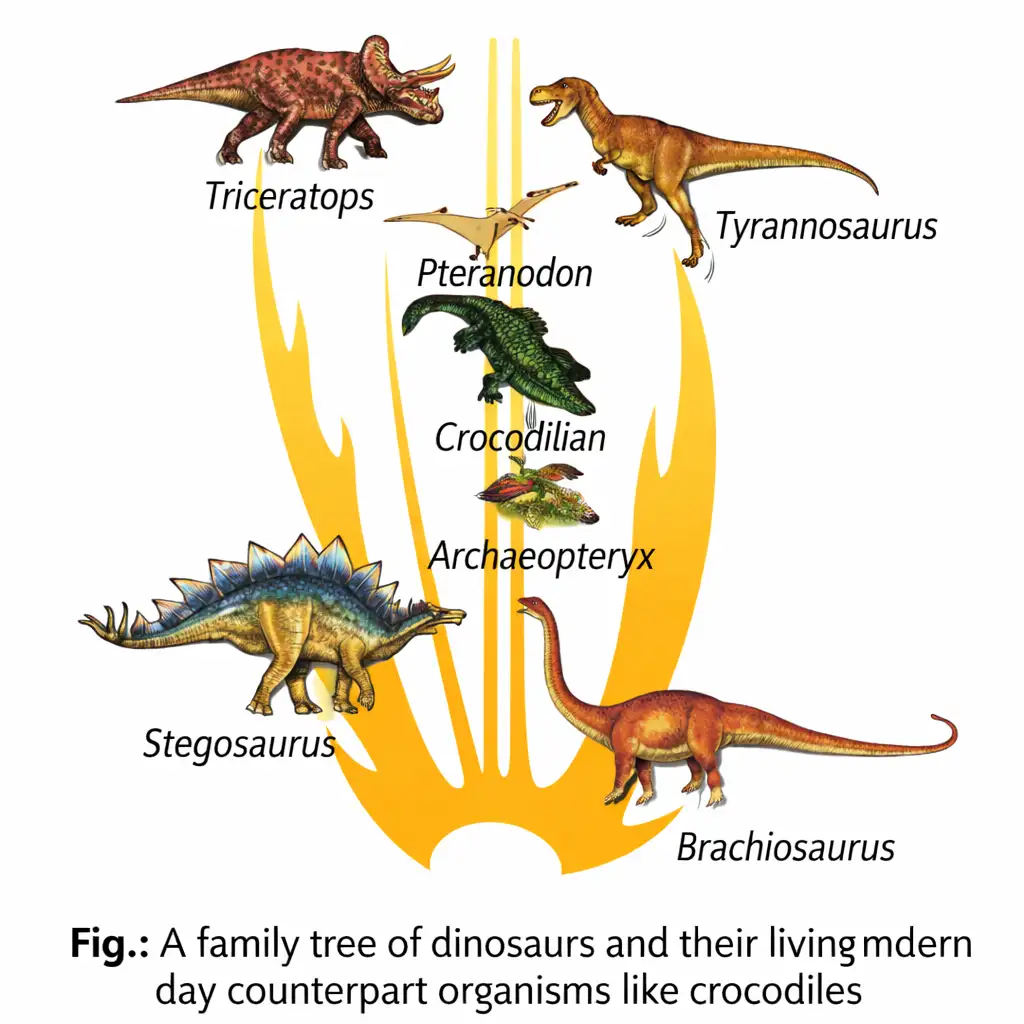
- Dinosaurs: Land reptiles included dinosaurs; Tyrannosaurus rex was about 20 feet tall and had huge, dagger-like teeth.
Dinosaur disappearance
- Timing: Dinosaurs disappeared from Earth about 65 mya.
- Cause: The exact reason is unknown; possible explanations are climatic change or that most dinosaurs evolved into birds.
Mammals
- Early mammals: The first mammals were shrew-like; their fossils are small.
- Viviparity: Mammals protect their unborn young inside the mother's body.
- Survival advantage: Mammals were more intelligent in sensing and avoiding danger.
- Expansion: As reptiles declined, mammals took over the Earth.
Continental Drift and Mammal Distribution
Effects of continental drift on mammals
- South America had mammals resembling horses, hippopotamuses, bears and rabbits.
- Continental drift joined South America to North America.
- North American fauna overran many South American mammals.
- Australian pouched mammals survived because they faced little competition from other mammals.
Mammals in water
- Aquatic mammals: Some mammals live wholly in water; examples include whales, dolphins, seals and sea cows.
- Lobefins
- Strong-finned fish that gave rise to the first amphibians.
- Viviparous
- Giving birth to young that developed inside the mother's body.
- Continental drift
- Movement of continents that changed animal distribution and competition.
How did vertebrates move from water to land in this account?
Give two possible explanations for the disappearance of dinosaurs.
Quick recap
- Cellular life appeared about 2000 mya; invertebrates were active by about 500 mya.
- Plants colonised land before animals; strong-finned fish and lobefins link to the transition toward land vertebrates.
- Amphibians gave rise to reptiles, whose thick-shelled eggs resisted drying; small reptiles from that era still exist today.
- Reptiles dominated for a long period; some returned to water, and dinosaurs disappeared about 65 mya for an unknown reason.
- Early mammals were shrew-like, viviparous and better able to sense and avoid danger.
- Continental drift changed mammal competition and distribution; some mammals adapted to wholly aquatic life.
Origin and Evolution of Man
Human evolution (anthropogenesis) — The biological evolution that led to Homo sapiens sapiens as a distinct species from other hominids, great apes and placental mammals.
Early primates and upright hominids
| Group and period | Key features |
|---|---|
| Dryopithecus and Ramapithecus — about 15 million years ago | Hairy primates that walked like gorillas and chimpanzees; Ramapithecus was more man-like, while Dryopithecus was more ape-like. |
| Man-like primates — about 3–4 million years ago | Fossils from Ethiopia and Tanzania indicate hominid features. They walked upright in Eastern Africa and were no taller than 4 feet. |
| Australopithecus — about 2 million years ago | Probably lived in East African grasslands; used stone weapons to hunt but mainly ate fruit. |
| Homo habilis | Identified as the first human-like being (a hominid); brain capacity was 650–800 cc and it probably did not eat meat. |
Later human species
| Species and time | Brain capacity | Key features |
|---|---|---|
| Homo erectus — about 1.5 million years ago | Around 900 cc | Fossils were discovered in Java in 1891; probably ate meat. |
| Neanderthal man — 100,000–40,000 years ago | 1,400 cc | Lived in the Near East and Central Asia; used hides for body protection and buried the dead. |
| Homo sapiens | Not specified | Arose in Africa, spread across continents and developed into distinct races. |
Modern humans and settlement
Cultural development
- Modern Homo sapiens: Arose during the ice age, between 75,000 and 10,000 years ago.
- Cave art: Prehistoric cave paintings developed about 18,000 years ago. An example is at Bhimbetka rock shelter, Raisen district, Madhya Pradesh.
- Agriculture: Began about 10,000 years ago, leading to the start of human settlements.
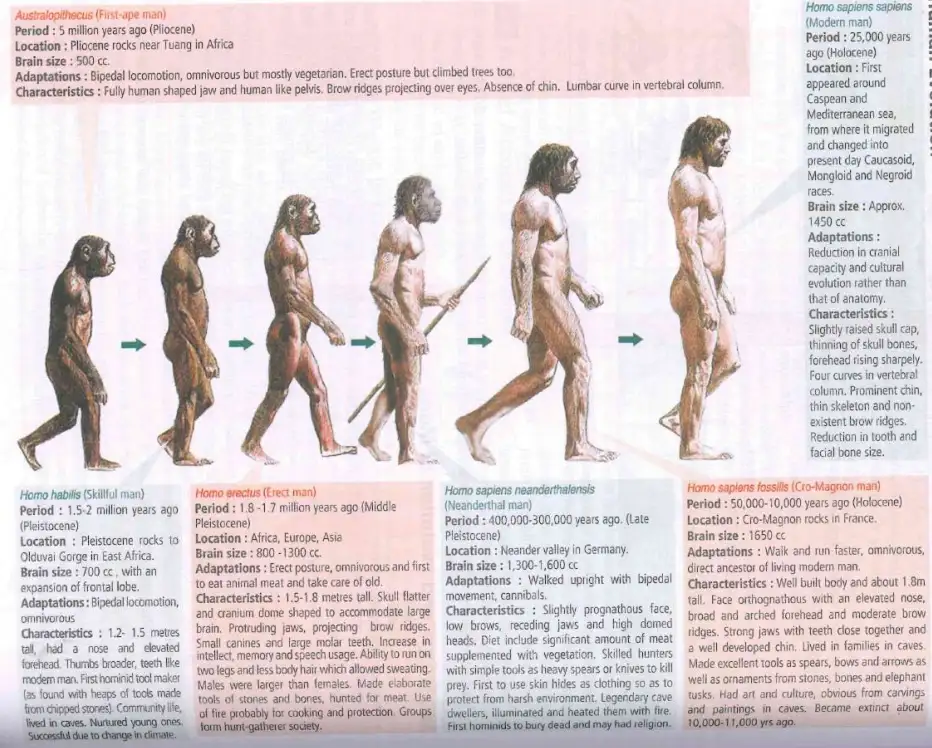
State two features of Neanderthal man.
How did agriculture affect human life?
Quick recap
- Dryopithecus and Ramapithecus lived about 15 million years ago; Ramapithecus was more man-like.
- Upright man-like primates lived in Eastern Africa about 3–4 million years ago.
- Australopithecus used stone weapons but mainly ate fruit; Homo habilis was the first human-like hominid and probably did not eat meat.
- Homo erectus lived about 1.5 million years ago and probably ate meat; Neanderthals used hides and buried their dead.
- Homo sapiens arose in Africa and spread across continents; modern Homo sapiens arose during the ice age.
- Cave art appeared about 18,000 years ago, and agriculture and human settlements began about 10,000 years ago.
NEET Zoology — ALL CHAPTERS
1
Structural Organisation in Animals
2
Breathing and Exchange of Gases
3
Body Fluids and Circulation
4
Excretory Products and their Elimination
5
Locomotion and Movement
6
Neural Control and Coordination
7
Human Reproduction
8
Reproductive Health
9
Evolution
10
Microbes in Human Welfare
11
Organism and Population
12
Ecosystem
13
Biodiversity and Conservation