Introduction & Similar Figures
Congruence and Similarity
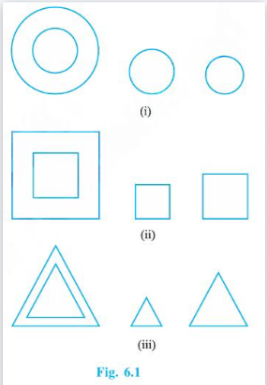
Congruent figures — Figures are congruent if they have the same shape and the same size.
Similar figures — Figures are similar if they have the same shape, but they need not have the same size.
| Feature | Congruent figures | Similar figures |
|---|---|---|
| Shape | Same | Same |
| Size | Same | May differ |
- Relationship All congruent figures are similar, but similar figures need not be congruent.
- Examples All circles are similar; all squares are similar; all equilateral triangles are similar.
- Different shapes A circle and a square, or a triangle and a square, are not similar.
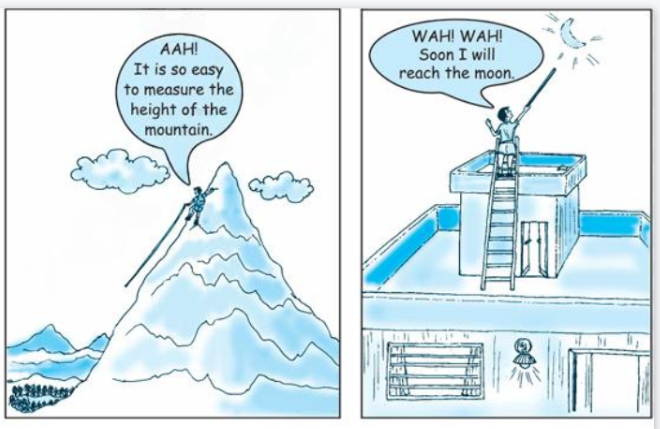
- Applications Similarity supports indirect measurement of heights and distances, and will be used to give a simple proof of the Pythagoras Theorem.
Similarity of Polygons
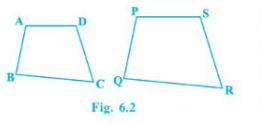
Similar polygons — Two polygons with the same number of sides are similar if their corresponding angles are equal and their corresponding sides are proportional.
- Correspondence Match each vertex and side in one polygon with its partner in the other; the order matters.
- Angles Every pair of corresponding angles must be equal.
- Sides Every pair of corresponding sides must have the same ratio.
- Scale factor The common ratio of corresponding side lengths is also called the Representative Fraction; it describes the enlargement or reduction.
Use corresponding sides in the same order. The value depends on which polygon is treated as the original.
Scale and Indirect Measurement
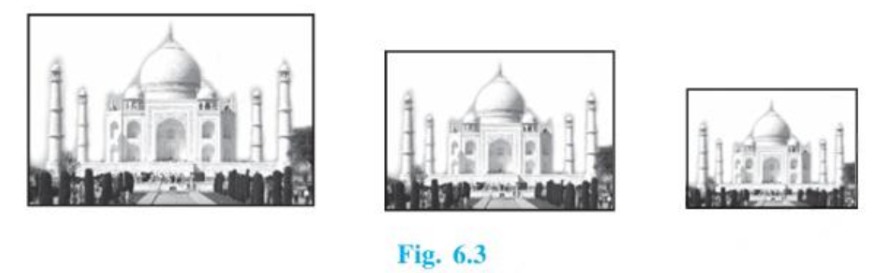
- Photographs Enlarging or reducing a photograph preserves its shape: corresponding angles stay equal and corresponding lengths change by one common scale factor.
- Example Enlarging a \(35\) mm photograph to \(45\) mm gives image-to-original scale factor \(\frac{45}{35}=\frac{9}{7}\).
- Applications Maps and building blueprints use a suitable scale factor; similarity also enables indirect measurement of heights and distant objects.
Photographs of the same person at different ages may have the same printed size but different shapes, so they are not necessarily similar.
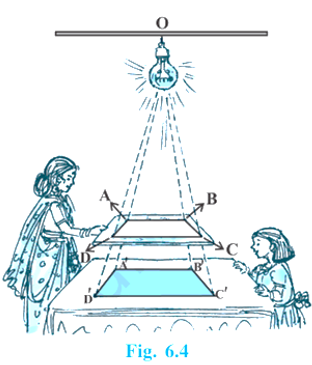
Correspondence in an Enlargement
- Vertices In the projected quadrilateral, corresponding vertices lie on the same ray from the light source: \(A'\) lies on ray \(OA\), and likewise for the other vertices.
- Angles Corresponding angles remain equal, for example \(\angle A=\angle A'\).
- Sides Corresponding side lengths have one common ratio: \(\frac{AB}{A'B'}=\frac{BC}{B'C'}=\frac{CD}{C'D'}=\frac{DA}{D'A'}\).
- Notation The correspondence \(A\leftrightarrow A'\), \(B\leftrightarrow B'\), \(C\leftrightarrow C'\), \(D\leftrightarrow D'\) gives \(ABCD\sim A'B'C'D'\). The similarity can also be stated in reverse.
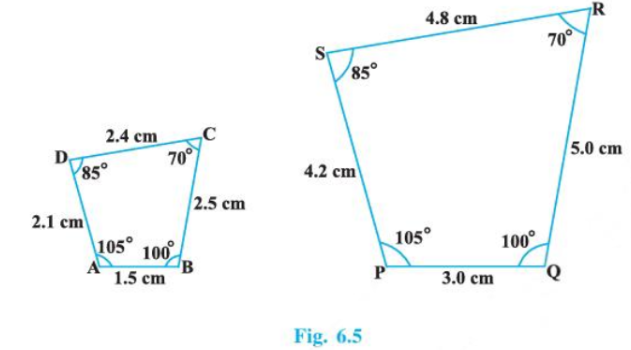
If one polygon is similar to a second, and the second is similar to a third, then the first is similar to the third.
Checking Whether Polygons Are Similar
- Both conditions are needed Equal corresponding angles alone do not establish similarity.
- Side ratios alone are insufficient Proportional corresponding sides do not establish similarity unless corresponding angles are also equal.
- Counterexample: angles A square and a non-square rectangle have equal right angles, but their corresponding side ratios are not all equal.
- Counterexample: sides A square and a rhombus can have proportional corresponding sides, but unequal corresponding angles.
| Example pair | Corresponding angles | Corresponding side ratios | Similar? |
|---|---|---|---|
| Square and non-square rectangle | Equal | Not all equal | No |
| Square and rhombus | Not all equal | Proportional | No |
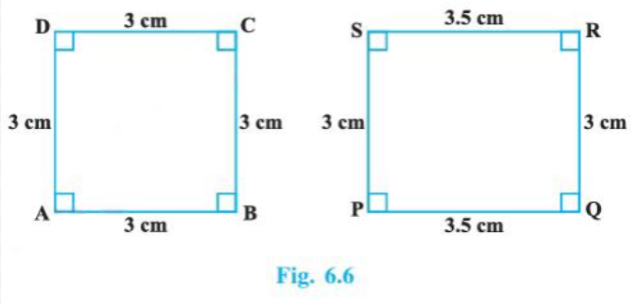
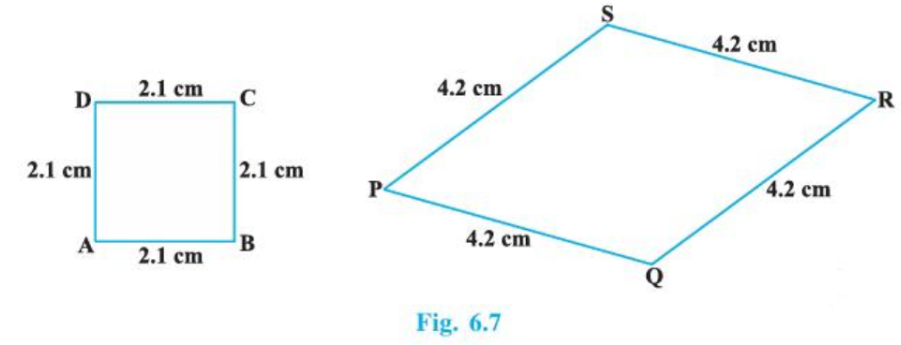
Test Two Polygons for Similarity
- Match corresponding vertices and sides in the stated order.
- Check that every pair of corresponding angles is equal.
- Compare corresponding side lengths; verify that all ratios are equal.$$\frac{a_1}{b_1}=\frac{a_2}{b_2}=\cdots$$
- Conclude that the polygons are similar only if both tests pass.
Are the two quadrilaterals similar?
- Two quadrilaterals have equal corresponding angles. Their corresponding side lengths, in matching order, are \(3,4,5,6\) and \(6,8,10,12\). Decide whether they are similar.
- Compare the ratios of corresponding sides.$$\frac{3}{6}=\frac{4}{8}=\frac{5}{10}=\frac{6}{12}=\frac{1}{2}$$
- All side ratios are equal, and the corresponding angles are equal, so both similarity conditions hold.
Do not decide polygons are similar from matching angles or proportional sides alone; both conditions must hold.
A photograph is enlarged from \(40\) mm to \(60\) mm. What is the image-to-original scale factor?
A square and a rectangle both have right angles. Are they necessarily similar?
Two polygons have equal corresponding angles and all corresponding sides are in the ratio \(2:3\). Are they similar?
Quick recap
- Similar figures have the same shape; their sizes may differ.
- All congruent figures are similar, but similar figures need not be congruent.
- Similar polygons have equal corresponding angles and proportional corresponding sides.
- The common ratio of corresponding side lengths is the scale factor, also called the Representative Fraction.
- Similarity is used in photographs, maps, blueprints and indirect measurement; it will also support a simple proof of the Pythagoras Theorem.
- Equal corresponding angles alone, or proportional sides alone, is not enough to prove polygon similarity.
Similarity Of Triangles
Similar and Equiangular Triangles
Use corresponding vertices in the same order.
Basic Proportionality Theorem
For the setup above:
BPT proof using areas
- Compare the areas of \(\triangle ADE\) and \(\triangle BDE\); they have the same altitude to line \(AB\).$$\frac{\operatorname{ar}(ADE)}{\operatorname{ar}(BDE)}=\frac{AD}{DB}$$
- Compare the areas of \(\triangle ADE\) and \(\triangle DEC\); they have the same altitude to line \(AC\).$$\frac{\operatorname{ar}(ADE)}{\operatorname{ar}(DEC)}=\frac{AE}{EC}$$
- Since \(DE\parallel BC\), triangles \(BDE\) and \(DEC\) have the same base and lie between the same parallels, so their areas are equal.$$\operatorname{ar}(BDE)=\operatorname{ar}(DEC)$$
- Equate the two area ratios to obtain the required result.$$\frac{AD}{DB}=\frac{AE}{EC}$$
Converse of the Basic Proportionality Theorem
Use this to prove that a line segment is parallel to the third side.
If \(DE\parallel BC\) in \(\triangle ABC\), prove that \(AD/AB=AE/AC\).
- In \(\triangle ABC\), \(D\) lies on \(AB\), \(E\) lies on \(AC\), and \(DE\parallel BC\). Prove that \(AD/AB=AE/AC\).
- Apply BPT to the parallel line \(DE\).$$\frac{AD}{DB}=\frac{AE}{EC}$$
- Take reciprocals and add \(1\) to both sides.$$\frac{DB}{AD}+1=\frac{EC}{AE}+1$$
- Combine the terms using \(AB=AD+DB\) and \(AC=AE+EC\).$$\frac{AB}{AD}=\frac{AC}{AE}$$
- Take reciprocals to reach the required result.$$\frac{AD}{AB}=\frac{AE}{AC}$$
Applying BPT and Its Converse
In trapezium \(ABCD\), \(AB\parallel DC\). Points \(E\) on \(AD\) and \(F\) on \(BC\) satisfy \(EF\parallel AB\). Prove that \(AE/ED=BF/FC\).
In \(\triangle PQR\), \(S\) lies on \(PQ\) and \(T\) lies on \(PR\). Given \(PS/SQ=PT/TR\) and \(\angle PST=\angle PRQ\), prove that \(\triangle PQR\) is isosceles.
Do not confuse BPT with its converse: parallelism gives equal segment ratios, while equal segment ratios prove parallelism.
Quick recap
- Similar triangles have equal corresponding angles and proportional corresponding sides.
- Equiangular triangles have equal ratios of corresponding sides.
- BPT: a line parallel to one side of a triangle divides the other two sides proportionally.
- Converse BPT: equal ratios on two sides imply that the joining line is parallel to the third side.
- Use area ratios to prove BPT; use an auxiliary diagonal to solve many trapezium problems.
- A pair of equal angles in a triangle implies the opposite sides are equal.
Criteria For Similarity Of Triangles
Similarity and Correspondence
- Triangle advantage: For triangles, establishing either equal corresponding angles or proportional corresponding sides is enough to conclude similarity, using a valid criterion.
AA Similarity Criterion
AA similarity criterion — If two angles of one triangle are respectively equal to two angles of another triangle, the triangles are similar.
The third angles are equal by the angle-sum property. Thus, two equal corresponding angles imply three equal corresponding angles; corresponding sides are then proportional.
Applying AA
- Identify two pairs of equal corresponding angles.$$\angle A=\angle D,\quad \angle B=\angle E$$
- Write the triangles in matching vertex order and conclude similarity by AA.$$\triangle ABC\sim\triangle DEF$$
If \(PQ\parallel RS\), prove that \(\triangle POQ\sim\triangle SOR\).
- Given \(PQ\parallel RS\), prove that \(\triangle POQ\) and \(\triangle SOR\) are similar.$$PQ\parallel RS$$
- Parallel lines give alternate interior angle pairs.$$\angle P=\angle S,\quad \angle Q=\angle R$$
- The angles at \(O\) are vertically opposite, so the triangles are similar by AA.$$\angle POQ=\angle SOR\quad\therefore\quad\triangle POQ\sim\triangle SOR$$
SSS Similarity Criterion
SSS similarity criterion — If the three sides of one triangle are proportional to the three corresponding sides of another triangle, the triangles are similar.
Proportional corresponding sides imply equal corresponding angles; hence the triangles are similar.
Applying SSS
- Match the sides using the stated or diagrammed vertex correspondence.$$AB\leftrightarrow DE,\quad BC\leftrightarrow EF,\quad CA\leftrightarrow FD$$
- Compare all three ratios in the same order; if equal, conclude similarity by SSS.$$\frac{AB}{DE}=\frac{BC}{EF}=\frac{CA}{FD}$$
Find \(\angle P\) using the given corresponding sides and angles.
- For \(\triangle ABC\) and \(\triangle RQP\), the side lengths are \(3.8,6,3\sqrt{3}\) and \(7.6,12,6\sqrt{3}\) in corresponding order. Given \(\angle A=80^\circ\) and \(\angle B=60^\circ\), find \(\angle P\).$$\frac{AB}{RQ}=\frac{3.8}{7.6},\quad \frac{BC}{QP}=\frac{6}{12},\quad \frac{CA}{PR}=\frac{3\sqrt{3}}{6\sqrt{3}}$$
- All three ratios are equal, so the triangles are similar by SSS; vertex correspondence gives \(C\leftrightarrow P\).$$\frac{AB}{RQ}=\frac{BC}{QP}=\frac{CA}{PR}=\frac{1}{2},\quad \triangle ABC\sim\triangle RQP$$
- Use the angle-sum property to find the remaining angle in \(\triangle ABC\).$$\angle C=180^\circ-80^\circ-60^\circ=40^\circ$$
- Corresponding angles are equal.$$\angle P=\angle C=40^\circ$$
SAS Similarity Criterion
SAS similarity criterion — If one angle of a triangle equals one angle of another triangle and the sides including those angles are proportional, the triangles are similar.
The equal angle must be included between the two proportional side pairs.
Applying SAS
- Identify the equal included angles.$$\angle A=\angle D$$
- Check that the two sides around each angle are proportional in corresponding order.$$\frac{AB}{DE}=\frac{AC}{DF}$$
- Conclude similarity by SAS and use the established correspondence.$$\triangle ABC\sim\triangle DEF$$
If \(OA\cdot OB=OC\cdot OD\), prove that \(\angle A=\angle C\) and \(\angle D=\angle B\).
- Given \(OA\cdot OB=OC\cdot OD\), show that \(\angle A=\angle C\) and \(\angle D=\angle B\).$$OA\cdot OB=OC\cdot OD$$
- Rearrange the product equality to obtain proportional sides around the angles at \(O\).$$\frac{OA}{OC}=\frac{OD}{OB}$$
- The angles at \(O\) are vertically opposite, so SAS gives similarity.$$\angle AOD=\angle COB,\quad \triangle AOD\sim\triangle COB$$
- Use corresponding angles of the similar triangles.$$\angle A=\angle C,\quad \angle D=\angle B$$
Applications: Lengths and Corresponding Medians
In similar triangles, corresponding medians are proportional to corresponding sides. The corresponding smaller triangles formed by the medians are also similar.
Proving results about corresponding medians
- Use that each median bisects its opposite side.$$AM=BM=\frac{AB}{2},\quad PN=QN=\frac{PQ}{2}$$
- Apply SAS to the triangles on one side of the medians, using proportional half-sides and equal corresponding angles.$$\frac{AM}{PN}=\frac{CA}{RP},\quad \angle MAC=\angle NPR$$
- Use corresponding sides to obtain the median ratio; use SSS for the triangles on the other side.$$\frac{CM}{RN}=\frac{CA}{RP},\quad \triangle CMB\sim\triangle RNQ$$
For \(\triangle ABC\sim\triangle PQR\), prove the corresponding median ratio and that \(\triangle CMB\sim\triangle RNQ\).
- Given \(\triangle ABC\sim\triangle PQR\), let \(CM\) and \(RN\) be medians to corresponding sides \(AB\) and \(PQ\).$$\frac{AB}{PQ}=\frac{BC}{QR}=\frac{CA}{RP}$$
- Since the medians bisect their sides, the corresponding half-sides have the same ratio as the full sides. The included angles are equal, so apply SAS.$$\frac{AM}{PN}=\frac{AB}{PQ}=\frac{CA}{RP},\quad \angle MAC=\angle NPR,\quad \triangle AMC\sim\triangle PNR$$
- Corresponding sides give the ratio of the medians.$$\frac{CM}{RN}=\frac{CA}{RP}=\frac{AB}{PQ}$$
- The other half-sides have the same ratio; combining this with the median and side ratios gives SSS similarity.$$\frac{CM}{RN}=\frac{BC}{QR}=\frac{BM}{QN},\quad \triangle CMB\sim\triangle RNQ$$
A girl \(0.9\) m tall walks away from a \(3.6\) m lamp-post at \(1.2\) m/s. Find her shadow length after \(4\) s.
In \(\triangle ABC\), \(\angle A=\angle D\) and \(\angle B=\angle E\) for another triangle \(\triangle DEF\). What can be concluded, and why?
If \(\triangle ABC\sim\triangle PQR\) and \(CM\), \(RN\) are medians to corresponding sides, state the ratio of the medians and the similarity of the remaining smaller triangles.
Do not compare sides in arbitrary order. First match corresponding vertices, and for SAS ensure the equal angle is included between the proportional sides.
Quick recap
- Write similar triangles in the correct corresponding vertex order.
- AA: two pairs of equal angles are sufficient; the third pair follows from the angle sum.
- SSS: three pairs of corresponding sides must be proportional.
- SAS: two side pairs are proportional and their included angles are equal.
- Use similarity to find unknown angles and lengths, including shadow lengths.
- Corresponding medians of similar triangles have the same ratio as corresponding sides.
Summary
Similar Figures and Polygons
Similar figures — Figures with the same shape, but not necessarily the same size, are similar.
Polygons with the same number of sides are similar when their corresponding angles are equal and their corresponding sides are proportional. Congruent figures are always similar, but similar figures need not be congruent.
Use this proportion together with equality of corresponding angles.
Checking whether polygons are similar
- Match corresponding vertices in the same order.
- Check that every pair of corresponding angles is equal.
- Check that all corresponding side ratios are equal.$$\frac{AB}{DE}=\frac{BC}{EF}=\frac{CA}{FD}$$
Are triangles with side lengths 3, 4, 5 and 6, 8, 10 similar?
- Compare the side lengths of triangles with sides 3, 4, 5 and 6, 8, 10.$$\frac{6}{3}=\frac{8}{4}=\frac{10}{5}=2$$
- The side ratios match; these triangles are similar by SSS.
Basic Proportionality Theorem and Its Converse
If a line is parallel to one side of a triangle and intersects the other two sides, it divides those sides in the same ratio.
If a line divides two sides of a triangle in the same ratio, then it is parallel to the third side.
In triangle \(ABC\), if \(DE\parallel BC\) with \(D\) on \(AB\) and \(E\) on \(AC\), then the divided sides are proportional.
Applying BPT or its converse
- Identify the two sides divided by the line and write their segment lengths.
- Use equal segment ratios to find an unknown, or to prove the line is parallel.$$\frac{AD}{DB}=\frac{AE}{EC}$$
Show that \(DE\parallel BC\) for the given segment lengths.
- In triangle \(ABC\), let \(D\) lie on \(AB\) and \(E\) lie on \(AC\), with \(AD=3\), \(DB=2\), \(AE=6\), and \(EC=4\).
- Compare the two side-division ratios.$$\frac{AD}{DB}=\frac{3}{2}=\frac{6}{4}=\frac{AE}{EC}$$
- The ratios are equal, so the converse of BPT gives the result.$$DE\parallel BC$$
Triangle Similarity Criteria
| Criterion | Condition |
|---|---|
| AAA | All corresponding angles are equal; corresponding sides are then proportional. |
| AA | Two pairs of corresponding angles are equal; the third pair is equal by the angle-sum property. |
| SSS | All three pairs of corresponding sides are proportional. |
| SAS | One pair of corresponding angles is equal, and the sides including those angles are proportional. |
| RHS similarity | For two right triangles, the hypotenuse and one corresponding side are proportional. |
For triangles \(ABC\) and \(DEF\), this proportion applies when the vertices correspond in the stated order.
Choosing and applying a similarity criterion
- Match corresponding vertices and list the given angles and sides.
- Choose the criterion whose conditions are provided: AA, AAA, SSS, SAS, or RHS.
- State the criterion and write the resulting side proportions or angle equalities.$$\triangle ABC\sim\triangle DEF$$
Prove that the two triangles are similar using the given measurements.
- In triangles \(ABC\) and \(DEF\), suppose \(\angle A=\angle D\), \(AB=4\), \(AC=6\), \(DE=6\), and \(DF=9\).
- Compare the sides that include the equal angles.$$\frac{AB}{DE}=\frac{4}{6}=\frac{2}{3},\qquad \frac{AC}{DF}=\frac{6}{9}=\frac{2}{3}$$
- The included angles are equal and the adjacent side ratios match; apply SAS.$$\triangle ABC\sim\triangle DEF$$
In triangle \(ABC\), \(DE\parallel BC\), with \(AD=4\), \(DB=6\), and \(AE=5\). Find \(EC\).
Two triangles have side lengths \(5, 7, 8\) and \(10, 14, 16\). Are they similar?
- BPT: Parallel line across a triangle means equal side-division ratios.
- Converse: Equal side-division ratios imply the line is parallel to the third side.
- Similarity: Use AA/AAA for angles, SSS for three side ratios, SAS for an included angle, and RHS for right triangles.
Quick recap
- Similar figures have the same shape; their sizes may differ.
- Similar polygons have equal corresponding angles and proportional corresponding sides.
- BPT: a line parallel to one triangle side divides the other two sides in the same ratio.
- Converse of BPT: equal side-division ratios show that the line is parallel to the third side.
- Triangle similarity criteria are AA, AAA, SSS, SAS, and RHS for right triangles.
- Congruent figures are similar, but similar figures are not necessarily congruent.
Formula sheet
Mathematics — ALL CHAPTERS
1
Real Numbers
2
Polynomials
3
Pair Of Linear Equations In Two Variables
4
Quadratic Equations
5
Arithmetic Progressions
6
Triangles
7
Coordinate Geometry
8
Introduction To Trigonometry
9
Some Applications Of Trigonometry
10
Circles
11
Areas Related To Circles
12
Surface areas And Volumes
13
Statistics
14
Probability