Probability -A Theoretical Approach
Equally Likely Outcomes
Equally likely outcomes — Outcomes are equally likely when each has the same chance of occurring.
Recognising equally likely outcomes
- Fair or unbiased: A fair coin or die has no bias favouring one outcome over another.
- Fair coin: The outcomes head and tail are equally likely.
- Fair die: Each of the outcomes \(1,2,3,4,5,6\) is equally likely.
- Not always equal: In a bag with \(4\) red balls and \(1\) blue ball, red and blue are not equally likely outcomes.
Empirical and Theoretical Probability
| Approach | Basis | When useful |
|---|---|---|
| Empirical probability | Observed results from repeated trials | Experiments that can be repeated |
| Theoretical probability | Counting equally likely outcomes | Finding probability without repeating the experiment |
Empirical probability — Empirical probability is the fraction of repeated trials in which an event occurs.
This estimate is based on observations from repeated trials.
Theoretical probability — Theoretical (classical) probability of an event is the fraction of equally likely outcomes that favour the event.
Use this formula only when all possible outcomes are equally likely.
Why theoretical probability is useful
- Advantage: It can give an exact probability without repeating an experiment.
- Practical limit of empirical probability: Repeating events such as satellite launches or earthquakes may be too costly or infeasible.
Finding theoretical probability
- List all possible outcomes and check that they are equally likely.
- Count the outcomes favourable to the event.
- Divide the favourable count by the total number of outcomes, then simplify.$$P(E)=\frac{\text{favourable outcomes}}{\text{all possible outcomes}}$$
Find the probability of getting a number greater than \(4\) on one fair die throw.
- A fair die is thrown once. For the event of getting a number greater than \(4\), list the outcomes and count the favourable ones.$$\{1,2,3,4,5,6\};\quad \{5,6\}$$
- There are \(6\) possible outcomes and \(2\) favourable outcomes. Apply the probability formula.$$P(E)=\frac{2}{6}=\frac{1}{3}$$
Events and Their Probabilities
Elementary event — An elementary event has exactly one outcome of the experiment.
The probabilities of all elementary events in an experiment add up to \(1\).
Examples of elementary events
- Coin: Getting a head and getting a tail are each elementary events; their probabilities add to \(1\).
- Three distinct balls: Drawing a red, blue, or yellow ball is an elementary event when there is one of each; each has probability \(\frac{1}{3}\) and the probabilities add to \(1\).
- Not elementary: On a die, getting a number greater than \(4\) has two outcomes, while getting a number at most \(4\) has four outcomes.
Complementary Events
Complement of an event — The complement of event \(E\), written \(\overline{E}\), is the event that \(E\) does not occur.
An event and its complement cover all possible outcomes and have probabilities that add to \(1\).
Use this when the probability of an event is easier to find than the probability of its opposite.
A fair coin is tossed once. Find the probability of getting a tail.
A fair die is thrown once. Find the probability of getting a number less than or equal to \(4\).
Impossible and Certain Events
| Event type | Meaning | Probability example |
|---|---|---|
| Impossible event | Cannot occur; it has no favourable outcomes | Getting an \(8\) on one throw of a standard die: \(P=0\) |
| Sure or certain event | Must occur; every possible outcome is favourable | Getting a number less than \(7\) on one throw of a standard die: \(P=1\) |
For every event, the number of favourable outcomes is between zero and the total number of outcomes, so its probability lies between \(0\) and \(1\), inclusive.
A fair die is thrown once. Find the probability of not getting a number greater than \(4\).
A Standard Deck of Playing Cards
Deck facts
- Total: A standard deck has \(52\) cards, divided into \(4\) suits of \(13\) cards each.
- Suits: Spades \(\spadesuit\) and clubs \(\clubsuit\) are black; hearts \(\heartsuit\) and diamonds \(\diamondsuit\) are red.
- Ranks in each suit: Ace, king, queen, jack, and the numbers \(10\) through \(2\).
- Face cards: Kings, queens, and jacks; there are \(3\) face cards in each suit.
Quick recap
- Theoretical probability counts favourable outcomes out of all equally likely outcomes.
- Empirical probability is based on results from repeated trials.
- An elementary event has exactly one outcome; the probabilities of all elementary events add to \(1\).
- For an event and its complement, \(P(E)+P(\overline{E})=1\).
- An impossible event has probability \(0\); a certain event has probability \(1\).
- Every probability satisfies \(0\leq P(E)\leq 1\).
- A standard deck contains \(52\) cards: four suits of \(13\) cards each.
Probability –A Theoretical Approach (Continue)
Classical Probability with Finite Outcomes
Theoretical (classical) probability — For equally likely outcomes, the probability of an event is the number of outcomes favourable to it divided by the total number of possible outcomes.
A sure event has probability \(1\); an impossible event has probability \(0\). For any event \(E\), \(0 \leq P(E) \leq 1\). An elementary event has exactly one outcome, and the probabilities of all elementary events add to \(1\).
Use when all possible outcomes are equally likely.
Finding a probability
- List or count all possible outcomes, making sure they are equally likely.
- Count the outcomes that satisfy the event.
- Divide the favourable count by the total count and simplify.$$P(E)=\frac{n(E)}{n(S)}$$
Important finite-outcome examples
- Cards: A well-shuffled deck has \(52\) equally likely cards, including \(4\) aces.
- Two coins: For two different coins, the outcomes are \((H,H),(H,T),(T,H),(T,T)\); these are equally likely.
- Birthday: Ignoring leap years and assuming each of the \(365\) days is equally likely, the chance that two people have the same birthday is \(\frac{1}{365}\); different birthdays have probability \(\frac{364}{365}\).
- Class representative: Among \(25\) girls and \(15\) boys in a class of \(40\), \(P(\text{girl})=\frac{25}{40}=\frac{5}{8}\) and \(P(\text{boy})=\frac{15}{40}=\frac{3}{8}\).
- Marbles: With \(3\) blue, \(2\) white and \(4\) red marbles, the total is \(9\); probabilities are \(P(B)=\frac{1}{3}\), \(P(W)=\frac{2}{9}\) and \(P(R)=\frac{4}{9}\). They add to \(1\).
- Shirts: Of \(100\) shirts, \(88\) are good, \(8\) have minor defects and \(4\) have major defects. Jimmy accepts only good shirts: probability \(0.88\); Sujatha rejects only major-defect shirts: probability \(\frac{96}{100}=0.96\).
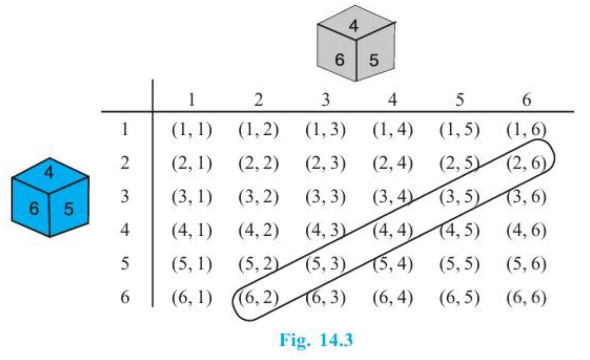
Find the probability that the sum on two distinct dice is \(8\).
- Two distinct dice are thrown. There are \(6 \times 6\) ordered outcomes because the result on each die is recorded separately.$$n(S)=36$$
- For a sum of \(8\), the favourable ordered pairs are \((2,6),(3,5),(4,4),(5,3),(6,2)\).$$n(E)=5$$
- Divide the favourable outcomes by the total outcomes.$$P(E)=\frac{5}{36}$$
Dice outcomes to remember
- Order matters: \((1,4)\) and \((4,1)\) are different outcomes for two distinct dice.
- Impossible sum: A sum of \(13\) cannot occur with two standard dice, so its probability is \(0\).
- Sure event: Every possible sum is at most \(12\), so the probability that the sum is at most \(12\) is \(1\).
Complementary Events
Complement of an event — The complement \(\overline{E}\) of event \(E\) is the event that \(E\) does not occur.
\(E\) and \(\overline{E}\) are complementary and together cover all outcomes, so their probabilities add to \(1\).
Using the complement
- Identify the event that is easier to calculate.
- Use the fact that the event and its complement have total probability \(1\).$$P(\overline{E})=1-P(E)$$
If Sangeeta’s probability of winning a tennis match is \(0.62\), find Reshma’s probability of winning.
- Sangeeta wins with probability \(0.62\). Reshma winning is the complementary event.$$P(R)=1-P(S)$$
- Subtract Sangeeta’s probability from \(1\).$$P(R)=1-0.62=0.38$$
Complement examples
- Not an ace: From a \(52\)-card deck, \(P(\text{ace})=\frac{4}{52}=\frac{1}{13}\), so \(P(\text{not ace})=1-\frac{1}{13}=\frac{12}{13}\).
- At least one head: For two coins, the complement is no heads, which has probability \(\frac{1}{4}\); hence \(P(\text{at least one head})=1-\frac{1}{4}=\frac{3}{4}\).
- Birthday comparison: Having the same birthday and having different birthdays are complementary events.
Probability over Length or Area
Geometric probability — When outcomes are uniformly distributed over a length or region, probability is the favourable length or area divided by the total length or area.
Use when every point in the given interval or region is equally likely.
Finding geometric probability
- Identify the total interval or region in which the outcome can lie.
- Measure the part corresponding to the event, using the same kind of measure.
- Divide the favourable measure by the total measure and simplify.$$P(E)=\frac{\text{favourable measure}}{\text{total measure}}$$
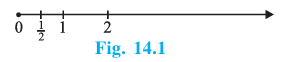
Length example
- Music stop: If the stop time is equally likely anywhere in \(0\) to \(2\) minutes, the probability it stops within the first \(\frac{1}{2}\) minute is \(\frac{\frac{1}{2}}{2}=\frac{1}{4}\).
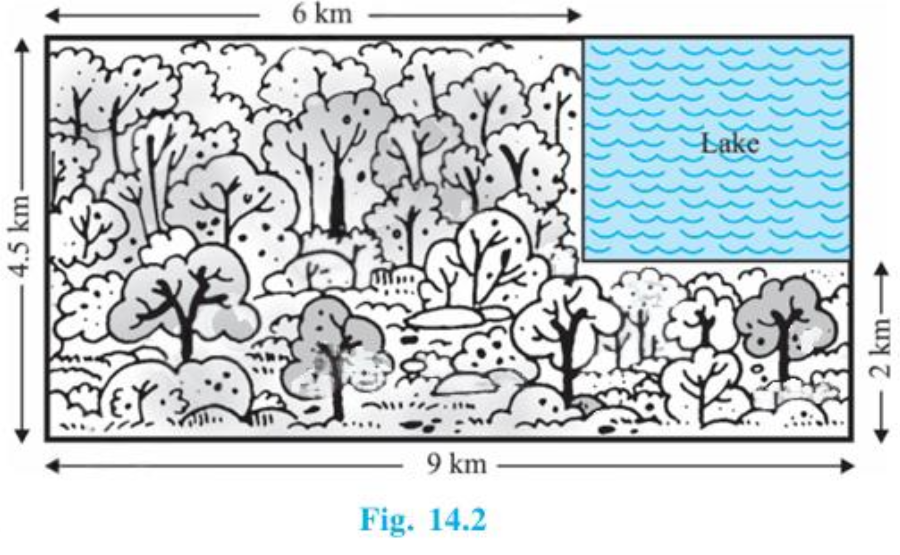
A helicopter is equally likely to crash anywhere in a \(4.5\) km by \(9\) km rectangle. A lake inside it measures \(2.5\) km by \(3\) km. Find the probability that the helicopter crashed in the lake.
- The whole rectangular region measures \(4.5\) km by \(9\) km.$$A_{\text{total}}=4.5\times 9=40.5\text{ km}^2$$
- The lake measures \(2.5\) km by \(3\) km.$$A_{\text{lake}}=2.5\times 3=7.5\text{ km}^2$$
- Assuming the helicopter is equally likely to crash anywhere in the region, divide the lake area by the total area.$$P(\text{lake})=\frac{7.5}{40.5}=\frac{5}{27}$$
| Point | Theoretical probability | Experimental probability |
|---|---|---|
| Basis | Predicts an outcome from equally likely assumptions and possible outcomes. | Uses what actually happens in repeated trials. |
| Relation | Provides the expected probability model. | As the number of trials increases, it may get close to the theoretical probability. |
A card is drawn from a well-shuffled deck of \(52\) cards. Find the probability that it is not an ace.
A stop time is equally likely anywhere in the first \(2\) minutes. Find the probability the music stops in the first \(30\) seconds.
Two distinct standard dice are thrown. Find the probability that their sum is less than or equal to \(12\).
Quick recap
- Classical probability is favourable outcomes divided by all equally likely outcomes.
- A sure event has probability \(1\), an impossible event has probability \(0\), and every probability lies between \(0\) and \(1\).
- An elementary event has one outcome; the probabilities of all elementary outcomes sum to \(1\).
- Complementary events satisfy \(P(E)+P(\overline{E})=1\).
- For uniform outcomes over a length or area, probability is favourable length or area divided by total length or area.
- Experimental probability is based on observed trials and may approach theoretical probability as trials increase.
Formula sheet
Mathematics — ALL CHAPTERS
1
Real Numbers
2
Polynomials
3
Pair Of Linear Equations In Two Variables
4
Quadratic Equations
5
Arithmetic Progressions
6
Triangles
7
Coordinate Geometry
8
Introduction To Trigonometry
9
Some Applications Of Trigonometry
10
Circles
11
Areas Related To Circles
12
Surface areas And Volumes
13
Statistics
14
Probability