Class 10 . Mathematics . Mathematics . Coordinate Geometry
Chapter 7: Coordinate Geometry
Ch 7
Mathematics
Class 10
Introduction & Distance Formula
Introduction to Coordinate Geometry
Distance Formula
For \(P(x_1,y_1)\) and \(Q(x_2,y_2)\), the horizontal and vertical differences are \(x_2-x_1\) and \(y_2-y_1\). Pythagoras' theorem gives the distance; take the non-negative square root.
Reversing the order of the points gives the same distance.
Set one point equal to the origin \((0,0)\).
Use the absolute difference of the coordinates that vary.
Finding the distance
- Write the points as \(P(x_1,y_1)\) and \(Q(x_2,y_2)\).
- Find the differences between corresponding coordinates.$$x_2-x_1,\quad y_2-y_1$$
- Square the differences, add them, and take the positive square root.$$PQ=\sqrt{(x_2-x_1)^2+(y_2-y_1)^2}$$
Find the distance between \(P(4,6)\) and \(Q(6,8)\).
- Find the distance between \(P(4,6)\) and \(Q(6,8)\).
- Substitute the coordinate differences into the distance formula.$$PQ=\sqrt{(6-4)^2+(8-6)^2}$$
- Square, add, and simplify.$$PQ=\sqrt{2^2+2^2}=\sqrt{8}=2\sqrt{2}$$
Do not treat a coordinate difference as a distance without considering its sign; square the differences and use the non-negative square root.
Using Distance to Study Points and Figures
If the squares of the two shorter sides add to the square of the longest side, the triangle is right-angled.
Equidistant point — A point is equidistant from two fixed points when its distances to them are equal; all such points lie on their perpendicular bisector.
Testing a shape or point relationship
- Use the distance formula to calculate the required side lengths.
- Compare lengths to test equal sides, diagonals, or a collinearity relation.
- For a right angle, use the converse of Pythagoras' theorem; for equidistance, set the squared distances equal and simplify.
Do \(P(3,2)\), \(Q(-2,-3)\) and \(R(2,3)\) form a triangle? If so, classify it.
Show that \(A(1,7)\), \(B(4,2)\), \(C(-1,-1)\) and \(D(-4,4)\) are the vertices of a square.
(a) Are \(A(3,1)\), \(B(6,4)\) and \(C(8,6)\) collinear? (b) Find the relation for points equidistant from \((7,1)\) and \((3,5)\). (c) Find the point on the \(y\)-axis equidistant from \((6,5)\) and \((-4,3)\).
- Distance depends on the squared differences of corresponding coordinates and is always non-negative.
- Use distance comparisons to test collinearity, right triangles, squares, and equidistance.
- Points equidistant from two fixed points lie on the perpendicular bisector of the segment between them.
Quick recap
- The abscissa is the \(x\)-coordinate and the ordinate is the \(y\)-coordinate.
- Points on the \(x\)-axis have form \((x,0)\); points on the \(y\)-axis have form \((0,y)\).
- The distance between \((x_1,y_1)\) and \((x_2,y_2)\) is \(\sqrt{(x_2-x_1)^2+(y_2-y_1)^2}\).
- The distance from \((0,0)\) to \((x,y)\) is \(\sqrt{x^2+y^2}\).
- Distance comparisons can establish collinearity, right angles, squares, and equidistance.
- The chapter also studies coordinates of a point dividing a segment in a given ratio.
Section Formula
Internal Division of a Line Segment
Section formula — The section formula gives the coordinates of a point dividing the line segment between two known points in a specified ratio.
Key idea
- Internal division: \(P\) divides \(AB\) internally when it lies between \(A\) and \(B\).
- Ratio convention: If \(PA:PB=m_1:m_2\), pair \(m_1\) with the coordinates of \(B\) and \(m_2\) with those of \(A\).
- Derivation: Perpendiculars to the axes form similar triangles, so the horizontal and vertical coordinate changes are divided in the same ratio.
- External division: A point on line \(AB\) but outside segment \(AB\) divides externally; its formula is not covered here.
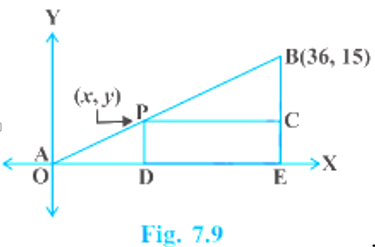
Relay-tower example
- Given: Let \(A=O=(0,0)\), \(B=(36,15)\), and \(OP:PB=1:2\).
- Coordinate ratios: If \(P=(x,y)\), then \(\frac{x}{36-x}=\frac{1}{2}\) and \(\frac{y}{15-y}=\frac{1}{2}\).
- Result: Solving gives \(x=12\) and \(y=5\), so the tower is at \(P=(12,5)\).
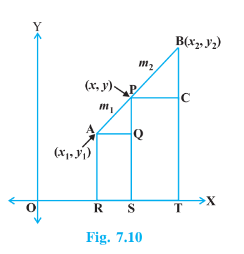
If \(P(x,y)\) divides the segment joining \(A(x_1,y_1)\) and \(B(x_2,y_2)\) internally in the ratio \(PA:PB=m_1:m_2\), then its coordinates are weighted averages of the endpoint coordinates.
For ratio \(k:1\), set \(m_1=k\) and \(m_2=1\). The midpoint is the special case \(1:1\).
Finding a point that divides a segment
- Identify the endpoints \(A(x_1,y_1)\) and \(B(x_2,y_2)\), and the ratio \(PA:PB=m_1:m_2\).
- Substitute the endpoint coordinates and ratio terms into the section formula.$$\left(\frac{m_1x_2+m_2x_1}{m_1+m_2},\frac{m_1y_2+m_2y_1}{m_1+m_2}\right)$$
- Simplify both coordinates and check that the point lies between the endpoints for internal division.
Find the coordinates of the point dividing the segment joining \((4,-3)\) and \((8,5)\) internally in the ratio \(3:1\).
- Find the point dividing the segment from \((4,-3)\) to \((8,5)\) internally in the ratio \(3:1\).
- Use \(m_1=3\), \(m_2=1\), \(A=(4,-3)\), and \(B=(8,5)\) in the section formula.$$P=\left(\frac{3(8)+1(4)}{3+1},\frac{3(5)+1(-3)}{3+1}\right)$$
- Simplify each coordinate.$$P=\left(\frac{28}{4},\frac{12}{4}\right)=(7,3)$$
Applications of the Section Formula
Useful applications
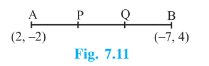
- Trisection: The two points dividing a segment into three equal parts divide it in ratios \(1:2\) and \(2:1\) from endpoint \(A\).
- Point on the \(y\)-axis: Its \(x\)-coordinate is \(0\); set the section-formula \(x\)-coordinate equal to \(0\).
- Parallelogram: Its diagonals bisect each other, so the diagonals have the same midpoint.
In what ratio does \((-4,6)\) divide the segment joining \(A(-6,10)\) and \(B(3,-8)\) internally?
Find the trisection points of the segment joining \(A(2,-2)\) and \(B(-7,4)\).
(a) Find where the \(y\)-axis divides the segment joining \((5,-6)\) and \((-1,-4)\). (b) If \(A(6,1)\), \(B(8,2)\), \(C(9,4)\), and \(D(p,3)\) are consecutive vertices of a parallelogram, find \(p\).
For points \(P(x_1,y_1)\) and \(Q(x_2,y_2)\), the distance formula gives \(PQ\). Setting one point to the origin gives the distance from the origin.
Do not pair \(m_1\) with the coordinates of \(A\): when \(PA:PB=m_1:m_2\), the numerator uses \(m_1(x_2,y_2)+m_2(x_1,y_1)\).
Quick recap
- For internal division with \(PA:PB=m_1:m_2\), use \(P=\left(\frac{m_1x_2+m_2x_1}{m_1+m_2},\frac{m_1y_2+m_2y_1}{m_1+m_2}\right)\).
- For ratio \(k:1\), set \(m_1=k\) and \(m_2=1\); the midpoint is the special case \(1:1\).
- The midpoint coordinates are the averages of the corresponding endpoint coordinates.
- Trisection points divide a segment in ratios \(1:2\) and \(2:1\) from the first endpoint.
- A point on the \(y\)-axis has \(x=0\); a parallelogram's diagonals have the same midpoint.
- The distance between \((x_1,y_1)\) and \((x_2,y_2)\) is \(\sqrt{(x_2-x_1)^2+(y_2-y_1)^2}\); the distance from the origin to \((x,y)\) is \(\sqrt{x^2+y^2}\).
Formula sheet
Mathematics — ALL CHAPTERS
1
Real Numbers
2
Polynomials
3
Pair Of Linear Equations In Two Variables
4
Quadratic Equations
5
Arithmetic Progressions
6
Triangles
7
Coordinate Geometry
8
Introduction To Trigonometry
9
Some Applications Of Trigonometry
10
Circles
11
Areas Related To Circles
12
Surface areas And Volumes
13
Statistics
14
Probability