Class 10 . Mathematics . Mathematics . Quadratic Equations
Chapter 4: Quadratic Equations
Ch 4
Mathematics
Class 10
Introduction & Quadratic Equations
Meaning and Standard Form
Use this form to identify whether an equation is quadratic.
Write \(4x-3x^2+2=0\) in standard form and identify its coefficients.
- Rewrite the equation in descending powers of the variable.$$4x-3x^2+2=0\quad\Longrightarrow\quad -3x^2+4x+2=0$$
- Compare with the standard form and identify the coefficients.$$a=-3,\qquad b=4,\qquad c=2$$
Forming Quadratic Equations from Situations
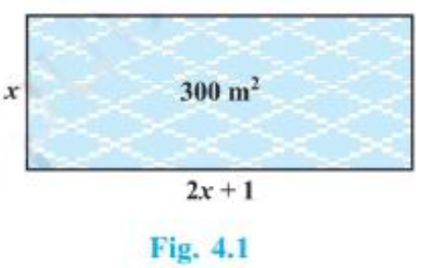
For a rectangle, area equals length multiplied by breadth; substitute the expressions given in the situation.
A rectangular hall has area \(300\text{ m}^2\) and its length is one metre more than twice its breadth. Form a quadratic equation for its breadth.
- Let the breadth be \(x\) metres; express the length using the given condition.$$\text{breadth}=x,\qquad \text{length}=2x+1$$
- Use the area condition to form an equation.$$x(2x+1)=300$$
- Expand and rearrange into standard form.$$2x^2+x=300\quad\Longrightarrow\quad 2x^2+x-300=0$$
Together, John and Jivanti initially have \(45\) marbles. Each loses \(5\), and the product of their remaining marbles is \(124\). If John initially had \(x\), form the quadratic equation.
A workshop makes \(x\) toys in a day. Each toy costs Rs. \(55-x\) to produce, and the total cost is Rs. \(750\). Form the quadratic equation.
Checking Whether an Equation Is Quadratic
Classify an equation
- Expand brackets and simplify each side.
- Bring all terms to one side and combine like terms.
- Check whether the resulting equation has degree \(2\) and a non-zero quadratic coefficient.$$ax^2+bx+c=0,\qquad a\ne0$$
| Given equation | Simplified form | Quadratic? |
|---|---|---|
| \((x-2)^2+1=2x-3\) | \(x^2-6x+8=0\) | Yes |
| \(x(x+1)+8=(x+2)(x-2)\) | \(x+12=0\) | No; it is linear |
| \(x(2x+3)=x^2+1\) | \(x^2+3x-1=0\) | Yes |
| \((x+2)^3=x^3-4\) | \(x^2+2x+2=0\) | Yes |
Check whether \((x+2)^3=x^3-4\) is a quadratic equation.
- Expand the cube on the left.$$(x+2)^3=x^3+6x^2+12x+8$$
- Cancel matching cubic terms and move all terms to one side.$$x^3+6x^2+12x+8=x^3-4\quad\Longrightarrow\quad 6x^2+12x+12=0$$
- Divide by the common factor and identify the degree.$$x^2+2x+2=0$$
Is \(x(x+1)+8=(x+2)(x-2)\) a quadratic equation?
Do not classify an equation by its original appearance alone. Simplify first: terms of degree \(2\) or higher may cancel, changing the equation's final degree.
Quick recap
- A quadratic equation has standard form \(ax^2+bx+c=0\), with \(a\ne0\).
- The equation's degree must be checked after simplification.
- To model a situation, define the unknown, write the relationships, and rearrange into standard form.
- For rectangle problems, use area \(=\) length \(\times\) breadth.
- Quadratic terms can cancel, while higher-degree terms can also cancel and leave a quadratic equation.
Solution Of A Quadratic Equation By Factorisation
Roots and Factorisation
Root of a quadratic equation — A real number \(\alpha\) is a root of \(ax^2+bx+c=0\) if \(a\alpha^2+b\alpha+c=0\), where \(a\ne 0\).
The roots of \(ax^2+bx+c=0\) are exactly the zeroes of the quadratic polynomial \(ax^2+bx+c\). A quadratic equation has at most two roots.
If a product is zero, at least one factor is zero: \(AB=0\) implies \(A=0\) or \(B=0\). Use this after factorising the quadratic.
For \(ax^2+bx+c\), choose \(m,n\) such that \(m+n=b\) and \(mn=ac\), then group and factor.
Solve by factorisation
- Write the equation in the form \(ax^2+bx+c=0\).$$ax^2+bx+c=0$$
- Find two terms whose sum is the middle-term coefficient and whose product is \(ac\); split the middle term.$$m+n=b,\qquad mn=ac$$
- Group terms and factorise into two linear factors.$$ax^2+bx+c=(px+q)(rx+s)$$
- Set each factor equal to zero and solve the resulting linear equations.$$(px+q)(rx+s)=0\Rightarrow px+q=0\text{ or }rx+s=0$$
Find the roots of \(6x^2-x-2=0\) by factorisation.
- Solve \(6x^2-x-2=0\) by splitting the middle term.$$6x^2-x-2=0$$
- Split \(-x\) as \(3x-4x\), since the terms add to \(-x\) and their product is \(-12x^2\).$$6x^2+3x-4x-2=0$$
- Factor by grouping.$$3x(2x+1)-2(2x+1)=0\Rightarrow(3x-2)(2x+1)=0$$
- Set each factor to zero and solve.$$3x-2=0\Rightarrow x=\frac{2}{3},\qquad 2x+1=0\Rightarrow x=-\frac{1}{2}$$
Do not divide by a factor that contains the variable; set each factor equal to zero so no root is lost.
Nature of Roots
Discriminant — For \(ax^2+bx+c=0\), the discriminant \(D=b^2-4ac\) determines the number and type of real roots.
| Discriminant | Nature of roots |
|---|---|
| \(D>0\) | Two distinct real roots |
| \(D=0\) | Two equal (coincident) real roots |
| \(D<0\) | No real roots |
Use to find the roots directly; for real roots, the condition is \(D\ge 0\).
Determine the nature of roots
- Identify \(a\), \(b\), and \(c\) in standard form.$$ax^2+bx+c=0$$
- Calculate the discriminant.$$D=b^2-4ac$$
- Use the sign of \(D\) to classify the roots.$$D>0:\text{ distinct real};\quad D=0:\text{ equal real};\quad D<0:\text{ no real roots}$$
Find the discriminant and nature of the roots of \(2x^2-4x+3=0\).
- Find the discriminant and nature of roots of \(2x^2-4x+3=0\).$$a=2,\quad b=-4,\quad c=3$$
- Calculate the discriminant.$$D=(-4)^2-4(2)(3)=16-24=-8$$
- Since the discriminant is negative, there are no real roots.$$D=-8<0$$
Applying Quadratic Equations
Choosing a meaningful root
- Applications: Form an equation from the situation, solve it, then reject roots that are not meaningful (for example, a negative distance or breadth).
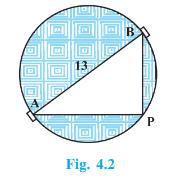
- Geometry: If a triangle is inscribed in a circle with one side as the diameter, the angle opposite the diameter is a right angle; Pythagoras’ theorem can then form the quadratic equation.
A hall has breadth \(x\) m, where \(2x^2+x-300=0\). Find its breadth and length if the length is \(2x+1\) m.
A circular park has diameter \(13\) m. A pole on its boundary is \(7\) m farther from one of two diametrically opposite gates than from the other. Is this possible, and what are its distances from the gates?
Find the nature and roots of \(3x^2-2\sqrt{6}x+2=0\).
Quick recap
- A root makes the quadratic polynomial equal to zero; a quadratic has at most two roots.
- Factorise the quadratic and set each linear factor equal to zero.
- For middle-term splitting, choose terms with sum \(b\) and product \(ac\).
- The discriminant is \(D=b^2-4ac\).
- \(D>0\) gives two distinct real roots, \(D=0\) gives equal real roots, and \(D<0\) gives no real roots.
- In applications, reject roots that cannot represent the quantity, such as negative lengths or distances.
Formula sheet
Mathematics — ALL CHAPTERS
1
Real Numbers
2
Polynomials
3
Pair Of Linear Equations In Two Variables
4
Quadratic Equations
5
Arithmetic Progressions
6
Triangles
7
Coordinate Geometry
8
Introduction To Trigonometry
9
Some Applications Of Trigonometry
10
Circles
11
Areas Related To Circles
12
Surface areas And Volumes
13
Statistics
14
Probability