Class 10 . Mathematics . Mathematics . Pair of Linear Equations in Two Variables
Chapter 3: Pair Of Linear Equations In Two Variables
Ch 3
Mathematics
Class 10
Introduction & Graphical Method Of Solution Of A Pair Of Linear Equations
Representing a Situation by a Pair of Linear Equations
Let \(x\) be the number of Giant Wheel rides and \(y\) the number of Hoopla games.
Translate a word problem
- Define a variable for each unknown quantity.
- Write an equation for each given condition.
- Solve both equations together and check the values against the situation.
Akhila's Hoopla games were half her Giant Wheel rides. Rides cost Rs. 3 each, games cost Rs. 4 each, and she spent Rs. 20. Find the numbers of rides and games.
- Use \(y=\frac{x}{2}\) in the spending equation.$$3x+4\left(\frac{x}{2}\right)=20$$
- Simplify and solve for the number of rides.$$5x=20\quad\Rightarrow\quad x=4$$
- Find the number of Hoopla games.$$y=\frac{4}{2}=2$$
- Check the cost: \(4\) rides and \(2\) games cost \(3(4)+4(2)=20\).
Consistency and the Number of Solutions
For \(a_1x+b_1y+c_1=0\) and \(a_2x+b_2y+c_2=0\): if \(\frac{a_1}{a_2}\ne\frac{b_1}{b_2}\), the lines intersect and there is one solution. If \(\frac{a_1}{a_2}=\frac{b_1}{b_2}=\frac{c_1}{c_2}\), the lines coincide and there are infinitely many solutions. If \(\frac{a_1}{a_2}=\frac{b_1}{b_2}\ne\frac{c_1}{c_2}\), the lines are parallel and there is no solution.
| Relationship | Ratio condition | Number of solutions |
|---|---|---|
| Intersecting | \(\frac{a_1}{a_2}\ne\frac{b_1}{b_2}\) | Exactly one |
| Coincident | \(\frac{a_1}{a_2}=\frac{b_1}{b_2}=\frac{c_1}{c_2}\) | Infinitely many |
| Parallel | \(\frac{a_1}{a_2}=\frac{b_1}{b_2}\ne\frac{c_1}{c_2}\) | None |
Compare the coefficient ratios for equations written in the form \(ax+by+c=0\).
Use the coefficient-ratio test
- Write both equations in standard form, \(ax+by+c=0\).
- Identify the coefficients and compare the three ratios.
- Use the ratio condition to state whether the lines intersect, coincide, or are parallel.
Determine the number of solutions of \(5x-8y+1=0\) and \(3x-\frac{24}{5}y+\frac{3}{5}=0\).
- Multiply the second equation by \(\frac{5}{3}\).$$\frac{5}{3}\left(3x-\frac{24}{5}y+\frac{3}{5}\right)=0\quad\Rightarrow\quad 5x-8y+1=0$$
- The result is exactly the first equation, so both equations represent the same line.
Examples of the three line relationships
- Intersecting: \(x-2y=0\) and \(3x+4y-20=0\) have \(\frac{1}{3}\ne\frac{-2}{4}\), so there is one solution.
- Coincident: \(2x+3y-9=0\) and \(4x+6y-18=0\) have all three ratios equal to \(\frac{1}{2}\), so there are infinitely many solutions.
- Parallel: \(x+2y-4=0\) and \(2x+4y-12=0\) have \(\frac{1}{2}=\frac{2}{4}\ne\frac{-4}{-12}\), so there is no solution.
Do not compare only the \(x\)- and \(y\)-coefficient ratios when deciding whether lines coincide; the constant ratio is needed to distinguish coincident lines from parallel lines.
Graphical Method of Solution
At the intersection, the same ordered pair \((x,y)\) satisfies both equations.
Solve a pair graphically
- Find at least two convenient points satisfying each equation.
- Plot each pair of points and draw the corresponding straight line.
- Read the intersection coordinates; if the lines coincide or are parallel, state the number of solutions accordingly.
- Substitute the intersection coordinates into both equations to verify them.
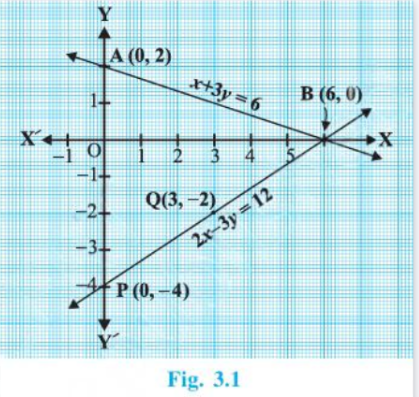
Solve graphically: \(x+3y=6\) and \(2x-3y=12\). Is the pair consistent?
- For \(x+3y=6\), use the points \((0,2)\) and \((6,0)\).
- For \(2x-3y=12\), use the points \((0,-4)\) and \((3,-2)\).
- Plot each pair and draw the two lines. They intersect at \((6,0)\).
- Verify the point in both equations.$$6+3(0)=6,\qquad 2(6)-3(0)=12$$
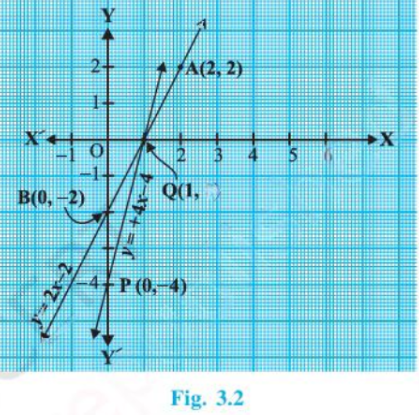
Champa's number of skirts \(y\) is two less than twice the number of pants \(x\), and also four less than four times the number of pants. Find how many of each she bought.
Classify the pair \(x+2y-4=0\) and \(2x+4y-12=0\) by its number of solutions.
Quick recap
- Translate each condition in a situation into a linear equation using the same variables.
- A consistent pair has at least one solution; an inconsistent pair has none.
- Intersecting lines give one solution, coincident lines infinitely many, and parallel lines none.
- For standard-form equations, compare \(\frac{a_1}{a_2}\), \(\frac{b_1}{b_2}\), and \(\frac{c_1}{c_2}\) to classify the pair.
- Graph each equation as a straight line; the intersection coordinates solve both equations.
Algebraic Methods Of Solving A Pair Of Linear Equations
Why use algebraic methods?
Algebraic solution
- Purpose: Algebraic methods find a pair of equations’ solution without reading coordinates from a graph.
- Advantage: They are especially useful when the solution has non-integer or difficult-to-read coordinates.
Substitution method
Substitution method — A method of solving two equations by expressing one variable in terms of the other and substituting that expression into the second equation.
After substitution, a true statement with no variable means the equations have infinitely many common solutions; a false statement means they are inconsistent and have no common solution.
Use one equation to write a variable in terms of the other, then substitute into the other equation.
Steps
- Choose the more convenient equation and express one variable in terms of the other.
- Substitute this expression into the other equation and solve the resulting one-variable equation.
- Substitute the value found back into the first expression to find the other variable.
- Check that the ordered pair satisfies both original equations.
Solve \(7x-15y=2\) and \(x+2y=3\) using substitution.
- Solve the pair by expressing x from the second equation.$$7x-15y=2,\qquad x+2y=3$$
- Write x in terms of y.$$x=3-2y$$
- Substitute into the first equation and solve for y.$$7(3-2y)-15y=2\;\Longrightarrow\;21-29y=2\;\Longrightarrow\;-29y=-19\;\Longrightarrow\;y=\frac{19}{29}$$
- Substitute this value into x=3-2y.$$x=3-2\left(\frac{19}{29}\right)=\frac{49}{29}$$
Do not stop after finding one variable: substitute it back to obtain the other variable, then verify both equations. In the worked example, \(21-29y=2\) gives \(-29y=-19\), not \(-1\).
Applications and special outcomes
Age problem
- Variables: Let Aftab’s present age be \(s\) years and his daughter’s present age be \(t\) years.
- Seven years ago: \(s-7=7(t-7)\), or \(s-7t+42=0\).
- Three years from now: \(s+3=3(t+3)\), or \(s-3t=6\).
- Solution: Substituting \(s=3t+6\) into the first equation gives \(t=12\) and then \(s=42\).
- Conclusion: Aftab is \(42\) years old and his daughter is \(12\) years old.
Pencil and eraser costs
- Let: A pencil cost \(x\) rupees and an eraser cost \(y\) rupees.
- Equations: \(2x+3y=9\) and \(4x+6y=18\).
- Substitution result: Substituting \(x=\frac{9-3y}{2}\) into the second equation gives \(18=18\).
- Conclusion: The equations represent the same line, so there are infinitely many solutions; the individual costs cannot be uniquely determined.
Do the rails cross?
- Equations: \(x+2y-4=0\) and \(2x+4y-12=0\).
- Substitution: From the first equation, \(x=4-2y\). Substituting into the second gives \(2(4-2y)+4y-12=0\), or \(-4=0\).
- Conclusion: The result is false, so the equations have no common solution; the rails do not cross.
A father’s present age is \(s\) and his daughter’s is \(t\). Seven years ago, he was seven times her age. Three years from now, he will be three times her age. Find their present ages.
Classify the solutions of \(2x+3y=9\) and \(4x+6y=18\).
Determine whether \(x+2y-4=0\) and \(2x+4y-12=0\) have a common solution.
Quick recap
- Substitution solves a pair by replacing one variable with an expression from the other equation.
- After solving for one variable, substitute back to find the second and verify both equations.
- A true variable-free statement, such as \(18=18\), indicates infinitely many common solutions.
- A false variable-free statement, such as \(-4=0\), indicates no common solution.
- Equivalent equations may describe the same line and fail to determine a unique pair.
Elimination Method
Elimination: core idea
Elimination method — An algebraic method that removes one variable from a pair of equations to obtain an equation in one variable.
Key idea
- Equalise coefficients: Multiply one or both equations by suitable non-zero constants so one variable has equal or opposite coefficients.
- Eliminate: Subtract equations with equal coefficients, or add equations with opposite coefficients.
- Finish: Solve for the remaining variable, then substitute into an original equation to find the other.
Steps for solving by elimination
- Multiply the equations by suitable non-zero constants to make the coefficients of one variable numerically equal.
- Add or subtract the equations so that this variable is eliminated.
- Solve the resulting one-variable equation. If elimination gives a true statement with no variable, there are infinitely many solutions; if it gives a false statement, there is no solution.
- Substitute the value found into either original equation to find the other variable.
A resulting equation in one variable gives a unique solution; a true statement without variables means infinitely many solutions, while a false statement means no solution.
Two people have income ratio \(9:7\) and expenditure ratio \(4:3\). Each saves Rs. \(2000\) per month. Find their monthly incomes.
- Let the incomes be Rs. \(9x\) and Rs. \(7x\), and expenditures be Rs. \(4y\) and Rs. \(3y\). Each person saves Rs. \(2000\).$$9x-4y=2000,\qquad 7x-3y=2000$$
- Multiply the first equation by \(3\) and the second by \(4\) to equalise the coefficients of \(y\).$$27x-12y=6000,\qquad 28x-12y=8000$$
- Subtract the first new equation from the second to eliminate \(y\).$$(28x-27x)+(-12y+12y)=8000-6000\;\Rightarrow\;x=2000$$
- Substitute \(x=2000\) into the first original equation to find \(y\).$$9(2000)-4y=2000\;\Rightarrow\;y=4000$$
- Calculate the incomes and verify the income and expenditure ratios.$$9x=18000,\quad 7x=14000,\quad 18000:14000=9:7,\quad (18000-2000):(14000-2000)=16000:12000=4:3$$
Use elimination to determine the solutions of \(2x+3y=8\) and \(4x+6y=7\).
Representing two-digit numbers
If the tens digit is \(x\) and the units digit is \(y\), the number is \(10x+y\) and its reversal is \(10y+x\).
The sum of a two-digit number and its reversal is \(66\). Its digits differ by \(2\). Find all such numbers.
Classifying pairs of linear equations
Algebraic methods
- Methods: The two algebraic methods for solving a pair of linear equations are the substitution method and the elimination method.
| Solution type | Consistency | Graph |
|---|---|---|
| One solution | Consistent | The lines intersect at one point. |
| Infinitely many solutions | Dependent and consistent | The lines coincide; every point on the line is a solution. |
| No solution | Inconsistent | The lines are parallel. |
For \(a_1x+b_1y+c_1=0\) and \(a_2x+b_2y+c_2=0\), compare the ratios of corresponding coefficients to classify the pair.
Modelling situations
- Transform first: Some situations are not initially expressed as linear equations; suitable changes or representations can reduce them to a pair of linear equations.
Quick recap
- Elimination solves two linear equations by equalising coefficients and adding or subtracting to remove a variable.
- Substitute the value of one variable into an original equation to find the other.
- A true statement with no variable means infinitely many solutions; a false statement means no solution.
- The substitution method and elimination method are the algebraic methods for solving a pair of linear equations.
- Intersecting, coincident, and parallel lines represent one, infinitely many, and no solutions respectively.
- Use coefficient ratios to classify a pair of linear equations.
- For digits \(x\) and \(y\), a two-digit number and its reversal are \(10x+y\) and \(10y+x\).
Formula sheet
Mathematics — ALL CHAPTERS
1
Real Numbers
2
Polynomials
3
Pair Of Linear Equations In Two Variables
4
Quadratic Equations
5
Arithmetic Progressions
6
Triangles
7
Coordinate Geometry
8
Introduction To Trigonometry
9
Some Applications Of Trigonometry
10
Circles
11
Areas Related To Circles
12
Surface areas And Volumes
13
Statistics
14
Probability