Class 10 . Mathematics . Mathematics . Some Applications of Trigonometry
Chapter 9: Some Applications Of Trigonometry
Ch 9
Mathematics
Class 10
Heights And Distances
Line of Sight, Elevation and Depression
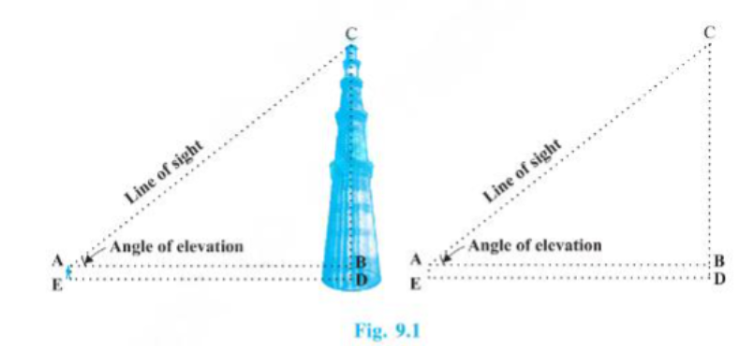
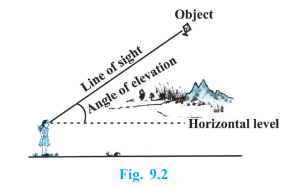
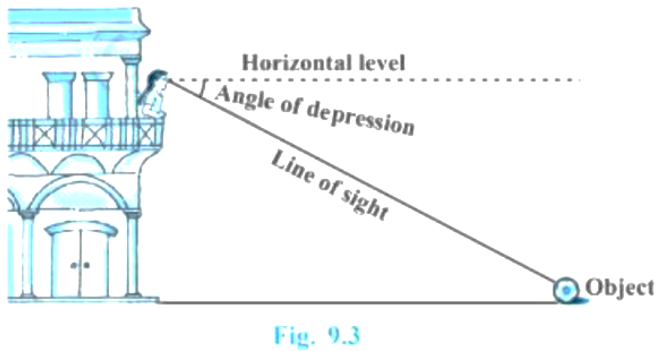
Do not measure an elevation or depression from the vertical. Both angles are measured from a horizontal line.
Using Trigonometry to Find Heights and Distances
Choose the ratio that includes the sides known and required.
These values are commonly used in height-and-distance questions.
Setting Up and Solving a Heights-and-Distances Problem
- Draw and label a right-triangle diagram, marking the horizontal and vertical sides.
- Select sine, cosine or tangent according to the sides involved.
- Solve for the unknown side, then include any extra height or length stated in the problem.
- Check that the final units and the size of the answer are reasonable.
Find the tower’s height.
- A tower is viewed from a point 15 m from its foot. The angle of elevation is 60°. Let its height be h.$$h$$
- Use tangent: opposite side divided by adjacent side.$$\tan 60^\circ=\frac{h}{15}$$
- Substitute the exact value and solve.$$\sqrt{3}=\frac{h}{15}\quad\Rightarrow\quad h=15\sqrt{3}$$
| Situation | Key relationship and result |
|---|---|
| Ladder reaches a point 1.3 m below the top of a 5 m pole; ladder makes 60° with horizontal. | Required vertical rise: \(5-1.3=3.7\text{ m}\). Ladder length: \(\frac{3.7}{\sin60^\circ}\approx4.28\text{ m}\); foot distance: \(\frac{3.7}{\tan60^\circ}\approx2.14\text{ m}\). |
| Observer’s eye is 1.5 m high, 28.5 m from a chimney; elevation is 45°. | Height above eye level: \(28.5\tan45^\circ=28.5\text{ m}\). Chimney height: \(28.5+1.5=30\text{ m}\). |
| A 10 m building and flagstaff have elevations 30° and 45° from the same point. | Distance to building: \(10\sqrt{3}\text{ m}\). Flagstaff length: \(10\sqrt{3}-10\approx7.32\text{ m}\). |
A tower’s shadow is 40 m longer when the Sun’s altitude is 30° than when it is 60°. Find the tower’s height.
From the top of a multistorey building, the angles of depression to the top and bottom of an 8 m building are 30° and 45°. Find the multistorey building’s height and the distance between the buildings.
A bridge point is 3 m above river banks on opposite sides. The angles of depression to the banks are 30° and 45°. Find the river’s width.
- Elevation: Look upward from the horizontal; depression: look downward from the horizontal.
- Heights: Account for observer or object height separately from the vertical side found using trigonometry.
- Two observations: Form a right triangle for each angle, then use their shared height or distance to connect the equations.
Quick recap
- A line of sight joins the observer’s eye to the viewed point.
- Elevation and depression are measured from the horizontal through the observer.
- Represent the situation with right triangles and select a ratio that connects the known and unknown sides.
- Add or subtract observer and object heights when the triangle gives only a partial vertical distance.
- For two-angle problems, form equations for both triangles and use their shared dimensions.
- Use exact values such as \(\tan30^\circ=1/\sqrt{3}\), \(\tan45^\circ=1\), and \(\tan60^\circ=\sqrt{3}\).
Formula sheet
Mathematics — ALL CHAPTERS
1
Real Numbers
2
Polynomials
3
Pair Of Linear Equations In Two Variables
4
Quadratic Equations
5
Arithmetic Progressions
6
Triangles
7
Coordinate Geometry
8
Introduction To Trigonometry
9
Some Applications Of Trigonometry
10
Circles
11
Areas Related To Circles
12
Surface areas And Volumes
13
Statistics
14
Probability