Introduction
Degree and Types of Polynomials
Degree of a polynomial — The degree is the greatest exponent of the variable with a non-zero coefficient.
Polynomial types
- Polynomial: Variable exponents are non-negative integers; coefficients may be real numbers.
- Not polynomials: Expressions such as \(\frac{1}{x}-1\), \(\sqrt{x}+2\), and \(\frac{1}{x^2}+2x+3\) have a variable in the denominator or a non-integer exponent.
- Linear: A polynomial of degree \(1\), such as \(2x-3\) or \(\sqrt{3}x+5\).
- Quadratic: A polynomial of degree \(2\), such as \(x^2-2\).
- Cubic: A polynomial of degree \(3\), such as \(2-x^3\).
The leading coefficient, the coefficient of the highest power, must be non-zero.
Classify \(5x^3-4x^2+x-\sqrt{2}\) and \(2x+5-x^2\) by degree.
- The highest exponent is \(3\), so this polynomial is cubic.$$5x^3-4x^2+x-\sqrt{2}$$
- The highest exponent is \(2\), so this polynomial is quadratic, not linear.$$2x+5-x^2$$
Values and Zeroes of a Polynomial
Value of a polynomial — For a polynomial \(p(x)\), its value at \(x=k\) is found by substituting \(k\) for \(x\) and is written as \(p(k)\).
Zero of a polynomial — A real number \(k\) is a zero of \(p(x)\) if and only if \(p(k)=0\).
Set the linear polynomial equal to zero and solve for its variable.
For \(p(x)=x^2-3x-4\), find \(p(2)\) and determine whether \(-1\) is a zero.
- Substitute \(x=2\) into the polynomial and simplify.$$p(2)=2^2-3(2)-4=4-6-4=-6$$
- Substitute \(x=-1\); the result is zero, so \(-1\) is a zero.$$p(-1)=(-1)^2-3(-1)-4=1+3-4=0$$
Geometrical Meaning and Number of Zeroes
Graphical meaning of a zero — The zeroes of \(p(x)\) are the \(x\)-coordinates of the points where the graph \(y=p(x)\) meets the \(x\)-axis.
Graph behaviour
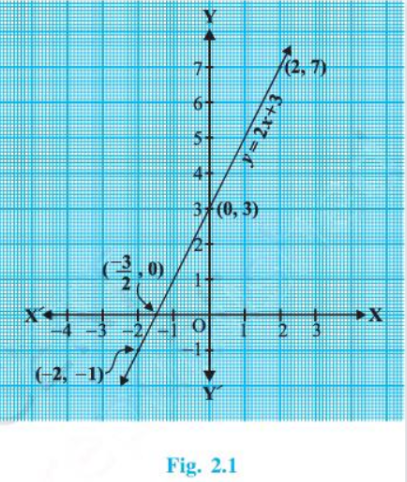
- Linear: The graph of \(y=ax+b\), where \(a\ne0\), is a straight line that meets the \(x\)-axis once, at \(\left(-\frac{b}{a},0\right)\).
- Example: The line \(y=2x+3\) passes through \((-2,-1)\) and \((2,7)\) and meets the \(x\)-axis at \(\left(-\frac{3}{2},0\right)\).
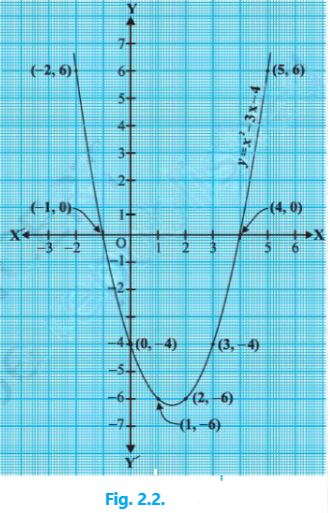
- Quadratic: The graph of \(y=ax^2+bx+c\) is a parabola; it opens upwards when \(a>0\) and downwards when \(a<0\).
- Quadratic zeroes: A parabola may cut the \(x\)-axis twice, touch it once (a repeated zero), or not meet it; thus a quadratic has at most two real zeroes.
- Cubic examples: \(x^3-4x=x(x-2)(x+2)\) has zeroes \(-2,0,2\); \(x^3\) has the distinct zero \(0\).
- More cubic examples: \(x^3-x^2=x^2(x-1)\) has distinct zeroes \(0\) and \(1\).
- General rule: A polynomial of degree \(n\) has at most \(n\) zeroes.
| \(x\) | \(-2\) | \(-1\) | \(0\) | \(1\) | \(2\) | \(3\) | \(4\) | \(5\) |
|---|---|---|---|---|---|---|---|---|
| \(y\) | \(6\) | \(0\) | \(-4\) | \(-6\) | \(-6\) | \(-4\) | \(0\) | \(6\) |
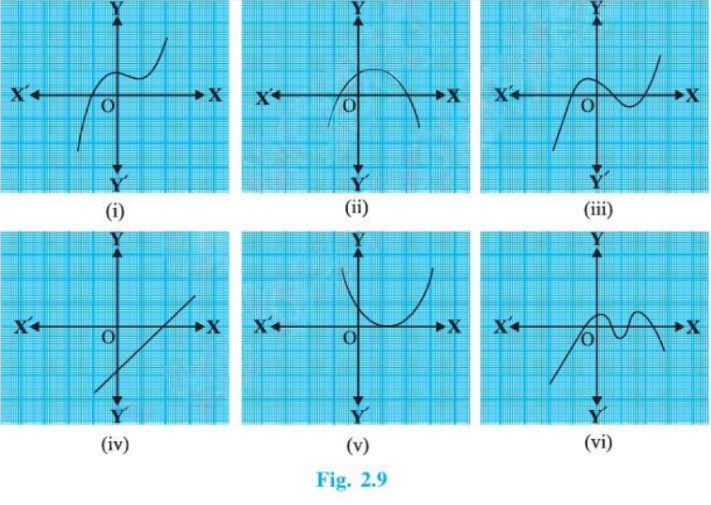
Counting zeroes from graphs
- Graph (i): \(1\) zero.
- Graph (ii): \(2\) zeroes.
- Graph (iii): \(3\) zeroes.
- Graph (iv): \(1\) zero.
- Graph (v): \(1\) zero.
- Graph (vi): \(4\) zeroes.
Find the zeroes of \(x^3-4x\) and state their graphical meaning.
- Factor out \(x\), then factor the difference of squares.$$x^3-4x=x(x^2-4)=x(x-2)(x+2)$$
- Set each factor equal to zero to find the zeroes.$$x=0,\quad x=2,\quad x=-2$$
A graph that touches the \(x\)-axis still has a zero there; a repeated zero counts as one distinct zero and one point of contact.
Relations Between Zeroes and Coefficients
For a quadratic with zeroes \(\alpha,\beta\) and a cubic with zeroes \(\alpha,\beta,\gamma\), sums and products of the zeroes are related to the coefficients.
Use these relations when the polynomial coefficients and its zeroes are known.
Verify the zero-coefficient relations for \(x^2-3x-4\).
- Factor to find the zeroes.$$x^2-3x-4=(x-4)(x+1),\quad \alpha=4,\quad \beta=-1$$
- Check that the sum equals \(-\frac{b}{a}\).$$\alpha+\beta=4+(-1)=3=-\frac{-3}{1}$$
- Check that the product equals \(\frac{c}{a}\).$$\alpha\beta=4(-1)=-4=\frac{-4}{1}$$
Find the degree of \(7u^6-\frac{3}{2}u^4+4u^2+u-8\).
How many distinct zeroes does \(x^3-x^2\) have?
A polynomial graph touches the \(x\)-axis at one point and does not cross it. How many distinct zeroes does it have?
Quick recap
- The degree is the greatest exponent with a non-zero coefficient; degrees \(1\), \(2\), and \(3\) are linear, quadratic, and cubic.
- A real number \(k\) is a zero of \(p(x)\) exactly when \(p(k)=0\).
- Graphically, zeroes are the \(x\)-coordinates where \(y=p(x)\) meets the \(x\)-axis.
- A quadratic can have two distinct real zeroes, one repeated real zero, or no real zero; a cubic has at most three zeroes.
- A polynomial of degree \(n\) has at most \(n\) zeroes.
- For a quadratic, \(\alpha+\beta=-\frac{b}{a}\) and \(\alpha\beta=\frac{c}{a}\).
- For a cubic, the sum, pairwise-product sum, and product of the zeroes are \(-\frac{b}{a}\), \(\frac{c}{a}\), and \(-\frac{d}{a}\).
Relationship Between Zeroes And Coefficients Of A Polynomial
Quadratic Polynomials
Quadratic polynomial — A quadratic polynomial has the form \(ax^2+bx+c\), where \(a\ne 0\).
If the zeroes are \(\alpha\) and \(\beta\), their sum is the negative ratio of the coefficient of \(x\) to that of \(x^2\), and their product is the ratio of the constant term to that of \(x^2\).
Key points
- Factored form: \(ax^2+bx+c=a(x-\alpha)(x-\beta)\).
- Coefficient comparison: The coefficients determine the sum and product of the zeroes.
- Reverse use: Given the sum and product, a suitable quadratic can be formed.
Use for a quadratic polynomial \(ax^2+bx+c\), with zeroes \(\alpha\) and \(\beta\).
Find and verify quadratic zeroes
- Factorise the polynomial.$$ax^2+bx+c=a(x-r_1)(x-r_2)$$
- Set each factor equal to zero to find the zeroes.$$x-r_1=0,\qquad x-r_2=0$$
- Check their sum and product against the coefficient formulas.$$r_1+r_2=-\frac{b}{a},\qquad r_1r_2=\frac{c}{a}$$
Find the zeroes of \(x^2-3\) and verify their relationship with the coefficients.
- Factorise the polynomial using the difference of squares.$$x^2-3=(x-\sqrt{3})(x+\sqrt{3})$$
- Set each factor to zero; the zeroes are \(\sqrt{3}\) and \(-\sqrt{3}\).$$x-\sqrt{3}=0\Rightarrow x=\sqrt{3},\qquad x+\sqrt{3}=0\Rightarrow x=-\sqrt{3}$$
- Verify the sum using \(a=1\) and \(b=0\).$$\sqrt{3}+(-\sqrt{3})=0=-\frac{0}{1}$$
- Verify the product using \(a=1\) and \(c=-3\).$$\sqrt{3}(-\sqrt{3})=-3=\frac{-3}{1}$$
Do not omit the negative sign in the sum formula: the sum is \(-b/a\), while the product is \(c/a\).
Cubic Polynomials
Cubic polynomial — A cubic polynomial has the form \(ax^3+bx^2+cx+d\), where \(a\ne 0\).
If the zeroes are \(\alpha\), \(\beta\) and \(\gamma\), their sum, pairwise-product sum and product are related to the coefficients as shown.
Key points
- Factored form: \(ax^3+bx^2+cx+d=a(x-\alpha)(x-\beta)(x-\gamma)\).
- Pairwise-product sum: Add the three products of zeroes taken two at a time: \(\alpha\beta+\beta\gamma+\gamma\alpha\).
- Signs: The sum and product have negative signs in their coefficient relations; the pairwise-product sum is positive.
Use for a cubic polynomial \(ax^3+bx^2+cx+d\), with zeroes \(\alpha\), \(\beta\) and \(\gamma\).
Verify cubic zeroes and coefficients
- Check each proposed zero by substitution or by factorisation.$$p(\alpha)=p(\beta)=p(\gamma)=0$$
- Calculate the sum of the three zeroes and compare it with the coefficient formula.$$\alpha+\beta+\gamma=-\frac{b}{a}$$
- Calculate the sum of pairwise products and compare it with the coefficient formula.$$\alpha\beta+\beta\gamma+\gamma\alpha=\frac{c}{a}$$
- Calculate the product of the three zeroes and compare it with the coefficient formula.$$\alpha\beta\gamma=-\frac{d}{a}$$
Verify that \(3\), \(-1\) and \(-1/3\) are zeroes of \(3x^3-5x^2-11x-3\), then verify the coefficient relationships.
- Substitute \(x=3\) to check the first proposed zero.$$p(3)=3(3)^3-5(3)^2-11(3)-3=81-45-33-3=0$$
- Substitute \(x=-1\) to check the second proposed zero.$$p(-1)=3(-1)^3-5(-1)^2-11(-1)-3=-3-5+11-3=0$$
- Substitute \(x=-\frac{1}{3}\) to check the third proposed zero.$$p\left(-\frac{1}{3}\right)=-\frac{1}{9}-\frac{5}{9}+\frac{11}{3}-3=0$$
- Their sum agrees with \(-b/a\).$$3+(-1)-\frac{1}{3}=\frac{5}{3}=-\frac{-5}{3}$$
- Their pairwise-product sum agrees with \(c/a\).$$3(-1)+(-1)\left(-\frac{1}{3}\right)+\left(-\frac{1}{3}\right)3=-3+\frac{1}{3}-1=-\frac{11}{3}$$
- Their product agrees with \(-d/a\).$$3(-1)\left(-\frac{1}{3}\right)=1=-\frac{-3}{3}$$
For a cubic, do not confuse the pairwise-product sum with the product of all three zeroes; their coefficient formulas are different.
Find the zeroes of \(x^2+7x+10\) and verify their relationship with the coefficients.
Find a quadratic polynomial whose zeroes have sum \(-3\) and product \(2\).
A monic cubic has zeroes \(1\), \(2\) and \(-3\). Find the polynomial.
Quadratic sign check
For \(ax^2+bx+c\), the zeroes' sum has the opposite sign to \(b/a\); their product has the same sign as \(c/a\).
Quick recap
- For \(ax^2+bx+c\), the zeroes satisfy \(\alpha+\beta=-b/a\) and \(\alpha\beta=c/a\).
- For \(ax^3+bx^2+cx+d\), the zeroes satisfy \(\alpha+\beta+\gamma=-b/a\).
- The cubic pairwise-product sum is \(\alpha\beta+\beta\gamma+\gamma\alpha=c/a\).
- The product of the cubic zeroes is \(\alpha\beta\gamma=-d/a\).
- The zeroes of \(x^2-3\) are the irrational values \(\sqrt{3}\) and \(-\sqrt{3}\), and they satisfy the quadratic relationships.
- Use coefficient relationships both to verify zeroes and to construct polynomials.
Formula sheet
Mathematics — ALL CHAPTERS
1
Real Numbers
2
Polynomials
3
Pair Of Linear Equations In Two Variables
4
Quadratic Equations
5
Arithmetic Progressions
6
Triangles
7
Coordinate Geometry
8
Introduction To Trigonometry
9
Some Applications Of Trigonometry
10
Circles
11
Areas Related To Circles
12
Surface areas And Volumes
13
Statistics
14
Probability