Introduction
Circle — A circle is the set of all points in a plane at a fixed distance, called the radius, from a fixed point, called the centre.
A Line and a Circle
Possible Positions
- No common point: The line is non-intersecting with respect to the circle.
- Two common points: The line is a secant; the points on the circle are the endpoints of a chord.
- One common point: The line is a tangent; the shared point is the point of contact.
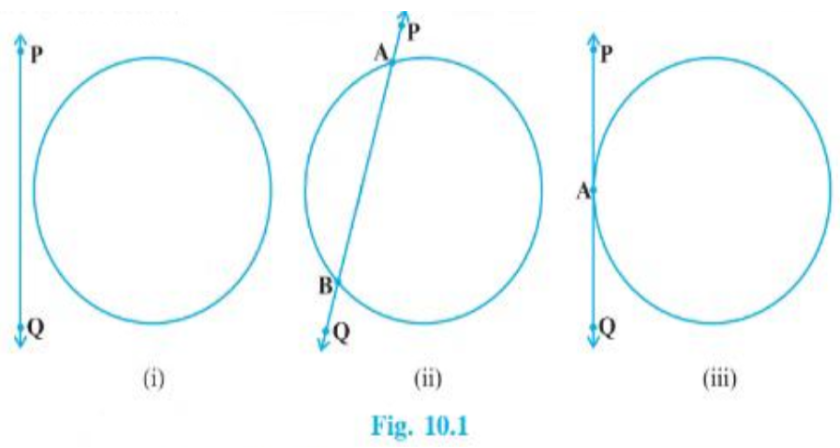
Tangent — A tangent is a line that meets a circle at exactly one point.
Tangent Facts
- Secant connection: A tangent is the limiting case of a secant when the two endpoints of the corresponding chord coincide.
- At a point: Exactly one tangent can be drawn to a circle at any given point on it.
- Parallel tangents: There can be at most two tangents to a circle parallel to a given secant.
- Everyday model: A rope touching a pulley, or the ground touching a wheel, can represent a tangent.
Radius and Tangent
The tangent at any point of a circle is perpendicular to the radius through the point of contact.
Use when a line is tangent at point \(P\) to a circle with centre \(O\).
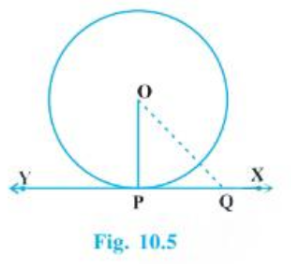
Why the Radius Is Perpendicular to the Tangent
- Let \(XY\) be tangent to the circle at \(P\), with centre \(O\); choose any other point \(Q\) on \(XY\).
- Since \(Q\) is not the point of contact, it lies outside the circle, so its distance from \(O\) exceeds the radius.$$OQ > OP$$
- Thus \(OP\) is the shortest distance from \(O\) to the line \(XY\); the shortest distance from a point to a line is perpendicular to it.$$OP \perp XY$$
Related Term
- Normal: The line containing the radius through the point of contact is called the normal to the circle at that point.
A line \(XY\) touches a circle with centre \(O\) at \(P\). Find the angle between \(OP\) and \(XY\).
- A line \(XY\) touches a circle with centre \(O\) at \(P\). Find the angle between \(OP\) and \(XY\).
- The radius through the point of contact is perpendicular to the tangent.$$OP \perp XY$$
- Therefore, the angle between them is a right angle.$$90^\circ$$
A line cuts a circle at exactly two points. What is the line called?
A tangent touches a circle at \(P\). If \(O\) is the centre, what is the angle between \(OP\) and the tangent?
What is the maximum number of tangents to a circle that can be parallel to a given secant?
Quick recap
- A line and a circle can have zero, one, or two common points.
- A line with one common point is a tangent; that point is the point of contact.
- A tangent is a limiting case of a secant when the chord endpoints coincide.
- There is exactly one tangent at any given point of a circle.
- The radius through the point of contact is perpendicular to the tangent.
- The radius line through the point of contact is also called the normal.
Number Of Tangents From A Point On A Circle
How Many Tangents Can Be Drawn?
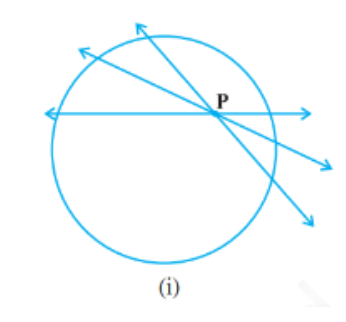
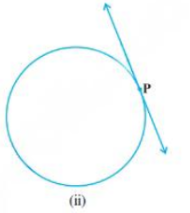
Number of tangents from a point — The number of tangents from a point depends on whether it lies inside, on, or outside the circle.
| Position of point | Number of tangents | Reason |
|---|---|---|
| Inside the circle | 0 | Every line through the point intersects the circle at two points. |
| On the circle | 1 | There is exactly one tangent at the point of contact. |
| Outside the circle | 2 | Exactly two tangents can be drawn from the point. |
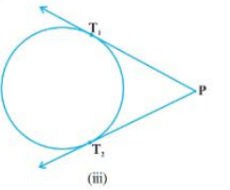
Equal Tangents from an External Point
The lengths of two tangents drawn from the same external point to a circle are equal. If tangents from \(P\) touch the circle at \(Q\) and \(R\), then \(PQ=PR\). Join the centre \(O\) to \(P\), \(Q\), and \(R\): \(OQ\) and \(OR\) are radii perpendicular to the tangents. Thus right triangles \(OQP\) and \(ORP\) are congruent by RHS, so \(PQ=PR\) by CPCT.
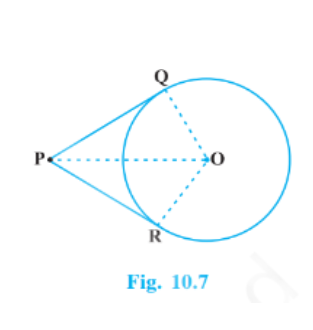
The line joining the external point to the centre bisects the angle between the two tangents.
Useful Consequences
- Equal tangent lengths: Tangents from the same external point are equal.
- Angle bisector: The centre-to-external-point line bisects the angle between the two tangents.
- Right triangle: For an external point \(X\), centre \(O\), radius \(r\), and tangent length \(XT\), \(XT^2=OX^2-r^2\).
Solving Tangent-Length Problems
- Join the centre to the external point and to each point of contact.
- Use the perpendicular radius–tangent property to identify right triangles.
- Apply equal tangents, congruence, similarity, or Pythagoras as appropriate.
- Substitute the known lengths and solve for the required quantity.
A chord \(PQ\) of length \(8\) cm in a circle of radius \(5\) cm has tangents at \(P\) and \(Q\) meeting at \(T\). Find \(TP\).
- A chord \(PQ\) of length \(8\) cm in a circle of radius \(5\) cm has tangents at \(P\) and \(Q\) meeting at \(T\). Find \(TP\).
- Since the tangents from \(T\) are equal, \(OT\) bisects the angle between them; hence it bisects chord \(PQ\) at \(R\) and is perpendicular to it.$$PR=RQ=\frac{8}{2}=4$$
- Use right triangle \(OPR\) to find the distance from the centre to the chord.$$OR=\sqrt{OP^2-PR^2}=\sqrt{5^2-4^2}=3$$
- Triangles \(TRP\) and \(PRO\) are similar, so their corresponding sides are proportional.$$\frac{TP}{PO}=\frac{PR}{RO},\qquad \frac{TP}{5}=\frac{4}{3}$$
- Solve for the tangent length.$$TP=\frac{20}{3}\text{ cm}$$
Applications
Chord of a Larger Circle Touching a Concentric Smaller Circle
- Setup: Two circles share centre \(O\). A chord \(AB\) of the larger circle touches the smaller circle at \(P\).
- Perpendicular: \(OP\) is a radius to the point of contact, so \(OP\perp AB\).
- Conclusion: A perpendicular from the centre of a circle to a chord bisects the chord; therefore, \(AP=PB\).
For tangents \(TP\) and \(TQ\) meeting at \(T\), \(\angle OPQ\) is the angle between \(OP\) and \(PQ\) (not between a radius and a tangent).
Why the Angle Relation Holds
- Equal tangents: \(TP=TQ\), so triangle \(TPQ\) is isosceles.
- Base angles: If \(\angle PTQ=\theta\), then \(\angle TPQ=90^\circ-\frac{\theta}{2}\).
- Radius and tangent: \(OP\perp TP\), so \(\angle OPT=90^\circ\). Since \(\angle OPQ=\angle OPT-\angle TPQ\), \(\angle OPQ=\frac{\theta}{2}\) and thus \(\angle PTQ=2\angle OPQ\).
Two concentric circles have centre \(O\). A chord \(AB\) of the larger circle touches the smaller circle at \(P\). Prove that \(AP=PB\).
Tangents \(TP\) and \(TQ\) are drawn from \(T\) to a circle with centre \(O\). Prove that \(\angle PTQ=2\angle OPQ\).
The equal-tangents theorem applies only to tangents drawn from the same external point. Also, \(\angle OPQ\) is between \(OP\) and \(PQ\); the radius is perpendicular to tangent \(PT\), not to chord \(PQ\).
Quick recap
- A point inside, on, or outside a circle has respectively \(0\), \(1\), or \(2\) tangents.
- A tangent is perpendicular to the radius at the point of contact.
- Two tangent segments from the same external point are equal.
- The line from the centre to the external point bisects the angle between the tangents.
- A perpendicular from the centre to a chord bisects the chord.
- For tangents \(TP\) and \(TQ\), \(\angle PTQ=2\angle OPQ\) when \(P,Q\) are the contact points.
Formula sheet
Mathematics — ALL CHAPTERS
1
Real Numbers
2
Polynomials
3
Pair Of Linear Equations In Two Variables
4
Quadratic Equations
5
Arithmetic Progressions
6
Triangles
7
Coordinate Geometry
8
Introduction To Trigonometry
9
Some Applications Of Trigonometry
10
Circles
11
Areas Related To Circles
12
Surface areas And Volumes
13
Statistics
14
Probability