Class 10 . Mathematics . Mathematics . Surface Areas and Volumes
Chapter 12: Surface areas And Volumes
Ch 12
Mathematics
Class 10
Introduction & Surface Area Of A Combination Of Solids
Basic Solids and Composite Solids

Surface Area of Joined Solids
For joined solids, total exposed area equals the sum of the exposed areas of each part. For example, a cone joined to a hemisphere along equal circular bases has area \(\pi rl+2\pi r^2\).
Use the curved areas of joined parts, plus any exposed flat faces or rings.
Finding the Exposed Area
- Separate the object into its basic solids and mark the dimensions.
- Identify the joined faces; exclude these hidden areas.
- Calculate each exposed curved surface, flat face or ring.
- Add the exposed areas and state the answer in square units.
Find the area to colour on a cone-and-hemisphere top with total height \(5\) cm and diameter \(3.5\) cm.
- A cone surmounted by a hemisphere forms a top of height \(5\) cm and diameter \(3.5\) cm. Find its exposed area using \(\pi=\frac{22}{7}\).
- The common radius is half the diameter.$$r=\frac{3.5}{2}=1.75\text{ cm}$$
- The cone’s height is the total height minus the hemisphere’s radius.$$h=5-1.75=3.25\text{ cm}$$
- Find the cone’s slant height.$$l=\sqrt{r^2+h^2}=\sqrt{1.75^2+3.25^2}\approx3.69\text{ cm}$$
- Add the curved areas only; the joined circular faces are hidden.$$\begin{aligned}A&=2\pi r^2+\pi rl\\&=2\left(\frac{22}{7}\right)(1.75)^2+\left(\frac{22}{7}\right)(1.75)(3.69)\\&\approx39.6\text{ cm}^2\end{aligned}$$
Do not add the total surface areas of the separate solids without adjustment: their joined faces are hidden. Use only exposed surfaces, and remember that a hemisphere’s curved area is \(2\pi r^2\).
A cube of edge \(5\) cm has a hemisphere of diameter \(4.2\) cm fixed on its top. Find the total exposed surface area using \(\pi=\frac{22}{7}\).
A rocket consists of a cone mounted on a cylinder. The cone has height \(6\) cm and base diameter \(5\) cm; the cylinder has diameter \(3\) cm and height \(20\) cm. Find the orange area (cone and exposed ring) and yellow area (cylinder’s curved surface and bottom), using \(\pi=3.14\).
A bird-bath is a cylinder of height \(1.45\) m and radius \(30\) cm with a hemispherical depression of the same radius. Find its exposed area using \(\pi=\frac{22}{7}\).
Quick recap
- A composite solid is made by joining two or more basic solids.
- Its surface area is the sum of the areas visible from outside.
- Exclude joined faces; include exposed flat faces and any uncovered ring-shaped areas.
- Use \(2\pi rh\) for a cylinder, \(\pi rl\) for a cone, and \(2\pi r^2\) for a hemisphere’s curved surface.
- For a cone, calculate slant height with \(l=\sqrt{r^2+h^2}\).
- Keep all dimensions in consistent units before calculating.
Volume Of A Combination Of Solids
Adding and subtracting volumes
Volume of a combination of solids — The volume of a solid made by joining basic solids is the sum of their volumes; if a part is hollow or removed, subtract its volume.
Joined solids: Add the volumes of the parts. Space removed or occupied: Subtract that volume from the total capacity. Joining surfaces do not reduce volume.
Use consistent units; volume is measured in cubic units.
Finding the volume or capacity
- Identify the basic solids and note their dimensions.
- Find each part's volume using the appropriate formula.
- Add volumes for joined parts; subtract cavities, raised parts, or occupied space when required.
- Check that all dimensions use the same unit and state the answer in cubic units.
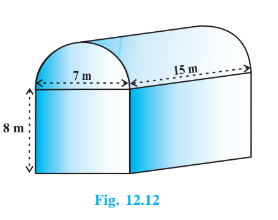
Find the shed's total capacity and the air remaining after the machinery and workers are inside.
- A shed has a cuboidal part measuring 15 m by 7 m by 8 m and a half-cylinder roof of length 15 m and diameter 7 m. Find its air capacity. Then find the air left after machinery occupies 300 m³ and 20 workers occupy 0.08 m³ each. Use π = 22/7.
- Find the cuboid volume and the half-cylinder radius.$$V_{\text{cuboid}}=15\times7\times8=840\text{ m}^3,\qquad r=\frac{7}{2}=3.5\text{ m}$$
- Add the volume of the half-cylinder roof to the cuboid volume.$$V_{\text{roof}}=\frac{1}{2}\times\frac{22}{7}\times(3.5)^2\times15=288.75\text{ m}^3,\qquad V_{\text{shed}}=840+288.75=1128.75\text{ m}^3$$
- Subtract the space occupied by the machinery and workers.$$V_{\text{workers}}=20\times0.08=1.6\text{ m}^3,\qquad V_{\text{air}}=1128.75-(300+1.6)=827.15\text{ m}^3$$
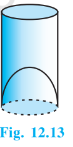
A cylindrical glass has inner diameter 5 cm and height 10 cm. A raised hemisphere of radius 2.5 cm is at its base. Find its apparent and actual capacities using π = 3.14.
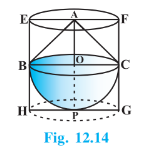
A toy consists of a hemisphere surmounted by a cone. Both have radius 2 cm; the cone height is 2 cm. Find the toy's volume and the difference between the volume of its circumscribing cylinder and the toy. Use π = 3.14.
Do not add every volume automatically: subtract a raised part or hollow space from the container's volume, and subtract machinery or people when finding air actually remaining.
Quick recap
- Joined solids: add the volumes of their constituent parts.
- Cavities and raised internal parts reduce a container's actual capacity.
- Air remaining = total capacity − space occupied.
- For a hemisphere, use half the volume of a sphere: (2/3)πr³.
- A circumscribing cylinder's height includes the vertical heights of all parts of the solid.
Formula sheet
Mathematics — ALL CHAPTERS
1
Real Numbers
2
Polynomials
3
Pair Of Linear Equations In Two Variables
4
Quadratic Equations
5
Arithmetic Progressions
6
Triangles
7
Coordinate Geometry
8
Introduction To Trigonometry
9
Some Applications Of Trigonometry
10
Circles
11
Areas Related To Circles
12
Surface areas And Volumes
13
Statistics
14
Probability