QUESTION PAPER
2025 BOARD EXAM
CBSE Class 10 Science Board Paper 2025 — Set 1
2025
Science
Class 10
Practice version of the official CBSE paper
Official CBSE paper80 marks
This practice set90 marksall “OR” options included
Optional (“OR”) questions are added here as separate questions, so the maximum marks are higher than in the official CBSE paper.
Why are the marks different?
Some questions in the official CBSE paper offer a choice (“OR”), and students attempt only one option. On Prepzy’s practice PYQs, we treat every option as a separate question so you can practise all of them. As a result, the total number of questions and the maximum marks shown here may be higher than in the original CBSE paper. For the official question paper, marking scheme and total marks, please refer to CBSE’s official website.
CBSE EXAMINATION PAPER-2025
SCIENCE
(Solved)
General Instructions :
Read the following instructions carefully and follow them :
- This question paper contains 45 questions. All questions are compulsory.
- This question paper is divided into 5 sections.
- Section A – questions number 1 to 3 are case based questions
- Section B – questions number 4 to 23 are multiple choice questions
- Section C – questions number 24 to 31 are very short answer
- Section D – questions number 32 to 39 are short answer
- Section E – questions number 40 to 45 are long answer
- There is no overall choice given in the question paper. However, an internal choice has been provided in few questions.
- Use of calculator is NOT allowed.
Section A
(1) Write balanced chemical equations to show the products formed during electrolysis of brine.
[1 Mark](2) A mild non-corrosive basic salt ‘A’, used for faster cooking, is strongly heated to produce a compound ‘B’, that is used for removing permanent hardness of water. Identify A and B and also write the equation for the reaction that occurs when A is heated.
(3) List two uses of any one product obtained during electrolysis of brine.
[1 Mark](4) Define water of crystallisation. Give two examples of salts that have water of crystallisation.
(1) Name and define the process by which green plants prepare food.
[1 Mark](2) State in proper sequence the events that occur in synthesis of food by desert plants.
(3) Write the chemical equation involved in the above process.
[1 Mark](4) Explain giving reasons what happens to the rate at which the green plants will prepare food (I) during cloudy weather, and (II) when stomata get blocked due to dust.
In our homes, we receive the supply of electric power through a main supply also called mains, either supported through overhead electric poles or by underground cables. In our country the potential difference between the two wires (live wire and neutral wire) of this supply is 220 V.
(1) Write the colours of the insulation covers of the line wires through which supply comes to our homes.
(2) What should be the current rating of the electric circuit (220 V) so that an electric iron of 1 kW power rating can be operated ?
(3) List two precautions to be taken to avoid electrical accidents. State how these precautions prevent possible damage to the circuit/appliance.
(4) What is the function of the earth wire ? State the advantage of the earth wire in domestic electric appliances such as electric iron.
Section B
Electrolysis of water is a decomposition reaction. The mass ratio (M_H : M_O) of hydrogen and oxygen gases liberated at the electrodes during electrolysis of water is:
The products formed when Aluminium and Magnesium are burnt in the presence of air respectively are:
The following table shows the pH values of four solutions A, B, C and D on a pH scale:
The solutions A, B, C and D respectively are of a
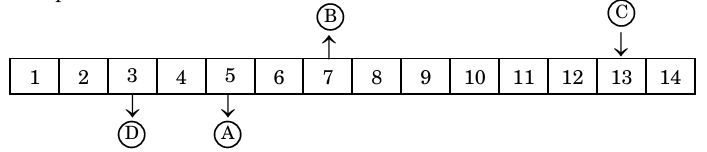
Consider the following reactions:
(i) Dilute hydrochloric acid reacts with sodium hydroxide.
(ii) Magnesium oxide reacts with dilute hydrochloric acid.
(iii) Carbon dioxide reacts with sodium hydroxide.
It is found that in each case:
Reaction between two elements A and B forms a compound C. A loses electrons and B gains electrons. Which one of the following properties will not be shown by compound C?
The metals obtained from their molten chlorides by the process of electrolytic reduction are:
The formation of magnesium oxide is correctly shown in option:
-
(A)

-
(B)

-
(C)
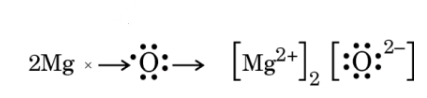
-
(D)
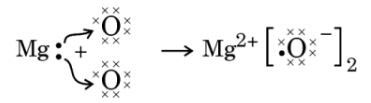
The correct/true statement(s) for a bisexual flower is/are:
(i) They possess both stamen and pistil.
(ii) They possess either stamen or pistil.
(iii) They exhibit either self-pollination or cross-pollination.
(iv) They cannot produce fruits on their own.
If pea plants with round and green seeds (RRyy) are crossed with pea plants having wrinkled and yellow seeds (rrYY), the seeds developed by the plants of F₁ generation will be:
Mirror ‘X’ is used to concentrate sunlight in solar furnace and Mirror ‘Y’ is fitted on the side of the vehicle to see the traffic behind the driver. Which of the following statements are true for the two mirrors ?
(i) The image formed by mirror ‘X’ is real, diminished and at its focus.
(ii) The image formed by mirror ‘Y’ is virtual, diminished and erect.
(iii) The image formed by mirror ‘X’ is virtual, diminished and erect.
(iv) The image formed by mirror ‘Y’ is real, diminished and at its focus.
Which of the following groups do not constitute a food chain?
(i) Wolf, rabbit, grass, lion
(ii) Plankton, man, grasshopper, fish
(iii) Hawk, grass, snake, grasshopper, frog
(iv) Grass, snake, wolf, tiger
The percentage of solar energy which is not converted into food energy by the leaves of green plants in a terrestrial ecosystem is about:
Assertion (A): Decomposition reactions are generally endothermic reactions.
Reason (R): Decomposition of organic matter into compost is an exothermic process.
Assertion (A): A human child bears all the basic features of human beings.
Reason (R): It looks exactly like its parents, showing very little variations.
Assertion (A): No two magnetic field lines are found to cross each other.
Reason (R): The compass needle cannot point towards two directions at the point of intersection of two magnetic field lines.
Assertion (A): The amount of ozone in the atmosphere began to drop sharply in the 1980s.
Reason (R): The oxygen atoms combine with molecular oxygen to form ozone.
Section C
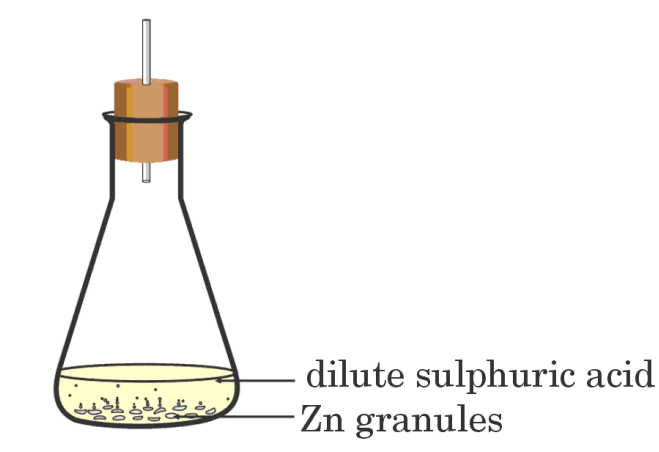
A student performs the following experiment in his school laboratory.
List two observations to justify that in this experiment a chemical change has taken place.
(i) The transport system in plants is relatively slower than in animals. Give reasons.
(ii) State the role of phloem in the transport of materials in plants.
A wire of resistance R is cut into three equal parts. If these three parts are then joined in parallel, calculate the total resistance of the combination so formed.
Section D
(a) ‘‘Displacement reactions also play a key role in extracting metals in the middle of the reactivity series.’’ Justify this statement with two examples.
(b) Why can metals high up in the reactivity series not be obtained by reduction of their oxides by carbon ?
Plants have neither a nervous system nor muscles, even then they respond to stimuli. For example, the leaves of chhui-mui (touch-me-not) plant when touched begin to fold up and droop.
(a) How is the information communicated in ‘‘touch-me-not’’ plants ?
(b) What enables the plant cells to bring out the observable response ?
(c) Differentiate the movement mentioned above from the movement of tendrils in a pea plant.
(a) What are chromosomes ?
(b) Explain in brief how stability of DNA content of a species is ensured in sexually reproducing organisms ?
Draw ray diagrams to show the nature, position and relative size of the image formed by a convex mirror when the object is placed
(i) at infinity and
(ii) between infinity and pole P of the mirror.
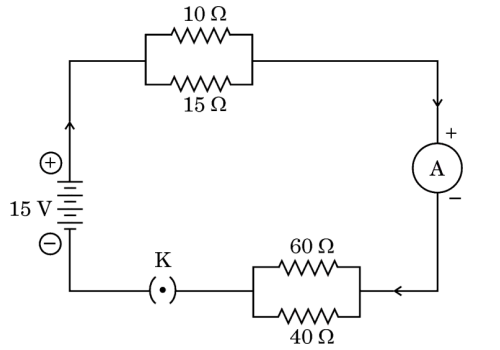
Consider the following electric circuit :
Calculate the values of the following :
(a) The total resistance of the circuit
(b) The total current drawn from the source
(c) potential difference across the parallel combination of 10 Ω and 15 Ω resistors
(a) Write the relationship between resistivity and resistance of a cylindrical conductor of length l and area of cross-section A. Hence derive the SI unit of resistivity.
(b) Why are alloys used in electrical heating devices ?
(i) Name two metals which react violently with cold water. List any three observations which a student notes when these metal are dropped in a beaker containing water.
(ii) Write a test to identify the gas evolved (if any) during the reaction of these metals with water.
Section E
(i) Draw two isomeric structures of Butene (C₄H₈).
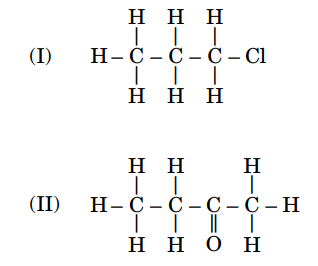
(ii) Name the following compounds :
(I) structure 1,
(II) structure 2.
(iii) Write the chemical equations for the following reactions. Mention one essential condition each for these reactions to take place.
(I) Ethanol undergoes complete oxidation
(II) Propene undergoes hydrogenation
(III) Ethanoic acid reacts with ethanol
(i) Write the functions of the following parts of the human female reproductive system:
(I) Ovary,
(II) Fallopian tube,
(III) Uterus.
(ii) State briefly two contraceptive methods used by human males.
(i) The power of a lens ‘X’ is – 2·5 D. Name the lens and determine its focal length in cm. For which eye defect of vision will an optician prescribe this type of lens as a corrective lens ?
(ii) ‘‘The value of magnification ‘m’ for a lens is – 2.’’ Using new Cartesian Sign Convention and considering that an object is placed at a distance of 20 cm from the optical centre of this lens, state :
(I) the nature of the image formed;
(II) size of the image compared to the size of the object;
(III) position of the image, and
(IV) sign of the height of the image.
(iii) The numerical values of the focal lengths of two lenses A and B are 10 cm and 20 cm respectively. Which one of the two will show higher degree of convergence/divergence ? Give reason to justify your answer.
(i) A carbon compound X is a good solvent. On reaction with sodium, X forms two products Y and Z. Z is used to convert vegetable oil into vegetable ghee. Identify and name X, Y and Z. Also write the equation of reaction of X with sodium to justify your answer.
(ii) Write chemical equation to show what happens when ethanol :
(I) burns in oxygen/air.
(II) is heated at 443 K in excess conc. H₂SO₄.
(III) reacts with acidified potassium dichromate.
(i) Differentiate between self-pollination and cross-pollination.
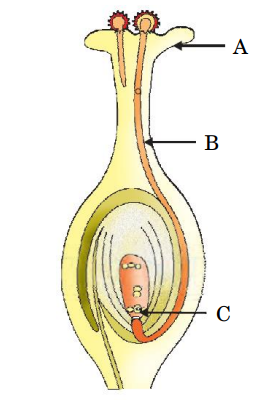
(ii) Identify A, B and C in the diagram given below and write one function of each.
(i) Draw a ray diagram to show the refraction of a ray of light through a rectangular glass slab when it falls obliquely from air into glass.
(ii) State Snell’s law of refraction of light.
(iii) Differentiate between the virtual images formed by a convex lens and a concave lens on the basis of :
(I) object distance, and
(II) magnification.
Paper Details
CBSE Board Exam 2025
Class
Class 10
Subject
Science
Year
2025
Set
Set 1
Official max marks
80
Practice set marks
90
Practice marks include every “OR” option. Official paper and marking scheme: CBSE’s official website.
Other Years — Science