Section B
[2 Marks]
Answer: As we move left to right across a period, the nuclear charge increases due to higher proton numbers, which attracts electrons more strongly, thus reducing atomic size. However, when moving down a group, although nuclear charge also increases, additional electron shells are added, which outweighs the effect of the increased nuclear charge. Thus, atom size increases down a group due to increased distance and electron shielding, resulting in a larger atomic radius.
Key Points: Nuclear charge increases left to right; atomic size decreases; nuclear charge increases top to bottom; additional shells increase electron shielding; atoms size increases down a group
[2 Marks]
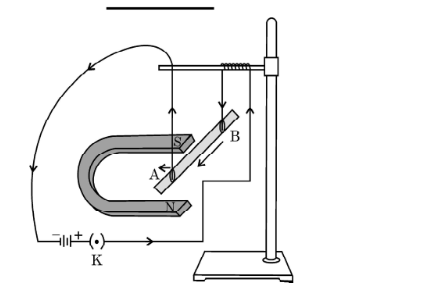
Answer: When a current flows from end B to end A through the aluminum rod placed in an upward magnetic field, the rod experiences a force and is displaced towards the left due to the interaction between the magnetic field and the current. If the rod is aligned parallel to the magnetic field while maintaining the same current direction, no force is exerted, and thus no movement occurs as the current's direction is parallel to the field lines. This shows that magnetic fields have both magnitude and direction.
Key Points: Current from B to A causes leftward movement; no movement when rod is parallel to field; proof of direction and magnitude of magnetic field.
[2 Marks]
Answer: Height in plants is strongly influenced by genes. The tallness trait (T) is dominant, meaning a plant needs only one copy to be tall, while two copies of the dwarf trait (t) are needed for a short plant. This dominance explains why variations occur in height based on genetic makeup. Additionally, genes regulate enzymes that produce growth hormones. Hence, if genes make these enzymes less efficient, the plant will not produce enough hormone and will be short.
Key Points: Genes control traits- Tallness is dominant (T)- Dwarfness is recessive (t)- One T makes tall plant- Two tt makes short plant- Genes regulate enzyme efficiency- Enzyme efficiency affects hormone levels
[2 Marks]
Answer: The placenta functions as a lifeline between the mother and fetus, supplying nutrients and oxygen while removing waste. The fallopian tubes transport the egg from the ovary to the uterus and are the site of fertilization. The uterus houses and nurtures the developing fetus during pregnancy. The ovaries produce female gametes called ova and also secrete hormones essential for the menstrual cycle and pregnancy.
Key Points: Function of placenta- nutrient and waste exchange;Function of fallopian tubes- egg transport and fertilization;Function of uterus- fetal development;Function of ovary- ova production and hormone secretion
[2 Marks]
Answer: The improvement in our lifestyle has led to increased waste generation primarily due to two reasons: First, the rising trend of disposable products contributes significantly to waste. Many items we use daily, such as cutlery, packaging, and personal care products, are designed for single use and discarded immediately. Second, changes in packaging materials, particularly the widespread use of non-biodegradable plastics, result in increased environmental pollution as they take hundreds of years to decompose.
Key Points: disposable products increase waste-non-biodegradable plastics pollution
[2 Marks]
Answer: Binary fission in Amoeba occurs without a definitive orientation, allowing division to take place in any plane. In contrast, Leishmania exhibits more cellular organization; the fission occurs in a specific orientation due to the presence of a whip-like structure at one end. Regarding malarial parasites, they reproduce both sexually and asexually. The asexual stage occurs in the human host, while sexual reproduction happens in the Anopheles mosquito, making the life cycle complex and well-adapted for survival.
Key Points: Binary fission in Amoeba is non-oriented; Leishmania shows oriented division; Malarial parasite has a complex reproduction involving both hosts.
[2 Marks]
Answer: The statement is proved by observing the magnetic field lines around a bar magnet using a compass needle. When the compass needle is placed near the magnet, its direction aligns with the magnetic field, indicating that the field has a specific direction. The density of the lines shows the strength of the magnetic field, demonstrating magnitude. Field lines emerge from the north pole and converge at the south pole, proving both attributes.
Key Points: Direction shown by compass alignment-Density of lines indicates strength-Magnetic field lines emerge from north, converge at south
[2 Marks]
Answer: Flow chart showing inheritance of flower colour:
P generation: Red flower (RR) × White flower (rr)
↓
F1 generation: All plants Red flower (Rr)
(Red is dominant, white is recessive)
↓
Self pollination of F1: Rr × Rr
↓
F2 generation: Genotype ratio: 1 RR : 2 Rr : 1 rr
Phenotype ratio: 3 Red : 1 White
Thus, 75% plants have red flowers and 25% plants have white flowers in F2 generation.
Key Points: Red is dominant - White is recessive - F2 ratio is 3 red : 1 white
[2 Marks]
Answer: The shift to non-biodegradable packaging materials is evident in daily products. For instance, the use of plastic bags for groceries, which take years to decompose, contributes significantly to landfill waste. Another example is packaging for ready-to-eat meals, often consisting of plastic and styrofoam. These materials persist in the environment and can lead to pollution and harmful impacts on wildlife as they do not break down easily, affecting ecosystems.
Key Points: Plastic bags take years to decompose - ready-to-eat meal packaging often made of plastic and styrofoam - persistent waste causes pollution - impacts on wildlife and ecosystems
Section C
[2.5 Marks]
Answer: The human female reproductive system consists of several key organs, each with specific functions. Firstly, the ovary produces female gametes known as ova or eggs, and it also secretes hormones like estrogen and progesterone, which regulate the menstrual cycle and facilitate reproduction. Secondly, the fallopian tubes, also known as oviducts, transport the released egg from the ovary to the uterus and are the site where fertilization typically occurs when sperm meets the egg. Thirdly, the uterus is a muscular organ that supports the developing embryo after fertilization. Its lining thickens to nourish the embryo; if implantation does not occur, this lining sheds during menstruation. Lastly, the placenta forms after implantation and connects the developing fetus to the mother’s blood supply, facilitating the exchange of nutrients, gases, and waste products, thus playing a crucial role in fetal development and sustaining pregnancy.
Key Points: Ovary produces ova and hormones; Fallopian tubes transport eggs and site of fertilization; Uterus supports embryo development and menstrual cycle; Placenta nourishes fetus and connects to mother's blood supply.
[2.5 Marks]
Answer: The improvement in our lifestyle has significantly contributed to the generation of large amounts of waste material for various reasons. Firstly, the shift towards a more consumerist culture has led to an increased demand for products made with non-biodegradable materials, such as plastics. Many of these products, including single-use bags, containers, and packaging, contribute to substantial waste that does not decompose easily in the environment. Secondly, changes in our attitudes towards convenience have accelerated the use of disposable items. Items such as plates, cutlery, and even clothing are often designed for one-time use, leading to higher waste generation. This change has not only increased the volume of waste but has also affected the natural environment, as large quantities of waste accumulate in landfills and in oceans, adversely impacting ecosystems and water sources. Consequently, the need for effective waste management practices becomes critical to mitigate these environmental issues.
Key Points: Shift towards consumerism resulting in increased demand for non-biodegradable products; Increased reliance on convenience leading to the popularity of disposable items; Accumulation of waste adversely affecting ecosystems and water sources.
[4 Marks]
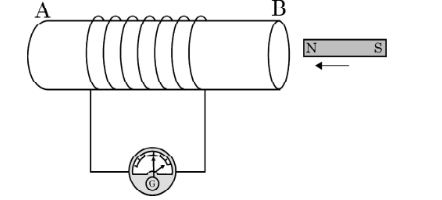
Answer: The galvanometer is used to measure the deflection caused by induced electromotive force (EMF) generated in the coil. When the north pole of the magnet approaches the coil, the changing magnetic field induces an electric current in the coil, momentarily causing the galvanometer needle to deflect. If both the coil and the magnet move together at the same speed and direction, there would be no change in magnetic flux through the coil, resulting in no induced current and thus no deflection in the galvanometer. This indicates that relative motion between the magnet and the coil is necessary for inducing EMF. The conclusion from this activity is that a change in magnetic field around a coil induces electric current, demonstrating Faraday's law of electromagnetic induction, which is fundamental in electromagnetic applications, including electromagnets.
Key Points: Purpose of galvanometer; Induced current due to changing magnetic field; No deflection at constant relative speed; Importance of relative motion; Conclusion on electromagnetic induction
Section D
[3 Marks]
Answer: Mendeleev primarily used the compounds of elements such as hydrogen, oxygen, carbon, and nitrogen for classification in his periodic table. He chose these elements because they form a variety of binary compounds, which demonstrated different chemical properties and behaviors. The chemical formulae derived from these compounds, based on the valencies of the participating elements, allowed Mendeleev to determine relationships between elements. The consistent patterns in the properties and formulae of these compounds helped him position elements according to their similar characteristics.
Key Points: Mendeleev's basis: hydrogen, oxygen, carbon, nitrogen; reasons for choice: diverse binary compounds; role of formulae: revealed relationships and properties; aided classification.
[3 Marks]
Answer: Trophic levels are the hierarchical stages in a food chain through which energy passes in an ecosystem. Autotrophs, also known as producers, occupy the first trophic level because they capture solar energy through the process of photosynthesis, converting it into chemical energy stored in organic matter. As energy moves up the trophic levels from autotrophs to herbivores and then to carnivores, a significant amount is lost at each stage, primarily through metabolic processes and heat. This energy loss limits the number of trophic levels—typically, food chains consist of only three or four levels. Beyond that, insufficient energy remains to support additional levels, leading to an upper limit on ecosystem complexity.
Key Points: Trophic levels define energy stages in an ecosystem - Autotrophs are first trophic level as they capture solar energy - Energy loss limits number of trophic levels
[3 Marks]
Answer: In flowering plants, the process of pollination leads to the male germ cell reaching the ovary. Initially, pollen grains from the stamen are transferred to the stigma, the sticky part of the pistil. Once on the stigma, the pollen germinates and forms a pollen tube. This tube grows down through the style, a connecting structure between the stigma and ovary. The pollen tube carries two male gametes to the ovary where the ovules are located. The male gametes then fuse with the female gametes in the ovules, leading to fertilization to form a zygote, which can develop into a new plant. A labelled diagram showing the stigma, style, and ovary is essential to illustrate this process clearly.
Key Points: Pollen transfer occurs from stamen to stigma; pollen tube forms from the pollen grain; pollen tube travels through the style to ovary; fusion of male and female gametes occurs in ovule; fertilization leads to zygote formation.
[3 Marks]
Answer: Diamond and graphite are both allotropes of carbon, meaning they are different structural forms of the same element. In diamond, each carbon atom is covalently bonded to four other carbon atoms in a tetrahedral structure, resulting in a rigid, three-dimensional lattice. This structure gives diamond its exceptional hardness and high melting and boiling points. In contrast, graphite consists of layers of carbon atoms bonded in a hexagonal arrangement, with weaker van der Waals forces between layers. This structure allows layers to slide over each other, making graphite soft and an excellent conductor of electricity. Thus, despite having the same chemical properties, their distinct structures lead to vastly different physical properties.
Key Points: Allotropes of carbon; diamond's tetrahedral structure; rigid and hard; graphite's layered structure; soft and conductive; different physical properties despite similar chemical properties.
[3 Marks]
Answer: To use an electric heater, an electric bulb, and an electric fan simultaneously, all these gadgets should be connected in parallel to the mains. This connection allows each device to operate independently, ensuring they can function at their required voltage levels without affecting each other. If one device fails, the others remain operational, preventing complete circuit disruption. Additionally, a parallel circuit distributes current evenly, ensuring all devices receive the power they need for optimal performance.
An electric fuse is a safety device that prevents excess current from damaging electrical appliances and reducing the risk of fire. It is connected in series with the circuit so that all the current passes through it, allowing it to blow and break the circuit if the current exceeds a safe level.
Key Points: Connected in parallel allows independent operation; devices maintain required voltage levels; prevents total circuit failure.
[3 Marks]
Answer: To find the current drawn from the mains, we can use the formula P = VI, where P is the power (1100 W) and V is the voltage (220 V). Rearranging gives I = P/V = 1100 W / 220 V = 5 A. The electric energy consumed by the motor when used for 5 hours daily over 6 days is calculated as Energy = Power × Time = 1100 W × (5 hours/day × 6 days) = 1100 W × 30 hours = 33,000 Wh or 33 kWh. The total cost of energy consumed at Rs. 5 per unit (kWh) is 33 kWh × Rs. 5/unit = Rs. 165.
Key Points: Use P = VI to find current; Calculate electric energy consumed using Energy = Power × Time; Determine cost by multiplying total consumed energy with unit rate
[3 Marks]
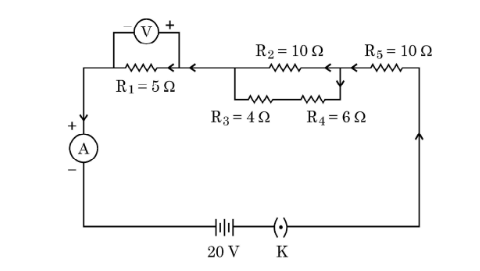
Answer: To find the effective resistance (Rp) of the circuit with R1 = 5Ω, R2 = 10Ω, and R3 = 30Ω, we use the formula for resistors in parallel: 1/Rp = 1/R1 + 1/R2 + 1/R3. Substituting the values, we get 1/Rp = 1/5 + 1/10 + 1/30, which simplifies to Rp = 3Ω. The total current drawn from the battery (I) can be calculated using Ohm's law (I = V/Rp). With a battery voltage V = 12V, I = 12V / 3Ω = 4A. The potential difference across the 5Ω resistor (V1) can be determined using Ohm’s law (V1 = I1 * R1), where I1 = 2.4A, yielding V1 = 2.4A * 5Ω = 12V.
Key Points: Effective resistance calculated using 1/Rp = 1/R1 + 1/R2 + 1/R3; Total current I derived from I = V/Rp; Potential difference V1 across 5Ω resistor determined through V1 = I1 * R1.