Class 9 . Social Science . India And The Contemporary World I . Nazism and the Rise of Hitler
Chapter 3: Nazism And The Rise Of Hitler
Ch 3
Social Science
Class 9
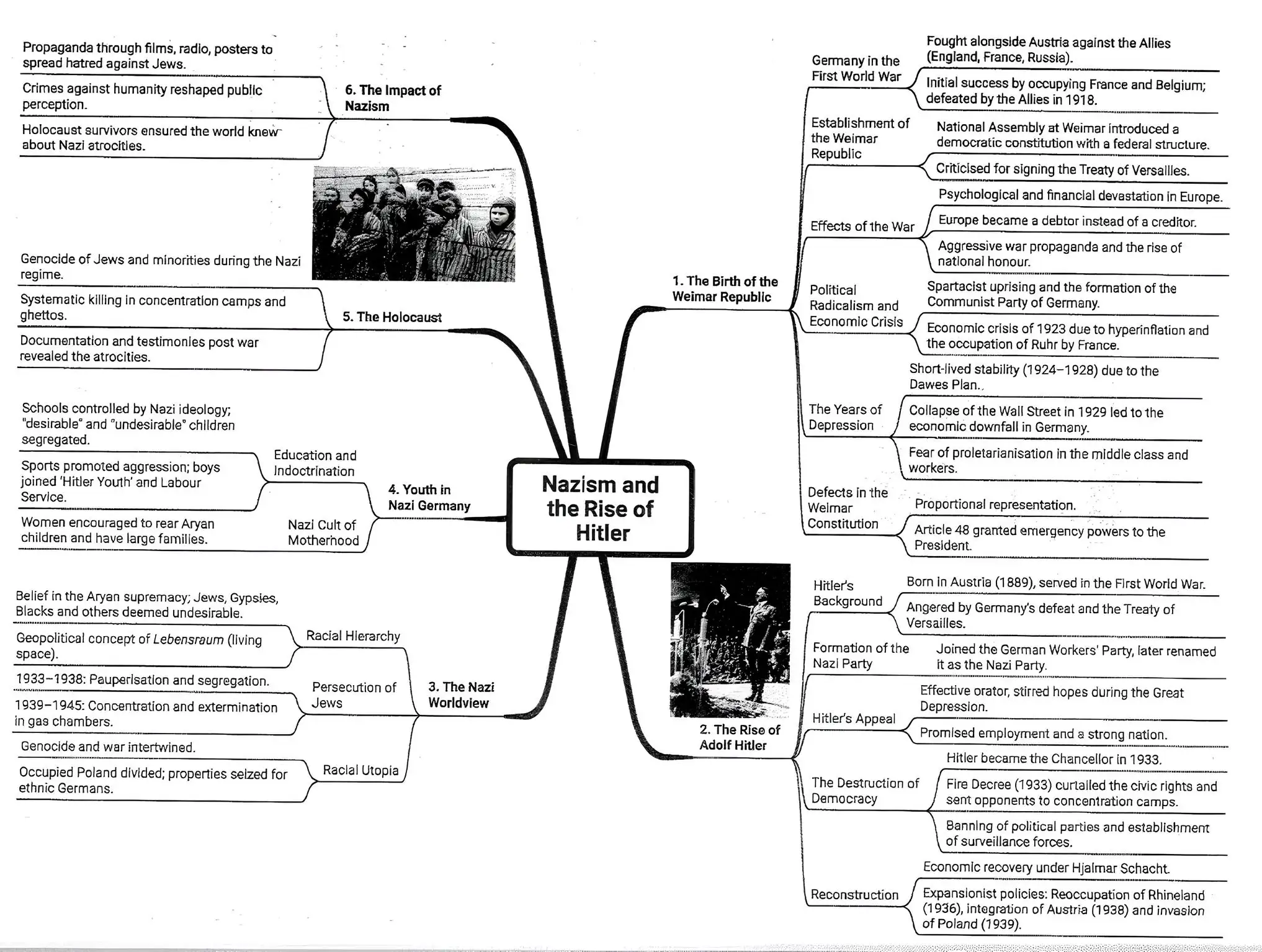
Birth of the Weimar Republic
Germany, a powerful empire in the early twentieth century, fought the First World War (1914–1918) alongside the Austrian empire against the Allies (England, France, and Russia). The defeat of Imperial Germany and the abdication of the Emperor led to the formation of a new parliamentary government. A National Assembly met at Weimar and established a democratic constitution with a federal structure. Deputies were elected to the German Parliament, called the Reichstag, based on equal and universal suffrage, including women.
The Treaty of Versailles included the War Guilt Clause, which held Germany responsible for the war and reparations. The Allied armies occupied the Rhineland in the 1920s. Many Germans blamed the Weimar Republic for the defeat and the humiliations of Versailles.
The Effects of the War
The war had devastating psychological and financial impacts on Europe. Europe shifted from being a continent of creditors to one of debtors. Soldiers were placed above civilians in social status.
Political Radicalisation and Economic Crises
The Weimar Republic's birth coincided with the Spartacist League's revolutionary uprising, inspired by the Bolshevik Revolution in Russia. Opponents such as Socialists, Democrats, and Catholics supported the democratic republic. The uprising was crushed with the help of the Free Corps, a war veterans' organization. Political radicalisation increased during the 1923 economic crisis, marked by hyperinflation where prices rose phenomenally, symbolized by Germans carrying carts of currency to buy bread.
The Years of Depression
Between 1924 and 1928, Germany experienced some stability, but it depended heavily on short-term loans from the USA. The Wall Street Crash of 1929 triggered the Great Economic Depression, causing factory closures, falling exports, and widespread unemployment in Germany. The Weimar Republic was fragile due to constitutional defects, including Article 48, which allowed the President to suspend civil rights and rule by decree. Public confidence in democracy declined.
Exam Questions
Q1: What was the War Guilt Clause and how did it affect Germany?
Ans: The War Guilt Clause in the Treaty of Versailles held Germany responsible for starting the First World War and required it to pay reparations. It caused humiliation and economic hardship, leading many Germans to blame the Weimar Republic.
Q2: What was hyperinflation and how did it impact German society?
Ans: Hyperinflation was a period in 1923 when prices rose extremely fast, making money almost worthless. It caused economic distress, poverty, and loss of savings for many Germans.
Practice Set
- Easy: Define the Weimar Republic.
- Moderate: Explain the causes and effects of the 1923 hyperinflation crisis.
- Challenging: Analyze the constitutional weaknesses of the Weimar Republic that led to its instability.
Answer Key
- Weimar Republic: The democratic government established in Germany after World War I.
- Causes of hyperinflation: War reparations, printing money to pay debts; Effects: Economic hardship, loss of savings.
- Constitutional weaknesses: Article 48 allowed emergency powers; proportional representation led to fragmented parliaments.
Quick Reference
- 1918: Proclamation of the Weimar Republic
- 1919: Treaty of Versailles signed
- 1923: Hyperinflation crisis
- 1929: Wall Street Crash and Great Depression
Glossary
- Reichstag: German Parliament.
- Hyperinflation: Extremely rapid inflation causing currency devaluation.
- Article 48: Constitutional article allowing emergency powers to the President.
| Year | Event | Significance |
|---|---|---|
| 1918 | Proclamation of the Weimar Republic | Established democratic government in Germany after WWI |
| 1919 | Treaty of Versailles signed | Imposed harsh penalties on Germany, including war guilt and reparations |
| 1923 | Hyperinflation crisis | Economic collapse causing widespread hardship |
| 1929 | Wall Street Crash | Triggered Great Depression affecting Germany's economy |
Hitler's Rise to Power
The economic, political, and social crises in Germany created the background for Adolf Hitler's rise. Born in Austria in 1889, Hitler joined the German Workers' Party in 1919, which he later renamed the National Socialist German Workers' Party (Nazi Party). During the Great Depression, Nazism became a mass movement, and by 1932, the Nazi Party was the largest in Germany with 37% of the vote.
How Hitler Mobilised Support
Hitler was a powerful orator who promised to restore Germany's strength, undo the Treaty of Versailles, provide employment, and protect German interests. He used mass rallies, symbols like the swastika, and rituals to create unity and demonstrate power.
The Destruction of Democracy
On 30 January 1933, President Hindenburg appointed Hitler as Chancellor. The Reichstag Fire Decree (28 February 1933) suspended civil liberties, and the Enabling Act (23 March 1933) gave Hitler dictatorial powers, allowing him to rule by decree and sideline Parliament.
Reconstruction and Foreign Policy
Hitler withdrew Germany from the League of Nations in 1933, reoccupied the Rhineland in 1936, and annexed Austria in 1938 under the slogan "One People, One Empire, One Leader." The Tripartite Pact of 1940 allied Germany with Italy and Japan. Germany attacked the Soviet Union in 1941. The USA entered World War II after Japan's attack on Pearl Harbor. The war ended in 1945 with Hitler's defeat and suicide.
Exam Questions
Q1: What factors contributed to Hitler's rise to power?
Ans: Economic crisis, political instability, public dissatisfaction with the Weimar Republic, Hitler's oratory skills, promises to restore Germany's pride, and use of propaganda.
Q2: What was the significance of the Enabling Act?
Ans: It gave Hitler dictatorial powers to rule by decree, effectively ending democracy in Germany.
Practice Set
- Easy: When was Hitler appointed Chancellor of Germany?
- Moderate: Describe the role of propaganda in Hitler's rise.
- Challenging: Explain how the Enabling Act changed the political system in Germany.
Answer Key
- 1933
- Propaganda created mass support through rallies, symbols, and promises.
- The Enabling Act allowed Hitler to bypass Parliament and establish dictatorship.
Quick Reference
- 1933: Hitler becomes Chancellor and Germany leaves League of Nations
- 1934: Hitler becomes President
- 1936: Reoccupation of Rhineland
- 1938: Annexation of Austria
- 1939: Invasion of Poland
- 1940: Tripartite Pact signed
- 1941: Attack on Soviet Union
- 1945: Hitler's suicide
Glossary
- Chancellor: Head of the German government.
- Enabling Act: Law giving Hitler dictatorial powers.
- Tripartite Pact: Alliance between Germany, Italy, and Japan.
| Year | Event | Significance |
|---|---|---|
| 1933 | Hitler appointed Chancellor | Start of Nazi dictatorship |
| 1934 | Hitler becomes President | Consolidation of power |
| 1936 | Reoccupation of Rhineland | Violation of Treaty of Versailles |
| 1938 | Annexation of Austria | Expansion of Nazi Germany |
| 1939 | Invasion of Poland | Start of World War II |
| 1940 | Tripartite Pact signed | Axis alliance formed |
| 1941 | Attack on Soviet Union | Expansion of war |
| 1945 | Hitler's suicide | End of Nazi regime |
The Nazi Worldview
Nazi ideology, synonymous with Hitler's worldview, placed blond, blue-eyed Nordic German Aryans at the top of a racial hierarchy, with Jews at the lowest rank, regarded as the arch-enemies of Aryans. Other groups were ranked based on physical features. The concept of Lebensraum (living space) justified acquiring new territories for German settlement.
Establishment of the Racial State
The Nazis aimed to create a society of 'pure and healthy Nordic Aryans,' excluding those deemed 'undesirable' such as Jews, Gypsies, and Blacks, who were considered racial inferiors threatening Aryan purity. Jews were stereotyped as killers of Christ and usurers, forced into ghettos, terrorized, and segregated from 1933 to 1938. From 1939 to 1945, the Nazis concentrated Jews in camps and systematically killed them in gas chambers in Poland.
The Racial Utopia
Genocide and war were intertwined. Poland was divided, with much of northwestern Poland annexed to Germany. Poles were displaced, and the intelligentsia was murdered. Polish children resembling Aryans were taken for racial examination.
Exam Questions
Q1: What was the Nazi concept of Lebensraum?
Ans: Lebensraum was the idea that Germany needed to acquire new living space by expanding its territory to provide for its people.
Q2: How were Jews treated under Nazi racial policies?
Ans: Jews were persecuted, segregated into ghettos, deprived of rights, and ultimately subjected to genocide in concentration camps.
Practice Set
- Easy: Define Lebensraum.
- Moderate: Describe the racial hierarchy promoted by the Nazis.
- Challenging: Explain the impact of Nazi racial policies on Poland.
Answer Key
- Lebensraum: Living space for German expansion.
- Racial hierarchy: Aryans at top, Jews and others at bottom.
- Impact on Poland: Annexation, displacement, murder of intelligentsia, and forced racial examinations.
Quick Reference
- 1933–1938: Persecution and segregation of Jews
- 1939–1945: Concentration and extermination of Jews
Glossary
- Lebensraum: German for "living space"; territorial expansion policy.
- Ghetto: Segregated area where Jews were forced to live.
- Genocide: Systematic killing of a particular group.
- Usurers: Moneylenders charging excessive interest.
- Pauperised: Reduced to extreme poverty.
Key Personalities
- Charles Darwin: Natural scientist known for theory of evolution.
- Herbert Spencer: Philosopher who developed Social Darwinism.
Youth, Ordinary People and the Crimes Against Humanity
Hitler focused intensely on the youth, believing a strong Nazi society required ideological control inside and outside schools.
Effects of Nazism on the School System
- Teachers who were Jews or politically unreliable were dismissed.
- Children were segregated; Germans and Jews could not interact.
- Undesirable children, including Jews, the physically handicapped, and Gypsies, were expelled.
- ‘Good German’ children underwent Nazi ideological training.
- Textbooks were rewritten to include racial science justifying Nazi ideas.
- Children were taught loyalty to Hitler, hatred of Jews, and submission.
- Sports promoted aggression and violence to build strong, masculine youth.
Youth organizations like Jungvolk (for boys up to 14) and Hitler Youth (from 14) indoctrinated children to glorify war, hate enemies, and prepare for military service.
The Nazi Cult of Motherhood
Girls were taught to become good mothers, rear pure Aryan children, and uphold Nazi values. Honour Crosses were awarded to women who bore many children. However, not all mothers were treated equally.
The Art of Propaganda
Nazis used euphemisms like “special treatment” and “final solution” to describe mass killings. Gas chambers were disguised as showers. Propaganda spread through films, radio, posters, and slogans, portraying Jews as vermin and pests. Nazis sought support from all social groups by promising solutions to their problems.
Knowledge about the Holocaust
The Holocaust refers to the mass murder of Jews by the Nazis between 1933 and 1945. The term comes from Greek words meaning “completely burnt.”
Exam Questions
Q1: How did the Nazis control education and youth?
Ans: They dismissed Jewish and unreliable teachers, segregated children, rewrote textbooks, and used youth organizations to indoctrinate loyalty and hatred.
Q2: What was the Nazi propaganda strategy?
Ans: To use euphemisms for atrocities, spread hateful stereotypes, and appeal to different social groups to gain support.
Practice Set
- Easy: What was the Hitler Youth?
- Moderate: Explain the role of women in Nazi ideology.
- Challenging: Discuss how propaganda was used to support Nazi policies.
Answer Key
- Hitler Youth: Nazi youth organization for boys aged 14 and above.
- Women were encouraged to bear many Aryan children and uphold Nazi values at home.
- Propaganda used media and euphemisms to normalize atrocities and spread Nazi ideology.
Quick Reference
- 1933–1945: Nazi control of education and youth
- 1933–1945: Holocaust and mass murder of Jews
Glossary
- Jungvolk: Nazi youth group for boys up to 14 years.
- Holocaust: Systematic genocide of Jews by Nazis.
- Final Solution: Nazi plan for extermination of Jews.
Key Dates
- 1933–1945: Period of Nazi rule and Holocaust
Social Science — ALL CHAPTERS
1
The French Revolution
2
Socialism In Europe And The Russian Revolution
3
Nazism And The Rise Of Hitler
4
Forest Society And Colonialism
5
Pastoralists In The Modern World
1
Understanding Social Science
2
Shaping of the Earth’s Surface
3
Atmosphere and Climate
4
Early Humans and Beginning of Civilisation
5
State and Society up to 1000 CE
6
Democracy
7
Elections
8
Building Blocks in Economics: The Problem of Choice
9
The Price Puzzle: What Drives the Market