Class 9 . Social Science . India And The Contemporary World I . Forest Society and Colonialism
Chapter 4: Forest Society And Colonialism
Ch 4
Social Science
Class 9
Introduction and Why Deforestation
Forests provide a vast array of resources essential for daily life and industry. Items such as paper, furniture, dyes, spices, medicinal herbs, and many others originate from forests. For example, sal seeds provide oil used in chocolates, and tendu leaves are used in bidis. Forests also support biodiversity, with some areas like the Amazon and Western Ghats hosting up to 500 plant species in a single patch.
However, this rich diversity is rapidly disappearing. Between 1700 and 1995, during the period of industrialisation, approximately 13.9 million square kilometers of forest—about 9.3% of the world's total area—were cleared for industrial use, cultivation, pastures, and fuelwood.
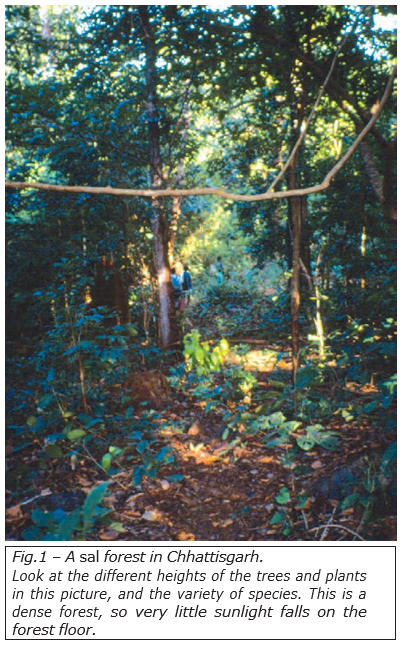
The image above shows a sal forest in Chhattisgarh, India. Sal trees (Shorea robusta) dominate this forest type. The forest has multiple layers: tall canopy trees, smaller trees and shrubs below, and low-growing plants near the forest floor. This layering supports a complex ecosystem with diverse species. The dense canopy limits sunlight reaching the ground, so plants on the forest floor have adapted to low-light conditions.
Exam Question
Q: Why is biodiversity important in forests like the sal forest?
A: Biodiversity maintains environmental balance and supports a healthy ecosystem by providing various habitats and resources for different species.
Why Deforestation?
Deforestation refers to the disappearance of forests. It is not a recent problem but became systematic and extensive under colonial rule. Several causes contributed to deforestation in India.
Land to be Improved
In 1600, about one-sixth of India’s land was cultivated; now it is about half. Population growth increased food demand, leading peasants to clear forests for cultivation. The British encouraged commercial crop production (jute, sugar, wheat, cotton) to meet European demand. Between 1880 and 1920, cultivated area rose by 6.7 million hectares, often at the expense of forests.
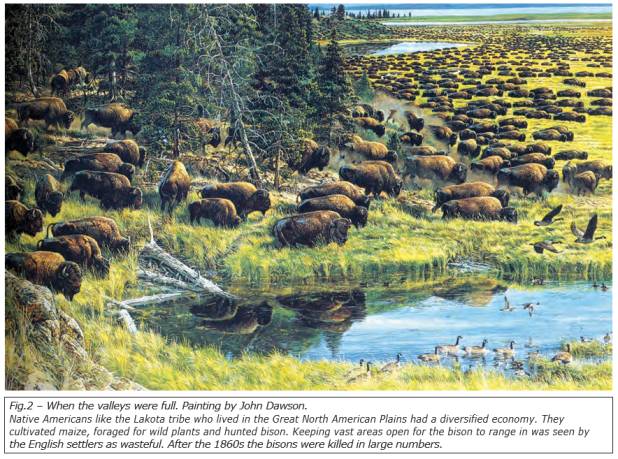
The painting above depicts a large herd of bison in the Great North American Plains. Native Americans, including the Lakota tribe, depended on bison for food, clothing, and tools. European settlers viewed free-roaming bison as wasted resources and hunted them extensively, leading to drastic population declines and ecosystem changes.
Exam Question
Q: How did the expansion of cultivation contribute to deforestation during colonial times?
A: Expansion of cultivation cleared forests to increase agricultural land for food and commercial crops, leading to large-scale deforestation.
Sleepers on the Tracks
Railway expansion in colonial India created a huge demand for timber sleepers to lay tracks and wood fuel for locomotives. Each mile of track required between 1,760 and 2,000 sleepers. The British government contracted individuals to supply sleepers, leading to indiscriminate tree felling and rapid forest loss near railway lines.
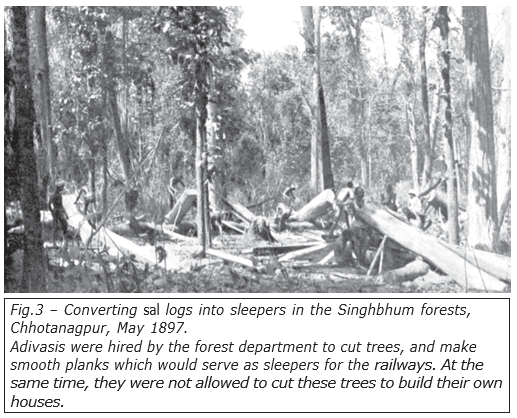
The image shows Adivasi workers in Singhbhum forests cutting sal logs into railway sleepers in 1897. Although allowed to cut trees for sleepers, they were forbidden from using the wood for their own homes, illustrating colonial control over forest resources and indigenous rights.
Exam Question
Q: What role did railway construction play in deforestation?
A: Railways required large quantities of timber for sleepers and fuel, leading to extensive tree felling and forest depletion.
Plantations
Large natural forests were cleared to establish tea, coffee, and rubber plantations to meet European demand. The colonial government allocated vast forest areas to European planters at low costs, enclosing and clearing them for plantation agriculture.

The vintage advertisement above promotes "Pleasure Brand Tea," highlighting the commercial importance of tea plantations during colonial times.
Exam Question
Q: How did plantations contribute to deforestation?
A: Establishing plantations required clearing large forest areas, reducing natural forest cover.
The Rise of Commercial Forestry
To manage forest resources for shipbuilding and railways, the British appointed Dietrich Brandis as the first Inspector General of Forests in India. He introduced scientific forestry, which involved controlled tree felling, replanting, and legal regulations to conserve forests for timber production. The Indian Forest Service was established in 1864, and the Indian Forest Act was enacted in 1865, later amended in 1878 and 1927.
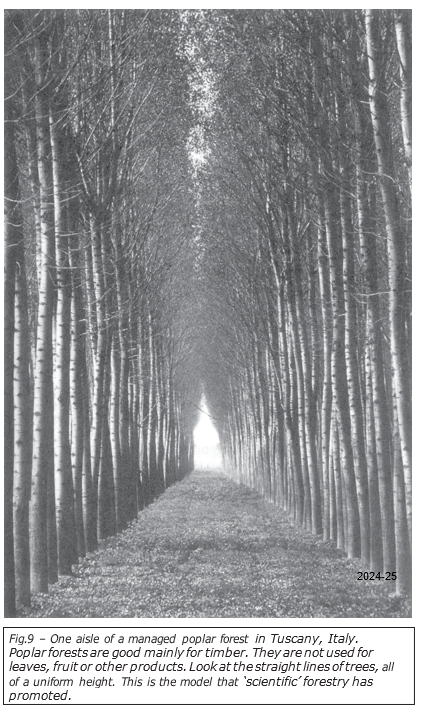
The image shows a managed poplar forest in Tuscany, Italy, illustrating scientific forestry with uniform tree planting for efficient timber production.
Exam Question
Q: What is scientific forestry?
A: Scientific forestry is a system of forest management involving planned cutting and replanting of trees to ensure sustainable timber production.
How Were the Lives of People Affected?
Forest officials prioritized trees suitable for timber like teak and sal, often cutting other species. Villagers depended on forests for fuel, fodder, medicine, and materials. The Forest Act restricted their access, making traditional activities like wood collection, grazing, hunting, and fishing illegal. This caused hardship, forced illegal activities, and led to exploitation by forest guards.
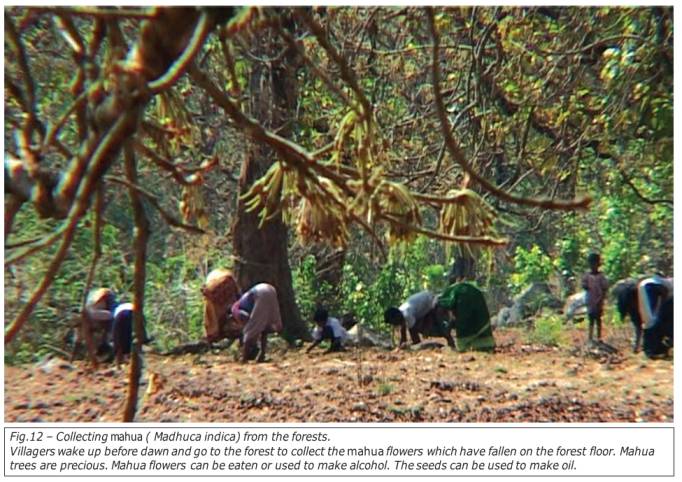
The image shows villagers collecting mahua flowers, which are used for food, alcohol, and oil, highlighting the importance of forest products for local livelihoods.
Exam Question
Q: How did the Forest Act affect forest-dwelling communities?
A: It restricted their access to forest resources, criminalized traditional practices, and caused economic and social hardships.
How Did Forest Rules Affect Cultivation?
Shifting cultivation, a traditional practice involving cutting and burning forest patches for crop rotation, was banned by colonial authorities as harmful to forests and timber production. This led to displacement and resistance among forest communities.
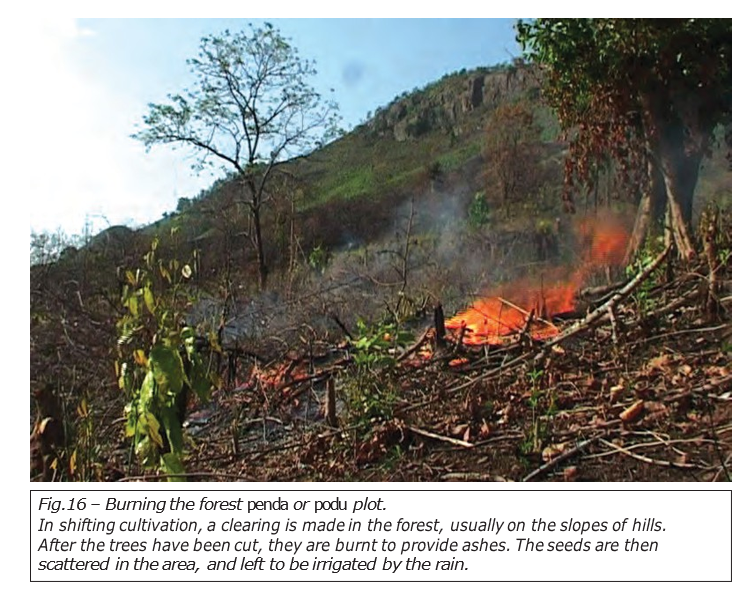
The image illustrates the burning of forest land in shifting cultivation, which enriches soil with ash but was viewed negatively by colonial foresters.
Exam Question
Q: Why was shifting cultivation banned by colonial governments?
A: It was seen as damaging to forests and incompatible with commercial timber production.
Who Could Hunt?
Forest laws prohibited customary hunting by local people, criminalizing them as poachers. Meanwhile, big game hunting became a colonial sport, leading to the near extinction of species like tigers. Hunting was used to assert colonial control and 'civilize' the land.
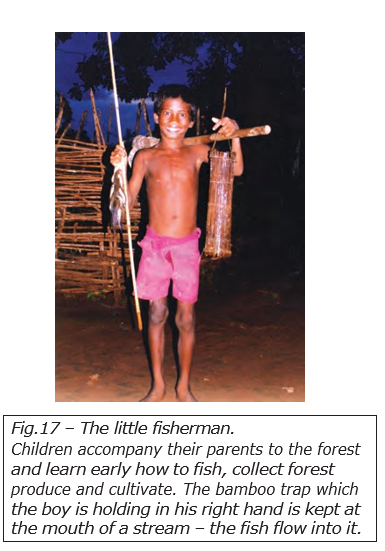
The image shows a boy using traditional bamboo traps for fishing, demonstrating sustainable forest-based livelihoods.
Exam Question
Q: How did colonial forest laws change hunting practices?
A: They banned traditional hunting by locals but encouraged big game hunting as a sport for colonizers.
New Trades, New Employments and New Services
Colonial forest control disrupted traditional livelihoods but created new trade opportunities in forest products. Many communities became dependent on regulated trade, often under exploitative conditions. Some were labeled 'criminal tribes' and forced into labor in factories and plantations.
Rebellion in the Forest
Forest communities across India resisted colonial forest policies. Leaders like Siddhu and Kanu, Birsa Munda, and Alluri Sitarama Raju led rebellions. The 1910 Bastar rebellion was a significant uprising against forest reservation and colonial oppression.
The People of Bastar
Bastar, in southern Chhattisgarh, is home to diverse communities who traditionally managed forests respectfully, believing in spiritual connections with nature. Villages had defined boundaries and managed resources collectively.
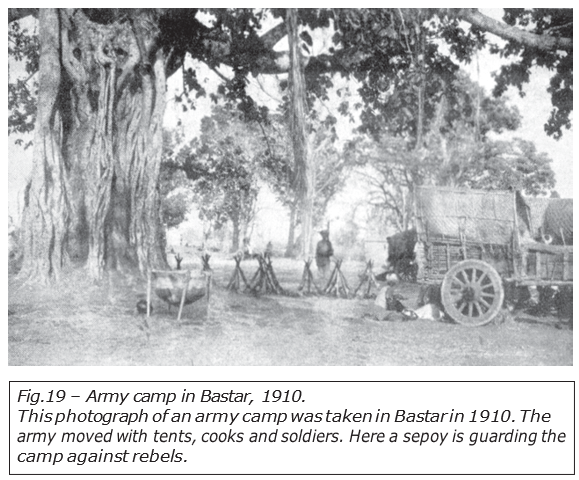
The image shows a British army camp set up to suppress the Bastar rebellion in 1910.
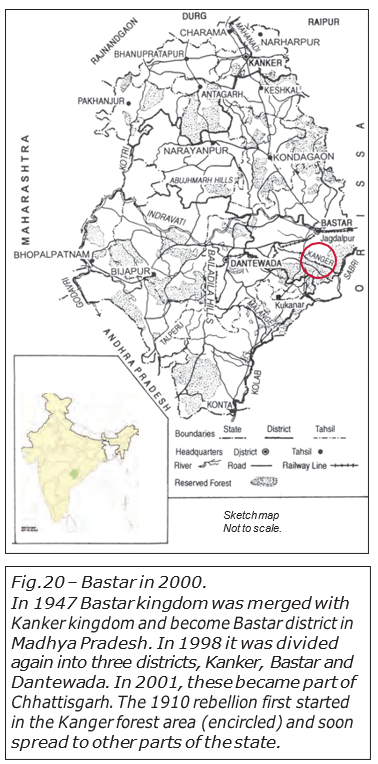
The map illustrates Bastar's location, administrative divisions, and the area of the 1910 rebellion.
Exam Question
Q: What were the causes and outcomes of the Bastar rebellion?
A: Causes included forest reservation, displacement, and colonial oppression. The rebellion led to temporary suspension and reduction of forest reservation areas.
Forest Transformations in Java
Java, Indonesia, was once forested but transformed under Dutch colonial rule. The Kalangs, skilled forest cutters, resisted Dutch control. The Dutch introduced forest laws restricting access and imposed labor systems to support timber extraction, especially teak for shipbuilding.
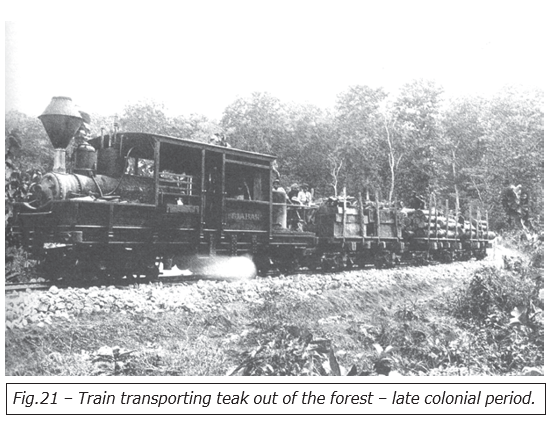
The image shows a steam locomotive transporting teak logs during the late colonial period, illustrating the scale of timber extraction.
Exam Question
Q: How did colonial powers manage forests in Java?
A: They enacted laws restricting access, introduced scientific forestry, and used forced labor systems to extract timber.
War and Deforestation
World Wars I and II increased demand for timber, leading to unregulated tree felling in India and Java. The Japanese occupation further exploited forests. Post-war, conflicts arose between forest departments and local agricultural expansion.
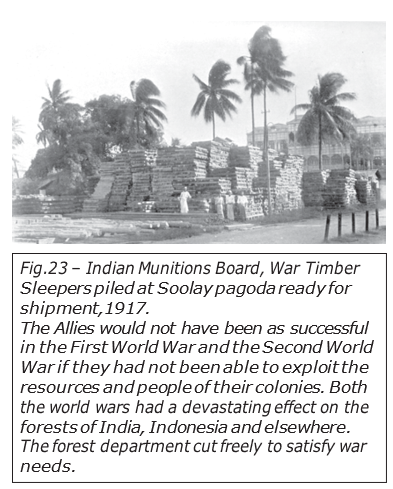
The image shows timber sleepers prepared for shipment during World War I, highlighting the role of colonial forests in war efforts.
Exam Question
Q: What impact did the World Wars have on forests in colonies?
A: They caused heavy deforestation due to increased demand for timber for military use.
New Developments in Forestry
Since the 1980s, governments have recognized the failures of scientific forestry and exclusionary policies. Conservation goals now emphasize involving local communities in forest management. Sacred groves and community patrols have helped preserve forests in many regions.
Glossary
- Deforestation: The clearing or removal of forests.
- Scientific Forestry: A system of forest management involving planned cutting and replanting.
- Shifting Cultivation: Agricultural practice involving cutting and burning forest patches for crop rotation.
- Sleepers: Wooden supports laid under railway tracks.
- Plantation: Large-scale agricultural land where crops or trees are systematically grown.
- Poaching: Illegal hunting or capturing of wild animals.
- Adivasis: Indigenous tribal communities in India.
Quick Reference
- Deforestation increased during colonial times due to agriculture, railways, and plantations.
- Scientific forestry introduced controlled forest management but often excluded local needs.
- Forest laws restricted traditional rights, causing hardship and rebellions.
- World Wars intensified forest exploitation.
- Modern forestry emphasizes community involvement and conservation.
Solved Example
Question: If one average tree yields 4 sleepers and one mile of railway requires 1,800 sleepers, approximately how many trees are needed to lay one mile of track?
Solution: Number of trees = Total sleepers / Sleepers per tree = 1800 / 4 = 450 trees.
Practice Set
Easy
- What is deforestation?
- Name two commercial crops introduced during colonial times that led to forest clearing.
Moderate
- Explain the impact of railway construction on forests in colonial India.
- Describe the main features of scientific forestry.
Challenging
- Discuss the causes and consequences of the Bastar rebellion of 1910.
- Compare forest management policies in colonial India and Java.
Answer Key
- Deforestation is the clearing or removal of forests.
- Tea and rubber are two commercial crops introduced during colonial times.
- Railway construction required large amounts of timber for sleepers and fuel, leading to extensive tree felling and forest loss.
- Scientific forestry involved planned cutting, replanting, and legal control to sustain timber production.
- The Bastar rebellion was caused by forest reservation and displacement; it resulted in temporary suspension of reservation and highlighted tribal resistance.
- Both India and Java had forest laws restricting access, introduced scientific forestry, and used forced labor, but local resistance and specific policies varied.
Social Science — ALL CHAPTERS
1
The French Revolution
2
Socialism In Europe And The Russian Revolution
3
Nazism And The Rise Of Hitler
4
Forest Society And Colonialism
5
Pastoralists In The Modern World
1
Understanding Social Science
2
Shaping of the Earth’s Surface
3
Atmosphere and Climate
4
Early Humans and Beginning of Civilisation
5
State and Society up to 1000 CE
6
Democracy
7
Elections
8
Building Blocks in Economics: The Problem of Choice
9
The Price Puzzle: What Drives the Market