Class 12 PCB . Biology . Biology . Reproductive Health
Chapter 3: Reproductive Health
Ch 3
Biology
Class 12 PCB
Reproductive Health
Definition and Scope
Reproductive health refers to the well-being of the reproductive system and its normal functioning. According to the World Health Organization (WHO), it encompasses physical, emotional, behavioral, and social well-being in all aspects of reproduction.
Problems Associated with Reproductive Health
Several issues affect reproductive health, including:
- Population explosion due to rapid increase in human population.
- Lack of awareness and sex education.
- Spread of myths and misconceptions about sexual health.
- Prevalence of sexually transmitted diseases (STDs) due to poor hygiene and knowledge.
- Illegal abortions and female foeticide.
- Sexual abuse and related crimes.
Reproductive Health Programmes
To address these problems, reproductive health and family planning programmes were initiated in 1951. Currently, the Reproductive and Child Health Care (RCH) Programmes cover a wide range of reproductive health issues.
Objectives of Reproductive and Child Health Care Programmes
- Create awareness about reproductive health among males and females through media and education.
- Provide sex education in schools to dispel myths and misconceptions.
- Prevent and control sexually transmitted diseases by promoting safe and hygienic practices.
- Educate couples about birth control, prenatal and postnatal care, and breastfeeding.
- Raise awareness about the negative effects of population explosion, sexual abuse, and sex discrimination.
- Provide medical facilities to reduce maternal and infant mortality rates.
- Promote Assisted Reproductive Technologies (ART) to address infertility.
Steps to Maintain a Reproductively Healthy Society
- Ban on amniocentesis for fetal sex determination.
- Implementation of immunization programs.
- Establishment of specialized health centers for infertility diagnosis and treatment.
- Improved awareness about sexual health and related problems.
- Increase in medically assisted deliveries and postnatal care.
- Development of female contraceptives like Saheli.
- Early detection and treatment of sexually transmitted diseases.
Population Explosion
Population explosion refers to the rapid increase in human population size and growth rate. Causes include:
- Decline in death rate, infant mortality rate (IMR), and maternal mortality rate (MMR).
- Increased longevity and better medical facilities.
- Prevention of diseases and improved agriculture.
- Better transportation and protection from natural factors.
- Increase in reproductive age population.
Consequences include poverty, unemployment, food shortage, unhygienic conditions, education and housing problems, pollution, crime, and depletion of natural resources.
Immunisation
Immunisation is the process of making an individual immune to infection by using vaccines to protect against diseases.
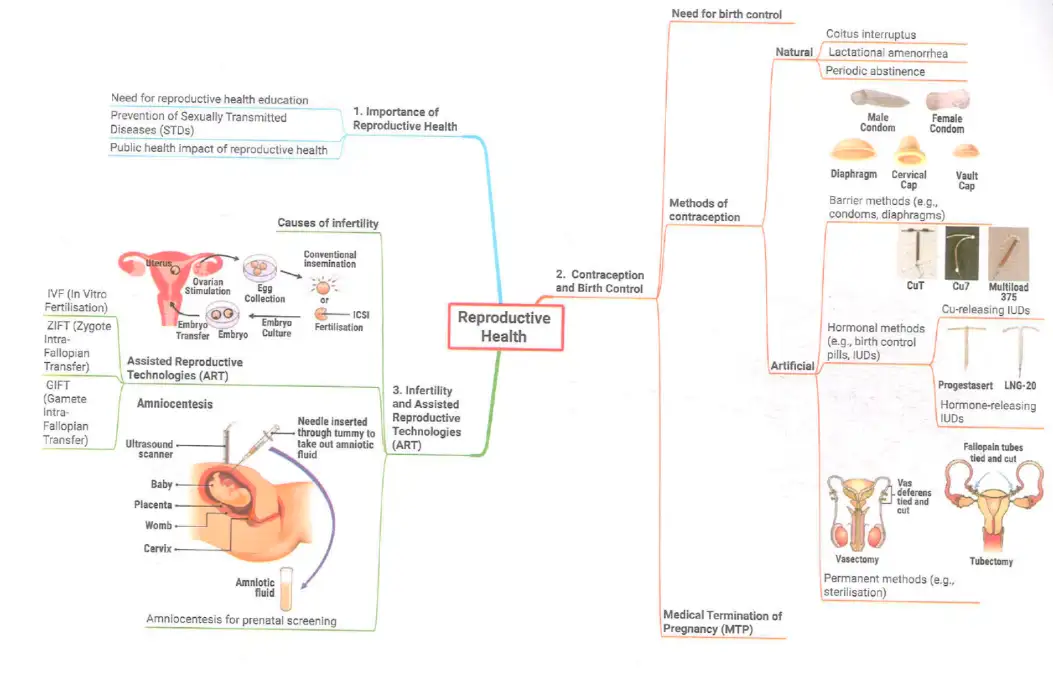
Birth Control
Importance of Birth Control
Birth control methods help prevent unwanted pregnancies and control population growth. An ideal contraceptive should be user-friendly, effective, reversible, have minimal side effects, and not interfere with sexual desire or activity.
Natural or Traditional Methods
- Coitus Interruptus (Withdrawal): The male withdraws the penis before ejaculation to prevent sperm deposition. Limitations include possible sperm presence in pre-ejaculate and psychological effects.
- Periodic Abstinence: Avoiding sex during the fertile period (10th to 17th day of menstrual cycle) reduces pregnancy chances by about 80% in women with regular cycles.
- Lactational Amenorrhoea: Frequent breastfeeding suppresses ovulation for up to six months after childbirth.
Artificial Methods
- Condoms: Rubber or latex sheaths worn on the penis to prevent sperm entry and protect against STDs. Female condoms (femidoms) are also available.
- Diaphragms, Cervical Caps, and Vaults: Reusable rubber barriers fitted in the vagina to block sperm entry.
- Intrauterine Devices (IUDs): Inserted by medical professionals into the uterus. Types include non-medicated (Lippes loop), copper-releasing (Copper T), and hormone-releasing IUDs. They prevent implantation and increase sperm phagocytosis.
Chemical Methods
- Spermicidal Tablets, Jellies, and Creams: Chemicals like lactic acid and citric acid kill sperms when applied in the vagina before intercourse.
- Oral Contraceptive Pills: Hormonal tablets containing progestogens or combined progestogen-oestrogen taken daily for 21 days, followed by a 7-day break. They inhibit ovulation, implantation, and alter cervical mucus.
- Saheli: A non-steroidal oral contraceptive developed in India, taken once a week with few side effects.
- Injectables and Implants: Hormonal injections or implants provide longer-term contraception and can be effective as emergency contraceptives.
Surgical Methods
- Male Sterilisation (Vasectomy): Cutting or blocking the vas deferens to prevent sperm transport.
- Female Sterilisation: Includes ovariectomy (removal of ovaries), tubectomy (tying or cutting fallopian tubes), and tubal ligation (blocking tubes using laparoscope).
Medical Termination of Pregnancy
Definition and Importance
Medical Termination of Pregnancy (MTP) is the intentional termination of pregnancy before full term. It helps reduce unwanted pregnancies and is safe during the first trimester (up to 12 weeks).
Legal and Ethical Aspects
MTP is legal in India under strict conditions to prevent misuse and female foeticide. It is essential in cases where pregnancy endangers the mother or fetus.
Problems Related to MTP
- Many MTPs are performed illegally.
- Misuse of amniocentesis for fetal sex determination.
- Sex ratio imbalance due to female foeticide.
Amniocentesis
A prenatal diagnostic technique to detect genetic disorders and fetal sex by analyzing amniotic fluid. It is legally banned in India for sex determination due to misuse.
Sexually Transmitted Diseases
Overview
Sexually transmitted diseases (STDs), also called venereal diseases or reproductive tract infections, are infections transmitted through sexual contact. Examples include gonorrhea, syphilis, genital herpes, chlamydiasis, genital warts, trichomoniasis, hepatitis B, and HIV/AIDS.
Transmission and Symptoms
STDs can also spread through sharing needles, blood transfusions, and from mother to fetus. Early symptoms include itching, discharge, pain, and swelling in the genital area. Many infections are curable if detected early.
Prevention
- Avoid sexual contact with unknown or multiple partners.
- Use condoms consistently during intercourse.
- Seek early medical diagnosis and treatment if symptoms appear.
Infertility
Definition and Causes
Infertility is the inability of a male or female to produce offspring. Causes include physical, congenital, disease-related, drug-induced, immunological, or psychological factors.
Assisted Reproductive Technologies
In Vitro Fertilisation (IVF)
Ova and sperms are collected and fertilized in a laboratory to form a zygote, which is then transferred to the female reproductive tract. Types include:
- Zygote Intra Fallopian Transfer (ZIFT): Transfer of early embryos into the fallopian tube.
- Intrauterine Transfer (IUT): Transfer of embryos into the uterus.
Gamete Intra Fallopian Transfer (GIFT)
Transfer of an ovum from a donor into the fallopian tube of a recipient female who cannot produce ova but can support fertilization and development.
Intra Cytoplasmic Sperm Injection (ICSI)
A single sperm is injected directly into an egg in the laboratory, and the fertilized egg is implanted into the uterus.
Artificial Insemination (AI)
Semen from a husband or donor is artificially introduced into the female reproductive tract to assist fertilization, useful in cases of male infertility.
Surrogacy
A surrogate mother carries a child for a couple unable to conceive or carry a pregnancy. The surrogate is impregnated via artificial insemination or embryo implantation.
Challenges of ART
ART requires specialized professionals and expensive equipment, limiting availability and affordability.
Solved Examples
Practice Set
- Level 1 (Easy): Define reproductive health and list two problems associated with it.
- Level 2 (Moderate): Explain the difference between natural and artificial contraceptive methods with examples.
- Level 3 (Challenging): Describe the process and significance of In Vitro Fertilisation (IVF) in treating infertility.
Answer Key
- Level 1: Reproductive health is the well-being of the reproductive system in all aspects. Problems include population explosion and spread of sexually transmitted diseases.
- Level 2: Natural methods rely on avoiding intercourse during fertile periods (e.g., withdrawal, periodic abstinence), while artificial methods use devices or chemicals (e.g., condoms, oral pills) to prevent pregnancy.
- Level 3: IVF involves fertilizing eggs and sperms outside the body in a lab, then transferring the embryo to the uterus. It helps couples with infertility conceive.
Quick Reference Table
Reproductive Health: Overall well-being of reproductive system including physical, emotional, and social aspects.
Population Explosion: Rapid increase in population due to decreased death rates and increased longevity.
Immunisation: Process of making an individual immune to infection using vaccines.
Natural Contraceptive Methods: Withdrawal, periodic abstinence, lactational amenorrhoea.
Artificial Contraceptive Methods: Condoms, diaphragms, cervical caps, intrauterine devices (IUDs).
Chemical Contraceptives: Spermicidal tablets, oral contraceptive pills, injectables, implants.
Surgical Methods: Vasectomy (male), tubectomy, tubal ligation, ovariectomy (female).
Medical Termination of Pregnancy (MTP): Legal termination of pregnancy under specified conditions.
Amniocentesis: Prenatal diagnostic test for genetic disorders and fetal sex determination (banned for sex determination in India).
Sexually Transmitted Diseases (STDs): Infections transmitted through sexual contact, e.g., HIV/AIDS, syphilis, gonorrhea.
Assisted Reproductive Technologies (ART): IVF, ZIFT, IUT, GIFT, ICSI, artificial insemination, surrogacy.
Common Mistakes and Misconceptions
- Confusing natural contraceptive methods with artificial methods; natural methods rely on timing and behavior, artificial methods use devices or chemicals.
- Assuming all STDs are incurable; many are curable if detected early and treated properly.
- Believing MTP is legal without restrictions; it is legal only under specific conditions and time limits.
- Misunderstanding ART procedures; IVF involves fertilization outside the body, while GIFT involves placing gametes inside the fallopian tube.
- Using amniocentesis for sex determination is illegal and unethical in India.
- Thinking sterilisation methods are reversible; they are generally permanent.
Glossary
- Reproductive Health: State of complete physical, mental, and social well-being in all matters relating to the reproductive system.
- Population Explosion: Rapid increase in human population.
- Immunisation: Process of protecting against infectious diseases by vaccination.
- Contraception: Methods used to prevent pregnancy.
- Coitus Interruptus: Withdrawal method of contraception.
- Periodic Abstinence: Avoiding sexual intercourse during fertile days.
- Lactational Amenorrhoea: Natural postpartum infertility due to breastfeeding.
- Intrauterine Device (IUD): A device inserted into the uterus to prevent pregnancy.
- Medical Termination of Pregnancy (MTP): Legal abortion under specified conditions.
- Amniocentesis: Prenatal test analyzing amniotic fluid for genetic disorders.
- Sexually Transmitted Diseases (STDs): Infections transmitted through sexual contact.
- Infertility: Inability to conceive after one year of regular unprotected intercourse.
- In Vitro Fertilisation (IVF): Fertilization of egg and sperm outside the body.
- Zygote Intra Fallopian Transfer (ZIFT): Transfer of fertilized egg into fallopian tube.
- Gamete Intra Fallopian Transfer (GIFT): Transfer of egg and sperm into fallopian tube for fertilization.
- Intra Cytoplasmic Sperm Injection (ICSI): Injection of a single sperm into an egg.
- Artificial Insemination (AI): Introduction of semen into female reproductive tract artificially.
- Surrogacy: Arrangement where a woman carries a pregnancy for another couple.
- Saheli: A non-steroidal oral contraceptive pill developed in India.
Biology — ALL CHAPTERS
1
Sexual Reproduction In Flowering Plants
2
Human Reproduction
3
Reproductive Health
4
Principles Of Inheritance And Variation
5
Molecular Basis Of Inheritance
6
Evolution
7
Human Health And Disease
8
Microbes In Human Welfare
9
Biotechnology : Principles And Processes
10
Biotechnology And Its Applications
11
Organisms And Populations
12
Ecosystem
13
Biodiversity And Conservation