Class 12 PCM . Mathematics . Mathematics Part I . Determinants
Chapter 4: DETERMINANTS
Ch 4
Mathematics
Class 12 PCM
Introduction
Meaning and Use of Determinants
For a two-variable linear system, a non-zero coefficient determinant guarantees a unique solution.
Test for a Unique Solution
- Write the coefficient matrix of the system.
- Calculate its determinant.$$\det(A)=a_1b_2-a_2b_1$$
- If the determinant is non-zero, the system has a unique solution.$$\det(A)\ne 0$$
Does the system \(2x+4y=6\), \(x+3y=5\) have a unique solution?
- Find the coefficient determinant for the system.$$\begin{vmatrix}2&4\\1&3\end{vmatrix}=2(3)-4(1)=2$$
- Since it is non-zero, the system has a unique solution.$$2\ne 0$$
Determinant of Order One
Evaluate \(\det([7])\).
- The determinant equals the only entry.$$\det([7])=7$$
Determinant of Order Two
Evaluate \(\begin{vmatrix}2&4\\-1&2\end{vmatrix}\).
- Apply the order-two formula.$$\begin{vmatrix}2&4\\-1&2\end{vmatrix}=2(2)-4(-1)$$
- Simplify.$$4+4=8$$
Do not add the diagonal products: the order-two rule is main-diagonal product minus off-diagonal product.
Determinant of Order Three
For an entry in row \(i\) and column \(j\), use sign \((-1)^{i+j}\), delete its row and column to form the order-two determinant, and add the resulting terms. Expansion along any row or column gives the same value.
This equivalent form is useful for checking an expansion.
Expansion Properties and Examples
- Sign pattern: Along the first row the signs are \(+,-,+\); generally, the sign at \((i,j)\) is \((-1)^{i+j}\).
- Efficient choice: Expand along a row or column containing the most zeros.
- Same value: Expansions along all three rows and all three columns give the same determinant.
- Zero-column example: \(\begin{vmatrix}1&2&4\\-1&3&0\\4&1&0\end{vmatrix}=-52\).
- Trigonometric example: \(\begin{vmatrix}0&\sin\alpha&-\cos\alpha\\-\sin\alpha&0&\sin\beta\\\cos\alpha&-\sin\beta&0\end{vmatrix}=0\); expansion along the first row gives \(\sin\alpha\sin\beta\cos\alpha-\cos\alpha\sin\alpha\sin\beta=0\).
If \(A=kB\) and both matrices have order \(n\), scaling every entry by \(k\) scales the determinant by \(k^n\).
Expand an Order-three Determinant
- Choose a row or column, preferably one with the most zeros.
- For each entry, delete its row and column to form an order-two determinant.
- Multiply each entry by its minor and sign \((-1)^{i+j}\), then add the terms.
Evaluate \(\begin{vmatrix}1&2&4\\-1&3&0\\4&1&0\end{vmatrix}\).
- Expand down the third column, which contains two zeros.$$\begin{vmatrix}1&2&4\\-1&3&0\\4&1&0\end{vmatrix}=4\begin{vmatrix}-1&3\\4&1\end{vmatrix}$$
- Evaluate the remaining order-two determinant.$$4((-1)(1)-3(4))=4(-13)=-52$$
Evaluate \(\begin{vmatrix}x&x+1\\x-1&x\end{vmatrix}\).
If \(A=3B\), where \(B\) is an order-three matrix and \(|B|=-2\), find \(|A|\).
Find \(x\) if \(\begin{vmatrix}3&x\\x&1\end{vmatrix}=\begin{vmatrix}3&2\\4&1\end{vmatrix}\).
Quick recap
- A determinant is a number assigned only to a square matrix; its notations include \(|A|\), \(\det(A)\), and \(\Delta\).
- For two linear equations, a non-zero coefficient determinant guarantees a unique solution.
- An order-one determinant is its entry; an order-two determinant is the main-diagonal product minus the off-diagonal product.
- An order-three determinant can be expanded along any row or column using signed order-two determinants.
- The expansion sign at position \((i,j)\) is \((-1)^{i+j}\); choosing a line with zeros simplifies calculations.
- If \(A=kB\) for matrices of order \(n\), then \(|A|=k^n|B|\).
Area Of A Triangle
Area of a Triangle
Area of a triangle using determinants — For vertices \((x_1,y_1)\), \((x_2,y_2)\) and \((x_3,y_3)\), the triangle’s area is half the absolute value of their coordinate determinant.
Key properties
- Positive area: Take the absolute value of the determinant.
- Given area: Use both positive and negative determinant values when solving.
- Collinear points: Three collinear points form a triangle of area \(0\).
- Line test: A point \((x,y)\) is on the line through two fixed points if the determinant for the three points is \(0\).
Use the determinant of the three coordinate rows; the expanded form is equivalent.
Finding a triangle’s area
- Write the three vertices as rows with a final coordinate of \(1\).$$\begin{vmatrix}x_1&y_1&1\\x_2&y_2&1\\x_3&y_3&1\end{vmatrix}$$
- Evaluate the determinant, take its absolute value, and divide by \(2\).$$\Delta=\frac{1}{2}|D|$$
Find the area of the triangle with vertices \((3,8)\), \((-4,2)\) and \((5,1)\).
- Find the area for vertices \((3,8)\), \((-4,2)\) and \((5,1)\).$$\Delta=\frac{1}{2}\left|\begin{vmatrix}3&8&1\\-4&2&1\\5&1&1\end{vmatrix}\right|$$
- Expand the determinant along the first row.$$\Delta=\frac{1}{2}|3(2-1)-8(-4-5)+1(-4-10)|$$
- Simplify and take the absolute value.$$\Delta=\frac{1}{2}|3+72-14|=\frac{61}{2}$$
Do not report a negative area: take the absolute value of the determinant. If the area is given, retain both determinant signs while solving.
Use determinants to find the line through \(A(1,3)\) and \(B(0,0)\). If \(D(k,0)\) makes the area of \(\triangle ABD\) equal to \(3\) square units, find \(k\).
Minors and Cofactors
Minor — The minor \(M_{ij}\) of element \(a_{ij}\) is the determinant formed by deleting row \(i\) and column \(j\).
For an element \(a_{ij}\), its cofactor is \(A_{ij}=(-1)^{i+j}M_{ij}\). A determinant can be expanded along any one row or column by summing each entry times its corresponding cofactor.
Key properties
- Order: In an order-\(n\) determinant, each minor is of order \(n-1\).
- Sign pattern: Cofactor signs alternate, starting with \(+\) at the top left.
- Expansion along row \(i\): Sum \(a_{ij}A_{ij}\) across that row.
- Expansion along column \(j\): Sum \(a_{ij}A_{ij}\) down that column.
- Different row or column: Entries from one row (or column) multiplied by cofactors from a different row (or column) sum to \(0\).
| Row 1 | Row 2 | Row 3 |
|---|---|---|
| \(+\quad-\quad+\) | \(-\quad+\quad-\) | \(+\quad-\quad+\) |
For a fixed row or column, multiply each entry by its cofactor and add.
For distinct rows \(r\) and \(s\), \(\sum_{j=1}^{n}a_{rj}A_{sj}=0\). For distinct columns \(r\) and \(s\), \(\sum_{i=1}^{n}a_{ir}A_{is}=0\).
Finding a minor and cofactor
- Locate \(a_{ij}\) and delete its row and column to get \(M_{ij}\).$$M_{ij}$$
- Evaluate the remaining determinant; for a \(2\times2\) determinant, subtract the cross-products.$$\begin{vmatrix}a&b\\c&d\end{vmatrix}=ad-bc$$
- Multiply the minor by \((-1)^{i+j}\) to obtain the cofactor.$$A_{ij}=(-1)^{i+j}M_{ij}$$
Find the minors and cofactors of all elements of \(\begin{vmatrix}1&4\\-2&3\end{vmatrix}\).
- Find all minors and cofactors of the determinant.$$\Delta=\begin{vmatrix}1&4\\-2&3\end{vmatrix}$$
- Each minor is the single entry left after deleting the element’s row and column.$$M_{11}=3,\quad M_{12}=-2,\quad M_{21}=4,\quad M_{22}=1$$
- Apply the alternating cofactor signs.$$A_{11}=3,\quad A_{12}=-(-2)=2,\quad A_{21}=-4,\quad A_{22}=1$$
Do not confuse a minor with a cofactor: the cofactor includes the sign factor \((-1)^{i+j}\).
Find the minor and cofactor of the element \(6\) in \(\begin{vmatrix}1&2&3\\4&5&6\\7&8&9\end{vmatrix}\).
For \(\Delta=\begin{vmatrix}2&-3&5\\6&0&4\\1&5&-7\end{vmatrix}\), find all minors and cofactors, then verify \(a_{11}A_{31}+a_{12}A_{32}+a_{13}A_{33}=0\).
Quick recap
- Triangle area is half the absolute value of the coordinate determinant.
- Three collinear points have determinant \(0\) and form a zero-area triangle.
- A minor \(M_{ij}\) is formed by deleting row \(i\) and column \(j\).
- A cofactor is \(A_{ij}=(-1)^{i+j}M_{ij}\).
- Expand a determinant along any one row or column using matching cofactors.
- Entries from one row multiplied by cofactors from a different row sum to \(0\).
Adjoint And Inverse Of A Matrix
Adjoint of a Matrix
For a matrix of order \(2\), interchange the diagonal entries and change the signs of the off-diagonal entries.
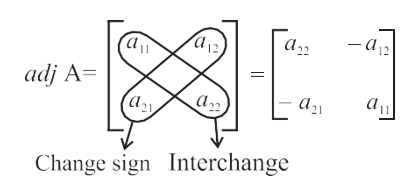
Find \(\operatorname{adj} A\) for \(A=\begin{bmatrix}2&3\\1&4\end{bmatrix}\).
- Find the adjoint by using the 2 × 2 rule.$$A=\begin{bmatrix}2&3\\1&4\end{bmatrix}$$
- Swap the diagonal entries and negate the off-diagonal entries.$$\operatorname{adj}A=\begin{bmatrix}4&-3\\-1&2\end{bmatrix}$$
Adjoint Identity and Determinant Properties
For a square matrix \(A\) of order \(n\), \(A(\operatorname{adj}A)=(\operatorname{adj}A)A=|A|I\).
For a square matrix \(A\) of order \(n\), \(|\operatorname{adj}A|=|A|^{n-1}\).
Singular matrix — A square matrix is singular if its determinant is zero.
Nonsingular matrix — A square matrix is nonsingular if its determinant is nonzero.
| Point | Singular | Nonsingular |
|---|---|---|
| Determinant | \(|A|=0\) | \(|A|\ne 0\) |
| Inverse | Does not exist | Exists |
Examples
- Singular: \(\begin{bmatrix}1&2\\4&8\end{bmatrix}\) has determinant \(0\).
- Nonsingular: \(\begin{bmatrix}1&2\\3&4\end{bmatrix}\) has determinant \(-2\), so it is nonsingular.
Inverse of a Matrix
A square matrix \(A\) is invertible if and only if \(|A|\ne0\).
Find an Inverse Using the Adjoint
- Calculate the determinant \(|A|\).
- If \(|A|=0\), the inverse does not exist; otherwise find the cofactors and form \(\operatorname{adj}A\).
- Use the inverse formula.$$A^{-1}=\frac{1}{|A|}\operatorname{adj}A$$
For \(A=\begin{bmatrix}1&3&3\\1&4&3\\1&3&4\end{bmatrix}\), verify \(A(\operatorname{adj}A)=|A|I\) and find \(A^{-1}\).
- Expand the determinant along the first row.$$|A|=1(16-9)-3(4-3)+3(3-4)=1$$
- The cofactor matrix transposed gives the adjoint.$$\operatorname{adj}A=\begin{bmatrix}7&-3&-3\\-1&1&0\\-1&0&1\end{bmatrix}$$
- Since \(|A|=1\), the inverse equals the adjoint.$$A^{-1}=\frac{1}{1}\operatorname{adj}A=\begin{bmatrix}7&-3&-3\\-1&1&0\\-1&0&1\end{bmatrix}$$
- The adjoint identity verifies the product.$$A(\operatorname{adj}A)=I=|A|I$$
Inverse of a Product
For invertible matrices \(A\) and \(B\) of the same order:
Verify \((AB)^{-1}=B^{-1}A^{-1}\) for \(A=\begin{bmatrix}2&3\\1&-4\end{bmatrix}\) and \(B=\begin{bmatrix}1&-2\\-1&3\end{bmatrix}\).
- Multiply the matrices and check the product is invertible.$$AB=\begin{bmatrix}-1&5\\5&-14\end{bmatrix},\quad |AB|=-11$$
- Find the inverse of the product using the 2 × 2 adjoint formula.$$(AB)^{-1}=\frac{1}{-11}\begin{bmatrix}-14&-5\\-5&-1\end{bmatrix}=\frac{1}{11}\begin{bmatrix}14&5\\5&1\end{bmatrix}$$
- Calculate each inverse, then multiply them in reverse order.$$B^{-1}A^{-1}=\frac{1}{11}\begin{bmatrix}14&5\\5&1\end{bmatrix}$$
- The two results agree.$$(AB)^{-1}=B^{-1}A^{-1}$$
Finding an Inverse from a Matrix Equation
Show that \(A^2-4A+I=O\) for \(A=\begin{bmatrix}2&3\\1&2\end{bmatrix}\), then find \(A^{-1}\).
- Square the matrix and confirm the given identity.$$A=\begin{bmatrix}2&3\\1&2\end{bmatrix},\quad A^2=\begin{bmatrix}7&12\\4&7\end{bmatrix},\quad A^2-4A+I=O$$
- Rearrange the equation and postmultiply by \(A^{-1}\).$$A^2-4A=-I\quad\Longrightarrow\quad A-4I=-A^{-1}$$
- Solve for the inverse.$$A^{-1}=4I-A=\begin{bmatrix}2&-3\\-1&2\end{bmatrix}$$
Do not reverse the wrong way: \((AB)^{-1}=B^{-1}A^{-1}\), not \(A^{-1}B^{-1}\). Also, never use the adjoint inverse formula when \(|A|=0\).
Find \(\operatorname{adj}A\) for \(A=\begin{bmatrix}3&-2\\5&1\end{bmatrix}\).
Find the inverse of \(A=\begin{bmatrix}4&1\\2&1\end{bmatrix}\), if it exists.
If \(A\) and \(B\) are invertible, state and verify the inverse formula for their product.
Quick recap
- The adjoint is the transpose of the cofactor matrix; for order \(2\), swap diagonal entries and negate the others.
- \(A(\operatorname{adj}A)=(\operatorname{adj}A)A=|A|I\).
- A matrix is singular when \(|A|=0\) and nonsingular when \(|A|\ne0\).
- A square matrix is invertible exactly when it is nonsingular; then \(A^{-1}=\frac{1}{|A|}\operatorname{adj}A\).
- For matrices of the same order, \(|AB|=|A||B|\) and \(|\operatorname{adj}A|=|A|^{n-1}\) for order \(n\).
- The inverse of a product reverses the order: \((AB)^{-1}=B^{-1}A^{-1}\).
Applications of Determinants and Matrices
Consistency and the matrix method
Write a linear system as \(AX=B\), where \(A\) is the coefficient matrix, \(X\) is the variable vector and \(B\) is the constants vector. If \(|A|\ne 0\), then \(A^{-1}\) exists and the system has the unique solution \(X=A^{-1}B\).
If \(|A|=0\), then \(A^{-1}\) does not exist. For a square singular matrix, if \((\operatorname{adj}A)B\ne O\), the system has no solution; if \((\operatorname{adj}A)B=O\), it may have infinitely many solutions or no solution.
Use these formulas when the coefficient matrix is nonsingular.
Solve a system using the inverse matrix
- Arrange the equations as \(AX=B\).$$AX=B$$
- Find \(|A|\). If it is nonzero, calculate \(A^{-1}=\frac{1}{|A|}\operatorname{adj}A\).$$A^{-1}=\frac{1}{|A|}\operatorname{adj}A$$
- Calculate \(X=A^{-1}B\) and read off the variable values.$$X=A^{-1}B$$
Solve \(3x-2y+3z=8\), \(2x+y-z=1\) and \(4x-3y+2z=4\) using the matrix method.
- Solve the system using the matrix method.$$\begin{aligned}3x-2y+3z&=8\\2x+y-z&=1\\4x-3y+2z&=4\end{aligned}$$
- Form \(AX=B\) and check that the coefficient matrix is nonsingular.$$A=\begin{bmatrix}3&-2&3\\2&1&-1\\4&-3&2\end{bmatrix},\quad B=\begin{bmatrix}8\\1\\4\end{bmatrix},\quad |A|=-17\ne0$$
- Calculate the inverse using the adjugate.$$A^{-1}=\frac{1}{-17}\begin{bmatrix}-1&-5&-1\\-8&-6&9\\-10&1&7\end{bmatrix}$$
- Multiply by \(B\) to obtain the variable vector.$$X=A^{-1}B=\frac{1}{-17}\begin{bmatrix}-17\\-34\\-51\end{bmatrix}=\begin{bmatrix}1\\2\\3\end{bmatrix}$$
Do not use \(A^{-1}\) when \(|A|=0\); the inverse exists only for a nonsingular matrix. Also check the sign of \(|A|\) when dividing the adjugate.
Solve \(2x+5y=1\) and \(3x+2y=7\) using the inverse-matrix method.
The sum of three numbers is \(6\). Three times the third number plus the second is \(11\), and the sum of the first and third is twice the second. Find the numbers using the matrix method.
Quick recap
- A system is consistent if it has at least one solution; otherwise it is inconsistent.
- This chapter's discussion is restricted to systems having unique solutions.
- Write a linear system in the form \(AX=B\).
- If \(|A|\ne0\), then \(X=A^{-1}B\) gives the unique solution.
- For a nonsingular matrix, \(A^{-1}=\frac{1}{|A|}\operatorname{adj}A\).
- If \(|A|=0\), the inverse method cannot be used; the system may have no solution or infinitely many solutions.
Miscellaneous Examples
Determinants, Adjugates and Systems of Equations
For a third-order determinant, the expansion shown is along the first row.
A determinant equals the sum of the products of entries in any row or column with their corresponding cofactors. For example, expansion along the first row gives \(|A|=a_{11}A_{11}+a_{12}A_{12}+a_{13}A_{13}\). The sum of entries of one row multiplied by the corresponding cofactors of a different row is zero, such as \(a_{11}A_{21}+a_{12}A_{22}+a_{13}A_{23}=0\). The adjugate is the transpose of the cofactor matrix, and \(A(\operatorname{adj}A)=(\operatorname{adj}A)A=|A|I\). A matrix is singular when \(|A|=0\) and non-singular when \(|A|\ne 0\).
Use the absolute value of the determinant; the third row contains the third vertex coordinates.
A square matrix has an inverse exactly when it is non-singular. If \(AB=BA=I\), then \(B=A^{-1}\) and \((A^{-1})^{-1}=A\).
For \(AX=B\), a non-singular coefficient matrix gives exactly one solution. If \(|A|=0\), then \((\operatorname{adj}A)B\ne 0\) implies no solution; if \((\operatorname{adj}A)B=0\), the system may or may not be consistent. A system is consistent if at least one solution exists, and inconsistent if none exists.
Solve a Linear System Using the Inverse
- Write the system as \(AX=B\), where \(A\) contains the coefficients and \(X\) contains the variables.$$AX=B$$
- Check that \(|A|\ne 0\) so the inverse exists.$$|A|\ne 0$$
- Find \(A^{-1}\) and calculate \(X=A^{-1}B\).$$X=A^{-1}B$$
- Read the values of the variables from the resulting vector.
Solve \(x-y+2z=1\), \(2y-3z=1\), and \(3x-2y+4z=2\) using the inverse-matrix method.
- Write the system in matrix form.$$\begin{bmatrix}1&-1&2\\0&2&-3\\3&-2&4\end{bmatrix}\begin{bmatrix}x\\y\\z\end{bmatrix}=\begin{bmatrix}1\\1\\2\end{bmatrix}$$
- The coefficient determinant is non-zero, so the inverse exists.$$|A|=-1$$
- Use the inverse matrix and verify that it gives the identity when multiplied by \(A\).$$A^{-1}=\begin{bmatrix}-2&0&1\\9&2&-3\\6&1&-2\end{bmatrix},\qquad AA^{-1}=I$$
- Multiply the inverse by the constants vector.$$\begin{bmatrix}x\\y\\z\end{bmatrix}=A^{-1}B=\begin{bmatrix}-2&0&1\\9&2&-3\\6&1&-2\end{bmatrix}\begin{bmatrix}1\\1\\2\end{bmatrix}=\begin{bmatrix}0\\5\\3\end{bmatrix}$$
Do not use \(A^{-1}=\frac{1}{|A|}\operatorname{adj}A\) when \(|A|=0\); a singular matrix has no inverse. For coordinate-area questions, use the absolute value of the determinant.
Find \(\begin{vmatrix}1&2&0\\0&1&1\\2&0&1\end{vmatrix}\).
Find the area of the triangle with vertices \((0,0)\), \((4,0)\) and \((1,3)\).
Classify the solutions of \(x+y=1\) and \(2x+2y=2\).
Quick recap
- Expand a determinant using entries and their matching cofactors.
- The cofactor is \(A_{ij}=(-1)^{i+j}M_{ij}\); the adjugate is the transpose of the cofactor matrix.
- A matrix is invertible exactly when its determinant is non-zero.
- For \(AX=B\) with \(|A|\ne 0\), the unique solution is \(X=A^{-1}B\).
- For triangle vertices, the area is one-half the absolute value of the coordinate determinant.
- When \(|A|=0\), use the adjugate consistency test carefully: a zero result does not alone guarantee consistency.
Formula sheet
Mathematics — ALL CHAPTERS
1
Relations And Functions
2
Inverse Trigonometric Functions
3
Matrices
4
DETERMINANTS
5
Continuity And Differentiability
6
Application Of Derivatives
7
Integrals
8
APPLICATION OF INTEGRALS
9
DIFFERENTIAL EQUATIONS
10
VECTOR ALGEBRA
11
Three Dimensional Geometry
12
Linear Programming
13
Probability
14
Proofs In Mathematics
15
Mathematical Modelling