Class 12 Commerce . Accountancy . Company Accounts and Analysis of Financial Accounts . Issue and Redemption of Debentures
Chapter 2: Issue and Redemption of Debentures
Ch 2
Accountancy
Class 12 Commerce
Meaning of Debentures
Meaning and Features of Debentures
Debenture — A written instrument under a company’s common seal acknowledging its debt and setting out repayment terms and interest obligations.
Key features
- Meaning: The word comes from the Latin *debere*, meaning “to borrow”; debentures are a form of long-term borrowed capital.
- Repayment: Principal is repayable after a specified period, in instalments, or at the company’s option, according to the issue terms.
- Interest: Interest is paid at a fixed rate, usually half-yearly or yearly on specified dates.
- Legal definition: Under Section 2(30) of the Companies Act, 2013, debentures include debenture stock, bonds and other company securities, whether or not they create a charge on company assets.
- Bonds: A bond is also an instrument acknowledging debt. Traditionally issued by governments, bonds are now also issued by semi-government and non-government organisations; “bond” and “debenture” are often used interchangeably.
Shares vs Debentures
| Point | Shares | Debentures |
|---|---|---|
| Capital | Represent ownership; form part of owned capital. | Acknowledge debt; form part of borrowed capital. |
| Return | Return is dividend; its rate may vary with profits. | Return is interest at a prefixed rate. |
| Treatment of return | Dividend is an appropriation of profits and depends on profits. | Interest is a charge on profits and is payable even if the company has no profit. |
| Repayment | Normally not repaid during the company’s life. | Generally repayable after a specified period. |
| Voting rights | Shareholders have voting rights. | Debentureholders normally have no voting rights. |
| Security | Not secured by a charge on company assets. | Generally secured by a fixed or floating charge on assets. |
| Conversion | Shares cannot be converted into debentures. | May be converted into shares if the issue terms allow. |
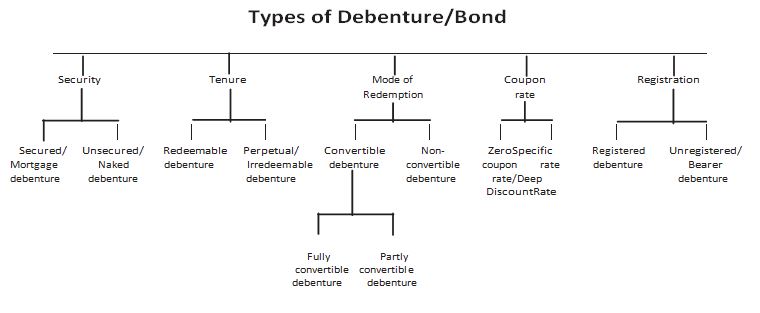
Types of Debentures
| Type | Meaning and key points |
|---|---|
| Secured | A charge on company assets supports payment if the company defaults. A fixed charge covers a specific asset used in operations and not held for sale; a floating charge covers general assets, excluding assets assigned to secured creditors. |
| Unsecured | No specific charge is created on company assets. A floating charge may arise on default; these debentures are not normally issued. |
| Type | Meaning and key points |
|---|---|
| Redeemable | Repayable after a specified period, either in a lump sum or in instalments during the company’s life. Redemption may be at par or at a premium. |
| Irredeemable (perpetual) | No repayment undertaking is given for a specified period; repayment is on winding-up or after a long period, as applicable. |
| Type | Meaning and key points |
|---|---|
| Convertible | May convert into equity shares or another security at the option of the company or debentureholders. They may be fully or partly convertible. |
| Non-convertible | Cannot be converted into shares or other securities; most company debentures are of this type. |
| Type | Meaning and key points |
|---|---|
| Registered | The company records holders’ names, addresses and holdings in a register. Transfer requires a regular transfer deed. |
| Bearer | Transferred by delivery, with no holder record kept by the company. Interest is paid to the person presenting the attached interest coupon. |
Quick recap
- Debentures are written acknowledgements of company debt under the company’s common seal and form borrowed capital.
- They provide for repayment under the issue terms and carry interest at a fixed rate; interest is a charge on profits, unlike dividends.
- Shares represent ownership; debentures generally represent debt and are repayable.
- Debentures are classified by security, tenure, convertibility and registration.
- Registered debentures need a transfer deed; bearer debentures transfer by delivery.
Issue of Debentures
Overview of Debenture Issue
Issue of debentures — A company invites investors to apply under its prospectus and collects the amount according to the stated payment terms.
The procedure for issuing debentures is the same as the procedure for issuing shares. Payment may be collected in one amount or in instalments; debentures may be issued at par, premium or discount, for consideration other than cash, or as collateral security.
Payment Stages
- Instalments: Amounts may be payable on application, allotment and subsequent calls.
- Usual practice: The full amount is commonly collected on application or in two instalments—application and allotment.
Issue of Debentures for Cash at Par
Issue at par — Debentures are issued at par when their issue price equals their face value.
Accounting Rules
- Application received: Debit Bank; credit Debenture Application (or Application & Allotment) Account.
- Application transferred: On allotment, debit Debenture Application and credit Debentures.
- Amount due: Debit Allotment or the relevant Call Account; credit Debentures.
- Amount received: Debit Bank and credit the relevant Allotment or Call Account.
Use the number of debentures actually allotted.
| Event | Debit | Credit |
|---|---|---|
| Whole amount received in one instalment | Bank A/c | Debenture Application & Allotment A/c |
| Transfer application money on allotment | Debenture Application & Allotment A/c | Debentures A/c |
| Application received in instalments | Bank A/c | Debenture Application A/c |
| Transfer application money on allotment | Debenture Application A/c | Debentures A/c |
| Allotment / call becomes due | Debenture Allotment / Call A/c | Debentures A/c |
| Allotment / call money received | Bank A/c | Debenture Allotment / Call A/c |
Recording an Issue at Par
- Calculate each instalment using the number allotted.$$\text{Instalment total}=\text{Number allotted}\times\text{Instalment per debenture}$$
- Record cash received and transfer application money to Debentures when allotment is made.$$\text{Application total}=\text{Number allotted}\times\text{Application per debenture}$$
- Record each subsequent amount due and its receipt separately.$$\text{Amount due}=\text{Number allotted}\times\text{Amount per debenture}$$
Prepare the journal entries and relevant balance-sheet amounts for ABC Ltd.’s issue.
- ABC Ltd. issues 10,000 12% debentures of Rs. 100 each; 9,000 are applied for and allotted. Rs. 30 is payable on application and the balance on allotment.$$9{,}000\times \text{Rs. }30=\text{Rs. }2{,}70{,}000;\quad 9{,}000\times \text{Rs. }70=\text{Rs. }6{,}30{,}000$$
- Record application money received and transfer it to Debentures on allotment.$$\text{Bank Dr. }\text{Rs. }2{,}70{,}000;\quad \text{Debenture Application Dr. }\text{Rs. }2{,}70{,}000$$
- Record allotment due and received; the total debenture liability and cash at bank are each Rs. 9,00,000.$$\text{Allotment due} = \text{receipt}=\text{Rs. }6{,}30{,}000;\quad 9{,}000\times \text{Rs. }100=\text{Rs. }9{,}00{,}000$$
Issue of Debentures at a Discount
Issue at a discount — Debentures are issued at a discount when their issue price is below their face value.
Accounting, Write-off and Presentation
- Example: A Rs. 100 debenture issued for Rs. 95 has a discount of Rs. 5.
- Amount due: Debit the cash instalment receivable and Discount on Issue of Debentures; credit Debentures for the full face value due.
- Write-off: The discount may be written off against Securities Premium Reserve, if available, or charged to the Statement of Profit and Loss during the debentures’ life.
- Balance sheet: The portion due to be written off within 12 months of the balance-sheet date or operating cycle is shown under Other Current Assets; the later portion is shown under Other Non-Current Assets.
- Legal point: The Companies Act, 2013 does not restrict the issue of debentures at a discount.
Debentures are credited at face value, not at the cash received.
| Event | Debit | Credit |
|---|---|---|
| Application received | Bank A/c | Debenture Application A/c |
| Application transferred on allotment | Debenture Application A/c | Debentures A/c |
| Allotment due | Debenture Allotment A/c and Discount on Issue of Debentures A/c | Debentures A/c (full face value due) |
| Allotment received | Bank A/c | Debenture Allotment A/c |
| Discount written off | Securities Premium Reserve A/c or Statement of Profit and Loss A/c | Discount on Issue of Debentures A/c |
Recording an Issue at a Discount
- Calculate total face value, discount and cash proceeds.$$\text{Cash proceeds}=\text{Total face value}-\text{Total discount}$$
- Record application receipts and transfer application money to Debentures on allotment.$$\text{Application cash}=\text{Number issued}\times\text{Application per debenture}$$
- When the remaining face value is due, debit the cash instalment and discount; credit Debentures for the full amount due.$$\text{Face value due}=\text{Allotment cash} + \text{Discount allocated to allotment}$$
- Record the receipt, then write off the discount to the appropriate account.$$\text{Discount written off} \rightarrow \text{Securities Premium Reserve or Statement of Profit and Loss}$$
Prepare the journal entries and relevant balance-sheet items for TV Components Ltd.’s issue.
- TV Components Ltd. issues 10,000 12% debentures of Rs. 100 each at a 5% discount. Rs. 40 is payable on application and Rs. 55 on allotment.$$\text{Face value}=10{,}000\times\text{Rs. }100=\text{Rs. }10{,}00{,}000;\quad \text{discount}=10{,}000\times\text{Rs. }5=\text{Rs. }50{,}000$$
- Application cash is Rs. 4,00,000; allotment cash is Rs. 5,50,000. On allotment, the remaining face value of Rs. 6,00,000 comprises cash of Rs. 5,50,000 and discount of Rs. 50,000.$$10{,}000\times\text{Rs. }40=\text{Rs. }4{,}00{,}000;\quad 10{,}000\times\text{Rs. }55=\text{Rs. }5{,}50{,}000;\quad \text{Rs. }5{,}50{,}000+\text{Rs. }50{,}000=\text{Rs. }6{,}00{,}000$$
- Total cash received is Rs. 9,50,000. The discount is written off to the Statement of Profit and Loss in this presentation; the debentures are presumed redeemable after 10 years.$$\text{Bank}=\text{Rs. }4{,}00{,}000+\text{Rs. }5{,}50{,}000=\text{Rs. }9{,}50{,}000;\quad \text{Debentures}=\text{Rs. }10{,}00{,}000$$
A company issues 2,000 debentures of Rs. 100 each at par. Rs. 25 is payable on application and the balance on allotment. All amounts are received. Find the instalment totals and final bank and debenture balances.
A company issues 500 debentures of Rs. 100 each at a 4% discount. Rs. 30 per debenture is payable on application and Rs. 66 on allotment. All amounts are received. Give the allotment-due entry and calculate total cash proceeds.
Quick recap
- Procedure: Debentures are issued through a process like shares; applications follow the prospectus.
- Issue terms: Payment may be in one amount or instalments; issue may be at par, premium or discount.
- At par: Face value equals issue price; credit Debentures for the amount due.
- At discount: Debit the discount and credit Debentures at full face value; cash proceeds are lower.
- Write-off: Discount may be charged to Securities Premium Reserve or Statement of Profit and Loss.
- Presentation: Unwritten-off discount is classified as current or non-current according to when it is to be written off.
Debentures issued at Premium
Meaning and Accounting Treatment
Use these to split total receipts between debenture capital and premium.
Recording an issue at premium
- Calculate the total nominal value, premium, and instalment amounts.$$N\times\text{amount per debenture}$$
- When application money is received, debit Bank and credit Debenture Application.$$\text{Bank A/c Dr.}\quad\text{To Debenture Application A/c}$$
- Transfer application money to Debentures A/c, if it is applied to nominal value.$$\text{Debenture Application A/c Dr.}\quad\text{To Debentures A/c}$$
- When an instalment is due, credit Debentures A/c for its nominal-value part and Securities Premium Reserve for its premium part.$$\text{Instalment A/c Dr.}\quad\text{To Debentures A/c}\quad\text{To Securities Premium Reserve A/c}$$
- On receipt of each instalment, debit Bank and credit the relevant instalment account.$$\text{Bank A/c Dr.}\quad\text{To Instalment A/c}$$
Record the journal entries and show the relevant balance sheet amounts.
- A Limited issues 5,000 debentures of ₹100 each at a premium of ₹10 each. Application is ₹25, allotment is ₹45 (including premium), and the first and final call is ₹40. All amounts are received.$$N=5{,}000$$
- Find the total nominal value, premium, and proceeds.$$\text{Nominal value}=5{,}000\times₹100=₹500{,}000;\quad \text{Premium}=5{,}000\times₹10=₹50{,}000;\quad \text{Proceeds}=₹550{,}000$$
- Split the allotment: ₹35 per debenture is nominal value and ₹10 is premium.$$₹45-₹10=₹35;\quad 5{,}000\times₹35=₹175{,}000;\quad 5{,}000\times₹10=₹50{,}000$$
- Calculate receipts at each stage.$$\text{Application}=5{,}000\times₹25=₹125{,}000;\quad \text{Allotment}=5{,}000\times₹45=₹225{,}000;\quad \text{Call}=5{,}000\times₹40=₹200{,}000$$
| Particulars | Debit | Credit |
|---|---|---|
| Bank A/c Dr. | To 10% Debenture Application A/c | 125,000 | 125,000 |
| 10% Debenture Application A/c Dr. | To 10% Debentures A/c | 125,000 | 125,000 |
| 10% Debenture Allotment A/c Dr. | To 10% Debentures A/c | To Securities Premium Reserve A/c | 225,000 | 175,000; 50,000 |
| Bank A/c Dr. | To 10% Debenture Allotment A/c | 225,000 | 225,000 |
| 10% Debenture First and Final Call A/c Dr. | To 10% Debentures A/c | 200,000 | 200,000 |
| Bank A/c Dr. | To 10% Debenture First and Final Call A/c | 200,000 | 200,000 |
| Particulars | Amount (₹) |
|---|---|
| Equity and Liabilities — Reserves and Surplus: Securities Premium Reserve | 50,000 |
| Non-current liabilities — Long-term borrowings: 5,000 debentures of ₹100 each | 500,000 |
| Total | 550,000 |
| Assets — Current assets: Cash and cash equivalents | 550,000 |
A company issues 2,000 debentures of ₹100 each at a premium of ₹10. Application is ₹50 and allotment is ₹60, including the premium. Find the amount due at each stage and the balance sheet amounts.
A company issues 1,000 debentures of ₹100 each at a premium of ₹5. Application is ₹40 and allotment is ₹65, including premium. Find the premium reserve and total proceeds.
Do not add the premium to the debenture liability: credit it separately to Securities Premium Reserve, while debentures appear at nominal value.
Quick recap
- A debenture is issued at a premium when its issue price exceeds its nominal value.
- Credit premium due to Securities Premium Reserve.
- Show debentures at nominal value under long-term borrowings.
- Split each instalment due between nominal value and premium, as applicable.
- Total cash received equals total nominal value plus total premium.
Over Subscription
Over-Subscription of Debentures
Issue of Debentures for Consideration Other than Cash
| Particulars | Debit (Rs.) | Credit (Rs.) |
|---|---|---|
| Bank A/c Dr. — To 12% Debenture Application A/c | 5,60,000 | 5,60,000 |
| 12% Debenture Application A/c Dr. — To 12% Debentures A/c — To Debenture Allotment A/c — To Bank A/c | 5,60,000 | 4,00,000; 40,000; 1,20,000 |
| 12% Debenture Allotment A/c Dr. — To 12% Debentures A/c | 6,00,000 | 6,00,000 |
| Bank A/c Dr. — To Debenture Allotment A/c | 5,60,000 | 5,60,000 |
| Particulars | Debit (Rs.) | Credit (Rs.) |
|---|---|---|
| Sundry Assets A/c Dr. — To Vendor’s A/c | 2,00,000 | 2,00,000 |
| Vendor’s A/c Dr. — To 10% Debentures A/c | 2,00,000 | 2,00,000 |
A company offered 900 debentures of Rs. 100 each, payable Rs. 20 on application and Rs. 80 on allotment. It received 1,200 applications: 800 were accepted in full, 200 applications received 100 debentures, and 200 applications were rejected. Find the application-money transfer, adjustment, refund, and net allotment receipt.
A company purchases assets for Rs. 2,20,000 and settles the amount by issuing 2,000 debentures of Rs. 100 each at a premium of 10%. State the journal entry for the issue.
Quick recap
- Over-subscription means applications exceed the number of debentures offered.
- Allot no more than the offer; refund application money for wholly rejected applications.
- Excess application money may be adjusted against allotment or calls due.
- For a non-cash asset purchase, debit assets and credit the vendor before settlement.
- On settlement, credit debentures at nominal value and record any premium or discount separately.
Illustration 7 based on Journal entries
Purchasing Assets by Issuing Debentures
Purchase consideration — The agreed amount payable to the vendor for assets or a business purchased.
Basic entries
- Purchase: Debit Sundry Assets A/c and credit Vendors A/c with the purchase consideration.
- Settlement: Debit Vendors A/c; credit Debentures A/c at face value, recording any premium or discount separately.
- Balance: The total debits and credits in each journal entry must be equal.
Premium or discount is calculated on the debentures’ total face value.
| Point | At par | At discount | At premium |
|---|---|---|---|
| Issue value | Equals face value | Below face value | Above face value |
| Additional account | None | Debit Discount on Issue of Debentures A/c | Credit Securities Premium Reserve A/c |
| Settlement entry | Vendors Dr.; Debentures Cr. | Vendors Dr. and Discount Dr.; Debentures Cr. | Vendors Dr.; Debentures and Securities Premium Reserve Cr. |
Recording an asset purchase settled by debentures
- Record the assets acquired and the amount payable to Vendors.$$\text{Sundry Assets Dr.} = \text{Vendors Cr.}$$
- Calculate the debentures’ total face value and the premium or discount.$$\text{Face value} = \text{Number of debentures} \times \text{Face value per debenture}$$
- Settle the Vendors balance; include premium as a credit or discount as a debit.$$\text{Vendors Dr.} = \text{Debentures Cr.} + \text{Premium Cr.} - \text{Discount Dr.}$$
Rai Company purchased assets valued at Rs. 2,20,000 and issued 2,000 10% debentures of Rs. 100 each at a 10% premium. Record the entries.
- Find the total face value of 2,000 debentures of Rs. 100 each.$$2{,}000 \times 100 = \text{Rs. }2{,}00{,}000$$
- Calculate the 10% premium; the issue value equals the purchase consideration.$$10\% \times 2{,}00{,}000 = \text{Rs. }20{,}000;\quad 2{,}00{,}000 + 20{,}000 = \text{Rs. }2{,}20{,}000$$
- Record the asset purchase and then settle Vendors with debentures and premium.$$\text{Purchase consideration} = \text{Rs. }2{,}20{,}000$$
| Particulars | Debit (Rs.) | Credit (Rs.) |
|---|---|---|
| Sundry Assets A/c Dr. | 2,20,000 | |
| To Vendors A/c | 2,20,000 | |
| Vendors A/c Dr. | 2,20,000 | |
| To 10% Debentures A/c | 2,00,000 | |
| To Securities Premium Reserve A/c | 20,000 |
| Particulars | Debit (Rs.) | Credit (Rs.) |
|---|---|---|
| Sundry Assets A/c Dr. | 1,90,000 | |
| To Vendors A/c | 1,90,000 | |
| Vendors A/c Dr. | 1,90,000 | |
| Discount on Issue of Debentures A/c Dr. | 10,000 | |
| To 10% Debentures A/c | 2,00,000 |
| Case / Particulars | Debit (Rs.) | Credit (Rs.) |
|---|---|---|
| Purchase: Sundry Assets A/c Dr. | 99,000 | |
| To Vendors A/c | 99,000 | |
| At par: Vendors A/c Dr. | 99,000 | |
| To 11% Debentures A/c (990 debentures) | 99,000 | |
| At 10% discount: Vendors A/c Dr. | 99,000 | |
| Discount on Issue of Debentures A/c Dr. | 11,000 | |
| To 11% Debentures A/c (1,100 debentures) | 1,10,000 | |
| At 10% premium: Vendors A/c Dr. | 99,000 | |
| To 11% Debentures A/c (900 debentures) | 90,000 | |
| To Securities Premium Reserve A/c | 9,000 |
Do not treat purchase consideration as the debentures’ face value when they are issued at a discount or premium. Calculate the face value needed to give the agreed consideration at the issue price.
Purchase of a Business and Assumption of Liabilities
Net assets — The value of assets taken over less the liabilities assumed.
When a business is purchased and its liabilities are taken over, consideration is based on net assets.
| Particulars | Debit | Credit |
|---|---|---|
| Sundry Assets A/c Dr. | Value of assets taken over | |
| To Sundry Liabilities A/c | Value of liabilities taken over | |
| To Vendors A/c | Purchase consideration |
National Packaging Company purchased assets valued at Rs. 1,90,000 and issued 2,000 debentures of Rs. 100 each at a 5% discount. Record the entries.
G.S. Rai Company purchased assets valued at Rs. 99,000, settling the consideration with Rs. 100 debentures at par, at a 10% discount, or at a 10% premium. State the debenture amount and settlement entry for each case.
Quick recap
- For an asset purchase, debit Sundry Assets and credit Vendors with the purchase consideration.
- On settlement, debit Vendors; credit debentures at face value and record discount or premium separately.
- At a discount, debit Discount on Issue of Debentures; at a premium, credit Securities Premium Reserve.
- For Rs. 99,000 consideration, Rs. 100 debentures require 990 at par, 1,100 at a 10% discount, or 900 at a 10% premium.
- For a business purchase with liabilities assumed, consideration equals assets taken over less liabilities taken over.
- The business purchase entry debits assets and credits liabilities assumed and Vendors.
Illustration 10 based on Journal entries
Taking Over a Business and Settling the Purchase Consideration
| Particulars | Debit (Rs.) | Credit (Rs.) |
|---|---|---|
| Building A/c Dr. | 1,50,000 | |
| Plant & Machinery A/c Dr. | 1,40,000 | |
| Furniture A/c Dr. | 10,000 | |
| Goodwill A/c Dr. | 35,000 | |
| To Liabilities of XYZ Co. | 20,000 | |
| To XYZ Co. | 3,15,000 | |
| XYZ Co. Dr. | 3,15,000 | |
| To 12% Debentures A/c | 3,00,000 | |
| To Securities Premium Reserve A/c | 15,000 |
Use the issue price per debenture, not its face value, in the denominator.
| Case | Purchase entry | Settlement entry |
|---|---|---|
| Romi Ltd.: assets Rs. 20,00,000; creditors Rs. 2,00,000; consideration Rs. 18,00,000 | Sundry Assets A/c Dr. Rs. 20,00,000; To Kapil Enterprises Rs. 18,00,000; To Sundry Creditors A/c Rs. 2,00,000 | Kapil Enterprises Dr. Rs. 18,00,000; To 8% Debentures A/c Rs. 18,00,000. Issue 18,000 debentures of Rs. 100 each at par. |
| A Ltd.: assets Rs. 3,00,000; liabilities Rs. 10,000; consideration Rs. 2,70,000 | Sundry Assets A/c Dr. Rs. 3,00,000; To Sundry Liabilities A/c Rs. 10,000; To B & Co. Ltd. Rs. 2,70,000; To Capital Reserve Rs. 20,000 | B & Co. Ltd. Dr. Rs. 2,70,000; To 15% Debentures A/c Rs. 2,25,000; To Securities Premium Reserve A/c Rs. 45,000. Issue 2,250 debentures of Rs. 100 at 20% premium. |
Debentures Issued to Settle an Asset Purchase
The percentage discount or premium is calculated on face value.
Record an asset purchase settled by debentures
- Record the asset purchase: debit the asset and credit the supplier.$$\text{Asset A/c Dr.} \quad \text{To Supplier A/c}$$
- Calculate the debenture issue price and divide the amount due to the supplier by that price.$$\text{Number issued} = \frac{\text{Amount due}}{\text{Issue price per debenture}}$$
- Debit the supplier; credit Debentures A/c at face value and record discount or premium separately.$$\text{Supplier A/c Dr.} + \text{Discount A/c Dr.} = \text{Debentures A/c Cr.} + \text{Premium Reserve A/c Cr.}$$
Record the machinery purchase and debenture issue at 10% discount.
- Suvidha Ltd. owes Suppliers Ltd. Rs. 1,98,000 for machinery and issues Rs. 100 debentures at 10% discount. Find the number and face value of debentures.$$\text{Issue price}=100-10=\text{Rs. }90$$
- Divide the amount due by the issue price to find the number issued.$$\frac{1,98,000}{90}=2,200\text{ debentures}$$
- The debentures’ aggregate face value is 2,200 × Rs. 100.$$2,200\times 100=\text{Rs. }2,20,000$$
- The discount is the difference between face value and amount due.$$2,20,000-1,98,000=\text{Rs. }22,000$$
| Case | Particulars | Debit (Rs.) | Credit (Rs.) |
|---|---|---|---|
| Purchase | Machinery A/c Dr. / To Suppliers Ltd. | 1,98,000 | 1,98,000 |
| Issue at par | Suppliers Ltd. Dr. / To 12% Debentures A/c | 1,98,000 | 1,98,000 |
| Issue at 10% discount | Suppliers Ltd. Dr.; Discount on Issue of Debentures A/c Dr. / To 12% Debentures A/c | 1,98,000; 22,000 | 2,20,000 |
| Issue at 10% premium | Suppliers Ltd. Dr. / To 12% Debentures A/c; To Securities Premium Reserve A/c | 1,98,000 | 1,80,000; 18,000 |
Suvidha Ltd. — Debenture calculations
- At par: Rs. 1,98,000 ÷ Rs. 100 = 1,980 debentures.
- At 10% discount: issue price Rs. 90; Rs. 1,98,000 ÷ Rs. 90 = 2,200 debentures, face value Rs. 2,20,000.
- At 10% premium: issue price Rs. 110; Rs. 1,98,000 ÷ Rs. 110 = 1,800 debentures, face value Rs. 1,80,000.
Do not use face value to calculate the number of debentures when they are issued at a discount or premium; divide the amount due by the issue price per debenture.
Romi Ltd. takes over assets of Rs. 20,00,000 and creditors of Rs. 2,00,000. It issues Rs. 100 debentures at par for the purchase consideration. Find the consideration and number issued, and state the entries.
A Ltd. takes over assets of Rs. 3,00,000 and liabilities of Rs. 10,000 for Rs. 2,70,000, settled by Rs. 100 debentures at 20% premium. Find the capital reserve and debentures issued.
Quick recap
- Net assets taken over = assets − liabilities assumed.
- Excess purchase consideration over net assets is debited to Goodwill; an excess of net assets is credited to Capital Reserve.
- When debentures settle a vendor’s account, debit the vendor and credit debentures at face value.
- At discount, debit Discount on Issue of Debentures; at premium, credit Securities Premium Reserve.
- Calculate the number issued using amount due ÷ issue price per debenture.
Issue of Debentures as a Collateral Security
Meaning and Purpose
Accounting Treatment
Method 1: No Journal Entry
Method 2: Journal Entry
| Transaction | Debit | Credit |
|---|---|---|
| Issue of 10,000 debentures of ₹100 each as collateral security | Debenture Suspense Account ₹10,00,000 | Debentures Account ₹10,00,000 |
| Cancellation after repayment of the loan | Debentures Account ₹10,00,000 | Debenture Suspense Account ₹10,00,000 |
A company issues 10,000 debentures of ₹100 each as collateral security for a bank loan of ₹10,00,000. Record the issue and cancellation under Method 2.
- Calculate the face value of the collateral debentures.$$10{,}000 \times ₹100 = ₹10{,}00{,}000$$
- Record the issue using Debenture Suspense Account.$$\text{Dr Debenture Suspense Account } ₹10{,}00{,}000;\quad \text{Cr Debentures Account } ₹10{,}00{,}000$$
- When the bank loan is repaid, cancel the entry by reversing it.$$\text{Dr Debentures Account } ₹10{,}00{,}000;\quad \text{Cr Debenture Suspense Account } ₹10{,}00{,}000$$
Do not treat collateral debentures as a cash issue. Under Method 2, the debit is to Debenture Suspense Account, not Bank Account; on repayment, reverse the original entry.
Quick recap
- Collateral security is additional security given over and above the primary security for a loan.
- If the borrower defaults, the lender first realises the primary security and may then use or sell the collateral debentures.
- Method 1: make no journal entry and disclose the loan’s collateral security in the balance sheet.
- Method 2: debit Debenture Suspense Account and credit Debentures Account when the debentures are issued.
- On repayment of the loan under Method 2, reverse the original entry.
Illustration 14 based on Issue of Debentures
Debentures Issued as Collateral Security
Quick recap
- Collateral debentures are additional security for a loan, not a separate cash receipt.
- First method: no journal entry; disclose the security against the loan.
- Second method: debit Debenture Suspense and credit Debentures at face value.
- Under the second method, deduct Debenture Suspense from the debentures in the balance-sheet note.
- The loan shown remains the amount borrowed.
Terms of Issue of Debentures
Meaning and terms of issue
Journal entries for the six issue and redemption combinations
Accounting treatment of redemption premium
Do not debit Discount on Issue separately when debentures are issued at a discount and redeemable at a premium: both the issue discount and redemption premium are debited to Loss on Issue of Debentures.
Quick recap
- Issue proceeds equal nominal value less discount or plus issue premium.
- Debentures A/c is credited at nominal value on allotment.
- Issue premium is credited to Securities Premium Reserve.
- Redemption premium is credited to Premium on Redemption of Debentures and debited to Loss on Issue.
- For discount issue with premium redemption, Loss on Issue includes both amounts.
- Premium on Redemption is a long-term liability until the debentures are redeemed.
Illustration 15 based on Journal entries
Recording Debenture Issue at Different Prices
Do not treat issue premium and redemption premium as the same item: issue premium is credited to Securities Premium Reserve, while redemption premium is a future liability. When both apply, include both in the transfer entry.
Quick recap
- At par, cash received equals the face value of the debentures.
- Issue premium is credited to Securities Premium Reserve A/c.
- Issue discount is debited to Discount on Issue of Debentures A/c.
- Redemption premium is credited to Premium on Redemption of Debentures A/c.
- Discount on issue and premium on redemption both contribute to loss on issue.
- Check every journal entry by ensuring total debits equal total credits.
Illustration 16 based on Issue of Debentures
Issue terms and accounting treatment
Issue and redemption terms — The issue price is the amount received per debenture; the redemption amount is what the company repays at maturity.
Key rules
- At par: Issue price equals face value.
- At discount: Cash received is below face value; the discount is a loss on issue.
- At premium: Cash received exceeds face value; credit the excess to Securities Premium Reserve.
- Redeemable at premium: The extra amount payable is a liability and contributes to the loss on issue.
Calculate these amounts before recording the issue entries.
Write off the loss against available Securities Premium Reserve first; charge any uncovered amount to Statement of Profit and Loss.
Prepare the debenture issue entries
- Calculate total face value, issue discount or premium, and any redemption premium.$$\text{Face value}=N\times F$$
- Record cash received by debiting Bank and crediting Debenture Application and Allotment.
- On transfer, credit Debentures with face value; record issue premium and redemption premium separately.
- Debit Loss on Issue for issue discount and any redemption premium.
- Write off the loss using Securities Premium Reserve first, then Statement of Profit and Loss if needed.
Calculate proceeds and loss for 150 debentures of Rs. 1,000 each issued at 5% discount and redeemable at 10% premium, with Securities Premium Reserve of Rs. 20,000.
- Find the face value of 150 debentures of Rs. 1,000 each.$$150\times 1{,}000=\text{Rs. }1{,}50{,}000$$
- Calculate the issue discount and redemption premium.$$\text{Discount}=1{,}50{,}000\times 5\%=\text{Rs. }7{,}500;\quad \text{redemption premium}=1{,}50{,}000\times 10\%=\text{Rs. }15{,}000$$
- Calculate cash proceeds and total loss on issue.$$\text{Proceeds}=1{,}50{,}000-7{,}500=\text{Rs. }1{,}42{,}500;\quad \text{loss}=7{,}500+15{,}000=\text{Rs. }22{,}500$$
- Use the Rs. 20,000 reserve first; charge the remaining loss to Statement of Profit and Loss.$$22{,}500-20{,}000=\text{Rs. }2{,}500$$
Journal entries in Illustration 16
| Particulars | Debit (Rs.) | Credit (Rs.) |
|---|---|---|
| Bank A/c Dr. | To Debenture Application and Allotment A/c | 1,14,000 | 1,14,000 |
| Debenture Application and Allotment A/c Dr. | Loss on Issue of Debentures A/c Dr. | To 8% Debentures A/c | 1,14,000 | 6,000 | 1,20,000 |
| Securities Premium Reserve A/c Dr. | To Loss on Issue of Debentures A/c | 6,000 | 6,000 |
| Particulars | Debit (Rs.) | Credit (Rs.) |
|---|---|---|
| Bank A/c Dr. | To Debenture Application and Allotment A/c | 1,42,500 | 1,42,500 |
| Debenture Application and Allotment A/c Dr. | Loss on Issue of Debentures A/c Dr. | To 7% Debentures A/c | To Premium on Redemption of Debentures A/c | 1,42,500 | 22,500 | 1,50,000 | 15,000 |
| Securities Premium Reserve A/c Dr. | Statement of Profit and Loss A/c Dr. | To Loss on Issue of Debentures A/c | 20,000 | 2,500 | 22,500 |
| Particulars | Debit (Rs.) | Credit (Rs.) |
|---|---|---|
| Bank A/c Dr. | To Debenture Application and Allotment A/c | 84,000 | 84,000 |
| Debenture Application and Allotment A/c Dr. | To 9% Debentures A/c | To Securities Premium Reserve A/c | 84,000 | 80,000 | 4,000 |
Debentures issued as collateral security
Collateral security — Debentures issued as collateral security provide additional security for a loan; they do not provide separate cash proceeds.
Pass the entry for 400, 8% debentures of Rs. 100 each issued as collateral security against a loan of Rs. 40,000.
- Calculate the nominal value of 400 debentures of Rs. 100 each.$$400\times 100=\text{Rs. }40{,}000$$
- Record the debentures given as security for the Rs. 40,000 loan.$$\text{Debenture Suspense A/c Dr. }\text{ Rs. }40{,}000$$
In case (a), the issue loss is Rs. 6,000, so only Rs. 6,000 is written off—not Rs. 8,000. In case (b), use 7% Debentures, as stated in the question; an 8% label in the printed journal is a typo.
A company issues 1,000 debentures of Rs. 100 each at par and redeemable at par. Find the proceeds and issue entry.
A company issues 2,000 debentures of Rs. 100 each at 10% premium, redeemable at par. Calculate proceeds and the issue credits.
A company issues 500 debentures of Rs. 100 each at 5% discount and redeems them at 4% premium. Find proceeds and loss on issue.
Quick recap
- Issue proceeds = face value less issue discount plus issue premium.
- Loss on issue = issue discount plus any premium payable on redemption.
- Issue premium is credited to Securities Premium Reserve; redemption premium is recorded as a liability.
- Write off loss against Securities Premium Reserve first, then Statement of Profit and Loss.
- Case (a): the Rs. 6,000 discount is fully covered by the Rs. 10,000 reserve.
- Collateral debentures are recorded by debiting Debenture Suspense A/c and crediting Debentures A/c.
Interest on Debentures
Meaning and key features
Calculation and accounting treatment
Calculate interest on nominal value, not on issue price. For a half-yearly payment:
| Event | Debit | Credit |
|---|---|---|
| Interest becomes due | Debenture Interest A/c | Income Tax Payable A/c (TDS); Debentureholders A/c (net interest) |
| Net interest paid | Debentureholders A/c | Bank A/c |
| TDS paid to government | Income Tax Payable A/c | Bank A/c |
| Interest transferred to profit and loss | Statement of Profit and Loss A/c | Debenture Interest A/c |
Recording interest and TDS
- Find interest for the payment period using nominal value and the annual rate.$$\text{Interest}=\text{Nominal value}\times\text{rate}\times\frac{\text{period in months}}{12}$$
- Calculate TDS on the interest due; the remainder is payable to debentureholders.$$\text{Net interest}=\text{Interest due}-\text{TDS}$$
- Credit TDS payable and debentureholders when interest becomes due.
- Record separate bank payments for the net interest and TDS.
- At the end of the accounting period, transfer total debenture interest to the Statement of Profit and Loss.
Prepare the journal entries for the issue and interest for the year ending 31 March 2017, assuming TDS is 10% and interest is paid half-yearly.
- A Ltd. issues 2,000 debentures of ₹100 each at a 10% discount, redeemable at a 10% premium. Find issue figures and half-yearly interest at 10%.$$2{,}000\times ₹100=₹2{,}00{,}000\text{ nominal value}$$
- Calculate cash received and the loss on issue (discount plus redemption premium).$$\text{Cash}=₹2{,}00{,}000-₹20{,}000=₹1{,}80{,}000;\quad \text{Loss}=₹20{,}000+₹20{,}000=₹40{,}000$$
- Calculate each half-year’s interest, TDS at 10%, and net payment.$$\text{Interest}=₹2{,}00{,}000\times10\%\times\frac{6}{12}=₹10{,}000;\quad \text{TDS}=₹1{,}000;\quad \text{Net}=₹9{,}000$$
- For two half-years, transfer total interest of ₹20,000 to the Statement of Profit and Loss.$$2\times ₹10{,}000=₹20{,}000$$
| Date / transaction | Debit account(s) | Debit (₹) | Credit account(s) | Credit (₹) |
|---|---|---|---|---|
| 1 Apr 2016 — money received | Bank A/c | 1,80,000 | Debenture Application and Allotment A/c | 1,80,000 |
| 1 Apr 2016 — issue at discount, redeemable at premium | Debenture Application and Allotment A/c; Loss on Issue of Debentures A/c | 1,80,000; 40,000 | 10% Debentures A/c; Premium on Redemption of Debentures A/c | 2,00,000; 20,000 |
| 30 Sep 2016 — interest due; TDS deducted | Debenture Interest A/c | 10,000 | Debentureholders A/c; Income Tax Payable A/c | 9,000; 1,000 |
| 30 Sep 2016 — TDS paid | Income Tax Payable A/c | 1,000 | Bank A/c | 1,000 |
| 30 Sep 2016 — net interest paid | Debentureholders A/c | 9,000 | Bank A/c | 9,000 |
| 31 Mar 2017 — interest due; TDS deducted | Debenture Interest A/c | 10,000 | Debentureholders A/c; Income Tax Payable A/c | 9,000; 1,000 |
| 31 Mar 2017 — net interest paid | Debentureholders A/c | 9,000 | Bank A/c | 9,000 |
| 31 Mar 2017 — TDS paid | Income Tax Payable A/c | 1,000 | Bank A/c | 1,000 |
| 31 Mar 2017 — interest transferred to profit and loss | Statement of Profit and Loss A/c | 20,000 | Debenture Interest A/c | 20,000 |
Do not calculate interest on the discounted issue price: interest is calculated on nominal value. Also, credit Income Tax Payable for TDS; only the net amount is credited to Debentureholders.
A company has ₹10,00,000 of 6% debentures. Interest is paid half-yearly and TDS is 10%. Find the interest, TDS and net payment for each half-year.
A company issues 7,00,000 debentures of ₹100 each, carrying 8% interest. Interest is paid half-yearly; TDS is 10%. Calculate the half-yearly interest, TDS and net payment.
Quick recap
- Debenture interest is fixed, periodic, and calculated on nominal value.
- Interest is a charge against profit and is payable whether or not profit is earned.
- TDS is deducted from interest due and credited to Income Tax Payable.
- Debentureholders receive interest net of TDS; the company deposits TDS with the government.
- Transfer the period’s total Debenture Interest to the Statement of Profit and Loss.
Writing off Discount/Loss on Issue of Debentures
Meaning and Treatment of Discount or Loss
Use the reserve up to its available balance; charge any balance to profit and loss.
| Account | Debit | Credit |
|---|---|---|
| Securities Premium Reserve A/c (up to available balance) | Dr. | |
| Statement of Profit and Loss A/c (remaining loss, if any) | Dr. | |
| To Discount/Loss on Issue of Debentures A/c | Total loss written off |
Rohit Ltd. issues 50,000 debentures of Rs. 100 each at 9% discount, redeemable at a 7% premium. Securities Premium Reserve is Rs. 5,00,000. Calculate the loss and its write-off.
- Find the face value of 50,000 debentures of Rs. 100 each.$$50{,}000 \times 100 = \text{Rs. }50{,}00{,}000$$
- Calculate the issue discount and redemption premium.$$\text{Discount} = 50{,}00{,}000 \times 9\% = \text{Rs. }4{,}50{,}000;\quad \text{redemption premium} = 50{,}00{,}000 \times 7\% = \text{Rs. }3{,}50{,}000$$
- Add both amounts to obtain the loss on issue.$$\text{Total loss} = 4{,}50{,}000 + 3{,}50{,}000 = \text{Rs. }8{,}00{,}000$$
- Use the Rs. 5,00,000 reserve first; charge the balance to profit and loss.$$\text{P\&L charge} = 8{,}00{,}000 - 5{,}00{,}000 = \text{Rs. }3{,}00{,}000$$
| Particulars | Debit (Rs.) | Credit (Rs.) |
|---|---|---|
| Bank A/c Dr. — application money received | 45,50,000 | |
| To Debenture Application and Allotment A/c | 45,50,000 | |
| Debenture Application and Allotment A/c Dr. | 45,50,000 | |
| Loss on Issue of Debentures A/c Dr. | 8,00,000 | |
| To 8% Debentures A/c | 50,00,000 | |
| To Premium on Redemption of Debentures A/c | 3,50,000 | |
| Securities Premium Reserve A/c Dr. | 5,00,000 | |
| Statement of Profit and Loss A/c Dr. | 3,00,000 | |
| To Loss on Issue of Debentures A/c | 8,00,000 |
Application of the Rule
- Available reserve: If the loss is less than the reserve, write off the full loss from Securities Premium Reserve.
- Later share premium: If a share issue creates additional Securities Premium Reserve before the loss is written off, that balance may also be used. In Amrit Ltd., the reserve rose from Rs. 70,000 to Rs. 1,70,000; against a Rs. 2,00,000 loss, Rs. 30,000 remained chargeable to profit and loss.
- Timing: The loss is written off in the issue year; a later reserve balance matters only if it exists when the write-off is made.
Do not charge the entire loss to profit and loss before using an available Securities Premium Reserve; debit profit and loss only for the shortfall.
X Ltd. issues 2,000 debentures of Rs. 100 each at an 8% discount. Its Securities Premium Reserve is Rs. 30,000. How much should be written off from the reserve?
A company issues 10,000 debentures of Rs. 100 each at a 10% discount, redeemable at a 10% premium. Securities Premium Reserve is Rs. 70,000. Find the amount charged to the Statement of Profit and Loss.
Quick recap
- Discount on issue and premium on redemption are capital-loss components.
- Write off the loss in the year the debentures are issued.
- Use the available Securities Premium Reserve first, as permitted under Section 52(2).
- Charge any loss exceeding the reserve to the Statement of Profit and Loss.
- For a discounted issue redeemable at a premium, add both amounts to find the total loss.
Redemption of Debentures
Redemption of debentures — Redemption is the repayment of debenture amounts and discharge of the related liability according to the terms of issue.
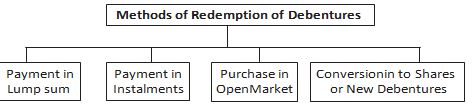
Methods of Redemption
| Method | How it works |
|---|---|
| Lump sum | The company pays the debentureholders the amount due at maturity in one payment. |
| Instalments | The liability is repaid in portions on specified dates; the debentures selected for each payment are identified by drawing lots. |
| Open-market purchase | The company buys its own debentures in the market and cancels them. |
| Conversion | Debentures are exchanged for shares or a new class of debentures, if the holders accept the offer. |
Conversion: key points
- Eligibility: This method applies only to convertible debentures.
- Issue terms: Replacement shares or debentures may be issued at par, at a discount, or at a premium.
- Calculation basis: Use the actual proceeds from the original debenture issue to determine the number of replacement shares; for debentures issued at a discount, use the amount actually received.
Timing and Sources of Redemption
Factors to consider
- Timing: Redemption is usually on the due date. Earlier redemption is possible when the company’s articles provide for it.
- Source: Redemption may be made out of capital or out of profits.
- Debenture Redemption Reserve (DRR): Under the rules described in this lecture, specified exempt entities need not create a DRR; other unlisted companies require a DRR equal to 10% of outstanding debentures.
| Category | Treatment |
|---|---|
| All-India financial institutions registered with the RBI; banking companies; RBI-registered NBFCs; NHB-registered housing finance companies; stock-exchange-listed companies | Exempt from creating a DRR, as stated in the lecture. |
| Other unlisted companies | DRR adequacy is 10% of the value of outstanding debentures. |
Debenture Redemption Investment
Debenture Redemption Investment — The company must invest or deposit a prescribed amount to provide funds for debentures maturing in the following financial year.
Invest or deposit the amount on or before April 30; it must be at least 15% of the debentures maturing in the year ending the following March 31.
Permitted investments or deposits
- Bank deposit: Deposit with a scheduled bank, free from any charge or lien.
- Government securities: Securities of the Central Government or any State Government.
- Trust Act securities: Securities specified under Section 20, sub-clauses (a) to (d) and (ee), of the Indian Trusts Act, 1982.
- Notified company bonds: Bonds issued by a company notified under Section 20, sub-clause (f), of that Act.
- Restriction: These funds may be used only to redeem debentures maturing in the relevant year.
Managing investment for instalment redemptions
- Calculate 15% of the debentures due for redemption in the coming year.
- By April 30, invest enough to bring the balance up to that required amount.
- Carry the investment forward when redemptions are spread over several years; do not automatically realise it each year.
- After a redemption, realise any amount above the next year's required 15% balance; invest more if the balance is short.
- For a final lump-sum redemption, invest 15% of the debentures due and realise the investment when redemption occurs.
How does Kays Ltd. manage the 15% redemption investment for its instalment redemptions?
- Kays Ltd. has 10,000 debentures of Rs. 100 each, redeemed as follows: 2,000 in 2017, 3,000 in 2018, 3,000 in 2019, and 2,000 in 2020. Find the investment movements at 15%.
- For the first instalment, invest 15% of Rs. 2,00,000 by April 30, 2016.$$0.15 \times (2{,}000 \times 100) = \text{Rs. }30{,}000$$
- For the 2018 instalment, raise the carried balance from Rs. 30,000 to Rs. 45,000 by investing an additional Rs. 15,000 by April 30, 2017.$$0.15 \times (3{,}000 \times 100) = \text{Rs. }45{,}000;\quad 45{,}000 - 30{,}000 = 15{,}000$$
- The balance of Rs. 45,000 meets the requirement for the 2019 instalment. After that redemption, realise Rs. 15,000 and carry Rs. 30,000 for the 2020 instalment.$$0.15 \times (2{,}000 \times 100) = \text{Rs. }30{,}000;\quad 45{,}000 - 15{,}000 = 30{,}000$$
- The carried Rs. 30,000 meets the 2020 requirement and is realised at the final redemption.$$0.15 \times (2{,}000 \times 100) = \text{Rs. }30{,}000$$
| Redemption date | Debentures redeemed | Required investment (15%) | Investment movement |
|---|---|---|---|
| Jan. 31, 2017 | 2,000 (Rs. 2,00,000) | Rs. 30,000 | Invest Rs. 30,000 by Apr. 30, 2016. |
| Jan. 31, 2018 | 3,000 (Rs. 3,00,000) | Rs. 45,000 | Add Rs. 15,000 by Apr. 30, 2017; balance becomes Rs. 45,000. |
| Jan. 31, 2019 | 3,000 (Rs. 3,00,000) | Rs. 45,000 | Carry Rs. 45,000; after redemption, realise Rs. 15,000 and retain Rs. 30,000. |
| Jan. 31, 2020 | 2,000 (Rs. 2,00,000) | Rs. 30,000 | Carry the Rs. 30,000 balance and realise it at final redemption. |
A company has Rs. 8,00,000 of debentures maturing in the relevant year. What is the minimum 15% investment?
1,000 debentures of Rs. 100 each were issued at a 5% discount and later converted into shares of Rs. 20 each. Using the lecture’s proceeds basis, how many shares are issued?
Do not treat the required investment as 15% of all outstanding debentures automatically; calculate it on the debentures maturing in the relevant year, and carry forward the investment balance for instalment redemptions as required.
Quick recap
- Redemption is repayment of debentures under their issue terms.
- The four methods are lump sum, instalments, open-market purchase, and conversion.
- Early redemption is allowed when provided for in the company’s articles.
- Redemption may be funded out of capital or profits; DRR requirements depend on the company category.
- The stated investment requirement is at least 15% of debentures maturing in the relevant year, by April 30.
- For instalment redemptions, carry forward the investment and adjust it to meet the next year's required balance.
Redemption by Payment in Lump Sum
Lump-Sum Redemption at Par or Premium
Lump-sum redemption — The company repays all debentures together in one payment on the due date.
Key points
- Amount due: Face value plus any premium payable on redemption.
- Due entry: Debit Debentures A/c and, if applicable, Premium on Redemption of Debentures A/c; credit Debentureholders A/c.
- Payment entry: Debit Debentureholders A/c and credit Bank A/c for the amount paid.
- Issue price and interest rate: Neither changes the face value used to calculate redemption.
- Out of capital: Illustration 21, case 1, specifies redemption out of capital; its entries record redemption and payment, with no reserve entry shown.
Calculate any premium on the nominal (face) value.
Journal-entry method
- Calculate the total face value.$$\text{Face value}=\text{Number of debentures}\times\text{Face value per debenture}$$
- Calculate redemption premium, if any, on face value.$$\text{Premium}=\text{Face value}\times\text{Premium rate}$$
- Record the amount due to debentureholders.
- Record payment by bank.
| Situation | Debit | Credit |
|---|---|---|
| Amount due at par | Debentures A/c | Debentureholders A/c |
| Payment at par | Debentureholders A/c | Bank A/c |
| Amount due at premium | Debentures A/c; Premium on Redemption of Debentures A/c | Debentureholders A/c |
| Payment at premium | Debentureholders A/c | Bank A/c |
Give the redemption entries for the four cases in Illustration 21.
- Case 1: 5,000 debentures of ₹100 each are redeemable at par out of capital.$$\text{Amount due}=5{,}000\times ₹100=₹5{,}00{,}000$$
- Case 2: 1,000 debentures of ₹100 each are redeemable at a 10% premium.$$\text{Premium}=₹1{,}00{,}000\times10\%=₹10{,}000;\quad\text{amount due}=₹1{,}10{,}000$$
- Case 3: Face value ₹1,00,000; issued at 5% premium but redeemable at par.$$\text{Amount due}=₹1{,}00{,}000$$
- Case 4: Face value ₹1,00,000; issued at 5% discount and redeemable at a 5% premium.$$\text{Premium}=₹1{,}00{,}000\times5\%=₹5{,}000;\quad\text{amount due}=₹1{,}05{,}000$$
| Case | Particulars | Debit (₹) | Credit (₹) |
|---|---|---|---|
| 1: Out of capital; at par | 9% Debentures A/c Dr. → To Debentureholders A/c | 5,00,000 | 5,00,000 |
| 1: Payment | Debentureholders A/c Dr. → To Bank A/c | 5,00,000 | 5,00,000 |
| 2: At 10% premium | 12% Debentures A/c Dr. ₹1,00,000; Premium on Redemption of Debentures A/c Dr. ₹10,000 → To Debentureholders A/c | 1,10,000 | 1,10,000 |
| 2: Payment | Debentureholders A/c Dr. → To Bank A/c | 1,10,000 | 1,10,000 |
| 3: Issued at 5% premium; redeemable at par | 12% Debentures A/c Dr. → To Debentureholders A/c | 1,00,000 | 1,00,000 |
| 3: Payment | Debentureholders A/c Dr. → To Bank A/c | 1,00,000 | 1,00,000 |
| 4: Issued at 5% discount; redeemable at 5% premium | 12% Debentures A/c Dr. ₹1,00,000; Premium on Redemption of Debentures A/c Dr. ₹5,000 → To Debentureholders A/c | 1,05,000 | 1,05,000 |
| 4: Payment | Debentureholders A/c Dr. → To Bank A/c | 1,05,000 | 1,05,000 |
Do not calculate redemption premium on issue price. Calculate it on face value; the issue discount or premium does not change the redemption amount.
Issue at Discount and Redemption at Premium
Loss on issue of debentures — When debentures are issued at a discount and are redeemable at a premium, the loss includes both the issue discount and the redemption premium.
Key points
- Issue proceeds: Face value less discount on issue.
- Loss on issue: Issue discount plus premium payable on redemption.
- Redemption: Debentureholders receive face value plus redemption premium.
- DRI: Record the required Debenture Redemption Investment when invested, and record its encashment when realised for redemption.
- DRR in this illustration: The other unlisted company creates DRR at 10% of outstanding debentures; the listed-company entries shown do not include DRR creation.
- After redemption: In the other unlisted-company example, transfer the DRR to General Reserve.
Calculate issue discount and redemption premium on nominal value.
Entries for issue and lump-sum redemption
- Record application money received in Bank A/c and transfer it to Debenture Application and Allotment A/c.
- On allotment, debit the application account and Loss on Issue of Debentures A/c; credit Debentures A/c and Premium on Redemption of Debentures A/c.
- Record the required DRI investment and its later encashment.
- At redemption, transfer face value plus premium to Debentureholders A/c, then record payment through Bank A/c.
- For the other unlisted company in this example, create DRR as shown and transfer it to General Reserve after redemption.
Summarise the issue and redemption entries for the listed and other unlisted company cases in Illustration 22.
- XYZ Ltd. issues 200 debentures of ₹100 each at 10% discount, redeemable at 10% premium.$$\text{Face value}=200\times ₹100=₹20{,}000$$
- Calculate proceeds, redemption premium, loss on issue and redemption amount.$$\text{Proceeds}=₹20{,}000-₹2{,}000=₹18{,}000;\quad\text{premium}=₹2{,}000;\quad\text{loss}=₹2{,}000+₹2{,}000=₹4{,}000;\quad\text{redemption amount}=₹22{,}000$$
- The stipulated DRI investment is ₹3,000; the unlisted-company example also creates DRR of 10% of face value.$$\text{DRI}=₹3{,}000;\quad\text{DRR}=₹20{,}000\times10\%=₹2{,}000$$
- The solution's dates conflict with the issue date and four-year term stated in the question; the discrepancy is detailed below.
| Date | Particulars | Debit (₹) | Credit (₹) |
|---|---|---|---|
| 1 Apr 2016 | Bank A/c Dr. → To Debenture Application and Allotment A/c | 18,000 | 18,000 |
| 1 Apr 2016 | Debenture Application and Allotment A/c Dr. ₹18,000; Loss on Issue of Debentures A/c Dr. ₹4,000 → To 15% Debentures A/c ₹20,000; To Premium on Redemption of Debentures A/c ₹2,000 | 22,000 | 22,000 |
| 30 Apr (year printed as 2016) | Debenture Redemption Investment A/c Dr. → To Bank A/c | 3,000 | 3,000 |
| 31 Mar 2020 | Bank A/c Dr. → To Debenture Redemption Investment A/c (DRI encashed) | 3,000 | 3,000 |
| 31 Mar 2020 | 15% Debentures A/c Dr. ₹20,000; Premium on Redemption of Debentures A/c Dr. ₹2,000 → To Debentureholders A/c | 22,000 | 22,000 |
| 31 Mar 2020 | Debentureholders A/c Dr. → To Bank A/c | 22,000 | 22,000 |
| Date as printed | Particulars | Debit (₹) | Credit (₹) |
|---|---|---|---|
| 31 Mar 2019 | Surplus (Balance in Statement of Profit and Loss) A/c Dr. → To Debenture Redemption Reserve A/c (10% of ₹20,000) | 2,000 | 2,000 |
| After redemption, 31 Mar 2020 | Debenture Redemption Reserve A/c Dr. → To General Reserve A/c | 2,000 | 2,000 |
Date discrepancy in Illustration 22
- Question states: Issue on 1 April 2013 and redemption at the end of the fourth year, which gives a due date of 31 March 2017.
- Printed solution states: Issue entries dated 1 April 2016, DRI investment dated 30 April (shown in the solution in 2016), and redemption entries dated 31 March 2020.
- Use with care: The stated issue date and four-year term do not agree with the journal-entry dates; do not silently treat them as matching.
A company has 2,000 debentures of ₹100 each, redeemable at par. State the amount due and the two redemption entries.
Debentures of face value ₹80,000 were issued at a 5% premium and are redeemable at a 5% premium. Find the redemption amount and state the entries.
Quick recap
- Lump-sum redemption repays all debentures together on the due date.
- At par, amount due equals face value; at premium, add premium calculated on face value.
- Transfer the amount due to Debentureholders A/c, then record payment through Bank A/c.
- Illustration 21, case 1, is specifically redeemable out of capital.
- For issue at discount and redemption at premium, loss on issue equals issue discount plus redemption premium.
- The Illustration 22 example records DRI in both company cases; its other unlisted case also records DRR creation and transfer.
- Illustration 22's stated 2013 issue and four-year term conflict with the solution's 2016 issue and 2020 redemption dates.
Redemption by Payment in Instalments
Meaning and accounting treatment
Redemption by instalments — Repayment of debentures in specified portions over several dates, rather than in one lump sum.
Key points
- Selection: The debentures due for redemption in a particular instalment are usually chosen by draw of lots.
- Liability: On the due date, transfer the face value of the debentures being redeemed to Debentureholders A/c.
- Payment: Pay the amount due to debentureholders through Bank A/c; include any redemption premium and interest payable.
- Outstanding balance: Calculate later interest only on the debentures still outstanding.
| Transaction | Debit | Credit |
|---|---|---|
| Face value due for redemption | Debentures A/c | Debentureholders A/c |
| Redemption premium, if applicable | Premium on Redemption of Debentures A/c | Debentureholders A/c |
| Payment to holders | Debentureholders A/c | Bank A/c |
Illustration: JK Ltd.
Given information
- Issue: 6,000 debentures of ₹50 each, issued on 1 April 2014 at 5% premium; interest is 12% annually, payable on 31 March.
- Redemption: Four equal instalments at the end of years 3–6; the question states a 10% redemption premium.
- Investment: The illustration records ₹11,250 invested in specified securities for redemption.
Use the face value outstanding to calculate interest; calculate redemption premium on the face value being redeemed.
Prepare the main issue and redemption entries for JK Ltd., including interest due and paid.
- Calculate the issue proceeds and the face value of each instalment.$$6{,}000\times ₹50=₹3{,}00{,}000;\quad ₹3{,}00{,}000\times 1.05=₹3{,}15{,}000;\quad ₹3{,}00{,}000\div4=₹75{,}000$$
- Calculate the premium and total principal payable for each instalment.$$₹75{,}000\times10\%=₹7{,}500;\quad ₹75{,}000+₹7{,}500=₹82{,}500$$
- Work out the annual interest on the remaining debentures.$$2015,\ 2016,\ 2017:\ ₹3{,}00{,}000\times12\%=₹36{,}000\text{ each};\quad 2018:\ ₹2{,}25{,}000\times12\%=₹27{,}000;\quad 2019:\ ₹1{,}50{,}000\times12\%=₹18{,}000;\quad 2020:\ ₹75{,}000\times12\%=₹9{,}000$$
- Add each year's interest to the principal and premium due that year to get the cash payment.$$2017:\ ₹36{,}000+₹82{,}500=₹1{,}18{,}500;\quad 2018:\ ₹27{,}000+₹82{,}500=₹1{,}09{,}500;\quad 2019:\ ₹18{,}000+₹82{,}500=₹1{,}00{,}500;\quad 2020:\ ₹9{,}000+₹82{,}500=₹91{,}500$$
| Date | Particulars | Debit (₹) | Credit (₹) |
|---|---|---|---|
| 1 Apr 2014 | Bank A/c Dr. | To Debenture Application and Allotment A/c | 3,15,000 | 3,15,000 |
| 1 Apr 2014 | Debenture Application and Allotment A/c Dr. | To 12% Debentures A/c | To Securities Premium Reserve | 3,15,000 | 3,00,000; 15,000 |
| 31 Mar 2015 and 31 Mar 2016 (each year) | Debenture Interest A/c Dr. | To Debentureholders A/c; then Debentureholders A/c Dr. | To Bank A/c | 36,000; 36,000 | 36,000; 36,000 |
| 30 Apr 2016 | Debenture Redemption Investment A/c Dr. | To Bank A/c | 11,250 | 11,250 |
| 31 Mar 2017 | Debenture Interest A/c Dr. | To Debentureholders A/c | 36,000 | 36,000 |
| 31 Mar 2017 | 12% Debentures A/c Dr. | Premium on Redemption of Debentures A/c Dr. | To Debentureholders A/c | 75,000; 7,500 | 82,500 |
| 31 Mar 2017 | Debentureholders A/c Dr. | To Bank A/c (interest and redemption amount paid) | 1,18,500 | 1,18,500 |
| 31 Mar 2018 | Debenture Interest A/c Dr. | To Debentureholders A/c | 27,000 | 27,000 |
| 31 Mar 2018 | 12% Debentures A/c Dr. | Premium on Redemption of Debentures A/c Dr. | To Debentureholders A/c | 75,000; 7,500 | 82,500 |
| 31 Mar 2018 | Debentureholders A/c Dr. | To Bank A/c (interest and redemption amount paid) | 1,09,500 | 1,09,500 |
| 31 Mar 2019 | Debenture Interest A/c Dr. | To Debentureholders A/c | 18,000 | 18,000 |
| 31 Mar 2019 | 12% Debentures A/c Dr. | Premium on Redemption of Debentures A/c Dr. | To Debentureholders A/c | 75,000; 7,500 | 82,500 |
| 31 Mar 2019 | Debentureholders A/c Dr. | To Bank A/c (interest and redemption amount paid) | 1,00,500 | 1,00,500 |
| 31 Mar 2020 | Bank A/c Dr. | To Debenture Redemption Investment A/c (investment realised) | 11,250 | 11,250 |
| 31 Mar 2020 | Debenture Interest A/c Dr. | To Debentureholders A/c | 9,000 | 9,000 |
| 31 Mar 2020 | 12% Debentures A/c Dr. | Premium on Redemption of Debentures A/c Dr. | To Debentureholders A/c | 75,000; 7,500 | 82,500 |
| 31 Mar 2020 | Debentureholders A/c Dr. | To Bank A/c (interest and redemption amount paid) | 91,500 | 91,500 |
Do not omit a redemption premium stated in the question. For each ₹75,000 instalment here, the liability to holders is ₹82,500 before adding that year’s interest.
A company has 4,000 debentures of ₹100 each, redeemable in four equal annual instalments. Find the face value of each instalment.
A 10% debenture issue has ₹2,00,000 outstanding before redemption. One-quarter is redeemed at a 5% premium. Find the interest for the year and the redemption amount payable, excluding interest.
Quick recap
- Debentures due in each instalment are commonly selected by draw of lots.
- Transfer the face value due from Debentures A/c to Debentureholders A/c.
- Record any redemption premium as an additional amount payable to debentureholders.
- Pay interest on the debentures outstanding for the relevant period.
- JK Ltd. redeems 1,500 debentures, or ₹75,000 face value, at each of four dates.
- In the JK Ltd. example, each instalment’s redemption amount is ₹82,500 before interest.
Illustration 24 based on Issue of Debentures
Issue terms and key calculations
Interest each year is calculated on the face value outstanding during that year, before that year's installment is redeemed.
| Year ending | Face value outstanding for interest | Interest at 12% | Face value redeemed |
|---|---|---|---|
| 31 March 2015 | ₹3,00,000 | ₹36,000 | — |
| 31 March 2016 | ₹3,00,000 | ₹36,000 | — |
| 31 March 2017 | ₹3,00,000 | ₹36,000 | ₹75,000 |
| 31 March 2018 | ₹2,25,000 | ₹27,000 | ₹75,000 |
| 31 March 2019 | ₹1,50,000 | ₹18,000 | ₹75,000 |
| 31 March 2020 | ₹75,000 | ₹9,000 | ₹75,000 |
Journal entries in the books of XYZ Ltd.
Journal-entry method
- Record receipt of the issue proceeds, then transfer application money to debentures and the related premium accounts.$$₹3{,}15{,}000=₹3{,}00{,}000+₹15{,}000$$
- At issue, recognise the redemption premium payable and the corresponding loss on issue.$$₹3{,}00{,}000\times10\%=₹30{,}000$$
- Each year, record interest due and its payment; calculate interest on the year's outstanding face value.$$\text{Interest}=\text{Outstanding face value}\times12\%$$
- On each installment date, transfer the face value and redemption premium payable to Debentureholders, then record payment.$$₹75{,}000+₹7{,}500=₹82{,}500$$
- Record the specified-securities investment and its realisation separately at the amounts given.$$₹11{,}250$$
| Date | Journal entry | Debit (₹) | Credit (₹) |
|---|---|---|---|
| 1 April 2014 | Bank A/c Dr.; To Debenture Application and Allotment A/c | 3,15,000 | 3,15,000 |
| 1 April 2014 | Debenture Application and Allotment A/c Dr. 3,15,000; Loss on Issue of Debentures A/c Dr. 30,000; To 12% Debentures A/c 3,00,000; To Securities Premium Reserve A/c 15,000; To Premium on Redemption of Debentures A/c 30,000 | 3,45,000 | 3,45,000 |
| 31 March 2015 | Debenture Interest A/c Dr.; To Debentureholders A/c | 36,000 | 36,000 |
| 31 March 2015 | Debentureholders A/c Dr.; To Bank A/c | 36,000 | 36,000 |
| 1 April 2015 | Statement of Profit and Loss A/c Dr.; To Loss on Issue of Debentures A/c | 30,000 | 30,000 |
| 31 March 2016 | Debenture Interest A/c Dr.; To Debentureholders A/c | 36,000 | 36,000 |
| 31 March 2016 | Debentureholders A/c Dr.; To Bank A/c | 36,000 | 36,000 |
| 31 March 2017 | Debenture Interest A/c Dr.; To Debentureholders A/c | 36,000 | 36,000 |
| 31 March 2017 | 12% Debentures A/c Dr. 75,000; Premium on Redemption of Debentures A/c Dr. 7,500; To Debentureholders A/c | 82,500 | 82,500 |
| 31 March 2017 | Debentureholders A/c Dr.; To Bank A/c | 1,18,500 | 1,18,500 |
| 30 April 2017 | Debenture Redemption Investment A/c Dr.; To Bank A/c | 11,250 | 11,250 |
| 31 March 2018 | Debenture Interest A/c Dr.; To Debentureholders A/c | 27,000 | 27,000 |
| 31 March 2018 | 12% Debentures A/c Dr. 75,000; Premium on Redemption of Debentures A/c Dr. 7,500; To Debentureholders A/c | 82,500 | 82,500 |
| 31 March 2018 | Debentureholders A/c Dr.; To Bank A/c | 1,09,500 | 1,09,500 |
| 31 March 2019 | Debenture Interest A/c Dr.; To Debentureholders A/c | 18,000 | 18,000 |
| 31 March 2019 | 12% Debentures A/c Dr. 75,000; Premium on Redemption of Debentures A/c Dr. 7,500; To Debentureholders A/c | 82,500 | 82,500 |
| 31 March 2019 | Debentureholders A/c Dr.; To Bank A/c | 1,00,500 | 1,00,500 |
| 31 March 2020 | Bank A/c Dr.; To Debenture Redemption Investment A/c | 11,250 | 11,250 |
| 31 March 2020 | Debenture Interest A/c Dr.; To Debentureholders A/c | 9,000 | 9,000 |
| 31 March 2020 | 12% Debentures A/c Dr. 75,000; Premium on Redemption of Debentures A/c Dr. 7,500; To Debentureholders A/c | 82,500 | 82,500 |
| 31 March 2020 | Debentureholders A/c Dr.; To Bank A/c | 91,500 | 91,500 |
What is the total amount paid to debentureholders on 31 March 2018?
- On 31 March 2018, 4,500 debentures are outstanding before the year's redemption; 1,500 are redeemed.$$4{,}500\times₹50=₹2{,}25{,}000$$
- Calculate interest on the outstanding face value.$$₹2{,}25{,}000\times12\%=₹27{,}000$$
- Calculate the installment payable, including the 10% redemption premium.$$1{,}500\times₹50\times110\%=₹82{,}500$$
- Add interest and redemption payment to find the total bank payment.$$₹27{,}000+₹82{,}500=₹1{,}09{,}500$$
Credit Debentureholders A/c—not Debentures A/c—when interest becomes due. Also, the 31 March 2017 payment is ₹1,18,500 (₹36,000 interest + ₹82,500 redemption), not ₹1,18,000.
Calculate the amount received on issuing 6,000 debentures of ₹50 each at a 5% premium.
Find the interest due on 31 March 2019, when 3,000 debentures remain outstanding.
Quick recap
- Issue proceeds are ₹3,15,000, including ₹15,000 securities premium.
- The ₹30,000 redemption premium is recognised as a liability and a loss on issue.
- Each of the four installments redeems 1,500 debentures for ₹82,500.
- Annual interest falls from ₹36,000 to ₹9,000 as the outstanding face value declines.
- Add the year's interest to the redemption installment to calculate each payment to debentureholders.
- Record the ₹11,250 specified-securities investment and its ₹11,250 realisation separately; no calculation basis is given.
Illustration 25 based on Issue of Debentures
Key Details and Calculations for ABC Ltd.
Issue at a discount and redemption at a premium — The company receives less than the debentures’ face value on issue but repays more than face value on redemption.
Facts of the illustration
- Company status: ABC Ltd. is an other unlisted company; it invests in specified securities for debenture redemption.
- Issue: 6,000 debentures of ₹50 each issued on 1 April 2014; total face value is ₹3,00,000.
- Issue price: Issued at a 5% discount, so cash received is ₹2,85,000.
- Interest: 12% per year, payable annually on 31 March.
- Redemption: Four equal instalments at the ends of years 3, 4, 5 and 6: 1,500 debentures per instalment.
- Redemption premium: 10% of face value; total premium is ₹30,000.
- Loss on issue: Discount of ₹15,000 plus redemption premium of ₹30,000 equals ₹45,000.
Use face value to calculate interest and the amount redeemed; add the redemption premium to the instalment’s face value.
Calculate each year’s interest and total payment
- Start with all debentures outstanding and calculate interest at 12% on face value.$$6{,}000\times₹50\times12\%=₹36{,}000$$
- Reduce the outstanding number by 1,500 after each annual redemption; calculate the next year’s interest on the balance.$$4{,}500,\ 3{,}000,\ 1{,}500\text{ debentures remain in successive years}$$
- For each redemption year, add the instalment payment of ₹82,500 to that year’s interest.$$\text{Total payment}=₹82{,}500+\text{annual interest}$$
For ABC Ltd., calculate the issue proceeds, loss on issue and amount payable for one redemption instalment.
- Find the face value, issue proceeds and total loss on issue.$$6{,}000\times₹50=₹3{,}00{,}000;\quad ₹3{,}00{,}000\times95\%=₹2{,}85{,}000;\quad ₹15{,}000+₹30{,}000=₹45{,}000$$
- Find the number and face value of debentures in one redemption instalment.$$6{,}000\div4=1{,}500;\quad 1{,}500\times₹50=₹75{,}000$$
- Add the 10% redemption premium to that instalment’s face value.$$₹75{,}000\times10\%=₹7{,}500;\quad ₹75{,}000+₹7{,}500=₹82{,}500$$
Journal Entries
| Date | Particulars | Debit | Credit |
|---|---|---|---|
| 1 Apr 2014 | Bank A/c Dr. To Debenture Application and Allotment A/c | 2,85,000 | 2,85,000 |
| 1 Apr 2014 | Debenture Application and Allotment A/c Dr. Loss on Issue of Debentures A/c Dr. To 12% Debentures A/c To Premium on Redemption of Debentures A/c | 2,85,000 45,000 | 3,00,000 30,000 |
| 31 Mar 2015 | Statement of Profit and Loss A/c Dr. To Loss on Issue of Debentures A/c | 45,000 | 45,000 |
| 31 Mar 2015 | Debenture Interest A/c Dr. To Debentureholders A/c | 36,000 | 36,000 |
| 31 Mar 2015 | Debentureholders A/c Dr. To Bank A/c | 36,000 | 36,000 |
| 31 Mar 2016 | Debenture Interest A/c Dr. To Debentureholders A/c | 36,000 | 36,000 |
| 31 Mar 2016 | Debentureholders A/c Dr. To Bank A/c | 36,000 | 36,000 |
| 31 Mar 2016 | Surplus, i.e. Statement of Profit and Loss A/c Dr. To Debenture Redemption Reserve (DRR) A/c | 30,000 | 30,000 |
| 30 Apr 2016 | Debenture Redemption Investment (DRI) A/c Dr. To Bank A/c | 11,250 | 11,250 |
| 31 Mar 2017 | Debenture Interest A/c Dr. To Debentureholders A/c | 36,000 | 36,000 |
| 31 Mar 2017 | Debentures A/c Dr. Premium on Redemption of Debentures A/c Dr. To Debentureholders A/c | 75,000 7,500 | 82,500 |
| 31 Mar 2017 | Debentureholders A/c Dr. To Bank A/c | 118,500 | 118,500 |
| 31 Mar 2017 | Debenture Redemption Reserve A/c Dr. To General Reserve A/c | 7,500 | 7,500 |
| 31 Mar 2018 | Debenture Interest A/c Dr. To Debentureholders A/c | 27,000 | 27,000 |
| 31 Mar 2018 | Debentures A/c Dr. Premium on Redemption of Debentures A/c Dr. To Debentureholders A/c | 75,000 7,500 | 82,500 |
| 31 Mar 2018 | Debentureholders A/c Dr. To Bank A/c | 109,500 | 109,500 |
| 31 Mar 2018 | Debenture Redemption Reserve A/c Dr. To General Reserve A/c | 7,500 | 7,500 |
| 31 Mar 2019 | Debenture Interest A/c Dr. To Debentureholders A/c | 18,000 | 18,000 |
| 31 Mar 2019 | Debentures A/c Dr. Premium on Redemption of Debentures A/c Dr. To Debentureholders A/c | 75,000 7,500 | 82,500 |
| 31 Mar 2019 | Debentureholders A/c Dr. To Bank A/c | 100,500 | 100,500 |
| 31 Mar 2019 | Debenture Redemption Reserve A/c Dr. To General Reserve A/c | 7,500 | 7,500 |
| 31 Mar 2020 | Debenture Interest A/c Dr. To Debentureholders A/c | 9,000 | 9,000 |
| 31 Mar 2020 | Debentures A/c Dr. Premium on Redemption of Debentures A/c Dr. To Debentureholders A/c | 75,000 7,500 | 82,500 |
| 31 Mar 2020 | Debentureholders A/c Dr. To Bank A/c | 91,500 | 91,500 |
| 31 Mar 2020 | Bank A/c Dr. To Debenture Redemption Investment A/c | 11,250 | 11,250 |
| 31 Mar 2020 | Debenture Redemption Reserve A/c Dr. To General Reserve A/c | 7,500 | 7,500 |
Reserve, investment and annual amounts
- DRR: The illustration creates a reserve equal to 10% of ₹3,00,000, or ₹30,000, on 31 March 2016.
- DRI: Invest 15% of the debentures due for redemption: ₹75,000 × 15% = ₹11,250 on 30 April 2016; realise the investment on 31 March 2020.
- Interest: Outstanding debentures fall after each redemption; annual interest for 2017–2020 is ₹36,000, ₹27,000, ₹18,000 and ₹9,000.
- Total paid to holders: Redemption payment plus annual interest gives ₹1,18,500, ₹1,09,500, ₹1,00,500 and ₹91,500 for 2017–2020.
- DRR transfer: Transfer ₹7,500, or one-fourth of the reserve, to General Reserve after each instalment is redeemed.
Do not keep calculating interest on all 6,000 debentures after instalments are redeemed. The 2018 total payment is ₹1,09,500, not ₹1,09,000; each redemption instalment is 1,500 × ₹50 = ₹75,000 face value, not 6,000 × ₹25.
How much interest is due on 4,500 debentures of ₹50 each at 12%?
At the end of a year, 1,500 debentures of ₹50 each are redeemed at a 10% premium. Find the redemption amount and total payment if that year’s interest is ₹18,000.
Quick recap
- ABC Ltd. is an other unlisted company investing in specified securities for redemption.
- Face value issued is ₹3,00,000; after a 5% discount, cash proceeds are ₹2,85,000.
- Loss on issue is ₹15,000 discount plus ₹30,000 redemption premium, totalling ₹45,000.
- Each of four instalments comprises 1,500 debentures: ₹75,000 face value plus ₹7,500 premium.
- Interest is 12% of the debentures still outstanding; redemption-year interest is ₹36,000, ₹27,000, ₹18,000 and ₹9,000.
- The illustration creates DRR of ₹30,000, invests ₹11,250 in DRI and transfers ₹7,500 of DRR to General Reserve after each redemption.
Illustration 26 based on Issue of Debentures
Issue at a Discount and Instalment Redemption
| Date | Debit side: particulars | ₹ | Credit side: particulars | ₹ |
|---|---|---|---|---|
| 31 Mar 2013 | Balance c/d | 3,00,000 | 1 Apr 2012: Debenture Application A/c | 2,85,000 |
| 1 Apr 2012: Discount on Issue of Debentures A/c | 15,000 | |||
| 31 Mar 2014 | Balance c/d | 3,00,000 | 1 Apr 2013: Balance b/d | 3,00,000 |
| 31 Mar 2015 | Debentureholders A/c | 1,00,000 | 1 Apr 2014: Balance b/d | 3,00,000 |
| 31 Mar 2015 | Balance c/d | 2,00,000 | ||
| 31 Mar 2016 | Debentureholders A/c | 1,00,000 | 1 Apr 2015: Balance b/d | 2,00,000 |
| 31 Mar 2016 | Balance c/d | 1,00,000 | ||
| 31 Mar 2017 | Debentureholders A/c | 1,00,000 | 1 Apr 2016: Balance b/d | 1,00,000 |
| Year ended 31 March | Debit side: Debentureholders A/c (₹) | Credit side: Statement of Profit and Loss (₹) |
|---|---|---|
| 2013 | 42,000 | 42,000 |
| 2014 | 42,000 | 42,000 |
| 2015 | 42,000 | 42,000 |
| 2016 | 28,000 | 28,000 |
| 2017 | 14,000 | 14,000 |
| Date | Debit side: particulars | ₹ | Credit side: particulars | ₹ |
|---|---|---|---|---|
| 1 Apr 2012 | 14% Debentures A/c | 15,000 | 31 Mar 2013: Statement of Profit and Loss | 15,000 |
Do not calculate every year’s interest on the original ₹3,00,000 after instalment redemption begins. Reduce the interest base by each ₹1,00,000 repayment.
Find the annual interest for each year if ₹3,00,000 of 14% debentures is redeemed in three equal instalments on 31 March 2015, 2016 and 2017.
A company issues 2,000 debentures of ₹100 each at a 4% discount. Calculate the issue discount and cash proceeds.
- Issue discount = face value − cash proceeds.
- Interest is calculated on the debentures outstanding during the year.
- Each redemption instalment reduces the debenture liability and future interest.
Quick recap
- Face value issued is ₹3,00,000; 5% discount is ₹15,000; cash proceeds are ₹2,85,000.
- The debenture liability is reduced by ₹1,00,000 at each of the three redemption dates.
- Annual interest is ₹42,000 on ₹3,00,000, ₹28,000 on ₹2,00,000 and ₹14,000 on ₹1,00,000.
- Interest expense is transferred to the Statement of Profit and Loss.
- In the illustration, the ₹15,000 issue discount is written off in the year ended 31 March 2013.
Illustration 27 based on Journal entries
Redemption schedule and Debenture Redemption Investment
Use this to find the target investment for the next redemption date.
| Date | Next redemption principal | Required DRI | Adjustment |
|---|---|---|---|
| 1 April 2016 | ₹3,00,000 | ₹45,000 | Invest ₹45,000 |
| 1 April 2017 | ₹6,00,000 | ₹90,000 | Existing ₹45,000; invest ₹45,000 |
| 31 March 2018 | ₹5,00,000 | ₹75,000 | Realise excess DRI of ₹15,000 |
| 1 April 2019 | ₹6,00,000 | ₹90,000 | Existing ₹75,000; invest ₹15,000 |
| 31 March 2020 | Final redemption | ₹90,000 held | Realise the DRI |
Recording redemption and DRI adjustments
- Calculate the principal due on each redemption date and the 15% DRI target for the next year.
- Compare the target with the DRI already held; record any additional investment or realisation.
- Record the debentures becoming due: debit 7% Debentures and credit Debentureholders.
- Record payment: debit Debentureholders and credit Bank.
- When DRI is realised, debit Bank and credit Debenture Redemption Investment.
What additional DRI should Vishwas Ltd. purchase on 1 April 2017?
- At 1 April 2017, ₹45,000 of DRI is already held. The next redemption is ₹6,00,000.$$15\% \times ₹6,00,000 = ₹90,000$$
- Find the additional investment needed to reach the target.$$₹90,000 - ₹45,000 = ₹45,000$$
- Record the additional investment.$$\text{Debenture Redemption Investment Dr. } ₹45,000;\quad \text{To Bank } ₹45,000$$
Journal entries
Ledger accounts
| Date | Particulars | Debit (₹) | Credit (₹) | Balance (₹) |
|---|---|---|---|---|
| 1 Apr 2016 | Investment purchased | 45,000 | — | 45,000 Dr. |
| 1 Apr 2017 | Additional investment | 45,000 | — | 90,000 Dr. |
| 31 Mar 2018 | Investment realised | — | 15,000 | 75,000 Dr. |
| 1 Apr 2019 | Additional investment | 15,000 | — | 90,000 Dr. |
| 31 Mar 2020 | Investment realised | — | 90,000 | Nil |
| Date | Amount credited when due (₹) | Amount debited when paid (₹) | Closing balance |
|---|---|---|---|
| 31 Mar 2017 | 3,00,000 | 3,00,000 | Nil |
| 31 Mar 2018 | 6,00,000 | 6,00,000 | Nil |
| 31 Mar 2019 | 5,00,000 | 5,00,000 | Nil |
| 31 Mar 2020 | 6,00,000 | 6,00,000 | Nil |
Do not treat each required DRI target as a fresh purchase: carry forward existing DRI and record only the increase or excess realisation. The final redemption is ₹6,00,000, so the 2020 DRI target is ₹90,000.
On 1 April 2019, Vishwas Ltd. already holds ₹75,000 of DRI. How much more must it invest for the final ₹6,00,000 redemption?
Pass the entries for redemption of 5,000 debentures of ₹100 each on 31 March 2019.
Quick recap
- The 20,000 debentures of ₹100 each represent ₹20,00,000 of principal.
- The required DRI balance is 15% of the next year's redemption principal.
- Carry forward existing DRI and invest only the shortfall or realise the excess.
- When debentures become due, debit 7% Debentures and credit Debentureholders.
- When payment is made, debit Debentureholders and credit Bank.
- The debenture balance falls to nil after the final ₹6,00,000 redemption in 2020.
Redemption by Purchase in Open Market
Meaning and advantages
Redemption by purchase in the open market — The purchase of a company’s own debentures from the market for immediate cancellation is called redemption by purchase in the open market.
| Situation | Journal entry |
|---|---|
| Purchased below face value (discount) | Debentures A/c Dr. $F$; To Bank A/c $P$; To Profit on Redemption of Debentures A/c $(F-P)$ |
| Transfer of discount-purchase profit | Profit on Redemption of Debentures A/c Dr. $(F-P)$; To Capital Reserve $(F-P)$ |
| Purchased above face value (premium) | Debentures A/c Dr. $F$; Loss on Redemption of Debentures A/c Dr. $(P-F)$; To Bank A/c $P$ |
| Transfer of premium-purchase loss | Statement of Profit and Loss A/c Dr. $(P-F)$; To Loss on Redemption of Debentures A/c $(P-F)$ |
Here, $F$ is face value and $P$ is the amount paid.
Recording the purchase and cancellation
- Calculate the cash paid using the market price per $100$ of face value.$$P=F\times\frac{\text{market price}}{100}$$
- Compare the cash paid with face value: the difference is a profit if below face value, or a loss if above it.
- Record the debentures cancelled, the bank payment, and the profit or loss; then transfer the profit to Capital Reserve or the loss to Statement of Profit and Loss.
X Ltd. purchases its own debentures of face value ₹20,000 at ₹92 per ₹100 for immediate cancellation. Record the entries.
- Find the cash paid for debentures of face value $₹20{,}000$ purchased at $₹92$ per $₹100$.$$P=₹20{,}000\times\frac{92}{100}=₹18{,}400$$
- Calculate the profit, since the purchase price is below face value.$$\text{Profit}=₹20{,}000-₹18{,}400=₹1{,}600$$
- Record the purchase for immediate cancellation.$$\begin{array}{lr} \text{Debentures A/c Dr.} & ₹20{,}000 \\ \text{To Bank A/c} & ₹18{,}400 \\ \text{To Profit on Redemption of Debentures A/c} & ₹1{,}600 \end{array}$$
- Transfer the profit to Capital Reserve.$$\begin{array}{lr} \text{Profit on Redemption of Debentures A/c Dr.} & ₹1{,}600 \\ \text{To Capital Reserve} & ₹1{,}600 \end{array}$$
Do not calculate the purchase payment as face value times the market price directly: divide the quoted price by $100$. Also, transfer a discount-purchase profit to Capital Reserve; a premium-purchase loss goes to Statement of Profit and Loss.
A company cancels its own debentures with a face value of ₹50,000 bought at ₹96 per ₹100. Find the bank payment and profit, and state the transfer entry.
A company cancels its own debentures of face value ₹30,000 purchased at ₹105 per ₹100. Find the bank payment and loss, and state the transfer entry.
Quick recap
- Open-market redemption means buying the company’s own debentures for immediate cancellation.
- The company can choose when to redeem, such as when it has surplus funds.
- Purchase below face value creates a profit: debit Debentures, credit Bank and Profit on Redemption.
- Transfer profit on redemption to Capital Reserve.
- Purchase above face value creates a loss: debit Debentures and Loss on Redemption, credit Bank.
- Transfer loss on redemption to Statement of Profit and Loss.
Illustration 29 based on Journal entries
Illustration 29: Redemption by Purchase and by Draw of Lots
Use the total purchase cost, including any expenses.
Working and journal-entry approach
- Find the number of debentures purchased from their total face value.$$20,000 \div 100 = 200$$
- Calculate total purchase cost, including expenses, then find the profit.$$200 \times 98.50 + 100 = 19,800;\quad 20,000 - 19,800 = 200$$
- Record the purchase cancellation, redeem the balance by draw of lots, and transfer the profit to Capital Reserve.$$25,000 - 20,000 = 5,000$$
- After redemption, transfer the DRR balance to General Reserve as shown.
Prepare the key journal entries for Illustration 29.
- The company redeems Rs. 25,000 face value and purchases Rs. 20,000 face value, or 200 debentures.$$250 \times 100 = 25,000;\quad 20,000 \div 100 = 200$$
- The purchase price is Rs. 19,700; adding Rs. 100 expenses gives total cost of Rs. 19,800.$$200 \times 98.50 + 100 = 19,800$$
- The profit is Rs. 200, and the remaining Rs. 5,000 is redeemed at par.$$20,000 - 19,800 = 200;\quad 25,000 - 20,000 = 5,000$$
| Particulars | Debit (Rs.) | Credit (Rs.) |
|---|---|---|
| Balance in Statement of Profit and Loss A/c Dr. | To Debenture Redemption Reserve A/c | 6,250 | 6,250 |
| Debenture Redemption Investment A/c Dr. | To Bank A/c | 3,750 | 3,750 |
| Bank A/c Dr. | To Debenture Redemption Investment A/c (DRI encashed) | 3,750 | 3,750 |
| 12% Debentures A/c Dr. | To Bank A/c | To Profit on Redemption of Debentures A/c (purchase cancellation) | 20,000 | 19,800; 200 |
| Profit on Redemption of Debentures A/c Dr. | To Capital Reserve A/c | 200 | 200 |
| 12% Debentures A/c Dr. | To Bank A/c (redemption by draw of lots) | 5,000 | 5,000 |
| Debenture Redemption Reserve A/c Dr. | To General Reserve A/c | 6,250 | 6,250 |
Do not calculate profit using only the market price: include expenses. Here, Rs. 20,000 − (Rs. 19,700 + Rs. 100) = Rs. 200.
Illustration 30: Issue at Discount and Redemption by Purchase
Apply this separately to each purchase for cancellation.
Working and journal-entry approach
- Record the issue proceeds and discount on issue on 1 April 2013.$$1,000 \times 1,000 = 10,00,000;\quad 10,00,000 - 9,60,000 = 40,000$$
- Write off the discount to Statement of Profit and Loss as shown on 31 March 2014.
- For each purchase on 31 March 2015, debit Debentures at face value and credit Bank at the price paid.
- Credit each difference to Profit on Redemption, then transfer the combined profit to Capital Reserve.$$4,000 + 12,000 = 16,000$$
Prepare the key journal entries for Illustration 30 and show the treatment of the profit.
- The total face value issued is Rs. 10,00,000; proceeds at Rs. 960 each are Rs. 9,60,000, so the issue discount is Rs. 40,000.$$1,000 \times 1,000 = 10,00,000;\quad 1,000 \times 960 = 9,60,000;\quad 10,00,000 - 9,60,000 = 40,000$$
- For Rs. 80,000 face value, 80 debentures are purchased at Rs. 950 each; the profit is Rs. 4,000.$$80 \times 950 = 76,000;\quad 80,000 - 76,000 = 4,000$$
- For Rs. 1,20,000 face value, 120 debentures are purchased at Rs. 900 each; the profit is Rs. 12,000.$$120 \times 900 = 1,08,000;\quad 1,20,000 - 1,08,000 = 12,000$$
- The total profit on cancellation is transferred to Capital Reserve.$$4,000 + 12,000 = 16,000$$
| Date | Particulars | Debit (Rs.) | Credit (Rs.) |
|---|---|---|---|
| 1 Apr 2013 | Bank A/c Dr. | To 6% Debentures Application and Allotment A/c | 9,60,000 | 9,60,000 |
| 1 Apr 2013 | 6% Debentures Application and Allotment A/c Dr. | Discount on Issue of Debentures A/c Dr. | To 6% Debentures A/c | 9,60,000; 40,000 | 10,00,000 |
| 31 Mar 2014 | Statement of Profit and Loss A/c Dr. | To Discount on Issue of Debentures A/c (discount written off) | 40,000 | 40,000 |
| 31 Mar 2015 | 6% Debentures A/c Dr. | To Bank A/c | To Profit on Redemption of Debentures A/c (80 debentures purchased at Rs. 950 each) | 80,000 | 76,000; 4,000 |
| 31 Mar 2015 | 6% Debentures A/c Dr. | To Bank A/c | To Profit on Redemption of Debentures A/c (120 debentures purchased at Rs. 900 each) | 1,20,000 | 1,08,000; 12,000 |
| 31 Mar 2015 | Profit on Redemption of Debentures A/c Dr. | To Capital Reserve A/c | 16,000 | 16,000 |
The second purchase is Rs. 1,20,000 face value, equal to 120 debentures at Rs. 1,000 each—not 30. The Rs. 900 price is per debenture.
A company cancels debentures with a face value of Rs. 50,000 after purchasing them for Rs. 48,400 and paying Rs. 200 expenses. Find the profit and give the cancellation entry.
A company issues 500 debentures of Rs. 1,000 each at Rs. 980 and cancels debentures with face value Rs. 1,00,000 bought at Rs. 950 each. Find the issue discount and redemption profit.
Quick recap
- Include purchase expenses when calculating the cost of debentures bought for cancellation.
- Debit Debentures at face value; credit Bank for the purchase price and the difference to Profit on Redemption.
- Transfer profit on redemption to Capital Reserve.
- In Illustration 29, the remaining Rs. 5,000 face value is redeemed at par by draw of lots.
- Illustration 30 requires redemption of 200 debentures each year from 31 March 2015, by purchase or draw of lots at the company’s option.
- The two Illustration 30 purchases total 200 debentures and produce Rs. 16,000 profit, transferred to Capital Reserve.
Redemption by Conversion
Redemption by Conversion
Redemption by conversion — A company redeems debentures by issuing new shares or debentures to debentureholders instead of repaying them in cash.
Key points
- Acceptance: Conversion takes place when debentureholders accept the company’s offer.
- Issue price: New shares or debentures may be issued at par, at a discount or at a premium.
- Share premium: Credit Share Capital with the shares’ face value and Securities Premium with any excess.
- Settlement: First record the amount due to Debentureholders A/c; then debit that account when the new securities are issued.
Use the total issue price per share to find the number of shares; split the credit between share capital and premium.
Recording conversion into shares
- Calculate the face value of debentures becoming due.$$\text{Debentures due} = \text{Number of debentures} \times \text{Face value per debenture}$$
- Calculate shares issued using their issue price, then split the amount between Share Capital and Securities Premium, if applicable.$$\text{Share Capital} = \text{Number of shares} \times \text{Share face value}$$
- Record the amount due and then discharge Debentureholders A/c by issuing the new securities.$$\text{Debentureholders A/c Dr.} \quad \text{To Share Capital A/c} \quad \text{To Securities Premium A/c}$$
Arjun Plastics Ltd. redeems 1,000, 15% debentures of Rs. 100 each by converting them into Rs. 10 equity shares issued at a premium of Rs. 2.50 per share. It also redeems 500 debentures using Rs. 50,000 out of profit. Give the journal entries.
- For the 1,000 debentures of Rs. 100 each, calculate the amount converted.$$1{,}000 \times Rs.\,100 = Rs.\,1{,}00{,}000$$
- Each Rs. 10 share is issued at a premium of Rs. 2.50; calculate the shares and their capital and premium amounts.$$\text{Issue price} = Rs.\,10 + Rs.\,2.50 = Rs.\,12.50;\quad \text{Shares} = \frac{Rs.\,1{,}00{,}000}{Rs.\,12.50} = 8{,}000$$
- Record the conversion; 500 other debentures of Rs. 100 each are settled through the bank as shown.$$8{,}000 \times Rs.\,10 = Rs.\,80{,}000;\quad 8{,}000 \times Rs.\,2.50 = Rs.\,20{,}000;\quad 500 \times Rs.\,100 = Rs.\,50{,}000$$
| Particulars | Debit (Rs.) | Credit (Rs.) |
|---|---|---|
| 15% Debentures A/c Dr. | To Debentureholders A/c | 1,00,000 | 1,00,000 |
| Debentureholders A/c Dr. | To Equity Share Capital A/c | To Securities Premium Reserve A/c | 1,00,000 | 80,000 | 20,000 |
| Debentures A/c Dr. | To Debentureholders A/c | 50,000 | 50,000 |
| Debentureholders A/c Dr. | To Bank A/c | 50,000 | 50,000 |
Do not divide the converted amount by the share face value alone: Rs. 1,00,000 at Rs. 12.50 per share gives 8,000 shares, not 10,000.
Conversion of Debentures Issued at a Discount
Conversion of discounted debentures — When debentures issued at a discount are redeemed by conversion, record the amount due and the related discount adjustment in the redemption entry.
Key points
- Issue terms: 10,000 debentures of Rs. 100 each were issued on April 1, 2013, at Rs. 92 each.
- Redemption schedule: From March 31, 2016, 2,000 debentures were redeemable each year, either by conversion into equity shares or by draw of lots at par, at the company’s option.
- Conversion chosen: On March 31, 2016, 2,000 debentures were converted into Rs. 20 equity shares.
- Entry allocation: The supplied entry credits Debentureholders A/c Rs. 1,84,000, Statement of Profit & Loss Rs. 7,600 and Discount on Issue of Debentures A/c Rs. 8,400.
The credits in the supplied entry must equal the face value debited: $Rs.\,1{,}84{,}000 + Rs.\,7{,}600 + Rs.\,8{,}400 = Rs.\,2{,}00{,}000$.
The shares are issued for the amount due to debentureholders.
Recording the discounted-debenture conversion
- Record the debentures becoming due, with the discount adjustment shown in the given entry.$$Rs.\,2{,}00{,}000 = Rs.\,1{,}84{,}000 + Rs.\,7{,}600 + Rs.\,8{,}400$$
- Discharge Debentureholders A/c by issuing equity shares.$$\text{Debentureholders A/c Dr. } Rs.\,1{,}84{,}000 \quad \text{To Equity Share Capital A/c } Rs.\,1{,}84{,}000$$
On March 31, 2016, a company converts 2,000 of its 9% debentures of Rs. 100 each into Rs. 20 equity shares. The debentures were issued at Rs. 92 each. Record the journal entries using the given allocation.
- Calculate the face value and the original issue proceeds for the 2,000 debentures converted.$$2{,}000 \times Rs.\,100 = Rs.\,2{,}00{,}000;\quad 2{,}000 \times Rs.\,92 = Rs.\,1{,}84{,}000$$
- Apply the supplied entry allocation and check that it balances.$$Rs.\,1{,}84{,}000 + Rs.\,7{,}600 + Rs.\,8{,}400 = Rs.\,2{,}00{,}000$$
- Calculate the number of Rs. 20 shares issued for Rs. 1,84,000.$$\frac{Rs.\,1{,}84{,}000}{Rs.\,20} = 9{,}200\text{ shares}$$
| Particulars | Debit (Rs.) | Credit (Rs.) |
|---|---|---|
| 9% Debentures A/c Dr. | To Debentureholders A/c | To Statement of Profit & Loss | To Discount on Issue of Debentures A/c | 2,00,000 | 1,84,000 | 7,600 | 8,400 |
| Debentureholders A/c Dr. | To Equity Share Capital A/c | 1,84,000 | 1,84,000 |
Use Rs. 7,600—not Rs. 9,600—for Statement of Profit & Loss in this entry: Rs. 9,600 would make the credits exceed the Rs. 2,00,000 debit.
Purchase of Own Debentures for Cancellation
Own debentures purchased for cancellation — A company may buy its own debentures and cancel them, removing the corresponding liability from its books.
Key points
- Purchase: Debit Own Debentures A/c and credit Bank A/c with the purchase cost.
- Cancellation: Debit Debentures A/c at face value; credit Own Debentures A/c at cost.
- Gain: When the purchase cost is below face value, credit Profit on Cancellation of Debentures A/c; transfer the gain to Capital Reserve.
A purchase below face value gives a profit on cancellation.
Recording purchase and cancellation
- Calculate the total face value and purchase cost.$$\text{Face value} = \text{Number} \times \text{Face value per debenture}$$
- Record the purchase of own debentures.$$\text{Own Debentures A/c Dr.} \quad \text{To Bank A/c}$$
- Cancel the liability and calculate the difference between face value and cost.$$\text{Debentures A/c Dr.} \quad \text{To Own Debentures A/c} \quad \text{To Profit on Cancellation A/c}$$
- Transfer any profit on cancellation to Capital Reserve.$$\text{Profit on Cancellation A/c Dr.} \quad \text{To Capital Reserve A/c}$$
LCM Ltd. purchased for cancellation 10,00,000 of its 9% debentures of Rs. 500 each at Rs. 480 each. Record the journal entries.
- Calculate face value and purchase cost for 10,00,000 debentures.$$10{,}00{,}000 \times Rs.\,500 = Rs.\,50{,}00{,}00{,}000;\quad 10{,}00{,}000 \times Rs.\,480 = Rs.\,48{,}00{,}00{,}000$$
- Find the gain on cancellation.$$Rs.\,50{,}00{,}00{,}000 - Rs.\,48{,}00{,}00{,}000 = Rs.\,2{,}00{,}00{,}000$$
- Record the purchase, cancellation and transfer of the gain to Capital Reserve.$$\text{Profit transferred} = Rs.\,2{,}00{,}00{,}000$$
| Particulars | Debit (Rs.) | Credit (Rs.) |
|---|---|---|
| Own Debentures A/c Dr. | To Bank A/c | 48,00,00,000 | 48,00,00,000 |
| 9% Debentures A/c Dr. | To Own Debentures A/c | To Profit on Cancellation of Debentures A/c | 50,00,00,000 | 48,00,00,000 | 2,00,00,000 |
| Profit on Cancellation of Debentures A/c Dr. | To Capital Reserve A/c | 2,00,00,000 | 2,00,00,000 |
A company converts Rs. 2,40,000 of debentures into Rs. 10 equity shares issued at a premium of Rs. 2 per share. Find the number of shares and record the conversion entry.
A company cancels 4,000 of its Rs. 100 debentures bought at Rs. 96 each. Find the profit on cancellation and give the entries for cancellation and transfer of profit.
Quick recap
- Redemption by conversion settles debentures using new shares or debentures instead of cash.
- For shares issued at a premium, credit Share Capital at face value and Securities Premium for the excess.
- Arjun Plastics converts Rs. 1,00,000 into 8,000 shares at Rs. 12.50 each.
- The 2013 debenture issue provided for 2,000 debentures to be redeemed yearly from March 31, 2016, by conversion or draw of lots at par, at the company’s option.
- The supplied discounted-debenture entry credits Rs. 7,600 to Statement of Profit & Loss and Rs. 8,400 to Discount on Issue of Debentures.
- Own debentures purchased below face value create a cancellation gain, transferred to Capital Reserve.
Summary
Debentures and Bonds
Charge on Assets
Types of Debentures
Issue of Debentures
A debenture with a face value of $100$ is issued for $95$. Find the discount.
- Compare the issue price with the face value.$$95 < 100$$
- Subtract the issue price from the face value to find the discount.$$\text{Discount} = 100 - 95 = 5$$
Issue for Consideration Other than Cash
Collateral Security
Redemption of Debentures
Additional Chapter Terms
A debenture has a face value of $1{,}000$ and is issued for $1{,}080$. How is the difference treated?
An asset under first charge is realised for $500{,}000$. First-charge holders are owed $420{,}000$. What amount may be available to second-charge holders?
Quick recap
- A debenture is a written acknowledgement of debt; its holder is a lender to the company.
- First-charge claims rank ahead of second-charge claims on the charged asset.
- Issue price equal to, above or below face value means par, premium or discount, respectively.
- Premium is credited to Securities Premium Account; discount is recorded as a loss and written off over time.
- Debentures may be issued to vendors or suppliers on a preferential basis for patents, copyrights or intellectual property rights.
- Collateral security is additional to primary security; redemption repays debenture holders, normally at the end of the issue period.
Formula sheet
Accountancy — ALL CHAPTERS
1
Accounting for Share Capital
2
Issue and Redemption of Debentures
3
Financial Statements of a Company
4
Analysis of Financial Statements
5
Accounting Ratios
6
Cash Flow Statement
1
Overview Of Computerised Accounting System
2
Spreadsheet
3
Use Of Spreadsheet In Business Applications
4
Graphs And Charts For Business Data
1
Accounting for Partnership: Basic Concepts
2
Reconstitution of a Partnership Firm –Admission of a Partner
3
Reconstitution of a Partnership Firm –Retirement/Death of a Partner
4
Dissolution of Partnership Firm