Class 10 . Science . Science . Chemical Reactions and Equations
Chapter 1: CHEMICAL REACTIONS AND EQUATIONS
Ch 1
Science
Class 10
Introduction & Chemical Equations
Chemical Reactions
Chemical reaction — A process in which a chemical change alters the nature and identity of the starting substance(s).
Everyday examples and evidence
- Examples: Milk souring, iron rusting in humid air, grape fermentation, cooking, digestion and respiration involve chemical changes.
- Signs: A change in state or colour, gas formation, or temperature change can indicate that a reaction has occurred.
- Magnesium: Burning magnesium gives a dazzling white flame and forms white magnesium oxide powder.
- Zinc and dilute acid: The reaction of zinc with dilute sulphuric acid forms hydrogen gas.
Chemical Equations
Word equation — A concise description of a chemical reaction using the names of reactants and products.
Parts and layout
- Reactants: Starting substances that undergo chemical change; they are written on the left-hand side (LHS).
- Products: New substances formed; they are written on the right-hand side (RHS).
- Plus sign (+): Separates multiple reactants or multiple products.
- Arrow (→): Points from reactants to products and shows the direction of the reaction.
Burning magnesium: word equation
- Word equation: Magnesium + Oxygen → Magnesium oxide.
- Reactants: Magnesium and oxygen; product: magnesium oxide.
Quick recap
- A chemical reaction changes the identity of the starting substances.
- State or colour change, gas formation and temperature change can indicate a reaction.
- Burning magnesium forms white magnesium oxide.
- A word equation names the reactants and products.
- Reactants go on the LHS, products on the RHS, separated by an arrow.
Writing a Chemical Equation
Chemical Equations and Skeletal Equations
Balanced chemical equation — A chemical equation with the same number of atoms of each element on the reactant and product sides.
Why equations must be balanced
- Law of conservation of mass: Mass can neither be created nor destroyed in a chemical reaction.
- Consequence: The number of atoms of every element—and therefore the total mass—must be equal on both sides.
- Check: Count each element separately on the left-hand side (LHS, reactants) and right-hand side (RHS, products).
Balancing Chemical Equations
| Element | Reactants (LHS) | Products (RHS) |
|---|---|---|
| Zn | 1 | 1 |
| H | 2 | 2 |
| S | 1 | 1 |
| O | 4 | 4 |
Hit-and-trial balancing: iron and steam
- Write the skeletal equation and count each element's atoms on both sides.$$\ce{Fe + H2O -> Fe3O4 + H2}$$
- It is often convenient to begin with the compound containing the maximum number of atoms, then choose the element with the maximum atom count in that compound. Here, choose Fe3O4 and oxygen.
- There are four O atoms in Fe3O4 and one in H2O, so place 4 before H2O.$$\ce{Fe + 4H2O -> Fe3O4 + H2}$$
- Balance hydrogen: 4H2O contains 8 H atoms, so place 4 before H2.$$\ce{Fe + 4H2O -> Fe3O4 + 4H2}$$
- Balance iron by placing 3 before Fe, then check every element. Use the smallest whole-number coefficients.$$\ce{3Fe + 4H2O -> Fe3O4 + 4H2}$$
| Element | Reactants (LHS) | Products (RHS) |
|---|---|---|
| Fe | 3 | 3 |
| H | 8 | 8 |
| O | 4 | 4 |
Do not change a formula to balance an equation: use 4H2O, not H2O4 or (H2O)4. Only coefficients may be changed.
Physical States and Reaction Conditions
| Symbol | Physical state |
|---|---|
| (s) | Solid |
| (l) | Liquid |
| (g) | Gas |
| (aq) | Aqueous solution |
Conditions above or below the arrow
- Conditions: Temperature, pressure, or a catalyst may be written above or below the reaction arrow.
- Example: Methanol formation is shown at 340 atm.
- Example: Photosynthesis is shown with sunlight and chlorophyll as reaction conditions.
Balance the skeletal equation for burning magnesium.
Quick recap
- A chemical equation represents a reaction using formulae; a skeletal equation may be unbalanced.
- Balancing follows the law of conservation of mass: each element must have equal atom counts on both sides.
- Use coefficients to balance equations; never change chemical formulae or subscripts.
- Hit-and-trial balancing often starts with the compound containing the most atoms, then its most numerous element; finish with the smallest whole-number coefficients and check atom counts.
- State symbols are (s), (l), (g), and (aq); include them when useful.
- Reaction conditions such as pressure, sunlight, or a catalyst may be written by the arrow.
Types of Chemical Reactions
Combination Reactions
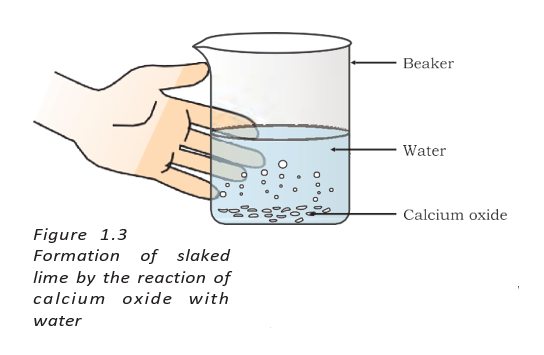
Whitewashing
- Wall coating: Slaked lime slowly reacts with carbon dioxide in air to form calcium carbonate, leaving a shiny layer after about two to three days.
- Example: Calcium carbonate is the chemical compound in marble.
Other combination reactions
- Coal burning: Carbon combines with oxygen to form carbon dioxide.
- Water formation: Hydrogen and oxygen combine to form water.
Exothermic Reactions
Decomposition Reactions
Thermal decomposition
- Definition: Decomposition brought about by heating is called thermal decomposition.
- Ferrous sulphate: Green ferrous sulphate crystals lose water on heating, then decompose; the products are ferric oxide and sulphur oxides.
- Observation: The heated solid changes colour, and sulphur dioxide and sulphur trioxide are gases.
Important thermal decomposition examples
- Limestone: Heating calcium carbonate produces quicklime, used in industries including cement manufacture.
- Lead nitrate: Heating it produces lead oxide, oxygen, and brown nitrogen dioxide fumes.
| Type | Energy source | Example | Key fact |
|---|---|---|---|
| Thermal decomposition | Heat | CaCO3 → CaO + CO2 | Used to produce quicklime from limestone. |
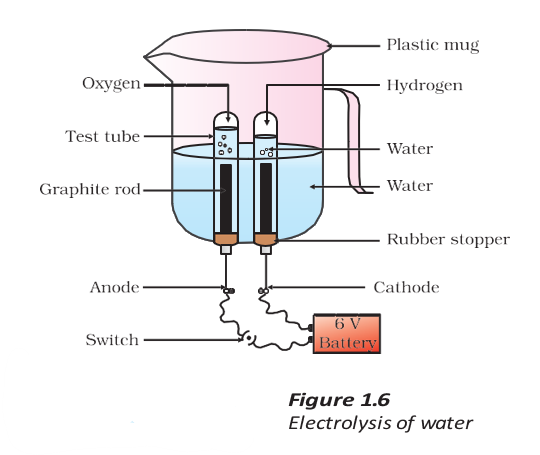
| Electrolytic decomposition | Electricity | Water → hydrogen + oxygen | Hydrogen and oxygen form in a 2:1 volume ratio. |
| Photodecomposition | Light | AgCl → Ag + Cl2 | Silver chloride changes from white to grey. |
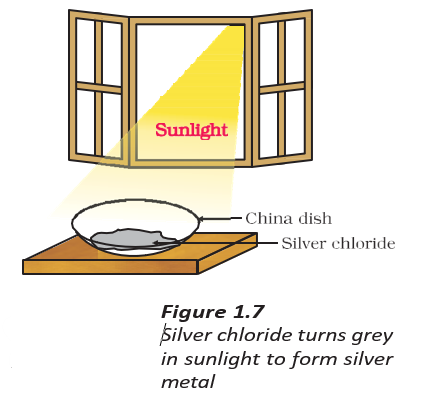
Photodecomposition
- Silver chloride: Sunlight decomposes white silver chloride; grey silver metal forms.
- Silver bromide: It decomposes similarly in sunlight.
- Use: These light-sensitive reactions are used in black-and-white photography.
Endothermic Reactions
Do not confuse reaction pattern with heat effect: combination/decomposition describe how reactants form products, while exothermic/endothermic describe energy released or absorbed.
What is the difference between a combination and a decomposition reaction?
Why does silver chloride turn grey in sunlight, and where is this reaction used?
Quick recap
- Combination reactions form a single product from two or more reactants.
- Quicklime plus water forms slaked lime and releases heat; slaked lime forms CaCO3 on whitewashed walls.
- Exothermic reactions release heat; respiration releases energy as glucose reacts with oxygen.
- Decomposition reactions split one reactant into simpler products using energy.
- Heating causes thermal decomposition; electricity decomposes water; sunlight decomposes silver halides.
- Decomposition absorbs energy and is therefore endothermic.
Displacement Reaction
Displacement Reaction
Displacement reaction — A reaction in which a more reactive element removes a less reactive element from its compound.
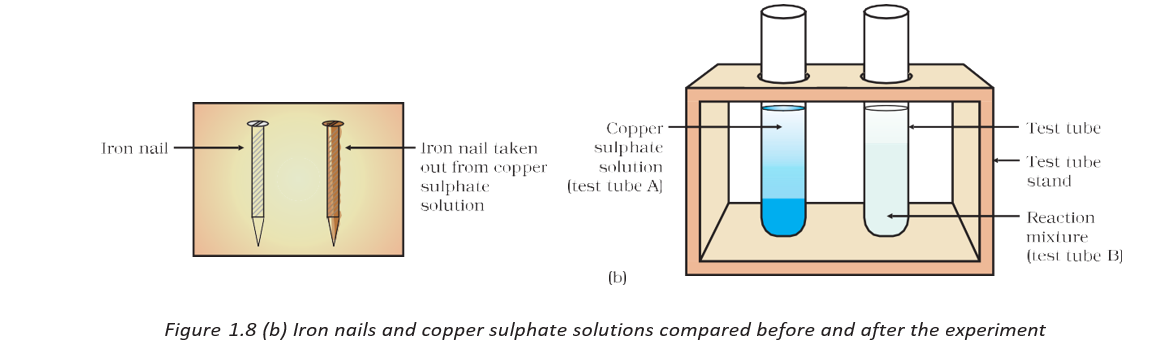
- Iron and copper sulphate: Iron displaces copper, forming iron sulphate and copper metal.
- Observations: A brown copper coating forms on the iron nail, while the blue copper sulphate solution fades as iron sulphate forms.
- Reactivity: Zinc and lead are more reactive than copper, so they can displace copper from its compounds.
Double Displacement and Precipitation
Double displacement reaction — A reaction in which ions are exchanged between two reactants to form new compounds.
Precipitate — An insoluble solid formed in a solution during a chemical reaction.
- Precipitation reaction: Any reaction that produces a precipitate.
- Barium sulphate reaction: The ions $\ce{Ba^{2+}}$ and $\ce{SO4^{2-}}$ form white, insoluble $\ce{BaSO4}$; sodium chloride remains dissolved.
Oxidation and Reduction
Oxidation — A substance is oxidised when it gains oxygen or loses hydrogen.
Reduction — A substance is reduced when it loses oxygen or gains hydrogen.
Redox reaction — A reaction in which oxidation and reduction occur together.
- Copper oxide and hydrogen: Black copper(II) oxide loses oxygen and is reduced to brown copper; hydrogen gains oxygen and is oxidised to water.
- Copper heated in air: Copper gains oxygen to form black copper(II) oxide.
- Magnesium burning in oxygen: Magnesium is oxidised as it forms magnesium oxide.
Effects of Oxidation in Everyday Life
Corrosion
Corrosion — The gradual damage of a metal due to reactions with substances in its surroundings, such as moisture or acids.
- Iron: Rusting produces a reddish-brown coating.
- Silver: Corrosion forms a black coating.
- Copper: Corrosion forms a green coating.
- Impact: Corrosion damages cars, bridges, railings, ships and other metal objects; replacing damaged iron is costly.
Rancidity
Rancidity — The oxidation of fats and oils in food, causing unpleasant changes in smell and taste.
- Antioxidants: Added to foods containing fats and oils to slow oxidation.
- Airtight storage: Limits contact with air and slows oxidation.
- Nitrogen flushing: Chips packets are often filled with nitrogen to reduce oxidation.
How can you identify the oxidation and reduction processes in $\ce{CuO + H2 -> Cu + H2O}$?
What is the difference between displacement and double displacement reactions?
Quick recap
- A more reactive element displaces a less reactive element from its compound.
- Double displacement involves ion exchange; insoluble products are precipitates.
- Oxidation means gaining oxygen or losing hydrogen; reduction means losing oxygen or gaining hydrogen.
- Redox reactions involve oxidation and reduction at the same time.
- Corrosion is the damage of metals by their surroundings; rusting is iron corrosion.
- Oxidation of fats and oils causes rancidity; antioxidants and reduced air exposure help prevent it.
Science — ALL CHAPTERS
1
CHEMICAL REACTIONS AND EQUATIONS
2
ACIDS, BASES AND SALTS
3
METALS AND NON-METALS
4
CARBON AND ITS COMPOUNDS
5
LIFE PROCESSES
6
CONTROL AND COORDINATION
7
HOW DO ORGANISMS REPRODUCE?
8
HEREDITY
9
LIGHT – REFLECTION AND REFRACTION
10
THE HUMAN EYE AND THE COLOURFUL WORLD
11
ELECTRICITY
12
MAGNETIC EFFECTS OF ELECTRIC CURRENT
13
OUR ENVIRONMENT