CBSE EXAMINATION PAPER-2018
NEET-PHYSICS
(Solved)
General Instructions :
Read the following instructions carefully and follow them :
- This question paper contains 17 questions. All questions are compulsory.
- This question paper is divided into 1 sections.
- Section A – questions number 1 to 17 are multiple choice questions
- There is no overall choice given in the question paper. However, an internal choice has been provided in few questions.
- Use of calculator is NOT allowed.
Section A
A student measured the diameter of a small steel ball using a screw gauge of least count 0.001 cm. The main scale reading is 5 mm and zero of circular scale division coincides with 25 divisions above the reference level. If screw gauge has a zero error of –0.004 cm, the diameter of ball is
Diameter of the ball
= MSR + CSR × (least count) – zero error
= 0.5 cm + 25 × 0.001 – (–0.004)
= 0.5 + 0.025 + 0.004
= 0.529 cm
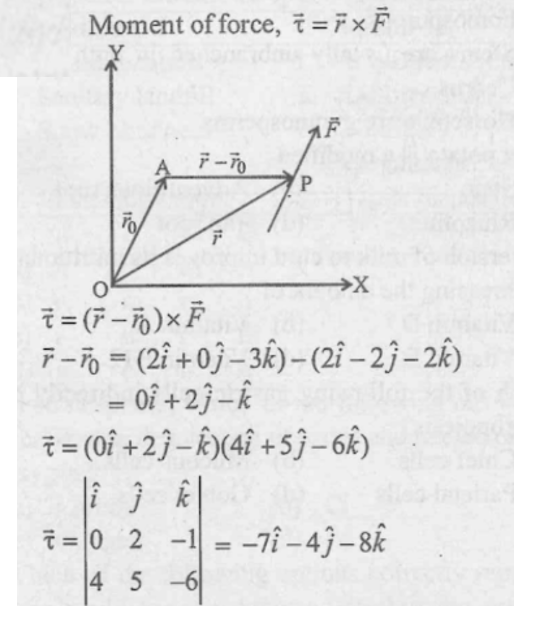
The moment of force on a force, ?⃗ = 4î+ 5ĵ – 6k̂ at (2, 0, –3), about the point
(2, –2, –2), is given by
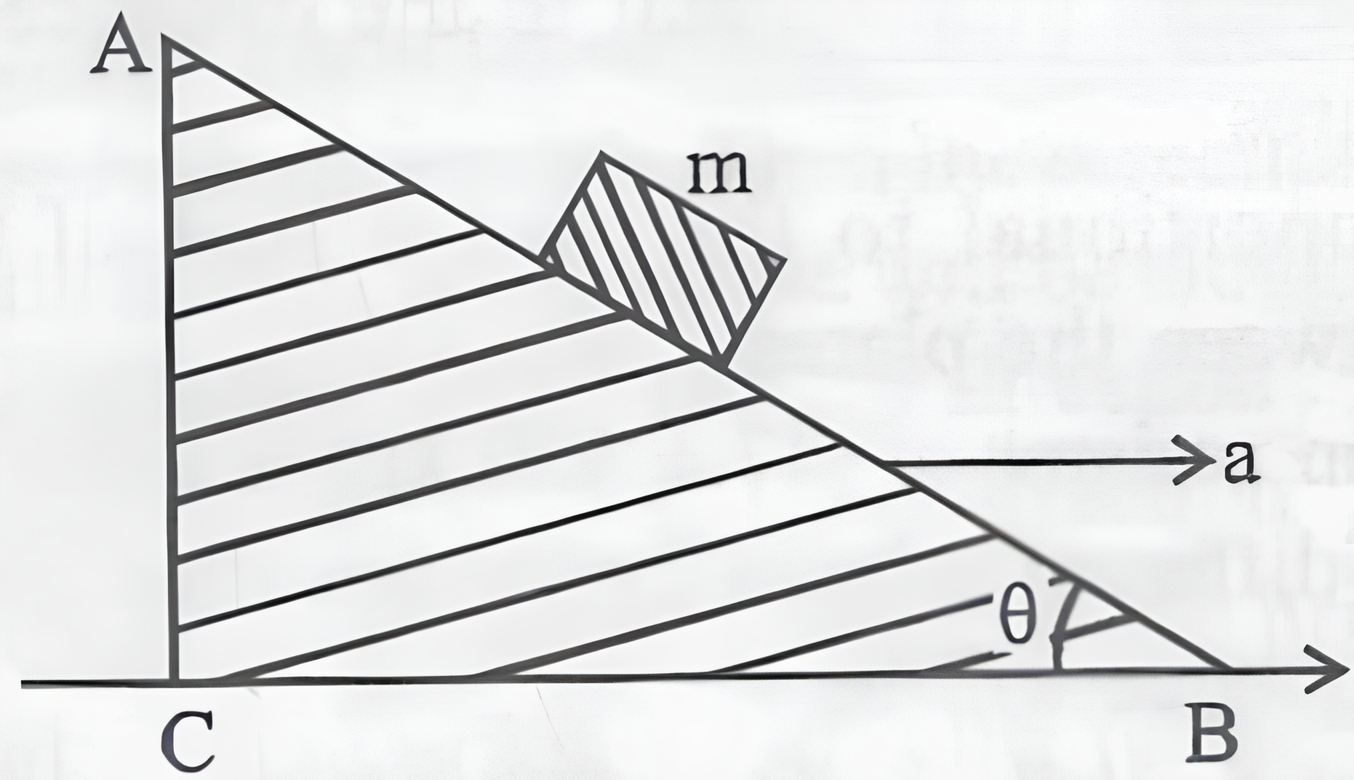
A block of mass m is placed on a smooth inclined wedge ABC of inclination θ as shown in the figure. The wedge is given an acceleration a towards the right. The relation between a and θ for the block to remain stationary on the wedge is
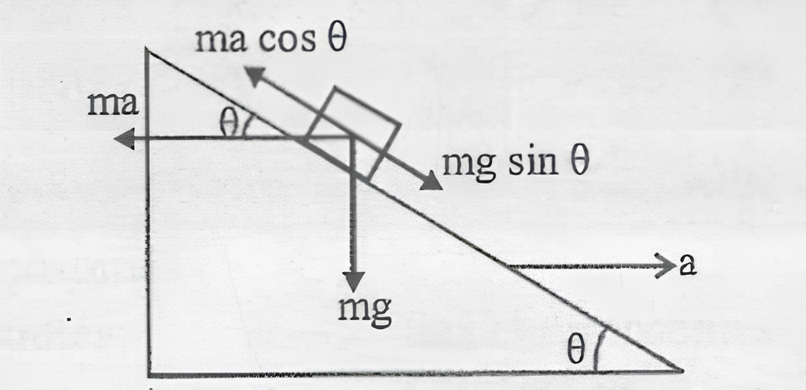
Let the mass of block is m . It will remain stationary if forces acting on it are in equilibrium, i.e. ma cos θ = mg sin θ ⇒ a = g tan θ.
Here ma = Pseudo force on block, mg = weight.
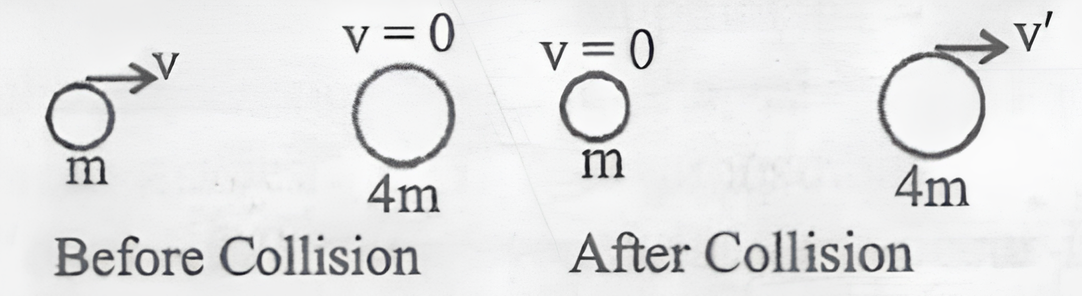
A moving block having mass m₁ collides with another stationary block having mass 4m. The lighter block comes to rest after collision. When the initial velocity of lighter block is v, then the value of coefficient of restitution (e) will be
According to law of conservation of linear momentum,
mv+4m x 0 = 4mv' + 0 ⇒ V' = v/4
Coefficient of restitution,
e = Relative velocity of separation / Relative velocity of approach v/4/v
or, e = 1/4 = 0.25
A solid sphere is rotating freely about its symmetry axis in free space. The radius of the sphere is increased keeping its mass same. Which of the following physical quantities would remain constant for the sphere?
Angular momentum, remains conserved until the torque acting on sphere remains zero. ?ₑₓ = 0
So, dL/dt = 0
i.e, angular momentum L = constant.
A solid sphere is in rolling motion. In rolling motion a body possesses translational kinetic energy (Kₜ) as well as rotational kinetic energy (Kᵣ) simultaneously. The ratio Kₜ : (Kₜ + Kᵣ)) for the sphere is
In rolling motion, rotational kinetic energy,
Kₜ = 1/2 Iv²
And, Kₜ + Kᵣ = 1/2 mv² +1 / 2 lω²
= 1/2 mv² + 1/2 (2/5 mr²)(v/r²) = 7 / 10 mv²
∴ Kₜ/(Kₜ + Kᵣ) = (1/2 mv²)/(7/10 mv²) = 5/7
Three objects A (a solid sphere), B (a thin circular disk) and C (a circular ring), each have the same mass M and radius R. They all spin with the same angular speed ω about their own symmetry axes. The amount of work (W) required to bring them to rest, would satisfy the relation
Work done required to bring them to rest ΔW = ΔKE (work-energy theorem)
ΔW = 1/2 Iω² (ΔKEᵣₒₜ = 1/2 Iω²)
or, ΔW ∝ I (for same ω)
I_ Solid sphere = 2/5 MR² , I_disk = 1/2 MR²
I_(ring) = MR² ∴ W_C > W_B > W_A
The kinetic energies of a planet in an elliptical orbit about the Sun, at positions A, B and C are K_A , K_B, and K_C respectively. AC is the major axis and SB is perpendicular to AC at the position of the Sun S as shown in the figure. Then
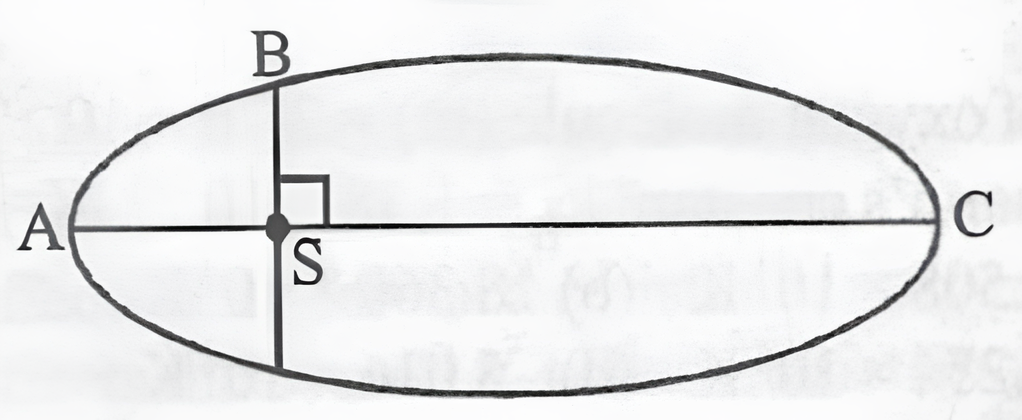
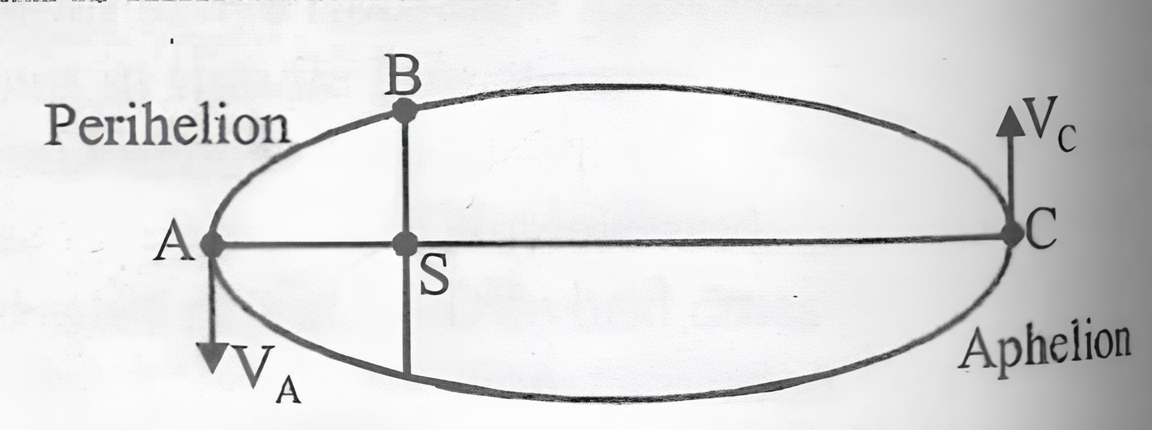
Speed of the planet will be maximum when its distance from the sun is minimum as mvr =constant.
Point A is perihelion and C is aphelion.
Clearly, V_A > V_B > V_C
So, K_A > K_B > K_C
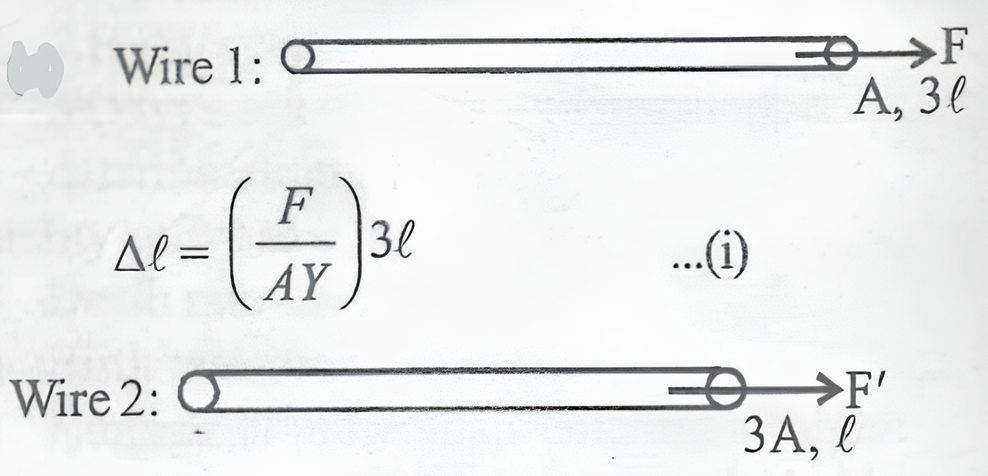
Two wires are made of the same material and have the same volume. The first wire has cross-sectional area A and the second wire has cross-sectional area 3A. If the length of the first wire is increased by Δl on applying a force F, how much force is needed to stretch the second 'wire by the same amount?
Δl = (F'/3AY)l ....(ii)
From equation (i) & (ii),
Δl =(F/AY)3l = (F' /3AY)l or, F'=9F
A small sphere of radius ‘r’ falls from rest in a viscous liquid. As a result, heat is produced due to viscous force. The rate of production of heat when the sphere attains its terminal velocity, is proportional to
Power = rate of production of heat F.V
= 6πηrV_T · V_T = 6πηrV_T²
(∵F = 6πηrV_Tr Stoke’s formula)
V_T∝ r²
∵ V_T = 2/9 ( r²(ρ − σ) / η( g)
∴ Power ∝ r⁵
The power radiated by a black body is P and it radiates maximum energy at wavelength,λ₀ If the temperature of the black body is now changed so that it radiates maximum energy at wavelength 3/4 λ₀ ,the power radiated by it becomes nP. The value of n is
From Wien’s law
λₘₐₓ T = constant
i.e., λₘₐₓ₁T₁ = λₘₐₓ₂T₂
⇒ λ₀ T = 3 λ₀/4 T
⇒ T' =4/3 T
Power radiated P ∝ T⁴
So, P₂/P₁ = n = (T'/T)⁴ = (4/3)⁴ = 256/81
The volume (V) of a monatomic gas varies with its temperature (T), as shown in the graph. The ratio of work done by the gas, to the heat absorbed by it, when it undergoes a change from state A to state B, is
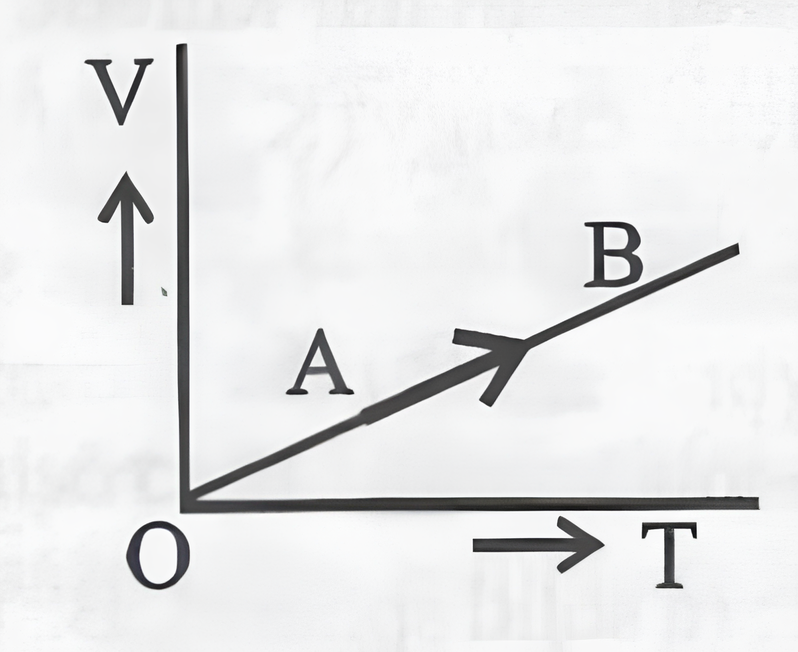
Gas is monatomic, so Cₚ = 5/2 R
Given process isobaric
∴ dQ = nCₚ dT
⇒ dQ = (5/2 R) dT
dW = PdV = nRdT
∴ Required ratio = dW/dQ = nRdT / n(5/2 R)dT = 2/5
The efficiency of an ideal heat engine working between the freezing point and boiling point of water, is
Efficiency of ideal heat engine, η = (1 − T₂/T₁)
Sink temperature, T₂ = 100°C = 100 + 273 = 373 K
Source temperature, T₁ = 0°C + 0° + 273 = 273 K
Percentage efficiency, % η = (1 − T₂/T₁) × 100
=(1- 273/373)x100 = (100/373) × 100 = 26.8%
At what temperature will the rms speed of oxygen molecules become just sufficient for escaping from the Earth’s atmosphere?
(Given:
Mass of oxygen molecule (m)=2.76 x 10⁻²⁶kg
Boltzmann’s constant k_B = 1.38 x 10⁻²³ JK⁻¹)
Let at temperature T rms speed of oxygen molecules become just sufficient for escaping from the Earth’s atmosphere.
V_escape =11200m/s
Also, Vᵣₘₛ = V_ escape = √(3k_BT/m₀₂) = 11200 m/s
Putting value of k_B and mO₂, we get,
T = 8.360 × 10⁴ K
A pendulum is hung from the roof of a sufficiently high building and is moving freely to and fro like a simple harmonic oscillator. The acceleration of the bob of the pendulum is 20 m/s² at a distance of 5 m from the mean position. The time period of oscillation is
From equation, acceleration, a = 20 m/s², and displacement, y = 5m |a| = ω²y
⇒20= ω²(5)
⇒ ω = 2 rad / s
Time period of pendulum,
T = 2π/ω = 2π/2 = πs
A tuning fork is used to produce resonance in a glass tube. The length of the air column in this tube can be adjusted by a variable piston. At room temperature of 27°C two successive resonances are produced at 20 cm and 73 cm of column length. If the frequency of the tuning fork 320 Hz, the velocity of sound in air at 27°C is
Two successive resonance are produced at 20 cm and 73 cm of column length
∴ λ/2 = (73 − 20) × 10⁻² m
⇒ λ = 2 × (73 − 20) × 10⁻²
Velocity of sound, ν = nλ
= 2 × 320 [73 − 20] × 10⁻² = 339.2 m/s⁻¹
The fundamental frequency in an open organ pipe is equal to the third harmonic of a closed organ pipe. If the length of the closed organ pipe is 20 cm, the length of the open organ pipe is
For closed organ pipe, third harmonic
n = (2N − 1)V / 4ℓ= 3V/4ℓ (∵ N = 2)
For open organ pipe, fundamental frequency
n = NV / 2ℓ′ =V/2ℓ (∵ N = 1)
According to question, 3V/4ℓ = V/2ℓ′
⇒ ℓ = 4ℓ′/3 × 2 = 2ℓ /3 = 2 x 20 / 3 =13.33cm